What is informationsecurity?
• Information security protects all types of data (not just personal)
from unauthorized access, breaches, or loss.
• Examples:
Encryption of Bank Transactions (Data remains unreadable if
intercepted)
Firewalls & Antivirus (Prevent cyberattacks)
Access Control in Companies (Employees can only access relevant
files)
Confidentiality?
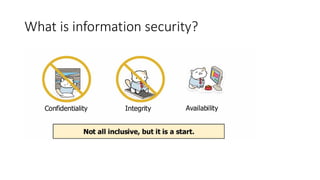
• Data beingstored is safe from unauthorized access & use
• This ensures confidentiality, meaning that only the intended recipient
can access the message, protecting it from eavesdropping, hackers, or
even the service provider itself.
• A real-world example of confidentiality in information security is the
way end-to-end encryption (E2EE) works in messaging apps like
WhatsApp, Signal, or Telegram (secret chats).
5.
Integrity
• Data isreliable and accurate. i.e., you get the “right” data
• Example : Healthcare: Integrity in Electronic Health Records (EHRs) ,
windows updates
What is privacy?
•Privacy in information security refers to protecting personal data
from unauthorized access, collection, or misuse while ensuring users
have control over their information.
• Example:
• GDPR Cookie Consent (Websites must ask before tracking users)
Private Mode in Browsers (No history or tracking)
Medical Records Access (Only authorized doctors can view patient
data)
8.
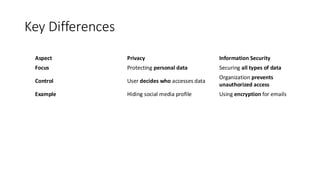
Key Differences
Aspect PrivacyInformation Security
Focus Protecting personal data Securing all types of data
Control User decides who accesses data
Organization prevents
unauthorized access
Example Hiding social media profile Using encryption for emails
9.
• Three KeyAssets to Protect:
Hardware (Physical devices like servers, computers, mobile
phones)
Software (Applications, operating systems, security tools)
Data (User information, business records, encrypted files)
10.
Hardware Security
• Whatis Hardware Security?
• Protecting physical devices from theft, damage, or tampering.
• Key Threats:
Device Theft (Laptops, USB drives, smartphones)
Unauthorized Access (Unprotected servers, unencrypted drives)
Hardware Failure (Data loss due to malfunction)
• Security Measures:
Encryption (Encrypt hard drives to prevent unauthorized access)
Access Controls (Use biometric authentication, smart cards)
Physical Security (Lock servers, use CCTV & access logs)
What is DataSecurity?
• What is Data Security?
• Protecting digital information from unauthorized access and
corruption.
• Key Threats:
Data Breaches (Hackers stealing sensitive data)
Ransomware Attacks (Encrypting data for ransom)
Unauthorized Data Sharing (Leaking private information)
• Security Measures:
Data Encryption (Protect files at rest and in transit)
Access Control (Only authorized users can view/edit data)
Regular Backups (Ensure data recovery in case of attacks)
13.
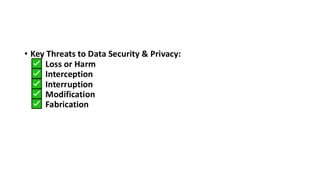
• Key Threatsto Data Security & Privacy:
Loss or Harm
Interception
Interruption
Modification
Fabrication
14.
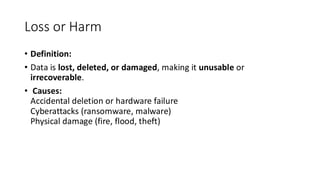
Loss or Harm
•Definition:
• Data is lost, deleted, or damaged, making it unusable or
irrecoverable.
• Causes:
Accidental deletion or hardware failure
Cyberattacks (ransomware, malware)
Physical damage (fire, flood, theft)
15.
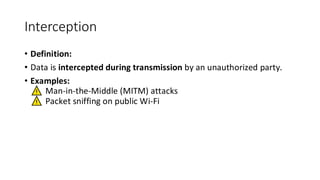
Interception
• Definition:
• Datais intercepted during transmission by an unauthorized party.
• Examples:
Man-in-the-Middle (MITM) attacks
Packet sniffing on public Wi-Fi
16.
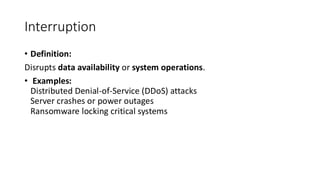
Interruption
• Definition:
Disrupts dataavailability or system operations.
• Examples:
Distributed Denial-of-Service (DDoS) attacks
Server crashes or power outages
Ransomware locking critical systems
17.
Modification
• Definition:
• Unauthorizedalteration of data, affecting its integrity.
• Examples:
Database tampering
Malware modifying financial transactions
Unauthorized edits in Electronic Health Records (EHRs)
18.
Fabrication
• Definition:
• Fakeor unauthorized data is created, misleading systems or users.
• Examples:
Fake accounts in banking apps
Phishing emails with malicious links
Spoofed transactions in financial systems