Chapter 5
Reproductive
Health
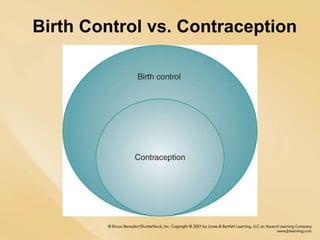
Birth Control vs. Contraception
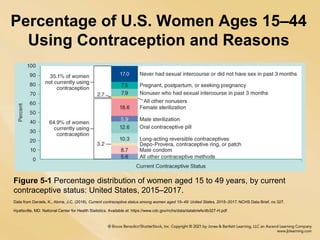
Percentage of U.S. Women Ages 15–44
Using Contraception and Reasons
Figure 5-1 Percentage distribution of women aged 15 to 49 years, by current
contraceptive status: United States, 2015–2017.
Data from Daniels, K., Abma, J.C. (2018). Current contraceptive status among women aged 15–49: United States, 2015–2017. NCHS Data Brief, no 327.
Hyattsville, MD: National Center for Health Statistics. Available at: https://www.cdc.gov/nchs/data/databriefs/db327-H.pdf
Legal Perspectives of Birth
Control
• Griswold v. Connecticut (1965)
• Mandated coverage for contraception for
federal employees via an act of Congress
(1998)
• All new health insurance plans must cover all
FDA-approved methods of birth control,
sterilization, and related education and
counseling without cost sharing (2010).
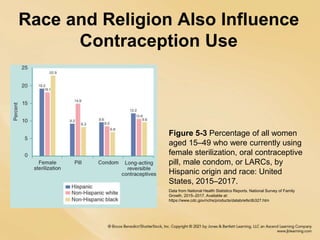
Race and Religion Also Influence
Contraception Use
Figure 5-3 Percentage of all women
aged 15–49 who were currently using
female sterilization, oral contraceptive
pill, male condom, or LARCs, by
Hispanic origin and race: United
States, 2015–2017.
Data from National Health Statistics Reports. National Survey of Family
Growth, 2015–2017. Available at:
https://www.cdc.gov/nchs/products/databriefs/db327.htm
Fertility Awareness Methods
“Free, no equipment necessary, but not
reliable”
Calendar method
• Avoidance of intercourse during fertile time of month by
calculating time of ovulation
Basal body temperature
• Fertility cycle related to changes in basal body
temperature
Cervical mucus or ovulation method
• Fertility cycle related to variations in type of cervical
mucus
Pros vs. Cons of Fertility
Awareness Methods
Pros Cons
❑ No side effects
❑ Used by anyone
❑ Cost-effective
❑ Limited effectiveness
❑ Need to abstain from
sexual intercourse
certain days/month
❑ No protection from
STIs
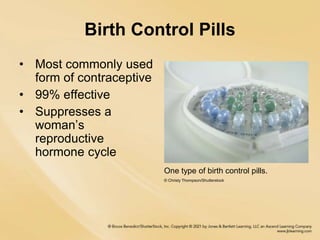
Birth Control Pills
• Most commonly used
form of contraceptive
• 99% effective
• Suppresses a
woman’s
reproductive
hormone cycle
One type of birth control pills.
© Christy Thompson/Shutterstock
Oral Contraceptives
Used by 16% of women aged 15–44 years
Pros Cons
❑ Lighter and less painful
periods
❑ Reduced PMS
symptoms
❑ Improved skin
❑ Protection against
ovarian and endometrial
cancers, ovarian cysts,
benign breast disease,
and PID
❑ Mood changes
❑ Spotting
❑ Weight changes
❑ Drug interactions
❑ Decreased libido
❑ Headaches
❑ Fluid retention
❑ Health risks for some
women
Hormone Delivery Methods
Depo-Provera
• Injectable progestin every 3 months
Contraceptive patch (Xulane)
• Patch worn on skin for 1-week intervals; fourth week is
patch-free
NuvaRing
• Flexible, plastic ring inserted into the upper vagina and
worn for 3 weeks; removed during week of
menstruation
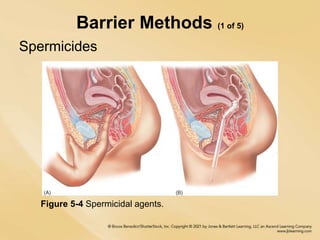
Barrier Methods (1 of 5)
Spermicides
Figure 5-4 Spermicidal agents.
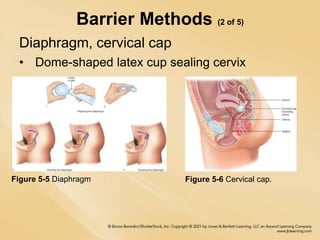
Barrier Methods (2 of 5)
Diaphragm, cervical cap
• Dome-shaped latex cup sealing cervix
Figure 5-5 Diaphragm Figure 5-6 Cervical cap.
Barrier Methods (3 of 5)
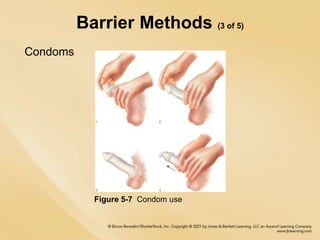
Condoms
Figure 5-7 Condom use
Barrier Methods (4 of 5)
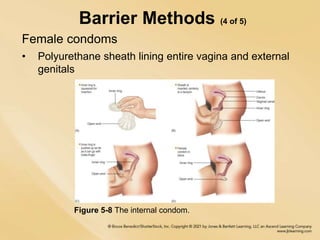
Female condoms
• Polyurethane sheath lining entire vagina and external
genitals
Figure 5-8 The internal condom.
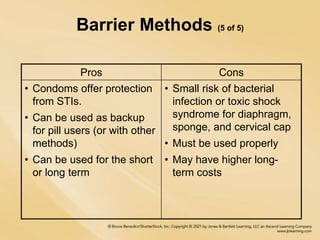
Barrier Methods (5 of 5)
Pros Cons
• Condoms offer protection
from STIs.
• Can be used as backup
for pill users (or with other
methods)
• Can be used for the short
or long term
• Small risk of bacterial
infection or toxic shock
syndrome for diaphragm,
sponge, and cervical cap
• Must be used properly
• May have higher long-
term costs
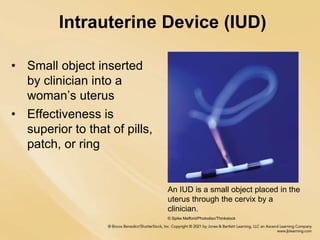
Intrauterine Device (IUD)
• Small object inserted
by clinician into a
woman’s uterus
• Effectiveness is
superior to that of pills,
patch, or ring
An IUD is a small object placed in the
uterus through the cervix by a
clinician.
© Spike Mafford/Photodisc/Thinkstock
Permanent Methods
Female sterilization
• Tubal ligation = fallopian tubes cut and tied
– Laparoscopic sterilization
– Minilaparotomy
– Essure
Male sterilization
• Vasectomy = vas deferens cut and tied
Other Forms of Contraception
Abstinence
• No penis-in-vagina intercourse
Withdrawal
• Coitus interruptus
Breastfeeding
• Lactational amenorrhea method (LAM)
Emergency Contraception (EC)
• NOT the same as RU-486, otherwise known as
“the abortion pill”
• Use of high-dose birth control pills taken within
72 hours of unprotected sex
• Plan B = progestin-only form of emergency
contraception
• ella = another form of emergency contraception
available by prescription
Failure Rates
A failure rate is the chance that the average
couple using a given birth control method will
become pregnant in a given year.
• Failure rates can be either for “perfect use” (ideal
conditions) or “actual use” (failure rate in the real world)
• Failure rates range from less than 1% to 30%.
• Condoms, sponges, and diaphragms have the largest
difference between these rates.
Contraceptive Failure
• High rates of effectiveness—oral
contraceptives, hormone injectables and
implants, IUDs, condoms, vaginal hormonal
ring, hormone patch, sterilization
• Lower rates of effectiveness—diaphragms,
cervical caps, sponges, spermicidal agents,
fertility awareness methods, rhythm method,
withdrawal
Handling an Unplanned
Pregnancy
• Adoption—can be “open” or “closed”; private
or public
• Abortion
Abortion
A controversial issue of debate or a very common
medical procedure?
…both, actually
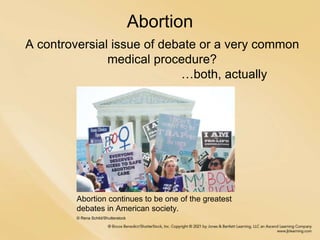
Abortion continues to be one of the greatest
debates in American society.
© Rena Schild/Shutterstock
Perspectives on Abortion (1 of 2)
Why do women choose abortions?
• Pregnancy would reduce a woman’s ability to work,
finish school, or care for others.
• Cannot afford a(nother) baby
• Relationship issues or not wanting to be a single
mother
• Completed childbearing
• Not ready for a(nother) child
• Did not want people to know she was pregnant or had
sex
Perspectives on Abortion (2 of 2)
Characteristics of U.S. abortion patients
• More than half are in their 20s; women ages 20 to 24
have the highest rates.
• 36% are non-Hispanic White, 30% are non-Hispanic
Black, 25% are Hispanic, and 9% are other races.
• Six in ten already have one child.
• Three in ten have two or more children.
• Women in poverty have more abortions than wealthy
women.
Abortion Procedures
Surgical abortion
• Vacuum curettage
• Dilation and curettage (D&C)
• Dilation and evacuation (D&E)
Medical abortion (“abortion with pills”)
• Mifepristone, misoprostol (RU-486)
Global Perspectives
Motherhood continues to be a major risk to life and
health in the developing world (most of Asia, Africa,
and Latin America)
Informed Decision Making
If you want to prevent pregnancy
• Review your and your partner’s needs
• Personal medical history
• Review failure rates
• Risks and benefits of method
• Reevaluate periodically
Discussion
• Where can people respectfully agree/disagree
about when and how women should be able to
end their pregnancies?
• How should unsafe abortion be addressed as a
public health issue?
• What are some ways to promote public health
and reduce the number of abortions?

Chapter pp 5.pptx

  • 1.
  • 2.
    Birth Control vs.Contraception
  • 3.
    Percentage of U.S.Women Ages 15–44 Using Contraception and Reasons Figure 5-1 Percentage distribution of women aged 15 to 49 years, by current contraceptive status: United States, 2015–2017. Data from Daniels, K., Abma, J.C. (2018). Current contraceptive status among women aged 15–49: United States, 2015–2017. NCHS Data Brief, no 327. Hyattsville, MD: National Center for Health Statistics. Available at: https://www.cdc.gov/nchs/data/databriefs/db327-H.pdf
  • 4.
    Legal Perspectives ofBirth Control • Griswold v. Connecticut (1965) • Mandated coverage for contraception for federal employees via an act of Congress (1998) • All new health insurance plans must cover all FDA-approved methods of birth control, sterilization, and related education and counseling without cost sharing (2010).
  • 5.
    Race and ReligionAlso Influence Contraception Use Figure 5-3 Percentage of all women aged 15–49 who were currently using female sterilization, oral contraceptive pill, male condom, or LARCs, by Hispanic origin and race: United States, 2015–2017. Data from National Health Statistics Reports. National Survey of Family Growth, 2015–2017. Available at: https://www.cdc.gov/nchs/products/databriefs/db327.htm
  • 6.
    Fertility Awareness Methods “Free,no equipment necessary, but not reliable” Calendar method • Avoidance of intercourse during fertile time of month by calculating time of ovulation Basal body temperature • Fertility cycle related to changes in basal body temperature Cervical mucus or ovulation method • Fertility cycle related to variations in type of cervical mucus
  • 7.
    Pros vs. Consof Fertility Awareness Methods Pros Cons ❑ No side effects ❑ Used by anyone ❑ Cost-effective ❑ Limited effectiveness ❑ Need to abstain from sexual intercourse certain days/month ❑ No protection from STIs
  • 8.
    Birth Control Pills •Most commonly used form of contraceptive • 99% effective • Suppresses a woman’s reproductive hormone cycle One type of birth control pills. © Christy Thompson/Shutterstock
  • 9.
    Oral Contraceptives Used by16% of women aged 15–44 years Pros Cons ❑ Lighter and less painful periods ❑ Reduced PMS symptoms ❑ Improved skin ❑ Protection against ovarian and endometrial cancers, ovarian cysts, benign breast disease, and PID ❑ Mood changes ❑ Spotting ❑ Weight changes ❑ Drug interactions ❑ Decreased libido ❑ Headaches ❑ Fluid retention ❑ Health risks for some women
  • 10.
    Hormone Delivery Methods Depo-Provera •Injectable progestin every 3 months Contraceptive patch (Xulane) • Patch worn on skin for 1-week intervals; fourth week is patch-free NuvaRing • Flexible, plastic ring inserted into the upper vagina and worn for 3 weeks; removed during week of menstruation
  • 11.
    Barrier Methods (1of 5) Spermicides Figure 5-4 Spermicidal agents.
  • 12.
    Barrier Methods (2of 5) Diaphragm, cervical cap • Dome-shaped latex cup sealing cervix Figure 5-5 Diaphragm Figure 5-6 Cervical cap.
  • 13.
    Barrier Methods (3of 5) Condoms Figure 5-7 Condom use
  • 14.
    Barrier Methods (4of 5) Female condoms • Polyurethane sheath lining entire vagina and external genitals Figure 5-8 The internal condom.
  • 15.
    Barrier Methods (5of 5) Pros Cons • Condoms offer protection from STIs. • Can be used as backup for pill users (or with other methods) • Can be used for the short or long term • Small risk of bacterial infection or toxic shock syndrome for diaphragm, sponge, and cervical cap • Must be used properly • May have higher long- term costs
  • 16.
    Intrauterine Device (IUD) •Small object inserted by clinician into a woman’s uterus • Effectiveness is superior to that of pills, patch, or ring An IUD is a small object placed in the uterus through the cervix by a clinician. © Spike Mafford/Photodisc/Thinkstock
  • 17.
    Permanent Methods Female sterilization •Tubal ligation = fallopian tubes cut and tied – Laparoscopic sterilization – Minilaparotomy – Essure Male sterilization • Vasectomy = vas deferens cut and tied
  • 18.
    Other Forms ofContraception Abstinence • No penis-in-vagina intercourse Withdrawal • Coitus interruptus Breastfeeding • Lactational amenorrhea method (LAM)
  • 19.
    Emergency Contraception (EC) •NOT the same as RU-486, otherwise known as “the abortion pill” • Use of high-dose birth control pills taken within 72 hours of unprotected sex • Plan B = progestin-only form of emergency contraception • ella = another form of emergency contraception available by prescription
  • 20.
    Failure Rates A failurerate is the chance that the average couple using a given birth control method will become pregnant in a given year. • Failure rates can be either for “perfect use” (ideal conditions) or “actual use” (failure rate in the real world) • Failure rates range from less than 1% to 30%. • Condoms, sponges, and diaphragms have the largest difference between these rates.
  • 21.
    Contraceptive Failure • Highrates of effectiveness—oral contraceptives, hormone injectables and implants, IUDs, condoms, vaginal hormonal ring, hormone patch, sterilization • Lower rates of effectiveness—diaphragms, cervical caps, sponges, spermicidal agents, fertility awareness methods, rhythm method, withdrawal
  • 22.
    Handling an Unplanned Pregnancy •Adoption—can be “open” or “closed”; private or public • Abortion
  • 23.
    Abortion A controversial issueof debate or a very common medical procedure? …both, actually Abortion continues to be one of the greatest debates in American society. © Rena Schild/Shutterstock
  • 24.
    Perspectives on Abortion(1 of 2) Why do women choose abortions? • Pregnancy would reduce a woman’s ability to work, finish school, or care for others. • Cannot afford a(nother) baby • Relationship issues or not wanting to be a single mother • Completed childbearing • Not ready for a(nother) child • Did not want people to know she was pregnant or had sex
  • 25.
    Perspectives on Abortion(2 of 2) Characteristics of U.S. abortion patients • More than half are in their 20s; women ages 20 to 24 have the highest rates. • 36% are non-Hispanic White, 30% are non-Hispanic Black, 25% are Hispanic, and 9% are other races. • Six in ten already have one child. • Three in ten have two or more children. • Women in poverty have more abortions than wealthy women.
  • 26.
    Abortion Procedures Surgical abortion •Vacuum curettage • Dilation and curettage (D&C) • Dilation and evacuation (D&E) Medical abortion (“abortion with pills”) • Mifepristone, misoprostol (RU-486)
  • 27.
    Global Perspectives Motherhood continuesto be a major risk to life and health in the developing world (most of Asia, Africa, and Latin America)
  • 28.
    Informed Decision Making Ifyou want to prevent pregnancy • Review your and your partner’s needs • Personal medical history • Review failure rates • Risks and benefits of method • Reevaluate periodically
  • 29.
    Discussion • Where canpeople respectfully agree/disagree about when and how women should be able to end their pregnancies? • How should unsafe abortion be addressed as a public health issue? • What are some ways to promote public health and reduce the number of abortions?