
Distributed Systems
Chapter 5 Synchronization
Synchnonization in Distributed Systems
Time in DS
• Time is an interesting and Important issue in DS
– Ex. At what time of day a particular event occurred at a particular
computer … Consistency (use of timestamp for serialization), e-
commerce, authentication etc.
• Algorithms that depend upon clock synchronization
have been developed for several problems.
• Due to loose synchrony, the notion of physical time is
problematic in DS
– There is no absolute physical “global time” in DS
Clocks
– How time is really measured?
» Earlier: Solar day, solar second, mean solar second
• Solar day: time between two consequtive transits
of the sun
• Solar second: 1/86400 of a solar day
• Mean solar day: average length of a solar day
• Problem: solar day gets longer because of
slowdown of earth rotation due to friction (300
million years ago there were 400 days per year)
Physical Clocks
• International Atomic Time (TAI): number of
ticks of Cesium 133 atom since 1/1/58
(atomic second)
• Atom clock: one second defined as (since
1967) 9,192,631,770 transitions of the atom
Cesium 133
Physical Clocks
• Because of slowdown of earth, leap seconds have
to be introduced
• Correction of TAI is called Universal Coordinated
Time (UTC): 30 leap seconds introduced so far
• Network Time Protocol (NTP) can synchronize
globally with an accuracy of up to 50 msec
Physical Clocks
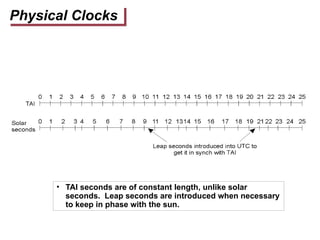
• TAI seconds are of constant length, unlike solar
seconds. Leap seconds are introduced when necessary
to keep in phase with the sun.
Clocks
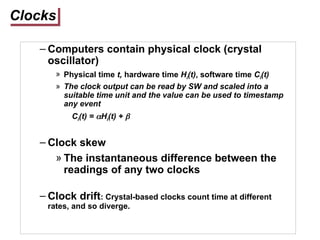
– Computers contain physical clock (crystal
oscillator)
» Physical time t, hardware time Hi(t), software time Ci(t)
» The clock output can be read by SW and scaled into a
suitable time unit and the value can be used to timestamp
any event
Ci(t) = Hi(t) + 
– Clock skew
» The instantaneous difference between the
readings of any two clocks
– Clock drift: Crystal-based clocks count time at different
rates, and so diverge.
Why
synchronization?
• You want to catch the 5 pm bus at the Harar stop,
but your watch is off by 15 minutes
– What if your watch is Late by 15 minutes?
– What if your watch is Fast by 15 minutes?
• Synchronization is required for
– Correctness
– Fairness
Why synchronization?
• Airline reservation system
• Server A receives a client request to purchase last
ticket on flight ABC 123.
• Server A timestamps purchase using local clock
9h:15m:32.45s, and logs it. Replies ok to client.
• That was the last seat. Server A sends message to
Server B saying “flight full.”
• B enters “Flight ABC 123 full” + local clock value
(which reads 9h:10m:10.11s) into its log.
• Server C queries A’s and B’s logs. Is confused
that a client purchased a ticket after the flight
became full.
– May execute incorrect or unfair actions.
Clock synchronization
• UTC signals are synchronized and broadcast
regularly from land-based radio stations and
satellites covering many parts of the world
– E.g. in the US the radio station WWV broadcasts time signals on
several short-wave frequencies
– Satellite sources include Geo-stationary Operational
Environmental Satellites (GOES) and the GPS
Clock synchronization
– Radio waves travel at near the speed of light. The propagation
delay can be accounted for if the exact speed and the distance
from the source are known
– Unfortunately, the propagation speed varies with atmospheric
conditions – leading to inaccuracy
– Accuracy of a received signal is a function of both the accuracy
of the source and its distance from the source through the
atmosphere
Clock Synchronization Algorithms
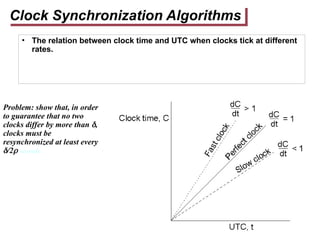
• The relation between clock time and UTC when clocks tick at different
rates.
Problem: show that, in order
to guarantee that no two
clocks differ by more than ,
clocks must be
resynchronized at least every
/2 seconds.
Clock Synchronization Algorithms
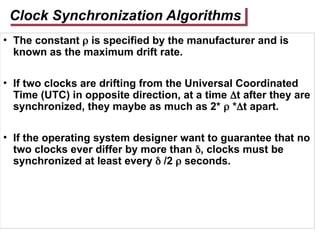
• The constant  is specified by the manufacturer and is
known as the maximum drift rate.
• If two clocks are drifting from the Universal Coordinated
Time (UTC) in opposite direction, at a time t after they are
synchronized, they maybe as much as 2*  *t apart.
• If the operating system designer want to guarantee that no
two clocks ever differ by more than , clocks must be
synchronized at least every  /2  seconds.
Clock synchronization
–Remember the definition of
synchronous distributed system?
» Known bounds for message delay, clock
drift rate and execution time.
• Clock synchronization is easy in this
case
» In practice most DS are asynchronous.
• Cristian’s Algorithm
• The Berkeley Algorithm
Clock synchronization in a synchronous system
• Consider internal synch between two procs in a
synch DS
• P sends time t on its local clock to Q in a msg m
• In principle, Q could set its clock to the time t + Ttrans,
where Ttrans is the time taken to transmit m between
them
• The two processes would then agree (internal synch)
Clock synchronization in a synchronous system
• Unfortunately, Ttrans is subject to variation and
is unknown
– All processes are competing for resources with P and Q
and other messages are competing with m for the network
– But there is always a minimum transmission time min that
would be obtained if no other processes executed and no
other network traffic existed
– min can be measured or conservatively estimated
Clock synchronization in a synchronous system
• In synch system, by definition, there is also an upper
bound max on the time taken to transmit any
message
• Let the uncertainty in the msg transmission time be u,
so that u = (max – min)
– If Q sets its clock to be (t + min), then clock skew may be as much
as u (since the message may in fact have taken time max to arrive).
– If Q sets it to (t + max), the skew may again be as large as u.
– If, however, Q sets it clock to (t + (max + min)/2), then the skew is at
most u/2.
– In general, for a synch system, the optimum bound that can be
achieved on clock skew when synchronizing N clocks is u(1-1/N)
• For an asynch system Ttrans = min + x, where x >=0
Cristian’s Algorithm (Accuracy)
• Assumption
– Request & reply via same network
– The value of minimum transmission time min is known or
conservatively estimated.
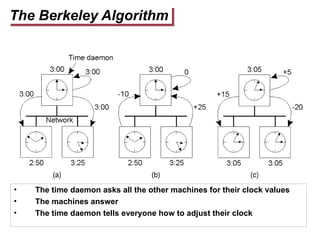
The Berkeley Algorithm (internal synchronization)
• A coordinator (time server): master
– Periodically the master polls the time of each
client (slave) whose clocks are to be
synchronized.
– Based on the answer (by observing the RTT as in
Cristian’s algorithm), it computes the average
(including its own clock value) and broadcasts the
new time.
• This method is suitable for a system in which no
machine has a WWV receiver getting the UTC.
• The time daemon’s time must be set manually by the
operator periodically.
The Berkeley Algorithm
• The balance of probabilities is that the average
cancels out the individual clock’s tendencies to
run fast or slow
• The accuracy depends upon a nominal maximum
RTT between the master and the slaves
• The master eliminates any occasional readings
associated with larger times than this maximum
The Berkeley Algorithm
– Instead of sending the updated current time
back to the comps – which will introduce further
uncertainty due to message transmission time –
the master send the amount by which each
individual slave’s clock requires adjustment (+
or - )
– The algorithm eliminates readings from faulty
clocks (since these could have significant
adverse effects if an ordinary average was
taken) – a subset of clock is chosen that do not
differ by more than a specified amount and then
the average is taken.
The Berkeley Algorithm
• The time daemon asks all the other machines for their clock values
• The machines answer
• The time daemon tells everyone how to adjust their clock
Averaging Algorithms
• Both Cristian’s and Berkeley’s methods are highly
centralized, with the usual disadvantages - single point
of failure, congestion around the server, … etc.
• One class of decentralized clock synchronization
algorithms works by dividing time into fixed-length re-
synchronization intervals.
• The ith
interval starts at T0 + iR and runs until T0 + (i+1)R,
where T0 is an agreed upon moment in the past, and R
is a system parameter.
25

Chapter Five Synchonization distributed Sytem.ppt

  • 1.
  • 2.
  • 3.
    Time in DS •Time is an interesting and Important issue in DS – Ex. At what time of day a particular event occurred at a particular computer … Consistency (use of timestamp for serialization), e- commerce, authentication etc. • Algorithms that depend upon clock synchronization have been developed for several problems. • Due to loose synchrony, the notion of physical time is problematic in DS – There is no absolute physical “global time” in DS
  • 4.
    Clocks – How timeis really measured? » Earlier: Solar day, solar second, mean solar second • Solar day: time between two consequtive transits of the sun • Solar second: 1/86400 of a solar day • Mean solar day: average length of a solar day • Problem: solar day gets longer because of slowdown of earth rotation due to friction (300 million years ago there were 400 days per year)
  • 5.
    Physical Clocks • InternationalAtomic Time (TAI): number of ticks of Cesium 133 atom since 1/1/58 (atomic second) • Atom clock: one second defined as (since 1967) 9,192,631,770 transitions of the atom Cesium 133
  • 6.
    Physical Clocks • Becauseof slowdown of earth, leap seconds have to be introduced • Correction of TAI is called Universal Coordinated Time (UTC): 30 leap seconds introduced so far • Network Time Protocol (NTP) can synchronize globally with an accuracy of up to 50 msec
  • 7.
    Physical Clocks • TAIseconds are of constant length, unlike solar seconds. Leap seconds are introduced when necessary to keep in phase with the sun.
  • 8.
    Clocks – Computers containphysical clock (crystal oscillator) » Physical time t, hardware time Hi(t), software time Ci(t) » The clock output can be read by SW and scaled into a suitable time unit and the value can be used to timestamp any event Ci(t) = Hi(t) +  – Clock skew » The instantaneous difference between the readings of any two clocks – Clock drift: Crystal-based clocks count time at different rates, and so diverge.
  • 9.
    Why synchronization? • You wantto catch the 5 pm bus at the Harar stop, but your watch is off by 15 minutes – What if your watch is Late by 15 minutes? – What if your watch is Fast by 15 minutes? • Synchronization is required for – Correctness – Fairness
  • 10.
    Why synchronization? • Airlinereservation system • Server A receives a client request to purchase last ticket on flight ABC 123. • Server A timestamps purchase using local clock 9h:15m:32.45s, and logs it. Replies ok to client. • That was the last seat. Server A sends message to Server B saying “flight full.” • B enters “Flight ABC 123 full” + local clock value (which reads 9h:10m:10.11s) into its log. • Server C queries A’s and B’s logs. Is confused that a client purchased a ticket after the flight became full. – May execute incorrect or unfair actions.
  • 11.
    Clock synchronization • UTCsignals are synchronized and broadcast regularly from land-based radio stations and satellites covering many parts of the world – E.g. in the US the radio station WWV broadcasts time signals on several short-wave frequencies – Satellite sources include Geo-stationary Operational Environmental Satellites (GOES) and the GPS
  • 12.
    Clock synchronization – Radiowaves travel at near the speed of light. The propagation delay can be accounted for if the exact speed and the distance from the source are known – Unfortunately, the propagation speed varies with atmospheric conditions – leading to inaccuracy – Accuracy of a received signal is a function of both the accuracy of the source and its distance from the source through the atmosphere
  • 13.
    Clock Synchronization Algorithms •The relation between clock time and UTC when clocks tick at different rates. Problem: show that, in order to guarantee that no two clocks differ by more than , clocks must be resynchronized at least every /2 seconds.
  • 14.
    Clock Synchronization Algorithms •The constant  is specified by the manufacturer and is known as the maximum drift rate. • If two clocks are drifting from the Universal Coordinated Time (UTC) in opposite direction, at a time t after they are synchronized, they maybe as much as 2*  *t apart. • If the operating system designer want to guarantee that no two clocks ever differ by more than , clocks must be synchronized at least every  /2  seconds.
  • 15.
    Clock synchronization –Remember thedefinition of synchronous distributed system? » Known bounds for message delay, clock drift rate and execution time. • Clock synchronization is easy in this case » In practice most DS are asynchronous. • Cristian’s Algorithm • The Berkeley Algorithm
  • 16.
    Clock synchronization ina synchronous system • Consider internal synch between two procs in a synch DS • P sends time t on its local clock to Q in a msg m • In principle, Q could set its clock to the time t + Ttrans, where Ttrans is the time taken to transmit m between them • The two processes would then agree (internal synch)
  • 17.
    Clock synchronization ina synchronous system • Unfortunately, Ttrans is subject to variation and is unknown – All processes are competing for resources with P and Q and other messages are competing with m for the network – But there is always a minimum transmission time min that would be obtained if no other processes executed and no other network traffic existed – min can be measured or conservatively estimated
  • 18.
    Clock synchronization ina synchronous system • In synch system, by definition, there is also an upper bound max on the time taken to transmit any message • Let the uncertainty in the msg transmission time be u, so that u = (max – min) – If Q sets its clock to be (t + min), then clock skew may be as much as u (since the message may in fact have taken time max to arrive). – If Q sets it to (t + max), the skew may again be as large as u. – If, however, Q sets it clock to (t + (max + min)/2), then the skew is at most u/2. – In general, for a synch system, the optimum bound that can be achieved on clock skew when synchronizing N clocks is u(1-1/N) • For an asynch system Ttrans = min + x, where x >=0
  • 19.
    Cristian’s Algorithm (Accuracy) •Assumption – Request & reply via same network – The value of minimum transmission time min is known or conservatively estimated.
  • 20.
    The Berkeley Algorithm(internal synchronization) • A coordinator (time server): master – Periodically the master polls the time of each client (slave) whose clocks are to be synchronized. – Based on the answer (by observing the RTT as in Cristian’s algorithm), it computes the average (including its own clock value) and broadcasts the new time. • This method is suitable for a system in which no machine has a WWV receiver getting the UTC. • The time daemon’s time must be set manually by the operator periodically.
  • 21.
    The Berkeley Algorithm •The balance of probabilities is that the average cancels out the individual clock’s tendencies to run fast or slow • The accuracy depends upon a nominal maximum RTT between the master and the slaves • The master eliminates any occasional readings associated with larger times than this maximum
  • 22.
    The Berkeley Algorithm –Instead of sending the updated current time back to the comps – which will introduce further uncertainty due to message transmission time – the master send the amount by which each individual slave’s clock requires adjustment (+ or - ) – The algorithm eliminates readings from faulty clocks (since these could have significant adverse effects if an ordinary average was taken) – a subset of clock is chosen that do not differ by more than a specified amount and then the average is taken.
  • 23.
    The Berkeley Algorithm •The time daemon asks all the other machines for their clock values • The machines answer • The time daemon tells everyone how to adjust their clock
  • 24.
    Averaging Algorithms • BothCristian’s and Berkeley’s methods are highly centralized, with the usual disadvantages - single point of failure, congestion around the server, … etc. • One class of decentralized clock synchronization algorithms works by dividing time into fixed-length re- synchronization intervals. • The ith interval starts at T0 + iR and runs until T0 + (i+1)R, where T0 is an agreed upon moment in the past, and R is a system parameter.
  • 25.