Lifespan Development
Developmental Psychology What shapes the way we change over time? Focus on psychological changes across the entire life span Every area of psychology can be looked at from this perspective biological development social development cognitive/perceptual development personality development
Fundamental Issues:  Nature vs. Nurture What is role of heredity vs. environment in determining psychological makeup? Is IQ inherited or determined early environment? Is there a ‘criminal’ gene? Is sexual orientation a choice or genetically determined? These are some of our greatest societal debates Mistake to pose as “either/or” questions
Fundamental Issues:  Is Development Continuous? Development means change; change can be abrupt or gradual Two views of human development stage theories: there are distinct phases to intellectual and personality development continuity: development is continuous
Fundamental Issues in Developmental Psychology Critical period —Are there periods when an individual is particularly sensitive to certain environmental experiences? Are the first hours after birth critical for parent-child bonding? Is first year critical for developing trust? Easier to learn a language before age 10?
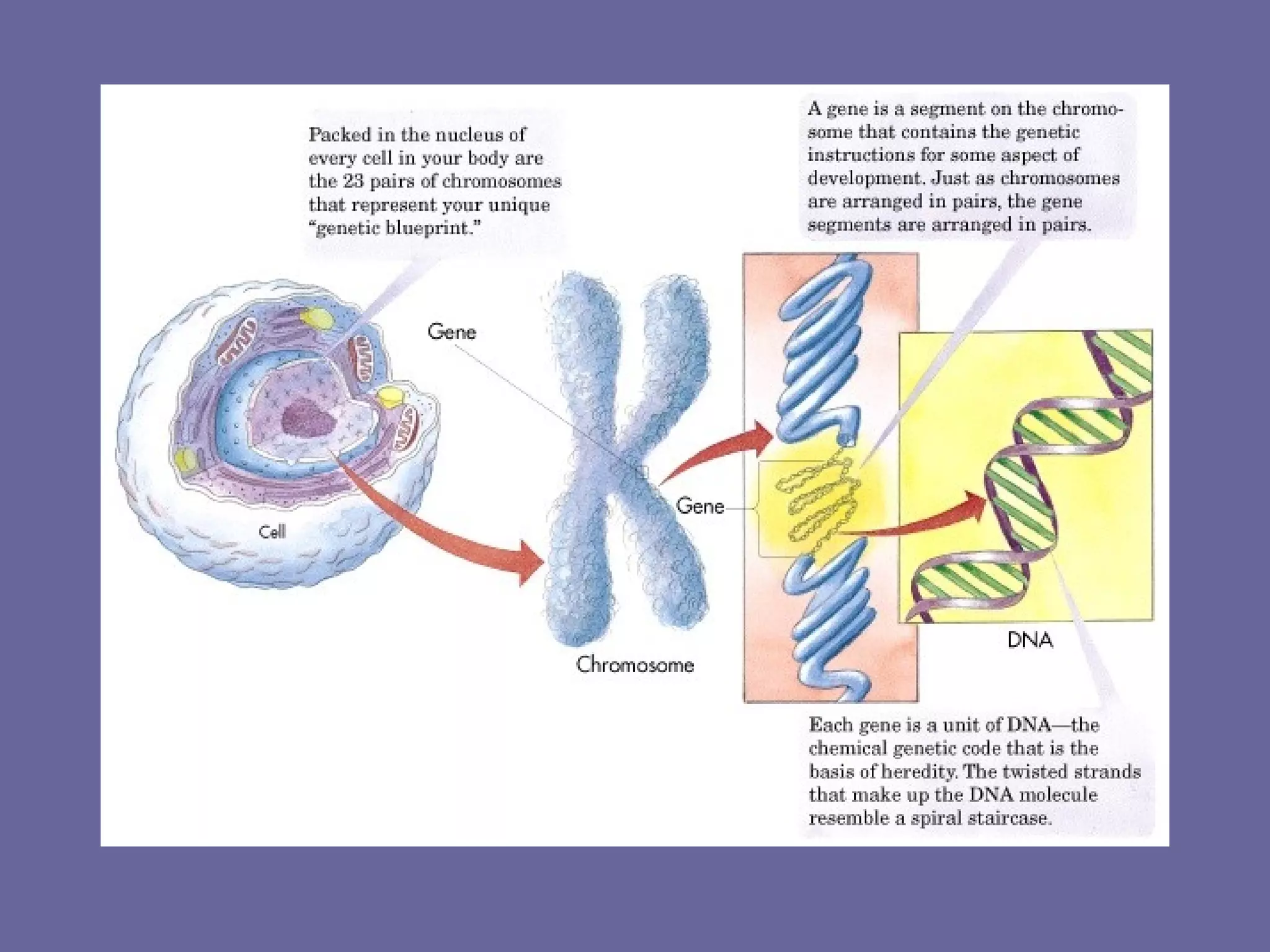
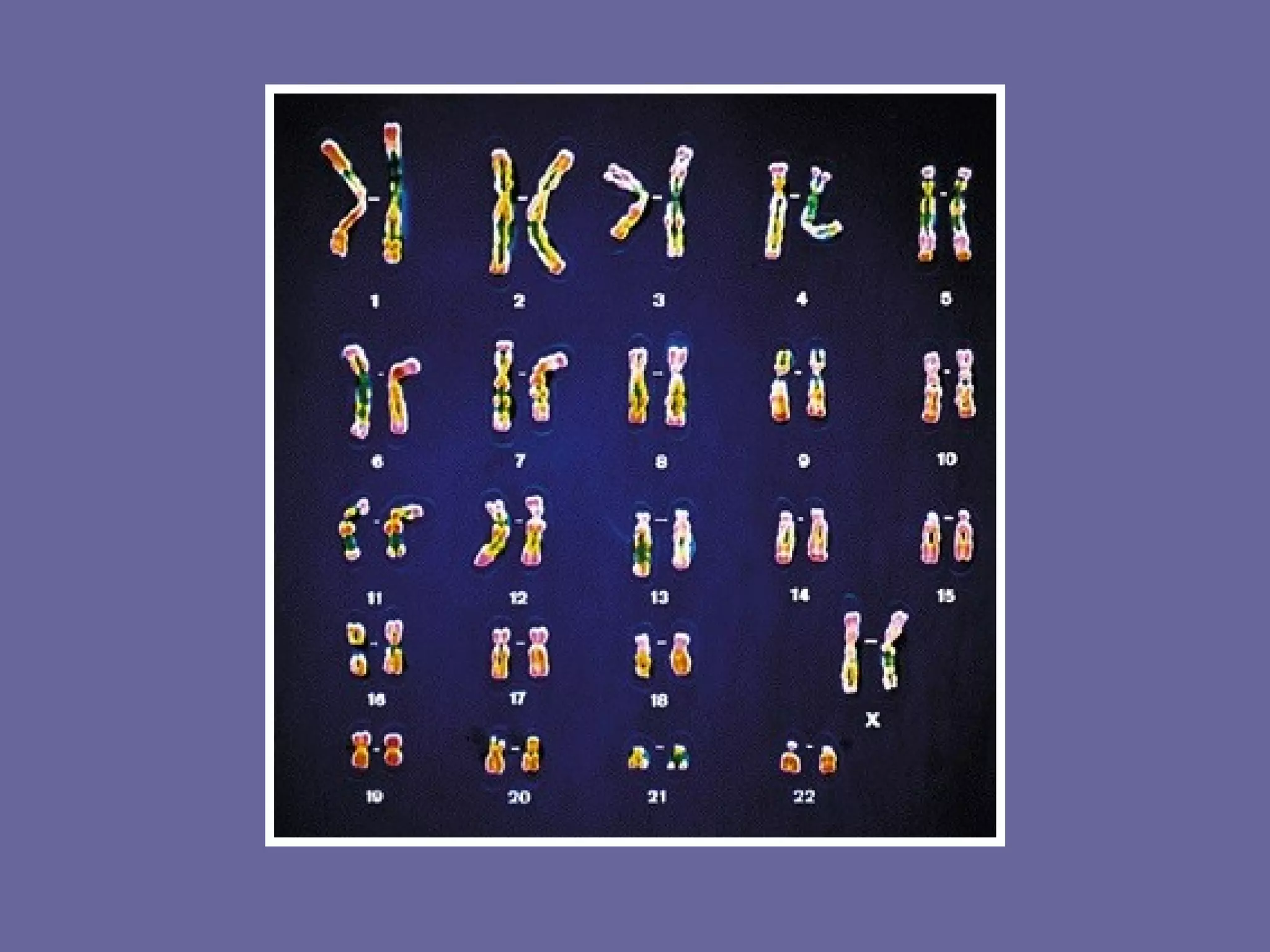
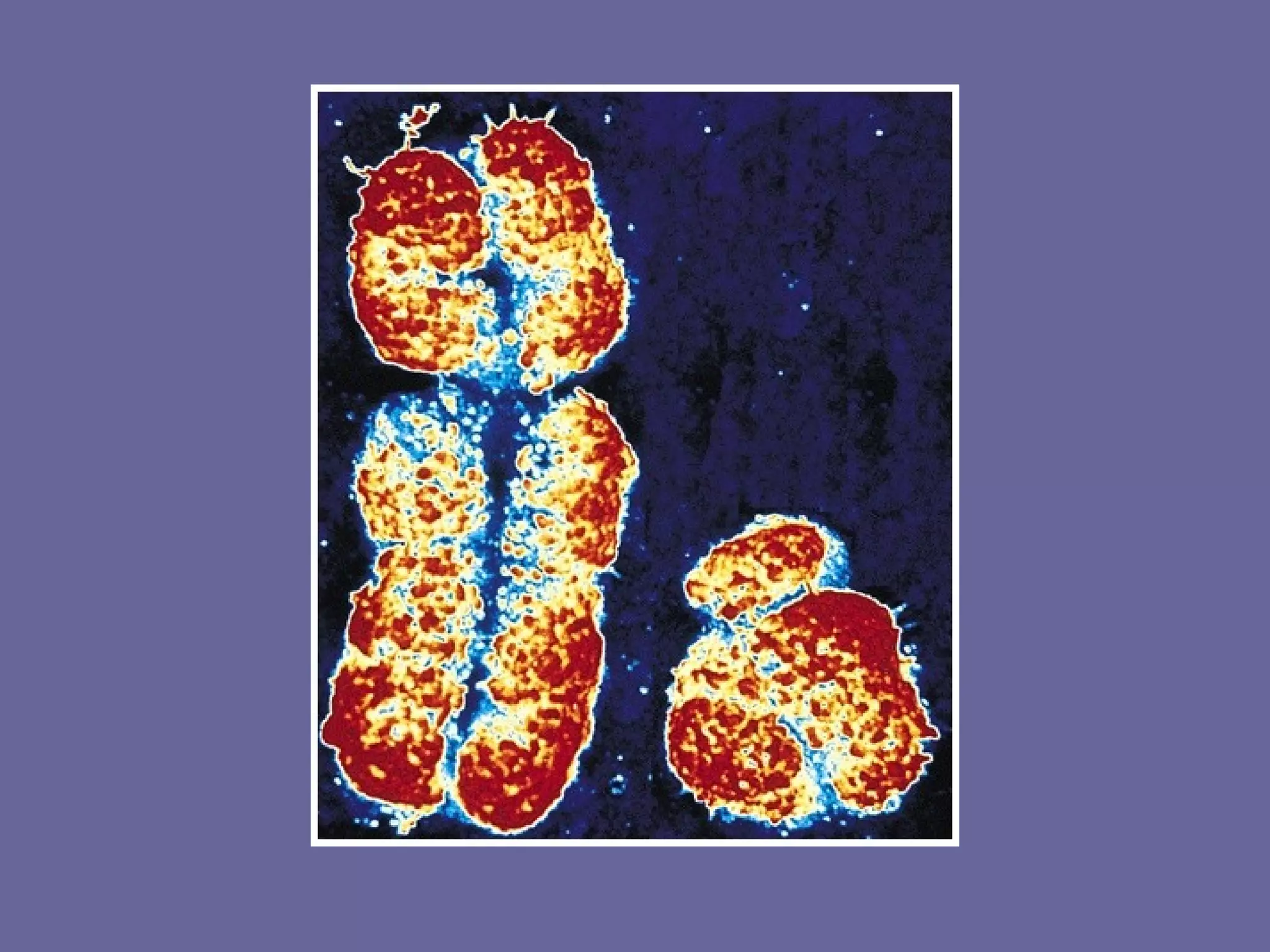
Overview of Genetics Humans have 23 pairs of chromosomes Chromosomes are long twisted strands  of DNA DNA is the chemical basis of heredity  and carries instructions Genes are the basic unit of heredity;  single unit of DNA on the chromosome
 
 
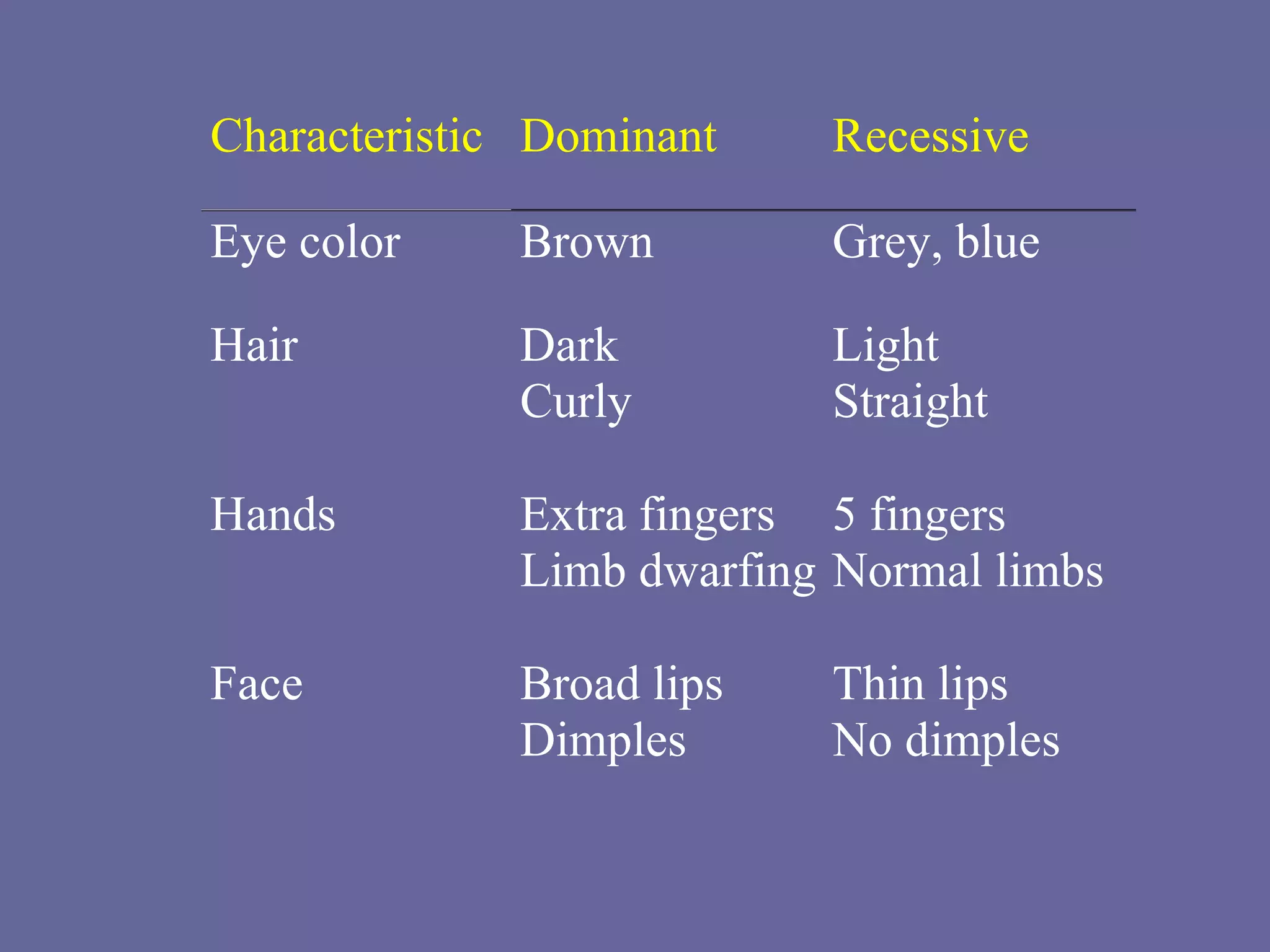
Dominant and Recessive Genotype—underlying genetic makeup Phenotype—traits that are expressed Dominant genes—will always be expressed if present Recessive genes—will not be expressed unless they are in a pair
 
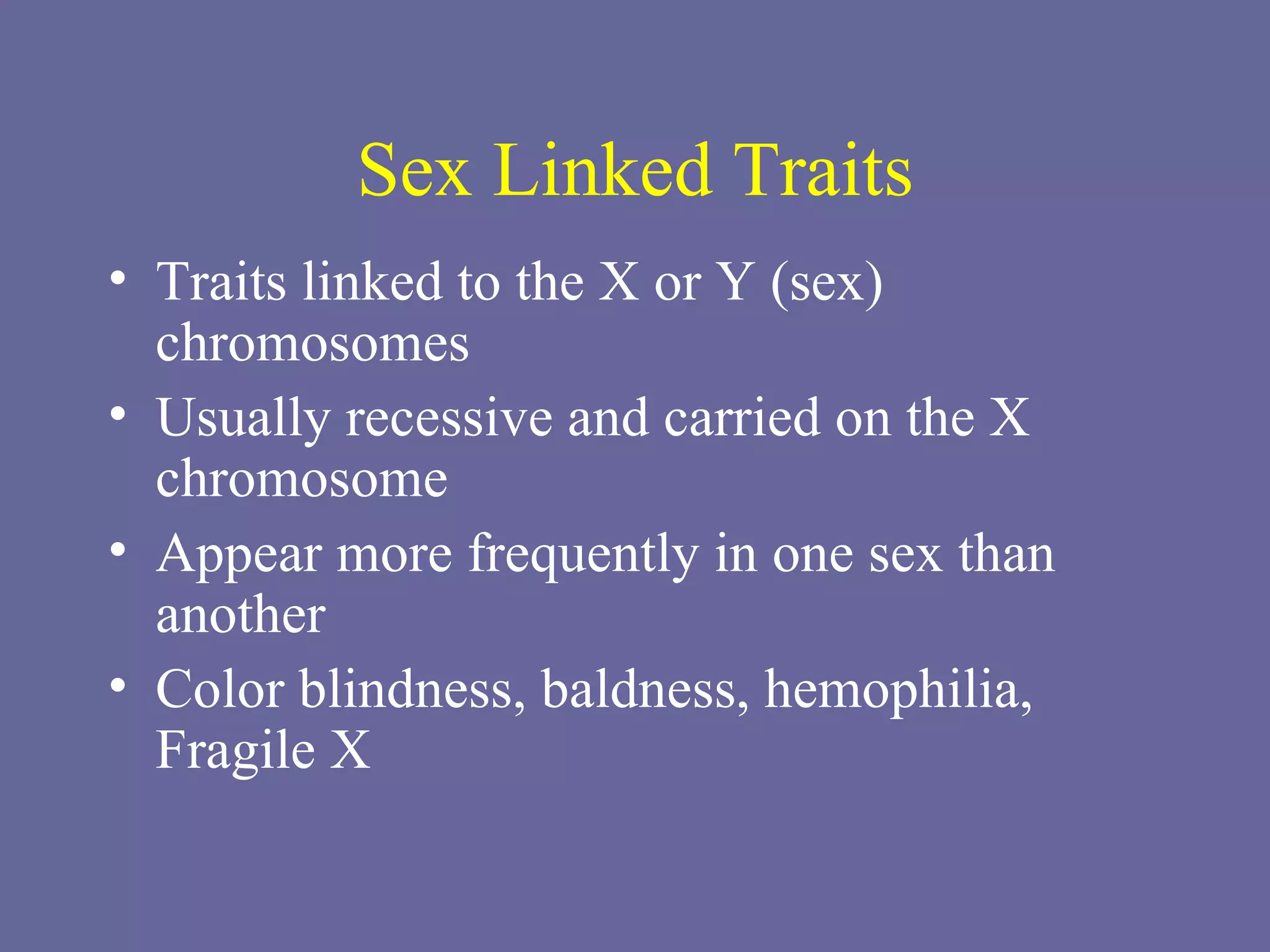
Sex Linked Traits Traits linked to the X or Y (sex) chromosomes Usually recessive and carried on the X chromosome Appear more frequently in one sex than another Color blindness, baldness, hemophilia, Fragile X
 
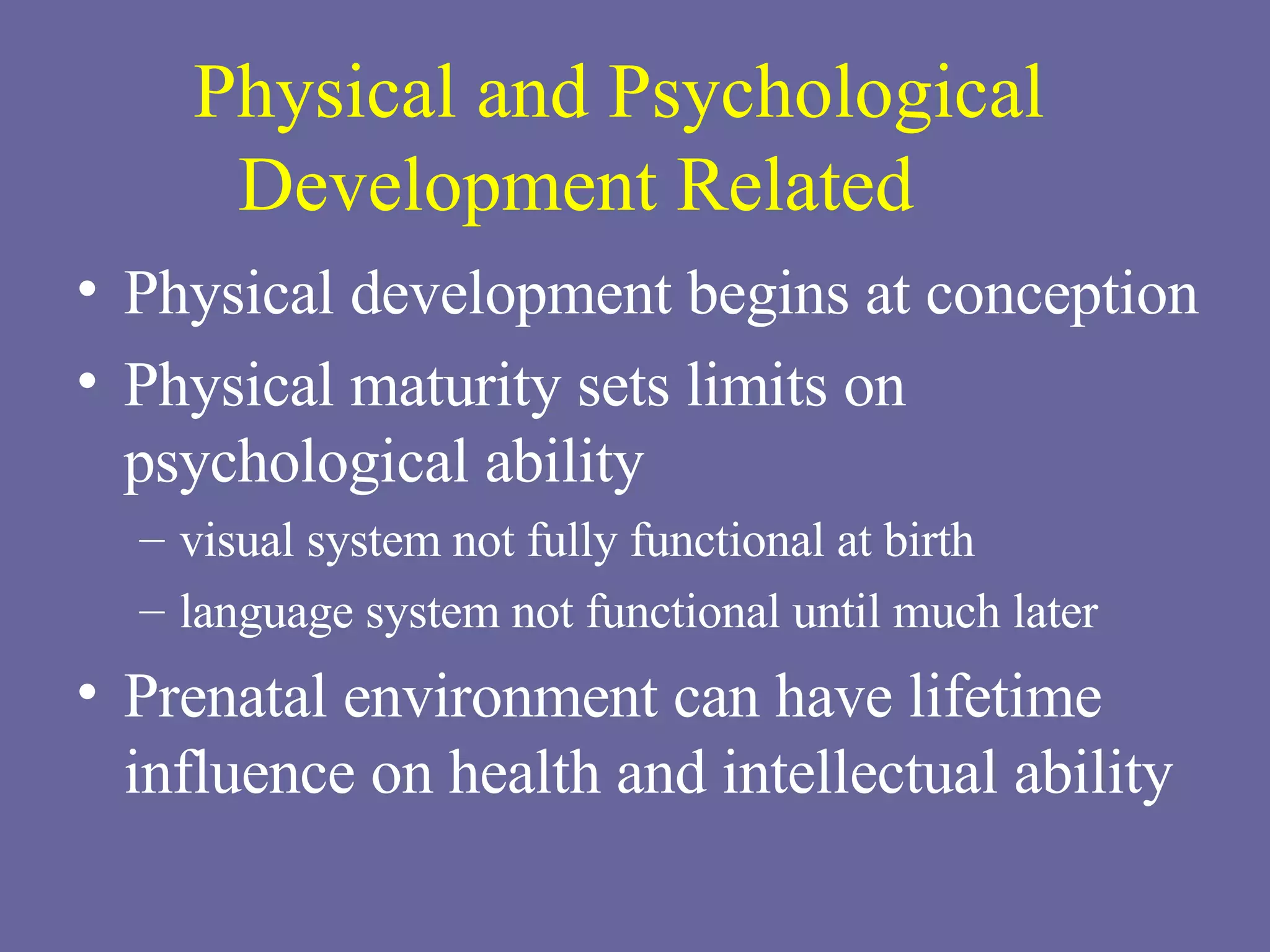
Physical and Psychological Development Related Physical development begins at conception Physical maturity sets limits on psychological ability visual system not fully functional at birth language system not functional until much later Prenatal environment can have lifetime influence on health and intellectual ability
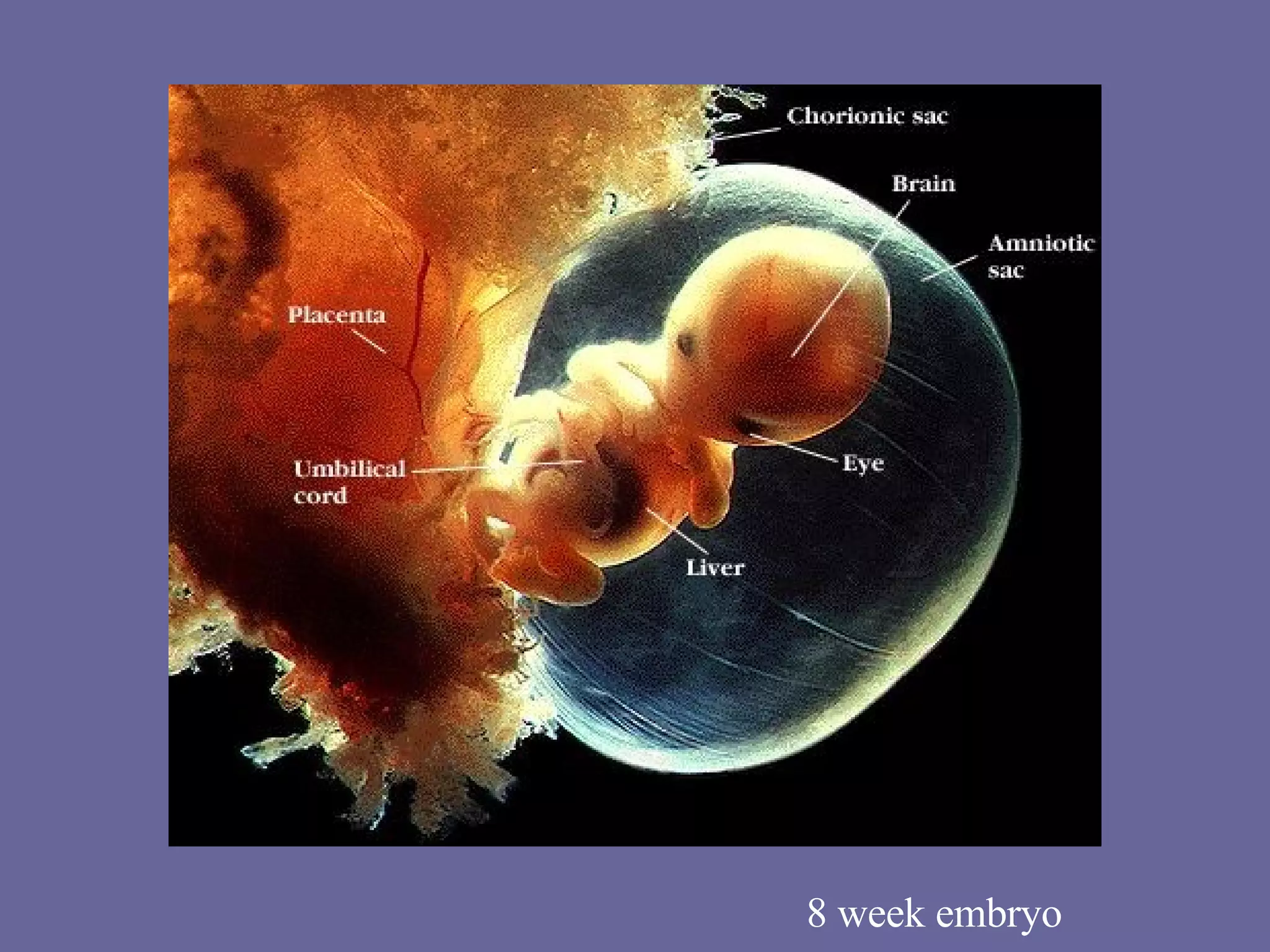
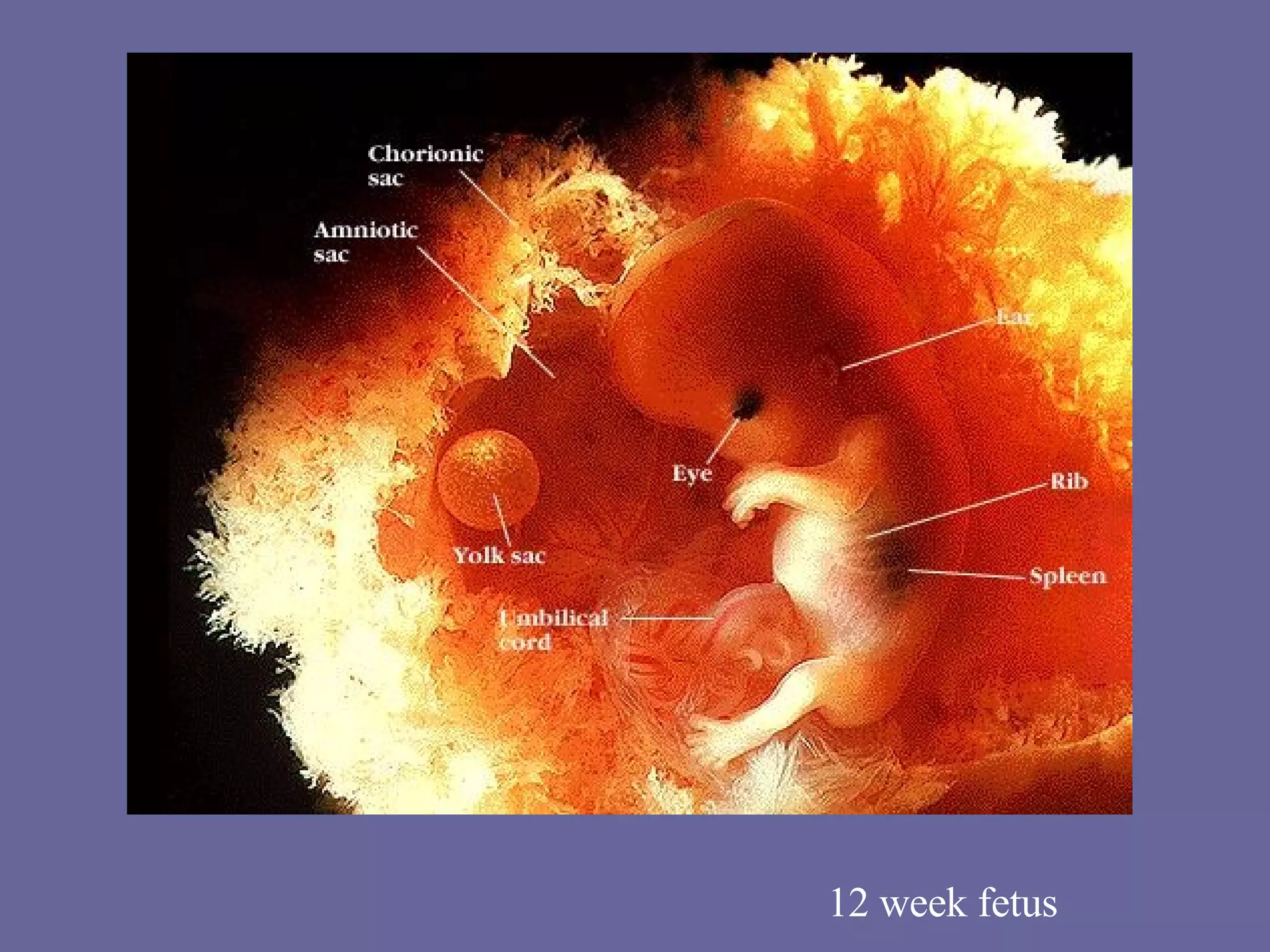
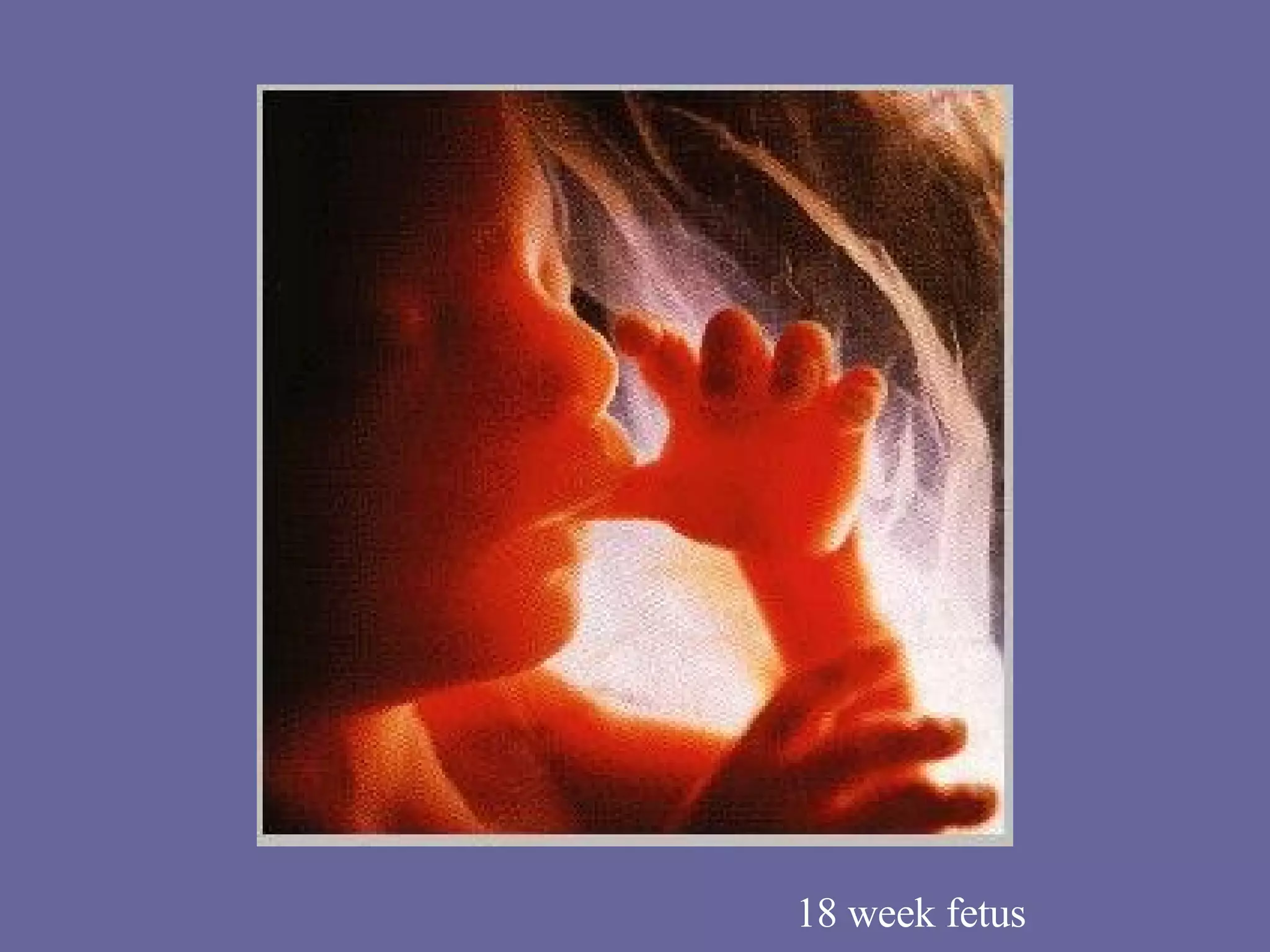
Prenatal Development Conception—when a sperm penetrates the ovum Zygote—a fertilized egg Germinal period—first two weeks after conception Embryonic period—weeks three through  eight after conception Fetal period—two months after conception  until birth
8 week embryo
12 week fetus
18 week fetus
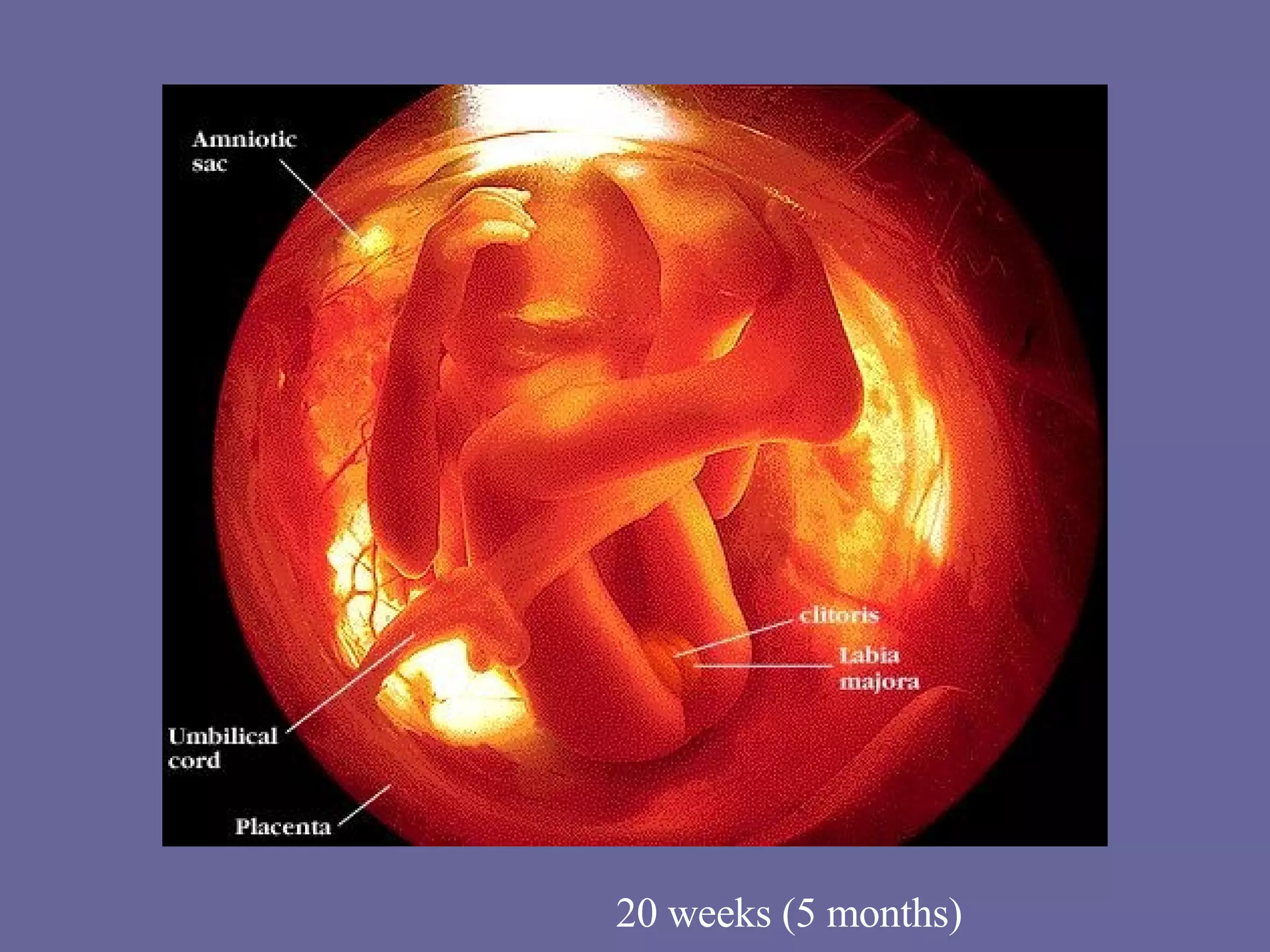
20 weeks (5 months)
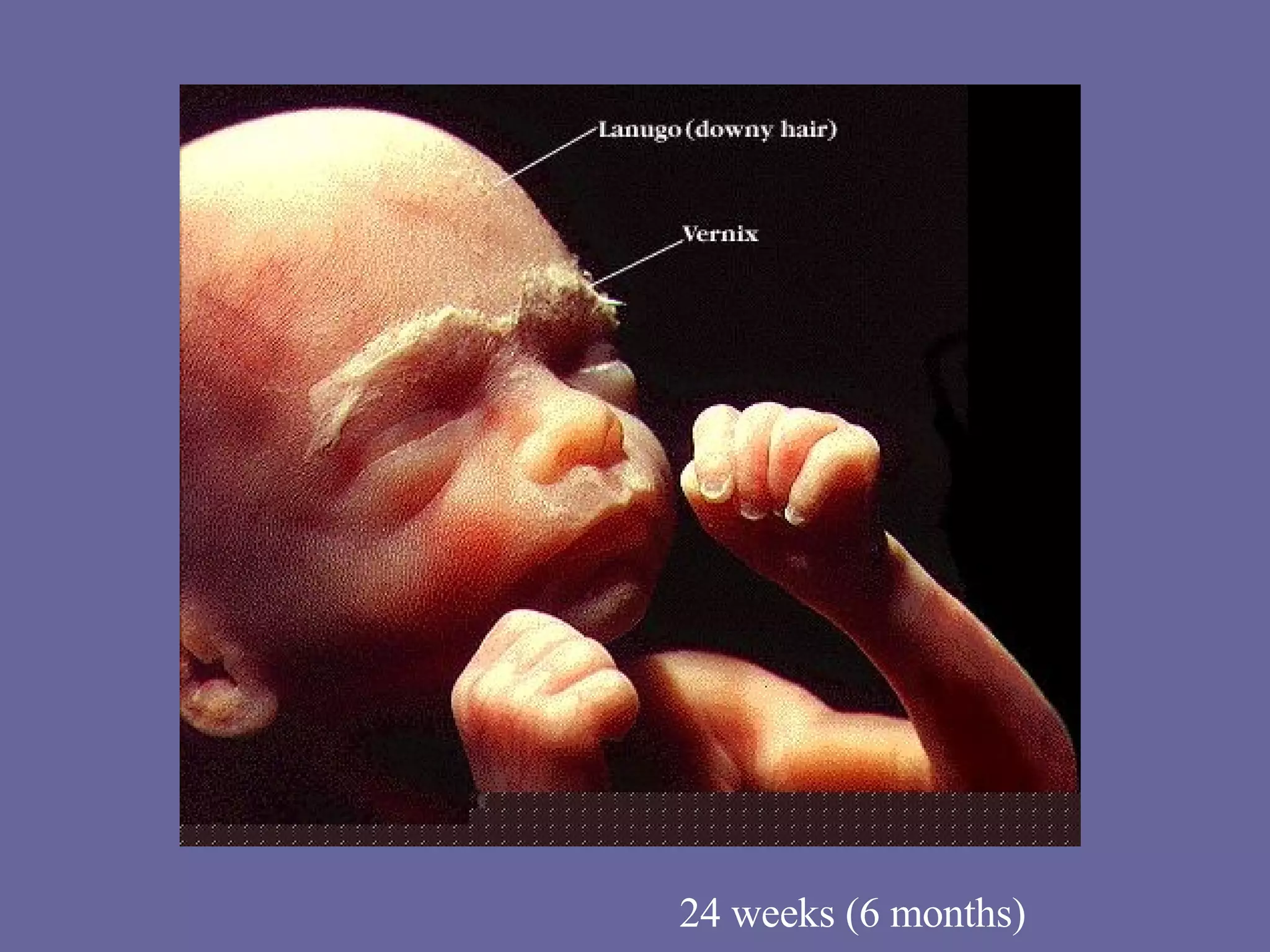
24 weeks (6 months)
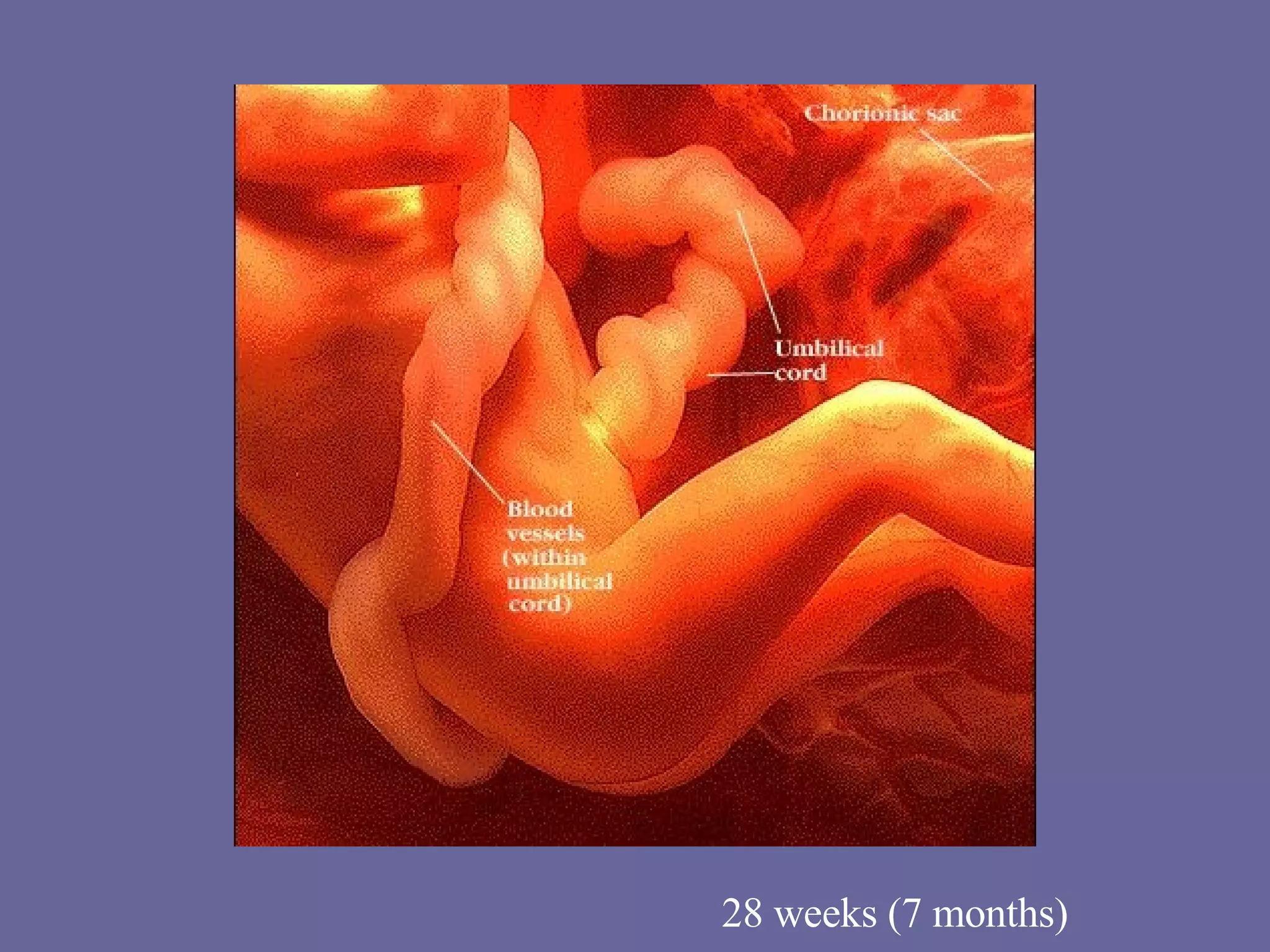
28 weeks (7 months)
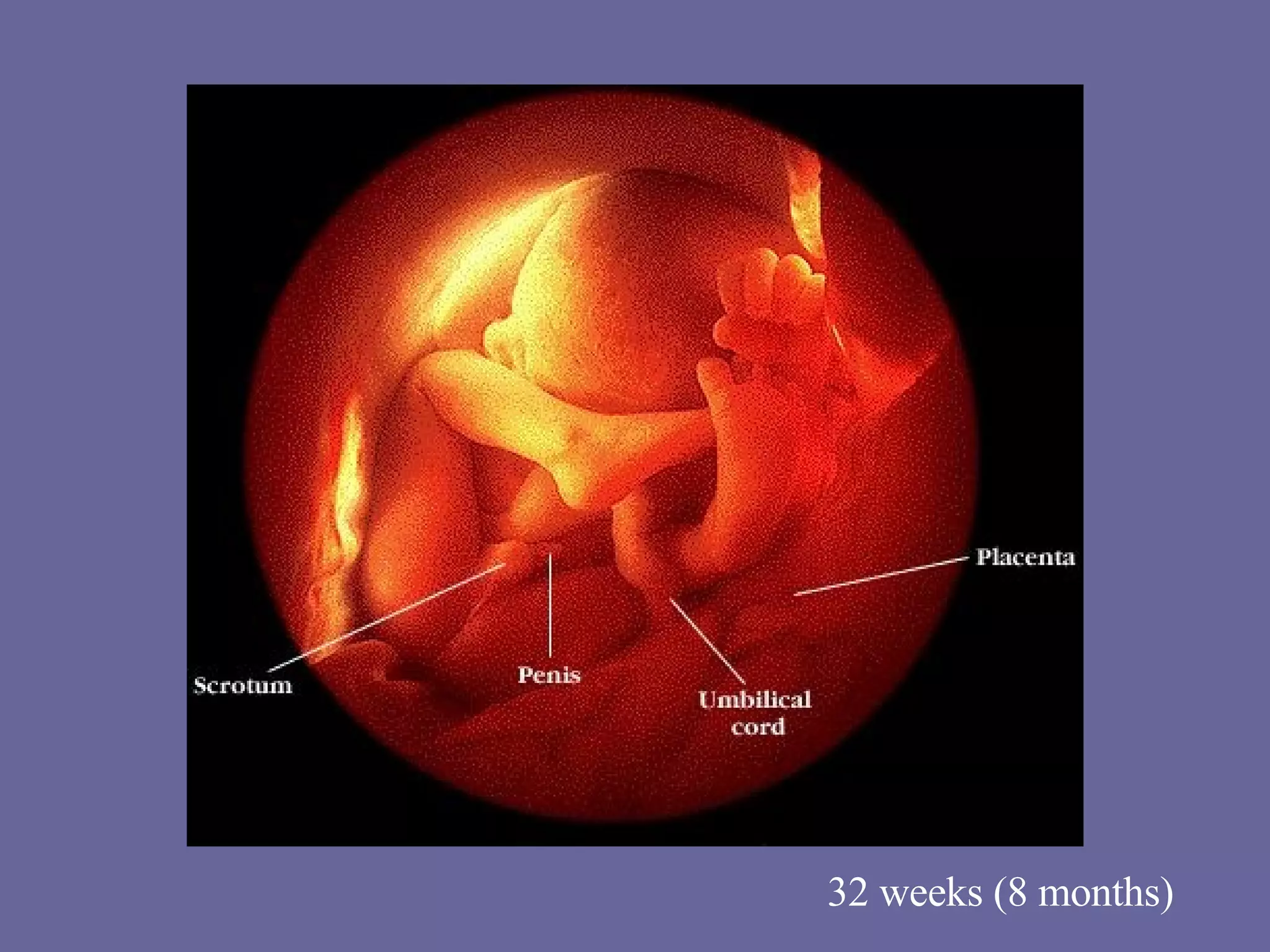
32 weeks (8 months)
Prenatal Influences  on Development Nutrition Anxiety Mother’s general health Maternal age Teratogens—any agent that causes  a birth defect (e.g., drugs, radiation, viruses)
Drugs Over the counter Alcohol Cocaine Heroine Nicotine Aspirin Excess vitamins
Disease Rubella HIV Toxoplasmosis Herpes Syphilis Influenza
Infant Abilities Infants are born with immature visual system can detect movement and large objects Other senses function well on day 1 will orient to sounds turn away from unpleasant odors prefer sweet to sour tastes Born with a number of reflex behaviors
Infant Reflexes Rooting—turning the head and opening the mouth in the direction of a touch on the cheek Sucking—sucking rhythmically in response to oral stimulation Grasping—curling the fingers around an object
Social and Personality Development Temperament--inborn predisposition to consistently behave and react in a certain way Attachment-- emotional bond between infant and caregiver
Temperament Easy—adaptable, positive mood, regular habits Slow to warm up—low activity, somewhat slow to adapt, generally withdraw from new situations Difficult—intense emotions, irritable, cry frequently Average—unable to classify (1/3 of all children)
Quality of Attachment Parents who are consistently warm, responsive, and sensitive to the infant’s needs usually have infants who are  securely attached Parents who are neglectful, inconsistent, or insensitive to infant’s needs usually have infants who are  insecurely attached
Ainsworth’s  Strange Situation Used to study quality of attachment in infants Observe child’s reaction when mother is present with the child in a “strange” room Observe the child’s reaction when mother leaves Observes the child’s reaction when mother returns
Language Development Noam Chomsky asserts that every child is born with a biological predisposition to learn language  “universal grammar” Motherese or infant directed speech--style of speech used by adults (mostly parents) in all cultures to talk to babies and children
Language Development Infant preference for human speech over other sounds before 6 months can hear differences used in all languages after 6 months begin to hear only differences used in native language Cooing—vowel sounds produced 2–4 months Babbling—consonant/vowel sounds between  4 to 6 months Even deaf infants coo and babble
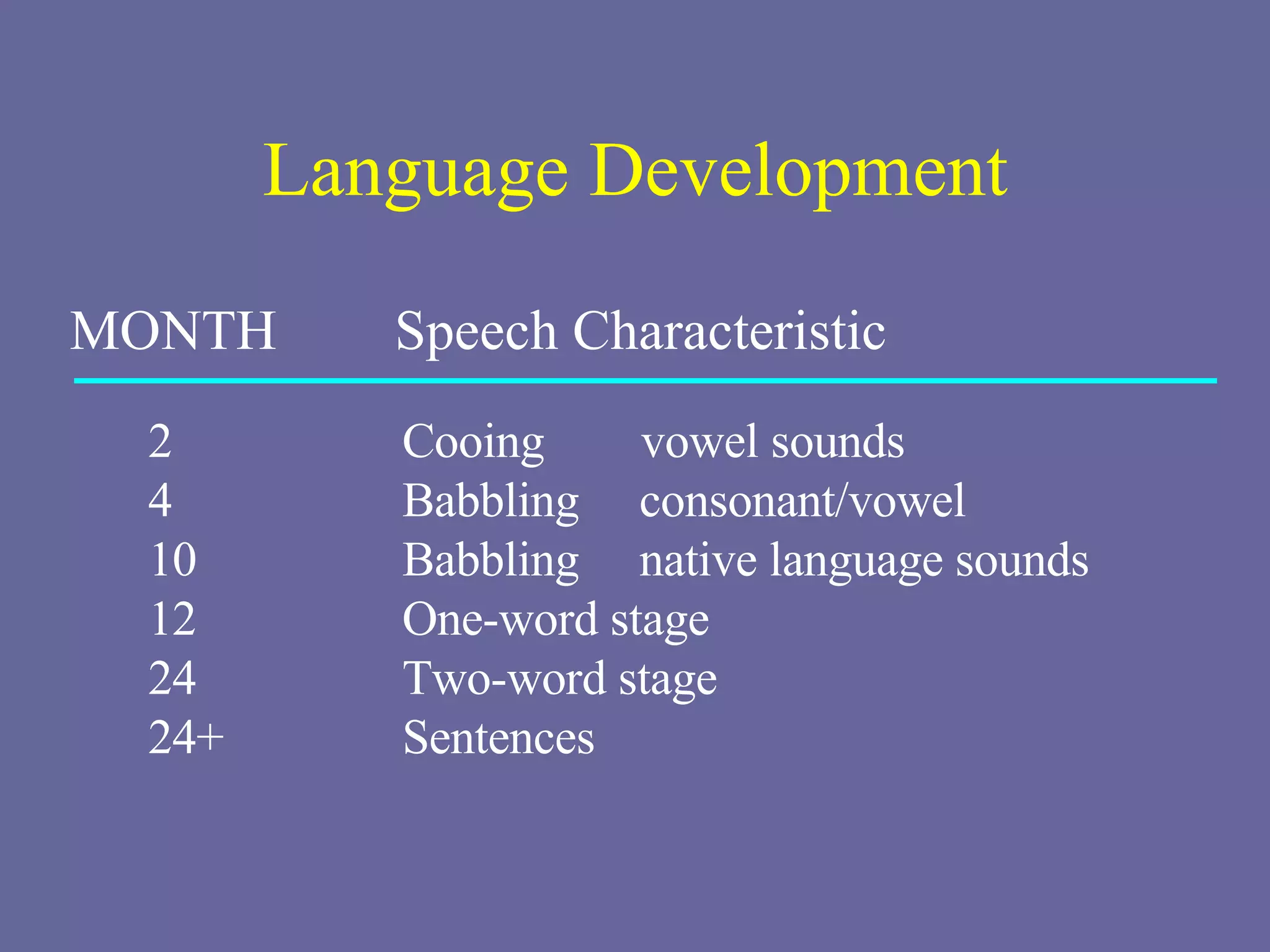
Language Development MONTH   Speech Characteristic   2 Cooing  vowel sounds  4 Babbling  consonant/vowel  10 Babbling  native language sounds 12 One-word stage  24 Two-word stage 24+ Sentences
Young Children’s Vocabulary Comprehension vocabulary--words that the infant or child understands Production vocabulary--words that the infant or child understands and can speak
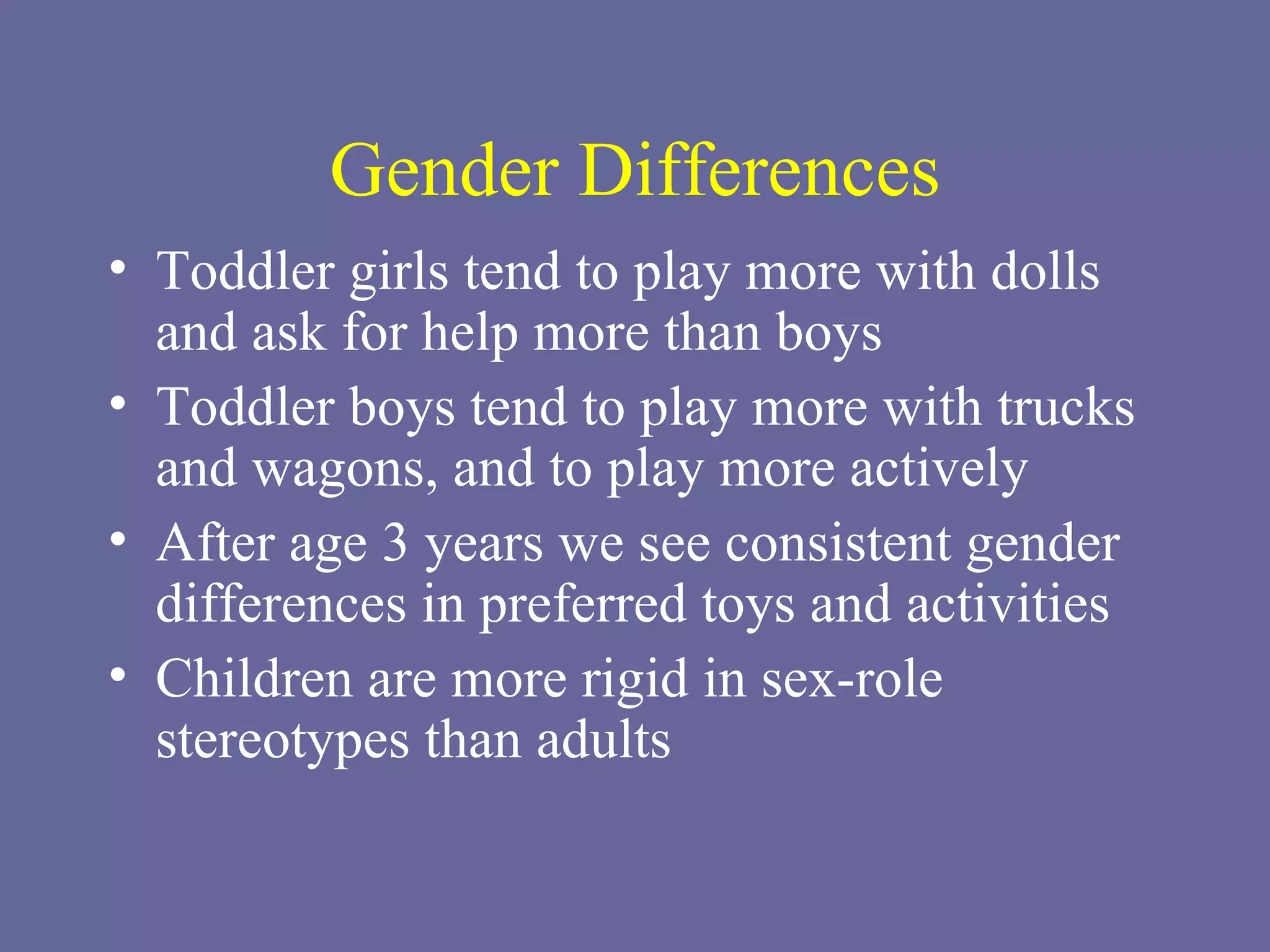
Gender Role Development Gender—cultural, social, and psychological meanings associated with masculinity or femininity Gender roles—various traits designated either masculine or feminine in a given culture Gender identity—A person’s psychological sense of being male or female Between ages 2-3 years, children can identify themselves and other children as boys or girls.  The concept of gender or sex, is, however, based more on outward characteristics such as clothing.
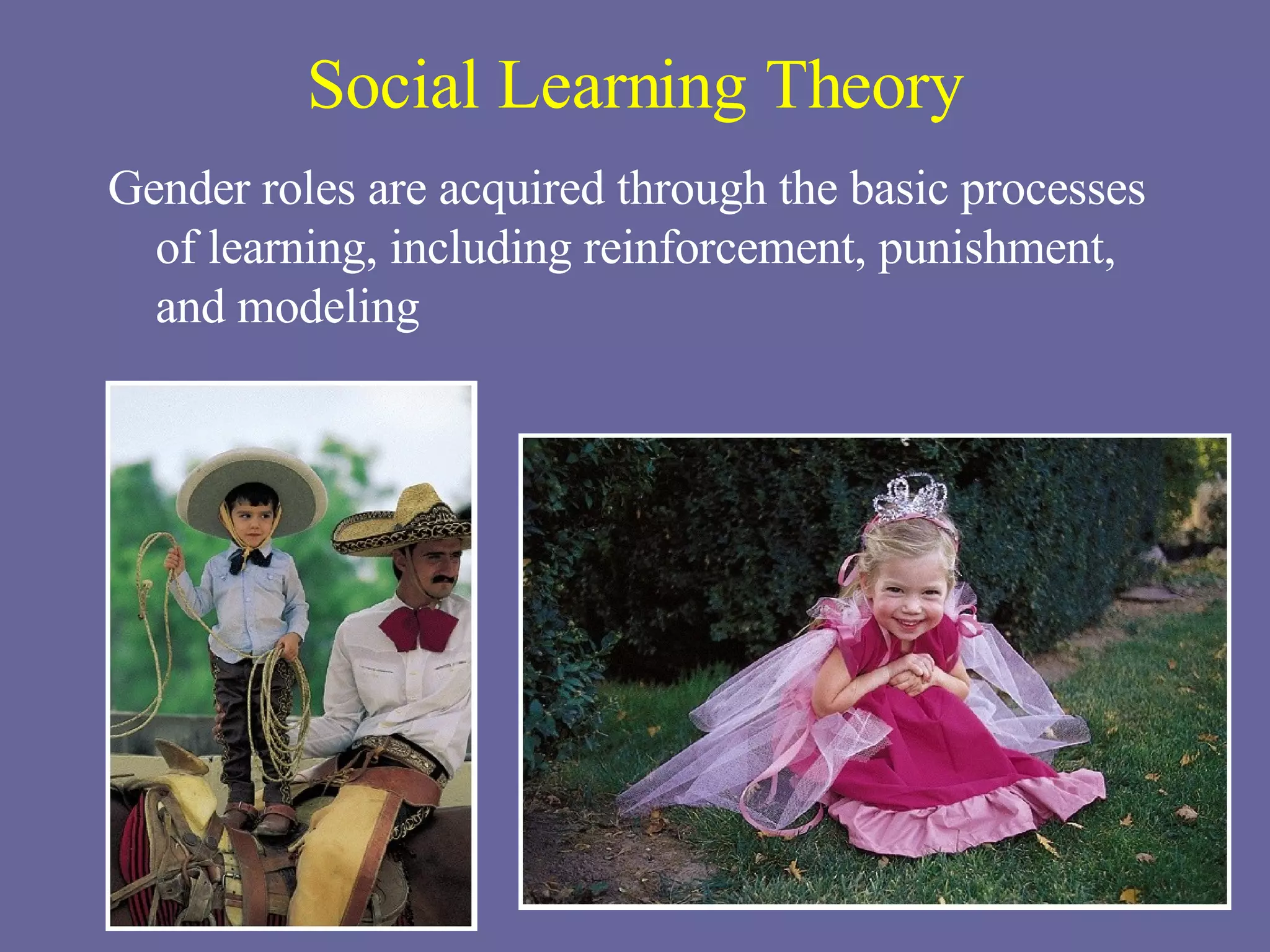
Gender Differences Toddler girls tend to play more with dolls and ask for help more than boys Toddler boys tend to play more with trucks and wagons, and to play more actively After age 3 years we see consistent gender differences in preferred toys and activities Children are more rigid in sex-role stereotypes than adults
Social Learning Theory Gender roles are acquired through the basic processes of learning, including reinforcement, punishment, and modeling
Gender Schema Theory Gender-role development is influenced by the formation of schemas, or mental representations, of masculinity and femininity Children actively develop mental categories of masculinity ad femininity and categorize these into gender categories or schemas Trucks are for boys and dolls are for girls is an example of a gender schema
Piaget’s Theory of  Cognitive Development Jean Piaget (1896–1980) Swiss psychologist who became leading theorist in 1930s Piaget believed that “children are active thinkers, constantly trying to construct more advanced understandings of the world” Cognitive development is a stage process
Qualitative Difference in Thinking Assimilation—process of taking in new knowledge or a new experience  Accommodation—process by which we change our way of thinking because of new knowledge These processes build on the knowledge of previous stages
Piaget’s Approach Primary method was to ask children to solve problems and to question them about the reasoning behind their solutions Discovered that children think in radically different ways than adults Proposed that development occurs as a series of ‘stages’ differing in how the world is understood
Sensorimotor Stage (birth – 2) Information is gained through the senses and motor actions Child perceives and manipulates but does not reason Symbols become internalized through language development Object permanence is acquired
Object Permanence The understanding that objects exist independent of one’s actions or perceptions of them Before 6 months infants act as if objects removed from sight cease to exist Can be surprised by disappearance/reappearance of a face (peek-a-boo)
Preoperational Stage  (2–7 years) Emergence of symbolic thought Centration Egocentrism Lack of the concept of conservation Animism Artificialism
Concrete Operational Stage  (7–12 years) Increasingly logical thought Classification and categorization Less egocentric Ability to understand that physical quantities are equal even if appearance changes (conservation)  Inability to reason abstractly or hypothetically
Formal Operational Stage  (age 12 – adulthood) Hypothetico-deductive reasoning Emerges gradually Continues to develop into adulthood
Critique of Piaget’s Theory Underestimates children’s abilities Overestimates age differences in thinking Vagueness about the process of change Underestimates the role of the social environment Lack of evidence for qualitatively different stages
Information-Processing Perspective Focuses on the mind as a system, analogous to a computer, for analyzing information from the environment Developmental improvements reflect   increased capacity of working memory faster speed of processing new algorithms (methods) more stored knowledge
Vygotsky’s  Sociocultural Perspective Emphasized the child’s interaction with the social world  (other people) as a cause of development Vygotsky believed language to be the foundation for social interaction and thought Piaget believed language was a byproduct of thought
Vygotsky’s  Sociocultural Perspective Vygotsky—children learn from interactions with other people Piaget—focused on children’s interaction with the physical world
Adolescence Transition stage between late childhood and early adulthood Sexual maturity is attained at this time Puberty--attainment of sexual maturity and ability to reproduce Health, nutrition, genetics play a role in onset and progression of puberty
Social Relationships Parent-child relationship is usually positive  May have some periods of friction Peers become increasingly important Peer influence may not be as bad as most people think. Adolescents tend to have friends of similar age, race, social class,  and with same religious beliefs.
Erikson’s Theory Biological because of belief that there are innate drives to develop social relationships and that these promote survival (Darwinism) Divided life span into eight psychosocial stages, each associated with a different drive and a problem or crisis to resolve Outcome of each stage varies along a continuum from positive to negative
Identity Development Identity vs. role confusion is the psychosocial stage during adolescence Developing a sense of who one is and where one is going in life Successful resolution leads to positive identity Unsuccessful resolution leads to identity confusion or a negative identity
Stage 1 (birth–1) Trust vs. Mistrust  Infants must rely on others for care Consistent and dependable caregiving and meeting infant needs leads to a sense of trust Infants who are not well cared for will develop mistrust
Stage 2 (1–3 years)  Autonomy vs. Shame and Doubt Children are discovering their own independence Those given the opportunity to experience independence will gain a sense of autonomy Children that are overly restrained or punished harshly will develop shame and doubt
Stage 3 (3–5 years) Initiative vs. Guilt Children are exposed to the wider social world and given greater responsibility Sense of accomplishment leads to initiative, whereas feelings of guilt can emerge if the child is made to feel too anxious or irresponsible
Stage 4 (5–12 years)  Industry vs. Inferiority Stage of life surrounding mastery of knowledge and intellectual skills Sense of competence and achievement leads to industry Feeling incompetent and unproductive leads to inferiority
Stage 5 (adolescence) Identity vs. Confusion Developing a sense of who one is and where one is going in life Successful resolution leads to positive identity Unsuccessful resolution leads to identity confusion or a negative identity
Stage 6 (young adulthood) Intimacy vs. Isolation Time for sharing oneself with another person Capacity to hold commitments with others leads to intimacy Failure to establish commitments leads to feelings of isolation
Stage 7 (middle adulthood) Generativity vs. Stagnation Caring for others in family, friends, and work leads to sense of contribution to later generations Stagnation comes from a sense of boredom and meaninglessness
Stage 8 (late adulthood to death) Integrity vs. Despair   Successful resolutions of all previous crises leads to integrity and the ability  to see broad truths and advise those in earlier stages Despair arises from feelings of helplessness and the bitter sense that  life has been incomplete
Kohlberg’s Theory of  Moral Development Assessed moral reasoning by posing hypothetical moral dilemmas and examining the reasoning behind people’s answers Proposed six stages, each taking into account a broader portion of the social world
Levels of Moral Reasoning Preconventional—moral reasoning is based on external rewards and punishments Conventional—laws and rules are upheld simply because they are laws and rules Postconventional—reasoning based on personal moral standards
Stage 1: Obedience and Punishment Orientation A focus on direct consequences Negative actions will result in punishments Positive actions will result in rewards
Stage 2: Mutual Benefit Reflects the understanding that different people have different self-interests, which sometimes come in conflict Getting what one wants often requires giving something up in return
Stage 3: Interpersonal  Expectations An attempt to live up to the expectations of important others Positive actions will improve relations with significant others Negative actions will harm those relationships
Stage 4: Law-and-Order Morality To maintain social order, people must resist personal pressures and follow the laws of the larger society
Stage 5: Legal Principles A balance is struck between respect for laws and ethical principles that transcend specific laws Laws that fail to promote general welfare or that violate ethical principles can be changed, reinterpreted, or abandoned
Stage 6:  Universal Moral Principles Self-chosen ethical principles Profound respect for sanctity of human life Moral principles take precedence over laws that might conflict with them, i.e., conscientious objectors
Adult Development Genetics and lifestyle combine to determine course of physical changes Social development involves marriage and transition to parenthood Paths of adult social development are varied and include diversity of lifestyles
Late Adulthood Old age as a time of poor health, inactivity, and decline is a myth Activity theory of aging—life satisfaction is highest when people maintain level of activity they had in earlier years
Death and Dying In general, anxiety about dying tends to decrease in late adulthood Kubler-Ross stages of dying Denial Anger Bargain Depression Acceptance Not universally demonstrated
Baumrind’s  Parenting Styles Authoritarian—value obedience and  use a high degree of power assertion Authoritative—less concerned with obedience, greater use of induction Permissive—most tolerant, least likely  to use discipline Neglectful—completely uninvolved

Chapter 9 Ppp

  • 1.
  • 2.
    Developmental Psychology Whatshapes the way we change over time? Focus on psychological changes across the entire life span Every area of psychology can be looked at from this perspective biological development social development cognitive/perceptual development personality development
  • 3.
    Fundamental Issues: Nature vs. Nurture What is role of heredity vs. environment in determining psychological makeup? Is IQ inherited or determined early environment? Is there a ‘criminal’ gene? Is sexual orientation a choice or genetically determined? These are some of our greatest societal debates Mistake to pose as “either/or” questions
  • 4.
    Fundamental Issues: Is Development Continuous? Development means change; change can be abrupt or gradual Two views of human development stage theories: there are distinct phases to intellectual and personality development continuity: development is continuous
  • 5.
    Fundamental Issues inDevelopmental Psychology Critical period —Are there periods when an individual is particularly sensitive to certain environmental experiences? Are the first hours after birth critical for parent-child bonding? Is first year critical for developing trust? Easier to learn a language before age 10?
  • 6.
    Overview of GeneticsHumans have 23 pairs of chromosomes Chromosomes are long twisted strands of DNA DNA is the chemical basis of heredity and carries instructions Genes are the basic unit of heredity; single unit of DNA on the chromosome
  • 7.
  • 8.
  • 9.
    Dominant and RecessiveGenotype—underlying genetic makeup Phenotype—traits that are expressed Dominant genes—will always be expressed if present Recessive genes—will not be expressed unless they are in a pair
  • 10.
  • 11.
    Sex Linked TraitsTraits linked to the X or Y (sex) chromosomes Usually recessive and carried on the X chromosome Appear more frequently in one sex than another Color blindness, baldness, hemophilia, Fragile X
  • 12.
  • 13.
    Physical and PsychologicalDevelopment Related Physical development begins at conception Physical maturity sets limits on psychological ability visual system not fully functional at birth language system not functional until much later Prenatal environment can have lifetime influence on health and intellectual ability
  • 14.
    Prenatal Development Conception—whena sperm penetrates the ovum Zygote—a fertilized egg Germinal period—first two weeks after conception Embryonic period—weeks three through eight after conception Fetal period—two months after conception until birth
  • 15.
  • 16.
  • 17.
  • 18.
    20 weeks (5months)
  • 19.
    24 weeks (6months)
  • 20.
    28 weeks (7months)
  • 21.
    32 weeks (8months)
  • 22.
    Prenatal Influences on Development Nutrition Anxiety Mother’s general health Maternal age Teratogens—any agent that causes a birth defect (e.g., drugs, radiation, viruses)
  • 23.
    Drugs Over thecounter Alcohol Cocaine Heroine Nicotine Aspirin Excess vitamins
  • 24.
    Disease Rubella HIVToxoplasmosis Herpes Syphilis Influenza
  • 25.
    Infant Abilities Infantsare born with immature visual system can detect movement and large objects Other senses function well on day 1 will orient to sounds turn away from unpleasant odors prefer sweet to sour tastes Born with a number of reflex behaviors
  • 26.
    Infant Reflexes Rooting—turningthe head and opening the mouth in the direction of a touch on the cheek Sucking—sucking rhythmically in response to oral stimulation Grasping—curling the fingers around an object
  • 27.
    Social and PersonalityDevelopment Temperament--inborn predisposition to consistently behave and react in a certain way Attachment-- emotional bond between infant and caregiver
  • 28.
    Temperament Easy—adaptable, positivemood, regular habits Slow to warm up—low activity, somewhat slow to adapt, generally withdraw from new situations Difficult—intense emotions, irritable, cry frequently Average—unable to classify (1/3 of all children)
  • 29.
    Quality of AttachmentParents who are consistently warm, responsive, and sensitive to the infant’s needs usually have infants who are securely attached Parents who are neglectful, inconsistent, or insensitive to infant’s needs usually have infants who are insecurely attached
  • 30.
    Ainsworth’s StrangeSituation Used to study quality of attachment in infants Observe child’s reaction when mother is present with the child in a “strange” room Observe the child’s reaction when mother leaves Observes the child’s reaction when mother returns
  • 31.
    Language Development NoamChomsky asserts that every child is born with a biological predisposition to learn language “universal grammar” Motherese or infant directed speech--style of speech used by adults (mostly parents) in all cultures to talk to babies and children
  • 32.
    Language Development Infantpreference for human speech over other sounds before 6 months can hear differences used in all languages after 6 months begin to hear only differences used in native language Cooing—vowel sounds produced 2–4 months Babbling—consonant/vowel sounds between 4 to 6 months Even deaf infants coo and babble
  • 33.
    Language Development MONTH Speech Characteristic 2 Cooing vowel sounds 4 Babbling consonant/vowel 10 Babbling native language sounds 12 One-word stage 24 Two-word stage 24+ Sentences
  • 34.
    Young Children’s VocabularyComprehension vocabulary--words that the infant or child understands Production vocabulary--words that the infant or child understands and can speak
  • 35.
    Gender Role DevelopmentGender—cultural, social, and psychological meanings associated with masculinity or femininity Gender roles—various traits designated either masculine or feminine in a given culture Gender identity—A person’s psychological sense of being male or female Between ages 2-3 years, children can identify themselves and other children as boys or girls. The concept of gender or sex, is, however, based more on outward characteristics such as clothing.
  • 36.
    Gender Differences Toddlergirls tend to play more with dolls and ask for help more than boys Toddler boys tend to play more with trucks and wagons, and to play more actively After age 3 years we see consistent gender differences in preferred toys and activities Children are more rigid in sex-role stereotypes than adults
  • 37.
    Social Learning TheoryGender roles are acquired through the basic processes of learning, including reinforcement, punishment, and modeling
  • 38.
    Gender Schema TheoryGender-role development is influenced by the formation of schemas, or mental representations, of masculinity and femininity Children actively develop mental categories of masculinity ad femininity and categorize these into gender categories or schemas Trucks are for boys and dolls are for girls is an example of a gender schema
  • 39.
    Piaget’s Theory of Cognitive Development Jean Piaget (1896–1980) Swiss psychologist who became leading theorist in 1930s Piaget believed that “children are active thinkers, constantly trying to construct more advanced understandings of the world” Cognitive development is a stage process
  • 40.
    Qualitative Difference inThinking Assimilation—process of taking in new knowledge or a new experience Accommodation—process by which we change our way of thinking because of new knowledge These processes build on the knowledge of previous stages
  • 41.
    Piaget’s Approach Primarymethod was to ask children to solve problems and to question them about the reasoning behind their solutions Discovered that children think in radically different ways than adults Proposed that development occurs as a series of ‘stages’ differing in how the world is understood
  • 42.
    Sensorimotor Stage (birth– 2) Information is gained through the senses and motor actions Child perceives and manipulates but does not reason Symbols become internalized through language development Object permanence is acquired
  • 43.
    Object Permanence Theunderstanding that objects exist independent of one’s actions or perceptions of them Before 6 months infants act as if objects removed from sight cease to exist Can be surprised by disappearance/reappearance of a face (peek-a-boo)
  • 44.
    Preoperational Stage (2–7 years) Emergence of symbolic thought Centration Egocentrism Lack of the concept of conservation Animism Artificialism
  • 45.
    Concrete Operational Stage (7–12 years) Increasingly logical thought Classification and categorization Less egocentric Ability to understand that physical quantities are equal even if appearance changes (conservation) Inability to reason abstractly or hypothetically
  • 46.
    Formal Operational Stage (age 12 – adulthood) Hypothetico-deductive reasoning Emerges gradually Continues to develop into adulthood
  • 47.
    Critique of Piaget’sTheory Underestimates children’s abilities Overestimates age differences in thinking Vagueness about the process of change Underestimates the role of the social environment Lack of evidence for qualitatively different stages
  • 48.
    Information-Processing Perspective Focuseson the mind as a system, analogous to a computer, for analyzing information from the environment Developmental improvements reflect increased capacity of working memory faster speed of processing new algorithms (methods) more stored knowledge
  • 49.
    Vygotsky’s SocioculturalPerspective Emphasized the child’s interaction with the social world (other people) as a cause of development Vygotsky believed language to be the foundation for social interaction and thought Piaget believed language was a byproduct of thought
  • 50.
    Vygotsky’s SocioculturalPerspective Vygotsky—children learn from interactions with other people Piaget—focused on children’s interaction with the physical world
  • 51.
    Adolescence Transition stagebetween late childhood and early adulthood Sexual maturity is attained at this time Puberty--attainment of sexual maturity and ability to reproduce Health, nutrition, genetics play a role in onset and progression of puberty
  • 52.
    Social Relationships Parent-childrelationship is usually positive May have some periods of friction Peers become increasingly important Peer influence may not be as bad as most people think. Adolescents tend to have friends of similar age, race, social class, and with same religious beliefs.
  • 53.
    Erikson’s Theory Biologicalbecause of belief that there are innate drives to develop social relationships and that these promote survival (Darwinism) Divided life span into eight psychosocial stages, each associated with a different drive and a problem or crisis to resolve Outcome of each stage varies along a continuum from positive to negative
  • 54.
    Identity Development Identityvs. role confusion is the psychosocial stage during adolescence Developing a sense of who one is and where one is going in life Successful resolution leads to positive identity Unsuccessful resolution leads to identity confusion or a negative identity
  • 55.
    Stage 1 (birth–1)Trust vs. Mistrust Infants must rely on others for care Consistent and dependable caregiving and meeting infant needs leads to a sense of trust Infants who are not well cared for will develop mistrust
  • 56.
    Stage 2 (1–3years) Autonomy vs. Shame and Doubt Children are discovering their own independence Those given the opportunity to experience independence will gain a sense of autonomy Children that are overly restrained or punished harshly will develop shame and doubt
  • 57.
    Stage 3 (3–5years) Initiative vs. Guilt Children are exposed to the wider social world and given greater responsibility Sense of accomplishment leads to initiative, whereas feelings of guilt can emerge if the child is made to feel too anxious or irresponsible
  • 58.
    Stage 4 (5–12years) Industry vs. Inferiority Stage of life surrounding mastery of knowledge and intellectual skills Sense of competence and achievement leads to industry Feeling incompetent and unproductive leads to inferiority
  • 59.
    Stage 5 (adolescence)Identity vs. Confusion Developing a sense of who one is and where one is going in life Successful resolution leads to positive identity Unsuccessful resolution leads to identity confusion or a negative identity
  • 60.
    Stage 6 (youngadulthood) Intimacy vs. Isolation Time for sharing oneself with another person Capacity to hold commitments with others leads to intimacy Failure to establish commitments leads to feelings of isolation
  • 61.
    Stage 7 (middleadulthood) Generativity vs. Stagnation Caring for others in family, friends, and work leads to sense of contribution to later generations Stagnation comes from a sense of boredom and meaninglessness
  • 62.
    Stage 8 (lateadulthood to death) Integrity vs. Despair Successful resolutions of all previous crises leads to integrity and the ability to see broad truths and advise those in earlier stages Despair arises from feelings of helplessness and the bitter sense that life has been incomplete
  • 63.
    Kohlberg’s Theory of Moral Development Assessed moral reasoning by posing hypothetical moral dilemmas and examining the reasoning behind people’s answers Proposed six stages, each taking into account a broader portion of the social world
  • 64.
    Levels of MoralReasoning Preconventional—moral reasoning is based on external rewards and punishments Conventional—laws and rules are upheld simply because they are laws and rules Postconventional—reasoning based on personal moral standards
  • 65.
    Stage 1: Obedienceand Punishment Orientation A focus on direct consequences Negative actions will result in punishments Positive actions will result in rewards
  • 66.
    Stage 2: MutualBenefit Reflects the understanding that different people have different self-interests, which sometimes come in conflict Getting what one wants often requires giving something up in return
  • 67.
    Stage 3: Interpersonal Expectations An attempt to live up to the expectations of important others Positive actions will improve relations with significant others Negative actions will harm those relationships
  • 68.
    Stage 4: Law-and-OrderMorality To maintain social order, people must resist personal pressures and follow the laws of the larger society
  • 69.
    Stage 5: LegalPrinciples A balance is struck between respect for laws and ethical principles that transcend specific laws Laws that fail to promote general welfare or that violate ethical principles can be changed, reinterpreted, or abandoned
  • 70.
    Stage 6: Universal Moral Principles Self-chosen ethical principles Profound respect for sanctity of human life Moral principles take precedence over laws that might conflict with them, i.e., conscientious objectors
  • 71.
    Adult Development Geneticsand lifestyle combine to determine course of physical changes Social development involves marriage and transition to parenthood Paths of adult social development are varied and include diversity of lifestyles
  • 72.
    Late Adulthood Oldage as a time of poor health, inactivity, and decline is a myth Activity theory of aging—life satisfaction is highest when people maintain level of activity they had in earlier years
  • 73.
    Death and DyingIn general, anxiety about dying tends to decrease in late adulthood Kubler-Ross stages of dying Denial Anger Bargain Depression Acceptance Not universally demonstrated
  • 74.
    Baumrind’s ParentingStyles Authoritarian—value obedience and use a high degree of power assertion Authoritative—less concerned with obedience, greater use of induction Permissive—most tolerant, least likely to use discipline Neglectful—completely uninvolved