





Sample and Sampling
   Techniques
THE POPULATION
• Consists of the totality or aggregate of the
  observations with which the researcher is
  concerned
• Population is an accessible group of
  people who meets a well-defined set of
  eligibility criteria.

• The utmost importance in selecting a
  population is that
  – “the population should be clearly defined so
    that the sample can be accurately identified.”
• The Specific Population types are:
  – Target population
     • is a group of individuals who meets the criteria.


  – Subject or respondent population
     • refers to a group of individuals participating in the study.


  – Strata or stratum
     • is described as a mutually exclusive segment of a population
       established by one or more characteristics.
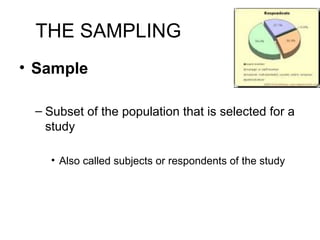
THE SAMPLING
• Sample

 – Subset of the population that is selected for a
   study

    • Also called subjects or respondents of the study
• Sampling

  – Process of choosing a representative portion
    of the entire population.

  – an integral part of research methodology.

  – involves selecting a group of people, events,
    behaviors or other elements with which to
    conduct a study.
• Element

  – most basic unit about which information is
    collected.
• Representativeness

  – means that the sample must be like the
    population in as many ways as possible.

  – The accessible population must be
    representative of the target population.
• Example of a sample:

  – The population of BSN students is 600, only
    200 BSN students are included as the target
    population and only 100 students are chosen
    as samples for the actual study.
Eligibility Criteria
• Eligibility Criteria

• A description chosen by the researcher to define
  which elements should be included in or excluded from
  the population.

• Such criteria may include sex, age, marital status,
  education level and diagnosis.
SAMPLING THEORY
SAMPLING THEORY

• is developed to determine mathematically
  the most effective way to acquire a sample
  that would accurately reflect     the
  population under study.
• Key concepts of sampling theory includes:

  – Sampling unit
    • refers to specific place or location which can be
      used during sampling process.


  – Sampling frame
    • describes the complete list of sampling units from
      which the sample is drawn.
SAMPLING CRITERIA
SAMPLING CRITERIA

• refers to the essential characteristics of a
  subject or respondent such as ability to
  read and write responses on the data
  collection instruments.
The steps involved in sampling
               include:
• Identify the target population

• Identify the subject or respondent population

• Specify the criteria for subject or respondent selection

• Specify the sampling design

• Recruit the subjects
SAMPLE SIZE
SAMPLE SIZE


• Prior to the selection of sampling technique, the
  nurse-researcher must first determine the size of
  the sample.
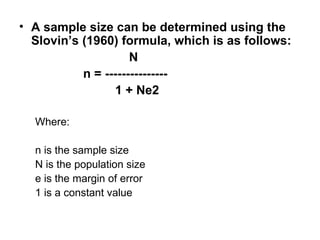
• A sample size can be determined using the
  Slovin’s (1960) formula, which is as follows:
                     N
           n = ---------------
                 1 + Ne2

  Where:

  n is the sample size
  N is the population size
  e is the margin of error
  1 is a constant value
• Example:

  – From the population of 10,000 clients with
    tuberculosis, a nurse-researcher selected a
    sample size with a margin of error of 5%.

  – The desired sample size is computed to be
    385
TYPES OF SAMPLING
   TECHNIQUES
TYPES OF SAMPLING
           TECHNIQUES
• two basic sampling techniques used in
  nursing research:

  – probability (random) sampling

  – nonprobability (nonrandom) sampling.
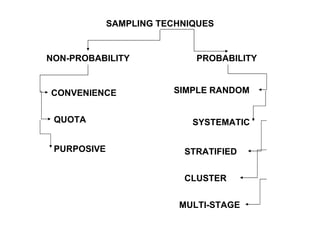
SAMPLING TECHNIQUES


NON-PROBABILITY             PROBABILITY


CONVENIENCE             SIMPLE RANDOM


 QUOTA                      SYSTEMATIC


 PURPOSIVE                STRATIFIED


                          CLUSTER


                         MULTI-STAGE
• Probability Sampling

• Involves the selection of elements from the population
  using random in which each element of the
  population has an equal and independent chance of
  being chosen.
Four Classification of Probability
               Sampling
1. Simple Random Sampling

•   Each member of the population has an equal chance of being included in
    the samples

•   Most commonly used method is the       lottery or Fish Bowl
    technique

•   In using the lottery method, there is a need for a complete listing of the
    members of the population.

•   The names or codes of all members are written on pieces of paper cards
    and placed in a container.

•   The researcher draws the desired number of sample from the container.

•   The process is relatively easy for small population but relatively difficult
    and time consuming for a large population
2. Systematic Sampling Technique

• Type of probability sampling which selects samples
  by following some rules set by the researcher which
  involves selecting the Kth member where the random
   start is determined.

• A system is a plan for selecting members after a starting
  point or random start has been determined.

• Then every nth member of the population will be
  determined by the system in drawing or selecting the
  members of the sample
3. Stratified Random Sampling

  – Type of probability sampling which selects members
    of the sample proportionally from each subpopulation
    or stratum.

  – Used when the population is too large to handle and
    is divided into subgroups (called strata)

  – Samples per stratum are then randomly selected,
    but considerations must be given to the sizes of the
    random samples to be drawn from the subgroups.

  – An example of procedure to use is proportional
    allocation which selects the sample sizes proportional
    to the sizes of the different subgroups.
4. Cluster Sampling

  – Used when population is divided into groups
    or clusters

  – Samples are selected in groups rather
    than individuals which is employed into a
    large-scale survey
5. Multi-Stage Sampling

  – Selects samples using more than two
    sampling techniques

  – Rarely used because of the complexity of its
    application

  – Requires a lot of effort, time, and cost
2. Non-Probability Sampling

  – Involves the selection of elements from a
    population using nonrandom procedures.
Characteristics of Non-Probability
             Sampling
2. The members of sample are drawn or selected based
   on the judgment of the researcher.

4. The results of these techniques are relatively biased.

6. The techniques lack objectivity in terms of the
   selection of samples.

8. The samples are not so reliable.

5. The techniques are convenient and economical to use.
Types of Non-Probability
       Sampling
Types of Non-Probability
            Sampling
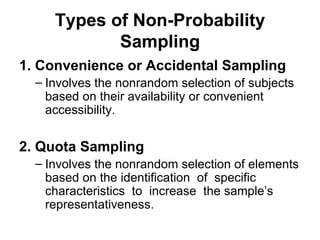
1. Convenience or Accidental Sampling
  – Involves the nonrandom selection of subjects
    based on their availability or convenient
    accessibility.


2. Quota Sampling
  – Involves the nonrandom selection of elements
    based on the identification of specific
    characteristics to increase the sample’s
    representativeness.
Types of Non-Probability
             Sampling
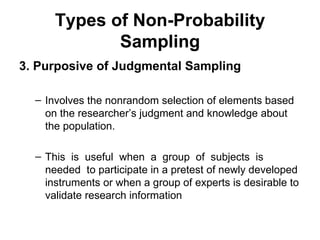
3. Purposive of Judgmental Sampling

  – Involves the nonrandom selection of elements based
    on the researcher’s judgment and knowledge about
    the population.

  – This is useful when a group of subjects is
    needed to participate in a pretest of newly developed
    instruments or when a group of experts is desirable to
    validate research information

Chapter 8-SAMPLE & SAMPLING TECHNIQUES

  • 1.
  • 2.
    THE POPULATION • Consistsof the totality or aggregate of the observations with which the researcher is concerned
  • 3.
    • Population isan accessible group of people who meets a well-defined set of eligibility criteria. • The utmost importance in selecting a population is that – “the population should be clearly defined so that the sample can be accurately identified.”
  • 4.
    • The SpecificPopulation types are: – Target population • is a group of individuals who meets the criteria. – Subject or respondent population • refers to a group of individuals participating in the study. – Strata or stratum • is described as a mutually exclusive segment of a population established by one or more characteristics.
  • 5.
    THE SAMPLING • Sample – Subset of the population that is selected for a study • Also called subjects or respondents of the study
  • 6.
    • Sampling – Process of choosing a representative portion of the entire population. – an integral part of research methodology. – involves selecting a group of people, events, behaviors or other elements with which to conduct a study.
  • 7.
    • Element – most basic unit about which information is collected.
  • 8.
    • Representativeness – means that the sample must be like the population in as many ways as possible. – The accessible population must be representative of the target population.
  • 9.
    • Example ofa sample: – The population of BSN students is 600, only 200 BSN students are included as the target population and only 100 students are chosen as samples for the actual study.
  • 10.
  • 11.
    • Eligibility Criteria •A description chosen by the researcher to define which elements should be included in or excluded from the population. • Such criteria may include sex, age, marital status, education level and diagnosis.
  • 12.
  • 13.
    SAMPLING THEORY • isdeveloped to determine mathematically the most effective way to acquire a sample that would accurately reflect the population under study.
  • 14.
    • Key conceptsof sampling theory includes: – Sampling unit • refers to specific place or location which can be used during sampling process. – Sampling frame • describes the complete list of sampling units from which the sample is drawn.
  • 15.
  • 16.
    SAMPLING CRITERIA • refersto the essential characteristics of a subject or respondent such as ability to read and write responses on the data collection instruments.
  • 17.
    The steps involvedin sampling include: • Identify the target population • Identify the subject or respondent population • Specify the criteria for subject or respondent selection • Specify the sampling design • Recruit the subjects
  • 18.
  • 19.
    SAMPLE SIZE • Priorto the selection of sampling technique, the nurse-researcher must first determine the size of the sample.
  • 20.
    • A samplesize can be determined using the Slovin’s (1960) formula, which is as follows: N n = --------------- 1 + Ne2 Where: n is the sample size N is the population size e is the margin of error 1 is a constant value
  • 21.
    • Example: – From the population of 10,000 clients with tuberculosis, a nurse-researcher selected a sample size with a margin of error of 5%. – The desired sample size is computed to be 385
  • 22.
  • 23.
    TYPES OF SAMPLING TECHNIQUES • two basic sampling techniques used in nursing research: – probability (random) sampling – nonprobability (nonrandom) sampling.
  • 24.
    SAMPLING TECHNIQUES NON-PROBABILITY PROBABILITY CONVENIENCE SIMPLE RANDOM QUOTA SYSTEMATIC PURPOSIVE STRATIFIED CLUSTER MULTI-STAGE
  • 25.
    • Probability Sampling •Involves the selection of elements from the population using random in which each element of the population has an equal and independent chance of being chosen.
  • 26.
    Four Classification ofProbability Sampling 1. Simple Random Sampling • Each member of the population has an equal chance of being included in the samples • Most commonly used method is the lottery or Fish Bowl technique • In using the lottery method, there is a need for a complete listing of the members of the population. • The names or codes of all members are written on pieces of paper cards and placed in a container. • The researcher draws the desired number of sample from the container. • The process is relatively easy for small population but relatively difficult and time consuming for a large population
  • 27.
    2. Systematic SamplingTechnique • Type of probability sampling which selects samples by following some rules set by the researcher which involves selecting the Kth member where the random start is determined. • A system is a plan for selecting members after a starting point or random start has been determined. • Then every nth member of the population will be determined by the system in drawing or selecting the members of the sample
  • 28.
    3. Stratified RandomSampling – Type of probability sampling which selects members of the sample proportionally from each subpopulation or stratum. – Used when the population is too large to handle and is divided into subgroups (called strata) – Samples per stratum are then randomly selected, but considerations must be given to the sizes of the random samples to be drawn from the subgroups. – An example of procedure to use is proportional allocation which selects the sample sizes proportional to the sizes of the different subgroups.
  • 29.
    4. Cluster Sampling – Used when population is divided into groups or clusters – Samples are selected in groups rather than individuals which is employed into a large-scale survey
  • 30.
    5. Multi-Stage Sampling – Selects samples using more than two sampling techniques – Rarely used because of the complexity of its application – Requires a lot of effort, time, and cost
  • 31.
  • 32.
    2. Non-Probability Sampling – Involves the selection of elements from a population using nonrandom procedures.
  • 33.
    Characteristics of Non-Probability Sampling 2. The members of sample are drawn or selected based on the judgment of the researcher. 4. The results of these techniques are relatively biased. 6. The techniques lack objectivity in terms of the selection of samples. 8. The samples are not so reliable. 5. The techniques are convenient and economical to use.
  • 34.
  • 35.
    Types of Non-Probability Sampling 1. Convenience or Accidental Sampling – Involves the nonrandom selection of subjects based on their availability or convenient accessibility. 2. Quota Sampling – Involves the nonrandom selection of elements based on the identification of specific characteristics to increase the sample’s representativeness.
  • 36.
    Types of Non-Probability Sampling 3. Purposive of Judgmental Sampling – Involves the nonrandom selection of elements based on the researcher’s judgment and knowledge about the population. – This is useful when a group of subjects is needed to participate in a pretest of newly developed instruments or when a group of experts is desirable to validate research information