Reducibility
Limits of Computation
Clayton Johnson
Edna Reiter
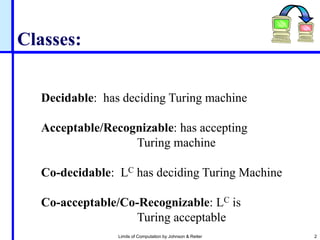
Classes:
Limits of Computation by Johnson & Reiter 2
Decidable: has deciding Turing machine
Acceptable/Recognizable: has accepting
Turing machine
Co-decidable: LC has deciding Turing Machine
Co-acceptable/Co-Recognizable: LC is
Turing acceptable
Some Familiar Languages
Limits of Computation by Johnson & Reiter 3
co-TM recognizable
TM-recognizable
TM decidable
EMPTY = { M | M is a TM with L(M)= }
ACCEPT = { M,w | M is a TM that accepts w }
ACCEPT_ε = { M | M is a TM that accepts ε}
You should be able to prove:
Limits of Computation by Johnson & Reiter 4
(1) ACCEPT is Turing-acceptable/recognizable
(2) EMPTY is co-Turing-acceptable
(co-Turing-recognizable)
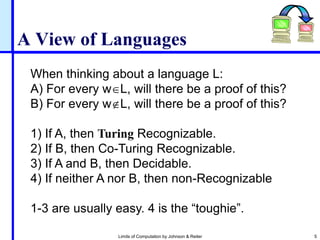
A View of Languages
Limits of Computation by Johnson & Reiter 5
When thinking about a language L:
A) For every wL, will there be a proof of this?
B) For every wL, will there be a proof of this?
1) If A, then Turing Recognizable.
2) If B, then Co-Turing Recognizable.
3) If A and B, then Decidable.
4) If neither A nor B, then non-Recognizable
1-3 are usually easy. 4 is the “toughie”.
Halting Problem
Limits of Computation by Johnson & Reiter 6
Theorem : The ‘halting problem’ language
HALT = { M,w | the TM M halts on input w }
is undecidable (but of course recognizable).
Definition : The ‘halting problem’ language
HALT = { M,w | the TM M halts on input w }
Restated: Given a Machine and a string, does
the machine halt (not loop) on the string?
Halting Problem Proof 1
Limits of Computation by Johnson & Reiter 7
Theorem : The ‘halting problem’ language
HALT = { M,w | the TM M halts on input w }
is undecidable
Proof: Let G be a TM that decides HALT. The
following TM then decides ACCEPT:
Mdecide-ACCEPT 1) Run G to decide halting
2) If G rejected M,w then “reject”
3) If G accepted M,w, simulate M on w until it
halts.
4) If M has accepted, “accept”; otherwise, “reject”.”
then copy (reject/accept) output of M on w.
Classic pattern
Limits of Computation by Johnson & Reiter 8
1. Build a new Turing machine that has M,w built into it
2. Run M on w
3. If M accepts w, do something to produce YES of QUESTION
4. If M rejects w, do something to produce NO of QUESTION
5. If M loops on w, won’t ever produce a YES (or a NO)
Thus, if get a YES of QUESTION,
M must have accepted w
Otherwise
M rejected w or looped on w
QUESTION is UNDECIDABLE
Classic pattern applied to HALT
Limits of Computation by Johnson & Reiter 9
1. Start with a Turing machine M and its input w.
2. Build a new machine that first runs M on w
3. Now, we want to build a new M´ so that
M accepts w  M´ accepts w
M rejects w  M´ loops on w
M loops on w  we can’t put anything here
(and moreover, we don’t need to!).
Now,
Yes of halt M´  yes of M accept w
No of halt M´  no of M accept w
Answer yes/no to halt answers yes/no to accept
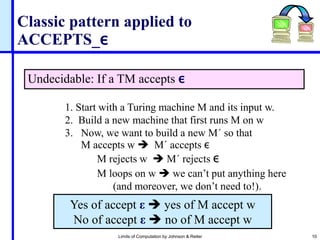
Classic pattern applied to
ACCEPTS_ε
Limits of Computation by Johnson & Reiter 10
1. Start with a Turing machine M and its input w.
2. Build a new machine that first runs M on w
3. Now, we want to build a new M´ so that
M accepts w  M´ accepts ε
M rejects w  M´ rejects ε
M loops on w  we can’t put anything here
(and moreover, we don’t need to!).
Undecidable: If a TM accepts ε
Yes of accept ε  yes of M accept w
No of accept ε  no of M accept w
Reducibility
Limits of Computation by Johnson & Reiter 11
It required quite some effort to prove that ACCEPT is
not TM-decidable.
But now we can build on this result as follows:
If “L is TM-decidable” implies “ACCEPT is
decidable”, then L is not decidable.
Typical proof outline:
Let M be the TM that decides L; with this M as a
subroutine, the following TM [….] decides ACCEPT.
Conclusion: M is not TM-decidable.
Reducible P1 and P2 decision problems
Limits of Computation by Johnson & Reiter 12
´
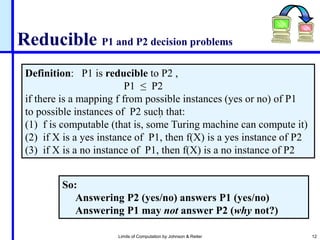
Definition: P1 is reducible to P2 ,
P1 ≤ P2
if there is a mapping f from possible instances (yes or no) of P1
to possible instances of P2 such that:
(1) f is computable (that is, some Turing machine can compute it)
(2) if X is a yes instance of P1, then f(X) is a yes instance of P2
(3) if X is a no instance of P1, then f(X) is a no instance of P2
So:
Answering P2 (yes/no) answers P1 (yes/no)
Answering P1 may not answer P2 (why not?)
Reductions in Math
Limits of Computation by Johnson & Reiter 13
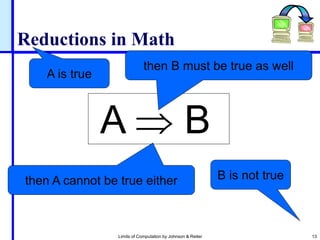
A  B
A is true
then B must be true as well
B is not true
then A cannot be true either
Reductions in CS
Limits of Computation by Johnson & Reiter 14
we can do A
we can do B as well
we cannot do B
we cannot do A either
Here B is deciding the language ACCEPT
we can do A  we can do B
B ≤ A
A is “as hard or harder than” B
Reductions in CS
Limits of Computation by Johnson & Reiter 15
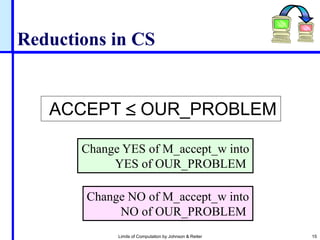
ACCEPT  OUR_PROBLEM
Change YES of M_accept_w into
YES of OUR_PROBLEM
Change NO of M_accept_w into
NO of OUR_PROBLEM
Emptiness Testing (1)
Limits of Computation by Johnson & Reiter 16
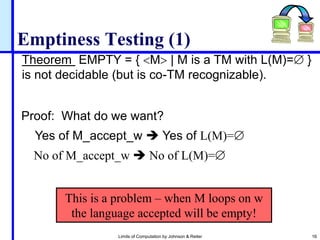
Theorem EMPTY = { M | M is a TM with L(M)= }
is not decidable (but is co-TM recognizable).
Proof: What do we want?
Yes of M_accept_w  Yes of L(M)=
No of M_accept_w  No of L(M)=
This is a problem – when M loops on w
the language accepted will be empty!
Emptiness Testing (2)
Limits of Computation by Johnson & Reiter 17
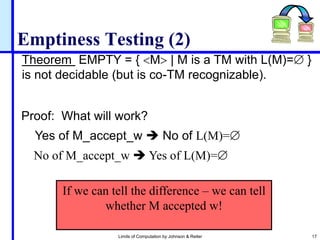
Theorem EMPTY = { M | M is a TM with L(M)= }
is not decidable (but is co-TM recognizable).
Proof: What will work?
Yes of M_accept_w  No of L(M)=
No of M_accept_w  Yes of L(M)=
If we can tell the difference – we can tell
whether M accepted w!
Emptiness Testing (3)
Limits of Computation by Johnson & Reiter 18
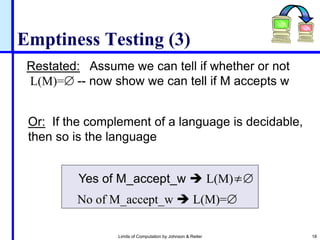
Restated: Assume we can tell if whether or not
L(M)= -- now show we can tell if M accepts w
Or: If the complement of a language is decidable,
then so is the language
Yes of M_accept_w  L(M)≠
No of M_accept_w  L(M)=
Emptiness Testing (4)
Limits of Computation by Johnson & Reiter 19
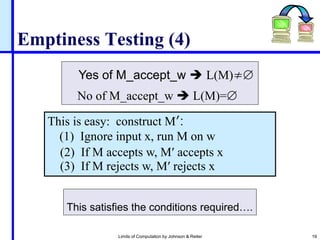
Yes of M_accept_w  L(M)≠
No of M_accept_w  L(M)=
This is easy: construct M′:
(1) Ignore input x, run M on w
(2) If M accepts w, M′ accepts x
(3) If M rejects w, M′ rejects x
This satisfies the conditions required….
Rice’s Theorem
Limits of Computation by Johnson & Reiter 20
Rice’s Theorem: Any nontrivial property of TM
languages is undecidable.
Nontrivial: Some languages have the property,
some do not.
Note: property of languages, not of the machines
(thus, it may be decidable to answer something
such as “machine has at least 200 states”)
Proof of Rice’s Theorem (1)
Limits of Computation by Johnson & Reiter 21
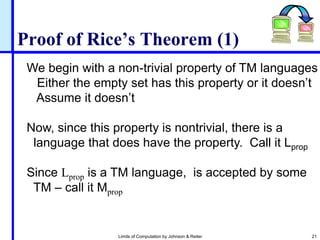
We begin with a non-trivial property of TM languages
Either the empty set has this property or it doesn’t
Assume it doesn’t
Now, since this property is nontrivial, there is a
language that does have the property. Call it Lprop
Since Lprop is a TM language, is accepted by some
TM – call it Mprop
Rice proof (2)
Limits of Computation by Johnson & Reiter 22
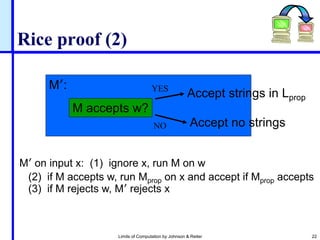
M′:
M accepts w?
Accept strings in Lprop
Accept no strings
YES
NO
M′ on input x: (1) ignore x, run M on w
(2) if M accepts w, run Mprop on x and accept if Mprop accepts
(3) if M rejects w, M′ rejects x
Proof of Rice (3)
Limits of Computation by Johnson & Reiter 23
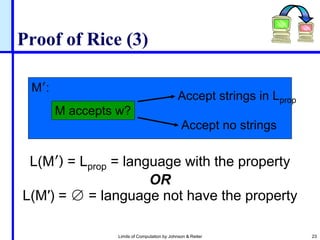
M′:
M accepts w?
Accept strings in Lprop
Accept no strings
L(M′) = Lprop = language with the property
OR
L(M′) = ∅ = language not have the property
Consequences of Rice’s Thm.
Limits of Computation by Johnson & Reiter 24
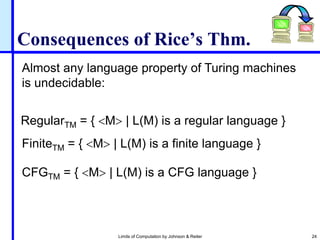
Almost any language property of Turing machines
is undecidable:
RegularTM = { M | L(M) is a regular language }
FiniteTM = { M | L(M) is a finite language }
CFGTM = { M | L(M) is a CFG language }
Halting Problem (again!)
Limits of Computation by Johnson & Reiter 25
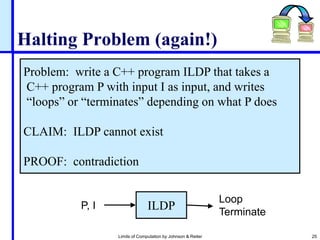
Problem: write a C++ program ILDP that takes a
C++ program P with input I as input, and writes
“loops” or “terminates” depending on what P does
CLAIM: ILDP cannot exist
PROOF: contradiction
ILDP
P, I
Loop
Terminate
Halting Problem (2)
Limits of Computation by Johnson & Reiter 26
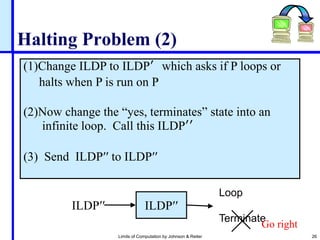
(1)Change ILDP to ILDP′ which asks if P loops or
halts when P is run on P
(2)Now change the “yes, terminates” state into an
infinite loop. Call this ILDP′′
(3) Send ILDP′′ to ILDP′′
ILDP′′
ILDP′′
Loop
Terminate
Go right
Halting Problem (3)
Limits of Computation by Johnson & Reiter 27
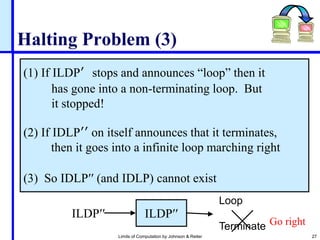
(1) If ILDP′ stops and announces “loop” then it
has gone into a non-terminating loop. But
it stopped!
(2) If IDLP′′ on itself announces that it terminates,
then it goes into a infinite loop marching right
(3) So IDLP′′ (and IDLP) cannot exist
ILDP′′
ILDP′′
Loop
Terminate Go right
Computation Histories
Limits of Computation by Johnson & Reiter 28
An accepting computation history for a TM M on a
string w consists of a sequence of configurations
C1,C2,…,Ck such that the following properties hold:
1. C1 is the start configuration of M on w
2. Each Cj+1 follows properly from Cj
3. Ck is an accepting configuration
Observation: Stating “M,wACCEPT” is
Equivalent to stating “There is no accepting
computation history C1,…,Ck for M on w”.
Computation Histories
Limits of Computation by Johnson & Reiter 29
FACT: For many machines, there are only a finite
number of possible configurations.
If you run such a machine long enough, it must
repeat (re-enter) one of its configurations
Obviously, a deterministic machine that repeats
a previous configuration is in an infinite loop.
Computation Histories
Limits of Computation by Johnson & Reiter 30
FACT: For many machines, there are only a finite
number of possible configurations. BUT NOT
TURING MACHINES!!!
Which category does your PC belong to? Your
supercomputer? Depends on point of view…
Any machine with a finite memory however does
only have a finite number of configurations.
If we had more time…
The Post Correspondence Problem (PCP)
Given Σ, and n pairs (ai, bi), i=1,n, with ai and
bi strings from Σ+ (so no string can be
empty), is there a sequence i1, i2, … ik of
integers, not necessarily distinct, 1 ≤ i,j ≤ n,
so that :
ai1 ai2 ai3 … aik = bi1 bi2… … bik
Limits of Computation by Johnson & Reiter 31
If we had more time…
Corollary to PCP
The following is undecidable: Given a
grammar G, is it ambiguous (does some
string have at least two parse trees)?
Limits of Computation by Johnson & Reiter 32

Chapter 7 Undecidable Reducible_Theory_of_Computation.ppt

  • 1.
  • 2.
    Classes: Limits of Computationby Johnson & Reiter 2 Decidable: has deciding Turing machine Acceptable/Recognizable: has accepting Turing machine Co-decidable: LC has deciding Turing Machine Co-acceptable/Co-Recognizable: LC is Turing acceptable
  • 3.
    Some Familiar Languages Limitsof Computation by Johnson & Reiter 3 co-TM recognizable TM-recognizable TM decidable EMPTY = { M | M is a TM with L(M)= } ACCEPT = { M,w | M is a TM that accepts w } ACCEPT_ε = { M | M is a TM that accepts ε}
  • 4.
    You should beable to prove: Limits of Computation by Johnson & Reiter 4 (1) ACCEPT is Turing-acceptable/recognizable (2) EMPTY is co-Turing-acceptable (co-Turing-recognizable)
  • 5.
    A View ofLanguages Limits of Computation by Johnson & Reiter 5 When thinking about a language L: A) For every wL, will there be a proof of this? B) For every wL, will there be a proof of this? 1) If A, then Turing Recognizable. 2) If B, then Co-Turing Recognizable. 3) If A and B, then Decidable. 4) If neither A nor B, then non-Recognizable 1-3 are usually easy. 4 is the “toughie”.
  • 6.
    Halting Problem Limits ofComputation by Johnson & Reiter 6 Theorem : The ‘halting problem’ language HALT = { M,w | the TM M halts on input w } is undecidable (but of course recognizable). Definition : The ‘halting problem’ language HALT = { M,w | the TM M halts on input w } Restated: Given a Machine and a string, does the machine halt (not loop) on the string?
  • 7.
    Halting Problem Proof1 Limits of Computation by Johnson & Reiter 7 Theorem : The ‘halting problem’ language HALT = { M,w | the TM M halts on input w } is undecidable Proof: Let G be a TM that decides HALT. The following TM then decides ACCEPT: Mdecide-ACCEPT 1) Run G to decide halting 2) If G rejected M,w then “reject” 3) If G accepted M,w, simulate M on w until it halts. 4) If M has accepted, “accept”; otherwise, “reject”.” then copy (reject/accept) output of M on w.
  • 8.
    Classic pattern Limits ofComputation by Johnson & Reiter 8 1. Build a new Turing machine that has M,w built into it 2. Run M on w 3. If M accepts w, do something to produce YES of QUESTION 4. If M rejects w, do something to produce NO of QUESTION 5. If M loops on w, won’t ever produce a YES (or a NO) Thus, if get a YES of QUESTION, M must have accepted w Otherwise M rejected w or looped on w QUESTION is UNDECIDABLE
  • 9.
    Classic pattern appliedto HALT Limits of Computation by Johnson & Reiter 9 1. Start with a Turing machine M and its input w. 2. Build a new machine that first runs M on w 3. Now, we want to build a new M´ so that M accepts w  M´ accepts w M rejects w  M´ loops on w M loops on w  we can’t put anything here (and moreover, we don’t need to!). Now, Yes of halt M´  yes of M accept w No of halt M´  no of M accept w Answer yes/no to halt answers yes/no to accept
  • 10.
    Classic pattern appliedto ACCEPTS_ε Limits of Computation by Johnson & Reiter 10 1. Start with a Turing machine M and its input w. 2. Build a new machine that first runs M on w 3. Now, we want to build a new M´ so that M accepts w  M´ accepts ε M rejects w  M´ rejects ε M loops on w  we can’t put anything here (and moreover, we don’t need to!). Undecidable: If a TM accepts ε Yes of accept ε  yes of M accept w No of accept ε  no of M accept w
  • 11.
    Reducibility Limits of Computationby Johnson & Reiter 11 It required quite some effort to prove that ACCEPT is not TM-decidable. But now we can build on this result as follows: If “L is TM-decidable” implies “ACCEPT is decidable”, then L is not decidable. Typical proof outline: Let M be the TM that decides L; with this M as a subroutine, the following TM [….] decides ACCEPT. Conclusion: M is not TM-decidable.
  • 12.
    Reducible P1 andP2 decision problems Limits of Computation by Johnson & Reiter 12 ´ Definition: P1 is reducible to P2 , P1 ≤ P2 if there is a mapping f from possible instances (yes or no) of P1 to possible instances of P2 such that: (1) f is computable (that is, some Turing machine can compute it) (2) if X is a yes instance of P1, then f(X) is a yes instance of P2 (3) if X is a no instance of P1, then f(X) is a no instance of P2 So: Answering P2 (yes/no) answers P1 (yes/no) Answering P1 may not answer P2 (why not?)
  • 13.
    Reductions in Math Limitsof Computation by Johnson & Reiter 13 A  B A is true then B must be true as well B is not true then A cannot be true either
  • 14.
    Reductions in CS Limitsof Computation by Johnson & Reiter 14 we can do A we can do B as well we cannot do B we cannot do A either Here B is deciding the language ACCEPT we can do A  we can do B B ≤ A A is “as hard or harder than” B
  • 15.
    Reductions in CS Limitsof Computation by Johnson & Reiter 15 ACCEPT  OUR_PROBLEM Change YES of M_accept_w into YES of OUR_PROBLEM Change NO of M_accept_w into NO of OUR_PROBLEM
  • 16.
    Emptiness Testing (1) Limitsof Computation by Johnson & Reiter 16 Theorem EMPTY = { M | M is a TM with L(M)= } is not decidable (but is co-TM recognizable). Proof: What do we want? Yes of M_accept_w  Yes of L(M)= No of M_accept_w  No of L(M)= This is a problem – when M loops on w the language accepted will be empty!
  • 17.
    Emptiness Testing (2) Limitsof Computation by Johnson & Reiter 17 Theorem EMPTY = { M | M is a TM with L(M)= } is not decidable (but is co-TM recognizable). Proof: What will work? Yes of M_accept_w  No of L(M)= No of M_accept_w  Yes of L(M)= If we can tell the difference – we can tell whether M accepted w!
  • 18.
    Emptiness Testing (3) Limitsof Computation by Johnson & Reiter 18 Restated: Assume we can tell if whether or not L(M)= -- now show we can tell if M accepts w Or: If the complement of a language is decidable, then so is the language Yes of M_accept_w  L(M)≠ No of M_accept_w  L(M)=
  • 19.
    Emptiness Testing (4) Limitsof Computation by Johnson & Reiter 19 Yes of M_accept_w  L(M)≠ No of M_accept_w  L(M)= This is easy: construct M′: (1) Ignore input x, run M on w (2) If M accepts w, M′ accepts x (3) If M rejects w, M′ rejects x This satisfies the conditions required….
  • 20.
    Rice’s Theorem Limits ofComputation by Johnson & Reiter 20 Rice’s Theorem: Any nontrivial property of TM languages is undecidable. Nontrivial: Some languages have the property, some do not. Note: property of languages, not of the machines (thus, it may be decidable to answer something such as “machine has at least 200 states”)
  • 21.
    Proof of Rice’sTheorem (1) Limits of Computation by Johnson & Reiter 21 We begin with a non-trivial property of TM languages Either the empty set has this property or it doesn’t Assume it doesn’t Now, since this property is nontrivial, there is a language that does have the property. Call it Lprop Since Lprop is a TM language, is accepted by some TM – call it Mprop
  • 22.
    Rice proof (2) Limitsof Computation by Johnson & Reiter 22 M′: M accepts w? Accept strings in Lprop Accept no strings YES NO M′ on input x: (1) ignore x, run M on w (2) if M accepts w, run Mprop on x and accept if Mprop accepts (3) if M rejects w, M′ rejects x
  • 23.
    Proof of Rice(3) Limits of Computation by Johnson & Reiter 23 M′: M accepts w? Accept strings in Lprop Accept no strings L(M′) = Lprop = language with the property OR L(M′) = ∅ = language not have the property
  • 24.
    Consequences of Rice’sThm. Limits of Computation by Johnson & Reiter 24 Almost any language property of Turing machines is undecidable: RegularTM = { M | L(M) is a regular language } FiniteTM = { M | L(M) is a finite language } CFGTM = { M | L(M) is a CFG language }
  • 25.
    Halting Problem (again!) Limitsof Computation by Johnson & Reiter 25 Problem: write a C++ program ILDP that takes a C++ program P with input I as input, and writes “loops” or “terminates” depending on what P does CLAIM: ILDP cannot exist PROOF: contradiction ILDP P, I Loop Terminate
  • 26.
    Halting Problem (2) Limitsof Computation by Johnson & Reiter 26 (1)Change ILDP to ILDP′ which asks if P loops or halts when P is run on P (2)Now change the “yes, terminates” state into an infinite loop. Call this ILDP′′ (3) Send ILDP′′ to ILDP′′ ILDP′′ ILDP′′ Loop Terminate Go right
  • 27.
    Halting Problem (3) Limitsof Computation by Johnson & Reiter 27 (1) If ILDP′ stops and announces “loop” then it has gone into a non-terminating loop. But it stopped! (2) If IDLP′′ on itself announces that it terminates, then it goes into a infinite loop marching right (3) So IDLP′′ (and IDLP) cannot exist ILDP′′ ILDP′′ Loop Terminate Go right
  • 28.
    Computation Histories Limits ofComputation by Johnson & Reiter 28 An accepting computation history for a TM M on a string w consists of a sequence of configurations C1,C2,…,Ck such that the following properties hold: 1. C1 is the start configuration of M on w 2. Each Cj+1 follows properly from Cj 3. Ck is an accepting configuration Observation: Stating “M,wACCEPT” is Equivalent to stating “There is no accepting computation history C1,…,Ck for M on w”.
  • 29.
    Computation Histories Limits ofComputation by Johnson & Reiter 29 FACT: For many machines, there are only a finite number of possible configurations. If you run such a machine long enough, it must repeat (re-enter) one of its configurations Obviously, a deterministic machine that repeats a previous configuration is in an infinite loop.
  • 30.
    Computation Histories Limits ofComputation by Johnson & Reiter 30 FACT: For many machines, there are only a finite number of possible configurations. BUT NOT TURING MACHINES!!! Which category does your PC belong to? Your supercomputer? Depends on point of view… Any machine with a finite memory however does only have a finite number of configurations.
  • 31.
    If we hadmore time… The Post Correspondence Problem (PCP) Given Σ, and n pairs (ai, bi), i=1,n, with ai and bi strings from Σ+ (so no string can be empty), is there a sequence i1, i2, … ik of integers, not necessarily distinct, 1 ≤ i,j ≤ n, so that : ai1 ai2 ai3 … aik = bi1 bi2… … bik Limits of Computation by Johnson & Reiter 31
  • 32.
    If we hadmore time… Corollary to PCP The following is undecidable: Given a grammar G, is it ambiguous (does some string have at least two parse trees)? Limits of Computation by Johnson & Reiter 32