5-5 Direct Variation Holt Algebra 1 Lesson Quiz Lesson Presentation Warm Up
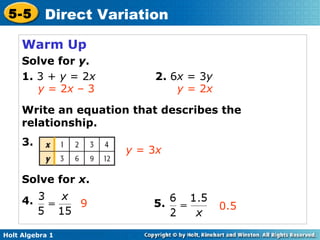
Warm Up Solve for  y . 1.  3 +  y  = 2 x   2.  6 x  = 3 y Write an equation that describes the relationship. 3. y  = 2 x y  = 2 x  – 3 4. 5. y  = 3 x 9 0.5 Solve for  x .
Identify, write, and graph direct variation. Objective
Vocabulary direct variation constant of variation
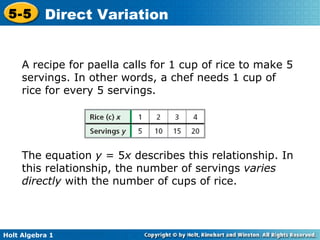
A recipe for paella calls for 1 cup of rice to make 5 servings. In other words, a chef needs 1 cup of rice for every 5 servings.  The equation  y  = 5 x  describes this relationship. In this relationship, the number of servings  varies directly  with the number of cups of rice.
A  direct variation  is a special type of linear relationship that can be written in the form  y = kx , where  k  is a nonzero constant called the  constant of variation.
Example 1A: Identifying Direct Variations from Equations Tell whether the equation represents a direct variation. If so, identify the constant of variation. y =  3 x This equation represents a direct variation because it is in the form of  y = kx . The constant of variation is 3.
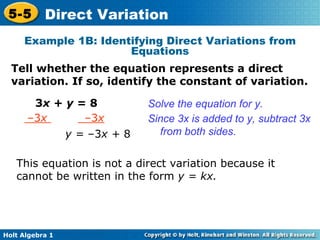
3 x  +  y  = 8 Solve the equation for y. Since 3x is added to y, subtract 3x from both sides. This equation is not a direct variation because it cannot be written in the form  y = kx. Example 1B: Identifying Direct Variations from Equations Tell whether the equation represents a direct variation. If so, identify the constant of variation. – 3 x  –3 x y =  –3 x +  8
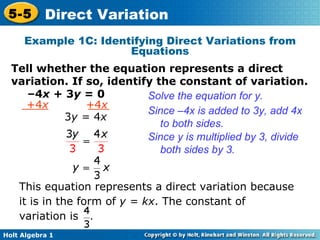
– 4 x  + 3 y  = 0 Solve the equation for y. Since –4x is added to 3y, add 4x to both sides. Since y is multiplied by 3, divide both sides by 3. Example 1C: Identifying Direct Variations from Equations Tell whether the equation represents a direct variation. If so, identify the constant of variation. +4 x  + 4 x 3 y =  4 x  This equation represents a direct variation because it is in the form of  y = kx . The constant of variation is  .
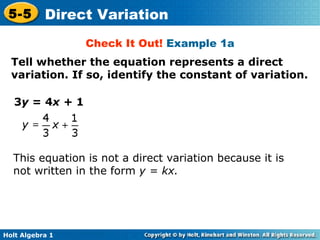
Check It Out!  Example 1a 3 y  = 4 x +  1 This equation is not a direct variation because it is not written in the form  y = kx. Tell whether the equation represents a direct variation. If so, identify the constant of variation.
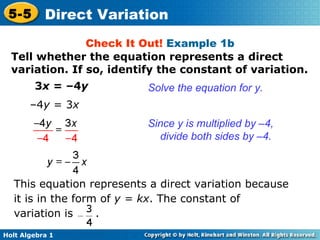
Check It Out!  Example 1b 3 x  = –4 y  Solve the equation for y. – 4 y  = 3 x  Since y is multiplied by –4, divide both sides by –4. Tell whether the equation represents a direct variation. If so, identify the constant of variation. This equation represents a direct variation because it is in the form of  y = kx . The constant of variation is  .
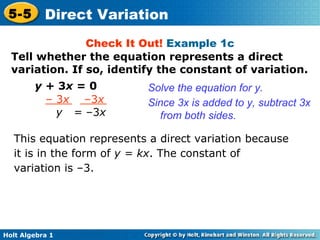
Check It Out!  Example 1c y +  3 x  = 0   Solve the equation for y. Since 3x is added to y, subtract 3x from both sides. This equation represents a direct variation because it is in the form of  y = kx . The constant of variation is –3. Tell whether the equation represents a direct variation. If so, identify the constant of variation. –  3 x   –3 x y  =  –3 x
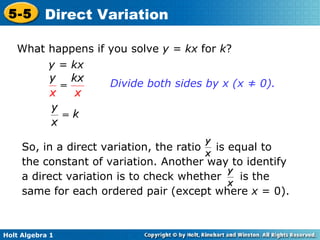
What happens if you solve  y = kx  for  k ? y = kx Divide both sides by x (x ≠ 0).  So, in a direct variation, the ratio  is equal to the constant of variation. Another way to identify a direct variation is to check whether  is the same for each ordered pair (except where  x  = 0).
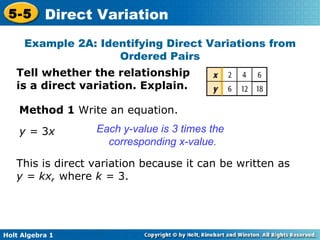
Example 2A: Identifying Direct Variations from Ordered Pairs Tell whether the relationship is a direct variation. Explain. Method 1  Write an equation. y =  3 x This is direct variation because it can be written as  y = kx,  where  k =  3. Each y-value is 3 times the corresponding x-value.
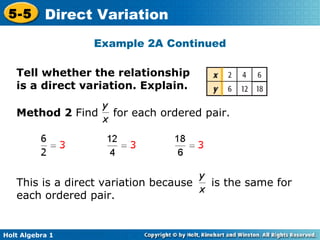
Example 2A Continued Tell whether the relationship is a direct variation. Explain. Method 2  Find  for each ordered pair. This is a direct variation because  is the same for each ordered pair.
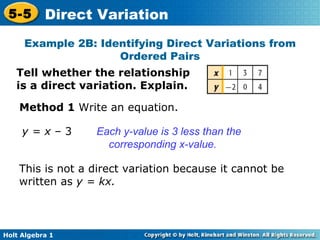
Method 1  Write an equation. y = x  – 3  Each y-value is 3 less than the corresponding x-value.  This is not a direct variation because it cannot be written as  y = kx. Example 2B: Identifying Direct Variations from Ordered Pairs Tell whether the relationship is a direct variation. Explain.
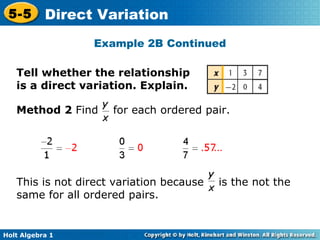
Method 2  Find  for each ordered pair. This is not direct variation because  is the not the same for all ordered pairs. Example 2B Continued Tell whether the relationship is a direct variation. Explain. …
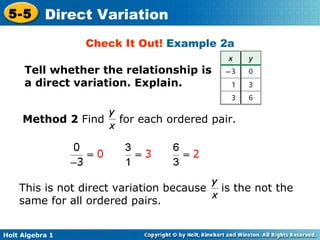
Check It Out!  Example 2a Tell whether the relationship is a direct variation. Explain.  Method 2  Find  for each ordered pair. This is not direct variation because  is the not the same for all ordered pairs.
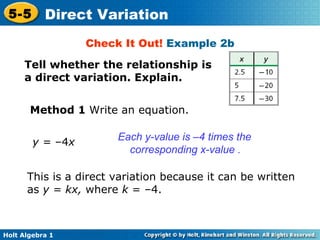
Tell whether the relationship is a direct variation. Explain.  Check It Out!  Example 2b Method 1  Write an equation. y =  –4 x Each y-value is –4 times the corresponding x-value . This is a direct variation because it can be written as  y = kx,  where  k  = –4.
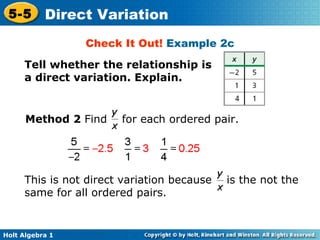
Tell whether the relationship is a direct variation. Explain.  Check It Out!  Example 2c Method 2  Find  for each ordered pair. This is not direct variation because  is the not the same for all ordered pairs.
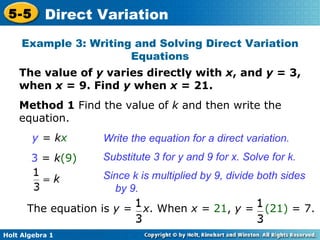
Example 3: Writing and Solving Direct Variation Equations The value of  y  varies directly with  x , and  y  = 3, when  x  = 9. Find  y  when  x  = 21.  Method 1  Find the value of  k  and then write the equation. y  = k x Write the equation for a direct variation. 3  =  k (9) Substitute 3 for y and 9 for x. Solve for k.  Since k is multiplied by 9, divide both sides by 9. The equation is  y =   x . When  x =  21 ,  y =  (21)  = 7.
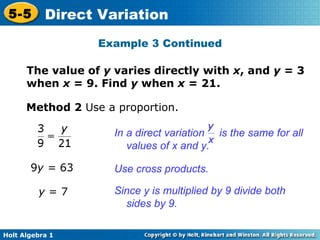
The value of  y  varies directly with  x , and  y  = 3 when  x  = 9. Find  y  when  x  = 21.  Method 2  Use a proportion. 9 y =  63 y  = 7 Use cross products. Since y is multiplied by 9 divide both sides by 9.  Example 3 Continued In a direct variation  is the same for all values of x and y.
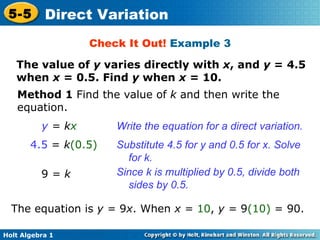
Check It Out!  Example 3 The value of  y  varies directly with  x , and  y  = 4.5 when  x  = 0.5. Find  y  when  x  = 10. Method 1  Find the value of  k  and then write the equation. y  = k x Write the equation for a direct variation. 4.5  =  k (0.5) Substitute 4.5 for y and 0.5 for x. Solve for k.  Since k is multiplied by 0.5, divide both sides by 0.5. The equation is  y =  9 x . When  x =  10 ,  y =  9 (10)  = 90. 9  = k
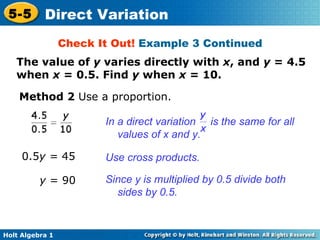
Check It Out!  Example 3 Continued Method 2  Use a proportion. 0.5 y =  45 y  = 90 Use cross products. Since y is multiplied by 0.5 divide both sides by 0.5.  The value of  y  varies directly with  x , and  y  = 4.5 when  x  = 0.5. Find  y  when  x  = 10. In a direct variation  is the same for all values of x and y.
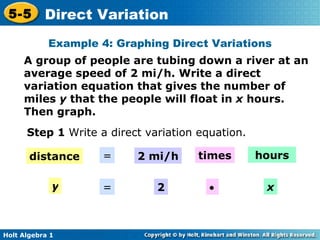
Example 4: Graphing Direct Variations A group of people are tubing down a river at an average speed of 2 mi/h. Write a direct variation equation that gives the number of miles  y  that the people will float in  x  hours. Then graph. Step 1  Write a direct variation equation. distance = 2 mi/h times hours y = 2  x
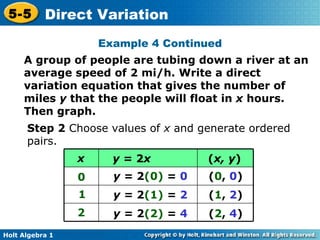
Example 4 Continued A group of people are tubing down a river at an average speed of 2 mi/h. Write a direct variation equation that gives the number of miles  y  that the people will float in  x  hours. Then graph. Step 2  Choose values of  x  and generate ordered pairs. x y =  2 x ( x, y ) 0 y =  2 (0)  =  0 ( 0 ,   0 ) 1 y =  2 (1)  =  2 ( 1 ,   2 ) 2 y =  2 (2)  =  4 ( 2 ,   4 )
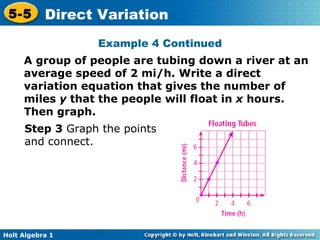
A group of people are tubing down a river at an average speed of 2 mi/h. Write a direct variation equation that gives the number of miles  y  that the people will float in  x  hours. Then graph. Step 3  Graph the points and connect. Example 4 Continued
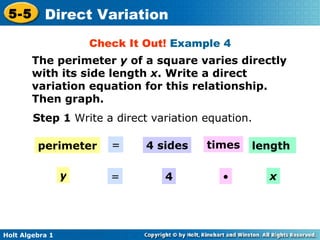
Check It Out!  Example 4 The perimeter  y  of a square varies directly with its side length  x . Write a direct variation equation for this relationship. Then graph. Step 1  Write a direct variation equation. perimeter = 4 sides times length y = 4 • x
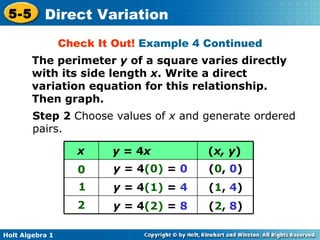
Check It Out!  Example 4 Continued Step 2  Choose values of  x  and generate ordered pairs. The perimeter  y  of a square varies directly with its side length  x . Write a direct variation equation for this relationship. Then graph. x y =  4 x ( x, y ) 0 y =  4 (0)  =  0 ( 0 ,   0 ) 1 y =  4 (1)  =  4 ( 1 ,   4 ) 2 y =  4 (2)  =  8 ( 2 ,   8 )
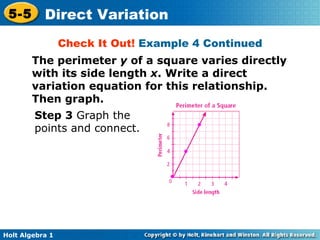
Step 3  Graph the points and connect. Check It Out!  Example 4 Continued The perimeter  y  of a square varies directly with its side length  x . Write a direct variation equation for this relationship. Then graph.
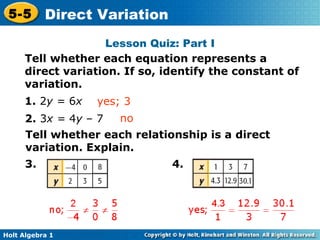
Lesson Quiz: Part I Tell whether each equation represents a direct variation. If so, identify the constant of variation. 1.   2 y =  6 x yes; 3 2.   3 x =  4 y  – 7 no Tell whether each relationship is a direct variation. Explain. 3. 4.
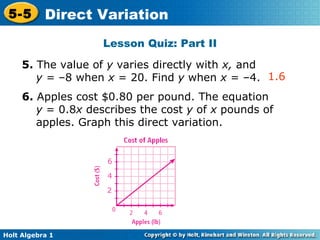
Lesson Quiz: Part II 5.  The value of  y  varies directly with  x,  and  y =  –8 when  x  = 20. Find  y  when  x  = –4.  1.6 6.  Apples cost $0.80 per pound. The equation  y  = 0.8 x  describes the cost  y  of  x  pounds of apples. Graph this direct variation. 2 4 6

Chapter 5 Direct Variation

  • 1.
    5-5 Direct VariationHolt Algebra 1 Lesson Quiz Lesson Presentation Warm Up
  • 2.
    Warm Up Solvefor y . 1. 3 + y = 2 x 2. 6 x = 3 y Write an equation that describes the relationship. 3. y = 2 x y = 2 x – 3 4. 5. y = 3 x 9 0.5 Solve for x .
  • 3.
    Identify, write, andgraph direct variation. Objective
  • 4.
    Vocabulary direct variationconstant of variation
  • 5.
    A recipe forpaella calls for 1 cup of rice to make 5 servings. In other words, a chef needs 1 cup of rice for every 5 servings. The equation y = 5 x describes this relationship. In this relationship, the number of servings varies directly with the number of cups of rice.
  • 6.
    A directvariation is a special type of linear relationship that can be written in the form y = kx , where k is a nonzero constant called the constant of variation.
  • 7.
    Example 1A: IdentifyingDirect Variations from Equations Tell whether the equation represents a direct variation. If so, identify the constant of variation. y = 3 x This equation represents a direct variation because it is in the form of y = kx . The constant of variation is 3.
  • 8.
    3 x + y = 8 Solve the equation for y. Since 3x is added to y, subtract 3x from both sides. This equation is not a direct variation because it cannot be written in the form y = kx. Example 1B: Identifying Direct Variations from Equations Tell whether the equation represents a direct variation. If so, identify the constant of variation. – 3 x –3 x y = –3 x + 8
  • 9.
    – 4 x + 3 y = 0 Solve the equation for y. Since –4x is added to 3y, add 4x to both sides. Since y is multiplied by 3, divide both sides by 3. Example 1C: Identifying Direct Variations from Equations Tell whether the equation represents a direct variation. If so, identify the constant of variation. +4 x + 4 x 3 y = 4 x This equation represents a direct variation because it is in the form of y = kx . The constant of variation is .
  • 10.
    Check It Out! Example 1a 3 y = 4 x + 1 This equation is not a direct variation because it is not written in the form y = kx. Tell whether the equation represents a direct variation. If so, identify the constant of variation.
  • 11.
    Check It Out! Example 1b 3 x = –4 y Solve the equation for y. – 4 y = 3 x Since y is multiplied by –4, divide both sides by –4. Tell whether the equation represents a direct variation. If so, identify the constant of variation. This equation represents a direct variation because it is in the form of y = kx . The constant of variation is .
  • 12.
    Check It Out! Example 1c y + 3 x = 0 Solve the equation for y. Since 3x is added to y, subtract 3x from both sides. This equation represents a direct variation because it is in the form of y = kx . The constant of variation is –3. Tell whether the equation represents a direct variation. If so, identify the constant of variation. – 3 x –3 x y = –3 x
  • 13.
    What happens ifyou solve y = kx for k ? y = kx Divide both sides by x (x ≠ 0). So, in a direct variation, the ratio is equal to the constant of variation. Another way to identify a direct variation is to check whether is the same for each ordered pair (except where x = 0).
  • 14.
    Example 2A: IdentifyingDirect Variations from Ordered Pairs Tell whether the relationship is a direct variation. Explain. Method 1 Write an equation. y = 3 x This is direct variation because it can be written as y = kx, where k = 3. Each y-value is 3 times the corresponding x-value.
  • 15.
    Example 2A ContinuedTell whether the relationship is a direct variation. Explain. Method 2 Find for each ordered pair. This is a direct variation because is the same for each ordered pair.
  • 16.
    Method 1 Write an equation. y = x – 3 Each y-value is 3 less than the corresponding x-value. This is not a direct variation because it cannot be written as y = kx. Example 2B: Identifying Direct Variations from Ordered Pairs Tell whether the relationship is a direct variation. Explain.
  • 17.
    Method 2 Find for each ordered pair. This is not direct variation because is the not the same for all ordered pairs. Example 2B Continued Tell whether the relationship is a direct variation. Explain. …
  • 18.
    Check It Out! Example 2a Tell whether the relationship is a direct variation. Explain. Method 2 Find for each ordered pair. This is not direct variation because is the not the same for all ordered pairs.
  • 19.
    Tell whether therelationship is a direct variation. Explain. Check It Out! Example 2b Method 1 Write an equation. y = –4 x Each y-value is –4 times the corresponding x-value . This is a direct variation because it can be written as y = kx, where k = –4.
  • 20.
    Tell whether therelationship is a direct variation. Explain. Check It Out! Example 2c Method 2 Find for each ordered pair. This is not direct variation because is the not the same for all ordered pairs.
  • 21.
    Example 3: Writingand Solving Direct Variation Equations The value of y varies directly with x , and y = 3, when x = 9. Find y when x = 21. Method 1 Find the value of k and then write the equation. y = k x Write the equation for a direct variation. 3 = k (9) Substitute 3 for y and 9 for x. Solve for k. Since k is multiplied by 9, divide both sides by 9. The equation is y = x . When x = 21 , y = (21) = 7.
  • 22.
    The value of y varies directly with x , and y = 3 when x = 9. Find y when x = 21. Method 2 Use a proportion. 9 y = 63 y = 7 Use cross products. Since y is multiplied by 9 divide both sides by 9. Example 3 Continued In a direct variation is the same for all values of x and y.
  • 23.
    Check It Out! Example 3 The value of y varies directly with x , and y = 4.5 when x = 0.5. Find y when x = 10. Method 1 Find the value of k and then write the equation. y = k x Write the equation for a direct variation. 4.5 = k (0.5) Substitute 4.5 for y and 0.5 for x. Solve for k. Since k is multiplied by 0.5, divide both sides by 0.5. The equation is y = 9 x . When x = 10 , y = 9 (10) = 90. 9 = k
  • 24.
    Check It Out! Example 3 Continued Method 2 Use a proportion. 0.5 y = 45 y = 90 Use cross products. Since y is multiplied by 0.5 divide both sides by 0.5. The value of y varies directly with x , and y = 4.5 when x = 0.5. Find y when x = 10. In a direct variation is the same for all values of x and y.
  • 25.
    Example 4: GraphingDirect Variations A group of people are tubing down a river at an average speed of 2 mi/h. Write a direct variation equation that gives the number of miles y that the people will float in x hours. Then graph. Step 1 Write a direct variation equation. distance = 2 mi/h times hours y = 2  x
  • 26.
    Example 4 ContinuedA group of people are tubing down a river at an average speed of 2 mi/h. Write a direct variation equation that gives the number of miles y that the people will float in x hours. Then graph. Step 2 Choose values of x and generate ordered pairs. x y = 2 x ( x, y ) 0 y = 2 (0) = 0 ( 0 , 0 ) 1 y = 2 (1) = 2 ( 1 , 2 ) 2 y = 2 (2) = 4 ( 2 , 4 )
  • 27.
    A group ofpeople are tubing down a river at an average speed of 2 mi/h. Write a direct variation equation that gives the number of miles y that the people will float in x hours. Then graph. Step 3 Graph the points and connect. Example 4 Continued
  • 28.
    Check It Out! Example 4 The perimeter y of a square varies directly with its side length x . Write a direct variation equation for this relationship. Then graph. Step 1 Write a direct variation equation. perimeter = 4 sides times length y = 4 • x
  • 29.
    Check It Out! Example 4 Continued Step 2 Choose values of x and generate ordered pairs. The perimeter y of a square varies directly with its side length x . Write a direct variation equation for this relationship. Then graph. x y = 4 x ( x, y ) 0 y = 4 (0) = 0 ( 0 , 0 ) 1 y = 4 (1) = 4 ( 1 , 4 ) 2 y = 4 (2) = 8 ( 2 , 8 )
  • 30.
    Step 3 Graph the points and connect. Check It Out! Example 4 Continued The perimeter y of a square varies directly with its side length x . Write a direct variation equation for this relationship. Then graph.
  • 31.
    Lesson Quiz: PartI Tell whether each equation represents a direct variation. If so, identify the constant of variation. 1. 2 y = 6 x yes; 3 2. 3 x = 4 y – 7 no Tell whether each relationship is a direct variation. Explain. 3. 4.
  • 32.
    Lesson Quiz: PartII 5. The value of y varies directly with x, and y = –8 when x = 20. Find y when x = –4. 1.6 6. Apples cost $0.80 per pound. The equation y = 0.8 x describes the cost y of x pounds of apples. Graph this direct variation. 2 4 6