CHAPTER 5:
CAPACITY PLANNING
CAPACITY PLANNING
 Capacity planning is a critical process in operations management, ensuring that an
organization has the necessary resources and infrastructure to meet current and future
demands efficiently.
 This process impacts cost efficiency, resource allocation, and customer satisfaction. In this
lecture, we will discuss key aspects of capacity planning, including the core questions that
guide it, methods for measuring capacity, and factors affecting capacity decisions.
KEY QUESTIONS IN CAPACITY PLANNING
Managers must address the following three key questions during capacity planning:
1. WHAT KIND OF CAPACITY IS NEEDED?
2. HOW MUCH CAPACITY IS NEEDED?
3. WHEN IS CAPACITY NEEDED?
1. What kind of capacity is needed?
 Organizations must determine what specific type of capacity is required to produce their
goods or services.
 For example, a hospital needs capacity in terms of beds, doctors, and medical
equipment, while a factory might need assembly lines, machinery, and labor.
2. How much capacity is needed?
 This refers to the volume of resources needed to meet expected demand.
 For Example: For instance, a bakery needs to ensure it can produce enough loaves of
bread to meet daily customer demand, but not so much that it overproduces and wastes
resources.
3.When is capacity needed?
 The timing of capacity expansion is critical to match demand fluctuations.
 For example, retailers often expand capacity (like staffing or stock levels) in anticipation of
holiday shopping seasons.
THE IMPORTANCE OF CAPACITY PLANNING
Capacity planning is important for several reasons:
1. COST EFFICIENCY
2. MEETING CUSTOMER DEMAND
3. SCALIBILITY
1. Cost Efficiency
 Having the right capacity prevents wasted resources. Overcapacity can result in
unnecessary costs (e.g., maintaining idle machinery), while undercapacity leads to lost
sales and dissatisfied customers.
2. Meeting Customer Demand
 Effective capacity planning ensures that customer needs are met without delays or
shortages.
 For example, airlines must have enough flights to accommodate passengers, but not so
many that planes fly with empty seats.
3. Scalability
 Proper planning allows businesses to scale up when demand increases, ensuring they can
grow sustainably over time.
 For instance, tech companies like Amazon invest in data centers to handle growing web
traffic.
Ways of Defining and Measuring Capacity
Capacity can be defined and measured in different ways, depending on the type of
business. Two primary methods include:
1. DESIGN CAPACITY
2. EFFECTIVE CAPACITY
CAPACITY CAN BE MEASURED USING:
 OUTPUT MEASURES- The number of units produced (e.g., tons of steel or number of
surgeries performed).
 INPUT MEASURES-The resources used, such as machine hours or labor hours.
1. DESIGN CAPACITY
 The maximum output that an organization can achieve under ideal conditions.
 For example, a car manufacturing plant may have a design capacity to produce 1,000
cars per day.
2. EFFECTIVE CAPACITY
 The actual capacity an organization can achieve under normal working conditions,
accounting for factors like maintenance and employee breaks.
 In practice, that same car plant may only produce 850 cars daily due to these constraints.
DETERMINANTS OF EFFECTIVE CAPACITY
1. FACILITIES
2. PRODUCT/ SERVICE DESIGN
3. PROCESS FACTORS
4. HUMAN FACTORS
5. EXTERNAL FACTORS
1. FACILITIES
 The physical layout and location of facilities impact capacity.
 For example, a poorly designed warehouse may slow down production, reducing overall
capacity.
2. Product/Service Design
 Complex designs take longer to produce, lowering effective capacity.
 A factory producing custom-made furniture will have a lower capacity than one
producing standardized items.
3. Process Factors
 The efficiency of production processes, including the technology used, affects capacity.
 Automation can increase effective capacity by speeding up production times.
4. Human Factors
 Employee skills, motivation, and productivity impact capacity.
 Well-trained employees are more efficient, increasing overall capacity.
5. External Factors
 Regulatory requirements, supply chain disruptions, or changes in market demand can
influence capacity.
Factors to Consider When Deciding
Whether to Perform In-House or Outsource
1. COST
2. CONTROL
3. FLEXIBILITY
4. CORE COMPETENCY
1. COST
 Is it cheaper to produce in-house, or are external suppliers more cost-effective?
 For example, many companies outsource IT services to specialized providers to reduce
costs.
2. CONTROL
 In-house production offers more control over quality and delivery times.
 A company like Tesla, which values innovation and quality control, prefers to manufacture
its batteries in-house.
3. Flexibility
 Outsourcing can offer flexibility, especially if demand is unpredictable.
 For instance, retailers may outsource logistics to third-party firms during peak seasons.
4. Core Competency
 Outsourcing non-core activities allows businesses to focus on what they do best.
 A restaurant, for instance, may outsource its cleaning services to concentrate on food
preparation.
MAJOR CONSIDERATIONS FOR
DEVELOPING CAPACITY ALTERNATIVES
1. INCREMENTAL VS. ONE-TIME EXPANSION
2. FLEXIBILITY
3. COST AND RISK
4. MARKET CONDITIONS
1. INCREMENTAL VS. ONE-TIME EXPANSION
 Should the company expand in small increments over time, or should it invest in a major
capacity expansion?
 A hospital might gradually add more beds as demand grows, while a factory might build
an entirely new facility to accommodate a large increase in production.
2. FLEXIBILITY
 Capacity alternatives should account for flexibility in case of demand fluctuations.
 Modular production lines or temporary staffing can offer the ability to scale up or down
quickly.
3. COST AND RISK
 What is the cost and financial risk of each capacity alternative?
 For instance, leasing additional warehouse space might be less risky than purchasing a
new facility outright.
4. MARKET CONDITIONS
 Forecasts of future demand are critical. If demand is uncertain, businesses should avoid
overcommitting resources.
STEPS TO RESOLVE CONSTRAINT ISSUES
1. IDENTIFY THE CONSTRAINT
2. EXPLOIT THE CONSTRAINT
3. SUBORDINATE OTHER PROCESSES
4. ELEVATE THE CONSTRAINT
5. REPEAT
1. Identify the Constraint
 Determine where the bottleneck occurs.
 For example, in a restaurant, the constraint might be a slow kitchen process limiting how
quickly food can be served.
2. Exploit the Constraint
 Maximize the throughput at the constraint.
 In the restaurant example, this could mean training staff to work more efficiently in the
kitchen.
3. Subordinate Other Processes
 Align all other processes to ensure that they support the constraint.
 In the restaurant, this might mean adjusting the number of waitstaff to match the kitchen's
pace.
4. ELEVEATE CONSTRAINTS
 If the constraint is still a problem, increase capacity at the bottleneck.
 For instance, hiring more kitchen staff or investing in faster cooking equipment.
5. REPEAT
 Once one constraint is resolved, another may emerge, so the process needs to be
repeated continuously.
APPROACHES FOR EVALUATING CAPACITY
ALTERNATIVES
1. COST-VOLUME ANALYSIS
2. DECISION TREES
3. SIMULATION MODELS
4. WAITING-LINE MODELS
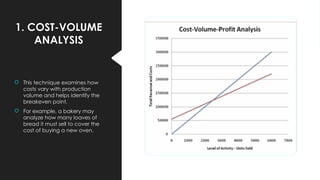
1. COST-VOLUME
ANALYSIS
 This technique examines how
costs vary with production
volume and helps identify the
breakeven point.
 For example, a bakery may
analyze how many loaves of
bread it must sell to cover the
cost of buying a new oven.
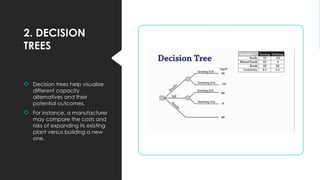
2. DECISION
TREES
 Decision trees help visualize
different capacity
alternatives and their
potential outcomes.
 For instance, a manufacturer
may compare the costs and
risks of expanding its existing
plant versus building a new
one.
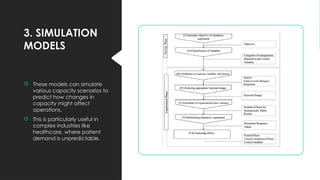
3. SIMULATION
MODELS
 These models can simulate
various capacity scenarios to
predict how changes in
capacity might affect
operations.
 This is particularly useful in
complex industries like
healthcare, where patient
demand is unpredictable.
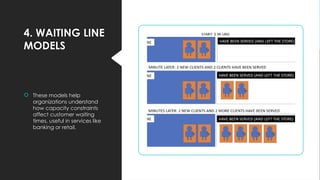
4. WAITING LINE
MODELS
 These models help
organizations understand
how capacity constraints
affect customer waiting
times, useful in services like
banking or retail.
CONCLUSION
 Effective capacity planning is essential for optimizing operations and aligning resources
with demand. By addressing key questions, understanding how to define and measure
capacity, and considering factors such as in-house vs. outsourcing, businesses can
develop strategies that ensure they remain flexible and efficient in meeting their goals.

Chapter-5.-Capacity-Planning.powerointtptx

  • 1.
  • 2.
    CAPACITY PLANNING  Capacityplanning is a critical process in operations management, ensuring that an organization has the necessary resources and infrastructure to meet current and future demands efficiently.  This process impacts cost efficiency, resource allocation, and customer satisfaction. In this lecture, we will discuss key aspects of capacity planning, including the core questions that guide it, methods for measuring capacity, and factors affecting capacity decisions.
  • 3.
    KEY QUESTIONS INCAPACITY PLANNING Managers must address the following three key questions during capacity planning: 1. WHAT KIND OF CAPACITY IS NEEDED? 2. HOW MUCH CAPACITY IS NEEDED? 3. WHEN IS CAPACITY NEEDED?
  • 4.
    1. What kindof capacity is needed?  Organizations must determine what specific type of capacity is required to produce their goods or services.  For example, a hospital needs capacity in terms of beds, doctors, and medical equipment, while a factory might need assembly lines, machinery, and labor.
  • 5.
    2. How muchcapacity is needed?  This refers to the volume of resources needed to meet expected demand.  For Example: For instance, a bakery needs to ensure it can produce enough loaves of bread to meet daily customer demand, but not so much that it overproduces and wastes resources.
  • 6.
    3.When is capacityneeded?  The timing of capacity expansion is critical to match demand fluctuations.  For example, retailers often expand capacity (like staffing or stock levels) in anticipation of holiday shopping seasons.
  • 7.
    THE IMPORTANCE OFCAPACITY PLANNING Capacity planning is important for several reasons: 1. COST EFFICIENCY 2. MEETING CUSTOMER DEMAND 3. SCALIBILITY
  • 8.
    1. Cost Efficiency Having the right capacity prevents wasted resources. Overcapacity can result in unnecessary costs (e.g., maintaining idle machinery), while undercapacity leads to lost sales and dissatisfied customers.
  • 9.
    2. Meeting CustomerDemand  Effective capacity planning ensures that customer needs are met without delays or shortages.  For example, airlines must have enough flights to accommodate passengers, but not so many that planes fly with empty seats.
  • 10.
    3. Scalability  Properplanning allows businesses to scale up when demand increases, ensuring they can grow sustainably over time.  For instance, tech companies like Amazon invest in data centers to handle growing web traffic.
  • 11.
    Ways of Definingand Measuring Capacity Capacity can be defined and measured in different ways, depending on the type of business. Two primary methods include: 1. DESIGN CAPACITY 2. EFFECTIVE CAPACITY CAPACITY CAN BE MEASURED USING:  OUTPUT MEASURES- The number of units produced (e.g., tons of steel or number of surgeries performed).  INPUT MEASURES-The resources used, such as machine hours or labor hours.
  • 12.
    1. DESIGN CAPACITY The maximum output that an organization can achieve under ideal conditions.  For example, a car manufacturing plant may have a design capacity to produce 1,000 cars per day.
  • 13.
    2. EFFECTIVE CAPACITY The actual capacity an organization can achieve under normal working conditions, accounting for factors like maintenance and employee breaks.  In practice, that same car plant may only produce 850 cars daily due to these constraints.
  • 14.
    DETERMINANTS OF EFFECTIVECAPACITY 1. FACILITIES 2. PRODUCT/ SERVICE DESIGN 3. PROCESS FACTORS 4. HUMAN FACTORS 5. EXTERNAL FACTORS
  • 15.
    1. FACILITIES  Thephysical layout and location of facilities impact capacity.  For example, a poorly designed warehouse may slow down production, reducing overall capacity.
  • 16.
    2. Product/Service Design Complex designs take longer to produce, lowering effective capacity.  A factory producing custom-made furniture will have a lower capacity than one producing standardized items.
  • 17.
    3. Process Factors The efficiency of production processes, including the technology used, affects capacity.  Automation can increase effective capacity by speeding up production times.
  • 18.
    4. Human Factors Employee skills, motivation, and productivity impact capacity.  Well-trained employees are more efficient, increasing overall capacity.
  • 19.
    5. External Factors Regulatory requirements, supply chain disruptions, or changes in market demand can influence capacity.
  • 20.
    Factors to ConsiderWhen Deciding Whether to Perform In-House or Outsource 1. COST 2. CONTROL 3. FLEXIBILITY 4. CORE COMPETENCY
  • 21.
    1. COST  Isit cheaper to produce in-house, or are external suppliers more cost-effective?  For example, many companies outsource IT services to specialized providers to reduce costs.
  • 22.
    2. CONTROL  In-houseproduction offers more control over quality and delivery times.  A company like Tesla, which values innovation and quality control, prefers to manufacture its batteries in-house.
  • 23.
    3. Flexibility  Outsourcingcan offer flexibility, especially if demand is unpredictable.  For instance, retailers may outsource logistics to third-party firms during peak seasons.
  • 24.
    4. Core Competency Outsourcing non-core activities allows businesses to focus on what they do best.  A restaurant, for instance, may outsource its cleaning services to concentrate on food preparation.
  • 25.
    MAJOR CONSIDERATIONS FOR DEVELOPINGCAPACITY ALTERNATIVES 1. INCREMENTAL VS. ONE-TIME EXPANSION 2. FLEXIBILITY 3. COST AND RISK 4. MARKET CONDITIONS
  • 26.
    1. INCREMENTAL VS.ONE-TIME EXPANSION  Should the company expand in small increments over time, or should it invest in a major capacity expansion?  A hospital might gradually add more beds as demand grows, while a factory might build an entirely new facility to accommodate a large increase in production.
  • 27.
    2. FLEXIBILITY  Capacityalternatives should account for flexibility in case of demand fluctuations.  Modular production lines or temporary staffing can offer the ability to scale up or down quickly.
  • 28.
    3. COST ANDRISK  What is the cost and financial risk of each capacity alternative?  For instance, leasing additional warehouse space might be less risky than purchasing a new facility outright.
  • 29.
    4. MARKET CONDITIONS Forecasts of future demand are critical. If demand is uncertain, businesses should avoid overcommitting resources.
  • 30.
    STEPS TO RESOLVECONSTRAINT ISSUES 1. IDENTIFY THE CONSTRAINT 2. EXPLOIT THE CONSTRAINT 3. SUBORDINATE OTHER PROCESSES 4. ELEVATE THE CONSTRAINT 5. REPEAT
  • 31.
    1. Identify theConstraint  Determine where the bottleneck occurs.  For example, in a restaurant, the constraint might be a slow kitchen process limiting how quickly food can be served.
  • 32.
    2. Exploit theConstraint  Maximize the throughput at the constraint.  In the restaurant example, this could mean training staff to work more efficiently in the kitchen.
  • 33.
    3. Subordinate OtherProcesses  Align all other processes to ensure that they support the constraint.  In the restaurant, this might mean adjusting the number of waitstaff to match the kitchen's pace.
  • 34.
    4. ELEVEATE CONSTRAINTS If the constraint is still a problem, increase capacity at the bottleneck.  For instance, hiring more kitchen staff or investing in faster cooking equipment.
  • 35.
    5. REPEAT  Onceone constraint is resolved, another may emerge, so the process needs to be repeated continuously.
  • 36.
    APPROACHES FOR EVALUATINGCAPACITY ALTERNATIVES 1. COST-VOLUME ANALYSIS 2. DECISION TREES 3. SIMULATION MODELS 4. WAITING-LINE MODELS
  • 37.
    1. COST-VOLUME ANALYSIS  Thistechnique examines how costs vary with production volume and helps identify the breakeven point.  For example, a bakery may analyze how many loaves of bread it must sell to cover the cost of buying a new oven.
  • 38.
    2. DECISION TREES  Decisiontrees help visualize different capacity alternatives and their potential outcomes.  For instance, a manufacturer may compare the costs and risks of expanding its existing plant versus building a new one.
  • 39.
    3. SIMULATION MODELS  Thesemodels can simulate various capacity scenarios to predict how changes in capacity might affect operations.  This is particularly useful in complex industries like healthcare, where patient demand is unpredictable.
  • 40.
    4. WAITING LINE MODELS These models help organizations understand how capacity constraints affect customer waiting times, useful in services like banking or retail.
  • 41.
    CONCLUSION  Effective capacityplanning is essential for optimizing operations and aligning resources with demand. By addressing key questions, understanding how to define and measure capacity, and considering factors such as in-house vs. outsourcing, businesses can develop strategies that ensure they remain flexible and efficient in meeting their goals.