CHAPTER-THREE
Basic Operators
&
Control Structures
By: Mikiale T.
1
Python 3 – Basic Operators
 Operators are the constructs, which can manipulate the value of operands.
 Python language supports the following types of operators
i. Arithmetic Operators
ii. Comparison (Relational) Operators
iii. Assignment Operators
iv. Logical Operators
v. Bitwise Operators
vi. Membership Operators
2
Cont’d …
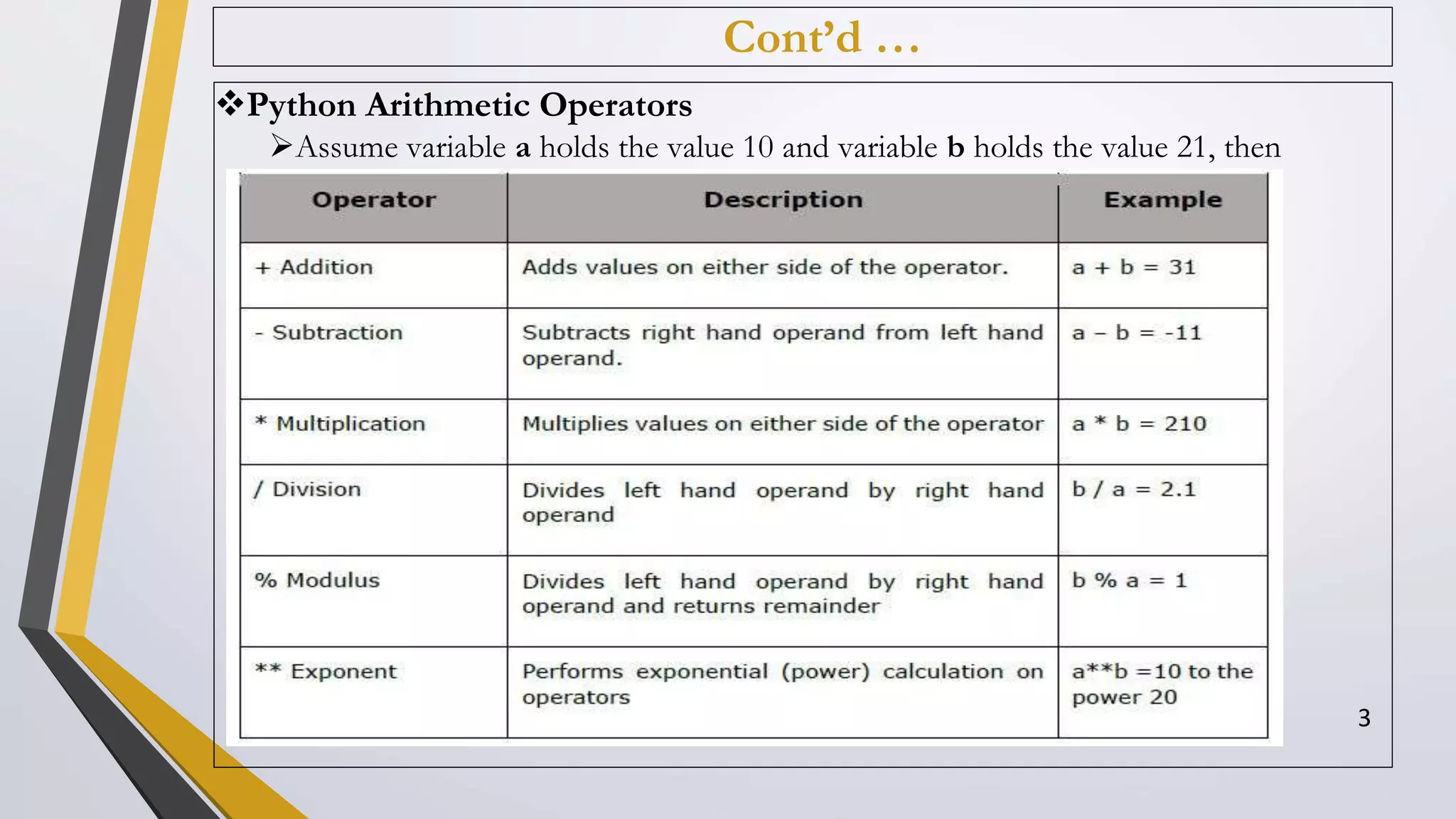
Python Arithmetic Operators
Assume variable a holds the value 10 and variable b holds the value 21, then
3
Cont’d …
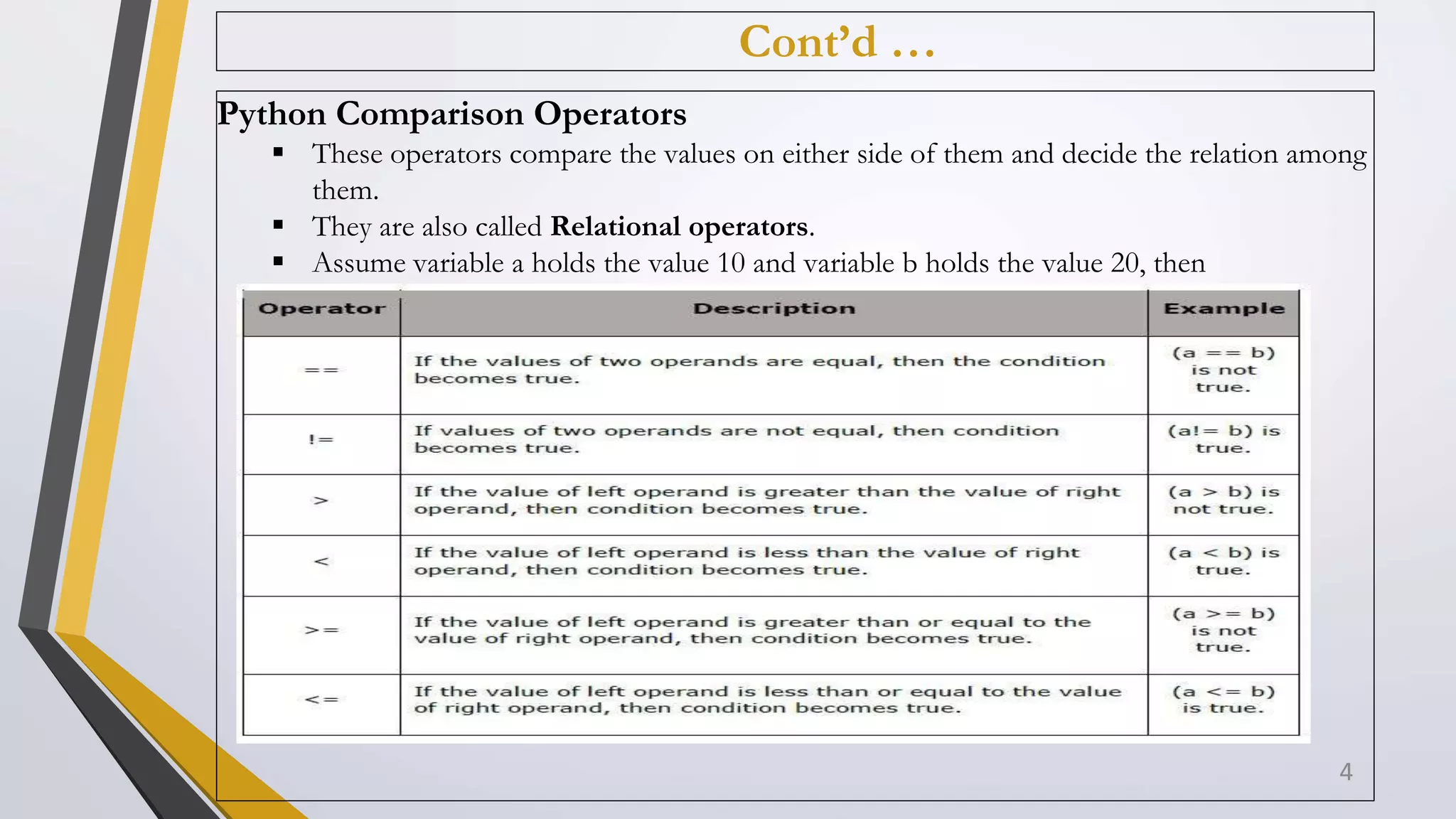
Python Comparison Operators
 These operators compare the values on either side of them and decide the relation among
them.
 They are also called Relational operators.
 Assume variable a holds the value 10 and variable b holds the value 20, then
4
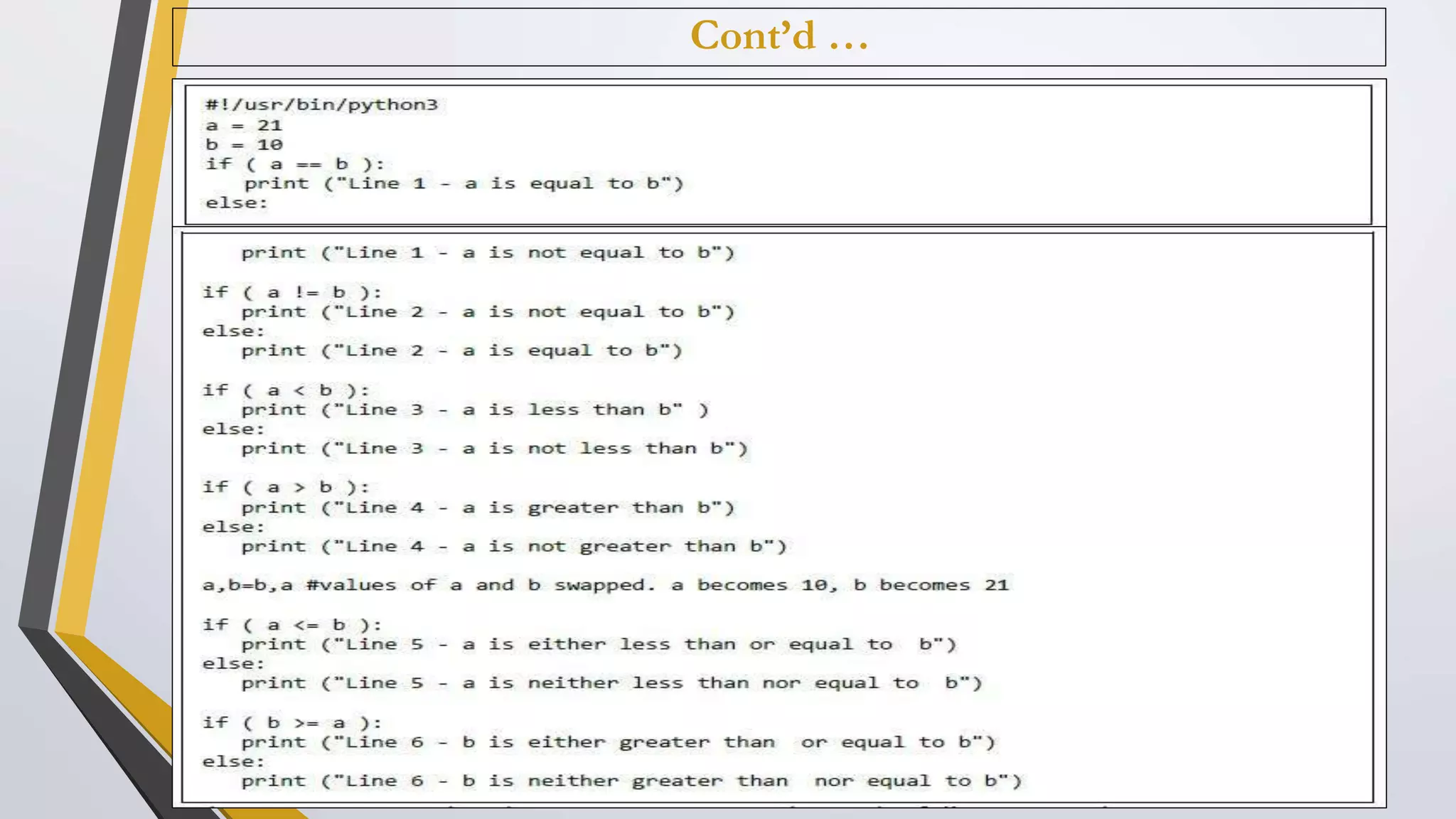
Cont’d …
5
Cont’d …
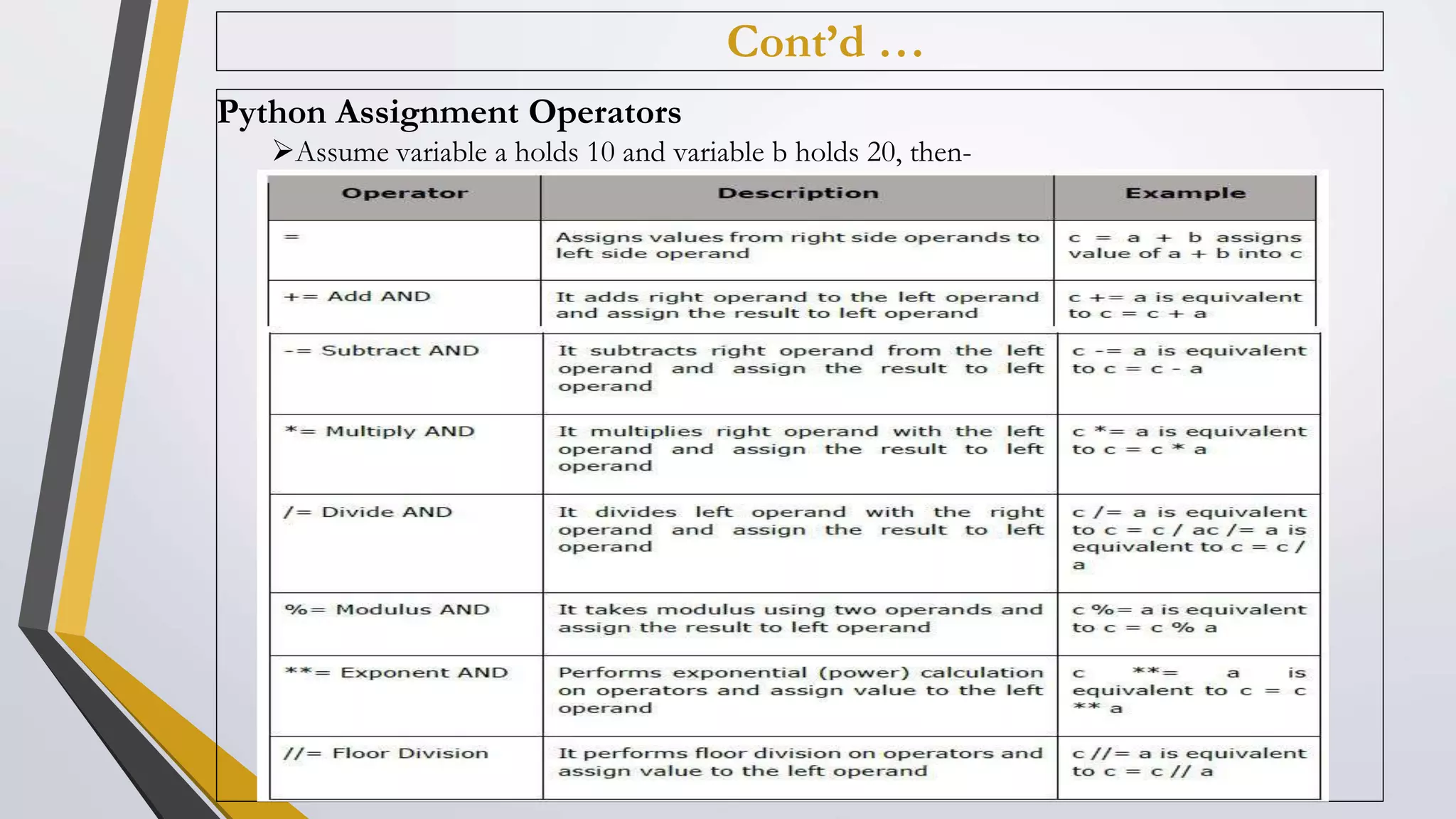
Python Assignment Operators
Assume variable a holds 10 and variable b holds 20, then-
6
Cont’d …
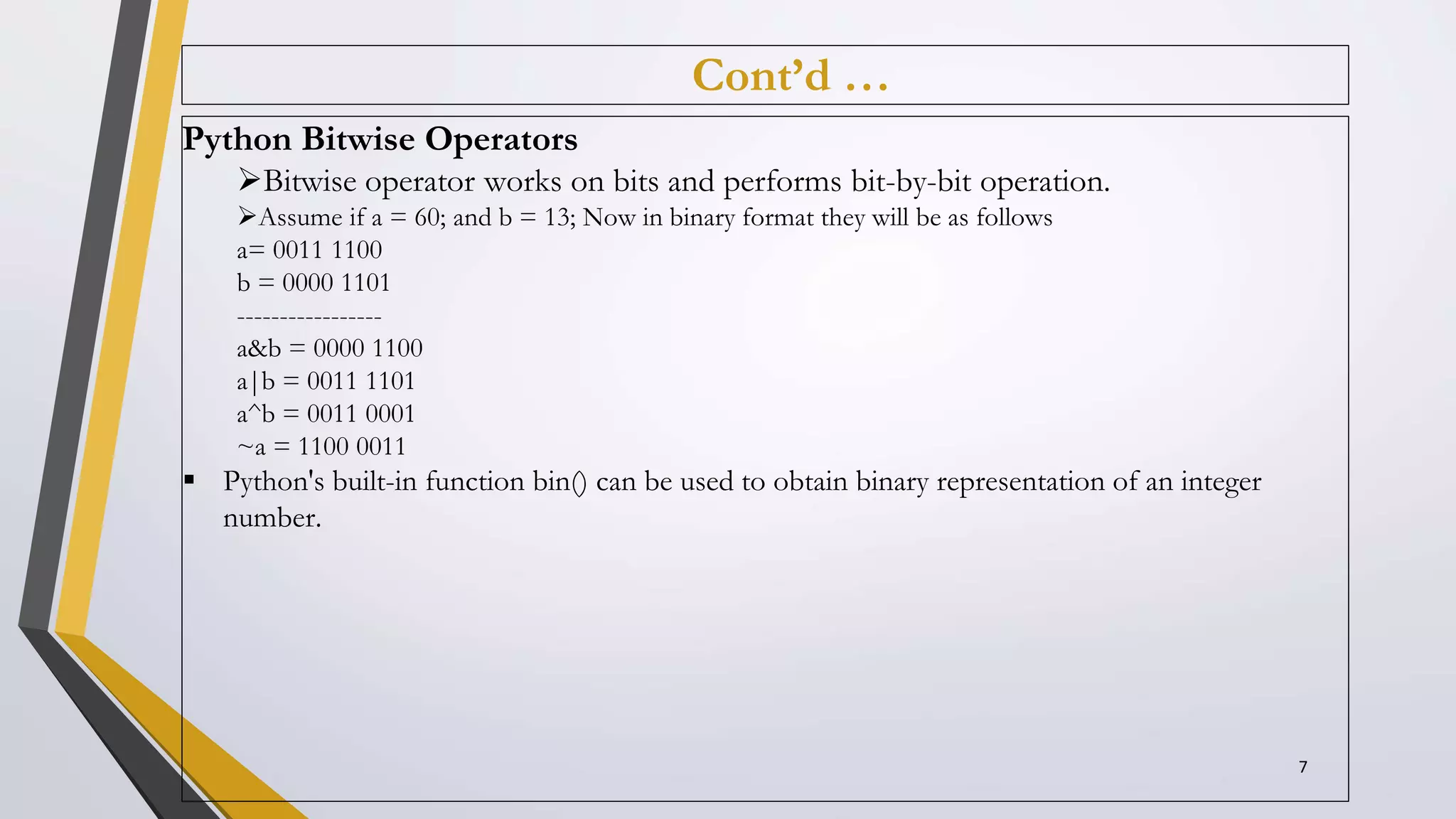
Python Bitwise Operators
Bitwise operator works on bits and performs bit-by-bit operation.
Assume if a = 60; and b = 13; Now in binary format they will be as follows
a= 0011 1100
b = 0000 1101
-----------------
a&b = 0000 1100
a|b = 0011 1101
a^b = 0011 0001
~a = 1100 0011
 Python's built-in function bin() can be used to obtain binary representation of an integer
number.
7
Cont’d …
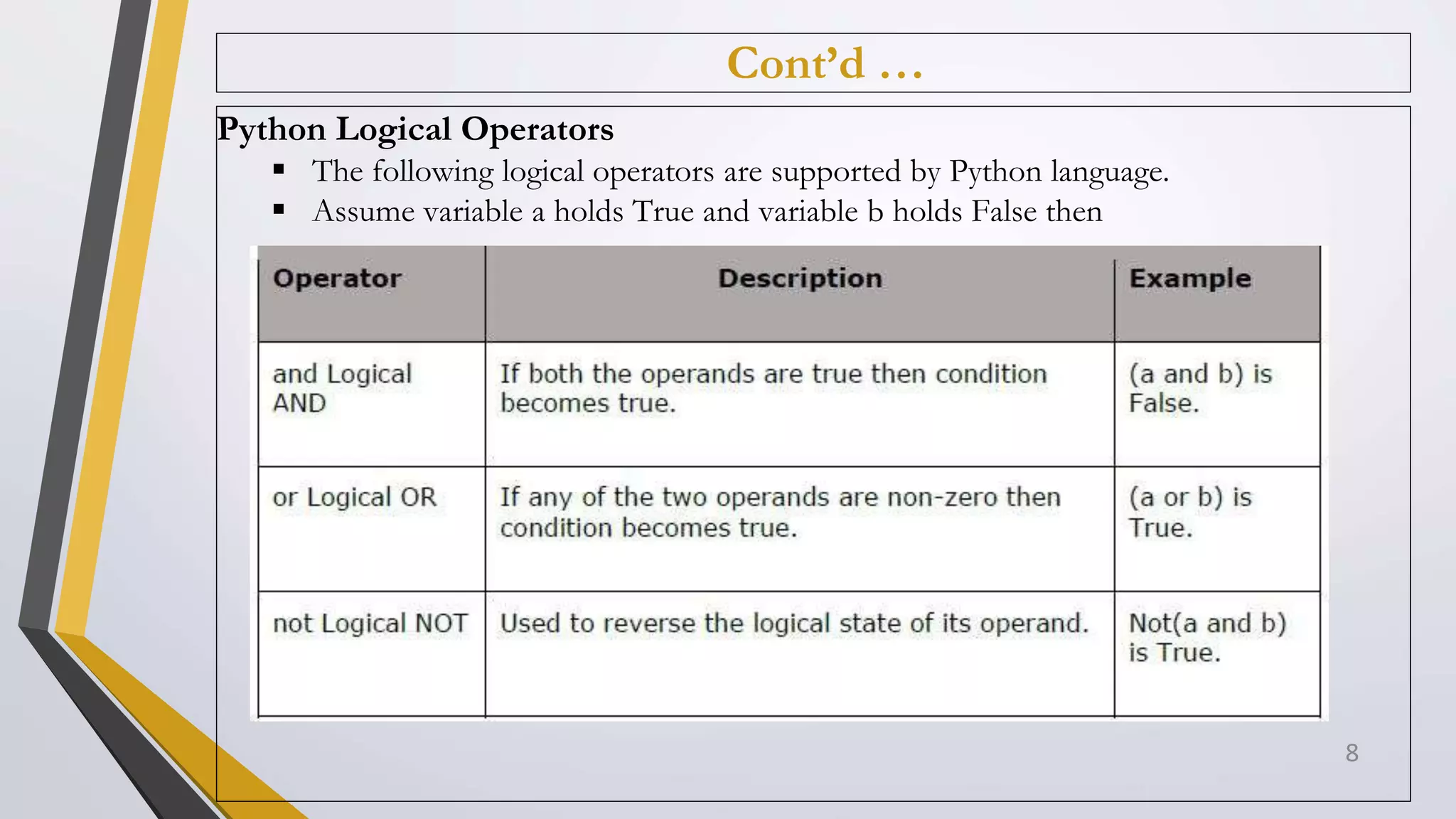
Python Logical Operators
 The following logical operators are supported by Python language.
 Assume variable a holds True and variable b holds False then
8
Cont’d …
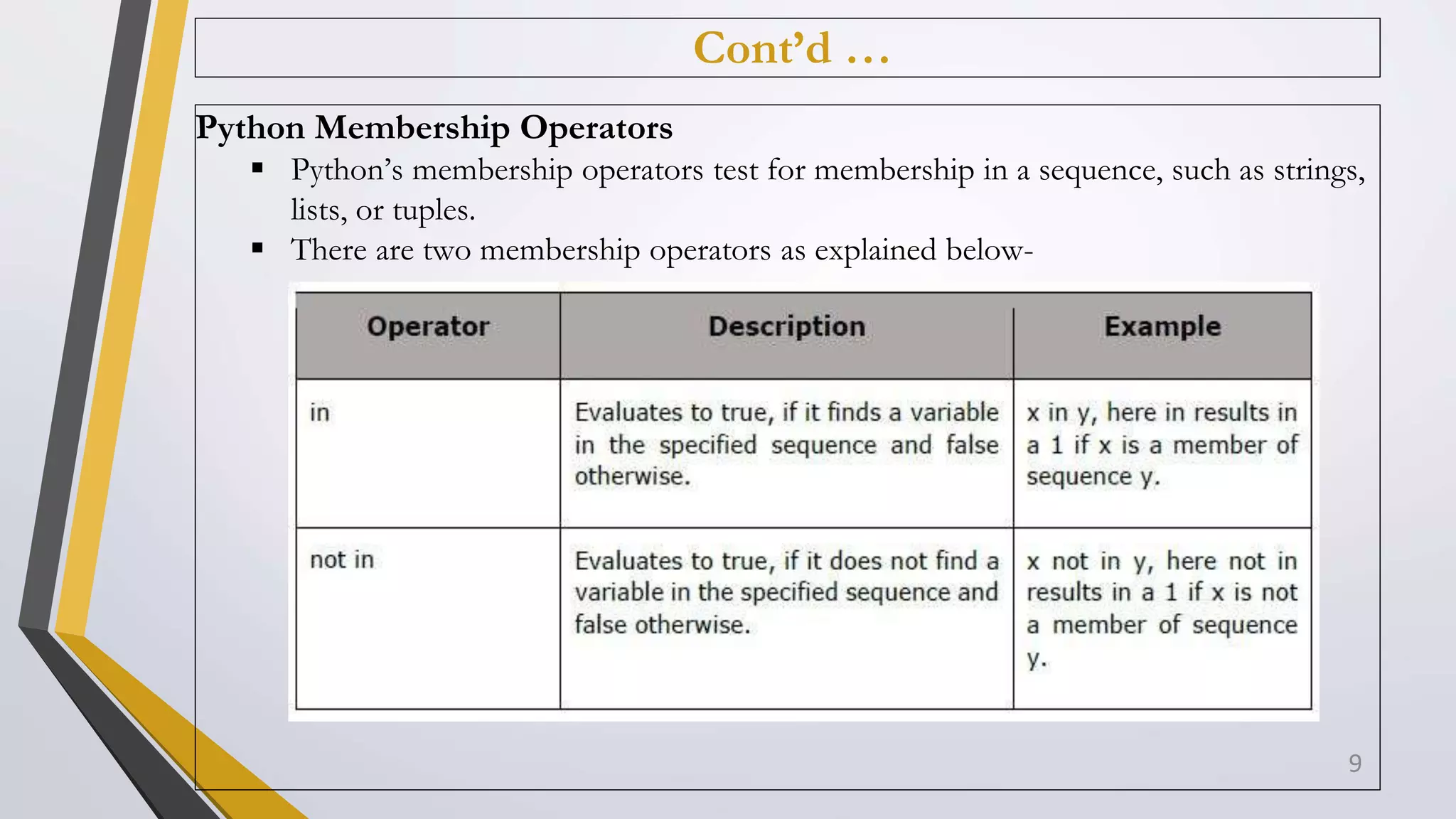
Python Membership Operators
 Python’s membership operators test for membership in a sequence, such as strings,
lists, or tuples.
 There are two membership operators as explained below-
9
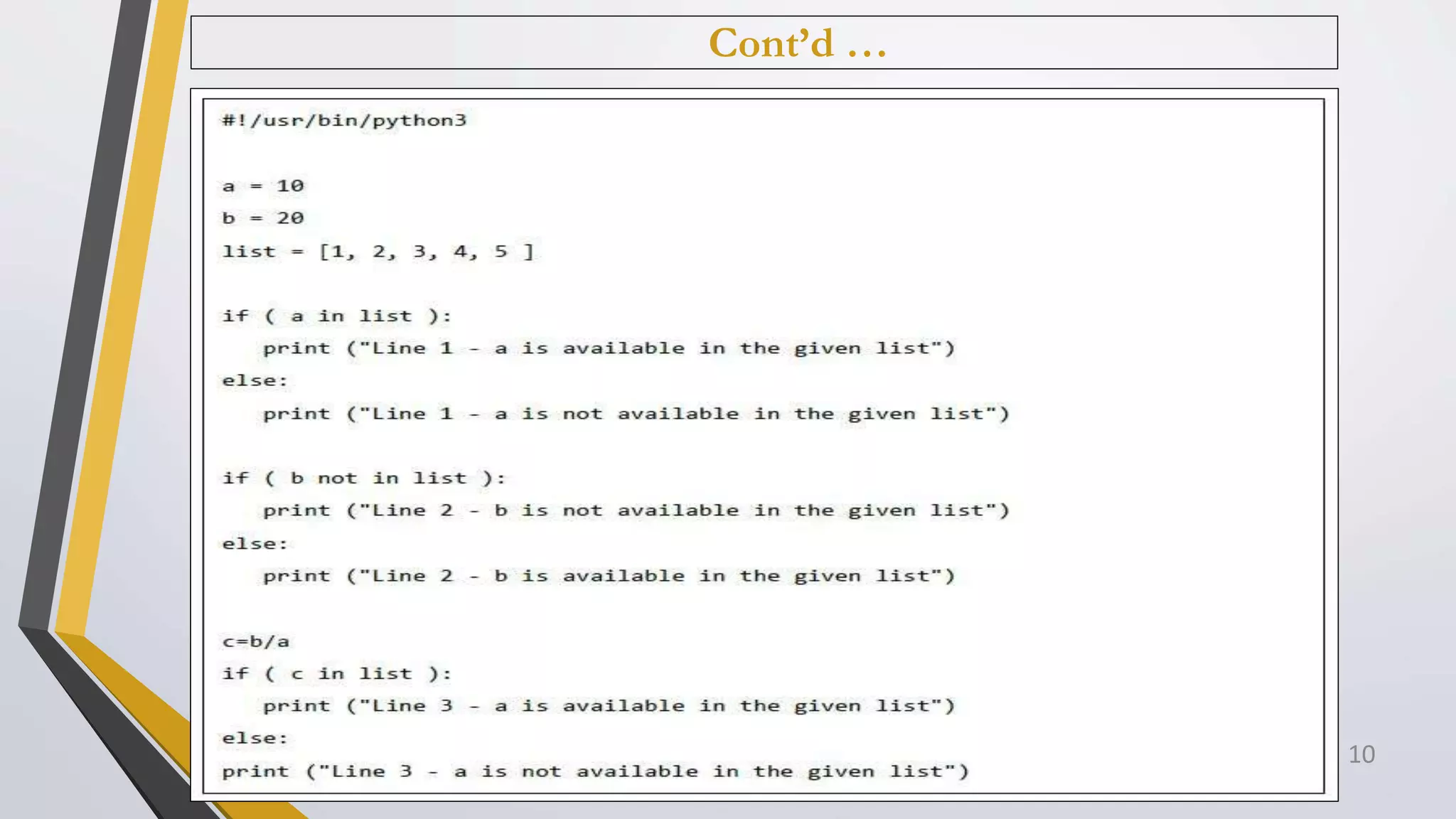
Cont’d …
10
Conditionals
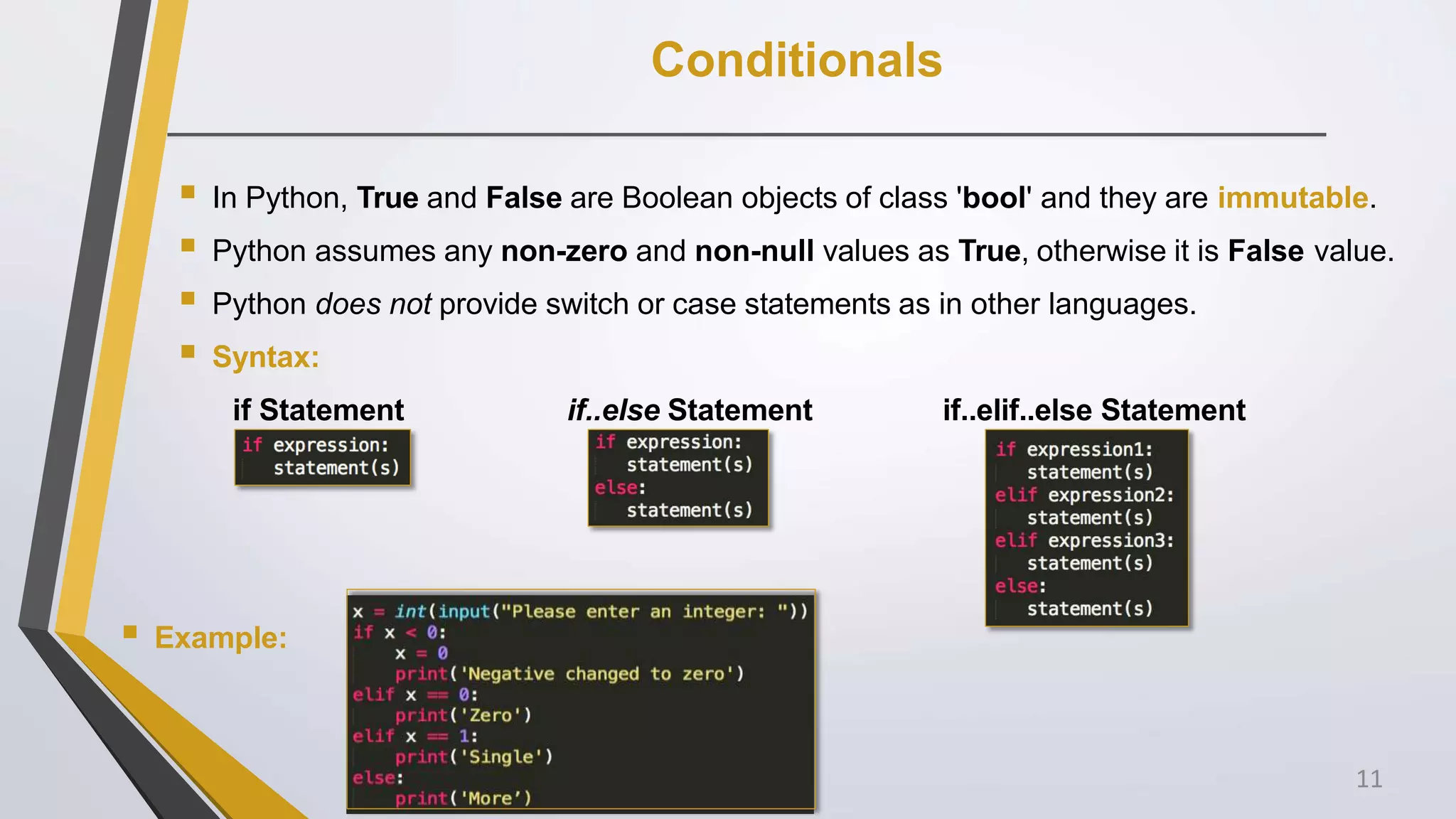
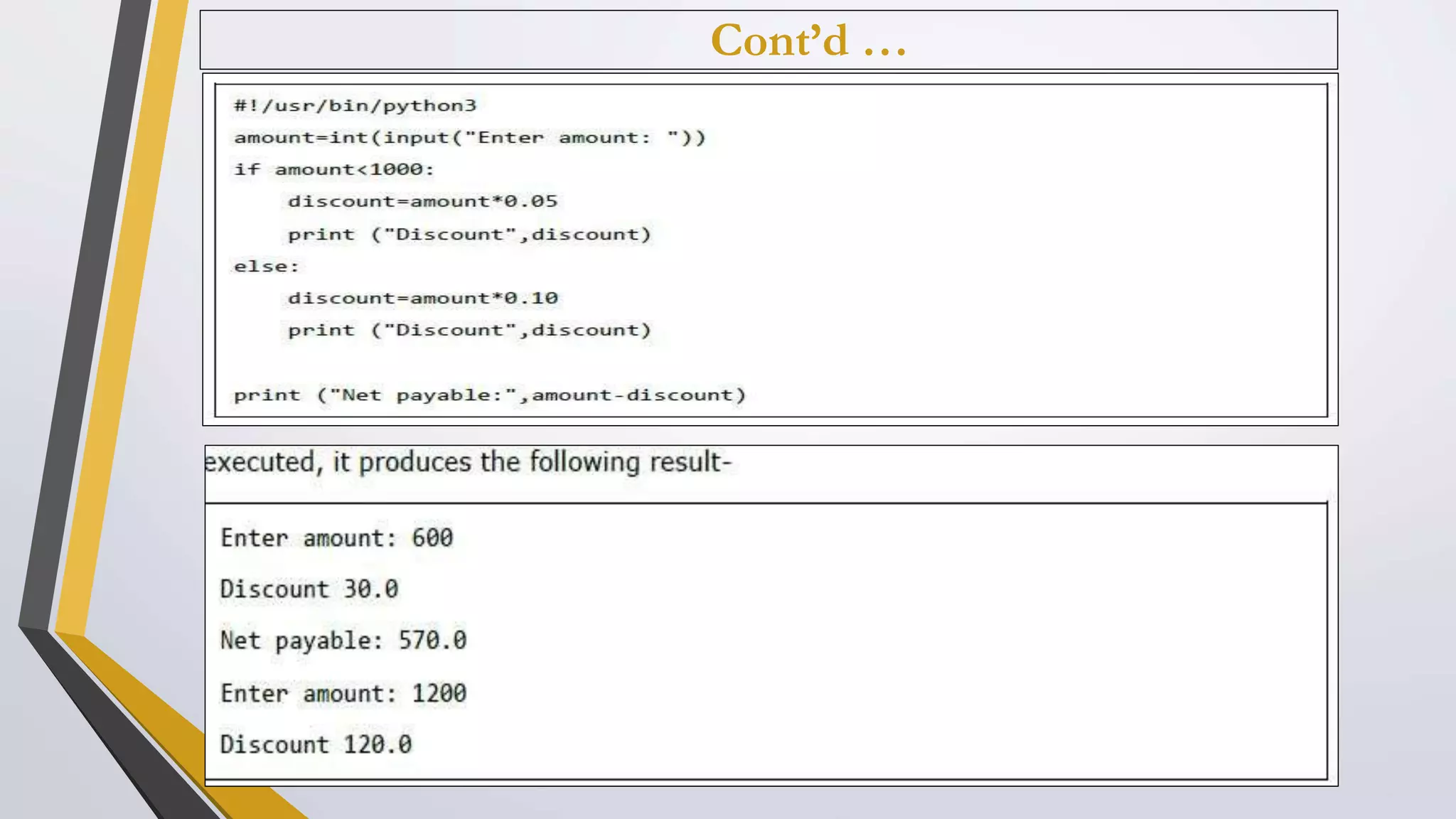
 In Python, True and False are Boolean objects of class 'bool' and they are immutable.
 Python assumes any non-zero and non-null values as True, otherwise it is False value.
 Python does not provide switch or case statements as in other languages.
 Syntax:
if Statement if..else Statement if..elif..else Statement
 Example:
11
Conditionals
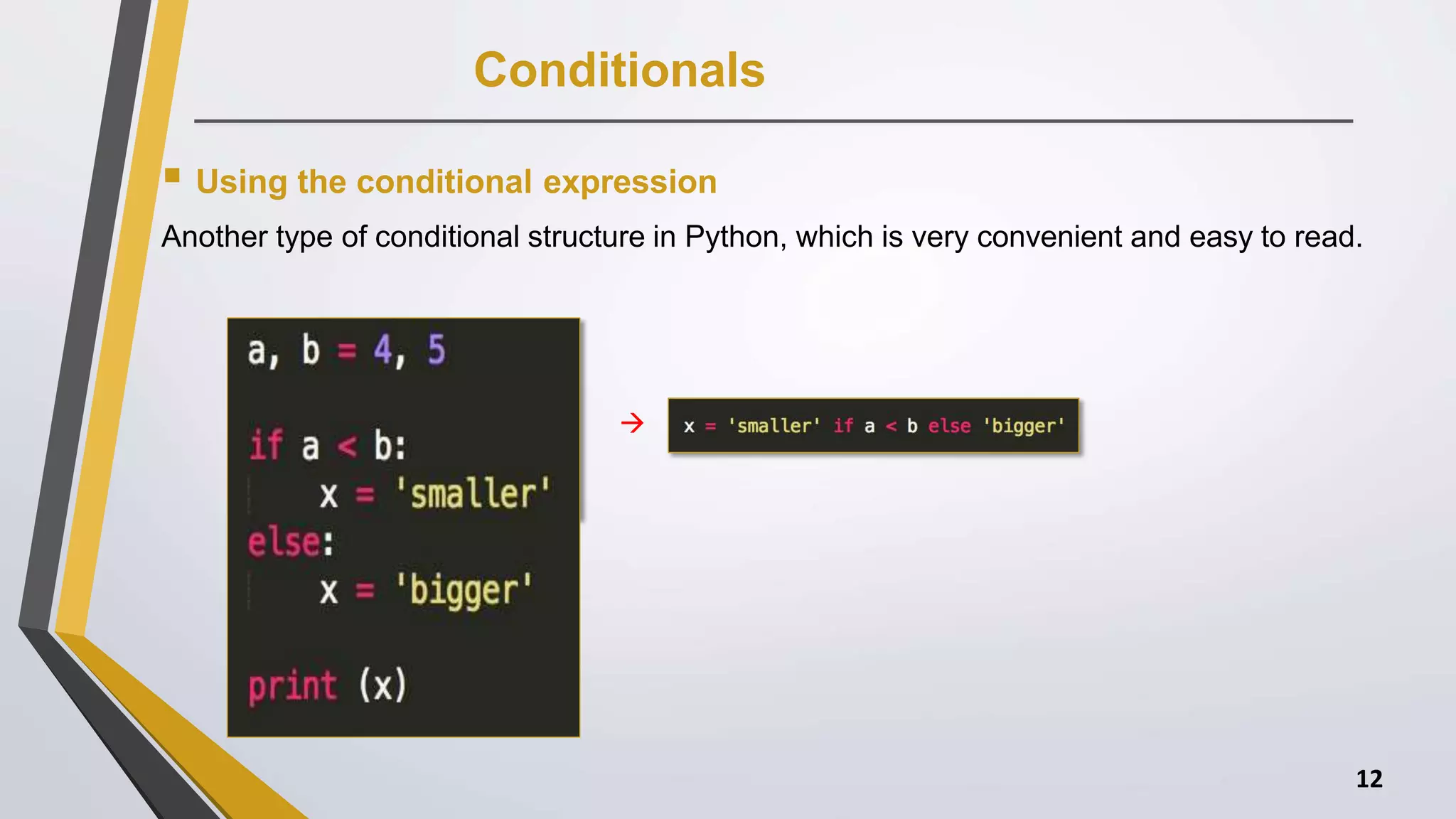
 Using the conditional expression
Another type of conditional structure in Python, which is very convenient and easy to read.

12
Cont’d …
13
Cont’d …
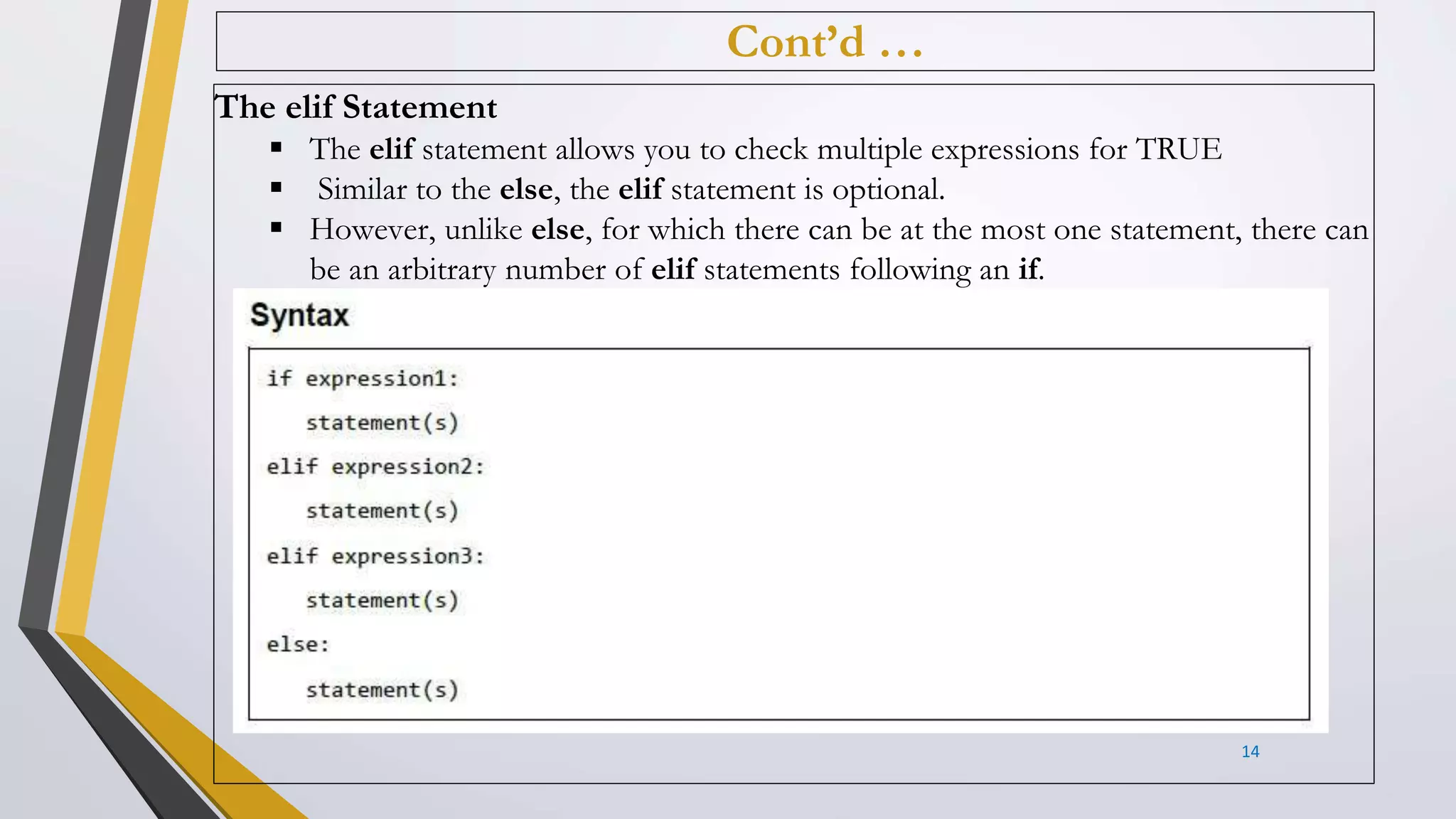
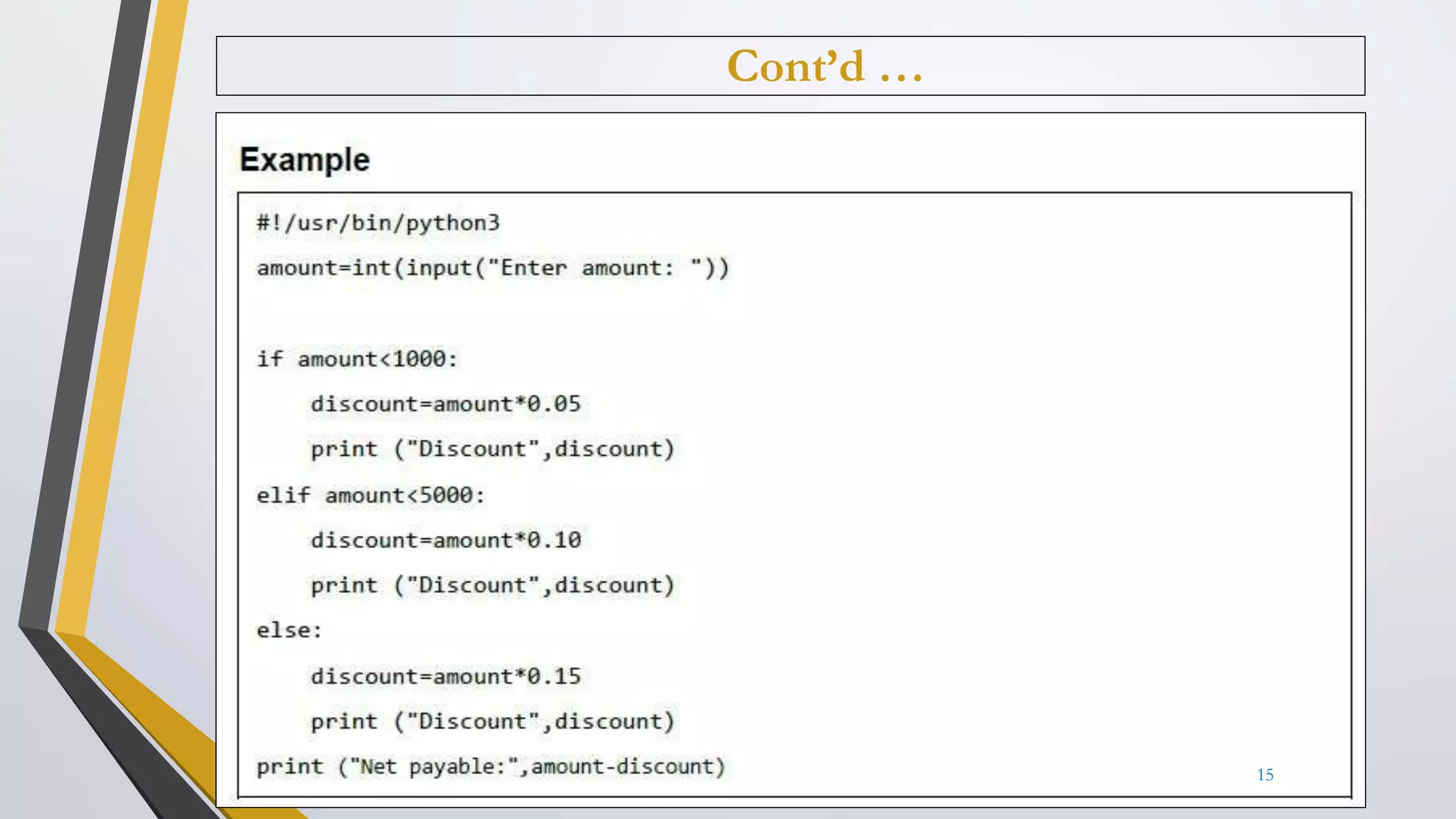
The elif Statement
 The elif statement allows you to check multiple expressions for TRUE
 Similar to the else, the elif statement is optional.
 However, unlike else, for which there can be at the most one statement, there can
be an arbitrary number of elif statements following an if.
14
Cont’d …
15
Cont’d …
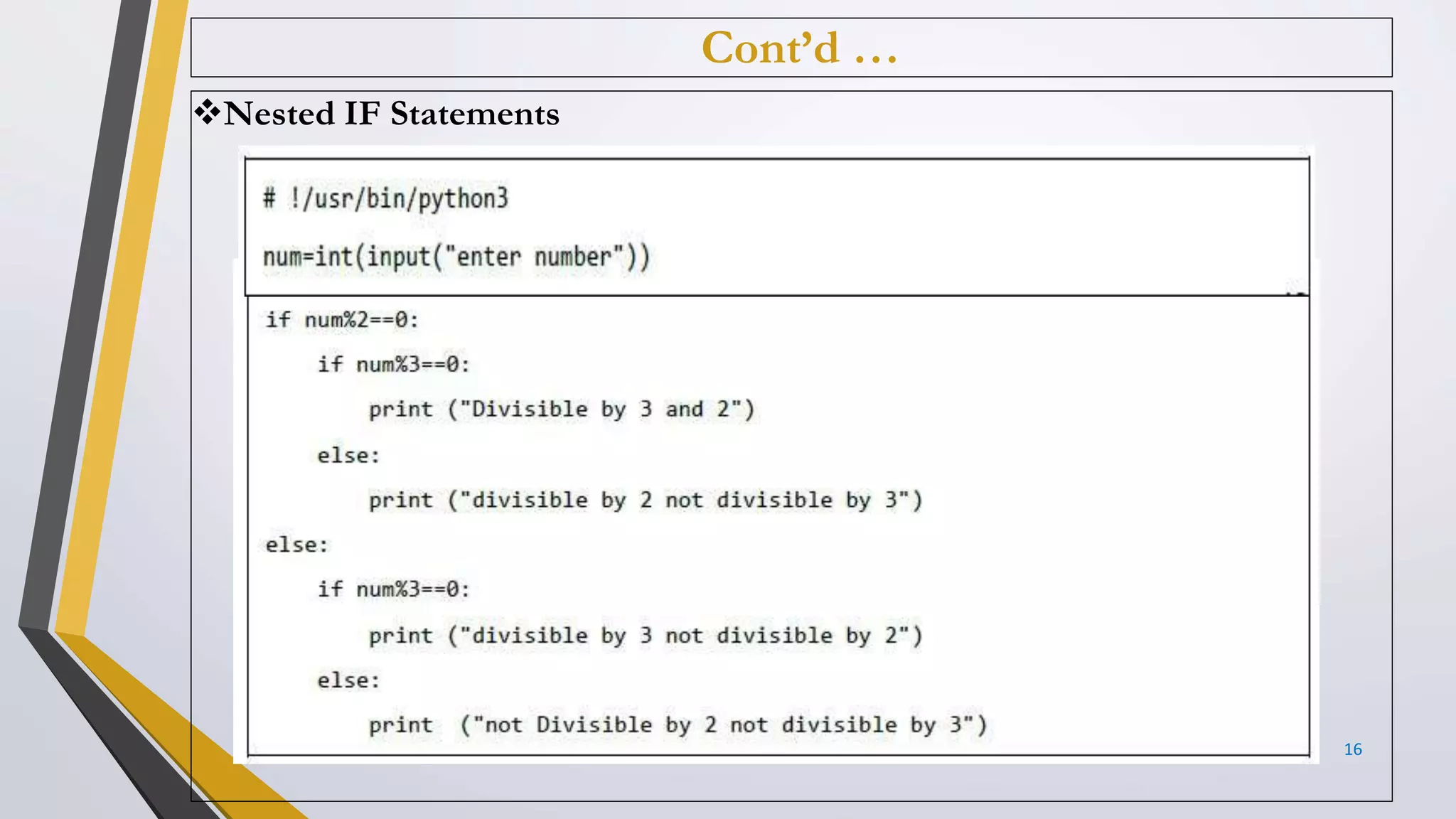
Nested IF Statements
16
Python 3 – Loops
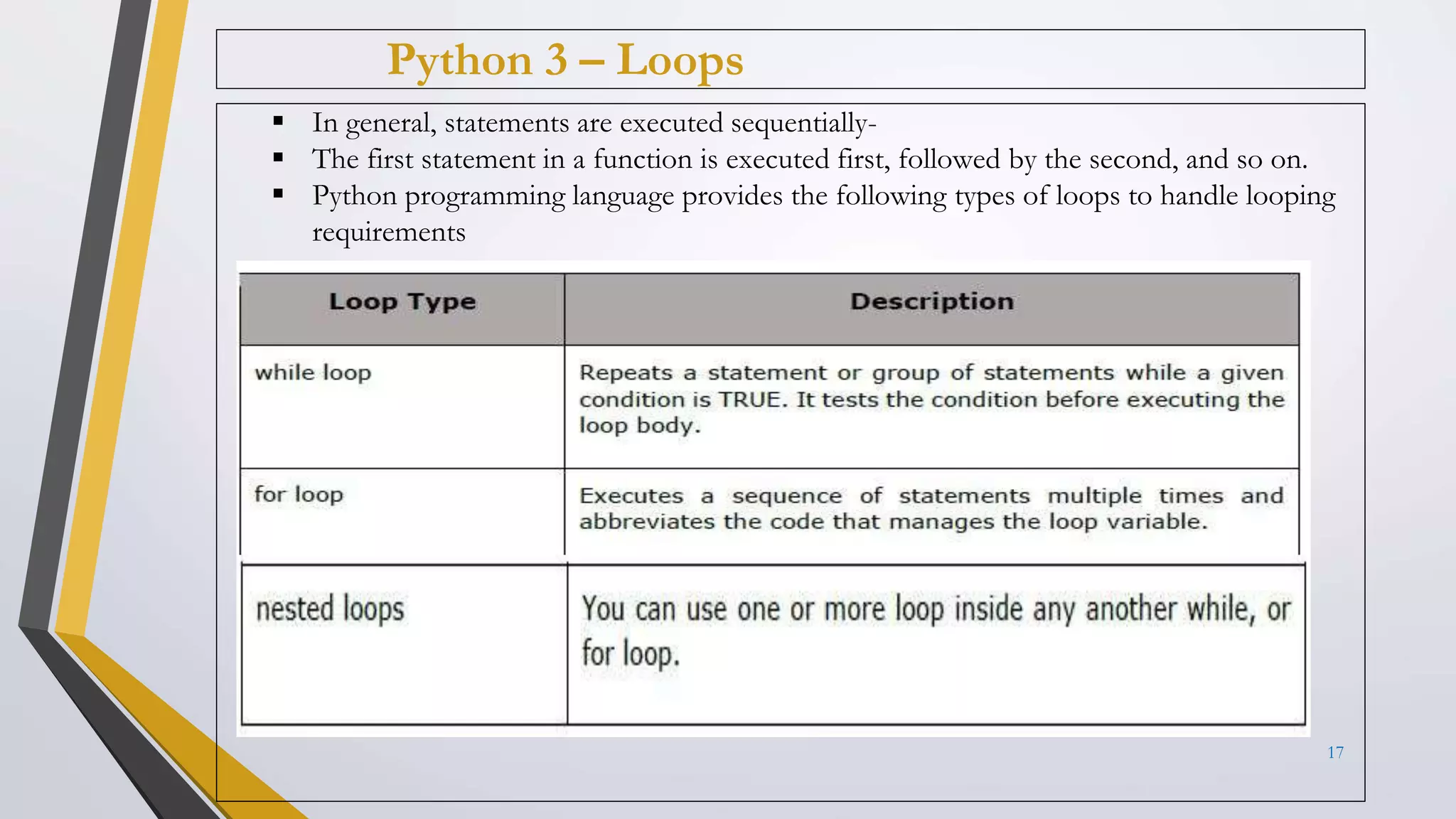
 In general, statements are executed sequentially-
 The first statement in a function is executed first, followed by the second, and so on.
 Python programming language provides the following types of loops to handle looping
requirements
17
Cont’d …
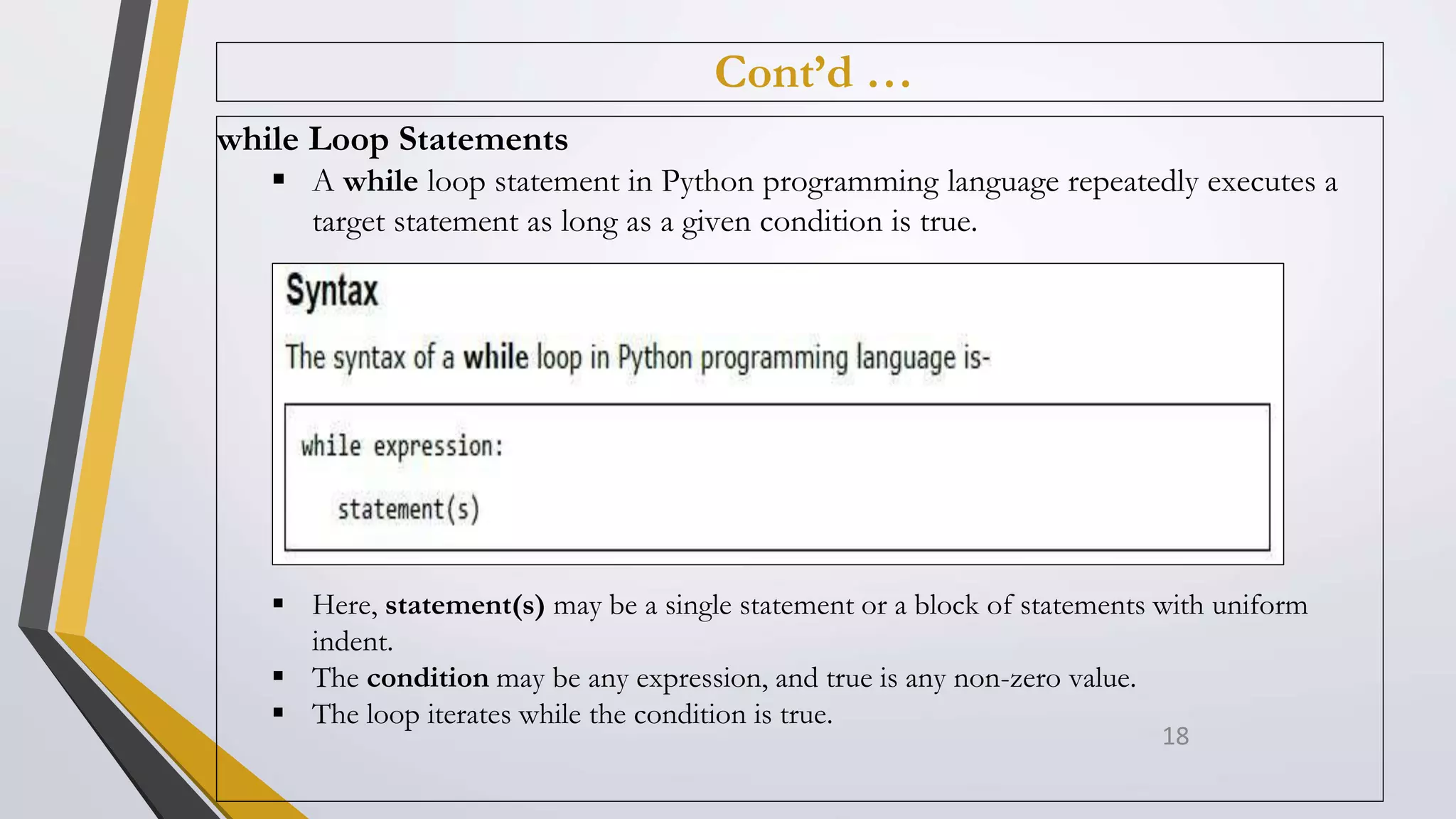
while Loop Statements
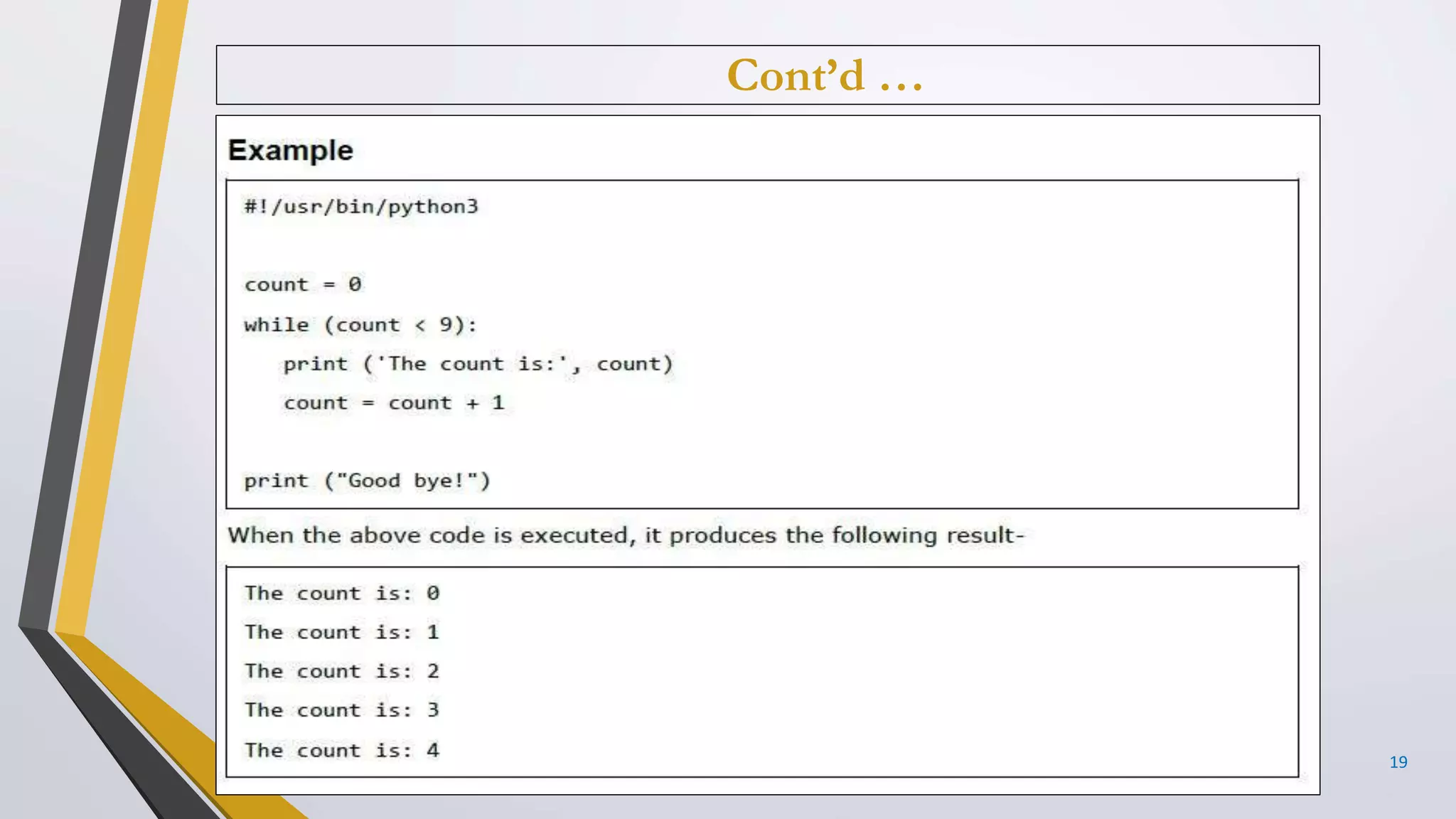
 A while loop statement in Python programming language repeatedly executes a
target statement as long as a given condition is true.
 Here, statement(s) may be a single statement or a block of statements with uniform
indent.
 The condition may be any expression, and true is any non-zero value.
 The loop iterates while the condition is true.
18
Cont’d …
19
Cont’d …
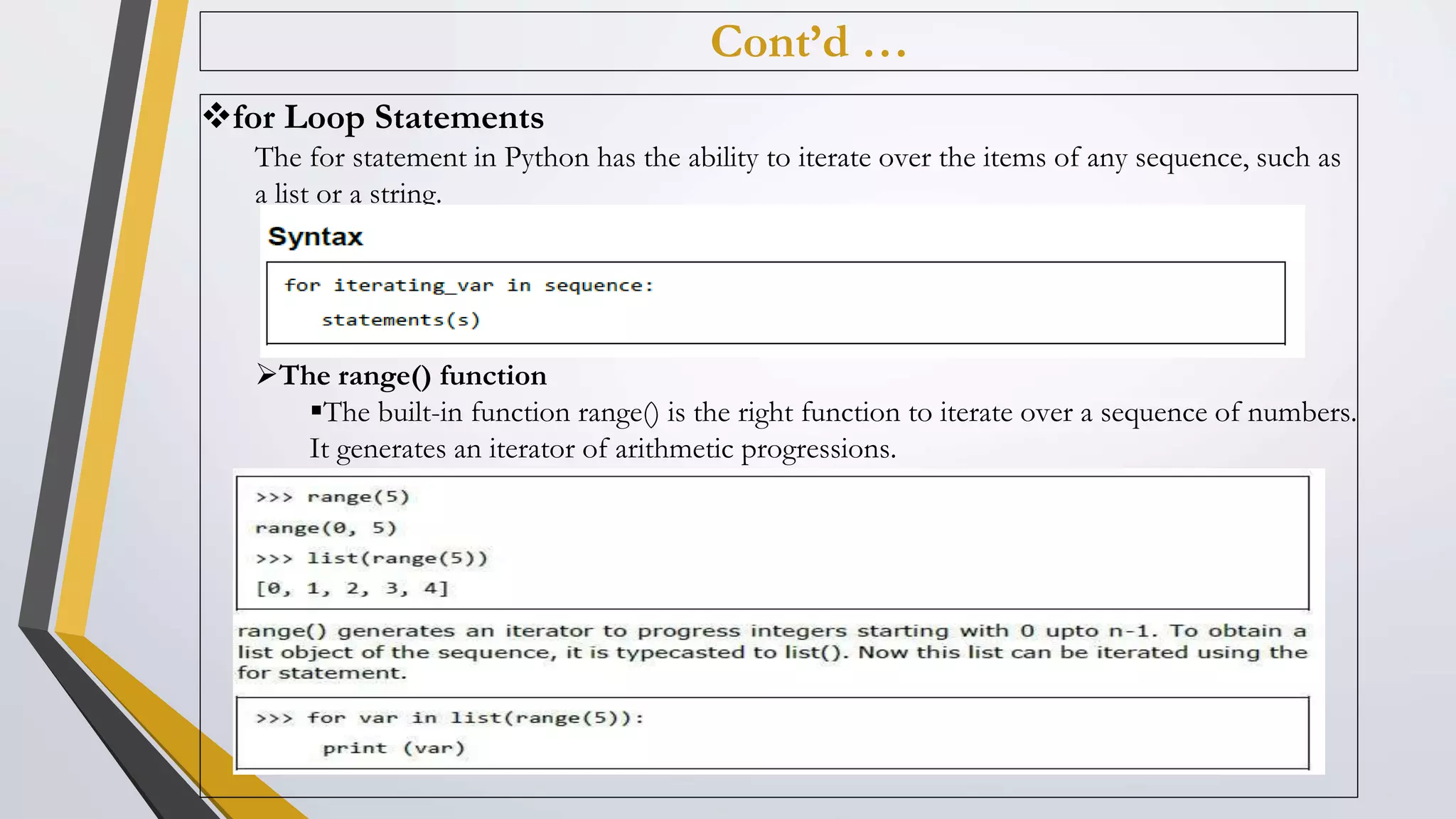
for Loop Statements
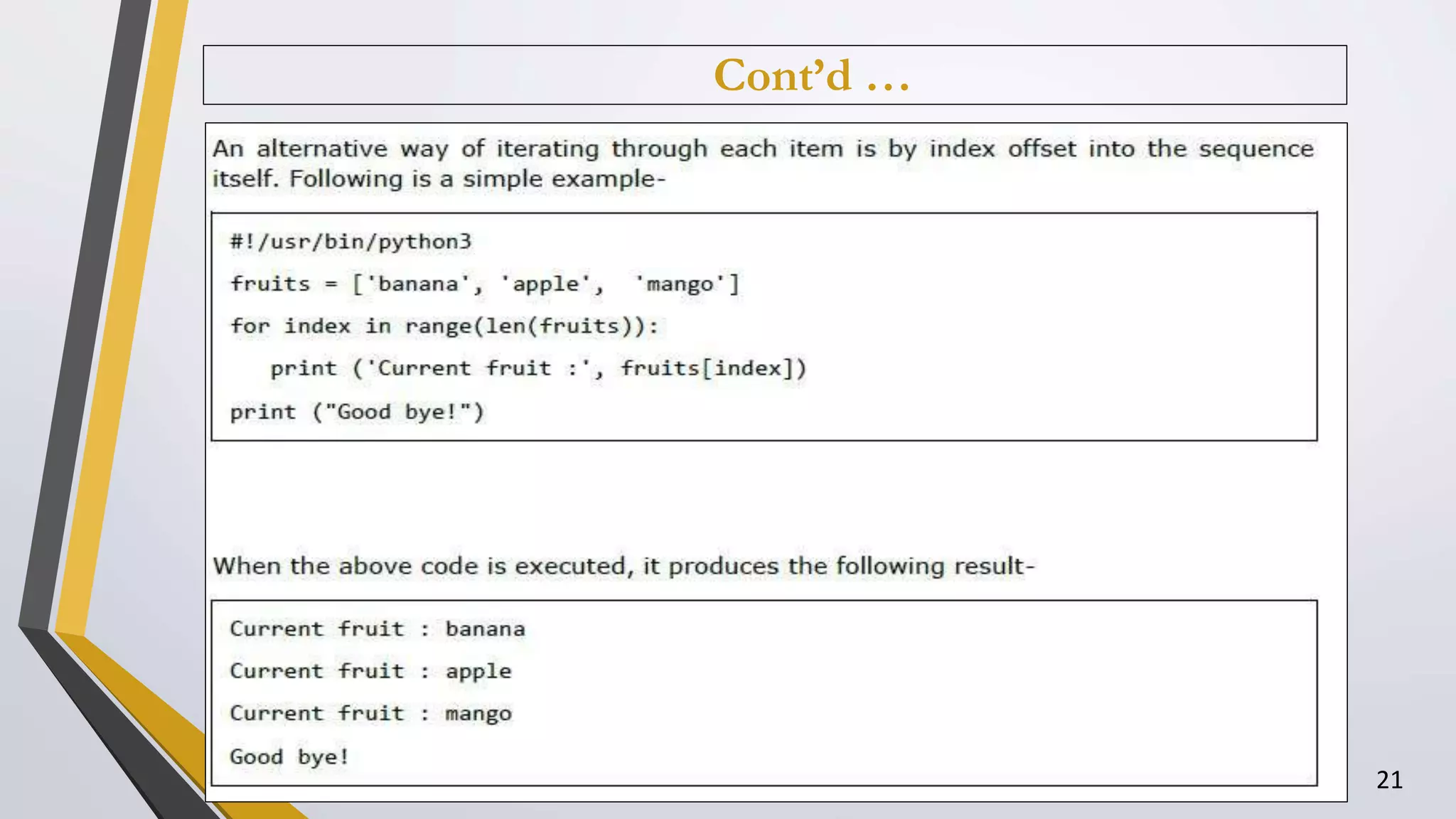
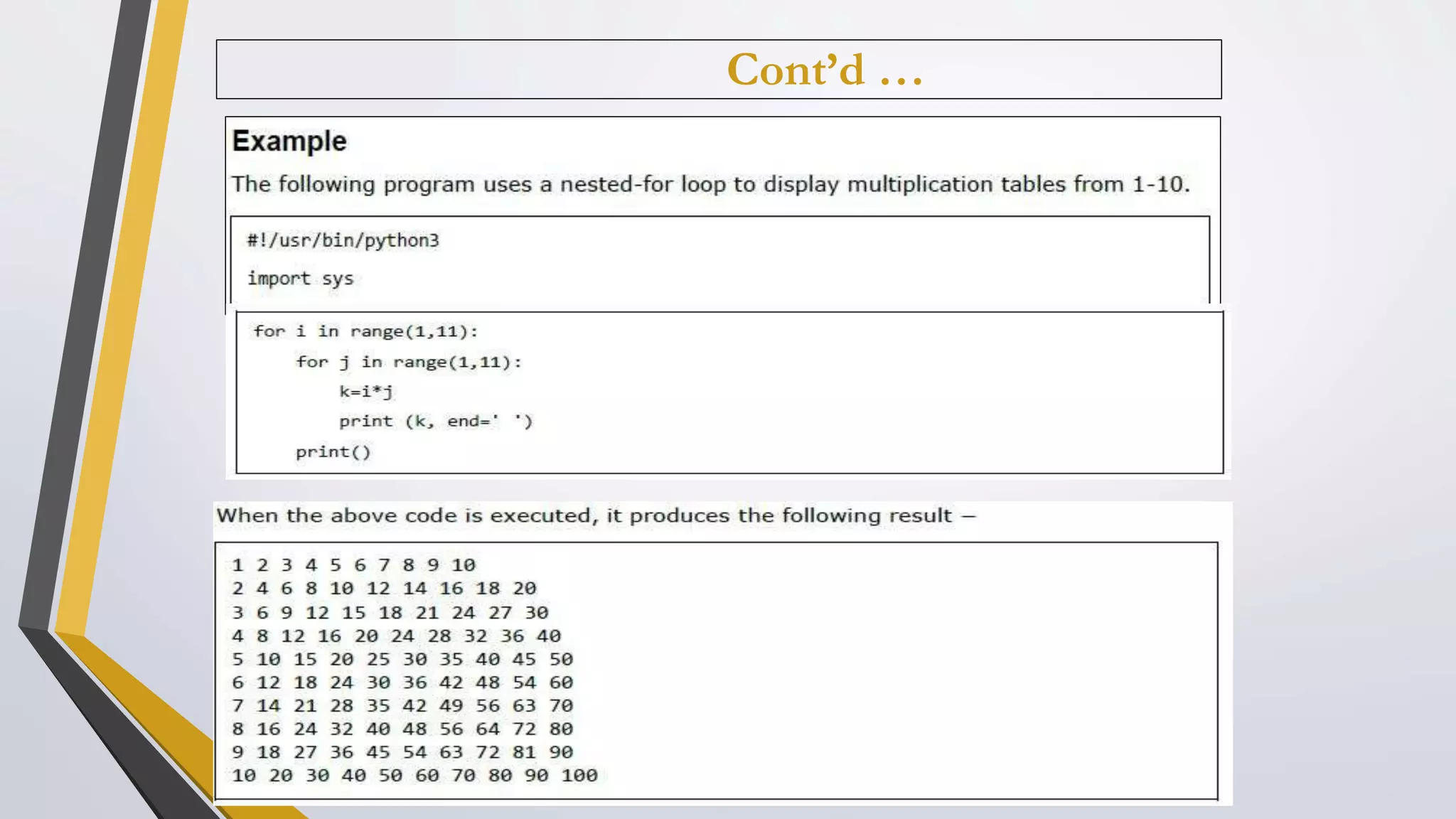
The for statement in Python has the ability to iterate over the items of any sequence, such as
a list or a string.
The range() function
The built-in function range() is the right function to iterate over a sequence of numbers.
It generates an iterator of arithmetic progressions.
20
Cont’d …
21
Cont’d …
22
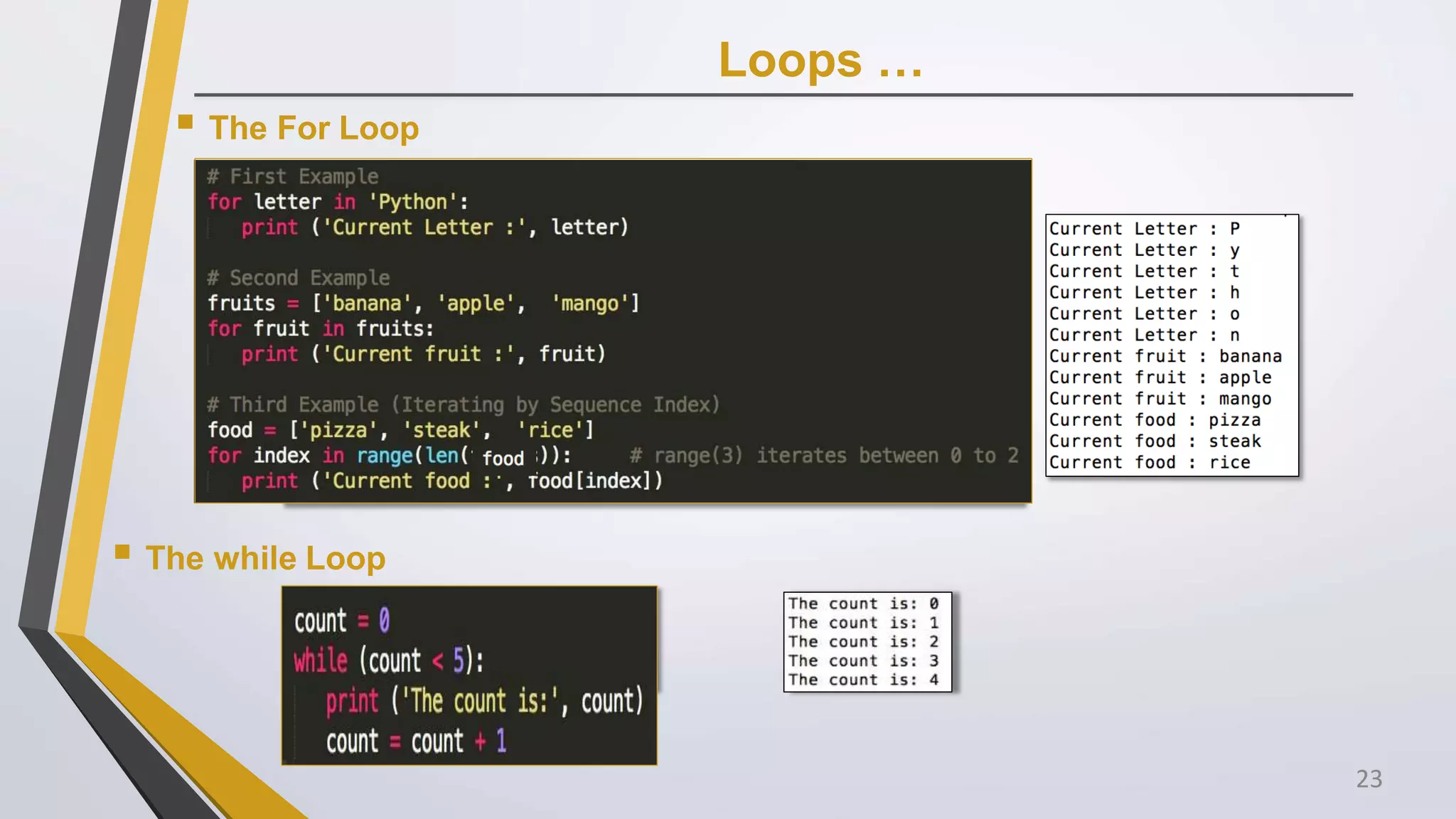
Loops …
 The For Loop
 The while Loop
23
Loops
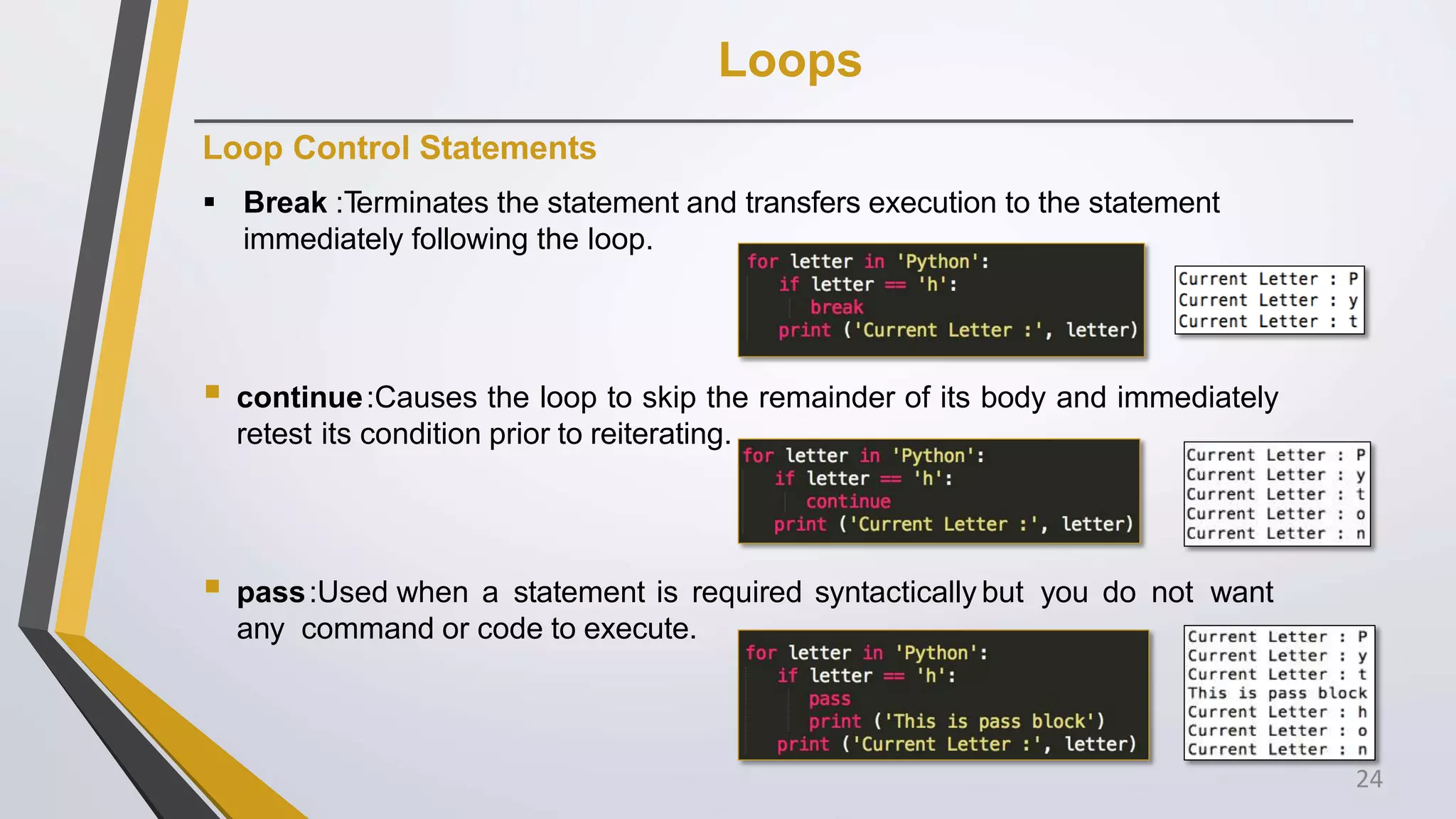
Loop Control Statements
 Break :Terminates the statement and transfers execution to the statement
immediately following the loop.
 continue:Causes the loop to skip the remainder of its body and immediately
retest its condition prior to reiterating.
 pass:Used when a statement is required syntactically but you do not want
any command or code to execute.
24
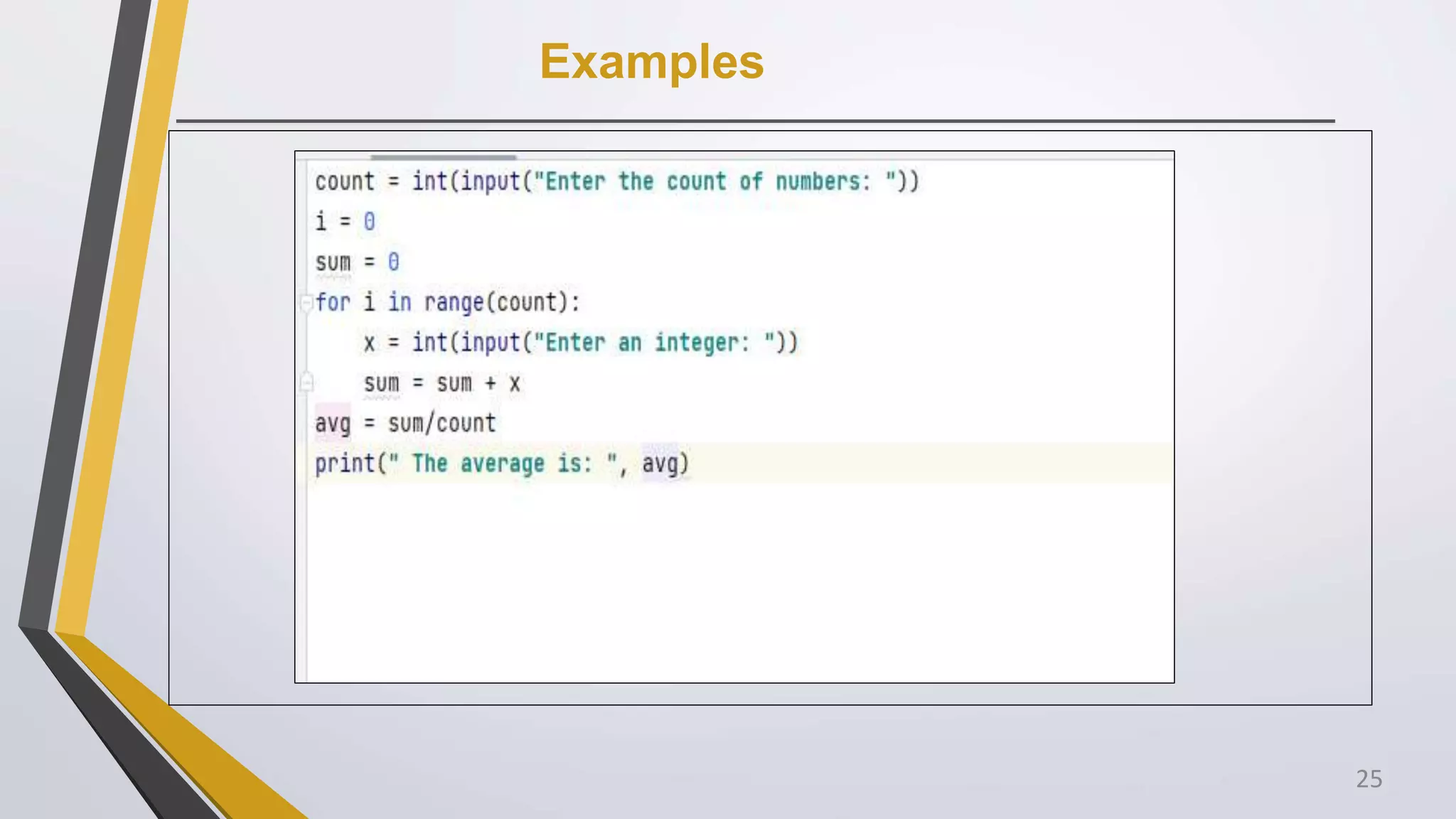
Examples
25
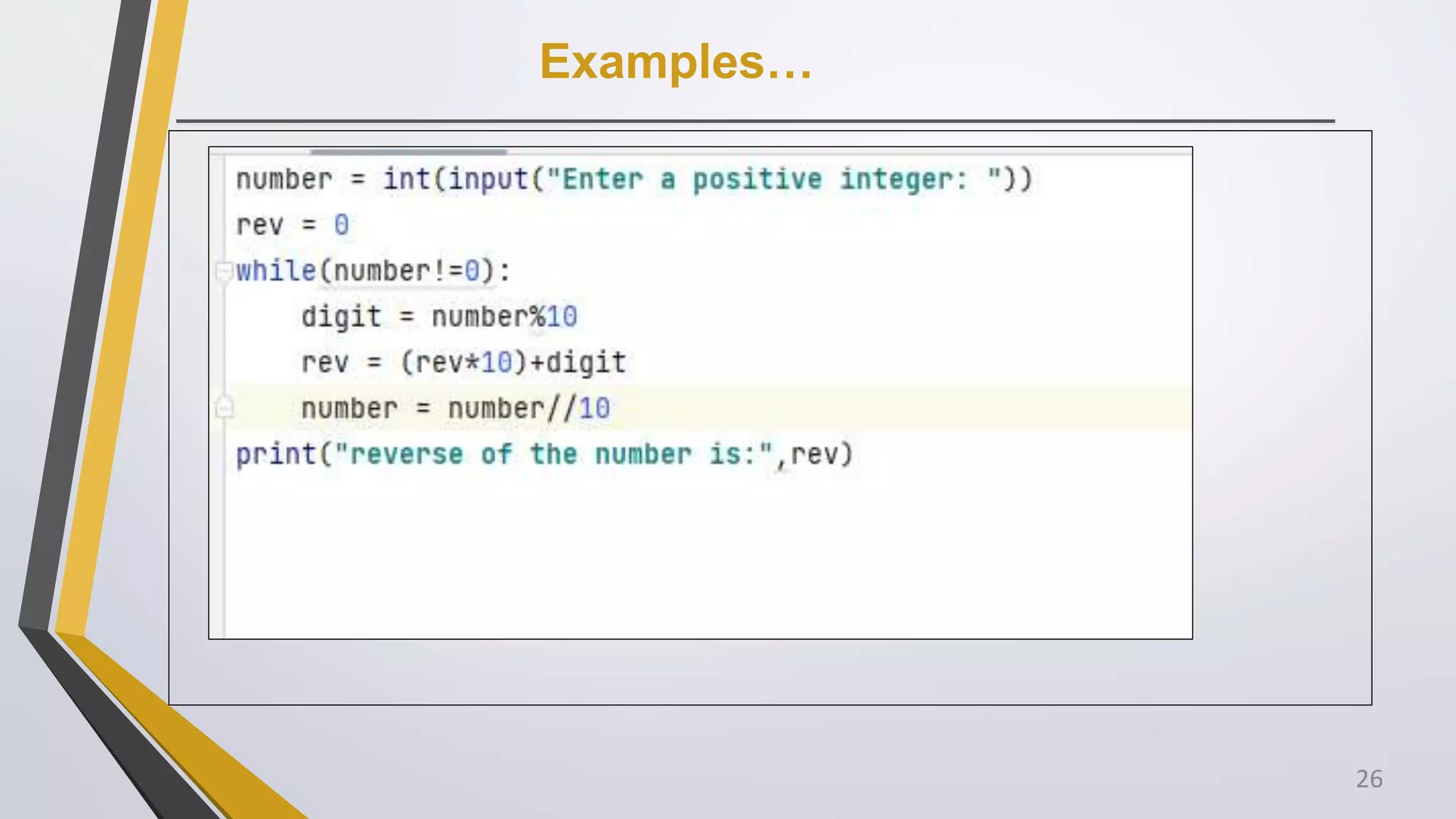
Examples…
26
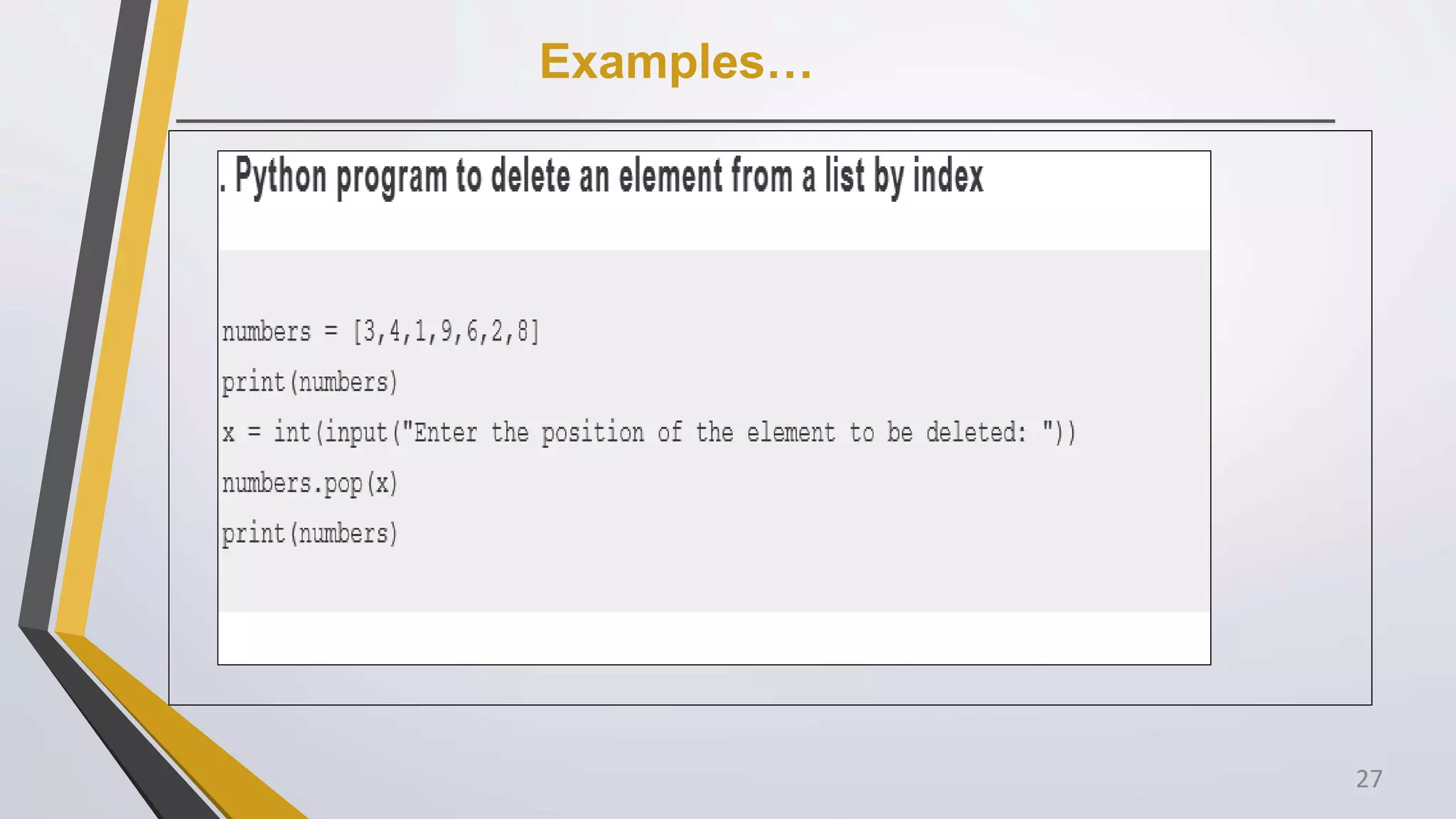
Examples…
27
QUIZ(5%)
1) Write python code that Accept two numbers from the user and calculate multiplication
,subtraction and addition.
2) Given a Python list of numbers. Turn every item of a list into its square
List = [1, 2, 3, 4, 5, 6, 7]
Expected Output: [1, 4, 9, 16, 25, 36, 49]
3) Reverse the given” List = [100, 200, 300, 400, 500]” in Python.
Expected Output: [500, 400, 300, 200, 100]
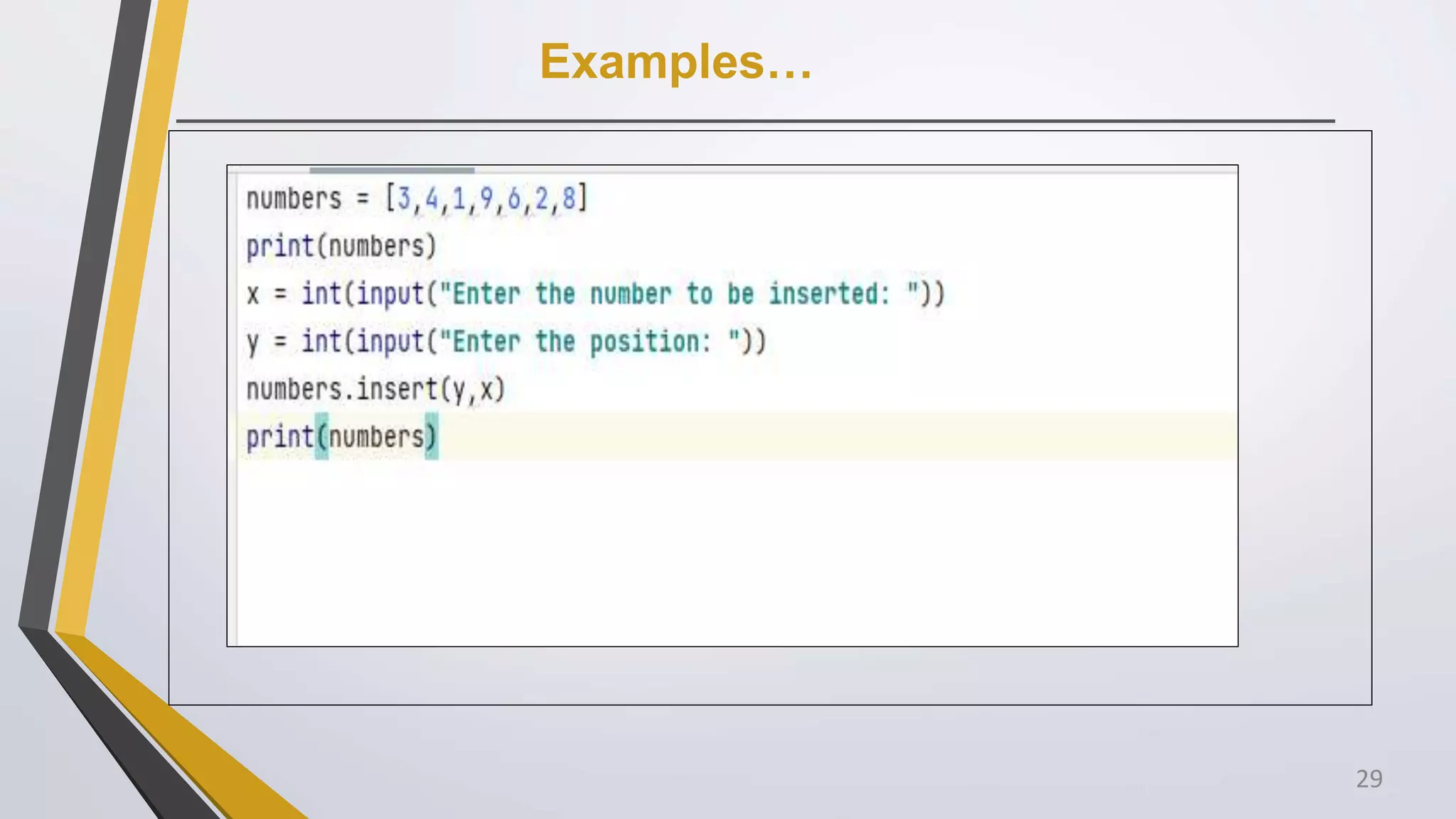
4. Write Python program to insert a number to any position in a list.
for example numbers = [3,4,1,9,6,2,8]
5. Write a program in Python to print number ranging from 1 to 25 but excluding number
which is the multiples of 5.
6. Write a program to filter even and odd number from a list.
Hint 1
Given x = [10, 23, 24, 35, 65, 78, 90] 28
Examples…
29

Chapter - 3.pptx

  • 1.
  • 2.
    Python 3 –Basic Operators  Operators are the constructs, which can manipulate the value of operands.  Python language supports the following types of operators i. Arithmetic Operators ii. Comparison (Relational) Operators iii. Assignment Operators iv. Logical Operators v. Bitwise Operators vi. Membership Operators 2
  • 3.
    Cont’d … Python ArithmeticOperators Assume variable a holds the value 10 and variable b holds the value 21, then 3
  • 4.
    Cont’d … Python ComparisonOperators  These operators compare the values on either side of them and decide the relation among them.  They are also called Relational operators.  Assume variable a holds the value 10 and variable b holds the value 20, then 4
  • 5.
  • 6.
    Cont’d … Python AssignmentOperators Assume variable a holds 10 and variable b holds 20, then- 6
  • 7.
    Cont’d … Python BitwiseOperators Bitwise operator works on bits and performs bit-by-bit operation. Assume if a = 60; and b = 13; Now in binary format they will be as follows a= 0011 1100 b = 0000 1101 ----------------- a&b = 0000 1100 a|b = 0011 1101 a^b = 0011 0001 ~a = 1100 0011  Python's built-in function bin() can be used to obtain binary representation of an integer number. 7
  • 8.
    Cont’d … Python LogicalOperators  The following logical operators are supported by Python language.  Assume variable a holds True and variable b holds False then 8
  • 9.
    Cont’d … Python MembershipOperators  Python’s membership operators test for membership in a sequence, such as strings, lists, or tuples.  There are two membership operators as explained below- 9
  • 10.
  • 11.
    Conditionals  In Python,True and False are Boolean objects of class 'bool' and they are immutable.  Python assumes any non-zero and non-null values as True, otherwise it is False value.  Python does not provide switch or case statements as in other languages.  Syntax: if Statement if..else Statement if..elif..else Statement  Example: 11
  • 12.
    Conditionals  Using theconditional expression Another type of conditional structure in Python, which is very convenient and easy to read.  12
  • 13.
  • 14.
    Cont’d … The elifStatement  The elif statement allows you to check multiple expressions for TRUE  Similar to the else, the elif statement is optional.  However, unlike else, for which there can be at the most one statement, there can be an arbitrary number of elif statements following an if. 14
  • 15.
  • 16.
  • 17.
    Python 3 –Loops  In general, statements are executed sequentially-  The first statement in a function is executed first, followed by the second, and so on.  Python programming language provides the following types of loops to handle looping requirements 17
  • 18.
    Cont’d … while LoopStatements  A while loop statement in Python programming language repeatedly executes a target statement as long as a given condition is true.  Here, statement(s) may be a single statement or a block of statements with uniform indent.  The condition may be any expression, and true is any non-zero value.  The loop iterates while the condition is true. 18
  • 19.
  • 20.
    Cont’d … for LoopStatements The for statement in Python has the ability to iterate over the items of any sequence, such as a list or a string. The range() function The built-in function range() is the right function to iterate over a sequence of numbers. It generates an iterator of arithmetic progressions. 20
  • 21.
  • 22.
  • 23.
    Loops …  TheFor Loop  The while Loop 23
  • 24.
    Loops Loop Control Statements Break :Terminates the statement and transfers execution to the statement immediately following the loop.  continue:Causes the loop to skip the remainder of its body and immediately retest its condition prior to reiterating.  pass:Used when a statement is required syntactically but you do not want any command or code to execute. 24
  • 25.
  • 26.
  • 27.
  • 28.
    QUIZ(5%) 1) Write pythoncode that Accept two numbers from the user and calculate multiplication ,subtraction and addition. 2) Given a Python list of numbers. Turn every item of a list into its square List = [1, 2, 3, 4, 5, 6, 7] Expected Output: [1, 4, 9, 16, 25, 36, 49] 3) Reverse the given” List = [100, 200, 300, 400, 500]” in Python. Expected Output: [500, 400, 300, 200, 100] 4. Write Python program to insert a number to any position in a list. for example numbers = [3,4,1,9,6,2,8] 5. Write a program in Python to print number ranging from 1 to 25 but excluding number which is the multiples of 5. 6. Write a program to filter even and odd number from a list. Hint 1 Given x = [10, 23, 24, 35, 65, 78, 90] 28
  • 29.