
DR. MANIN CHAUDHARY
MD, DNB MEDICAL ONCOLOGY 1ST YEAR
27-06-2017
 The regulatory T-cells (Tregs) were formerly
known as suppressor T-cells.
 They are a subpopulation of T-cells that modulate
the immune system, maintain tolerance to self-
antigens and prevent autoimmune disease.
 This is an important “self-check” built into the
immune system to prevent excessive reactions.
 Tregs suppress activation of the immune system
and prevent pathological self-reactivity i.e.
autoimmunity.
 The molecular mechanism by which Tregs exert
their suppressor/ regulatory activity has not been
defined accurately.
 The immunosuppressive cytokines TFG-ß and IL-
10 have been implicated in the Treg cells function.
 Another control mechanism is through the IL-2
feedback loop.
 Antigen-activated T-cells produce IL-2 which then
act on IL-2 receptors on Tregs alerting them of the
fact that high T-cell activity is occurring, and
thereby mount a suppressory response against
them.
 Negative feedback loop to ensure that over-
reaction is not occurring.
 Like helper T-cells, the Tregs display the CD4
antigen on their surface.
 However, the Tregs are distinguished by their
additional display of the CD25 surface antigen
and their expression of a transciption factor,
termed FOXP3 (forkhead box P3), that
programs their development.
 Under the influence of TGF-ß, Treg cells mature
from CD4+ precursors.
 They acquire the expression of markers typical
of Tregs like:
• CD25
• CTLA-4 (cytotoxic T-lymphocyte associated molecule-
4)
• GITR (glucocorticoid-induced TNF receptor)
 Upon up-regulation of the transcription factor
FOXP3, Treg cells begin their suppressive
effect.
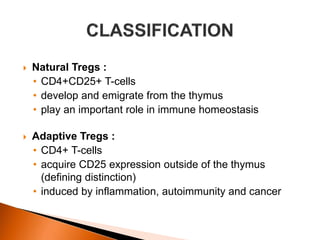
 Natural Tregs :
• CD4+CD25+ T-cells
• develop and emigrate from the thymus
• play an important role in immune homeostasis
 Adaptive Tregs :
• CD4+ T-cells
• acquire CD25 expression outside of the thymus
(defining distinction)
• induced by inflammation, autoimmunity and cancer
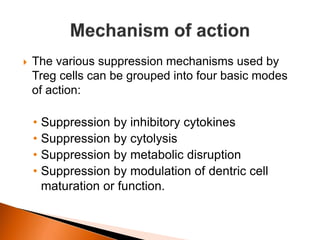
 The various suppression mechanisms used by
Treg cells can be grouped into four basic modes
of action:
• Suppression by inhibitory cytokines
• Suppression by cytolysis
• Suppression by metabolic disruption
• Suppression by modulation of dentric cell
maturation or function.
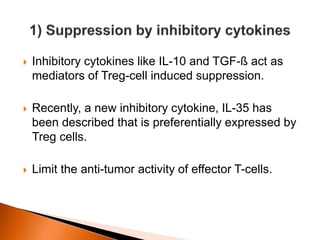
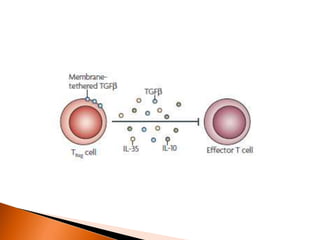
 Inhibitory cytokines like IL-10 and TGF-ß act as
mediators of Treg-cell induced suppression.
 Recently, a new inhibitory cytokine, IL-35 has
been described that is preferentially expressed by
Treg cells.
 Limit the anti-tumor activity of effector T-cells.
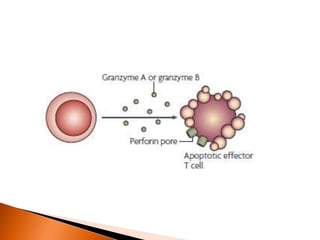
 Cytolysis mediated through secretion of granzymes is
considered as the forte of natural killer cells and CD8+
cytotoxic T-cells.
 Consistent with this, nTregs have been shown to
express granzyme A and granzyme B, and suppress NK
and cytotoxic T-cells by killing them in a granzyme- and
perforin-dependent mannner.
 Activated Tregs induce apoptosis of effector T-cells
through a TRAIL-DR5 pathway (Tumor-necrosis-factor
Related Apoptosis-Inducing Ligand – Death Receptor
5).
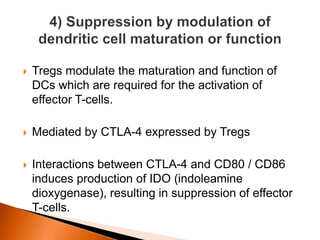
 High expression level of CD25 empowers Treg
cells to consume local IL-2 and therefore starve
the actively dividing effector T-cells by depleting
the IL-2 they need to survive.
 Cytokine (IL-2)-deprivation mediated apoptosis
 Concordant expression of ectoenzymes CD39 and
CD73 generates pericellular adenosine, that
suppresses effector T-cell function through
activation of adenosine receptor 2A (A2AR).
 Binding of adenosine to the receptor also enhance
the generation of induced Tregs by promoting
TGF-ß and inhibiting IL-6.
 Tregs suppress effector T-cells by directly
tranferring the inhibitory cAMP into effector T-cells
through membrane gap junctions.
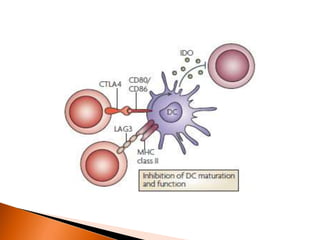
 Tregs modulate the maturation and function of
DCs which are required for the activation of
effector T-cells.
 Mediated by CTLA-4 expressed by Tregs
 Interactions between CTLA-4 and CD80 / CD86
induces production of IDO (indoleamine
dioxygenase), resulting in suppression of effector
T-cells.
 Tregs may also decrease the capacity of DCs to
activate effector T-cells.
 Lymphocyte-activation gene 3 (LAG3) may block
DC maturation.
 However, systemic depletion of Treg cells may
elicit deleterious autoimmunity.
 Mutations of the gene encoding the Treg-specific
transcription factor FOXP3 impair Treg cell
development and cause a fatal multi-organ
autoimmune disease called IPEX syndrome
(immunodysregulation, polyendocrinopathy and
enteropathy, X-linked syndrome)
 Characterised by development of overwhelming
systemic autoimmunity in the first year of life,
resulting in the triad of watery diarrhoea,
eczematous dermatitis and endocrinopathy, seen
as insulin-dependent diabetes mellitus.
 Males are affected, while females are carriers
 Coombs-positive hemolytic anemia, autoimmune
thrombocytopenia, autoimmune neutropenia and
tubular nephropathy.
 The majority of patients die within the first year of
life of either metabolic derangements or sepsis.
 Most tumors elicit an immune response in the host
that is mediated by tumor antigens.
 This causes large number of tumor-infiltrating
lymphocytes (TILs) to be found in the tumor
microenvironment.
 Tregs seem to be preferentially trafficked to the
tumor microenvironment.
 Tregs not only suppress autoimmunity, they also
suppress host’s immune defense against the
tumor antigens.
 In normal individuals, the Tregs represent only 5
to 10% of the population of CD4+ lymphocytes,
the remainder being helper T cells.
 In cancer patients, this number may increase to
25 to 30%.
 Infiltration of a large number of Treg cells into
tumor tissues is often associated with poor
prognosis.
 Several innate and adaptive immune cells
participate in the recognition and destruction of
cancer cells – known as cancer
immunosurveillance.
 Highly immunogenic cancer cell clones are
eliminated in immunocompetent hosts.
 However, cancer cells avoid such
immunosurveillance through the outgrowth of
weakly immunogenic cancer cells – a process
known as immunoediting/ immunoevasion.
 Escape from immune attack is an important step
in the progression of tumors toward the malignant
growth state.
 Immunoevasion has been recognised as a
hallmark of cancer.
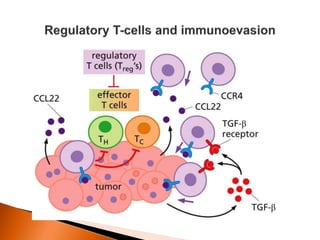
 Tregs are the major components that facilitate
tumor immune escape.
 In humans, tumors in the head and neck, breast,
lung, liver, gastrointestinal tract, pancreas and
ovary have been shown to harbor a large number
of tumor-infiltrating Treg cells.
 Decreased ratios of tumor-infiltrating CD8+ T-cells
to FOXP3+ Treg cells were shown to correlate
with poor prognosis.
 This indicates that Tregs suppress effector T-cells
and hinder the body’s immune response against
cancer.
 However, the opposite is true in some cancers and
high levels of Tregs are associated with a positive
prognosis.
 This is seen in colorectal carcinoma and follicular
lymphoma.
 These opposite effects indicate that Tregs role in
development of cancer is dependent on both type
and location of tumor.
 Although FOXP3 appears to be required for
human Treg cell development and function,
expression of FOXP3 alone is not sufficient for
regulatory function.
 Consequently, FOXP3 is not an adequate marker
for human Treg cells.
 There is great interest in identifying cell surface
markers that are uniquely and specifically
expressed on all FOXP3 expressing Tregs,
however till date no such molecule has been
identified.
 Recent advances in cancer immunotherapy target
Tregs suggest that molecules relatively specific to
Treg cells are good candidates for Treg depletion
or functional modulation.
 These molecules include CTLA-4, GITR, CCR4,
PD-1, OX-40 and LAG3.
 Anti-CTLA4-antibody, also known as checkpoint
blockade therapy.
 Two fully humanized monoclonal antibody against
CTLA-4 (Ipilimumab and Tremelimumab) have
been tested in patients with melanoma, prostate
cancer and RCC.
 They target Treg cells which are abundant in
tumor tissues and express high levels of CTLA-4.
 Surface molecules expressed specifically or
selectively on effector Tregs are good targets.
 CCR4 is predominantly expressed by effector
Tregs, not by naive Tregs and helper T-cells.
 Treg migration and infiltration into various tumor
tissues appear to be dependent on the expression
of CCR4 ligands (CCL22).
 Use of anti-CCR4 antibody has been shown to
be effective in depleting effector Tregs
selectively and augmenting induction of tumor-
specific CD4+ and CD8+ T-cells.
 GITR is another molecule expressed by Tregs and
can serve as a target for functional modulation.
 The antibody for GITR is under clinical trials for
use in melanoma and other advanced solid
tumors.
 Antibodies specific for other molecules such as
OX40 are under clinical investigation.
 The A2AR antagonists are currently undergoing
cancer clinical trials.
 IDO inhibitors have also entered clinical trials in
combination with immune checkpoint blockade.
 It is hoped that the combination of Treg-cell
targeting (by reducing Tregs or attenuating their
suppressive activity in tumor tissues) with the
activation of tumor-specific effector T-cells (by
cancer vaccine or immune checkpoint blockade)
will make the current cancer immunotherapy more
effective.
Chapter 36 t reg cells

Chapter 36 t reg cells

  • 1.
    DR. MANIN CHAUDHARY MD,DNB MEDICAL ONCOLOGY 1ST YEAR 27-06-2017
  • 2.
     The regulatoryT-cells (Tregs) were formerly known as suppressor T-cells.  They are a subpopulation of T-cells that modulate the immune system, maintain tolerance to self- antigens and prevent autoimmune disease.  This is an important “self-check” built into the immune system to prevent excessive reactions.
  • 3.
     Tregs suppressactivation of the immune system and prevent pathological self-reactivity i.e. autoimmunity.  The molecular mechanism by which Tregs exert their suppressor/ regulatory activity has not been defined accurately.  The immunosuppressive cytokines TFG-ß and IL- 10 have been implicated in the Treg cells function.
  • 4.
     Another controlmechanism is through the IL-2 feedback loop.  Antigen-activated T-cells produce IL-2 which then act on IL-2 receptors on Tregs alerting them of the fact that high T-cell activity is occurring, and thereby mount a suppressory response against them.  Negative feedback loop to ensure that over- reaction is not occurring.
  • 6.
     Like helperT-cells, the Tregs display the CD4 antigen on their surface.  However, the Tregs are distinguished by their additional display of the CD25 surface antigen and their expression of a transciption factor, termed FOXP3 (forkhead box P3), that programs their development.
  • 7.
     Under theinfluence of TGF-ß, Treg cells mature from CD4+ precursors.  They acquire the expression of markers typical of Tregs like: • CD25 • CTLA-4 (cytotoxic T-lymphocyte associated molecule- 4) • GITR (glucocorticoid-induced TNF receptor)  Upon up-regulation of the transcription factor FOXP3, Treg cells begin their suppressive effect.
  • 8.
     Natural Tregs: • CD4+CD25+ T-cells • develop and emigrate from the thymus • play an important role in immune homeostasis  Adaptive Tregs : • CD4+ T-cells • acquire CD25 expression outside of the thymus (defining distinction) • induced by inflammation, autoimmunity and cancer
  • 9.
     The varioussuppression mechanisms used by Treg cells can be grouped into four basic modes of action: • Suppression by inhibitory cytokines • Suppression by cytolysis • Suppression by metabolic disruption • Suppression by modulation of dentric cell maturation or function.
  • 10.
     Inhibitory cytokineslike IL-10 and TGF-ß act as mediators of Treg-cell induced suppression.  Recently, a new inhibitory cytokine, IL-35 has been described that is preferentially expressed by Treg cells.  Limit the anti-tumor activity of effector T-cells.
  • 12.
     Cytolysis mediatedthrough secretion of granzymes is considered as the forte of natural killer cells and CD8+ cytotoxic T-cells.  Consistent with this, nTregs have been shown to express granzyme A and granzyme B, and suppress NK and cytotoxic T-cells by killing them in a granzyme- and perforin-dependent mannner.  Activated Tregs induce apoptosis of effector T-cells through a TRAIL-DR5 pathway (Tumor-necrosis-factor Related Apoptosis-Inducing Ligand – Death Receptor 5).
  • 14.
     High expressionlevel of CD25 empowers Treg cells to consume local IL-2 and therefore starve the actively dividing effector T-cells by depleting the IL-2 they need to survive.  Cytokine (IL-2)-deprivation mediated apoptosis
  • 15.
     Concordant expressionof ectoenzymes CD39 and CD73 generates pericellular adenosine, that suppresses effector T-cell function through activation of adenosine receptor 2A (A2AR).  Binding of adenosine to the receptor also enhance the generation of induced Tregs by promoting TGF-ß and inhibiting IL-6.  Tregs suppress effector T-cells by directly tranferring the inhibitory cAMP into effector T-cells through membrane gap junctions.
  • 17.
     Tregs modulatethe maturation and function of DCs which are required for the activation of effector T-cells.  Mediated by CTLA-4 expressed by Tregs  Interactions between CTLA-4 and CD80 / CD86 induces production of IDO (indoleamine dioxygenase), resulting in suppression of effector T-cells.
  • 18.
     Tregs mayalso decrease the capacity of DCs to activate effector T-cells.  Lymphocyte-activation gene 3 (LAG3) may block DC maturation.
  • 20.
     However, systemicdepletion of Treg cells may elicit deleterious autoimmunity.  Mutations of the gene encoding the Treg-specific transcription factor FOXP3 impair Treg cell development and cause a fatal multi-organ autoimmune disease called IPEX syndrome (immunodysregulation, polyendocrinopathy and enteropathy, X-linked syndrome)
  • 21.
     Characterised bydevelopment of overwhelming systemic autoimmunity in the first year of life, resulting in the triad of watery diarrhoea, eczematous dermatitis and endocrinopathy, seen as insulin-dependent diabetes mellitus.  Males are affected, while females are carriers  Coombs-positive hemolytic anemia, autoimmune thrombocytopenia, autoimmune neutropenia and tubular nephropathy.  The majority of patients die within the first year of life of either metabolic derangements or sepsis.
  • 22.
     Most tumorselicit an immune response in the host that is mediated by tumor antigens.  This causes large number of tumor-infiltrating lymphocytes (TILs) to be found in the tumor microenvironment.  Tregs seem to be preferentially trafficked to the tumor microenvironment.  Tregs not only suppress autoimmunity, they also suppress host’s immune defense against the tumor antigens.
  • 23.
     In normalindividuals, the Tregs represent only 5 to 10% of the population of CD4+ lymphocytes, the remainder being helper T cells.  In cancer patients, this number may increase to 25 to 30%.  Infiltration of a large number of Treg cells into tumor tissues is often associated with poor prognosis.
  • 24.
     Several innateand adaptive immune cells participate in the recognition and destruction of cancer cells – known as cancer immunosurveillance.  Highly immunogenic cancer cell clones are eliminated in immunocompetent hosts.  However, cancer cells avoid such immunosurveillance through the outgrowth of weakly immunogenic cancer cells – a process known as immunoediting/ immunoevasion.
  • 25.
     Escape fromimmune attack is an important step in the progression of tumors toward the malignant growth state.  Immunoevasion has been recognised as a hallmark of cancer.  Tregs are the major components that facilitate tumor immune escape.
  • 27.
     In humans,tumors in the head and neck, breast, lung, liver, gastrointestinal tract, pancreas and ovary have been shown to harbor a large number of tumor-infiltrating Treg cells.  Decreased ratios of tumor-infiltrating CD8+ T-cells to FOXP3+ Treg cells were shown to correlate with poor prognosis.  This indicates that Tregs suppress effector T-cells and hinder the body’s immune response against cancer.
  • 28.
     However, theopposite is true in some cancers and high levels of Tregs are associated with a positive prognosis.  This is seen in colorectal carcinoma and follicular lymphoma.  These opposite effects indicate that Tregs role in development of cancer is dependent on both type and location of tumor.
  • 29.
     Although FOXP3appears to be required for human Treg cell development and function, expression of FOXP3 alone is not sufficient for regulatory function.  Consequently, FOXP3 is not an adequate marker for human Treg cells.  There is great interest in identifying cell surface markers that are uniquely and specifically expressed on all FOXP3 expressing Tregs, however till date no such molecule has been identified.
  • 30.
     Recent advancesin cancer immunotherapy target Tregs suggest that molecules relatively specific to Treg cells are good candidates for Treg depletion or functional modulation.  These molecules include CTLA-4, GITR, CCR4, PD-1, OX-40 and LAG3.
  • 31.
     Anti-CTLA4-antibody, alsoknown as checkpoint blockade therapy.  Two fully humanized monoclonal antibody against CTLA-4 (Ipilimumab and Tremelimumab) have been tested in patients with melanoma, prostate cancer and RCC.  They target Treg cells which are abundant in tumor tissues and express high levels of CTLA-4.
  • 32.
     Surface moleculesexpressed specifically or selectively on effector Tregs are good targets.  CCR4 is predominantly expressed by effector Tregs, not by naive Tregs and helper T-cells.  Treg migration and infiltration into various tumor tissues appear to be dependent on the expression of CCR4 ligands (CCL22).
  • 33.
     Use ofanti-CCR4 antibody has been shown to be effective in depleting effector Tregs selectively and augmenting induction of tumor- specific CD4+ and CD8+ T-cells.
  • 34.
     GITR isanother molecule expressed by Tregs and can serve as a target for functional modulation.  The antibody for GITR is under clinical trials for use in melanoma and other advanced solid tumors.  Antibodies specific for other molecules such as OX40 are under clinical investigation.
  • 35.
     The A2ARantagonists are currently undergoing cancer clinical trials.  IDO inhibitors have also entered clinical trials in combination with immune checkpoint blockade.
  • 36.
     It ishoped that the combination of Treg-cell targeting (by reducing Tregs or attenuating their suppressive activity in tumor tissues) with the activation of tumor-specific effector T-cells (by cancer vaccine or immune checkpoint blockade) will make the current cancer immunotherapy more effective.