Chapter 22
CONCEPTUAL AND
ACTIVIST ART
Art & Language
Joseph Kosuth’s artwork One and Three
Chairs, consists of a wooden folding
chair placed against the wall, flanked by
a black and white photograph of the
chair, and a photostat of its dictionary
definition.
Conceptual art, which emerged in the
mid-1960s, advocated an art whose
value, meaning and existence was
rooted in its concept, rather than in the
work’s physical properties.
Kosuth was influenced by new theories
of language and signification,
particularly semiotics—the study of the
meaning of signs
Joseph Kosuth. One and Three
Chairs, 1965. Wooden folding
chair, photographic copy of a
chair, and photographic
enlargement of a dictionary
definition of a chairMuseum of
Modern Art New York
Art as Language
Weiner, Huebler, and Barry
Lawrence Weiner, a participant of the Conceptual Art movement of the
1960s
• is best known for his text-based work,
• created subversive installations that alter an existing space or
environment.
In 1967 and in 1968-9, Douglas Huebler, began to turn everyday activities
through photographs, notes, maps, and drawings into a series of
artworks.
Robert Barry focused on the transitional and the impermanent aspects in
art that included the viewers as participants by simply being in the
galleries, reacting to the art, and discussing it with others.
Man
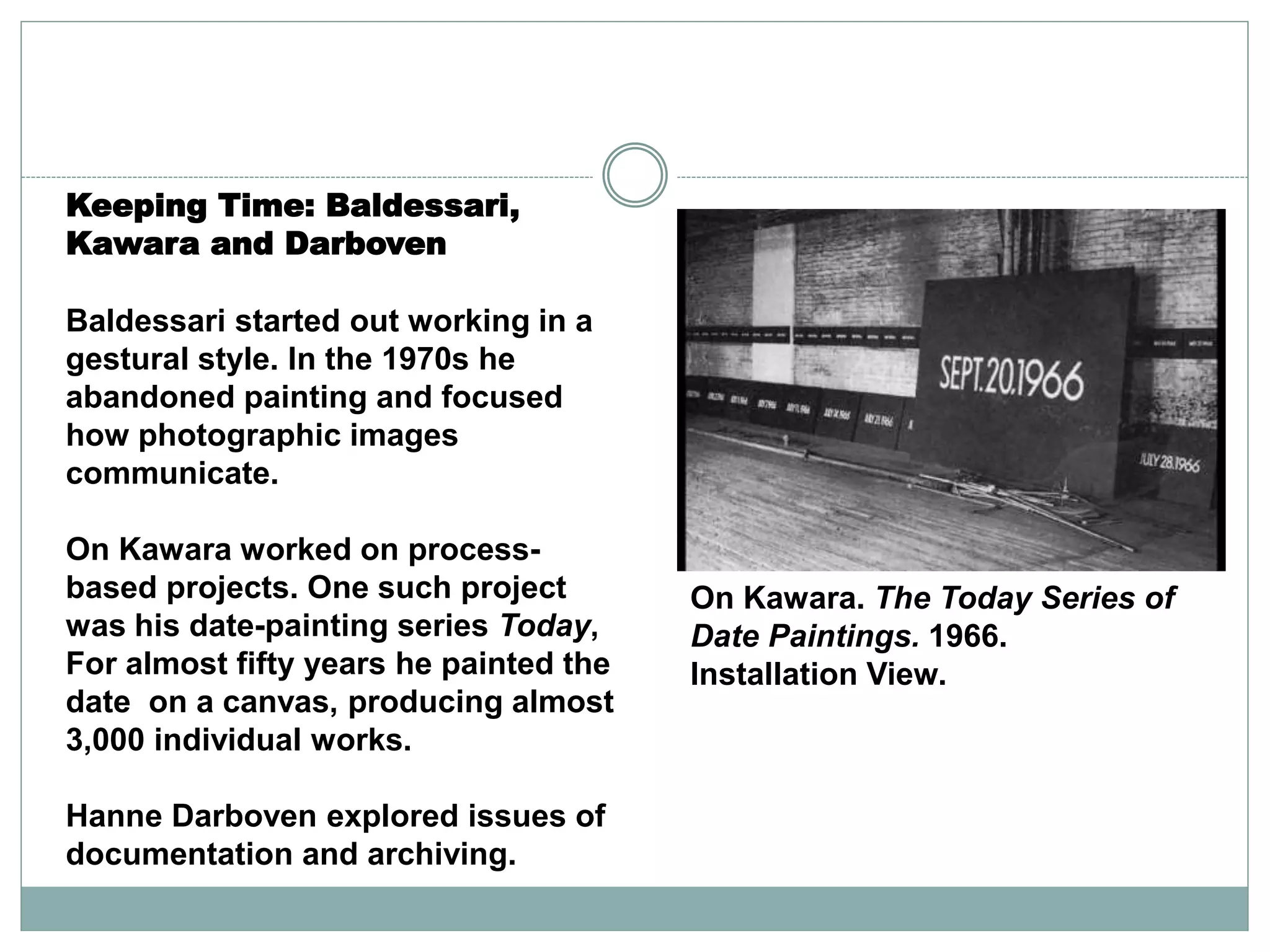
On Kawara. The Today Series of
Date Paintings. 1966.
Installation View.
Keeping Time: Baldessari,
Kawara and Darboven
Baldessari started out working in a
gestural style. In the 1970s he
abandoned painting and focused
how photographic images
communicate.
On Kawara worked on process-
based projects. One such project
was his date-painting series Today,
For almost fifty years he painted the
date on a canvas, producing almost
3,000 individual works.
Hanne Darboven explored issues of
documentation and archiving.
Broodthaers, Burren, and
Sanejouand
Marcel Broodthaers' focus on identity
questions the meaning of national identity
and the role of art in an increaseangly
globalized world.
Daniel Burren creates site-specific
installations of alternating stripe patterns.
He employs simplified patterns in relation
to architecture and space.
Jean-Michel Sanejouand’s work focuses
on the interrogation of social and
aesthetic significance of art.
Marcel Broodthaers, La
Tour visuelle. 1966. Glass,
wood, and magazine
reproductions, 33-1⁄2 × 31-
1⁄2”. Scottish National
Gallery of Modern Art
Edinburgh.
Conceptual Art as Cultural Critique
Haacke and Asher
Hans Haacke transformed modern
'artivism' into a political strategy for
conceptual artists.
Michael Asher’s
• work focused more on the realm of
ideas than on art as object.
• approach is defined as institutional
critique.
• work focused on
• the hidden conventions that
surrounded art and
• how art was viewed,
• how art was valued and used in
society.
Hans Haacke
Shapolsky et al
Manhattan Real
Estate Holdings a
Real-Time Social
System as of May
1, 1971 (detail)
1971.
142 Photographs
2 maps, 6 charts
Edition of two
Lawler and Wilson
Louise Lawler’s work questions
the art market and the forces
driving it. She takes photographs
of art objects in collector’s homes,
museums, auction houses, and
storage facilities.
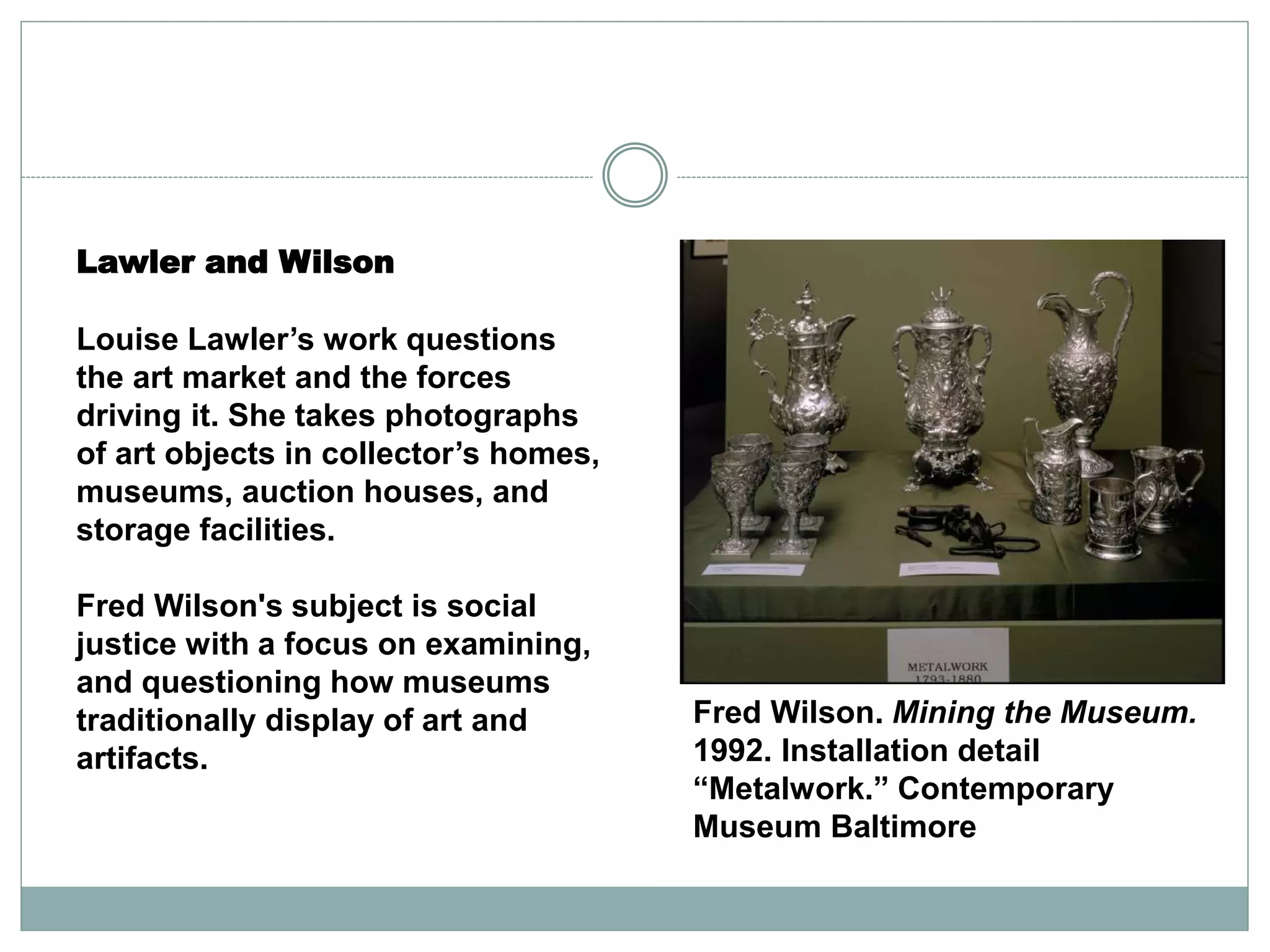
Fred Wilson's subject is social
justice with a focus on examining,
and questioning how museums
traditionally display of art and
artifacts.
Fred Wilson. Mining the Museum.
1992. Installation detail
“Metalwork.” Contemporary
Museum Baltimore
Paik
Nam June Paik
• studied music, history, art history and
philosophy at the University of Tokyo.
• continued his studies in Munich and
Freiburg and in 1958 meets John Cage in
• became a member of the Fluxus
movement
• in1963 shows the first manipulated TV
sets.
• 1964 moved to New York and becomes
the first artist to make videotapes.
Paik's early works are image manipulations
and colorizations of the Paik/Abe
Synthesizer, a device he developed in 1969
with electronics engineer Shuya Abe.
Nam June Paik. TV Bra for
Living Sculpture (worn by
Charlotte Moorman), 1969
Television sets and cello.
Photo by Peter Moore
The Medium is the
Message: Early Video Art
Nauman
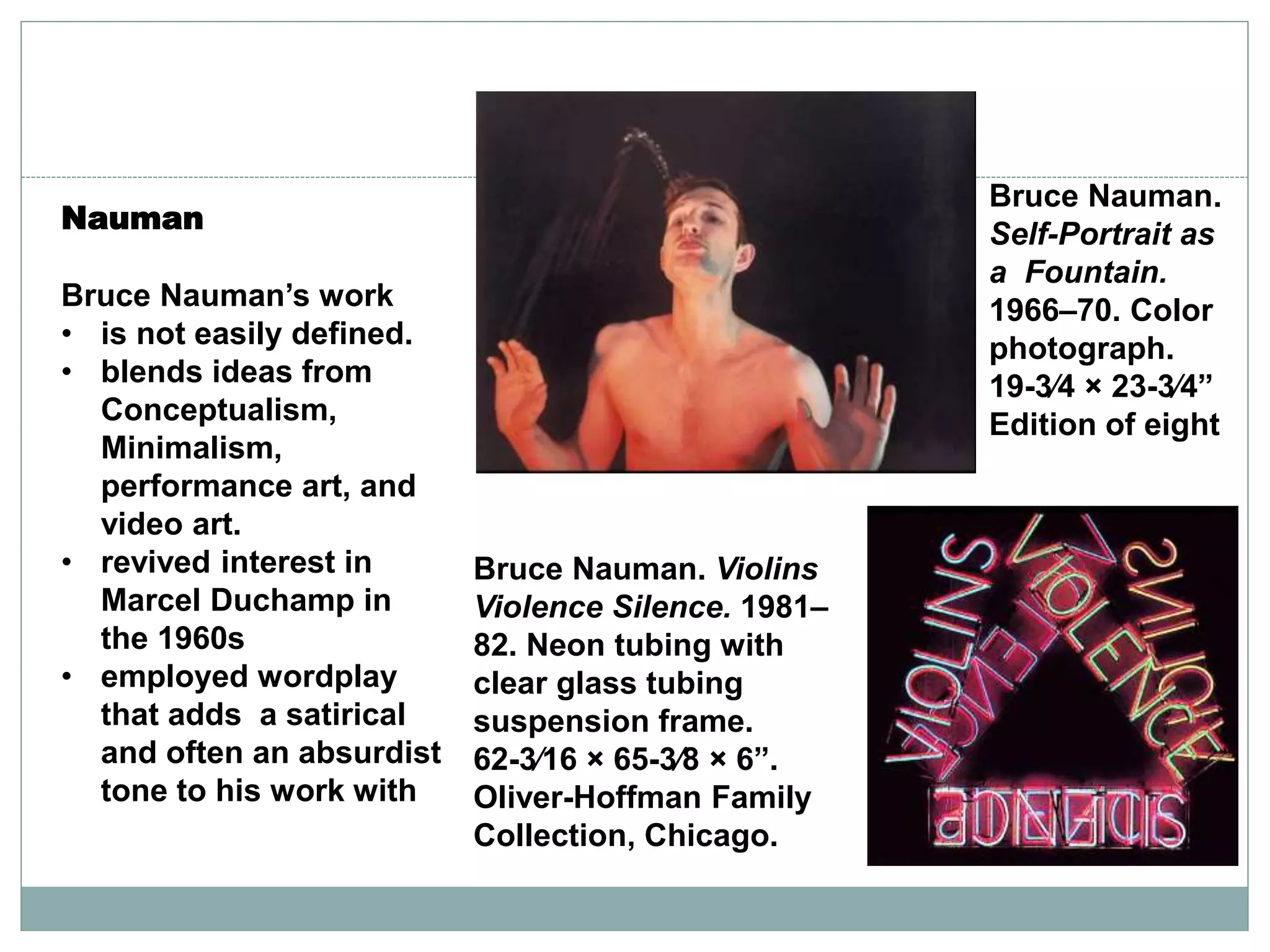
Bruce Nauman’s work
• is not easily defined.
• blends ideas from
Conceptualism,
Minimalism,
performance art, and
video art.
• revived interest in
Marcel Duchamp in
the 1960s
• employed wordplay
that adds a satirical
and often an absurdist
tone to his work with
Bruce Nauman.
Self-Portrait as
a Fountain.
1966–70. Color
photograph.
19-3⁄4 × 23-3⁄4”
Edition of eight
Bruce Nauman. Violins
Violence Silence. 1981–
82. Neon tubing with
clear glass tubing
suspension frame.
62-3⁄16 × 65-3⁄8 × 6”.
Oliver-Hoffman Family
Collection, Chicago.
Campus’ VIdeo Art
Peter Campus
• is a major new media and video
artist.
• studied at The City College Film
Institute
• participated in the experimental
workshops at Boston’s famous
WGBH-TV.
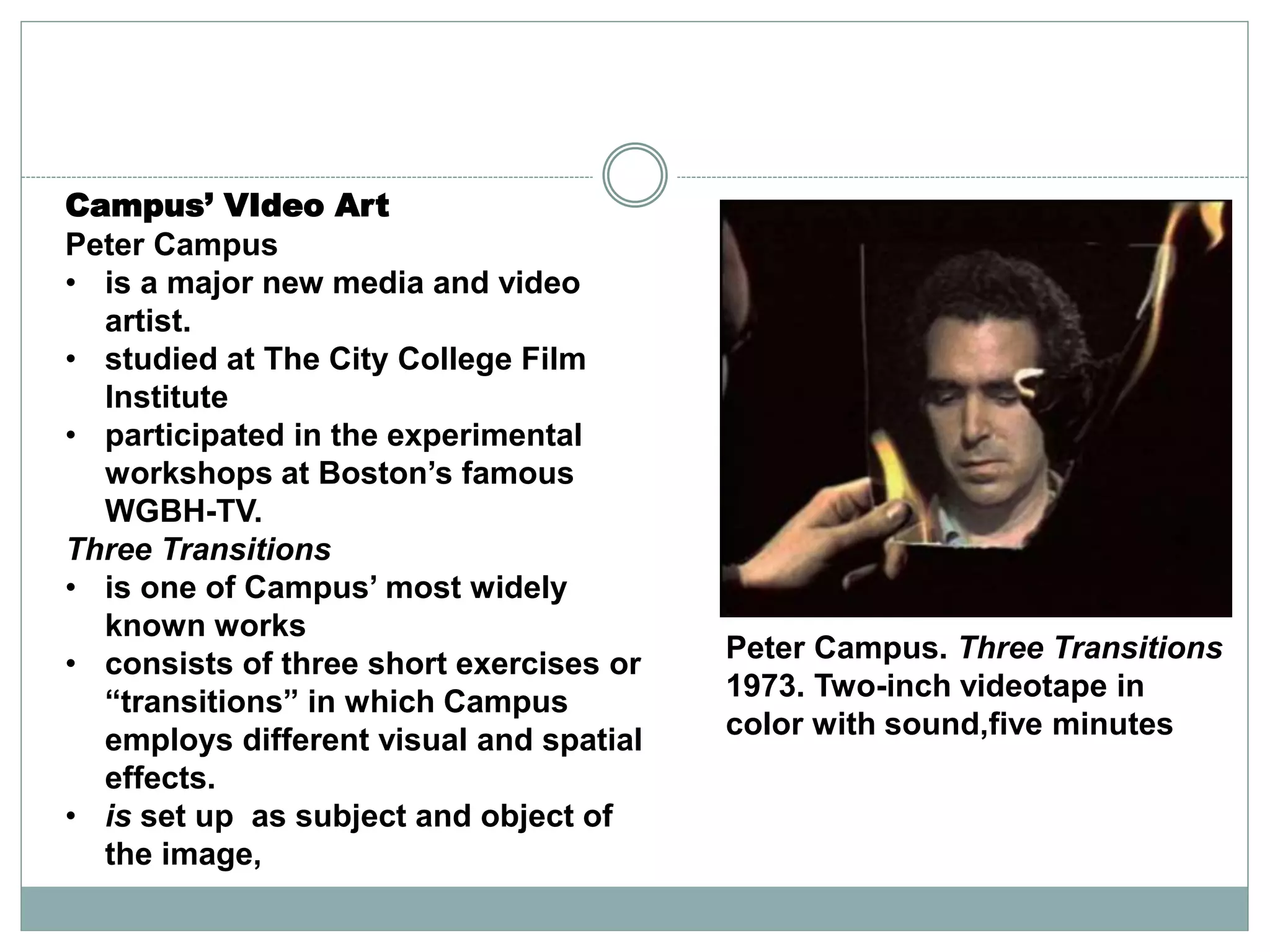
Three Transitions
• is one of Campus’ most widely
known works
• consists of three short exercises or
“transitions” in which Campus
employs different visual and spatial
effects.
• is set up as subject and object of
the image,
Peter Campus. Three Transitions
1973. Two-inch videotape in
color with sound,five minutes
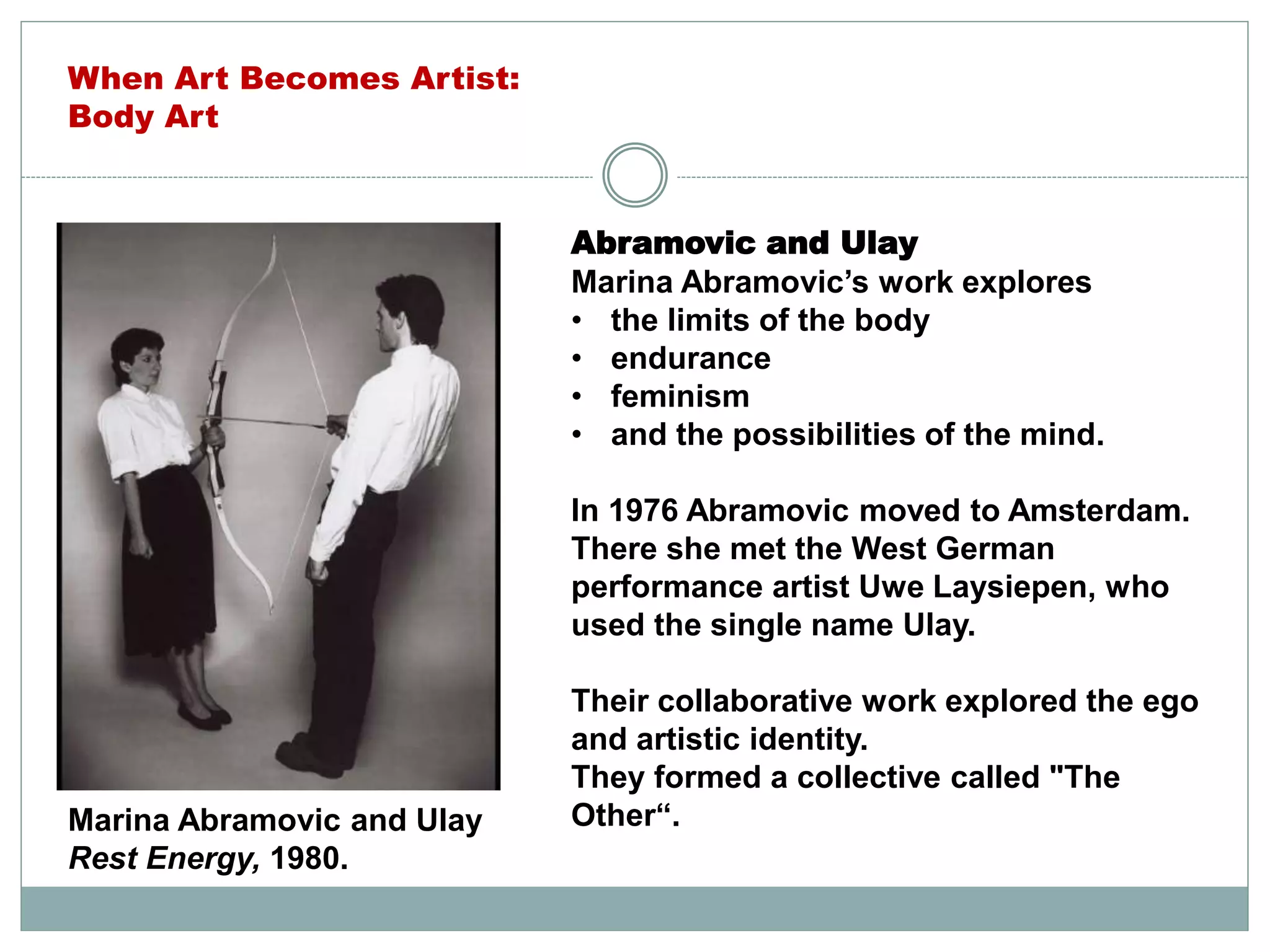
Abramovic and Ulay
Marina Abramovic’s work explores
• the limits of the body
• endurance
• feminism
• and the possibilities of the mind.
In 1976 Abramovic moved to Amsterdam.
There she met the West German
performance artist Uwe Laysiepen, who
used the single name Ulay.
Their collaborative work explored the ego
and artistic identity.
They formed a collective called "The
Other“.Marina Abramovic and Ulay
Rest Energy, 1980.
When Art Becomes Artist:
Body Art
Schneemann and Wilkie
Carolee Schneemann’s work examend the possibilities of political and
personal liberation from oppressive social and aesthetic conventions.
Hannah Wilke’s performances and photography are a crucial
contribution to the Feminist movement. Wilke’s work challenges the
traditional art practices and cultural assumptions.
Mendieta
Ana Mendieta was born in Cuba. She and her sister were part of a
government-sponsored project for Cuban children to flee Fidel Castro's
dictatorship. The sisters were sent Iowa, where they lived in foster
homes.
In her work Mendieta explored the disconnection from concepts of
mother, place, identity, and belonging.
Acconci
Vito Acconci created
experimental film and video
from 1969 to 1977.
His artistic career in a variety
of disciplines, included
performance art.
In the late '70s, Acconci
started building interactive
sculptures.
In the late '80s, he began to
construct small, cramped,
temporary houses as
sculptures.
This is a period in which he
created experimental, free-
floating, and often temporary
architecture and public art.
Vito Acconci. Instant House.
1980. Flags, wood, springs,
ropes, & pulleys, open 8’ × 21’ ×
21’. closed 8’ × 5’ × 5’. Museum
of Contemporary Art San Diego
Gilbert and George, Anderson
and Horn
Gilbert and George met at St Martin's
in 1967, while studying sculpture.
Early in their careers they formulated
the concept of being their own art,
creating the so-called 'Living
Sculptures' from their own bodies.
They worked very hard to convince
gallery owners to give them show of
themselves as sculptures.
Gilbert and George. The Singing
Sculpture (“Underneath the
Arches”). 1969. Presentation at
the Sonnabend Gallery, New York.
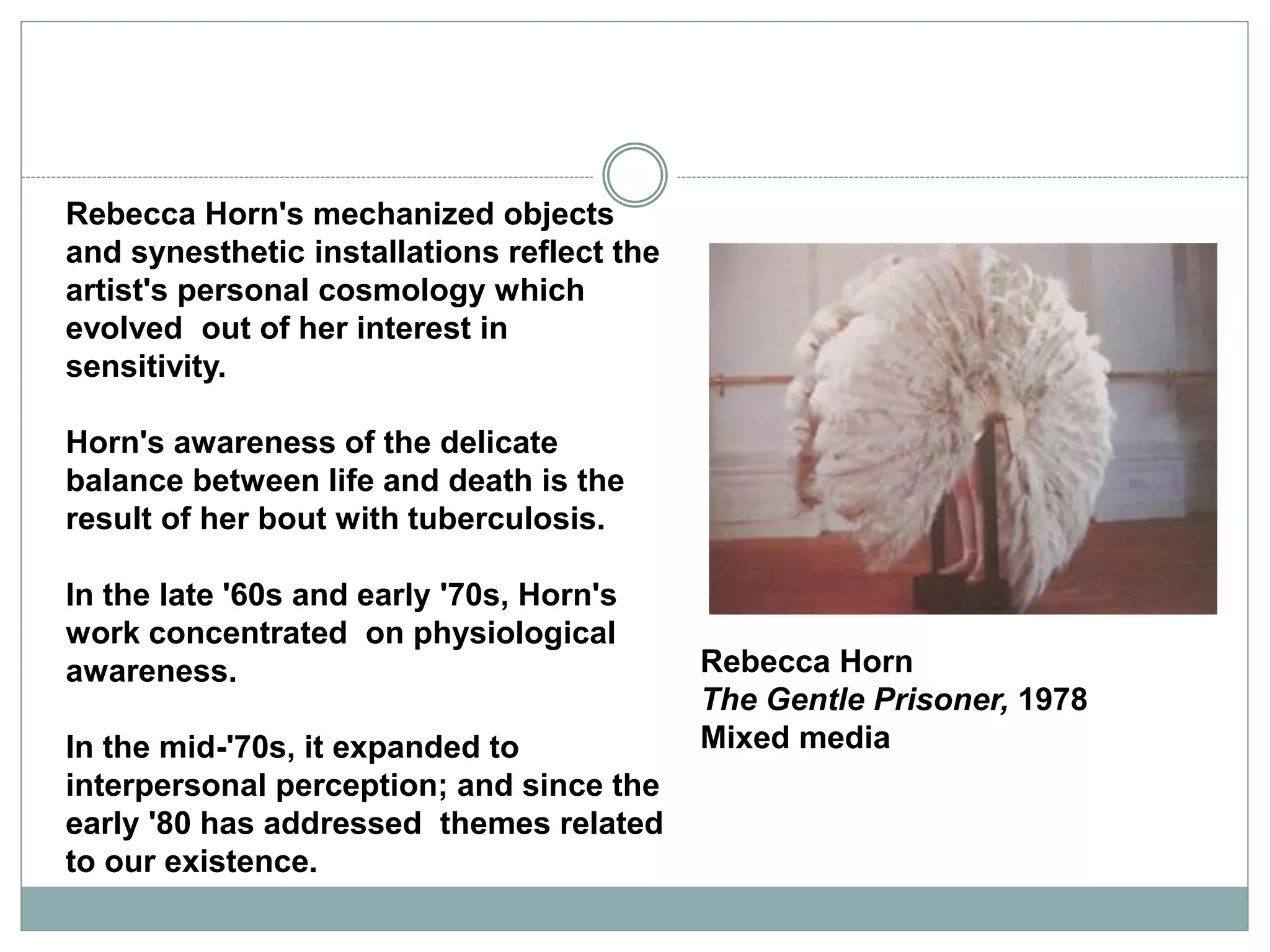
Rebecca Horn
The Gentle Prisoner, 1978
Mixed media
Rebecca Horn's mechanized objects
and synesthetic installations reflect the
artist's personal cosmology which
evolved out of her interest in
sensitivity.
Horn's awareness of the delicate
balance between life and death is the
result of her bout with tuberculosis.
In the late '60s and early '70s, Horn's
work concentrated on physiological
awareness.
In the mid-'70s, it expanded to
interpersonal perception; and since the
early '80 has addressed themes related
to our existence.
The poetic nature of Rebecca
Horn’s creations unconsciously
unleashes contradictions and
premonitions of the future.
Horn's work concentrates on
physiological awareness,
interpersonal perception, and
universal themes that underlie our
existence.
Despite these life-encompassing
questions, Horn's sculpture has a
dramatic tension. Rebecca Horn. The Moon, the
Child, the River of Anarchy, 1991.
Mixed media installation
The Feminist Art Program
Female artists before the end
of the 1960s, conformed to the dominant
modes of expression of male artists:
Abstract Expressionism and Minimalism
during the 1950s and 1960s.
The content of the works of female artists
had little connection to their experiences.
The Feminist Art Program at Cal Arts was a
historic attempt. Art historian and faculty,
Paula Harper, encouraged the students to
collaborate on installations in an
abandoned house called Womanhouse.
Judy Chicago and Miriam Schapiro served
as facilitators.
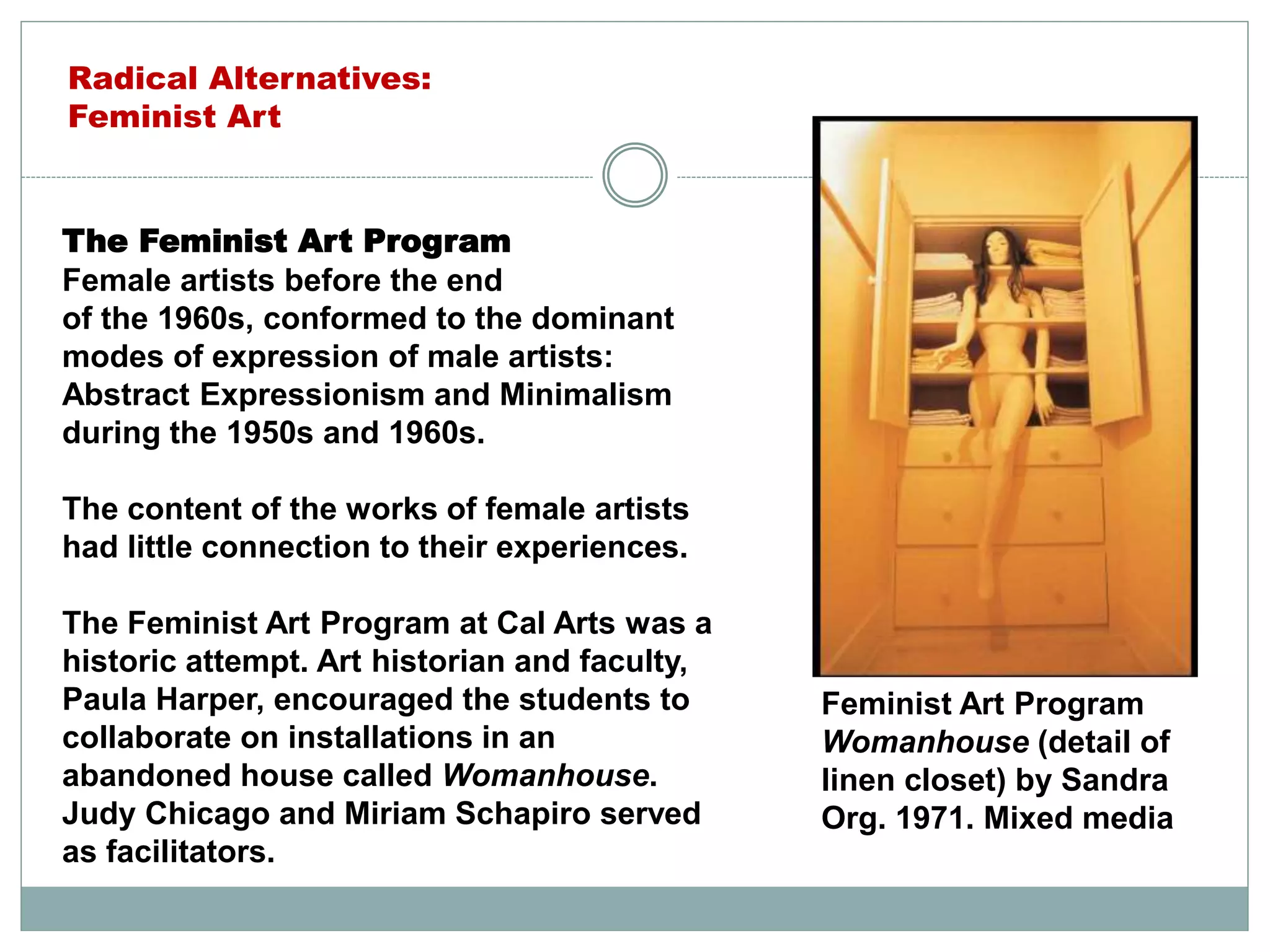
Feminist Art Program
Womanhouse (detail of
linen closet) by Sandra
Org. 1971. Mixed media
Radical Alternatives:
Feminist Art
Judy Chicago’s work
• reflects on women's roles as artists,
• focuses on preoccupation with
personal narrative and political activity.,
• seeks to address the women's l
underrepresentation in the visual arts,
• focuses on female subject matter.
In her work The Dinner Party (1979),
Chicago
• celebrates the achievements of women
throughout history,
• employed the "feminine" arts relegated
to the lowest levels of the artistic
hierarchy:
• needlework
• and embroidery
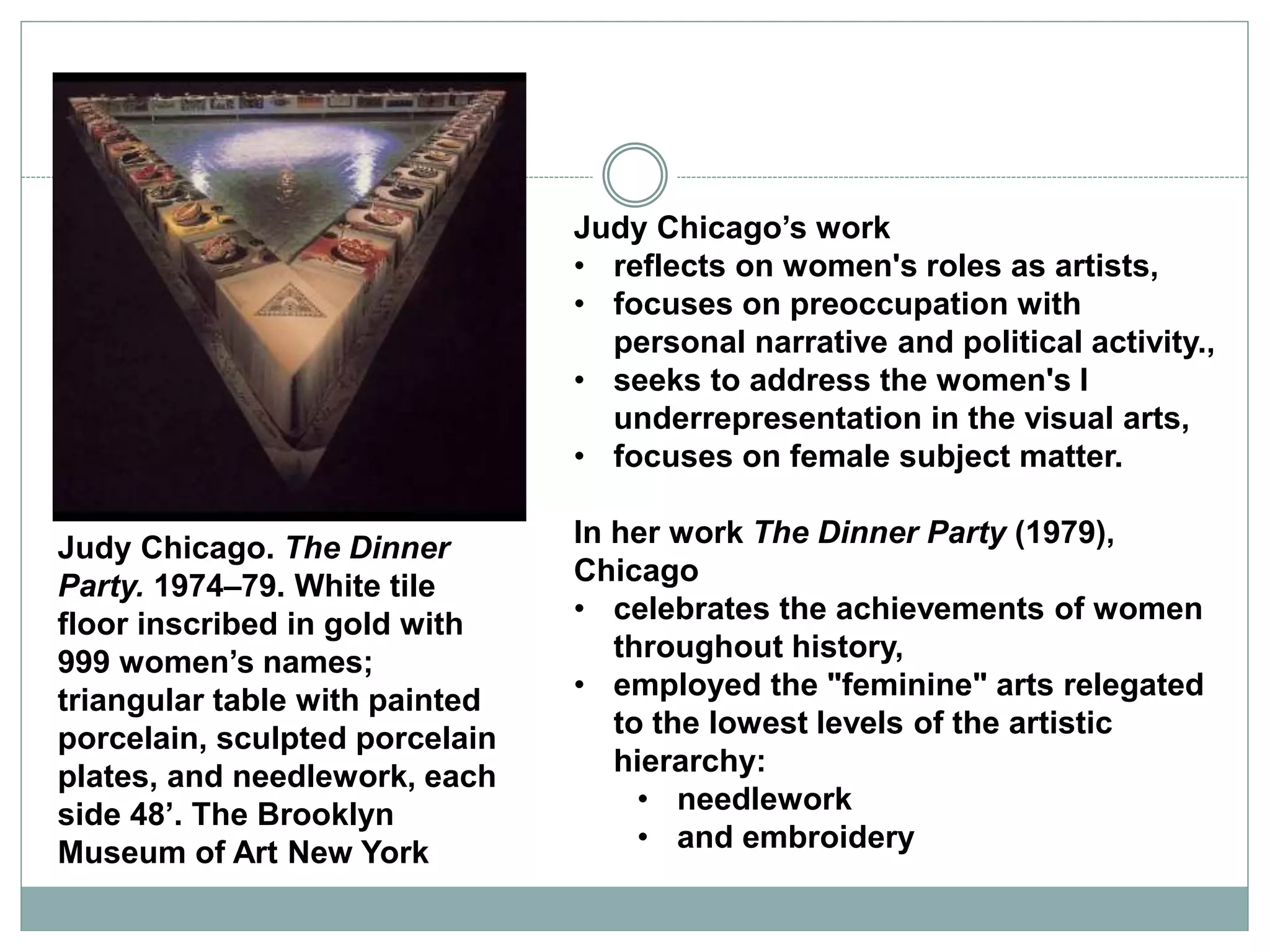
Judy Chicago. The Dinner
Party. 1974–79. White tile
floor inscribed in gold with
999 women’s names;
triangular table with painted
porcelain, sculpted porcelain
plates, and needlework, each
side 48’. The Brooklyn
Museum of Art New York
Kelly
Mary Kelly contribution consists
of her work’s opening up the
world of conceptual art to feminist
discourse
Guerrilla Girls
In 1985, a group of women
wearing gorilla masks took to the
streets. They called themselves
the Guerrilla Girls, and set out to
shame the art world for its
suppression of women artists.
They employed unorthodox
tactics. The group is currently
active and effective.
Guerrilla Girls. The Advantages of
Being a Woman. Artist. 1988.
Poster
Erasing the Boundaries between Art
and Life: Later Feminist Art
OBACM Afri-COBRA, and
SPARK
AFRICOBRA (African Commune Of
Bad Relevant Artists), in Chicago is
an artists group founded in 1968.
The founding members are:
• Jeff Donaldson,
• Jae Jarrell,
• Wadsworth Jarrell,
• Barbara Jones-Hogu,
• and Gerald Williams,
The group is still active, and
creates opportunities for
educational engagement .
Invisible to Visible:
Art and Racial Politics
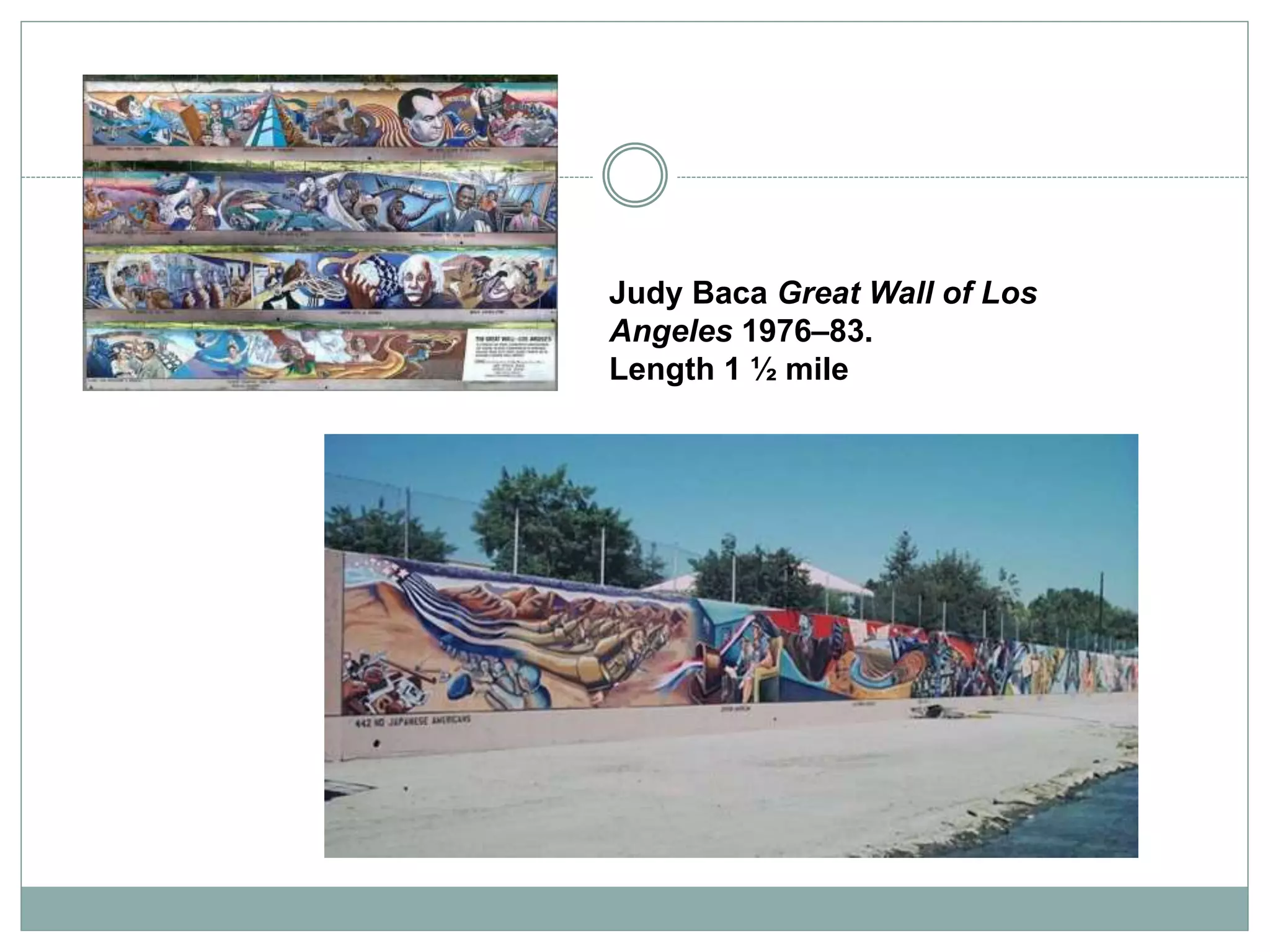
Judy Baca. Great Wall of Los
Angeles. 1976–83
Judy Baca Great Wall of Los
Angeles 1976–83.
Length 1 ½ mile
SPARC
• is a non-profit community arts center based in Venice, California.
• hosts exhibitions,
• sponsors workshops and murals,
• lobbies for the preservation of
• Los Angeles area murals
• other works of public art.
• hosts community programs and artist spaces
• uses public art as an organizing tool for
• addressing contemporary issues,
• fostering cross-cultural understanding
• promoting civic dialogue."
Ringold and Folk Traditions
Faith Ringgold, American Multi-media
Artist, adopted the traditional craft of
quilt making and re-interpreted its
purpose to tell stories of her life.
Social and Political Critique:
Hammons and Colescott
Robert Colescott, was known for his
expressionistic paintings which
depicted events related to black
history.
In the mid-1970s, Colescott painted a
series of works which interpreted
influential European paintings.
Robert Colescott. George
Washington Carver Crossing
the Delaware: Page from an
American. History Textbook
1975. Acrylic on canvas
4’ 6” × 9’
The Concept of Race: Piper
Adrian Piper is a contemporary
artist who addresses issues of
ethics, gender, class, and race
with her work.
She employs a cerebral approach
to art making.
Adrian Piper Political Self-Portrait
(race), 1978. Photostat, 24” x 16”
Collection Richard Sandor.

Chapter 22 conceptual and activist art

  • 1.
  • 2.
    Art & Language JosephKosuth’s artwork One and Three Chairs, consists of a wooden folding chair placed against the wall, flanked by a black and white photograph of the chair, and a photostat of its dictionary definition. Conceptual art, which emerged in the mid-1960s, advocated an art whose value, meaning and existence was rooted in its concept, rather than in the work’s physical properties. Kosuth was influenced by new theories of language and signification, particularly semiotics—the study of the meaning of signs Joseph Kosuth. One and Three Chairs, 1965. Wooden folding chair, photographic copy of a chair, and photographic enlargement of a dictionary definition of a chairMuseum of Modern Art New York Art as Language
  • 3.
    Weiner, Huebler, andBarry Lawrence Weiner, a participant of the Conceptual Art movement of the 1960s • is best known for his text-based work, • created subversive installations that alter an existing space or environment. In 1967 and in 1968-9, Douglas Huebler, began to turn everyday activities through photographs, notes, maps, and drawings into a series of artworks. Robert Barry focused on the transitional and the impermanent aspects in art that included the viewers as participants by simply being in the galleries, reacting to the art, and discussing it with others.
  • 4.
    Man On Kawara. TheToday Series of Date Paintings. 1966. Installation View. Keeping Time: Baldessari, Kawara and Darboven Baldessari started out working in a gestural style. In the 1970s he abandoned painting and focused how photographic images communicate. On Kawara worked on process- based projects. One such project was his date-painting series Today, For almost fifty years he painted the date on a canvas, producing almost 3,000 individual works. Hanne Darboven explored issues of documentation and archiving.
  • 5.
    Broodthaers, Burren, and Sanejouand MarcelBroodthaers' focus on identity questions the meaning of national identity and the role of art in an increaseangly globalized world. Daniel Burren creates site-specific installations of alternating stripe patterns. He employs simplified patterns in relation to architecture and space. Jean-Michel Sanejouand’s work focuses on the interrogation of social and aesthetic significance of art. Marcel Broodthaers, La Tour visuelle. 1966. Glass, wood, and magazine reproductions, 33-1⁄2 × 31- 1⁄2”. Scottish National Gallery of Modern Art Edinburgh. Conceptual Art as Cultural Critique
  • 6.
    Haacke and Asher HansHaacke transformed modern 'artivism' into a political strategy for conceptual artists. Michael Asher’s • work focused more on the realm of ideas than on art as object. • approach is defined as institutional critique. • work focused on • the hidden conventions that surrounded art and • how art was viewed, • how art was valued and used in society. Hans Haacke Shapolsky et al Manhattan Real Estate Holdings a Real-Time Social System as of May 1, 1971 (detail) 1971. 142 Photographs 2 maps, 6 charts Edition of two
  • 7.
    Lawler and Wilson LouiseLawler’s work questions the art market and the forces driving it. She takes photographs of art objects in collector’s homes, museums, auction houses, and storage facilities. Fred Wilson's subject is social justice with a focus on examining, and questioning how museums traditionally display of art and artifacts. Fred Wilson. Mining the Museum. 1992. Installation detail “Metalwork.” Contemporary Museum Baltimore
  • 8.
    Paik Nam June Paik •studied music, history, art history and philosophy at the University of Tokyo. • continued his studies in Munich and Freiburg and in 1958 meets John Cage in • became a member of the Fluxus movement • in1963 shows the first manipulated TV sets. • 1964 moved to New York and becomes the first artist to make videotapes. Paik's early works are image manipulations and colorizations of the Paik/Abe Synthesizer, a device he developed in 1969 with electronics engineer Shuya Abe. Nam June Paik. TV Bra for Living Sculpture (worn by Charlotte Moorman), 1969 Television sets and cello. Photo by Peter Moore The Medium is the Message: Early Video Art
  • 9.
    Nauman Bruce Nauman’s work •is not easily defined. • blends ideas from Conceptualism, Minimalism, performance art, and video art. • revived interest in Marcel Duchamp in the 1960s • employed wordplay that adds a satirical and often an absurdist tone to his work with Bruce Nauman. Self-Portrait as a Fountain. 1966–70. Color photograph. 19-3⁄4 × 23-3⁄4” Edition of eight Bruce Nauman. Violins Violence Silence. 1981– 82. Neon tubing with clear glass tubing suspension frame. 62-3⁄16 × 65-3⁄8 × 6”. Oliver-Hoffman Family Collection, Chicago.
  • 10.
    Campus’ VIdeo Art PeterCampus • is a major new media and video artist. • studied at The City College Film Institute • participated in the experimental workshops at Boston’s famous WGBH-TV. Three Transitions • is one of Campus’ most widely known works • consists of three short exercises or “transitions” in which Campus employs different visual and spatial effects. • is set up as subject and object of the image, Peter Campus. Three Transitions 1973. Two-inch videotape in color with sound,five minutes
  • 11.
    Abramovic and Ulay MarinaAbramovic’s work explores • the limits of the body • endurance • feminism • and the possibilities of the mind. In 1976 Abramovic moved to Amsterdam. There she met the West German performance artist Uwe Laysiepen, who used the single name Ulay. Their collaborative work explored the ego and artistic identity. They formed a collective called "The Other“.Marina Abramovic and Ulay Rest Energy, 1980. When Art Becomes Artist: Body Art
  • 12.
    Schneemann and Wilkie CaroleeSchneemann’s work examend the possibilities of political and personal liberation from oppressive social and aesthetic conventions. Hannah Wilke’s performances and photography are a crucial contribution to the Feminist movement. Wilke’s work challenges the traditional art practices and cultural assumptions. Mendieta Ana Mendieta was born in Cuba. She and her sister were part of a government-sponsored project for Cuban children to flee Fidel Castro's dictatorship. The sisters were sent Iowa, where they lived in foster homes. In her work Mendieta explored the disconnection from concepts of mother, place, identity, and belonging.
  • 13.
    Acconci Vito Acconci created experimentalfilm and video from 1969 to 1977. His artistic career in a variety of disciplines, included performance art. In the late '70s, Acconci started building interactive sculptures. In the late '80s, he began to construct small, cramped, temporary houses as sculptures. This is a period in which he created experimental, free- floating, and often temporary architecture and public art. Vito Acconci. Instant House. 1980. Flags, wood, springs, ropes, & pulleys, open 8’ × 21’ × 21’. closed 8’ × 5’ × 5’. Museum of Contemporary Art San Diego
  • 14.
    Gilbert and George,Anderson and Horn Gilbert and George met at St Martin's in 1967, while studying sculpture. Early in their careers they formulated the concept of being their own art, creating the so-called 'Living Sculptures' from their own bodies. They worked very hard to convince gallery owners to give them show of themselves as sculptures. Gilbert and George. The Singing Sculpture (“Underneath the Arches”). 1969. Presentation at the Sonnabend Gallery, New York.
  • 15.
    Rebecca Horn The GentlePrisoner, 1978 Mixed media Rebecca Horn's mechanized objects and synesthetic installations reflect the artist's personal cosmology which evolved out of her interest in sensitivity. Horn's awareness of the delicate balance between life and death is the result of her bout with tuberculosis. In the late '60s and early '70s, Horn's work concentrated on physiological awareness. In the mid-'70s, it expanded to interpersonal perception; and since the early '80 has addressed themes related to our existence.
  • 16.
    The poetic natureof Rebecca Horn’s creations unconsciously unleashes contradictions and premonitions of the future. Horn's work concentrates on physiological awareness, interpersonal perception, and universal themes that underlie our existence. Despite these life-encompassing questions, Horn's sculpture has a dramatic tension. Rebecca Horn. The Moon, the Child, the River of Anarchy, 1991. Mixed media installation
  • 17.
    The Feminist ArtProgram Female artists before the end of the 1960s, conformed to the dominant modes of expression of male artists: Abstract Expressionism and Minimalism during the 1950s and 1960s. The content of the works of female artists had little connection to their experiences. The Feminist Art Program at Cal Arts was a historic attempt. Art historian and faculty, Paula Harper, encouraged the students to collaborate on installations in an abandoned house called Womanhouse. Judy Chicago and Miriam Schapiro served as facilitators. Feminist Art Program Womanhouse (detail of linen closet) by Sandra Org. 1971. Mixed media Radical Alternatives: Feminist Art
  • 18.
    Judy Chicago’s work •reflects on women's roles as artists, • focuses on preoccupation with personal narrative and political activity., • seeks to address the women's l underrepresentation in the visual arts, • focuses on female subject matter. In her work The Dinner Party (1979), Chicago • celebrates the achievements of women throughout history, • employed the "feminine" arts relegated to the lowest levels of the artistic hierarchy: • needlework • and embroidery Judy Chicago. The Dinner Party. 1974–79. White tile floor inscribed in gold with 999 women’s names; triangular table with painted porcelain, sculpted porcelain plates, and needlework, each side 48’. The Brooklyn Museum of Art New York
  • 19.
    Kelly Mary Kelly contributionconsists of her work’s opening up the world of conceptual art to feminist discourse Guerrilla Girls In 1985, a group of women wearing gorilla masks took to the streets. They called themselves the Guerrilla Girls, and set out to shame the art world for its suppression of women artists. They employed unorthodox tactics. The group is currently active and effective. Guerrilla Girls. The Advantages of Being a Woman. Artist. 1988. Poster Erasing the Boundaries between Art and Life: Later Feminist Art
  • 20.
    OBACM Afri-COBRA, and SPARK AFRICOBRA(African Commune Of Bad Relevant Artists), in Chicago is an artists group founded in 1968. The founding members are: • Jeff Donaldson, • Jae Jarrell, • Wadsworth Jarrell, • Barbara Jones-Hogu, • and Gerald Williams, The group is still active, and creates opportunities for educational engagement . Invisible to Visible: Art and Racial Politics Judy Baca. Great Wall of Los Angeles. 1976–83
  • 21.
    Judy Baca GreatWall of Los Angeles 1976–83. Length 1 ½ mile
  • 22.
    SPARC • is anon-profit community arts center based in Venice, California. • hosts exhibitions, • sponsors workshops and murals, • lobbies for the preservation of • Los Angeles area murals • other works of public art. • hosts community programs and artist spaces • uses public art as an organizing tool for • addressing contemporary issues, • fostering cross-cultural understanding • promoting civic dialogue."
  • 23.
    Ringold and FolkTraditions Faith Ringgold, American Multi-media Artist, adopted the traditional craft of quilt making and re-interpreted its purpose to tell stories of her life. Social and Political Critique: Hammons and Colescott Robert Colescott, was known for his expressionistic paintings which depicted events related to black history. In the mid-1970s, Colescott painted a series of works which interpreted influential European paintings. Robert Colescott. George Washington Carver Crossing the Delaware: Page from an American. History Textbook 1975. Acrylic on canvas 4’ 6” × 9’
  • 24.
    The Concept ofRace: Piper Adrian Piper is a contemporary artist who addresses issues of ethics, gender, class, and race with her work. She employs a cerebral approach to art making. Adrian Piper Political Self-Portrait (race), 1978. Photostat, 24” x 16” Collection Richard Sandor.