Chapter 2 Introduction to Chemistry
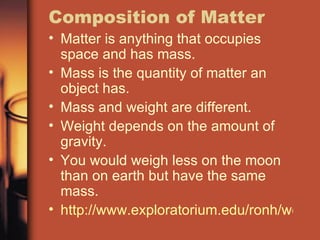
Composition of Matter Matter is anything that occupies space and has mass. Mass is the quantity of matter an object has. Mass and weight are different. Weight depends on the amount of gravity. You would weigh less on the moon than on earth but have the same mass. http://www.exploratorium.edu/ronh/weight/
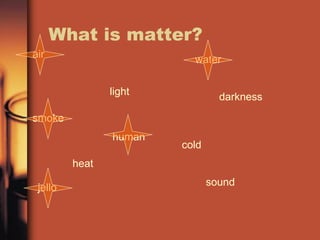
What is matter? air water smoke light heat cold darkness jello sound human
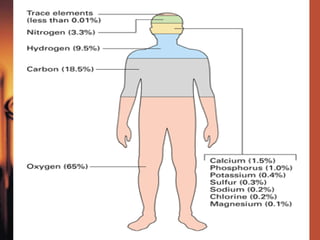
Element An element is a pure substance that cannot be broken down into simpler kinds of matter. Each element has a different chemical symbol. More than 100 elements have been identified. More than 90% of the mass of living things is composed of oxygen, carbon, hydrogen and nitrogen
 
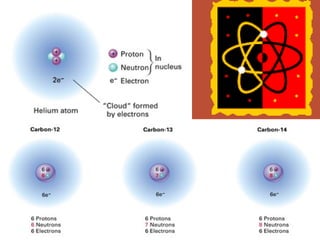
Atom An atom is the simplest part of an element that retains the properties of that element. The properties of atoms determine how the element will behave in nature. An atoms consists of three parts. The nucleus contains protons and neutrons. Electrons float around the outside of the nucleus. The number of protons is called the atomic number. Protons are charges positively, electrons are negative and neutrons are neutral or zero charge.
 
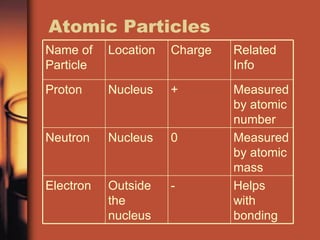
Atomic Particles Name of Particle Location Charge Related Info Proton Nucleus + Measured by atomic number Neutron Nucleus 0 Measured by atomic mass Electron Outside the nucleus - Helps with bonding
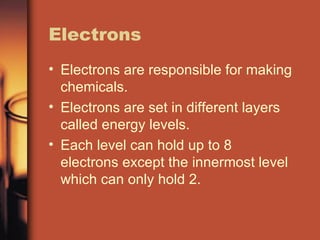
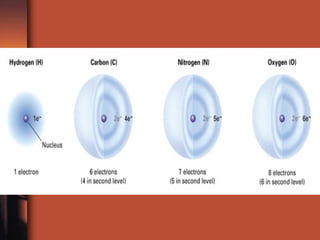
Electrons Electrons are responsible for making chemicals. Electrons are set in different layers called energy levels. Each level can hold up to 8 electrons except the innermost level which can only hold 2.
 
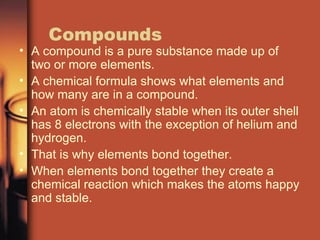
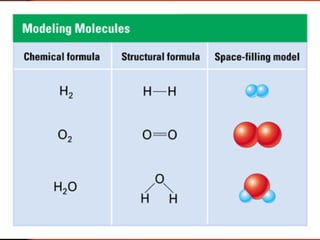
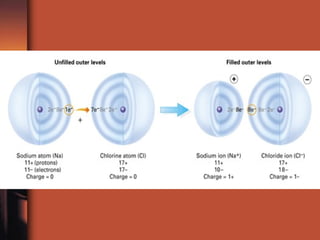
Compounds A compound is a pure substance made up of two or more elements. A chemical formula shows what elements and how many are in a compound. An atom is chemically stable when its outer shell has 8 electrons with the exception of helium and hydrogen. That is why elements bond together. When elements bond together they create a chemical reaction which makes the atoms happy and stable.
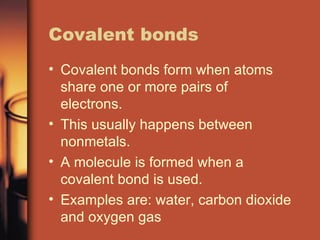
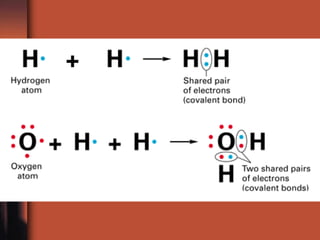
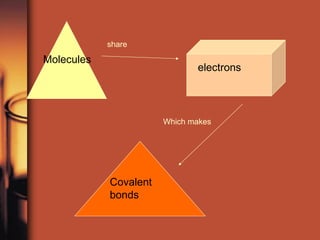
Covalent bonds Covalent bonds form when atoms share one or more pairs of electrons. This usually happens between nonmetals. A molecule is formed when a covalent bond is used. Examples are: water, carbon dioxide and oxygen gas
 
 
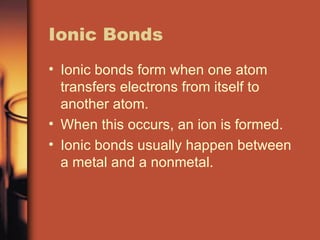
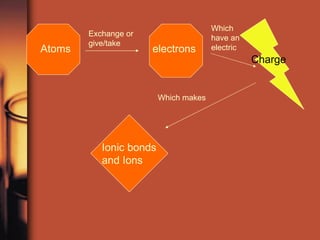
Ionic Bonds Ionic bonds form when one atom transfers electrons from itself to another atom. When this occurs, an ion is formed. Ionic bonds usually happen between a metal and a nonmetal.
 
Energy and Matter Energy is the ability to do work or cause change Free energy is the energy in a system available for work. There are three main states of matter. Solid, liquid and gas.
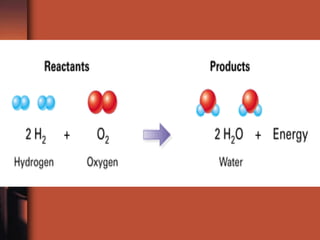
Energy and Chemical Reactions Living things undergo thousands of chemical reactions as part of their life processes. The reactants are shown on the left side of the equation. The products are shown on the right side. Reactants are converted to products. Energy is required for the chemical reaction to occur.
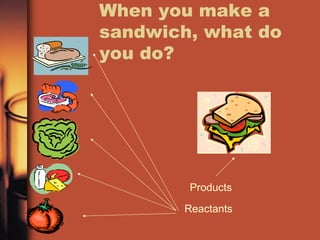
A chemical reaction must make something totally different that has different properties from when it started. You start with the reactants And you end with the products
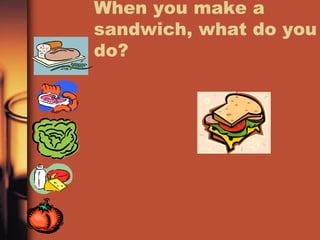
When you make a sandwich, what do you do?
When you make a sandwich, what do you do? Reactants Products
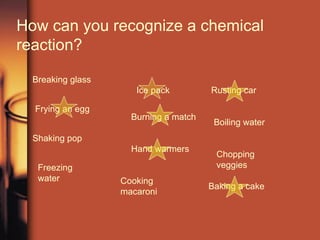
How can you recognize a chemical reaction? Breaking glass Frying an egg Shaking pop Ice pack Burning a match Freezing water Hand warmers Cooking macaroni Rusting car Boiling water Chopping veggies Baking a cake
 
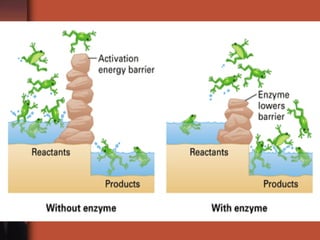
Energy Transfer Chemical reactions that release energy are called exergonic reactions. Chemical reactions that absorb energy are called endergonic reactions. Both exergonic and endergonic reactions require energy to start the process. This is called activation energy. Certain chemicals called catalysts, reduce the amount of activation energy required. The reaction happens easier. One catalyst in the body is called an enzyme.
 
Redox reactions Many chemicals reactions that help transfer energy in living things involve the transfer of electrons. These are called reduction-oxidation reactions or redox reactions. In oxidation, a reactant loses one or more electrons, making it a positive ion. In reduction, a reactant gains one or more electrons making it more negative. There is always an atom that is oxidized and an atom that is reduced.
Solutions A solution is a mixture in which one or more substances is uniformly distributed in another substance. A solution has two parts. The solute is the substance dissolved in the solution. The solvent is the substance in which the solute in dissolved. The concentration is the measurement of the amount of solute dissolved in the solvent. A saturated solution is one in which no more solute can dissolve. An aqueous solution are solutions in which water is the solvent.  These are very common.
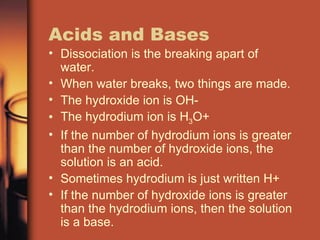
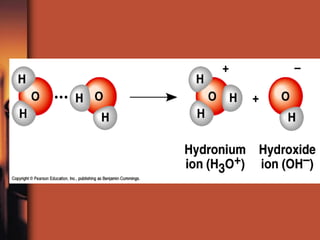
Acids and Bases Dissociation is the breaking apart of water. When water breaks, two things are made. The hydroxide ion is OH- The hydrodium ion is H 3 O+ If the number of hydrodium ions is greater than the number of hydroxide ions, the solution is an acid. Sometimes hydrodium is just written H+ If the number of hydroxide ions is greater than the hydrodium ions, then the solution is a base.
 
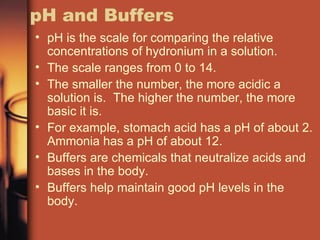
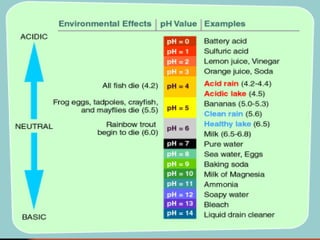
pH and Buffers pH is the scale for comparing the relative concentrations of hydronium in a solution. The scale ranges from 0 to 14. The smaller the number, the more acidic a solution is.  The higher the number, the more basic it is. For example, stomach acid has a pH of about 2.  Ammonia has a pH of about 12. Buffers are chemicals that neutralize acids and bases in the body. Buffers help maintain good pH levels in the body.
 
Exchange or give/take Which have an electric Which makes Atoms electrons Charge Ionic bonds and Ions
share Which makes Molecules electrons Covalent bonds
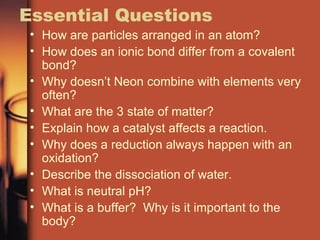
Essential Questions How are particles arranged in an atom? How does an ionic bond differ from a covalent bond? Why doesn’t Neon combine with elements very often? What are the 3 state of matter? Explain how a catalyst affects a reaction. Why does a reduction always happen with an oxidation? Describe the dissociation of water. What is neutral pH? What is a buffer?  Why is it important to the body?

Chapter 2

  • 1.
  • 2.
    Composition of MatterMatter is anything that occupies space and has mass. Mass is the quantity of matter an object has. Mass and weight are different. Weight depends on the amount of gravity. You would weigh less on the moon than on earth but have the same mass. http://www.exploratorium.edu/ronh/weight/
  • 3.
    What is matter?air water smoke light heat cold darkness jello sound human
  • 4.
    Element An elementis a pure substance that cannot be broken down into simpler kinds of matter. Each element has a different chemical symbol. More than 100 elements have been identified. More than 90% of the mass of living things is composed of oxygen, carbon, hydrogen and nitrogen
  • 5.
  • 6.
    Atom An atomis the simplest part of an element that retains the properties of that element. The properties of atoms determine how the element will behave in nature. An atoms consists of three parts. The nucleus contains protons and neutrons. Electrons float around the outside of the nucleus. The number of protons is called the atomic number. Protons are charges positively, electrons are negative and neutrons are neutral or zero charge.
  • 7.
  • 8.
    Atomic Particles Nameof Particle Location Charge Related Info Proton Nucleus + Measured by atomic number Neutron Nucleus 0 Measured by atomic mass Electron Outside the nucleus - Helps with bonding
  • 9.
    Electrons Electrons areresponsible for making chemicals. Electrons are set in different layers called energy levels. Each level can hold up to 8 electrons except the innermost level which can only hold 2.
  • 10.
  • 11.
    Compounds A compoundis a pure substance made up of two or more elements. A chemical formula shows what elements and how many are in a compound. An atom is chemically stable when its outer shell has 8 electrons with the exception of helium and hydrogen. That is why elements bond together. When elements bond together they create a chemical reaction which makes the atoms happy and stable.
  • 12.
    Covalent bonds Covalentbonds form when atoms share one or more pairs of electrons. This usually happens between nonmetals. A molecule is formed when a covalent bond is used. Examples are: water, carbon dioxide and oxygen gas
  • 13.
  • 14.
  • 15.
    Ionic Bonds Ionicbonds form when one atom transfers electrons from itself to another atom. When this occurs, an ion is formed. Ionic bonds usually happen between a metal and a nonmetal.
  • 16.
  • 17.
    Energy and MatterEnergy is the ability to do work or cause change Free energy is the energy in a system available for work. There are three main states of matter. Solid, liquid and gas.
  • 18.
    Energy and ChemicalReactions Living things undergo thousands of chemical reactions as part of their life processes. The reactants are shown on the left side of the equation. The products are shown on the right side. Reactants are converted to products. Energy is required for the chemical reaction to occur.
  • 19.
    A chemical reactionmust make something totally different that has different properties from when it started. You start with the reactants And you end with the products
  • 20.
    When you makea sandwich, what do you do?
  • 21.
    When you makea sandwich, what do you do? Reactants Products
  • 22.
    How can yourecognize a chemical reaction? Breaking glass Frying an egg Shaking pop Ice pack Burning a match Freezing water Hand warmers Cooking macaroni Rusting car Boiling water Chopping veggies Baking a cake
  • 23.
  • 24.
    Energy Transfer Chemicalreactions that release energy are called exergonic reactions. Chemical reactions that absorb energy are called endergonic reactions. Both exergonic and endergonic reactions require energy to start the process. This is called activation energy. Certain chemicals called catalysts, reduce the amount of activation energy required. The reaction happens easier. One catalyst in the body is called an enzyme.
  • 25.
  • 26.
    Redox reactions Manychemicals reactions that help transfer energy in living things involve the transfer of electrons. These are called reduction-oxidation reactions or redox reactions. In oxidation, a reactant loses one or more electrons, making it a positive ion. In reduction, a reactant gains one or more electrons making it more negative. There is always an atom that is oxidized and an atom that is reduced.
  • 27.
    Solutions A solutionis a mixture in which one or more substances is uniformly distributed in another substance. A solution has two parts. The solute is the substance dissolved in the solution. The solvent is the substance in which the solute in dissolved. The concentration is the measurement of the amount of solute dissolved in the solvent. A saturated solution is one in which no more solute can dissolve. An aqueous solution are solutions in which water is the solvent. These are very common.
  • 28.
    Acids and BasesDissociation is the breaking apart of water. When water breaks, two things are made. The hydroxide ion is OH- The hydrodium ion is H 3 O+ If the number of hydrodium ions is greater than the number of hydroxide ions, the solution is an acid. Sometimes hydrodium is just written H+ If the number of hydroxide ions is greater than the hydrodium ions, then the solution is a base.
  • 29.
  • 30.
    pH and BufferspH is the scale for comparing the relative concentrations of hydronium in a solution. The scale ranges from 0 to 14. The smaller the number, the more acidic a solution is. The higher the number, the more basic it is. For example, stomach acid has a pH of about 2. Ammonia has a pH of about 12. Buffers are chemicals that neutralize acids and bases in the body. Buffers help maintain good pH levels in the body.
  • 31.
  • 32.
    Exchange or give/takeWhich have an electric Which makes Atoms electrons Charge Ionic bonds and Ions
  • 33.
    share Which makesMolecules electrons Covalent bonds
  • 34.
    Essential Questions Howare particles arranged in an atom? How does an ionic bond differ from a covalent bond? Why doesn’t Neon combine with elements very often? What are the 3 state of matter? Explain how a catalyst affects a reaction. Why does a reduction always happen with an oxidation? Describe the dissociation of water. What is neutral pH? What is a buffer? Why is it important to the body?