Chapter (2): Vibration of Single-degree of Freedom
Systems (SDOF)
2.1 Degree of Freedom
2.2 Differential Equations of Motion in Time Domain:
- Newton’s Law of Motion
- Energy Method
2.3 General Solution of Equation: Transient and Steady-
state Response
2.4 Frequency Response Method in Frequency Domain:
Impedance Method
2.5 Comparison of Rectilinear & Rotational Systems
2.1 Degree of Freedom:
The One-degree-of-freedom system is the keystone for
more advanced studies in vibration.
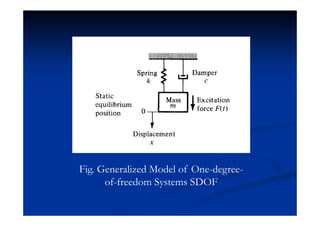
The system is representation by a generalized model
shown below.
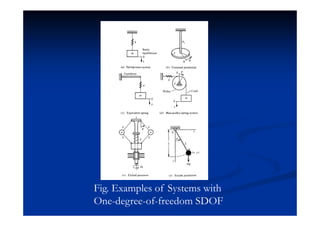
Examples of one-degree-of-freedom systems are shown
in next figure. Though they differ in appearance, they can
be represented by the same generalized model.
The model serves:
To unify a class of problems commonly
encountered.
To bring into focus the concept of vibration.
Fig. Generalized Model of One-degree-
of-freedom Systems SDOF
Fig. Examples of Systems with
One-degree-of-freedom SDOF
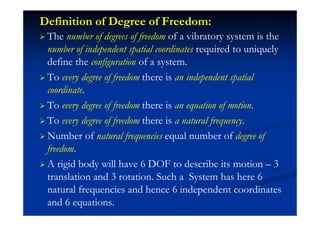
Definition of Degree of Freedom:
The number of degrees of freedom of a vibratory system is the
number of independent spatial coordinates required to uniquely
define the configuration of a system.
To every degree of freedom there is an independent spatial
coordinate.
To every degree of freedom there is an equation of motion.
To every degree of freedom there is a natural frequency.
Number of natural frequencies equal number of degree of
freedom.
A rigid body will have 6 DOF to describe its motion – 3
translation and 3 rotation. Such a System has here 6
natural frequencies and hence 6 independent coordinates
and 6 equations.
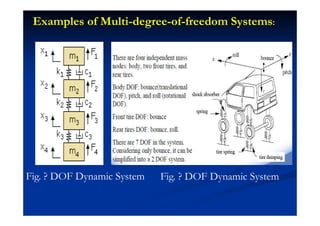
Examples of Multi-degree-of-freedom Systems:
Fig. ? DOF Dynamic SystemFig. ? DOF Dynamic System
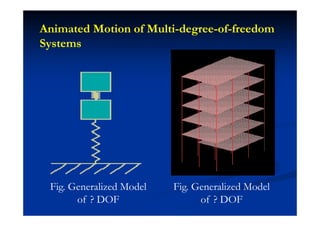
Animated Motion of Multi-degree-of-freedom
Systems
Fig. Generalized Model
of ? DOF
Fig. Generalized Model
of ? DOF
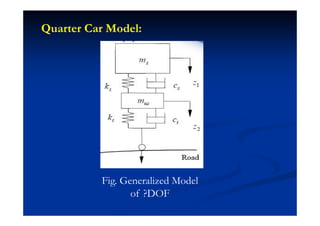
Quarter Car Model:
Fig. Generalized Model
of ?DOF
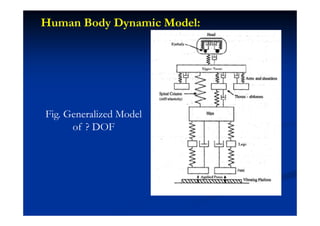
Human Body Dynamic Model:
Fig. Generalized Model
of ? DOF
2.2 Differential Equations of Motion in Time
Domain:
The equation of motion of a dynamic system can be
written using the following methods:
Force Method using Newton’s Law of Motion (Time
Domain)
Energy Method using Kinetic & Potential Energies
(Time Domain)
Frequency Response Methods (Frequency Domain)
Equation of Motion using Laplace transform (Frequency
Domain)
At first we consider the equations of motion of dynamic
systems in time domain.
Types of Vibratory Motions for SDOF Systems:
Fig. (a) Undamped Free
Vibration (b) Damped Free
Vibration and (c) Forced
Damped Motions
2.2.1 Equation of Motion - Newton’s Law of
Motion/Force Method:
This method states simply that the inertia force on a
dynamic system is equal to the sum of all forces and/or
moments acting on that system. In general we can write
˭˲ӕ = ˓ˬˬ ˦JJI˥J IIˮ˩J˧ JJ ˮ˨˥ J˳Jˮ˥˭.
H ӕ = ˓ˬˬ ˭J˭˥JˮJ IIˮ˩J˧ JJ ˮ˨˥ J˳Jˮ˥˭ .
To simplify solution, we can neglect in this analysis all the
forces and moments from Statics and keeping only the
dynamic ones.
Following examples take into account these above
principles.
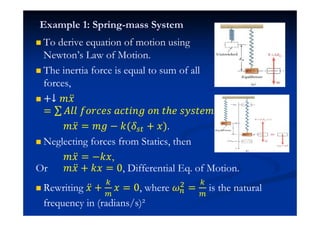
Example 1: Spring-mass System
To derive equation of motion using
Newton’s Law of Motion.
The inertia force is equal to sum of all
forces,
+↓ ˭˲ӕ
= ˓ˬˬ ˦JJI˥J IIˮ˩J˧ JJ ˮ˨˥ J˳Jˮ˥˭
˭˲ӕ = ˭˧ − ˫( + ˲).
Neglecting forces from Statics, then
˭˲ӕ = −˫˲,
Or ˭˲ӕ + ˫˲ = 0, Differential Eq. of Motion.
Rewriting ˲ӕ + ˲ = 0, where $
= is the natural
frequency in (radians/s)²
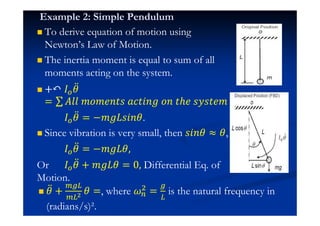
Example 2: Simple Pendulum
To derive equation of motion using
Newton’s Law of Motion.
The inertia moment is equal to sum of all
moments acting on the system.
+Ʉ H ӕ
= ˓ˬˬ ˭J˭˥JˮJ IIˮ˩J˧ JJ ˮ˨˥ J˳Jˮ˥˭
H ӕ = −˭˧HJ˩J .
Since vibration is very small, then J˩J ,
H ӕ = −˭˧H
Or H ӕ + ˭˧H = 0 Differential Eq. of
Motion.
ӕ + =, where $ = is the natural frequency in
(radians/s)².
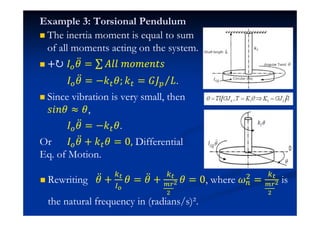
Example 3: Torsional Pendulum
The inertia moment is equal to sum
of all moments acting on the system.
+ɉ H ӕ = ˓ˬˬ ˭J˭˥JˮJ
H ӕ = −˫ ˫ = ˙H H.
Since vibration is very small, then
J˩J ,
H ӕ = −˫ .
Or H ӕ + ˫ = 0 Differential
Eq. of Motion.
Rewriting ӕ + = ӕ + = 0, where $ = is
the natural frequency in (radians/s)².
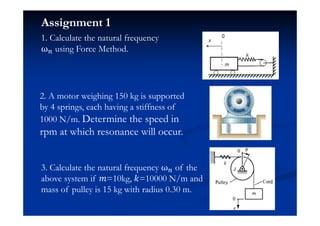
Assignment 1
1. Calculate the natural frequency
Ă using Force Method.
2. A motor weighing 150 kg is supported
by 4 springs, each having a stiffness of
1000 N/m. Determine the speed in
rpm at which resonance will occur.
3. Calculate the natural frequency Ă of the
above system if ˭=10kg, ˫=10000 N/m and
mass of pulley is 15 kg with radius 0.30 m.
The equation of motion of a conservative system can be
established from energy conservations.
The total mechanical energy in a conservative mechanical
system is the sum of the kinetic energy T and the potential
energy U.
The kinetic energy T is due to the velocity of the mass.
The potential energy U is due to the strain energy of the
spring by virtue of its deformation.
For a conservative system, the total mechanical energy is
constant and its time derivative is zero.
Total Mechanical Energy= ˠ + ˡ = ˕JJJˮIJˮ.
ˠ + ˡ = 0.
2.2.2 Equation of Motion - Energy Method:
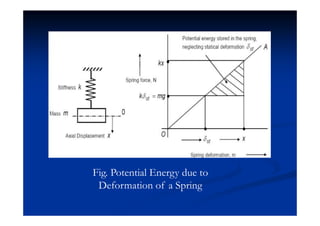
Fig. Potential Energy due to
Deformation of a Spring
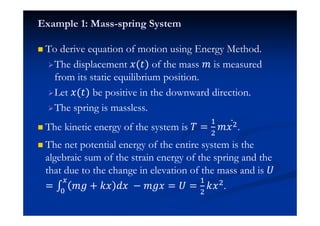
Example 1: Mass-spring System
To derive equation of motion using Energy Method.
The displacement ˲(ˮ) of the mass ˭ is measured
from its static equilibrium position.
Let ˲(ˮ) be positive in the downward direction.
The spring is massless.
The kinetic energy of the system is ˠ =
#
$
˭˲$Ӕ .
The net potential energy of the entire system is the
algebraic sum of the strain energy of the spring and the
that due to the change in elevation of the mass and is ˡ
= ˭˧ + ˫˲ ˤ˲ − ˭˧˲"
= ˡ =
#
$
˫˲$.
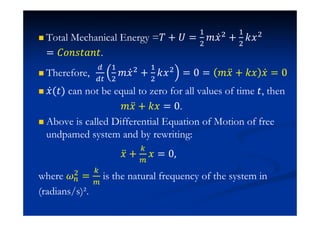
Total Mechanical Energy =ˠ + ˡ =
#
$
˭˲Ӕ$
+
#
$
˫˲$
= ˕JJJˮIJˮ.
Therefore,
#
$
˭˲Ӕ$ +
#
$
˫˲$ = 0 = ˭˲ӕ + ˫˲ ˲Ӕ = 0
˲Ӕ(ˮ) can not be equal to zero for all values of time ˮ, then
˭˲ӕ + ˫˲ = 0.
Above is called Differential Equation of Motion of free
undpamed system and by rewriting:
˲ӕ + ˲ = 0
where $ = is the natural frequency of the system in
(radians/s)².
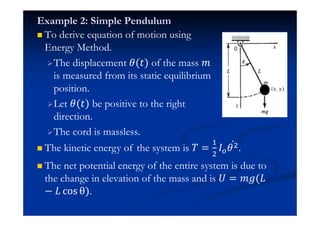
Example 2: Simple Pendulum
To derive equation of motion using
Energy Method.
The displacement (ˮ) of the mass ˭
is measured from its static equilibrium
position.
Let (ˮ) be positive to the right
direction.
The cord is massless.
The kinetic energy of the system is ˠ =
#
$
H $Ӕ .
The net potential energy of the entire system is due to
the change in elevation of the mass and is ˡ = ˭˧(H
− H …‘• õ).
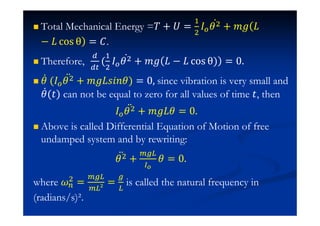
Total Mechanical Energy =ˠ + ˡ =
#
$
H $Ӕ + ˭˧(H
− H …‘• õ) = ˕.
Therefore, (
#
$
H $Ӕ + ˭˧ H − H …‘• õ) = 0.
Ӕ (H $ӕ + ˭˧HJ˩J ) = 0 since vibration is very small and
Ӕ(ˮ) can not be equal to zero for all values of time ˮ, then
H $ӕ + ˭˧H = 0.
Above is called Differential Equation of Motion of free
undamped system and by rewriting:
$ӕ + = 0.
where $ =
²
= is called the natural frequency in
(radians/s)².
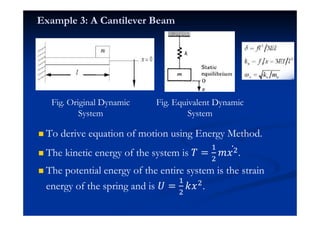
Example 3: A Cantilever Beam
To derive equation of motion using Energy Method.
The kinetic energy of the system is ˠ =
#
$
˭˲$Ӕ .
The potential energy of the entire system is the strain
energy of the spring and is ˡ =
#
$
˫˲$.
Fig. Original Dynamic
System
Fig. Equivalent Dynamic
System
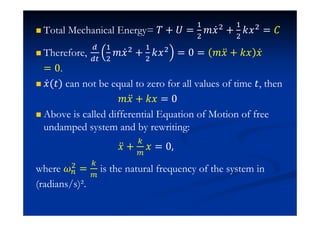
Total Mechanical Energy= ˠ + ˡ =
#
$
˭˲Ӕ$ +
#
$
˫˲$ = ˕
Therefore,
#
$
˭˲Ӕ$
+
#
$
˫˲$
= 0 = ˭˲ӕ + ˫˲ ˲Ӕ
= 0.
˲Ӕ(ˮ) can not be equal to zero for all values of time ˮ, then
˭˲ӕ + ˫˲ = 0
Above is called differential Equation of Motion of free
undamped system and by rewriting:
˲ӕ + ˲ = 0
where $ = is the natural frequency of the system in
(radians/s)².
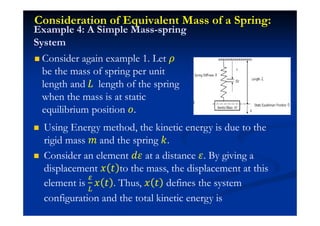
Consideration of Equivalent Mass of a Spring:
Consider again example 1. Let
be the mass of spring per unit
length and H length of the spring
when the mass is at static
equilibrium position J.
Example 4: A Simple Mass-spring
System
Using Energy method, the kinetic energy is due to the
rigid mass ˭ and the spring ˫.
Consider an element ˤ at a distance . By giving a
displacement ˲ ˮ to the mass, the displacement at this
element is ˲ ˮ . Thus, ˲ ˮ defines the system
configuration and the total kinetic energy is
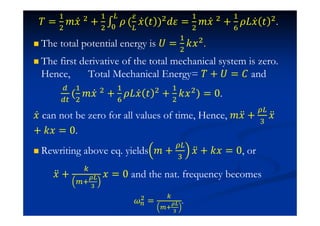
ˠ =
#
$
˭˲Ӕ $ +
#
$ "
( ˲Ӕ ˮ )$ˤ =
#
$
˭˲Ӕ $ +
#
H˲Ӕ ˮ $.
The total potential energy is ˡ =
#
$
˫˲$.
The first derivative of the total mechanical system is zero.
Hence, Total Mechanical Energy= ˠ + ˡ = ˕ and
(
#
$
˭˲Ӕ $
+
#
H˲Ӕ ˮ $
+
#
$
˫˲$
) = 0.
˲Ӕ can not be zero for all values of time, Hence, ˭˲ӕ +

%
˲ӕ
+ ˫˲ = 0.
Rewriting above eq. yields ˭ +

%
˲ӕ + ˫˲ = 0, or
˲ӕ + 
 ˲ = 0 and the nat. frequency becomes
$ = 
 .
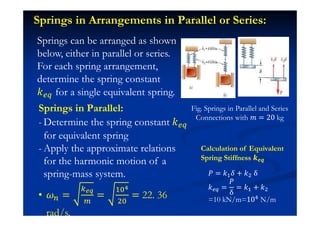
Springs in Parallel:
- Determine the spring constant ˫
for equivalent spring
- Apply the approximate relations
for the harmonic motion of a
spring-mass system.
• = =
#
$
= 22. 36
rad/s.
Springs can be arranged as shown
below, either in parallel or series.
For each spring arrangement,
determine the spring constant
˫ for a single equivalent spring.
Springs in Arrangements in Parallel or Series:
˜ = ˫# + ˫$ δ
˫ =
˜
δ
= ˫# + ˫$
=10 kN/m=10 N/m
Fig. Springs in Parallel and Series
Connections with ˭ = 20 kg
Calculation of Equivalent
Spring Stiffness ͻX΁
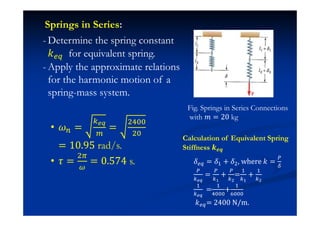
- Determine the spring constant
˫ for equivalent spring.
- Apply the approximate relations
for the harmonic motion of a
spring-mass system.
Springs in Series:
= # + $ where ˫ =
= + =
#
+
#
#
=
#

+
#

˫ = 2400 N/m.
Fig. Springs in Series Connections
with ˭ = 20 kg
Calculation of Equivalent Spring
Stiffness ͻX΁
• = =
$
$
= 10.95 rad/s.
• =
$

= 0.574 s.
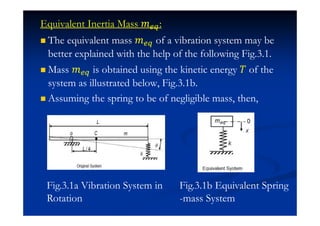
Equivalent Inertia Mass ˭ :
The equivalent mass ˭ of a vibration system may be
better explained with the help of the following Fig.3.1.
Mass ˭ is obtained using the kinetic energy ˠ of the
system as illustrated below, Fig.3.1b.
Assuming the spring to be of negligible mass, then,
Fig.3.1a Vibration System in
Rotation
Fig.3.1b Equivalent Spring
-mass System
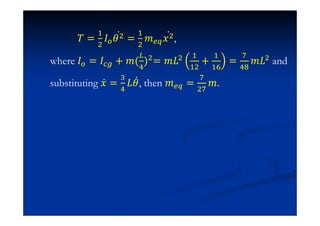
ˠ =
#
$
H $Ӕ =
#
$
˭ ˲$Ӕ ,
where H = H + ˭(

)$= ˭H$ #
#$
+
#
#
=

˭H$ and
substituting ˲Ӕ =
%

H Ӕ, then ˭ =
$
˭.
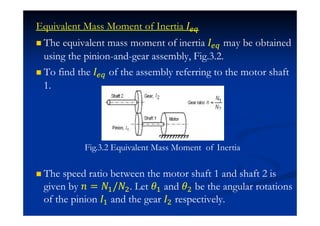
Equivalent Mass Moment of Inertia H
The equivalent mass moment of inertia H may be obtained
using the pinion-and-gear assembly, Fig.3.2.
To find the H of the assembly referring to the motor shaft
1.
The speed ratio between the motor shaft 1 and shaft 2 is
given by J = ˚#/˚$. Let # and $ be the angular rotations
of the pinion H# and the gear H$ respectively.
Fig.3.2 Equivalent Mass Moment of Inertia
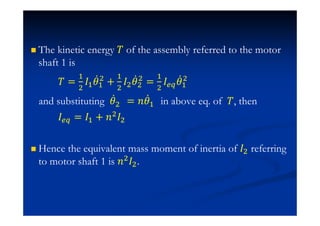
The kinetic energy ˠ of the assembly referred to the motor
shaft 1 is
ˠ =
#
$
H#
Ӕ#
$
+
#
$
H$
Ӕ$
$
=
#
$
H Ӕ#
$
and substituting Ӕ$ = J Ӕ# in above eq. of ˠ, then
H = H# + J$H$
Hence the equivalent mass moment of inertia of H$ referring
to motor shaft 1 is J$H$.
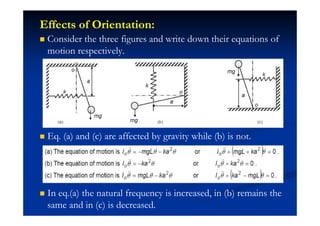
Effects of Orientation:
Consider the three figures and write down their equations of
motion respectively.
Eq. (a) and (c) are affected by gravity while (b) is not.
In eq.(a) the natural frequency is increased, in (b) remains the
same and in (c) is decreased.
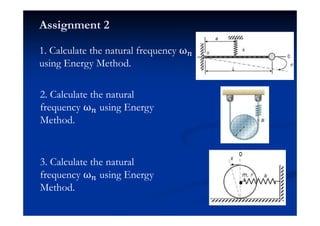
Assignment 2
k
1. Calculate the natural frequency Ă
using Energy Method.
2. Calculate the natural
frequency Ă using Energy
Method.
3. Calculate the natural
frequency Ă using Energy
Method.
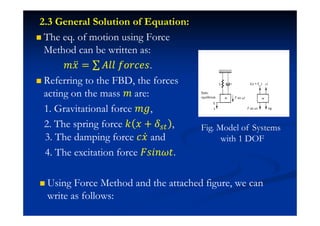
2.3 General Solution of Equation:
The eq. of motion using Force
Method can be written as:
˭˲ӕ = ˓ˬˬ ˦JJI˥J.
Referring to the FBD, the forces
acting on the mass ˭ are:
1. Gravitational force ˭˧,
2. The spring force ˫ ˲ + , Fig. Model of Systems
with 1 DOF3. The damping force I˲Ӕ and
4. The excitation force ˘J˩J ˮ.
Using Force Method and the attached figure, we can
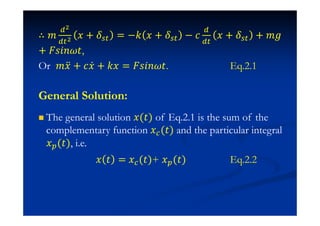
write as follows:
∴ ˭ ˲ + = −˫ ˲ + − I ˲ + + ˭˧
+ ˘J˩J ˮ,
Or ˭˲ӕ + I˲Ӕ + ˫˲ = ˘J˩J ˮ. Eq.2.1
General Solution:
The general solution ˲(ˮ) of Eq.2.1 is the sum of the
complementary function ˲ (ˮ) and the particular integral
˲ (ˮ), i.e.
˲ ˮ = ˲ (ˮ)+ ˲ (ˮ) Eq.2.2
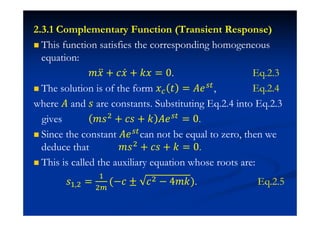
2.3.1 Complementary Function (Transient Response)
This function satisfies the corresponding homogeneous
equation:
˭˲ӕ + I˲Ӕ + ˫˲ = 0. Eq.2.3
The solution is of the form ˲ ˮ = ˓˥ , Eq.2.4
where ˓ and J are constants. Substituting Eq.2.4 into Eq.2.3
gives ˭J$
+ IJ + ˫ ˓˥ = 0.
Since the constant ˓˥ can not be equal to zero, then we
deduce that ˭J$ + IJ + ˫ = 0.
This is called the auxiliary equation whose roots are:
J# $ =
#
$
(−I ± I$ − 4˭˫). Eq.2.5
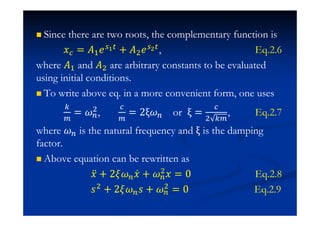
Since there are two roots, the complementary function is
˲ = ˓#˥ + ˓$˥ , Eq.2.6
where ˓# and ˓$ are arbitrary constants to be evaluated
using initial conditions.
To write above eq. in a more convenient form, one uses
= $, = 2ξ or ξ =
$
, Eq.2.7
where is the natural frequency and ξ is the damping
factor.
Above equation can be rewritten as
˲ӕ + 2 ˲Ӕ + $˲ = 0 Eq.2.8
J$ + 2 J + $
= 0 Eq.2.9
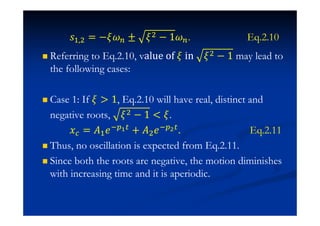
J# $ = − ± $ − 1 . Eq.2.10
Referring to Eq.2.10, value ‘f in $ − 1 may lead to
the following cases:
Case 1: If  1, Eq.2.10 will have real, distinct and
negative roots, $ − 1  .
˲ = ˓#˥ + ˓$˥ . Eq.2.11
Thus, no oscillation is expected from Eq.2.11.
Since both the roots are negative, the motion diminishes
with increasing time and it is aperiodic.
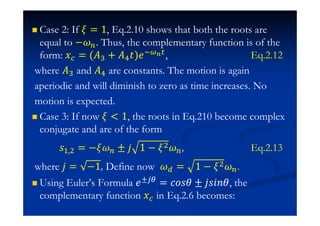
Case 2: If = 1, Eq.2.10 shows that both the roots are
equal to − . Thus, the complementary function is of the
form: ˲ = (˓% + ˓ˮ)˥  , Eq.2.12
where ˓% and ˓ are constants. The motion is again
aperiodic and will diminish to zero as time increases. No
motion is expected.
Case 3: If now  1, the roots in Eq.210 become complex
conjugate and are of the form
J# $ = − ± ˪ 1 − $ Eq.2.13
where ˪ = −1, Define now = 1 − $ .
Using Euler’s Formula ˥± = IJJ ± ˪J˩J , the
complementary function ˲ in Eq.2.6 becomes:
˲ = ˓'˥ + ˓ ˥ = ˥  ˓'˥  + ˓ ˥ 
or ˲ = ˥  ( ˓' + ˓ IJJ ˮ + ˪ ˓' − ˓ J˩J ˮ).
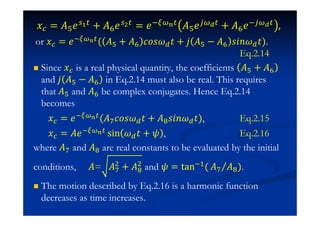
Eq.2.14
Since ˲ is a real physical quantity, the coefficients ˓' + ˓
and ˪ ˓' − ˓ in Eq.2.14 must also be real. This requires
that ˓' and ˓ be complex conjugates. Hence Eq.2.14
becomes
˲ = ˥  (˓ IJJ ˮ + ˓ J˩J ˮ), Eq.2.15
˲ = ˓˥ 
•in ˮ + , Eq.2.16
where ˓ and ˓ are real constants to be evaluated by the initial
conditions, ˓= ˓$
+ ˓$
and = tan #( ˓ ˓ ).
The motion described by Eq.2.16 is a harmonic function
decreases as time increases.
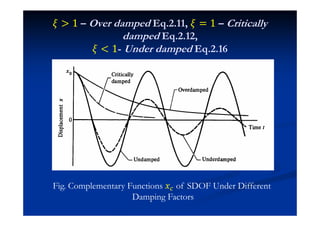
1 – Over damped Eq.2.11, = 1 – Critically
damped Eq.2.12,
 1- Under damped Eq.2.16
Fig. Complementary Functions ˲ of SDOF Under Different
Damping Factors
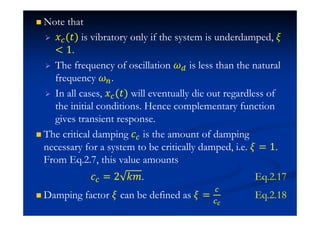
Note that
˲ (ˮ) is vibratory only if the system is underdamped,
 1.
The frequency of oscillation is less than the natural
frequency .
In all cases, ˲ (ˮ) will eventually die out regardless of
the initial conditions. Hence complementary function
gives transient response.
The critical damping I is the amount of damping
necessary for a system to be critically damped, i.e. = 1.
From Eq.2.7, this value amounts
I = 2 ˫˭. Eq.2.17
Damping factor can be defined as = Eq.2.18
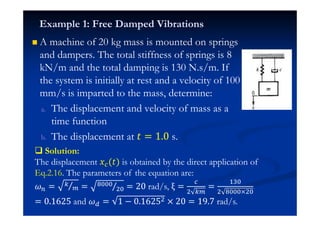
A machine of 20 kg mass is mounted on springs
and dampers. The total stiffness of springs is 8
kN/m and the total damping is 130 N.s/m. If
the system is initially at rest and a velocity of 100
mm/s is imparted to the mass, determine:
a. The displacement and velocity of mass as a
time function
b. The displacement at ˮ = 1.0 s.
Example 1: Free Damped Vibrations
Solution:
The displacement ˲ (ˮ) is obtained by the direct application of
Eq.2.16. The parameters of the equation are:
= = 
$ = 20 rad/s, ξ =
$
=
#%
$ 0$
= 0.1ź25 and = 1 − 0.1ź25$ 0 20 = 19.7 rad/s.
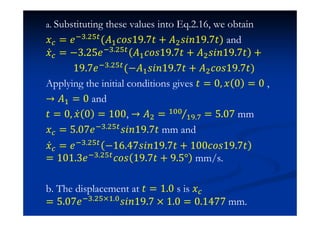
a. Substituting these values into Eq.2.16, we obtain
˲ = ˥ %.$' (˓#IJJ19.7ˮ + ˓$J˩J19.7ˮ) and
˲Ӕ = −3.25˥ %.$'
˓#IJJ19.7ˮ + ˓$J˩J19.7ˮ +
19.7˥ %.$' (−˓#J˩J19.7ˮ + ˓$IJJ19.7ˮ)
Applying the initial conditions gives ˮ = 0 ˲ 0 = 0 ,
→ ˓# = 0 and
ˮ = 0 ˲Ӕ 0 = 100, → ˓$ = #
# . = 5.07 mm
˲ = 5.07˥ %.$'
J˩J19.7ˮ mm and
˲Ӕ = ˥ %.$' −1ź.47J˩J19.7ˮ + 100IJJ19.7ˮ
= 101.3˥ %.$' IJJ 19.7ˮ + 9.5° mm/s.
b. The displacement at ˮ = 1.0 s is ˲
= 5.07˥ %.$'0#.J˩J19.7 0 1.0 = 0.1477 mm.
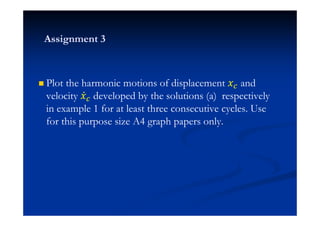
Plot the harmonic motions of displacement ˲ and
velocity ˲Ӕ developed by the solutions (a) respectively
in example 1 for at least three consecutive cycles. Use
for this purpose size A4 graph papers only.
Assignment 3

Chapter 2 lecture 1 mechanical vibration

  • 1.
    Chapter (2): Vibrationof Single-degree of Freedom Systems (SDOF) 2.1 Degree of Freedom 2.2 Differential Equations of Motion in Time Domain: - Newton’s Law of Motion - Energy Method 2.3 General Solution of Equation: Transient and Steady- state Response 2.4 Frequency Response Method in Frequency Domain: Impedance Method 2.5 Comparison of Rectilinear & Rotational Systems
  • 2.
    2.1 Degree ofFreedom: The One-degree-of-freedom system is the keystone for more advanced studies in vibration. The system is representation by a generalized model shown below. Examples of one-degree-of-freedom systems are shown in next figure. Though they differ in appearance, they can be represented by the same generalized model. The model serves: To unify a class of problems commonly encountered. To bring into focus the concept of vibration.
  • 3.
    Fig. Generalized Modelof One-degree- of-freedom Systems SDOF
  • 4.
    Fig. Examples ofSystems with One-degree-of-freedom SDOF
  • 5.
    Definition of Degreeof Freedom: The number of degrees of freedom of a vibratory system is the number of independent spatial coordinates required to uniquely define the configuration of a system. To every degree of freedom there is an independent spatial coordinate. To every degree of freedom there is an equation of motion. To every degree of freedom there is a natural frequency. Number of natural frequencies equal number of degree of freedom. A rigid body will have 6 DOF to describe its motion – 3 translation and 3 rotation. Such a System has here 6 natural frequencies and hence 6 independent coordinates and 6 equations.
  • 6.
    Examples of Multi-degree-of-freedomSystems: Fig. ? DOF Dynamic SystemFig. ? DOF Dynamic System
  • 7.
    Animated Motion ofMulti-degree-of-freedom Systems Fig. Generalized Model of ? DOF Fig. Generalized Model of ? DOF
  • 8.
    Quarter Car Model: Fig.Generalized Model of ?DOF
  • 9.
    Human Body DynamicModel: Fig. Generalized Model of ? DOF
  • 10.
    2.2 Differential Equationsof Motion in Time Domain: The equation of motion of a dynamic system can be written using the following methods: Force Method using Newton’s Law of Motion (Time Domain) Energy Method using Kinetic & Potential Energies (Time Domain) Frequency Response Methods (Frequency Domain) Equation of Motion using Laplace transform (Frequency Domain) At first we consider the equations of motion of dynamic systems in time domain.
  • 11.
    Types of VibratoryMotions for SDOF Systems: Fig. (a) Undamped Free Vibration (b) Damped Free Vibration and (c) Forced Damped Motions
  • 12.
    2.2.1 Equation ofMotion - Newton’s Law of Motion/Force Method: This method states simply that the inertia force on a dynamic system is equal to the sum of all forces and/or moments acting on that system. In general we can write ˭˲ӕ = ˓ˬˬ ˦JJI˥J IIˮ˩J˧ JJ ˮ˨˥ J˳Jˮ˥˭. H ӕ = ˓ˬˬ ˭J˭˥JˮJ IIˮ˩J˧ JJ ˮ˨˥ J˳Jˮ˥˭ . To simplify solution, we can neglect in this analysis all the forces and moments from Statics and keeping only the dynamic ones. Following examples take into account these above principles.
  • 13.
    Example 1: Spring-massSystem To derive equation of motion using Newton’s Law of Motion. The inertia force is equal to sum of all forces, +↓ ˭˲ӕ = ˓ˬˬ ˦JJI˥J IIˮ˩J˧ JJ ˮ˨˥ J˳Jˮ˥˭ ˭˲ӕ = ˭˧ − ˫( + ˲). Neglecting forces from Statics, then ˭˲ӕ = −˫˲, Or ˭˲ӕ + ˫˲ = 0, Differential Eq. of Motion. Rewriting ˲ӕ + ˲ = 0, where $ = is the natural frequency in (radians/s)²
  • 14.
    Example 2: SimplePendulum To derive equation of motion using Newton’s Law of Motion. The inertia moment is equal to sum of all moments acting on the system. +Ʉ H ӕ = ˓ˬˬ ˭J˭˥JˮJ IIˮ˩J˧ JJ ˮ˨˥ J˳Jˮ˥˭ H ӕ = −˭˧HJ˩J . Since vibration is very small, then J˩J , H ӕ = −˭˧H Or H ӕ + ˭˧H = 0 Differential Eq. of Motion. ӕ + =, where $ = is the natural frequency in (radians/s)².
  • 15.
    Example 3: TorsionalPendulum The inertia moment is equal to sum of all moments acting on the system. +ɉ H ӕ = ˓ˬˬ ˭J˭˥JˮJ H ӕ = −˫ ˫ = ˙H H. Since vibration is very small, then J˩J , H ӕ = −˫ . Or H ӕ + ˫ = 0 Differential Eq. of Motion. Rewriting ӕ + = ӕ + = 0, where $ = is the natural frequency in (radians/s)².
  • 16.
    Assignment 1 1. Calculatethe natural frequency Ă using Force Method. 2. A motor weighing 150 kg is supported by 4 springs, each having a stiffness of 1000 N/m. Determine the speed in rpm at which resonance will occur. 3. Calculate the natural frequency Ă of the above system if ˭=10kg, ˫=10000 N/m and mass of pulley is 15 kg with radius 0.30 m.
  • 17.
    The equation ofmotion of a conservative system can be established from energy conservations. The total mechanical energy in a conservative mechanical system is the sum of the kinetic energy T and the potential energy U. The kinetic energy T is due to the velocity of the mass. The potential energy U is due to the strain energy of the spring by virtue of its deformation. For a conservative system, the total mechanical energy is constant and its time derivative is zero. Total Mechanical Energy= ˠ + ˡ = ˕JJJˮIJˮ. ˠ + ˡ = 0. 2.2.2 Equation of Motion - Energy Method:
  • 18.
    Fig. Potential Energydue to Deformation of a Spring
  • 19.
    Example 1: Mass-springSystem To derive equation of motion using Energy Method. The displacement ˲(ˮ) of the mass ˭ is measured from its static equilibrium position. Let ˲(ˮ) be positive in the downward direction. The spring is massless. The kinetic energy of the system is ˠ = # $ ˭˲$Ӕ . The net potential energy of the entire system is the algebraic sum of the strain energy of the spring and the that due to the change in elevation of the mass and is ˡ = ˭˧ + ˫˲ ˤ˲ − ˭˧˲" = ˡ = # $ ˫˲$.
  • 20.
    Total Mechanical Energy=ˠ + ˡ = # $ ˭˲Ӕ$ + # $ ˫˲$ = ˕JJJˮIJˮ. Therefore, # $ ˭˲Ӕ$ + # $ ˫˲$ = 0 = ˭˲ӕ + ˫˲ ˲Ӕ = 0 ˲Ӕ(ˮ) can not be equal to zero for all values of time ˮ, then ˭˲ӕ + ˫˲ = 0. Above is called Differential Equation of Motion of free undpamed system and by rewriting: ˲ӕ + ˲ = 0 where $ = is the natural frequency of the system in (radians/s)².
  • 21.
    Example 2: SimplePendulum To derive equation of motion using Energy Method. The displacement (ˮ) of the mass ˭ is measured from its static equilibrium position. Let (ˮ) be positive to the right direction. The cord is massless. The kinetic energy of the system is ˠ = # $ H $Ӕ . The net potential energy of the entire system is due to the change in elevation of the mass and is ˡ = ˭˧(H − H …‘• õ).
  • 22.
    Total Mechanical Energy=ˠ + ˡ = # $ H $Ӕ + ˭˧(H − H …‘• õ) = ˕. Therefore, ( # $ H $Ӕ + ˭˧ H − H …‘• õ) = 0. Ӕ (H $ӕ + ˭˧HJ˩J ) = 0 since vibration is very small and Ӕ(ˮ) can not be equal to zero for all values of time ˮ, then H $ӕ + ˭˧H = 0. Above is called Differential Equation of Motion of free undamped system and by rewriting: $ӕ + = 0. where $ = ² = is called the natural frequency in (radians/s)².
  • 23.
    Example 3: ACantilever Beam To derive equation of motion using Energy Method. The kinetic energy of the system is ˠ = # $ ˭˲$Ӕ . The potential energy of the entire system is the strain energy of the spring and is ˡ = # $ ˫˲$. Fig. Original Dynamic System Fig. Equivalent Dynamic System
  • 24.
    Total Mechanical Energy=ˠ + ˡ = # $ ˭˲Ӕ$ + # $ ˫˲$ = ˕ Therefore, # $ ˭˲Ӕ$ + # $ ˫˲$ = 0 = ˭˲ӕ + ˫˲ ˲Ӕ = 0. ˲Ӕ(ˮ) can not be equal to zero for all values of time ˮ, then ˭˲ӕ + ˫˲ = 0 Above is called differential Equation of Motion of free undamped system and by rewriting: ˲ӕ + ˲ = 0 where $ = is the natural frequency of the system in (radians/s)².
  • 25.
    Consideration of EquivalentMass of a Spring: Consider again example 1. Let be the mass of spring per unit length and H length of the spring when the mass is at static equilibrium position J. Example 4: A Simple Mass-spring System Using Energy method, the kinetic energy is due to the rigid mass ˭ and the spring ˫. Consider an element ˤ at a distance . By giving a displacement ˲ ˮ to the mass, the displacement at this element is ˲ ˮ . Thus, ˲ ˮ defines the system configuration and the total kinetic energy is
  • 26.
    ˠ = # $ ˭˲Ӕ $+ # $ " ( ˲Ӕ ˮ )$ˤ = # $ ˭˲Ӕ $ + # H˲Ӕ ˮ $. The total potential energy is ˡ = # $ ˫˲$. The first derivative of the total mechanical system is zero. Hence, Total Mechanical Energy= ˠ + ˡ = ˕ and ( # $ ˭˲Ӕ $ + # H˲Ӕ ˮ $ + # $ ˫˲$ ) = 0. ˲Ӕ can not be zero for all values of time, Hence, ˭˲ӕ + % ˲ӕ + ˫˲ = 0. Rewriting above eq. yields ˭ + % ˲ӕ + ˫˲ = 0, or ˲ӕ + ˲ = 0 and the nat. frequency becomes $ = .
  • 27.
    Springs in Parallel: -Determine the spring constant ˫ for equivalent spring - Apply the approximate relations for the harmonic motion of a spring-mass system. • = = # $ = 22. 36 rad/s. Springs can be arranged as shown below, either in parallel or series. For each spring arrangement, determine the spring constant ˫ for a single equivalent spring. Springs in Arrangements in Parallel or Series: ˜ = ˫# + ˫$ δ ˫ = ˜ δ = ˫# + ˫$ =10 kN/m=10 N/m Fig. Springs in Parallel and Series Connections with ˭ = 20 kg Calculation of Equivalent Spring Stiffness ͻX΁
  • 28.
    - Determine thespring constant ˫ for equivalent spring. - Apply the approximate relations for the harmonic motion of a spring-mass system. Springs in Series: = # + $ where ˫ = = + = # + # # = # + # ˫ = 2400 N/m. Fig. Springs in Series Connections with ˭ = 20 kg Calculation of Equivalent Spring Stiffness ͻX΁ • = = $ $ = 10.95 rad/s. • = $ = 0.574 s.
  • 29.
    Equivalent Inertia Mass˭ : The equivalent mass ˭ of a vibration system may be better explained with the help of the following Fig.3.1. Mass ˭ is obtained using the kinetic energy ˠ of the system as illustrated below, Fig.3.1b. Assuming the spring to be of negligible mass, then, Fig.3.1a Vibration System in Rotation Fig.3.1b Equivalent Spring -mass System
  • 30.
    ˠ = # $ H $Ӕ= # $ ˭ ˲$Ӕ , where H = H + ˭( )$= ˭H$ # #$ + # # = ˭H$ and substituting ˲Ӕ = % H Ӕ, then ˭ = $ ˭.
  • 31.
    Equivalent Mass Momentof Inertia H The equivalent mass moment of inertia H may be obtained using the pinion-and-gear assembly, Fig.3.2. To find the H of the assembly referring to the motor shaft 1. The speed ratio between the motor shaft 1 and shaft 2 is given by J = ˚#/˚$. Let # and $ be the angular rotations of the pinion H# and the gear H$ respectively. Fig.3.2 Equivalent Mass Moment of Inertia
  • 32.
    The kinetic energyˠ of the assembly referred to the motor shaft 1 is ˠ = # $ H# Ӕ# $ + # $ H$ Ӕ$ $ = # $ H Ӕ# $ and substituting Ӕ$ = J Ӕ# in above eq. of ˠ, then H = H# + J$H$ Hence the equivalent mass moment of inertia of H$ referring to motor shaft 1 is J$H$.
  • 33.
    Effects of Orientation: Considerthe three figures and write down their equations of motion respectively. Eq. (a) and (c) are affected by gravity while (b) is not. In eq.(a) the natural frequency is increased, in (b) remains the same and in (c) is decreased.
  • 34.
    Assignment 2 k 1. Calculatethe natural frequency Ă using Energy Method. 2. Calculate the natural frequency Ă using Energy Method. 3. Calculate the natural frequency Ă using Energy Method.
  • 35.
    2.3 General Solutionof Equation: The eq. of motion using Force Method can be written as: ˭˲ӕ = ˓ˬˬ ˦JJI˥J. Referring to the FBD, the forces acting on the mass ˭ are: 1. Gravitational force ˭˧, 2. The spring force ˫ ˲ + , Fig. Model of Systems with 1 DOF3. The damping force I˲Ӕ and 4. The excitation force ˘J˩J ˮ. Using Force Method and the attached figure, we can write as follows:
  • 36.
    ∴ ˭ ˲+ = −˫ ˲ + − I ˲ + + ˭˧ + ˘J˩J ˮ, Or ˭˲ӕ + I˲Ӕ + ˫˲ = ˘J˩J ˮ. Eq.2.1 General Solution: The general solution ˲(ˮ) of Eq.2.1 is the sum of the complementary function ˲ (ˮ) and the particular integral ˲ (ˮ), i.e. ˲ ˮ = ˲ (ˮ)+ ˲ (ˮ) Eq.2.2
  • 37.
    2.3.1 Complementary Function(Transient Response) This function satisfies the corresponding homogeneous equation: ˭˲ӕ + I˲Ӕ + ˫˲ = 0. Eq.2.3 The solution is of the form ˲ ˮ = ˓˥ , Eq.2.4 where ˓ and J are constants. Substituting Eq.2.4 into Eq.2.3 gives ˭J$ + IJ + ˫ ˓˥ = 0. Since the constant ˓˥ can not be equal to zero, then we deduce that ˭J$ + IJ + ˫ = 0. This is called the auxiliary equation whose roots are: J# $ = # $ (−I ± I$ − 4˭˫). Eq.2.5
  • 38.
    Since there aretwo roots, the complementary function is ˲ = ˓#˥ + ˓$˥ , Eq.2.6 where ˓# and ˓$ are arbitrary constants to be evaluated using initial conditions. To write above eq. in a more convenient form, one uses = $, = 2ξ or ξ = $ , Eq.2.7 where is the natural frequency and ξ is the damping factor. Above equation can be rewritten as ˲ӕ + 2 ˲Ӕ + $˲ = 0 Eq.2.8 J$ + 2 J + $ = 0 Eq.2.9
  • 39.
    J# $ =− ± $ − 1 . Eq.2.10 Referring to Eq.2.10, value ‘f in $ − 1 may lead to the following cases: Case 1: If 1, Eq.2.10 will have real, distinct and negative roots, $ − 1 . ˲ = ˓#˥ + ˓$˥ . Eq.2.11 Thus, no oscillation is expected from Eq.2.11. Since both the roots are negative, the motion diminishes with increasing time and it is aperiodic.
  • 40.
    Case 2: If= 1, Eq.2.10 shows that both the roots are equal to − . Thus, the complementary function is of the form: ˲ = (˓% + ˓ˮ)˥ , Eq.2.12 where ˓% and ˓ are constants. The motion is again aperiodic and will diminish to zero as time increases. No motion is expected. Case 3: If now 1, the roots in Eq.210 become complex conjugate and are of the form J# $ = − ± ˪ 1 − $ Eq.2.13 where ˪ = −1, Define now = 1 − $ . Using Euler’s Formula ˥± = IJJ ± ˪J˩J , the complementary function ˲ in Eq.2.6 becomes:
  • 41.
    ˲ = ˓'˥+ ˓ ˥ = ˥ ˓'˥ + ˓ ˥ or ˲ = ˥ ( ˓' + ˓ IJJ ˮ + ˪ ˓' − ˓ J˩J ˮ). Eq.2.14 Since ˲ is a real physical quantity, the coefficients ˓' + ˓ and ˪ ˓' − ˓ in Eq.2.14 must also be real. This requires that ˓' and ˓ be complex conjugates. Hence Eq.2.14 becomes ˲ = ˥ (˓ IJJ ˮ + ˓ J˩J ˮ), Eq.2.15 ˲ = ˓˥ •in ˮ + , Eq.2.16 where ˓ and ˓ are real constants to be evaluated by the initial conditions, ˓= ˓$ + ˓$ and = tan #( ˓ ˓ ). The motion described by Eq.2.16 is a harmonic function decreases as time increases.
  • 42.
    1 – Overdamped Eq.2.11, = 1 – Critically damped Eq.2.12, 1- Under damped Eq.2.16 Fig. Complementary Functions ˲ of SDOF Under Different Damping Factors
  • 43.
    Note that ˲ (ˮ)is vibratory only if the system is underdamped, 1. The frequency of oscillation is less than the natural frequency . In all cases, ˲ (ˮ) will eventually die out regardless of the initial conditions. Hence complementary function gives transient response. The critical damping I is the amount of damping necessary for a system to be critically damped, i.e. = 1. From Eq.2.7, this value amounts I = 2 ˫˭. Eq.2.17 Damping factor can be defined as = Eq.2.18
  • 44.
    A machine of20 kg mass is mounted on springs and dampers. The total stiffness of springs is 8 kN/m and the total damping is 130 N.s/m. If the system is initially at rest and a velocity of 100 mm/s is imparted to the mass, determine: a. The displacement and velocity of mass as a time function b. The displacement at ˮ = 1.0 s. Example 1: Free Damped Vibrations Solution: The displacement ˲ (ˮ) is obtained by the direct application of Eq.2.16. The parameters of the equation are: = = $ = 20 rad/s, ξ = $ = #% $ 0$ = 0.1ź25 and = 1 − 0.1ź25$ 0 20 = 19.7 rad/s.
  • 45.
    a. Substituting thesevalues into Eq.2.16, we obtain ˲ = ˥ %.$' (˓#IJJ19.7ˮ + ˓$J˩J19.7ˮ) and ˲Ӕ = −3.25˥ %.$' ˓#IJJ19.7ˮ + ˓$J˩J19.7ˮ + 19.7˥ %.$' (−˓#J˩J19.7ˮ + ˓$IJJ19.7ˮ) Applying the initial conditions gives ˮ = 0 ˲ 0 = 0 , → ˓# = 0 and ˮ = 0 ˲Ӕ 0 = 100, → ˓$ = # # . = 5.07 mm ˲ = 5.07˥ %.$' J˩J19.7ˮ mm and ˲Ӕ = ˥ %.$' −1ź.47J˩J19.7ˮ + 100IJJ19.7ˮ = 101.3˥ %.$' IJJ 19.7ˮ + 9.5° mm/s. b. The displacement at ˮ = 1.0 s is ˲ = 5.07˥ %.$'0#.J˩J19.7 0 1.0 = 0.1477 mm.
  • 46.
    Plot the harmonicmotions of displacement ˲ and velocity ˲Ӕ developed by the solutions (a) respectively in example 1 for at least three consecutive cycles. Use for this purpose size A4 graph papers only. Assignment 3