WESTERN EXPANSION
CHAPTER 2
•Take sheet from
chair and start
on bellwork/task
focus.
2.1 TERRITORIAL
EXPANSION
TEXAS: INDEPENDENCE AND
ANNEXATION
• Manifest Destiny – U.S. leaders and citizens
believed it to be destiny to expand and
possess land to the West
• Middle of the nineteenth century
• Mexico gained independence from Spain
• Gained control of Texas with large number of U.S.
settlers
• General Antonio Lopez de Santa Anna gained
control over Mexican Government
• Sam Houston launched a rebellion in Texas
• March 2, 1836 Texas declared an independent
republic
• The Alamo – a battle fought between Santa
Anna’s men and Texans
• Every Texan who fought perished in battle or captured
and killed
• Texans defeated Santa Anna and took him
hostage
• For freedom, Santa Anna promised to recognize the
Republic of Texas
• Texas becomes part of the U.S.
• Asked to be annexed
• Andrew Jackson in favor but know northern states
would oppose a large slave state
• Texas stayed independent until 1845
• Election of 1844
• Texas annexation was critical issues in election
• Split the Democratic Party
• James K. Polk – first “dark horse” (unexpected
winner) presidential nominee
• Called for annexation of Texas and Oregon
• Defeated the Whig Party
• Whigs and Democrats were dominate
political parties at this time.
OREGON TERRITORY
• After Polk settled with Texas, he turned his
attention to Oregon.
• Great Britain and U.S. jointly occupied Oregon
• Polk argued the U.S. should claim territory up to
54˚40’N because of citizen population
• Polk ready to fight – Great Britain willing to give it
up because it was no longer profitable; U.S.
important consumer of British goods
• Oregon became territory 1846
SOUTHWEST TERRITORIES
• 1848 Mexico and U.S. signed treaty after U.S.
defeated Mexico in war
• Mexico surrendered New Mexico and
California territories
• 1853 boundary dispute sill remained with Mexico
• President Franklin Pierce sent James
Gadsden to purchase land from Mexico for
transcontinental railroad
• Gadsden Purchase - $10 Million for present-day
New Mexico and Arizona
• Gold Rush of 1849
• Settlers discovered gold north of Sacramento,
California
• Gold seekers come from all over the world
• Congress admitted California to the Union as a
state in 1850
2.2 CULTURAL
CLASHES
EUROPEAN MIGRATION
• With expansion west came a migration
of settlers with different motivations
• Catholics hoped to read the message of
Jesus to Native Americans
• Gold Rush of 1849 – became major reason
for conflict between settlers and Native
Americans
• Comstock Lode – region in Nevada with
largest load of precious ore
• 1862 Congress passed two pieces of
legislation to encourage western settlement
• Homestead Act – anyone who agreed to
cultivate 160 acres of land for five years would
have title to that land from federal government
• Morrill Land-Grant Act – millions of acres given to
state governments to sell as agriculture colleges;
teach farmers how to use new technology to
farm the Midwest
• Oklahoma land rush
• 50,000 people on horseback, bicycle, wagon,
and on foot gathered waiting for the gun how to
open the Oklahoma territory
• “The Sooner State” – people tired to jump the gun
to get a head start and get to Oklahoma sooner
WOMEN OF THE WEST
• Enjoyed greater freedom
• Required women to take on men's jobs
• New freedoms attracted women to the west
AFRICAN AMERICANS OF THE
WEST
• Before the Civil War, many African Americas
in the South were slaves
• Black Exodus – African Americas who left
the south after the Civil War
• Large number migrated; became carriers or
cowhands
• Large number of cowboys were African
Americans
• Serve in west as United States Army
• Buffalo Soldiers – name given by Native Americans who
fought against them; all black regiments
CHINESE IMMIGRANTS
• Chinese immigrants arrived in California
• Population grew rapidly
• Came to find work building railroads
• Major role in building western railroads
• Connecting eastern and western railroads
• Citizens did not like Chinese immigrants
• Felt they drove price of labor down and stole jobs
from Americans
• Racism/Nativism – opposed to immigration
• Trust – did not trust Chinese because of
appearance, dress, language
• Chinese Exclusion Act – prohibited people
from china from immigration to the United
States
• Not repealed until 1943
EUROPEAN AMERICANS AND
MEXICANS
• Annexation of Texan and Mexican-
American war made relation between U.S.
and Mexico tense
• Mexicans did have a positive effect on
settlers in the western region
• Taught white settlers how to herd, raise, and drive
cattle to market
• Cowboy hats and chaps were also adopted by
white settlers
NATIVE AMERICANS
• European Americans had conflict with Native
Americans living in the west
• Buffalo – great source of food, clothing, and shelter for
Plains Indians
• Settlers killed great number for hides and make way
for the cattle industry
• Plains Indians would no longer continue their way of
life
• Caused a dramatic decline in the population of
Native Americans
• Ranching took more land from Native
Americans for railroads, towns, and cattle
• Native Americans were forced to relocate
to reservations – land set aside for Native
Americans just to be forcibly moved again
and again because of gold being
discovered
• Native Americans grew tired of this and violent
wars broke out
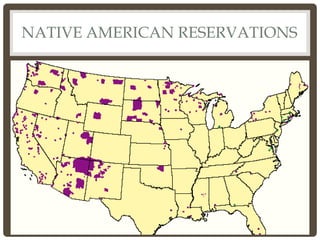
NATIVE AMERICAN RESERVATIONS
• The Sand Creek Massacre and The Battle of
Little Bighorn
• Sand Creek Massacre – 270 Native American
dead; most were women and children
• Cheyenne forced to give up claims to land given to them
• Warriors raided mining camps and local settlements
• U.S. forces surprised Cheyenne at Sand Creek in Colorado
Territory
• The Battle of Little Bighorn – General Custer
attempted to surprise and defeat the Sioux in
Montana
• Known as “Custer’s Last Stand”
• Last greatest victory for Native Americans
• Sioux and Cheyenne surrendered to U.S. troops to
moved to land in the Dakotas and Oklahoma
• Chief Joseph and the Nez Perce
• Nez Perce – tribe bed by Chief Joseph
• Forced to leave land
• Warriors killed several white settlers without Chief
Joseph’s blessing
• Joseph ordered to comply with move to
reservation
• Troops attacked tribe while moving them
• Joseph and Nez Perce retreated and planed to
avoid U.S. troops and escape into Canada
• Caught thirty miles for the border
• Forced onto reservation in Oklahoma
• Many died due to sickness and malnutrition
• Wounded Knee
• last notable armed conflict between U.S. and Native
Americans
• “Ghost Dance” alarmed settlers and sent U.S. Army
• Believed Sioux leader Sitting Bull was trying to start an
uprising
• The Dawes Act
• Congress passed 1887
• Assimilate Native Americans – force them to
became part of mainstream society
• Abolished tribes and separated reservations into
land for individuals
• Huge failure – did not want to give up tribes, no
interest in farming
GROUP ASSIGNMENT
• Create a poster that shows the social, political, and
economic antagonism that occurred once
westward expansion began to occur. It should be
formatted like a graphic organizer using the
information that we covered today. Every person
must have a rough draft and the final copy will be
the group poster.
2.3 RAILROADS, FARMING,
AND THE RISE OF POPULISM
THE TRANSCONTINENTAL
RAILROAD
• Railroads became important means of
transportation in the U.S.
• Transcontinental Railroad
• Union Pacific – Eastern rail company
• Central Pacific – rail company from California
• Irish and Chinese workers
• Promontory Point – city in Utah were
transcontinental railroad met to unite the East
and West
FARMING, RANCHING, AND
MINING
• Many people moved West intended on
farming
• Adapt to terrain different from the East
• Technological Advances:
• John Deere’s steel plow – allowed farmers to cut
through prairie sod
• Windmills – allowed farmers to harness wind
power to push water to the surface
• Barbed wire – made it possible for farmers to
fence in there livestock and land
• Railroads – import needs/ship products to other
parts of the country
• Cattle Ranching
• used ranching techniques of Mexicans
• Growth of cattle contributed to slaughter of
buffalo
• Land taken from Native Americans
• “Cowboys”
• Moved cattle on long drives to be shipped by train to
market
• Became legendary figures in Western culture
• Mining – became important with discoveries
of gold
• Mining camps and towns were established
• Boomtowns – mining towns that were booming
with minerals
• Ghost towns –mining towns that were not
booming anymore and everyone has left
FARMER COOPERATIVES
• 1870’s – 1880’s – overproduction cased
prices to drop
• Farmers making less money/rising cost of
equipment and railroads
• Farmers went into debt; lost their farms and
land
• Cooperatives – farmers pulled their
resources together to purchase new
equipment and sell crops
• Began to build political influence
THE POPULIST MOVEMENT
• Populist Movement – formed because of
concerns of the farmers
• Low prices for their goods and the crop lien
system (farmers borrow money against crops; slip
further into debt)
• Populists wanted to regulate railroad prices for
farmers on hauling products and machinery
• Appealed to “common man” – working class in
the Northeast, South, and West
• Omaha Platform – unlimited coinage of sliver,
government regulated railroads/industry,
graduated income tax, election reforms
• Green Backs – paper money
• Printing more paper money would ease the
farmers’ burdens of raising prices
• Free Silver Policy – base the U.S. dollar on
silver and gold
• Populists believed this would pump money into the
nation’s economy and ease financial pressure on
farmers.
• Election of 1896
• Economic depression
• President Cleveland seemed vulnerable
• Free sliver became major issue
• William Jennings Bryan
• Democratic Party nomination
• Backed means to spur inflation and raise prices of
for farmers
• Populist Party backed Bryan
• Could not overcome a split in Democratic party
• Republican Party candidate William McKinley
won election

Chapter 2

  • 1.
  • 2.
    •Take sheet from chairand start on bellwork/task focus.
  • 3.
  • 4.
    TEXAS: INDEPENDENCE AND ANNEXATION •Manifest Destiny – U.S. leaders and citizens believed it to be destiny to expand and possess land to the West • Middle of the nineteenth century • Mexico gained independence from Spain • Gained control of Texas with large number of U.S. settlers • General Antonio Lopez de Santa Anna gained control over Mexican Government • Sam Houston launched a rebellion in Texas
  • 5.
    • March 2,1836 Texas declared an independent republic • The Alamo – a battle fought between Santa Anna’s men and Texans • Every Texan who fought perished in battle or captured and killed • Texans defeated Santa Anna and took him hostage • For freedom, Santa Anna promised to recognize the Republic of Texas
  • 6.
    • Texas becomespart of the U.S. • Asked to be annexed • Andrew Jackson in favor but know northern states would oppose a large slave state • Texas stayed independent until 1845 • Election of 1844 • Texas annexation was critical issues in election • Split the Democratic Party • James K. Polk – first “dark horse” (unexpected winner) presidential nominee • Called for annexation of Texas and Oregon • Defeated the Whig Party • Whigs and Democrats were dominate political parties at this time.
  • 7.
    OREGON TERRITORY • AfterPolk settled with Texas, he turned his attention to Oregon. • Great Britain and U.S. jointly occupied Oregon • Polk argued the U.S. should claim territory up to 54˚40’N because of citizen population • Polk ready to fight – Great Britain willing to give it up because it was no longer profitable; U.S. important consumer of British goods • Oregon became territory 1846
  • 8.
    SOUTHWEST TERRITORIES • 1848Mexico and U.S. signed treaty after U.S. defeated Mexico in war • Mexico surrendered New Mexico and California territories • 1853 boundary dispute sill remained with Mexico • President Franklin Pierce sent James Gadsden to purchase land from Mexico for transcontinental railroad • Gadsden Purchase - $10 Million for present-day New Mexico and Arizona
  • 9.
    • Gold Rushof 1849 • Settlers discovered gold north of Sacramento, California • Gold seekers come from all over the world • Congress admitted California to the Union as a state in 1850
  • 10.
  • 11.
    EUROPEAN MIGRATION • Withexpansion west came a migration of settlers with different motivations • Catholics hoped to read the message of Jesus to Native Americans • Gold Rush of 1849 – became major reason for conflict between settlers and Native Americans • Comstock Lode – region in Nevada with largest load of precious ore
  • 12.
    • 1862 Congresspassed two pieces of legislation to encourage western settlement • Homestead Act – anyone who agreed to cultivate 160 acres of land for five years would have title to that land from federal government • Morrill Land-Grant Act – millions of acres given to state governments to sell as agriculture colleges; teach farmers how to use new technology to farm the Midwest
  • 13.
    • Oklahoma landrush • 50,000 people on horseback, bicycle, wagon, and on foot gathered waiting for the gun how to open the Oklahoma territory • “The Sooner State” – people tired to jump the gun to get a head start and get to Oklahoma sooner
  • 14.
    WOMEN OF THEWEST • Enjoyed greater freedom • Required women to take on men's jobs • New freedoms attracted women to the west
  • 15.
    AFRICAN AMERICANS OFTHE WEST • Before the Civil War, many African Americas in the South were slaves • Black Exodus – African Americas who left the south after the Civil War • Large number migrated; became carriers or cowhands • Large number of cowboys were African Americans • Serve in west as United States Army • Buffalo Soldiers – name given by Native Americans who fought against them; all black regiments
  • 16.
    CHINESE IMMIGRANTS • Chineseimmigrants arrived in California • Population grew rapidly • Came to find work building railroads • Major role in building western railroads • Connecting eastern and western railroads • Citizens did not like Chinese immigrants • Felt they drove price of labor down and stole jobs from Americans • Racism/Nativism – opposed to immigration • Trust – did not trust Chinese because of appearance, dress, language
  • 17.
    • Chinese ExclusionAct – prohibited people from china from immigration to the United States • Not repealed until 1943
  • 18.
    EUROPEAN AMERICANS AND MEXICANS •Annexation of Texan and Mexican- American war made relation between U.S. and Mexico tense • Mexicans did have a positive effect on settlers in the western region • Taught white settlers how to herd, raise, and drive cattle to market • Cowboy hats and chaps were also adopted by white settlers
  • 19.
    NATIVE AMERICANS • EuropeanAmericans had conflict with Native Americans living in the west • Buffalo – great source of food, clothing, and shelter for Plains Indians • Settlers killed great number for hides and make way for the cattle industry • Plains Indians would no longer continue their way of life • Caused a dramatic decline in the population of Native Americans • Ranching took more land from Native Americans for railroads, towns, and cattle
  • 20.
    • Native Americanswere forced to relocate to reservations – land set aside for Native Americans just to be forcibly moved again and again because of gold being discovered • Native Americans grew tired of this and violent wars broke out
  • 21.
  • 22.
    • The SandCreek Massacre and The Battle of Little Bighorn • Sand Creek Massacre – 270 Native American dead; most were women and children • Cheyenne forced to give up claims to land given to them • Warriors raided mining camps and local settlements • U.S. forces surprised Cheyenne at Sand Creek in Colorado Territory • The Battle of Little Bighorn – General Custer attempted to surprise and defeat the Sioux in Montana • Known as “Custer’s Last Stand”
  • 23.
    • Last greatestvictory for Native Americans • Sioux and Cheyenne surrendered to U.S. troops to moved to land in the Dakotas and Oklahoma • Chief Joseph and the Nez Perce • Nez Perce – tribe bed by Chief Joseph • Forced to leave land • Warriors killed several white settlers without Chief Joseph’s blessing • Joseph ordered to comply with move to reservation • Troops attacked tribe while moving them
  • 24.
    • Joseph andNez Perce retreated and planed to avoid U.S. troops and escape into Canada • Caught thirty miles for the border • Forced onto reservation in Oklahoma • Many died due to sickness and malnutrition • Wounded Knee • last notable armed conflict between U.S. and Native Americans • “Ghost Dance” alarmed settlers and sent U.S. Army • Believed Sioux leader Sitting Bull was trying to start an uprising
  • 25.
    • The DawesAct • Congress passed 1887 • Assimilate Native Americans – force them to became part of mainstream society • Abolished tribes and separated reservations into land for individuals • Huge failure – did not want to give up tribes, no interest in farming
  • 26.
    GROUP ASSIGNMENT • Createa poster that shows the social, political, and economic antagonism that occurred once westward expansion began to occur. It should be formatted like a graphic organizer using the information that we covered today. Every person must have a rough draft and the final copy will be the group poster.
  • 27.
    2.3 RAILROADS, FARMING, ANDTHE RISE OF POPULISM
  • 28.
    THE TRANSCONTINENTAL RAILROAD • Railroadsbecame important means of transportation in the U.S. • Transcontinental Railroad • Union Pacific – Eastern rail company • Central Pacific – rail company from California • Irish and Chinese workers • Promontory Point – city in Utah were transcontinental railroad met to unite the East and West
  • 29.
    FARMING, RANCHING, AND MINING •Many people moved West intended on farming • Adapt to terrain different from the East • Technological Advances: • John Deere’s steel plow – allowed farmers to cut through prairie sod • Windmills – allowed farmers to harness wind power to push water to the surface • Barbed wire – made it possible for farmers to fence in there livestock and land • Railroads – import needs/ship products to other parts of the country
  • 30.
    • Cattle Ranching •used ranching techniques of Mexicans • Growth of cattle contributed to slaughter of buffalo • Land taken from Native Americans • “Cowboys” • Moved cattle on long drives to be shipped by train to market • Became legendary figures in Western culture
  • 31.
    • Mining –became important with discoveries of gold • Mining camps and towns were established • Boomtowns – mining towns that were booming with minerals • Ghost towns –mining towns that were not booming anymore and everyone has left
  • 32.
    FARMER COOPERATIVES • 1870’s– 1880’s – overproduction cased prices to drop • Farmers making less money/rising cost of equipment and railroads • Farmers went into debt; lost their farms and land • Cooperatives – farmers pulled their resources together to purchase new equipment and sell crops • Began to build political influence
  • 33.
    THE POPULIST MOVEMENT •Populist Movement – formed because of concerns of the farmers • Low prices for their goods and the crop lien system (farmers borrow money against crops; slip further into debt) • Populists wanted to regulate railroad prices for farmers on hauling products and machinery • Appealed to “common man” – working class in the Northeast, South, and West • Omaha Platform – unlimited coinage of sliver, government regulated railroads/industry, graduated income tax, election reforms
  • 34.
    • Green Backs– paper money • Printing more paper money would ease the farmers’ burdens of raising prices • Free Silver Policy – base the U.S. dollar on silver and gold • Populists believed this would pump money into the nation’s economy and ease financial pressure on farmers.
  • 35.
    • Election of1896 • Economic depression • President Cleveland seemed vulnerable • Free sliver became major issue • William Jennings Bryan • Democratic Party nomination • Backed means to spur inflation and raise prices of for farmers • Populist Party backed Bryan • Could not overcome a split in Democratic party • Republican Party candidate William McKinley won election