BANKS AND FINANCIAL INSTITUTIONS ISBN:978-93-94676-00-8 Page 274
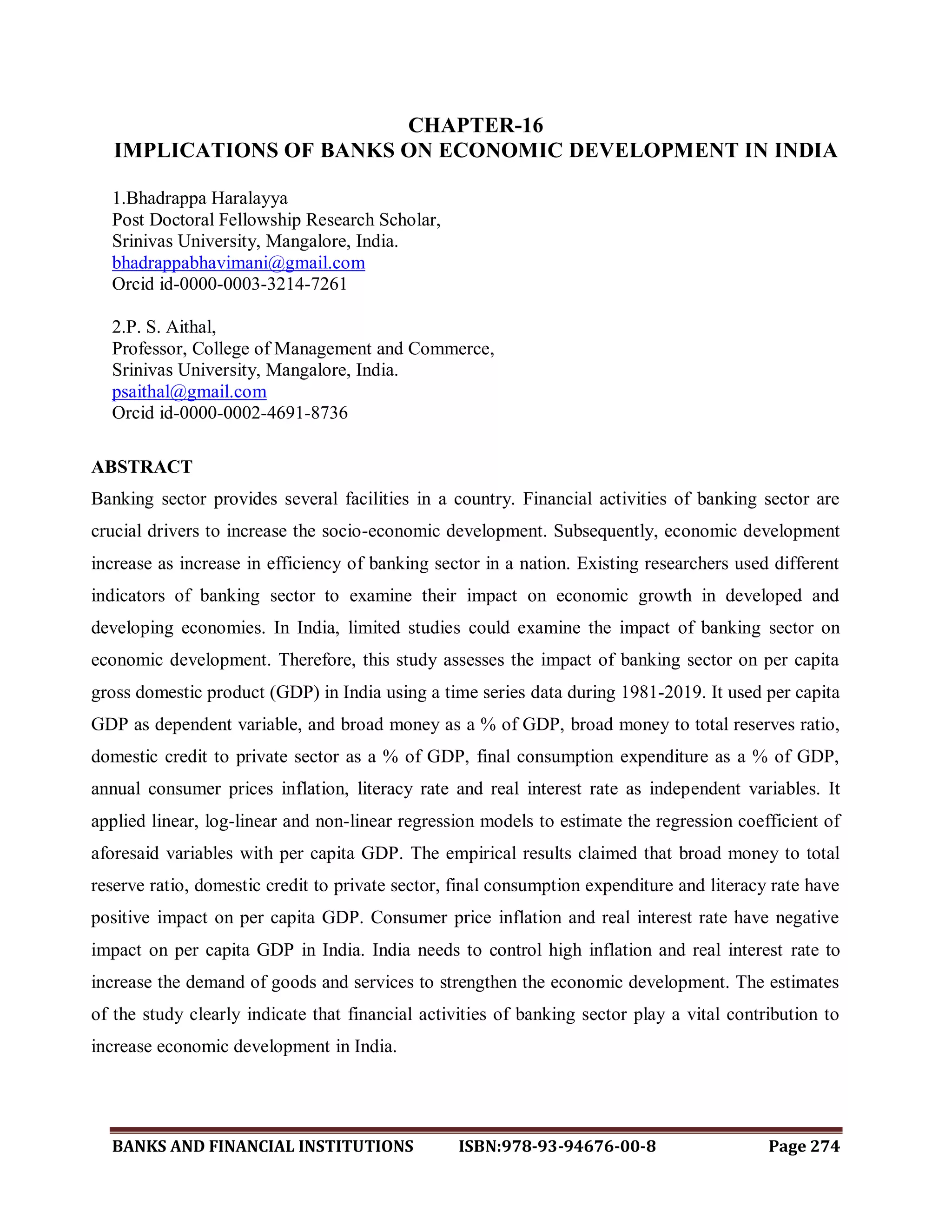
CHAPTER-16
IMPLICATIONS OF BANKS ON ECONOMIC DEVELOPMENT IN INDIA
1.Bhadrappa Haralayya
Post Doctoral Fellowship Research Scholar,
Srinivas University, Mangalore, India.
bhadrappabhavimani@gmail.com
Orcid id-0000-0003-3214-7261
2.P. S. Aithal,
Professor, College of Management and Commerce,
Srinivas University, Mangalore, India.
psaithal@gmail.com
Orcid id-0000-0002-4691-8736
ABSTRACT
Banking sector provides several facilities in a country. Financial activities of banking sector are
crucial drivers to increase the socio-economic development. Subsequently, economic development
increase as increase in efficiency of banking sector in a nation. Existing researchers used different
indicators of banking sector to examine their impact on economic growth in developed and
developing economies. In India, limited studies could examine the impact of banking sector on
economic development. Therefore, this study assesses the impact of banking sector on per capita
gross domestic product (GDP) in India using a time series data during 1981-2019. It used per capita
GDP as dependent variable, and broad money as a % of GDP, broad money to total reserves ratio,
domestic credit to private sector as a % of GDP, final consumption expenditure as a % of GDP,
annual consumer prices inflation, literacy rate and real interest rate as independent variables. It
applied linear, log-linear and non-linear regression models to estimate the regression coefficient of
aforesaid variables with per capita GDP. The empirical results claimed that broad money to total
reserve ratio, domestic credit to private sector, final consumption expenditure and literacy rate have
positive impact on per capita GDP. Consumer price inflation and real interest rate have negative
impact on per capita GDP in India. India needs to control high inflation and real interest rate to
increase the demand of goods and services to strengthen the economic development. The estimates
of the study clearly indicate that financial activities of banking sector play a vital contribution to
increase economic development in India.
BANKS AND FINANCIAL INSTITUTIONS ISBN:978-93-94676-00-8 Page 275
Keywords: Economic growth; Economic development; Per capita gross domestic product; banking
sector; India.
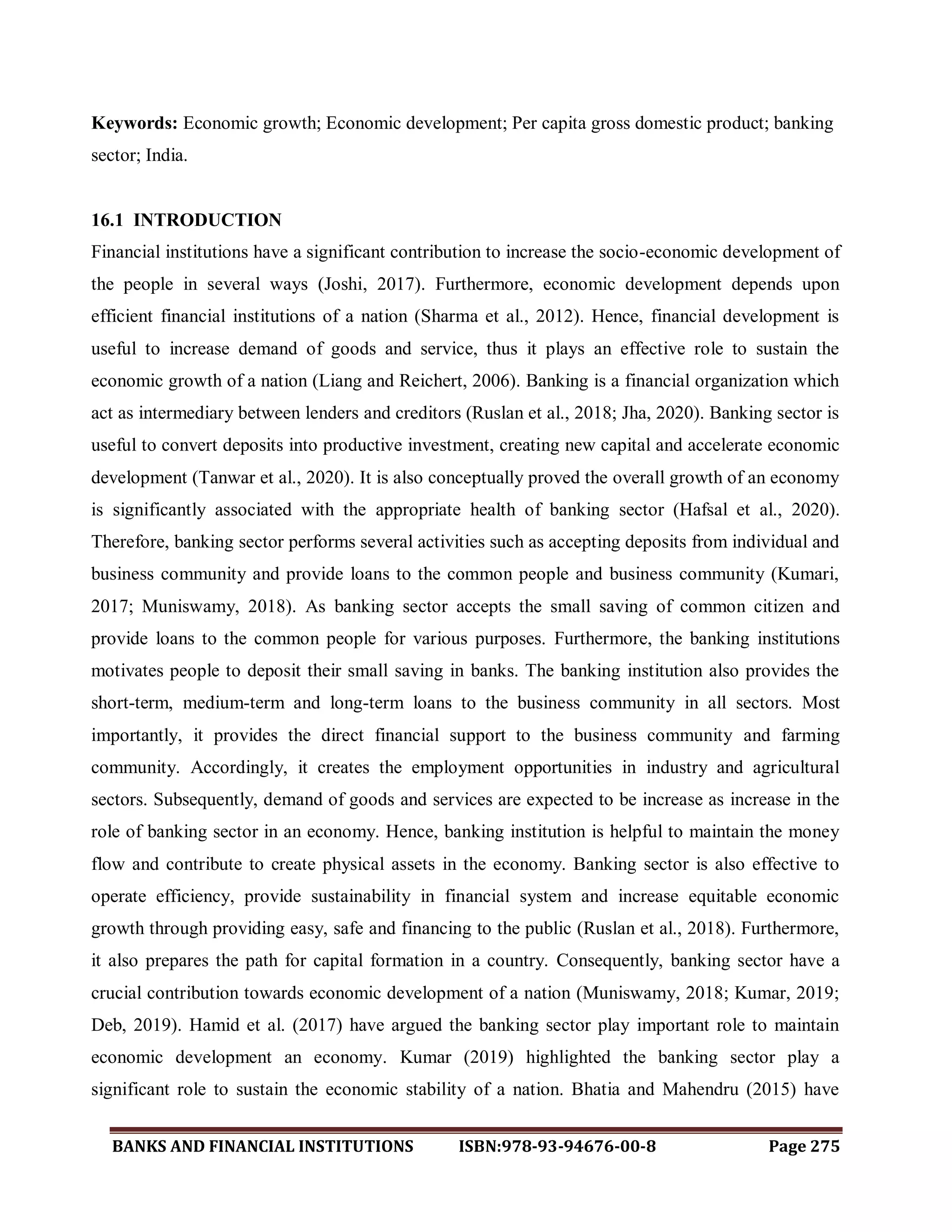
16.1 INTRODUCTION
Financial institutions have a significant contribution to increase the socio-economic development of
the people in several ways (Joshi, 2017). Furthermore, economic development depends upon
efficient financial institutions of a nation (Sharma et al., 2012). Hence, financial development is
useful to increase demand of goods and service, thus it plays an effective role to sustain the
economic growth of a nation (Liang and Reichert, 2006). Banking is a financial organization which
act as intermediary between lenders and creditors (Ruslan et al., 2018; Jha, 2020). Banking sector is
useful to convert deposits into productive investment, creating new capital and accelerate economic
development (Tanwar et al., 2020). It is also conceptually proved the overall growth of an economy
is significantly associated with the appropriate health of banking sector (Hafsal et al., 2020).
Therefore, banking sector performs several activities such as accepting deposits from individual and
business community and provide loans to the common people and business community (Kumari,
2017; Muniswamy, 2018). As banking sector accepts the small saving of common citizen and
provide loans to the common people for various purposes. Furthermore, the banking institutions
motivates people to deposit their small saving in banks. The banking institution also provides the
short-term, medium-term and long-term loans to the business community in all sectors. Most
importantly, it provides the direct financial support to the business community and farming
community. Accordingly, it creates the employment opportunities in industry and agricultural
sectors. Subsequently, demand of goods and services are expected to be increase as increase in the
role of banking sector in an economy. Hence, banking institution is helpful to maintain the money
flow and contribute to create physical assets in the economy. Banking sector is also effective to
operate efficiency, provide sustainability in financial system and increase equitable economic
growth through providing easy, safe and financing to the public (Ruslan et al., 2018). Furthermore,
it also prepares the path for capital formation in a country. Consequently, banking sector have a
crucial contribution towards economic development of a nation (Muniswamy, 2018; Kumar, 2019;
Deb, 2019). Hamid et al. (2017) have argued the banking sector play important role to maintain
economic development an economy. Kumar (2019) highlighted the banking sector play a
significant role to sustain the economic stability of a nation. Bhatia and Mahendru (2015) have
BANKS AND FINANCIAL INSTITUTIONS ISBN:978-93-94676-00-8 Page 276
argued that efficient banking system contribute towards economic development. Efficient efficiency
of banking sector is helpful to increases the mobilization of saving and deposits funds to increase
economic growth (Karimzadeh, 2012). Rajan and Zingales (1998) claimed the efficient banking
sector works as important driver to strengthen the economic growth through mobilization of
financial saving and use these saving to create physical assets.
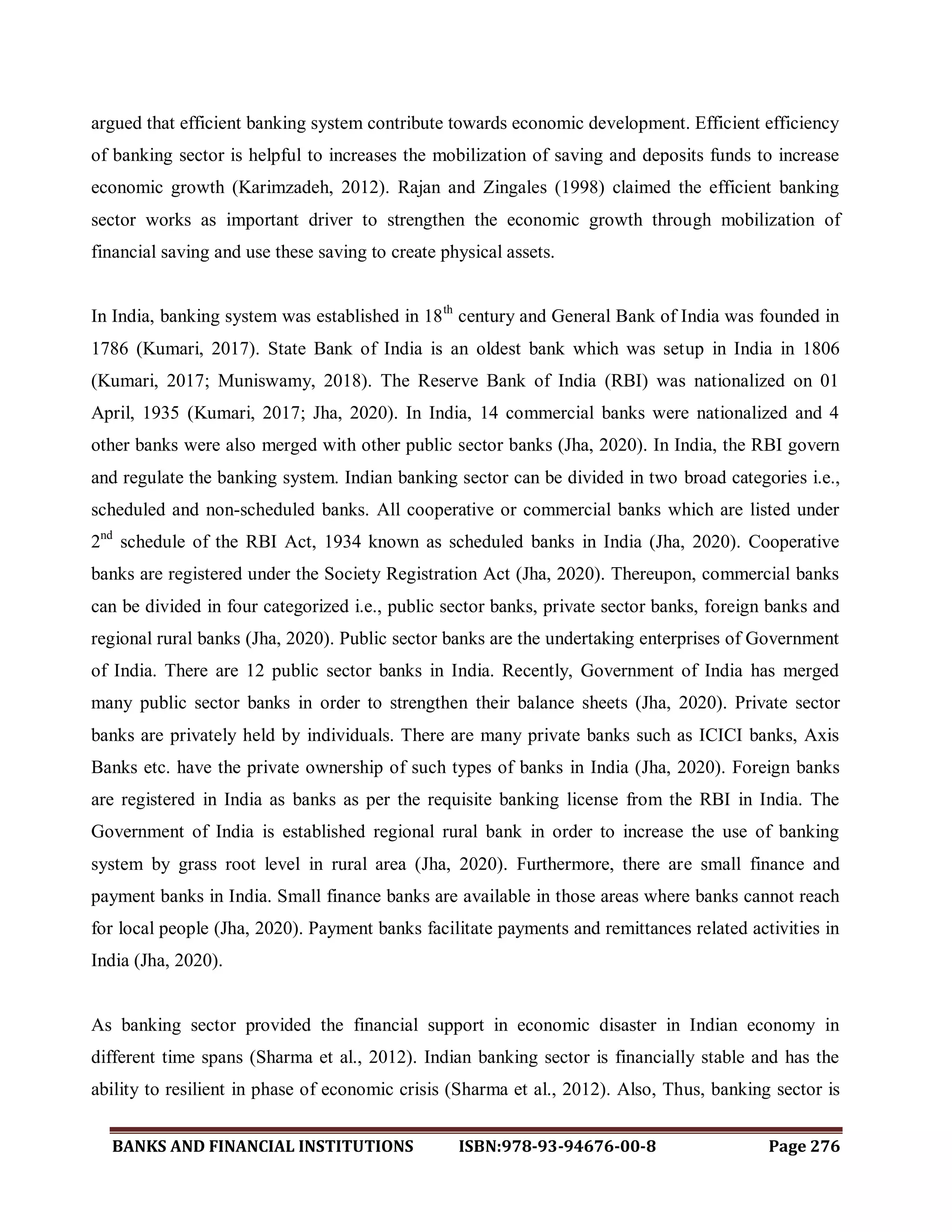
In India, banking system was established in 18th
century and General Bank of India was founded in
1786 (Kumari, 2017). State Bank of India is an oldest bank which was setup in India in 1806
(Kumari, 2017; Muniswamy, 2018). The Reserve Bank of India (RBI) was nationalized on 01
April, 1935 (Kumari, 2017; Jha, 2020). In India, 14 commercial banks were nationalized and 4
other banks were also merged with other public sector banks (Jha, 2020). In India, the RBI govern
and regulate the banking system. Indian banking sector can be divided in two broad categories i.e.,
scheduled and non-scheduled banks. All cooperative or commercial banks which are listed under
2nd
schedule of the RBI Act, 1934 known as scheduled banks in India (Jha, 2020). Cooperative
banks are registered under the Society Registration Act (Jha, 2020). Thereupon, commercial banks
can be divided in four categorized i.e., public sector banks, private sector banks, foreign banks and
regional rural banks (Jha, 2020). Public sector banks are the undertaking enterprises of Government
of India. There are 12 public sector banks in India. Recently, Government of India has merged
many public sector banks in order to strengthen their balance sheets (Jha, 2020). Private sector
banks are privately held by individuals. There are many private banks such as ICICI banks, Axis
Banks etc. have the private ownership of such types of banks in India (Jha, 2020). Foreign banks
are registered in India as banks as per the requisite banking license from the RBI in India. The
Government of India is established regional rural bank in order to increase the use of banking
system by grass root level in rural area (Jha, 2020). Furthermore, there are small finance and
payment banks in India. Small finance banks are available in those areas where banks cannot reach
for local people (Jha, 2020). Payment banks facilitate payments and remittances related activities in
India (Jha, 2020).
As banking sector provided the financial support in economic disaster in Indian economy in
different time spans (Sharma et al., 2012). Indian banking sector is financially stable and has the
ability to resilient in phase of economic crisis (Sharma et al., 2012). Also, Thus, banking sector is
BANKS AND FINANCIAL INSTITUTIONS ISBN:978-93-94676-00-8 Page 277
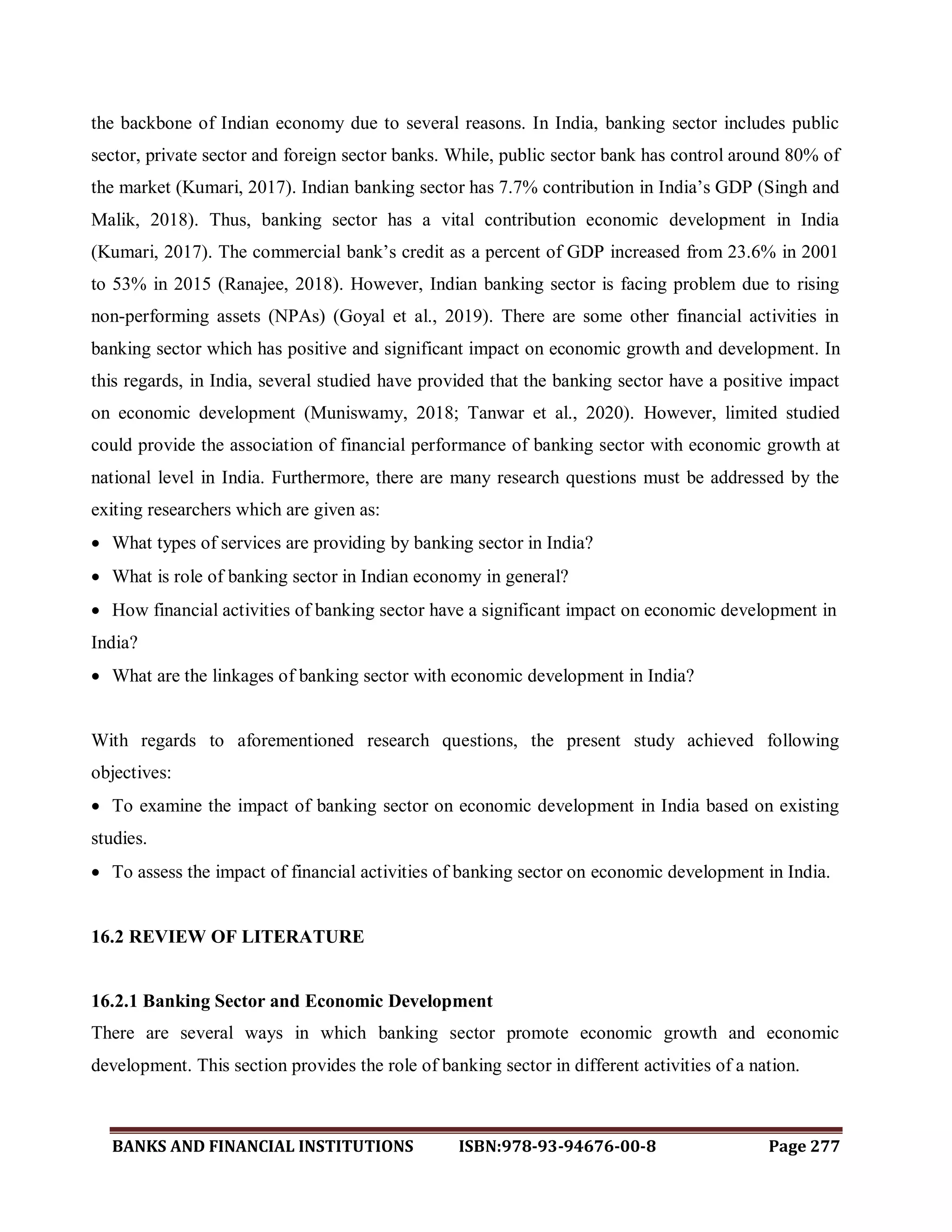
the backbone of Indian economy due to several reasons. In India, banking sector includes public
sector, private sector and foreign sector banks. While, public sector bank has control around 80% of
the market (Kumari, 2017). Indian banking sector has 7.7% contribution in India‟s GDP (Singh and
Malik, 2018). Thus, banking sector has a vital contribution economic development in India
(Kumari, 2017). The commercial bank‟s credit as a percent of GDP increased from 23.6% in 2001
to 53% in 2015 (Ranajee, 2018). However, Indian banking sector is facing problem due to rising
non-performing assets (NPAs) (Goyal et al., 2019). There are some other financial activities in
banking sector which has positive and significant impact on economic growth and development. In
this regards, in India, several studied have provided that the banking sector have a positive impact
on economic development (Muniswamy, 2018; Tanwar et al., 2020). However, limited studied
could provide the association of financial performance of banking sector with economic growth at
national level in India. Furthermore, there are many research questions must be addressed by the
exiting researchers which are given as:
 What types of services are providing by banking sector in India?
 What is role of banking sector in Indian economy in general?
 How financial activities of banking sector have a significant impact on economic development in
India?
 What are the linkages of banking sector with economic development in India?
With regards to aforementioned research questions, the present study achieved following
objectives:
 To examine the impact of banking sector on economic development in India based on existing
studies.
 To assess the impact of financial activities of banking sector on economic development in India.
16.2 REVIEW OF LITERATURE
16.2.1 Banking Sector and Economic Development
There are several ways in which banking sector promote economic growth and economic
development. This section provides the role of banking sector in different activities of a nation.
BANKS AND FINANCIAL INSTITUTIONS ISBN:978-93-94676-00-8 Page 278
Banking sectors in conducive to promote saving habits of the people for deposit in the banks for get
better and safe return (Muniswamy, 2018). Capital formation works as blood for a nation. As
banking sector collect deposits from depositors and provide collected amount to the people,
business community, farmers and others as loans to earn profit. Thus, the banking sector is highly
effective to create capital formation (Muniswamy, 2018). Banking institutions provides the loans to
the business community to set up new industry and venture (Singh et al., 2019; Singh et al., 2020).
Financial support from banking sector to small companies is useful to create start-up (Jyoti and
Singh, 2020). Therefore, banking sector is useful to increase industrialization and entrepreneurship
ecosystem (Singh and Ashraf, 2020; Singh and Jyoti, 2020). Appropriate banking sector is useful to
make transfer of money for trade of goods and services through mobile banking, internet banking,
debit cards, credit cards and other (Muniswamy, 2018). The growth of Indian economy largely
depends upon agricultural sector as the sector meet the food security of Indian. Banking sector
provide short-term and long-term loans to the farmers for their farming activities. Subsequently,
banking sector promote agricultural production (Kumar et al., 2017; Singh and Jyoti, 2021). As
banking sector provide loans to the industry and business community. Therefore, it creates
employment opportunities at grater scale (Muniswamy, 2018). Economic development may be
adversely affected due to inflation, deflation and crisis. A monetary policy is useful to control
inflation, deflation and crisis (Muniswamy, 2018). As monetary policy governs by central bank of
nation, hence, banking sector has a significant contribution to maintain financial stability in a
country.
16.2.2 Association of Banking Sector and Economic Development
At present banking sector in one of the biggest service providers sectors in India (Kumari, 2017). In
India, banking sector is providing several services such as credit cards, debit cards, ATM services,
telebanking, internet banking, electronic payments, consumer finance, life insurance, mutual fund,
pension fund, regulation services, stock broking services (Kumari, 2017; Muniswamy, 2018).
Accordingly, banking sector have a vital contribution to increase economic growth. Previous
studied have theoretically and empirically proved that banking sector have a positive impact on
economic growth. For instance, Muniswamy (2018) assessed the role of banks in capital formation
and economic growth in India. Alam et al. (2021) have reported that interest margin and return on
assets of banking sector have significant impact on economic growth in India. Al-Homaidi et al.
BANKS AND FINANCIAL INSTITUTIONS ISBN:978-93-94676-00-8 Page 279
(2018) have claimed that commercial banks dominate the financial system and have vital
contribution in economic development. However, previous could not find uniform relationship
between economic growth and banking sector. Saeed et al. (2018) reported positive bi-directional
causality relationship between banking sector and economic growth in Pakistan. Joshi (2017)
assessed the relationship between the financial development and growth in India.
16.3 RESEARCH METHODOLOGY
16.3.1 Explanation of Dependent and Independent Variables
Previous studies have also used different indicators such as gross domestic product, per capita gross
domestic product and growth gross domestic product as a proxy for economic growth, economic
development and economic proxy across countries (Liang and Reichert, 2006; Prochniak and
Wasiak, 2016; Puatwoe and Piabup, 2017; Joshi, 2017; Al-Homaidi et al., 2018; Singh and Malik,
2018). Liang and Reichert (2006) used aggregate output or real GDP as dependent variable, and
capital stock and financial sector development are used as independent variables. Hence, previous
studies have used different indicators as proxy for financial or banking sector to examine their
impact on economic growth and economic development in different countries. For instance,
Prochniak and Wasiak (2016) examined the impact of financial sector on economic growth in 28
EU and 34 OECD countries during 1993 – 2013. This study is used economic growth as dependent
variable, and bank non-performing loans, bank capital to assets ratio, market capitalization of listed
companies, turnover ratio of stocks traded and monetization ratio as independent variables in
regression model. Puatwoe and Piabup (2017) have assessed the implications of financial sector
development and economic growth in Cameroon. Al-Homaidi et al. (2018) have considered the
gross domestic product, inflation rate, interest rate and exchange rate to analysis banking
performance in India. Guru and Yadav (2019) have examined the relationship between financial
development and economic growth in BRICS countries. This study is used macroeconomic
indicators such as credit to deposit ratio, domestic credit to private sector, inflation, exports and
enrolment in secondary education. Al-Homaidi et al. (2018) have used different macroeconomic
indicators such as gross domestic product, inflation rate, interest rate, exchange rate and others to
assess the macro-economic determinants of profitability of commercial banks in India. Saeed et al.
(2018) have considered lending capability, innovation, interest margin and bank investment as
BANKS AND FINANCIAL INSTITUTIONS ISBN:978-93-94676-00-8 Page 280
proxy variables of banking sector to examine their impact on economic growth in Pakistan. Joshi
(2017) have used M2 GDP ratio and ratio of stock market capitalization to GDP in India.
16.3.2 Empirical Model
As economic development may not be capture by a single variable of nation. Prior studied have
used gross domestic product, per capita GDP and growth in gross domestic product as a proxy for
economic development in empirical investigation (Singh and Malik, 2018). Therefore, per capita
gross domestic product is used as proxy for economic development to assess its association with
financial activities of banking sector in India in this study. Joshi (2017) have also used GDP per
capita as a proxy for economic growth to assess its relationship with financial development in India.
Broad money (% of GDP), domestic credit to private sector (% of GDP) and broad money to total
reserves ratio are used to assess the impact of banking sector on per capita GDP in this study. Real
interest rate (%) is an important driver to increase the attention of common people and business
community to take the loan from banking sector (Al-Homaidi et al., 2018). Hence, it is expected
that per capita GDP may decline as increase in real interest rate. Demand of goods and service may
decline due to increase in consumer prices inflation (annual %) in a country. Subsequently, it is
likely to be predicted that Final consumption expenditure decreases as increase in consumer price
inflation. Hence, broad money (% of GDP), broad money to total reserves ratio, domestic credit to
private sector (% of GDP), final consumption expenditure (% of GDP), consumer prices inflation
(annual %), literacy rate adult total and real interest rate (%) are used as independent variables in
this study. This study used time series data for above-mentioned variables during 1981-2019. All
data is derived from official website of the World Bank (World Development Indicator). Linear,
log-linear and non-linear regression models are used to assess the influence of aforesaid explanatory
variables on per capita gross domestic product. Following linear regression model is used:
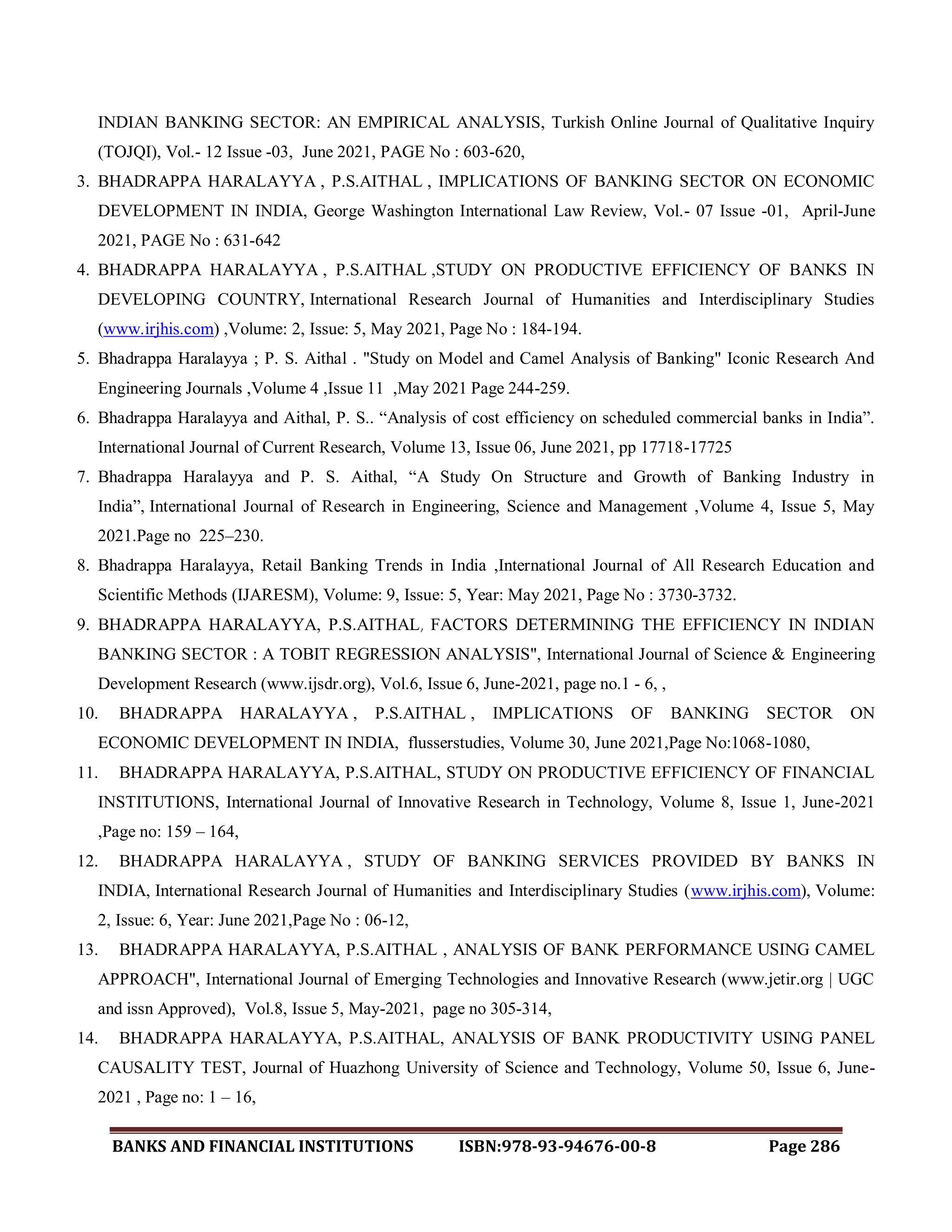
(GDPPC)t = β0 +β1 (BPGDP)t+β2 (BMTRR)t +β3 (DCPSPGDP)t +β4 (FCEPGDP) +β5 (CPI)t +β6
(LRAT)t +β7 (RIR)t + ut (1)
Here, t is time period (1981-2019), β0 is constant term; β1, β2, …, β7 are the regression coefficient of
associated explanatory variables; and ut is the error term in equation (1). The explanation of
variables is given in Table 1.
BANKS AND FINANCIAL INSTITUTIONS ISBN:978-93-94676-00-8 Page 281
Table 16.1: List of dependent and independent variables
Variable Symbol Unit Source of Data
GDP per capita (constant 2010 US$) GDPPC US $
World
Development
Indicator (World
Bank)
Broad money (% of GDP) BPGDP Number
Broad money to total reserves ratio BMTRR %
Domestic credit to private sector (% of GDP) DCPSPGDP %
Final consumption expenditure (% of GDP) FCEPGDP %
Consumer prices inflation (annual %) CPI %
Literacy rate adult total (% of people ages 15 and above)LRAT %
Real interest rate (%) RIR %
Log-linear regression model is used in following form:
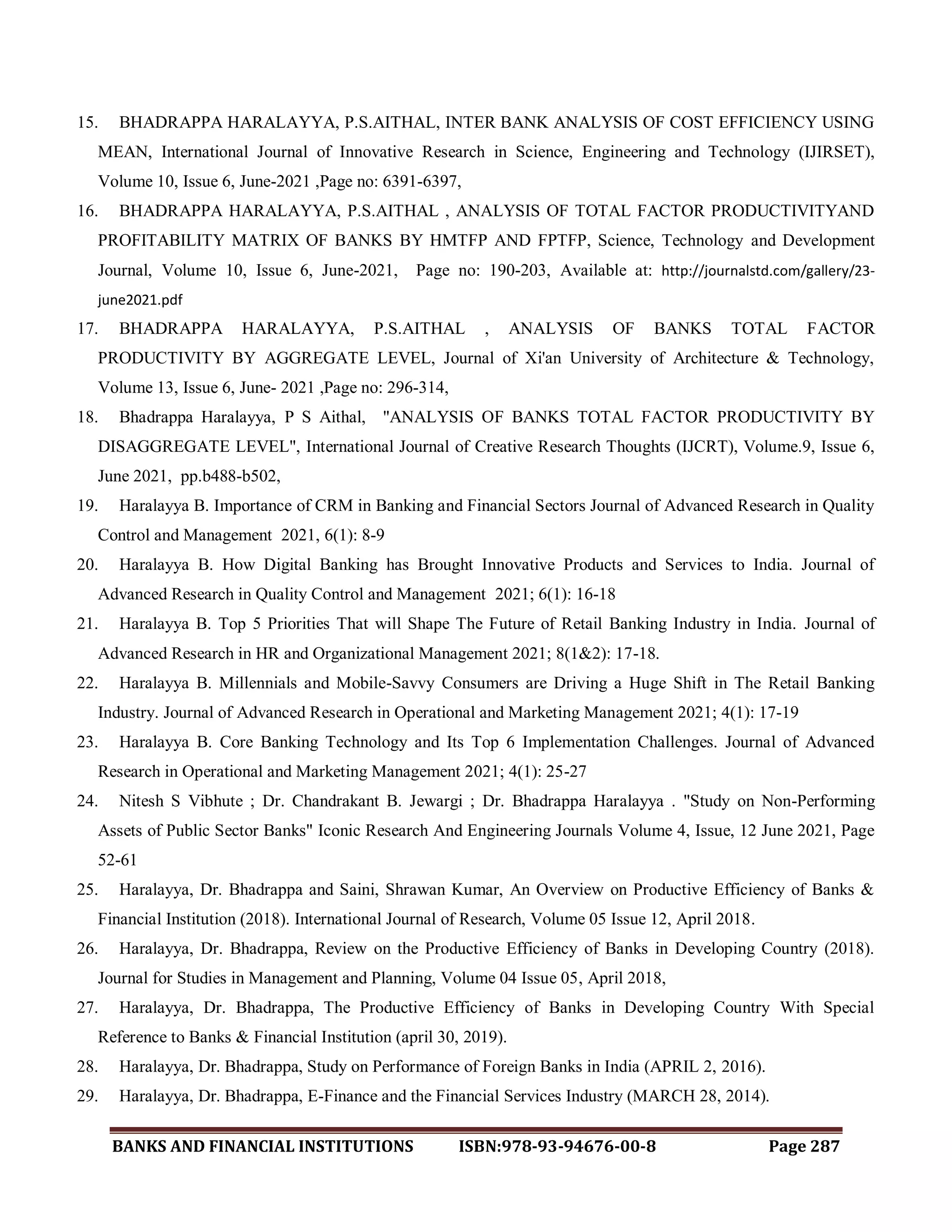
ln(GDPPC)t = α0 +α1 ln(BPGDP)t+α2 ln(BMTRR)t +α3 ln(DCPSPGDP)t +α4 ln(FCEPGDP) +α5
ln(CPI)t +α6 ln(LRAT)t +α7 ln(RIR)t + θt (2)
Here, ln is natural logarithm of corresponding variables, α0 is constant term; α1, α2, …, α7 are the
regression coefficient of associated explanatory variables; and θt is the error term in equation (2).
Original and square term of all explanatory variables are considered in non-linear regression model.
Non-linear regression model is used in following form:
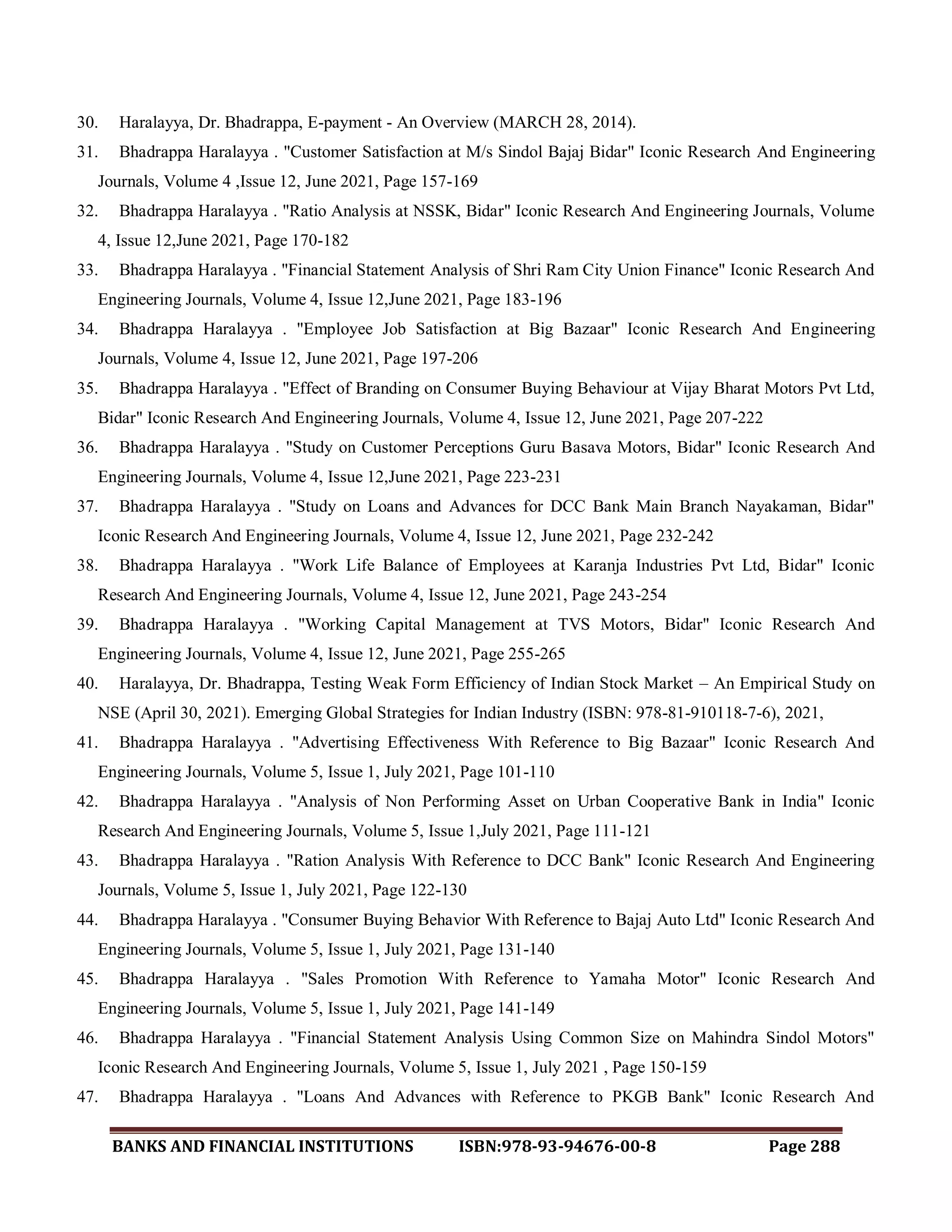
(GDPPC)t = λ0 +λ1 (BPGDP)t+λ2 (Sq. BPGDP)t +λ3 (BMTRR)t +λ4 (Sq. BMTRR)t +λ5 (DCPSPGDP)t +λ6
(Sq. DCPSPGDP)t +λ7 (FCEPGDP)t +λ8 (FCEPGDP)t +λ9 (CPI)t +λ10 (CPI)t +λ11 (LRAT)t +λ12 (LRAT)t
+λ13 (RIR)t +λ14 (RIR)t + µt (3)
Here, Sq. is square term of respective variables; λ0 is constant term; λ1, λ2, …, λ7 are the regression
coefficient of associated explanatory variables; and µt is the error term in equation (3).
16.3.3 Process to Select an Appropriate Model
As this study is used a time series data of dependent and independent variables during 1981-2019.
Therefore, it is necessary to check the normality, stationarity, unit root, autocorrelation, multi-
correlation and heteroskedasticity in the time series data. Accordingly, skewness and kurtosis
BANKS AND FINANCIAL INSTITUTIONS ISBN:978-93-94676-00-8 Page 282
values of each variable is estimated the check the normality of the data (Singh and Jyoti, 2021). The
existence of unit root in each variable of time series data is check through Augmented Dickey-
Fuller (ADF) unit root test (Singh, 2017). Most variables are found stationarity in nature. Multi-
correlation shows the linear relationship among the explanatory variables (Singh, 2017). Hence, the
existence of multi-correlation is identified through variance inflation factor (VIF). Presence of
autocorrelation is a prime problem of time series data (Singh, 2017). Therefore, Durbin-Watson d-
statistics and Durbin‟s Alternative test is used to check the presence of autocorrelation in time
series data. Cameron and Trivedi decomposition of IM-test, and Breusch-Pagan/Cook-Weisberg
test are considered to identify the presence of heteroskedasticity in the time series data (Singh,
2017). Since, this study is used linear, log-linear and non-linear regression models, thus, Ramsay
RESET test is used to check the well-defined function form of empirical model (Singh, 2017).
Furthermore, Akaike Information Criterion and Bayesian Information Criterion (BIC) are used to
check the consistency of regression coefficients of explanatory variables in the proposed model
(Singh, 2017).
16.4 Empirical Results and Discussion
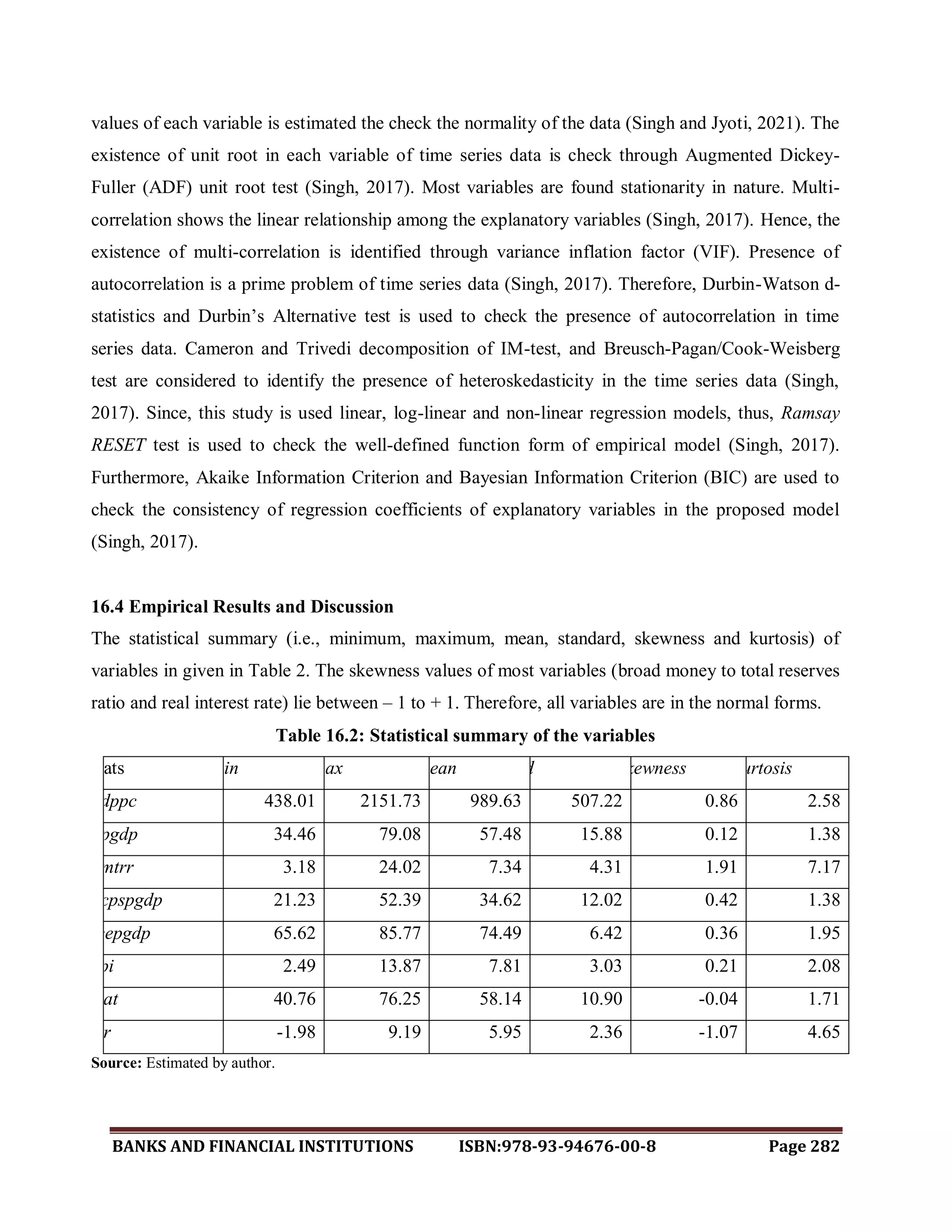
The statistical summary (i.e., minimum, maximum, mean, standard, skewness and kurtosis) of
variables in given in Table 2. The skewness values of most variables (broad money to total reserves
ratio and real interest rate) lie between – 1 to + 1. Therefore, all variables are in the normal forms.
Table 16.2: Statistical summary of the variables
stats min max mean sd skewness kurtosis
gdppc 438.01 2151.73 989.63 507.22 0.86 2.58
bpgdp 34.46 79.08 57.48 15.88 0.12 1.38
bmtrr 3.18 24.02 7.34 4.31 1.91 7.17
dcpspgdp 21.23 52.39 34.62 12.02 0.42 1.38
fcepgdp 65.62 85.77 74.49 6.42 0.36 1.95
cpi 2.49 13.87 7.81 3.03 0.21 2.08
lrat 40.76 76.25 58.14 10.90 -0.04 1.71
rir -1.98 9.19 5.95 2.36 -1.07 4.65
Source: Estimated by author.
BANKS AND FINANCIAL INSTITUTIONS ISBN:978-93-94676-00-8 Page 283
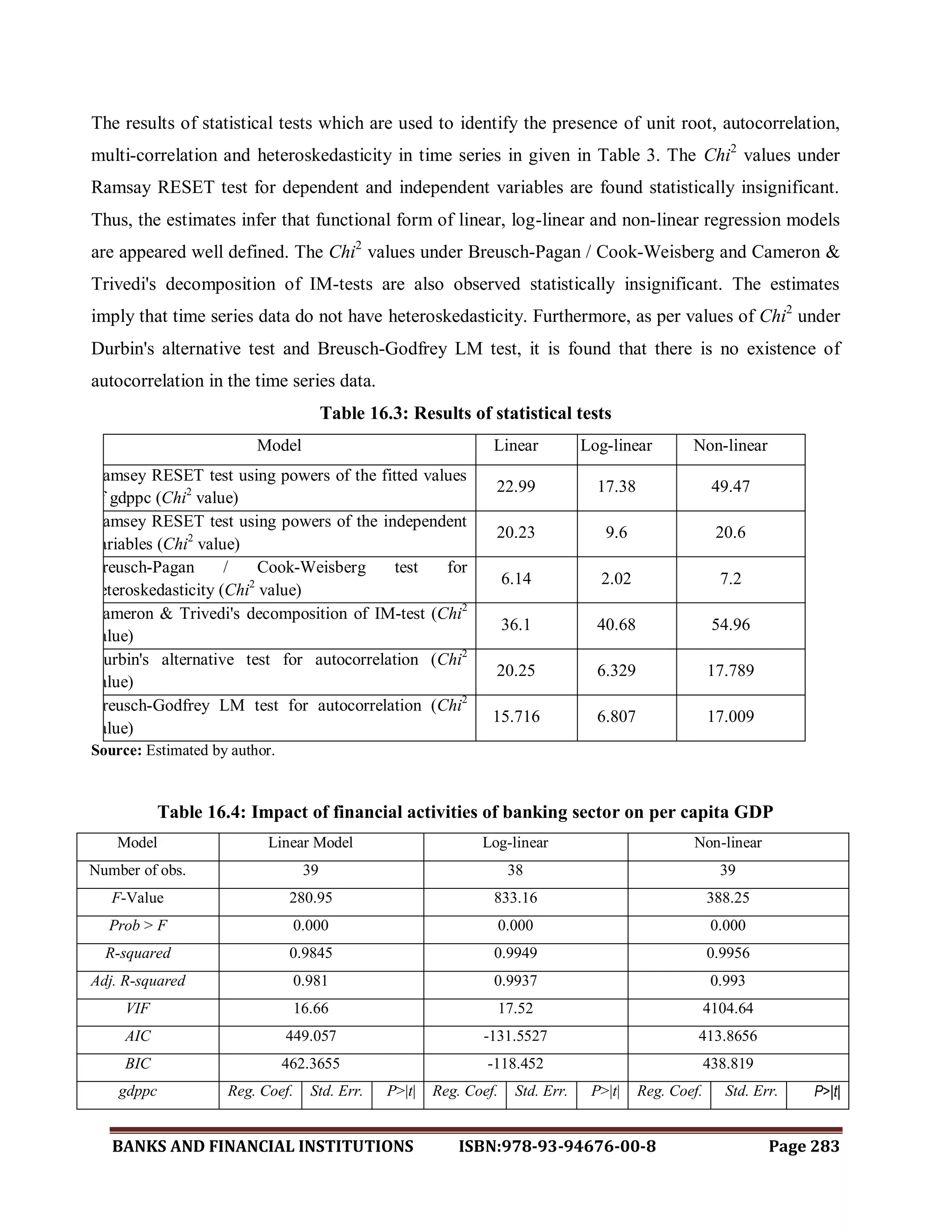
The results of statistical tests which are used to identify the presence of unit root, autocorrelation,
multi-correlation and heteroskedasticity in time series in given in Table 3. The Chi2
values under
Ramsay RESET test for dependent and independent variables are found statistically insignificant.
Thus, the estimates infer that functional form of linear, log-linear and non-linear regression models
are appeared well defined. The Chi2
values under Breusch-Pagan / Cook-Weisberg and Cameron &
Trivedi's decomposition of IM-tests are also observed statistically insignificant. The estimates
imply that time series data do not have heteroskedasticity. Furthermore, as per values of Chi2
under
Durbin's alternative test and Breusch-Godfrey LM test, it is found that there is no existence of
autocorrelation in the time series data.
Table 16.3: Results of statistical tests
Model Linear Log-linear Non-linear
Ramsey RESET test using powers of the fitted values
of gdppc (Chi2
value)
22.99 17.38 49.47
Ramsey RESET test using powers of the independent
variables (Chi2
value)
20.23 9.6 20.6
Breusch-Pagan / Cook-Weisberg test for
heteroskedasticity (Chi2
value)
6.14 2.02 7.2
Cameron & Trivedi's decomposition of IM-test (Chi2
value)
36.1 40.68 54.96
Durbin's alternative test for autocorrelation (Chi2
value)
20.25 6.329 17.789
Breusch-Godfrey LM test for autocorrelation (Chi2
value)
15.716 6.807 17.009
Source: Estimated by author.
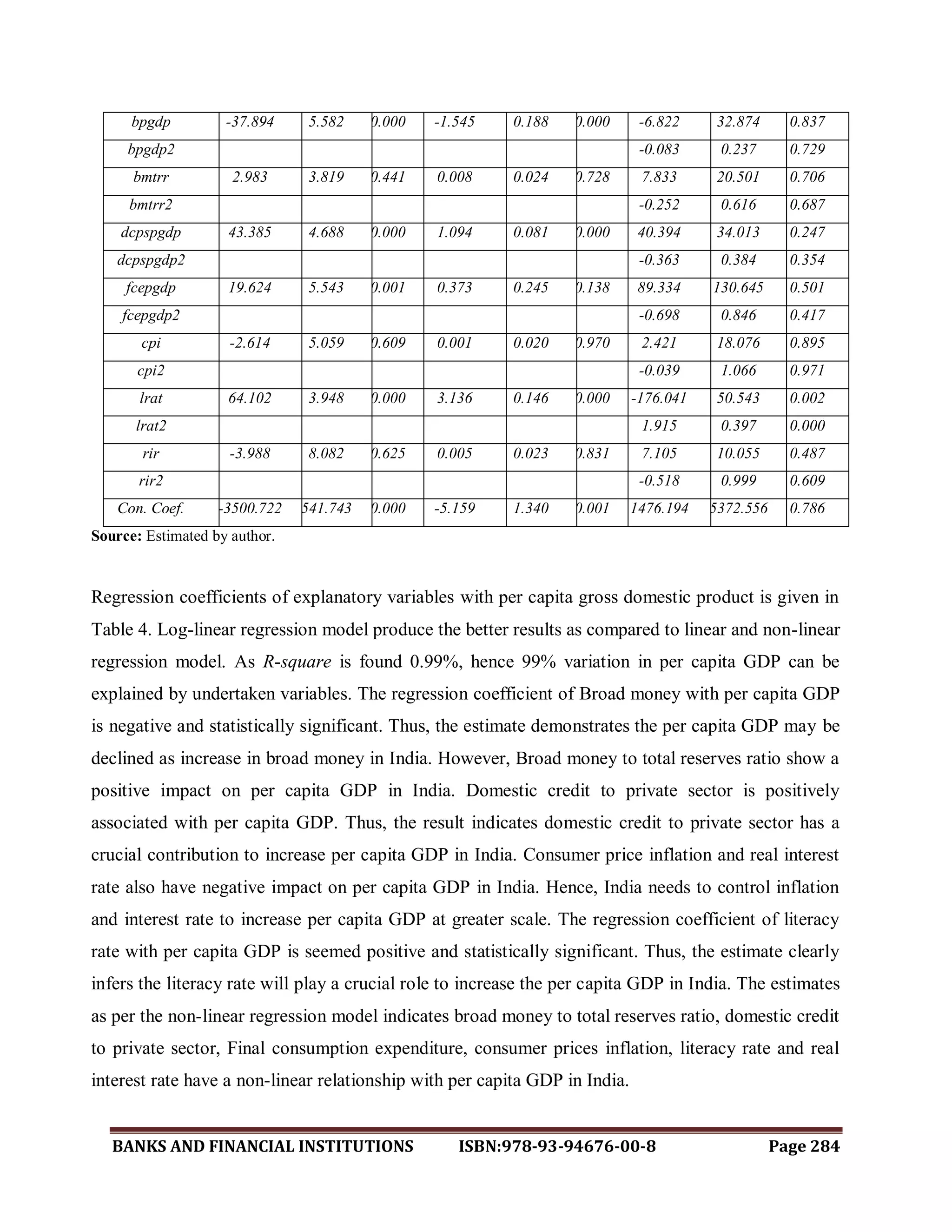
Table 16.4: Impact of financial activities of banking sector on per capita GDP
Model Linear Model Log-linear Non-linear
Number of obs. 39 38 39
F-Value 280.95 833.16 388.25
Prob > F 0.000 0.000 0.000
R-squared 0.9845 0.9949 0.9956
Adj. R-squared 0.981 0.9937 0.993
VIF 16.66 17.52 4104.64
AIC 449.057 -131.5527 413.8656
BIC 462.3655 -118.452 438.819
gdppc Reg. Coef. Std. Err. P>|t| Reg. Coef. Std. Err. P>|t| Reg. Coef. Std. Err. P>|t|
BANKS AND FINANCIAL INSTITUTIONS ISBN:978-93-94676-00-8 Page 284
bpgdp -37.894 5.582 0.000 -1.545 0.188 0.000 -6.822 32.874 0.837
bpgdp2 -0.083 0.237 0.729
bmtrr 2.983 3.819 0.441 0.008 0.024 0.728 7.833 20.501 0.706
bmtrr2 -0.252 0.616 0.687
dcpspgdp 43.385 4.688 0.000 1.094 0.081 0.000 40.394 34.013 0.247
dcpspgdp2 -0.363 0.384 0.354
fcepgdp 19.624 5.543 0.001 0.373 0.245 0.138 89.334 130.645 0.501
fcepgdp2 -0.698 0.846 0.417
cpi -2.614 5.059 0.609 0.001 0.020 0.970 2.421 18.076 0.895
cpi2 -0.039 1.066 0.971
lrat 64.102 3.948 0.000 3.136 0.146 0.000 -176.041 50.543 0.002
lrat2 1.915 0.397 0.000
rir -3.988 8.082 0.625 0.005 0.023 0.831 7.105 10.055 0.487
rir2 -0.518 0.999 0.609
Con. Coef. -3500.722 541.743 0.000 -5.159 1.340 0.001 1476.194 5372.556 0.786
Source: Estimated by author.
Regression coefficients of explanatory variables with per capita gross domestic product is given in
Table 4. Log-linear regression model produce the better results as compared to linear and non-linear
regression model. As R-square is found 0.99%, hence 99% variation in per capita GDP can be
explained by undertaken variables. The regression coefficient of Broad money with per capita GDP
is negative and statistically significant. Thus, the estimate demonstrates the per capita GDP may be
declined as increase in broad money in India. However, Broad money to total reserves ratio show a
positive impact on per capita GDP in India. Domestic credit to private sector is positively
associated with per capita GDP. Thus, the result indicates domestic credit to private sector has a
crucial contribution to increase per capita GDP in India. Consumer price inflation and real interest
rate also have negative impact on per capita GDP in India. Hence, India needs to control inflation
and interest rate to increase per capita GDP at greater scale. The regression coefficient of literacy
rate with per capita GDP is seemed positive and statistically significant. Thus, the estimate clearly
infers the literacy rate will play a crucial role to increase the per capita GDP in India. The estimates
as per the non-linear regression model indicates broad money to total reserves ratio, domestic credit
to private sector, Final consumption expenditure, consumer prices inflation, literacy rate and real
interest rate have a non-linear relationship with per capita GDP in India.
BANKS AND FINANCIAL INSTITUTIONS ISBN:978-93-94676-00-8 Page 285
16.5 CONCLUSION AND POLICY SUGGESTIONS
The prime aim of this study is to examine the impact of banking sector on economic development
in India based on existing studies. Thereupon, it assesses the impact of financial activities of
banking sector on economic development using empirical analysis. For this investigation, it used
per capita GDP as dependent variable, and broad money as a % of GDP, broad money to total
reserves ratio, domestic credit to private sector as a % of GDP, final consumption expenditure as a
% of GDP, annual consumer prices inflation, literacy rate and real interest rate as independent
variables in a time series of 1981-2019.
The regression coefficient of explanatory variables with per capita GDP is estimated through linear,
log-linear and non-linear regression models. The results shows that broad money to reserve ratio
and Domestic credit to private sector have a positive impact on per capita GDP. Domestic
consumption expenditure is also showed a positive impact on per capita GDP. Real interest rate and
consumer price inflation have a negative impact on per capita GDP. Hence, it is suggested that
India needs to control interest rate and consumer price inflation to increase the demand of goods
and service in domestic market. It would be useful to create employment opportunities and
accordingly per capita GDP in India. Literacy rate is also an important driver to increase the per
capita GDP. As literate person has a greater possibility to be engaged in economic activities as
compared to illiterate person. Hence, India requires to create skills among the people to get more
jobs in India. Subsequently, it would be conducive to increase per capita GDP in India. The
empirical results based on non-linear regression model show that broad money to total reserves
ratio, domestic credit to private sector, final consumption expenditure, consumer prices inflation,
literacy rate and real interest rate have a non-linear association with per capita GDP. Furthermore,
some variables have hilly and U-shaped association with per capita GDP in India.
REFERENCES
1. BHADRAPPA HARALAYYA , P.S.AITHAL , PERFORMANCE AFFECTING FACTORS OF INDIAN
BANKING SECTOR: AN EMPIRICAL ANALYSIS, George Washington International Law Review, Vol.- 07
Issue -01, April-June 2021, PAGE No : 607-621.
2. BHADRAPPA HARALAYYA , P.S.AITHAL , TECHNICAL EFFICIENCY AFFECTING FACTORS IN
BANKS AND FINANCIAL INSTITUTIONS ISBN:978-93-94676-00-8 Page 286
INDIAN BANKING SECTOR: AN EMPIRICAL ANALYSIS, Turkish Online Journal of Qualitative Inquiry
(TOJQI), Vol.- 12 Issue -03, June 2021, PAGE No : 603-620,
3. BHADRAPPA HARALAYYA , P.S.AITHAL , IMPLICATIONS OF BANKING SECTOR ON ECONOMIC
DEVELOPMENT IN INDIA, George Washington International Law Review, Vol.- 07 Issue -01, April-June
2021, PAGE No : 631-642
4. BHADRAPPA HARALAYYA , P.S.AITHAL ,STUDY ON PRODUCTIVE EFFICIENCY OF BANKS IN
DEVELOPING COUNTRY, International Research Journal of Humanities and Interdisciplinary Studies
(www.irjhis.com) ,Volume: 2, Issue: 5, May 2021, Page No : 184-194.
5. Bhadrappa Haralayya ; P. S. Aithal . "Study on Model and Camel Analysis of Banking" Iconic Research And
Engineering Journals ,Volume 4 ,Issue 11 ,May 2021 Page 244-259.
6. Bhadrappa Haralayya and Aithal, P. S.. “Analysis of cost efficiency on scheduled commercial banks in India”.
International Journal of Current Research, Volume 13, Issue 06, June 2021, pp 17718-17725
7. Bhadrappa Haralayya and P. S. Aithal, “A Study On Structure and Growth of Banking Industry in
India”, International Journal of Research in Engineering, Science and Management ,Volume 4, Issue 5, May
2021.Page no 225–230.
8. Bhadrappa Haralayya, Retail Banking Trends in India ,International Journal of All Research Education and
Scientific Methods (IJARESM), Volume: 9, Issue: 5, Year: May 2021, Page No : 3730-3732.
9. BHADRAPPA HARALAYYA, P.S.AITHAL, FACTORS DETERMINING THE EFFICIENCY IN INDIAN
BANKING SECTOR : A TOBIT REGRESSION ANALYSIS", International Journal of Science & Engineering
Development Research (www.ijsdr.org), Vol.6, Issue 6, June-2021, page no.1 - 6, ,
10. BHADRAPPA HARALAYYA , P.S.AITHAL , IMPLICATIONS OF BANKING SECTOR ON
ECONOMIC DEVELOPMENT IN INDIA, flusserstudies, Volume 30, June 2021,Page No:1068-1080,
11. BHADRAPPA HARALAYYA, P.S.AITHAL, STUDY ON PRODUCTIVE EFFICIENCY OF FINANCIAL
INSTITUTIONS, International Journal of Innovative Research in Technology, Volume 8, Issue 1, June-2021
,Page no: 159 – 164,
12. BHADRAPPA HARALAYYA , STUDY OF BANKING SERVICES PROVIDED BY BANKS IN
INDIA, International Research Journal of Humanities and Interdisciplinary Studies (www.irjhis.com), Volume:
2, Issue: 6, Year: June 2021,Page No : 06-12,
13. BHADRAPPA HARALAYYA, P.S.AITHAL , ANALYSIS OF BANK PERFORMANCE USING CAMEL
APPROACH", International Journal of Emerging Technologies and Innovative Research (www.jetir.org | UGC
and issn Approved), Vol.8, Issue 5, May-2021, page no 305-314,
14. BHADRAPPA HARALAYYA, P.S.AITHAL, ANALYSIS OF BANK PRODUCTIVITY USING PANEL
CAUSALITY TEST, Journal of Huazhong University of Science and Technology, Volume 50, Issue 6, June-
2021 , Page no: 1 – 16,
BANKS AND FINANCIAL INSTITUTIONS ISBN:978-93-94676-00-8 Page 287
15. BHADRAPPA HARALAYYA, P.S.AITHAL, INTER BANK ANALYSIS OF COST EFFICIENCY USING
MEAN, International Journal of Innovative Research in Science, Engineering and Technology (IJIRSET),
Volume 10, Issue 6, June-2021 ,Page no: 6391-6397,
16. BHADRAPPA HARALAYYA, P.S.AITHAL , ANALYSIS OF TOTAL FACTOR PRODUCTIVITYAND
PROFITABILITY MATRIX OF BANKS BY HMTFP AND FPTFP, Science, Technology and Development
Journal, Volume 10, Issue 6, June-2021, Page no: 190-203, Available at: http://journalstd.com/gallery/23-
june2021.pdf
17. BHADRAPPA HARALAYYA, P.S.AITHAL , ANALYSIS OF BANKS TOTAL FACTOR
PRODUCTIVITY BY AGGREGATE LEVEL, Journal of Xi'an University of Architecture & Technology,
Volume 13, Issue 6, June- 2021 ,Page no: 296-314,
18. Bhadrappa Haralayya, P S Aithal, "ANALYSIS OF BANKS TOTAL FACTOR PRODUCTIVITY BY
DISAGGREGATE LEVEL", International Journal of Creative Research Thoughts (IJCRT), Volume.9, Issue 6,
June 2021, pp.b488-b502,
19. Haralayya B. Importance of CRM in Banking and Financial Sectors Journal of Advanced Research in Quality
Control and Management 2021, 6(1): 8-9
20. Haralayya B. How Digital Banking has Brought Innovative Products and Services to India. Journal of
Advanced Research in Quality Control and Management 2021; 6(1): 16-18
21. Haralayya B. Top 5 Priorities That will Shape The Future of Retail Banking Industry in India. Journal of
Advanced Research in HR and Organizational Management 2021; 8(1&2): 17-18.
22. Haralayya B. Millennials and Mobile-Savvy Consumers are Driving a Huge Shift in The Retail Banking
Industry. Journal of Advanced Research in Operational and Marketing Management 2021; 4(1): 17-19
23. Haralayya B. Core Banking Technology and Its Top 6 Implementation Challenges. Journal of Advanced
Research in Operational and Marketing Management 2021; 4(1): 25-27
24. Nitesh S Vibhute ; Dr. Chandrakant B. Jewargi ; Dr. Bhadrappa Haralayya . "Study on Non-Performing
Assets of Public Sector Banks" Iconic Research And Engineering Journals Volume 4, Issue, 12 June 2021, Page
52-61
25. Haralayya, Dr. Bhadrappa and Saini, Shrawan Kumar, An Overview on Productive Efficiency of Banks &
Financial Institution (2018). International Journal of Research, Volume 05 Issue 12, April 2018.
26. Haralayya, Dr. Bhadrappa, Review on the Productive Efficiency of Banks in Developing Country (2018).
Journal for Studies in Management and Planning, Volume 04 Issue 05, April 2018,
27. Haralayya, Dr. Bhadrappa, The Productive Efficiency of Banks in Developing Country With Special
Reference to Banks & Financial Institution (april 30, 2019).
28. Haralayya, Dr. Bhadrappa, Study on Performance of Foreign Banks in India (APRIL 2, 2016).
29. Haralayya, Dr. Bhadrappa, E-Finance and the Financial Services Industry (MARCH 28, 2014).
BANKS AND FINANCIAL INSTITUTIONS ISBN:978-93-94676-00-8 Page 288
30. Haralayya, Dr. Bhadrappa, E-payment - An Overview (MARCH 28, 2014).
31. Bhadrappa Haralayya . "Customer Satisfaction at M/s Sindol Bajaj Bidar" Iconic Research And Engineering
Journals, Volume 4 ,Issue 12, June 2021, Page 157-169
32. Bhadrappa Haralayya . "Ratio Analysis at NSSK, Bidar" Iconic Research And Engineering Journals, Volume
4, Issue 12,June 2021, Page 170-182
33. Bhadrappa Haralayya . "Financial Statement Analysis of Shri Ram City Union Finance" Iconic Research And
Engineering Journals, Volume 4, Issue 12,June 2021, Page 183-196
34. Bhadrappa Haralayya . "Employee Job Satisfaction at Big Bazaar" Iconic Research And Engineering
Journals, Volume 4, Issue 12, June 2021, Page 197-206
35. Bhadrappa Haralayya . "Effect of Branding on Consumer Buying Behaviour at Vijay Bharat Motors Pvt Ltd,
Bidar" Iconic Research And Engineering Journals, Volume 4, Issue 12, June 2021, Page 207-222
36. Bhadrappa Haralayya . "Study on Customer Perceptions Guru Basava Motors, Bidar" Iconic Research And
Engineering Journals, Volume 4, Issue 12,June 2021, Page 223-231
37. Bhadrappa Haralayya . "Study on Loans and Advances for DCC Bank Main Branch Nayakaman, Bidar"
Iconic Research And Engineering Journals, Volume 4, Issue 12, June 2021, Page 232-242
38. Bhadrappa Haralayya . "Work Life Balance of Employees at Karanja Industries Pvt Ltd, Bidar" Iconic
Research And Engineering Journals, Volume 4, Issue 12, June 2021, Page 243-254
39. Bhadrappa Haralayya . "Working Capital Management at TVS Motors, Bidar" Iconic Research And
Engineering Journals, Volume 4, Issue 12, June 2021, Page 255-265
40. Haralayya, Dr. Bhadrappa, Testing Weak Form Efficiency of Indian Stock Market – An Empirical Study on
NSE (April 30, 2021). Emerging Global Strategies for Indian Industry (ISBN: 978-81-910118-7-6), 2021,
41. Bhadrappa Haralayya . "Advertising Effectiveness With Reference to Big Bazaar" Iconic Research And
Engineering Journals, Volume 5, Issue 1, July 2021, Page 101-110
42. Bhadrappa Haralayya . "Analysis of Non Performing Asset on Urban Cooperative Bank in India" Iconic
Research And Engineering Journals, Volume 5, Issue 1,July 2021, Page 111-121
43. Bhadrappa Haralayya . "Ration Analysis With Reference to DCC Bank" Iconic Research And Engineering
Journals, Volume 5, Issue 1, July 2021, Page 122-130
44. Bhadrappa Haralayya . "Consumer Buying Behavior With Reference to Bajaj Auto Ltd" Iconic Research And
Engineering Journals, Volume 5, Issue 1, July 2021, Page 131-140
45. Bhadrappa Haralayya . "Sales Promotion With Reference to Yamaha Motor" Iconic Research And
Engineering Journals, Volume 5, Issue 1, July 2021, Page 141-149
46. Bhadrappa Haralayya . "Financial Statement Analysis Using Common Size on Mahindra Sindol Motors"
Iconic Research And Engineering Journals, Volume 5, Issue 1, July 2021 , Page 150-159
47. Bhadrappa Haralayya . "Loans And Advances with Reference to PKGB Bank" Iconic Research And
BANKS AND FINANCIAL INSTITUTIONS ISBN:978-93-94676-00-8 Page 289
Engineering Journals, Volume 5, Issue 1, July 2021, Page 160-170
48. Bhadrappa Haralayya . "Study on Trend Analysis at John Deere" Iconic Research And Engineering Journals,
Volume 5, Issue 1, July 2021, Page 171-181
49. Haralayya B, Aithal PS. Study on Cost Efficiency in Indian and Other Countries Experience. Journal of
Advanced Research in HR and Organizational Management 2021; 8(1&2): 23-30.
50. Haralayya B, Aithal PS. Study on Theoretical Foundations of Bank Efficiency. . Journal of Advanced
Research in Operational and Marketing Management 2021; 4(2): 12-23.
51. Haralayya B, Aithal PS. Study on Profitability Efficiency in Indian and Other Countries Experience. Journal
of Advanced Research in Quality Control and Management 2021; 6(2): 1-10.
52. S. Vinoth, Hari Leela Vemula, Bhadrappa Haralayya, Pradeep Mamgain, Mohammed Faez Hasan, Mohd
Naved, Application of cloud computing in banking and e-commerce and related security threats, Materials
Today: Proceedings, 2021,ISSN 2214-7853,
https://doi.org/10.1016/j.matpr.2021.11.121.(https://www.sciencedirect.com/science/article/pii/S2214785321071
285).
53. Haralayya B, Jeelan BV, Vibhute NS. Capital Structure and Factors Affecting Capital Structure. J Adv Res
Eco Busi Mgmt 2021; 4(2): 4-35.
54. Vibhute NS, Haralayya B, Jeelan BV. Performance Evaluation of Selected Banks using Ratio Analysis. J Adv
Res Eco Busi Mgmt 2021; 4(2): 36-44
55. Jeelan BV, Haralayya B, Vibhute NS. A Study on Empirical Analysis of Relationship between FPI and
NIFTY Returns. J Adv Res Acct Fin Mgmt 2021; 3(2): 3-22
56. Jeelan BV, Haralayya B, Vibhute NS. A Study on Performance Evaluation of Initial Public Offering (IPO). J
Adv Res Pub Poli Admn 2021; 3(2): 12-26.
57. Basha VJ, Haralayya B, Vibhute NS. Analysis of Segment Reporting with Reference to Selected Software
Companies. J Adv Res Entrep Innov SMES Mgmt 2021; 4(2): 9-26.
58. Jeelan BV, Haralayya B, Vibhute NS. Co-Movement and Integration among Stock Markets: A Study of 10
Countries. J Adv Res Acct Fin Mgmt 2021; 3(2): 23-38.
59. Jeelan BV, Haralayya B, Vibhute NS. A Comparative Study on Selected Foreign Currencies. J Adv Res Eco
Busi Mgmt 2021; 4(2): 45-5
60. Bhadrappa Haralayya . "A Study on Customer Satisfaction at TVS Vanish Motors Bidar" Iconic Research
And Engineering Journals Volume 5 Issue 9 2022 Page 117-127
61. Bhadrappa Haralayya . "Consumer Buying Behavior at Kailash Motors Bidar" Iconic Research And
Engineering Journals Volume 5 Issue 9 2022 Page 128-137
62. Bhadrappa Haralayya . "Credit Risk of Canara Bank Bidar" Iconic Research And Engineering Journals
Volume 5 Issue 9 2022 Page 138-149
BANKS AND FINANCIAL INSTITUTIONS ISBN:978-93-94676-00-8 Page 290
63. Bhadrappa Haralayya . "Effect of Branding on Consumer Buying Behaviour in Bharat Ford Bidar" Iconic
Research And Engineering Journals Volume 5 Issue 9 2022 Page 150-159
64. Bhadrappa Haralayya . "Employee Engagement at Kharanja Industry Pvt Ltd Humanbad" Iconic Research
And Engineering Journals Volume 5 Issue 9 2022 Page 160-170
65. Bhadrappa Haralayya . "Employee Performance Appraisal at Sri Veerabhadreshwar Motors Bidar" Iconic
Research And Engineering Journals Volume 5 Issue 9 2022 Page 171-183
66. Bhadrappa Haralayya . "Employees Traning and Development at Mgssk Ltd Bhalki" Iconic Research And
Engineering Journals Volume 5 Issue 9 2022 Page 184-196
67. Bhadrappa Haralayya . "Impact of Financial Statement Analysis on Financial Performance in Lahoti Motors
Bidar" Iconic Research And Engineering Journals Volume 5 Issue 9 2022 Page 197-206
68. Bhadrappa Haralayya . "Impact of Ratio Analysis on Financial Performance in Royal Enfield (Bhavani
Motors) Bidar" Iconic Research And Engineering Journals Volume 5 Issue 9 2022 Page 207-222
69. Bhadrappa Haralayya . "Sales Promotion at Keshva Enterprise Bidar" Iconic Research And Engineering
Journals Volume 5 Issue 9 2022 Page 223-232
70. Bhadrappa Haralayya . "The Impact of Safety and Health Measures of Employees at KJD Pharma Bidar"
Iconic Research And Engineering Journals Volume 5 Issue 9 2022 Page 233-242
71. Bhadrappa Haralayya . "Comparative Analysis of Mutual Funds in Geojit Financial Services Ltd Gulbarga"
Iconic Research And Engineering Journals Volume 5 Issue 9 2022 Page 243-251
72. Bhadrappa Haralayya . "Cost Analysis at MGSSK Bhalki" Iconic Research And Engineering Journals
Volume 5 Issue 9 2022 Page 252-258
73. Bhadrappa Haralayya . "Employee Compensation Management at Vani Organic Pvt Ltd Bidar" Iconic
Research And Engineering Journals Volume 5 Issue 9 2022 Page 259-266
74. Bhadrappa Haralayya . "Employees Performance Appraisal of Chettinad Cement Gulbarga" Iconic Research
And Engineering Journals Volume 5 Issue 9 2022 Page 267-277
75. Bhadrappa Haralayya . "Ratio Analysis in Muthoot Finance Ltd Aurad" Iconic Research And Engineering
Journals Volume 5 Issue 9 2022 Page 278-284
76. Bhadrappa Haralayya . "Study on Promotion Mix Strategy Towards Big Bazaar Bidar" Iconic Research And
Engineering Journals Volume 5 Issue 9 2022 Page 285-291
77. Bhadrappa Haralayya . "Study on Sales Promotion Techniques Used by VKG Bajaj at Kalaburagi" Iconic
Research And Engineering Journals Volume 5 Issue 9 2022 Page 292-298
78. Bhadrappa Haralayya . "Working Capital Management in Hyundai Showroom Bidar" Iconic Research And
Engineering Journals Volume 5 Issue 9 2022 Page 299-308
79. Bhadrappa Haralayya "Study on Performance Evaluation of Mutual Funds" Iconic Research And Engineering
Journals Volume 5 Issue 10 2022 Page 29-36
BANKS AND FINANCIAL INSTITUTIONS ISBN:978-93-94676-00-8 Page 291
80. Bhadrappa Haralayya . "The Performance of Mutual Fund Schemes in The Framework of Risk and Return"
Iconic Research And Engineering Journals Volume 5 Issue 10 2022 Page 37-44
81. Bhadrappa Haralayya . "Risk And Return Analysis of Mutual Funds with Reference to Banks" Iconic
Research And Engineering Journals Volume 5 Issue 10 2022 Page 45-55
82. Bhadrappa Haralayya . "Comparative Study on Performance Evaluation of Mutual Funds with Reference to
Banking Funds" Iconic Research And Engineering Journals Volume 5 Issue 10 2022 Page 56-64

CHAPTER 16.pdf

  • 1.
    BANKS AND FINANCIALINSTITUTIONS ISBN:978-93-94676-00-8 Page 274 CHAPTER-16 IMPLICATIONS OF BANKS ON ECONOMIC DEVELOPMENT IN INDIA 1.Bhadrappa Haralayya Post Doctoral Fellowship Research Scholar, Srinivas University, Mangalore, India. bhadrappabhavimani@gmail.com Orcid id-0000-0003-3214-7261 2.P. S. Aithal, Professor, College of Management and Commerce, Srinivas University, Mangalore, India. psaithal@gmail.com Orcid id-0000-0002-4691-8736 ABSTRACT Banking sector provides several facilities in a country. Financial activities of banking sector are crucial drivers to increase the socio-economic development. Subsequently, economic development increase as increase in efficiency of banking sector in a nation. Existing researchers used different indicators of banking sector to examine their impact on economic growth in developed and developing economies. In India, limited studies could examine the impact of banking sector on economic development. Therefore, this study assesses the impact of banking sector on per capita gross domestic product (GDP) in India using a time series data during 1981-2019. It used per capita GDP as dependent variable, and broad money as a % of GDP, broad money to total reserves ratio, domestic credit to private sector as a % of GDP, final consumption expenditure as a % of GDP, annual consumer prices inflation, literacy rate and real interest rate as independent variables. It applied linear, log-linear and non-linear regression models to estimate the regression coefficient of aforesaid variables with per capita GDP. The empirical results claimed that broad money to total reserve ratio, domestic credit to private sector, final consumption expenditure and literacy rate have positive impact on per capita GDP. Consumer price inflation and real interest rate have negative impact on per capita GDP in India. India needs to control high inflation and real interest rate to increase the demand of goods and services to strengthen the economic development. The estimates of the study clearly indicate that financial activities of banking sector play a vital contribution to increase economic development in India.
  • 2.
    BANKS AND FINANCIALINSTITUTIONS ISBN:978-93-94676-00-8 Page 275 Keywords: Economic growth; Economic development; Per capita gross domestic product; banking sector; India. 16.1 INTRODUCTION Financial institutions have a significant contribution to increase the socio-economic development of the people in several ways (Joshi, 2017). Furthermore, economic development depends upon efficient financial institutions of a nation (Sharma et al., 2012). Hence, financial development is useful to increase demand of goods and service, thus it plays an effective role to sustain the economic growth of a nation (Liang and Reichert, 2006). Banking is a financial organization which act as intermediary between lenders and creditors (Ruslan et al., 2018; Jha, 2020). Banking sector is useful to convert deposits into productive investment, creating new capital and accelerate economic development (Tanwar et al., 2020). It is also conceptually proved the overall growth of an economy is significantly associated with the appropriate health of banking sector (Hafsal et al., 2020). Therefore, banking sector performs several activities such as accepting deposits from individual and business community and provide loans to the common people and business community (Kumari, 2017; Muniswamy, 2018). As banking sector accepts the small saving of common citizen and provide loans to the common people for various purposes. Furthermore, the banking institutions motivates people to deposit their small saving in banks. The banking institution also provides the short-term, medium-term and long-term loans to the business community in all sectors. Most importantly, it provides the direct financial support to the business community and farming community. Accordingly, it creates the employment opportunities in industry and agricultural sectors. Subsequently, demand of goods and services are expected to be increase as increase in the role of banking sector in an economy. Hence, banking institution is helpful to maintain the money flow and contribute to create physical assets in the economy. Banking sector is also effective to operate efficiency, provide sustainability in financial system and increase equitable economic growth through providing easy, safe and financing to the public (Ruslan et al., 2018). Furthermore, it also prepares the path for capital formation in a country. Consequently, banking sector have a crucial contribution towards economic development of a nation (Muniswamy, 2018; Kumar, 2019; Deb, 2019). Hamid et al. (2017) have argued the banking sector play important role to maintain economic development an economy. Kumar (2019) highlighted the banking sector play a significant role to sustain the economic stability of a nation. Bhatia and Mahendru (2015) have
  • 3.
    BANKS AND FINANCIALINSTITUTIONS ISBN:978-93-94676-00-8 Page 276 argued that efficient banking system contribute towards economic development. Efficient efficiency of banking sector is helpful to increases the mobilization of saving and deposits funds to increase economic growth (Karimzadeh, 2012). Rajan and Zingales (1998) claimed the efficient banking sector works as important driver to strengthen the economic growth through mobilization of financial saving and use these saving to create physical assets. In India, banking system was established in 18th century and General Bank of India was founded in 1786 (Kumari, 2017). State Bank of India is an oldest bank which was setup in India in 1806 (Kumari, 2017; Muniswamy, 2018). The Reserve Bank of India (RBI) was nationalized on 01 April, 1935 (Kumari, 2017; Jha, 2020). In India, 14 commercial banks were nationalized and 4 other banks were also merged with other public sector banks (Jha, 2020). In India, the RBI govern and regulate the banking system. Indian banking sector can be divided in two broad categories i.e., scheduled and non-scheduled banks. All cooperative or commercial banks which are listed under 2nd schedule of the RBI Act, 1934 known as scheduled banks in India (Jha, 2020). Cooperative banks are registered under the Society Registration Act (Jha, 2020). Thereupon, commercial banks can be divided in four categorized i.e., public sector banks, private sector banks, foreign banks and regional rural banks (Jha, 2020). Public sector banks are the undertaking enterprises of Government of India. There are 12 public sector banks in India. Recently, Government of India has merged many public sector banks in order to strengthen their balance sheets (Jha, 2020). Private sector banks are privately held by individuals. There are many private banks such as ICICI banks, Axis Banks etc. have the private ownership of such types of banks in India (Jha, 2020). Foreign banks are registered in India as banks as per the requisite banking license from the RBI in India. The Government of India is established regional rural bank in order to increase the use of banking system by grass root level in rural area (Jha, 2020). Furthermore, there are small finance and payment banks in India. Small finance banks are available in those areas where banks cannot reach for local people (Jha, 2020). Payment banks facilitate payments and remittances related activities in India (Jha, 2020). As banking sector provided the financial support in economic disaster in Indian economy in different time spans (Sharma et al., 2012). Indian banking sector is financially stable and has the ability to resilient in phase of economic crisis (Sharma et al., 2012). Also, Thus, banking sector is
  • 4.
    BANKS AND FINANCIALINSTITUTIONS ISBN:978-93-94676-00-8 Page 277 the backbone of Indian economy due to several reasons. In India, banking sector includes public sector, private sector and foreign sector banks. While, public sector bank has control around 80% of the market (Kumari, 2017). Indian banking sector has 7.7% contribution in India‟s GDP (Singh and Malik, 2018). Thus, banking sector has a vital contribution economic development in India (Kumari, 2017). The commercial bank‟s credit as a percent of GDP increased from 23.6% in 2001 to 53% in 2015 (Ranajee, 2018). However, Indian banking sector is facing problem due to rising non-performing assets (NPAs) (Goyal et al., 2019). There are some other financial activities in banking sector which has positive and significant impact on economic growth and development. In this regards, in India, several studied have provided that the banking sector have a positive impact on economic development (Muniswamy, 2018; Tanwar et al., 2020). However, limited studied could provide the association of financial performance of banking sector with economic growth at national level in India. Furthermore, there are many research questions must be addressed by the exiting researchers which are given as:  What types of services are providing by banking sector in India?  What is role of banking sector in Indian economy in general?  How financial activities of banking sector have a significant impact on economic development in India?  What are the linkages of banking sector with economic development in India? With regards to aforementioned research questions, the present study achieved following objectives:  To examine the impact of banking sector on economic development in India based on existing studies.  To assess the impact of financial activities of banking sector on economic development in India. 16.2 REVIEW OF LITERATURE 16.2.1 Banking Sector and Economic Development There are several ways in which banking sector promote economic growth and economic development. This section provides the role of banking sector in different activities of a nation.
  • 5.
    BANKS AND FINANCIALINSTITUTIONS ISBN:978-93-94676-00-8 Page 278 Banking sectors in conducive to promote saving habits of the people for deposit in the banks for get better and safe return (Muniswamy, 2018). Capital formation works as blood for a nation. As banking sector collect deposits from depositors and provide collected amount to the people, business community, farmers and others as loans to earn profit. Thus, the banking sector is highly effective to create capital formation (Muniswamy, 2018). Banking institutions provides the loans to the business community to set up new industry and venture (Singh et al., 2019; Singh et al., 2020). Financial support from banking sector to small companies is useful to create start-up (Jyoti and Singh, 2020). Therefore, banking sector is useful to increase industrialization and entrepreneurship ecosystem (Singh and Ashraf, 2020; Singh and Jyoti, 2020). Appropriate banking sector is useful to make transfer of money for trade of goods and services through mobile banking, internet banking, debit cards, credit cards and other (Muniswamy, 2018). The growth of Indian economy largely depends upon agricultural sector as the sector meet the food security of Indian. Banking sector provide short-term and long-term loans to the farmers for their farming activities. Subsequently, banking sector promote agricultural production (Kumar et al., 2017; Singh and Jyoti, 2021). As banking sector provide loans to the industry and business community. Therefore, it creates employment opportunities at grater scale (Muniswamy, 2018). Economic development may be adversely affected due to inflation, deflation and crisis. A monetary policy is useful to control inflation, deflation and crisis (Muniswamy, 2018). As monetary policy governs by central bank of nation, hence, banking sector has a significant contribution to maintain financial stability in a country. 16.2.2 Association of Banking Sector and Economic Development At present banking sector in one of the biggest service providers sectors in India (Kumari, 2017). In India, banking sector is providing several services such as credit cards, debit cards, ATM services, telebanking, internet banking, electronic payments, consumer finance, life insurance, mutual fund, pension fund, regulation services, stock broking services (Kumari, 2017; Muniswamy, 2018). Accordingly, banking sector have a vital contribution to increase economic growth. Previous studied have theoretically and empirically proved that banking sector have a positive impact on economic growth. For instance, Muniswamy (2018) assessed the role of banks in capital formation and economic growth in India. Alam et al. (2021) have reported that interest margin and return on assets of banking sector have significant impact on economic growth in India. Al-Homaidi et al.
  • 6.
    BANKS AND FINANCIALINSTITUTIONS ISBN:978-93-94676-00-8 Page 279 (2018) have claimed that commercial banks dominate the financial system and have vital contribution in economic development. However, previous could not find uniform relationship between economic growth and banking sector. Saeed et al. (2018) reported positive bi-directional causality relationship between banking sector and economic growth in Pakistan. Joshi (2017) assessed the relationship between the financial development and growth in India. 16.3 RESEARCH METHODOLOGY 16.3.1 Explanation of Dependent and Independent Variables Previous studies have also used different indicators such as gross domestic product, per capita gross domestic product and growth gross domestic product as a proxy for economic growth, economic development and economic proxy across countries (Liang and Reichert, 2006; Prochniak and Wasiak, 2016; Puatwoe and Piabup, 2017; Joshi, 2017; Al-Homaidi et al., 2018; Singh and Malik, 2018). Liang and Reichert (2006) used aggregate output or real GDP as dependent variable, and capital stock and financial sector development are used as independent variables. Hence, previous studies have used different indicators as proxy for financial or banking sector to examine their impact on economic growth and economic development in different countries. For instance, Prochniak and Wasiak (2016) examined the impact of financial sector on economic growth in 28 EU and 34 OECD countries during 1993 – 2013. This study is used economic growth as dependent variable, and bank non-performing loans, bank capital to assets ratio, market capitalization of listed companies, turnover ratio of stocks traded and monetization ratio as independent variables in regression model. Puatwoe and Piabup (2017) have assessed the implications of financial sector development and economic growth in Cameroon. Al-Homaidi et al. (2018) have considered the gross domestic product, inflation rate, interest rate and exchange rate to analysis banking performance in India. Guru and Yadav (2019) have examined the relationship between financial development and economic growth in BRICS countries. This study is used macroeconomic indicators such as credit to deposit ratio, domestic credit to private sector, inflation, exports and enrolment in secondary education. Al-Homaidi et al. (2018) have used different macroeconomic indicators such as gross domestic product, inflation rate, interest rate, exchange rate and others to assess the macro-economic determinants of profitability of commercial banks in India. Saeed et al. (2018) have considered lending capability, innovation, interest margin and bank investment as
  • 7.
    BANKS AND FINANCIALINSTITUTIONS ISBN:978-93-94676-00-8 Page 280 proxy variables of banking sector to examine their impact on economic growth in Pakistan. Joshi (2017) have used M2 GDP ratio and ratio of stock market capitalization to GDP in India. 16.3.2 Empirical Model As economic development may not be capture by a single variable of nation. Prior studied have used gross domestic product, per capita GDP and growth in gross domestic product as a proxy for economic development in empirical investigation (Singh and Malik, 2018). Therefore, per capita gross domestic product is used as proxy for economic development to assess its association with financial activities of banking sector in India in this study. Joshi (2017) have also used GDP per capita as a proxy for economic growth to assess its relationship with financial development in India. Broad money (% of GDP), domestic credit to private sector (% of GDP) and broad money to total reserves ratio are used to assess the impact of banking sector on per capita GDP in this study. Real interest rate (%) is an important driver to increase the attention of common people and business community to take the loan from banking sector (Al-Homaidi et al., 2018). Hence, it is expected that per capita GDP may decline as increase in real interest rate. Demand of goods and service may decline due to increase in consumer prices inflation (annual %) in a country. Subsequently, it is likely to be predicted that Final consumption expenditure decreases as increase in consumer price inflation. Hence, broad money (% of GDP), broad money to total reserves ratio, domestic credit to private sector (% of GDP), final consumption expenditure (% of GDP), consumer prices inflation (annual %), literacy rate adult total and real interest rate (%) are used as independent variables in this study. This study used time series data for above-mentioned variables during 1981-2019. All data is derived from official website of the World Bank (World Development Indicator). Linear, log-linear and non-linear regression models are used to assess the influence of aforesaid explanatory variables on per capita gross domestic product. Following linear regression model is used: (GDPPC)t = β0 +β1 (BPGDP)t+β2 (BMTRR)t +β3 (DCPSPGDP)t +β4 (FCEPGDP) +β5 (CPI)t +β6 (LRAT)t +β7 (RIR)t + ut (1) Here, t is time period (1981-2019), β0 is constant term; β1, β2, …, β7 are the regression coefficient of associated explanatory variables; and ut is the error term in equation (1). The explanation of variables is given in Table 1.
  • 8.
    BANKS AND FINANCIALINSTITUTIONS ISBN:978-93-94676-00-8 Page 281 Table 16.1: List of dependent and independent variables Variable Symbol Unit Source of Data GDP per capita (constant 2010 US$) GDPPC US $ World Development Indicator (World Bank) Broad money (% of GDP) BPGDP Number Broad money to total reserves ratio BMTRR % Domestic credit to private sector (% of GDP) DCPSPGDP % Final consumption expenditure (% of GDP) FCEPGDP % Consumer prices inflation (annual %) CPI % Literacy rate adult total (% of people ages 15 and above)LRAT % Real interest rate (%) RIR % Log-linear regression model is used in following form: ln(GDPPC)t = α0 +α1 ln(BPGDP)t+α2 ln(BMTRR)t +α3 ln(DCPSPGDP)t +α4 ln(FCEPGDP) +α5 ln(CPI)t +α6 ln(LRAT)t +α7 ln(RIR)t + θt (2) Here, ln is natural logarithm of corresponding variables, α0 is constant term; α1, α2, …, α7 are the regression coefficient of associated explanatory variables; and θt is the error term in equation (2). Original and square term of all explanatory variables are considered in non-linear regression model. Non-linear regression model is used in following form: (GDPPC)t = λ0 +λ1 (BPGDP)t+λ2 (Sq. BPGDP)t +λ3 (BMTRR)t +λ4 (Sq. BMTRR)t +λ5 (DCPSPGDP)t +λ6 (Sq. DCPSPGDP)t +λ7 (FCEPGDP)t +λ8 (FCEPGDP)t +λ9 (CPI)t +λ10 (CPI)t +λ11 (LRAT)t +λ12 (LRAT)t +λ13 (RIR)t +λ14 (RIR)t + µt (3) Here, Sq. is square term of respective variables; λ0 is constant term; λ1, λ2, …, λ7 are the regression coefficient of associated explanatory variables; and µt is the error term in equation (3). 16.3.3 Process to Select an Appropriate Model As this study is used a time series data of dependent and independent variables during 1981-2019. Therefore, it is necessary to check the normality, stationarity, unit root, autocorrelation, multi- correlation and heteroskedasticity in the time series data. Accordingly, skewness and kurtosis
  • 9.
    BANKS AND FINANCIALINSTITUTIONS ISBN:978-93-94676-00-8 Page 282 values of each variable is estimated the check the normality of the data (Singh and Jyoti, 2021). The existence of unit root in each variable of time series data is check through Augmented Dickey- Fuller (ADF) unit root test (Singh, 2017). Most variables are found stationarity in nature. Multi- correlation shows the linear relationship among the explanatory variables (Singh, 2017). Hence, the existence of multi-correlation is identified through variance inflation factor (VIF). Presence of autocorrelation is a prime problem of time series data (Singh, 2017). Therefore, Durbin-Watson d- statistics and Durbin‟s Alternative test is used to check the presence of autocorrelation in time series data. Cameron and Trivedi decomposition of IM-test, and Breusch-Pagan/Cook-Weisberg test are considered to identify the presence of heteroskedasticity in the time series data (Singh, 2017). Since, this study is used linear, log-linear and non-linear regression models, thus, Ramsay RESET test is used to check the well-defined function form of empirical model (Singh, 2017). Furthermore, Akaike Information Criterion and Bayesian Information Criterion (BIC) are used to check the consistency of regression coefficients of explanatory variables in the proposed model (Singh, 2017). 16.4 Empirical Results and Discussion The statistical summary (i.e., minimum, maximum, mean, standard, skewness and kurtosis) of variables in given in Table 2. The skewness values of most variables (broad money to total reserves ratio and real interest rate) lie between – 1 to + 1. Therefore, all variables are in the normal forms. Table 16.2: Statistical summary of the variables stats min max mean sd skewness kurtosis gdppc 438.01 2151.73 989.63 507.22 0.86 2.58 bpgdp 34.46 79.08 57.48 15.88 0.12 1.38 bmtrr 3.18 24.02 7.34 4.31 1.91 7.17 dcpspgdp 21.23 52.39 34.62 12.02 0.42 1.38 fcepgdp 65.62 85.77 74.49 6.42 0.36 1.95 cpi 2.49 13.87 7.81 3.03 0.21 2.08 lrat 40.76 76.25 58.14 10.90 -0.04 1.71 rir -1.98 9.19 5.95 2.36 -1.07 4.65 Source: Estimated by author.
  • 10.
    BANKS AND FINANCIALINSTITUTIONS ISBN:978-93-94676-00-8 Page 283 The results of statistical tests which are used to identify the presence of unit root, autocorrelation, multi-correlation and heteroskedasticity in time series in given in Table 3. The Chi2 values under Ramsay RESET test for dependent and independent variables are found statistically insignificant. Thus, the estimates infer that functional form of linear, log-linear and non-linear regression models are appeared well defined. The Chi2 values under Breusch-Pagan / Cook-Weisberg and Cameron & Trivedi's decomposition of IM-tests are also observed statistically insignificant. The estimates imply that time series data do not have heteroskedasticity. Furthermore, as per values of Chi2 under Durbin's alternative test and Breusch-Godfrey LM test, it is found that there is no existence of autocorrelation in the time series data. Table 16.3: Results of statistical tests Model Linear Log-linear Non-linear Ramsey RESET test using powers of the fitted values of gdppc (Chi2 value) 22.99 17.38 49.47 Ramsey RESET test using powers of the independent variables (Chi2 value) 20.23 9.6 20.6 Breusch-Pagan / Cook-Weisberg test for heteroskedasticity (Chi2 value) 6.14 2.02 7.2 Cameron & Trivedi's decomposition of IM-test (Chi2 value) 36.1 40.68 54.96 Durbin's alternative test for autocorrelation (Chi2 value) 20.25 6.329 17.789 Breusch-Godfrey LM test for autocorrelation (Chi2 value) 15.716 6.807 17.009 Source: Estimated by author. Table 16.4: Impact of financial activities of banking sector on per capita GDP Model Linear Model Log-linear Non-linear Number of obs. 39 38 39 F-Value 280.95 833.16 388.25 Prob > F 0.000 0.000 0.000 R-squared 0.9845 0.9949 0.9956 Adj. R-squared 0.981 0.9937 0.993 VIF 16.66 17.52 4104.64 AIC 449.057 -131.5527 413.8656 BIC 462.3655 -118.452 438.819 gdppc Reg. Coef. Std. Err. P>|t| Reg. Coef. Std. Err. P>|t| Reg. Coef. Std. Err. P>|t|
  • 11.
    BANKS AND FINANCIALINSTITUTIONS ISBN:978-93-94676-00-8 Page 284 bpgdp -37.894 5.582 0.000 -1.545 0.188 0.000 -6.822 32.874 0.837 bpgdp2 -0.083 0.237 0.729 bmtrr 2.983 3.819 0.441 0.008 0.024 0.728 7.833 20.501 0.706 bmtrr2 -0.252 0.616 0.687 dcpspgdp 43.385 4.688 0.000 1.094 0.081 0.000 40.394 34.013 0.247 dcpspgdp2 -0.363 0.384 0.354 fcepgdp 19.624 5.543 0.001 0.373 0.245 0.138 89.334 130.645 0.501 fcepgdp2 -0.698 0.846 0.417 cpi -2.614 5.059 0.609 0.001 0.020 0.970 2.421 18.076 0.895 cpi2 -0.039 1.066 0.971 lrat 64.102 3.948 0.000 3.136 0.146 0.000 -176.041 50.543 0.002 lrat2 1.915 0.397 0.000 rir -3.988 8.082 0.625 0.005 0.023 0.831 7.105 10.055 0.487 rir2 -0.518 0.999 0.609 Con. Coef. -3500.722 541.743 0.000 -5.159 1.340 0.001 1476.194 5372.556 0.786 Source: Estimated by author. Regression coefficients of explanatory variables with per capita gross domestic product is given in Table 4. Log-linear regression model produce the better results as compared to linear and non-linear regression model. As R-square is found 0.99%, hence 99% variation in per capita GDP can be explained by undertaken variables. The regression coefficient of Broad money with per capita GDP is negative and statistically significant. Thus, the estimate demonstrates the per capita GDP may be declined as increase in broad money in India. However, Broad money to total reserves ratio show a positive impact on per capita GDP in India. Domestic credit to private sector is positively associated with per capita GDP. Thus, the result indicates domestic credit to private sector has a crucial contribution to increase per capita GDP in India. Consumer price inflation and real interest rate also have negative impact on per capita GDP in India. Hence, India needs to control inflation and interest rate to increase per capita GDP at greater scale. The regression coefficient of literacy rate with per capita GDP is seemed positive and statistically significant. Thus, the estimate clearly infers the literacy rate will play a crucial role to increase the per capita GDP in India. The estimates as per the non-linear regression model indicates broad money to total reserves ratio, domestic credit to private sector, Final consumption expenditure, consumer prices inflation, literacy rate and real interest rate have a non-linear relationship with per capita GDP in India.
  • 12.
    BANKS AND FINANCIALINSTITUTIONS ISBN:978-93-94676-00-8 Page 285 16.5 CONCLUSION AND POLICY SUGGESTIONS The prime aim of this study is to examine the impact of banking sector on economic development in India based on existing studies. Thereupon, it assesses the impact of financial activities of banking sector on economic development using empirical analysis. For this investigation, it used per capita GDP as dependent variable, and broad money as a % of GDP, broad money to total reserves ratio, domestic credit to private sector as a % of GDP, final consumption expenditure as a % of GDP, annual consumer prices inflation, literacy rate and real interest rate as independent variables in a time series of 1981-2019. The regression coefficient of explanatory variables with per capita GDP is estimated through linear, log-linear and non-linear regression models. The results shows that broad money to reserve ratio and Domestic credit to private sector have a positive impact on per capita GDP. Domestic consumption expenditure is also showed a positive impact on per capita GDP. Real interest rate and consumer price inflation have a negative impact on per capita GDP. Hence, it is suggested that India needs to control interest rate and consumer price inflation to increase the demand of goods and service in domestic market. It would be useful to create employment opportunities and accordingly per capita GDP in India. Literacy rate is also an important driver to increase the per capita GDP. As literate person has a greater possibility to be engaged in economic activities as compared to illiterate person. Hence, India requires to create skills among the people to get more jobs in India. Subsequently, it would be conducive to increase per capita GDP in India. The empirical results based on non-linear regression model show that broad money to total reserves ratio, domestic credit to private sector, final consumption expenditure, consumer prices inflation, literacy rate and real interest rate have a non-linear association with per capita GDP. Furthermore, some variables have hilly and U-shaped association with per capita GDP in India. REFERENCES 1. BHADRAPPA HARALAYYA , P.S.AITHAL , PERFORMANCE AFFECTING FACTORS OF INDIAN BANKING SECTOR: AN EMPIRICAL ANALYSIS, George Washington International Law Review, Vol.- 07 Issue -01, April-June 2021, PAGE No : 607-621. 2. BHADRAPPA HARALAYYA , P.S.AITHAL , TECHNICAL EFFICIENCY AFFECTING FACTORS IN
  • 13.
    BANKS AND FINANCIALINSTITUTIONS ISBN:978-93-94676-00-8 Page 286 INDIAN BANKING SECTOR: AN EMPIRICAL ANALYSIS, Turkish Online Journal of Qualitative Inquiry (TOJQI), Vol.- 12 Issue -03, June 2021, PAGE No : 603-620, 3. BHADRAPPA HARALAYYA , P.S.AITHAL , IMPLICATIONS OF BANKING SECTOR ON ECONOMIC DEVELOPMENT IN INDIA, George Washington International Law Review, Vol.- 07 Issue -01, April-June 2021, PAGE No : 631-642 4. BHADRAPPA HARALAYYA , P.S.AITHAL ,STUDY ON PRODUCTIVE EFFICIENCY OF BANKS IN DEVELOPING COUNTRY, International Research Journal of Humanities and Interdisciplinary Studies (www.irjhis.com) ,Volume: 2, Issue: 5, May 2021, Page No : 184-194. 5. Bhadrappa Haralayya ; P. S. Aithal . "Study on Model and Camel Analysis of Banking" Iconic Research And Engineering Journals ,Volume 4 ,Issue 11 ,May 2021 Page 244-259. 6. Bhadrappa Haralayya and Aithal, P. S.. “Analysis of cost efficiency on scheduled commercial banks in India”. International Journal of Current Research, Volume 13, Issue 06, June 2021, pp 17718-17725 7. Bhadrappa Haralayya and P. S. Aithal, “A Study On Structure and Growth of Banking Industry in India”, International Journal of Research in Engineering, Science and Management ,Volume 4, Issue 5, May 2021.Page no 225–230. 8. Bhadrappa Haralayya, Retail Banking Trends in India ,International Journal of All Research Education and Scientific Methods (IJARESM), Volume: 9, Issue: 5, Year: May 2021, Page No : 3730-3732. 9. BHADRAPPA HARALAYYA, P.S.AITHAL, FACTORS DETERMINING THE EFFICIENCY IN INDIAN BANKING SECTOR : A TOBIT REGRESSION ANALYSIS", International Journal of Science & Engineering Development Research (www.ijsdr.org), Vol.6, Issue 6, June-2021, page no.1 - 6, , 10. BHADRAPPA HARALAYYA , P.S.AITHAL , IMPLICATIONS OF BANKING SECTOR ON ECONOMIC DEVELOPMENT IN INDIA, flusserstudies, Volume 30, June 2021,Page No:1068-1080, 11. BHADRAPPA HARALAYYA, P.S.AITHAL, STUDY ON PRODUCTIVE EFFICIENCY OF FINANCIAL INSTITUTIONS, International Journal of Innovative Research in Technology, Volume 8, Issue 1, June-2021 ,Page no: 159 – 164, 12. BHADRAPPA HARALAYYA , STUDY OF BANKING SERVICES PROVIDED BY BANKS IN INDIA, International Research Journal of Humanities and Interdisciplinary Studies (www.irjhis.com), Volume: 2, Issue: 6, Year: June 2021,Page No : 06-12, 13. BHADRAPPA HARALAYYA, P.S.AITHAL , ANALYSIS OF BANK PERFORMANCE USING CAMEL APPROACH", International Journal of Emerging Technologies and Innovative Research (www.jetir.org | UGC and issn Approved), Vol.8, Issue 5, May-2021, page no 305-314, 14. BHADRAPPA HARALAYYA, P.S.AITHAL, ANALYSIS OF BANK PRODUCTIVITY USING PANEL CAUSALITY TEST, Journal of Huazhong University of Science and Technology, Volume 50, Issue 6, June- 2021 , Page no: 1 – 16,
  • 14.
    BANKS AND FINANCIALINSTITUTIONS ISBN:978-93-94676-00-8 Page 287 15. BHADRAPPA HARALAYYA, P.S.AITHAL, INTER BANK ANALYSIS OF COST EFFICIENCY USING MEAN, International Journal of Innovative Research in Science, Engineering and Technology (IJIRSET), Volume 10, Issue 6, June-2021 ,Page no: 6391-6397, 16. BHADRAPPA HARALAYYA, P.S.AITHAL , ANALYSIS OF TOTAL FACTOR PRODUCTIVITYAND PROFITABILITY MATRIX OF BANKS BY HMTFP AND FPTFP, Science, Technology and Development Journal, Volume 10, Issue 6, June-2021, Page no: 190-203, Available at: http://journalstd.com/gallery/23- june2021.pdf 17. BHADRAPPA HARALAYYA, P.S.AITHAL , ANALYSIS OF BANKS TOTAL FACTOR PRODUCTIVITY BY AGGREGATE LEVEL, Journal of Xi'an University of Architecture & Technology, Volume 13, Issue 6, June- 2021 ,Page no: 296-314, 18. Bhadrappa Haralayya, P S Aithal, "ANALYSIS OF BANKS TOTAL FACTOR PRODUCTIVITY BY DISAGGREGATE LEVEL", International Journal of Creative Research Thoughts (IJCRT), Volume.9, Issue 6, June 2021, pp.b488-b502, 19. Haralayya B. Importance of CRM in Banking and Financial Sectors Journal of Advanced Research in Quality Control and Management 2021, 6(1): 8-9 20. Haralayya B. How Digital Banking has Brought Innovative Products and Services to India. Journal of Advanced Research in Quality Control and Management 2021; 6(1): 16-18 21. Haralayya B. Top 5 Priorities That will Shape The Future of Retail Banking Industry in India. Journal of Advanced Research in HR and Organizational Management 2021; 8(1&2): 17-18. 22. Haralayya B. Millennials and Mobile-Savvy Consumers are Driving a Huge Shift in The Retail Banking Industry. Journal of Advanced Research in Operational and Marketing Management 2021; 4(1): 17-19 23. Haralayya B. Core Banking Technology and Its Top 6 Implementation Challenges. Journal of Advanced Research in Operational and Marketing Management 2021; 4(1): 25-27 24. Nitesh S Vibhute ; Dr. Chandrakant B. Jewargi ; Dr. Bhadrappa Haralayya . "Study on Non-Performing Assets of Public Sector Banks" Iconic Research And Engineering Journals Volume 4, Issue, 12 June 2021, Page 52-61 25. Haralayya, Dr. Bhadrappa and Saini, Shrawan Kumar, An Overview on Productive Efficiency of Banks & Financial Institution (2018). International Journal of Research, Volume 05 Issue 12, April 2018. 26. Haralayya, Dr. Bhadrappa, Review on the Productive Efficiency of Banks in Developing Country (2018). Journal for Studies in Management and Planning, Volume 04 Issue 05, April 2018, 27. Haralayya, Dr. Bhadrappa, The Productive Efficiency of Banks in Developing Country With Special Reference to Banks & Financial Institution (april 30, 2019). 28. Haralayya, Dr. Bhadrappa, Study on Performance of Foreign Banks in India (APRIL 2, 2016). 29. Haralayya, Dr. Bhadrappa, E-Finance and the Financial Services Industry (MARCH 28, 2014).
  • 15.
    BANKS AND FINANCIALINSTITUTIONS ISBN:978-93-94676-00-8 Page 288 30. Haralayya, Dr. Bhadrappa, E-payment - An Overview (MARCH 28, 2014). 31. Bhadrappa Haralayya . "Customer Satisfaction at M/s Sindol Bajaj Bidar" Iconic Research And Engineering Journals, Volume 4 ,Issue 12, June 2021, Page 157-169 32. Bhadrappa Haralayya . "Ratio Analysis at NSSK, Bidar" Iconic Research And Engineering Journals, Volume 4, Issue 12,June 2021, Page 170-182 33. Bhadrappa Haralayya . "Financial Statement Analysis of Shri Ram City Union Finance" Iconic Research And Engineering Journals, Volume 4, Issue 12,June 2021, Page 183-196 34. Bhadrappa Haralayya . "Employee Job Satisfaction at Big Bazaar" Iconic Research And Engineering Journals, Volume 4, Issue 12, June 2021, Page 197-206 35. Bhadrappa Haralayya . "Effect of Branding on Consumer Buying Behaviour at Vijay Bharat Motors Pvt Ltd, Bidar" Iconic Research And Engineering Journals, Volume 4, Issue 12, June 2021, Page 207-222 36. Bhadrappa Haralayya . "Study on Customer Perceptions Guru Basava Motors, Bidar" Iconic Research And Engineering Journals, Volume 4, Issue 12,June 2021, Page 223-231 37. Bhadrappa Haralayya . "Study on Loans and Advances for DCC Bank Main Branch Nayakaman, Bidar" Iconic Research And Engineering Journals, Volume 4, Issue 12, June 2021, Page 232-242 38. Bhadrappa Haralayya . "Work Life Balance of Employees at Karanja Industries Pvt Ltd, Bidar" Iconic Research And Engineering Journals, Volume 4, Issue 12, June 2021, Page 243-254 39. Bhadrappa Haralayya . "Working Capital Management at TVS Motors, Bidar" Iconic Research And Engineering Journals, Volume 4, Issue 12, June 2021, Page 255-265 40. Haralayya, Dr. Bhadrappa, Testing Weak Form Efficiency of Indian Stock Market – An Empirical Study on NSE (April 30, 2021). Emerging Global Strategies for Indian Industry (ISBN: 978-81-910118-7-6), 2021, 41. Bhadrappa Haralayya . "Advertising Effectiveness With Reference to Big Bazaar" Iconic Research And Engineering Journals, Volume 5, Issue 1, July 2021, Page 101-110 42. Bhadrappa Haralayya . "Analysis of Non Performing Asset on Urban Cooperative Bank in India" Iconic Research And Engineering Journals, Volume 5, Issue 1,July 2021, Page 111-121 43. Bhadrappa Haralayya . "Ration Analysis With Reference to DCC Bank" Iconic Research And Engineering Journals, Volume 5, Issue 1, July 2021, Page 122-130 44. Bhadrappa Haralayya . "Consumer Buying Behavior With Reference to Bajaj Auto Ltd" Iconic Research And Engineering Journals, Volume 5, Issue 1, July 2021, Page 131-140 45. Bhadrappa Haralayya . "Sales Promotion With Reference to Yamaha Motor" Iconic Research And Engineering Journals, Volume 5, Issue 1, July 2021, Page 141-149 46. Bhadrappa Haralayya . "Financial Statement Analysis Using Common Size on Mahindra Sindol Motors" Iconic Research And Engineering Journals, Volume 5, Issue 1, July 2021 , Page 150-159 47. Bhadrappa Haralayya . "Loans And Advances with Reference to PKGB Bank" Iconic Research And
  • 16.
    BANKS AND FINANCIALINSTITUTIONS ISBN:978-93-94676-00-8 Page 289 Engineering Journals, Volume 5, Issue 1, July 2021, Page 160-170 48. Bhadrappa Haralayya . "Study on Trend Analysis at John Deere" Iconic Research And Engineering Journals, Volume 5, Issue 1, July 2021, Page 171-181 49. Haralayya B, Aithal PS. Study on Cost Efficiency in Indian and Other Countries Experience. Journal of Advanced Research in HR and Organizational Management 2021; 8(1&2): 23-30. 50. Haralayya B, Aithal PS. Study on Theoretical Foundations of Bank Efficiency. . Journal of Advanced Research in Operational and Marketing Management 2021; 4(2): 12-23. 51. Haralayya B, Aithal PS. Study on Profitability Efficiency in Indian and Other Countries Experience. Journal of Advanced Research in Quality Control and Management 2021; 6(2): 1-10. 52. S. Vinoth, Hari Leela Vemula, Bhadrappa Haralayya, Pradeep Mamgain, Mohammed Faez Hasan, Mohd Naved, Application of cloud computing in banking and e-commerce and related security threats, Materials Today: Proceedings, 2021,ISSN 2214-7853, https://doi.org/10.1016/j.matpr.2021.11.121.(https://www.sciencedirect.com/science/article/pii/S2214785321071 285). 53. Haralayya B, Jeelan BV, Vibhute NS. Capital Structure and Factors Affecting Capital Structure. J Adv Res Eco Busi Mgmt 2021; 4(2): 4-35. 54. Vibhute NS, Haralayya B, Jeelan BV. Performance Evaluation of Selected Banks using Ratio Analysis. J Adv Res Eco Busi Mgmt 2021; 4(2): 36-44 55. Jeelan BV, Haralayya B, Vibhute NS. A Study on Empirical Analysis of Relationship between FPI and NIFTY Returns. J Adv Res Acct Fin Mgmt 2021; 3(2): 3-22 56. Jeelan BV, Haralayya B, Vibhute NS. A Study on Performance Evaluation of Initial Public Offering (IPO). J Adv Res Pub Poli Admn 2021; 3(2): 12-26. 57. Basha VJ, Haralayya B, Vibhute NS. Analysis of Segment Reporting with Reference to Selected Software Companies. J Adv Res Entrep Innov SMES Mgmt 2021; 4(2): 9-26. 58. Jeelan BV, Haralayya B, Vibhute NS. Co-Movement and Integration among Stock Markets: A Study of 10 Countries. J Adv Res Acct Fin Mgmt 2021; 3(2): 23-38. 59. Jeelan BV, Haralayya B, Vibhute NS. A Comparative Study on Selected Foreign Currencies. J Adv Res Eco Busi Mgmt 2021; 4(2): 45-5 60. Bhadrappa Haralayya . "A Study on Customer Satisfaction at TVS Vanish Motors Bidar" Iconic Research And Engineering Journals Volume 5 Issue 9 2022 Page 117-127 61. Bhadrappa Haralayya . "Consumer Buying Behavior at Kailash Motors Bidar" Iconic Research And Engineering Journals Volume 5 Issue 9 2022 Page 128-137 62. Bhadrappa Haralayya . "Credit Risk of Canara Bank Bidar" Iconic Research And Engineering Journals Volume 5 Issue 9 2022 Page 138-149
  • 17.
    BANKS AND FINANCIALINSTITUTIONS ISBN:978-93-94676-00-8 Page 290 63. Bhadrappa Haralayya . "Effect of Branding on Consumer Buying Behaviour in Bharat Ford Bidar" Iconic Research And Engineering Journals Volume 5 Issue 9 2022 Page 150-159 64. Bhadrappa Haralayya . "Employee Engagement at Kharanja Industry Pvt Ltd Humanbad" Iconic Research And Engineering Journals Volume 5 Issue 9 2022 Page 160-170 65. Bhadrappa Haralayya . "Employee Performance Appraisal at Sri Veerabhadreshwar Motors Bidar" Iconic Research And Engineering Journals Volume 5 Issue 9 2022 Page 171-183 66. Bhadrappa Haralayya . "Employees Traning and Development at Mgssk Ltd Bhalki" Iconic Research And Engineering Journals Volume 5 Issue 9 2022 Page 184-196 67. Bhadrappa Haralayya . "Impact of Financial Statement Analysis on Financial Performance in Lahoti Motors Bidar" Iconic Research And Engineering Journals Volume 5 Issue 9 2022 Page 197-206 68. Bhadrappa Haralayya . "Impact of Ratio Analysis on Financial Performance in Royal Enfield (Bhavani Motors) Bidar" Iconic Research And Engineering Journals Volume 5 Issue 9 2022 Page 207-222 69. Bhadrappa Haralayya . "Sales Promotion at Keshva Enterprise Bidar" Iconic Research And Engineering Journals Volume 5 Issue 9 2022 Page 223-232 70. Bhadrappa Haralayya . "The Impact of Safety and Health Measures of Employees at KJD Pharma Bidar" Iconic Research And Engineering Journals Volume 5 Issue 9 2022 Page 233-242 71. Bhadrappa Haralayya . "Comparative Analysis of Mutual Funds in Geojit Financial Services Ltd Gulbarga" Iconic Research And Engineering Journals Volume 5 Issue 9 2022 Page 243-251 72. Bhadrappa Haralayya . "Cost Analysis at MGSSK Bhalki" Iconic Research And Engineering Journals Volume 5 Issue 9 2022 Page 252-258 73. Bhadrappa Haralayya . "Employee Compensation Management at Vani Organic Pvt Ltd Bidar" Iconic Research And Engineering Journals Volume 5 Issue 9 2022 Page 259-266 74. Bhadrappa Haralayya . "Employees Performance Appraisal of Chettinad Cement Gulbarga" Iconic Research And Engineering Journals Volume 5 Issue 9 2022 Page 267-277 75. Bhadrappa Haralayya . "Ratio Analysis in Muthoot Finance Ltd Aurad" Iconic Research And Engineering Journals Volume 5 Issue 9 2022 Page 278-284 76. Bhadrappa Haralayya . "Study on Promotion Mix Strategy Towards Big Bazaar Bidar" Iconic Research And Engineering Journals Volume 5 Issue 9 2022 Page 285-291 77. Bhadrappa Haralayya . "Study on Sales Promotion Techniques Used by VKG Bajaj at Kalaburagi" Iconic Research And Engineering Journals Volume 5 Issue 9 2022 Page 292-298 78. Bhadrappa Haralayya . "Working Capital Management in Hyundai Showroom Bidar" Iconic Research And Engineering Journals Volume 5 Issue 9 2022 Page 299-308 79. Bhadrappa Haralayya "Study on Performance Evaluation of Mutual Funds" Iconic Research And Engineering Journals Volume 5 Issue 10 2022 Page 29-36
  • 18.
    BANKS AND FINANCIALINSTITUTIONS ISBN:978-93-94676-00-8 Page 291 80. Bhadrappa Haralayya . "The Performance of Mutual Fund Schemes in The Framework of Risk and Return" Iconic Research And Engineering Journals Volume 5 Issue 10 2022 Page 37-44 81. Bhadrappa Haralayya . "Risk And Return Analysis of Mutual Funds with Reference to Banks" Iconic Research And Engineering Journals Volume 5 Issue 10 2022 Page 45-55 82. Bhadrappa Haralayya . "Comparative Study on Performance Evaluation of Mutual Funds with Reference to Banking Funds" Iconic Research And Engineering Journals Volume 5 Issue 10 2022 Page 56-64