INTERPERSONAL
BEHAVIOR
Chapter Eleven
CHAPTER OBJECTIVES
To Understand
The Nature and Types
of Conflict
Conflict Outcomes and
Resolution Strategies
Different Personality
Types
Assertive Behavior
 Interpersonal
Orientations and
Stroking
 Types of Power
 Organizational Politics
and Influence
Conflict In Organizations
THE NATURE OF CONFLICT
Conflict
 An interpersonal process that arises from
disagreements over the goals to attain or
the methods to be used to accomplish
those goals
Conflict In Organizations
THE NATURE OF CONFLICT
 Conflict can occur in any
situation in which two or more
parties feel themselves in
opposition.
Conflict In Organizations
THE NATURE OF CONFLICT
 Conflicts also arise due to task
interdependence, ambiguity of roles,
policies, and rules, personality
differences, ineffective communications,
the competition over scarce resources,
personal stress, and underlying
differences in attitudes, beliefs, and
experiences.
Conflict In Organizations
THE NATURE OF CONFLICT
Knowledge and understanding of
conflict and the methods for
resolving it are important.
Conflict In Organizations
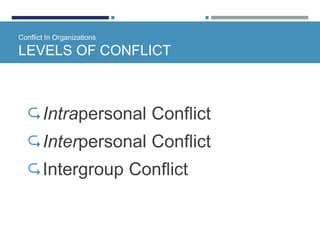
LEVELS OF CONFLICT
Intrapersonal Conflict
Interpersonal Conflict
Intergroup Conflict
Conflict In Organizations
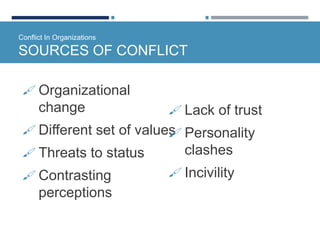
SOURCES OF CONFLICT
 Organizational
change
 Different set of values
 Threats to status
 Contrasting
perceptions
 Lack of trust
 Personality
clashes
 Incivility
Conflict In Organizations
EFFECTS OF CONFLICT
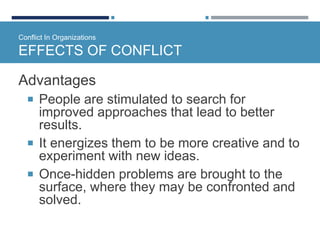
Advantages
 People are stimulated to search for
improved approaches that lead to better
results.
 It energizes them to be more creative and to
experiment with new ideas.
 Once-hidden problems are brought to the
surface, where they may be confronted and
solved.
Conflict In Organizations
EFFECTS OF CONFLICT
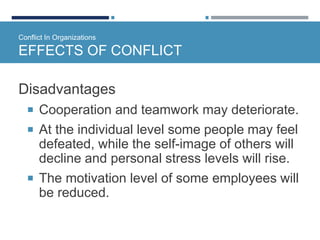
Disadvantages
 Cooperation and teamwork may deteriorate.
 At the individual level some people may feel
defeated, while the self-image of others will
decline and personal stress levels will rise.
 The motivation level of some employees will
be reduced.
Conflict In Organizations
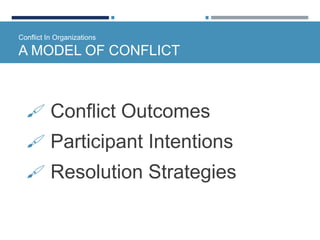
A MODEL OF CONFLICT
 Conflict Outcomes
 Participant Intentions
 Resolution Strategies
Assertive Behavior
ASSERTIVENESS
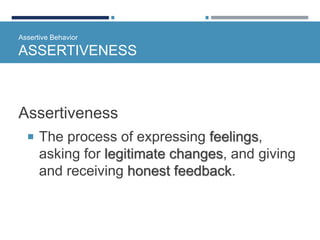
Assertiveness
 The process of expressing feelings,
asking for legitimate changes, and giving
and receiving honest feedback.
Assertive Behavior
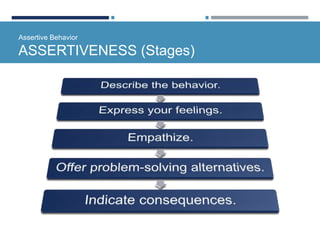
ASSERTIVENESS (Stages)
Assertive Behavior
INTERPERSONAL ORIENTATIONS
Interpersonal Orientations
 Dominant way of relating to people
Assertive Behavior
FACILITATING SMOOTH RELATIONS
Interpersonal Facilitation
 The capacity to focus on others’ personal
needs, sensitivities, and idiosyncrasies
Assertive Behavior
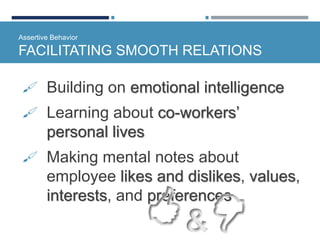
FACILITATING SMOOTH RELATIONS
 Building on emotional intelligence
 Learning about co-workers’
personal lives
 Making mental notes about
employee likes and dislikes, values,
interests, and preferences
&
Assertive Behavior
FACILITATING SMOOTH RELATIONS
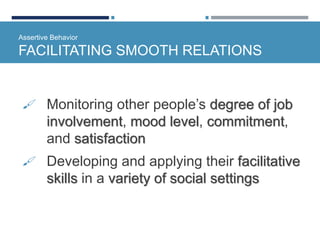
 Monitoring other people’s degree of job
involvement, mood level, commitment,
and satisfaction
 Developing and applying their facilitative
skills in a variety of social settings
Assertive Behavior
STROKING
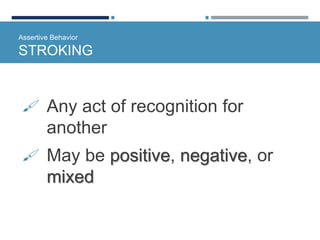
 Any act of recognition for
another
 May be positive, negative, or
mixed
Assertive Behavior
STROKING
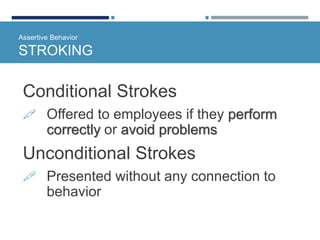
Conditional Strokes
 Offered to employees if they perform
correctly or avoid problems
Unconditional Strokes
 Presented without any connection to
behavior
Assertive Behavior
STROKING
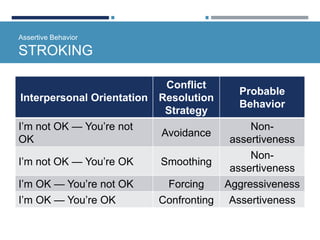
Interpersonal Orientation
Conflict
Resolution
Strategy
Probable
Behavior
I’m not OK — You’re not
OK
Avoidance
Non-
assertiveness
I’m not OK — You’re OK Smoothing
Non-
assertiveness
I’m OK — You’re not OK Forcing Aggressiveness
I’m OK — You’re OK Confronting Assertiveness
Power and Politics
POWER
 The ability to influence
other people and events
Power and Politics
Types of POWER
Personal Power
 Ability of leaders to develop followers
from strength of their own personalities
Power and Politics
Types of POWER
Legitimate Power
 Arises from the culture of society by
which power is delegated legitimately
from higher established authorities to
others
Power and Politics
Types of POWER
Expert Power
 Power that arises from a person’s
knowledge of and information about a
complex situation
Power and Politics
Types of POWER
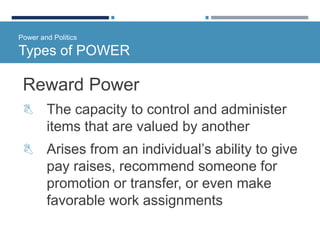
Reward Power
 The capacity to control and administer
items that are valued by another
 Arises from an individual’s ability to give
pay raises, recommend someone for
promotion or transfer, or even make
favorable work assignments
Power and Politics
Types of POWER
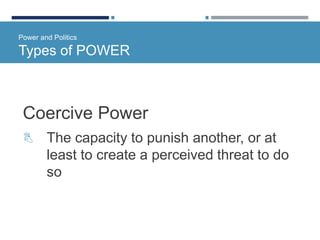
Coercive Power
 The capacity to punish another, or at
least to create a perceived threat to do
so
Power and Politics
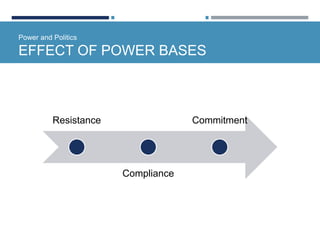
EFFECT OF POWER BASES
Resistance
Compliance
Commitment
Power and Politics
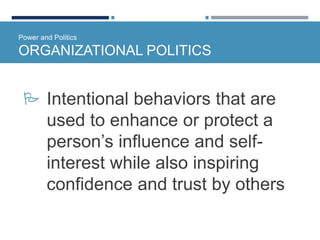
ORGANIZATIONAL POLITICS
 Intentional behaviors that are
used to enhance or protect a
person’s influence and self-
interest while also inspiring
confidence and trust by others
Power and Politics
ORGANIZATIONAL POLITICS
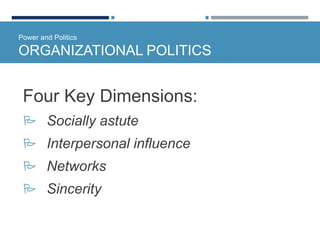
Four Key Dimensions:
 Socially astute
 Interpersonal influence
 Networks
 Sincerity
Power and Politics
INFLUENCE AND POLITICAL POWER
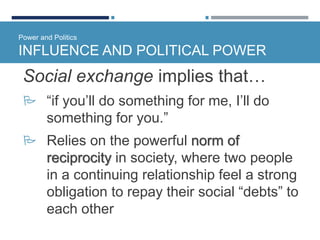
Social exchange implies that…
 “if you’ll do something for me, I’ll do
something for you.”
 Relies on the powerful norm of
reciprocity in society, where two people
in a continuing relationship feel a strong
obligation to repay their social “debts” to
each other
Power and Politics
INFLUENCE AND POLITICAL POWER
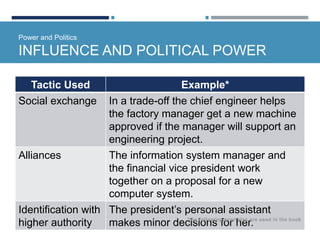
Tactic Used Example*
Social exchange In a trade-off the chief engineer helps
the factory manager get a new machine
approved if the manager will support an
engineering project.
Alliances The information system manager and
the financial vice president work
together on a proposal for a new
computer system.
Identification with
higher authority
The president’s personal assistant
makes minor decisions for her.*the following examples are used in the book
Power and Politics
INFLUENCE AND POLITICAL POWER
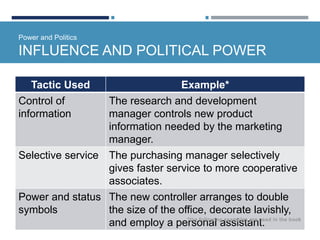
Tactic Used Example*
Control of
information
The research and development
manager controls new product
information needed by the marketing
manager.
Selective service The purchasing manager selectively
gives faster service to more cooperative
associates.
Power and status
symbols
The new controller arranges to double
the size of the office, decorate lavishly,
and employ a personal assistant.*the following examples are used in the book
Power and Politics
INFLUENCE AND POLITICAL POWER
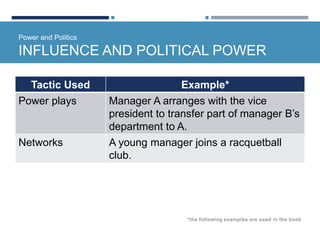
Tactic Used Example*
Power plays Manager A arranges with the vice
president to transfer part of manager B’s
department to A.
Networks A young manager joins a racquetball
club.
*the following examples are used in the book
Chapter 11   interpersonal behavior (1)

Chapter 11 interpersonal behavior (1)

  • 2.
  • 3.
    CHAPTER OBJECTIVES To Understand TheNature and Types of Conflict Conflict Outcomes and Resolution Strategies Different Personality Types Assertive Behavior  Interpersonal Orientations and Stroking  Types of Power  Organizational Politics and Influence
  • 4.
    Conflict In Organizations THENATURE OF CONFLICT Conflict  An interpersonal process that arises from disagreements over the goals to attain or the methods to be used to accomplish those goals
  • 5.
    Conflict In Organizations THENATURE OF CONFLICT  Conflict can occur in any situation in which two or more parties feel themselves in opposition.
  • 6.
    Conflict In Organizations THENATURE OF CONFLICT  Conflicts also arise due to task interdependence, ambiguity of roles, policies, and rules, personality differences, ineffective communications, the competition over scarce resources, personal stress, and underlying differences in attitudes, beliefs, and experiences.
  • 7.
    Conflict In Organizations THENATURE OF CONFLICT Knowledge and understanding of conflict and the methods for resolving it are important.
  • 8.
    Conflict In Organizations LEVELSOF CONFLICT Intrapersonal Conflict Interpersonal Conflict Intergroup Conflict
  • 9.
    Conflict In Organizations SOURCESOF CONFLICT  Organizational change  Different set of values  Threats to status  Contrasting perceptions  Lack of trust  Personality clashes  Incivility
  • 10.
    Conflict In Organizations EFFECTSOF CONFLICT Advantages  People are stimulated to search for improved approaches that lead to better results.  It energizes them to be more creative and to experiment with new ideas.  Once-hidden problems are brought to the surface, where they may be confronted and solved.
  • 11.
    Conflict In Organizations EFFECTSOF CONFLICT Disadvantages  Cooperation and teamwork may deteriorate.  At the individual level some people may feel defeated, while the self-image of others will decline and personal stress levels will rise.  The motivation level of some employees will be reduced.
  • 12.
    Conflict In Organizations AMODEL OF CONFLICT  Conflict Outcomes  Participant Intentions  Resolution Strategies
  • 13.
    Assertive Behavior ASSERTIVENESS Assertiveness  Theprocess of expressing feelings, asking for legitimate changes, and giving and receiving honest feedback.
  • 14.
  • 15.
    Assertive Behavior INTERPERSONAL ORIENTATIONS InterpersonalOrientations  Dominant way of relating to people
  • 16.
    Assertive Behavior FACILITATING SMOOTHRELATIONS Interpersonal Facilitation  The capacity to focus on others’ personal needs, sensitivities, and idiosyncrasies
  • 17.
    Assertive Behavior FACILITATING SMOOTHRELATIONS  Building on emotional intelligence  Learning about co-workers’ personal lives  Making mental notes about employee likes and dislikes, values, interests, and preferences &
  • 18.
    Assertive Behavior FACILITATING SMOOTHRELATIONS  Monitoring other people’s degree of job involvement, mood level, commitment, and satisfaction  Developing and applying their facilitative skills in a variety of social settings
  • 19.
    Assertive Behavior STROKING  Anyact of recognition for another  May be positive, negative, or mixed
  • 20.
    Assertive Behavior STROKING Conditional Strokes Offered to employees if they perform correctly or avoid problems Unconditional Strokes  Presented without any connection to behavior
  • 21.
    Assertive Behavior STROKING Interpersonal Orientation Conflict Resolution Strategy Probable Behavior I’mnot OK — You’re not OK Avoidance Non- assertiveness I’m not OK — You’re OK Smoothing Non- assertiveness I’m OK — You’re not OK Forcing Aggressiveness I’m OK — You’re OK Confronting Assertiveness
  • 22.
    Power and Politics POWER The ability to influence other people and events
  • 23.
    Power and Politics Typesof POWER Personal Power  Ability of leaders to develop followers from strength of their own personalities
  • 24.
    Power and Politics Typesof POWER Legitimate Power  Arises from the culture of society by which power is delegated legitimately from higher established authorities to others
  • 25.
    Power and Politics Typesof POWER Expert Power  Power that arises from a person’s knowledge of and information about a complex situation
  • 26.
    Power and Politics Typesof POWER Reward Power  The capacity to control and administer items that are valued by another  Arises from an individual’s ability to give pay raises, recommend someone for promotion or transfer, or even make favorable work assignments
  • 27.
    Power and Politics Typesof POWER Coercive Power  The capacity to punish another, or at least to create a perceived threat to do so
  • 28.
    Power and Politics EFFECTOF POWER BASES Resistance Compliance Commitment
  • 29.
    Power and Politics ORGANIZATIONALPOLITICS  Intentional behaviors that are used to enhance or protect a person’s influence and self- interest while also inspiring confidence and trust by others
  • 30.
    Power and Politics ORGANIZATIONALPOLITICS Four Key Dimensions:  Socially astute  Interpersonal influence  Networks  Sincerity
  • 31.
    Power and Politics INFLUENCEAND POLITICAL POWER Social exchange implies that…  “if you’ll do something for me, I’ll do something for you.”  Relies on the powerful norm of reciprocity in society, where two people in a continuing relationship feel a strong obligation to repay their social “debts” to each other
  • 32.
    Power and Politics INFLUENCEAND POLITICAL POWER Tactic Used Example* Social exchange In a trade-off the chief engineer helps the factory manager get a new machine approved if the manager will support an engineering project. Alliances The information system manager and the financial vice president work together on a proposal for a new computer system. Identification with higher authority The president’s personal assistant makes minor decisions for her.*the following examples are used in the book
  • 33.
    Power and Politics INFLUENCEAND POLITICAL POWER Tactic Used Example* Control of information The research and development manager controls new product information needed by the marketing manager. Selective service The purchasing manager selectively gives faster service to more cooperative associates. Power and status symbols The new controller arranges to double the size of the office, decorate lavishly, and employ a personal assistant.*the following examples are used in the book
  • 34.
    Power and Politics INFLUENCEAND POLITICAL POWER Tactic Used Example* Power plays Manager A arranges with the vice president to transfer part of manager B’s department to A. Networks A young manager joins a racquetball club. *the following examples are used in the book

Editor's Notes

  • #5 Conflict An interpersonal process that arises from disagreements over the goals to attain or the methods to be used to accomplish those goals
  • #6 Conflict can occur in any situation in which two or more parties feel themselves in opposition.
  • #7 Conflicts also arise due to task interdependence, ambiguity of roles, policies, and rules, personality differences, ineffective communications, the competition over scarce resources, personal stress, and underlying differences in attitudes, beliefs, and experiences.
  • #8 Knowledge and understanding of conflict and the methods for resolving it are important.
  • #9 Intrapersonal Conflict Interpersonal Conflict Intergroup Conflict
  • #10 Organizational change Different set of values Threats to status Contrasting perceptions Lack of trust Personality clashes Incivility
  • #11 Advantages People are stimulated to search for improved approaches that lead to better results. It energizes them to be more creative and to experiment with new ideas. Once-hidden problems are brought to the surface, where they may be confronted and solved.
  • #12 Knowledge and understanding of conflict and the methods for resolving it are important.
  • #13 Knowledge and understanding of conflict and the methods for resolving it are important.
  • #14 Knowledge and understanding of conflict and the methods for resolving it are important.
  • #15 Knowledge and understanding of conflict and the methods for resolving it are important.
  • #16 Knowledge and understanding of conflict and the methods for resolving it are important.
  • #17 Knowledge and understanding of conflict and the methods for resolving it are important.
  • #18 Knowledge and understanding of conflict and the methods for resolving it are important.
  • #19 Knowledge and understanding of conflict and the methods for resolving it are important.
  • #20 Knowledge and understanding of conflict and the methods for resolving it are important.
  • #21 Knowledge and understanding of conflict and the methods for resolving it are important.
  • #22 Knowledge and understanding of conflict and the methods for resolving it are important.
  • #23 Knowledge and understanding of conflict and the methods for resolving it are important.
  • #24 Knowledge and understanding of conflict and the methods for resolving it are important.
  • #25 Knowledge and understanding of conflict and the methods for resolving it are important.
  • #26 Knowledge and understanding of conflict and the methods for resolving it are important.
  • #27 Knowledge and understanding of conflict and the methods for resolving it are important.
  • #28 Knowledge and understanding of conflict and the methods for resolving it are important.
  • #29 Knowledge and understanding of conflict and the methods for resolving it are important.
  • #30 Knowledge and understanding of conflict and the methods for resolving it are important.
  • #31 Knowledge and understanding of conflict and the methods for resolving it are important.
  • #32 Knowledge and understanding of conflict and the methods for resolving it are important.
  • #33 Knowledge and understanding of conflict and the methods for resolving it are important.
  • #34 Knowledge and understanding of conflict and the methods for resolving it are important.
  • #35 Knowledge and understanding of conflict and the methods for resolving it are important.