PRICING DECISION 1
chapter
1010
Influences on pricing
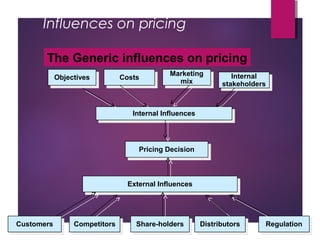
The Generic influences on pricing
ObjectivesObjectives CostsCosts Marketing
mix
Marketing
mix Internal
stakeholders
Internal
stakeholders
Internal InfluencesInternal Influences
Pricing DecisionPricing Decision
External InfluencesExternal Influences
CustomersCustomers CompetitorsCompetitors Share-holdersShare-holders DistributorsDistributors RegulationRegulation
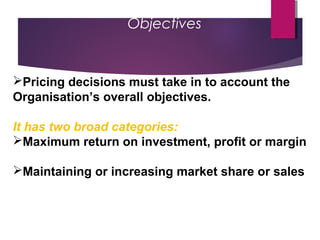
Objectives
Pricing decisions must take in to account the
Organisation’s overall objectives.
It has two broad categories:
Maximum return on investment, profit or margin
Maintaining or increasing market share or sales
Costs
1010
This is the most widely recognized influence on
Price.
Cost are typically recognize under two headings
oFixed cost- are incurred irrespective of levels of
Sales of a product.
oVariable cost- refer to those costs which relate
directly to the number of unit sold.
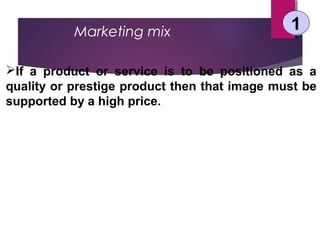
Marketing mix 11
If a product or service is to be positioned as a
quality or prestige product then that image must be
supported by a high price.
Internal stakeholders
1010
Pricing decisions involve different groups within
the organization
They will thus need to reflect the differing needs
of groups.
For example finance and
Accounting may be concerned with price, only in
Relation to cost and the organization’s ability to
Certain specified financial targets.
External Factors 1010
This includes:
Consumers
Competition
Intermediaries
Shareholders
Policy and Regulation
Consumers 1010
Marketing managers must also think about
consumer Perceptions of the value and the
benefits they receive from the product.
What is important is not the cost but how highly
the consumer value them.
Competition 1010
If competitors prices are significantly lower, the
Customers are more likely to buy from them.
Equally if competitors prices are significantly
higher then the organization that is able to offer a
lower price may gain additional sales.
Intermediaries 1010
The intermediaries perform a range of services
Including providing customers with information,
helping them make choices and providing after
sales.
The intermediaries has to be rewarded for
providing these services.
Shareholders
1010
Organization must give careful consideration
to the needs and expectation of shareholders
Those providing capital will expect to receive
an appropriate return and this must be factored
into the pricing decision.
Policy and regulation
Chapter 1 Version 3e
12
1010
Specific policy and regulations may affect the
pricing of certain product and services. These
factors may constrain decisions made with
respect to price.
Challenges Associated with Pricing
Financial Services
Internal issues
Costs:-Financial service organizations may face
difficulties in allocating costs across their products
because any service they provide to customer may
be combination of individual services.
Risks:- The issue of risk is probably far greater
for financial services. When a bank provides a
loan or issues a credit card, there is a risk that the
consumer will not be able to make the payment.
External issues 1010
Complexity and Transparency:- Many customers
find financial service complex and difficult to
understand. One particular area is the lack of
transparency in pricing.
Uncertainty:- Complication consumers face is
that the value or benefit they get from particular
financial service may not be clear or may be
difficult to assess.
Variability:- Financial services are characterized
by Variability.
Forms of pricing 1010
Explicit or Over Pricing
Implicit or Covert Pricing
Spread Pricing
Explicit or Over Pricing 1010
This approach makes the price paid for the
service very clear.
Implicit or Covert Pricing
This is a system of pricing in which the actual
price to the consumer is unclear and the may
appear not pay it.
Spread pricing 1010
This is a relatively specific approach to pricing
most commonly used in relation to managed funds.
Pricing strategies 1010
The three general pricing strategies are :
Fixed Fee
Transactions Charges
Two-Part Tariffs
Fixed Fee
This types of pricing strategy presents the
customer with a fixed fee for a given service in
specific time period.
It may be used in combination with either implicit
or explicit pricing.
Transactions Charges
This involves a specified charge for each
transaction.
This type of pricing strategy only really works with
explicit pricing.
Two-Part Tariffs
This involves a combination of fixed fee and
transactions charges.
This comprises of charging a fixed fee and
also a charge for the service used.

Chapter 10 pricing

  • 1.
  • 2.
    Influences on pricing TheGeneric influences on pricing ObjectivesObjectives CostsCosts Marketing mix Marketing mix Internal stakeholders Internal stakeholders Internal InfluencesInternal Influences Pricing DecisionPricing Decision External InfluencesExternal Influences CustomersCustomers CompetitorsCompetitors Share-holdersShare-holders DistributorsDistributors RegulationRegulation
  • 3.
    Objectives Pricing decisions musttake in to account the Organisation’s overall objectives. It has two broad categories: Maximum return on investment, profit or margin Maintaining or increasing market share or sales
  • 4.
    Costs 1010 This is themost widely recognized influence on Price. Cost are typically recognize under two headings oFixed cost- are incurred irrespective of levels of Sales of a product. oVariable cost- refer to those costs which relate directly to the number of unit sold.
  • 5.
    Marketing mix 11 Ifa product or service is to be positioned as a quality or prestige product then that image must be supported by a high price.
  • 6.
    Internal stakeholders 1010 Pricing decisionsinvolve different groups within the organization They will thus need to reflect the differing needs of groups. For example finance and Accounting may be concerned with price, only in Relation to cost and the organization’s ability to Certain specified financial targets.
  • 7.
    External Factors 1010 Thisincludes: Consumers Competition Intermediaries Shareholders Policy and Regulation
  • 8.
    Consumers 1010 Marketing managersmust also think about consumer Perceptions of the value and the benefits they receive from the product. What is important is not the cost but how highly the consumer value them.
  • 9.
    Competition 1010 If competitorsprices are significantly lower, the Customers are more likely to buy from them. Equally if competitors prices are significantly higher then the organization that is able to offer a lower price may gain additional sales.
  • 10.
    Intermediaries 1010 The intermediariesperform a range of services Including providing customers with information, helping them make choices and providing after sales. The intermediaries has to be rewarded for providing these services.
  • 11.
    Shareholders 1010 Organization must givecareful consideration to the needs and expectation of shareholders Those providing capital will expect to receive an appropriate return and this must be factored into the pricing decision.
  • 12.
    Policy and regulation Chapter1 Version 3e 12 1010 Specific policy and regulations may affect the pricing of certain product and services. These factors may constrain decisions made with respect to price.
  • 13.
    Challenges Associated withPricing Financial Services Internal issues Costs:-Financial service organizations may face difficulties in allocating costs across their products because any service they provide to customer may be combination of individual services. Risks:- The issue of risk is probably far greater for financial services. When a bank provides a loan or issues a credit card, there is a risk that the consumer will not be able to make the payment.
  • 14.
    External issues 1010 Complexityand Transparency:- Many customers find financial service complex and difficult to understand. One particular area is the lack of transparency in pricing. Uncertainty:- Complication consumers face is that the value or benefit they get from particular financial service may not be clear or may be difficult to assess. Variability:- Financial services are characterized by Variability.
  • 15.
    Forms of pricing1010 Explicit or Over Pricing Implicit or Covert Pricing Spread Pricing
  • 16.
    Explicit or OverPricing 1010 This approach makes the price paid for the service very clear.
  • 17.
    Implicit or CovertPricing This is a system of pricing in which the actual price to the consumer is unclear and the may appear not pay it.
  • 18.
    Spread pricing 1010 Thisis a relatively specific approach to pricing most commonly used in relation to managed funds.
  • 19.
    Pricing strategies 1010 Thethree general pricing strategies are : Fixed Fee Transactions Charges Two-Part Tariffs
  • 20.
    Fixed Fee This typesof pricing strategy presents the customer with a fixed fee for a given service in specific time period. It may be used in combination with either implicit or explicit pricing.
  • 21.
    Transactions Charges This involvesa specified charge for each transaction. This type of pricing strategy only really works with explicit pricing.
  • 22.
    Two-Part Tariffs This involvesa combination of fixed fee and transactions charges. This comprises of charging a fixed fee and also a charge for the service used.