Introduction to Python Programing
By: Mikiale T.
1
Python Overview
2
3
History of Python
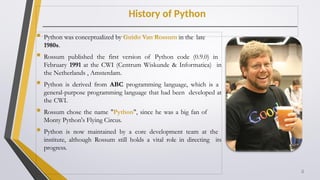
 Python was conceptualized by Guido Van Rossum in the late
1980s.
 Rossum published the first version of Python code (0.9.0) in
February 1991 at the CWI (Centrum Wiskunde & Informatica) in
the Netherlands , Amsterdam.
 Python is derived from ABC programming language, which is a
general-purpose programming language that had been developed at
the CWI.
 Rossum chose the name "Python", since he was a big fan of
Monty Python's Flying Circus.
 Python is now maintained by a core development team at the
institute, although Rossum still holds a vital role in directing its
progress.
4
What is Scripting Language?
 A scripting language is a “wrapper” language that integrates OS functions.
 The interpreter is a layer of software logic between your code and the computer hardware
on your machine.
Wiki Says:
 The “program” has an executable form that the computer can use directly to execute the
instructions.
 The same program in its human-readable source code form, from which executable
programs are derived (e.g., compiled)
 Python is scripting language, fast and dynamic.
 Python is called ‘scripting language’ because of it’s scalable interpreter, but actually it is much
more than that
5
What is Python?
Python is a high-level programming language which is:
 Interpreted: Python is processed at runtime by the interpreter.
 Interactive: You can use a Python prompt and interact with the interpreter
directly to write your programs.
 Object-Oriented: Python supports Object-Oriented technique of programming.
 Beginner’s Language: Python is a great language for the beginner-level
programmers and supports the development of a wide range of applications.
6
Interpreters Vs Compilers
 The first thing that is important to understand about Python is that it is an interpreted language.
 There are two sorts of programming languages: interpreted ones and compiled ones. A compiled language
is what you are probably used to if you have done any programming in the past.
 The process for a compiled language is as follows:
• Create source file using text edit
• Use compiler to syntax check and convert source file into binary .
• Use linker to turn binary files into executable format.
• Run the resulting executable format file in the operating system.
 The biggest difference between interpreted code and compiled code is that an interpreted application
need not be “complete.”
 You can test it in bits and pieces until you are satisfied with the results and put them all together later
for the end user to use.
7
Python Features
 Easy to learn, easy to read and easy to maintain.
 Portable: It can run on various hardware platforms and has the same
interface on all platforms.
 Extendable: You can add low-level modules to the Python interpreter.
 Scalable: Python provides a good structure and support for large programs.
 Python has support for an interactive mode of testing and debugging.
 Python has a broad standard library cross-platform.
 Everything in Python is an object: variables, functions, even code. Every
object has an ID, a type, and a value.
8
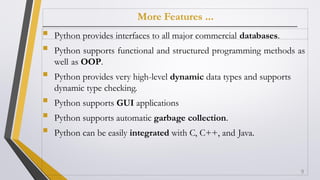
More Features ...
 Python provides interfaces to all major commercial databases.
 Python supports functional and structured programming methods as
well as OOP.
 Python provides very high-level dynamic data types and supports
dynamic type checking.
 Python supports GUI applications
 Python supports automatic garbage collection.
 Python can be easily integrated with C, C++, and Java.
9
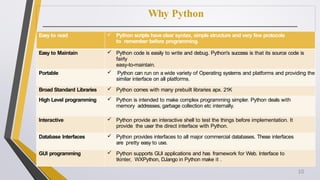
Why Python
Easy to read  Python scripts have clear syntax, simple structure and very few protocols
to remember before programming.
Easy to Maintain  Python code is easily to write and debug. Python's success is that its source code is
fairly
easy-to-maintain.
Portable  Python can run on a wide variety of Operating systems and platforms and providing the
similar interface on all platforms.
Broad Standard Libraries  Python comes with many prebuilt libraries apx. 21K
High Level programming  Python is intended to make complex programming simpler. Python deals with
memory addresses, garbage collection etc internally.
Interactive  Python provide an interactive shell to test the things before implementation. It
provide the user the direct interface with Python.
Database Interfaces  Python provides interfaces to all major commercial databases. These interfaces
are pretty easy to use.
GUI programming  Python supports GUI applications and has framework for Web. Interface to
tkinter, WXPython, DJango in Python make it .
10
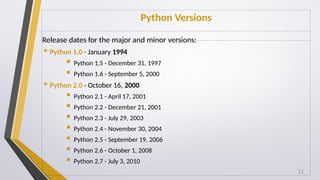
Python Versions
Release dates for the major and minor versions:
Python 1.0 - January 1994
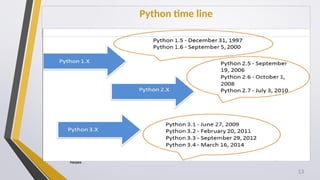
 Python 1.5 - December 31, 1997
 Python 1.6 - September 5, 2000
Python 2.0 - October 16, 2000
 Python 2.1 - April 17, 2001
 Python 2.2 - December 21, 2001
 Python 2.3 - July 29, 2003
 Python 2.4 - November 30, 2004
 Python 2.5 - September 19, 2006
 Python 2.6 - October 1, 2008
 Python 2.7 - July 3, 2010
11
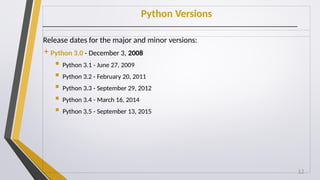
Python Versions
Release dates for the major and minor versions:
Python 3.0 - December 3, 2008
 Python 3.1 - June 27, 2009
 Python 3.2 - February 20, 2011
 Python 3.3 - September 29, 2012
 Python 3.4 - March 16, 2014
 Python 3.5 - September 13, 2015
12
By Ripal
Ranpara
Python time line
13
Key Changes in Python 3.0
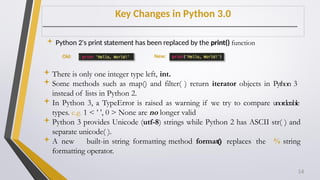
 Python 2's print statement has been replaced by the print() function
There is only one integer type left, int.
Some methods such as map() and filter( ) return iterator objects in Python 3
instead of lists in Python 2.
In Python 3, a TypeError is raised as warning if we try to compare unorderable
types. e.g. 1 < ’ ', 0 > None are no longer valid
Python 3 provides Unicode (utf-8) strings while Python 2 has ASCII str( ) and
separate unicode( ).
A new built-in string formatting method format() replaces the % string
formatting operator.
Old: New:
14
Key Changes in Python 3.0
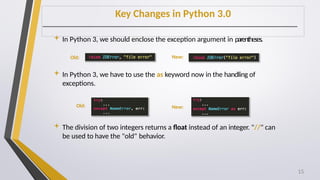
 In Python 3, we should enclose the exception argument in parentheses.
 In Python 3, we have to use the as keyword now in the handling of
exceptions.
 The division of two integers returns a float instead of an integer. "//" can
be used to have the "old" behavior.
Old:
Old: New:
New:
15
Python Useful Tools
 Python IDEs
 PyCharm
 Vim
 Eclipse with PyDev
 Sublime Text
 Emacs
 Komodo Edit
16
Python Useful Tools
 Python Web Frameworks
 Django
 Flask
 Pylons
 Pyramid
 TurboGears
 Web2py
17
Organizations Use Python
 Web Development :Google, Yahoo
 Games :Battlefield 2, Crystal Space
 Graphics :Walt Disney Feature Animation, Blender 3D
 Science :National Weather Service, NASA, Applied Maths
 Software Development :Nokia, Red Hat, IBM
 Education :University of California-Irvine, SchoolTool
 Government :The USA Central Intelligence Agency (CIA)
18
Chapter - 1.pptx introduction to python programming

  • 1.
    Introduction to PythonPrograming By: Mikiale T. 1
  • 2.
  • 3.
  • 4.
    History of Python Python was conceptualized by Guido Van Rossum in the late 1980s.  Rossum published the first version of Python code (0.9.0) in February 1991 at the CWI (Centrum Wiskunde & Informatica) in the Netherlands , Amsterdam.  Python is derived from ABC programming language, which is a general-purpose programming language that had been developed at the CWI.  Rossum chose the name "Python", since he was a big fan of Monty Python's Flying Circus.  Python is now maintained by a core development team at the institute, although Rossum still holds a vital role in directing its progress. 4
  • 5.
    What is ScriptingLanguage?  A scripting language is a “wrapper” language that integrates OS functions.  The interpreter is a layer of software logic between your code and the computer hardware on your machine. Wiki Says:  The “program” has an executable form that the computer can use directly to execute the instructions.  The same program in its human-readable source code form, from which executable programs are derived (e.g., compiled)  Python is scripting language, fast and dynamic.  Python is called ‘scripting language’ because of it’s scalable interpreter, but actually it is much more than that 5
  • 6.
    What is Python? Pythonis a high-level programming language which is:  Interpreted: Python is processed at runtime by the interpreter.  Interactive: You can use a Python prompt and interact with the interpreter directly to write your programs.  Object-Oriented: Python supports Object-Oriented technique of programming.  Beginner’s Language: Python is a great language for the beginner-level programmers and supports the development of a wide range of applications. 6
  • 7.
    Interpreters Vs Compilers The first thing that is important to understand about Python is that it is an interpreted language.  There are two sorts of programming languages: interpreted ones and compiled ones. A compiled language is what you are probably used to if you have done any programming in the past.  The process for a compiled language is as follows: • Create source file using text edit • Use compiler to syntax check and convert source file into binary . • Use linker to turn binary files into executable format. • Run the resulting executable format file in the operating system.  The biggest difference between interpreted code and compiled code is that an interpreted application need not be “complete.”  You can test it in bits and pieces until you are satisfied with the results and put them all together later for the end user to use. 7
  • 8.
    Python Features  Easyto learn, easy to read and easy to maintain.  Portable: It can run on various hardware platforms and has the same interface on all platforms.  Extendable: You can add low-level modules to the Python interpreter.  Scalable: Python provides a good structure and support for large programs.  Python has support for an interactive mode of testing and debugging.  Python has a broad standard library cross-platform.  Everything in Python is an object: variables, functions, even code. Every object has an ID, a type, and a value. 8
  • 9.
    More Features ... Python provides interfaces to all major commercial databases.  Python supports functional and structured programming methods as well as OOP.  Python provides very high-level dynamic data types and supports dynamic type checking.  Python supports GUI applications  Python supports automatic garbage collection.  Python can be easily integrated with C, C++, and Java. 9
  • 10.
    Why Python Easy toread  Python scripts have clear syntax, simple structure and very few protocols to remember before programming. Easy to Maintain  Python code is easily to write and debug. Python's success is that its source code is fairly easy-to-maintain. Portable  Python can run on a wide variety of Operating systems and platforms and providing the similar interface on all platforms. Broad Standard Libraries  Python comes with many prebuilt libraries apx. 21K High Level programming  Python is intended to make complex programming simpler. Python deals with memory addresses, garbage collection etc internally. Interactive  Python provide an interactive shell to test the things before implementation. It provide the user the direct interface with Python. Database Interfaces  Python provides interfaces to all major commercial databases. These interfaces are pretty easy to use. GUI programming  Python supports GUI applications and has framework for Web. Interface to tkinter, WXPython, DJango in Python make it . 10
  • 11.
    Python Versions Release datesfor the major and minor versions: Python 1.0 - January 1994  Python 1.5 - December 31, 1997  Python 1.6 - September 5, 2000 Python 2.0 - October 16, 2000  Python 2.1 - April 17, 2001  Python 2.2 - December 21, 2001  Python 2.3 - July 29, 2003  Python 2.4 - November 30, 2004  Python 2.5 - September 19, 2006  Python 2.6 - October 1, 2008  Python 2.7 - July 3, 2010 11
  • 12.
    Python Versions Release datesfor the major and minor versions: Python 3.0 - December 3, 2008  Python 3.1 - June 27, 2009  Python 3.2 - February 20, 2011  Python 3.3 - September 29, 2012  Python 3.4 - March 16, 2014  Python 3.5 - September 13, 2015 12
  • 13.
  • 14.
    Key Changes inPython 3.0  Python 2's print statement has been replaced by the print() function There is only one integer type left, int. Some methods such as map() and filter( ) return iterator objects in Python 3 instead of lists in Python 2. In Python 3, a TypeError is raised as warning if we try to compare unorderable types. e.g. 1 < ’ ', 0 > None are no longer valid Python 3 provides Unicode (utf-8) strings while Python 2 has ASCII str( ) and separate unicode( ). A new built-in string formatting method format() replaces the % string formatting operator. Old: New: 14
  • 15.
    Key Changes inPython 3.0  In Python 3, we should enclose the exception argument in parentheses.  In Python 3, we have to use the as keyword now in the handling of exceptions.  The division of two integers returns a float instead of an integer. "//" can be used to have the "old" behavior. Old: Old: New: New: 15
  • 16.
    Python Useful Tools Python IDEs  PyCharm  Vim  Eclipse with PyDev  Sublime Text  Emacs  Komodo Edit 16
  • 17.
    Python Useful Tools Python Web Frameworks  Django  Flask  Pylons  Pyramid  TurboGears  Web2py 17
  • 18.
    Organizations Use Python Web Development :Google, Yahoo  Games :Battlefield 2, Crystal Space  Graphics :Walt Disney Feature Animation, Blender 3D  Science :National Weather Service, NASA, Applied Maths  Software Development :Nokia, Red Hat, IBM  Education :University of California-Irvine, SchoolTool  Government :The USA Central Intelligence Agency (CIA) 18