CHAPTER - II
FUNCTIONS
Unit I
Programming and Computational
Thinking (PCT-II)
(80 Theory + 70 Practical)
DCSc & Engg, PGDCA,ADCA,MCA.MSc(IT),Mtech(IT),MPhil (Comp. Sci)
Department of Computer Science, Sainik School Amaravathinagar
Cell No: 9431453730
Praveen M Jigajinni
Prepared by
Courtesy CBSE
CHAPTER - II
FUNCTIONS
What is Function?
What is Function?
A function is a group of statements that is
executed when it is called from some point of the
program.
It’s a divide and conquer approach
TYPES OF FUNCTIONS
TYPES OF FUNCTIONS
Functions can be categorized into three types
1) Built in Functions.
2) Modules.
3) User - defined functions.
TYPES OF FUNCTIONS
These are predefined function in python and
are used as and when there is need by simply calling
them. For example:
int()
float()
str()
min()
max() ...etc
1) BUILT IN FUNCTIONS
TYPES OF FUNCTIONS
Module is a container of functions,
variables, constants, class in a separate file which
can be reused.
2)MODULES
i) Import statement
ii) from statement
IMPORTING MODULES
IMPORTING MODULES – import STATEMENT
i) import statement : used to import
entire module.
Syntax: import modulename
example: import math
IMPORTING MODULES – import STATEMENT
ii) from: import all functions or selected
one.
Syntax:
from module name import function name
for example:
from random import randint
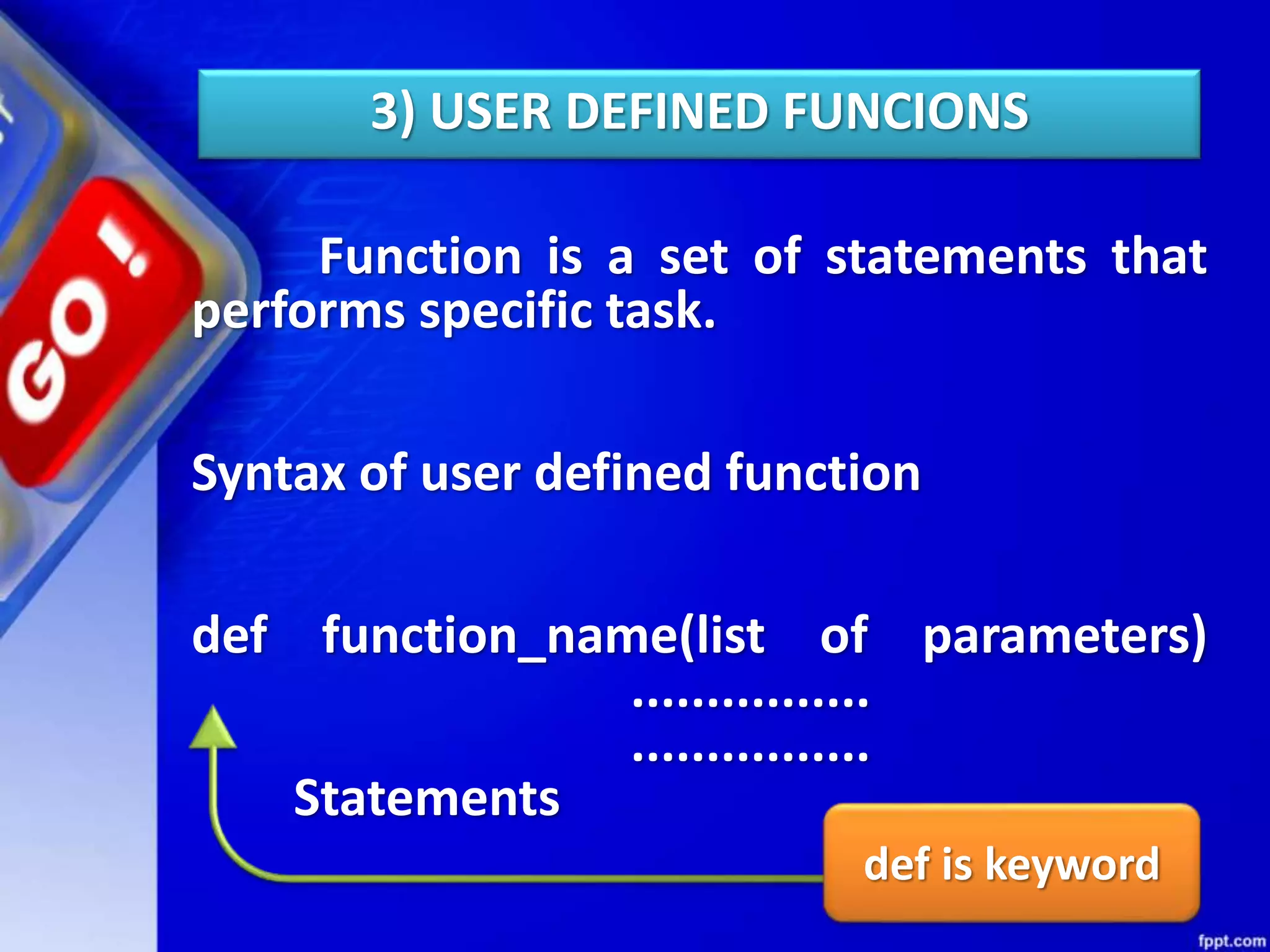
3) USER DEFINED FUNCIONS
Function is a set of statements that
performs specific task.
Syntax of user defined function
def function_name(list of parameters)
................
................
Statements
def is keyword
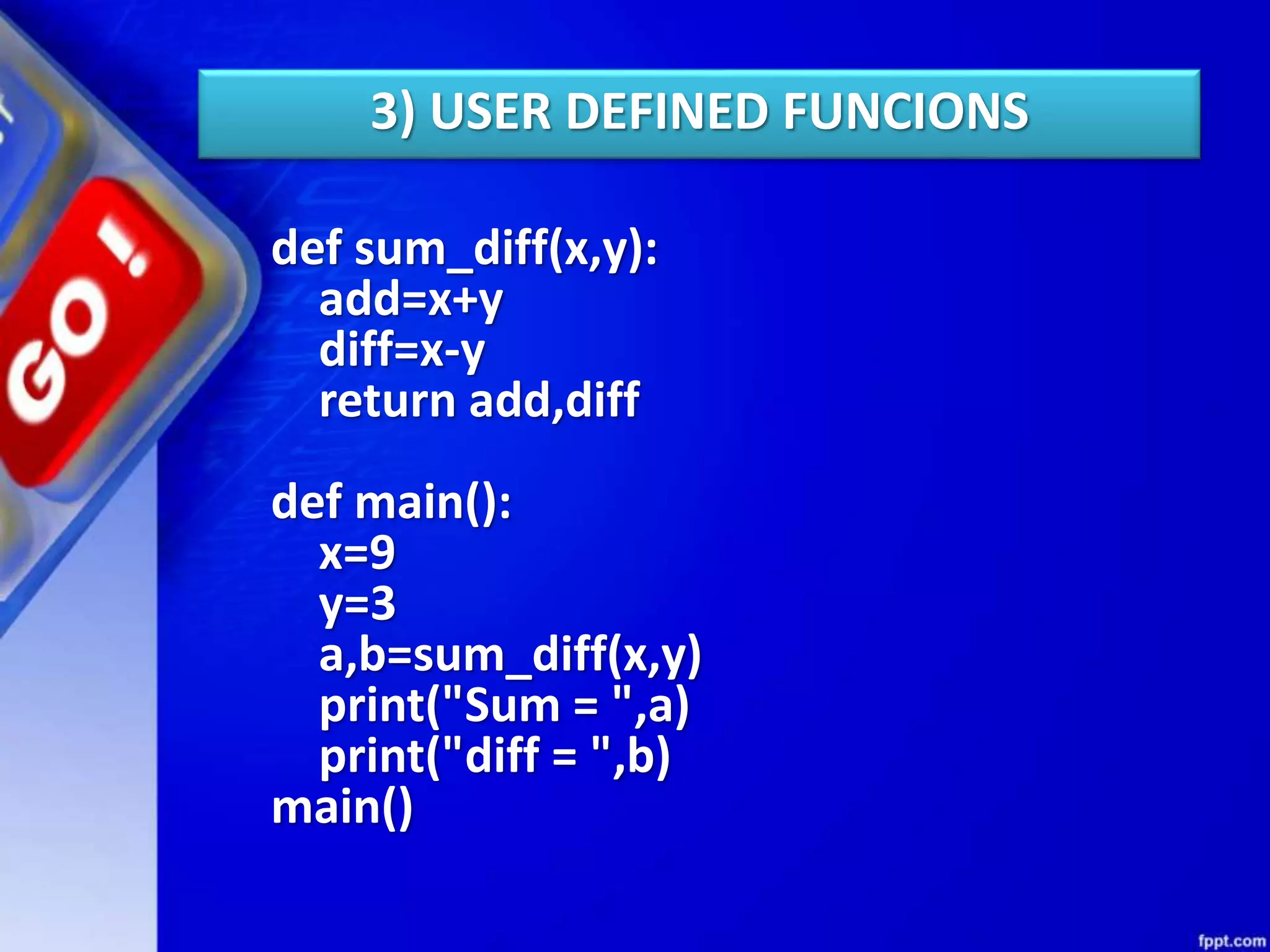
3) USER DEFINED FUNCIONS
def sum_diff(x,y):
add=x+y
diff=x-y
return add,diff
def main():
x=9
y=3
a,b=sum_diff(x,y)
print("Sum = ",a)
print("diff = ",b)
main()
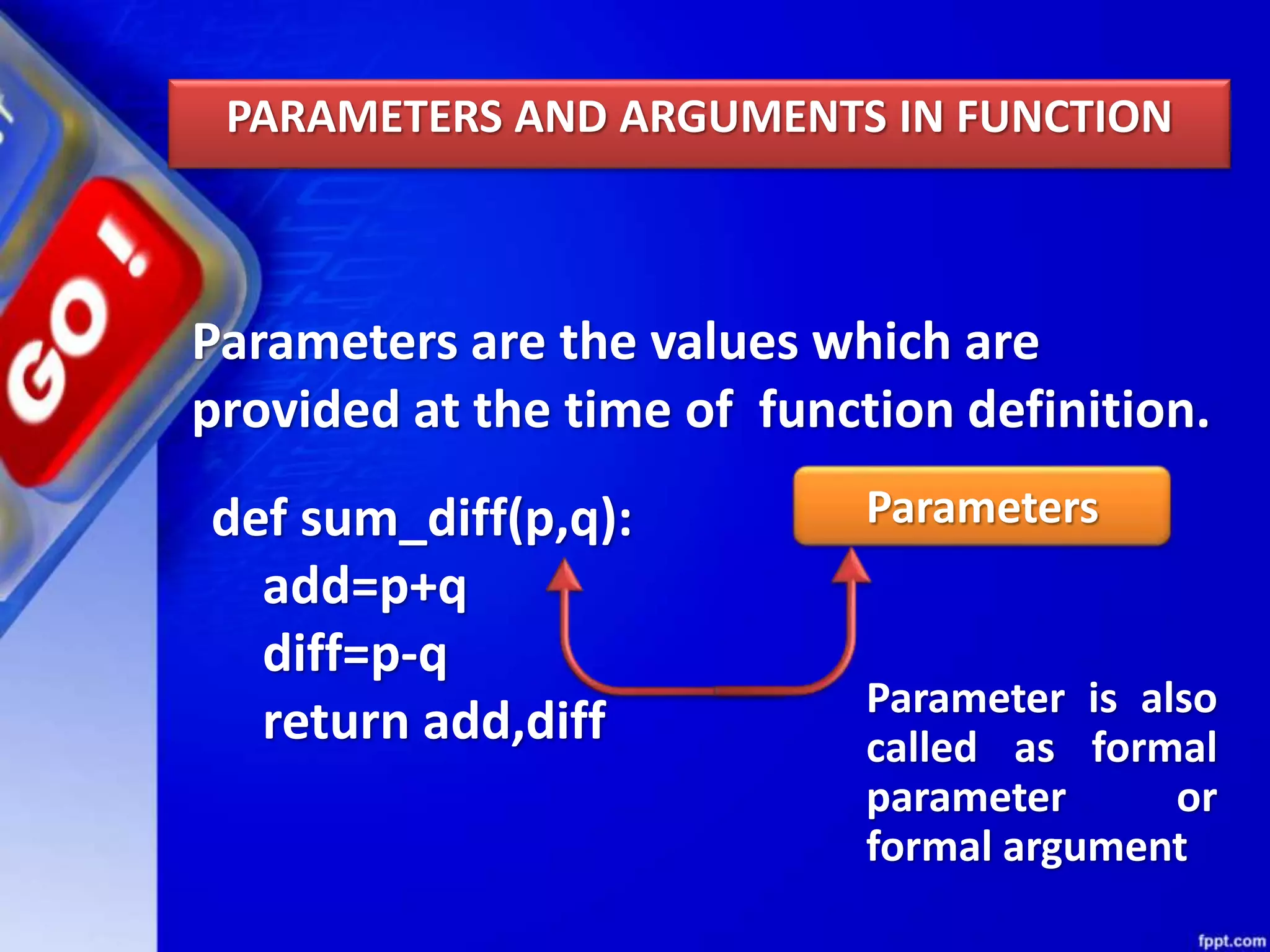
PARAMETERS AND ARGUMENTS IN FUNCTION
Parameters are the values which are
provided at the time of function definition.
Parameters
Parameter is also
called as formal
parameter or
formal argument
def sum_diff(p,q):
add=p+q
diff=p-q
return add,diff
Parameter is also
called as formal
parameter or
formal argument
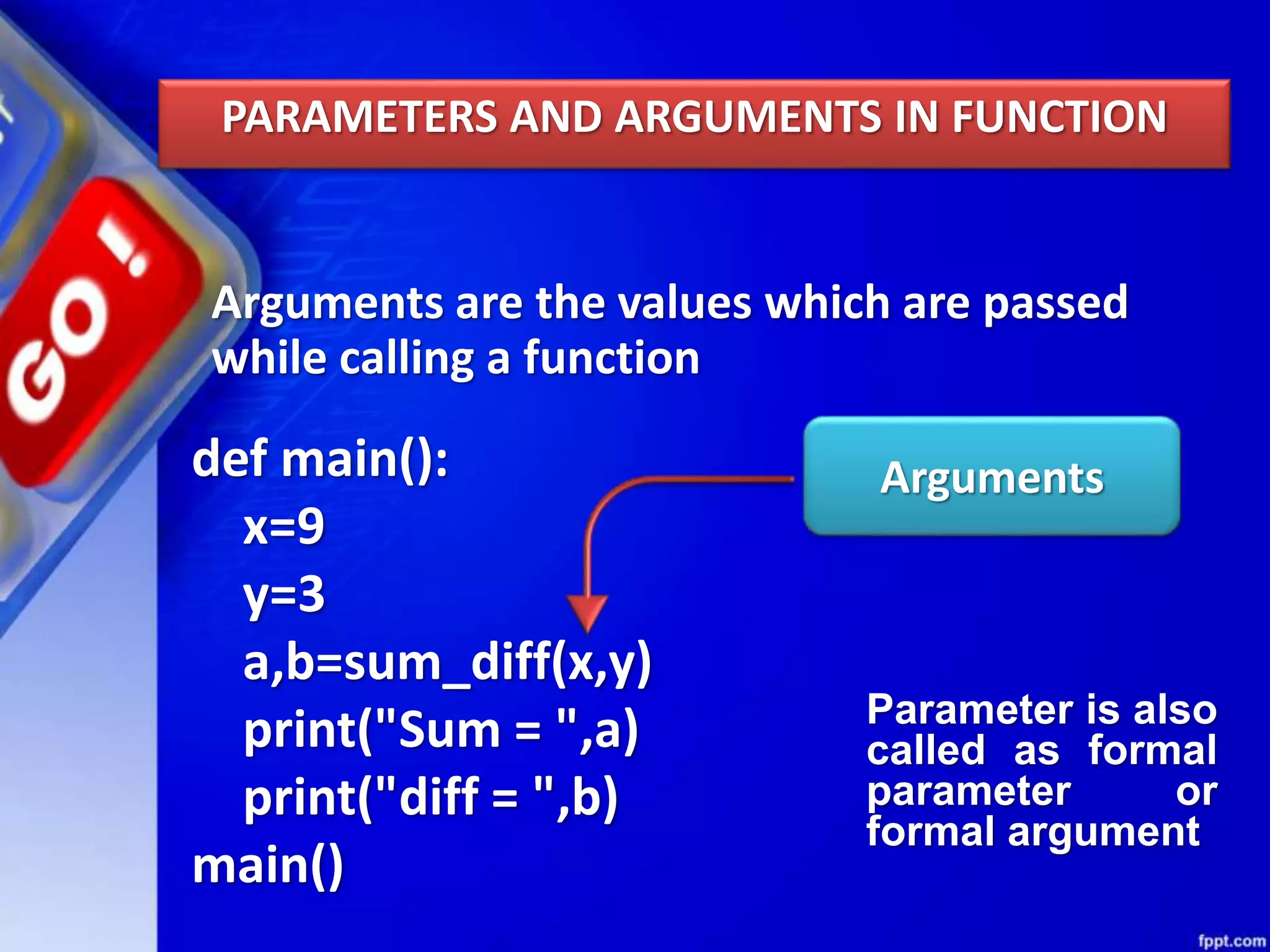
PARAMETERS AND ARGUMENTS IN FUNCTION
Arguments are the values which are passed
while calling a function
def main():
x=9
y=3
a,b=sum_diff(x,y)
print("Sum = ",a)
print("diff = ",b)
main()
Arguments
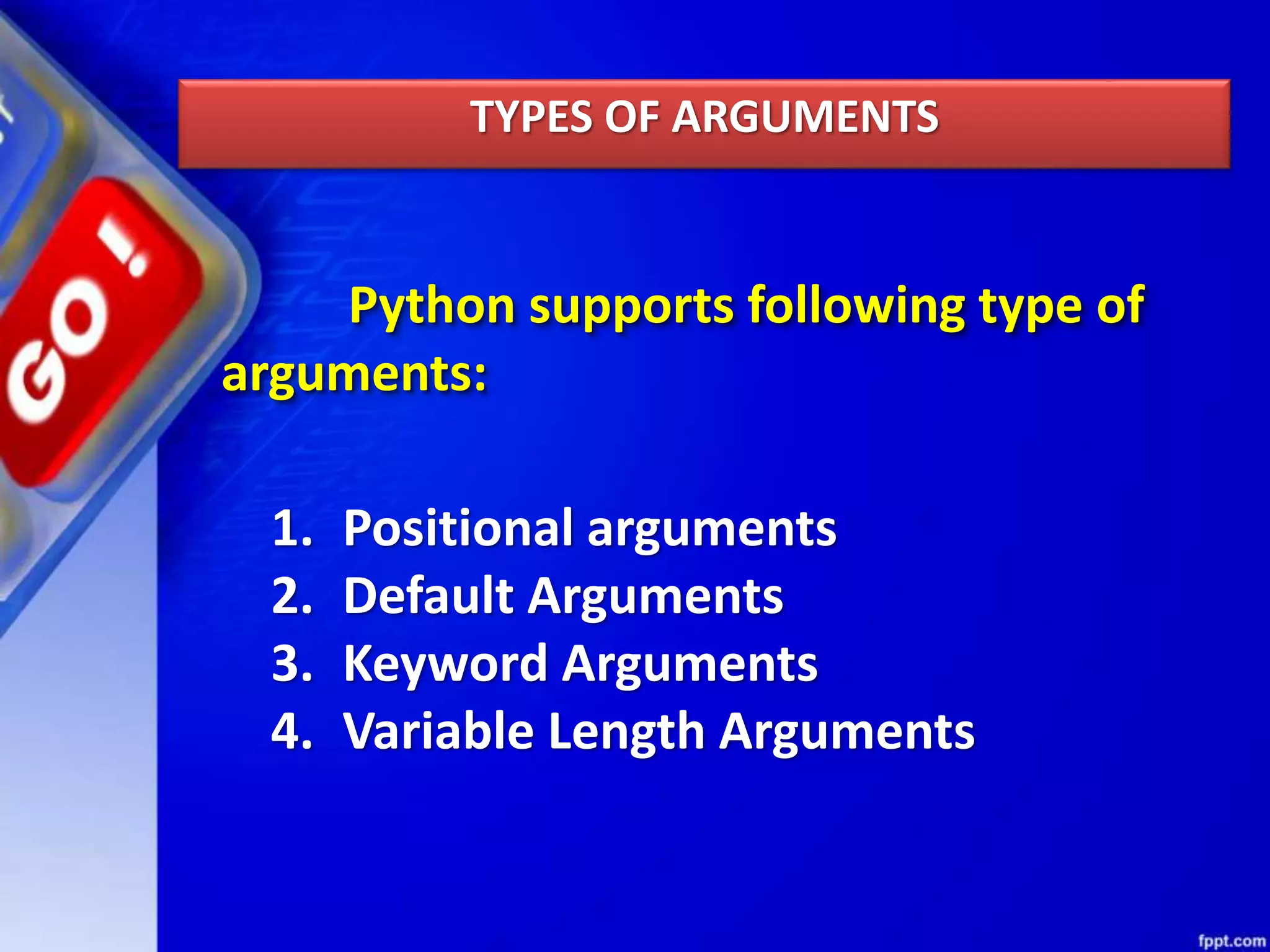
Python supports following type of
arguments:
TYPES OF ARGUMENTS
1. Positional arguments
2. Default Arguments
3. Keyword Arguments
4. Variable Length Arguments
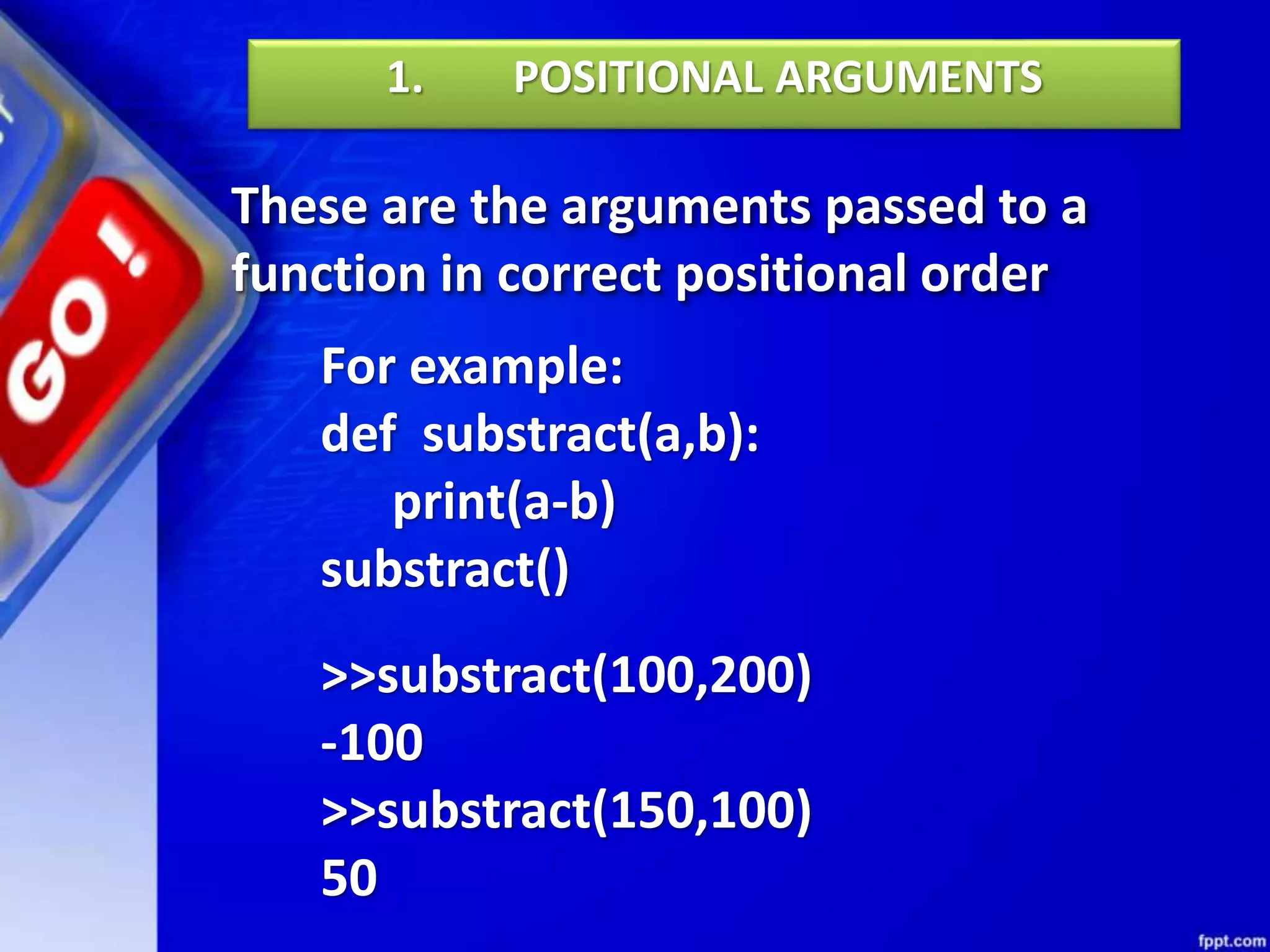
These are the arguments passed to a
function in correct positional order
1. POSITIONAL ARGUMENTS
For example:
def substract(a,b):
print(a-b)
substract()
>>substract(100,200)
-100
>>substract(150,100)
50
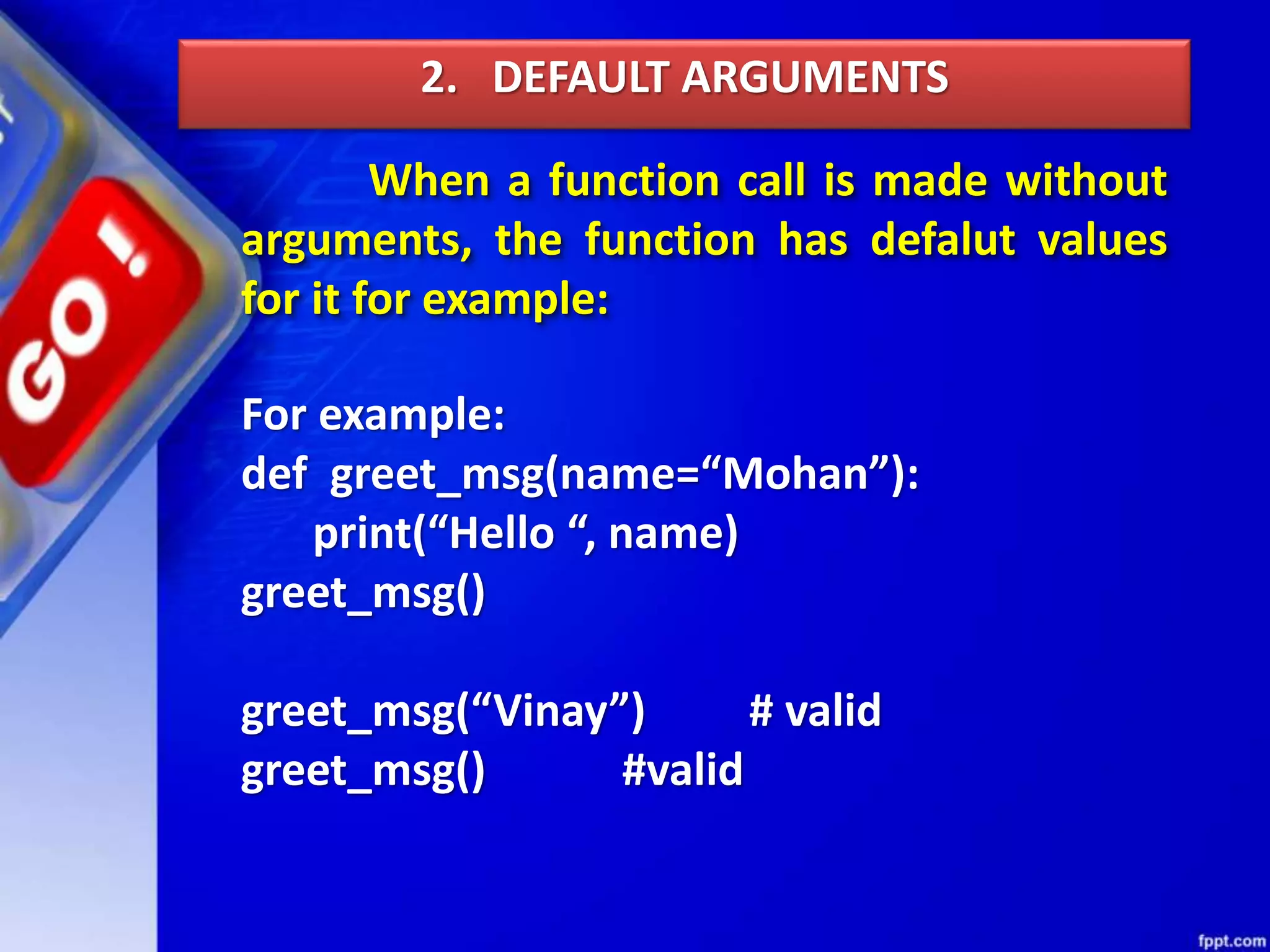
When a function call is made without
arguments, the function has defalut values
for it for example:
2. DEFAULT ARGUMENTS
For example:
def greet_msg(name=“Mohan”):
print(“Hello “, name)
greet_msg()
greet_msg(“Vinay”) # valid
greet_msg() #valid
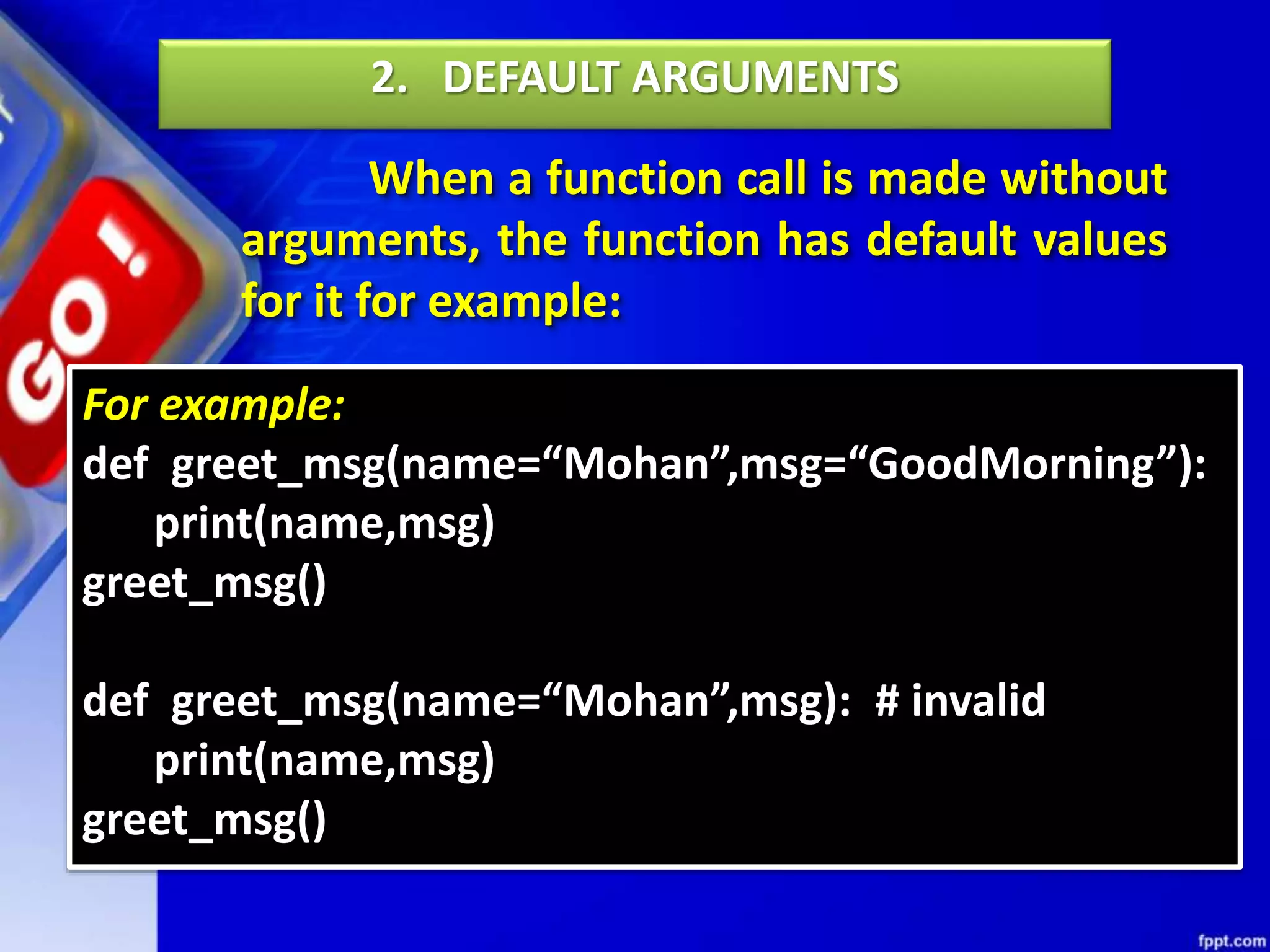
When a function call is made without
arguments, the function has default values
for it for example:
2. DEFAULT ARGUMENTS
For example:
def greet_msg(name=“Mohan”,msg=“GoodMorning”):
print(name,msg)
greet_msg()
def greet_msg(name=“Mohan”,msg): # invalid
print(name,msg)
greet_msg()
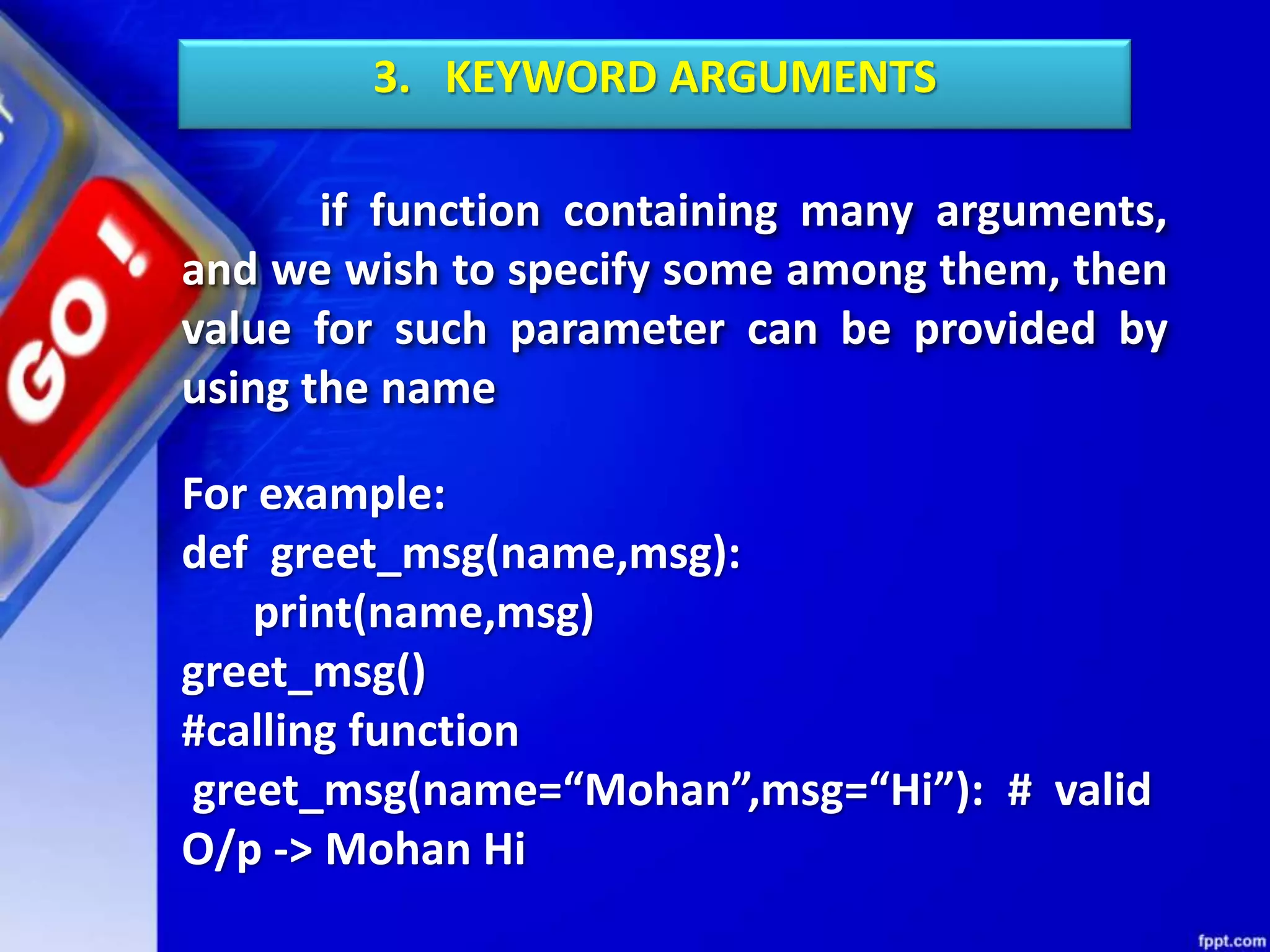
if function containing many arguments,
and we wish to specify some among them, then
value for such parameter can be provided by
using the name
3. KEYWORD ARGUMENTS
For example:
def greet_msg(name,msg):
print(name,msg)
greet_msg()
#calling function
greet_msg(name=“Mohan”,msg=“Hi”): # valid
O/p -> Mohan Hi
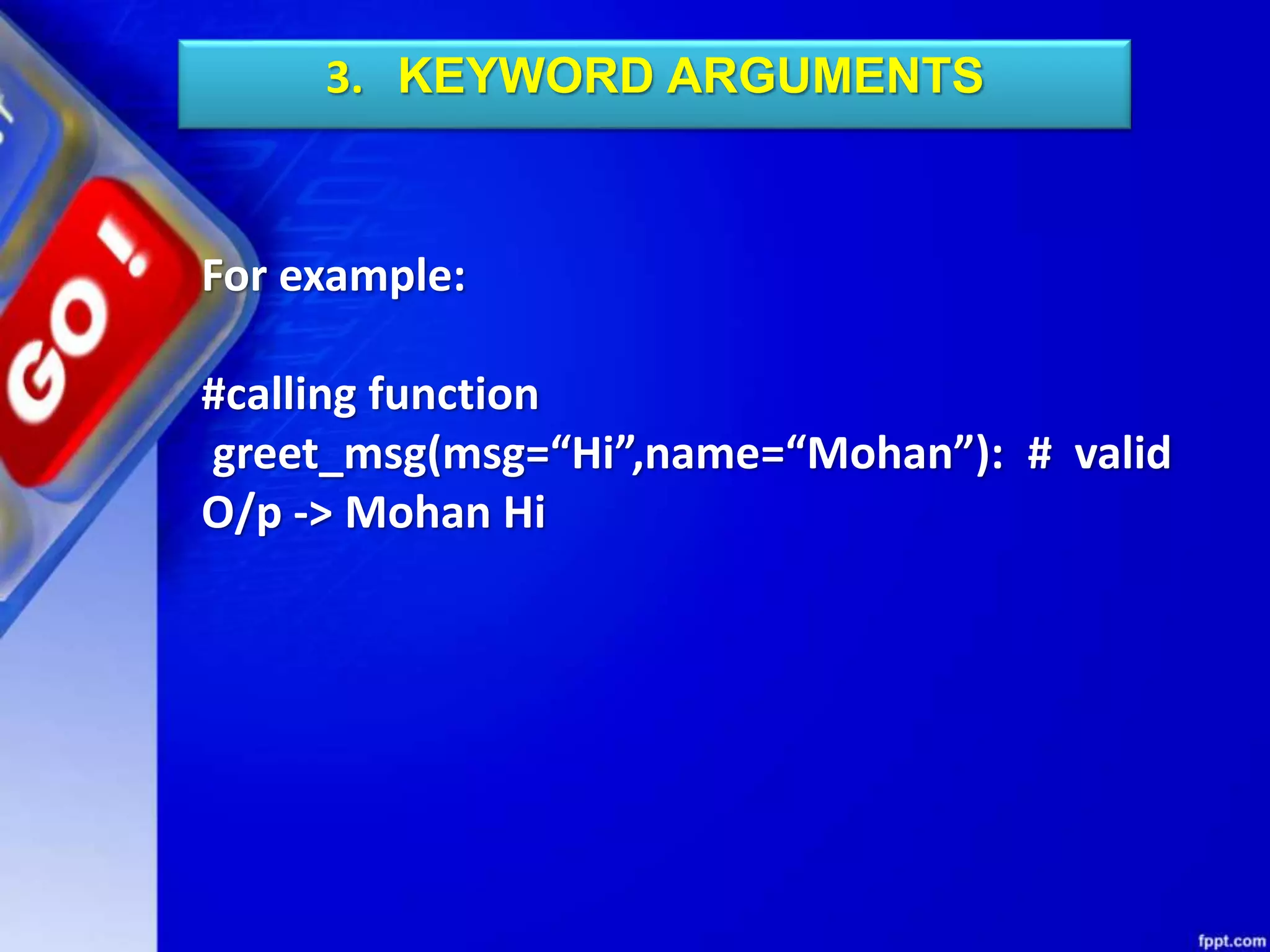
For example:
#calling function
greet_msg(msg=“Hi”,name=“Mohan”): # valid
O/p -> Mohan Hi
3. KEYWORD ARGUMENTS
4. VARIABLE LENGTH ARGUMENTS
In some situation one needs to pass as
many as argument to a function, python
provides a way to pass number of argument
to a function, such type of arguments are
called variable length arguments.
Variable length arguments are defined
with * symbol.
For Example: (next slide)
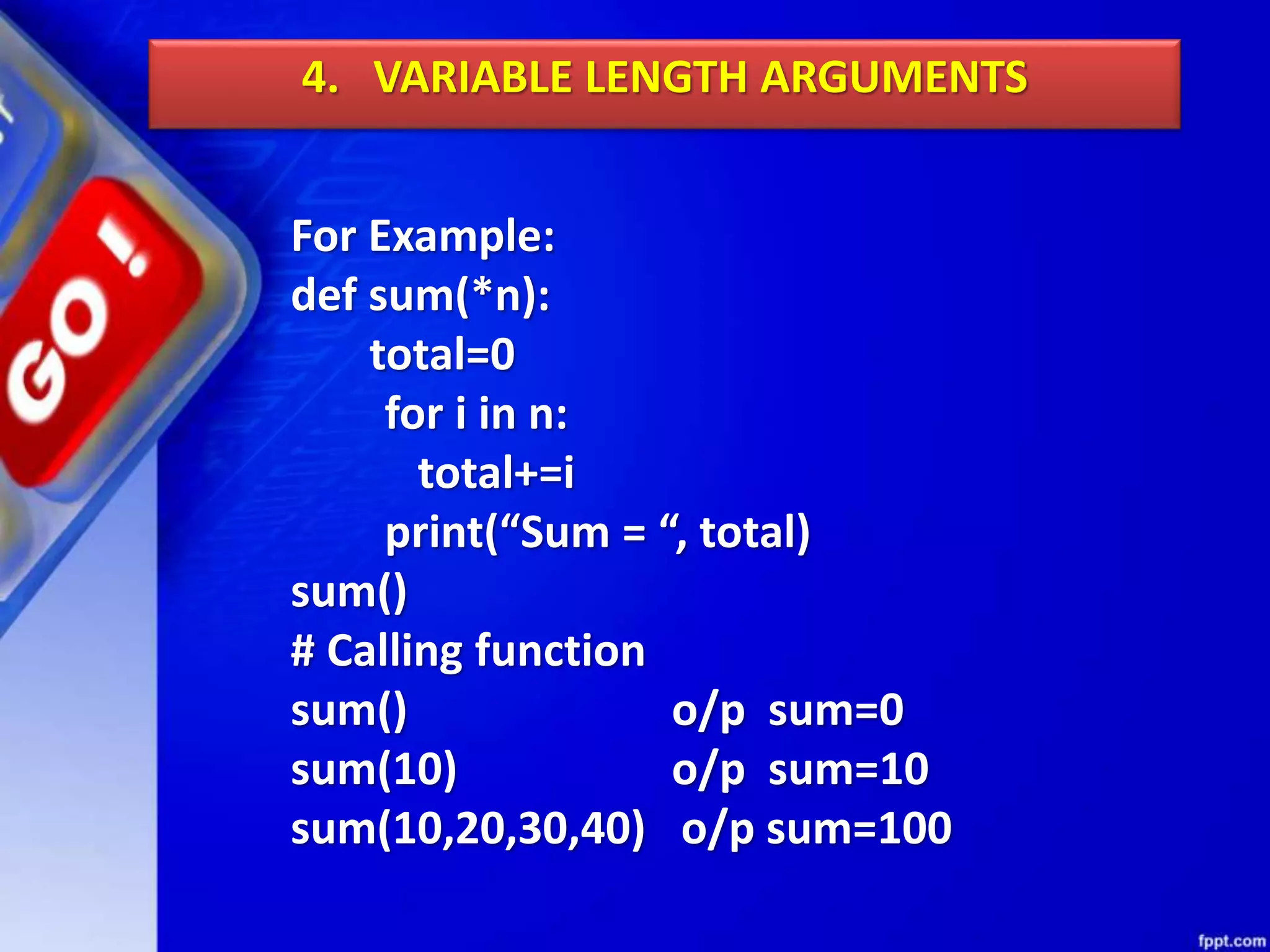
4. VARIABLE LENGTH ARGUMENTS
For Example:
def sum(*n):
total=0
for i in n:
total+=i
print(“Sum = “, total)
sum()
# Calling function
sum() o/p sum=0
sum(10) o/p sum=10
sum(10,20,30,40) o/p sum=100
PASSING ARRAYS/LISTS TO FUNCTIONS
Arrays in basic python are lists that contain
mixed data types and can be passed as an
argument to a function.
For Example: # Arithmetic mean of list
def list_avg(lst):
l=len(lst)
sum=0
for i in lst:
sum+=i
return sum/l
def main():
print(“Input integers”)
a=input()
a=a.split()
for i in range(len(a) ):
a[i]=int(a[i])
avg=list_ave(a)
print (“Average is = “, avg)
SCOPE OF VARIABLES
Scope mean measure of access of variable
or constants in a program. Generally there are
two types of scope of variables:
i) Global (Module)
ii) Local (Function)
i) Global variables are accessed throughout the
program their scope is global
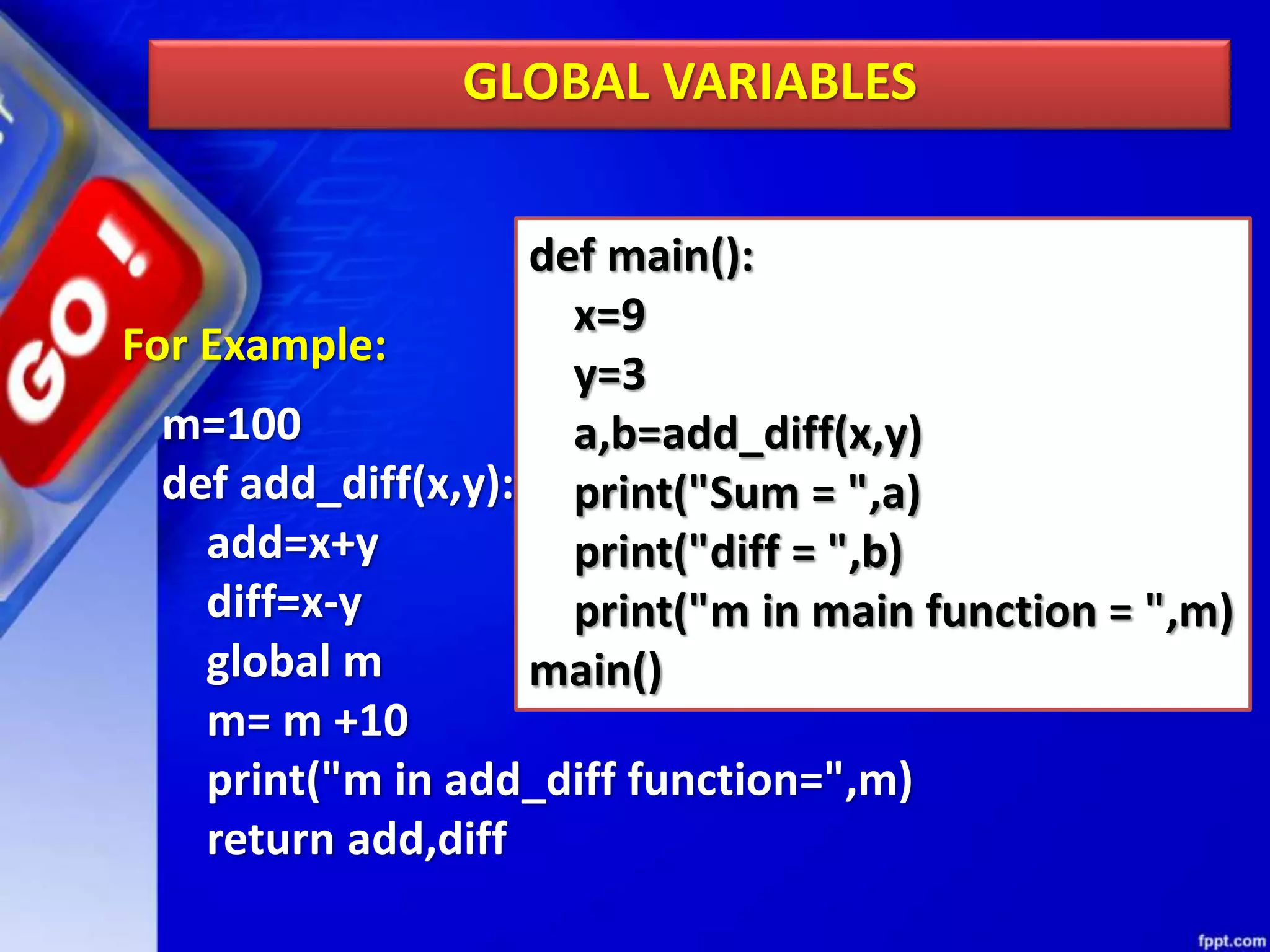
GLOBAL VARIABLES
For Example:
m=100
def add_diff(x,y):
add=x+y
diff=x-y
global m
m= m +10
print("m in add_diff function=",m)
return add,diff
def main():
x=9
y=3
a,b=add_diff(x,y)
print("Sum = ",a)
print("diff = ",b)
print("m in main function = ",m)
main()
RECURSION
A recursive function is a function that calls
itself until a “base condition” is true, and
execution stops. While false
Recursion in computer science is a method of
solving a problem where the solution depends
on solutions to smaller instances of the same
problem (as opposed to iteration). ...
Most computer programming languages
support recursion by allowing a function to
call itself from within its own code.
ADVANTAGES OF RECURSION
1. Recursive functions make the code look
clean and elegant.
2. A complex task can be broken down into
simpler sub-problems using recursion.
3. Sequence generation is easier with recursion
than using some nested iteration.
DISADVANTAGES OF RECURSION
1. Sometimes the logic behind recursion is
hard to follow through.
2. Recursive calls are expensive (inefficient)
as they take up a lot of memory and
time.
3. Recursive functions are hard to debug.
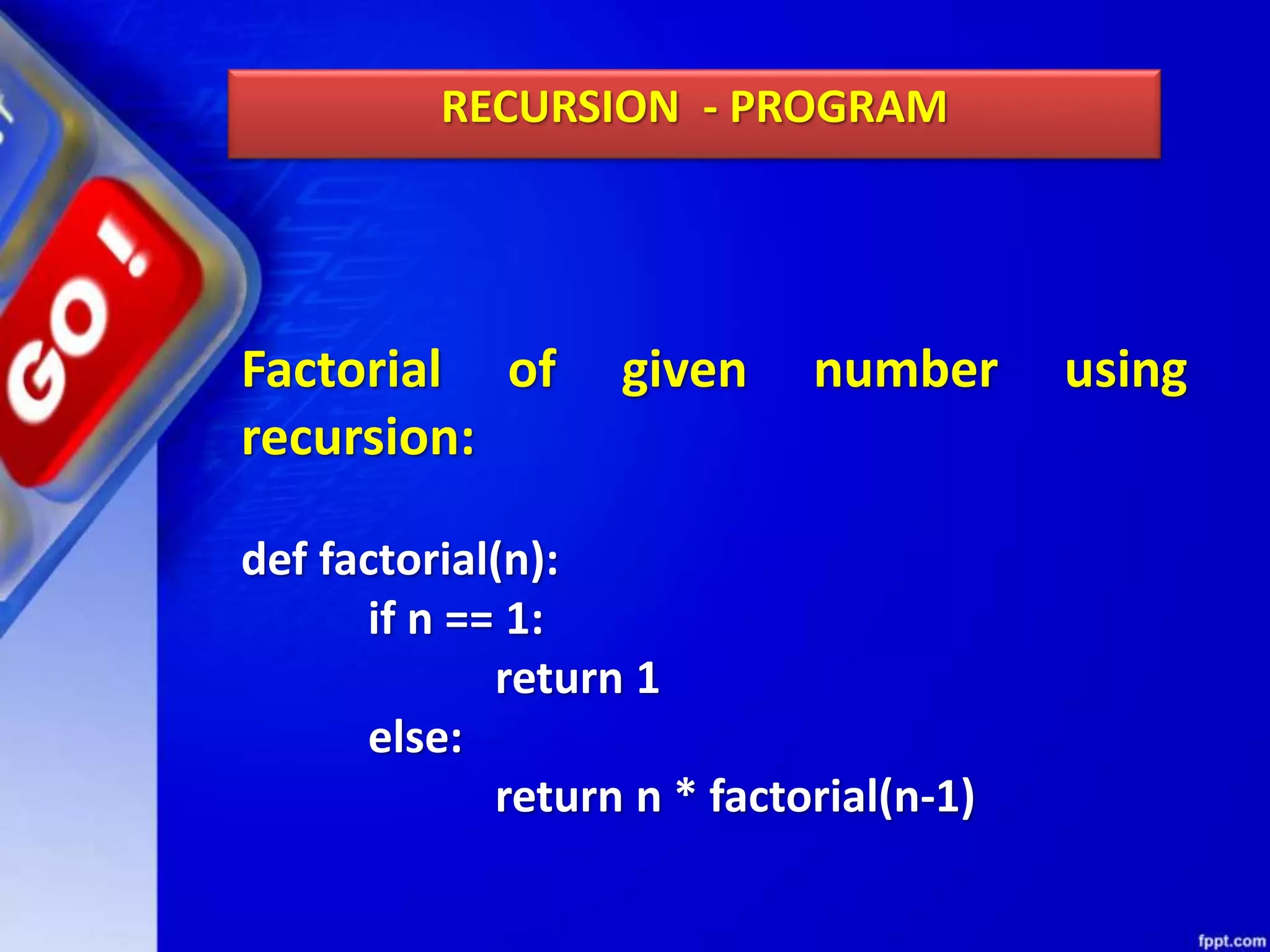
RECURSION - PROGRAM
Factorial of given number using
recursion:
def factorial(n):
if n == 1:
return 1
else:
return n * factorial(n-1)
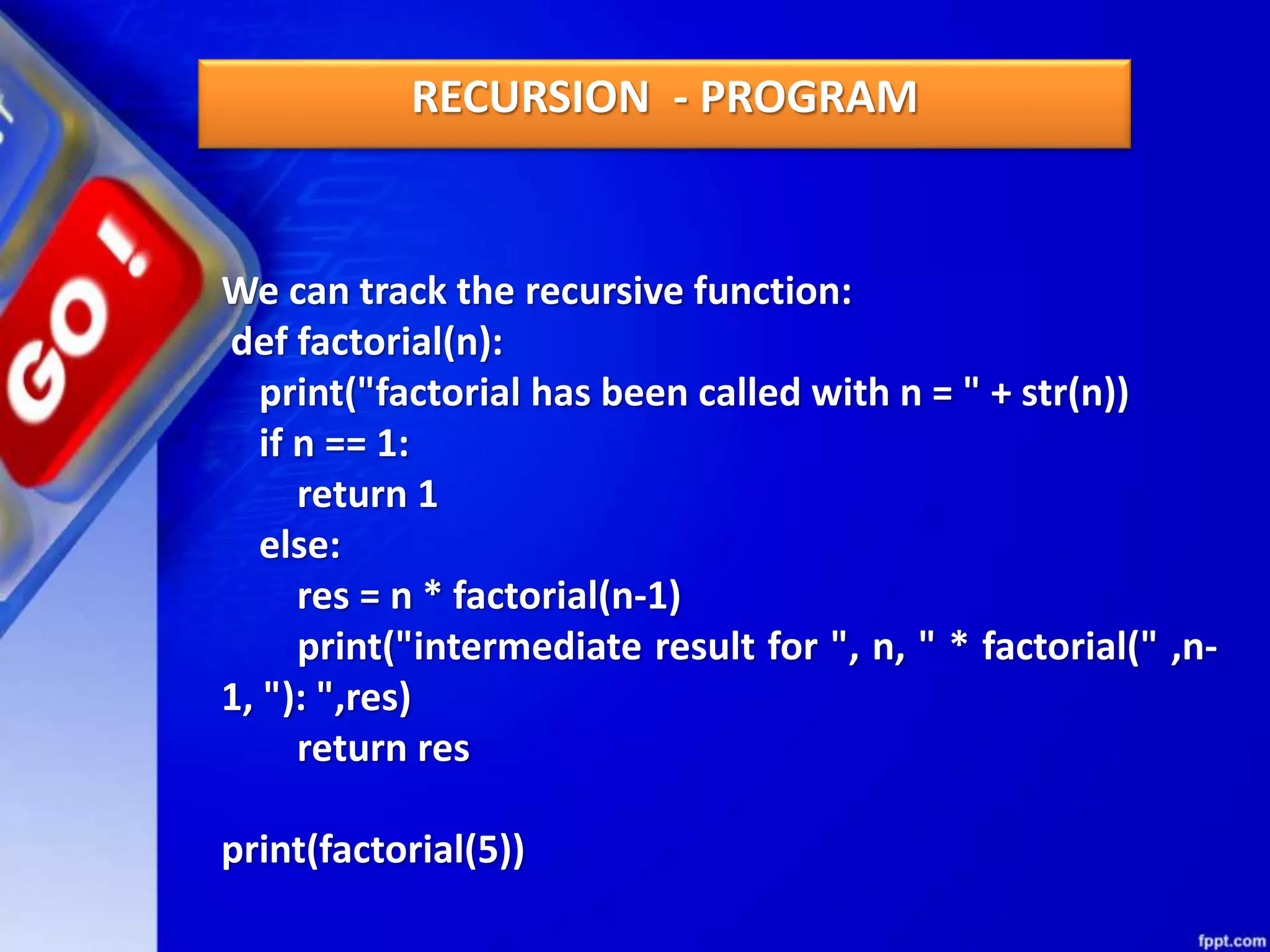
We can track the recursive function:
def factorial(n):
print("factorial has been called with n = " + str(n))
if n == 1:
return 1
else:
res = n * factorial(n-1)
print("intermediate result for ", n, " * factorial(" ,n-
1, "): ",res)
return res
print(factorial(5))
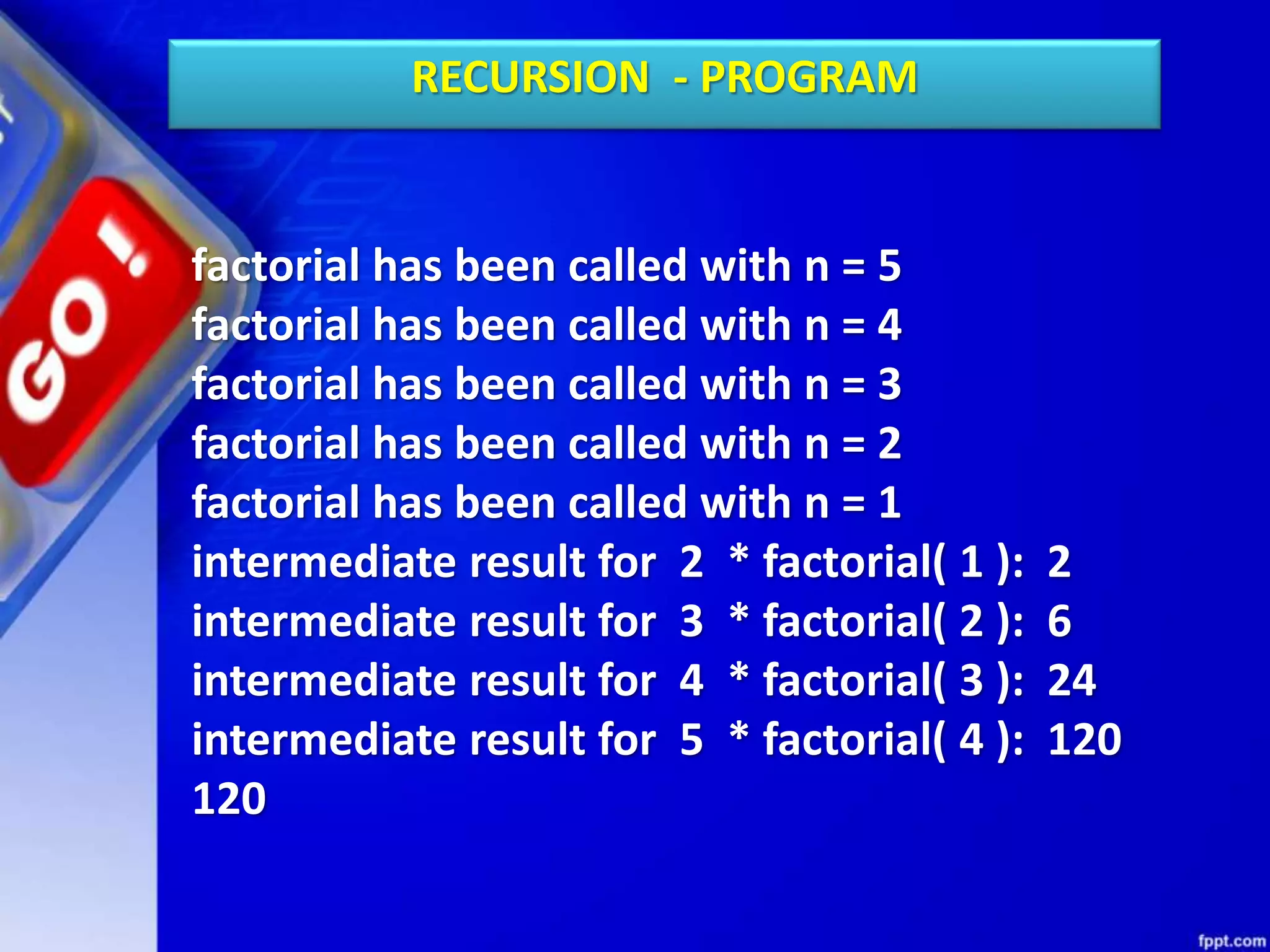
RECURSION - PROGRAM
factorial has been called with n = 5
factorial has been called with n = 4
factorial has been called with n = 3
factorial has been called with n = 2
factorial has been called with n = 1
intermediate result for 2 * factorial( 1 ): 2
intermediate result for 3 * factorial( 2 ): 6
intermediate result for 4 * factorial( 3 ): 24
intermediate result for 5 * factorial( 4 ): 120
120
RECURSION - PROGRAM
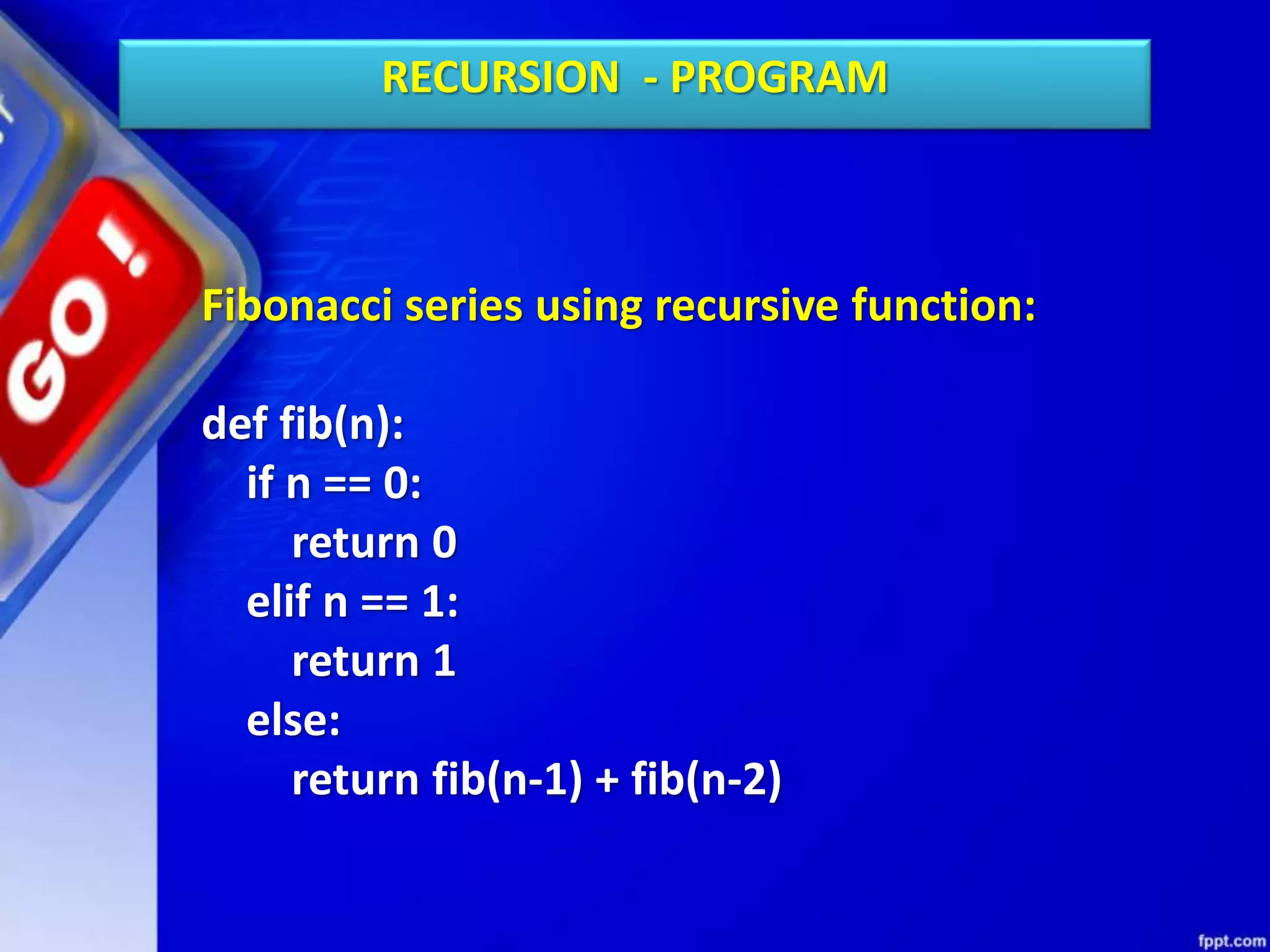
Fibonacci series using recursive function:
def fib(n):
if n == 0:
return 0
elif n == 1:
return 1
else:
return fib(n-1) + fib(n-2)
RECURSION - PROGRAM
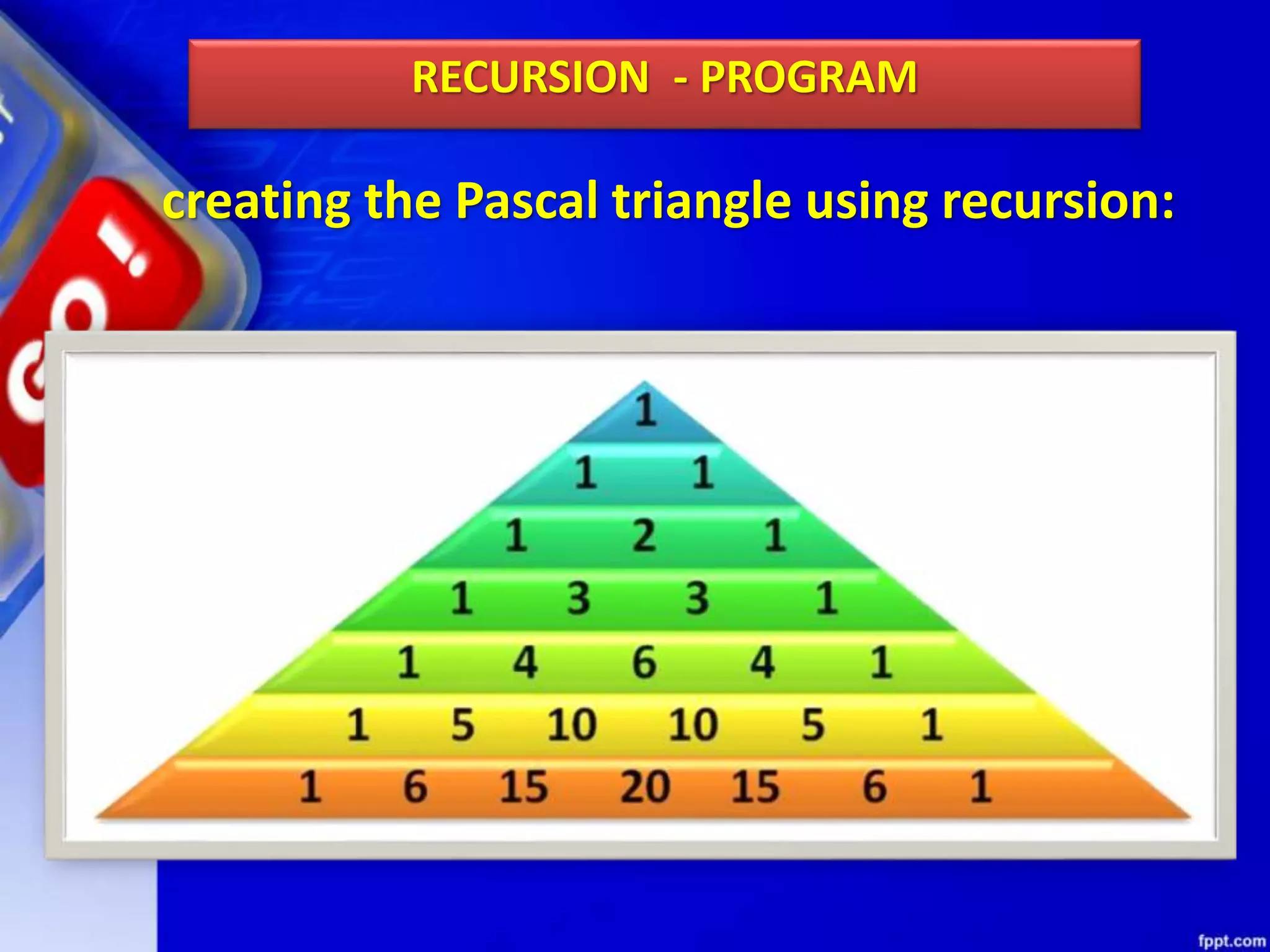
creating the Pascal triangle using recursion:
RECURSION - PROGRAM
creating the Pascal triangle using recursion:
RECURSION - PROGRAM
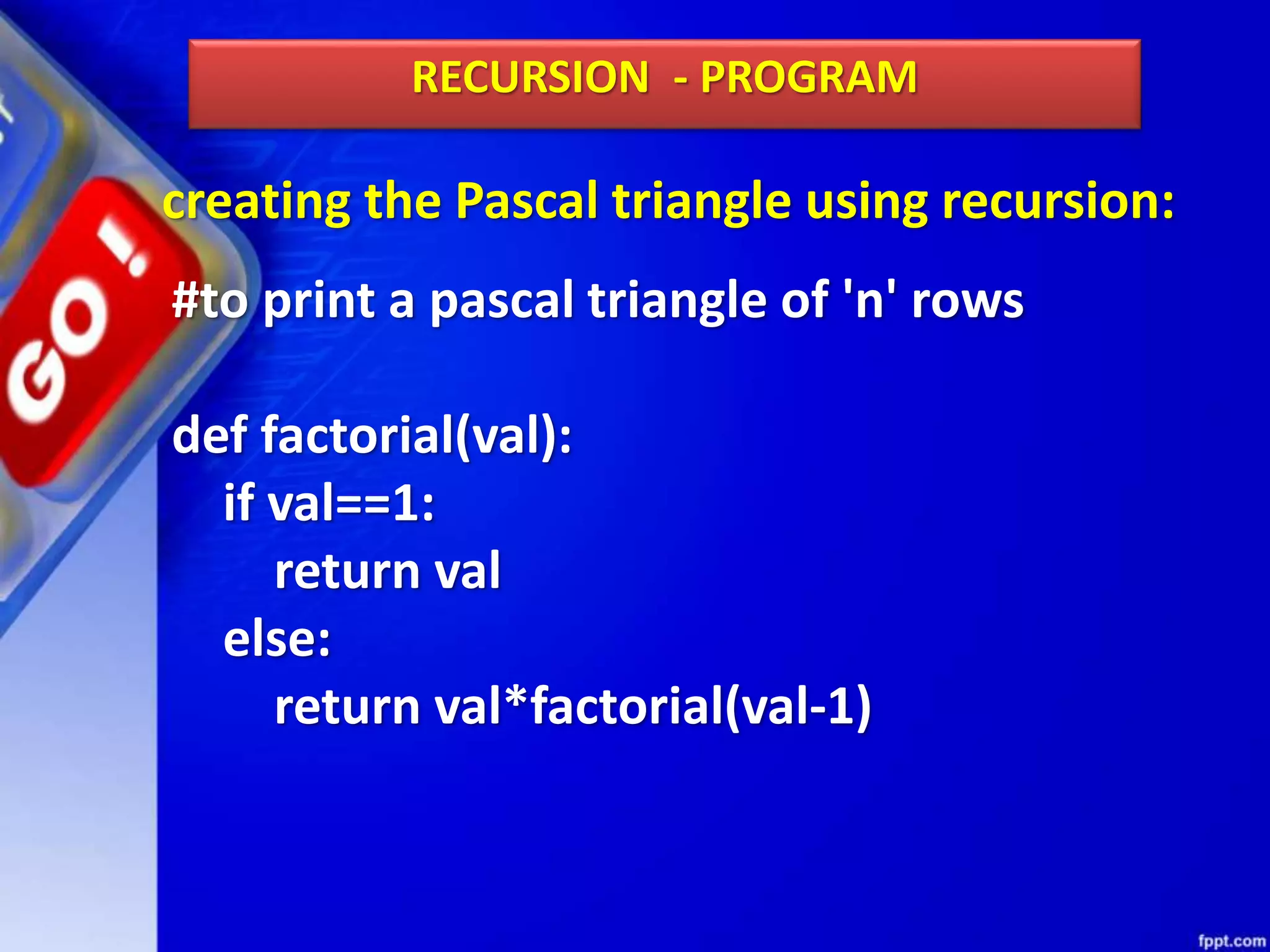
#to print a pascal triangle of 'n' rows
def factorial(val):
if val==1:
return val
else:
return val*factorial(val-1)
creating the Pascal triangle using recursion:
RECURSION - PROGRAM
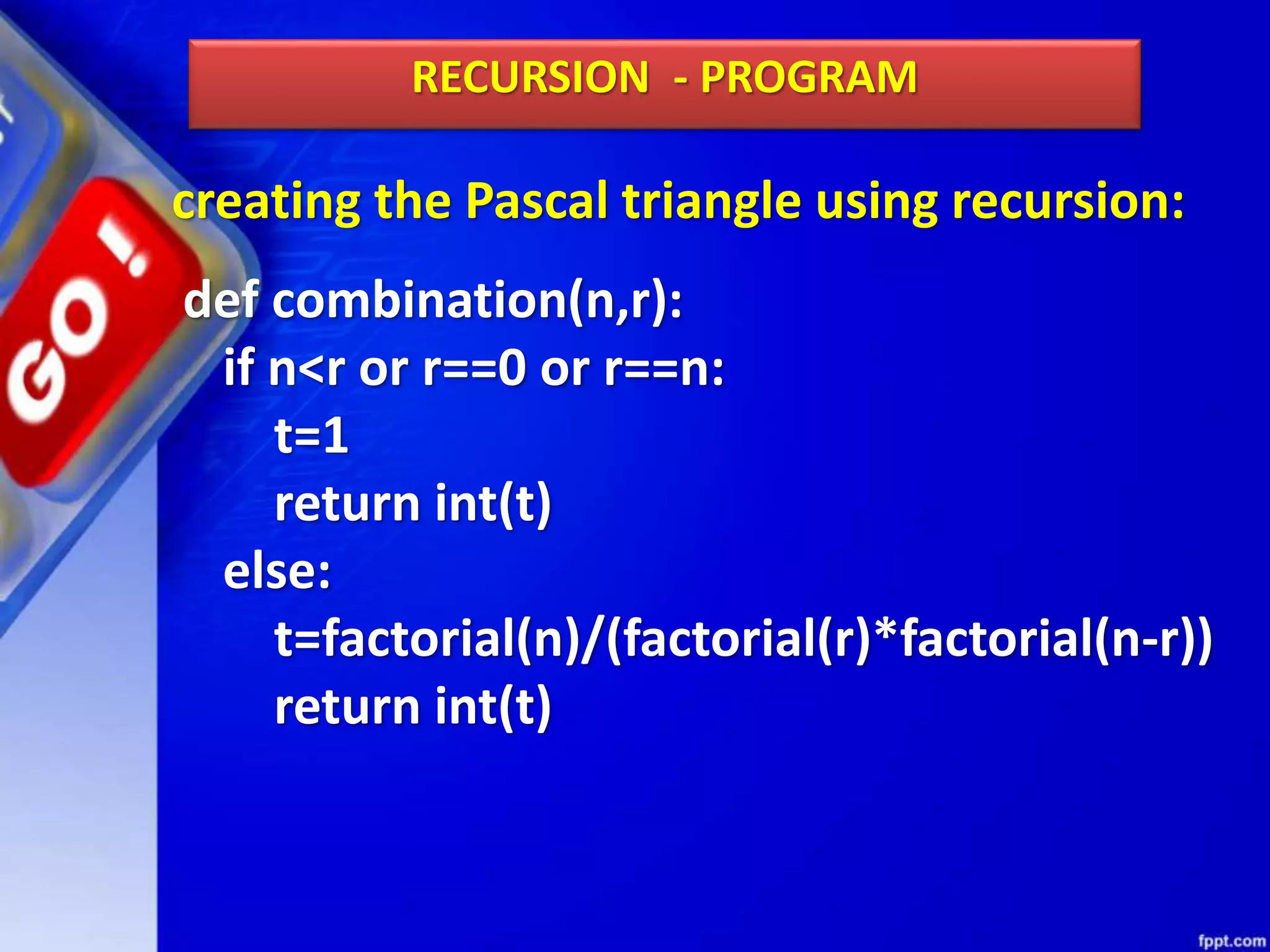
def combination(n,r):
if n<r or r==0 or r==n:
t=1
return int(t)
else:
t=factorial(n)/(factorial(r)*factorial(n-r))
return int(t)
creating the Pascal triangle using recursion:
RECURSION - PROGRAM
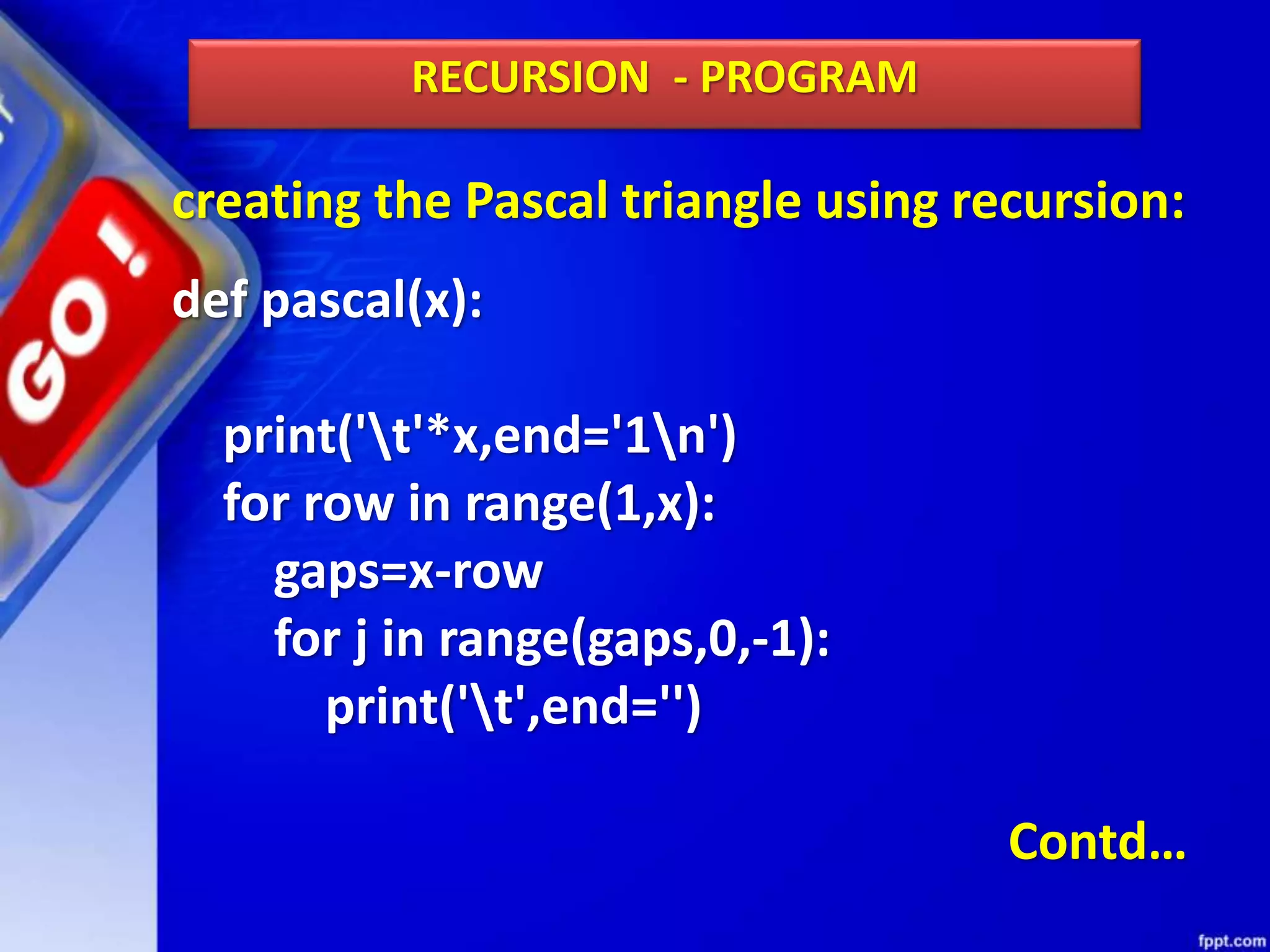
def pascal(x):
print('t'*x,end='1n')
for row in range(1,x):
gaps=x-row
for j in range(gaps,0,-1):
print('t',end='')
Contd…
creating the Pascal triangle using recursion:
RECURSION - PROGRAM
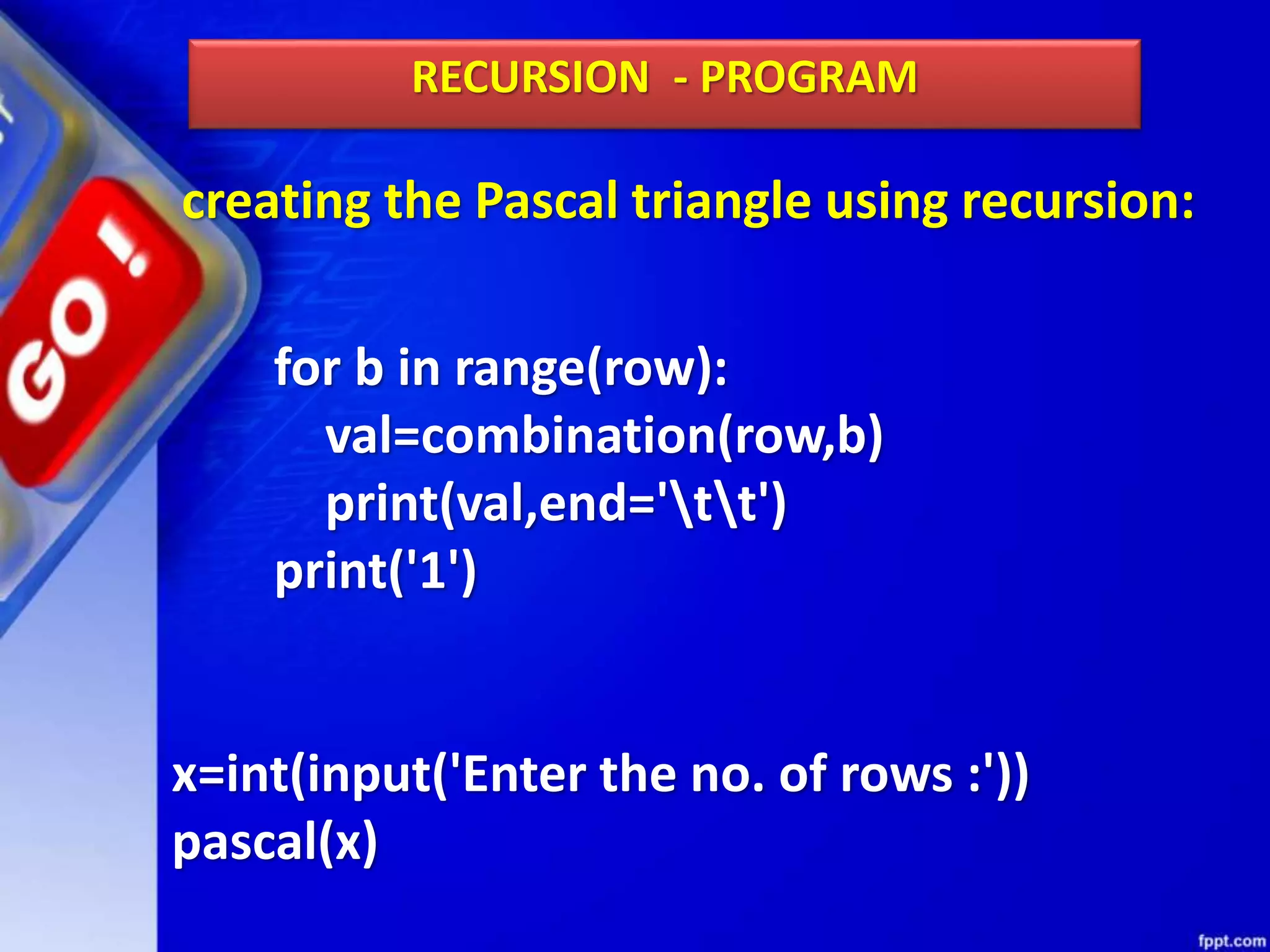
for b in range(row):
val=combination(row,b)
print(val,end='tt')
print('1')
x=int(input('Enter the no. of rows :'))
pascal(x)
Tower of Hanoi Python Program
RECURSION - PROGRAM
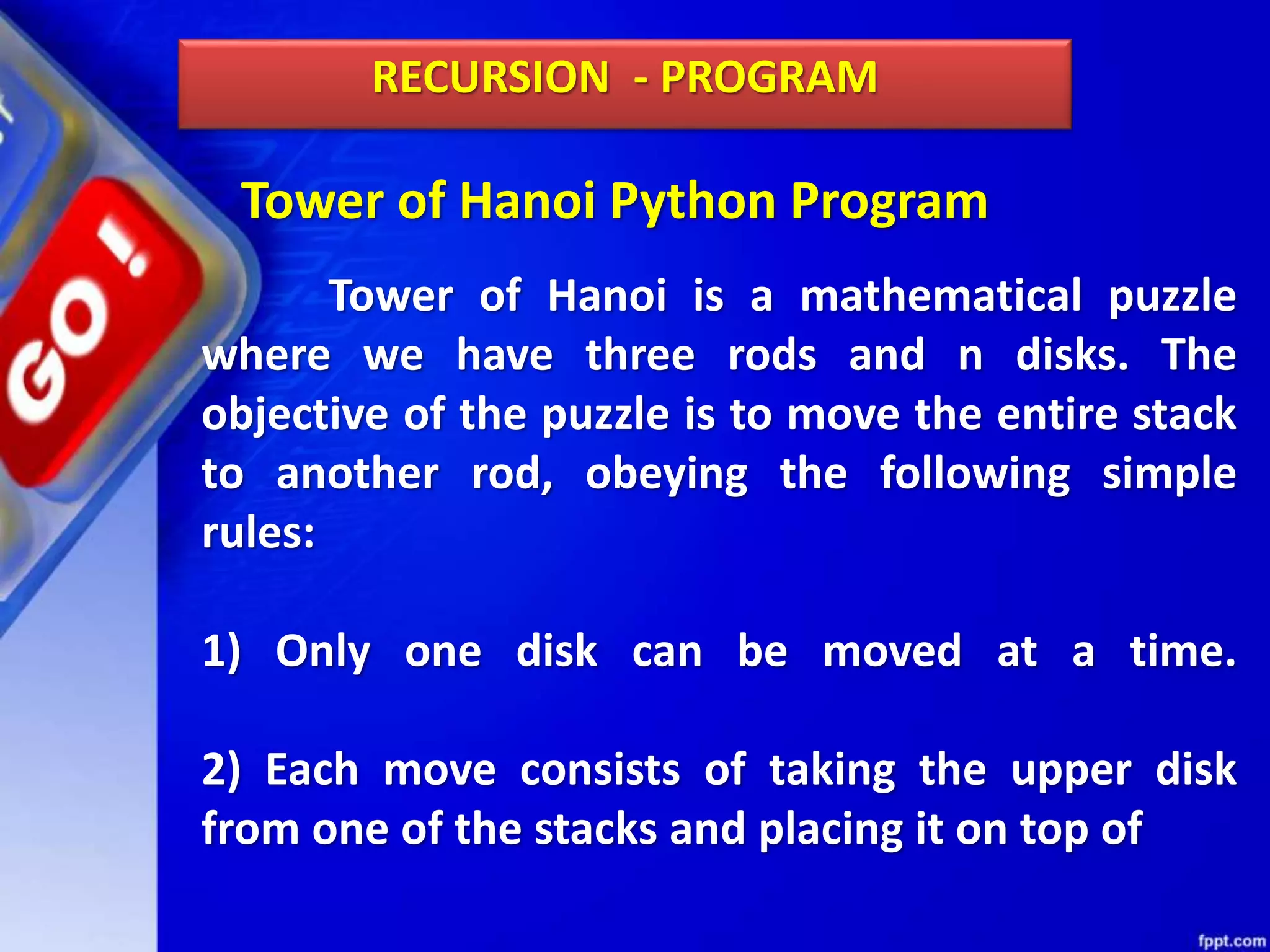
Tower of Hanoi is a mathematical puzzle
where we have three rods and n disks. The
objective of the puzzle is to move the entire stack
to another rod, obeying the following simple
rules:
1) Only one disk can be moved at a time.
2) Each move consists of taking the upper disk
from one of the stacks and placing it on top of
Tower of Hanoi Python Program
RECURSION - PROGRAM
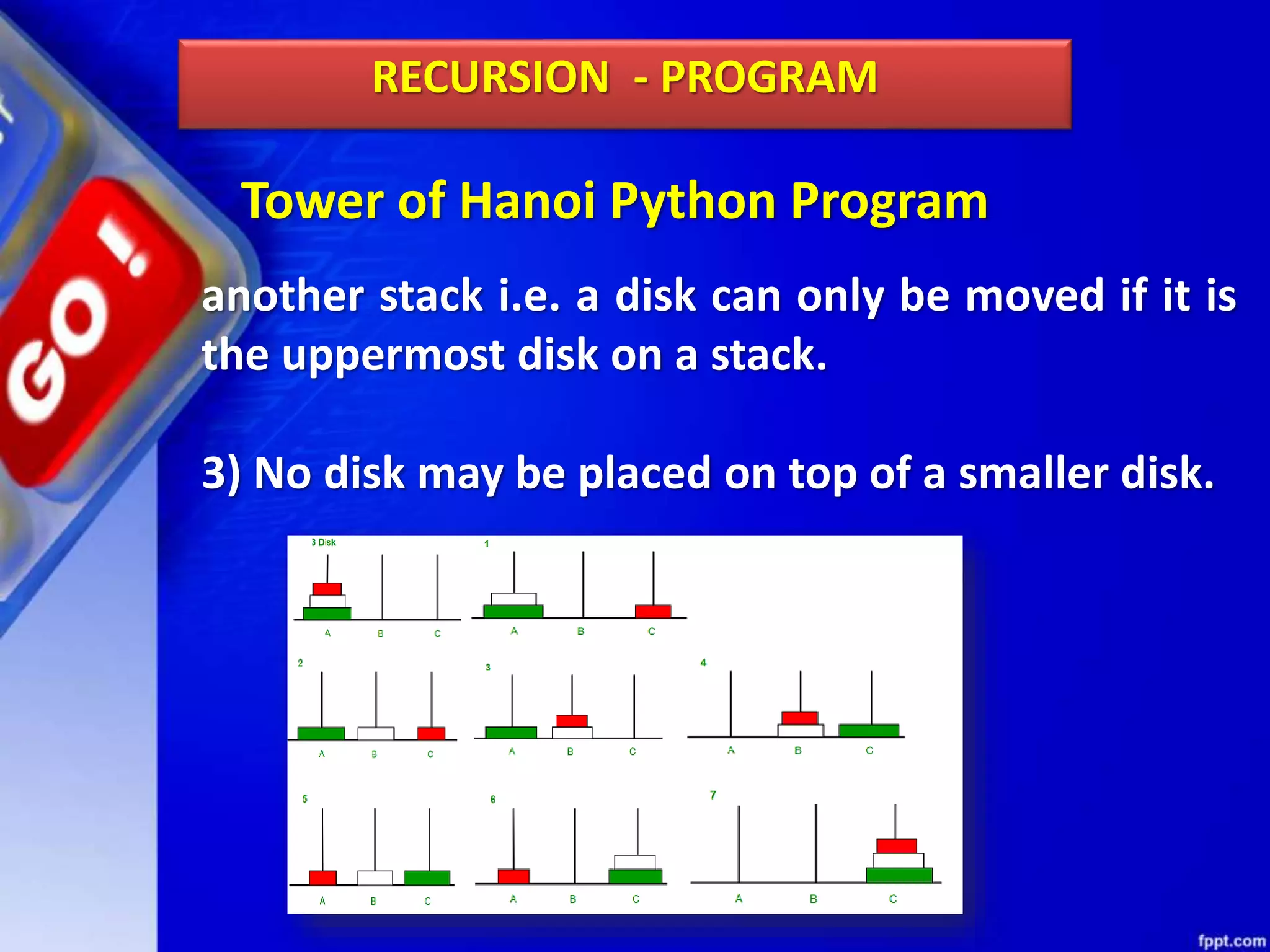
another stack i.e. a disk can only be moved if it is
the uppermost disk on a stack.
3) No disk may be placed on top of a smaller disk.
Tower of Hanoi Python Program
RECURSION - PROGRAM
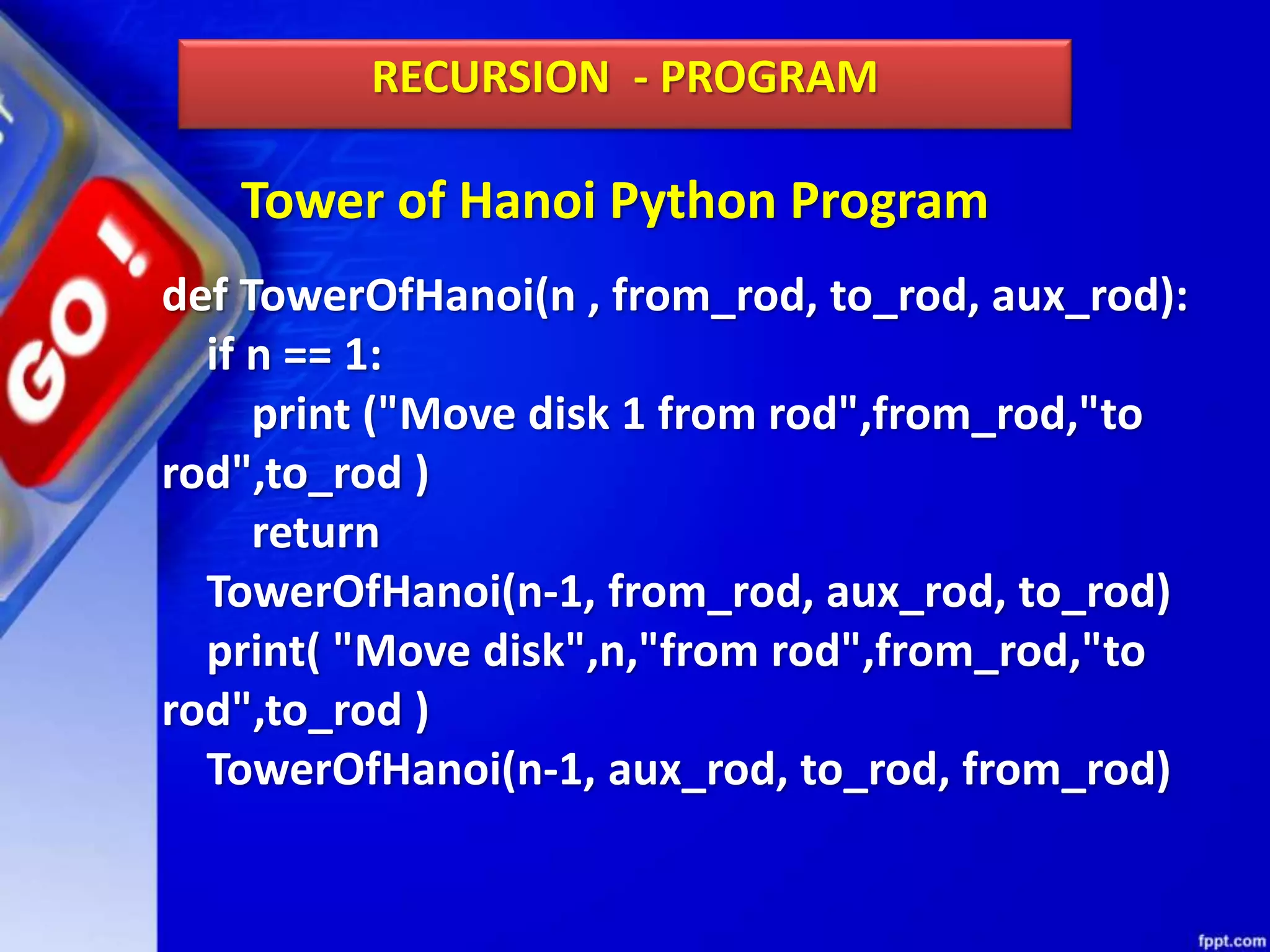
def TowerOfHanoi(n , from_rod, to_rod, aux_rod):
if n == 1:
print ("Move disk 1 from rod",from_rod,"to
rod",to_rod )
return
TowerOfHanoi(n-1, from_rod, aux_rod, to_rod)
print( "Move disk",n,"from rod",from_rod,"to
rod",to_rod )
TowerOfHanoi(n-1, aux_rod, to_rod, from_rod)
Tower of Hanoi Python Program
RECURSION - PROGRAM
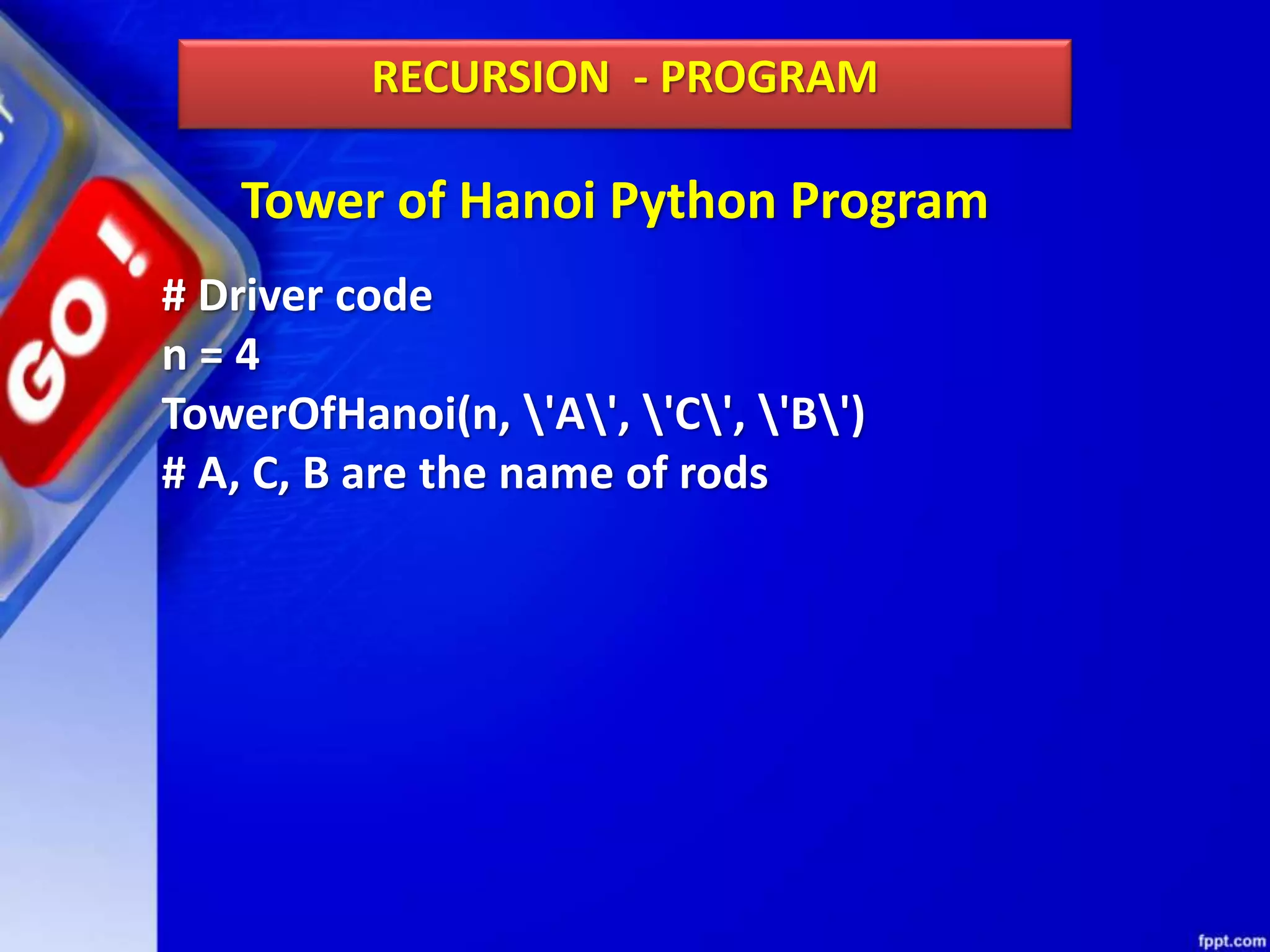
# Driver code
n = 4
TowerOfHanoi(n, 'A', 'C', 'B')
# A, C, B are the name of rods
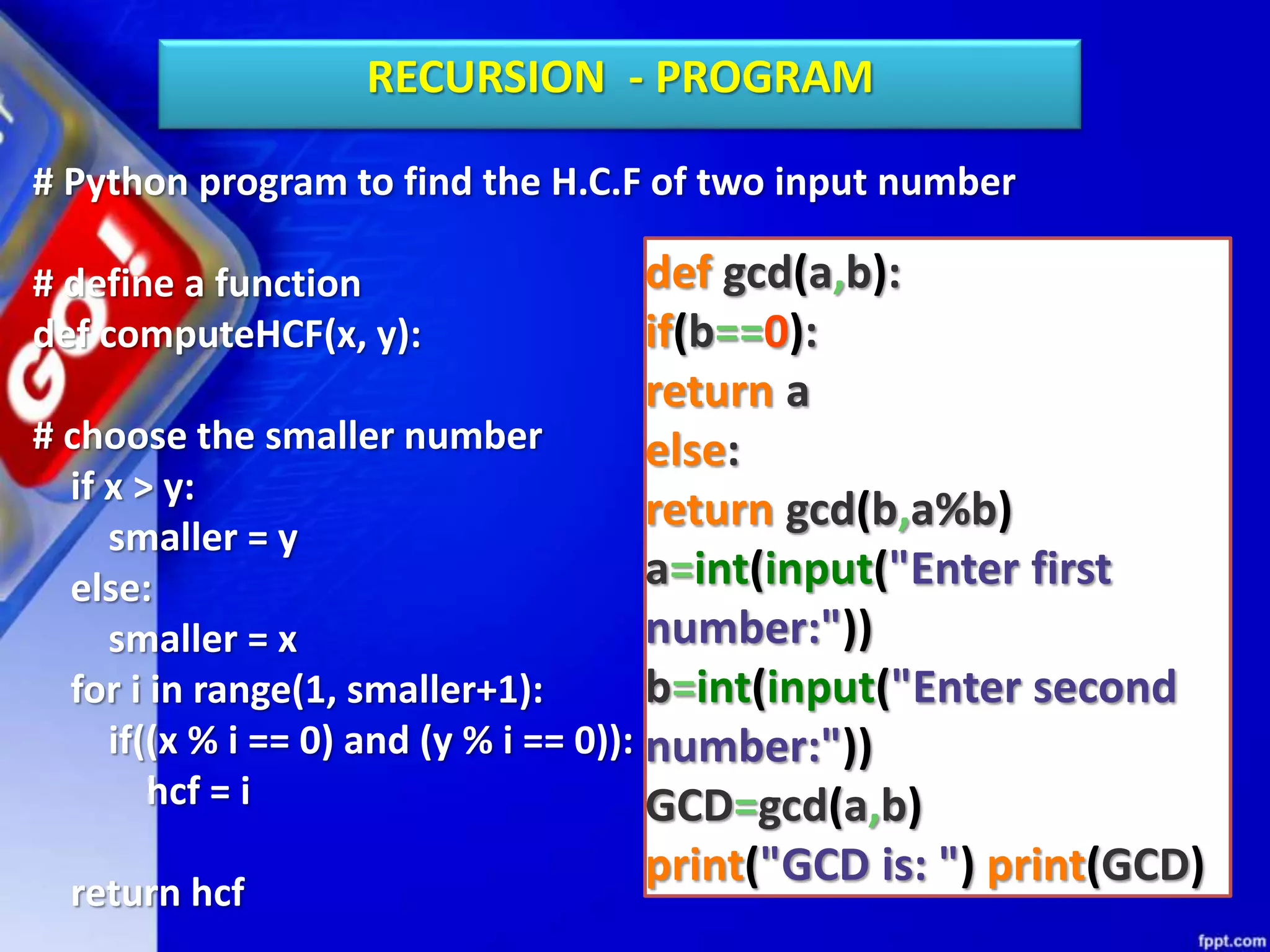
# Python program to find the H.C.F of two input number
# define a function
def computeHCF(x, y):
# choose the smaller number
if x > y:
smaller = y
else:
smaller = x
for i in range(1, smaller+1):
if((x % i == 0) and (y % i == 0)):
hcf = i
return hcf
RECURSION - PROGRAM
def gcd(a,b):
if(b==0):
return a
else:
return gcd(b,a%b)
a=int(input("Enter first
number:"))
b=int(input("Enter second
number:"))
GCD=gcd(a,b)
print("GCD is: ") print(GCD)
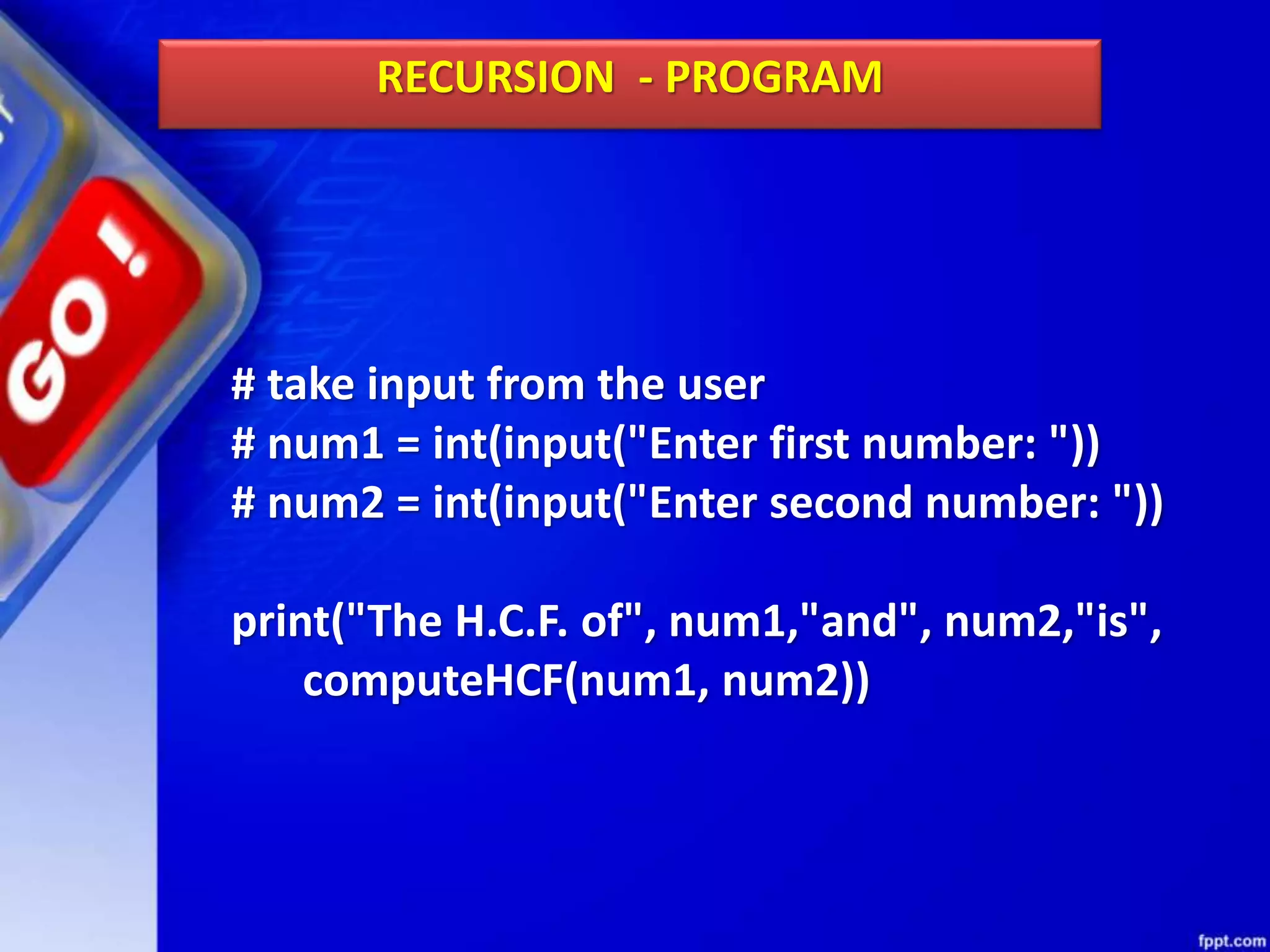
# take input from the user
# num1 = int(input("Enter first number: "))
# num2 = int(input("Enter second number: "))
print("The H.C.F. of", num1,"and", num2,"is",
computeHCF(num1, num2))
RECURSION - PROGRAM
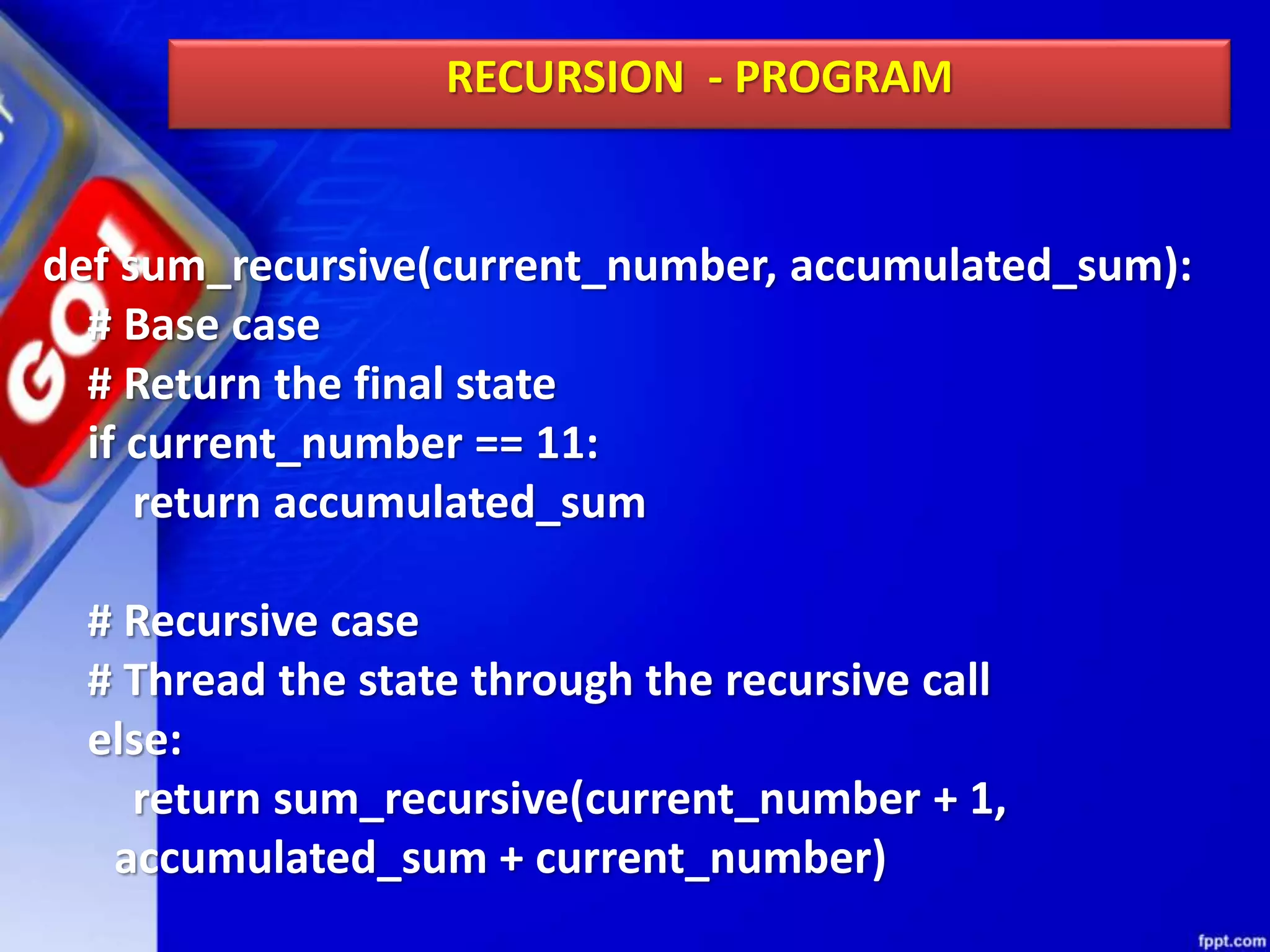
def sum_recursive(current_number, accumulated_sum):
# Base case
# Return the final state
if current_number == 11:
return accumulated_sum
# Recursive case
# Thread the state through the recursive call
else:
return sum_recursive(current_number + 1,
accumulated_sum + current_number)
RECURSION - PROGRAM
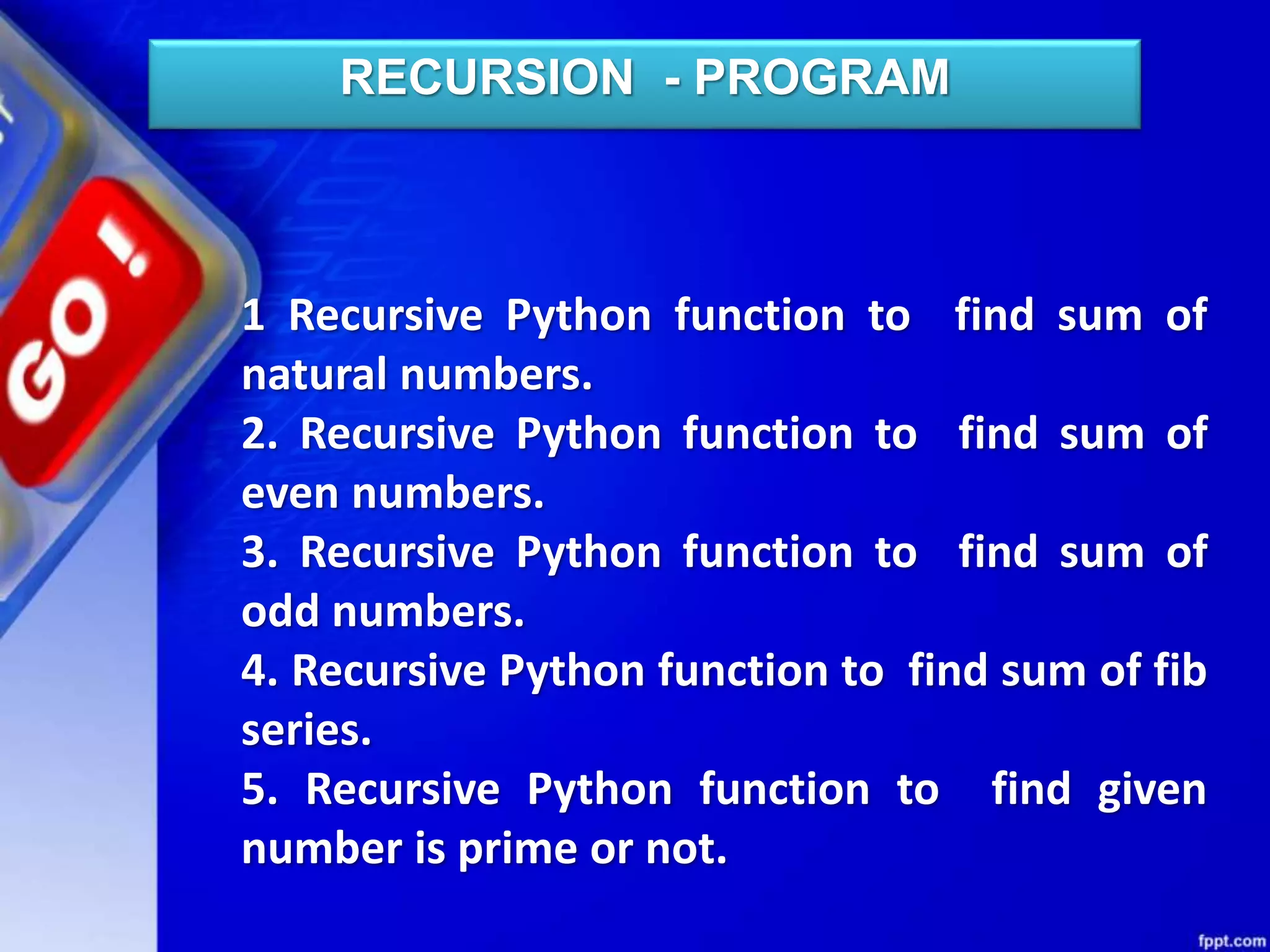
1 Recursive Python function to find sum of
natural numbers.
2. Recursive Python function to find sum of
even numbers.
3. Recursive Python function to find sum of
odd numbers.
4. Recursive Python function to find sum of fib
series.
5. Recursive Python function to find given
number is prime or not.
RECURSION - PROGRAM
Class Test
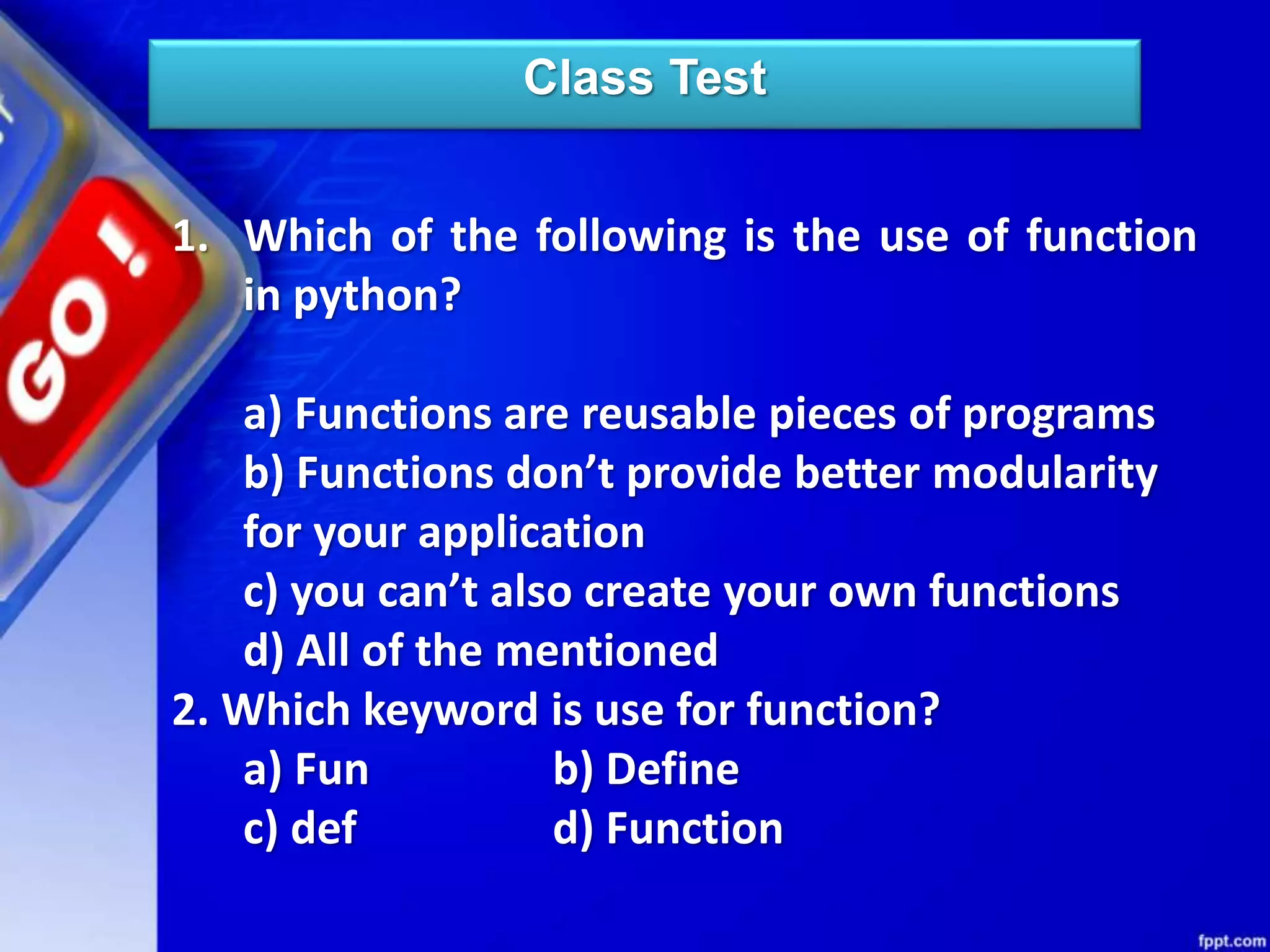
1. Which of the following is the use of function
in python?
a) Functions are reusable pieces of programs
b) Functions don’t provide better modularity
for your application
c) you can’t also create your own functions
d) All of the mentioned
2. Which keyword is use for function?
a) Fun b) Define
c) def d) Function
Class Test
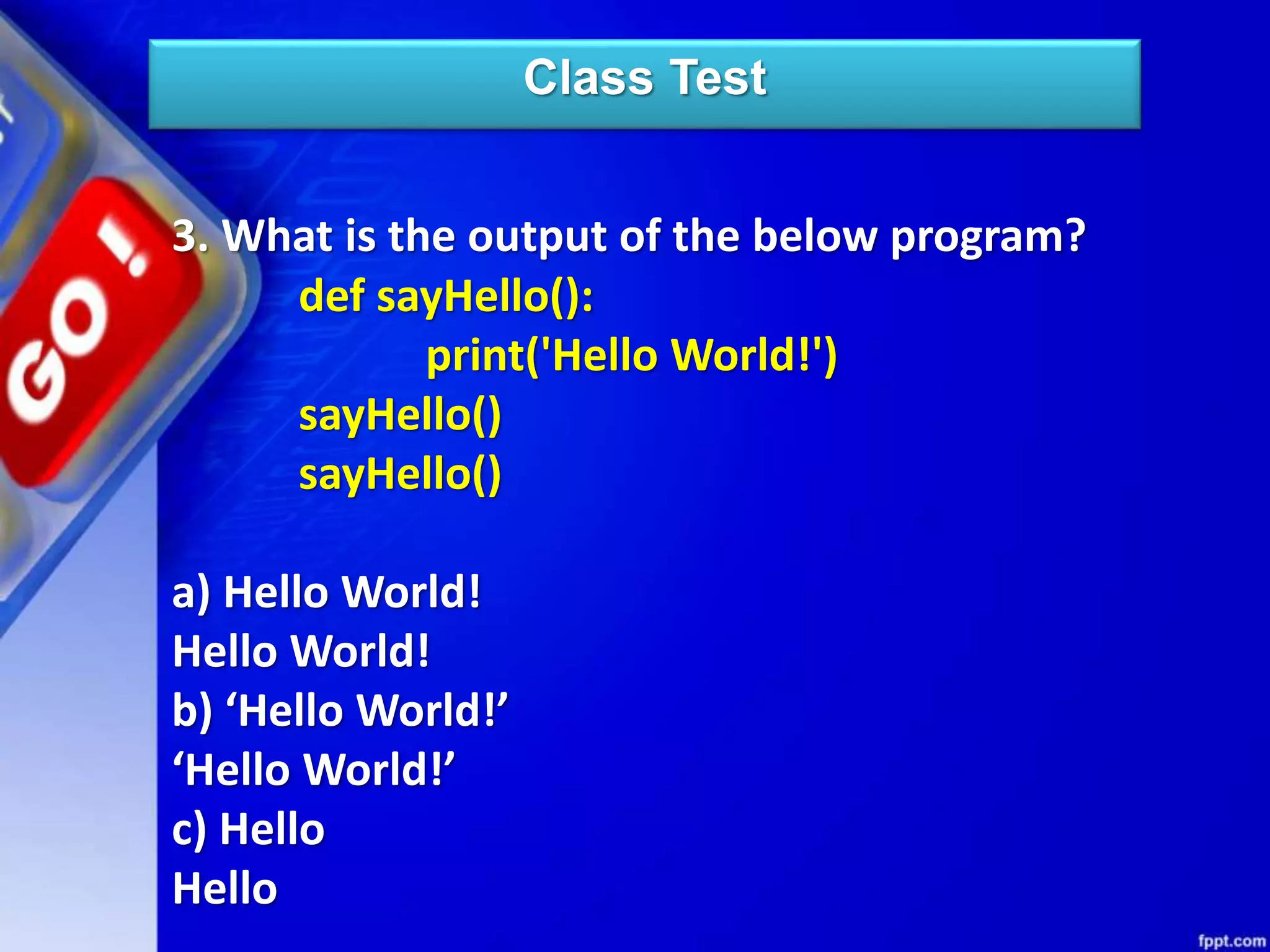
3. What is the output of the below program?
def sayHello():
print('Hello World!')
sayHello()
sayHello()
a) Hello World!
Hello World!
b) ‘Hello World!’
‘Hello World!’
c) Hello
Hello
Class Test
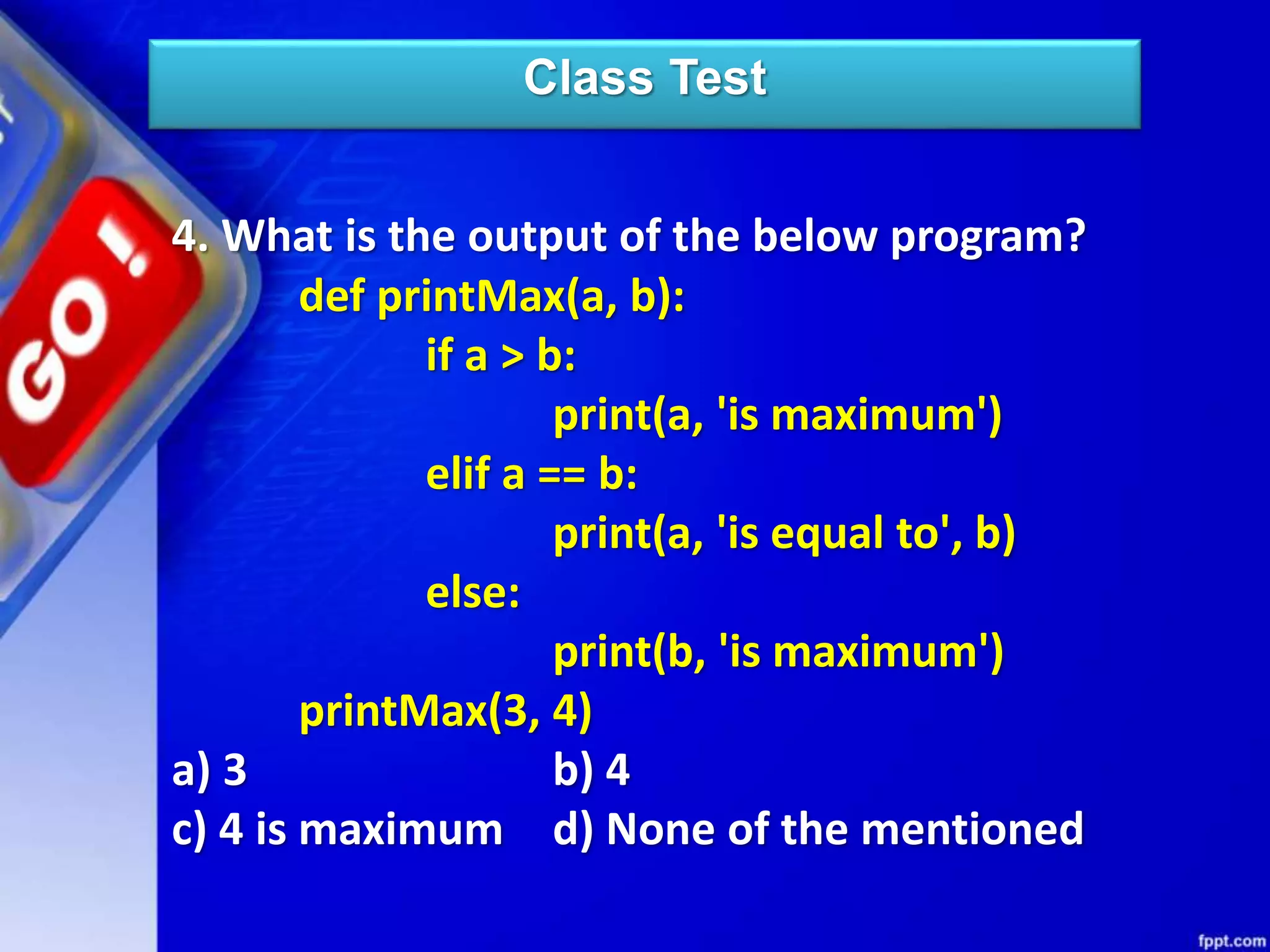
4. What is the output of the below program?
def printMax(a, b):
if a > b:
print(a, 'is maximum')
elif a == b:
print(a, 'is equal to', b)
else:
print(b, 'is maximum')
printMax(3, 4)
a) 3 b) 4
c) 4 is maximum d) None of the mentioned
Class Test
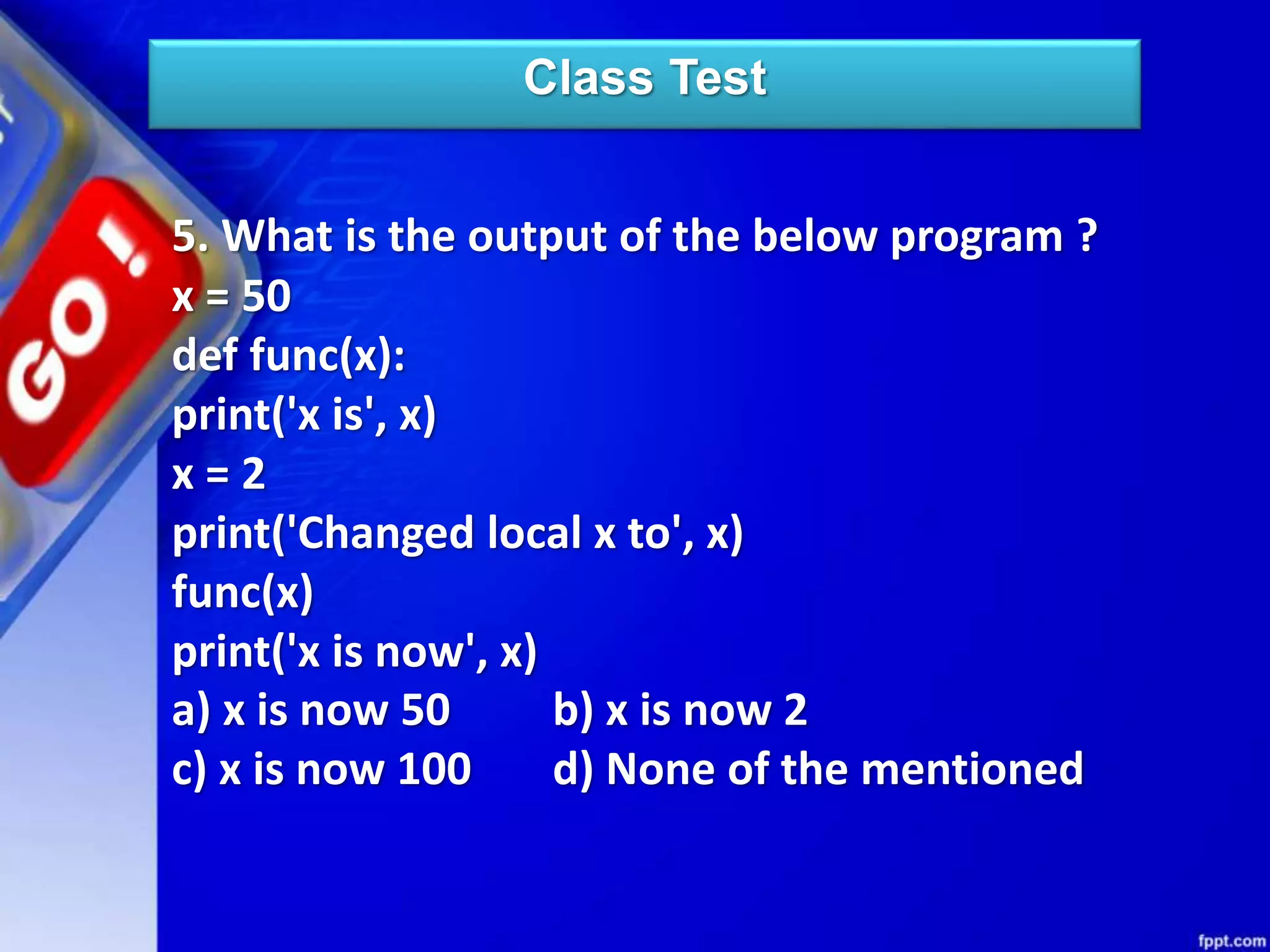
5. What is the output of the below program ?
x = 50
def func(x):
print('x is', x)
x = 2
print('Changed local x to', x)
func(x)
print('x is now', x)
a) x is now 50 b) x is now 2
c) x is now 100 d) None of the mentioned
Class Test
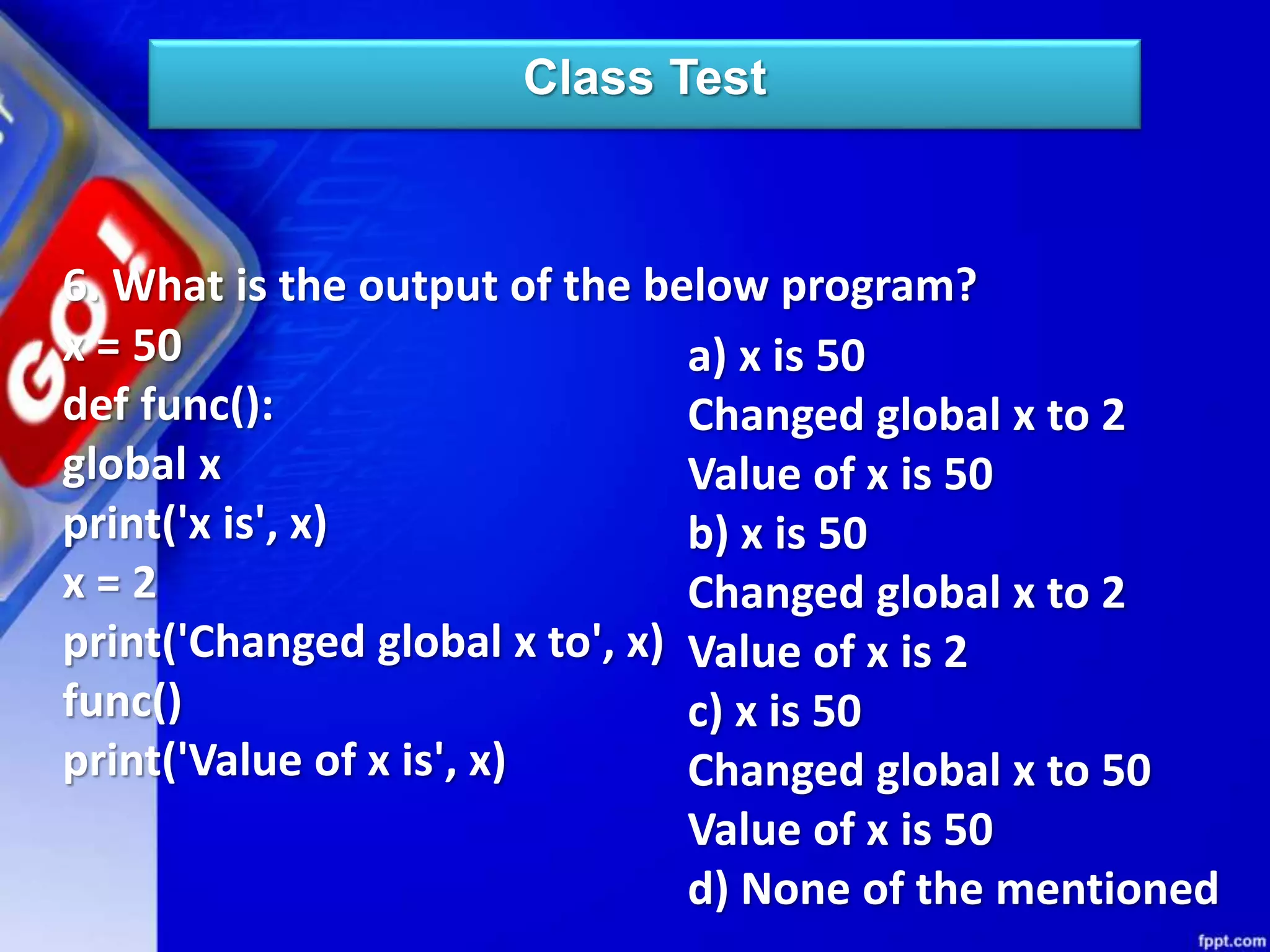
6. What is the output of the below program?
x = 50
def func():
global x
print('x is', x)
x = 2
print('Changed global x to', x)
func()
print('Value of x is', x)
a) x is 50
Changed global x to 2
Value of x is 50
b) x is 50
Changed global x to 2
Value of x is 2
c) x is 50
Changed global x to 50
Value of x is 50
d) None of the mentioned
Class Test
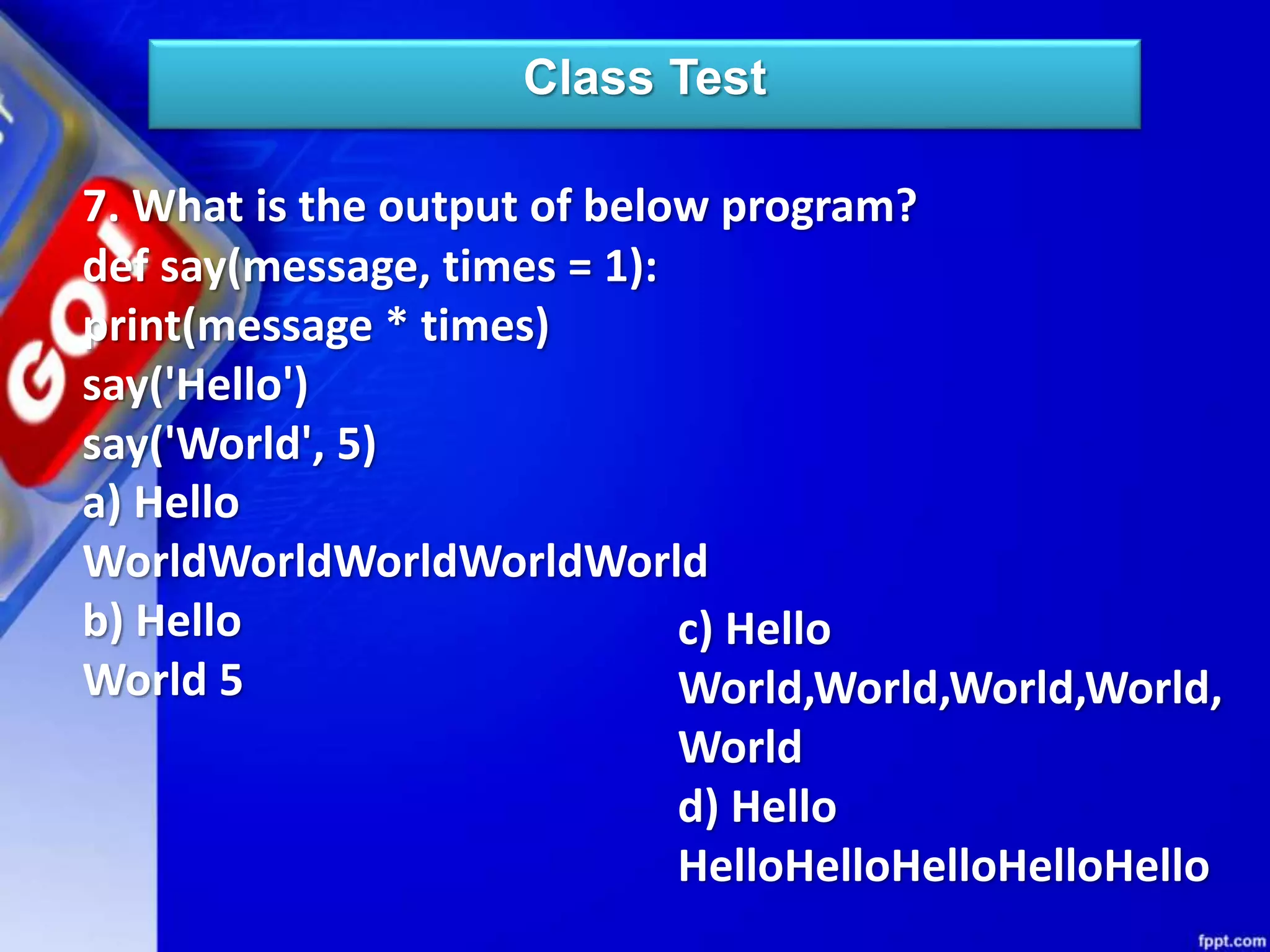
7. What is the output of below program?
def say(message, times = 1):
print(message * times)
say('Hello')
say('World', 5)
a) Hello
WorldWorldWorldWorldWorld
b) Hello
World 5
c) Hello
World,World,World,World,
World
d) Hello
HelloHelloHelloHelloHello
Class Test
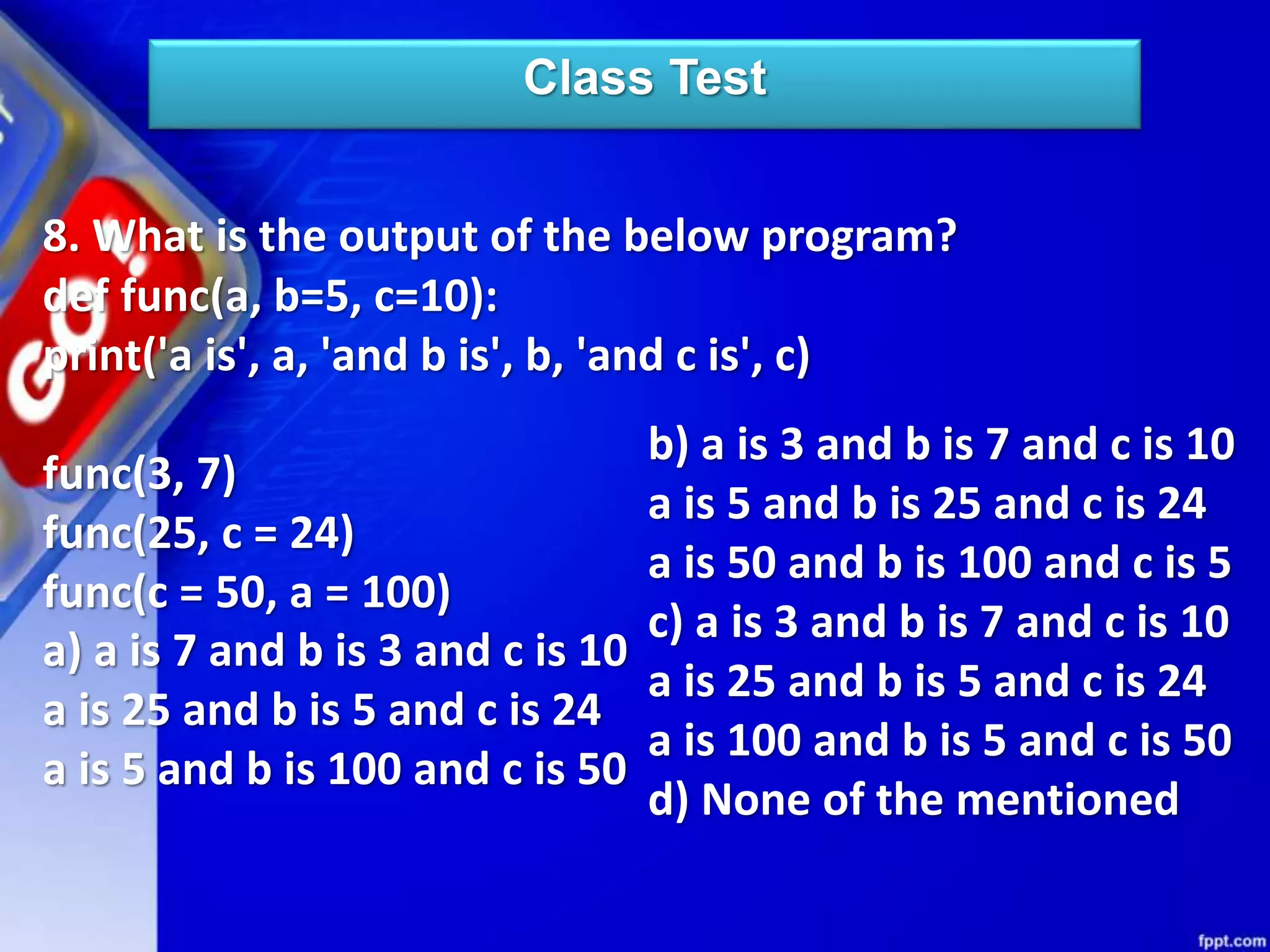
8. What is the output of the below program?
def func(a, b=5, c=10):
print('a is', a, 'and b is', b, 'and c is', c)
func(3, 7)
func(25, c = 24)
func(c = 50, a = 100)
a) a is 7 and b is 3 and c is 10
a is 25 and b is 5 and c is 24
a is 5 and b is 100 and c is 50
b) a is 3 and b is 7 and c is 10
a is 5 and b is 25 and c is 24
a is 50 and b is 100 and c is 5
c) a is 3 and b is 7 and c is 10
a is 25 and b is 5 and c is 24
a is 100 and b is 5 and c is 50
d) None of the mentioned
Class Test
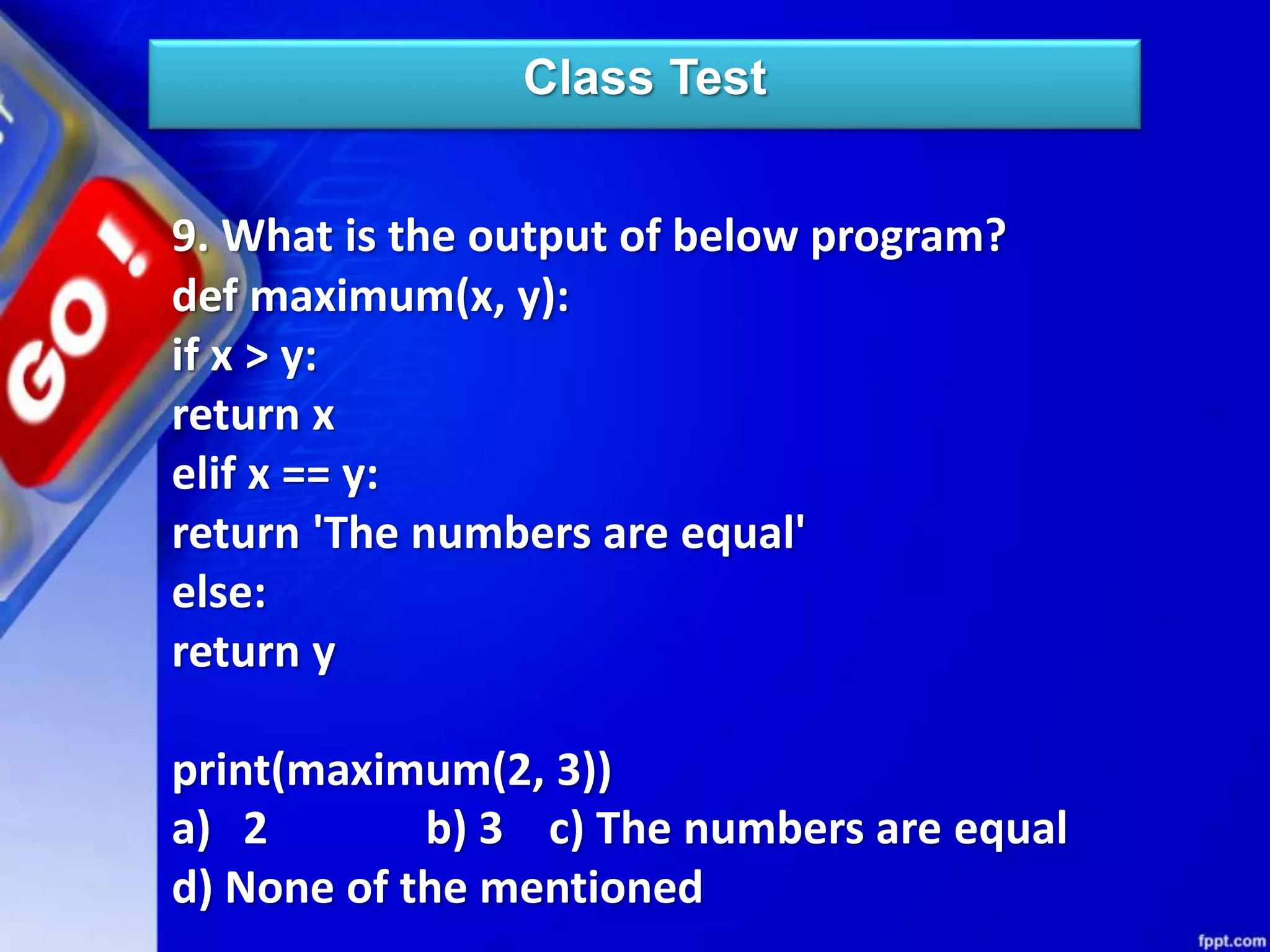
9. What is the output of below program?
def maximum(x, y):
if x > y:
return x
elif x == y:
return 'The numbers are equal'
else:
return y
print(maximum(2, 3))
a) 2 b) 3 c) The numbers are equal
d) None of the mentioned
Class Test
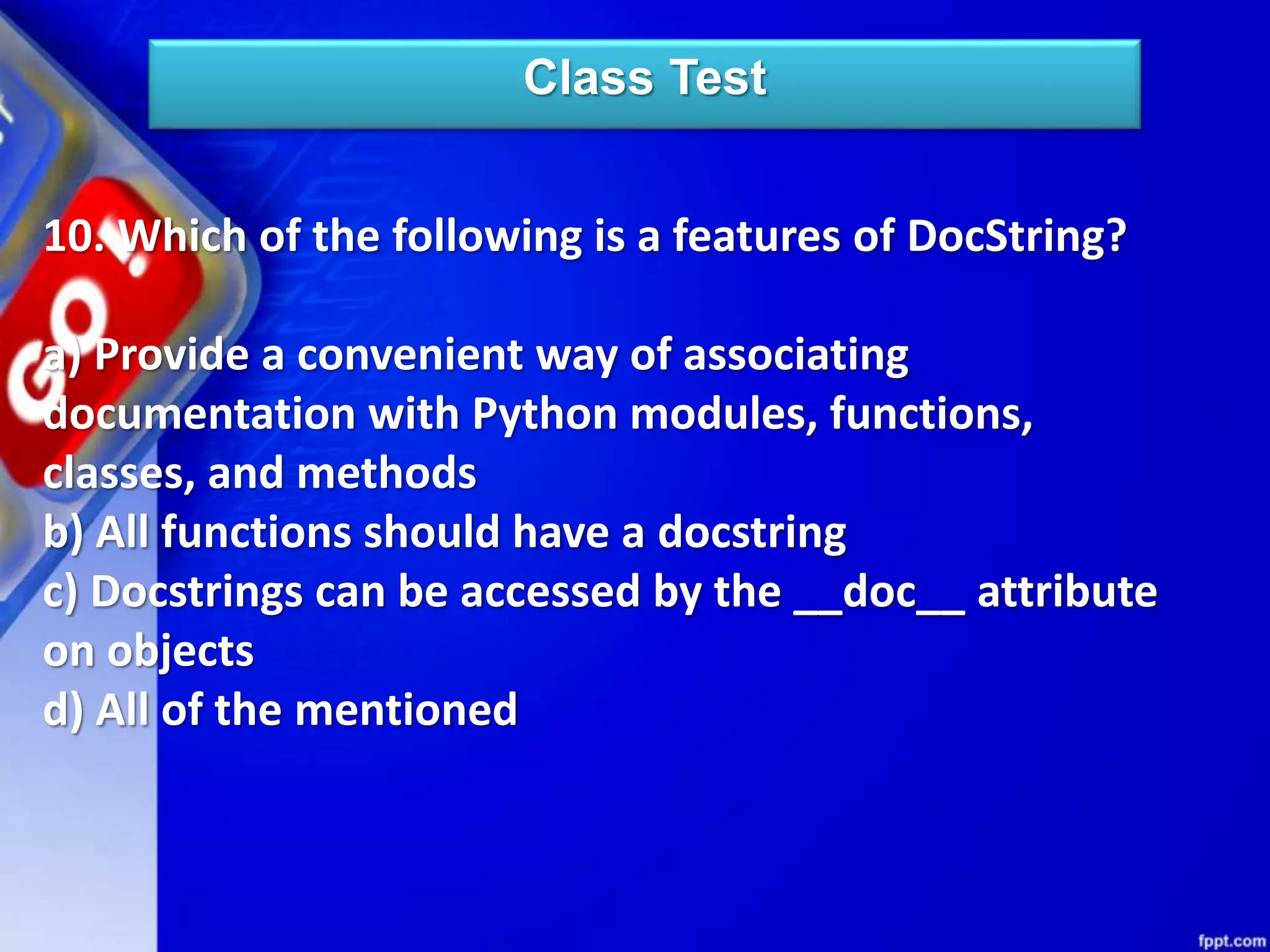
10. Which of the following is a features of DocString?
a) Provide a convenient way of associating
documentation with Python modules, functions,
classes, and methods
b) All functions should have a docstring
c) Docstrings can be accessed by the __doc__ attribute
on objects
d) All of the mentioned
Class Test
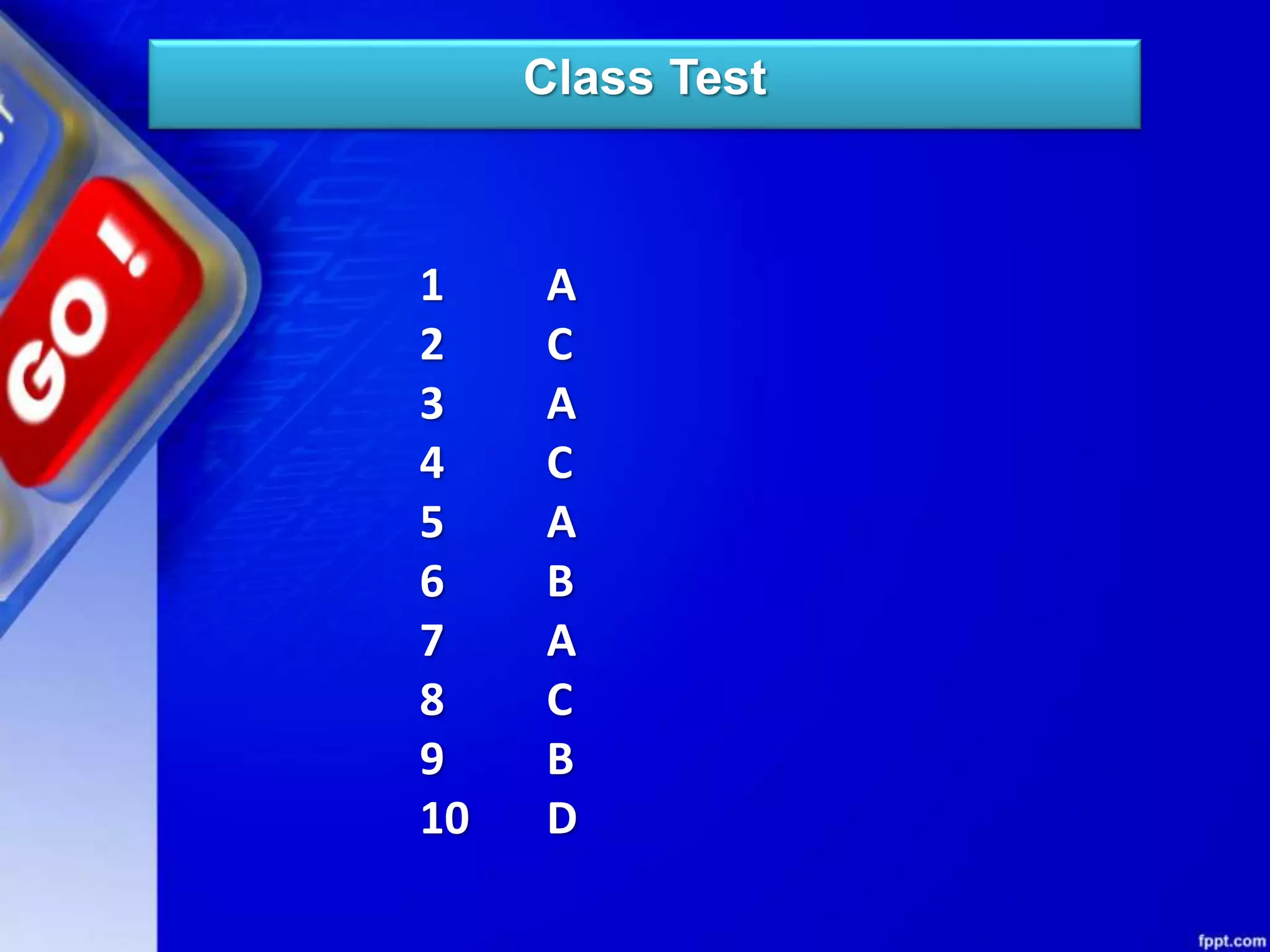
1 A
2 C
3 A
4 C
5 A
6 B
7 A
8 C
9 B
10 D
Thank You

Chapter 02 functions -class xii

  • 1.
  • 2.
    Unit I Programming andComputational Thinking (PCT-II) (80 Theory + 70 Practical) DCSc & Engg, PGDCA,ADCA,MCA.MSc(IT),Mtech(IT),MPhil (Comp. Sci) Department of Computer Science, Sainik School Amaravathinagar Cell No: 9431453730 Praveen M Jigajinni Prepared by Courtesy CBSE
  • 3.
  • 4.
  • 5.
    What is Function? Afunction is a group of statements that is executed when it is called from some point of the program. It’s a divide and conquer approach
  • 6.
  • 7.
    TYPES OF FUNCTIONS Functionscan be categorized into three types 1) Built in Functions. 2) Modules. 3) User - defined functions.
  • 8.
    TYPES OF FUNCTIONS Theseare predefined function in python and are used as and when there is need by simply calling them. For example: int() float() str() min() max() ...etc 1) BUILT IN FUNCTIONS
  • 9.
    TYPES OF FUNCTIONS Moduleis a container of functions, variables, constants, class in a separate file which can be reused. 2)MODULES
  • 10.
    i) Import statement ii)from statement IMPORTING MODULES
  • 11.
    IMPORTING MODULES –import STATEMENT i) import statement : used to import entire module. Syntax: import modulename example: import math
  • 12.
    IMPORTING MODULES –import STATEMENT ii) from: import all functions or selected one. Syntax: from module name import function name for example: from random import randint
  • 13.
    3) USER DEFINEDFUNCIONS Function is a set of statements that performs specific task. Syntax of user defined function def function_name(list of parameters) ................ ................ Statements def is keyword
  • 14.
    3) USER DEFINEDFUNCIONS def sum_diff(x,y): add=x+y diff=x-y return add,diff def main(): x=9 y=3 a,b=sum_diff(x,y) print("Sum = ",a) print("diff = ",b) main()
  • 15.
    PARAMETERS AND ARGUMENTSIN FUNCTION Parameters are the values which are provided at the time of function definition. Parameters Parameter is also called as formal parameter or formal argument def sum_diff(p,q): add=p+q diff=p-q return add,diff
  • 16.
    Parameter is also calledas formal parameter or formal argument PARAMETERS AND ARGUMENTS IN FUNCTION Arguments are the values which are passed while calling a function def main(): x=9 y=3 a,b=sum_diff(x,y) print("Sum = ",a) print("diff = ",b) main() Arguments
  • 17.
    Python supports followingtype of arguments: TYPES OF ARGUMENTS 1. Positional arguments 2. Default Arguments 3. Keyword Arguments 4. Variable Length Arguments
  • 18.
    These are thearguments passed to a function in correct positional order 1. POSITIONAL ARGUMENTS For example: def substract(a,b): print(a-b) substract() >>substract(100,200) -100 >>substract(150,100) 50
  • 19.
    When a functioncall is made without arguments, the function has defalut values for it for example: 2. DEFAULT ARGUMENTS For example: def greet_msg(name=“Mohan”): print(“Hello “, name) greet_msg() greet_msg(“Vinay”) # valid greet_msg() #valid
  • 20.
    When a functioncall is made without arguments, the function has default values for it for example: 2. DEFAULT ARGUMENTS For example: def greet_msg(name=“Mohan”,msg=“GoodMorning”): print(name,msg) greet_msg() def greet_msg(name=“Mohan”,msg): # invalid print(name,msg) greet_msg()
  • 21.
    if function containingmany arguments, and we wish to specify some among them, then value for such parameter can be provided by using the name 3. KEYWORD ARGUMENTS For example: def greet_msg(name,msg): print(name,msg) greet_msg() #calling function greet_msg(name=“Mohan”,msg=“Hi”): # valid O/p -> Mohan Hi
  • 22.
  • 23.
    4. VARIABLE LENGTHARGUMENTS In some situation one needs to pass as many as argument to a function, python provides a way to pass number of argument to a function, such type of arguments are called variable length arguments. Variable length arguments are defined with * symbol. For Example: (next slide)
  • 24.
    4. VARIABLE LENGTHARGUMENTS For Example: def sum(*n): total=0 for i in n: total+=i print(“Sum = “, total) sum() # Calling function sum() o/p sum=0 sum(10) o/p sum=10 sum(10,20,30,40) o/p sum=100
  • 25.
    PASSING ARRAYS/LISTS TOFUNCTIONS Arrays in basic python are lists that contain mixed data types and can be passed as an argument to a function. For Example: # Arithmetic mean of list def list_avg(lst): l=len(lst) sum=0 for i in lst: sum+=i return sum/l def main(): print(“Input integers”) a=input() a=a.split() for i in range(len(a) ): a[i]=int(a[i]) avg=list_ave(a) print (“Average is = “, avg)
  • 26.
    SCOPE OF VARIABLES Scopemean measure of access of variable or constants in a program. Generally there are two types of scope of variables: i) Global (Module) ii) Local (Function) i) Global variables are accessed throughout the program their scope is global
  • 27.
    GLOBAL VARIABLES For Example: m=100 defadd_diff(x,y): add=x+y diff=x-y global m m= m +10 print("m in add_diff function=",m) return add,diff def main(): x=9 y=3 a,b=add_diff(x,y) print("Sum = ",a) print("diff = ",b) print("m in main function = ",m) main()
  • 28.
    RECURSION A recursive functionis a function that calls itself until a “base condition” is true, and execution stops. While false Recursion in computer science is a method of solving a problem where the solution depends on solutions to smaller instances of the same problem (as opposed to iteration). ... Most computer programming languages support recursion by allowing a function to call itself from within its own code.
  • 29.
    ADVANTAGES OF RECURSION 1.Recursive functions make the code look clean and elegant. 2. A complex task can be broken down into simpler sub-problems using recursion. 3. Sequence generation is easier with recursion than using some nested iteration.
  • 30.
    DISADVANTAGES OF RECURSION 1.Sometimes the logic behind recursion is hard to follow through. 2. Recursive calls are expensive (inefficient) as they take up a lot of memory and time. 3. Recursive functions are hard to debug.
  • 31.
    RECURSION - PROGRAM Factorialof given number using recursion: def factorial(n): if n == 1: return 1 else: return n * factorial(n-1)
  • 32.
    We can trackthe recursive function: def factorial(n): print("factorial has been called with n = " + str(n)) if n == 1: return 1 else: res = n * factorial(n-1) print("intermediate result for ", n, " * factorial(" ,n- 1, "): ",res) return res print(factorial(5)) RECURSION - PROGRAM
  • 33.
    factorial has beencalled with n = 5 factorial has been called with n = 4 factorial has been called with n = 3 factorial has been called with n = 2 factorial has been called with n = 1 intermediate result for 2 * factorial( 1 ): 2 intermediate result for 3 * factorial( 2 ): 6 intermediate result for 4 * factorial( 3 ): 24 intermediate result for 5 * factorial( 4 ): 120 120 RECURSION - PROGRAM
  • 34.
    Fibonacci series usingrecursive function: def fib(n): if n == 0: return 0 elif n == 1: return 1 else: return fib(n-1) + fib(n-2) RECURSION - PROGRAM
  • 35.
    creating the Pascaltriangle using recursion: RECURSION - PROGRAM
  • 36.
    creating the Pascaltriangle using recursion: RECURSION - PROGRAM #to print a pascal triangle of 'n' rows def factorial(val): if val==1: return val else: return val*factorial(val-1)
  • 37.
    creating the Pascaltriangle using recursion: RECURSION - PROGRAM def combination(n,r): if n<r or r==0 or r==n: t=1 return int(t) else: t=factorial(n)/(factorial(r)*factorial(n-r)) return int(t)
  • 38.
    creating the Pascaltriangle using recursion: RECURSION - PROGRAM def pascal(x): print('t'*x,end='1n') for row in range(1,x): gaps=x-row for j in range(gaps,0,-1): print('t',end='') Contd…
  • 39.
    creating the Pascaltriangle using recursion: RECURSION - PROGRAM for b in range(row): val=combination(row,b) print(val,end='tt') print('1') x=int(input('Enter the no. of rows :')) pascal(x)
  • 40.
    Tower of HanoiPython Program RECURSION - PROGRAM Tower of Hanoi is a mathematical puzzle where we have three rods and n disks. The objective of the puzzle is to move the entire stack to another rod, obeying the following simple rules: 1) Only one disk can be moved at a time. 2) Each move consists of taking the upper disk from one of the stacks and placing it on top of
  • 41.
    Tower of HanoiPython Program RECURSION - PROGRAM another stack i.e. a disk can only be moved if it is the uppermost disk on a stack. 3) No disk may be placed on top of a smaller disk.
  • 42.
    Tower of HanoiPython Program RECURSION - PROGRAM def TowerOfHanoi(n , from_rod, to_rod, aux_rod): if n == 1: print ("Move disk 1 from rod",from_rod,"to rod",to_rod ) return TowerOfHanoi(n-1, from_rod, aux_rod, to_rod) print( "Move disk",n,"from rod",from_rod,"to rod",to_rod ) TowerOfHanoi(n-1, aux_rod, to_rod, from_rod)
  • 43.
    Tower of HanoiPython Program RECURSION - PROGRAM # Driver code n = 4 TowerOfHanoi(n, 'A', 'C', 'B') # A, C, B are the name of rods
  • 44.
    # Python programto find the H.C.F of two input number # define a function def computeHCF(x, y): # choose the smaller number if x > y: smaller = y else: smaller = x for i in range(1, smaller+1): if((x % i == 0) and (y % i == 0)): hcf = i return hcf RECURSION - PROGRAM def gcd(a,b): if(b==0): return a else: return gcd(b,a%b) a=int(input("Enter first number:")) b=int(input("Enter second number:")) GCD=gcd(a,b) print("GCD is: ") print(GCD)
  • 45.
    # take inputfrom the user # num1 = int(input("Enter first number: ")) # num2 = int(input("Enter second number: ")) print("The H.C.F. of", num1,"and", num2,"is", computeHCF(num1, num2)) RECURSION - PROGRAM
  • 46.
    def sum_recursive(current_number, accumulated_sum): #Base case # Return the final state if current_number == 11: return accumulated_sum # Recursive case # Thread the state through the recursive call else: return sum_recursive(current_number + 1, accumulated_sum + current_number) RECURSION - PROGRAM
  • 47.
    1 Recursive Pythonfunction to find sum of natural numbers. 2. Recursive Python function to find sum of even numbers. 3. Recursive Python function to find sum of odd numbers. 4. Recursive Python function to find sum of fib series. 5. Recursive Python function to find given number is prime or not. RECURSION - PROGRAM
  • 48.
    Class Test 1. Whichof the following is the use of function in python? a) Functions are reusable pieces of programs b) Functions don’t provide better modularity for your application c) you can’t also create your own functions d) All of the mentioned 2. Which keyword is use for function? a) Fun b) Define c) def d) Function
  • 49.
    Class Test 3. Whatis the output of the below program? def sayHello(): print('Hello World!') sayHello() sayHello() a) Hello World! Hello World! b) ‘Hello World!’ ‘Hello World!’ c) Hello Hello
  • 50.
    Class Test 4. Whatis the output of the below program? def printMax(a, b): if a > b: print(a, 'is maximum') elif a == b: print(a, 'is equal to', b) else: print(b, 'is maximum') printMax(3, 4) a) 3 b) 4 c) 4 is maximum d) None of the mentioned
  • 51.
    Class Test 5. Whatis the output of the below program ? x = 50 def func(x): print('x is', x) x = 2 print('Changed local x to', x) func(x) print('x is now', x) a) x is now 50 b) x is now 2 c) x is now 100 d) None of the mentioned
  • 52.
    Class Test 6. Whatis the output of the below program? x = 50 def func(): global x print('x is', x) x = 2 print('Changed global x to', x) func() print('Value of x is', x) a) x is 50 Changed global x to 2 Value of x is 50 b) x is 50 Changed global x to 2 Value of x is 2 c) x is 50 Changed global x to 50 Value of x is 50 d) None of the mentioned
  • 53.
    Class Test 7. Whatis the output of below program? def say(message, times = 1): print(message * times) say('Hello') say('World', 5) a) Hello WorldWorldWorldWorldWorld b) Hello World 5 c) Hello World,World,World,World, World d) Hello HelloHelloHelloHelloHello
  • 54.
    Class Test 8. Whatis the output of the below program? def func(a, b=5, c=10): print('a is', a, 'and b is', b, 'and c is', c) func(3, 7) func(25, c = 24) func(c = 50, a = 100) a) a is 7 and b is 3 and c is 10 a is 25 and b is 5 and c is 24 a is 5 and b is 100 and c is 50 b) a is 3 and b is 7 and c is 10 a is 5 and b is 25 and c is 24 a is 50 and b is 100 and c is 5 c) a is 3 and b is 7 and c is 10 a is 25 and b is 5 and c is 24 a is 100 and b is 5 and c is 50 d) None of the mentioned
  • 55.
    Class Test 9. Whatis the output of below program? def maximum(x, y): if x > y: return x elif x == y: return 'The numbers are equal' else: return y print(maximum(2, 3)) a) 2 b) 3 c) The numbers are equal d) None of the mentioned
  • 56.
    Class Test 10. Whichof the following is a features of DocString? a) Provide a convenient way of associating documentation with Python modules, functions, classes, and methods b) All functions should have a docstring c) Docstrings can be accessed by the __doc__ attribute on objects d) All of the mentioned
  • 57.
    Class Test 1 A 2C 3 A 4 C 5 A 6 B 7 A 8 C 9 B 10 D
  • 58.