© 2007 Pearson Education
Operations Strategy
Chapter 2Chapter 2
© 2007 Pearson Education
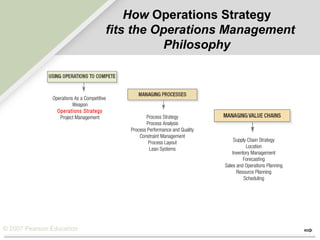
How Operations Strategy
fits the Operations Management
Philosophy
Operations As a Competitive
Weapon
Operations Strategy
Project Management Process Strategy
Process Analysis
Process Performance and Quality
Constraint Management
Process Layout
Lean Systems
Supply Chain Strategy
Location
Inventory Management
Forecasting
Sales and Operations Planning
Resource Planning
Scheduling
© 2007 Pearson Education
Starbucks
 If someone says, “Lets go out for coffee,”
Starbucks often comes to mind.
 Entrepreneur Howard Schultz had an
operations strategy in mind in 1990 when he
bought the 17-store Seattle chain and turned
it into a global success.
 Service strategy was key.
 Offering a variety of specialized products
and services, such as Internet access,
phone ahead ordering, and CD burning,
all in a socially interactive atmosphere.
© 2007 Pearson Education
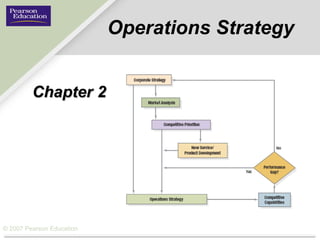
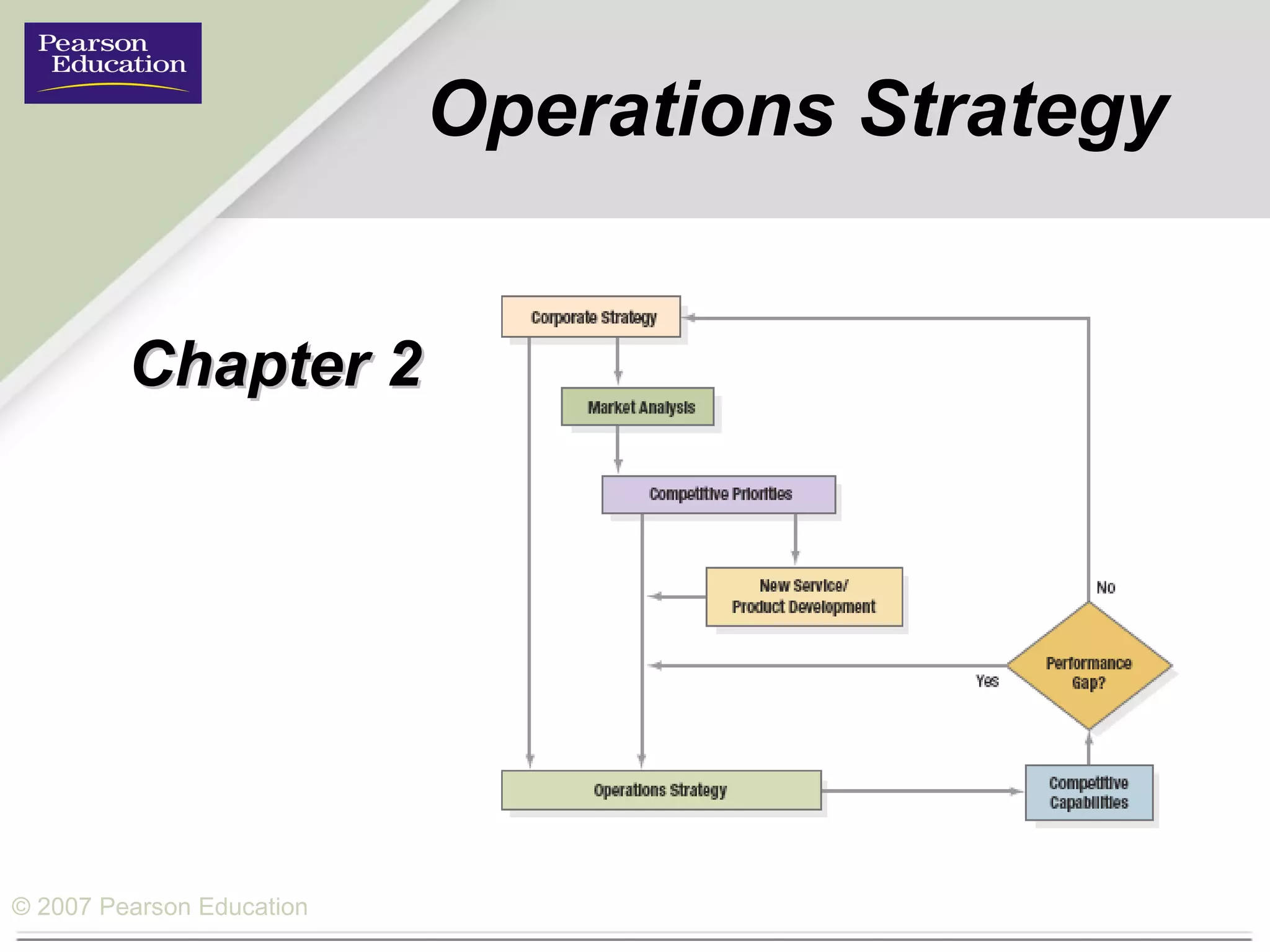
Operations Strategy
 Operations strategy is the means by which
operations implements the firm’s corporate
strategy and helps to build a customer-driven
firm.
 It links long-term and short-term operations
decisions to corporate strategy.
 It is the core of managing processes and
value chains.
© 2007 Pearson Education
Customer-Driven
Operations Strategy
 Corporate strategy views the organization
as a system of interconnected parts, each
working with the others to achieve desired
goals.
 Operations Strategy supports the
corporate strategy and requires continuous
cross-functional interaction.
 The operations strategy should be customer
driven.
© 2007 Pearson Education
Developing a Corporate
Strategy
 Developing a corporate strategy involves
three considerations:
1. Monitoring and adapting to the environment
2. Identifying and developing core competencies
3. Developing the firm’s core processes
 Adapting requires environmental scanning
to monitor trends for opportunities and
threats.
 Core Competencies are the unique
resources and strengths an organization
possesses.
© 2007 Pearson Education
Core Competencies
 Core competencies include…
A well-trained and flexible Workforce
Having well-located & flexible Facilities
Having Market and Financial Know-How.
Expertise in Systems and Technology.
 The core competencies should determine
the firm’s core processes.
These can include customer relations, new
service/product development, order fulfillment,
and supplier relationships.
A firm may have all of these or focus on a subset
of them, as determined by its core competencies.
© 2007 Pearson Education
Global Strategies
 A global strategy may include buying
foreign services or parts and entering or
expanding foreign markets.
 Two effective global strategies are:
1. Strategic Alliances
a) Collaborative efforts
b) Joint ventures
c) Technology licensing
2. Locating abroad
© 2007 Pearson Education
Market Analysis
 A Market Analysis is one key to developing
a customer-driven strategy, and is
accomplished in two parts.
Market Segmentation, which identifies groups of
customers with enough in common to warrant
developing services and/or products for them.
Needs Assessment identifies the needs of each
market segment. Needs include such things as:
Service or product needs
Delivery system needs
Volume needs
© 2007 Pearson Education
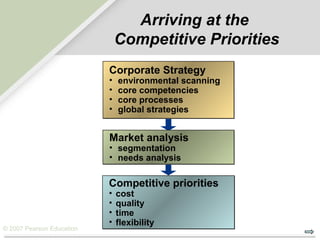
Competitive priorities
• cost
• quality
• time
• flexibility
Competitive priorities
• cost
• quality
• time
• flexibility
Market analysis
• segmentation
• needs analysis
Market analysis
• segmentation
• needs analysis
Arriving at the
Competitive Priorities
Corporate Strategy
• environmental scanning
• core competencies
• core processes
• global strategies
Corporate Strategy
• environmental scanning
• core competencies
• core processes
• global strategies
© 2007 Pearson Education
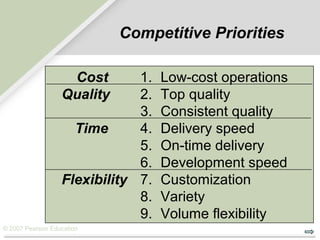
Competitive Priorities
Cost 1. Low-cost operations
Quality 2. Top quality
3. Consistent quality
Time 4. Delivery speed
5. On-time delivery
6. Development speed
Flexibility 7. Customization
8. Variety
9. Volume flexibility
© 2007 Pearson Education
Competitive Capabilities
 The Competitive Capabilities are the cost,
quality, time and flexibility dimensions of
competitive priorities that a process or value
chain actually possesses and is able to
deliver.
 Low Cost means delivering a service or
product at the lowest possible cost to the
satisfaction of the customer.
© 2007 Pearson Education
Top Quality: Delivering an outstanding
service or product.
 Considerable interaction with the customers
may be required to determine what that
means.
Consistent Quality: Producing services
or products that meet design
specifications on a consistent basis.
Quality as a
Competitive Capability
© 2007 Pearson Education
Time as a
Competitive Capability
 Delivery Speed is quickly filling a
customer’s order.
Lead Time is the time between receipt of an
order and filling the order.
 On-Time Delivery means meeting the
delivery time promises.
 Development Speed is quickly introducing
a new service or product.
 Time-Based Competition is a strategy
that focuses on development speed and
delivery speed.
© 2007 Pearson Education
 Customization means satisfying the unique
needs of each customer by changing the
service or product designs.
 Variety involves handling a wide assortment
of services or products efficiently.
 Volume Flexibility requires accelerating or
decelerating the rate of production quickly to
handle large fluctuations in demand.
Flexibility as a
Competitive Capability
© 2007 Pearson Education
Northrup Grumman
Newport News Ship Building
The world’s only producer of full-sized
aircraft carriers
Long lead times of 8 years or more
often involve many changes.
Their processes have a high degree of
flexibility to handle changes in design.
Flexibility in workforce skills as well as
process flexibility is necessary.
© 2007 Pearson Education
Order Winners
and Order Qualifiers
 These are criteria used by customers in
service or product selection.
 Order Winners are criteria for
differentiating services or products of one
firm from those of another.
 Price, quality, time, flexibility, after sales
support, reputation, etc.
 Order Qualifiers are demonstrated levels
of performance required to do business in
a particular market segment.
© 2007 Pearson Education
Service or Product
Development Strategies
 Product Variety: Offering a wide assortment.
 Design: Ease of use and desirable features.
 Innovation: Translate new technology into new
products.
 Service: Products with services added.
 Leader: Being first to introduce new services and/or
products.
 Middle of the Road: Wait for the leaders to
introduce new services and/or products.
 Laggard: Wait to see if the leader’s new services
and/or products catch on in the market.
© 2007 Pearson Education
Service Package
 A Service Package is a collection of goods and
services provided by a service process to its
customers. It consists of four features:
1. Supporting Facility: The physical resources
that must be in place before a service can be
offered.
2. Facilitating Goods: The materials purchased
or consumed by the customer or the items
provided by the customer to receive a service.
3. Explicit Services: The readily observable
benefits.
4. Implicit Services: Psychological benefits.
© 2007 Pearson Education
Quality Function
Deployment (QDF)
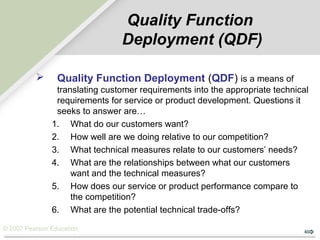
 Quality Function Deployment (QDF) is a means of
translating customer requirements into the appropriate technical
requirements for service or product development. Questions it
seeks to answer are…
1. What do our customers want?
2. How well are we doing relative to our competition?
3. What technical measures relate to our customers’ needs?
4. What are the relationships between what our customers
want and the technical measures?
5. How does our service or product performance compare to
the competition?
6. What are the potential technical trade-offs?
© 2007 Pearson Education
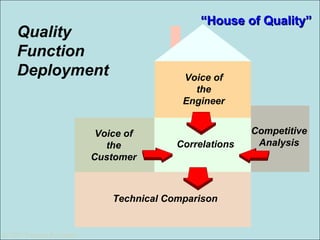
Quality
Function
Deployment
Voice of
the
Customer
Competitive
Analysis
Voice of
the
Engineer
Correlations
Technical Comparison
““House of Quality”House of Quality”
© 2007 Pearson Education
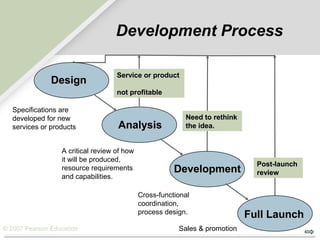
Development Process
Service or productService or product
not profitablenot profitable
Need to rethinkNeed to rethink
the idea.the idea.
Post-launchPost-launch
reviewreview
DesignDesign
Specifications are
developed for new
services or products AnalysisAnalysis
A critical review of how
it will be produced,
resource requirements
and capabilities.
DevelopmentDevelopment
Cross-functional
coordination,
process design.
Full LaunchFull Launch
Sales & promotion
© 2007 Pearson Education
Concurrent Engineering
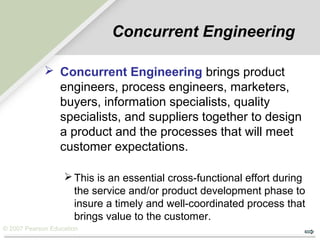
 Concurrent Engineering brings product
engineers, process engineers, marketers,
buyers, information specialists, quality
specialists, and suppliers together to design
a product and the processes that will meet
customer expectations.
This is an essential cross-functional effort during
the service and/or product development phase to
insure a timely and well-coordinated process that
brings value to the customer.
© 2007 Pearson Education
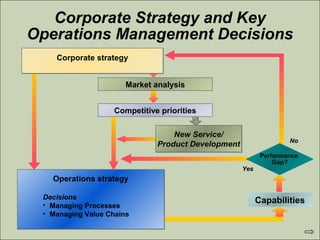
Corporate Strategy and Key
Operations Management Decisions
Capabilities
Performance
Gap?
NoNo
YesYes
Operations strategy
Decisions
• Managing Processes
• Managing Value Chains
New Service/
Product Development
New Service/
Product Development
Market analysis
Competitive priorities
Corporate strategyCorporate strategy
© 2007 Pearson Education
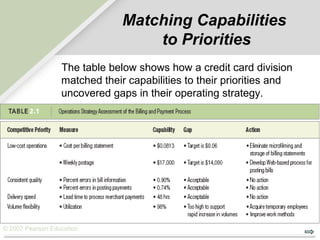
Matching Capabilities
to Priorities
The table below shows how a credit card division
matched their capabilities to their priorities and
uncovered gaps in their operating strategy.

Chapter 02

  • 1.
    © 2007 PearsonEducation Operations Strategy Chapter 2Chapter 2
  • 2.
    © 2007 PearsonEducation How Operations Strategy fits the Operations Management Philosophy Operations As a Competitive Weapon Operations Strategy Project Management Process Strategy Process Analysis Process Performance and Quality Constraint Management Process Layout Lean Systems Supply Chain Strategy Location Inventory Management Forecasting Sales and Operations Planning Resource Planning Scheduling
  • 3.
    © 2007 PearsonEducation Starbucks  If someone says, “Lets go out for coffee,” Starbucks often comes to mind.  Entrepreneur Howard Schultz had an operations strategy in mind in 1990 when he bought the 17-store Seattle chain and turned it into a global success.  Service strategy was key.  Offering a variety of specialized products and services, such as Internet access, phone ahead ordering, and CD burning, all in a socially interactive atmosphere.
  • 4.
    © 2007 PearsonEducation Operations Strategy  Operations strategy is the means by which operations implements the firm’s corporate strategy and helps to build a customer-driven firm.  It links long-term and short-term operations decisions to corporate strategy.  It is the core of managing processes and value chains.
  • 5.
    © 2007 PearsonEducation Customer-Driven Operations Strategy  Corporate strategy views the organization as a system of interconnected parts, each working with the others to achieve desired goals.  Operations Strategy supports the corporate strategy and requires continuous cross-functional interaction.  The operations strategy should be customer driven.
  • 6.
    © 2007 PearsonEducation Developing a Corporate Strategy  Developing a corporate strategy involves three considerations: 1. Monitoring and adapting to the environment 2. Identifying and developing core competencies 3. Developing the firm’s core processes  Adapting requires environmental scanning to monitor trends for opportunities and threats.  Core Competencies are the unique resources and strengths an organization possesses.
  • 7.
    © 2007 PearsonEducation Core Competencies  Core competencies include… A well-trained and flexible Workforce Having well-located & flexible Facilities Having Market and Financial Know-How. Expertise in Systems and Technology.  The core competencies should determine the firm’s core processes. These can include customer relations, new service/product development, order fulfillment, and supplier relationships. A firm may have all of these or focus on a subset of them, as determined by its core competencies.
  • 8.
    © 2007 PearsonEducation Global Strategies  A global strategy may include buying foreign services or parts and entering or expanding foreign markets.  Two effective global strategies are: 1. Strategic Alliances a) Collaborative efforts b) Joint ventures c) Technology licensing 2. Locating abroad
  • 9.
    © 2007 PearsonEducation Market Analysis  A Market Analysis is one key to developing a customer-driven strategy, and is accomplished in two parts. Market Segmentation, which identifies groups of customers with enough in common to warrant developing services and/or products for them. Needs Assessment identifies the needs of each market segment. Needs include such things as: Service or product needs Delivery system needs Volume needs
  • 10.
    © 2007 PearsonEducation Competitive priorities • cost • quality • time • flexibility Competitive priorities • cost • quality • time • flexibility Market analysis • segmentation • needs analysis Market analysis • segmentation • needs analysis Arriving at the Competitive Priorities Corporate Strategy • environmental scanning • core competencies • core processes • global strategies Corporate Strategy • environmental scanning • core competencies • core processes • global strategies
  • 11.
    © 2007 PearsonEducation Competitive Priorities Cost 1. Low-cost operations Quality 2. Top quality 3. Consistent quality Time 4. Delivery speed 5. On-time delivery 6. Development speed Flexibility 7. Customization 8. Variety 9. Volume flexibility
  • 12.
    © 2007 PearsonEducation Competitive Capabilities  The Competitive Capabilities are the cost, quality, time and flexibility dimensions of competitive priorities that a process or value chain actually possesses and is able to deliver.  Low Cost means delivering a service or product at the lowest possible cost to the satisfaction of the customer.
  • 13.
    © 2007 PearsonEducation Top Quality: Delivering an outstanding service or product.  Considerable interaction with the customers may be required to determine what that means. Consistent Quality: Producing services or products that meet design specifications on a consistent basis. Quality as a Competitive Capability
  • 14.
    © 2007 PearsonEducation Time as a Competitive Capability  Delivery Speed is quickly filling a customer’s order. Lead Time is the time between receipt of an order and filling the order.  On-Time Delivery means meeting the delivery time promises.  Development Speed is quickly introducing a new service or product.  Time-Based Competition is a strategy that focuses on development speed and delivery speed.
  • 15.
    © 2007 PearsonEducation  Customization means satisfying the unique needs of each customer by changing the service or product designs.  Variety involves handling a wide assortment of services or products efficiently.  Volume Flexibility requires accelerating or decelerating the rate of production quickly to handle large fluctuations in demand. Flexibility as a Competitive Capability
  • 16.
    © 2007 PearsonEducation Northrup Grumman Newport News Ship Building The world’s only producer of full-sized aircraft carriers Long lead times of 8 years or more often involve many changes. Their processes have a high degree of flexibility to handle changes in design. Flexibility in workforce skills as well as process flexibility is necessary.
  • 17.
    © 2007 PearsonEducation Order Winners and Order Qualifiers  These are criteria used by customers in service or product selection.  Order Winners are criteria for differentiating services or products of one firm from those of another.  Price, quality, time, flexibility, after sales support, reputation, etc.  Order Qualifiers are demonstrated levels of performance required to do business in a particular market segment.
  • 18.
    © 2007 PearsonEducation Service or Product Development Strategies  Product Variety: Offering a wide assortment.  Design: Ease of use and desirable features.  Innovation: Translate new technology into new products.  Service: Products with services added.  Leader: Being first to introduce new services and/or products.  Middle of the Road: Wait for the leaders to introduce new services and/or products.  Laggard: Wait to see if the leader’s new services and/or products catch on in the market.
  • 19.
    © 2007 PearsonEducation Service Package  A Service Package is a collection of goods and services provided by a service process to its customers. It consists of four features: 1. Supporting Facility: The physical resources that must be in place before a service can be offered. 2. Facilitating Goods: The materials purchased or consumed by the customer or the items provided by the customer to receive a service. 3. Explicit Services: The readily observable benefits. 4. Implicit Services: Psychological benefits.
  • 20.
    © 2007 PearsonEducation Quality Function Deployment (QDF)  Quality Function Deployment (QDF) is a means of translating customer requirements into the appropriate technical requirements for service or product development. Questions it seeks to answer are… 1. What do our customers want? 2. How well are we doing relative to our competition? 3. What technical measures relate to our customers’ needs? 4. What are the relationships between what our customers want and the technical measures? 5. How does our service or product performance compare to the competition? 6. What are the potential technical trade-offs?
  • 21.
    © 2007 PearsonEducation © 2007 Pearson Education Quality Function Deployment Voice of the Customer Competitive Analysis Voice of the Engineer Correlations Technical Comparison ““House of Quality”House of Quality”
  • 22.
    © 2007 PearsonEducation Development Process Service or productService or product not profitablenot profitable Need to rethinkNeed to rethink the idea.the idea. Post-launchPost-launch reviewreview DesignDesign Specifications are developed for new services or products AnalysisAnalysis A critical review of how it will be produced, resource requirements and capabilities. DevelopmentDevelopment Cross-functional coordination, process design. Full LaunchFull Launch Sales & promotion
  • 23.
    © 2007 PearsonEducation Concurrent Engineering  Concurrent Engineering brings product engineers, process engineers, marketers, buyers, information specialists, quality specialists, and suppliers together to design a product and the processes that will meet customer expectations. This is an essential cross-functional effort during the service and/or product development phase to insure a timely and well-coordinated process that brings value to the customer.
  • 24.
    © 2007 PearsonEducation Corporate Strategy and Key Operations Management Decisions Capabilities Performance Gap? NoNo YesYes Operations strategy Decisions • Managing Processes • Managing Value Chains New Service/ Product Development New Service/ Product Development Market analysis Competitive priorities Corporate strategyCorporate strategy
  • 25.
    © 2007 PearsonEducation Matching Capabilities to Priorities The table below shows how a credit card division matched their capabilities to their priorities and uncovered gaps in their operating strategy.