Global Marketing Management:
Planning and Organization
Chapter 11
McGraw-Hill/Irwin © 2005 The McGraw-Hill Companies, Inc. All rights reserved.
Chapter 9 by Jeannet and Hennessey
Chapter Learning Objectives
1. How global marketing management differs
from international marketing management
2. The increasing importance of international
strategic alliances
3. The need for planning to achieve company
goals
4. The important factors for each alternative market-entry strategy
Introduction
• Increasingly firms are entering foreign markets
• Acquiring a global perspective requires
execution requires planning, organization, and
a willingness to try new approaches—such as
engaging in collaborative relationships
• This chapter discusses global marketing
management, competition in the global
marketplace, strategic planning, and alternative
market-entry strategies
Global Marketing Management
• Global Marketing Management thought has
undergone substantial revision
• In the 1970s the argument was framed as
“standardization vs. adaptation”
• In the 1980s it was “globalization vs.
localization” or “Think local, act local”
• In the 1990s it was “global integration vs.
local responsiveness”
• The basic issue is whether the global
homogenization of consumer tastes allowed
global standardization of the marketing mix
Global Marketing Management: An Old Debate and a New View
The Nestle Way
• The “Nestlé way” is to dominate its
markets can be summarized in four
points:
(1) think and plan long term
(2) decentralize
(3) stick to what you know, and
(4) adapt to local tastes
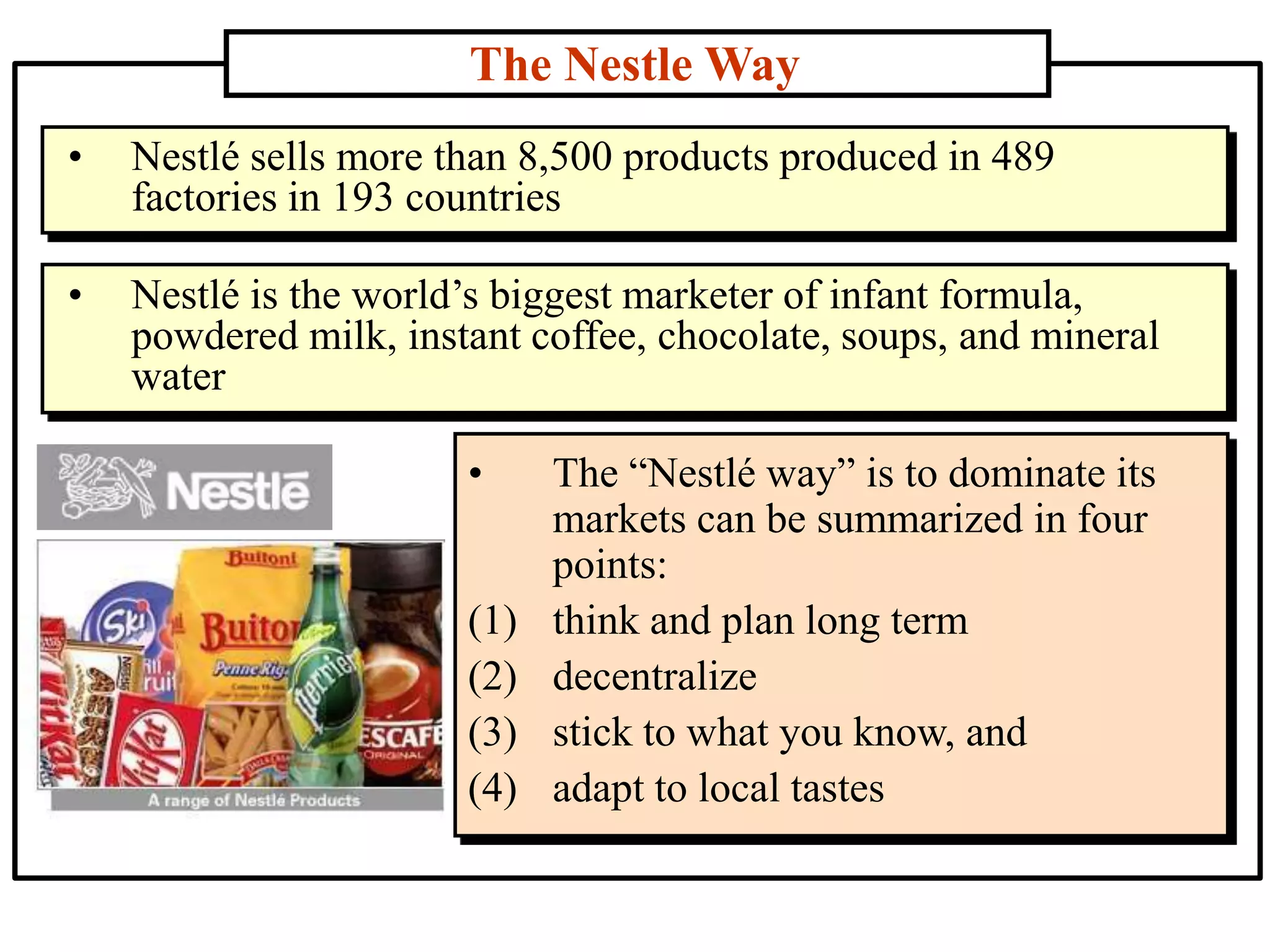
• Nestlé sells more than 8,500 products produced in 489
factories in 193 countries
• Nestlé is the world’s biggest marketer of infant formula,
powdered milk, instant coffee, chocolate, soups, and mineral
water
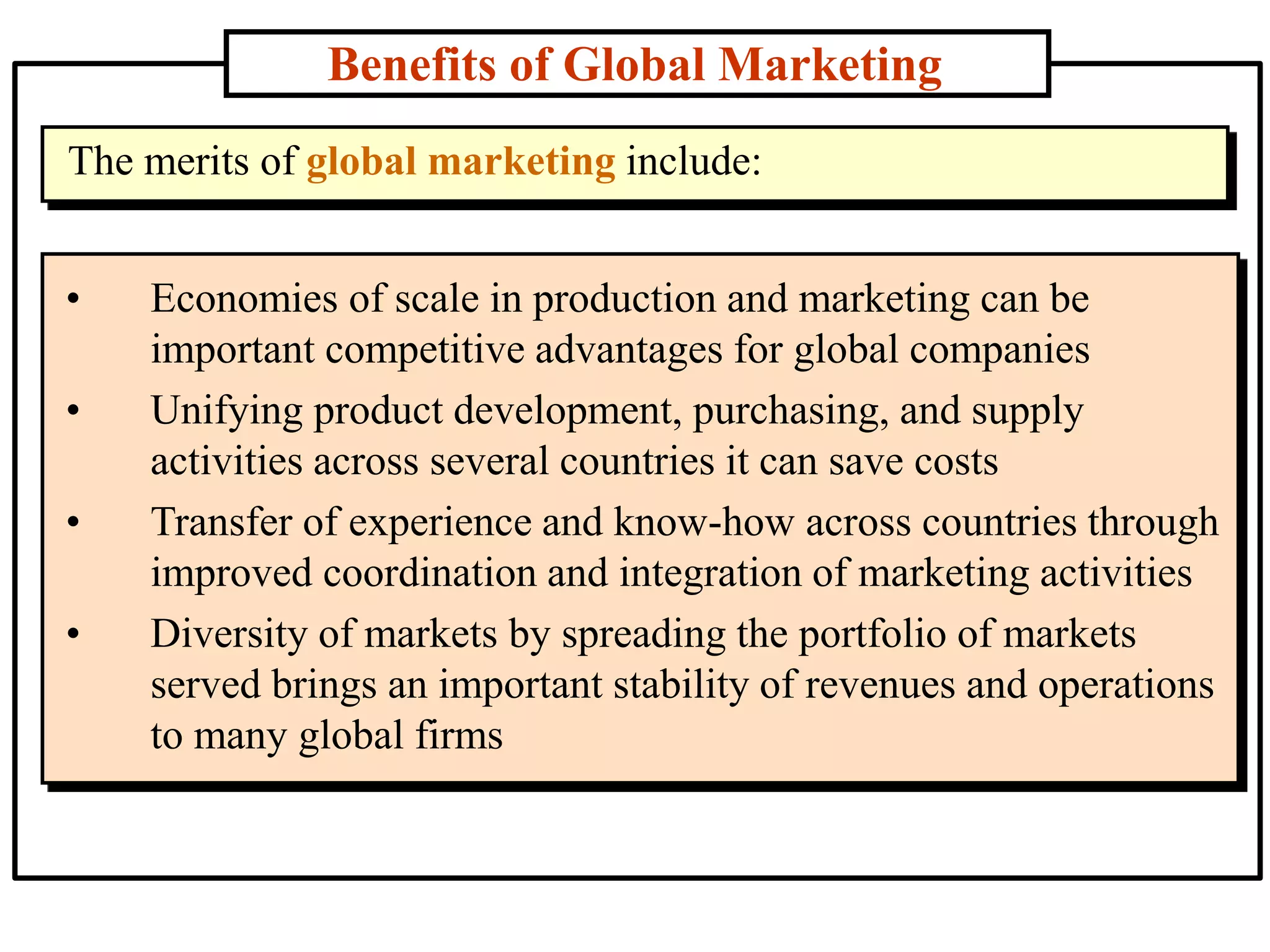
Benefits of Global Marketing
• Economies of scale in production and marketing can be
important competitive advantages for global companies
• Unifying product development, purchasing, and supply
activities across several countries it can save costs
• Transfer of experience and know-how across countries through
improved coordination and integration of marketing activities
• Diversity of markets by spreading the portfolio of markets
served brings an important stability of revenues and operations
to many global firms
The merits of global marketing include:
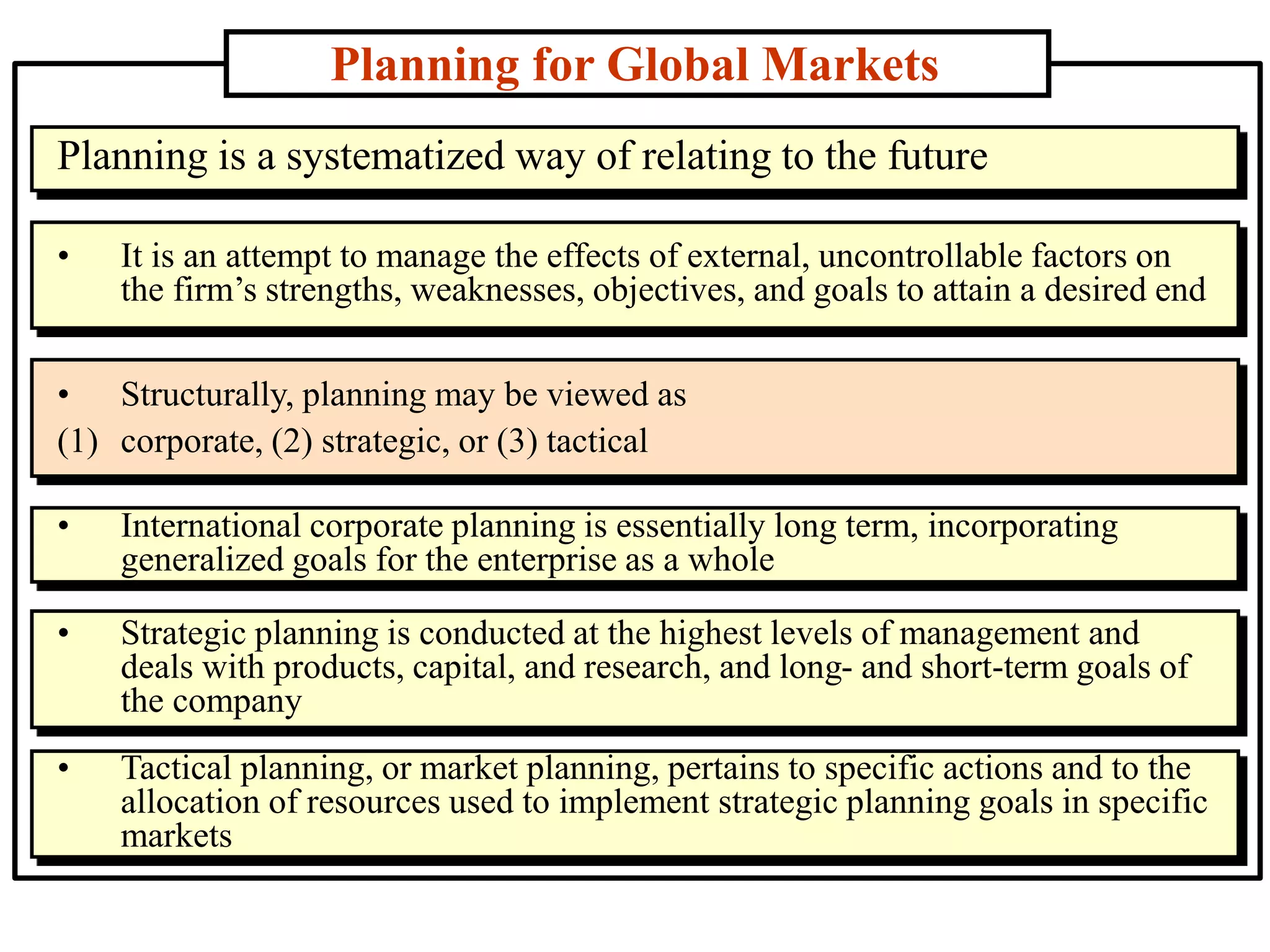
Planning for Global Markets
• Structurally, planning may be viewed as
(1) corporate, (2) strategic, or (3) tactical
Planning is a systematized way of relating to the future
• It is an attempt to manage the effects of external, uncontrollable factors on
the firm’s strengths, weaknesses, objectives, and goals to attain a desired end
• International corporate planning is essentially long term, incorporating
generalized goals for the enterprise as a whole
• Strategic planning is conducted at the highest levels of management and
deals with products, capital, and research, and long- and short-term goals of
the company
• Tactical planning, or market planning, pertains to specific actions and to the
allocation of resources used to implement strategic planning goals in specific
markets
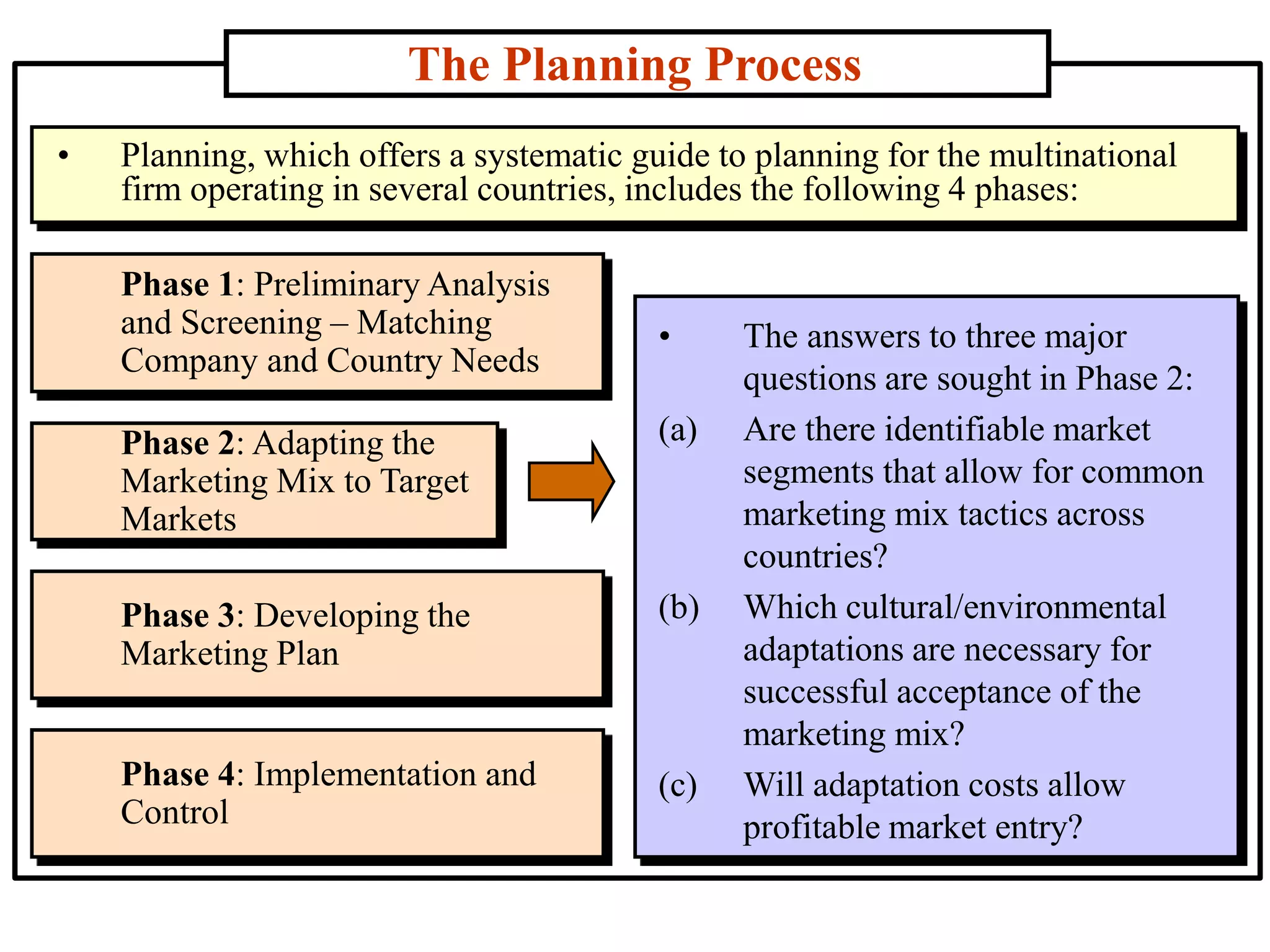
The Planning Process
Phase 1: Preliminary Analysis
and Screening – Matching
Company and Country Needs
• Planning, which offers a systematic guide to planning for the multinational
firm operating in several countries, includes the following 4 phases:
Phase 2: Adapting the
Marketing Mix to Target
Markets
Phase 3: Developing the
Marketing Plan
Phase 4: Implementation and
Control
• The answers to three major
questions are sought in Phase 2:
(a) Are there identifiable market
segments that allow for common
marketing mix tactics across
countries?
(b) Which cultural/environmental
adaptations are necessary for
successful acceptance of the
marketing mix?
(c) Will adaptation costs allow
profitable market entry?
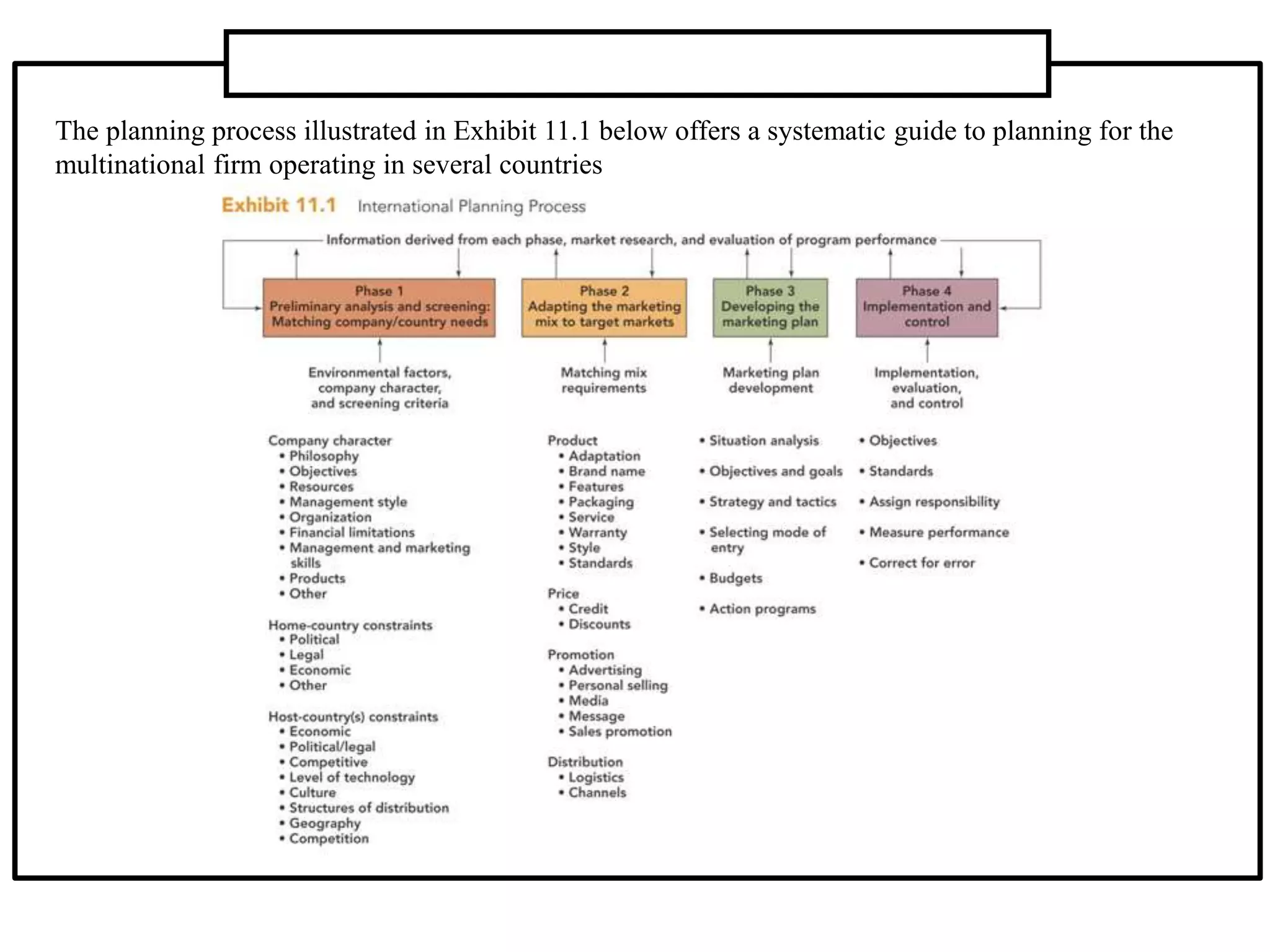
The planning process illustrated in Exhibit 11.1 below offers a systematic guide to planning for the
multinational firm operating in several countries
Foreign Market-Entry Strategies
– Market Size and Growth
– Risk
– Government Regulations
– Competitive Environment
– Local Infrastructure
– Company Objectives
– Need for Control
– Internal Resources, Assets and Capabilities
– Flexibility
When a company makes the commitment to go international, it
must choose an entry strategy
The choice of entry strategy depends on:
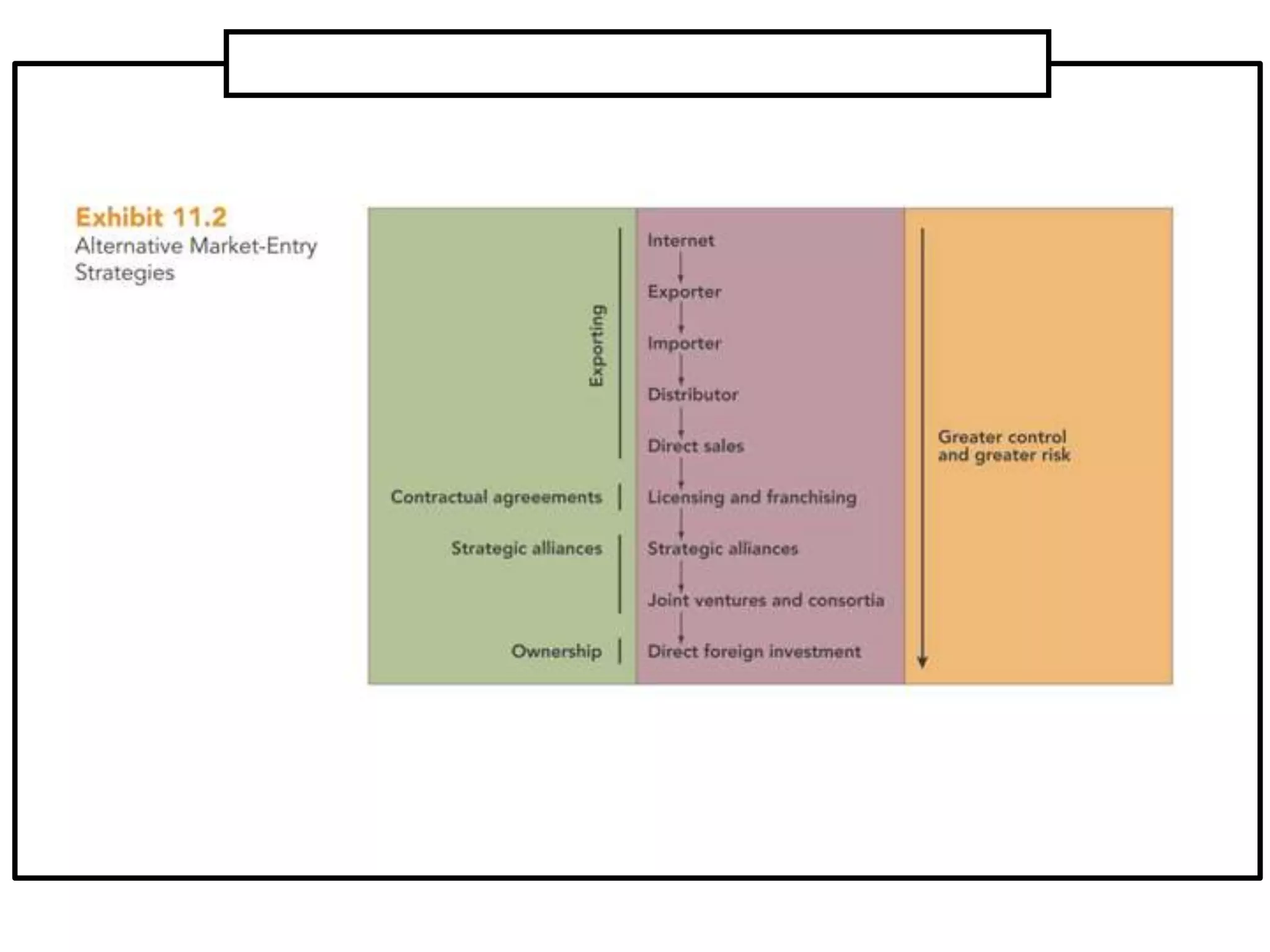
Alternative Market-Entry Strategies
• exporting
• contractual agreements
• strategic alliances, and
• direct foreign investment
• Import regulations may be imposed to protect health, conserve
foreign exchange, serve as economic reprisals, protect home
industry, or provide revenue in the form of tariffs
• A company has four different modes of foreign market entry
from which to select:
Exporting
• Exporting can be either direct or
indirect
• In direct exporting the company sells to
a customer in another country
• In contrast, indirect exporting usually
means that the company sells to a
buyer (importer or distributor) in the
home country who in turn exports the
product
• The Internet is becoming increasingly
important as a foreign market entry
method
Exporting as an Entry Strategy
• Indirect Exporting
– Domestic Intermediary
• Direct Exporting
– Independent Distributor Vs. Sales
Subsidiary
– The Company Owned Sales
Office (Foreign Sales Subsidiary)
Foreign Production as
an Entry Strategy
• Licensing
• Reasons for Licensing
• Disadvantages of Licensing
Licensing
• Licensor and the licensee
• Benefits:
– Appealing to small companies that lack
resources
– Faster access to the market
– Rapid penetration of the global markets
Licensing
• Disadvantages:
– Other entry mode choices may be affected
– Licensee may not be committed
– Lack of enthusiasm on the part of a licensee
– Biggest danger is the risk of opportunism
– Licensee may become a future competitor
Licensing
• How to seek a good licensing agreement:
– Seek patent or trademark protection
– Thorough profitability analysis
– Careful selection of prospective licensees
– Contract parameter (technology package,
use conditions, compensation, and
provisions for the settlement of disputes)
Franchising
• Franchisor and the franchisee
• Master franchising
• Benefits:
– Overseas expansion with a minimum
investment
– Franchisees’ profits tied to their efforts
– Availability of local franchisees’ knowledge
Franchising
• Disadvantages:
– Revenues may not be adequate
– Availability of a master franchisee
– Limited franchising opportunities overseas
– Lack of control over the franchisees’
operations
– Problem in performance standards
– Cultural problems
– Physical proximity
Contractual Agreements
• Contractual agreements generally involve the transfer of
technology, processes, trademarks, or human skills
• Contractual forms of market entry include:
(1) Licensing: A means of establishing a foothold in foreign markets
without large capital outlays is licensing of patent rights, trademark
rights, and the rights to use technological
(2) Franchising: In licensing the franchisor provides a standard package of
products, systems, and management services, and the franchisee
provides market knowledge, capital, and personal involvement in
management
Contractual agreements are long-term, non-equity associations
between a company and another in a foreign market
Strategic International Alliances
• SIAs are sought as a way to shore up weaknesses and increase
competitive strengths
• SIAs offer opportunities for rapid expansion into new markets,
access to new technology, more efficient production and marketing
costs
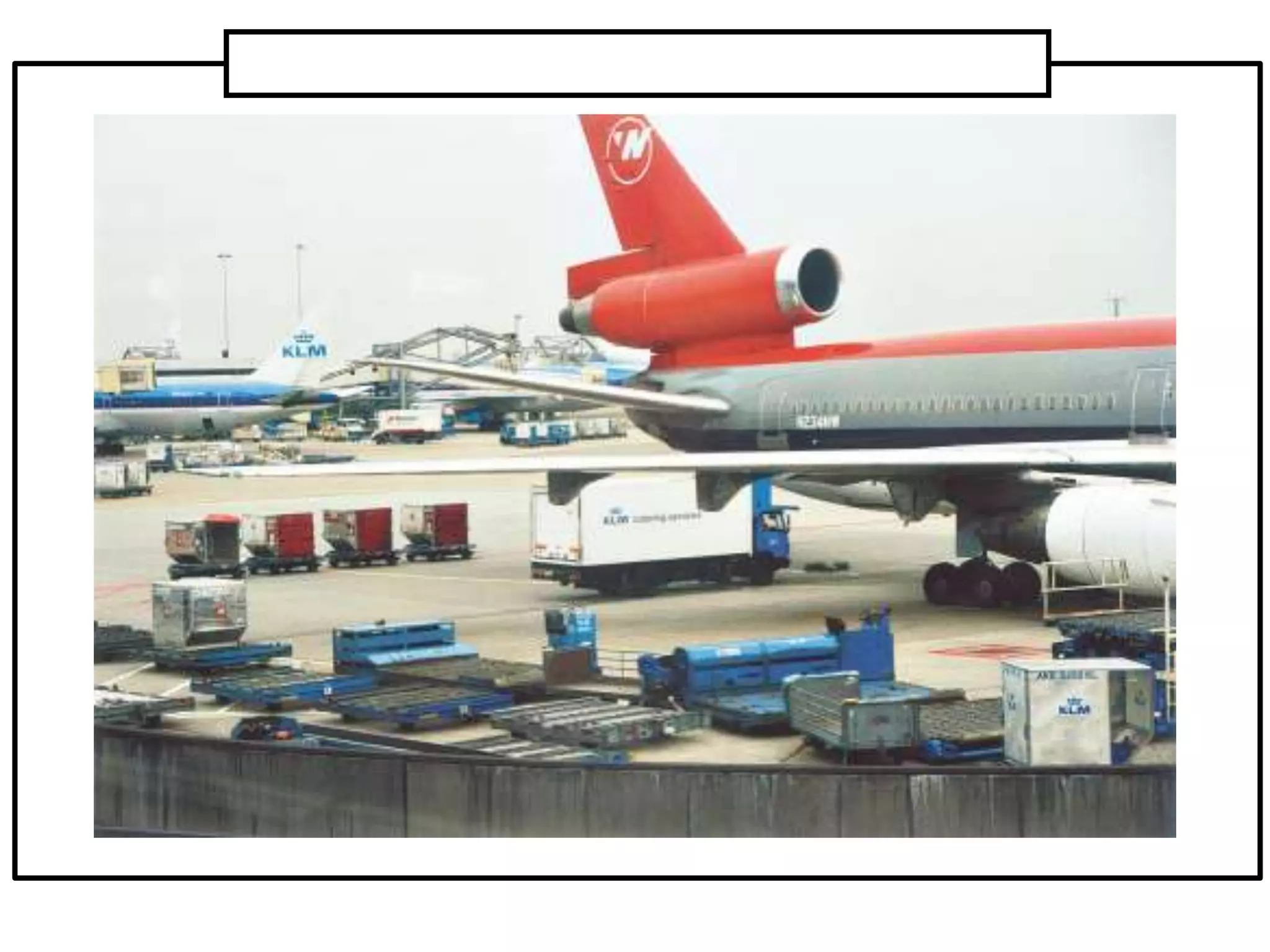
• An example of SIAs in the airlines industry is that of the Oneworld
alliance partners made up of American Airlines, Cathay Pacific,
British Airways, Canadian Airlines, Aer Lingus, and Qantas
• Strategic alliances have grown in importance over the last few
decades as a competitive strategy in global marketing
management
• A strategic international alliance (SIA) is a business
relationship established by two or more companies to
cooperate out of mutual need and to share risk in achieving a
common objective
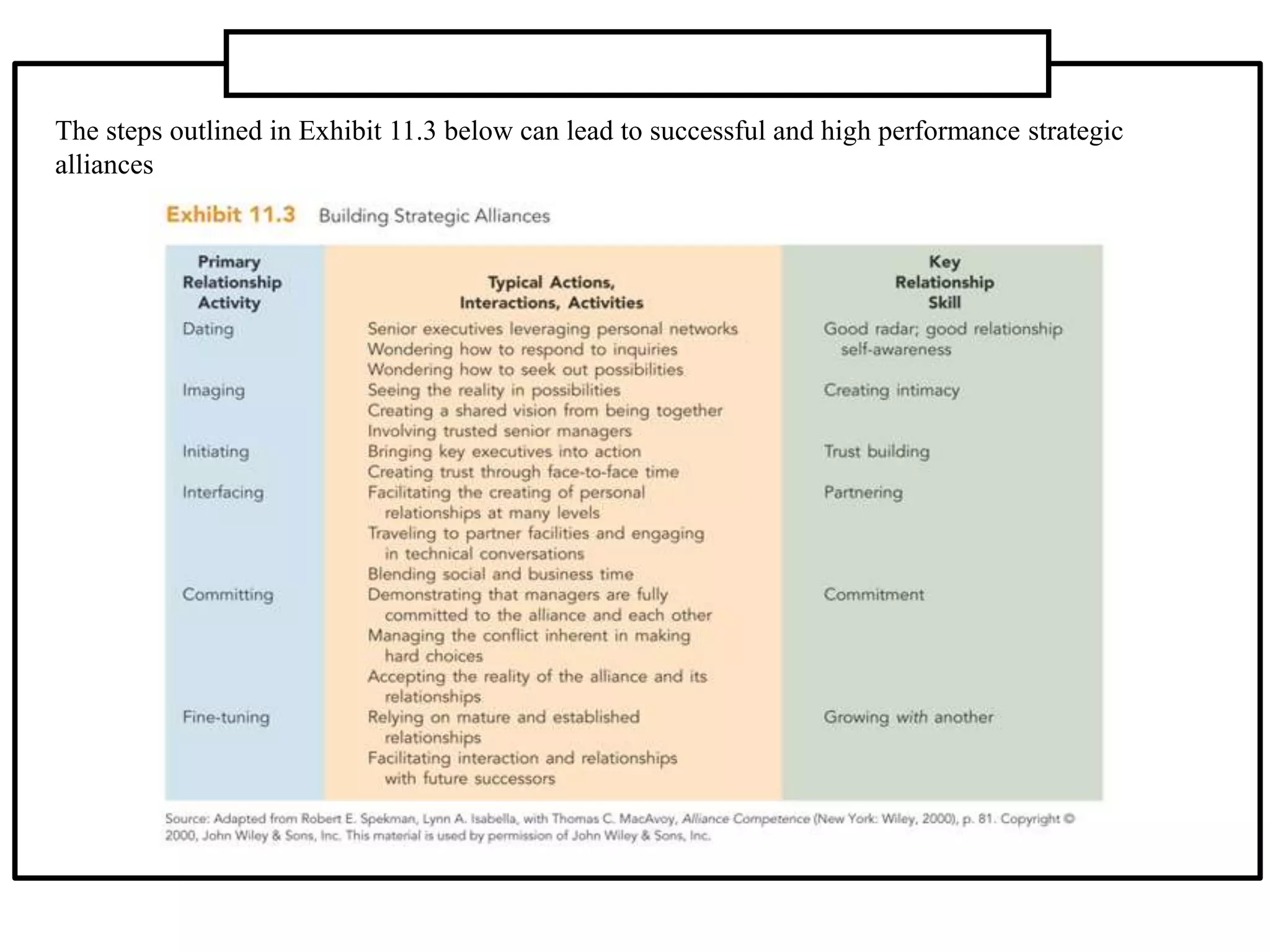
The steps outlined in Exhibit 11.3 below can lead to successful and high performance strategic
alliances
International Joint Ventures
• International joint ventures (IJVs) have been increasingly
used since 1970s
• IJVs are used as a means of lessening political and economic
risks by the amount of the partner’s contribution to the venture
• JVs provide a less risky way to enter markets that pose legal and
cultural barriers than would be the case in an acquisition of an
existing company
• A joint venture is different from strategic alliances or
collaborative relationships in that a joint venture is a partnership
of two or more participating companies that have joined forces
to create a separate legal entity
• Joint ventures are different from minority holdings by an MNC
in a local firm.
International Joint Ventures (contd.)
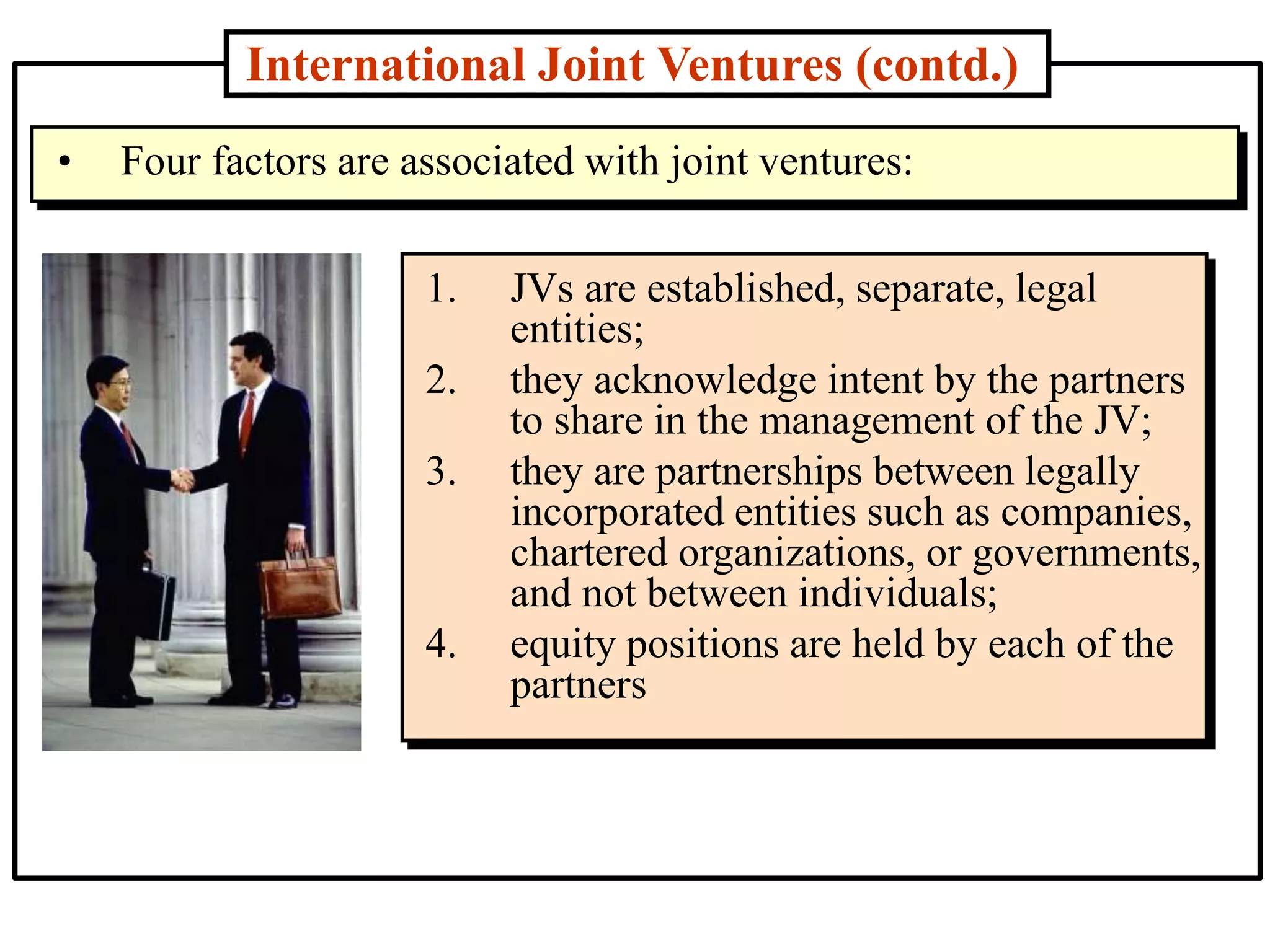
1. JVs are established, separate, legal
entities;
2. they acknowledge intent by the partners
to share in the management of the JV;
3. they are partnerships between legally
incorporated entities such as companies,
chartered organizations, or governments,
and not between individuals;
4. equity positions are held by each of the
partners
• Four factors are associated with joint ventures:
Joint Ventures
• Cooperative joint venture
• Equity joint venture
• Benefits:
– Higher rate of return and more control over the
operations
– Creation of synergy
– Sharing of resources
– Access to distribution network
– Contact with local suppliers and government officials
Joint Ventures
• Disadvantages:
– Lack of control
– Lack of trust
– Conflicts arising over matters such as
strategies, resource allocation, transfer pricing,
ownership of critical assets like technologies
and brand names
Joint Ventures
• Drivers Behind Successful International Joint
Ventures :
– Pick the right partner
– Establish clear objectives from the
beginning
– Bridge cultural gaps
– Gain top managerial commitment and
respect
– Use incremental approach
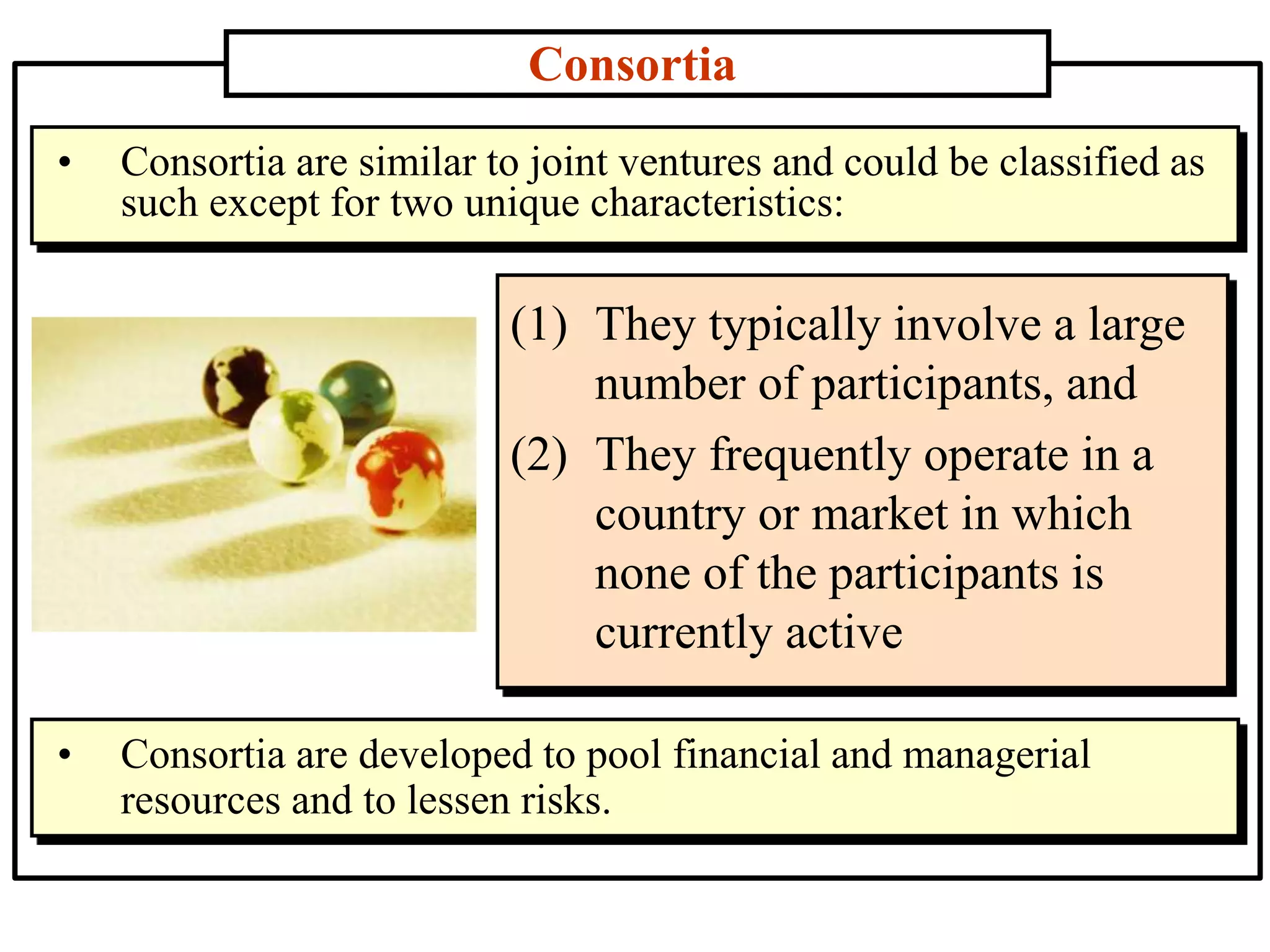
Consortia
(1) They typically involve a large
number of participants, and
(2) They frequently operate in a
country or market in which
none of the participants is
currently active
• Consortia are similar to joint ventures and could be classified as
such except for two unique characteristics:
• Consortia are developed to pool financial and managerial
resources and to lessen risks.
Direct Foreign Investment
• Companies may manufacture locally to capitalize on low-cost
labor, to avoid high import taxes, to reduce the high costs of
transportation to market, to gain access to raw materials, or as
a means of gaining market entry
• Firms may either invest in or buy local companies or establish
new operations facilities
• A fourth means of foreign market development and entry is
direct foreign investment
Organizing for Global Competition
(1) global product divisions responsible for product sales
throughout the world;
(2) geographical divisions responsible for all products and functions
within a given geographical area; or
(3) a matrix organization consisting of either of these arrangements
with centralized sales and marketing run by a centralized
functional staff, or a combination of area operations and global
product management
• An international marketing plan should optimize the resources
committed to company objectives by using one of the
following three alternative organizational structures:
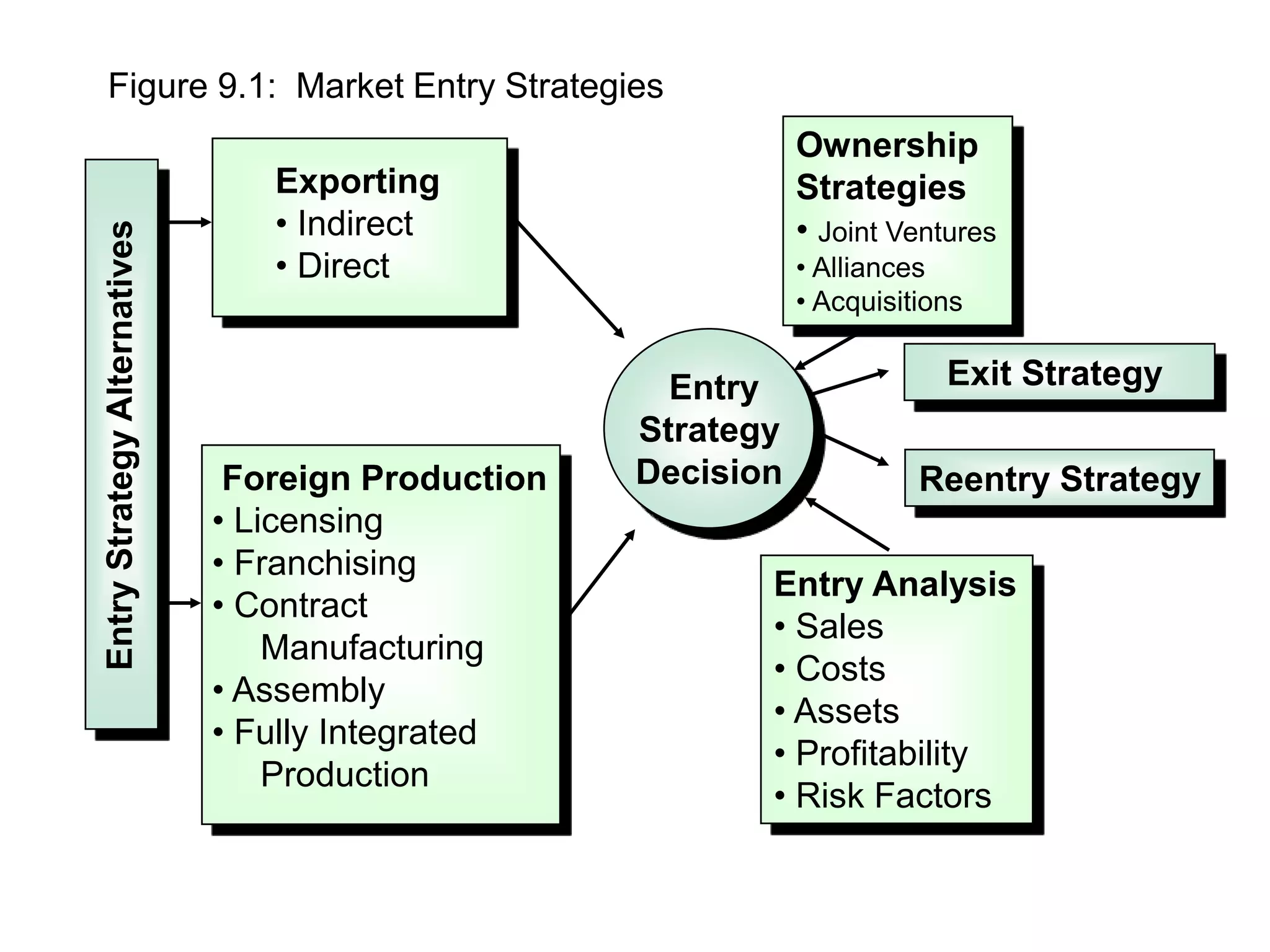
Figure 9.1: Market Entry Strategies
Exporting
• Indirect
• Direct
Foreign Production
• Licensing
• Franchising
• Contract
Manufacturing
• Assembly
• Fully Integrated
Production
Ownership
Strategies
• Joint Ventures
• Alliances
• Acquisitions
Entry Analysis
• Sales
• Costs
• Assets
• Profitability
• Risk Factors
Exit Strategy
Reentry Strategy
Entry
Strategy
Alternatives
Entry
Strategy
Decision

Chap11(Debbie).ppt

  • 1.
    Global Marketing Management: Planningand Organization Chapter 11 McGraw-Hill/Irwin © 2005 The McGraw-Hill Companies, Inc. All rights reserved. Chapter 9 by Jeannet and Hennessey
  • 2.
    Chapter Learning Objectives 1.How global marketing management differs from international marketing management 2. The increasing importance of international strategic alliances 3. The need for planning to achieve company goals 4. The important factors for each alternative market-entry strategy
  • 3.
    Introduction • Increasingly firmsare entering foreign markets • Acquiring a global perspective requires execution requires planning, organization, and a willingness to try new approaches—such as engaging in collaborative relationships • This chapter discusses global marketing management, competition in the global marketplace, strategic planning, and alternative market-entry strategies
  • 4.
    Global Marketing Management •Global Marketing Management thought has undergone substantial revision • In the 1970s the argument was framed as “standardization vs. adaptation” • In the 1980s it was “globalization vs. localization” or “Think local, act local” • In the 1990s it was “global integration vs. local responsiveness” • The basic issue is whether the global homogenization of consumer tastes allowed global standardization of the marketing mix Global Marketing Management: An Old Debate and a New View
  • 9.
    The Nestle Way •The “Nestlé way” is to dominate its markets can be summarized in four points: (1) think and plan long term (2) decentralize (3) stick to what you know, and (4) adapt to local tastes • Nestlé sells more than 8,500 products produced in 489 factories in 193 countries • Nestlé is the world’s biggest marketer of infant formula, powdered milk, instant coffee, chocolate, soups, and mineral water
  • 10.
    Benefits of GlobalMarketing • Economies of scale in production and marketing can be important competitive advantages for global companies • Unifying product development, purchasing, and supply activities across several countries it can save costs • Transfer of experience and know-how across countries through improved coordination and integration of marketing activities • Diversity of markets by spreading the portfolio of markets served brings an important stability of revenues and operations to many global firms The merits of global marketing include:
  • 11.
    Planning for GlobalMarkets • Structurally, planning may be viewed as (1) corporate, (2) strategic, or (3) tactical Planning is a systematized way of relating to the future • It is an attempt to manage the effects of external, uncontrollable factors on the firm’s strengths, weaknesses, objectives, and goals to attain a desired end • International corporate planning is essentially long term, incorporating generalized goals for the enterprise as a whole • Strategic planning is conducted at the highest levels of management and deals with products, capital, and research, and long- and short-term goals of the company • Tactical planning, or market planning, pertains to specific actions and to the allocation of resources used to implement strategic planning goals in specific markets
  • 12.
    The Planning Process Phase1: Preliminary Analysis and Screening – Matching Company and Country Needs • Planning, which offers a systematic guide to planning for the multinational firm operating in several countries, includes the following 4 phases: Phase 2: Adapting the Marketing Mix to Target Markets Phase 3: Developing the Marketing Plan Phase 4: Implementation and Control • The answers to three major questions are sought in Phase 2: (a) Are there identifiable market segments that allow for common marketing mix tactics across countries? (b) Which cultural/environmental adaptations are necessary for successful acceptance of the marketing mix? (c) Will adaptation costs allow profitable market entry?
  • 13.
    The planning processillustrated in Exhibit 11.1 below offers a systematic guide to planning for the multinational firm operating in several countries
  • 14.
    Foreign Market-Entry Strategies –Market Size and Growth – Risk – Government Regulations – Competitive Environment – Local Infrastructure – Company Objectives – Need for Control – Internal Resources, Assets and Capabilities – Flexibility When a company makes the commitment to go international, it must choose an entry strategy The choice of entry strategy depends on:
  • 15.
    Alternative Market-Entry Strategies •exporting • contractual agreements • strategic alliances, and • direct foreign investment • Import regulations may be imposed to protect health, conserve foreign exchange, serve as economic reprisals, protect home industry, or provide revenue in the form of tariffs • A company has four different modes of foreign market entry from which to select:
  • 17.
    Exporting • Exporting canbe either direct or indirect • In direct exporting the company sells to a customer in another country • In contrast, indirect exporting usually means that the company sells to a buyer (importer or distributor) in the home country who in turn exports the product • The Internet is becoming increasingly important as a foreign market entry method
  • 18.
    Exporting as anEntry Strategy • Indirect Exporting – Domestic Intermediary • Direct Exporting – Independent Distributor Vs. Sales Subsidiary – The Company Owned Sales Office (Foreign Sales Subsidiary)
  • 19.
    Foreign Production as anEntry Strategy • Licensing • Reasons for Licensing • Disadvantages of Licensing
  • 20.
    Licensing • Licensor andthe licensee • Benefits: – Appealing to small companies that lack resources – Faster access to the market – Rapid penetration of the global markets
  • 21.
    Licensing • Disadvantages: – Otherentry mode choices may be affected – Licensee may not be committed – Lack of enthusiasm on the part of a licensee – Biggest danger is the risk of opportunism – Licensee may become a future competitor
  • 22.
    Licensing • How toseek a good licensing agreement: – Seek patent or trademark protection – Thorough profitability analysis – Careful selection of prospective licensees – Contract parameter (technology package, use conditions, compensation, and provisions for the settlement of disputes)
  • 23.
    Franchising • Franchisor andthe franchisee • Master franchising • Benefits: – Overseas expansion with a minimum investment – Franchisees’ profits tied to their efforts – Availability of local franchisees’ knowledge
  • 24.
    Franchising • Disadvantages: – Revenuesmay not be adequate – Availability of a master franchisee – Limited franchising opportunities overseas – Lack of control over the franchisees’ operations – Problem in performance standards – Cultural problems – Physical proximity
  • 25.
    Contractual Agreements • Contractualagreements generally involve the transfer of technology, processes, trademarks, or human skills • Contractual forms of market entry include: (1) Licensing: A means of establishing a foothold in foreign markets without large capital outlays is licensing of patent rights, trademark rights, and the rights to use technological (2) Franchising: In licensing the franchisor provides a standard package of products, systems, and management services, and the franchisee provides market knowledge, capital, and personal involvement in management Contractual agreements are long-term, non-equity associations between a company and another in a foreign market
  • 26.
    Strategic International Alliances •SIAs are sought as a way to shore up weaknesses and increase competitive strengths • SIAs offer opportunities for rapid expansion into new markets, access to new technology, more efficient production and marketing costs • An example of SIAs in the airlines industry is that of the Oneworld alliance partners made up of American Airlines, Cathay Pacific, British Airways, Canadian Airlines, Aer Lingus, and Qantas • Strategic alliances have grown in importance over the last few decades as a competitive strategy in global marketing management • A strategic international alliance (SIA) is a business relationship established by two or more companies to cooperate out of mutual need and to share risk in achieving a common objective
  • 28.
    The steps outlinedin Exhibit 11.3 below can lead to successful and high performance strategic alliances
  • 29.
    International Joint Ventures •International joint ventures (IJVs) have been increasingly used since 1970s • IJVs are used as a means of lessening political and economic risks by the amount of the partner’s contribution to the venture • JVs provide a less risky way to enter markets that pose legal and cultural barriers than would be the case in an acquisition of an existing company • A joint venture is different from strategic alliances or collaborative relationships in that a joint venture is a partnership of two or more participating companies that have joined forces to create a separate legal entity • Joint ventures are different from minority holdings by an MNC in a local firm.
  • 30.
    International Joint Ventures(contd.) 1. JVs are established, separate, legal entities; 2. they acknowledge intent by the partners to share in the management of the JV; 3. they are partnerships between legally incorporated entities such as companies, chartered organizations, or governments, and not between individuals; 4. equity positions are held by each of the partners • Four factors are associated with joint ventures:
  • 31.
    Joint Ventures • Cooperativejoint venture • Equity joint venture • Benefits: – Higher rate of return and more control over the operations – Creation of synergy – Sharing of resources – Access to distribution network – Contact with local suppliers and government officials
  • 32.
    Joint Ventures • Disadvantages: –Lack of control – Lack of trust – Conflicts arising over matters such as strategies, resource allocation, transfer pricing, ownership of critical assets like technologies and brand names
  • 33.
    Joint Ventures • DriversBehind Successful International Joint Ventures : – Pick the right partner – Establish clear objectives from the beginning – Bridge cultural gaps – Gain top managerial commitment and respect – Use incremental approach
  • 34.
    Consortia (1) They typicallyinvolve a large number of participants, and (2) They frequently operate in a country or market in which none of the participants is currently active • Consortia are similar to joint ventures and could be classified as such except for two unique characteristics: • Consortia are developed to pool financial and managerial resources and to lessen risks.
  • 35.
    Direct Foreign Investment •Companies may manufacture locally to capitalize on low-cost labor, to avoid high import taxes, to reduce the high costs of transportation to market, to gain access to raw materials, or as a means of gaining market entry • Firms may either invest in or buy local companies or establish new operations facilities • A fourth means of foreign market development and entry is direct foreign investment
  • 37.
    Organizing for GlobalCompetition (1) global product divisions responsible for product sales throughout the world; (2) geographical divisions responsible for all products and functions within a given geographical area; or (3) a matrix organization consisting of either of these arrangements with centralized sales and marketing run by a centralized functional staff, or a combination of area operations and global product management • An international marketing plan should optimize the resources committed to company objectives by using one of the following three alternative organizational structures:
  • 38.
    Figure 9.1: MarketEntry Strategies Exporting • Indirect • Direct Foreign Production • Licensing • Franchising • Contract Manufacturing • Assembly • Fully Integrated Production Ownership Strategies • Joint Ventures • Alliances • Acquisitions Entry Analysis • Sales • Costs • Assets • Profitability • Risk Factors Exit Strategy Reentry Strategy Entry Strategy Alternatives Entry Strategy Decision