OPERATIONS
AND VALUE
CHAIN
MANAGEMENT
© Prentice Hall, 2002 19-1
Learning Objectives
You should learn to:
– Describe the role of the transformation process in
operations management
– Explain why operations management is important
to all types of organizations
– Define value chain management
– Discuss the goal of value chain management
– Explain the organizational and managerial
requirements for value chain management
© Prentice Hall, 2002 19-2
Learning Objectives (cont.)
You should learn to:
– Describe the benefits of and obstacles to value
chain management
– Discuss technology’s role in operations
management
– Describe how quality affects operations
management
– Explain ISO 9000 and Six Sigma
© Prentice Hall, 2002 19-3
What Is Operations Management?
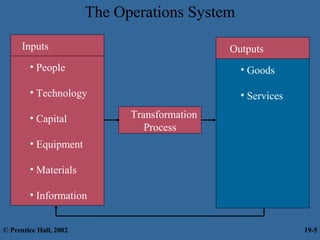
Operations Management
– the design, operation, and control of the transformation
process that converts such resources as labor and raw
materials into goods and services that are sold to
customers
– every organization has an operations system that creates
value by transforming inputs into outputs
• every unit in an organization also has an operations
system
© Prentice Hall, 2002 19-4
The Operations System
• People
• Technology
• Capital
• Equipment
• Materials
• Information
Inputs Outputs
• Goods
• Services
Transformation
Process
© Prentice Hall, 2002 19-5
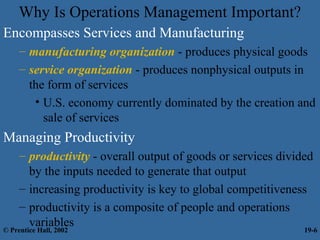
Why Is Operations Management Important?
Encompasses Services and Manufacturing
– manufacturing organization - produces physical goods
– service organization - produces nonphysical outputs in
the form of services
• U.S. economy currently dominated by the creation and
sale of services
Managing Productivity
– productivity - overall output of goods or services divided
by the inputs needed to generate that output
– increasing productivity is key to global competitiveness
– productivity is a composite of people and operations
variables
© Prentice Hall, 2002 19-6
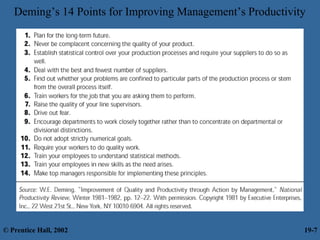
Deming’s 14 Points for Improving Management’s Productivity
© Prentice Hall, 2002 19-7
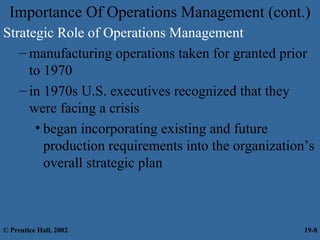
Importance Of Operations Management (cont.)
Strategic Role of Operations Management
– manufacturing operations taken for granted prior
to 1970
– in 1970s U.S. executives recognized that they
were facing a crisis
• began incorporating existing and future
production requirements into the organization’s
overall strategic plan
© Prentice Hall, 2002 19-8
Value Chain Management
What is Value Chain Management?
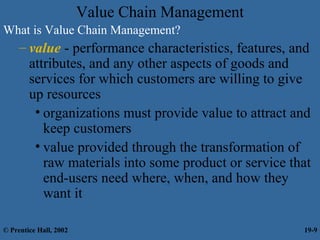
– value - performance characteristics, features, and
attributes, and any other aspects of goods and
services for which customers are willing to give
up resources
• organizations must provide value to attract and
keep customers
• value provided through the transformation of
raw materials into some product or service that
end-users need where, when, and how they
want it
© Prentice Hall, 2002 19-9
What is Value Chain Management? (cont.)
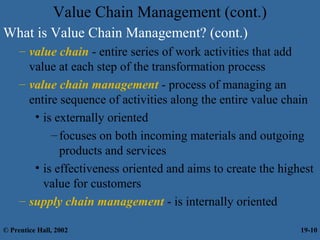
– value chain - entire series of work activities that add
value at each step of the transformation process
– value chain management - process of managing an
entire sequence of activities along the entire value chain
• is externally oriented
–focuses on both incoming materials and outgoing
products and services
• is effectiveness oriented and aims to create the highest
value for customers
– supply chain management - is internally oriented
Value Chain Management (cont.)
© Prentice Hall, 2002 19-10
Value Chain Management (cont.)
Goal of Value Chain Management
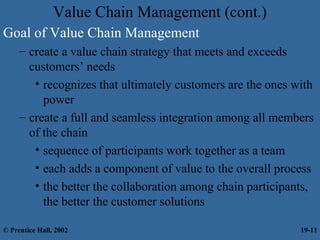
– create a value chain strategy that meets and exceeds
customers’ needs
• recognizes that ultimately customers are the ones with
power
– create a full and seamless integration among all members
of the chain
• sequence of participants work together as a team
• each adds a component of value to the overall process
• the better the collaboration among chain participants,
the better the customer solutions
© Prentice Hall, 2002 19-11
Value Chain Management (cont.)
Requirements for Value Chain Management
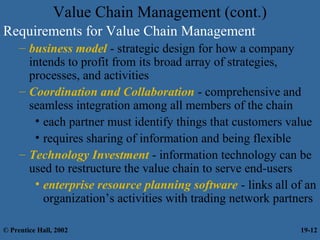
– business model - strategic design for how a company
intends to profit from its broad array of strategies,
processes, and activities
– Coordination and Collaboration - comprehensive and
seamless integration among all members of the chain
• each partner must identify things that customers value
• requires sharing of information and being flexible
– Technology Investment - information technology can be
used to restructure the value chain to serve end-users
• enterprise resource planning software - links all of an
organization’s activities with trading network partners
© Prentice Hall, 2002 19-12
Value Chain Management (cont.)
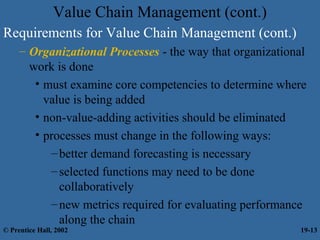
Requirements for Value Chain Management (cont.)
– Organizational Processes - the way that organizational
work is done
• must examine core competencies to determine where
value is being added
• non-value-adding activities should be eliminated
• processes must change in the following ways:
–better demand forecasting is necessary
–selected functions may need to be done
collaboratively
–new metrics required for evaluating performance
along the chain
© Prentice Hall, 2002 19-13
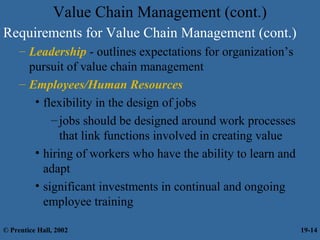
Value Chain Management (cont.)
Requirements for Value Chain Management (cont.)
– Leadership - outlines expectations for organization’s
pursuit of value chain management
– Employees/Human Resources
• flexibility in the design of jobs
–jobs should be designed around work processes
that link functions involved in creating value
• hiring of workers who have the ability to learn and
adapt
• significant investments in continual and ongoing
employee training
© Prentice Hall, 2002 19-14
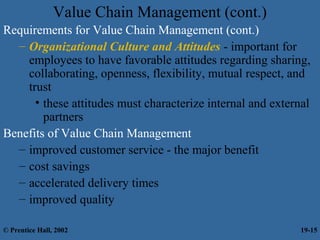
Value Chain Management (cont.)
Requirements for Value Chain Management (cont.)
– Organizational Culture and Attitudes - important for
employees to have favorable attitudes regarding sharing,
collaborating, openness, flexibility, mutual respect, and
trust
• these attitudes must characterize internal and external
partners
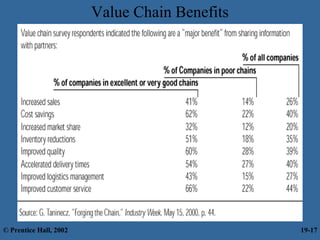
Benefits of Value Chain Management
– improved customer service - the major benefit
– cost savings
– accelerated delivery times
– improved quality
© Prentice Hall, 2002 19-15
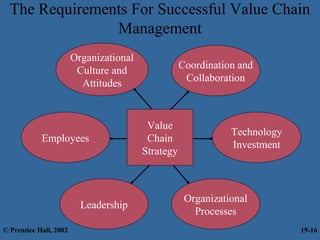
The Requirements For Successful Value Chain
Management
Technology
Investment
Organizational
Culture and
Attitudes
Employees
Organizational
Processes
Leadership
Value
Chain
Strategy
Coordination and
Collaboration
© Prentice Hall, 2002 19-16
Value Chain Benefits
© Prentice Hall, 2002 19-17
Value Chain Management (cont.)
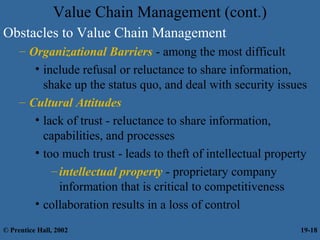
Obstacles to Value Chain Management
– Organizational Barriers - among the most difficult
• include refusal or reluctance to share information,
shake up the status quo, and deal with security issues
– Cultural Attitudes
• lack of trust - reluctance to share information,
capabilities, and processes
• too much trust - leads to theft of intellectual property
–intellectual property - proprietary company
information that is critical to competitiveness
• collaboration results in a loss of control
© Prentice Hall, 2002 19-18
Value Chain Management (cont.)
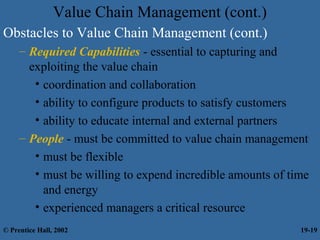
Obstacles to Value Chain Management (cont.)
– Required Capabilities - essential to capturing and
exploiting the value chain
• coordination and collaboration
• ability to configure products to satisfy customers
• ability to educate internal and external partners
– People - must be committed to value chain management
• must be flexible
• must be willing to expend incredible amounts of time
and energy
• experienced managers a critical resource
© Prentice Hall, 2002 19-19
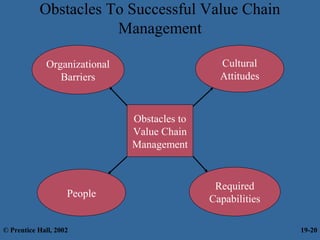
Obstacles To Successful Value Chain
Management
Cultural
Attitudes
Organizational
Barriers
Required
Capabilities
People
Obstacles to
Value Chain
Management
© Prentice Hall, 2002 19-20
Current Issues In Operations Management
Technology’s Role in E-Manufacturing
– smart companies trying to harness Web technology to
improve operations management
– link plant-floor automation with enterprise-wide business
network systems
• synchronize enterprise operations with customers
– technology is helping to reduce manufacturing costs
• e-manufacturing technology is affecting equipment
maintenance
• prevents equipment breakdowns and subsequent
production downtime
© Prentice Hall, 2002 19-21
Current Issues (cont.)
Quality Initiatives
– strategic initiatives that promote quality and continuous
improvement are critical to manufacturing excellence
– quality - the ability of a product or service to reliably do
what it’s supposed to do and to satisfy customer
expectations
– Planning for Quality - need quality improvement goals
and strategies to achieve those goals
– Organizing and Leading for Quality - two approaches
• cross-functional teams
• self-directed or empowered teams
© Prentice Hall, 2002 19-22
Current Issues (cont.)
Quality Initiatives (cont)
– Controlling for Quality - monitor and evaluate
the progress of quality improvement efforts
• e.g., standards for inventory control, defect
rate, and raw materials procurement
• defect prevention rather than defect detection is
a priority
–quality is the responsibility of all employees
© Prentice Hall, 2002 19-23
Current Issues (cont.)
Quality Goals
– ISO 9000 - series of international quality
management standards proposed by the
International Organization for Standardization
• uniform guidelines for processes to ensure that
products conform to customer requirements
• internationally recognized
–ISO certification becoming a prerequisite for
global business
© Prentice Hall, 2002 19-24
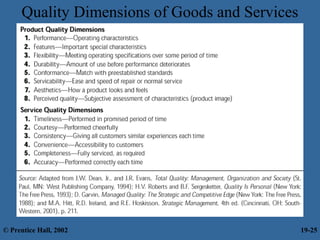
Quality Dimensions of Goods and Services
© Prentice Hall, 2002 19-25
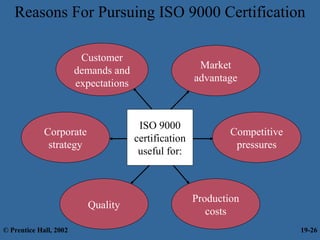
Reasons For Pursuing ISO 9000 Certification
Competitive
pressures
Customer
demands and
expectations
Corporate
strategy
Production
costs
Quality
ISO 9000
certification
useful for:
Market
advantage
© Prentice Hall, 2002 19-26
Current Issues (cont.)
Quality Goals (cont.)
– Six Sigma - a quality standard that establishes a
goal of no more than 3.4 defects per million units
or procedures
– is essentially a zero-defects standard
• quality-driven businesses use it to judge their
suppliers
© Prentice Hall, 2002 19-27

Chap1 operations iipm

  • 1.
  • 2.
    Learning Objectives You shouldlearn to: – Describe the role of the transformation process in operations management – Explain why operations management is important to all types of organizations – Define value chain management – Discuss the goal of value chain management – Explain the organizational and managerial requirements for value chain management © Prentice Hall, 2002 19-2
  • 3.
    Learning Objectives (cont.) Youshould learn to: – Describe the benefits of and obstacles to value chain management – Discuss technology’s role in operations management – Describe how quality affects operations management – Explain ISO 9000 and Six Sigma © Prentice Hall, 2002 19-3
  • 4.
    What Is OperationsManagement? Operations Management – the design, operation, and control of the transformation process that converts such resources as labor and raw materials into goods and services that are sold to customers – every organization has an operations system that creates value by transforming inputs into outputs • every unit in an organization also has an operations system © Prentice Hall, 2002 19-4
  • 5.
    The Operations System •People • Technology • Capital • Equipment • Materials • Information Inputs Outputs • Goods • Services Transformation Process © Prentice Hall, 2002 19-5
  • 6.
    Why Is OperationsManagement Important? Encompasses Services and Manufacturing – manufacturing organization - produces physical goods – service organization - produces nonphysical outputs in the form of services • U.S. economy currently dominated by the creation and sale of services Managing Productivity – productivity - overall output of goods or services divided by the inputs needed to generate that output – increasing productivity is key to global competitiveness – productivity is a composite of people and operations variables © Prentice Hall, 2002 19-6
  • 7.
    Deming’s 14 Pointsfor Improving Management’s Productivity © Prentice Hall, 2002 19-7
  • 8.
    Importance Of OperationsManagement (cont.) Strategic Role of Operations Management – manufacturing operations taken for granted prior to 1970 – in 1970s U.S. executives recognized that they were facing a crisis • began incorporating existing and future production requirements into the organization’s overall strategic plan © Prentice Hall, 2002 19-8
  • 9.
    Value Chain Management Whatis Value Chain Management? – value - performance characteristics, features, and attributes, and any other aspects of goods and services for which customers are willing to give up resources • organizations must provide value to attract and keep customers • value provided through the transformation of raw materials into some product or service that end-users need where, when, and how they want it © Prentice Hall, 2002 19-9
  • 10.
    What is ValueChain Management? (cont.) – value chain - entire series of work activities that add value at each step of the transformation process – value chain management - process of managing an entire sequence of activities along the entire value chain • is externally oriented –focuses on both incoming materials and outgoing products and services • is effectiveness oriented and aims to create the highest value for customers – supply chain management - is internally oriented Value Chain Management (cont.) © Prentice Hall, 2002 19-10
  • 11.
    Value Chain Management(cont.) Goal of Value Chain Management – create a value chain strategy that meets and exceeds customers’ needs • recognizes that ultimately customers are the ones with power – create a full and seamless integration among all members of the chain • sequence of participants work together as a team • each adds a component of value to the overall process • the better the collaboration among chain participants, the better the customer solutions © Prentice Hall, 2002 19-11
  • 12.
    Value Chain Management(cont.) Requirements for Value Chain Management – business model - strategic design for how a company intends to profit from its broad array of strategies, processes, and activities – Coordination and Collaboration - comprehensive and seamless integration among all members of the chain • each partner must identify things that customers value • requires sharing of information and being flexible – Technology Investment - information technology can be used to restructure the value chain to serve end-users • enterprise resource planning software - links all of an organization’s activities with trading network partners © Prentice Hall, 2002 19-12
  • 13.
    Value Chain Management(cont.) Requirements for Value Chain Management (cont.) – Organizational Processes - the way that organizational work is done • must examine core competencies to determine where value is being added • non-value-adding activities should be eliminated • processes must change in the following ways: –better demand forecasting is necessary –selected functions may need to be done collaboratively –new metrics required for evaluating performance along the chain © Prentice Hall, 2002 19-13
  • 14.
    Value Chain Management(cont.) Requirements for Value Chain Management (cont.) – Leadership - outlines expectations for organization’s pursuit of value chain management – Employees/Human Resources • flexibility in the design of jobs –jobs should be designed around work processes that link functions involved in creating value • hiring of workers who have the ability to learn and adapt • significant investments in continual and ongoing employee training © Prentice Hall, 2002 19-14
  • 15.
    Value Chain Management(cont.) Requirements for Value Chain Management (cont.) – Organizational Culture and Attitudes - important for employees to have favorable attitudes regarding sharing, collaborating, openness, flexibility, mutual respect, and trust • these attitudes must characterize internal and external partners Benefits of Value Chain Management – improved customer service - the major benefit – cost savings – accelerated delivery times – improved quality © Prentice Hall, 2002 19-15
  • 16.
    The Requirements ForSuccessful Value Chain Management Technology Investment Organizational Culture and Attitudes Employees Organizational Processes Leadership Value Chain Strategy Coordination and Collaboration © Prentice Hall, 2002 19-16
  • 17.
    Value Chain Benefits ©Prentice Hall, 2002 19-17
  • 18.
    Value Chain Management(cont.) Obstacles to Value Chain Management – Organizational Barriers - among the most difficult • include refusal or reluctance to share information, shake up the status quo, and deal with security issues – Cultural Attitudes • lack of trust - reluctance to share information, capabilities, and processes • too much trust - leads to theft of intellectual property –intellectual property - proprietary company information that is critical to competitiveness • collaboration results in a loss of control © Prentice Hall, 2002 19-18
  • 19.
    Value Chain Management(cont.) Obstacles to Value Chain Management (cont.) – Required Capabilities - essential to capturing and exploiting the value chain • coordination and collaboration • ability to configure products to satisfy customers • ability to educate internal and external partners – People - must be committed to value chain management • must be flexible • must be willing to expend incredible amounts of time and energy • experienced managers a critical resource © Prentice Hall, 2002 19-19
  • 20.
    Obstacles To SuccessfulValue Chain Management Cultural Attitudes Organizational Barriers Required Capabilities People Obstacles to Value Chain Management © Prentice Hall, 2002 19-20
  • 21.
    Current Issues InOperations Management Technology’s Role in E-Manufacturing – smart companies trying to harness Web technology to improve operations management – link plant-floor automation with enterprise-wide business network systems • synchronize enterprise operations with customers – technology is helping to reduce manufacturing costs • e-manufacturing technology is affecting equipment maintenance • prevents equipment breakdowns and subsequent production downtime © Prentice Hall, 2002 19-21
  • 22.
    Current Issues (cont.) QualityInitiatives – strategic initiatives that promote quality and continuous improvement are critical to manufacturing excellence – quality - the ability of a product or service to reliably do what it’s supposed to do and to satisfy customer expectations – Planning for Quality - need quality improvement goals and strategies to achieve those goals – Organizing and Leading for Quality - two approaches • cross-functional teams • self-directed or empowered teams © Prentice Hall, 2002 19-22
  • 23.
    Current Issues (cont.) QualityInitiatives (cont) – Controlling for Quality - monitor and evaluate the progress of quality improvement efforts • e.g., standards for inventory control, defect rate, and raw materials procurement • defect prevention rather than defect detection is a priority –quality is the responsibility of all employees © Prentice Hall, 2002 19-23
  • 24.
    Current Issues (cont.) QualityGoals – ISO 9000 - series of international quality management standards proposed by the International Organization for Standardization • uniform guidelines for processes to ensure that products conform to customer requirements • internationally recognized –ISO certification becoming a prerequisite for global business © Prentice Hall, 2002 19-24
  • 25.
    Quality Dimensions ofGoods and Services © Prentice Hall, 2002 19-25
  • 26.
    Reasons For PursuingISO 9000 Certification Competitive pressures Customer demands and expectations Corporate strategy Production costs Quality ISO 9000 certification useful for: Market advantage © Prentice Hall, 2002 19-26
  • 27.
    Current Issues (cont.) QualityGoals (cont.) – Six Sigma - a quality standard that establishes a goal of no more than 3.4 defects per million units or procedures – is essentially a zero-defects standard • quality-driven businesses use it to judge their suppliers © Prentice Hall, 2002 19-27