CHAPTER 9:
THE RULES OF
SELLING
Report by: Gadaingan, Rhealyn P.
Solis, Sheila Mae D.
THE RULES OF SELLING
The "art of selling" is simply knowing how to
present whatever it is that you're selling, to the
buyer in such a manner that he feels buying it
from you will solve his problems or fulfill his
dreams.
1.The art of salesmanship is
showmanship
2.The art of salesmanship is
the concealment of
salesmanship
3.The art of salesmanship is
the absence of
salesmanship
A career in sales has three separate and
distinct phases or levels of growth. The three
phases are:
The art of salesmanship is SHOWMANSHIP
● Characterized by the development of sophisticated and
polished presentation of skills that unfailingly dazzles (but do
not always win the business).
Positive aspect : Good exhibition of product knowledge
wrapped in exceptional presentation skills.
Negative aspect : One sided approach. It does not take much of
what is going on with customer the customer into consideration.
The art of salesmanship is the CONCEALMENT of
salesmanship.
● Characterized by well prepared, interactive questions that elicit
the “right responses” from the customer.
Positive aspect : Interaction with and feedback from the customer.
Negative aspect : Often a stacked deck. Leading questions usually
reveal what you think the issues and problems are, not what the
customer knows they are.
The art of salesmanship is the ABSENCE of
salesmanship.
● Characterized by a quiet, relaxed, well prepared salesperson
who forgets every aspect of the technique and just listens and
reacts in the real time.
Positive aspect : It’s so easy to tell the truth.
Negative aspect : It often takes a lifetime in sales before one has
the confidence to say almost nothing and communicate
effectively.
CREDITS: This presentation template was created by Slidesgo,
including icons by Flaticon and infographics & images by Freepik
THE RULES OF SELLING
One rule that seems to hold fast and true in every
selling situation is “AT FIRST GLANCE OR AT
FIRST HEARING THE PRESENTATION MUST
BE LOGICAL TO THE CUSTOMER AT THEIR
LEVEL OF UNDERSTANDING”.
This template was created by Slidesgo
3. Believe in your
own words
2. Know your
prospect
1. Know your
product or
service
• Know it inside and
out backward and
forward. You should
know its strengths,
weaknesses, and all
its features. Also
understand the
factors that influence
its supply and
demand. All of these
will strengthen your
presentation and help
the customer make a
more informed
purchasing decision.
• Along with knowing
your product comes
knowing your
prospect. Strive to
know all you can
about your target
demographic and
potential clients.
Make sure you deal
with the decision
maker.
• If you are lucky
enough to sell a
product you do
not believe in, you
still lose because
you risk killing
referral business
and losing the
trust of your
customer.
5. Gain trust by
associating
yourself with
things they respect
6. Offer a free trial,
incentive, bargain
or guarantee
4. Be
Transparent
• Transparency builds
trust. Things people do
not understand will
always be greeted with
"no." The more
information available
when making a
purchasing decision,
the more likely they
are to say "yes."
Another benefit of
being transparent is the
more resources you
divulge free of charge,
the more likely you are
to generate interest in
your product/service.
• By offering
endorsements and
testimonials,
especially from
well-known sources
that your target
market respects, you
strike the chord of
"trust."
• There are many
variations of each, but
incentives and
guarantees are great
ways to gain your
potential buyer's
confidence. Guarantees
and free trails allow the
skeptic to try the
product/service before
determining if your
offer is a good fit.
7. Compare & differentiate yourself from your
competitors
● Know the nature of your business. Is it commodity based, where the low
price bidder wins? Is the strength of your brand a factor? Is there
something unique about your offer? You must understand your
competitors and their advantages and disadvantages. Once you have both
the knowledge of your competitors and an understanding of the skeptic's
needs, you can choose the most effective marketing angle. We offer such
phrases as:
 “The lowest cost………………” you play for the desire of value
 “The official……………………...” you validate for authenticity
 “The best…………………………” you show superiority
 “The only………………………….” you offer exclusivity
 If possible, demonstrate the differences that make your product/service
unique or superior.
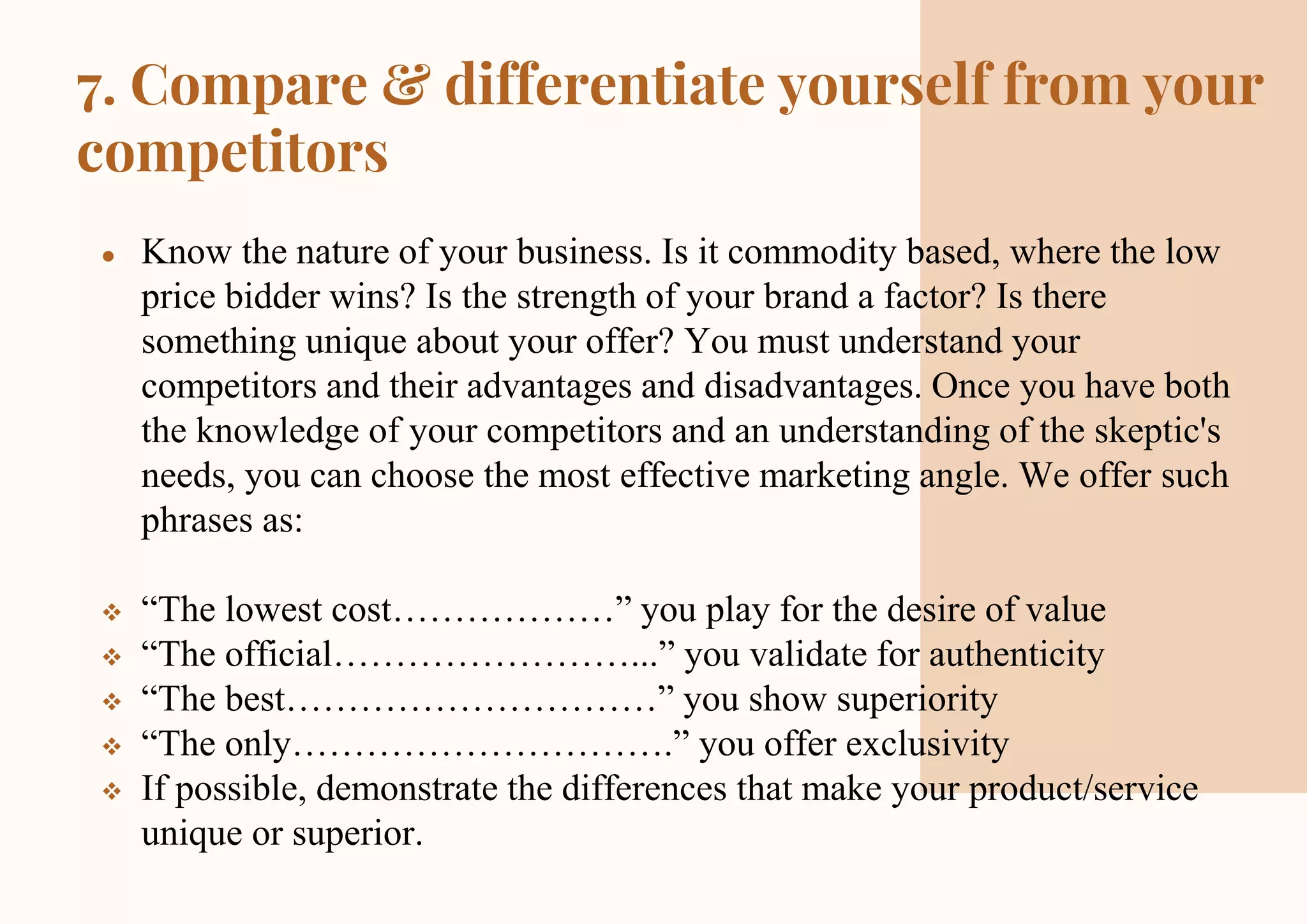
8. Sell the relationship and not the product
● Relationships are more valuable to
both you and the prospect than a
one-time transaction. For the
salesperson, relationships bring
repeat business and the ability to
cross-market your offerings;
increased referrals because you gain
access to the prospect's network
base, and the ability to charge a
premium because of the higher
perceived value of your relationship.
Relationships help build trust.
9. Focus on the
benefit offered and
value delivered
● Emotional selling differs
from bottom-line selling
because it focuses on
feelings rather than metrics.
Remember to focus on the
benefits that concern your
potential buyer; anything
else will make a skeptic
lose interest and you lose
the sale.
● To do so, ask two types of
questions: those to better
understand your potential buyer
and his/her needs, and questions
designed to lead your prospect to
buy. A series of well-placed
questions will allow you to isolate
any objections. You should
brainstorm every possible reason a
skeptic will not buy from you and
comprise an effective solution or
rebuttal for each.
10. Isolate their
objection
CREDITS: This presentation template was created by Slidesgo,
including icons by Flaticon and infographics & images by Freepik
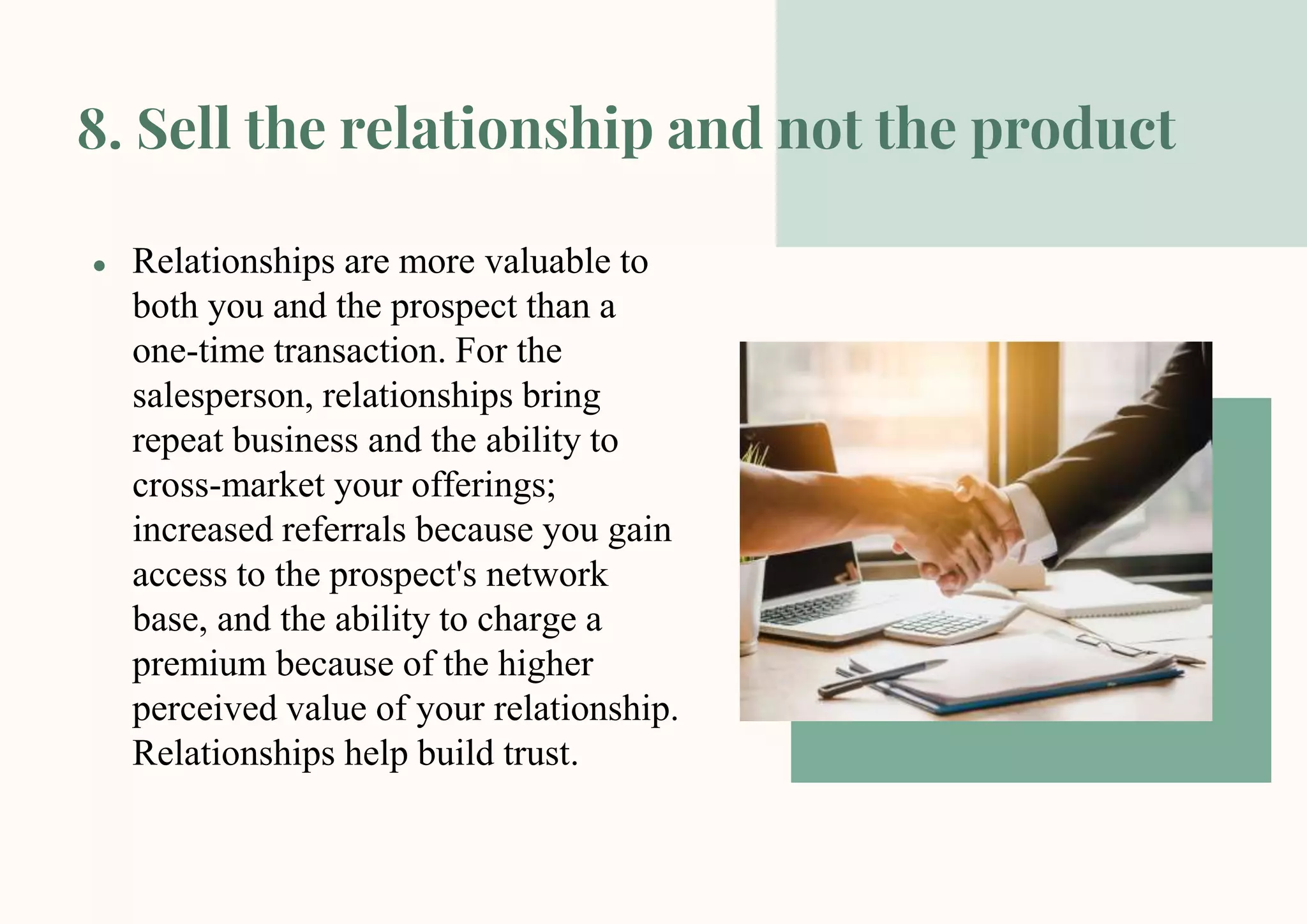
11. Don’t seem desperate
• Your emotional state will be
apparent to a customer. Never
appear as though you "need" a
sale. Everyone avoids a hard-
pressed individual. Often we are
conditioned to give to and buy
from those who do not need our
money.
The Power of
Confidence
People want to buy from sales people who are
confident in their abilities. Taking control of the
circumstances and situations around you will develop
your self-confidence. When you consider the amount of
rejection that many sales people encounter, the fact that
many salespeople lack self-confidence is not surprising.
Top performing people in any industry typically possess a
high level of self-confidence. They may not necessarily
possess this confidence all their lives.
How do we prevent this from happening?
● Carrying around mental baggage is a natural part of being a human
being. It is the way we view and deal with our baggage that makes the
real difference in our lives. If we look at each experience and consider
how we can learn from it, our baggage will have less hold over us.
When you encounter a sales situation that does not turn out favorably,
rather than focus on the negatives and beating yourself up over it, ask
yourself three questions:
○ What did I do well?
○ What did I miss or forget to do?
○ What will I do differently if faced with a similar situation in the
future?
CREDITS: This presentation template was created by Slidesgo,
including icons by Flaticon and infographics & images by Freepik
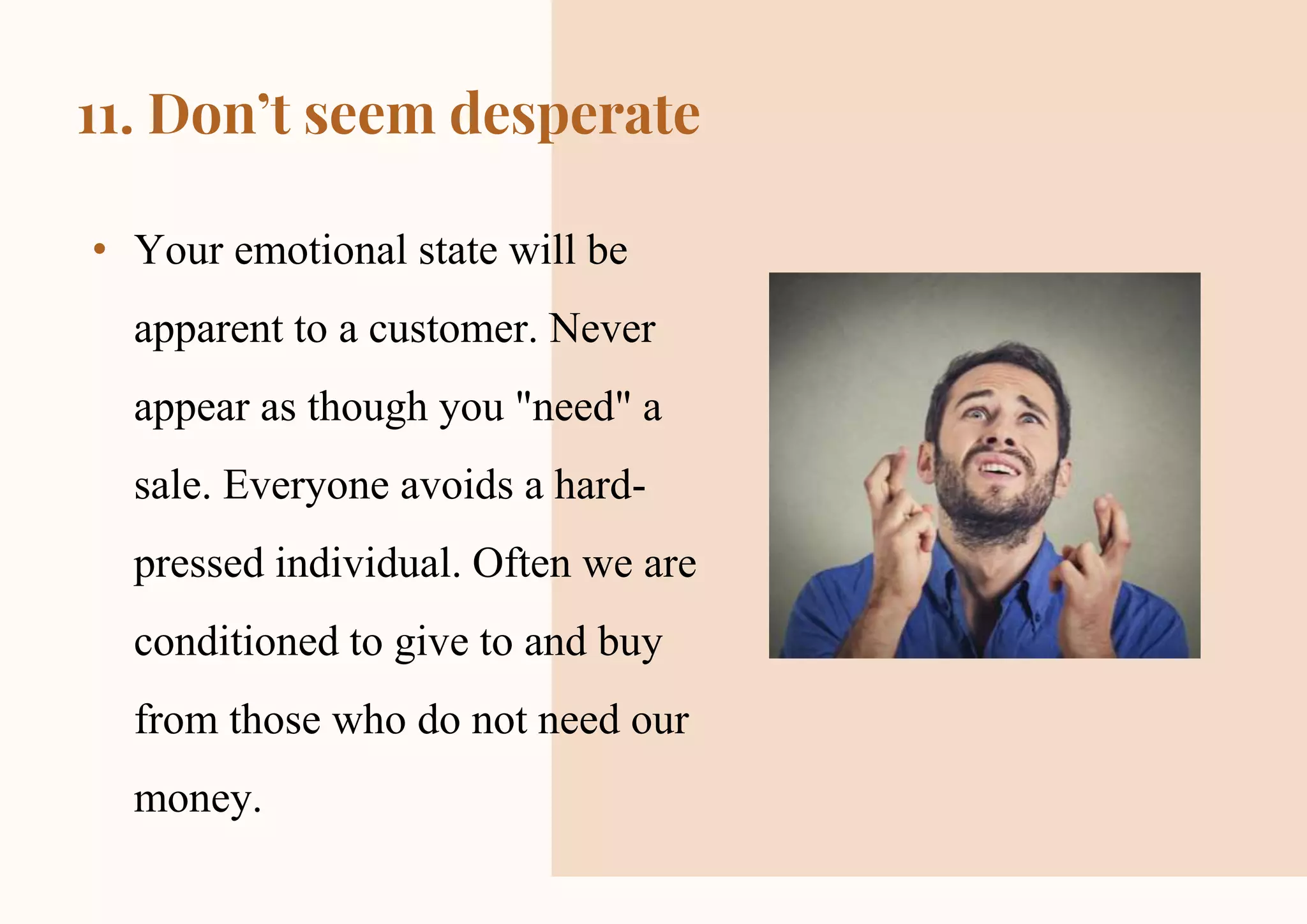
Selling Yourself – It’s Not
About You
 Selling yourself (or
anything else) isn't about
talking about you or what
you do; it's about
listening and
understanding the other
person's situation. So if
you want to be
INTERESTING then be
INTERESTED!
Words to Remember:
1. Strategic Selling
Strategic selling' describes a broad methodology which began to be
practiced in the 1980's, literally 'strategic' by its nature (the principles
involve taking a strategic view of the prospective customer's organization,
its markets, customers and strategic priorities, etc).
2. Target/Sales Target
In a sales context this is the issued (or ideally agreed) level of sales
performance for a sales person or team or department over a given period.
3. Telemarketing
Any pre-sales activity conducted by telephone, usually by specially trained
telemarketing personnel - for instance, research, appointment- making,
product promotion.
4. Tele sales
Selling by telephone contact alone, normally a sales function in its
own right, i.e., utilizing specially trained tele sales personnel; used typically
where low order values prevent the use of expensive field-based sales
people, and a recognizable product or service allows the process to succeed.
5. Tender
A very structured formal proposal in response to the issue of an
invitation to tender for the supply of a product or service to a large
organization or government department. Tenders require certain qualifying
criteria to be met first by the tendering organization, which in itself can
constitute several weeks or months work by lots of different staff.
CREDITS: This presentation template was created by Slidesgo,
including icons by Flaticon and infographics & images by Freepik
Please keep this slide for attribution
Thank you
for listening
and God
Bless!

Chap 9 reporting

  • 1.
    CHAPTER 9: THE RULESOF SELLING Report by: Gadaingan, Rhealyn P. Solis, Sheila Mae D.
  • 2.
    THE RULES OFSELLING The "art of selling" is simply knowing how to present whatever it is that you're selling, to the buyer in such a manner that he feels buying it from you will solve his problems or fulfill his dreams.
  • 3.
    1.The art ofsalesmanship is showmanship 2.The art of salesmanship is the concealment of salesmanship 3.The art of salesmanship is the absence of salesmanship A career in sales has three separate and distinct phases or levels of growth. The three phases are:
  • 4.
    The art ofsalesmanship is SHOWMANSHIP ● Characterized by the development of sophisticated and polished presentation of skills that unfailingly dazzles (but do not always win the business). Positive aspect : Good exhibition of product knowledge wrapped in exceptional presentation skills. Negative aspect : One sided approach. It does not take much of what is going on with customer the customer into consideration.
  • 5.
    The art ofsalesmanship is the CONCEALMENT of salesmanship. ● Characterized by well prepared, interactive questions that elicit the “right responses” from the customer. Positive aspect : Interaction with and feedback from the customer. Negative aspect : Often a stacked deck. Leading questions usually reveal what you think the issues and problems are, not what the customer knows they are.
  • 6.
    The art ofsalesmanship is the ABSENCE of salesmanship. ● Characterized by a quiet, relaxed, well prepared salesperson who forgets every aspect of the technique and just listens and reacts in the real time. Positive aspect : It’s so easy to tell the truth. Negative aspect : It often takes a lifetime in sales before one has the confidence to say almost nothing and communicate effectively.
  • 7.
    CREDITS: This presentationtemplate was created by Slidesgo, including icons by Flaticon and infographics & images by Freepik THE RULES OF SELLING One rule that seems to hold fast and true in every selling situation is “AT FIRST GLANCE OR AT FIRST HEARING THE PRESENTATION MUST BE LOGICAL TO THE CUSTOMER AT THEIR LEVEL OF UNDERSTANDING”.
  • 8.
    This template wascreated by Slidesgo 3. Believe in your own words 2. Know your prospect 1. Know your product or service • Know it inside and out backward and forward. You should know its strengths, weaknesses, and all its features. Also understand the factors that influence its supply and demand. All of these will strengthen your presentation and help the customer make a more informed purchasing decision. • Along with knowing your product comes knowing your prospect. Strive to know all you can about your target demographic and potential clients. Make sure you deal with the decision maker. • If you are lucky enough to sell a product you do not believe in, you still lose because you risk killing referral business and losing the trust of your customer.
  • 9.
    5. Gain trustby associating yourself with things they respect 6. Offer a free trial, incentive, bargain or guarantee 4. Be Transparent • Transparency builds trust. Things people do not understand will always be greeted with "no." The more information available when making a purchasing decision, the more likely they are to say "yes." Another benefit of being transparent is the more resources you divulge free of charge, the more likely you are to generate interest in your product/service. • By offering endorsements and testimonials, especially from well-known sources that your target market respects, you strike the chord of "trust." • There are many variations of each, but incentives and guarantees are great ways to gain your potential buyer's confidence. Guarantees and free trails allow the skeptic to try the product/service before determining if your offer is a good fit.
  • 10.
    7. Compare &differentiate yourself from your competitors ● Know the nature of your business. Is it commodity based, where the low price bidder wins? Is the strength of your brand a factor? Is there something unique about your offer? You must understand your competitors and their advantages and disadvantages. Once you have both the knowledge of your competitors and an understanding of the skeptic's needs, you can choose the most effective marketing angle. We offer such phrases as:  “The lowest cost………………” you play for the desire of value  “The official……………………...” you validate for authenticity  “The best…………………………” you show superiority  “The only………………………….” you offer exclusivity  If possible, demonstrate the differences that make your product/service unique or superior.
  • 11.
    8. Sell therelationship and not the product ● Relationships are more valuable to both you and the prospect than a one-time transaction. For the salesperson, relationships bring repeat business and the ability to cross-market your offerings; increased referrals because you gain access to the prospect's network base, and the ability to charge a premium because of the higher perceived value of your relationship. Relationships help build trust.
  • 12.
    9. Focus onthe benefit offered and value delivered ● Emotional selling differs from bottom-line selling because it focuses on feelings rather than metrics. Remember to focus on the benefits that concern your potential buyer; anything else will make a skeptic lose interest and you lose the sale. ● To do so, ask two types of questions: those to better understand your potential buyer and his/her needs, and questions designed to lead your prospect to buy. A series of well-placed questions will allow you to isolate any objections. You should brainstorm every possible reason a skeptic will not buy from you and comprise an effective solution or rebuttal for each. 10. Isolate their objection
  • 13.
    CREDITS: This presentationtemplate was created by Slidesgo, including icons by Flaticon and infographics & images by Freepik 11. Don’t seem desperate • Your emotional state will be apparent to a customer. Never appear as though you "need" a sale. Everyone avoids a hard- pressed individual. Often we are conditioned to give to and buy from those who do not need our money.
  • 14.
  • 15.
    People want tobuy from sales people who are confident in their abilities. Taking control of the circumstances and situations around you will develop your self-confidence. When you consider the amount of rejection that many sales people encounter, the fact that many salespeople lack self-confidence is not surprising. Top performing people in any industry typically possess a high level of self-confidence. They may not necessarily possess this confidence all their lives.
  • 16.
    How do weprevent this from happening? ● Carrying around mental baggage is a natural part of being a human being. It is the way we view and deal with our baggage that makes the real difference in our lives. If we look at each experience and consider how we can learn from it, our baggage will have less hold over us. When you encounter a sales situation that does not turn out favorably, rather than focus on the negatives and beating yourself up over it, ask yourself three questions: ○ What did I do well? ○ What did I miss or forget to do? ○ What will I do differently if faced with a similar situation in the future?
  • 17.
    CREDITS: This presentationtemplate was created by Slidesgo, including icons by Flaticon and infographics & images by Freepik Selling Yourself – It’s Not About You  Selling yourself (or anything else) isn't about talking about you or what you do; it's about listening and understanding the other person's situation. So if you want to be INTERESTING then be INTERESTED!
  • 18.
    Words to Remember: 1.Strategic Selling Strategic selling' describes a broad methodology which began to be practiced in the 1980's, literally 'strategic' by its nature (the principles involve taking a strategic view of the prospective customer's organization, its markets, customers and strategic priorities, etc). 2. Target/Sales Target In a sales context this is the issued (or ideally agreed) level of sales performance for a sales person or team or department over a given period. 3. Telemarketing Any pre-sales activity conducted by telephone, usually by specially trained telemarketing personnel - for instance, research, appointment- making, product promotion.
  • 19.
    4. Tele sales Sellingby telephone contact alone, normally a sales function in its own right, i.e., utilizing specially trained tele sales personnel; used typically where low order values prevent the use of expensive field-based sales people, and a recognizable product or service allows the process to succeed. 5. Tender A very structured formal proposal in response to the issue of an invitation to tender for the supply of a product or service to a large organization or government department. Tenders require certain qualifying criteria to be met first by the tendering organization, which in itself can constitute several weeks or months work by lots of different staff.
  • 20.
    CREDITS: This presentationtemplate was created by Slidesgo, including icons by Flaticon and infographics & images by Freepik Please keep this slide for attribution Thank you for listening and God Bless!