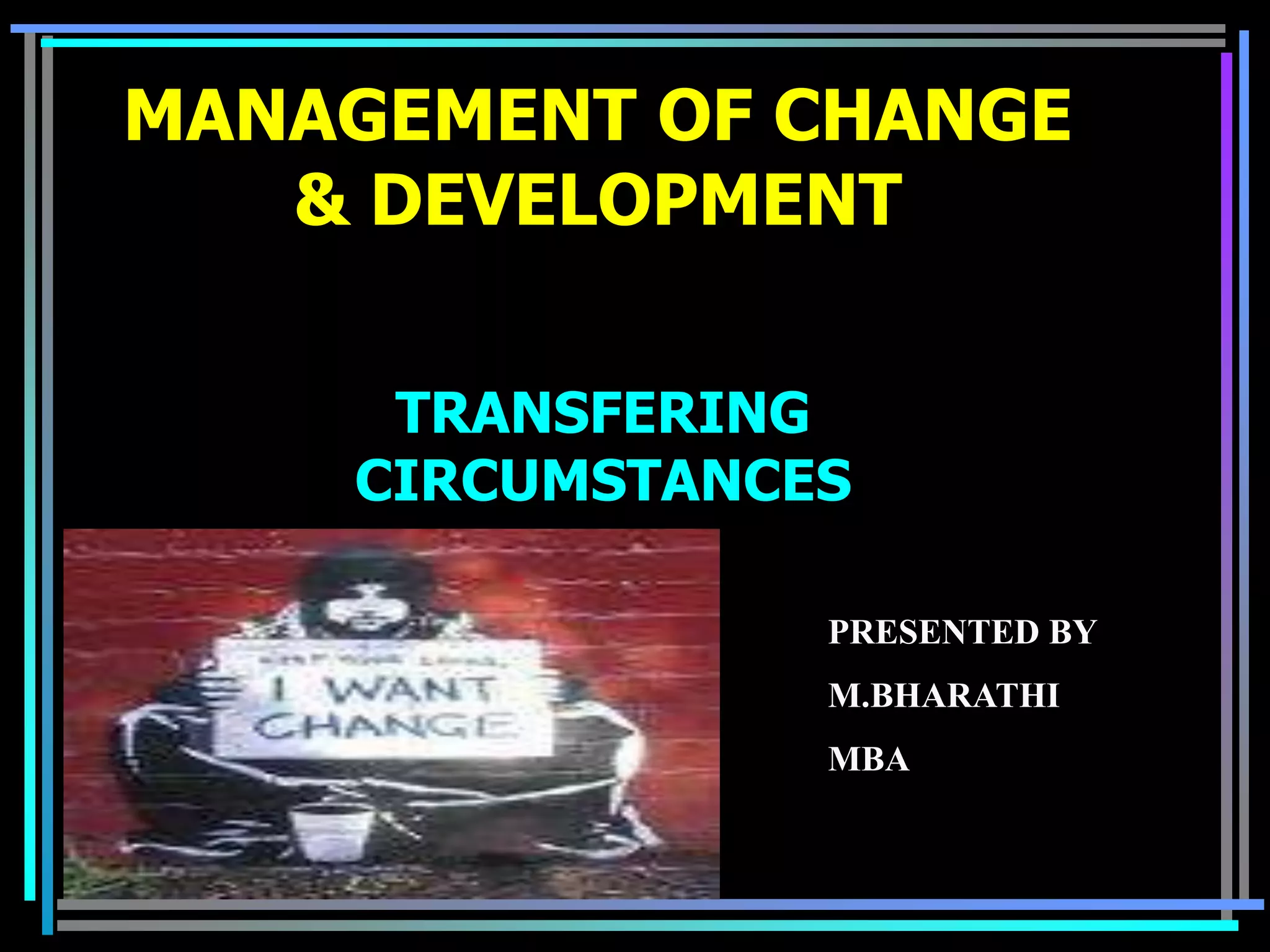
MANAGEMENT OF CHANGE
   & DEVELOPMENT

     TRANSFERING
    CIRCUMSTANCES

                PRESENTED BY
                M.BHARATHI
                MBA
CONTENTS
 What is change ?

What is change management?

Types of changes

How these changes influence the
 transferring circumstances

conclusion
CHANGE
• Change Is.....
• Change is something that presses us out of our
  comfort zone. It is destiny-filtered, heart grown, faith
  built. Change is inequitable; not a respecter of
  persons. Change is for the better or for the worst,
  depending on where you view it. Change has an
  adjustment period which varies on the individual. It is
  uncomfortable, for changing from one state to the
  next upsets our control over outcomes. Change has a
  ripping effect on those who won’t let go.
Change is won by victors not victims; and
 that choice is ours
CHANGE MANAGEMENT
 Change management is a structured
  approach to shifting/transitioning individuals,
  teams, and organizations from a current state
  to a desired future state.
 It is an organizational process aimed at
  empowering employees to accept and
  embrace changes in their current business
  environment.
 In project management, change management
  refers to a project management process
  where changes to a project are formally
  introduced and approved.[2]
TYPES OF CHANGES
 Missionary changes

 Strategic changes

 Operational changes (including Structural changes)

 Technological changes

 Changing the attitudes and behaviors of personnel
MISSIONARY CHANGES
 Mission Statement
  Like the Missionary, your Mission Statement
  will turn your vision into practice. The Mission
  Statement is the one that will actually do the
  work.
 Mission
  Have we done our work in a way that
  monitors to ensure we really are
  accomplishing our mission? And if not, how
  might we change our work to ensure we are
  indeed accomplishing that work?
STRATEGIC CHANGES
 Planning and implementing strategic change is an important aspect to the
  management role. Strategic change is a term that is frequently used in business,
  but what does it really mean?
 In basic terms strategic change is about having a strategy to manage change.
  Strategy is derived from the Greek wood “strategos”, meaning: stratos (army)
  and ago (ancient Greek for leading).
 A strategy is a long-term plan to achieve specific objectives or goals. Strategies
  are focused on the future and bring about sustained change, and typically require
  detailed planning and analysis.
 In Business, strategy planning is often seen as key to future success or even
  survival. With the world changing at a rapid pace, companies need to be
  dynamic and flexible to stay in business. They need to foresee the future and be
  ready to adapt to the potential changes that will come their way.
TECHNOLOGICAL CHANGES
 Technological change (TC) is a term that is used to
  describe the overall process of invention, innovation and
  diffusion of technology or processes The term is redundant
  with technological development, technological achievement,
  and technological progress.
 In essence TC is the invention of a technology (or a
  process), the continuous process of improving a technology
  (in which it often becomes cheaper) and its diffusion
  throughout industry or society.
 In its earlier days, technological change was illustrated with
  the 'Linear Model of Innovation', which has now been
  largely discarded to be replaced with a model of
  technological change that involves innovation at all stages
  of research, development, diffusion and use.
OPERATIONAL CHANGES
• the change occurs in operational areas
  like manufacturing, production units,
  processes it includes structural changes
  etc;
The Four Layers of Operational Change
 standardization

 integration

Centralization and

optimization
CONCLUSION
• Change may be in two ways positive
  change and negative change positive
  change helps to get best results from
  present stage to future stage
Change management

Change management

  • 1.
    MANAGEMENT OF CHANGE & DEVELOPMENT TRANSFERING CIRCUMSTANCES PRESENTED BY M.BHARATHI MBA
  • 2.
    CONTENTS  What ischange ? What is change management? Types of changes How these changes influence the transferring circumstances conclusion
  • 3.
    CHANGE • Change Is..... •Change is something that presses us out of our comfort zone. It is destiny-filtered, heart grown, faith built. Change is inequitable; not a respecter of persons. Change is for the better or for the worst, depending on where you view it. Change has an adjustment period which varies on the individual. It is uncomfortable, for changing from one state to the next upsets our control over outcomes. Change has a ripping effect on those who won’t let go. Change is won by victors not victims; and that choice is ours
  • 4.
    CHANGE MANAGEMENT  Changemanagement is a structured approach to shifting/transitioning individuals, teams, and organizations from a current state to a desired future state.  It is an organizational process aimed at empowering employees to accept and embrace changes in their current business environment.  In project management, change management refers to a project management process where changes to a project are formally introduced and approved.[2]
  • 5.
    TYPES OF CHANGES Missionary changes  Strategic changes  Operational changes (including Structural changes)  Technological changes  Changing the attitudes and behaviors of personnel
  • 6.
    MISSIONARY CHANGES  MissionStatement Like the Missionary, your Mission Statement will turn your vision into practice. The Mission Statement is the one that will actually do the work.  Mission Have we done our work in a way that monitors to ensure we really are accomplishing our mission? And if not, how might we change our work to ensure we are indeed accomplishing that work?
  • 7.
    STRATEGIC CHANGES  Planningand implementing strategic change is an important aspect to the management role. Strategic change is a term that is frequently used in business, but what does it really mean?  In basic terms strategic change is about having a strategy to manage change. Strategy is derived from the Greek wood “strategos”, meaning: stratos (army) and ago (ancient Greek for leading).  A strategy is a long-term plan to achieve specific objectives or goals. Strategies are focused on the future and bring about sustained change, and typically require detailed planning and analysis.  In Business, strategy planning is often seen as key to future success or even survival. With the world changing at a rapid pace, companies need to be dynamic and flexible to stay in business. They need to foresee the future and be ready to adapt to the potential changes that will come their way.
  • 8.
    TECHNOLOGICAL CHANGES  Technologicalchange (TC) is a term that is used to describe the overall process of invention, innovation and diffusion of technology or processes The term is redundant with technological development, technological achievement, and technological progress.  In essence TC is the invention of a technology (or a process), the continuous process of improving a technology (in which it often becomes cheaper) and its diffusion throughout industry or society.  In its earlier days, technological change was illustrated with the 'Linear Model of Innovation', which has now been largely discarded to be replaced with a model of technological change that involves innovation at all stages of research, development, diffusion and use.
  • 9.
    OPERATIONAL CHANGES • thechange occurs in operational areas like manufacturing, production units, processes it includes structural changes etc;
  • 10.
    The Four Layersof Operational Change  standardization  integration Centralization and optimization
  • 12.
    CONCLUSION • Change maybe in two ways positive change and negative change positive change helps to get best results from present stage to future stage