Challenges
in
JVM Language
Design
Andrey Breslav
JetBrains
http://kotlin.jetbrains.org
+
+
Kotlin
n  Statically typed
n  Compiles to JVM byte codes or JavaScript
n  JVM version is Java compatible both ways
n  Intended for industrial use
n  Designed for READABILITY
n  Relies on simple (but powerful) abstractions
n  Performance is a priority
n  Tooling matters
n  Open Source (Apache 2)
n  http://github.com/JetBrains/Kotlin
+Disclaimer
n  This talk is NOT an introduction to Kotlin
n  A few highlights J
n  Extension functions
n  Type-Safe builders
n  Primary constructors
n  Delegated properties
n  Please refer to http://kotlin.jetbrains.org for more
information
+
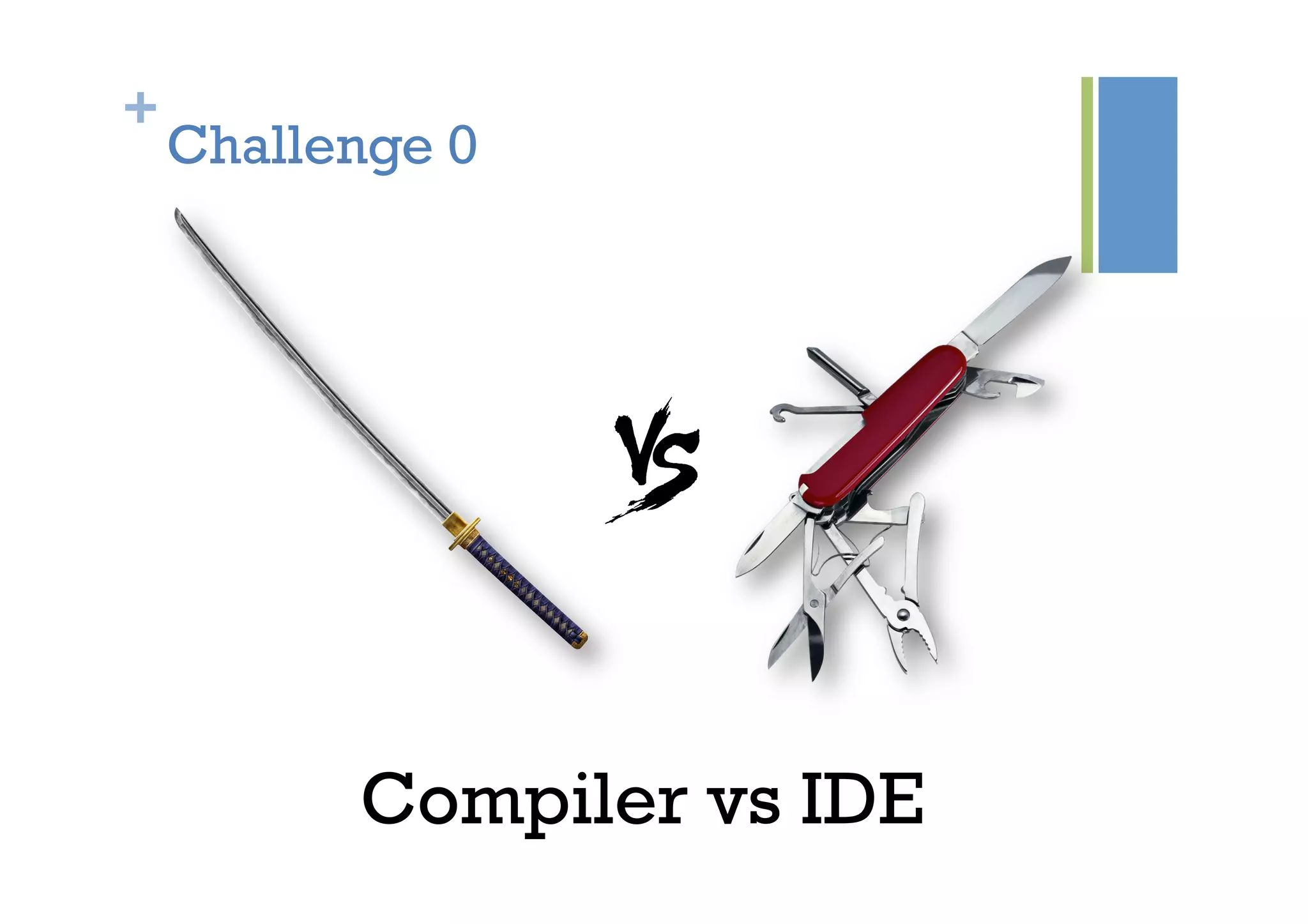
Challenge 0
Compiler vs IDE
+
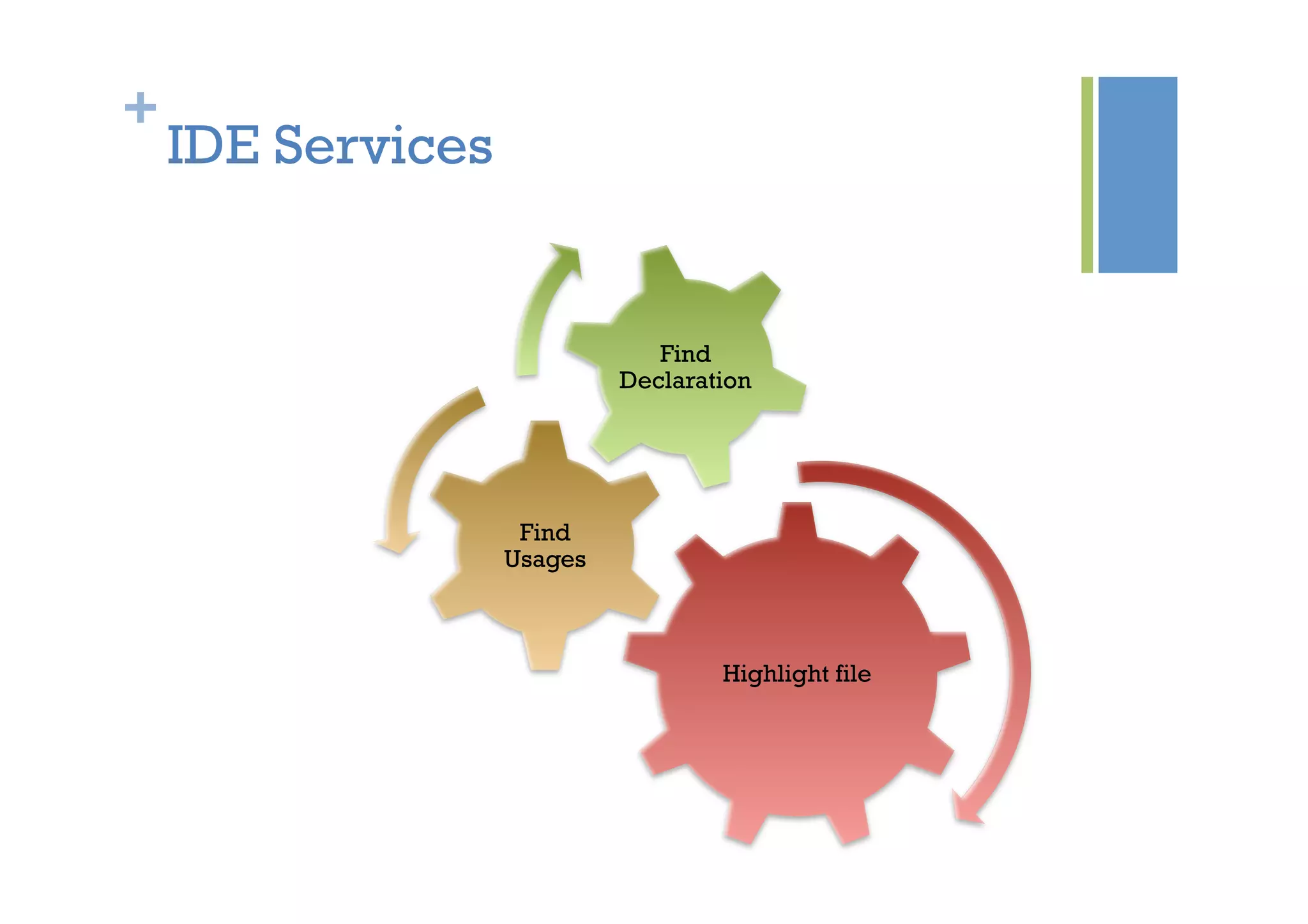
IDE Services
Highlight file
Find
Usages
Find
Declaration
+
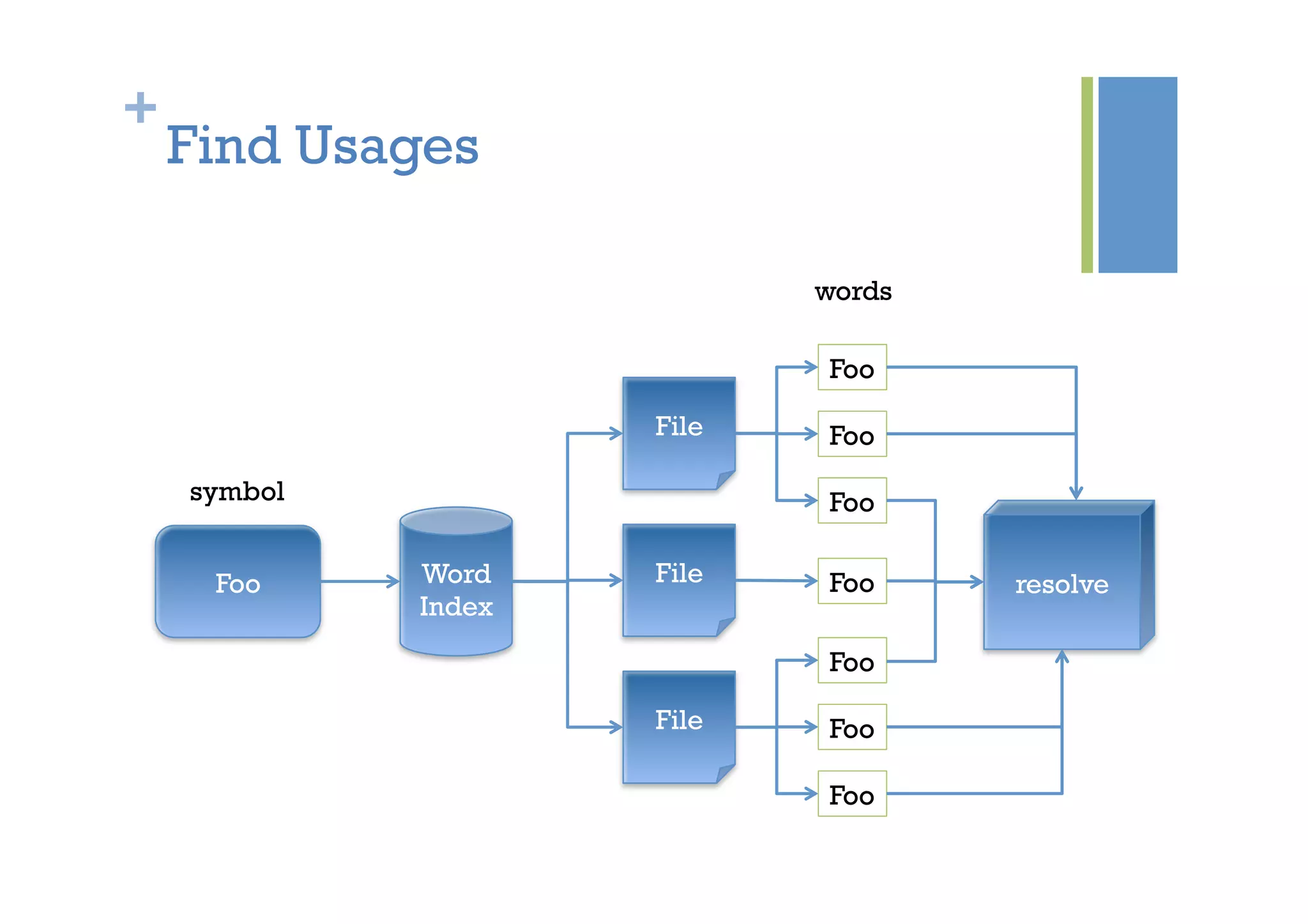
Find Usages
Foo
File
File
File
Word
Index
symbol
Foo
Foo
Foo
Foo
Foo
Foo
Foo
words
resolve
+
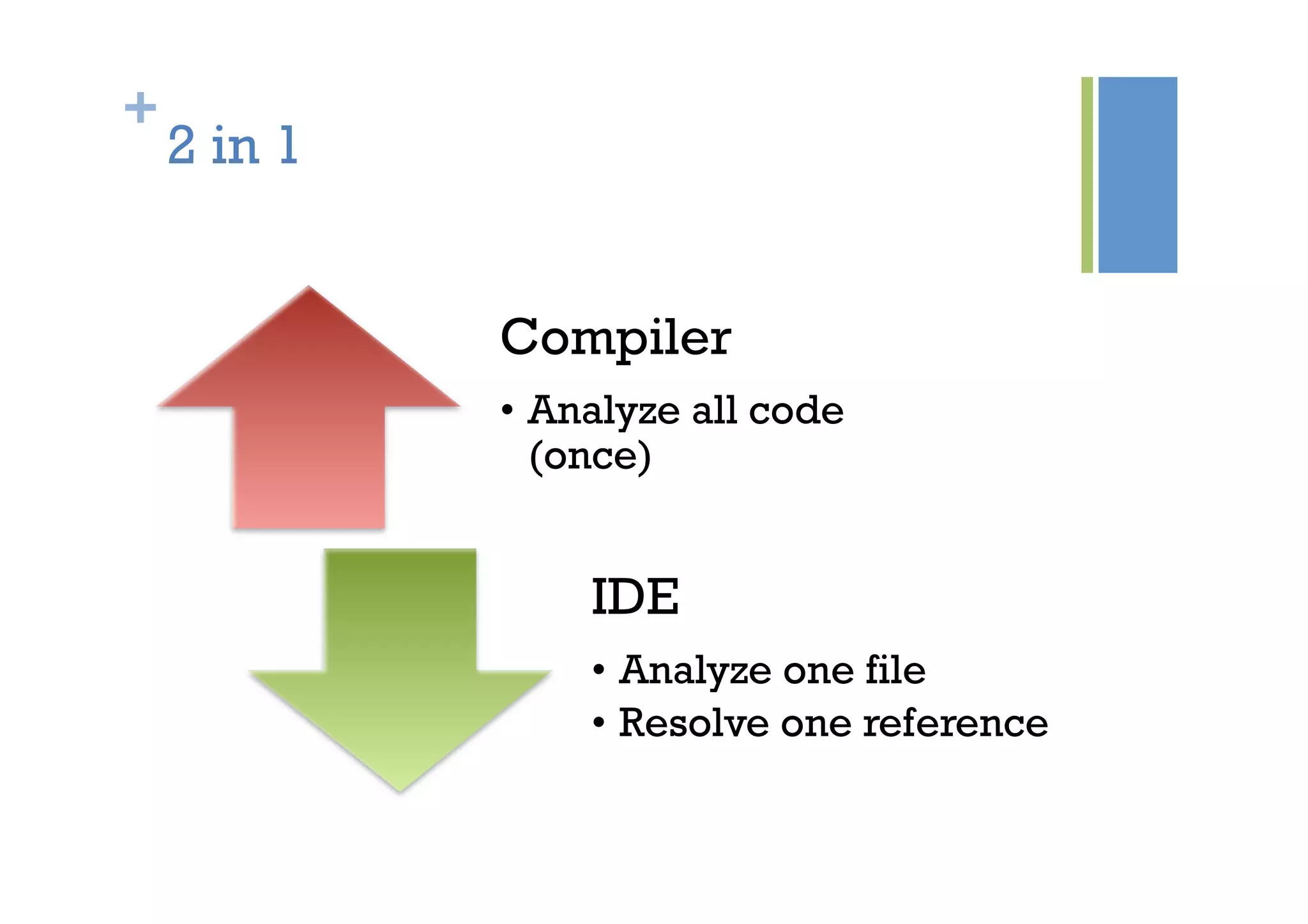
2 in 1
Compiler
•  Analyze all code
(once)
IDE
•  Analyze one file
•  Resolve one reference
+
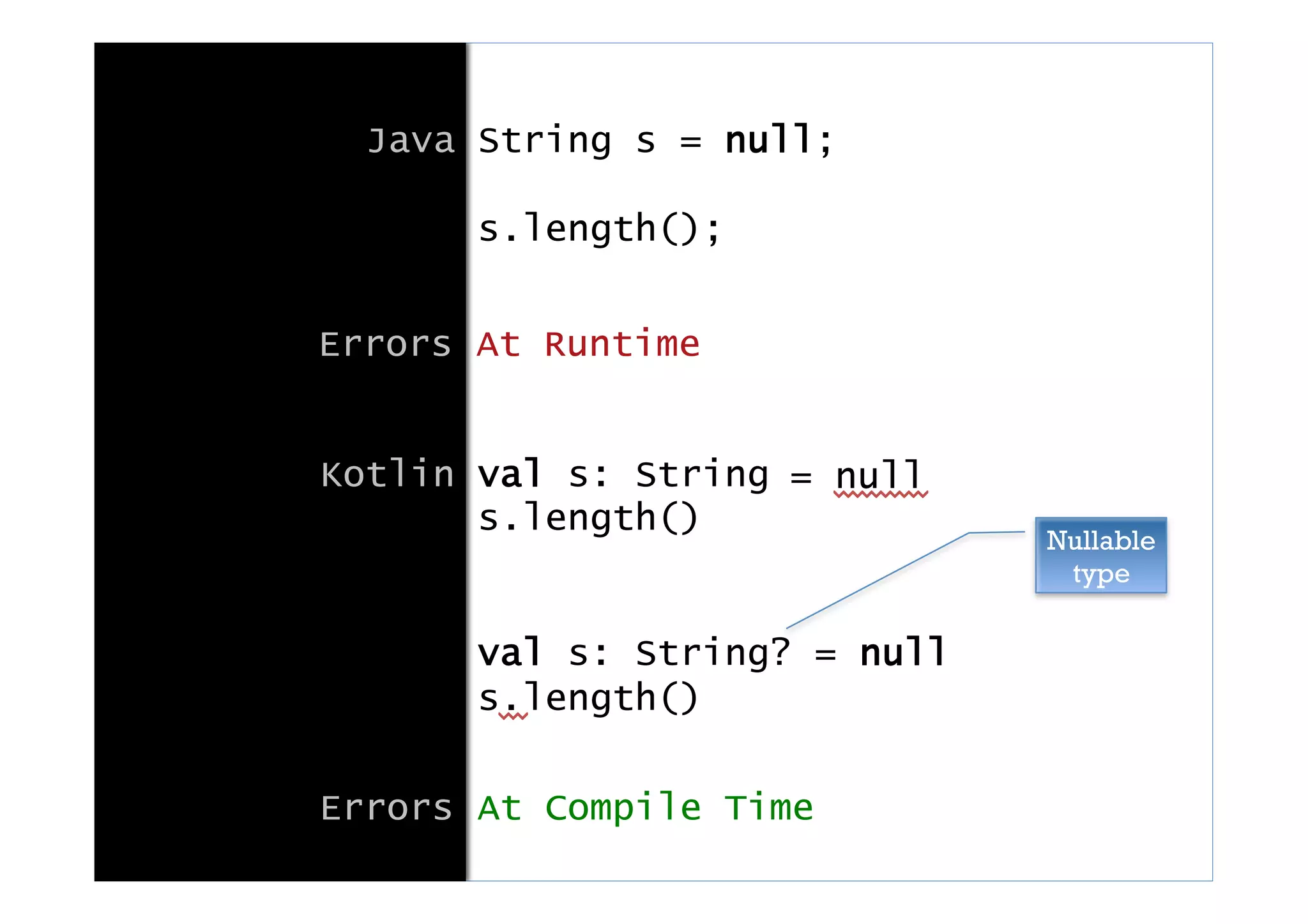
Java String s = null;
s.length();
Errors At Runtime
Kotlin val s: String
s.length()
val s: String? = null
s.length()
Errors At Compile Time
= null
Nullable
type
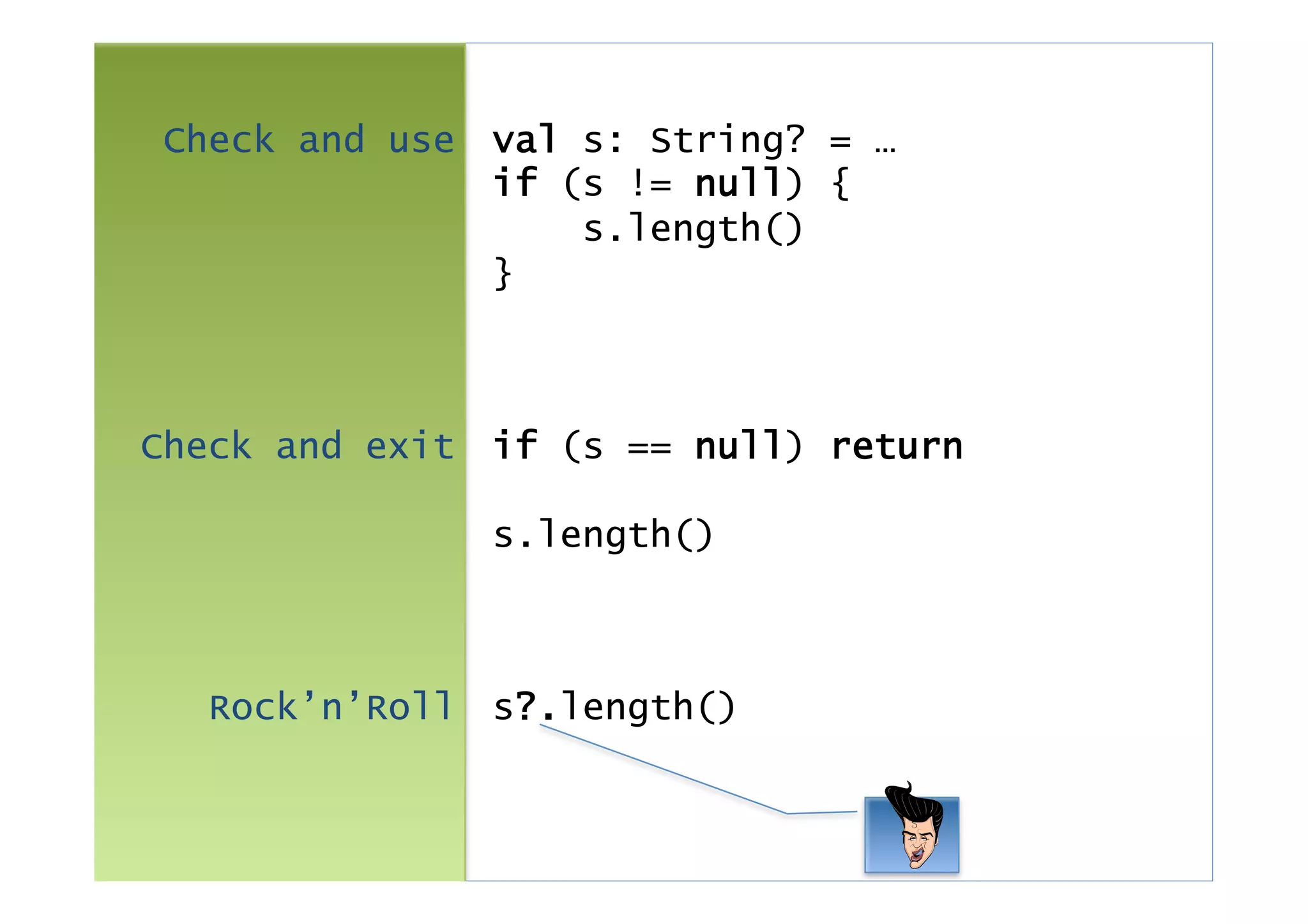
Check and use val s: String? = …
if (s != null) {
s.length()
}
Check and exit if (s == null) return
s.length()
Rock’n’Roll s?.length()
+
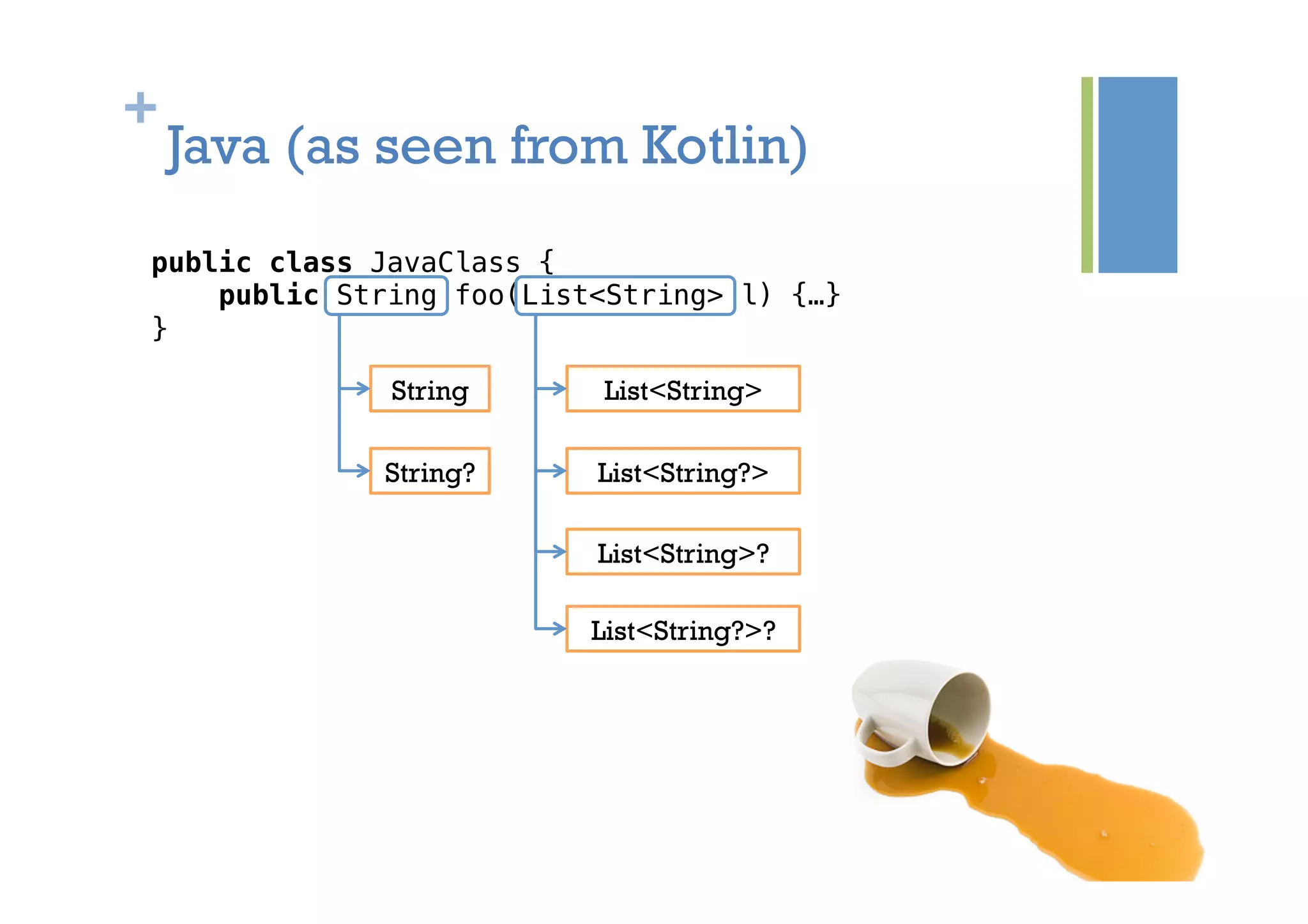
Java (as seen from Kotlin)
public class JavaClass {!
public String foo(List<String> l) {…}!
}!
String
String?
List<String>
List<String?>
List<String>?
List<String?>?
+
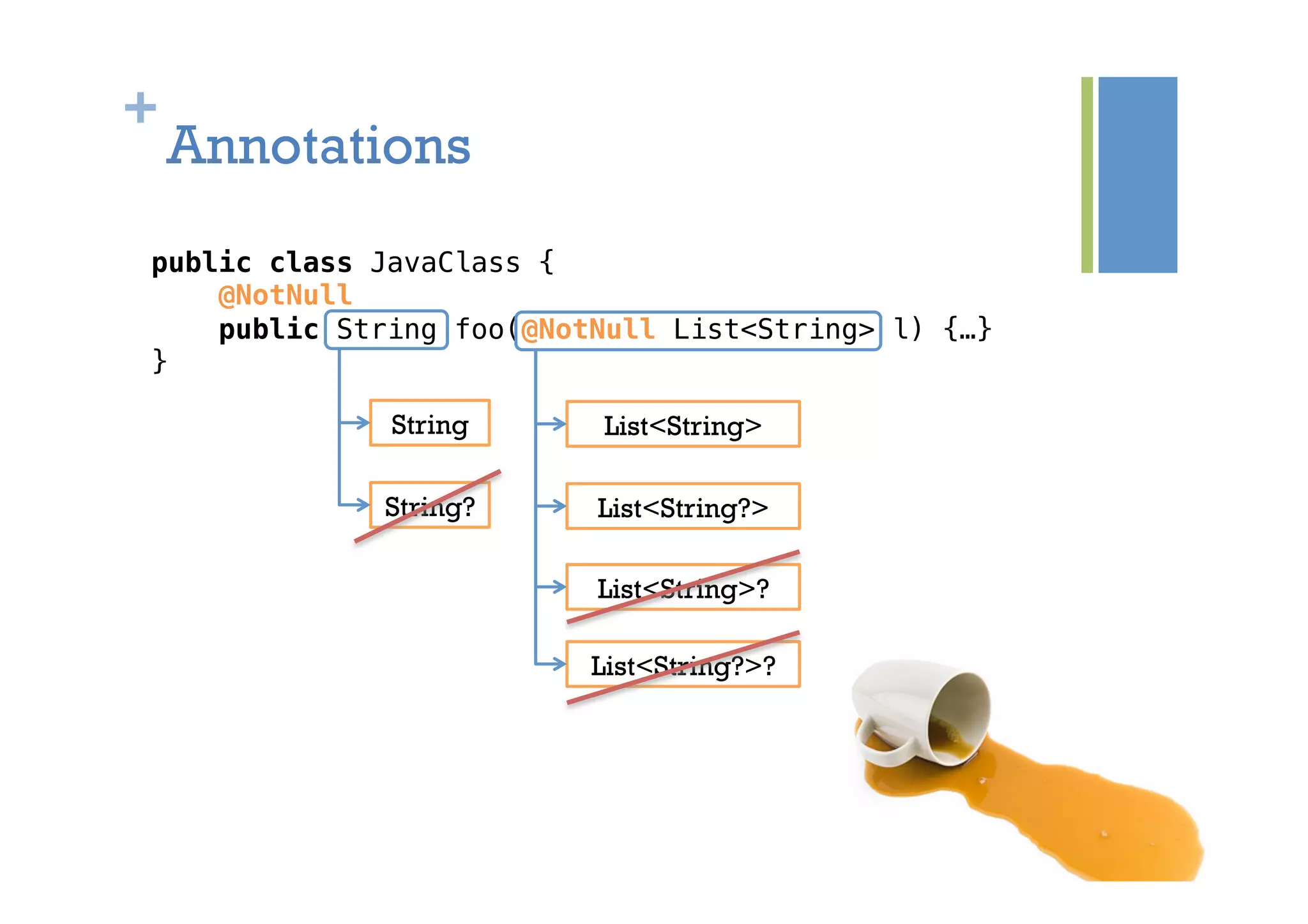
Annotations
public class JavaClass {!
@NotNull!
public String foo(@NotNull List<String> l) {…}!
}!
String
String?
List<String>
List<String?>
List<String>?
List<String?>?
+
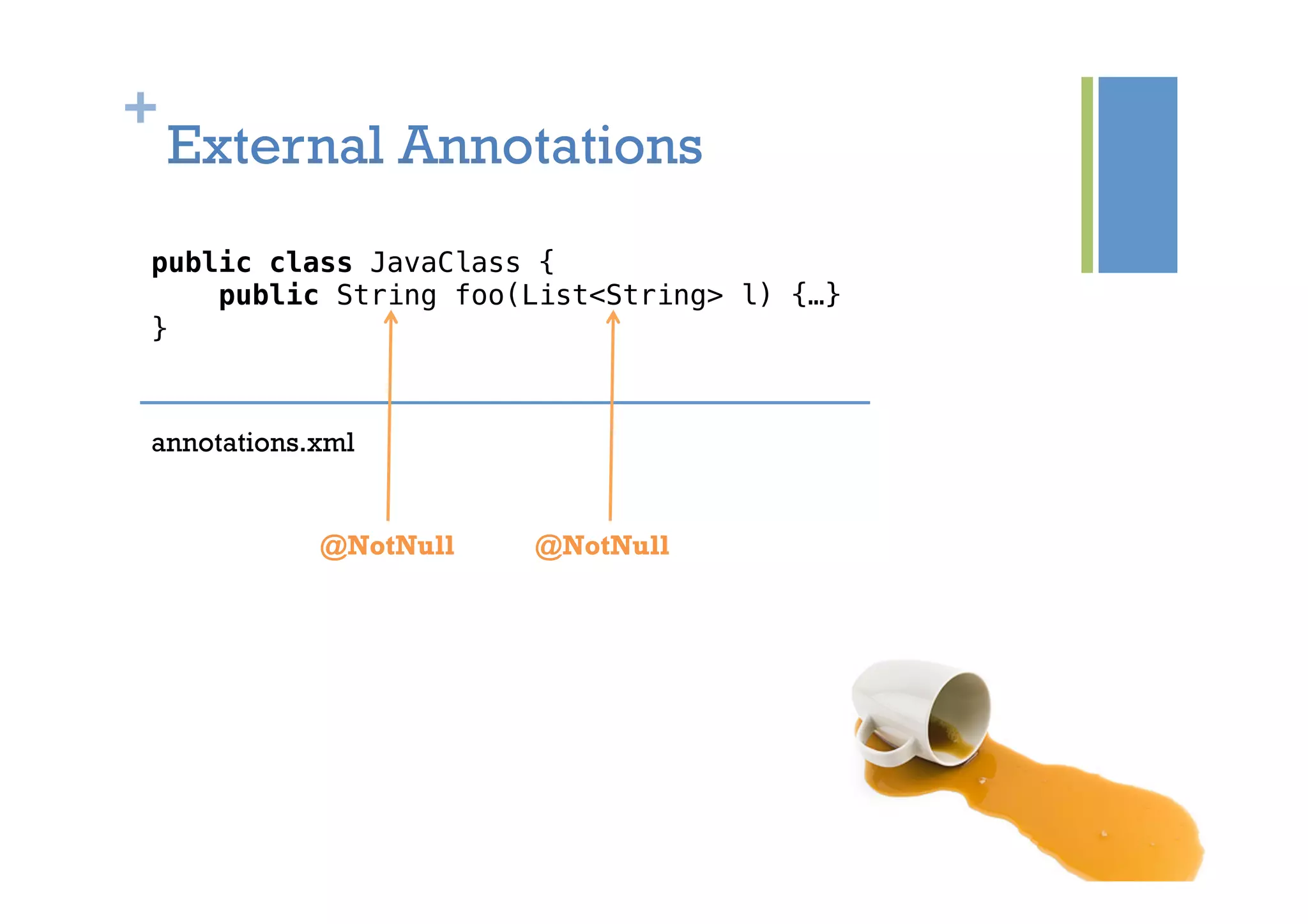
External Annotations
public class JavaClass {!
public String foo(List<String> l) {…}!
}!
@NotNull @NotNull
annotations.xml
+
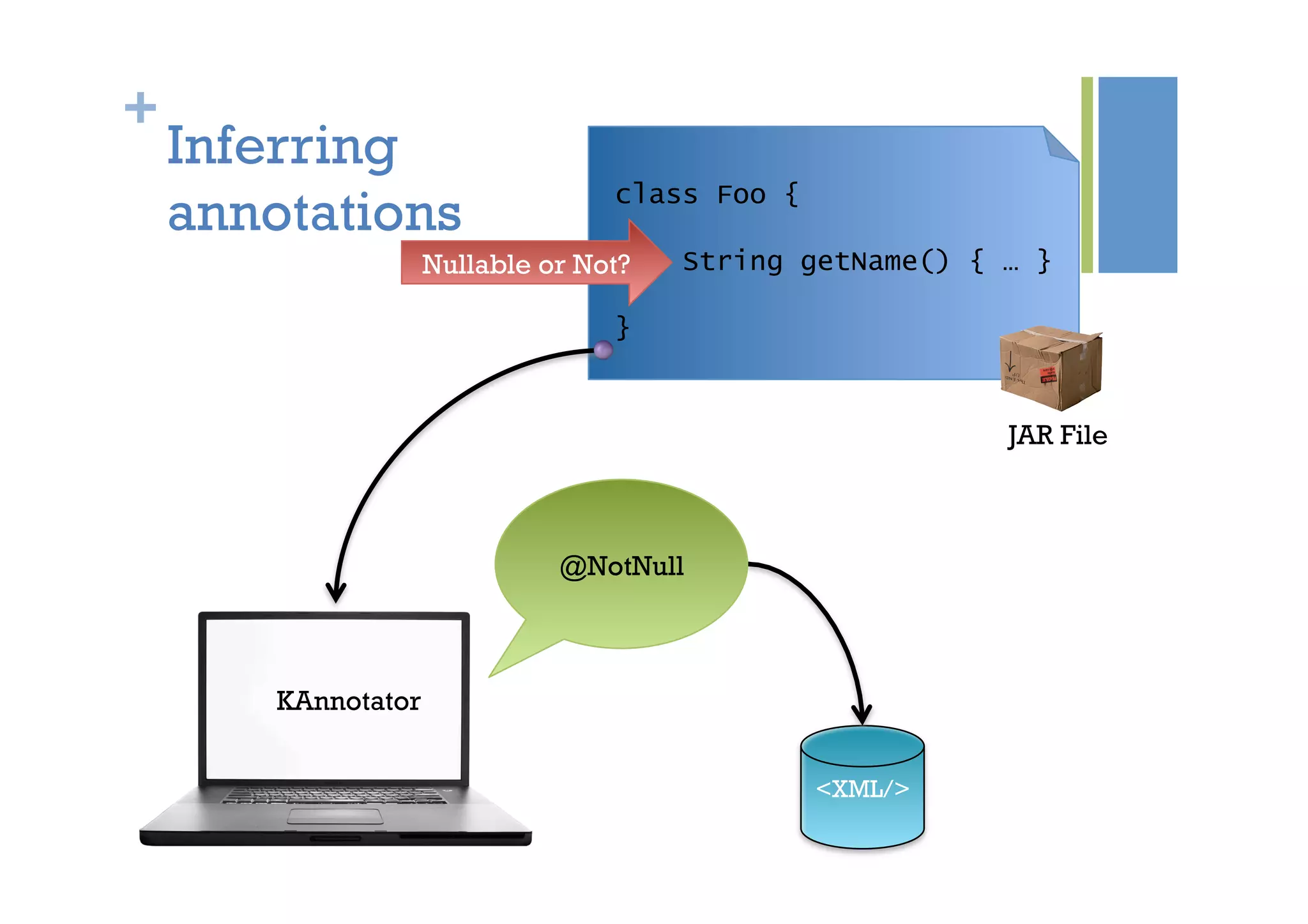
JAR File
class Foo {
String getName() { … }
}
Nullable or Not?
<XML/>
@NotNull
KAnnotator
Inferring
annotations
+
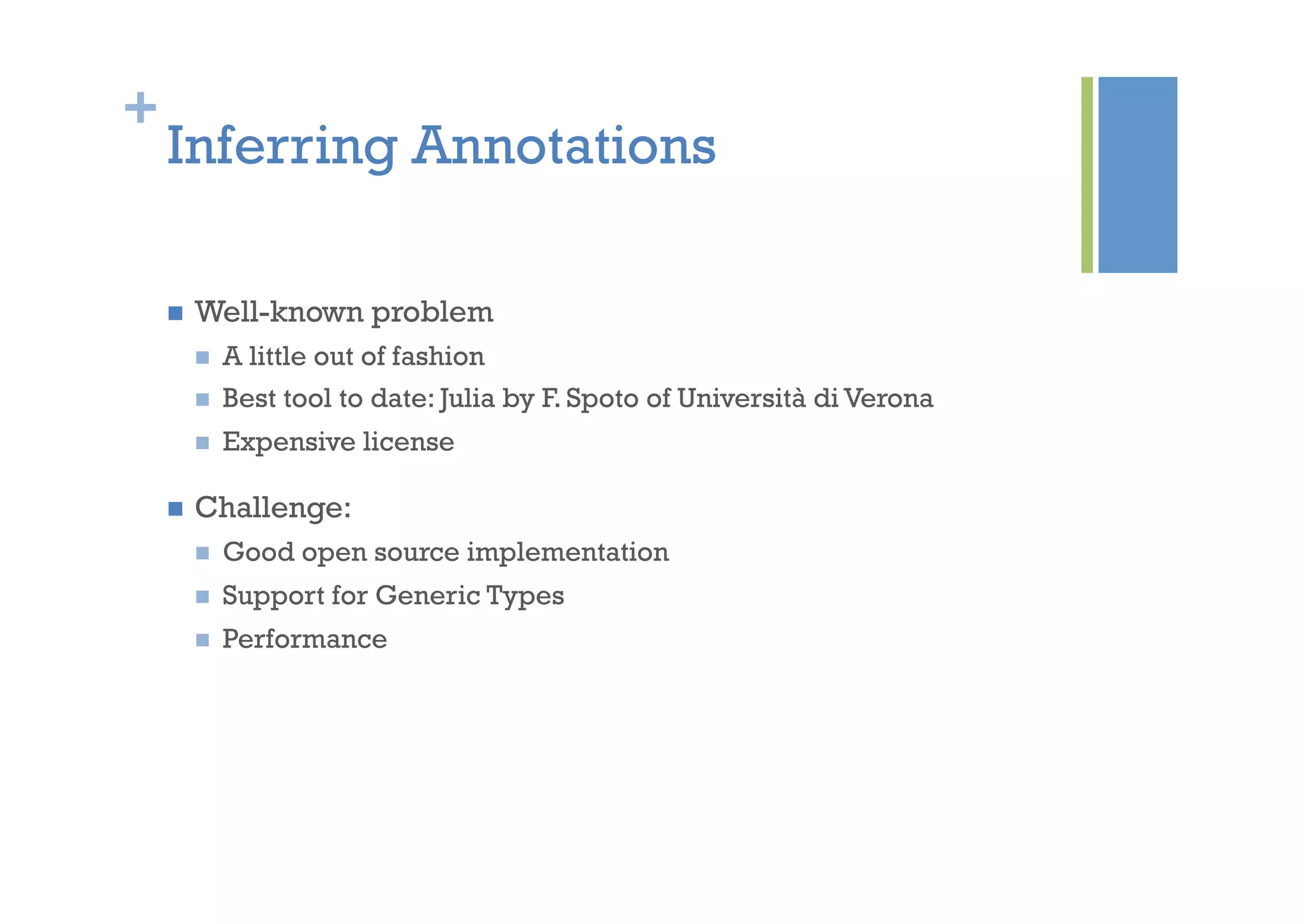
Inferring Annotations
n  Well-known problem
n  A little out of fashion
n  Best tool to date: Julia by F. Spoto of Università di Verona
n  Expensive license
n  Challenge:
n  Good open source implementation
n  Support for Generic Types
n  Performance
+
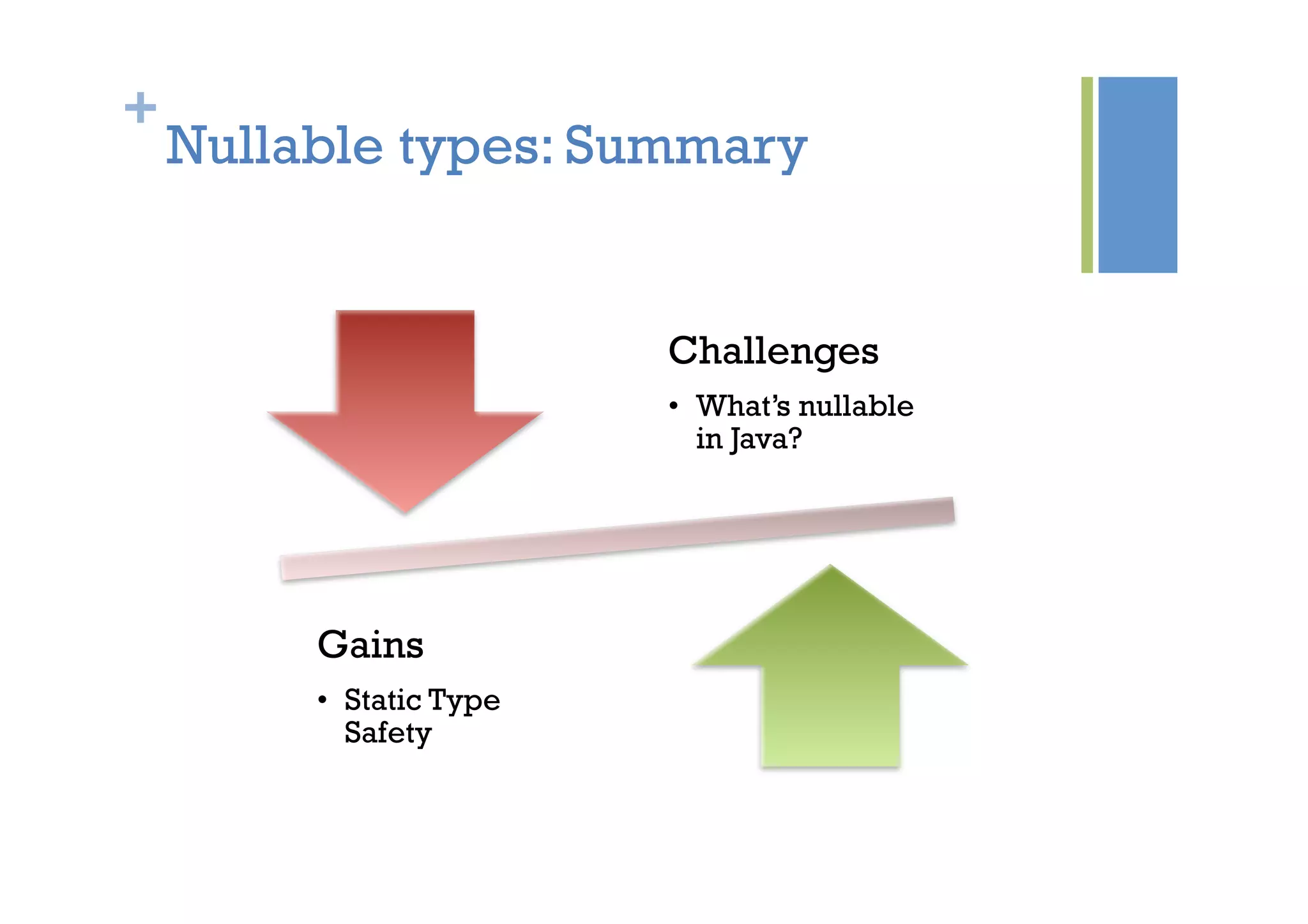
Nullable types: Summary
Challenges
•  What’s nullable
in Java?
Gains
•  Static Type
Safety
How the Types Flow
“Smart casts”
+
Demo: Expression Evaluator
+
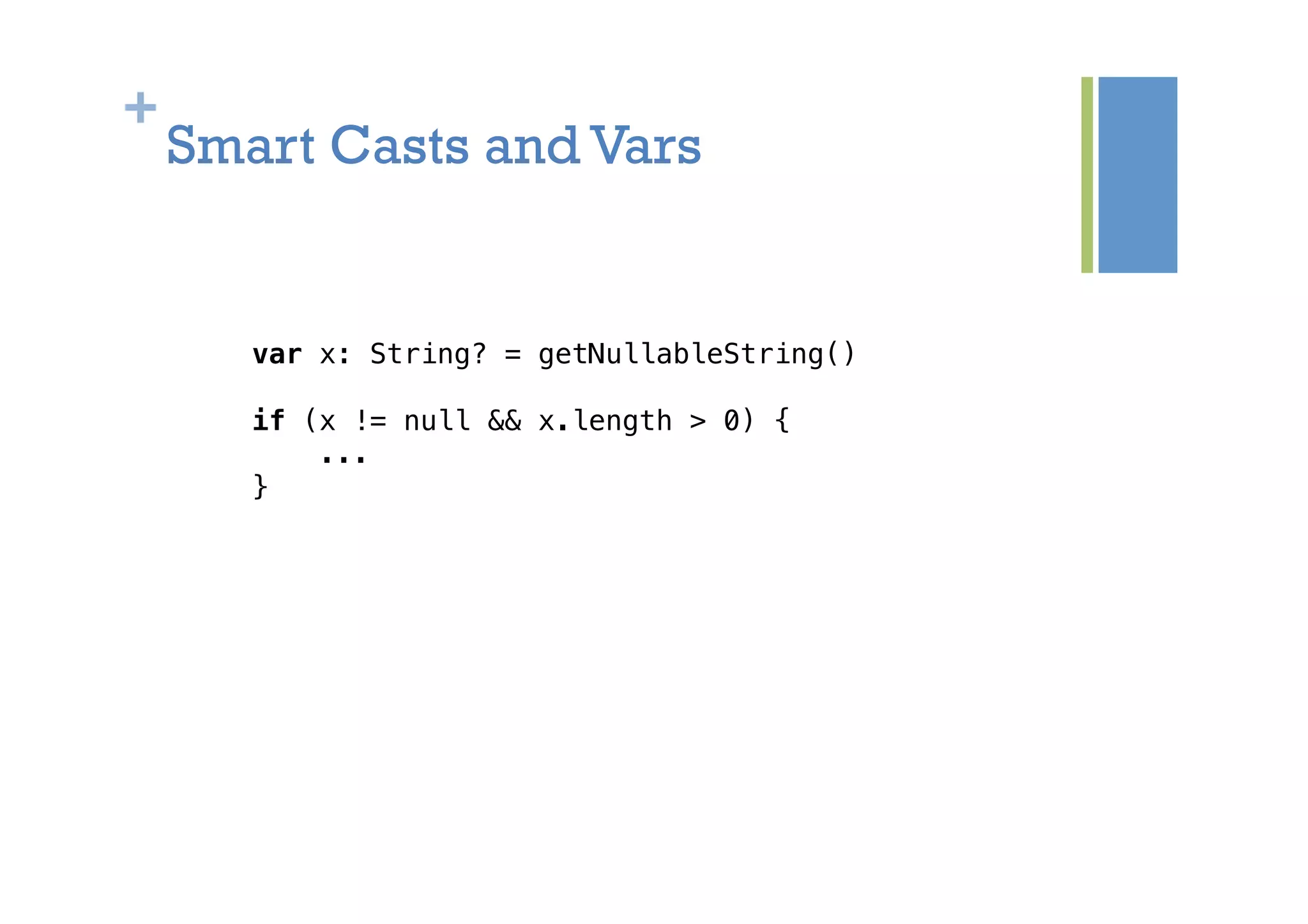
Smart Casts and Vars
var x: String? = getNullableString()!
!
if (x != null && x.length > 0) {!
...!
}!
+
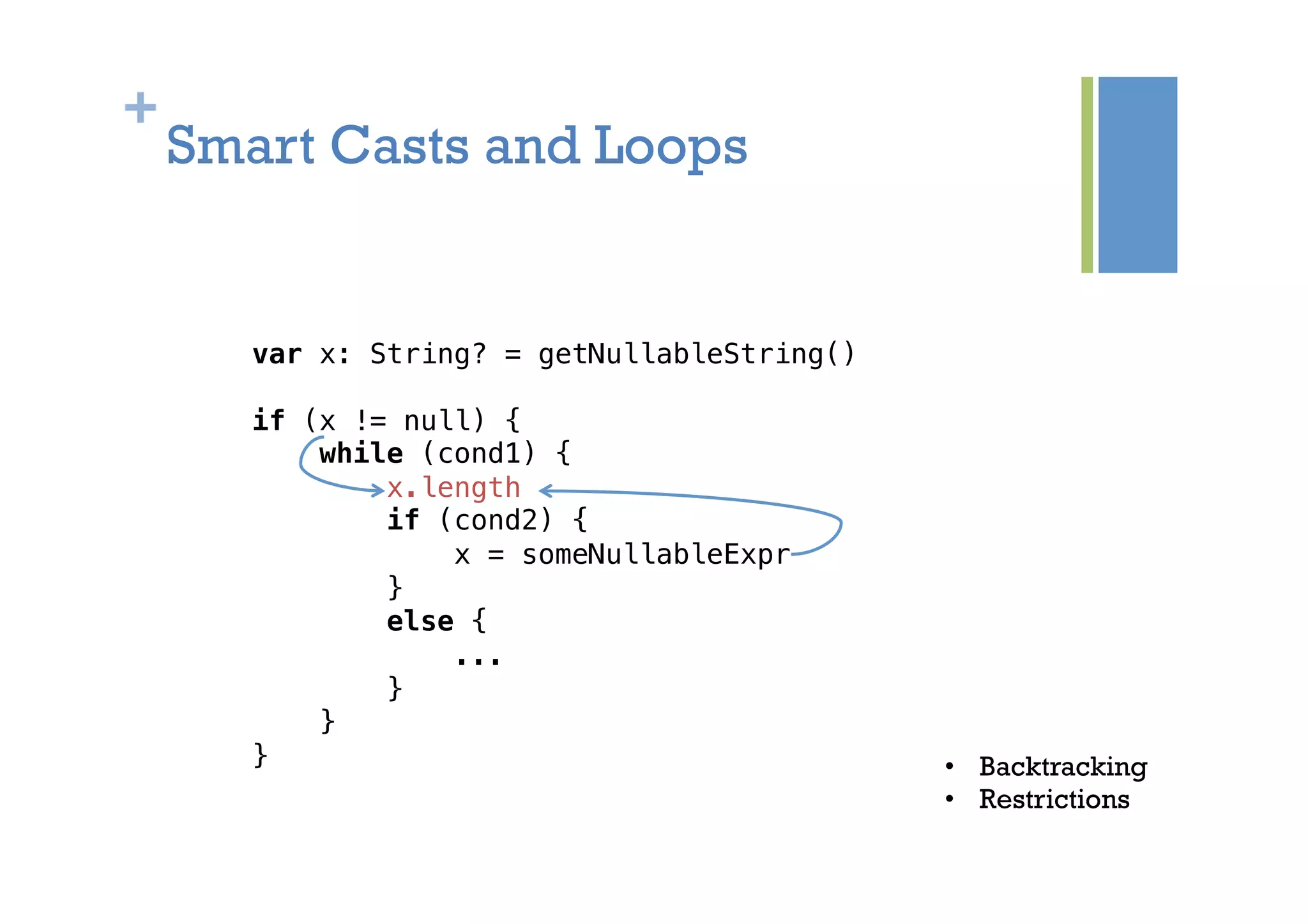
Smart Casts and Loops
var x: String? = getNullableString()!
!
if (x != null) {!
while (cond1) {!
x.length!
if (cond2) {!
x = someNullableExpr!
}!
else {!
...!
}!
}!
}! •  Backtracking
•  Restrictions
+
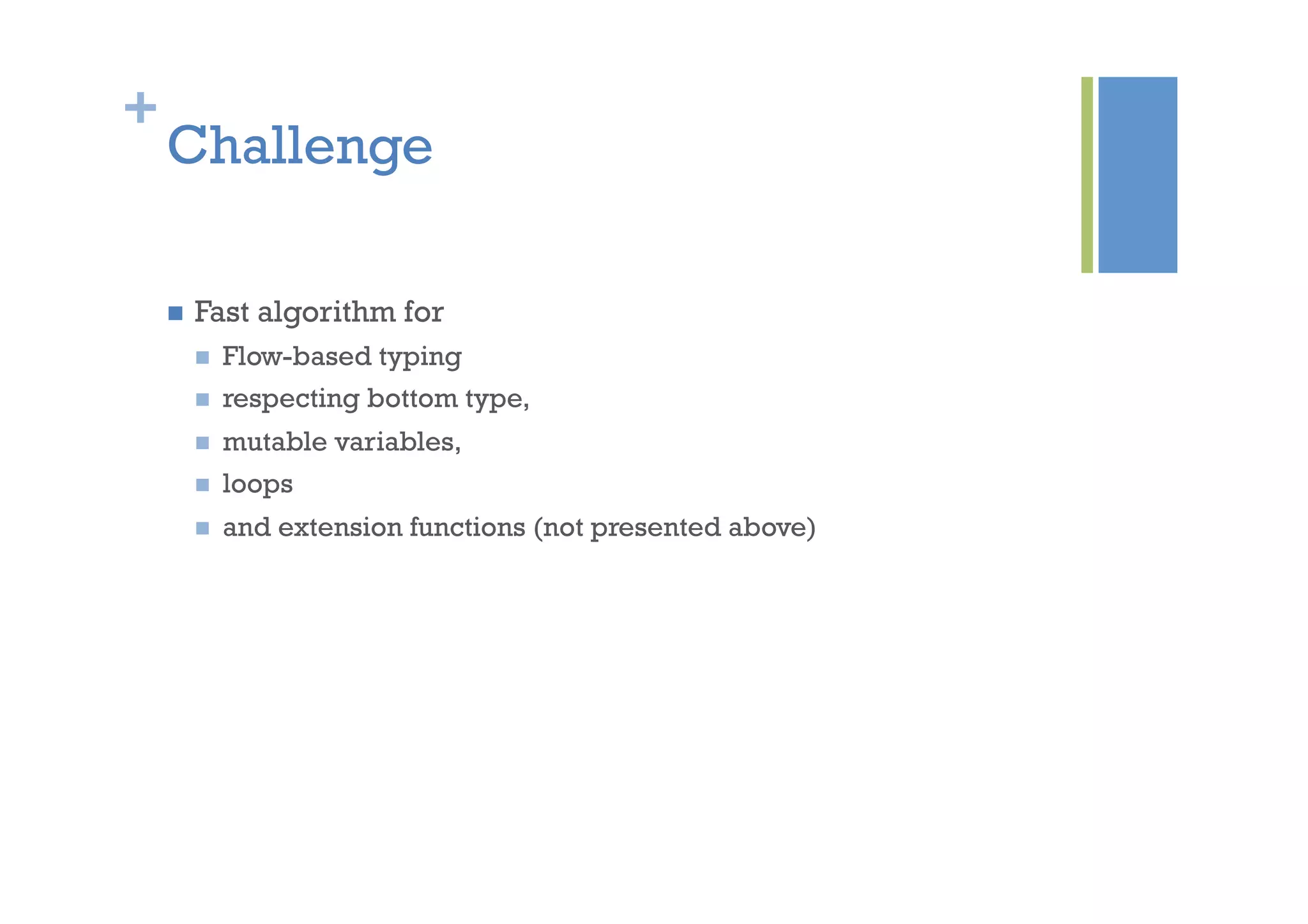
Challenge
n  Fast algorithm for
n  Flow-based typing
n  respecting bottom type,
n  mutable variables,
n  loops
n  and extension functions (not presented above)
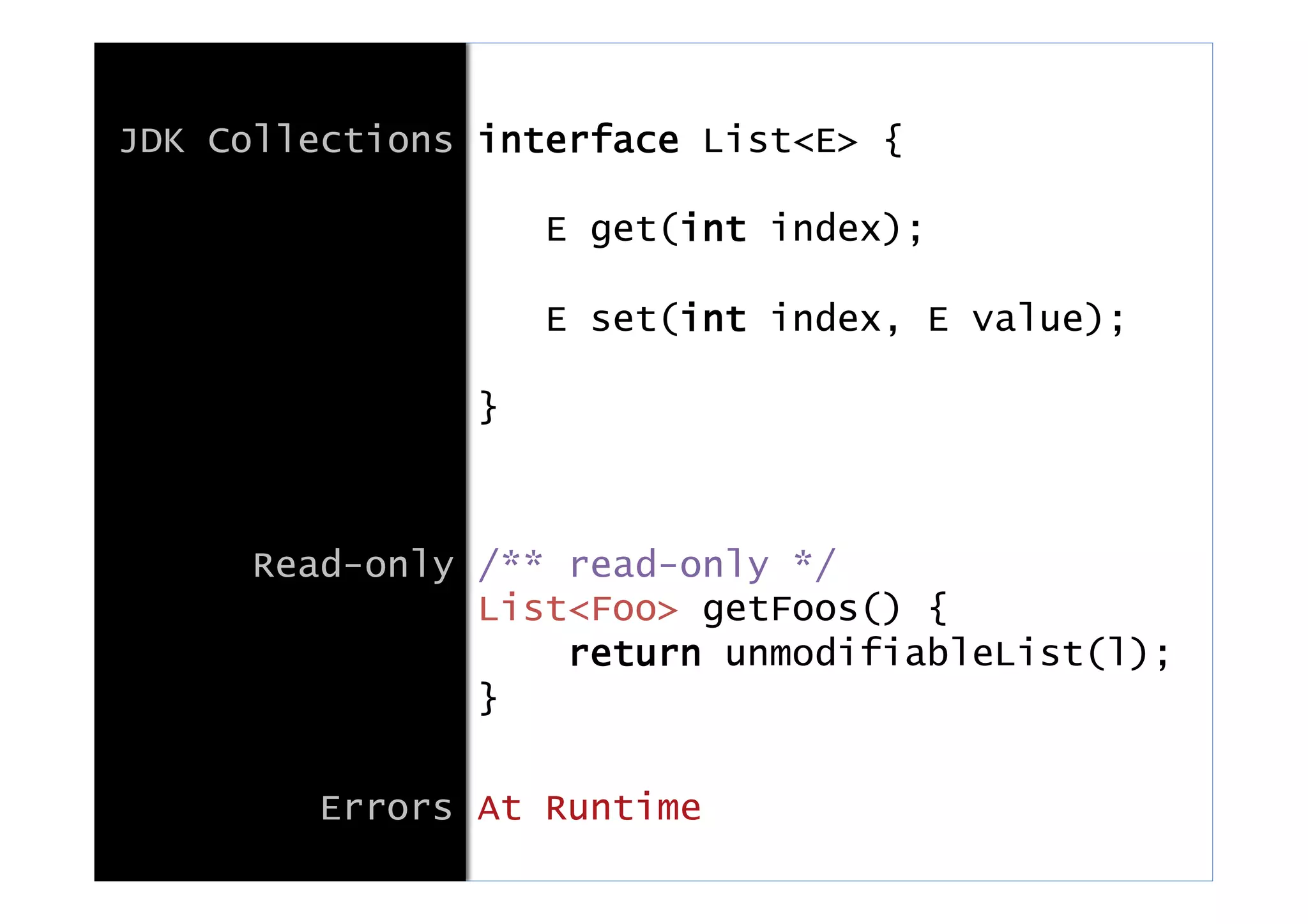
JDK Collections interface List<E> {
E get(int index);
E set(int index, E value);
}
Read-only /** read-only */
List<Foo> getFoos() {
return unmodifiableList(l);
}
Errors At Runtime
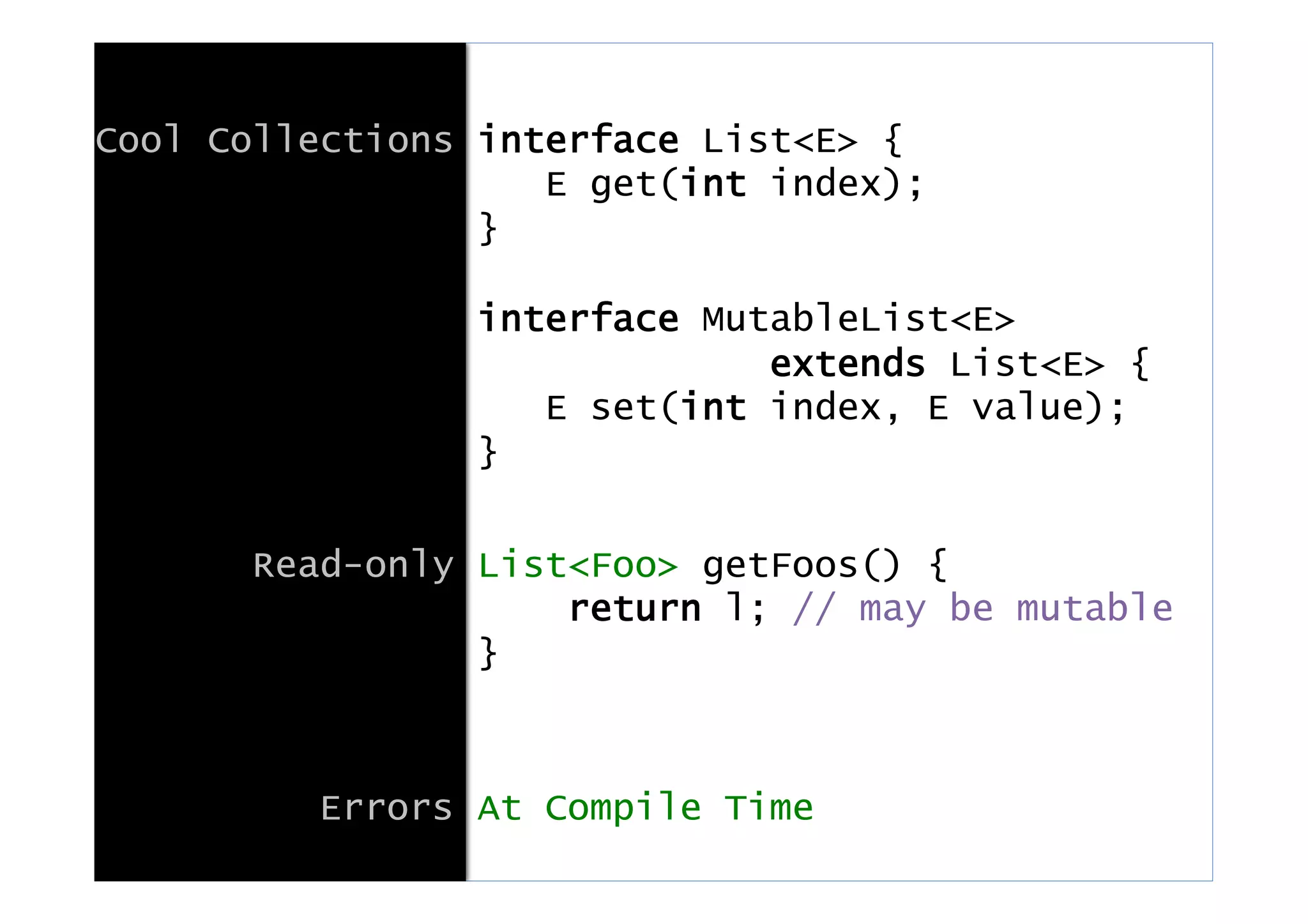
Cool Collections interface List<E> {
E get(int index);
}
interface MutableList<E>
extends List<E> {
E set(int index, E value);
}
Read-only List<Foo> getFoos() {
return l; // may be mutable
}
Errors At Compile Time
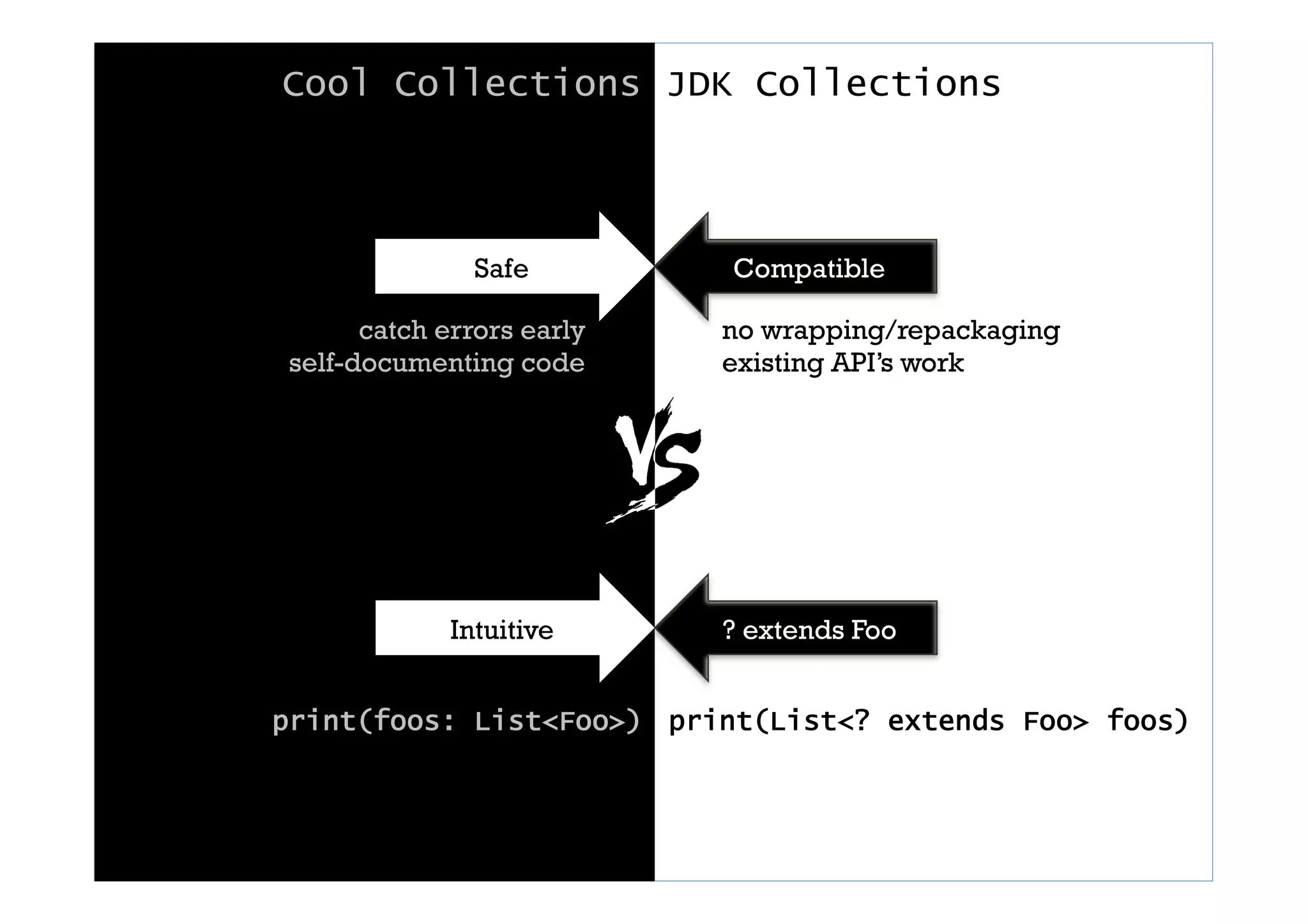
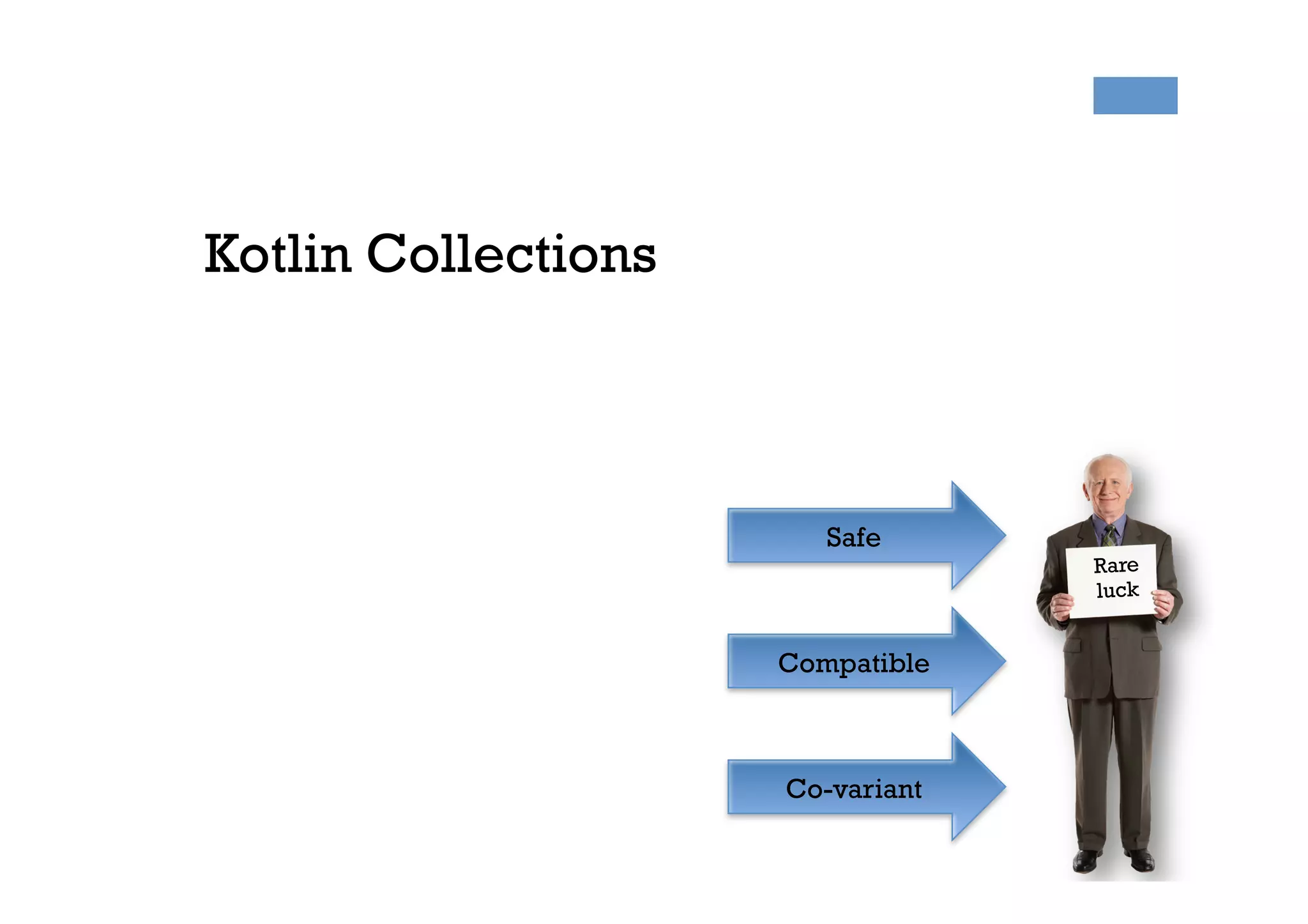
Safe Compatible
Cool Collections JDK Collections
catch errors early
self-documenting code
no wrapping/repackaging
existing API’s work
Intuitive ? extends Foo
print(List<? extends Foo> foos)print(foos: List<Foo>)
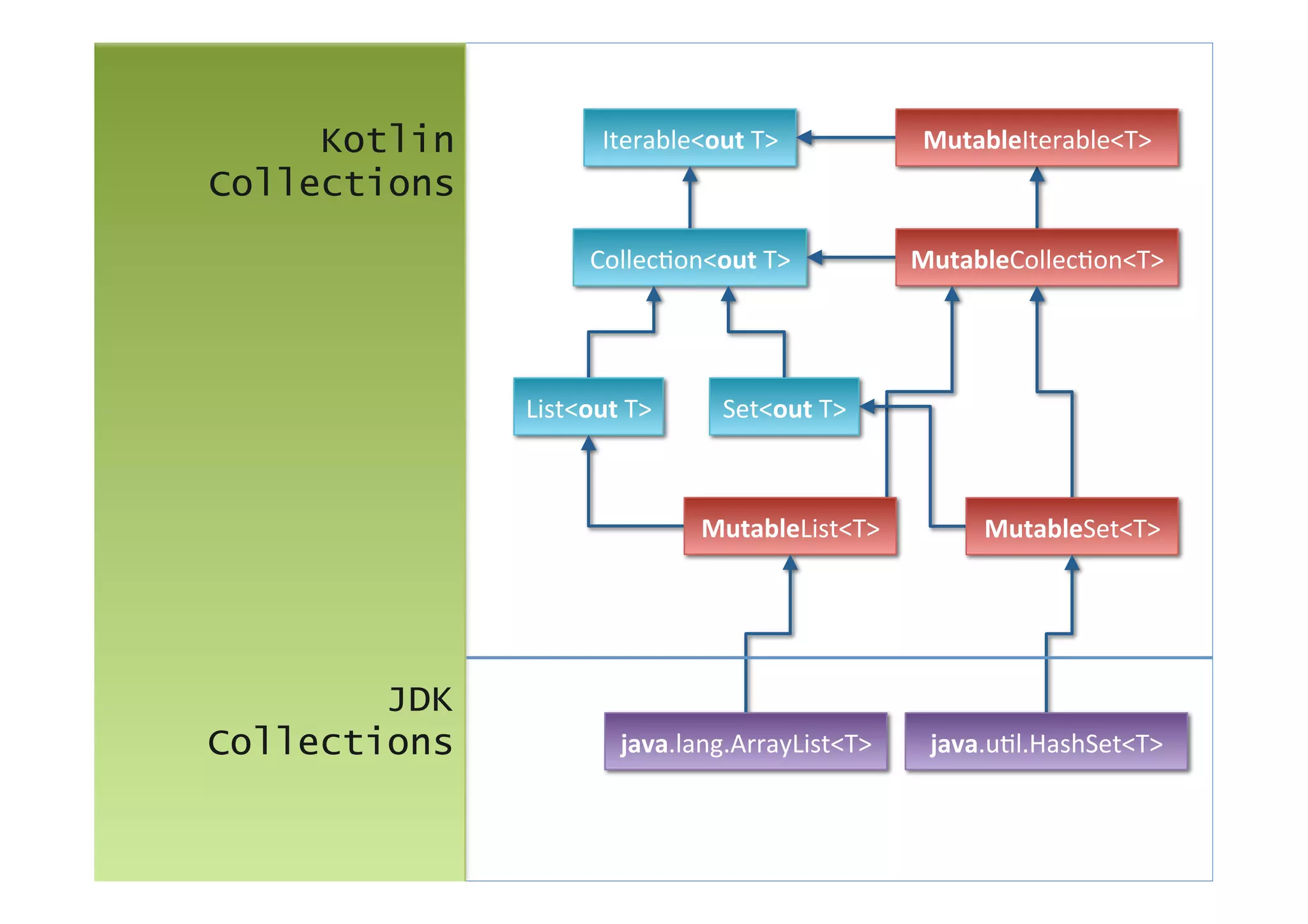
Iterable<out	
  T>	
  
Collec/on<out	
  T>	
  
List<out	
  T>	
   Set<out	
  T>	
  
MutableIterable<T>	
  
MutableCollec/on<T>	
  
MutableList<T>	
   MutableSet<T>	
  
java.lang.ArrayList<T>	
   java.u/l.HashSet<T>	
  
Kotlin
Collections
JDK
Collections
Rare
luck
Kotlin Collections
Safe
Compatible
Co-variant
+
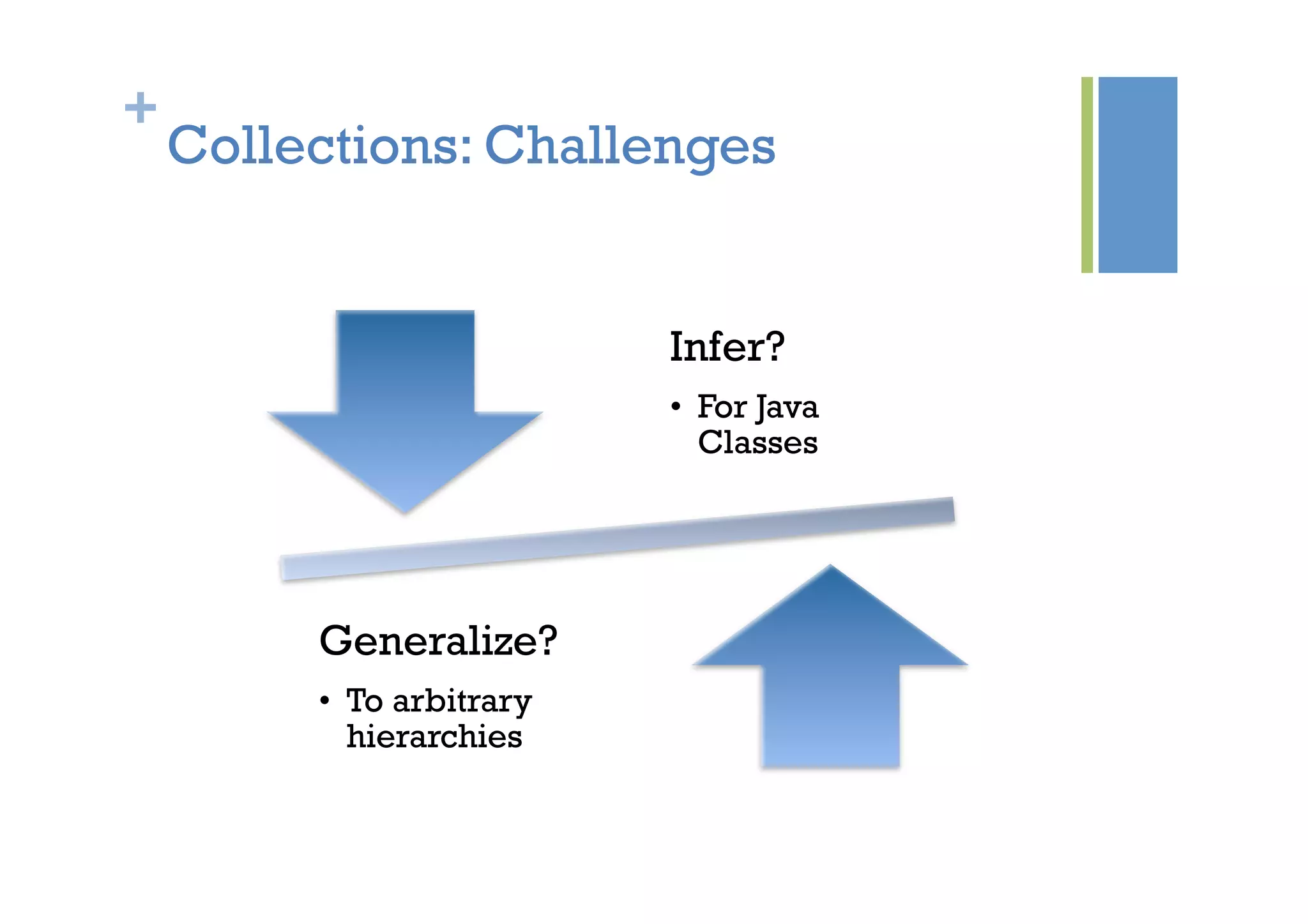
Collections: Challenges
Infer?
•  For Java
Classes
Generalize?
•  To arbitrary
hierarchies
Generics
+
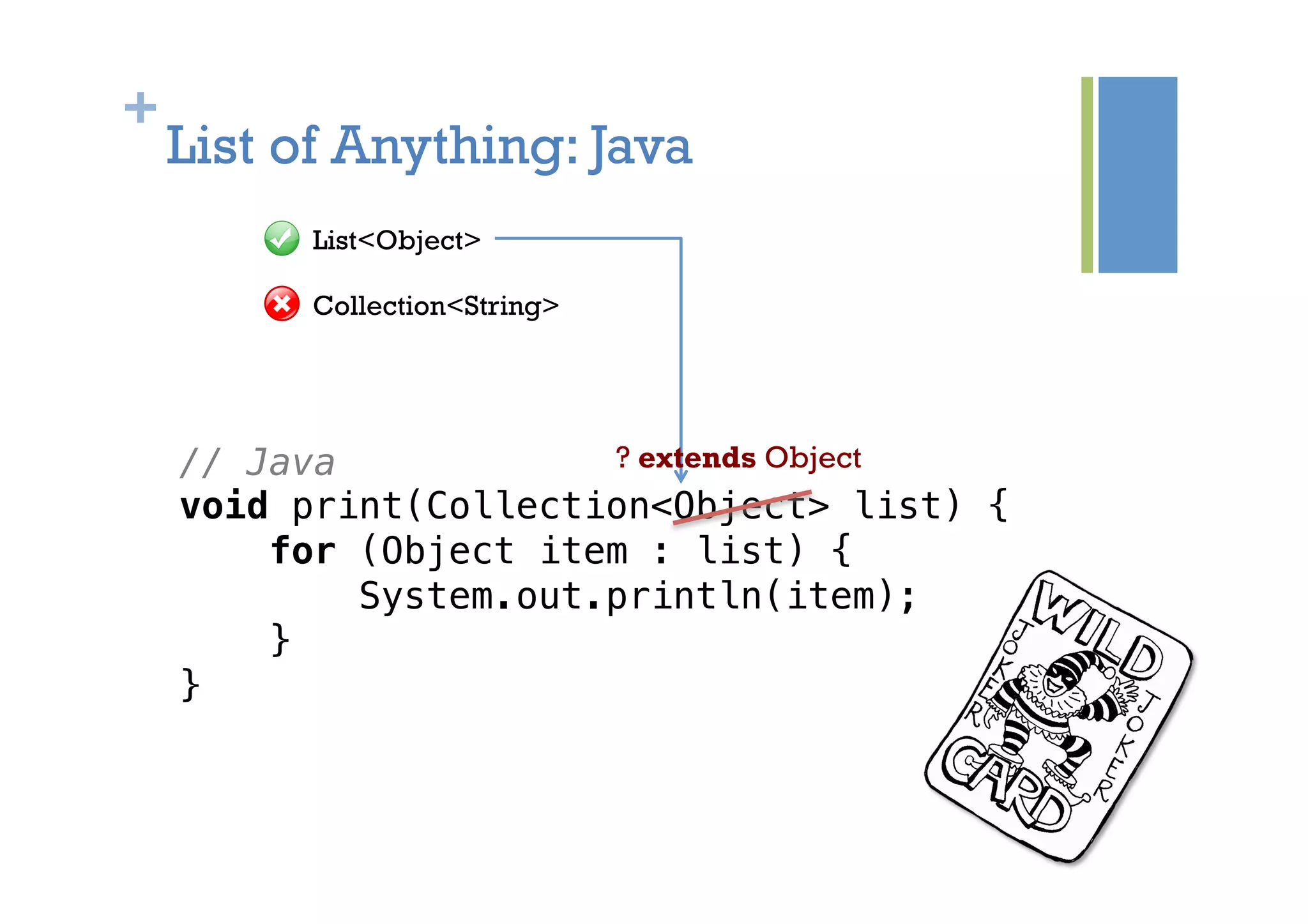
List of Anything: Java
// Java!
void print(Collection<Object> list) {!
for (Object item : list) {!
System.out.println(item);!
}!
}!
List<Object>
Collection<String>
? extends Object
+
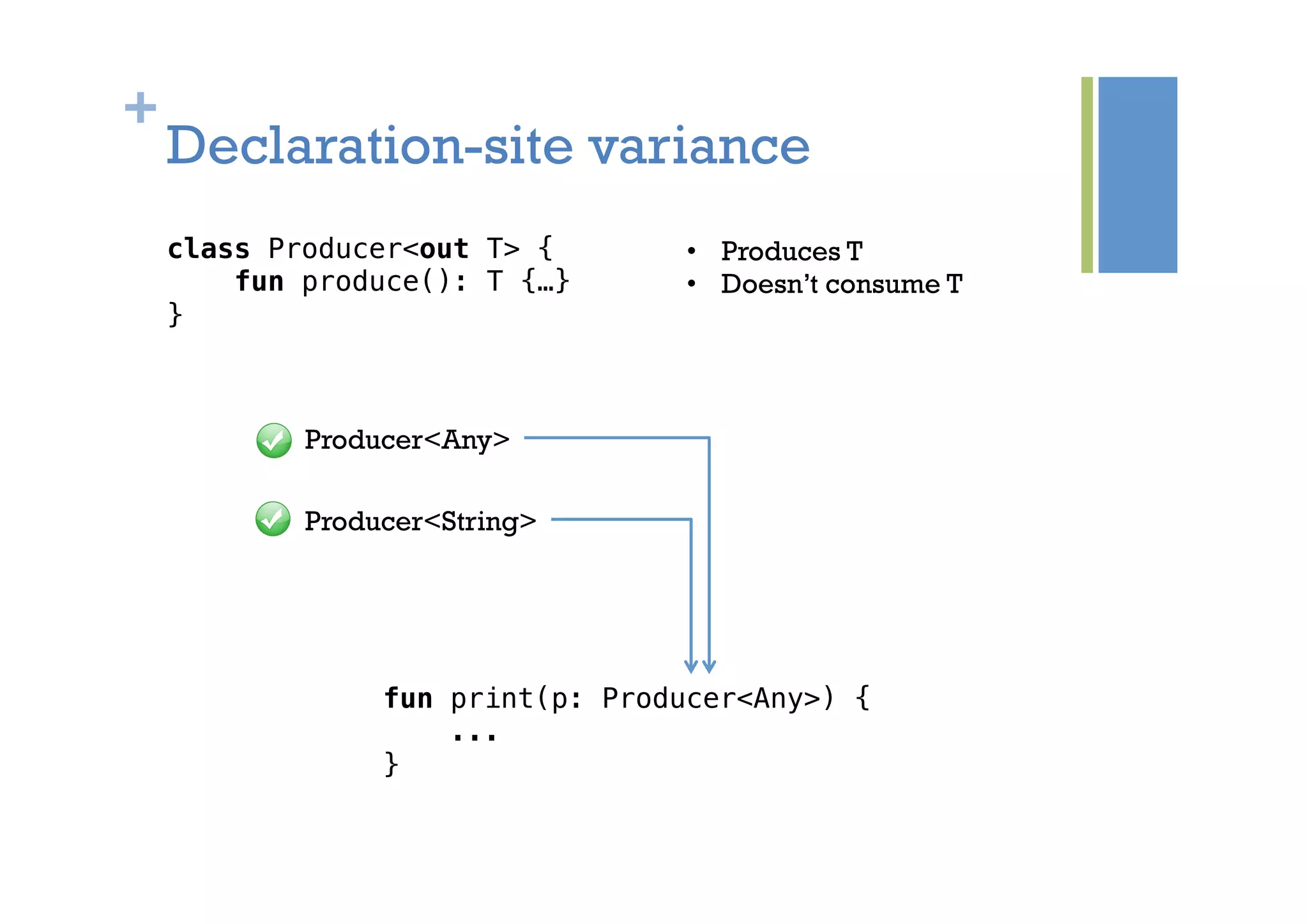
Declaration-site variance
class Producer<out T> {!
fun produce(): T {…}!
}!
fun print(p: Producer<Any>) {!
...!
}!
Producer<Any>
Producer<String>
•  Produces T
•  Doesn’t consume T
+
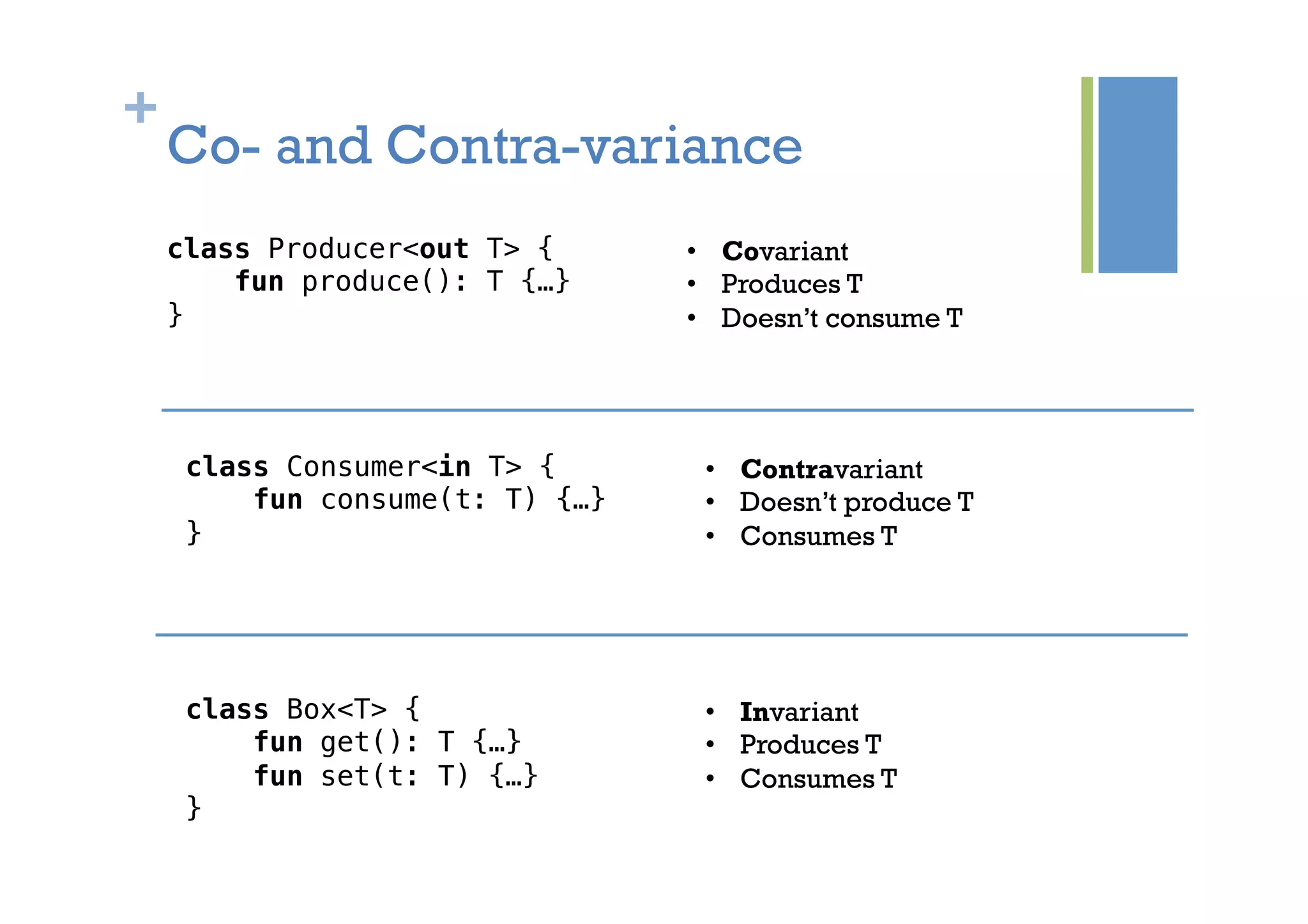
class Producer<out T> {!
fun produce(): T {…}!
}!
•  Covariant
•  Produces T
•  Doesn’t consume T
Co- and Contra-variance
class Consumer<in T> {!
fun consume(t: T) {…}!
}!
•  Contravariant
•  Doesn’t produce T
•  Consumes T
class Box<T> {!
fun get(): T {…}!
fun set(t: T) {…}!
}!
•  Invariant
•  Produces T
•  Consumes T
+
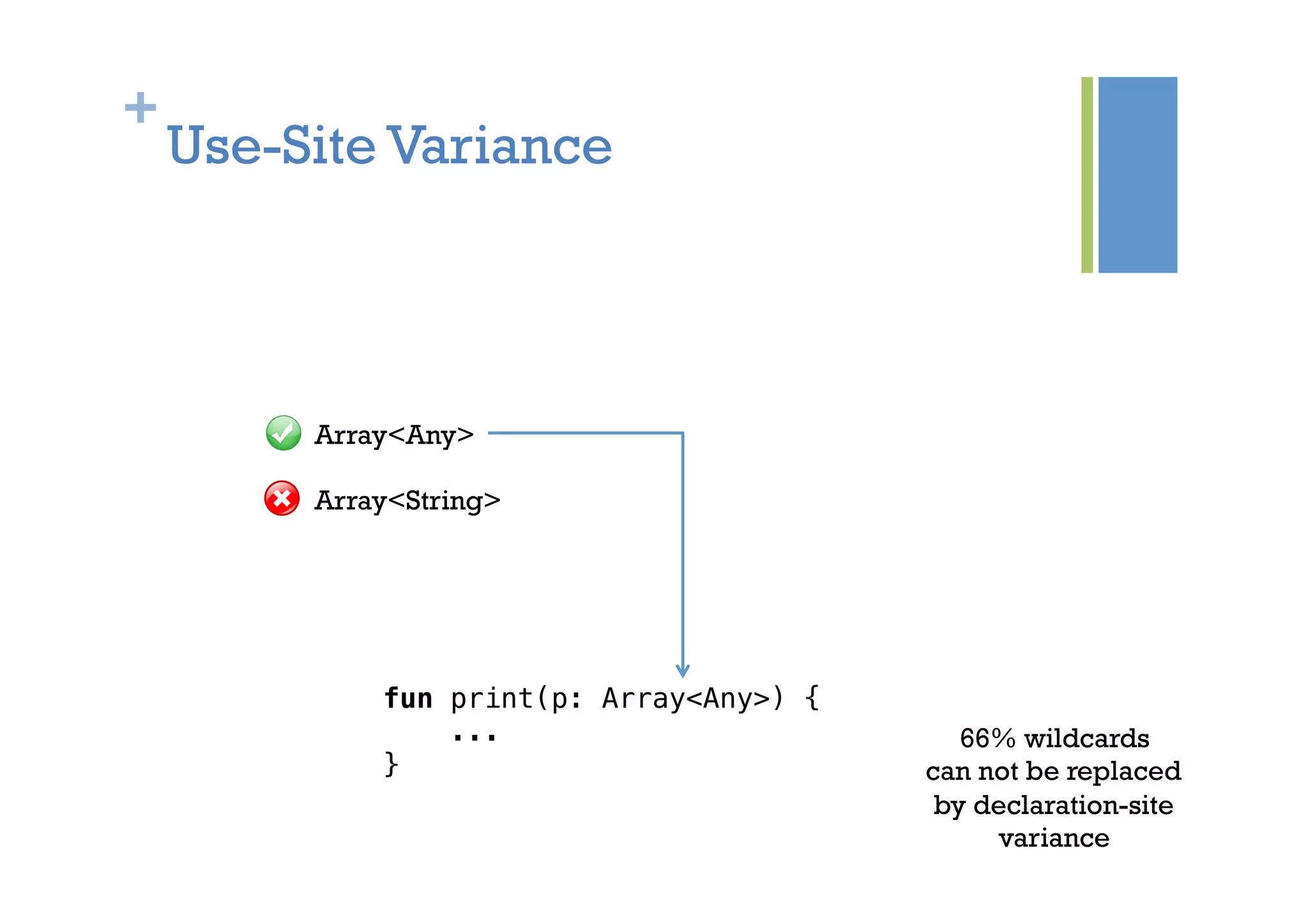
Use-Site Variance
fun print(p: Array<Any>) {!
...!
}!
Array<Any>
Array<String>
66% wildcards
can not be replaced
by declaration-site
variance
+
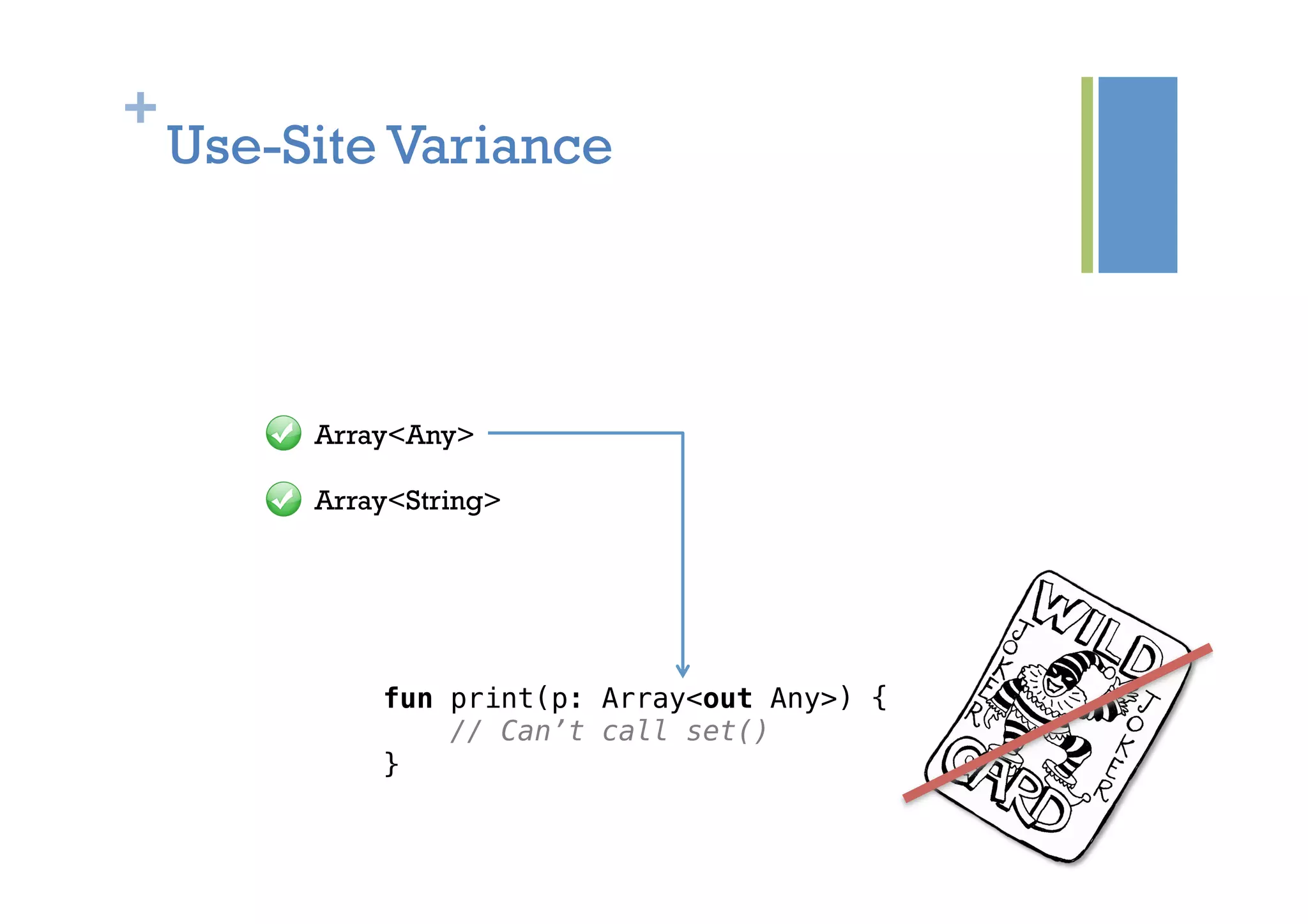
Use-Site Variance
fun print(p: Array<out Any>) {!
// Can’t call set()!
}!
Array<Any>
Array<String>
+
Mixed-Site Variance
Designed with the help from Ross Tate from Cornell University
http://www.cs.cornell.edu/~ross/publications/mixedsite/
+
Summary
n  Type system design
n  Generics
n  Flow-based typing
n  Interoperability
n  Mapping Java types to Kotlin (and back)
n  Re-using Java collections
n  IDE vs Compiler
n  Uniform implementation good for both scenarios
n  Incrementality
http://kotlin.jetbrains.org

Kotlin: Challenges in JVM language design