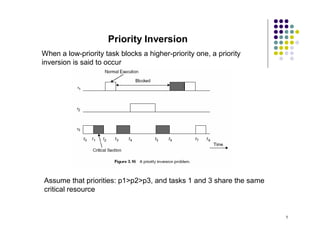
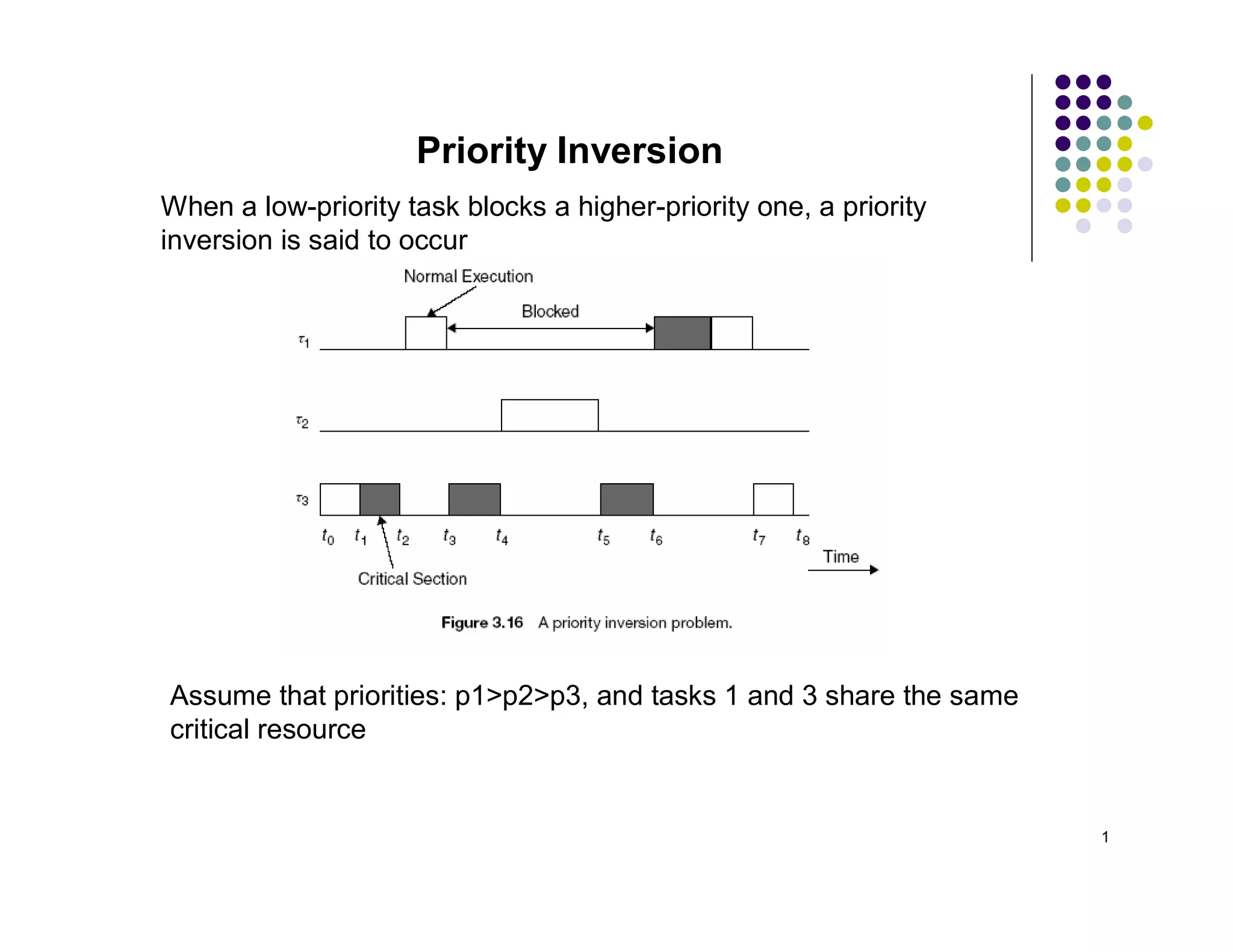
Priority Inversion
When a low-priority task blocks a higher-priority one, a priority
inversion is said to occur


Assume that priorities: p1>p2>p3, and tasks 1 and 3 share the same
critical resource


                                                                     1
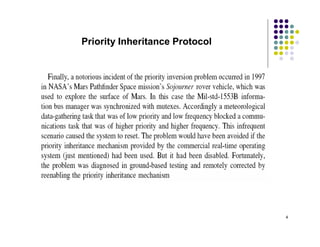
Priority Inheritance Protocol
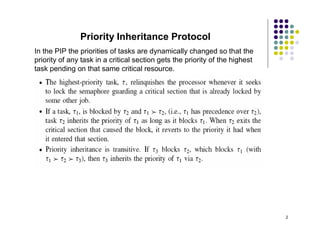
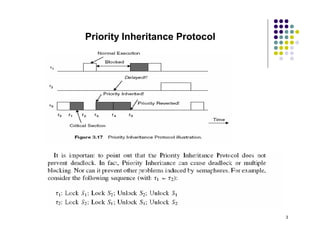
In the PIP the priorities of tasks are dynamically changed so that the
priority of any task in a critical section gets the priority of the highest
task pending on that same critical resource.


                                                                              2
Priority Inheritance Protocol


                                3
Priority Inheritance Protocol


                                4
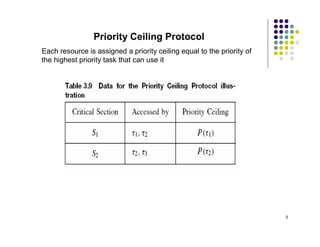
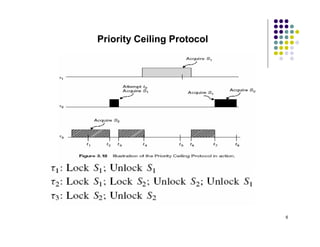
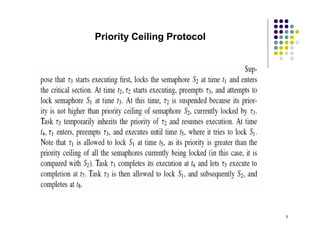
Priority Ceiling Protocol
Each resource is assigned a priority ceiling equal to the priority of
the highest priority task that can use it


                                                                        5
Priority Ceiling Protocol


                            6
Priority Ceiling Protocol


                            7
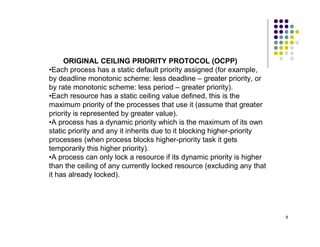
ORIGINAL CEILING PRIORITY PROTOCOL (OCPP)
•Each process has a static default priority assigned (for example,
by deadline monotonic scheme: less deadline – greater priority, or
by rate monotonic scheme: less period – greater priority).
•Each resource has a static ceiling value defined, this is the
maximum priority of the processes that use it (assume that greater
priority is represented by greater value).
•A process has a dynamic priority which is the maximum of its own
static priority and any it inherits due to it blocking higher-priority
processes (when process blocks higher-priority task it gets
temporarily this higher priority).
•A process can only lock a resource if its dynamic priority is higher
than the ceiling of any currently locked resource (excluding any that
it has already locked).


                                                                         8
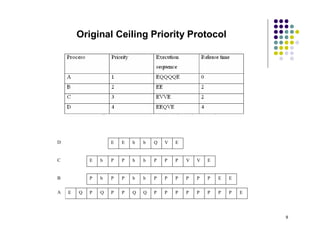
Original Ceiling Priority Protocol


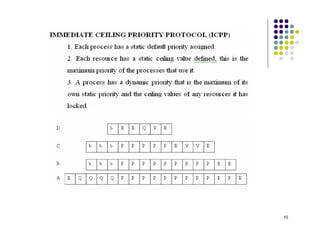
D                   E   E   b   b   Q   V   E


C           E   b   P   P   b   b   P   P   P   V   V   E


B           P   b   P   P   b   b   P   P   P   P   P   P   E   E

A   E   Q   P   Q   P   P   Q   Q   P   P   P   P   P   P   P   P   E


                                                                        9
10
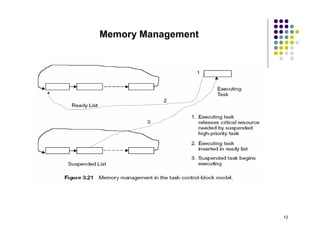
Memory Management
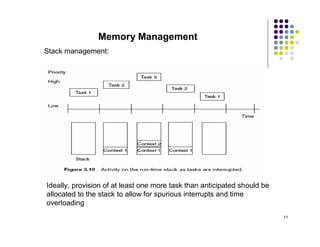
Stack management:


Ideally, provision of at least one more task than anticipated should be
allocated to the stack to allow for spurious interrupts and time
overloading
                                                                          11
Memory Management


                    12
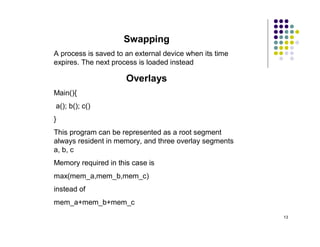
Swapping
A process is saved to an external device when its time
expires. The next process is loaded instead

                      Overlays
Main(){
a(); b(); c()
}
This program can be represented as a root segment
always resident in memory, and three overlay segments
a, b, c
Memory required in this case is
max(mem_a,mem_b,mem_c)
instead of
mem_a+mem_b+mem_c
                                                         13
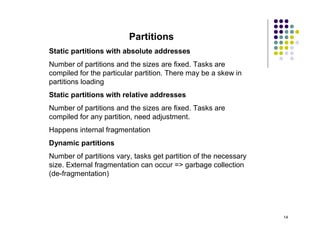
Partitions
Static partitions with absolute addresses
Number of partitions and the sizes are fixed. Tasks are
compiled for the particular partition. There may be a skew in
partitions loading
Static partitions with relative addresses
Number of partitions and the sizes are fixed. Tasks are
compiled for any partition, need adjustment.
Happens internal fragmentation
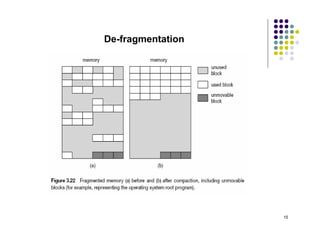
Dynamic partitions
Number of partitions vary, tasks get partition of the necessary
size. External fragmentation can occur => garbage collection
(de-fragmentation)


                                                                  14
De-fragmentation


                   15
Virtual Memory
Segmented: virtual address = (segment, offset)
Address=start(segment)+offset
Paged: (page, offset)
Address=start(page)+offset
Segmented-paged: (segment, page, offset)
Address=start(segment)+start(page)+offset

              Replacement algorithms
FIFO, LRU (Least recently used)
If we have 4 page memory and
2 4 6 8 is a a page reference string (page 2 is the least and
page 8 is the most recently used) then
2 4 6 8 9 2 4 6 8 9 2 4 6 8 9 will lead to page thrashing
Memory locking, Working sets
                                                                16
I/O Problems
    Disk fragmentation
    Contiguous file allocation: place parts of a file in adjacent
    sectors
    Elevator algorithm: reorder queries so that they will be served
    with minimal magnetic head replacement


                           Criteria for RTOS
1. Interrupt latency
2. Number of processes system can maintain
3. Memory for OS
4. Scheduling mechanisms set (round-robin, preemptive, etc)
5. Available communication methods (mutexes, semaphores, etc)
6. After sale support

                                                                      17
RTOS Criteria
7. Software development kits available
8. Hardware platforms support
9. Source code availability
10. Task context switch time
11. RTOS cost
12. Compatibility with other RTOS
13. Networks and network protocols supported by
    RTOS
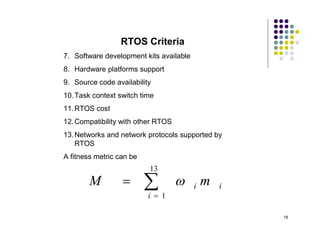
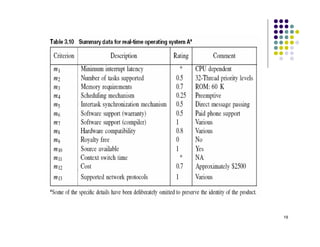
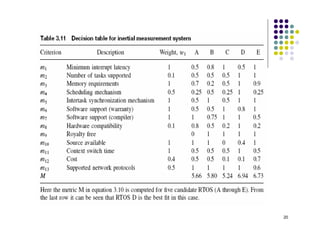
A fitness metric can be
                          13
        M                
                          i  1
                                        i   m   i


                                                     18
19
20
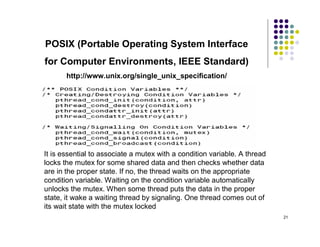
POSIX (Portable Operating System Interface
for Computer Environments, IEEE Standard)
       http://www.unix.org/single_unix_specification/
1. Threads – each process can contain several threads
2. Mutexes and Condition variables -


It is essential to associate a mutex with a condition variable. A thread
locks the mutex for some shared data and then checks whether data
are in the proper state. If no, the thread waits on the appropriate
condition variable. Waiting on the condition variable automatically
unlocks the mutex. When some thread puts the data in the proper
state, it wake a waiting thread by signaling. One thread comes out of
its wait state with the mutex locked
                                                                           21
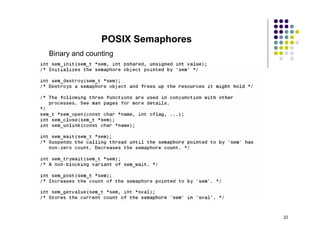
POSIX Semaphores
Binary and counting


                                  22
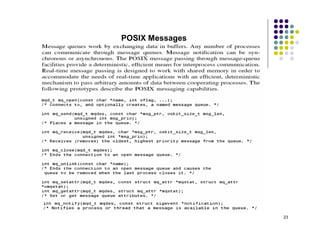
POSIX Messages


                 23
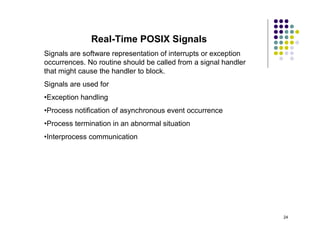
Real-Time POSIX Signals
Signals are software representation of interrupts or exception
occurrences. No routine should be called from a signal handler
that might cause the handler to block.
Signals are used for
•Exception handling
•Process notification of asynchronous event occurrence
•Process termination in an abnormal situation
•Interprocess communication


                                                                 24
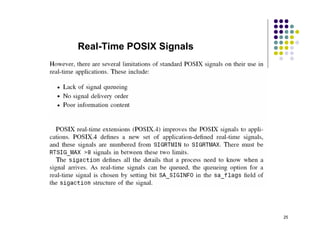
Real-Time POSIX Signals


                          25
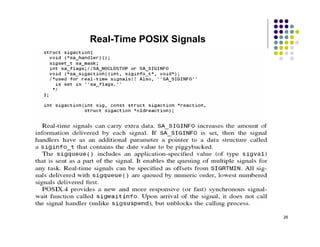
Real-Time POSIX Signals


                          26
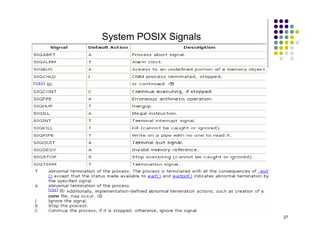
System POSIX Signals


                       27
Clocks and Timers
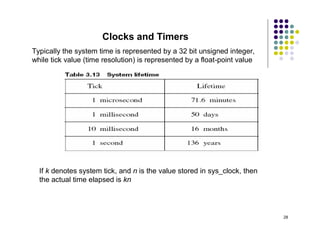
Typically the system time is represented by a 32 bit unsigned integer,
while tick value (time resolution) is represented by a float-point value


  If k denotes system tick, and n is the value stored in sys_clock, then
  the actual time elapsed is kn


                                                                           28
POSIX Clocks
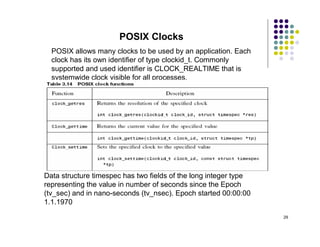
  POSIX allows many clocks to be used by an application. Each
  clock has its own identifier of type clockid_t. Commonly
  supported and used identifier is CLOCK_REALTIME that is
  systemwide clock visible for all processes.


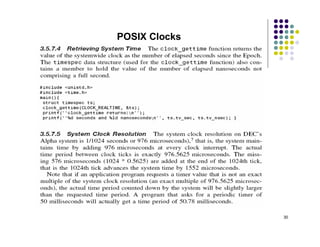
Data structure timespec has two fields of the long integer type
representing the value in number of seconds since the Epoch
(tv_sec) and in nano-seconds (tv_nsec). Epoch started 00:00:00
1.1.1970
                                                                  29
POSIX Clocks


               30
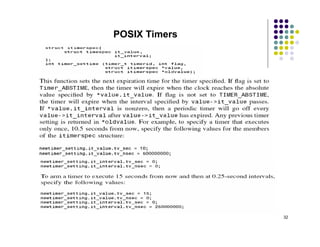
POSIX Timers


               31
POSIX Timers


               32
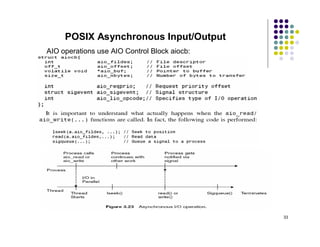
POSIX Asynchronous Input/Output
AIO operations use AIO Control Block aiocb:


                                              33
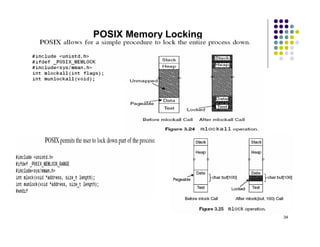
POSIX Memory Locking


                       34

Ch3-2

  • 1.
    Priority Inversion When alow-priority task blocks a higher-priority one, a priority inversion is said to occur Assume that priorities: p1>p2>p3, and tasks 1 and 3 share the same critical resource 1
  • 2.
    Priority Inheritance Protocol Inthe PIP the priorities of tasks are dynamically changed so that the priority of any task in a critical section gets the priority of the highest task pending on that same critical resource. 2
  • 3.
  • 4.
  • 5.
    Priority Ceiling Protocol Eachresource is assigned a priority ceiling equal to the priority of the highest priority task that can use it 5
  • 6.
  • 7.
  • 8.
    ORIGINAL CEILING PRIORITYPROTOCOL (OCPP) •Each process has a static default priority assigned (for example, by deadline monotonic scheme: less deadline – greater priority, or by rate monotonic scheme: less period – greater priority). •Each resource has a static ceiling value defined, this is the maximum priority of the processes that use it (assume that greater priority is represented by greater value). •A process has a dynamic priority which is the maximum of its own static priority and any it inherits due to it blocking higher-priority processes (when process blocks higher-priority task it gets temporarily this higher priority). •A process can only lock a resource if its dynamic priority is higher than the ceiling of any currently locked resource (excluding any that it has already locked). 8
  • 9.
    Original Ceiling PriorityProtocol D E E b b Q V E C E b P P b b P P P V V E B P b P P b b P P P P P P E E A E Q P Q P P Q Q P P P P P P P P E 9
  • 10.
  • 11.
    Memory Management Stack management: Ideally,provision of at least one more task than anticipated should be allocated to the stack to allow for spurious interrupts and time overloading 11
  • 12.
  • 13.
    Swapping A process issaved to an external device when its time expires. The next process is loaded instead Overlays Main(){ a(); b(); c() } This program can be represented as a root segment always resident in memory, and three overlay segments a, b, c Memory required in this case is max(mem_a,mem_b,mem_c) instead of mem_a+mem_b+mem_c 13
  • 14.
    Partitions Static partitions withabsolute addresses Number of partitions and the sizes are fixed. Tasks are compiled for the particular partition. There may be a skew in partitions loading Static partitions with relative addresses Number of partitions and the sizes are fixed. Tasks are compiled for any partition, need adjustment. Happens internal fragmentation Dynamic partitions Number of partitions vary, tasks get partition of the necessary size. External fragmentation can occur => garbage collection (de-fragmentation) 14
  • 15.
  • 16.
    Virtual Memory Segmented: virtualaddress = (segment, offset) Address=start(segment)+offset Paged: (page, offset) Address=start(page)+offset Segmented-paged: (segment, page, offset) Address=start(segment)+start(page)+offset Replacement algorithms FIFO, LRU (Least recently used) If we have 4 page memory and 2 4 6 8 is a a page reference string (page 2 is the least and page 8 is the most recently used) then 2 4 6 8 9 2 4 6 8 9 2 4 6 8 9 will lead to page thrashing Memory locking, Working sets 16
  • 17.
    I/O Problems Disk fragmentation Contiguous file allocation: place parts of a file in adjacent sectors Elevator algorithm: reorder queries so that they will be served with minimal magnetic head replacement Criteria for RTOS 1. Interrupt latency 2. Number of processes system can maintain 3. Memory for OS 4. Scheduling mechanisms set (round-robin, preemptive, etc) 5. Available communication methods (mutexes, semaphores, etc) 6. After sale support 17
  • 18.
    RTOS Criteria 7. Softwaredevelopment kits available 8. Hardware platforms support 9. Source code availability 10. Task context switch time 11. RTOS cost 12. Compatibility with other RTOS 13. Networks and network protocols supported by RTOS A fitness metric can be 13 M   i  1  i m i 18
  • 19.
  • 20.
  • 21.
    POSIX (Portable OperatingSystem Interface for Computer Environments, IEEE Standard) http://www.unix.org/single_unix_specification/ 1. Threads – each process can contain several threads 2. Mutexes and Condition variables - It is essential to associate a mutex with a condition variable. A thread locks the mutex for some shared data and then checks whether data are in the proper state. If no, the thread waits on the appropriate condition variable. Waiting on the condition variable automatically unlocks the mutex. When some thread puts the data in the proper state, it wake a waiting thread by signaling. One thread comes out of its wait state with the mutex locked 21
  • 22.
  • 23.
  • 24.
    Real-Time POSIX Signals Signalsare software representation of interrupts or exception occurrences. No routine should be called from a signal handler that might cause the handler to block. Signals are used for •Exception handling •Process notification of asynchronous event occurrence •Process termination in an abnormal situation •Interprocess communication 24
  • 25.
  • 26.
  • 27.
  • 28.
    Clocks and Timers Typicallythe system time is represented by a 32 bit unsigned integer, while tick value (time resolution) is represented by a float-point value If k denotes system tick, and n is the value stored in sys_clock, then the actual time elapsed is kn 28
  • 29.
    POSIX Clocks POSIX allows many clocks to be used by an application. Each clock has its own identifier of type clockid_t. Commonly supported and used identifier is CLOCK_REALTIME that is systemwide clock visible for all processes. Data structure timespec has two fields of the long integer type representing the value in number of seconds since the Epoch (tv_sec) and in nano-seconds (tv_nsec). Epoch started 00:00:00 1.1.1970 29
  • 30.
  • 31.
  • 32.
  • 33.
    POSIX Asynchronous Input/Output AIOoperations use AIO Control Block aiocb: 33
  • 34.