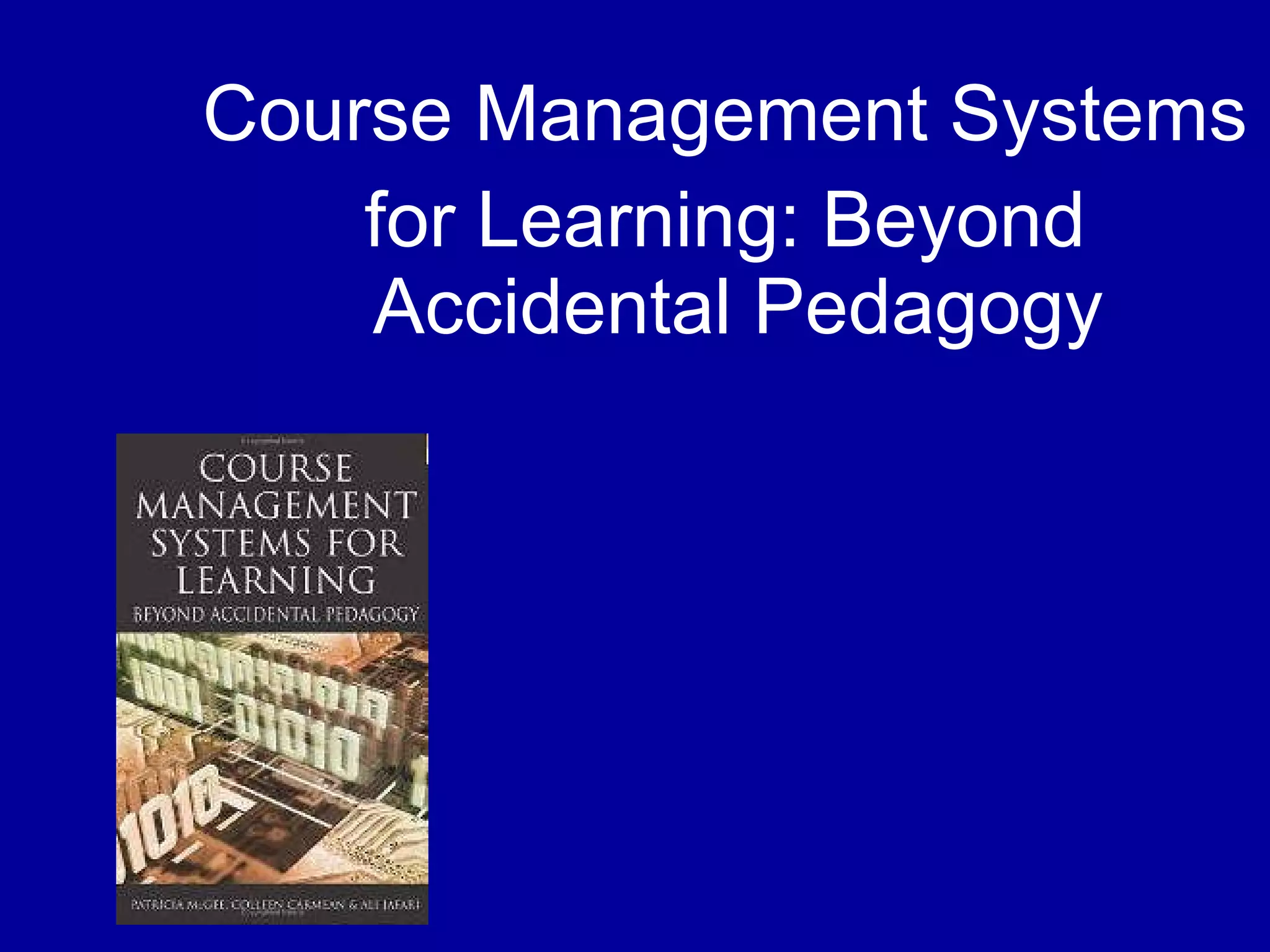
Course Management Systems  for Learning: Beyond Accidental Pedagogy
Chapter 11. Pushing the Envelope: Designing Authentic  Learning Activities Using Course Management Systems   CMS AUTHENTIC Learning Activities
Distributed forms of interactions  (distributed across space, time, and various media using tools that promote higher-order thinking, enhance social learning, and sustain motivation)   a. instantaneous access to global resources  b. coupling experts from around the world with novices  c. publishing to a world audience  d. virtual field trips  e. communicate with a diverse audience  f. share and compare information, negotiate meaning, and co-construct knowledge
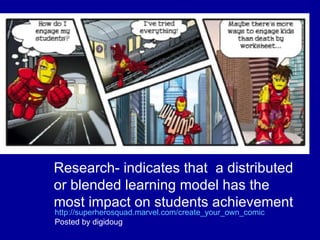
Research- indicates that  a distributed or blended learning model has the most impact on students achievement  http://superherosquad.marvel.com/create_your_own_comic Posted by digidoug
Concerns  limitation of CMS is inability to effectively accommodate multiple and alternative forms of student knowledge representation and authentic assessment which are fundamental to principles of constructivist learning  the course templates and structures of CMS appear to make implementing constructivist or learner centered practices more difficult than implementing objectivist or teacher-directed instructional practices  problem with tendency to use only the most obvious and easily accessible components and features  lack of pedagogical advisement and support to ensure online course developers and instructors are current on teaching research and course design
Solutions  rethink teaching approaches and course design based on current research on distributed and online learning  comprehensive examination of the features and components of CMS and the mindful integration of the instructional and learning task  goal- flexible and effective pedagogical designs that promote learner-centered practice and meaningful learning.
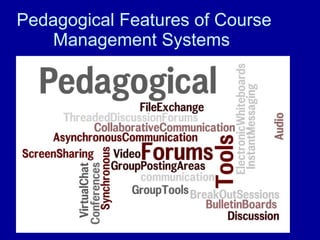
Pedagogical Features of Course Management Systems
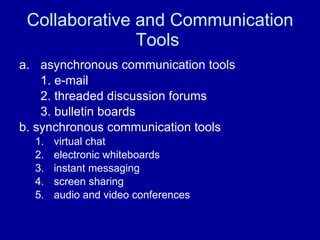
Collaborative and Communication Tools  asynchronous communication tools  1. e-mail  2. threaded discussion forums  3. bulletin boards  b. synchronous communication tools  virtual chat  electronic whiteboards  instant messaging  screen sharing  audio and video conferences
Group tools: 1. support both asynchronous and synchronous communication 2. support both formal and informal types of group activities
Group Tools group discussion forums  virtual chat areas  file exchange tools  group posting areas  break out sessions
Content Creation and Delivery Tools  tools for learners to contribute course content, submit assignments, and interact with course resources  student content creation tools allow students to post their assignments, reflection journals, and solutions to case studies
Administrative Tools  tools to manage students and student information  tools to manage teaching assistants and providing guest access  tools to manage group work  student presentation tools can be considered a content creation tool and delivery tool from a student standpoint and an administrative tool from an instructor standpoint
Learning Tools  Enable learners to interact meaningfully with course content  1. process content  2. organize learning experiences  3. manipulate content online  4. create personalized experiences during the learning process  5. annotate text while exploring course content  6. take notes online  7. link information  8. build a personal folder of relevant material
Types of Learning Tools Embedded in CMS collection tools such as bookmarks and personal folders  expository tools such as journal-type note taking tools  exploratory tools such as open-ended search tools  scaffolding tools such as glossary, help tools, index, course map
Assessment Tools assessment tools that are objectivist in nature such programmed quizzes that can be electronically scored and provide instant feedback  comprehension essay-type tools- are more subjective in nature and can be used to assess higher-order learning skills  self-assessment tests
Self-Assessment Tests  are an example of authentic assessment allowing students to monitor their own comprehension and learning  can be implemented using content creation and delivery tools  peer assessment activities by developing rubrics for assignments, posting rubrics, and requiring students to evaluate each other's work  instructors can promote self-assessment by requiring students to submit reflections journals and create electronic portfolios
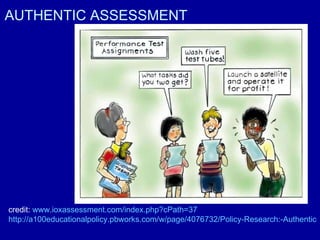
AUTHENTIC ASSESSMENT credit:  www.ioxassessment.com/index.php?cPath =37 http://a100educationalpolicy.pbworks.com/w/page/4076732/Policy-Research:-Authentic-Assessment
Tracking Features  number of times students access a course  content pages students access  time students accessed pages  number and times of postings per student  search discussion forums by student name  learners can also track their progress and grades
Designing Authentic Learning Tasks Using CMS  Authentic learning tasks are anchored in a realistic setting and place the focus on problem solving rather than learning a body of content and should be the primary consideration of online learning developers when designing distributed forms of interactions using CMS.
Attributes of authentic learning tasks include:  a. embedding learning in complex, realistic, and relevant contexts  b. providing for social negotiation and collaboration as an integral part of learning  c. supporting multiple models of knowledge representation  d. providing the opportunity to examine the learning task from different perspectives using a variety of resources  e. encouraging ownership in the learning process  f. providing the opportunity for reflective thinking, self-evaluation, and self-monitoring  g. allowing competing solutions and diversity of outcomes
Three types of learning tasks: Exploratory Dialogic Supportive
Exploratory Learning Tasks   based on discovery learning or inquiry-based learning  examples: problem solving, explorations, hypothesis generation, role playing  allows learners to try out different strategies and hypotheses and observe their effects
Dialogic Learning Tasks- emphasize social interaction through dialogue and conversation, assists learners in construction of new knowldge primarily through dialogue In collaboration and social negotiation the goal is to share different viewpoints and ideas and to collaborate on probelm solving. Groups are formed to provide variation in classroom activities, share work-loads, and promote peer tutoring.
Dialogic Learning Tasks include : a. reflection- learning tools b. articulation- collaboration and communication tools c. collaboration and social negotiation- collaboration and communication tools d. multiple perspectives- content creation and delivery tools
Supportive Learning Tasks   enacted by the expert, instructor, or embedded performance support system with the goal of modeling the desired performance, skill, or process and observing and supporting learners during the execution of a learning task
Supportive Learning Tasks include:  a. modeling and explaining- learners can experience an expert's cognitive processes and mode of thinking b. coaching- a good coach motivates learners, monitors and analyzes performance, provides feedback, and promotes reflection and articulation on new information learned c. scaffolding- supporting novice learners by limiting the complexities of the context and gradually removing or fading support as the learner gains knowledge, skills, and confidence
Implications  1. authentic learning tasks are aimed at enabling the online course developer and instructor to design learner-centered or constructivist practices that engage learners in meaningful learnings 2. the inclusion of learner tools in CMS, allows online learning environments to be increasingly learner-centered
Reference: Course Management Systems for Learning: Beyond Accidental Pedagogy  McGee, P.; Carmean, C., & Jafari,A. 2005 Outline created using open-source tool:  http:// www.quicklyst.com
Free Technology for Teachers written by Richard Byrne
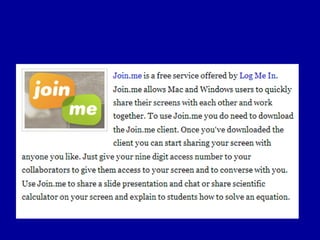
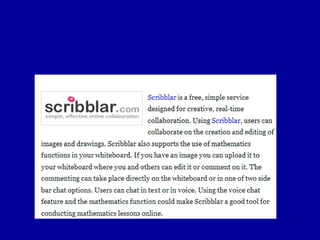
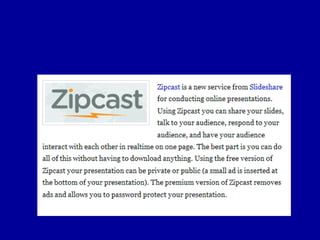
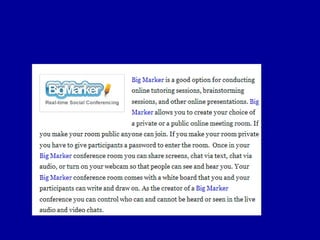
Four Ways to Give Short Presentations http:// www.freetech4teachers.com/2011/02/four-ways-to-give-short-presentations.html


Ch11 cms march1

  • 1.
    Course Management Systems for Learning: Beyond Accidental Pedagogy
  • 2.
    Chapter 11. Pushingthe Envelope: Designing Authentic Learning Activities Using Course Management Systems CMS AUTHENTIC Learning Activities
  • 3.
    Distributed forms ofinteractions (distributed across space, time, and various media using tools that promote higher-order thinking, enhance social learning, and sustain motivation) a. instantaneous access to global resources b. coupling experts from around the world with novices c. publishing to a world audience d. virtual field trips e. communicate with a diverse audience f. share and compare information, negotiate meaning, and co-construct knowledge
  • 4.
    Research- indicates that a distributed or blended learning model has the most impact on students achievement http://superherosquad.marvel.com/create_your_own_comic Posted by digidoug
  • 5.
    Concerns limitationof CMS is inability to effectively accommodate multiple and alternative forms of student knowledge representation and authentic assessment which are fundamental to principles of constructivist learning the course templates and structures of CMS appear to make implementing constructivist or learner centered practices more difficult than implementing objectivist or teacher-directed instructional practices problem with tendency to use only the most obvious and easily accessible components and features lack of pedagogical advisement and support to ensure online course developers and instructors are current on teaching research and course design
  • 6.
    Solutions rethinkteaching approaches and course design based on current research on distributed and online learning comprehensive examination of the features and components of CMS and the mindful integration of the instructional and learning task goal- flexible and effective pedagogical designs that promote learner-centered practice and meaningful learning.
  • 7.
    Pedagogical Features ofCourse Management Systems
  • 8.
    Collaborative and CommunicationTools asynchronous communication tools 1. e-mail 2. threaded discussion forums 3. bulletin boards b. synchronous communication tools virtual chat electronic whiteboards instant messaging screen sharing audio and video conferences
  • 9.
    Group tools: 1.support both asynchronous and synchronous communication 2. support both formal and informal types of group activities
  • 10.
    Group Tools groupdiscussion forums virtual chat areas file exchange tools group posting areas break out sessions
  • 11.
    Content Creation andDelivery Tools tools for learners to contribute course content, submit assignments, and interact with course resources student content creation tools allow students to post their assignments, reflection journals, and solutions to case studies
  • 12.
    Administrative Tools tools to manage students and student information tools to manage teaching assistants and providing guest access tools to manage group work student presentation tools can be considered a content creation tool and delivery tool from a student standpoint and an administrative tool from an instructor standpoint
  • 13.
    Learning Tools Enable learners to interact meaningfully with course content 1. process content 2. organize learning experiences 3. manipulate content online 4. create personalized experiences during the learning process 5. annotate text while exploring course content 6. take notes online 7. link information 8. build a personal folder of relevant material
  • 14.
    Types of LearningTools Embedded in CMS collection tools such as bookmarks and personal folders expository tools such as journal-type note taking tools exploratory tools such as open-ended search tools scaffolding tools such as glossary, help tools, index, course map
  • 15.
    Assessment Tools assessmenttools that are objectivist in nature such programmed quizzes that can be electronically scored and provide instant feedback comprehension essay-type tools- are more subjective in nature and can be used to assess higher-order learning skills self-assessment tests
  • 16.
    Self-Assessment Tests are an example of authentic assessment allowing students to monitor their own comprehension and learning can be implemented using content creation and delivery tools peer assessment activities by developing rubrics for assignments, posting rubrics, and requiring students to evaluate each other's work instructors can promote self-assessment by requiring students to submit reflections journals and create electronic portfolios
  • 17.
    AUTHENTIC ASSESSMENT credit: www.ioxassessment.com/index.php?cPath =37 http://a100educationalpolicy.pbworks.com/w/page/4076732/Policy-Research:-Authentic-Assessment
  • 18.
    Tracking Features number of times students access a course content pages students access time students accessed pages number and times of postings per student search discussion forums by student name learners can also track their progress and grades
  • 19.
    Designing Authentic LearningTasks Using CMS Authentic learning tasks are anchored in a realistic setting and place the focus on problem solving rather than learning a body of content and should be the primary consideration of online learning developers when designing distributed forms of interactions using CMS.
  • 20.
    Attributes of authenticlearning tasks include: a. embedding learning in complex, realistic, and relevant contexts b. providing for social negotiation and collaboration as an integral part of learning c. supporting multiple models of knowledge representation d. providing the opportunity to examine the learning task from different perspectives using a variety of resources e. encouraging ownership in the learning process f. providing the opportunity for reflective thinking, self-evaluation, and self-monitoring g. allowing competing solutions and diversity of outcomes
  • 21.
    Three types oflearning tasks: Exploratory Dialogic Supportive
  • 22.
    Exploratory Learning Tasks based on discovery learning or inquiry-based learning examples: problem solving, explorations, hypothesis generation, role playing allows learners to try out different strategies and hypotheses and observe their effects
  • 23.
    Dialogic Learning Tasks-emphasize social interaction through dialogue and conversation, assists learners in construction of new knowldge primarily through dialogue In collaboration and social negotiation the goal is to share different viewpoints and ideas and to collaborate on probelm solving. Groups are formed to provide variation in classroom activities, share work-loads, and promote peer tutoring.
  • 24.
    Dialogic Learning Tasksinclude : a. reflection- learning tools b. articulation- collaboration and communication tools c. collaboration and social negotiation- collaboration and communication tools d. multiple perspectives- content creation and delivery tools
  • 25.
    Supportive Learning Tasks enacted by the expert, instructor, or embedded performance support system with the goal of modeling the desired performance, skill, or process and observing and supporting learners during the execution of a learning task
  • 26.
    Supportive Learning Tasksinclude: a. modeling and explaining- learners can experience an expert's cognitive processes and mode of thinking b. coaching- a good coach motivates learners, monitors and analyzes performance, provides feedback, and promotes reflection and articulation on new information learned c. scaffolding- supporting novice learners by limiting the complexities of the context and gradually removing or fading support as the learner gains knowledge, skills, and confidence
  • 27.
    Implications 1.authentic learning tasks are aimed at enabling the online course developer and instructor to design learner-centered or constructivist practices that engage learners in meaningful learnings 2. the inclusion of learner tools in CMS, allows online learning environments to be increasingly learner-centered
  • 28.
    Reference: Course ManagementSystems for Learning: Beyond Accidental Pedagogy McGee, P.; Carmean, C., & Jafari,A. 2005 Outline created using open-source tool: http:// www.quicklyst.com
  • 29.
    Free Technology forTeachers written by Richard Byrne
  • 30.
    Four Ways toGive Short Presentations http:// www.freetech4teachers.com/2011/02/four-ways-to-give-short-presentations.html
  • 31.
  • 32.
  • 33.
  • 34.