1


Field Research
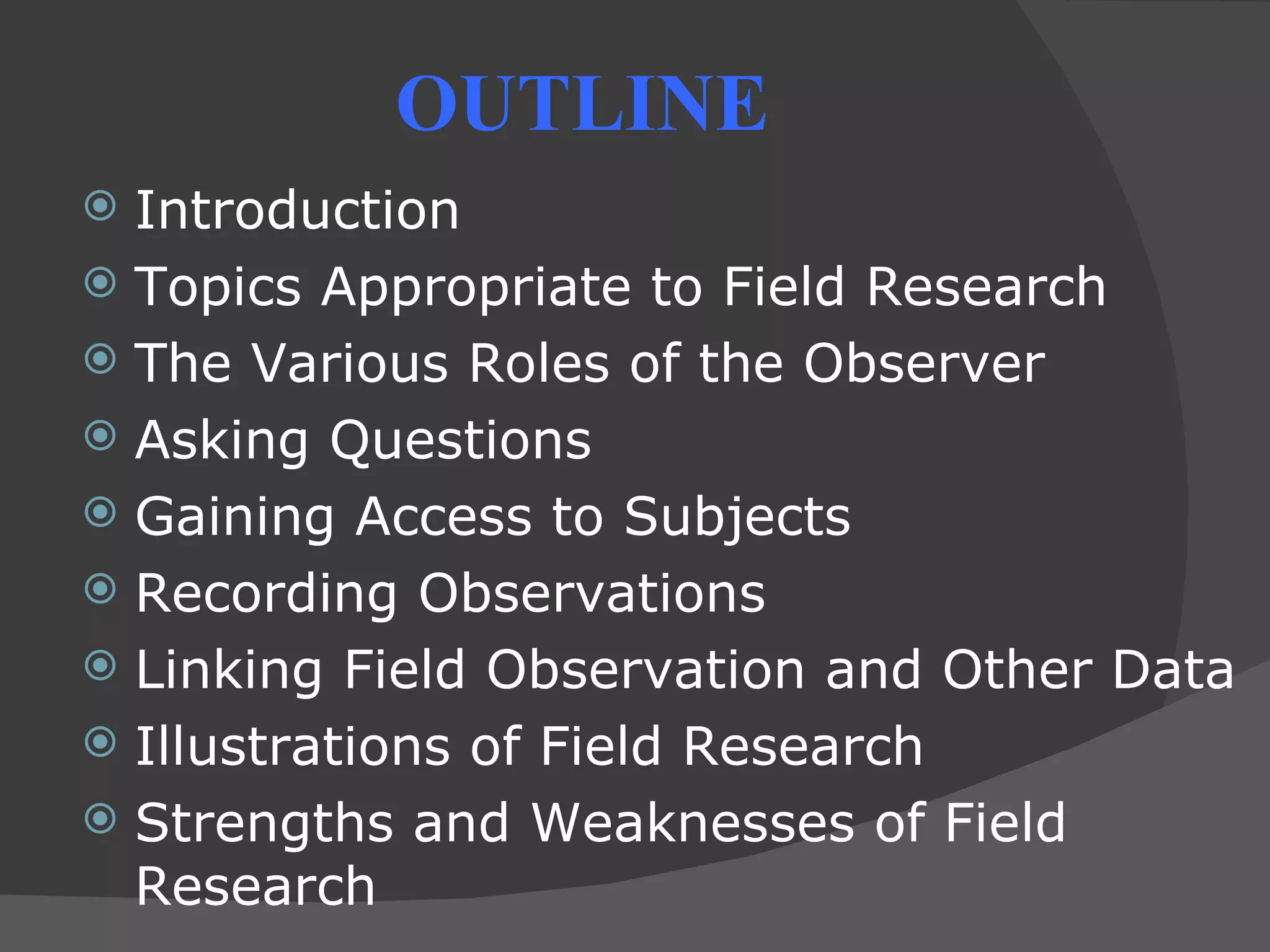
OUTLINE
 Introduction
 Topics Appropriate to Field Research
 The Various Roles of the Observer
 Asking Questions
 Gaining Access to Subjects
 Recording Observations
 Linking Field Observation and Other Data
 Illustrations of Field Research
 Strengths and Weaknesses of Field
  Research
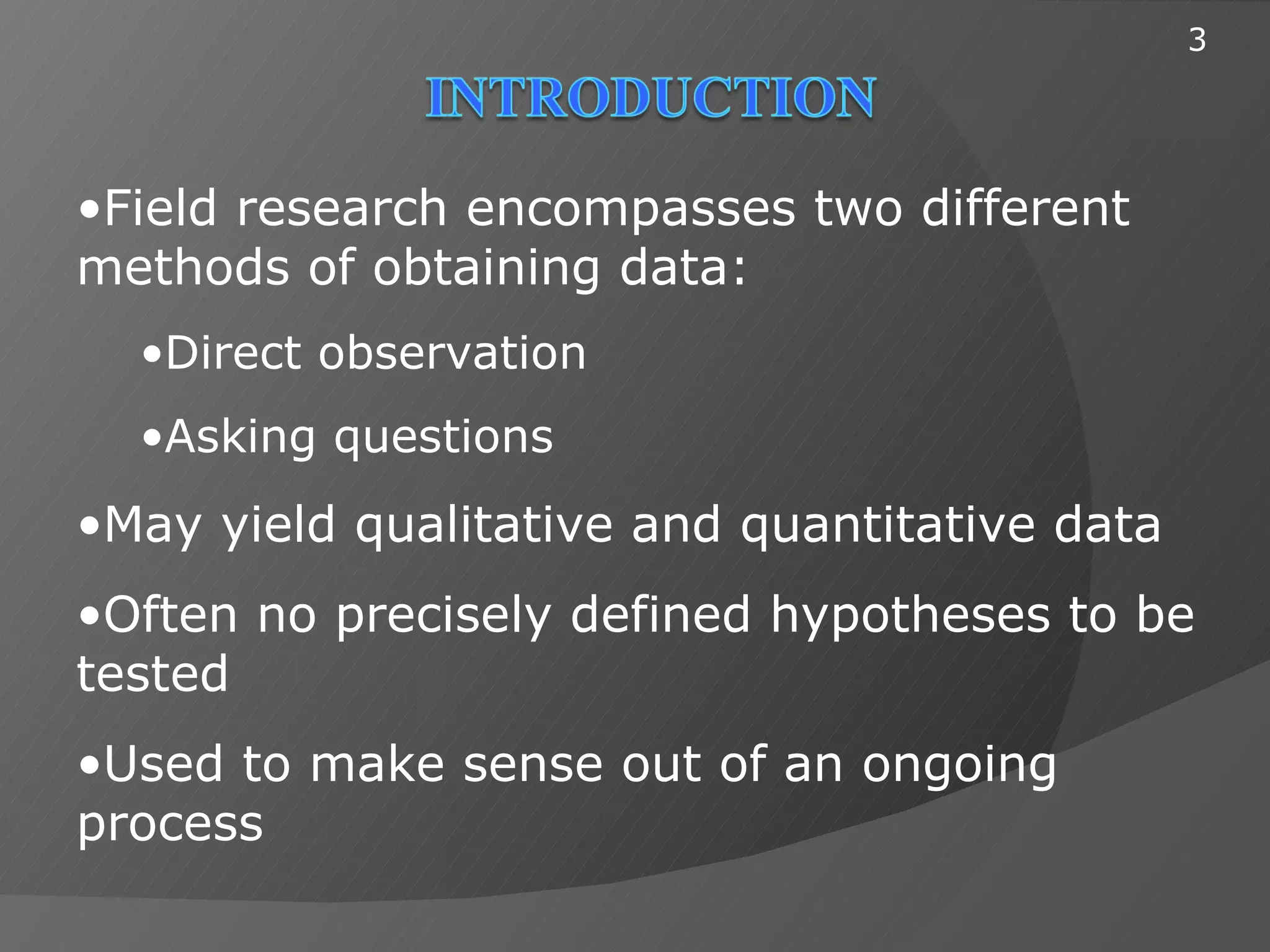
3


•Field research encompasses two different
methods of obtaining data:
  •Direct observation
  •Asking questions
•May yield qualitative and quantitative data
•Often no precisely defined hypotheses to be
tested
•Used to make sense out of an ongoing
process
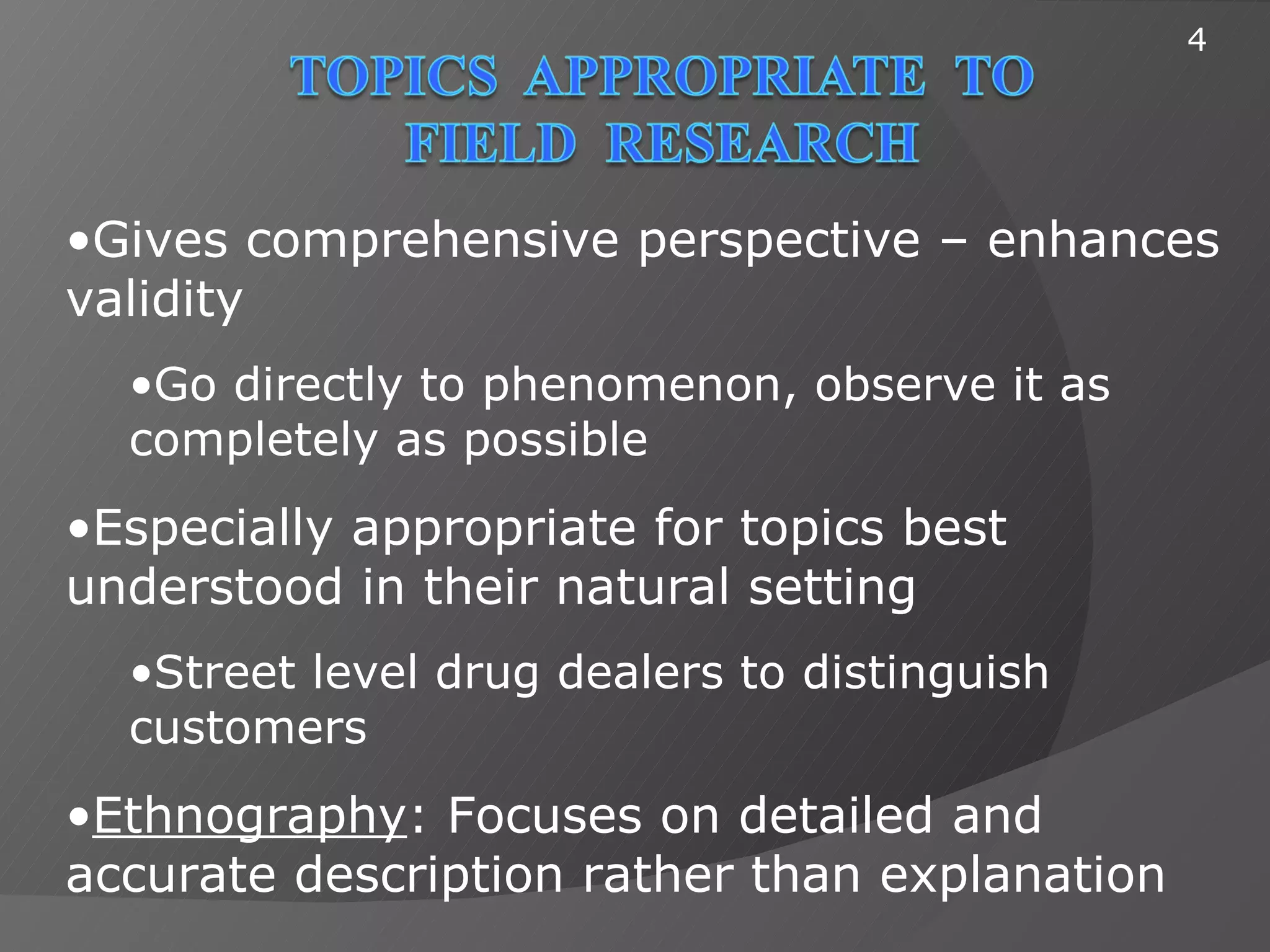
4


•Gives comprehensive perspective – enhances
validity
  •Go directly to phenomenon, observe it as
  completely as possible
•Especially appropriate for topics best
understood in their natural setting
  •Street level drug dealers to distinguish
  customers
•Ethnography: Focuses on detailed and
accurate description rather than explanation
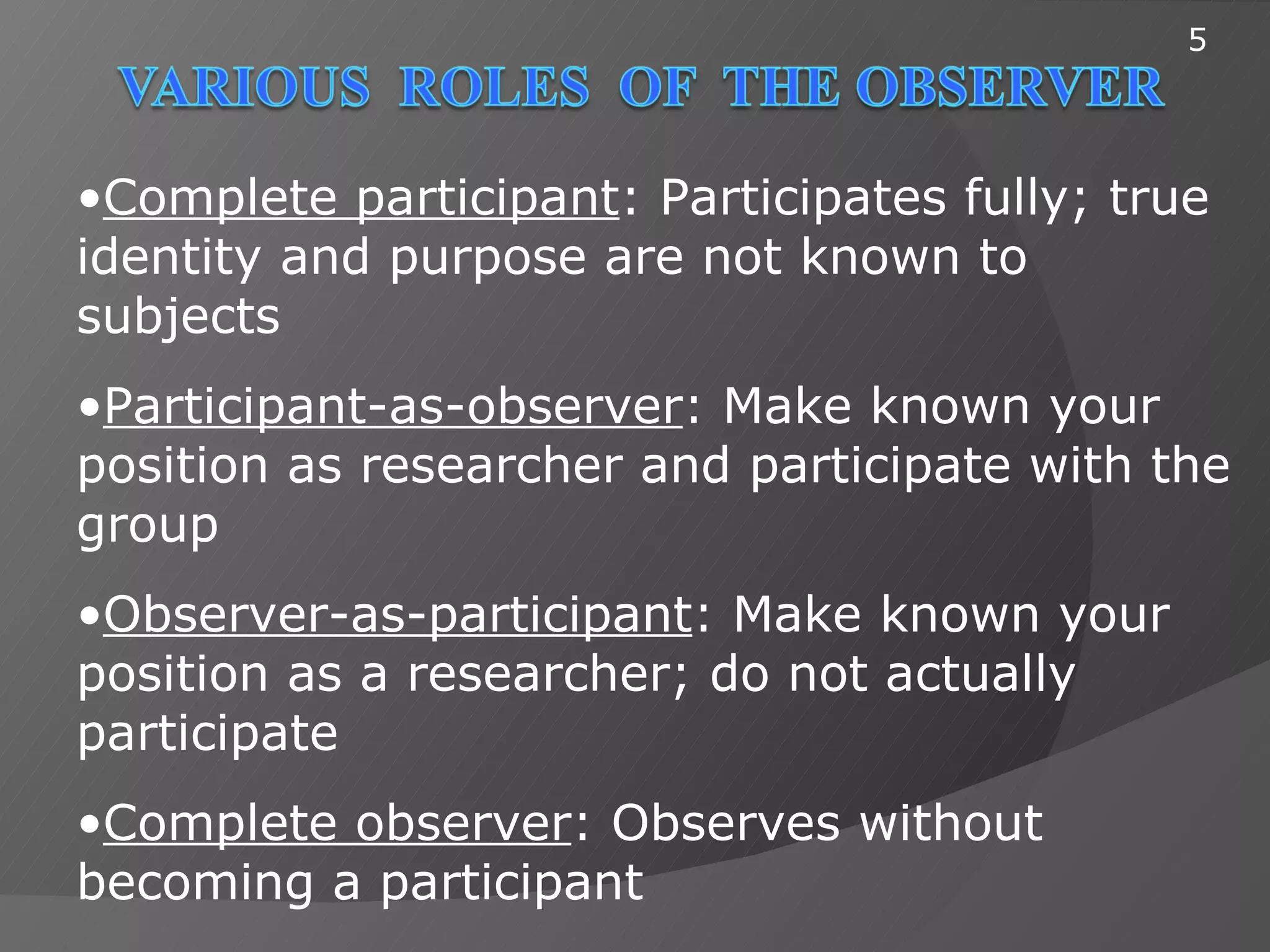
5


•Complete participant: Participates fully; true
identity and purpose are not known to
subjects
•Participant-as-observer: Make known your
position as researcher and participate with the
group
•Observer-as-participant: Make known your
position as a researcher; do not actually
participate
•Complete observer: Observes without
becoming a participant
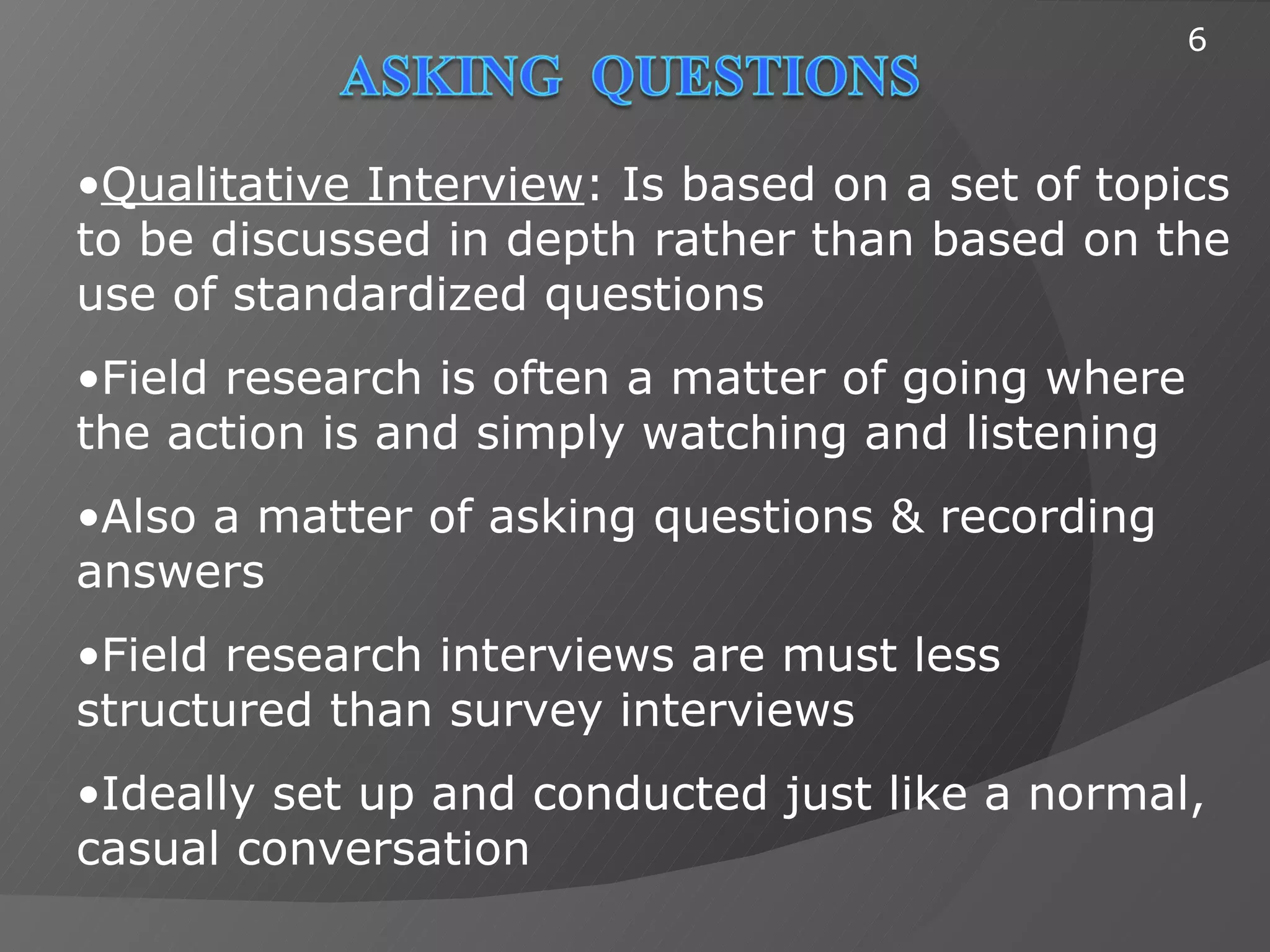
6


•Qualitative Interview: Is based on a set of topics
to be discussed in depth rather than based on the
use of standardized questions
•Field research is often a matter of going where
the action is and simply watching and listening
•Also a matter of asking questions & recording
answers
•Field research interviews are must less
structured than survey interviews
•Ideally set up and conducted just like a normal,
casual conversation
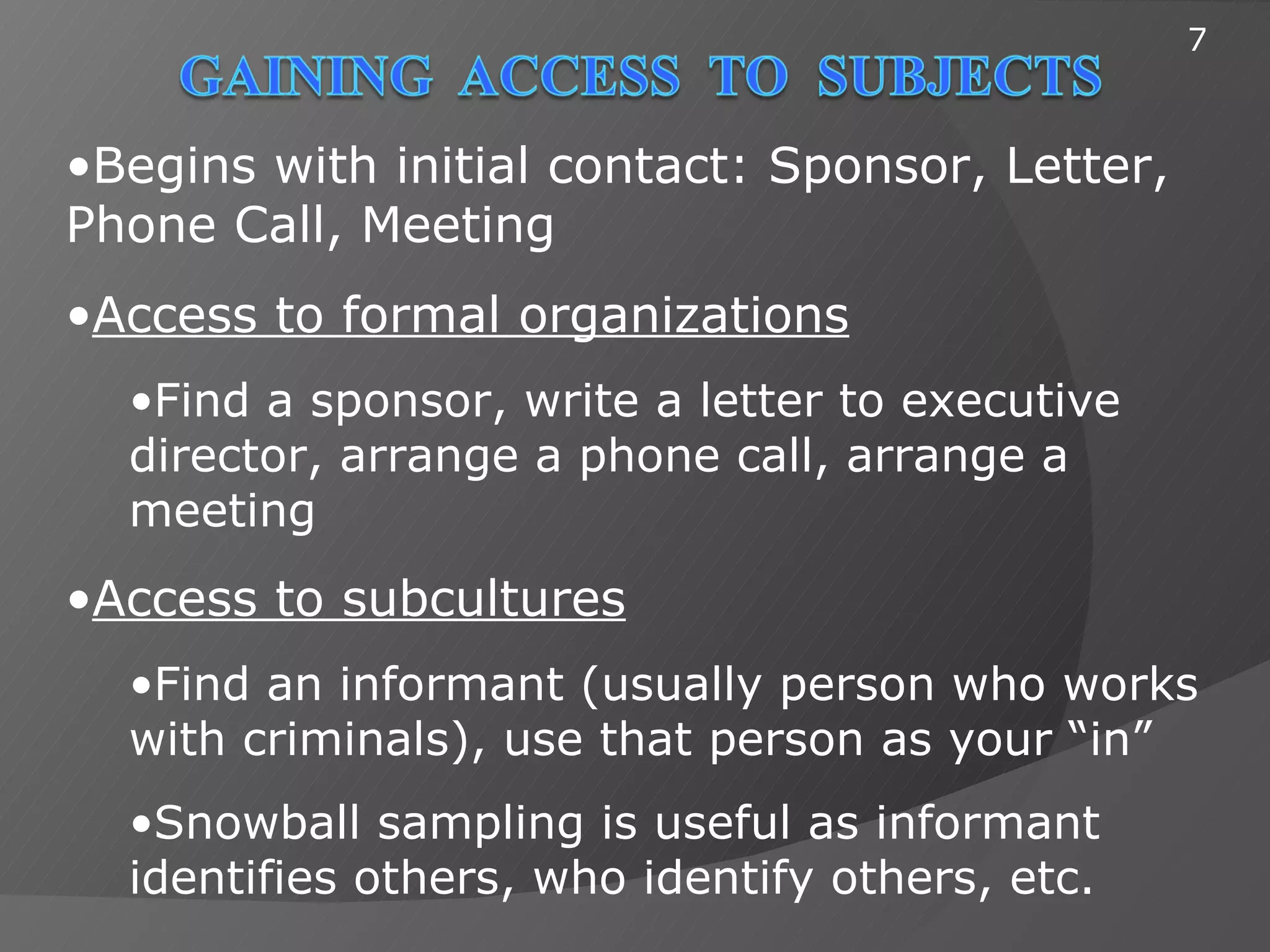
7


•Begins with initial contact: Sponsor, Letter,
Phone Call, Meeting
•Access to formal organizations
  •Find a sponsor, write a letter to executive
  director, arrange a phone call, arrange a
  meeting
•Access to subcultures
  •Find an informant (usually person who works
  with criminals), use that person as your “in”
  •Snowball sampling is useful as informant
  identifies others, who identify others, etc.
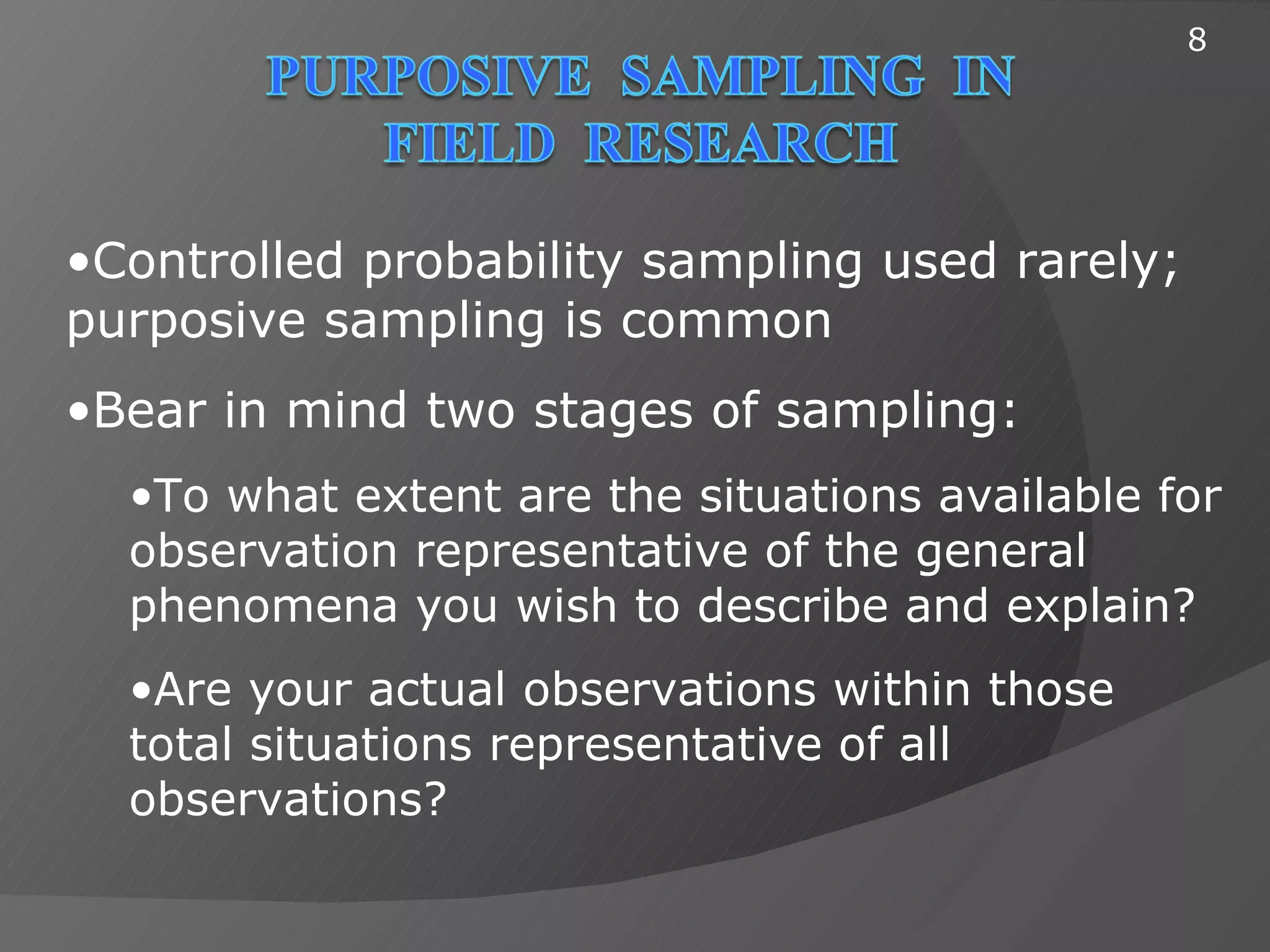
8


•Controlled probability sampling used rarely;
purposive sampling is common
•Bear in mind two stages of sampling:
  •To what extent are the situations available for
  observation representative of the general
  phenomena you wish to describe and explain?
  •Are your actual observations within those
  total situations representative of all
  observations?
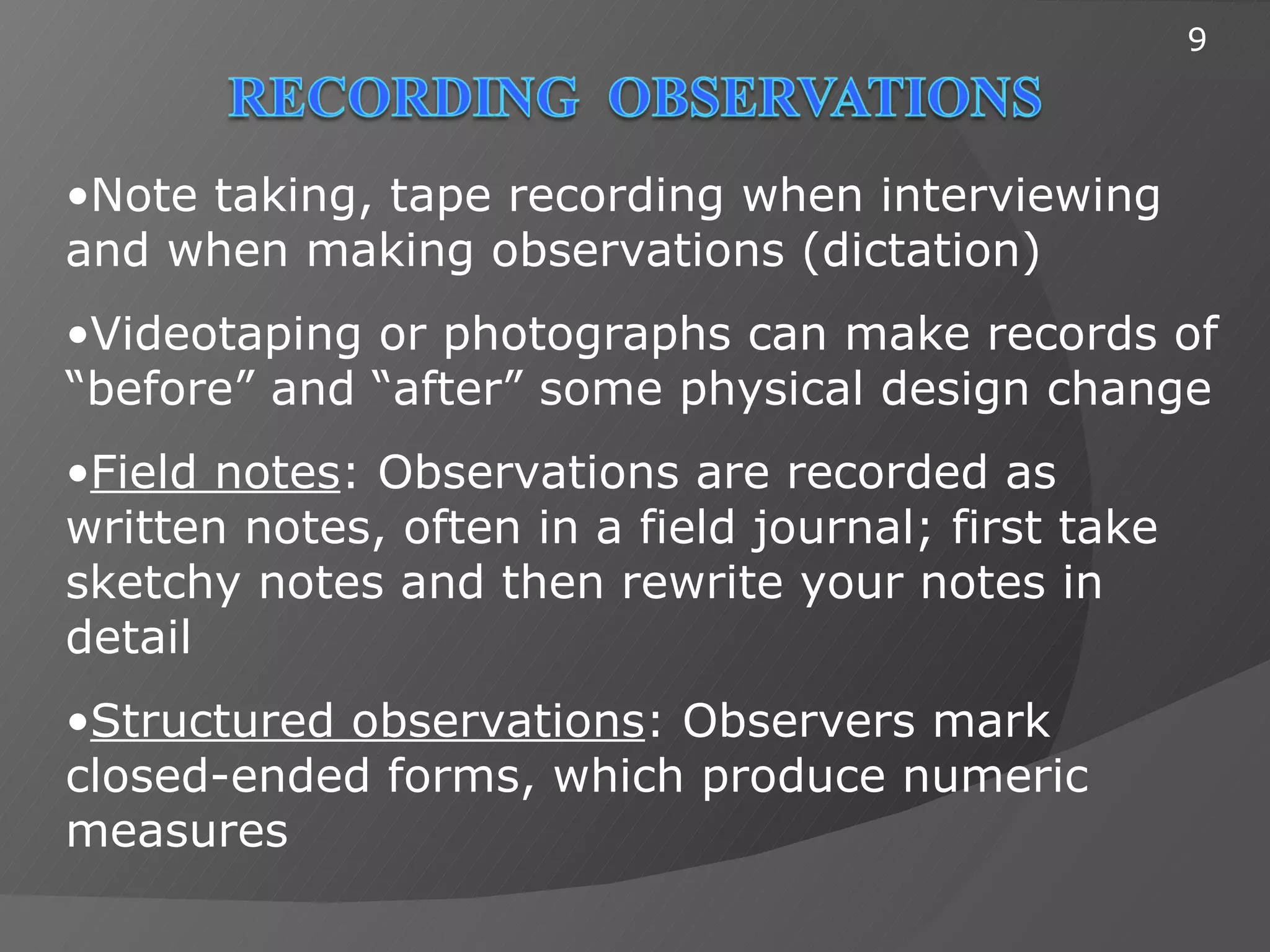
9


•Note taking, tape recording when interviewing
and when making observations (dictation)
•Videotaping or photographs can make records of
“before” and “after” some physical design change
•Field notes: Observations are recorded as
written notes, often in a field journal; first take
sketchy notes and then rewrite your notes in
detail
•Structured observations: Observers mark
closed-ended forms, which produce numeric
measures
10


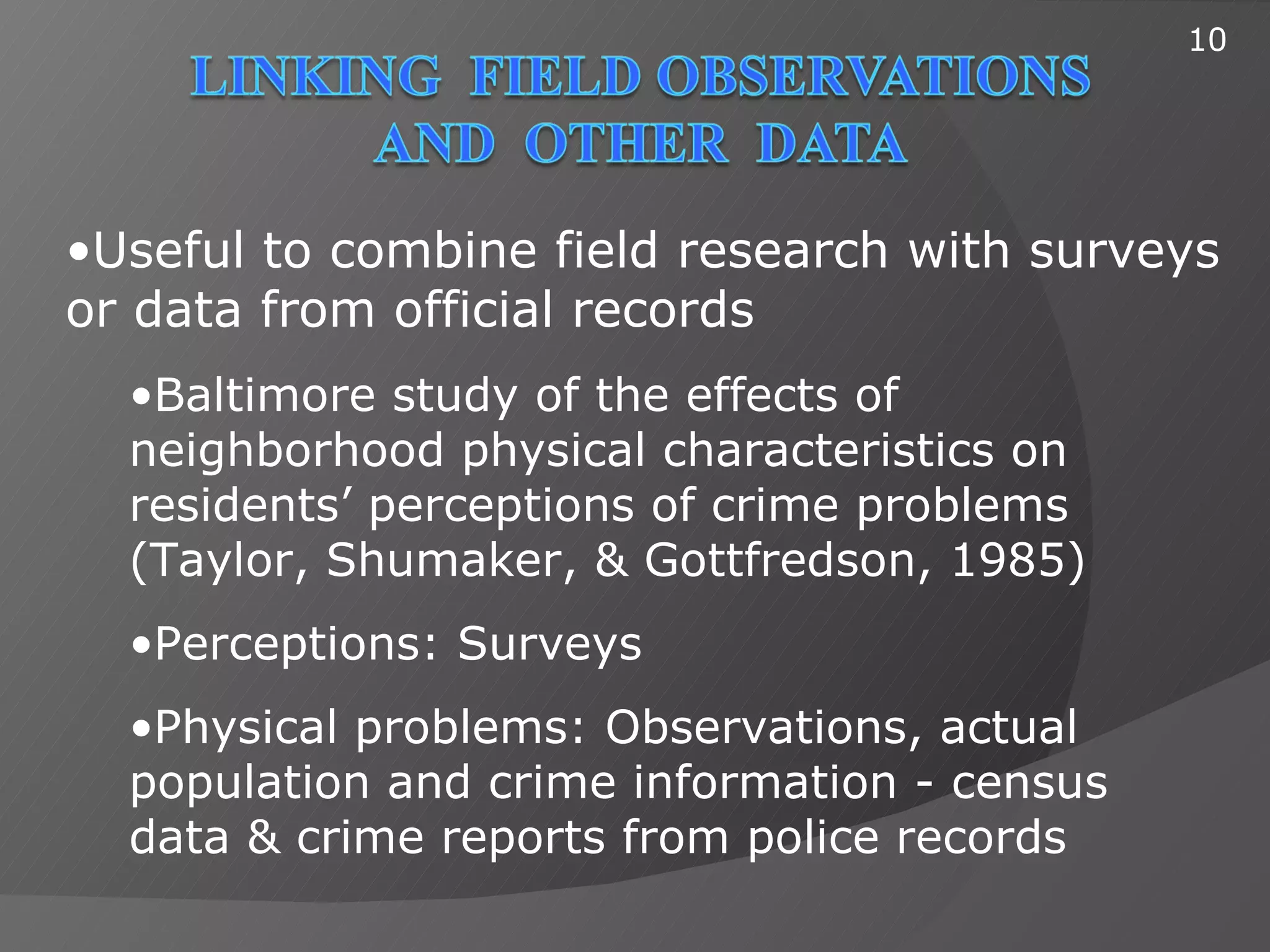
•Useful to combine field research with surveys
or data from official records
  •Baltimore study of the effects of
  neighborhood physical characteristics on
  residents’ perceptions of crime problems
  (Taylor, Shumaker, & Gottfredson, 1985)
  •Perceptions: Surveys
  •Physical problems: Observations, actual
  population and crime information - census
  data & crime reports from police records
11


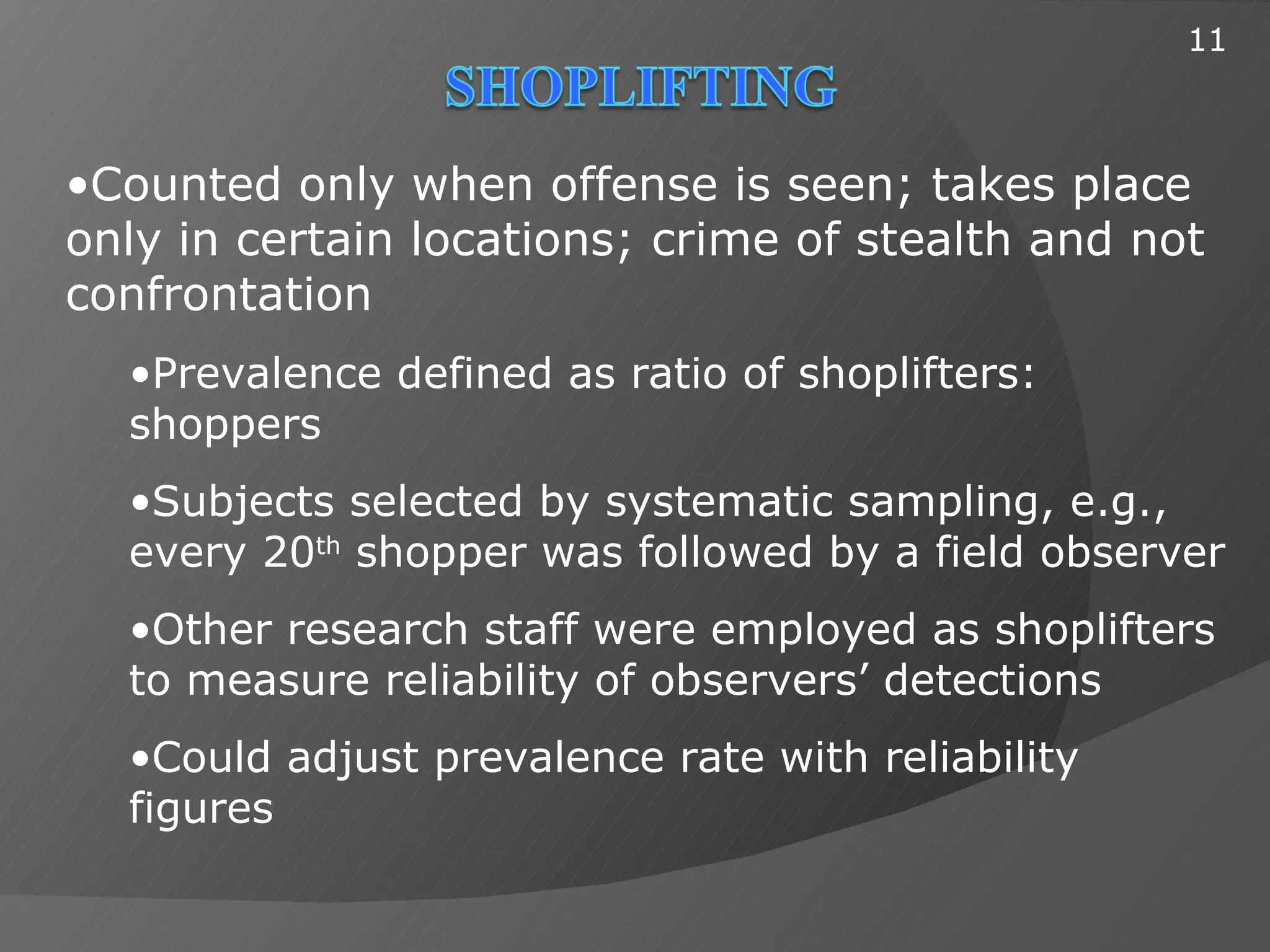
•Counted only when offense is seen; takes place
only in certain locations; crime of stealth and not
confrontation
  •Prevalence defined as ratio of shoplifters:
  shoppers
  •Subjects selected by systematic sampling, e.g.,
  every 20th shopper was followed by a field observer
  •Other research staff were employed as shoplifters
  to measure reliability of observers’ detections
  •Could adjust prevalence rate with reliability
  figures
12


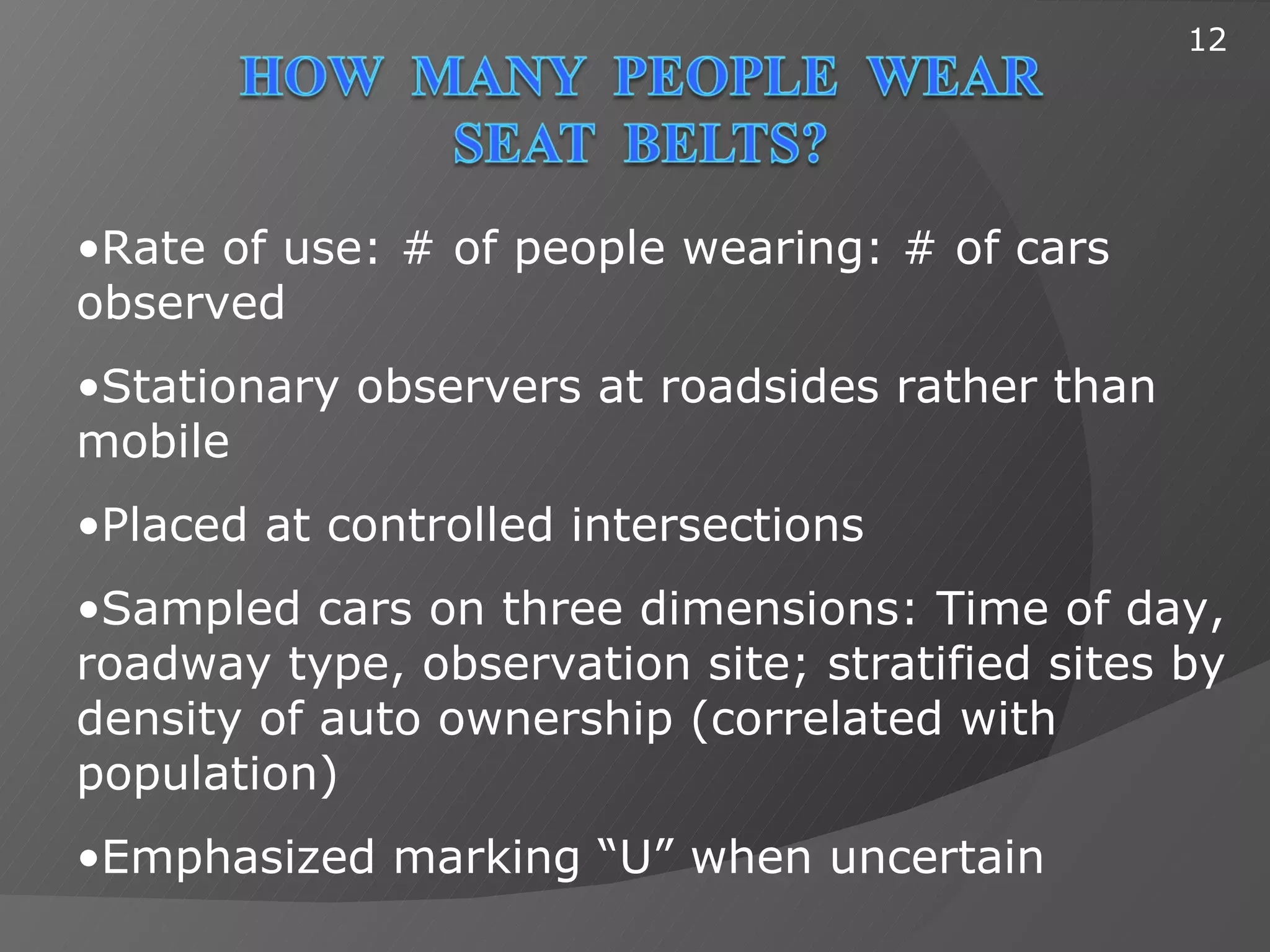
•Rate of use: # of people wearing: # of cars
observed
•Stationary observers at roadsides rather than
mobile
•Placed at controlled intersections
•Sampled cars on three dimensions: Time of day,
roadway type, observation site; stratified sites by
density of auto ownership (correlated with
population)
•Emphasized marking “U” when uncertain
13


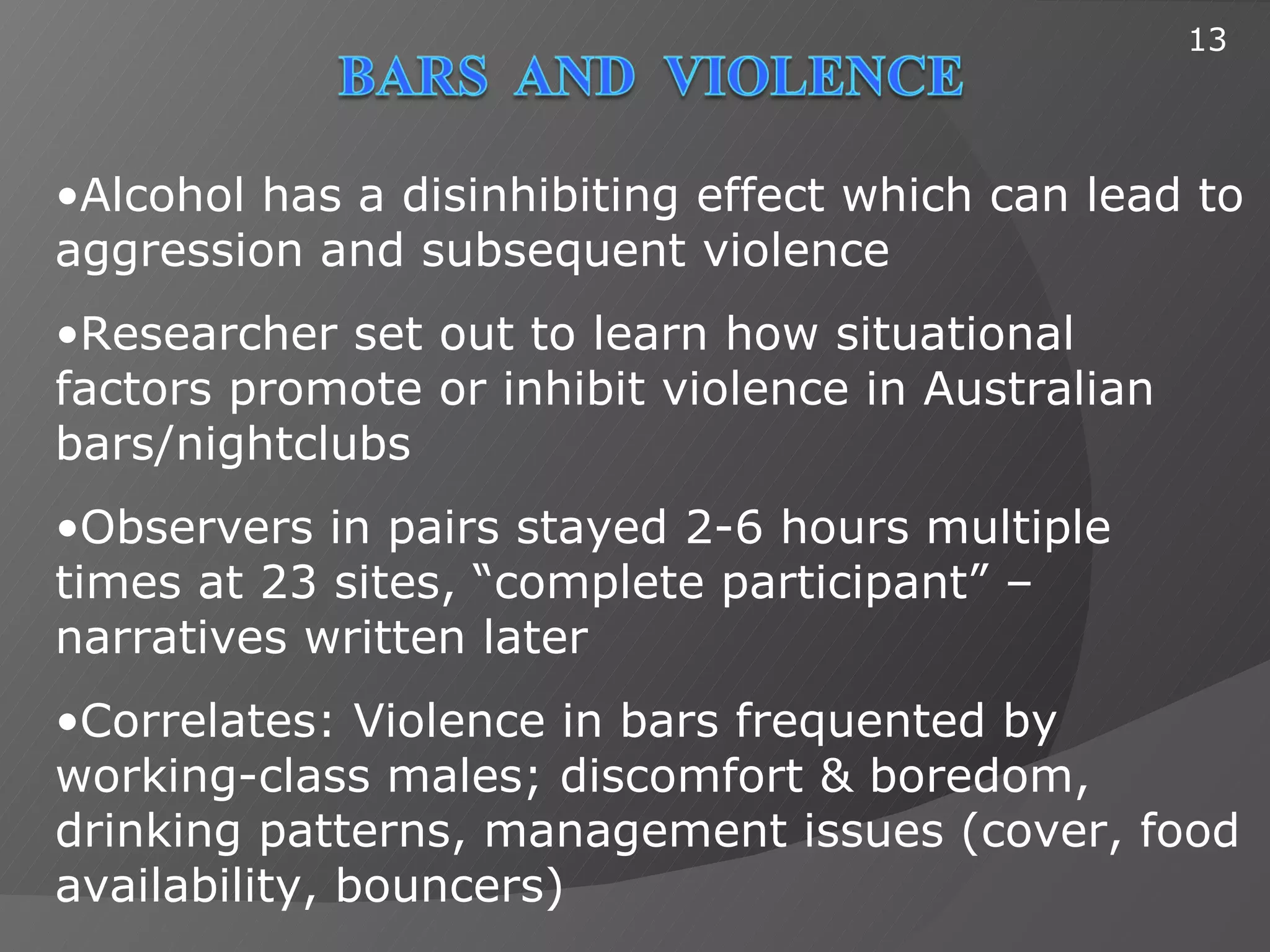
•Alcohol has a disinhibiting effect which can lead to
aggression and subsequent violence
•Researcher set out to learn how situational
factors promote or inhibit violence in Australian
bars/nightclubs
•Observers in pairs stayed 2-6 hours multiple
times at 23 sites, “complete participant” –
narratives written later
•Correlates: Violence in bars frequented by
working-class males; discomfort & boredom,
drinking patterns, management issues (cover, food
availability, bouncers)
14


•Provides great depth of understanding
•Flexibility (no need to prepare much in advance)
•More appropriate to measure behavior than
surveys
•High validity; quant. measures – Incomplete
picture
•Low reliability– Often very personal
•Generalizability – Personal nature may produce
findings that may not be replicated by another
•Precise probability samples can’t normally be
drawn

Ch10 Field Research

  • 1.
  • 2.
    OUTLINE  Introduction  TopicsAppropriate to Field Research  The Various Roles of the Observer  Asking Questions  Gaining Access to Subjects  Recording Observations  Linking Field Observation and Other Data  Illustrations of Field Research  Strengths and Weaknesses of Field Research
  • 3.
    3 •Field research encompassestwo different methods of obtaining data: •Direct observation •Asking questions •May yield qualitative and quantitative data •Often no precisely defined hypotheses to be tested •Used to make sense out of an ongoing process
  • 4.
    4 •Gives comprehensive perspective– enhances validity •Go directly to phenomenon, observe it as completely as possible •Especially appropriate for topics best understood in their natural setting •Street level drug dealers to distinguish customers •Ethnography: Focuses on detailed and accurate description rather than explanation
  • 5.
    5 •Complete participant: Participatesfully; true identity and purpose are not known to subjects •Participant-as-observer: Make known your position as researcher and participate with the group •Observer-as-participant: Make known your position as a researcher; do not actually participate •Complete observer: Observes without becoming a participant
  • 6.
    6 •Qualitative Interview: Isbased on a set of topics to be discussed in depth rather than based on the use of standardized questions •Field research is often a matter of going where the action is and simply watching and listening •Also a matter of asking questions & recording answers •Field research interviews are must less structured than survey interviews •Ideally set up and conducted just like a normal, casual conversation
  • 7.
    7 •Begins with initialcontact: Sponsor, Letter, Phone Call, Meeting •Access to formal organizations •Find a sponsor, write a letter to executive director, arrange a phone call, arrange a meeting •Access to subcultures •Find an informant (usually person who works with criminals), use that person as your “in” •Snowball sampling is useful as informant identifies others, who identify others, etc.
  • 8.
    8 •Controlled probability samplingused rarely; purposive sampling is common •Bear in mind two stages of sampling: •To what extent are the situations available for observation representative of the general phenomena you wish to describe and explain? •Are your actual observations within those total situations representative of all observations?
  • 9.
    9 •Note taking, taperecording when interviewing and when making observations (dictation) •Videotaping or photographs can make records of “before” and “after” some physical design change •Field notes: Observations are recorded as written notes, often in a field journal; first take sketchy notes and then rewrite your notes in detail •Structured observations: Observers mark closed-ended forms, which produce numeric measures
  • 10.
    10 •Useful to combinefield research with surveys or data from official records •Baltimore study of the effects of neighborhood physical characteristics on residents’ perceptions of crime problems (Taylor, Shumaker, & Gottfredson, 1985) •Perceptions: Surveys •Physical problems: Observations, actual population and crime information - census data & crime reports from police records
  • 11.
    11 •Counted only whenoffense is seen; takes place only in certain locations; crime of stealth and not confrontation •Prevalence defined as ratio of shoplifters: shoppers •Subjects selected by systematic sampling, e.g., every 20th shopper was followed by a field observer •Other research staff were employed as shoplifters to measure reliability of observers’ detections •Could adjust prevalence rate with reliability figures
  • 12.
    12 •Rate of use:# of people wearing: # of cars observed •Stationary observers at roadsides rather than mobile •Placed at controlled intersections •Sampled cars on three dimensions: Time of day, roadway type, observation site; stratified sites by density of auto ownership (correlated with population) •Emphasized marking “U” when uncertain
  • 13.
    13 •Alcohol has adisinhibiting effect which can lead to aggression and subsequent violence •Researcher set out to learn how situational factors promote or inhibit violence in Australian bars/nightclubs •Observers in pairs stayed 2-6 hours multiple times at 23 sites, “complete participant” – narratives written later •Correlates: Violence in bars frequented by working-class males; discomfort & boredom, drinking patterns, management issues (cover, food availability, bouncers)
  • 14.
    14 •Provides great depthof understanding •Flexibility (no need to prepare much in advance) •More appropriate to measure behavior than surveys •High validity; quant. measures – Incomplete picture •Low reliability– Often very personal •Generalizability – Personal nature may produce findings that may not be replicated by another •Precise probability samples can’t normally be drawn