Copyright © 2011 Pearson Education, Inc. Publishing as Pearson Addison-Wesley
Chapter 5
More SQL:
Complex
Queries,
Triggers, Views,
and Schema
Modification
Copyright © 2011 Ramez Elmasri and Shamkant Navathe
Chapter 5 Outline
  More Complex SQL Retrieval Queries
  Specifying Constraints as Assertions and
Actions as Triggers
  Views (Virtual Tables) in SQL
  Schema Change Statements in SQL
Copyright © 2011 Ramez Elmasri and Shamkant Navathe
More Complex SQL Retrieval
Queries
  Additional features allow users to specify
more complex retrievals from database:
  Nested queries, joined tables, outer joins,
aggregate functions, and grouping
Copyright © 2011 Ramez Elmasri and Shamkant Navathe
Comparisons Involving NULL
and Three-Valued Logic
  Meanings of NULL
  Unknown value
  Unavailable or withheld value
  Not applicable attribute
  Each individual NULL value considered to
be different from every other NULL value
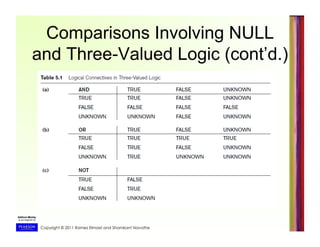
  SQL uses a three-valued logic:
  TRUE, FALSE, and UNKNOWN
Copyright © 2011 Ramez Elmasri and Shamkant Navathe
Comparisons Involving NULL
and Three-Valued Logic (cont’d.)
Copyright © 2011 Ramez Elmasri and Shamkant Navathe
Comparisons Involving NULL
and Three-Valued Logic (cont’d.)
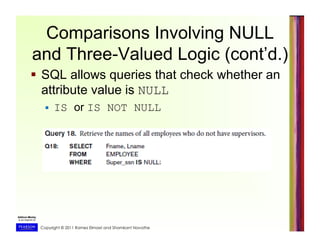
  SQL allows queries that check whether an
attribute value is NULL
  IS or IS NOT NULL
Copyright © 2011 Ramez Elmasri and Shamkant Navathe
Nested Queries, Tuples,
and Set/Multiset Comparisons
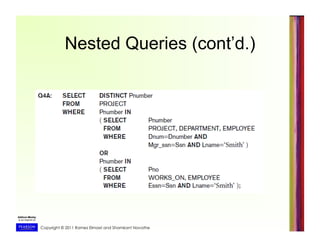
  Nested queries
  Complete select-from-where blocks within
WHERE clause of another query
  Outer query
  Comparison operator IN
  Compares value v with a set (or multiset) of
values V
  Evaluates to TRUE if v is one of the elements in
V
Copyright © 2011 Ramez Elmasri and Shamkant Navathe
Nested Queries (cont’d.)
Copyright © 2011 Ramez Elmasri and Shamkant Navathe
Nested Queries (cont’d.)
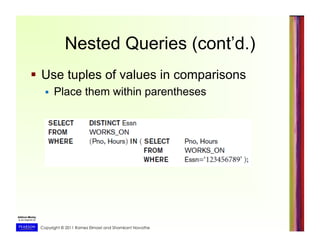
  Use tuples of values in comparisons
  Place them within parentheses
Copyright © 2011 Ramez Elmasri and Shamkant Navathe
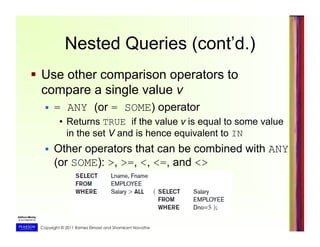
  Use other comparison operators to
compare a single value v
  = ANY (or = SOME) operator
•  Returns TRUE if the value v is equal to some value
in the set V and is hence equivalent to IN
  Other operators that can be combined with ANY
(or SOME): >, >=, <, <=, and <>
Nested Queries (cont’d.)
Copyright © 2011 Ramez Elmasri and Shamkant Navathe
Nested Queries (cont’d.)
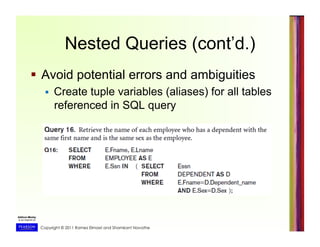
  Avoid potential errors and ambiguities
  Create tuple variables (aliases) for all tables
referenced in SQL query
Copyright © 2011 Ramez Elmasri and Shamkant Navathe
Correlated Nested Queries
  Correlated nested query
  Evaluated once for each tuple in the outer
query
Copyright © 2011 Ramez Elmasri and Shamkant Navathe
The EXISTS and UNIQUE
Functions in SQL
  EXISTS function
  Check whether the result of a correlated nested
query is empty or not
  EXISTS and NOT EXISTS
  Typically used in conjunction with a correlated
nested query
  SQL function UNIQUE(Q)
  Returns TRUE if there are no duplicate tuples in
the result of query Q
Copyright © 2011 Ramez Elmasri and Shamkant Navathe
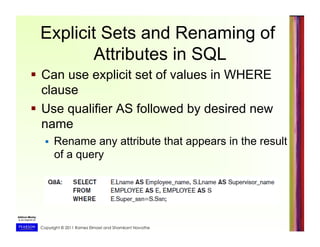
Explicit Sets and Renaming of
Attributes in SQL
  Can use explicit set of values in WHERE
clause
  Use qualifier AS followed by desired new
name
  Rename any attribute that appears in the result
of a query
Copyright © 2011 Ramez Elmasri and Shamkant Navathe
Joined Tables in SQL and Outer
Joins
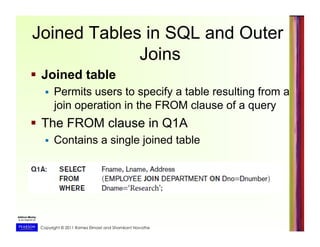
  Joined table
  Permits users to specify a table resulting from a
join operation in the FROM clause of a query
  The FROM clause in Q1A
  Contains a single joined table
Copyright © 2011 Ramez Elmasri and Shamkant Navathe
Joined Tables in SQL and Outer
Joins (cont’d.)
  Specify different types of join
  NATURAL JOIN
  Various types of OUTER JOIN
  NATURAL JOIN on two relations R and S
  No join condition specified
  Implicit EQUIJOIN condition for each pair of
attributes with same name from R and S
Copyright © 2011 Ramez Elmasri and Shamkant Navathe
Joined Tables in SQL and Outer
Joins (cont’d.)
  Inner join
  Default type of join in a joined table
  Tuple is included in the result only if a matching
tuple exists in the other relation
  LEFT OUTER JOIN
  Every tuple in left table must appear in result
  If no matching tuple
•  Padded with NULL values for attributes of right table
Copyright © 2011 Ramez Elmasri and Shamkant Navathe
Joined Tables in SQL and Outer
Joins (cont’d.)
  RIGHT OUTER JOIN
  Every tuple in right table must appear in result
  If no matching tuple
•  Padded with NULL values for the attributes of left
table
  FULL OUTER JOIN
  Can nest join specifications
Copyright © 2011 Ramez Elmasri and Shamkant Navathe
Aggregate Functions in SQL
  Used to summarize information from
multiple tuples into a single-tuple summary
  Grouping
  Create subgroups of tuples before summarizing
  Built-in aggregate functions
  COUNT, SUM, MAX, MIN, and AVG
  Functions can be used in the SELECT
clause or in a HAVING clause
Copyright © 2011 Ramez Elmasri and Shamkant Navathe
Aggregate Functions in SQL
(cont’d.)
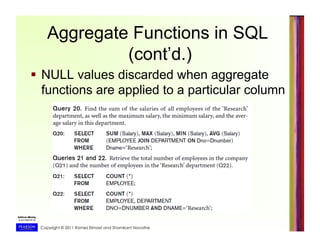
  NULL values discarded when aggregate
functions are applied to a particular column
Copyright © 2011 Ramez Elmasri and Shamkant Navathe
Grouping: The GROUP BY and
HAVING Clauses
  Partition relation into subsets of tuples
  Based on grouping attribute(s)
  Apply function to each such group
independently
  GROUP BY clause
  Specifies grouping attributes
  If NULLs exist in grouping attribute
  Separate group created for all tuples with a
NULL value in grouping attribute
Copyright © 2011 Ramez Elmasri and Shamkant Navathe
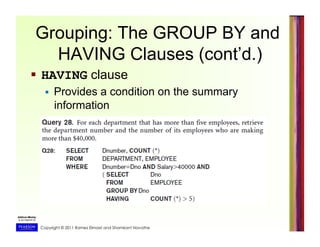
Grouping: The GROUP BY and
HAVING Clauses (cont’d.)
  HAVING clause
  Provides a condition on the summary
information
Copyright © 2011 Ramez Elmasri and Shamkant Navathe
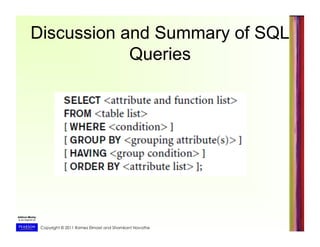
Discussion and Summary of SQL
Queries
Copyright © 2011 Ramez Elmasri and Shamkant Navathe
Specifying Constraints as
Assertions and Actions as
Triggers
  CREATE ASSERTION
  Specify additional types of constraints outside
scope of built-in relational model constraints
  CREATE TRIGGER
  Specify automatic actions that database
system will perform when certain events and
conditions occur
Copyright © 2011 Ramez Elmasri and Shamkant Navathe
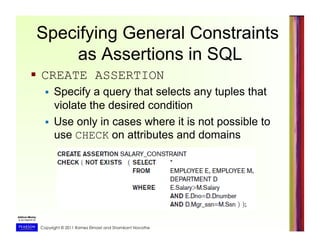
Specifying General Constraints
as Assertions in SQL
  CREATE ASSERTION
  Specify a query that selects any tuples that
violate the desired condition
  Use only in cases where it is not possible to
use CHECK on attributes and domains
Copyright © 2011 Ramez Elmasri and Shamkant Navathe
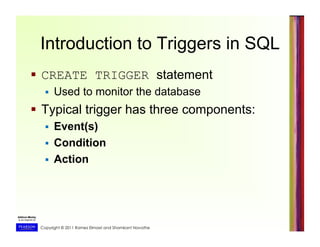
Introduction to Triggers in SQL
  CREATE TRIGGER statement
  Used to monitor the database
  Typical trigger has three components:
  Event(s)
  Condition
  Action
Copyright © 2011 Ramez Elmasri and Shamkant Navathe
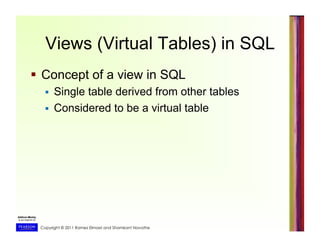
Views (Virtual Tables) in SQL
  Concept of a view in SQL
  Single table derived from other tables
  Considered to be a virtual table
Copyright © 2011 Ramez Elmasri and Shamkant Navathe
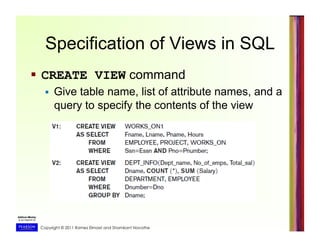
Specification of Views in SQL
  CREATE VIEW command
  Give table name, list of attribute names, and a
query to specify the contents of the view
Copyright © 2011 Ramez Elmasri and Shamkant Navathe
Specification of Views in SQL
(cont’d.)
  Specify SQL queries on a view
  View always up-to-date
  Responsibility of the DBMS and not the user
  DROP VIEW command
  Dispose of a view
Copyright © 2011 Ramez Elmasri and Shamkant Navathe
View Implementation, View
Update, and Inline Views
  Complex problem of efficiently
implementing a view for querying
  Query modification approach
  Modify view query into a query on underlying
base tables
  Disadvantage: inefficient for views defined via
complex queries that are time-consuming to
execute
Copyright © 2011 Ramez Elmasri and Shamkant Navathe
View Implementation
  View materialization approach
  Physically create a temporary view table when
the view is first queried
  Keep that table on the assumption that other
queries on the view will follow
  Requires efficient strategy for automatically
updating the view table when the base tables
are updated
Copyright © 2011 Ramez Elmasri and Shamkant Navathe
View Implementation (cont’d.)
  Incremental update strategies
  DBMS determines what new tuples must be
inserted, deleted, or modified in a materialized
view table
Copyright © 2011 Ramez Elmasri and Shamkant Navathe
View Update and Inline Views
  Update on a view defined on a single table
without any aggregate functions
  Can be mapped to an update on underlying
base table
  View involving joins
  Often not possible for DBMS to determine
which of the updates is intended
Copyright © 2011 Ramez Elmasri and Shamkant Navathe
  Clause WITH CHECK OPTION
  Must be added at the end of the view definition
if a view is to be updated
  In-line view
  Defined in the FROM clause of an SQL query
View Update and Inline Views
(cont’d.)
Copyright © 2011 Ramez Elmasri and Shamkant Navathe
Schema Change Statements in
SQL
  Schema evolution commands
  Can be done while the database is operational
  Does not require recompilation of the database
schema
Copyright © 2011 Ramez Elmasri and Shamkant Navathe
The DROP Command
  DROP command
  Used to drop named schema elements, such
as tables, domains, or constraint
  Drop behavior options:
  CASCADE and RESTRICT
  Example:
  DROP SCHEMA COMPANY CASCADE;
Copyright © 2011 Ramez Elmasri and Shamkant Navathe
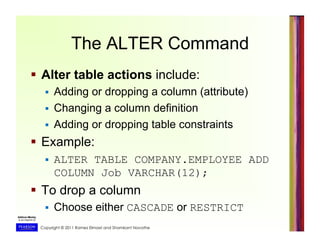
The ALTER Command
  Alter table actions include:
  Adding or dropping a column (attribute)
  Changing a column definition
  Adding or dropping table constraints
  Example:
  ALTER TABLE COMPANY.EMPLOYEE ADD
COLUMN Job VARCHAR(12);
  To drop a column
  Choose either CASCADE or RESTRICT
Copyright © 2011 Ramez Elmasri and Shamkant Navathe
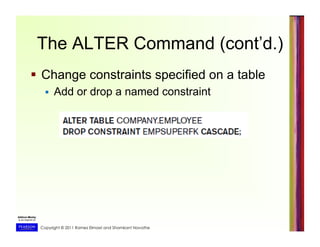
The ALTER Command (cont’d.)
  Change constraints specified on a table
  Add or drop a named constraint
Copyright © 2011 Ramez Elmasri and Shamkant Navathe
Summary
  Complex SQL:
  Nested queries, joined tables, outer joins,
aggregate functions, grouping
  CREATE ASSERTION and CREATE
TRIGGER
  Views
  Virtual or derived tables

Ch05

  • 1.
    Copyright © 2011Pearson Education, Inc. Publishing as Pearson Addison-Wesley Chapter 5 More SQL: Complex Queries, Triggers, Views, and Schema Modification
  • 2.
    Copyright © 2011Ramez Elmasri and Shamkant Navathe Chapter 5 Outline   More Complex SQL Retrieval Queries   Specifying Constraints as Assertions and Actions as Triggers   Views (Virtual Tables) in SQL   Schema Change Statements in SQL
  • 3.
    Copyright © 2011Ramez Elmasri and Shamkant Navathe More Complex SQL Retrieval Queries   Additional features allow users to specify more complex retrievals from database:   Nested queries, joined tables, outer joins, aggregate functions, and grouping
  • 4.
    Copyright © 2011Ramez Elmasri and Shamkant Navathe Comparisons Involving NULL and Three-Valued Logic   Meanings of NULL   Unknown value   Unavailable or withheld value   Not applicable attribute   Each individual NULL value considered to be different from every other NULL value   SQL uses a three-valued logic:   TRUE, FALSE, and UNKNOWN
  • 5.
    Copyright © 2011Ramez Elmasri and Shamkant Navathe Comparisons Involving NULL and Three-Valued Logic (cont’d.)
  • 6.
    Copyright © 2011Ramez Elmasri and Shamkant Navathe Comparisons Involving NULL and Three-Valued Logic (cont’d.)   SQL allows queries that check whether an attribute value is NULL   IS or IS NOT NULL
  • 7.
    Copyright © 2011Ramez Elmasri and Shamkant Navathe Nested Queries, Tuples, and Set/Multiset Comparisons   Nested queries   Complete select-from-where blocks within WHERE clause of another query   Outer query   Comparison operator IN   Compares value v with a set (or multiset) of values V   Evaluates to TRUE if v is one of the elements in V
  • 8.
    Copyright © 2011Ramez Elmasri and Shamkant Navathe Nested Queries (cont’d.)
  • 9.
    Copyright © 2011Ramez Elmasri and Shamkant Navathe Nested Queries (cont’d.)   Use tuples of values in comparisons   Place them within parentheses
  • 10.
    Copyright © 2011Ramez Elmasri and Shamkant Navathe   Use other comparison operators to compare a single value v   = ANY (or = SOME) operator •  Returns TRUE if the value v is equal to some value in the set V and is hence equivalent to IN   Other operators that can be combined with ANY (or SOME): >, >=, <, <=, and <> Nested Queries (cont’d.)
  • 11.
    Copyright © 2011Ramez Elmasri and Shamkant Navathe Nested Queries (cont’d.)   Avoid potential errors and ambiguities   Create tuple variables (aliases) for all tables referenced in SQL query
  • 12.
    Copyright © 2011Ramez Elmasri and Shamkant Navathe Correlated Nested Queries   Correlated nested query   Evaluated once for each tuple in the outer query
  • 13.
    Copyright © 2011Ramez Elmasri and Shamkant Navathe The EXISTS and UNIQUE Functions in SQL   EXISTS function   Check whether the result of a correlated nested query is empty or not   EXISTS and NOT EXISTS   Typically used in conjunction with a correlated nested query   SQL function UNIQUE(Q)   Returns TRUE if there are no duplicate tuples in the result of query Q
  • 14.
    Copyright © 2011Ramez Elmasri and Shamkant Navathe Explicit Sets and Renaming of Attributes in SQL   Can use explicit set of values in WHERE clause   Use qualifier AS followed by desired new name   Rename any attribute that appears in the result of a query
  • 15.
    Copyright © 2011Ramez Elmasri and Shamkant Navathe Joined Tables in SQL and Outer Joins   Joined table   Permits users to specify a table resulting from a join operation in the FROM clause of a query   The FROM clause in Q1A   Contains a single joined table
  • 16.
    Copyright © 2011Ramez Elmasri and Shamkant Navathe Joined Tables in SQL and Outer Joins (cont’d.)   Specify different types of join   NATURAL JOIN   Various types of OUTER JOIN   NATURAL JOIN on two relations R and S   No join condition specified   Implicit EQUIJOIN condition for each pair of attributes with same name from R and S
  • 17.
    Copyright © 2011Ramez Elmasri and Shamkant Navathe Joined Tables in SQL and Outer Joins (cont’d.)   Inner join   Default type of join in a joined table   Tuple is included in the result only if a matching tuple exists in the other relation   LEFT OUTER JOIN   Every tuple in left table must appear in result   If no matching tuple •  Padded with NULL values for attributes of right table
  • 18.
    Copyright © 2011Ramez Elmasri and Shamkant Navathe Joined Tables in SQL and Outer Joins (cont’d.)   RIGHT OUTER JOIN   Every tuple in right table must appear in result   If no matching tuple •  Padded with NULL values for the attributes of left table   FULL OUTER JOIN   Can nest join specifications
  • 19.
    Copyright © 2011Ramez Elmasri and Shamkant Navathe Aggregate Functions in SQL   Used to summarize information from multiple tuples into a single-tuple summary   Grouping   Create subgroups of tuples before summarizing   Built-in aggregate functions   COUNT, SUM, MAX, MIN, and AVG   Functions can be used in the SELECT clause or in a HAVING clause
  • 20.
    Copyright © 2011Ramez Elmasri and Shamkant Navathe Aggregate Functions in SQL (cont’d.)   NULL values discarded when aggregate functions are applied to a particular column
  • 21.
    Copyright © 2011Ramez Elmasri and Shamkant Navathe Grouping: The GROUP BY and HAVING Clauses   Partition relation into subsets of tuples   Based on grouping attribute(s)   Apply function to each such group independently   GROUP BY clause   Specifies grouping attributes   If NULLs exist in grouping attribute   Separate group created for all tuples with a NULL value in grouping attribute
  • 22.
    Copyright © 2011Ramez Elmasri and Shamkant Navathe Grouping: The GROUP BY and HAVING Clauses (cont’d.)   HAVING clause   Provides a condition on the summary information
  • 23.
    Copyright © 2011Ramez Elmasri and Shamkant Navathe Discussion and Summary of SQL Queries
  • 24.
    Copyright © 2011Ramez Elmasri and Shamkant Navathe Specifying Constraints as Assertions and Actions as Triggers   CREATE ASSERTION   Specify additional types of constraints outside scope of built-in relational model constraints   CREATE TRIGGER   Specify automatic actions that database system will perform when certain events and conditions occur
  • 25.
    Copyright © 2011Ramez Elmasri and Shamkant Navathe Specifying General Constraints as Assertions in SQL   CREATE ASSERTION   Specify a query that selects any tuples that violate the desired condition   Use only in cases where it is not possible to use CHECK on attributes and domains
  • 26.
    Copyright © 2011Ramez Elmasri and Shamkant Navathe Introduction to Triggers in SQL   CREATE TRIGGER statement   Used to monitor the database   Typical trigger has three components:   Event(s)   Condition   Action
  • 27.
    Copyright © 2011Ramez Elmasri and Shamkant Navathe Views (Virtual Tables) in SQL   Concept of a view in SQL   Single table derived from other tables   Considered to be a virtual table
  • 28.
    Copyright © 2011Ramez Elmasri and Shamkant Navathe Specification of Views in SQL   CREATE VIEW command   Give table name, list of attribute names, and a query to specify the contents of the view
  • 29.
    Copyright © 2011Ramez Elmasri and Shamkant Navathe Specification of Views in SQL (cont’d.)   Specify SQL queries on a view   View always up-to-date   Responsibility of the DBMS and not the user   DROP VIEW command   Dispose of a view
  • 30.
    Copyright © 2011Ramez Elmasri and Shamkant Navathe View Implementation, View Update, and Inline Views   Complex problem of efficiently implementing a view for querying   Query modification approach   Modify view query into a query on underlying base tables   Disadvantage: inefficient for views defined via complex queries that are time-consuming to execute
  • 31.
    Copyright © 2011Ramez Elmasri and Shamkant Navathe View Implementation   View materialization approach   Physically create a temporary view table when the view is first queried   Keep that table on the assumption that other queries on the view will follow   Requires efficient strategy for automatically updating the view table when the base tables are updated
  • 32.
    Copyright © 2011Ramez Elmasri and Shamkant Navathe View Implementation (cont’d.)   Incremental update strategies   DBMS determines what new tuples must be inserted, deleted, or modified in a materialized view table
  • 33.
    Copyright © 2011Ramez Elmasri and Shamkant Navathe View Update and Inline Views   Update on a view defined on a single table without any aggregate functions   Can be mapped to an update on underlying base table   View involving joins   Often not possible for DBMS to determine which of the updates is intended
  • 34.
    Copyright © 2011Ramez Elmasri and Shamkant Navathe   Clause WITH CHECK OPTION   Must be added at the end of the view definition if a view is to be updated   In-line view   Defined in the FROM clause of an SQL query View Update and Inline Views (cont’d.)
  • 35.
    Copyright © 2011Ramez Elmasri and Shamkant Navathe Schema Change Statements in SQL   Schema evolution commands   Can be done while the database is operational   Does not require recompilation of the database schema
  • 36.
    Copyright © 2011Ramez Elmasri and Shamkant Navathe The DROP Command   DROP command   Used to drop named schema elements, such as tables, domains, or constraint   Drop behavior options:   CASCADE and RESTRICT   Example:   DROP SCHEMA COMPANY CASCADE;
  • 37.
    Copyright © 2011Ramez Elmasri and Shamkant Navathe The ALTER Command   Alter table actions include:   Adding or dropping a column (attribute)   Changing a column definition   Adding or dropping table constraints   Example:   ALTER TABLE COMPANY.EMPLOYEE ADD COLUMN Job VARCHAR(12);   To drop a column   Choose either CASCADE or RESTRICT
  • 38.
    Copyright © 2011Ramez Elmasri and Shamkant Navathe The ALTER Command (cont’d.)   Change constraints specified on a table   Add or drop a named constraint
  • 39.
    Copyright © 2011Ramez Elmasri and Shamkant Navathe Summary   Complex SQL:   Nested queries, joined tables, outer joins, aggregate functions, grouping   CREATE ASSERTION and CREATE TRIGGER   Views   Virtual or derived tables