Download to read offline

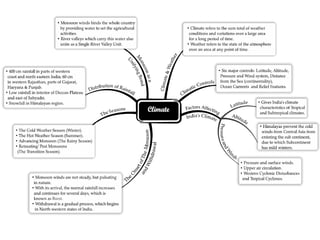
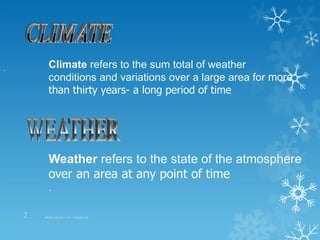
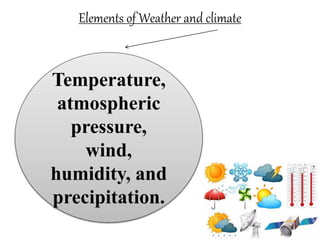
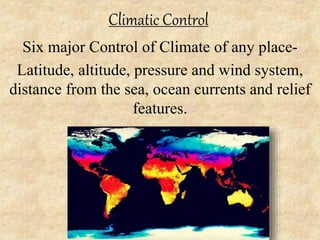
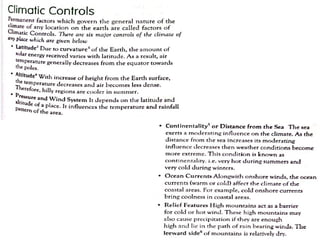
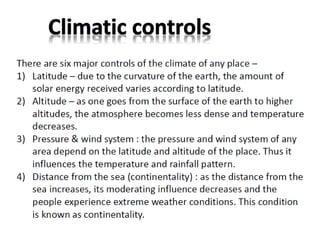
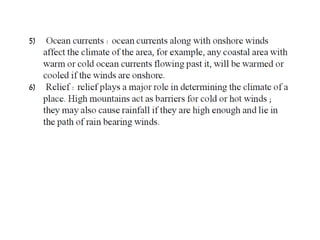
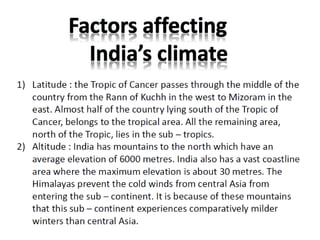
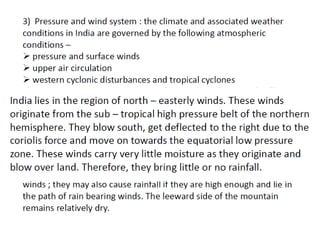

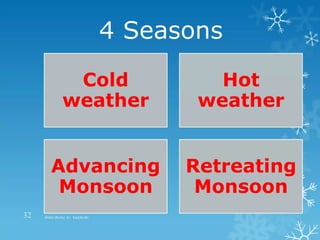
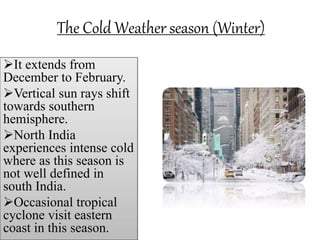
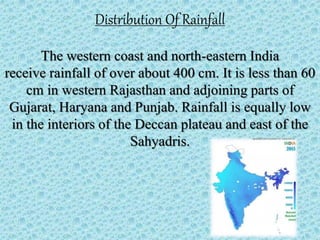
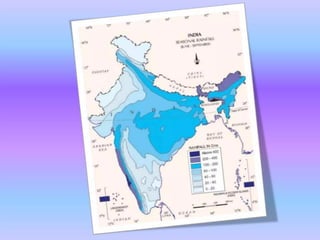

Learning Objectives: Analyse and infer the effect of monsoon winds on rainfall of the Indian subcontinent. Analyse the temperatures between plateau region, Himalayan region, desert region and coastal region. Enumerate and summarize the reasons for the wide difference between temperatures at different geographical locations of India. Competency: Draws interlinkages between various components of the physical environment, such as climate and relief, climate and vegetation and wildlife. Suggestive Pedagogical process: Use Mind map/ graphic organizers to enumerate and summarize the reasons for the wide difference between the day and night temperatures at different geographical locations of India. Collect Newspaper reports for knowing the weather status. Prepare and present mock drills on climate change and protocols as preventive action for various disasters. Climate is the long-term weather pattern in a region, typically averaged over 30 years. More rigorously, it is the mean and variability of meteorological variables over a time spanning from months to millions of years. Some of the meteorological variables that are commonly measured are temperature, humidity, atmospheric pressure, wind, and precipitation. In a broader sense, climate is the state of the components of the climate system, including the atmosphere, hydrosphere, cryosphere, lithosphere and biosphere and the interactions between them. The climate of a location is affected by its latitude, longitude, terrain, altitude, land use and nearby water bodies and their currents. Climates can be classified according to the average and typical variables, most commonly temperature and precipitation. The most widely used classification scheme is the Köppen climate classification. The Thornthwaite system, in use since 1948, incorporates evapotranspiration along with temperature and precipitation information and is used in studying biological diversity and how climate change affects it. The major classifications in Thornthwaite's climate classification are microthermal, mesothermal, and megathermal. Finally, the Bergeron and Spatial Synoptic Classification systems focus on the origin of air masses that define the climate of a region.


