DEPARTMENTOF STUDIESIN BIOTECHNOLOGY
Shivagangothri, Davangere -07
SEMINARTOPIC : CENTRIFUGATION TYPES AND IT’S
APPLICATIONS
Presented by:
MOHAMMED ASIF KILLEDAR
 INTRODUCTION
 HISTORY
 TYPE OF CENTRIFUGATION
 OPERATION
 APPLICATIONS
 CONCULSION
 REFERENCE
Centrifugation is a technique, based upon the behaviour of
particles in an applied centrifugal filed.
Centrifugation is a mechanical process which involves the use
of the centrifugal force to separate particles from a solution
according to their size, shape, density, medium viscosity and
rotor speed.
The denser components of the mixture migrate away from the
axis of the centrifuge, while the less dense components of the
mixture migrate towards the axis.
 precipitate (pellet) will travel quickly and fully to the bottom
of the tube.
The remaining liquid that lies above the precipitate is called
a supernatant.
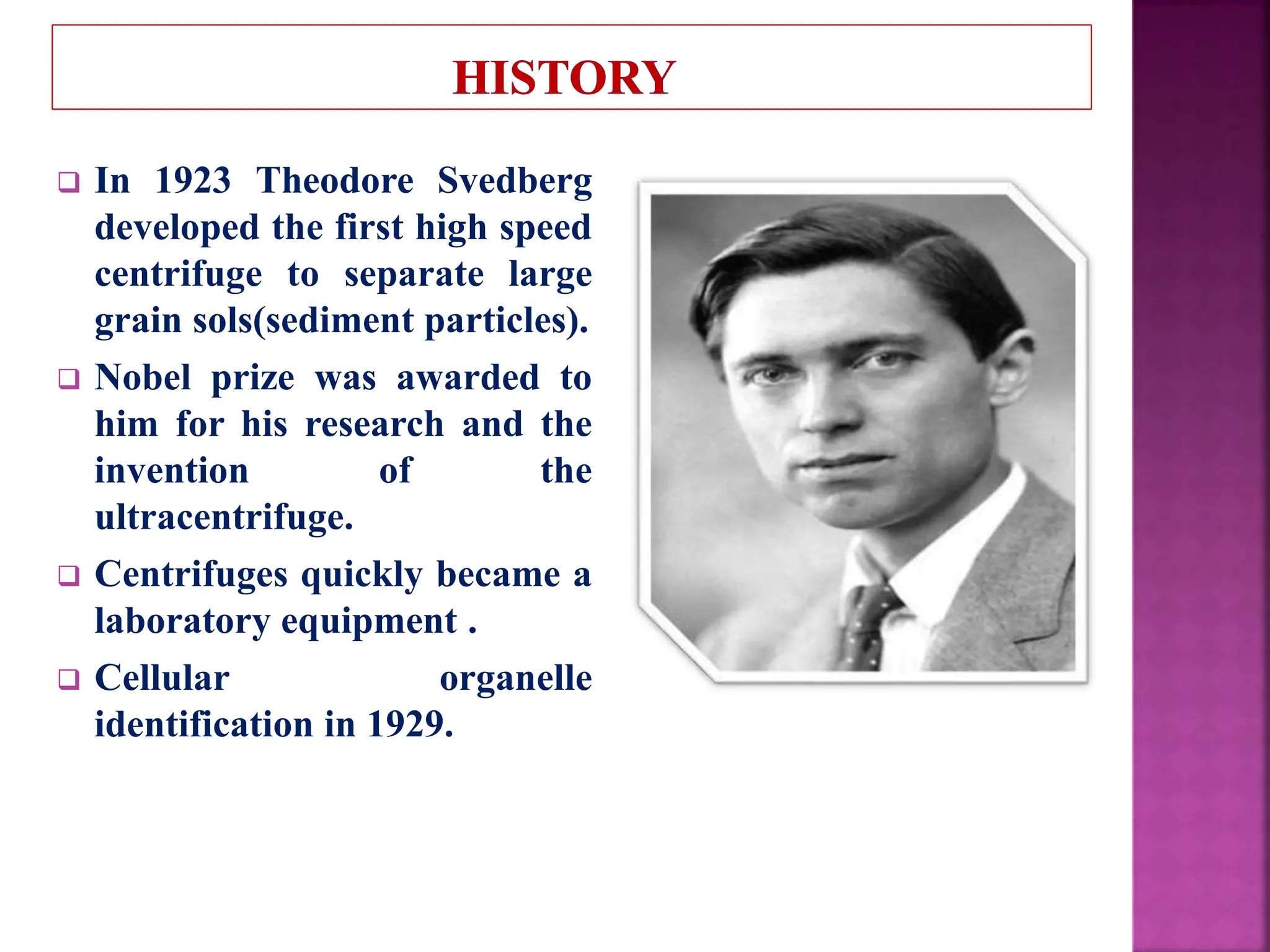
 In 1923 Theodore Svedberg
developed the first high speed
centrifuge to separate large
grain sols(sediment particles).
 Nobel prize was awarded to
him for his research and the
invention of the
ultracentrifuge.
 Centrifuges quickly became a
laboratory equipment .
 Cellular organelle
identification in 1929.
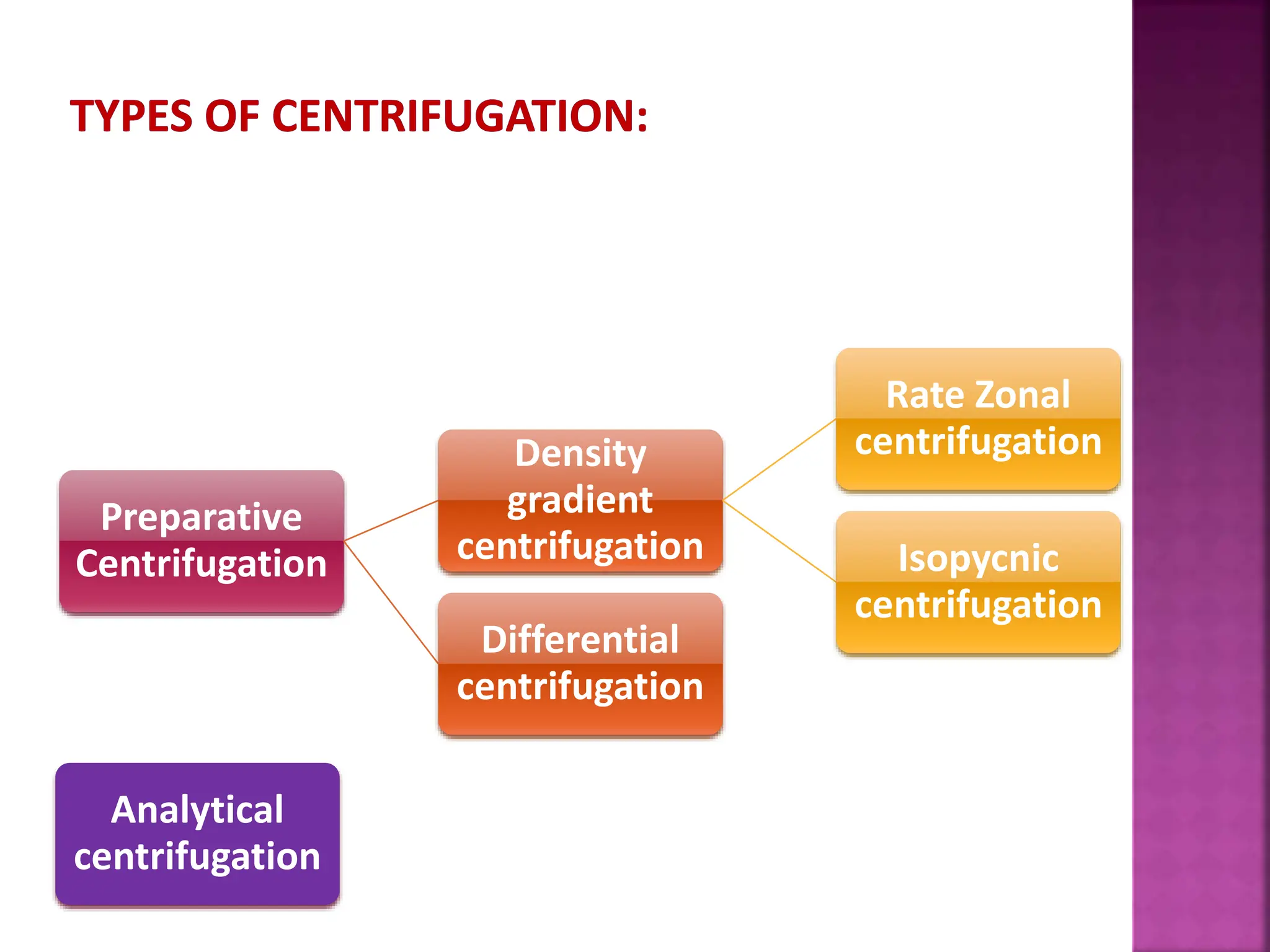
Preparative
Centrifugation
Density
gradient
centrifugation
Rate Zonal
centrifugation
Isopycnic
centrifugation
Differential
centrifugation
Analytical
centrifugation
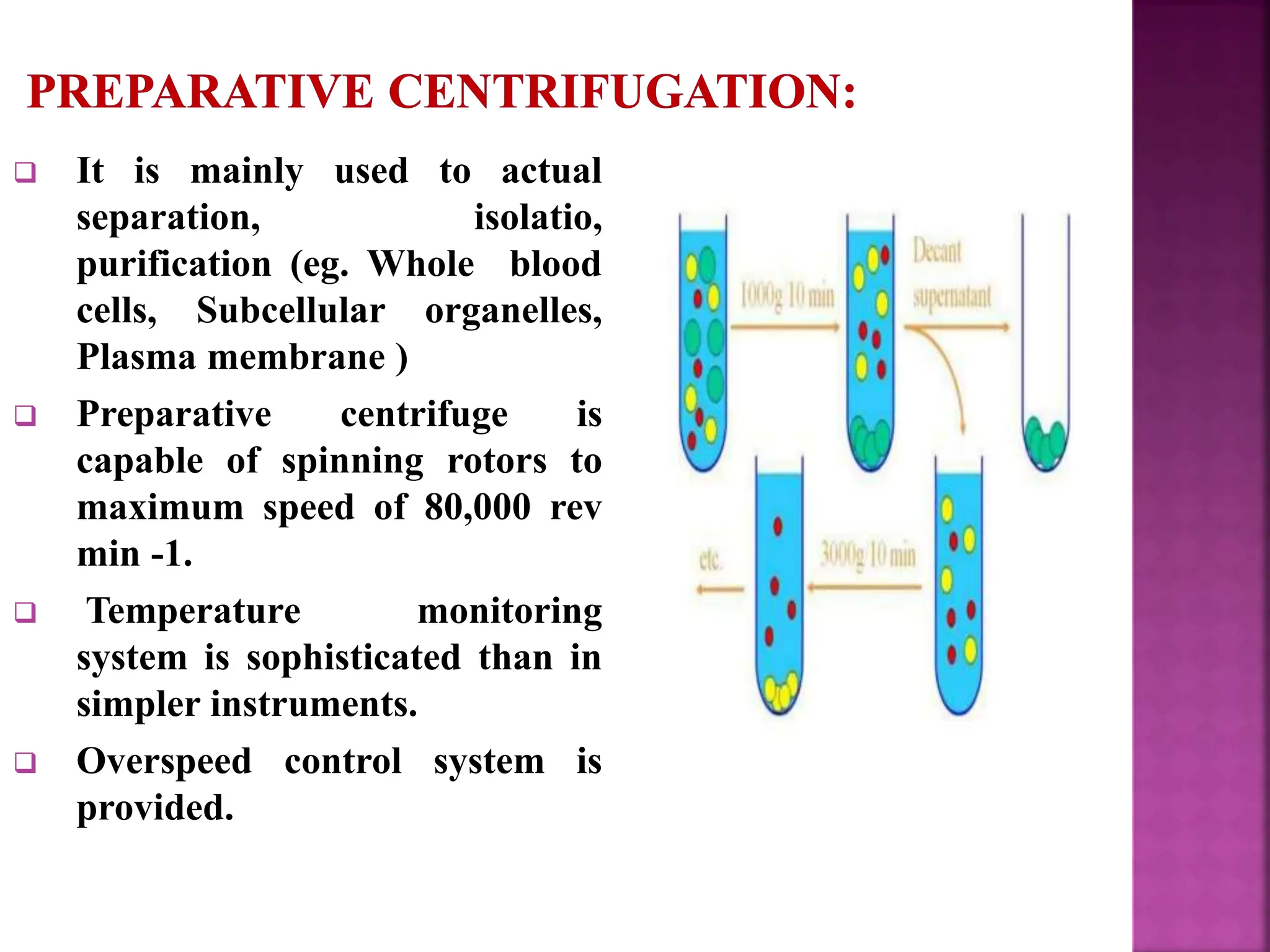
 It is mainly used to actual
separation, isolatio,
purification (eg. Whole blood
cells, Subcellular organelles,
Plasma membrane )
 Preparative centrifuge is
capable of spinning rotors to
maximum speed of 80,000 rev
min -1.
 Temperature monitoring
system is sophisticated than in
simpler instruments.
 Overspeed control system is
provided.
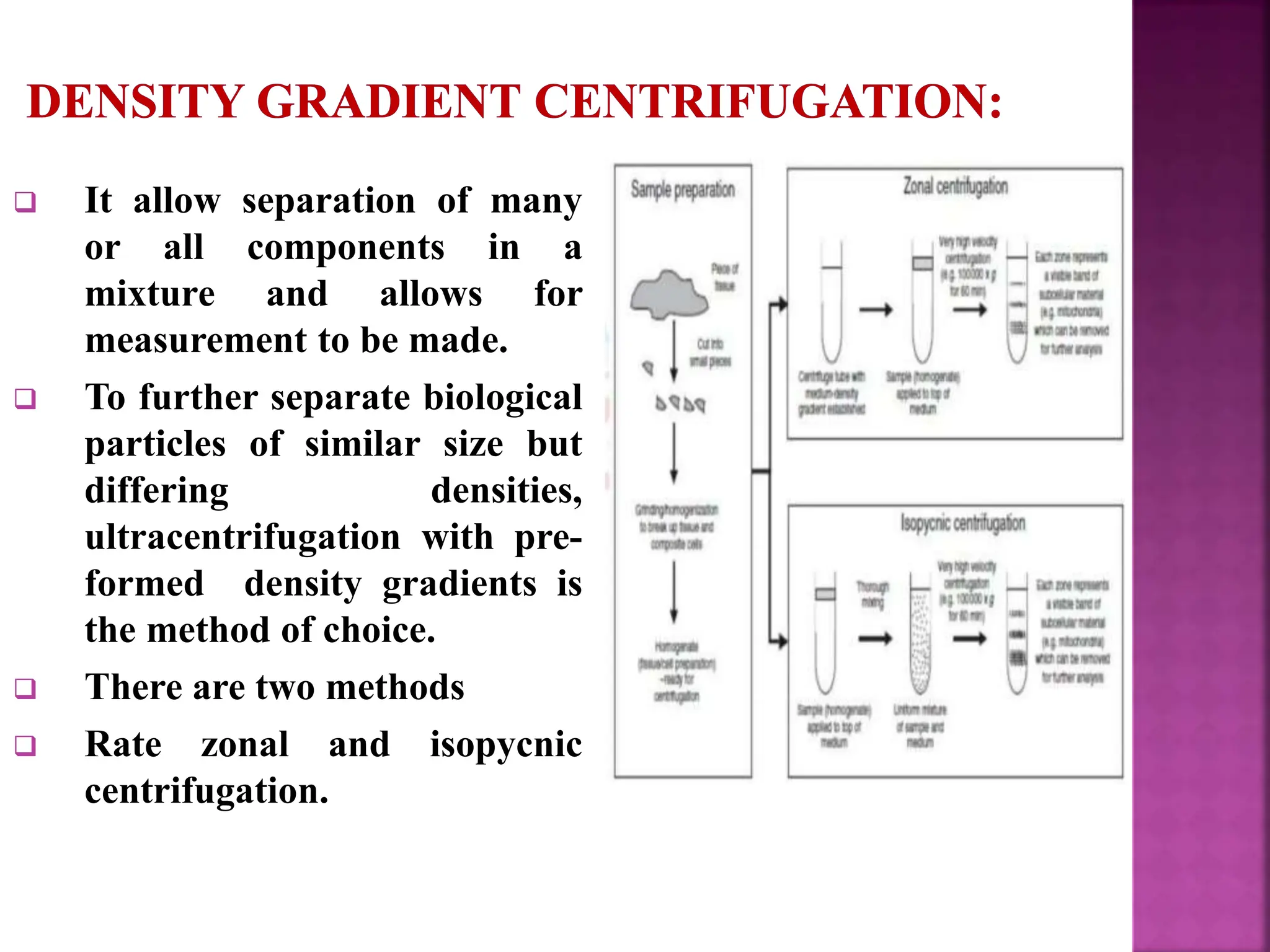
 It allow separation of many
or all components in a
mixture and allows for
measurement to be made.
 To further separate biological
particles of similar size but
differing densities,
ultracentrifugation with pre-
formed density gradients is
the method of choice.
 There are two methods
 Rate zonal and isopycnic
centrifugation.
 The particles will begin
sedimenting in separate zones
according to their size shape and
density.
 The larger particles will be able
to travel to the bottom layer
because they are more massive.
 Technique is used to separate
enzyme, hormone, DNA-RNA
hybrids, ribosomal subunits.
 Can separate proteins with
similar density and different
molecular mass easily.
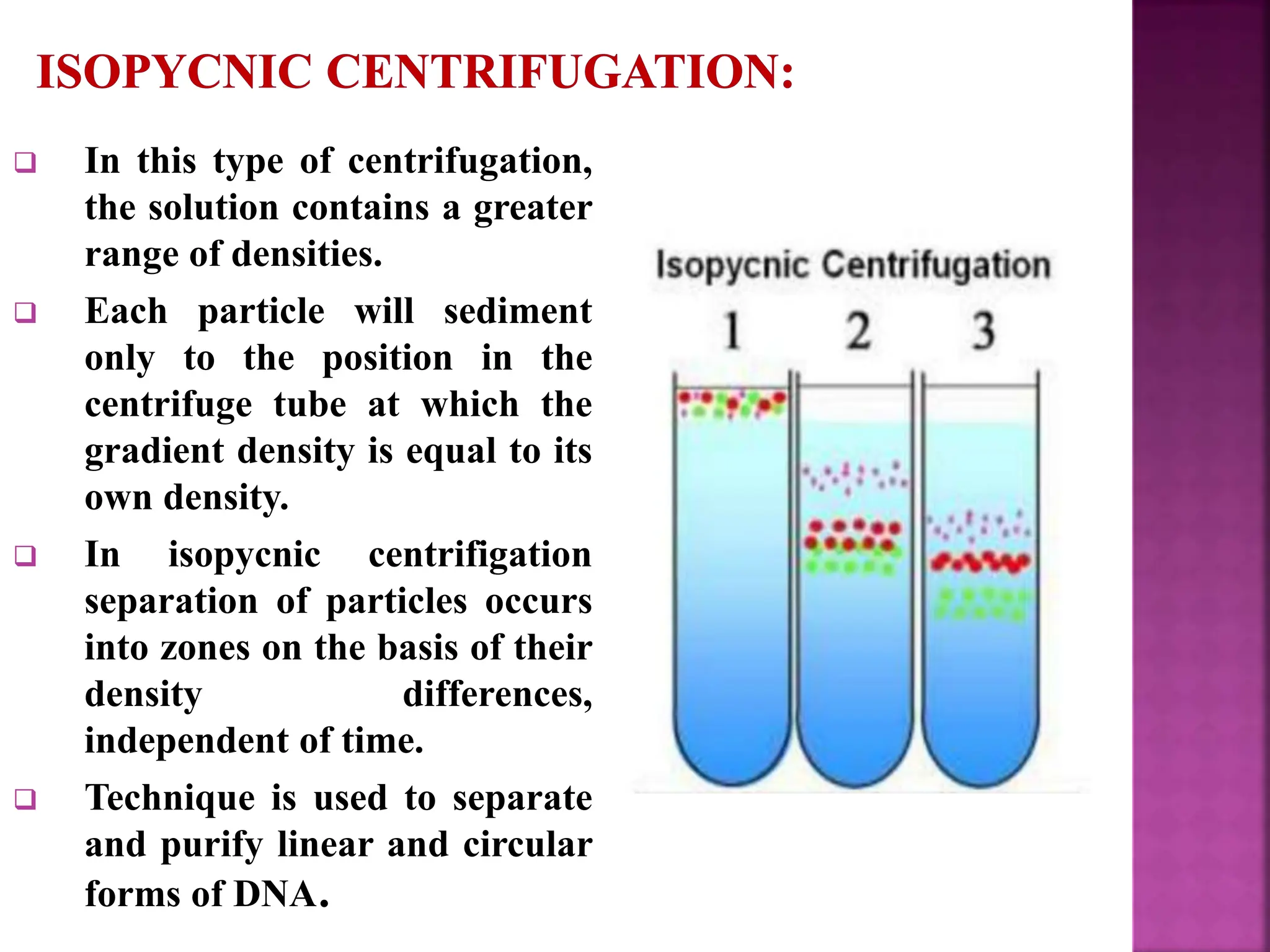
 In this type of centrifugation,
the solution contains a greater
range of densities.
 Each particle will sediment
only to the position in the
centrifuge tube at which the
gradient density is equal to its
own density.
 In isopycnic centrifigation
separation of particles occurs
into zones on the basis of their
density differences,
independent of time.
 Technique is used to separate
and purify linear and circular
forms of DNA.
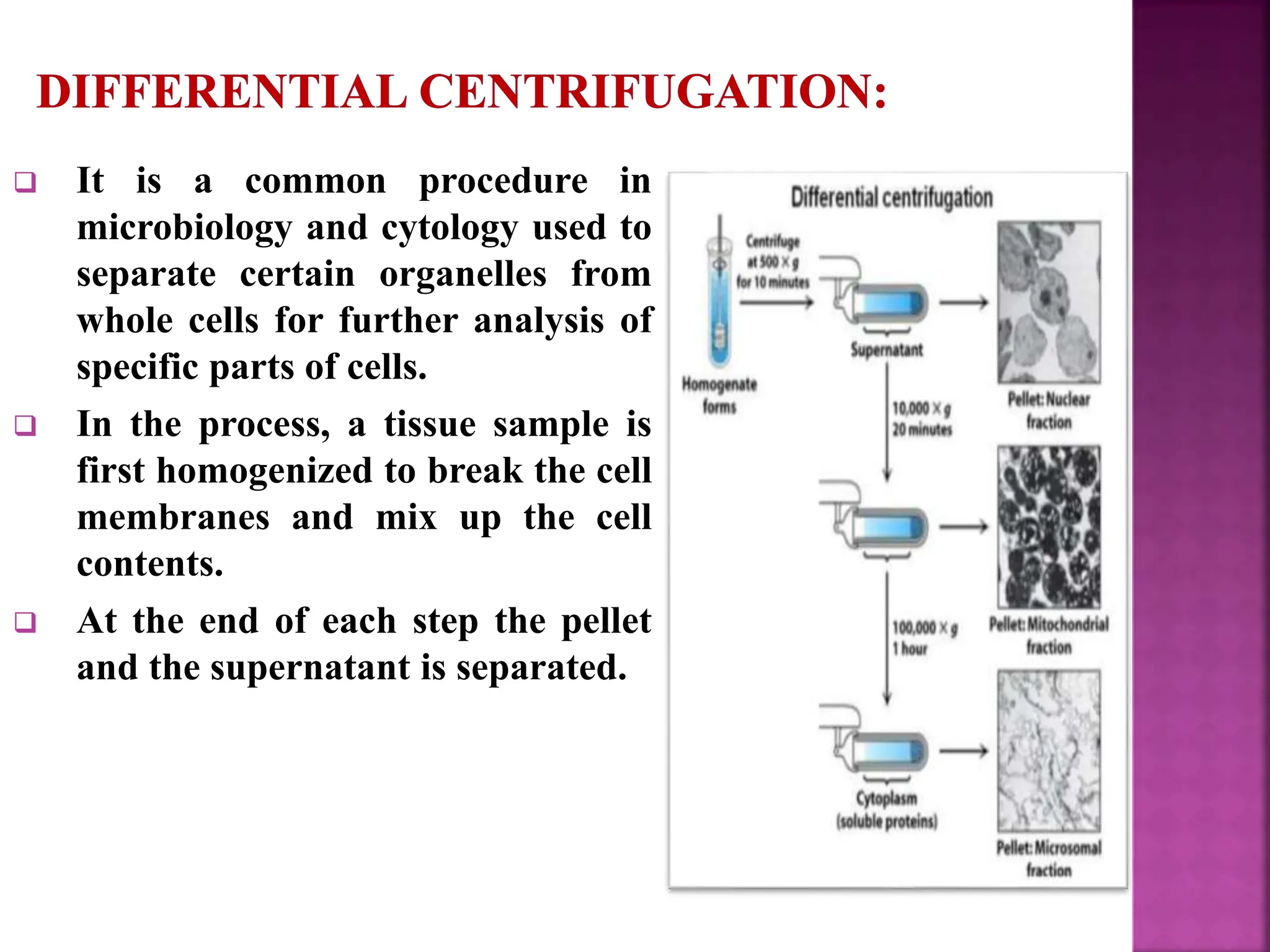
 It is a common procedure in
microbiology and cytology used to
separate certain organelles from
whole cells for further analysis of
specific parts of cells.
 In the process, a tissue sample is
first homogenized to break the cell
membranes and mix up the cell
contents.
 At the end of each step the pellet
and the supernatant is separated.
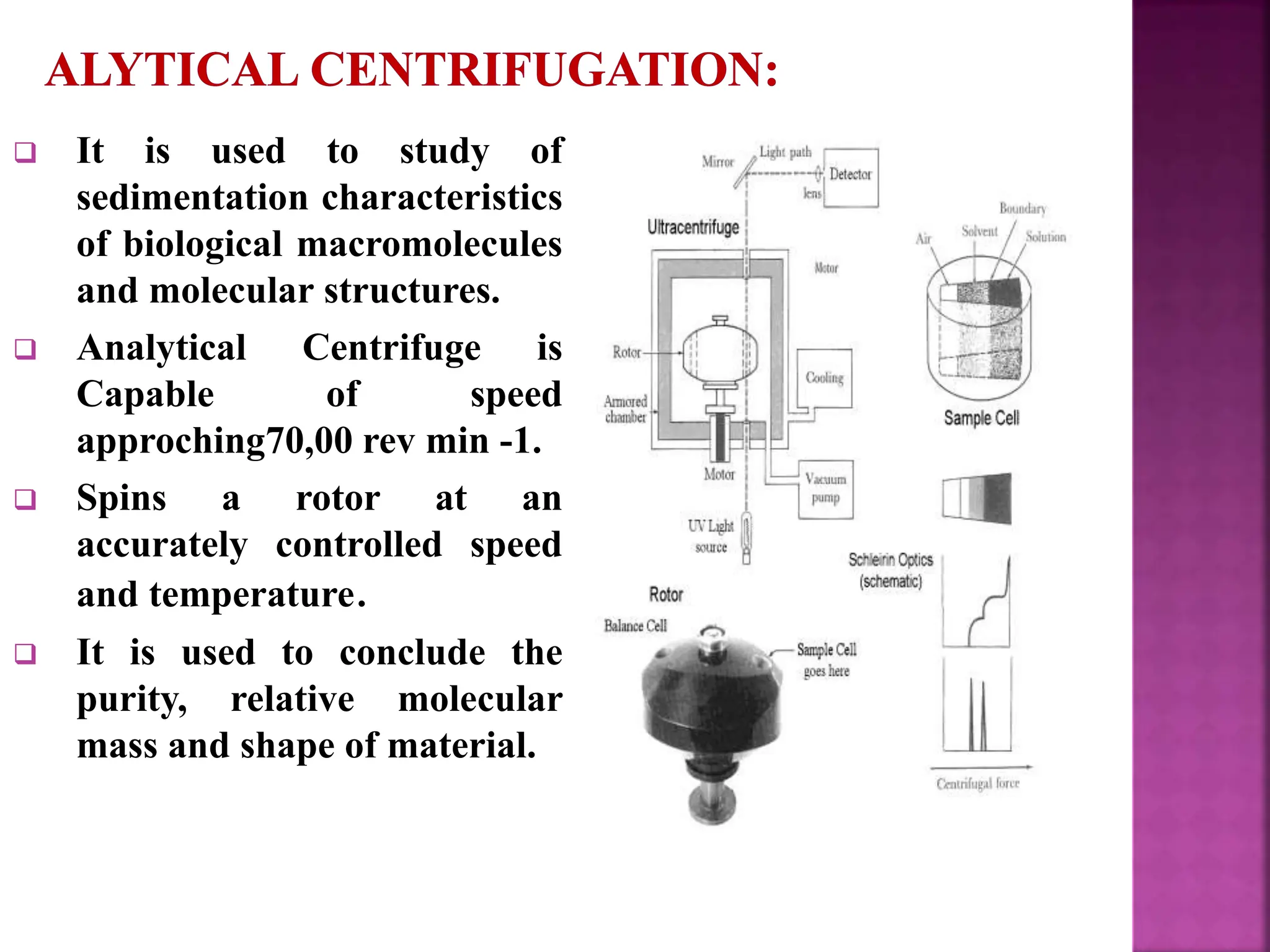
 It is used to study of
sedimentation characteristics
of biological macromolecules
and molecular structures.
 Analytical Centrifuge is
Capable of speed
approching70,00 rev min -1.
 Spins a rotor at an
accurately controlled speed
and temperature.
 It is used to conclude the
purity, relative molecular
mass and shape of material.
 Tubes recommended by their manufacturer should be
used.
 Top of tube should not extend so far above the bucket.
 Cleanliness-minimizing the possible of infection.
 Speed of centrifuge should be checked once 3m.
 Centrifuge timer to be checked per week.
 Centrifugation can be employed to separate a mixture
of two different miscible liquids.
 Chalk can be separated from water with the help of a
centrifuge.
 Another important application of this technique is in
the stabilization and clarification of wine.
 In clinical laboratory, centrifugation is used to ;
 Remove cellular elements from blood to provide
cell free plasma or serum for analysis.
 Remove chemically precipitated protein from an
analytical specimen.
 Separate lipid components.
The centrifugation is an instrument used in nearly
every research lab across the globe. Centrifugation is
the process by which a centrifuge is used to separate
complex mixture. There is no force that pushes an
object away from the center of its rotation. The reason
the object moves in a circle is because it wants to
continue to move in a straight line tangent to the
circular path.
 Pollock.J.C. (1986).Centrifuge., Publisher:bantam
doubleday dell publishing group inc., New delhi p-304
 https://study.com/ademy/lesson/what-is-centrifugation-
defination-process-uses.htm
Centrifugation types and its application

Centrifugation types and its application

  • 1.
    DEPARTMENTOF STUDIESIN BIOTECHNOLOGY Shivagangothri,Davangere -07 SEMINARTOPIC : CENTRIFUGATION TYPES AND IT’S APPLICATIONS Presented by: MOHAMMED ASIF KILLEDAR
  • 2.
     INTRODUCTION  HISTORY TYPE OF CENTRIFUGATION  OPERATION  APPLICATIONS  CONCULSION  REFERENCE
  • 3.
    Centrifugation is atechnique, based upon the behaviour of particles in an applied centrifugal filed. Centrifugation is a mechanical process which involves the use of the centrifugal force to separate particles from a solution according to their size, shape, density, medium viscosity and rotor speed. The denser components of the mixture migrate away from the axis of the centrifuge, while the less dense components of the mixture migrate towards the axis.  precipitate (pellet) will travel quickly and fully to the bottom of the tube. The remaining liquid that lies above the precipitate is called a supernatant.
  • 4.
     In 1923Theodore Svedberg developed the first high speed centrifuge to separate large grain sols(sediment particles).  Nobel prize was awarded to him for his research and the invention of the ultracentrifuge.  Centrifuges quickly became a laboratory equipment .  Cellular organelle identification in 1929.
  • 5.
  • 6.
     It ismainly used to actual separation, isolatio, purification (eg. Whole blood cells, Subcellular organelles, Plasma membrane )  Preparative centrifuge is capable of spinning rotors to maximum speed of 80,000 rev min -1.  Temperature monitoring system is sophisticated than in simpler instruments.  Overspeed control system is provided.
  • 7.
     It allowseparation of many or all components in a mixture and allows for measurement to be made.  To further separate biological particles of similar size but differing densities, ultracentrifugation with pre- formed density gradients is the method of choice.  There are two methods  Rate zonal and isopycnic centrifugation.
  • 8.
     The particleswill begin sedimenting in separate zones according to their size shape and density.  The larger particles will be able to travel to the bottom layer because they are more massive.  Technique is used to separate enzyme, hormone, DNA-RNA hybrids, ribosomal subunits.  Can separate proteins with similar density and different molecular mass easily.
  • 9.
     In thistype of centrifugation, the solution contains a greater range of densities.  Each particle will sediment only to the position in the centrifuge tube at which the gradient density is equal to its own density.  In isopycnic centrifigation separation of particles occurs into zones on the basis of their density differences, independent of time.  Technique is used to separate and purify linear and circular forms of DNA.
  • 10.
     It isa common procedure in microbiology and cytology used to separate certain organelles from whole cells for further analysis of specific parts of cells.  In the process, a tissue sample is first homogenized to break the cell membranes and mix up the cell contents.  At the end of each step the pellet and the supernatant is separated.
  • 11.
     It isused to study of sedimentation characteristics of biological macromolecules and molecular structures.  Analytical Centrifuge is Capable of speed approching70,00 rev min -1.  Spins a rotor at an accurately controlled speed and temperature.  It is used to conclude the purity, relative molecular mass and shape of material.
  • 12.
     Tubes recommendedby their manufacturer should be used.  Top of tube should not extend so far above the bucket.  Cleanliness-minimizing the possible of infection.  Speed of centrifuge should be checked once 3m.  Centrifuge timer to be checked per week.
  • 13.
     Centrifugation canbe employed to separate a mixture of two different miscible liquids.  Chalk can be separated from water with the help of a centrifuge.  Another important application of this technique is in the stabilization and clarification of wine.  In clinical laboratory, centrifugation is used to ;  Remove cellular elements from blood to provide cell free plasma or serum for analysis.  Remove chemically precipitated protein from an analytical specimen.  Separate lipid components.
  • 14.
    The centrifugation isan instrument used in nearly every research lab across the globe. Centrifugation is the process by which a centrifuge is used to separate complex mixture. There is no force that pushes an object away from the center of its rotation. The reason the object moves in a circle is because it wants to continue to move in a straight line tangent to the circular path.
  • 15.
     Pollock.J.C. (1986).Centrifuge.,Publisher:bantam doubleday dell publishing group inc., New delhi p-304  https://study.com/ademy/lesson/what-is-centrifugation- defination-process-uses.htm