
Centrifugation
Bioanalytical techniques
Introduction
● Centrifugation is the process of rapidly rotating container that applies
centrifugal force to its contents, typically to separating fluids of different
densities or solids from fluids.
● The centrifugal force causes increase in gravitational force thus speeding the
process of sedimentation during separation.
● It was in 1923 that Svedberg and Nicols employed a centrifuge for the first times
to speed up the rate of sedimentation for the purpose of measuring particle sizes.
● The applications of this technique range from collection and separation of cells,
organelles and molecules. To the study of molecular weights of
macromolecules.
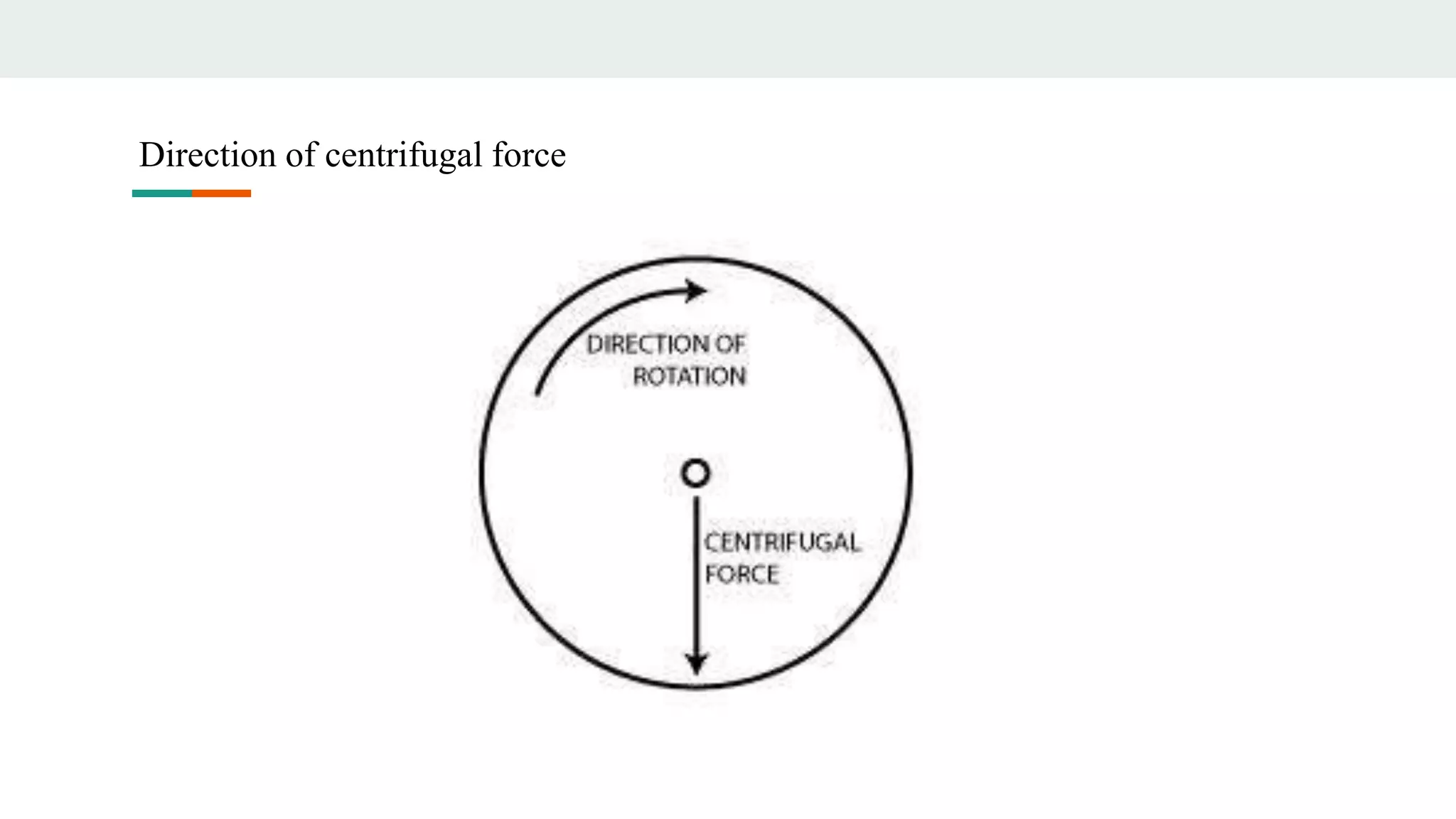
Direction of centrifugal force
Basic Principles of sedimentation
An object moving in a Circle at a steady angular velocity will experience a force, F directed
outwards. This is the basis of centrifugation. Angular velocity in radians, ω and the radius
of rotation, r in centimeters collectively determine the magnitude of the force F.
F=ω2r
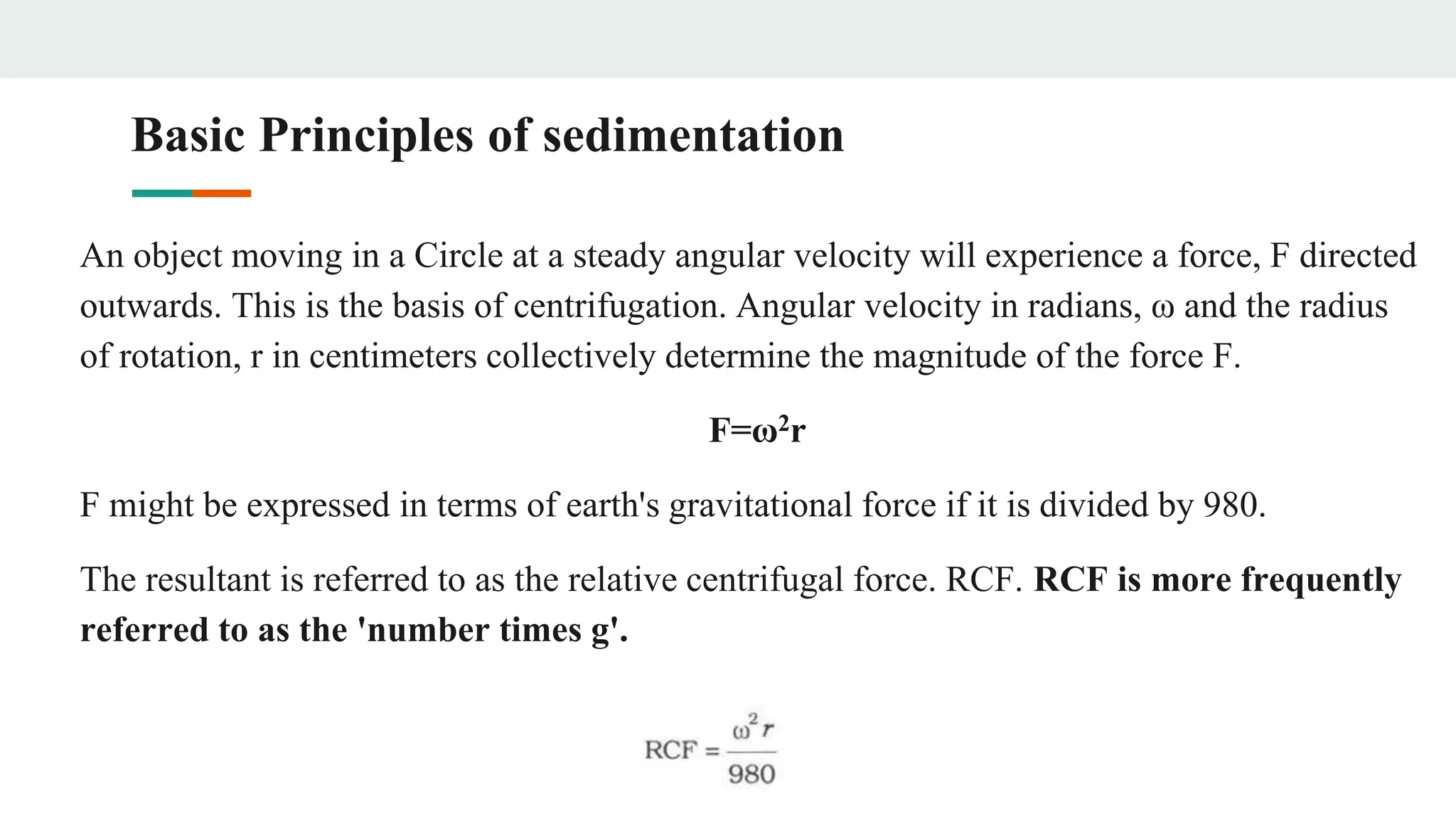
F might be expressed in terms of earth's gravitational force if it is divided by 980.
The resultant is referred to as the relative centrifugal force. RCF. RCF is more frequently
referred to as the 'number times g'.
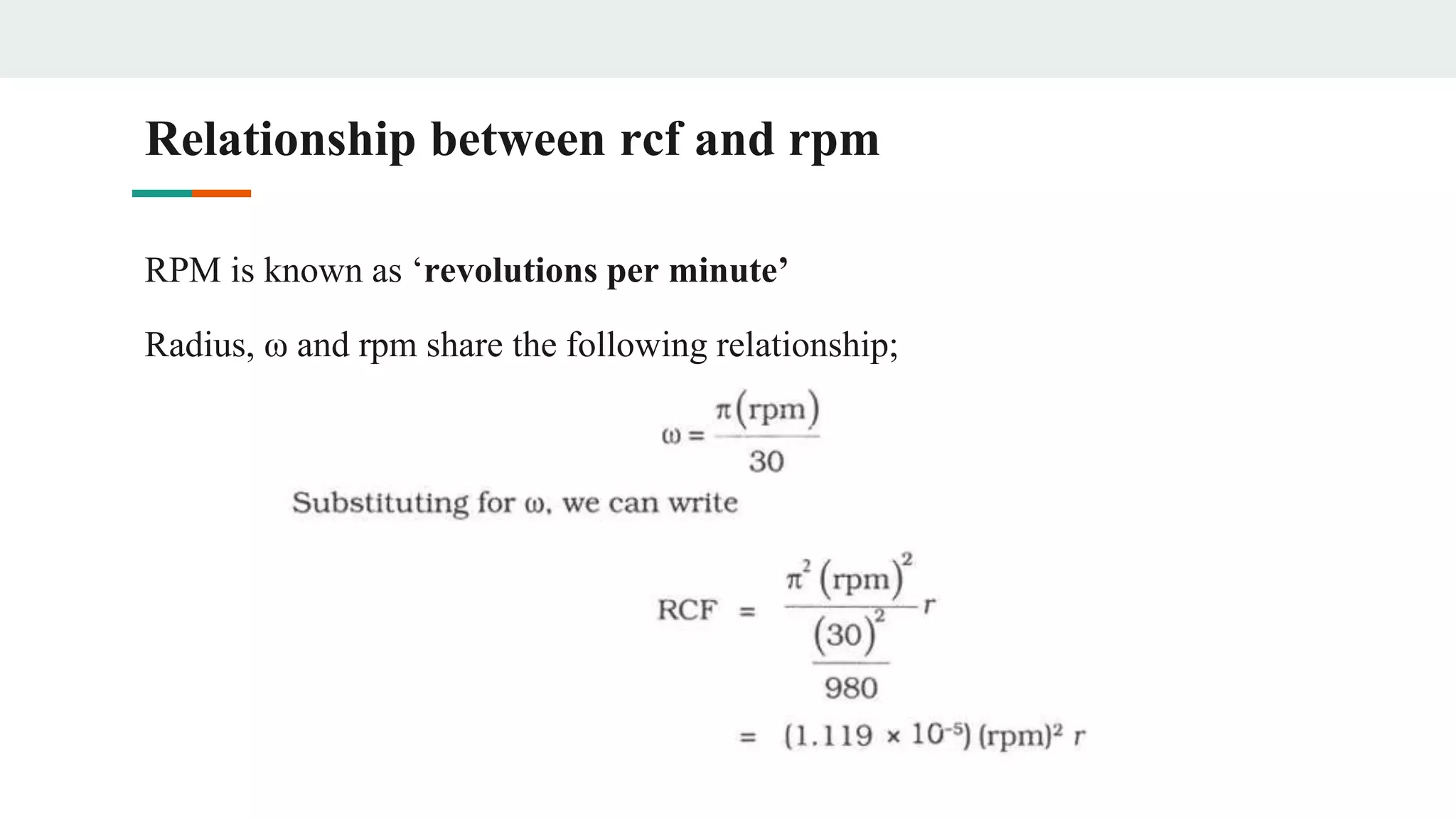
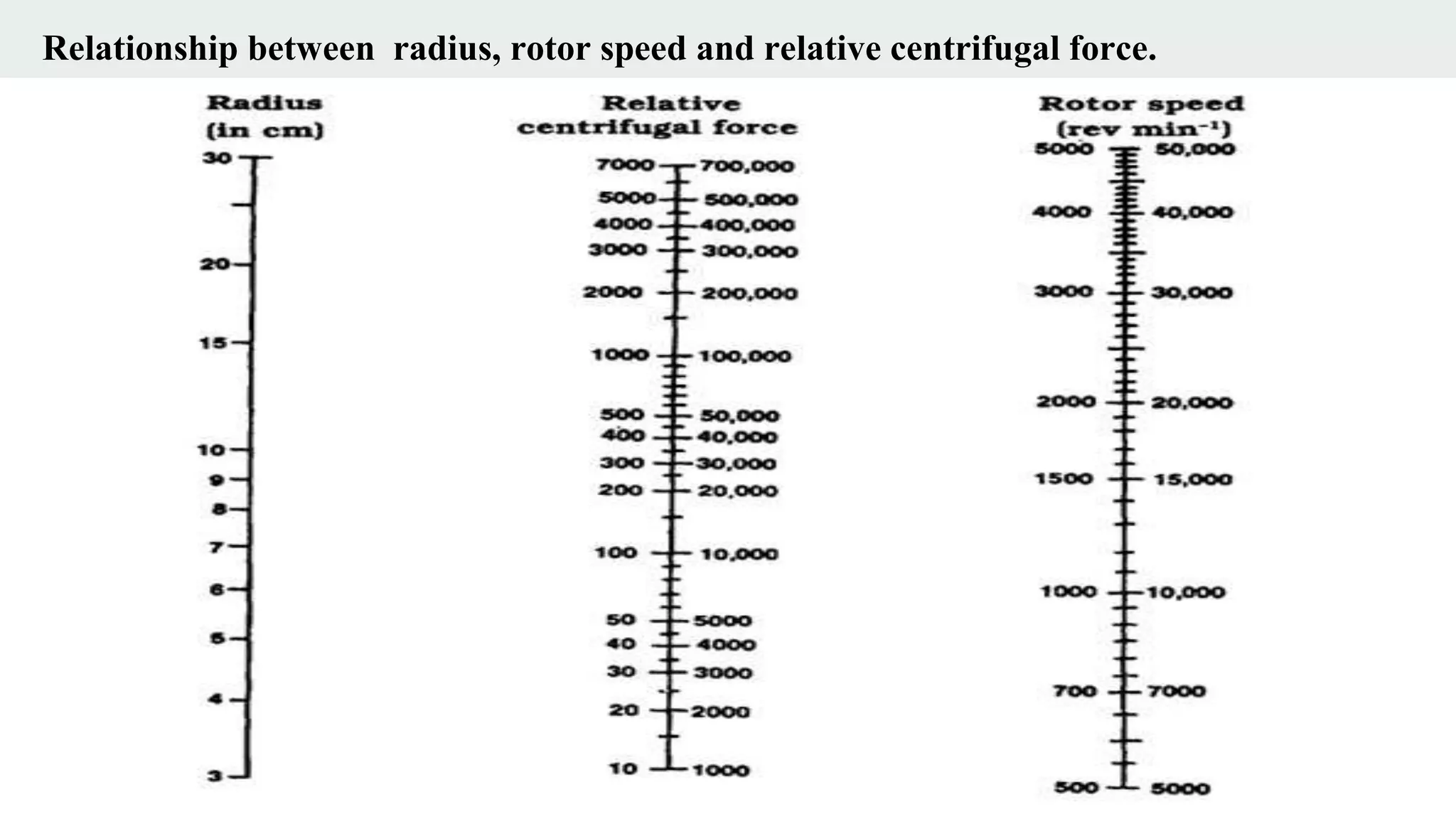
Relationship between rcf and rpm
RPM is known as ‘revolutions per minute’
Radius, ω and rpm share the following relationship;
Relationship between radius, rotor speed and relative centrifugal force.
Characteristics of sedimentation
● Apart from RCF, the rate of sedimentation of a given particle would also depend
upon its own characteristics such as its density, and its radius.
● The characteristics of the medium in which the particle is suspended -its
density, viscosity -will also tend to affect the rate of sedimentation of the given
particle.
● The larger the particle. the faster it will move (the size is the single most
important factor).
● The more dense a particle is the faster it will move.
● The more dense a solution is the slower will be the movement of the
particle.
● The higher the viscosity of the medium, the slower will be the particle
movement.
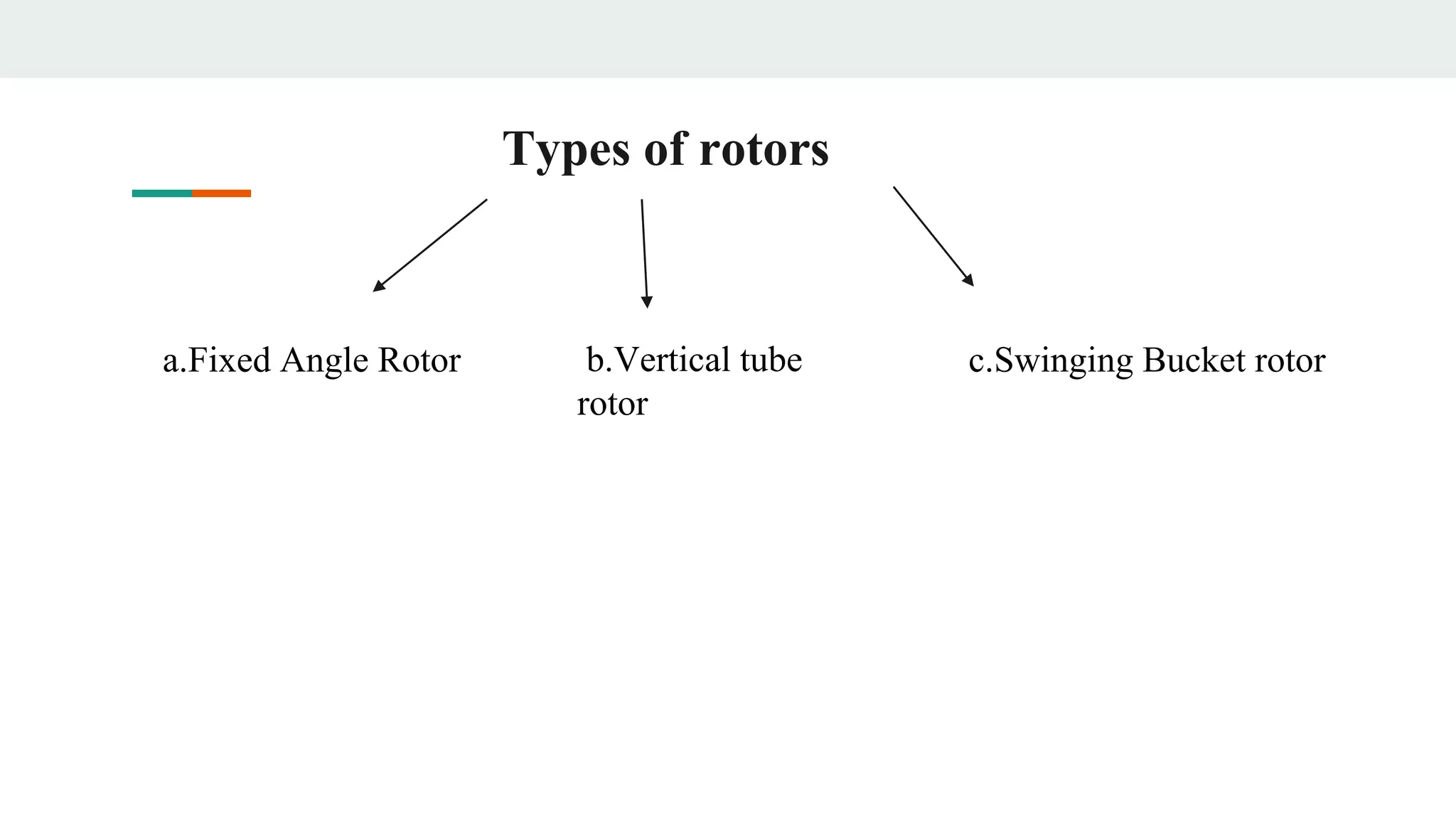
Types of rotors
a.Fixed Angle Rotor b.Vertical tube
rotor
c.Swinging Bucket rotor
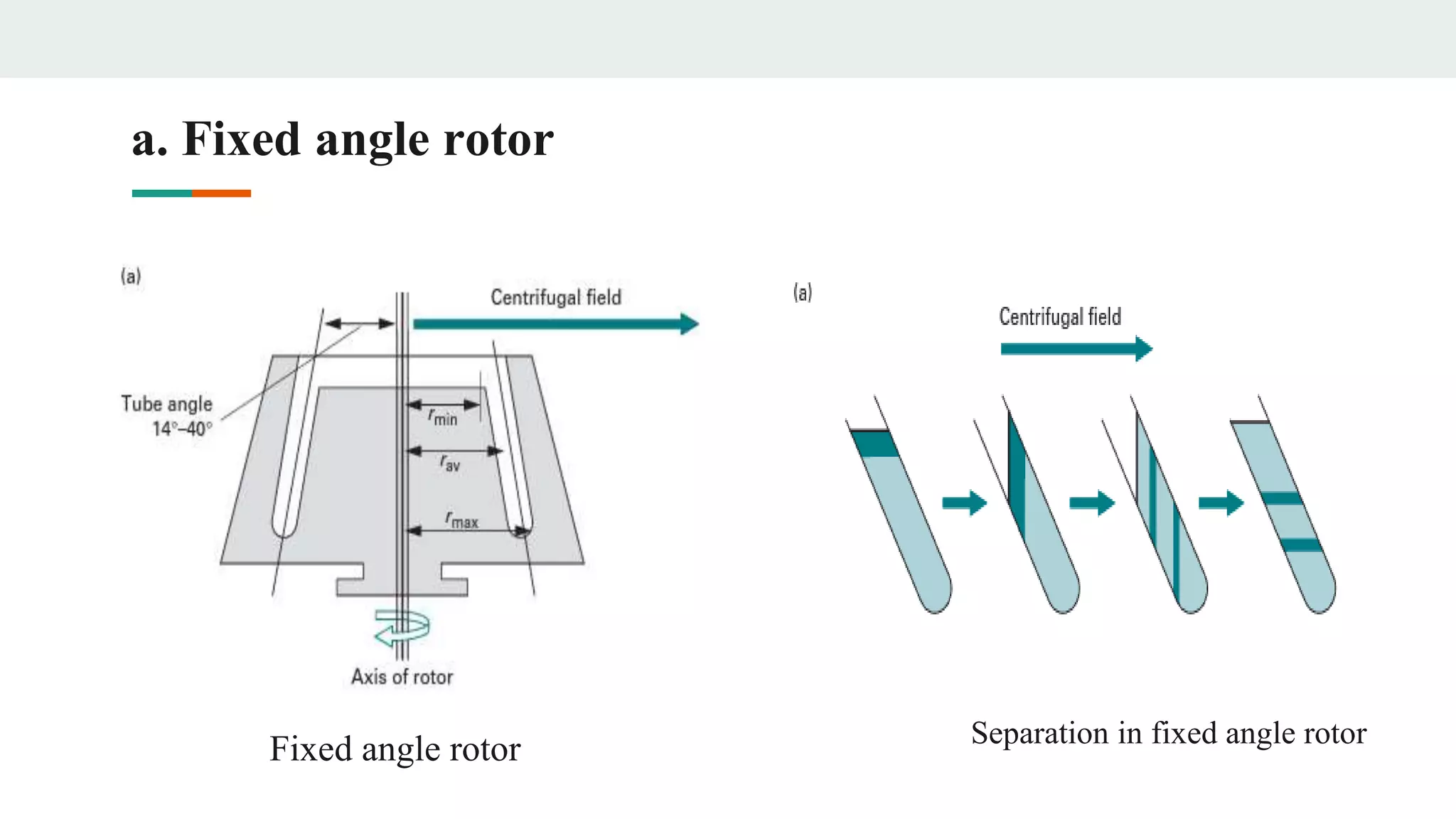
a. Fixed angle rotor
Fixed angle rotor Separation in fixed angle rotor
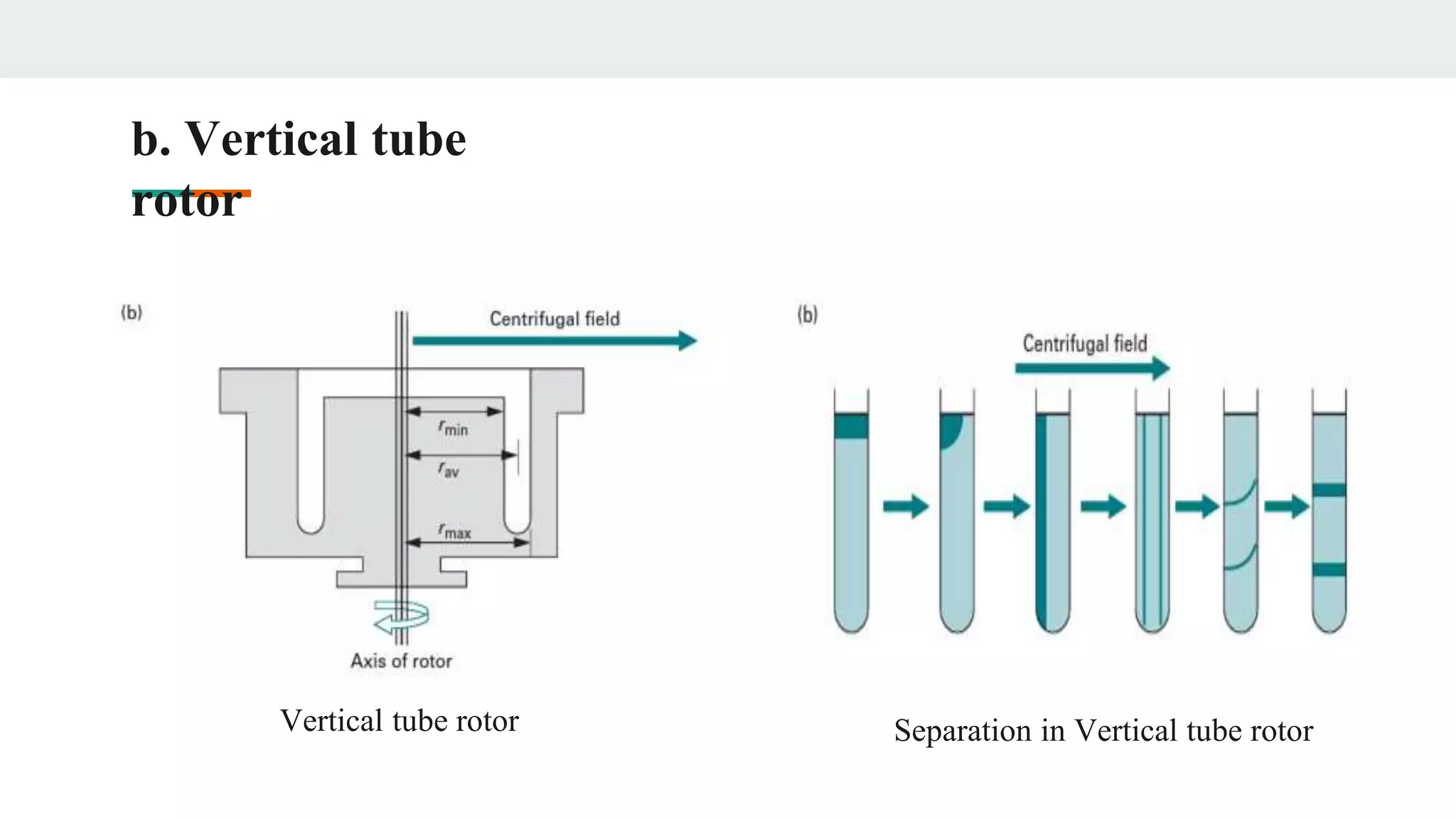
b. Vertical tube
rotor
Vertical tube rotor Separation in Vertical tube rotor
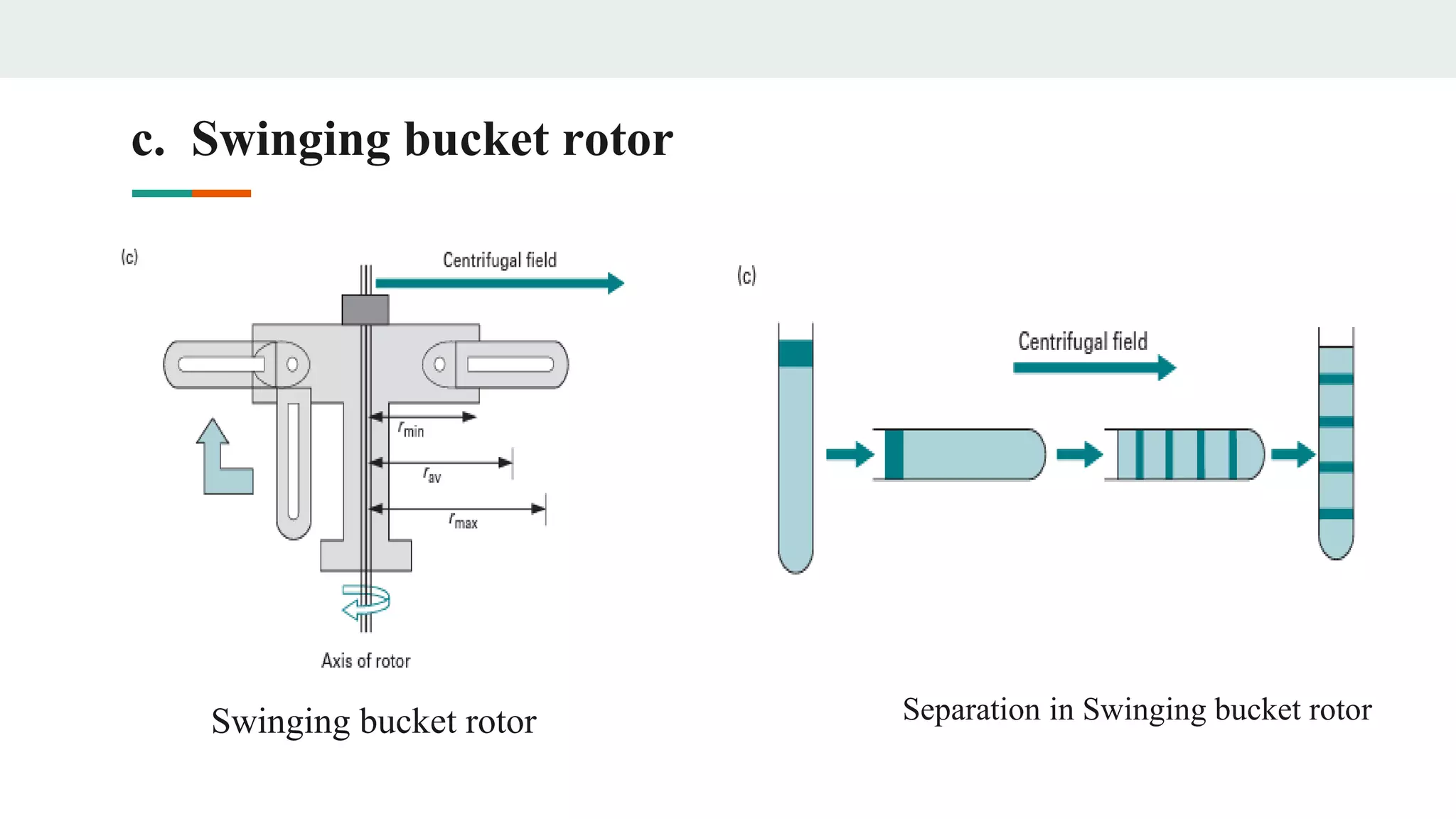
c. Swinging bucket rotor
Swinging bucket rotor Separation in Swinging bucket rotor
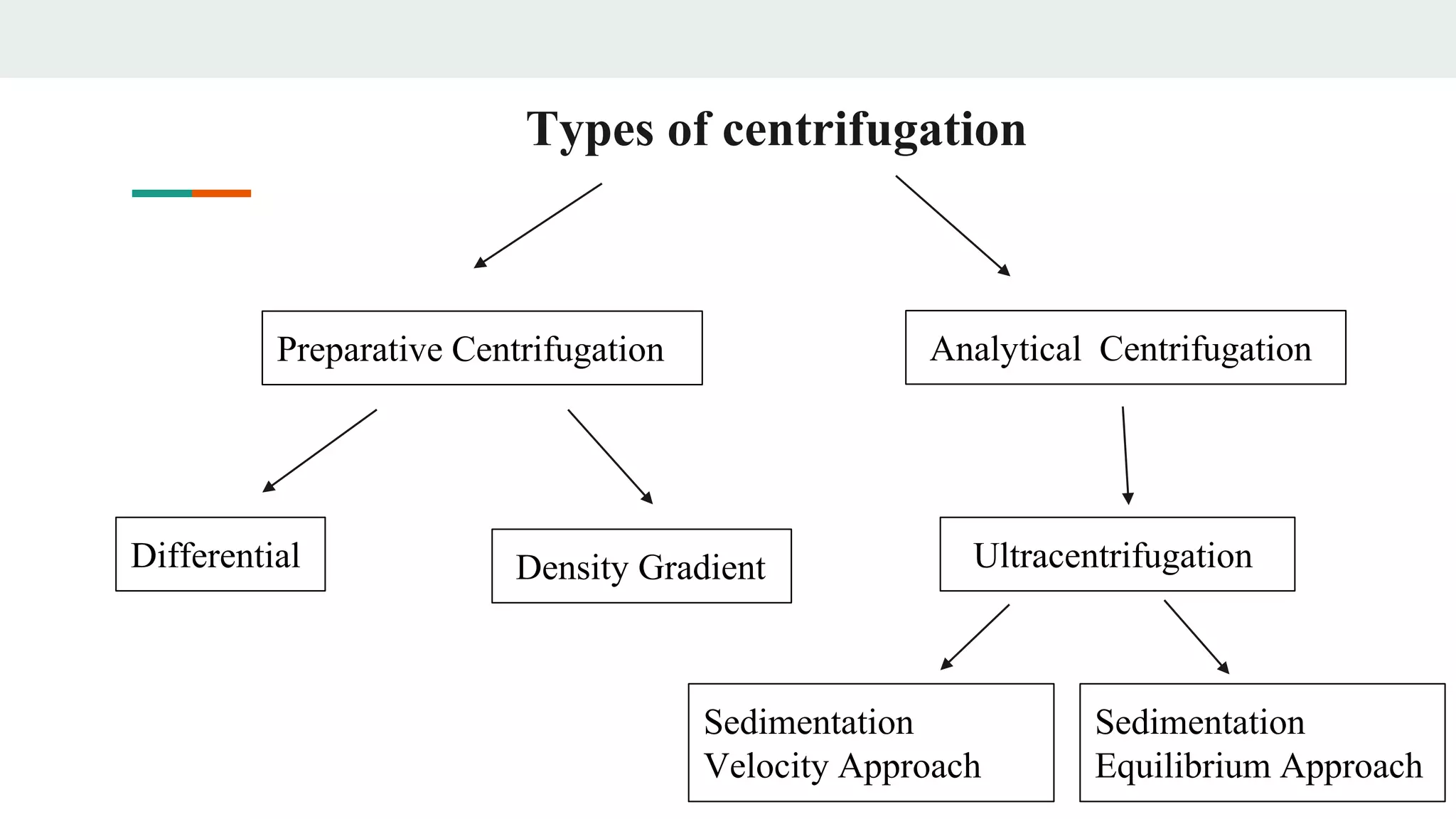
Types of centrifugation
Preparative Centrifugation Analytical Centrifugation
Differential Density Gradient Ultracentrifugation
Sedimentation
Velocity Approach
Sedimentation
Equilibrium Approach
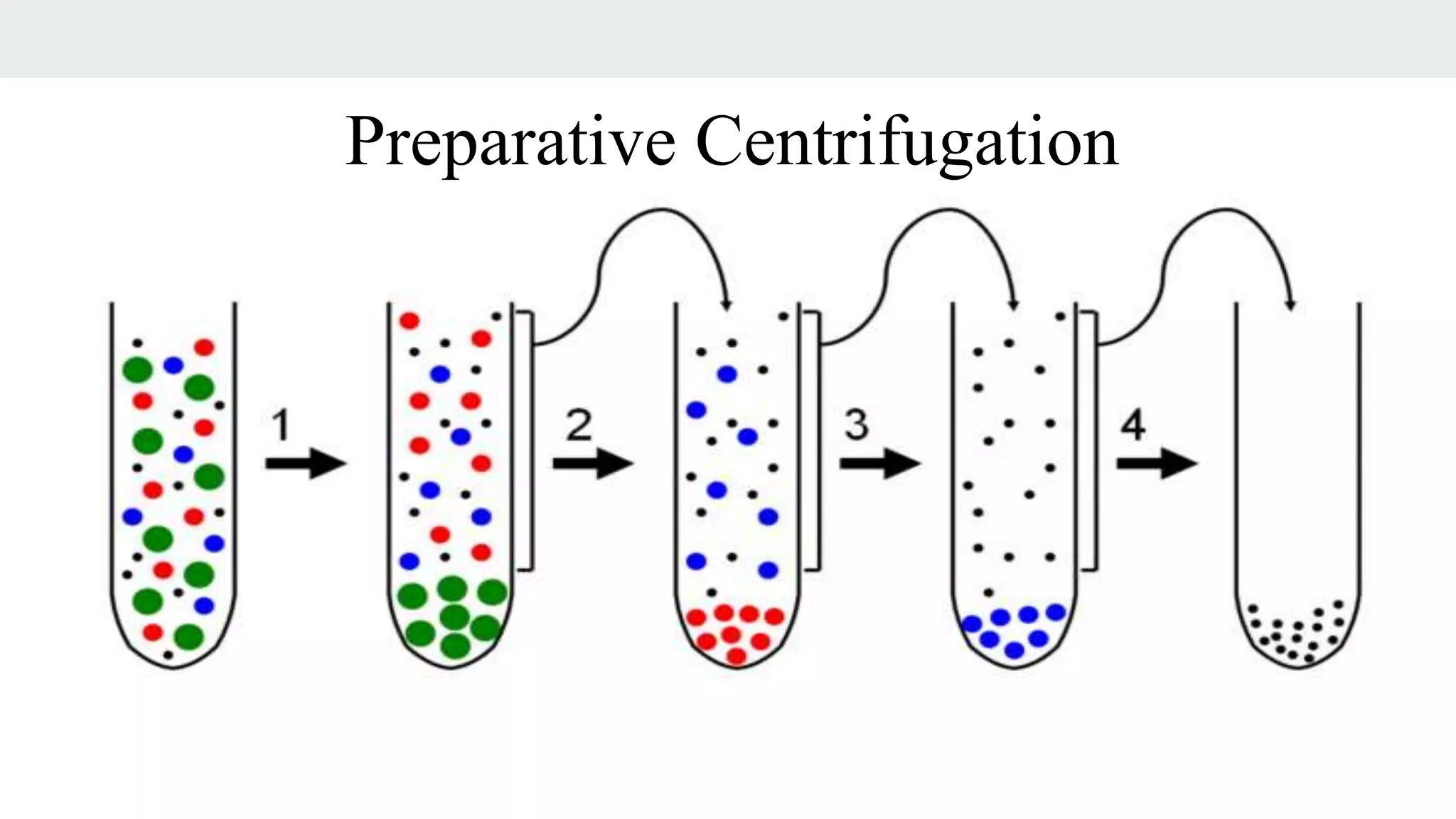
Preparative Centrifugation
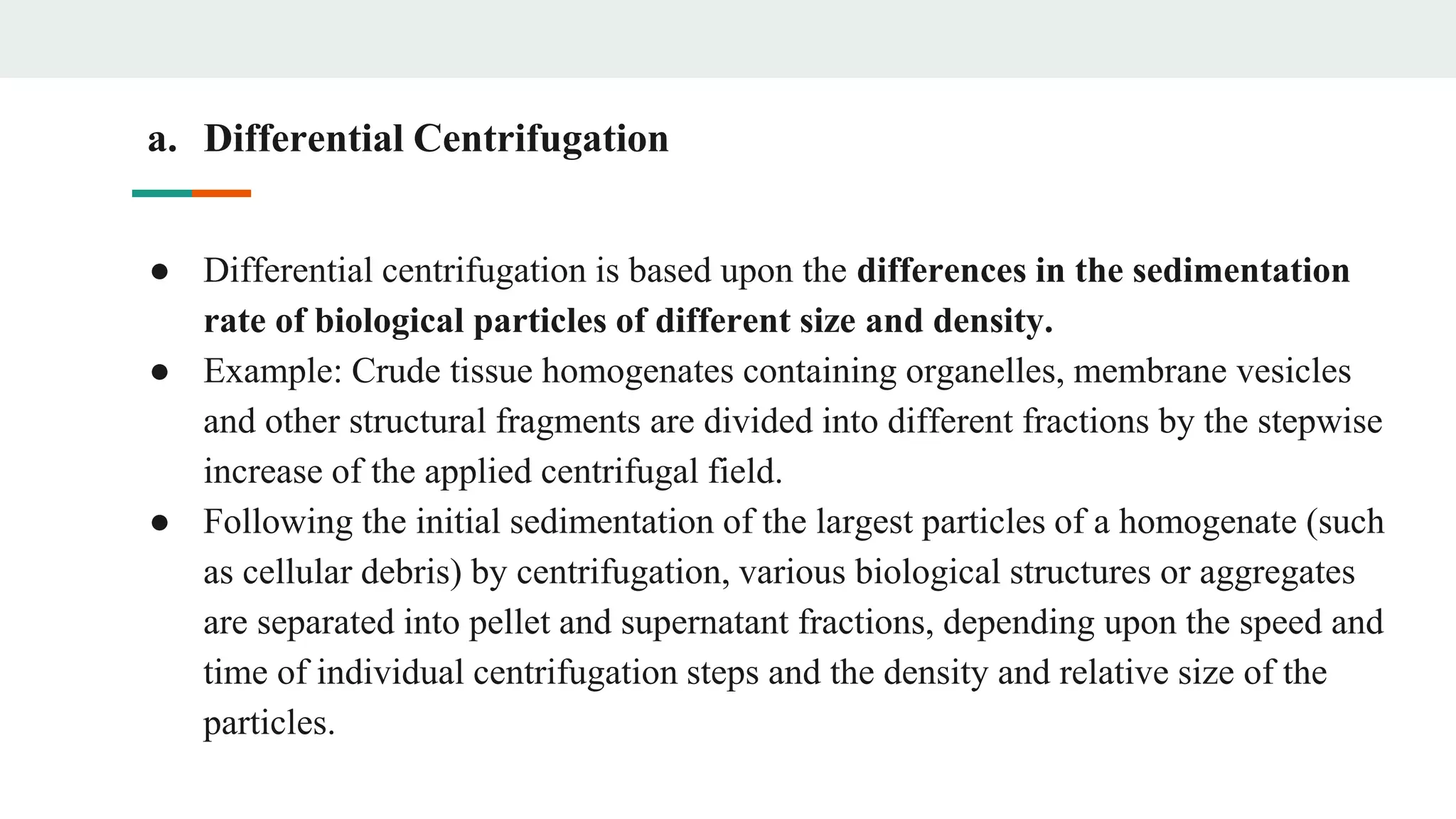
a. Differential Centrifugation
● Differential centrifugation is based upon the differences in the sedimentation
rate of biological particles of different size and density.
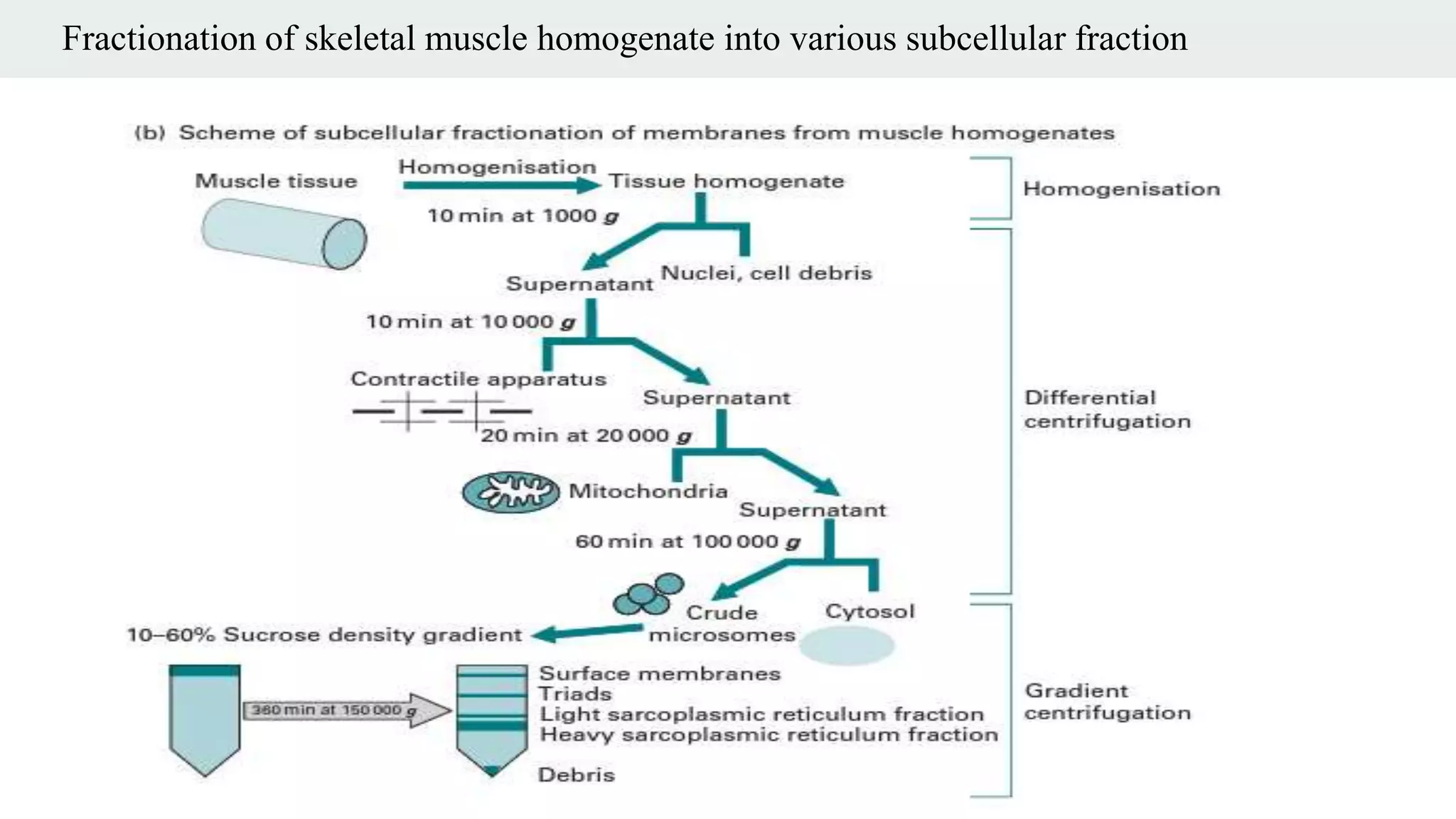
● Example: Crude tissue homogenates containing organelles, membrane vesicles
and other structural fragments are divided into different fractions by the stepwise
increase of the applied centrifugal field.
● Following the initial sedimentation of the largest particles of a homogenate (such
as cellular debris) by centrifugation, various biological structures or aggregates
are separated into pellet and supernatant fractions, depending upon the speed and
time of individual centrifugation steps and the density and relative size of the
particles.
Fractionation of skeletal muscle homogenate into various subcellular fraction
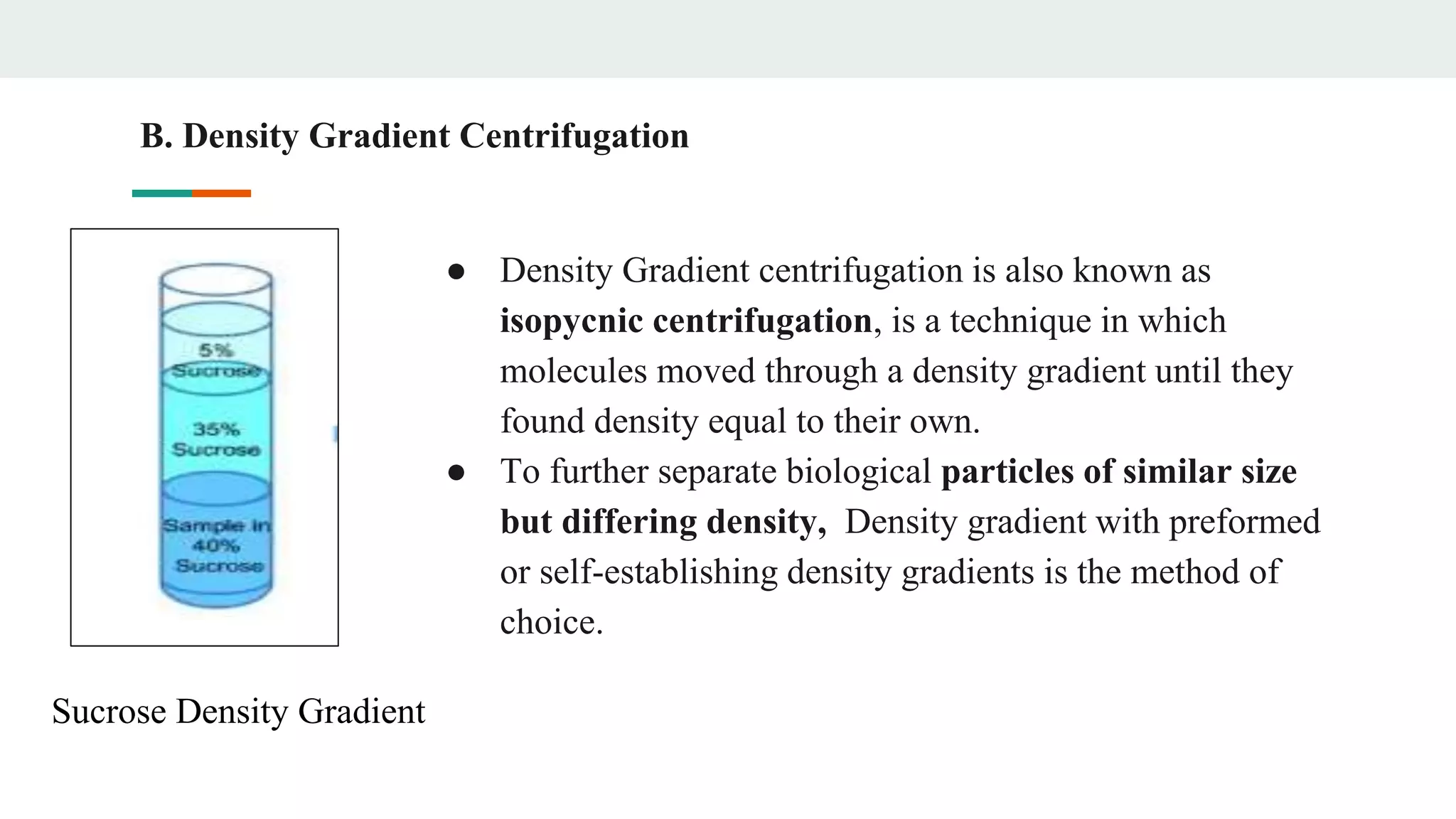
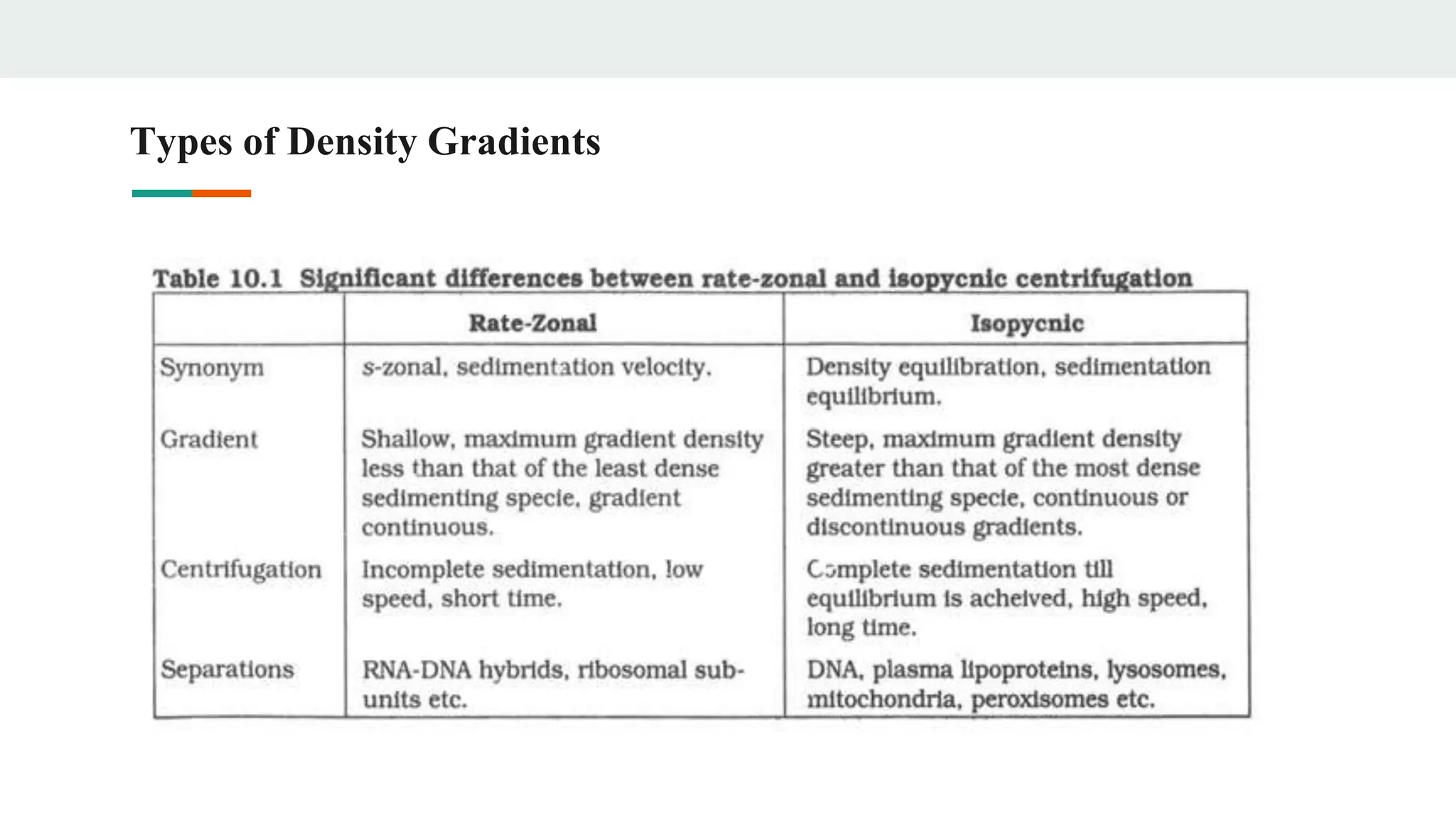
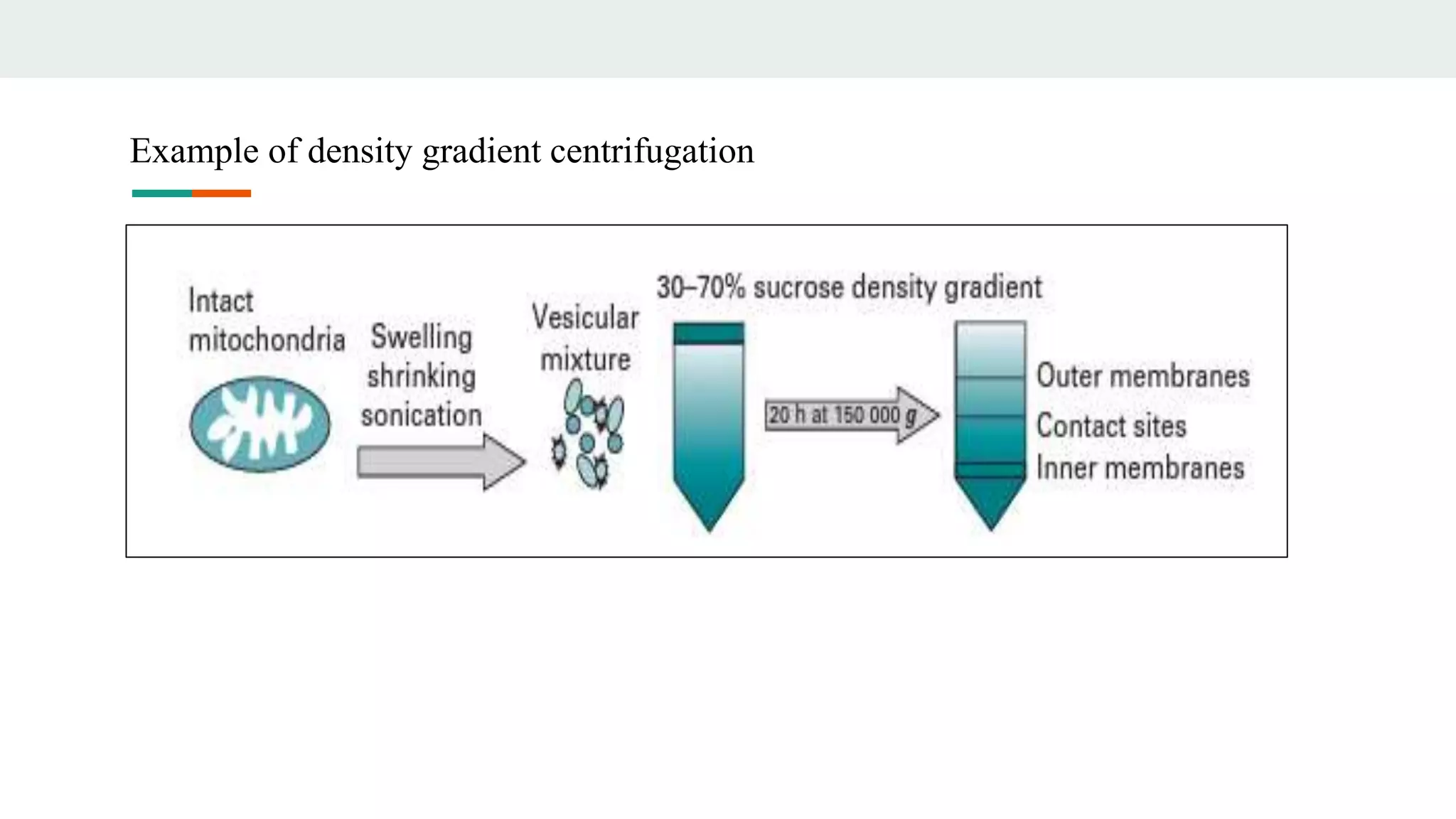
● Density Gradient centrifugation is also known as
isopycnic centrifugation, is a technique in which
molecules moved through a density gradient until they
found density equal to their own.
● To further separate biological particles of similar size
but differing density, Density gradient with preformed
or self-establishing density gradients is the method of
choice.
B. Density Gradient Centrifugation
Sucrose Density Gradient
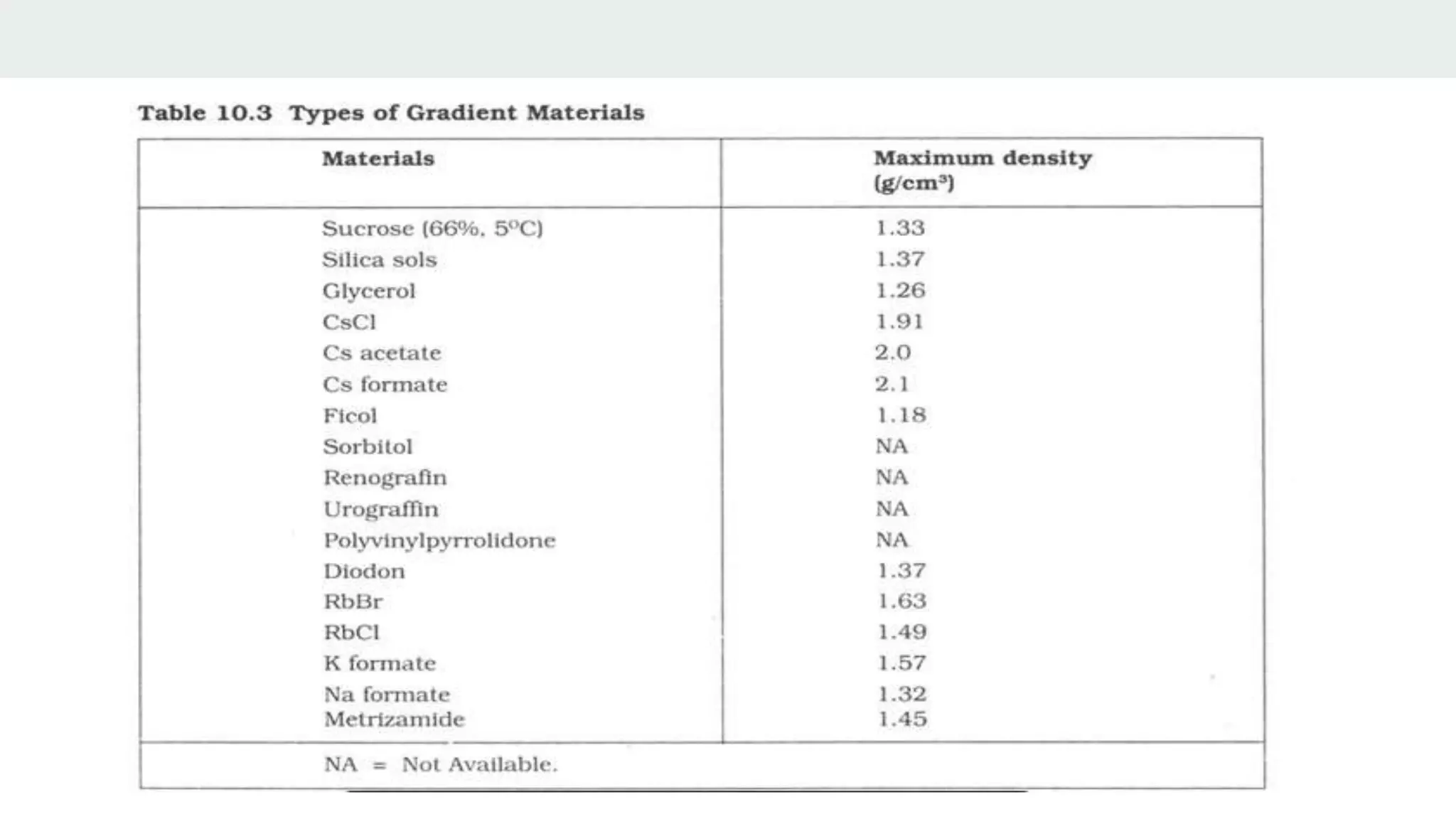
● Depending on the particular biological application, a great variety of
gradient materials are available. Caesium chloride is widely used for the
banding of DNA and the isolation of plasmids, nucleoproteins and viruses.
Sodium bromide and sodium iodide are employed for the fractionation of
lipoproteins and the banding of DNA or RNA molecules, respectively.
● Various companies offer a range of gradient material for the separation of
whole cells and subcellular particles, e.g. Percoll, Ficoll, Dextran,
Metrizamide and Nycodenz
Gradient Materials
Types of Density Gradients
Example of density gradient centrifugation
● Ultracentrifugation:
A typical analytical ultracentrifuge can generate a centrifugal field of
250000 g in its analytical cell. Within these extremely high gravitational
fields, the ultracentrifuge cell has to allow light passage through the
biological particles for proper measurement of the concentration
distribution.
Analytical Centrifugation
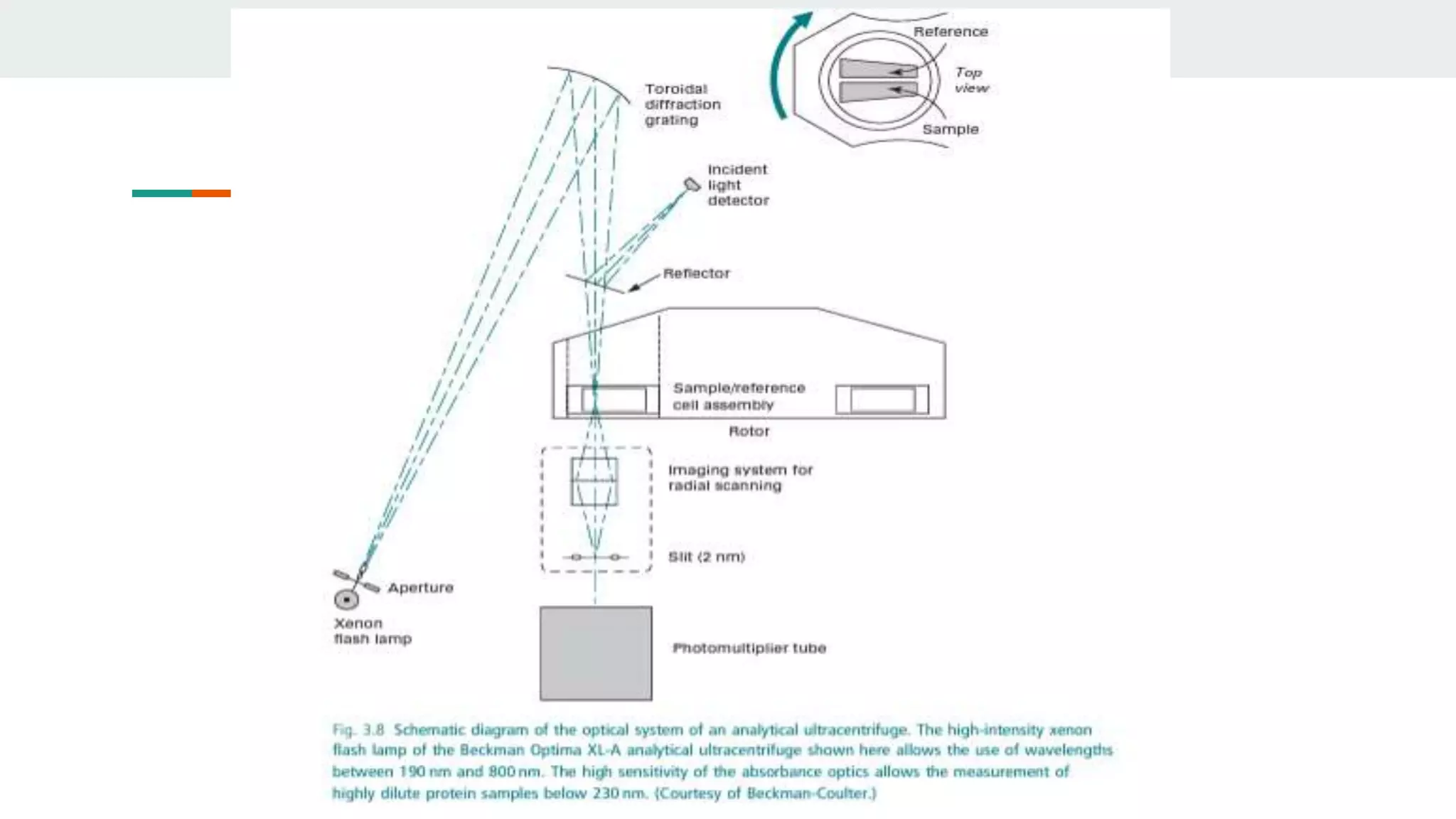
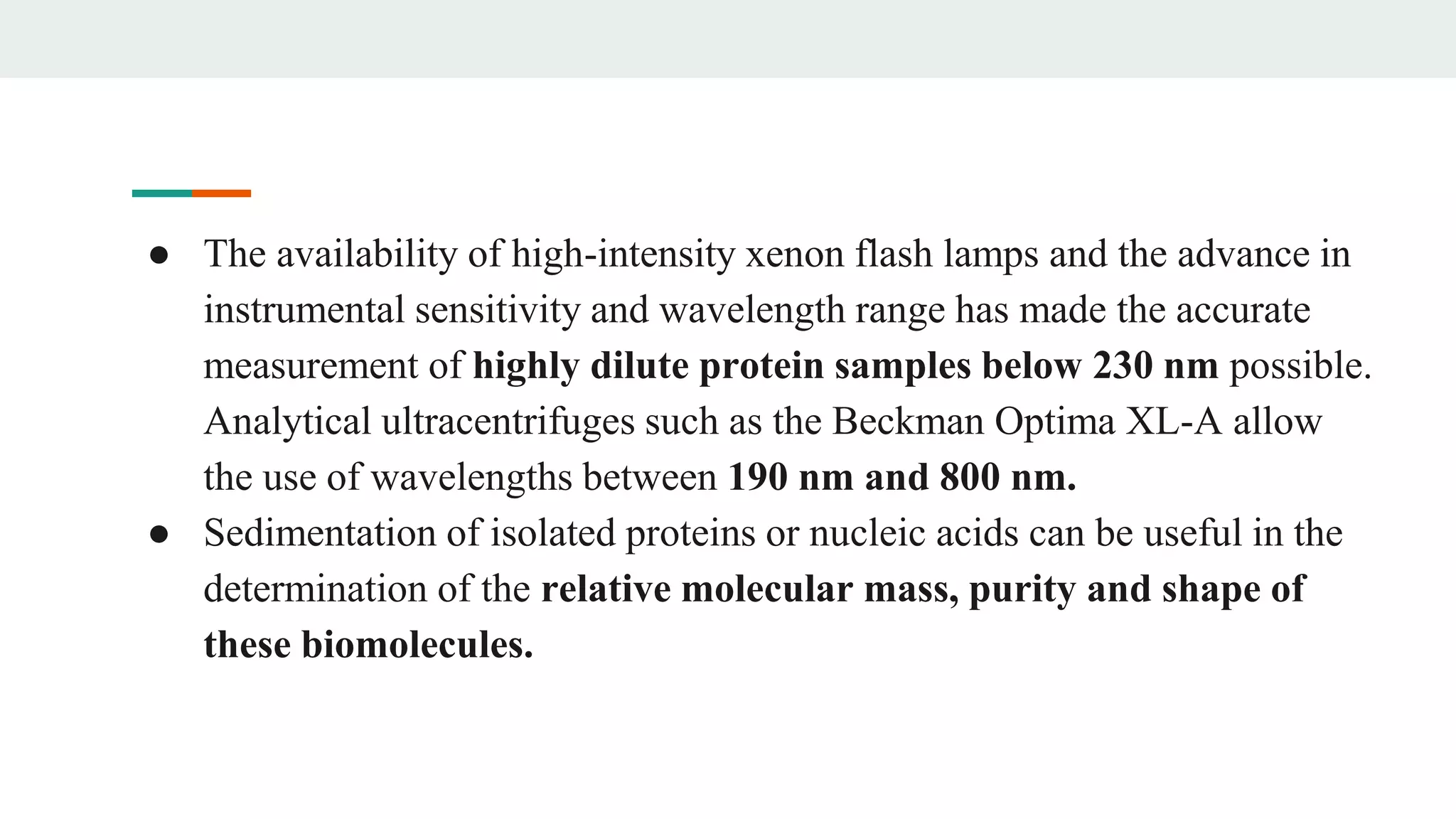
● The availability of high-intensity xenon flash lamps and the advance in
instrumental sensitivity and wavelength range has made the accurate
measurement of highly dilute protein samples below 230 nm possible.
Analytical ultracentrifuges such as the Beckman Optima XL-A allow
the use of wavelengths between 190 nm and 800 nm.
● Sedimentation of isolated proteins or nucleic acids can be useful in the
determination of the relative molecular mass, purity and shape of
these biomolecules.
Analytical ultracentrifugation for the determination of the relative molecular mass
● Sedimentation
velocity approach
● Sedimentation equilibrium
methodology
● For the accurate determination of the molecular mass of solutes in their native state,
analytical ultracentrifugation represents an unrivalled technique.
● The method requires only small sample sizes (20–120mm3) and low particle
concentrations (0.01–1 g dm3) and biological molecules with a wide range of
molecular masses can be characterised.
● In conjunction with electrophoretic, chromatographic, crystallographic and sequencing
data, the biochemical properties of a biological particle of interest can be determined in
great detail.
Sedimentation velocity approach
● The sedimentation velocity method can be employed to estimate
sample purity.
● This method measures the refractive index gradient at each point in the
ultracentrifugation cell at varying time intervals.
● During the entire duration of the sedimentation velocity analysis, a
homogeneous preparation forms a single sharp symmetrical
sedimenting boundary.
● Such a result demonstrates that the biological macromolecules analysed
exhibit the same molecular mass, shape and size.
● Sedimentation equilibrium experiments can be used to determine the
relative size of individual subunits participating in complex
formation, the stoichiometry and size of a complex assembly under
different physiological conditions and the strength of interactions
between subunits.
● In this experiment, samples are spun at lower speeds until the opposing
forces of sedimentation and diffusion acting on the protein come
into equilibrium. At that point, there is no net movement of the
proteins in the sample cell, and a stable equilibrium concentration
gradient is formed.
Sedimentation equilibrium methodology
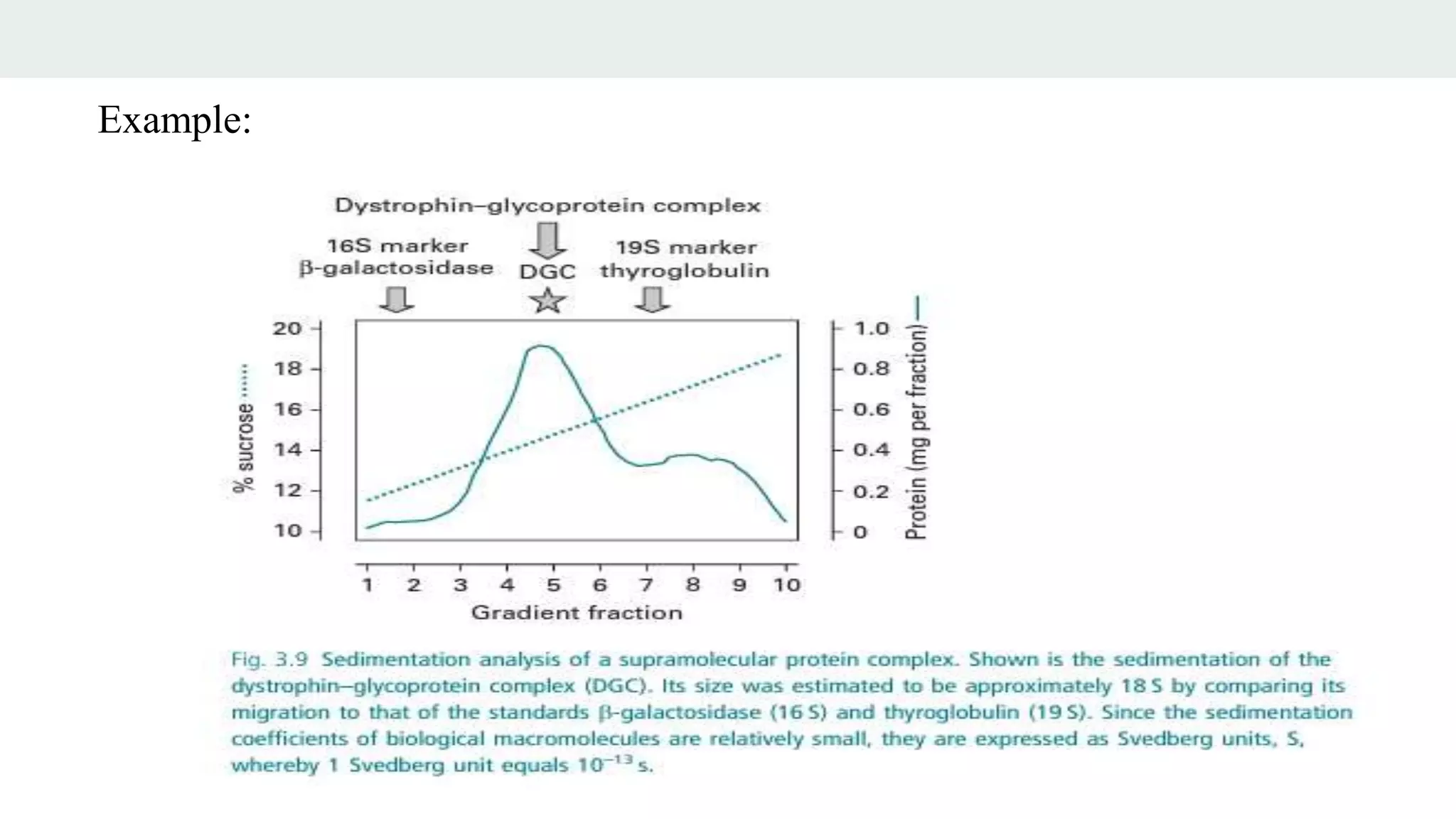
Example:
Analytical ultracentrifugation is most often employed in
• The determination of the purity of macromolecules
• The determination of the relative molecular mass of solutes in their
native state
• The examination of changes in the molecular mass of supramolecular
complexes
• The detection of conformational changes
• Ligand-binding studies
Applications Of Analytical Ultracentrifugation

_centrifugation .pptx

  • 1.
  • 2.
    Introduction ● Centrifugation isthe process of rapidly rotating container that applies centrifugal force to its contents, typically to separating fluids of different densities or solids from fluids. ● The centrifugal force causes increase in gravitational force thus speeding the process of sedimentation during separation. ● It was in 1923 that Svedberg and Nicols employed a centrifuge for the first times to speed up the rate of sedimentation for the purpose of measuring particle sizes. ● The applications of this technique range from collection and separation of cells, organelles and molecules. To the study of molecular weights of macromolecules.
  • 3.
  • 4.
    Basic Principles ofsedimentation An object moving in a Circle at a steady angular velocity will experience a force, F directed outwards. This is the basis of centrifugation. Angular velocity in radians, ω and the radius of rotation, r in centimeters collectively determine the magnitude of the force F. F=ω2r F might be expressed in terms of earth's gravitational force if it is divided by 980. The resultant is referred to as the relative centrifugal force. RCF. RCF is more frequently referred to as the 'number times g'.
  • 5.
    Relationship between rcfand rpm RPM is known as ‘revolutions per minute’ Radius, ω and rpm share the following relationship;
  • 6.
    Relationship between radius,rotor speed and relative centrifugal force.
  • 7.
    Characteristics of sedimentation ●Apart from RCF, the rate of sedimentation of a given particle would also depend upon its own characteristics such as its density, and its radius. ● The characteristics of the medium in which the particle is suspended -its density, viscosity -will also tend to affect the rate of sedimentation of the given particle. ● The larger the particle. the faster it will move (the size is the single most important factor). ● The more dense a particle is the faster it will move. ● The more dense a solution is the slower will be the movement of the particle. ● The higher the viscosity of the medium, the slower will be the particle movement.
  • 8.
    Types of rotors a.FixedAngle Rotor b.Vertical tube rotor c.Swinging Bucket rotor
  • 9.
    a. Fixed anglerotor Fixed angle rotor Separation in fixed angle rotor
  • 10.
    b. Vertical tube rotor Verticaltube rotor Separation in Vertical tube rotor
  • 11.
    c. Swinging bucketrotor Swinging bucket rotor Separation in Swinging bucket rotor
  • 12.
    Types of centrifugation PreparativeCentrifugation Analytical Centrifugation Differential Density Gradient Ultracentrifugation Sedimentation Velocity Approach Sedimentation Equilibrium Approach
  • 13.
  • 14.
    a. Differential Centrifugation ●Differential centrifugation is based upon the differences in the sedimentation rate of biological particles of different size and density. ● Example: Crude tissue homogenates containing organelles, membrane vesicles and other structural fragments are divided into different fractions by the stepwise increase of the applied centrifugal field. ● Following the initial sedimentation of the largest particles of a homogenate (such as cellular debris) by centrifugation, various biological structures or aggregates are separated into pellet and supernatant fractions, depending upon the speed and time of individual centrifugation steps and the density and relative size of the particles.
  • 15.
    Fractionation of skeletalmuscle homogenate into various subcellular fraction
  • 16.
    ● Density Gradientcentrifugation is also known as isopycnic centrifugation, is a technique in which molecules moved through a density gradient until they found density equal to their own. ● To further separate biological particles of similar size but differing density, Density gradient with preformed or self-establishing density gradients is the method of choice. B. Density Gradient Centrifugation Sucrose Density Gradient
  • 17.
    ● Depending onthe particular biological application, a great variety of gradient materials are available. Caesium chloride is widely used for the banding of DNA and the isolation of plasmids, nucleoproteins and viruses. Sodium bromide and sodium iodide are employed for the fractionation of lipoproteins and the banding of DNA or RNA molecules, respectively. ● Various companies offer a range of gradient material for the separation of whole cells and subcellular particles, e.g. Percoll, Ficoll, Dextran, Metrizamide and Nycodenz Gradient Materials
  • 19.
  • 20.
    Example of densitygradient centrifugation
  • 21.
    ● Ultracentrifugation: A typicalanalytical ultracentrifuge can generate a centrifugal field of 250000 g in its analytical cell. Within these extremely high gravitational fields, the ultracentrifuge cell has to allow light passage through the biological particles for proper measurement of the concentration distribution. Analytical Centrifugation
  • 23.
    ● The availabilityof high-intensity xenon flash lamps and the advance in instrumental sensitivity and wavelength range has made the accurate measurement of highly dilute protein samples below 230 nm possible. Analytical ultracentrifuges such as the Beckman Optima XL-A allow the use of wavelengths between 190 nm and 800 nm. ● Sedimentation of isolated proteins or nucleic acids can be useful in the determination of the relative molecular mass, purity and shape of these biomolecules.
  • 24.
    Analytical ultracentrifugation forthe determination of the relative molecular mass ● Sedimentation velocity approach ● Sedimentation equilibrium methodology ● For the accurate determination of the molecular mass of solutes in their native state, analytical ultracentrifugation represents an unrivalled technique. ● The method requires only small sample sizes (20–120mm3) and low particle concentrations (0.01–1 g dm3) and biological molecules with a wide range of molecular masses can be characterised. ● In conjunction with electrophoretic, chromatographic, crystallographic and sequencing data, the biochemical properties of a biological particle of interest can be determined in great detail.
  • 25.
    Sedimentation velocity approach ●The sedimentation velocity method can be employed to estimate sample purity. ● This method measures the refractive index gradient at each point in the ultracentrifugation cell at varying time intervals. ● During the entire duration of the sedimentation velocity analysis, a homogeneous preparation forms a single sharp symmetrical sedimenting boundary. ● Such a result demonstrates that the biological macromolecules analysed exhibit the same molecular mass, shape and size.
  • 26.
    ● Sedimentation equilibriumexperiments can be used to determine the relative size of individual subunits participating in complex formation, the stoichiometry and size of a complex assembly under different physiological conditions and the strength of interactions between subunits. ● In this experiment, samples are spun at lower speeds until the opposing forces of sedimentation and diffusion acting on the protein come into equilibrium. At that point, there is no net movement of the proteins in the sample cell, and a stable equilibrium concentration gradient is formed. Sedimentation equilibrium methodology
  • 27.
  • 28.
    Analytical ultracentrifugation ismost often employed in • The determination of the purity of macromolecules • The determination of the relative molecular mass of solutes in their native state • The examination of changes in the molecular mass of supramolecular complexes • The detection of conformational changes • Ligand-binding studies Applications Of Analytical Ultracentrifugation