Central line and Arterial
line insertion
DR. RUCHI GUPTA
CONSULTANT DEPARTMENT OF CRITICAL CARE
Central line
Central line insertion: Indications
•Hemodynamic instability that requires vasopressor support
•Need to instill hyperosmolar agents or agents known to cause vein
scarring (phlebosclerosis)
•Inadequate peripheral IV access (either failure to obtain peripheral
access anywhere, or needing multiple IVs to sustain and resuscitate
a patient)
•Mass transfusion protocol in patients with inadequate peripheral
access
Go to:
Contraindications
 Coagulopathy
 Infection at the insertion site (cellulitis, abscess)
 History of surgical manipulation or trauma at the insertion site
 Trauma to other structures (e.g. cervical spine collar is a soft
contraindication to an IJ central venous catheter (CVC) placement, a
pelvic binder is a contraindication to a femoral CVC placement)
Preparation
Obtain procedural consent as appropriate
.
•Obtain the equipment and devices needed for catheter placement.
•Select access site appropriate to the clinical situation.
•Prepare and position the patient, with attention to ensuring patient monitoring and support as
needed for the situation.
•Identify pertinent surface landmarks with special attention to access to the intended puncture site.
•Confirm the location and patency of the target vein and relationship to surface landmarks with
ultrasound, as available.
•Pause for a procedural time-out to verify the procedure, site, and technique with team members.
•Use sterile technique to prepare the skin and drape the patient.
Preparation
 Take a moment to confirm that you are with the
 right patient,
 performing the right procedure at the right site (commonly called a "time
out").
 All equipment prepared for procedure
Equipment
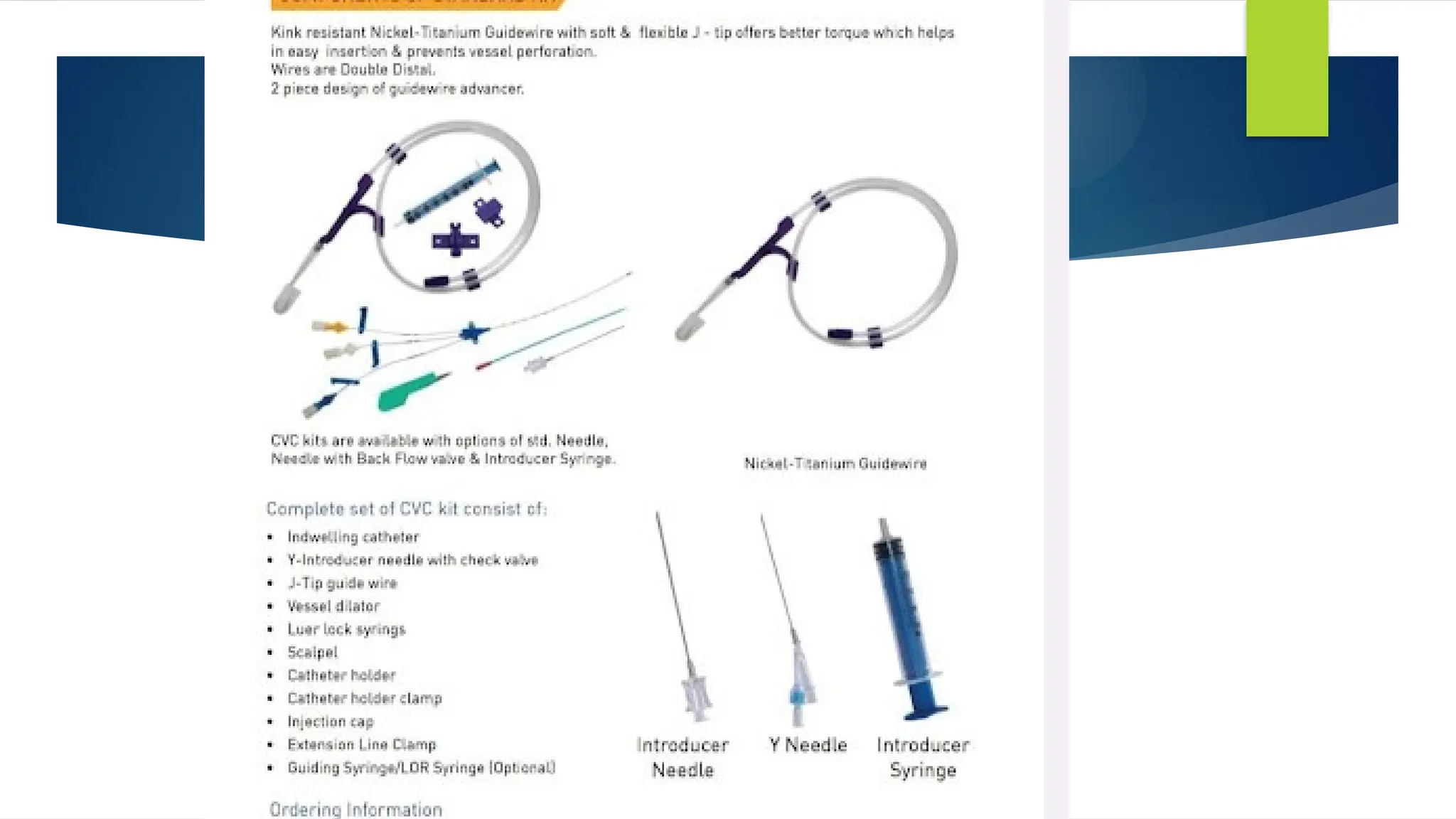
 Central line insertion kit, which is usually manufacturer-specific should contain the all
the equipment for the central line and Seldinger technique, including a central venous
catheter, guidewire, syringe, an introducer needle, a scalpel, a silk suture (on a Keith or
curved needle) and a skin dilator
 Sterile gloves and gown
 Hat and mask
 Drape or sterile towels to create a sterile barrier (to protect equipment and materials
from becoming contaminated)
 Antiseptic agent for skin preparation
 Proper caps for each lumen port
 Dressing to cover the insertion site
 Local anesthetic (1% to 2% lidocaine is supplied in most commercial kits) with a syringe
and needle to instill the medication
 All patients should be monitored during central
venous access procedures, including continuous
cardiac rhythm and pulse oximetry.
 Supplemental oxygen should be immediately
available,
Personnel
When possible, having an assistant present during the procedure is helpful.
Device and site selection —
 The most appropriate site and approach for
central venous cannulation should be
individualized based on the clinical situation
 Operator skill,
 ultrasound availability
 precannulation vein anatomy and patency
assessment,
 patient anatomy
 Aseptic technique — To reduce infectious complications, rmed in a
location that permits the use of aseptic technique.
 ●Barrier precautions –includes sterile drapes large enough to cover
the entire patient, sterile cover for ultrasound probe, surgical
antiseptic hand wash, long-sleeved sterile gown, surgical mask,
gloves, and head cover.
 Skin antisepsis – Preinsertion application of antiseptic solution for
skin disinfection at the catheter insertion site reduces catheter
colonization and aims to reduce risk of infection.
 Chlorhexidine gluconate (CHG)-based solutions (>0.5% chlorhexidine
preparation with alcohol) are superior to both aqueous and alcohol-
based povidone-iodine (PI) solutions
Needle access to the target vein
 Flush the catheter lumens with sterile saline. Arrange and position central venous access
supplies to expedite the procedure.
 Re-identify pertinent anatomic landmarks, even if ultrasound will be used. Reconfirm the
vein target with ultrasound.
 Infiltrate the skin with local anesthetic (eg, 1 to 2% lidocaine or an alternative agent) at
the intended insertion site.
 Use real-time ultrasound imaging to cannulate the vein using a standard introducer
needle, micropuncture needle, or angiocatheter.
 Using landmark and ultrasound guidance of the needle trajectory, insert and advance
the needle while applying continuous negative pressure on the syringe plunger.
 Monitor needle insertion depth, even during ultrasound guidance, to avoid deep tissue
penetration, which risks procedure complication.
 Aspiration of free-flowing venous-colored blood confirms vein cannulation*.
Jugular
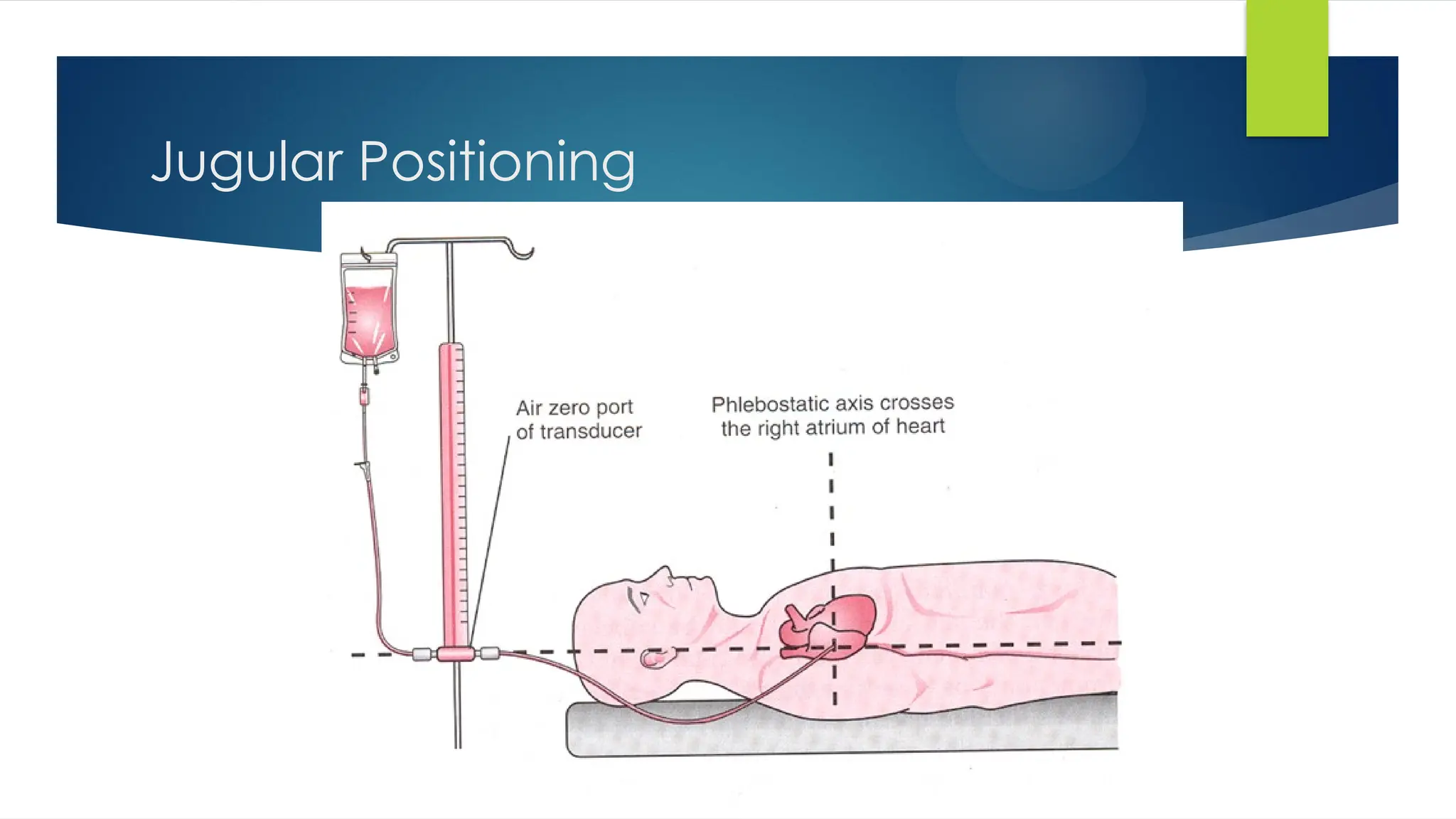
Jugular Positioning
In the middle approach to the subclavian vein, the
needle is inserted 2 to 3 cm inferior to the midpoint of
the clavicle. The needle is advanced while aiming for a
point just deep to the suprasternal notch.
Advance guidewire
 Gently remove the syringe from the needle hub while confirming low-pressure venous-
colored blood return. Cover the needle hub with a finger between manipulations to
avoid air entrainment.
 Insert the guidewire through the access needle or angiocatheter. The guidewire should
advance with minimal resistance. Maintain awareness of guidewire depth during
insertion.
 Advance the guidewire just beyond the anticipated catheter depth, which is
approximately 20 cm for adults and is often marked by two hash marks on the
guidewire.
 Avoid intracardiac advancement that may trigger arrhythmias.
 Confirm intravenous guidewire placement via ultrasound, if available.
 Remove the needle or angiocatheter while controlling the guidewire.
Uses of ultrasound in cannulation
 USE OF ULTRASOUND AND EFFICACY AT SPECIFIC SITES
 Use of ultrasound — We recommend ultrasound-guided venous
access
 Precannulation vein assessment — vein location, size, and
patency
 Real-time ultrasound guidance
 Detection of complications — Proper use of ultrasound aims to
reduce major complications.
 early detection of arterial and venous guidewire malposition and
identification of procedure-related pneumothorax
Place catheter
 Use a #11 scalpel blade to make a single stab skin incision at the puncture site and along the
guidewire path.
 Advance the tissue dilator over the guidewire to the approximate depth of the vein but not
deeper, then remove the tissue dilator while maintaining guidewire position.
 Load the venous catheter onto the guidewire while maintaining control of the guidewire at
the skin entry site.
 Back the guidewire out of the vein through the catheter until it emerges from the distal
access port. This allows continuous manual contact with the guidewire to avoid inadvertent
catheter insertion without guidewire removal, which is the common mistake leading to a
retained guidewire.
 Stabilize the distal guidewire as it exits the distal access port while
advancing the catheter over the guidewire into the vein.
 With the catheter in place, remove the guidewire, taking care to
stabilize the catheter to maintain intravascular placement.
 Place the removed guidewire in a visible location on the sterile
field as a confirmation step for guidewire removal. This also
maintains guidewire sterility in case the guidewire is again needed
to troubleshoot catheter malposition.
 Aspirate blood from each access hub and flush with sterile saline
to ensure a functioning catheter.
 Secure catheter and place sterile dressing.
Confirm catheter position
 n emergency situations, the central venous access may be used
immediately*.
 Obtain chest radiography to confirm catheter tip position for jugular and
subclavian approaches. Femoral catheters do not require radiologic
confirmation
 Complications
 Pneumothorax
 Pericardial effusion/tamponade
 Bleeding
 Arterial puncture with an expanding hematoma (can cause airway compromise in IJ)
 Infection
 Thrombosis
 Injury to the nerves
 Losing guidewire inside the vein
 Air embolism
 Arrhythmias
Central line care
Catheter and site care and
maintenance
 If adherence to sterile technique during placement cannot be assured,
the catheter should be replaced as soon as possible (and within 48 hours
after insertion).
 Replace dressings whenever soiled. Otherwise, routinely change
polyurethane dressings every 7 days.
 Routine catheter replacement is not necessary. When replacement is
needed based on clinical examination, replace at a new site, rather than
using guidewire exchange.
Arterial line
Indication
 Continuous monitoring of arterial BP:
 Shock
 Uncontrolled hypertension
 Strict BP monitoring: ICH, SAH
 Evaluation of respirophasic variations in the arterial pressure
waveform to predict fluid responsiveness
 Frequent blood sampling : ABG
SITE SELECTION
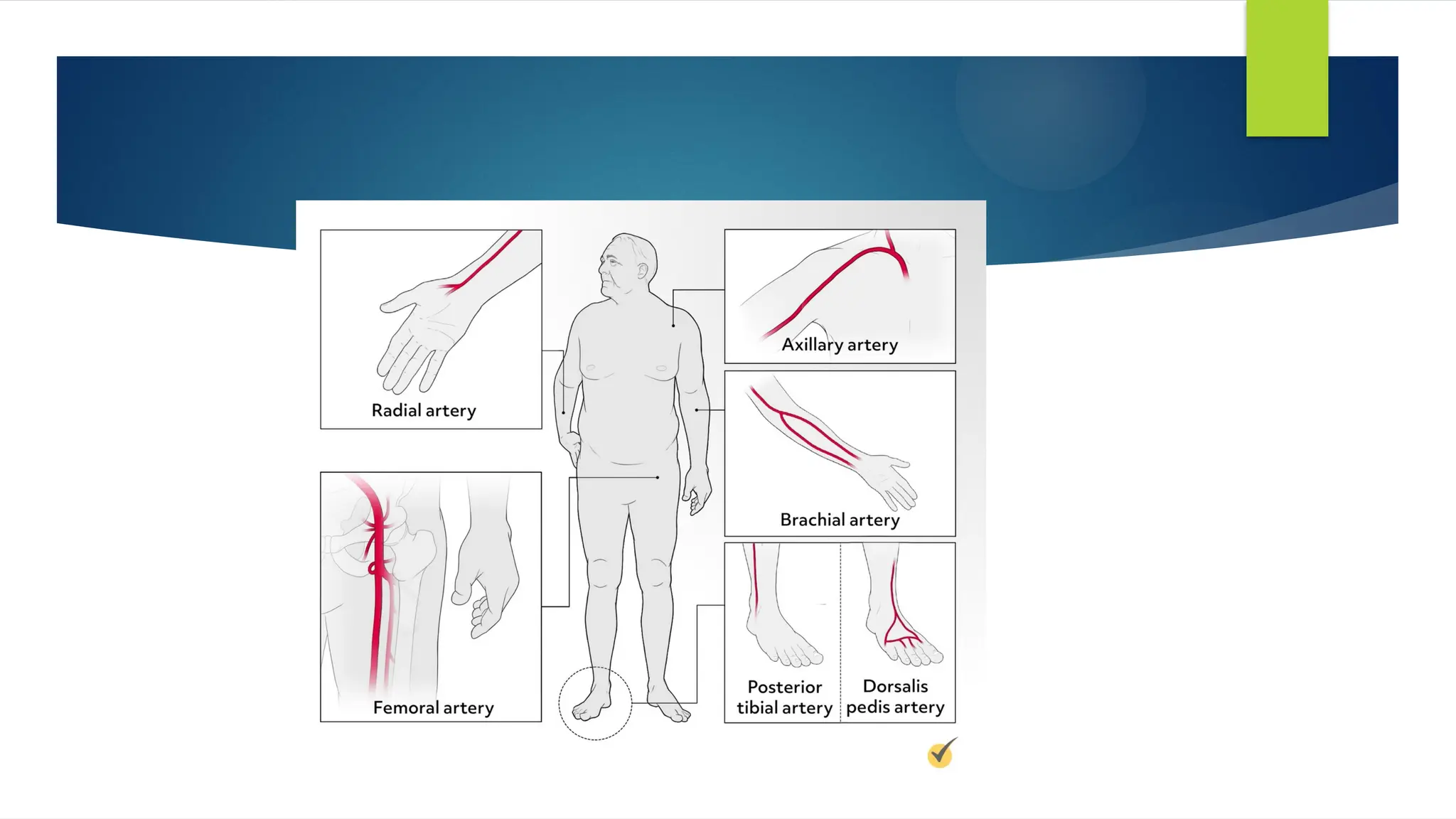
 location of a palpable arterial pulse.
 peripheral arteries (radial [most common], brachial, or dorsalis pedis sites)
and
 central arteries (femoral [most common] or axillary sites).
 Immobilization – If the radial artery is selected, the wrist is often
immobilized on a padded arm board. At the brachial or femoral site,
positioning to straighten the extremity is helpful for initial catheter insertion
and maintenance of catheter integrity.
INSERTION TECHNIQUES
 performed using standard sterile precautions.
 All equipment including equipment for
monitoring and the ultrasonography device
should be prepared and the transducer zeroed
and ready for use. T
 Sterile technique — The access site is prepared with standard techniques. For peripheral
arterial access sites (ie, radial, brachial, dorsalis pedis), a chlorhexidine-alcohol skin
antiseptic solution is applied to the access site and allowed to dry, and
 sterile gloves are worn.
 If a fenestrated drape is used, it should be positioned after the antiseptic solution is dry
on the skin
 For central arterial access sites (ie, femoral, axillary), full barrier precautions including
masks, caps, and eye protection can be used to reduce the potential for catheter site
infection and minimize risk for disease transmission associated with blood splatter
 Local anesthetic injection —
 conscious patients. Injection of local anesthetic does not
adversely impact the success of the procedure and may
reduce vasospasm.
 In particular, local anesthesia is necessary in awake
patients with tough skin if a small dermatotomy (ie, "skin
nick") is made in order to prevent occlusion of the
insertion needle with a skin plug and/or damage to the
plastic catheter.
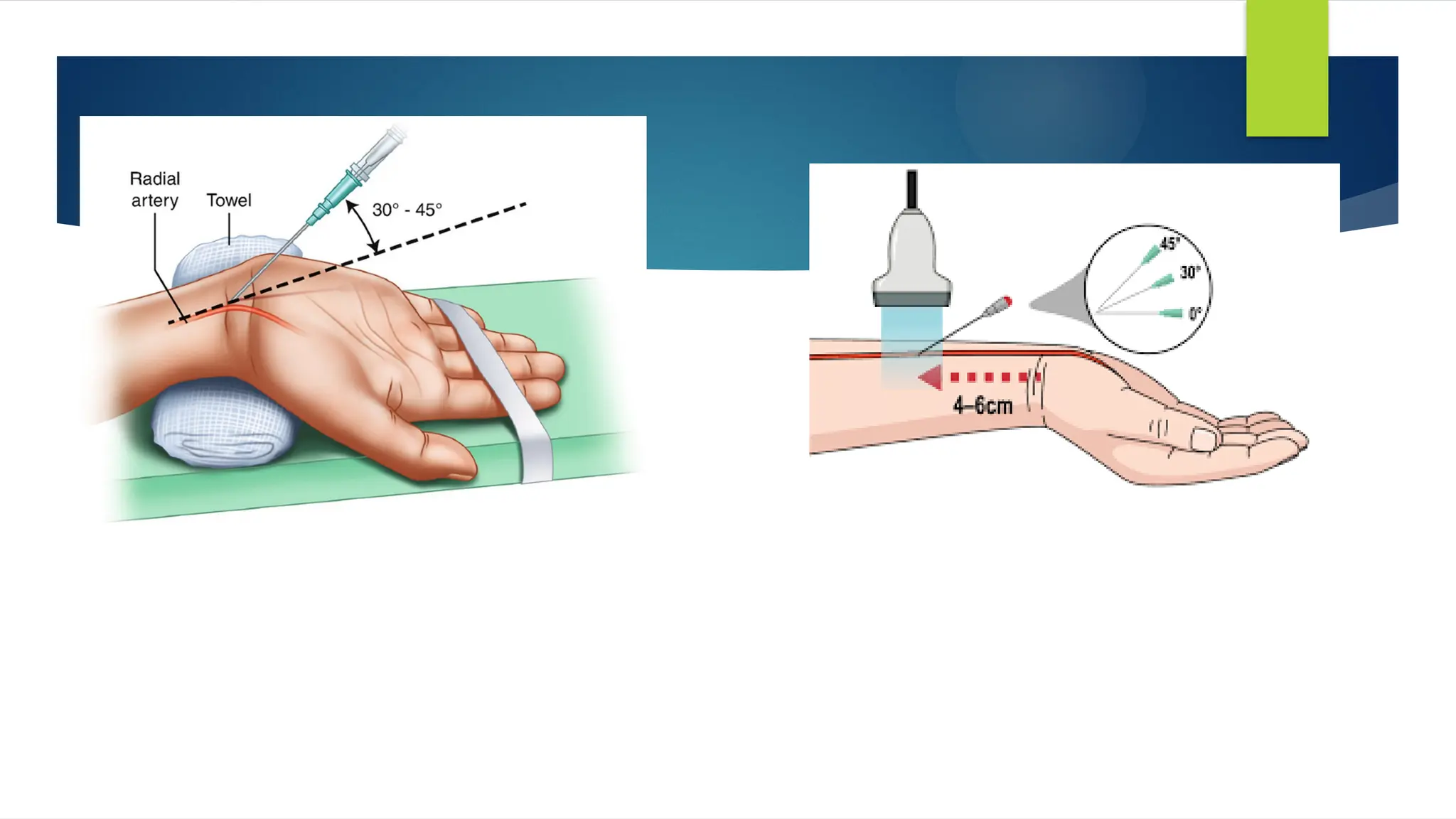
Radial artery cannulisation
 Catheter stabilization —
 All equipment should be prepared in advance, including
syringes with flush solution and the tubing that will be
connected to the arterial catheter. Once the catheter is
advanced into the artery, the needle is removed.
 The artery should be compressed proximal to the catheter
to prevent bleeding after removing the needle and during
connection of the pre-flushed arterial tubing.
 Finally, the catheter should be secured via sutures or with
a transparent adhesive dressing.
Complications
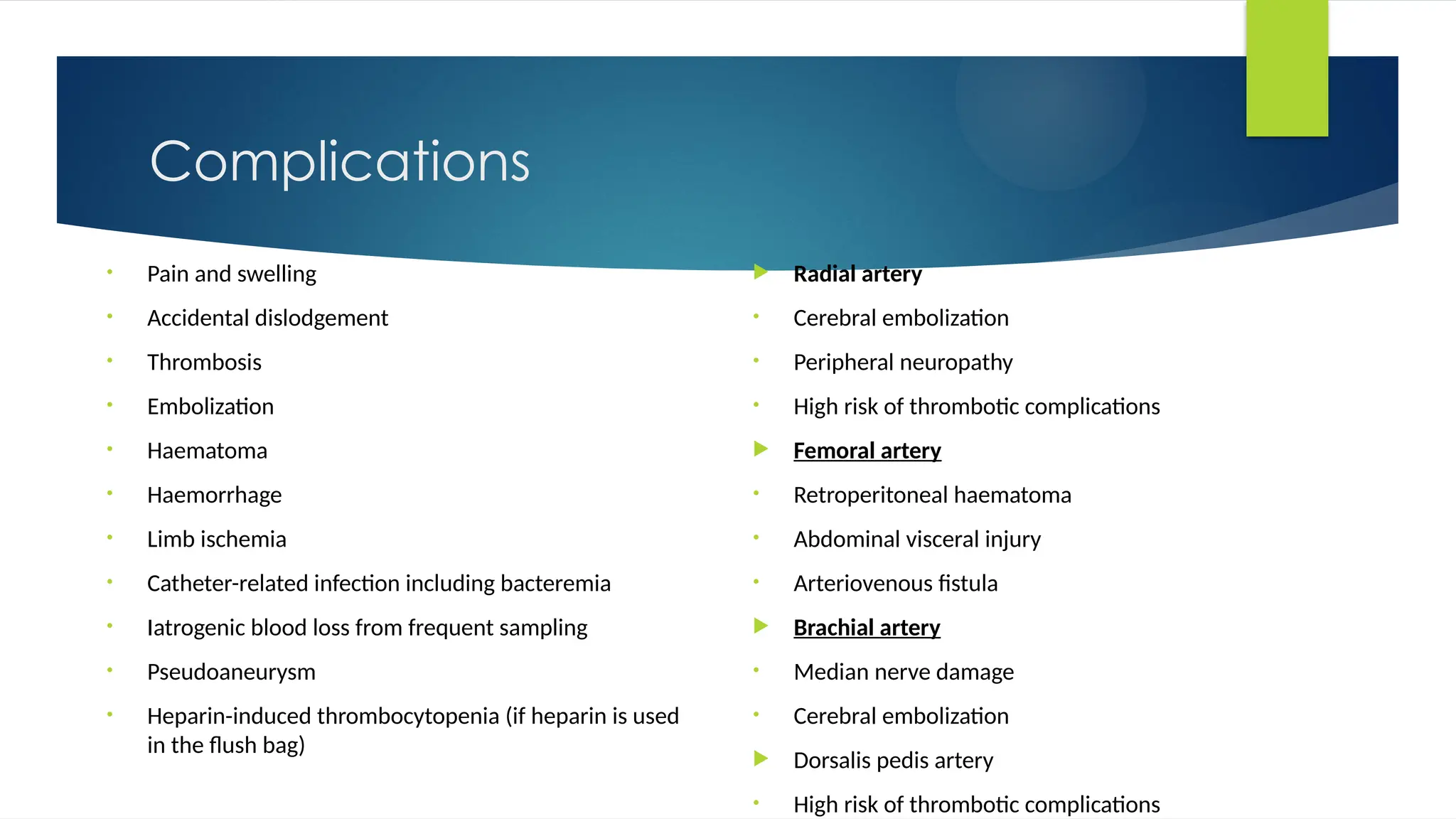
• Pain and swelling
• Accidental dislodgement
• Thrombosis
• Embolization
• Haematoma
• Haemorrhage
• Limb ischemia
• Catheter-related infection including bacteremia
• Iatrogenic blood loss from frequent sampling
• Pseudoaneurysm
• Heparin-induced thrombocytopenia (if heparin is used
in the flush bag)
 Radial artery
• Cerebral embolization
• Peripheral neuropathy
• High risk of thrombotic complications
 Femoral artery
• Retroperitoneal haematoma
• Abdominal visceral injury
• Arteriovenous fistula
 Brachial artery
• Median nerve damage
• Cerebral embolization
 Dorsalis pedis artery
• High risk of thrombotic complications
Arterial line care
 Aseptic precautions
 All connections to be tight
 Check distal pulses every shift
 Maintain adequate pressure in pressure bag
 Avoid unnecessary disconnections
THANK YOU

central and arterial line in medicine .pptx

  • 1.
    Central line andArterial line insertion DR. RUCHI GUPTA CONSULTANT DEPARTMENT OF CRITICAL CARE
  • 2.
  • 5.
    Central line insertion:Indications •Hemodynamic instability that requires vasopressor support •Need to instill hyperosmolar agents or agents known to cause vein scarring (phlebosclerosis) •Inadequate peripheral IV access (either failure to obtain peripheral access anywhere, or needing multiple IVs to sustain and resuscitate a patient) •Mass transfusion protocol in patients with inadequate peripheral access Go to:
  • 6.
    Contraindications  Coagulopathy  Infectionat the insertion site (cellulitis, abscess)  History of surgical manipulation or trauma at the insertion site  Trauma to other structures (e.g. cervical spine collar is a soft contraindication to an IJ central venous catheter (CVC) placement, a pelvic binder is a contraindication to a femoral CVC placement)
  • 7.
    Preparation Obtain procedural consentas appropriate . •Obtain the equipment and devices needed for catheter placement. •Select access site appropriate to the clinical situation. •Prepare and position the patient, with attention to ensuring patient monitoring and support as needed for the situation. •Identify pertinent surface landmarks with special attention to access to the intended puncture site. •Confirm the location and patency of the target vein and relationship to surface landmarks with ultrasound, as available. •Pause for a procedural time-out to verify the procedure, site, and technique with team members. •Use sterile technique to prepare the skin and drape the patient.
  • 8.
    Preparation  Take amoment to confirm that you are with the  right patient,  performing the right procedure at the right site (commonly called a "time out").  All equipment prepared for procedure
  • 9.
    Equipment  Central lineinsertion kit, which is usually manufacturer-specific should contain the all the equipment for the central line and Seldinger technique, including a central venous catheter, guidewire, syringe, an introducer needle, a scalpel, a silk suture (on a Keith or curved needle) and a skin dilator  Sterile gloves and gown  Hat and mask  Drape or sterile towels to create a sterile barrier (to protect equipment and materials from becoming contaminated)  Antiseptic agent for skin preparation  Proper caps for each lumen port  Dressing to cover the insertion site  Local anesthetic (1% to 2% lidocaine is supplied in most commercial kits) with a syringe and needle to instill the medication
  • 11.
     All patientsshould be monitored during central venous access procedures, including continuous cardiac rhythm and pulse oximetry.  Supplemental oxygen should be immediately available,
  • 12.
    Personnel When possible, havingan assistant present during the procedure is helpful.
  • 13.
    Device and siteselection —  The most appropriate site and approach for central venous cannulation should be individualized based on the clinical situation  Operator skill,  ultrasound availability  precannulation vein anatomy and patency assessment,  patient anatomy
  • 14.
     Aseptic technique— To reduce infectious complications, rmed in a location that permits the use of aseptic technique.  ●Barrier precautions –includes sterile drapes large enough to cover the entire patient, sterile cover for ultrasound probe, surgical antiseptic hand wash, long-sleeved sterile gown, surgical mask, gloves, and head cover.  Skin antisepsis – Preinsertion application of antiseptic solution for skin disinfection at the catheter insertion site reduces catheter colonization and aims to reduce risk of infection.  Chlorhexidine gluconate (CHG)-based solutions (>0.5% chlorhexidine preparation with alcohol) are superior to both aqueous and alcohol- based povidone-iodine (PI) solutions
  • 15.
    Needle access tothe target vein  Flush the catheter lumens with sterile saline. Arrange and position central venous access supplies to expedite the procedure.  Re-identify pertinent anatomic landmarks, even if ultrasound will be used. Reconfirm the vein target with ultrasound.  Infiltrate the skin with local anesthetic (eg, 1 to 2% lidocaine or an alternative agent) at the intended insertion site.  Use real-time ultrasound imaging to cannulate the vein using a standard introducer needle, micropuncture needle, or angiocatheter.  Using landmark and ultrasound guidance of the needle trajectory, insert and advance the needle while applying continuous negative pressure on the syringe plunger.  Monitor needle insertion depth, even during ultrasound guidance, to avoid deep tissue penetration, which risks procedure complication.  Aspiration of free-flowing venous-colored blood confirms vein cannulation*.
  • 16.
  • 17.
  • 18.
    In the middleapproach to the subclavian vein, the needle is inserted 2 to 3 cm inferior to the midpoint of the clavicle. The needle is advanced while aiming for a point just deep to the suprasternal notch.
  • 19.
    Advance guidewire  Gentlyremove the syringe from the needle hub while confirming low-pressure venous- colored blood return. Cover the needle hub with a finger between manipulations to avoid air entrainment.  Insert the guidewire through the access needle or angiocatheter. The guidewire should advance with minimal resistance. Maintain awareness of guidewire depth during insertion.  Advance the guidewire just beyond the anticipated catheter depth, which is approximately 20 cm for adults and is often marked by two hash marks on the guidewire.  Avoid intracardiac advancement that may trigger arrhythmias.  Confirm intravenous guidewire placement via ultrasound, if available.  Remove the needle or angiocatheter while controlling the guidewire.
  • 20.
    Uses of ultrasoundin cannulation  USE OF ULTRASOUND AND EFFICACY AT SPECIFIC SITES  Use of ultrasound — We recommend ultrasound-guided venous access  Precannulation vein assessment — vein location, size, and patency  Real-time ultrasound guidance  Detection of complications — Proper use of ultrasound aims to reduce major complications.  early detection of arterial and venous guidewire malposition and identification of procedure-related pneumothorax
  • 21.
    Place catheter  Usea #11 scalpel blade to make a single stab skin incision at the puncture site and along the guidewire path.  Advance the tissue dilator over the guidewire to the approximate depth of the vein but not deeper, then remove the tissue dilator while maintaining guidewire position.  Load the venous catheter onto the guidewire while maintaining control of the guidewire at the skin entry site.  Back the guidewire out of the vein through the catheter until it emerges from the distal access port. This allows continuous manual contact with the guidewire to avoid inadvertent catheter insertion without guidewire removal, which is the common mistake leading to a retained guidewire.
  • 24.
     Stabilize thedistal guidewire as it exits the distal access port while advancing the catheter over the guidewire into the vein.  With the catheter in place, remove the guidewire, taking care to stabilize the catheter to maintain intravascular placement.  Place the removed guidewire in a visible location on the sterile field as a confirmation step for guidewire removal. This also maintains guidewire sterility in case the guidewire is again needed to troubleshoot catheter malposition.  Aspirate blood from each access hub and flush with sterile saline to ensure a functioning catheter.  Secure catheter and place sterile dressing.
  • 26.
    Confirm catheter position n emergency situations, the central venous access may be used immediately*.  Obtain chest radiography to confirm catheter tip position for jugular and subclavian approaches. Femoral catheters do not require radiologic confirmation
  • 29.
     Complications  Pneumothorax Pericardial effusion/tamponade  Bleeding  Arterial puncture with an expanding hematoma (can cause airway compromise in IJ)  Infection  Thrombosis  Injury to the nerves  Losing guidewire inside the vein  Air embolism  Arrhythmias
  • 31.
  • 32.
    Catheter and sitecare and maintenance  If adherence to sterile technique during placement cannot be assured, the catheter should be replaced as soon as possible (and within 48 hours after insertion).  Replace dressings whenever soiled. Otherwise, routinely change polyurethane dressings every 7 days.  Routine catheter replacement is not necessary. When replacement is needed based on clinical examination, replace at a new site, rather than using guidewire exchange.
  • 33.
  • 34.
    Indication  Continuous monitoringof arterial BP:  Shock  Uncontrolled hypertension  Strict BP monitoring: ICH, SAH  Evaluation of respirophasic variations in the arterial pressure waveform to predict fluid responsiveness  Frequent blood sampling : ABG
  • 35.
    SITE SELECTION  locationof a palpable arterial pulse.  peripheral arteries (radial [most common], brachial, or dorsalis pedis sites) and  central arteries (femoral [most common] or axillary sites).  Immobilization – If the radial artery is selected, the wrist is often immobilized on a padded arm board. At the brachial or femoral site, positioning to straighten the extremity is helpful for initial catheter insertion and maintenance of catheter integrity.
  • 37.
    INSERTION TECHNIQUES  performedusing standard sterile precautions.  All equipment including equipment for monitoring and the ultrasonography device should be prepared and the transducer zeroed and ready for use. T
  • 39.
     Sterile technique— The access site is prepared with standard techniques. For peripheral arterial access sites (ie, radial, brachial, dorsalis pedis), a chlorhexidine-alcohol skin antiseptic solution is applied to the access site and allowed to dry, and  sterile gloves are worn.  If a fenestrated drape is used, it should be positioned after the antiseptic solution is dry on the skin  For central arterial access sites (ie, femoral, axillary), full barrier precautions including masks, caps, and eye protection can be used to reduce the potential for catheter site infection and minimize risk for disease transmission associated with blood splatter
  • 40.
     Local anestheticinjection —  conscious patients. Injection of local anesthetic does not adversely impact the success of the procedure and may reduce vasospasm.  In particular, local anesthesia is necessary in awake patients with tough skin if a small dermatotomy (ie, "skin nick") is made in order to prevent occlusion of the insertion needle with a skin plug and/or damage to the plastic catheter.
  • 43.
  • 47.
     Catheter stabilization—  All equipment should be prepared in advance, including syringes with flush solution and the tubing that will be connected to the arterial catheter. Once the catheter is advanced into the artery, the needle is removed.  The artery should be compressed proximal to the catheter to prevent bleeding after removing the needle and during connection of the pre-flushed arterial tubing.  Finally, the catheter should be secured via sutures or with a transparent adhesive dressing.
  • 49.
    Complications • Pain andswelling • Accidental dislodgement • Thrombosis • Embolization • Haematoma • Haemorrhage • Limb ischemia • Catheter-related infection including bacteremia • Iatrogenic blood loss from frequent sampling • Pseudoaneurysm • Heparin-induced thrombocytopenia (if heparin is used in the flush bag)  Radial artery • Cerebral embolization • Peripheral neuropathy • High risk of thrombotic complications  Femoral artery • Retroperitoneal haematoma • Abdominal visceral injury • Arteriovenous fistula  Brachial artery • Median nerve damage • Cerebral embolization  Dorsalis pedis artery • High risk of thrombotic complications
  • 50.
    Arterial line care Aseptic precautions  All connections to be tight  Check distal pulses every shift  Maintain adequate pressure in pressure bag  Avoid unnecessary disconnections
  • 51.