MATERIAL
FROM QUARRY
MATERIAL
FROM QUARRY
Faculty of graduate studies and advanced science
CEMENT COURSE
Mohamed Abuelseoud
Asst. Lecturer in environment and industry development department
Prepared by:
CEMENT COURSE
MATERIAL
FROM QUARRY
MATERIAL
FROM QUARRY
Introduction
CEMENT COURSE
History
Cement was first invented by the Egyptians. Cement was
later reinvented by the Greeks who made their mortar out of
lime. Later, the Romans produced cement from pozzolana, an
ash found in all of the volcanic areas of Italy, by mixing the ash
with lime.
The Egyptiens discovered lime
and gypsum mortar but to build
Pyramids they used only stones.
 Raw Materials
There are two types of raw materials which are combined to make
cement:
1. Lime-containing materials, such as limestone.
2. Clay and clay-like materials, such as slag from blast furnaces,
bauxite, iron ore, silica, sand, etc.
It takes approximately 3,400 lbs*. of raw materials to make one
ton (2,000 lbs*.) of Portland cement.
3
CEMENT COURSE
Ibs* : Irritable bowel syndrome
 Defination
Cement is a fine powder which, when mixed with water,
forms a thick paste. When this paste is mixed with sand and
gravel and allowed to dry it is called concrete.
4
Process
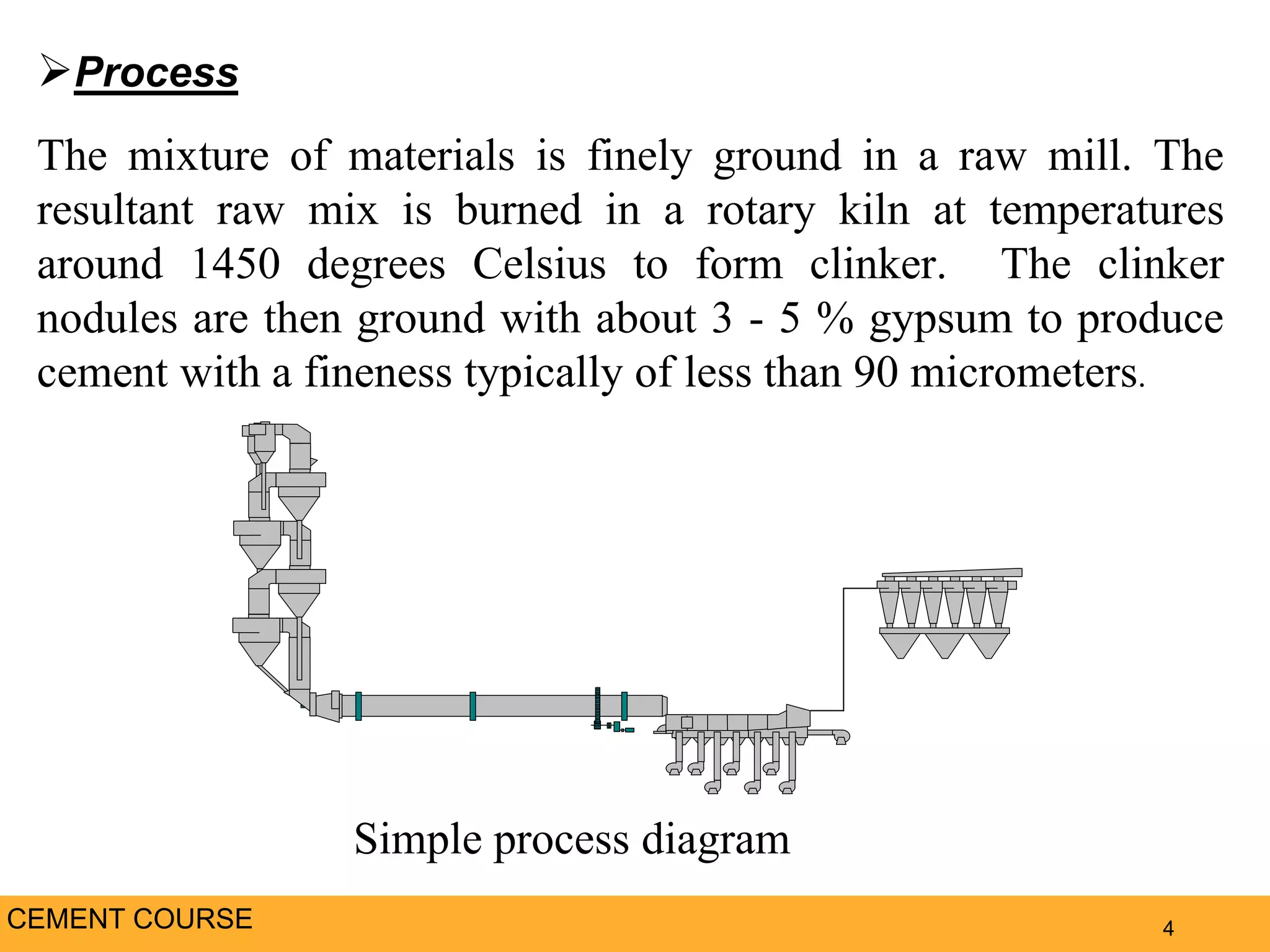
The mixture of materials is finely ground in a raw mill. The
resultant raw mix is burned in a rotary kiln at temperatures
around 1450 degrees Celsius to form clinker. The clinker
nodules are then ground with about 3 - 5 % gypsum to produce
cement with a fineness typically of less than 90 micrometers.
Simple process diagram
CEMENT COURSE
Course Agenda
5
Cement Chemistry
Cement Industry and Technology.
Cement and Environment.
Cement Alternatives.
CEMENT COURSE
Cement Chemistry
6CEMENT COURSE
7CEMENT COURSE
8
1. Quarries.
2. Respecting Standers EN 197-1
3. Owing ISO 9001 & 14001
CEMENT COURSE
9
The study of a cement plant starts with the search for raw
materials and the identification of their chemical and
physical characteristics,.The next stage is to select the
appropriate process for preparing the raw meal by evaluating
the raw materials needed to obtain the clinker-after that
cements, looking at each and every stage of manufacture
(quarry extraction, crushing, pre-homogenization, control and
homogenization system, burn process, etc.), Looking after
solutions to make easy the quality control.
CEMENT COURSE
 All reactions inside the kiln are solid-solid reactions and
depending on the kiln burn-ability and kiln rpm.
10
Calcinations zone Transition zone Burning zoneLiquid zone
CEMENT COURSE
The principal phases of the clinker are:
A. Alite (C3S).
B. Belite(C2S).
C. Aluminate (C3A).
D. Ferrite low quantity (C4AF).
11CEMENT COURSE
12CEMENT COURSE
Gypsum added to the clinker during grinding not
only regulates the setting time but also modifies some
properties of the hardened paste such as the
mechanical strength, shrinkage, resistance to sulfate
attack and the heat of hydration.
All of these properties represent optimum values in
relation to the given dosages of gypsum (3.0 – 5.0 %)
Course Agenda
13
Cement Chemistry
Cement Industry and Technology.
Cement and Environment.
Cement Alternatives.
CEMENT COURSE
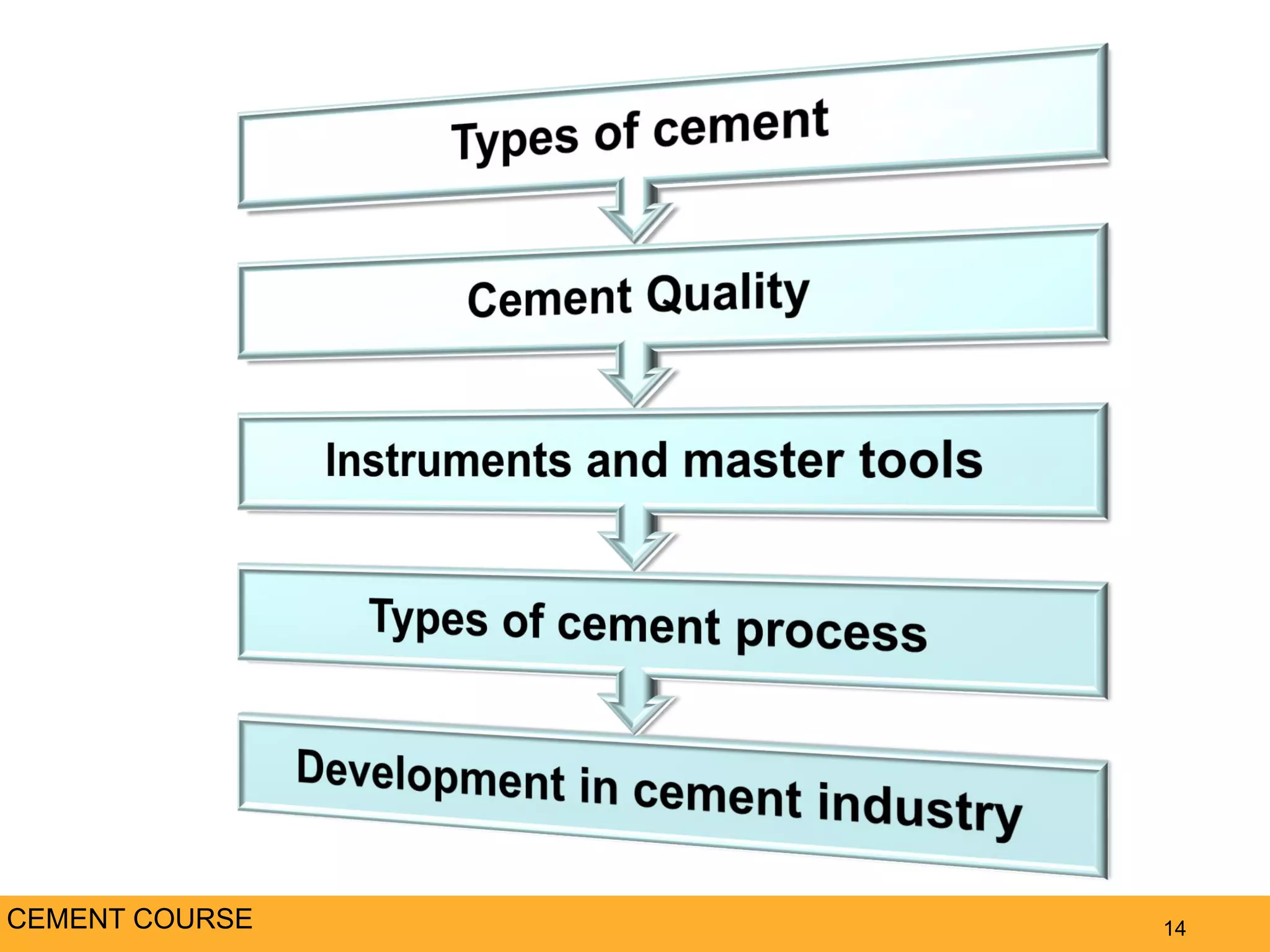
14CEMENT COURSE
15
1. CEM I Portland cement,
2. CEM II Portland-composite cement,
3. CEM III Blast furnace cement,
4. CEM IV Pozzolanic cement,
5. CEM V Composite cement.
CEMENT COURSE
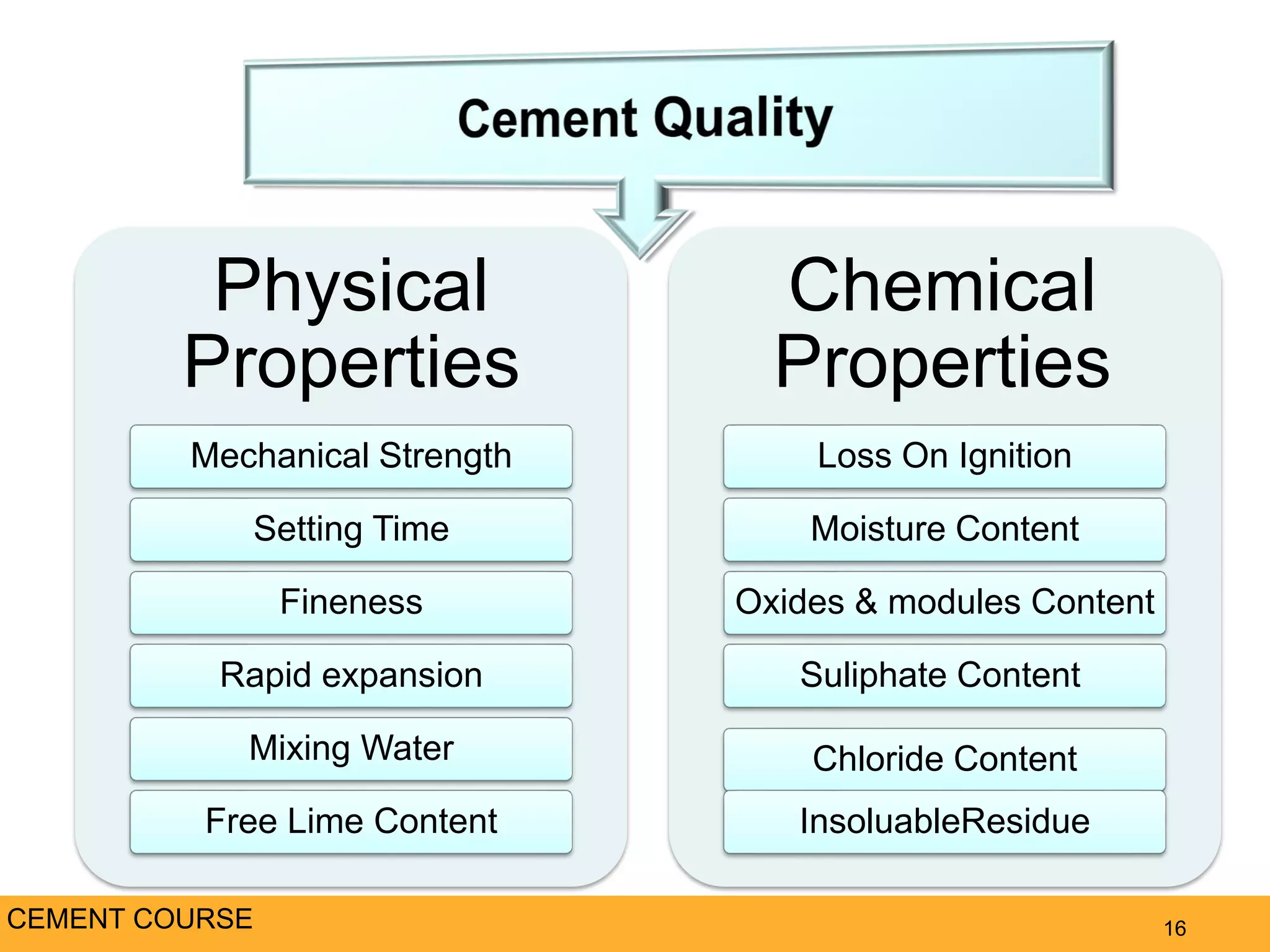
16
Physical
Properties
Mechanical Strength
Setting Time
Fineness
Rapid expansion
Mixing Water
Free Lime Content
Chemical
Properties
Loss On Ignition
Moisture Content
Oxides & modules Content
Suliphate Content
Chloride Content
InsoluableResidue
CEMENT COURSE
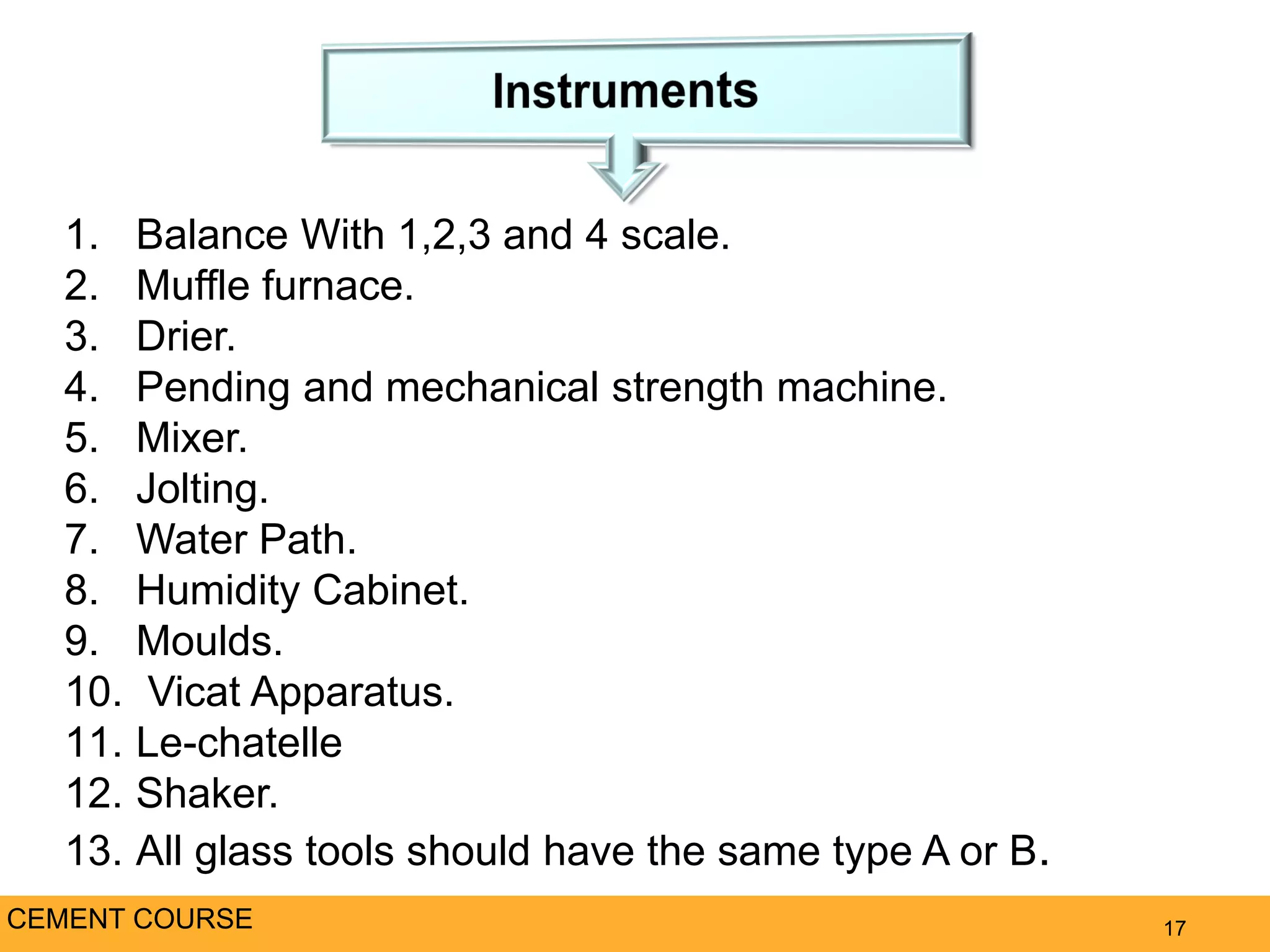
17CEMENT COURSE
1. Balance With 1,2,3 and 4 scale.
2. Muffle furnace.
3. Drier.
4. Pending and mechanical strength machine.
5. Mixer.
6. Jolting.
7. Water Path.
8. Humidity Cabinet.
9. Moulds.
10. Vicat Apparatus.
11. Le-chatelle
12. Shaker.
13. All glass tools should have the same type A or B.
18CEMENT COURSE
1. Caliper.
2. Thermo-cabel.
3. Gas Analyzer.
4. Humidity-meter
5. Wet Set.
6. Water Level.
7. Stop Watch.
8. Potable Thermo-meter.
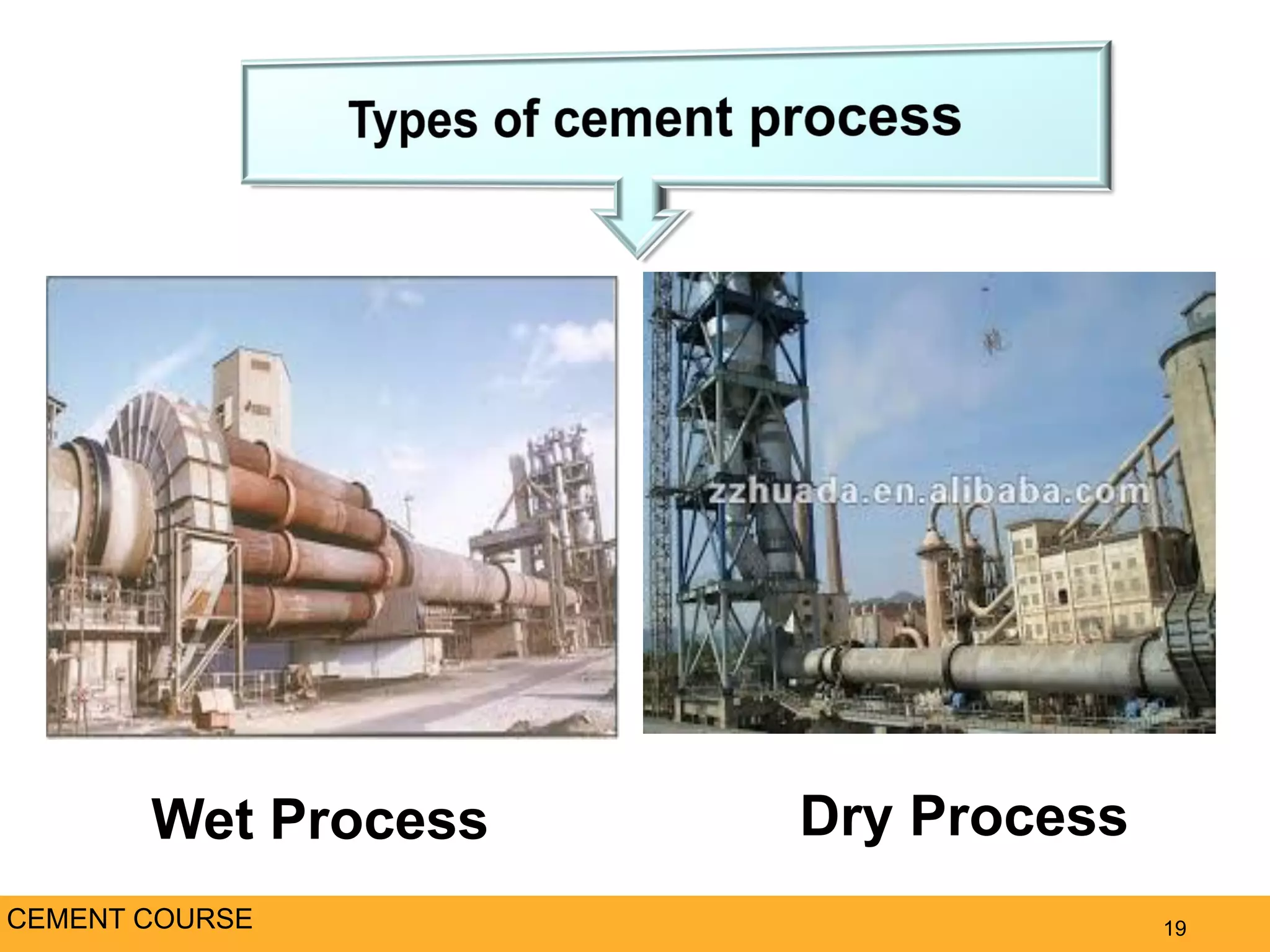
19
Wet Process Dry Process
CEMENT COURSE
20
 Cement industry has developed day by day in order to save
energy ( power & oil ) and no negative impact on the
surrounded environment by installing new filter system.
CEMENT COURSE
Chromium Reducer Bag House Filter
Course Agenda
21
Cement Chemistry
Cement Industry and Technology.
Cement and Environment.
Cement Alternatives.
CEMENT COURSE
22
Cement and
Environment
CO2
Emission
Manithabel
Wastes
Agriculture
Waters
Recycle of
HFO.
CEMENT COURSE
Course Agenda
23
Cement Chemistry
Cement Industry and Technology.
Cement and Environment.
Cement Alternatives.
CEMENT COURSE
Cement Alternatives.
24
Geo-polymers
When raw materials consumed all over
the world cement industry will be history
and the future will be for geo-polymers
CEMENT COURSE
Thank You
25CEMENT COURSE

Cement course

  • 1.
    MATERIAL FROM QUARRY MATERIAL FROM QUARRY Facultyof graduate studies and advanced science CEMENT COURSE Mohamed Abuelseoud Asst. Lecturer in environment and industry development department Prepared by: CEMENT COURSE
  • 2.
    MATERIAL FROM QUARRY MATERIAL FROM QUARRY Introduction CEMENTCOURSE History Cement was first invented by the Egyptians. Cement was later reinvented by the Greeks who made their mortar out of lime. Later, the Romans produced cement from pozzolana, an ash found in all of the volcanic areas of Italy, by mixing the ash with lime. The Egyptiens discovered lime and gypsum mortar but to build Pyramids they used only stones.
  • 3.
     Raw Materials Thereare two types of raw materials which are combined to make cement: 1. Lime-containing materials, such as limestone. 2. Clay and clay-like materials, such as slag from blast furnaces, bauxite, iron ore, silica, sand, etc. It takes approximately 3,400 lbs*. of raw materials to make one ton (2,000 lbs*.) of Portland cement. 3 CEMENT COURSE Ibs* : Irritable bowel syndrome  Defination Cement is a fine powder which, when mixed with water, forms a thick paste. When this paste is mixed with sand and gravel and allowed to dry it is called concrete.
  • 4.
    4 Process The mixture ofmaterials is finely ground in a raw mill. The resultant raw mix is burned in a rotary kiln at temperatures around 1450 degrees Celsius to form clinker. The clinker nodules are then ground with about 3 - 5 % gypsum to produce cement with a fineness typically of less than 90 micrometers. Simple process diagram CEMENT COURSE
  • 5.
    Course Agenda 5 Cement Chemistry CementIndustry and Technology. Cement and Environment. Cement Alternatives. CEMENT COURSE
  • 6.
  • 7.
  • 8.
    8 1. Quarries. 2. RespectingStanders EN 197-1 3. Owing ISO 9001 & 14001 CEMENT COURSE
  • 9.
    9 The study ofa cement plant starts with the search for raw materials and the identification of their chemical and physical characteristics,.The next stage is to select the appropriate process for preparing the raw meal by evaluating the raw materials needed to obtain the clinker-after that cements, looking at each and every stage of manufacture (quarry extraction, crushing, pre-homogenization, control and homogenization system, burn process, etc.), Looking after solutions to make easy the quality control. CEMENT COURSE
  • 10.
     All reactionsinside the kiln are solid-solid reactions and depending on the kiln burn-ability and kiln rpm. 10 Calcinations zone Transition zone Burning zoneLiquid zone CEMENT COURSE
  • 11.
    The principal phasesof the clinker are: A. Alite (C3S). B. Belite(C2S). C. Aluminate (C3A). D. Ferrite low quantity (C4AF). 11CEMENT COURSE
  • 12.
    12CEMENT COURSE Gypsum addedto the clinker during grinding not only regulates the setting time but also modifies some properties of the hardened paste such as the mechanical strength, shrinkage, resistance to sulfate attack and the heat of hydration. All of these properties represent optimum values in relation to the given dosages of gypsum (3.0 – 5.0 %)
  • 13.
    Course Agenda 13 Cement Chemistry CementIndustry and Technology. Cement and Environment. Cement Alternatives. CEMENT COURSE
  • 14.
  • 15.
    15 1. CEM IPortland cement, 2. CEM II Portland-composite cement, 3. CEM III Blast furnace cement, 4. CEM IV Pozzolanic cement, 5. CEM V Composite cement. CEMENT COURSE
  • 16.
    16 Physical Properties Mechanical Strength Setting Time Fineness Rapidexpansion Mixing Water Free Lime Content Chemical Properties Loss On Ignition Moisture Content Oxides & modules Content Suliphate Content Chloride Content InsoluableResidue CEMENT COURSE
  • 17.
    17CEMENT COURSE 1. BalanceWith 1,2,3 and 4 scale. 2. Muffle furnace. 3. Drier. 4. Pending and mechanical strength machine. 5. Mixer. 6. Jolting. 7. Water Path. 8. Humidity Cabinet. 9. Moulds. 10. Vicat Apparatus. 11. Le-chatelle 12. Shaker. 13. All glass tools should have the same type A or B.
  • 18.
    18CEMENT COURSE 1. Caliper. 2.Thermo-cabel. 3. Gas Analyzer. 4. Humidity-meter 5. Wet Set. 6. Water Level. 7. Stop Watch. 8. Potable Thermo-meter.
  • 19.
    19 Wet Process DryProcess CEMENT COURSE
  • 20.
    20  Cement industryhas developed day by day in order to save energy ( power & oil ) and no negative impact on the surrounded environment by installing new filter system. CEMENT COURSE Chromium Reducer Bag House Filter
  • 21.
    Course Agenda 21 Cement Chemistry CementIndustry and Technology. Cement and Environment. Cement Alternatives. CEMENT COURSE
  • 22.
  • 23.
    Course Agenda 23 Cement Chemistry CementIndustry and Technology. Cement and Environment. Cement Alternatives. CEMENT COURSE
  • 24.
    Cement Alternatives. 24 Geo-polymers When rawmaterials consumed all over the world cement industry will be history and the future will be for geo-polymers CEMENT COURSE
  • 25.