ACTIVITY REPORT
2011
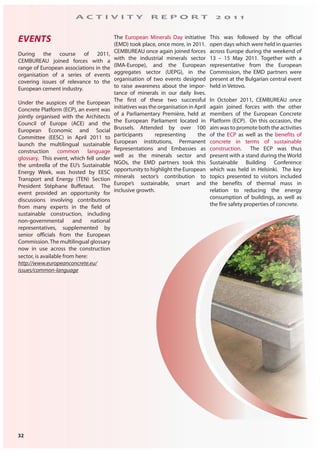
CEMBUREAU - The European Cement Association based in Brussels is the representative organisation
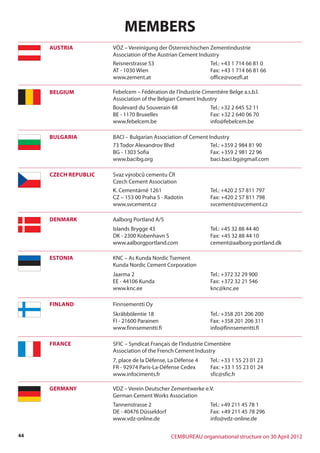
of the cement industry in Europe. Currently, its Full Members are the national cement industry
associations and cement companies of the European Union (with the exception of Cyprus, Malta
and Slovakia) plus Norway, Switzerland and Turkey. Croatia is an Associate Member of CEMBUREAU.
The Association acts as spokesman for the cement industry before the European Union institutions and
other public authorities, and communicates the industry’s views on all issues and policy developments
with regard to technical, environmental, energy and promotional issues. Permanent dialogue is
maintained with EU institutions, international authorities and other international associations.
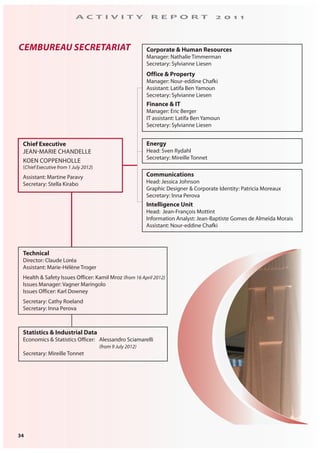
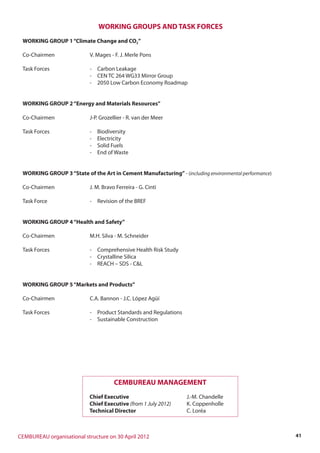
Serviced by a multi-national staff in Brussels and with the input from its Members via five Working
Groups as well as a number of Task Forces set up on an ad hoc basis and directly reporting to the
appropriate Working Group, CEMBUREAU takes action in relation to all developments at European
level affecting the cement industry.
CEMBUREAU plays a significant role in the world-wide promotion of cement and the ready-mix and
precastconcreteindustriesinco-operationwithMemberAssociationsandotherrelevantorganisations.
The Association regularly co-hosts conferences on specific issues aimed at improving the market
perception of the concrete industry and promoting the use of generic cement and concrete products.
In addition, the Association regularly commissions studies to evaluate specific issues of importance
to the industry.
Association
Européenne
du Ciment
The European
Cement
Association
Rue d’Arlon 55 – BE-1040 Bruxelles – Tel.: + 32 2 234 10 11 – Fax: + 32 2 230 47 20
secretariat@cembureau.eu – www.cembureau.eu
1
A C T I V I T Y R E P O R T 2 0 1 1
TABLE OF CONTENTS
MESSAGE FROM THE CHIEF EXECUTIVE 2
THE ECONOMY
THE WORLD 4
EUROPE 6
EMISSIONS REPORTING - GNR & BEYOND 15
CONTACTS WITH EU INSTITUTIONS 17
WORKING WITH ALLIANCES 18
CEMBUREAU MAIN ISSUES 21
CEM • PROSPECTS 30
THE ENERGY MARKET 30
EVENTS 32
CEMBUREAU IT 33
CORPORATE 33
CEMBUREAU SECRETARIAT 34
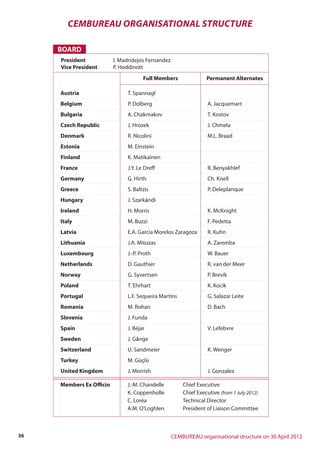
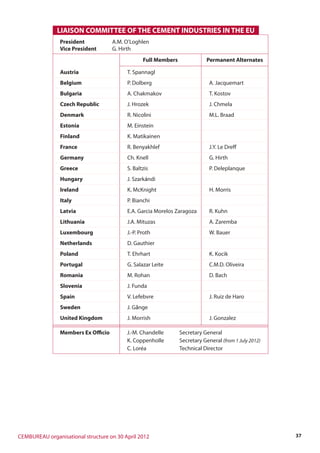
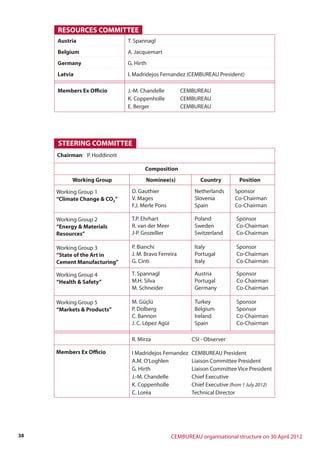
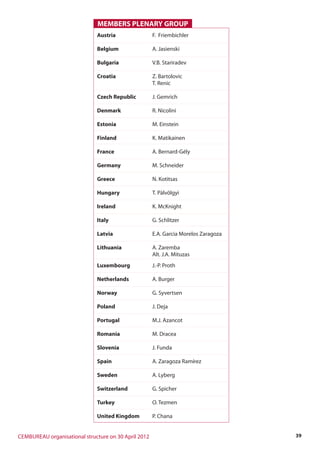
CEMBUREAU ORGANISATIONAL STRUCTURE 36
MEMBERS & 44
ASSOCIATE MEMBER 47
ABBREVIATIONS GLOSSARY 48
This Activity Report is produced in-house to meet the requirements of Paragraph 6 of the CEMBUREAU Articles
2
A C T I V I T Y R E P O R T 2 0 1 1
MESSAGE FROM THE
CHIEF EXECUTIVE
2011 – CEMBUREAU
prepares for the future in
a gloomy EU context
In 2011, the financial and economic
crisis, in Europe, was aggravated by
uncontrolled levels of public debt in
certain Member States. The response
from the EU, the IMF (International
Monetary Fund) and the ECB
(European Central Bank) was austerity
measures which in turn contributed to
worsening the economic situation, not
to mention dire social consequences.
The eurozone was seen in peril of
imploding under the pressure of
financial markets.
Voices were heard in many corners,
especially in the European Parliament,
calling upon the Member States to
take a bold step towards a more
federal Europe which would provide
the needed political and fiscal, as well
as economic, governance required
for the monetary Union to survive in
times of crisis. No such vision material-
ised, however, and the EU appeared
like an economic giant staggering
through history, hesitating between
the Community method and intergov-
ernmental cooperation, plugging
holes rather than running the game.
While rigour was undeniably needed,
austerity is definitely not the path to
growth and jobs.The lack of a common
political approach made it hard to
resort to truly European solutions,
such as EU Bonds or Project Bonds...
Austerity has taken its toll on European
industry and, at various degrees in
Member States, construction was
badly hit. Such crises have, of course, a
very detrimental effect, but they also
present opportunities. Unfortunately,
in 2011 a divided construction sector
was not able to seize these.
Construction, with a relatively high
ratio of labour intensity per € of
Fixed Capital Formation, represents a
relatively rapid means for generating
economic activity, creating jobs and
growth while, in the longer term,
providing the EU with a better
infrastructure. With greater concerted
action, the construction sector could
have aimed for and secured greater
support for such projects.
Crisis funds were set up by the EU
for construction projects but cash-
strapped national governments could
not find the matching funds needed
to release EU aid. This, in addition to
the lack of response from the con-
struction industry, explains why this
source of funding remained largely
untapped. Only a fraction of the total
funds available was actually allocated.
On the issues front, Climate Change
remained very high on the EU
agenda in 2011 but some develop-
ments took place which have
raised questions about the
wisdom of EU policy in
this field. The European
Commission has en-
trenched itself in
an arm wrestling
contest with
other nations
such as Brazil,
China, India,
Russia, the
USA, and many
others, when it
extended the
EU-ETS to CO2
emissions from
international
flights. Rather
than consult with
key partners, the
Commission has po-
sitioned itself on a legal
high horse and thereby
lost all room for manoeuvre.
In the EU-ETS itself, prices of
CO2 allowances fell so low as to
raise doubts about the viability of the
EU-ETS. On the international scene, at
the end of the year, Durban was
claimed to be a victory for the EU
Climate Change Policy. Let us hope it
will not prove a pyrrhic victory.
Meanwhile, the regulatory machine
worked at full throttle. The Guidance
Documents necessary to implement
the decisions on allocation of ETS
allowances taken in 2010 led to
complex and often heated debates in
comitology. Overall, the decision
made by the European Commission
and the Member States did not pose
fundamental problems to the cement
industry with one notable exception:
“rationalisation”.
3
A C T I V I T Y R E P O R T 2 0 1 1
CEMBUREAU argued that, logically,
if an operator transfers production
from one plant to a more efficient
installation, emitting less CO2, the
allowances should be re-allocated
from the former to the latter in order
to cover the increased production
of the latter, even if the nominal capac-
ity is not increased, provided always
that the environmental benefit is dem-
onstrated. Rather than address this
logically, the European Commission
has opposed the very idea of such
rationalisation. Worse, the Guidance
Documents provide an incentive to
maintain production in existing instal-
lations at at least 51% of their median
historical production level, i.e. the
median production in 2005 to 2008 or,
where applicable, the median produc-
tion in 2009 to 2010. This is bad news
for Climate Change and for the future
of industry. At a time when analysts
stress the need for capacity rationali-
sation in Europe, the European
Commission is taking steps which
clearly will not help Europe re-indus-
trialise.
Against such a gloomy background
CEMBUREAU has continued to pave
the way for the future. Many new
issues were tackled, ranging from
Biodiversity and related offsets,
Resource Efficiency and Standardisa-
tion. Sustainable Construction has
growninimportanceonCEMBUREAU’s
agenda and is a major point in the
Energy Efficiency Directive proposed
in 2011. The same year also saw
the successful creation of a cement
industry partnership under UNEP
(United Nations Environment
Programme) in order to cooperate
with governments and other stake-
holders on the development of a
legally binding international instru-
ment on mercury emissions which
must be in place by 2013.
CEMBUREAU has also to ensure that its
structure is appropriate to meet future
issues and challenges. Discussions
were initiated in 2011 and will
continue in 2012, looking at the role of
the Steering Committee, the operation
of the Working Groups and, under
the Resources Committee, a critical
examination of CEMBUREAU finance
and funding.
In 2012, these tasks and many others
will rest upon the shoulders of the
new Chief Executive who, no doubt,
will steer CEMBUREAU through new
waters as well as already opened
channels. The search for a new
Chief Executive was organised in 2011
and successfully completed at the
end of the year. I have no doubt that
Koen Coppenholle shall be successful
and that, under his leadership and
with an improved structure,
CEMBUREAU has a very promising
future.
4
A C T I V I T Y R E P O R T 2 0 1 1
THE ECONOMY
The World
World Production and Trends
In 2011, global economic growth was
lowerthanpreviouslyexpected,driven
mainly by uncertainty and vulnerabili-
ty in the most mature economies.
The financial turmoil in Europe partly
spread to other high-income and
some developing countries. This
pushed up borrowing costs in many
parts of the world, and put pressure on
stock markets. The European Union
lacked the fiscal or monetary resources
to bail out the banking system or
stimulate demand. At the same time,
capital flows to developing countries
weakened sharply as investors
withdrew substantial sums from
developing-country markets during
the second half of the year. As a result,
and despite a strengthening of activity
in the United States and Japan, global
growth and world trade slowed
sharply. World output was estimated
to have expanded by 2.7% in 2011,
6% in the developing countries and
1.6% in high-income economies1.
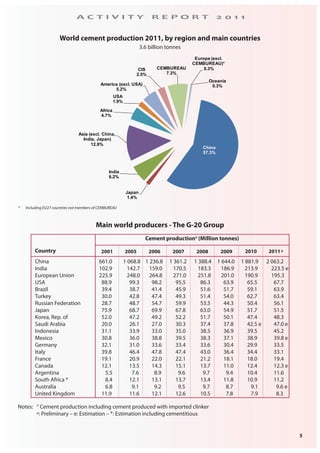
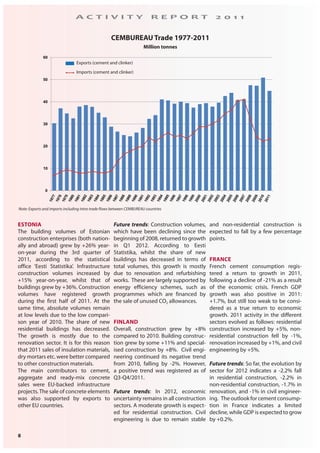
World cement production for 2011 is
estimated at 3.6Bt, an increase of 7.6%
compared to 2010. China registered an
additional increase of 9.6% to 2.1Bt, a
lower growth rate when compared
to 14.5% the previous year. China
accounted for 57.3% of the world’s
total cement production, translating
into an additional percentage point
compared to 56.2% in 2010. Apart
from China, global cement production
increased by 4.9%, a lower growth rate
compared to 6.2% in 2010. Among the
G20 countries, results showed a net
increase in the volumes of emerging
economies. In aggregated terms, these
countries encountered 6.7% growth
year-on-year. The highest increase was
registered in Indonesia, the Russian
Federation and Argentina, which grew
by around 14.6%, 11.3% and 11.2%,
respectively. Increases in cement
production levels were also notable in
Australia, India and South Africa. In
contrast, the effects of the economic
downturn were still visible among the
majority of advanced economies
where cement output recovered only
partially. 2011 data for G7 countries
showed some growth in the US (3.3%),
whilst Japan and Canada remained
slightly negative (-0.3% and -1%,
respectively). Higher growth rates
were registered in Germany, France
and the UK, while Italy remained
negative. Overall, G7 cement produc-
tion rose by 6.2% in 2011.
Cement production in South America,
Africa and Asia rose by 5% or more.
These regions were responsible for
3%, 5% and 78% of world cement
production, respectively. CEMBUREAU
countries accounted for about 7% of
world production whilst the EU27
Member States, contributed some 6%
to global production volumes.
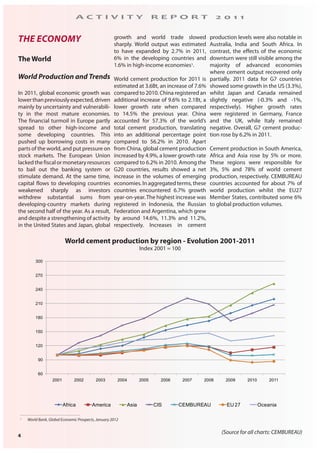
World cement production by region - Evolution 2001-2011
Index 2001 = 100
1 World Bank, Global Economic Prospects, January 2012
(Source for all charts: CEMBUREAU)
60
90
120
150
180
210
240
270
300
2001 2002 2003 2004 2005 2006 2007 2008 2009 2010 2011
Africa America Asia CIS CEMBUREAU EU 27 Oceania
5
A C T I V I T Y R E P O R T 2 0 1 1
China 661.0 1 068.8 1 236.8 1 361.2 1 388.4 1 644.0 1 881.9 2 063.2
India 102.9 142.7 159.0 170.5 183.3 186.9 213.9 223.5 e
European Union 225.9 248.0 264.8 271.0 251.8 201.0 190.9 195.3
USA 88.9 99.3 98.2 95.5 86.3 63.9 65.5 67.7
Brazil 39.4 38.7 41.4 45.9 51.6 51.7 59.1 63.9
Turkey 30.0 42.8 47.4 49.3 51.4 54.0 62.7 63.4
Russian Federation 28.7 48.7 54.7 59.9 53.5 44.3 50.4 56.1
Japan 75.9 68.7 69.9 67.8 63.0 54.9 51.7 51.5
Korea, Rep. of 52.0 47.2 49.2 52.2 51.7 50.1 47.4 48.3
Saudi Arabia 20.0 26.1 27.0 30.3 37.4 37.8 42.5 e 47.0 e
Indonesia 31.1 33.9 33.0 35.0 38.5 36.9 39.5 45.2
Mexico 30.8 36.0 38.8 39.5 38.3 37.1 38.9 39.8 e
Germany 32.1 31.0 33.6 33.4 33.6 30.4 29.9 33.5
Italy 39.8 46.4 47.8 47.4 43.0 36.4 34.4 33.1
France 19.1 20.9 22.0 22.1 21.2 18.1 18.0 19.4
Canada 12.1 13.5 14.3 15.1 13.7 11.0 12.4 12.3 e
Argentina 5.5 7.6 8.9 9.6 9.7 9.4 10.4 11.6
South Africa * 8.4 12.1 13.1 13.7 13.4 11.8 10.9 11.2
Australia 6.8 9.1 9.2 9.5 9.7 8.7 9.1 9.6 e
United Kingdom 11.9 11.6 12.1 12.6 10.5 7.8 7.9 8.3
Main world producers - The G-20 Group
Cement production° (Million tonnes)
Notes: ° Cement production including cement produced with imported clinker
p: Preliminary – e: Estimation – *: Estimation including cementitious
Country 2001 2005 2006 2007 2008 2009 2010
World cement production 2011, by region and main countries
3.6 billion tonnes
* Including EU27 countries not members of CEMBUREAU
2011 p
China
57.3%
Japan
1.4%
India
6.2%
Asia (excl. China,
India, Japan)
12.9%
Africa
4.7%
USA
1.9%
America (excl. USA)
5.2%
CIS
2.5%
CEMBUREAU
7.3%
Europe (excl.
CEMBUREAU)*
0.3%
Oceania
0.3%
6
A C T I V I T Y R E P O R T 2 0 1 1
Europe
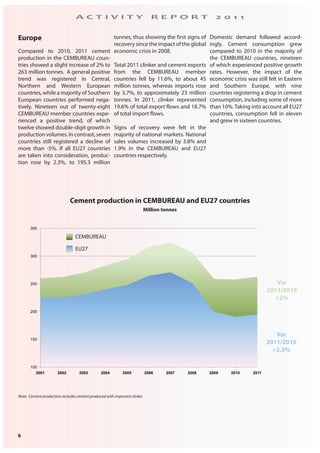
Compared to 2010, 2011 cement
production in the CEMBUREAU coun-
tries showed a slight increase of 2% to
263 million tonnes. A general positive
trend was registered in Central,
Northern and Western European
countries, while a majority of Southern
European countries performed nega-
tively. Nineteen out of twenty-eight
CEMBUREAU member countries expe-
rienced a positive trend, of which
twelve showed double-digit growth in
production volumes. In contrast, seven
countries still registered a decline of
more than -5%. If all EU27 countries
are taken into consideration, produc-
tion rose by 2.3%, to 195.3 million
tonnes, thus showing the first signs of
recovery since the impact of the global
economic crisis in 2008.
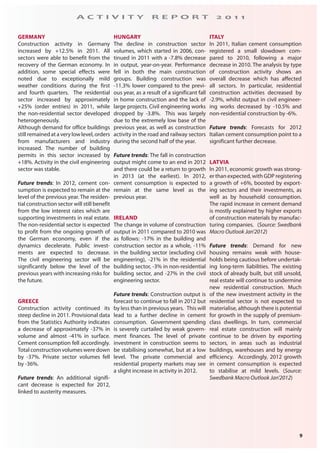
Total 2011 clinker and cement exports
from the CEMBUREAU member
countries fell by 11.6%, to about 45
million tonnes, whereas imports rose
by 3.7%, to approximately 23 million
tonnes. In 2011, clinker represented
19.6% of total export flows and 18.7%
of total import flows.
Signs of recovery were felt in the
majority of national markets. National
sales volumes increased by 3.8% and
1.9% in the CEMBUREAU and EU27
countries respectively.
Domestic demand followed accord-
ingly. Cement consumption grew
compared to 2010 in the majority of
the CEMBUREAU countries, nineteen
of which experienced positive growth
rates. However, the impact of the
economic crisis was still felt in Eastern
and Southern Europe, with nine
countries registering a drop in cement
consumption, including some of more
than 10%.Taking into account all EU27
countries, consumption fell in eleven
and grew in sixteen countries.
100
150
200
250
300
350
2001 2002 2003 2004 2005 2006 2007 2008 2009 2010 2011
Note: Cement production includes cement produced with imported clinker
Cement production in CEMBUREAU and EU27 countries
Million tonnes
CEMBUREAU
EU27
Var
2011/2010
+2.3%
Var
2011/2010
+2%
7
A C T I V I T Y R E P O R T 2 0 1 1
Country by country analysis - 2011
AUSTRIA
After the recession years, the Austrian
economy began to see the light at
the end of the tunnel: GDP grew by
+3.1% in 2011; investments picked up
leading, to a minor improvement in
the construction sector. Domestic
cement deliveries, however, remained
just below 2010 levels. In 2011, the
overall Austrian construction output
amounted to € 13.4 billion, an increase
of 2.8% compared to 2010. Residential
construction was up by +5%, non-
residential by +13.5%. Renovation
increased by +5.8% while industrial
and civil engineering went up by
+12.4%. Regarding infrastructure,
water engineering went up by +10.2%
but underground engineering and
other civil engineering fell by -3.6%
mostly due to a reduction of invest-
ment in tunnels (-23.1%) and railways
(-15.1%).
Future trends: Further to the upturn of
GDP in 2011, a number of private as
well as public projects were resumed
after having been stopped during the
recession. Due to the emphasis on
energy efficiency, renovation will
remain a growing market. Further to
the economic and financial difficulties
in the Euro-zone, the Austrian national
bank has revised its GDP forecast for
2012 down to +0.7%. A GDP growth of
+1.9% is expected for 2013 which
should lead to some growth in the
construction sector.
BELGIUM
Despite the consequences of the
international crisis, the Belgian
construction industry developed
positively in 2011. Construction sector
output grew by +3.1%, compared to
2010 partly due to very favourable
climatic conditions. Whilst activity in
the non-residential sector increased
only slightly (+1%), the residential
sector experienced a decline of -2.8%
in housing investment. Public works
performed best, with a leap of +10.5%
compared to 2010, most of which
being new construction (+12%) as
opposed to renovation (+4%). Cement
consumption increased by +12.5%, a
surprise given the limited growth of
construction in general.
Future trends: Forecasts are less
favourable for 2012, as 20% fewer
building permits were issued in 2011
compared to 2010. Compared with
2011, construction sector activity is
likely to slow down. Indeed, the
generalised economic crisis will
probably urge companies and the
private sector to invest cautiously,
whilst austerity programmes (with-
drawal of tax benefits for energy
savings and the ongoing crisis in the
banking sector) could force authorities
to cut public spending on infrastruc-
ture.
BULGARIA
In 2011, the cement market remained,
to a high degree, at 2010 levels. High
interest rates on loans from private
banks resulted in low levels of private
investment in the residential sector.
Thus, the private construction sector
did not regain any ground. Some posi-
tive developments were registered in
public infrastructure projects, mainly
roads. However, the impact of these
projects on cement consumption was
low.
Future trends: The market is expected
to fall a further -4 to -5% in 2012. This
will depend on the level of imports
from neighbouring countries and the
government’s efforts to speed up
public infrastructure projects.
CROATIA
2011 consumption continued to fall
due to the country’s economic crisis
and financial problems. The construc-
tion sector was, as a result, heavily
affected.
Future trends:The number of building
permits continued to drop. The first
recovery signs are not expected before
2013.
CZECH REPUBLIC
In 2011, output from construction fell
by -3.1%, year-on-year, and by -10.8%
compared to 2008 (a year which regis-
tered a construction boom). The plan-
ning and building control authorities
granted +1.4% more building permits,
year-on-year, although the approxi-
mate value of permitted constructions
dropped by -14.8%, compared to the
previous year. The total value of newly
received construction orders in the
Czech Republic decreased by -12.2%.
In 2011, the number of started
dwellings was -2.1% lower than in
2010 and the number of completed
dwellings plummeted by -21.4%,
year-on-year.
Futuretrends: 2012 cement consump-
tion is expected to either stagnate or
increase slightly.
DENMARK
Construction and building activity
improved in 2011 compared to the
historically low level in 2010. This
increase was positively affected, to a
certain extent, by publicly funded
growth initiatives, particularly in
relation to infrastructure and social
housing, and a milder winter com-
pared to the previous year.
Future trends: 2012 volumes are
expected to increase marginally based
on public-sector growth activities and
other political initiatives aimed at
kick-starting the sector. Although a
decline in the residential building
segment is expected in 2012 and 2013,
the commercial building segment is
forecast to remain at the historically
low level of 2011.
8
A C T I V I T Y R E P O R T 2 0 1 1
ESTONIA
The building volumes of Estonian
construction enterprises (both nation-
ally and abroad) grew by +26% year-
on-year during the 3rd quarter of
2011, according to the statistical
office ‘Eesti Statistika’. Infrastructure
construction volumes increased by
+15% year-on-year, whilst that of
buildings grew by +36%. Construction
volumes have registered growth
during the first half of 2011. At the
same time, absolute volumes remain
at low levels due to the low compari-
son year of 2010. The share of new
residential buildings has decreased.
The growth is mostly due to the
renovation sector. It is for this reason
that 2011 sales of insulation materials,
dry mortars etc. were better compared
to other construction materials.
The main contributors to cement,
aggregate and ready-mix concrete
sales were EU-backed infrastructure
projects.The sale of concrete elements
was also supported by exports to
other EU countries.
Future trends: Construction volumes,
which have been declining since the
beginning of 2008, returned to growth
in Q1 2012. According to Eesti
Statistika, whilst the share of new
buildings has decreased in terms of
total volumes, this growth is mostly
due to renovation and refurbishing
works. These are largely supported by
energy efficiency schemes, such as
programmes which are financed by
the sale of unused CO2 allowances.
FINLAND
Overall, construction grew by +8%
compared to 2010. Building construc-
tion grew by some +11% and special-
ised construction by +8%. Civil engi-
neering continued its negative trend
from 2010, falling by -2%. However,
a positive trend was registered as of
Q3-Q4/2011.
Future trends: In 2012, economic
uncertainty remains in all construction
sectors. A moderate growth is expect-
ed for residential construction. Civil
engineering is due to remain stable
and non-residential construction is
expected to fall by a few percentage
points.
FRANCE
French cement consumption regis-
tered a return to growth in 2011,
following a decline of -21% as a result
of the economic crisis. French GDP
growth was also positive in 2011:
+1.7%, but still too weak to be consi-
dered as a true return to economic
growth. 2011 activity in the different
sectors evolved as follows: residential
construction increased by +5%, non-
residential construction fell by -1%,
renovation increased by +1%, and civil
engineering by +5%.
Future trends: So far, the evolution by
sector for 2012 indicates a -2.2% fall
in residential construction, -2.2% in
non-residential construction, -1.7% in
renovation, and -1% in civil engineer-
ing. The outlook for cement consump-
tion in France indicates a limited
decline, while GDP is expected to grow
by +0.2%.
CEMBUREAU Trade 1977-2011
Million tonnes
Note: Exports and imports including intra-trade flows between CEMBUREAU countries
Exports (cement and clinker)
Imports (cement and clinker)
0
10
20
30
40
50
60
9
A C T I V I T Y R E P O R T 2 0 1 1
GERMANY
Construction activity in Germany
increased by +12.5% in 2011. All
sectors were able to benefit from the
recovery of the German economy. In
addition, some special effects were
noted due to exceptionally mild
weather conditions during the first
and fourth quarters. The residential
sector increased by approximately
+25% (order entries) in 2011, while
the non-residential sector developed
heterogeneously.
Although demand for office buildings
still remained at a very low level, orders
from manufacturers and industry
increased. The number of building
permits in this sector increased by
+18%. Activity in the civil engineering
sector was stable.
Future trends: In 2012, cement con-
sumption is expected to remain at the
level of the previous year. The residen-
tial construction sector will still benefit
from the low interest rates which are
supporting investments in real estate.
The non-residential sector is expected
to profit from the ongoing growth of
the German economy, even if the
dynamics decelerate. Public invest-
ments are expected to decrease.
The civil engineering sector will be
significantly below the level of the
previous years with increasing risks for
the future.
GREECE
Construction activity continued its
steep decline in 2011. Provisional data
from the Statistics Authority indicates
a decrease of approximately -37% in
volume and almost -41% in surface.
Cement consumption fell accordingly.
Total construction volumes were down
by -37%. Private sector volumes fell
by -36%.
Future trends: An additional signifi-
cant decrease is expected for 2012,
linked to austerity measures.
HUNGARY
The decline in construction sector
volumes, which started in 2006, con-
tinued in 2011 with a -7.8% decrease
in output, year-on-year. Performance
fell in both the main construction
groups. Building construction was
-11.3% lower compared to the previ-
ous year, as a result of a significant fall
in home construction and the lack of
large projects. Civil engineering works
dropped by -3.8%. This was largely
due to the extremely low base of the
previous year, as well as construction
activity in the road and railway sectors
during the second half of the year.
Future trends: The fall in construction
output might come to an end in 2012
and there could be a return to growth
in 2013 (at the earliest). In 2012,
cement consumption is expected to
remain at the same level as the
previous year.
IRELAND
The change in volume of construction
output in 2011 compared to 2010 was
as follows: -17% in the building and
construction sector as a whole, -11%
in the building sector (excluding civil
engineering), -21% in the residential
building sector, -3% in non-residential
building sector, and -27% in the civil
engineering sector.
Future trends: Construction output is
forecast to continue to fall in 2012 but
by less than in previous years. This will
lead to a further decline in cement
consumption. Government spending
is severely curtailed by weak govern-
ment finances. The level of private
investment in construction seems to
be stabilising somewhat, but at a low
level. The private commercial and
residential property markets may see
a slight increase in activity in 2012.
ITALY
In 2011, Italian cement consumption
registered a small slowdown com-
pared to 2010, following a major
decrease in 2010. The analysis by type
of construction activity shows an
overall decrease which has affected
all sectors. In particular, residential
construction activities decreased by
-2.9%, whilst output in civil engineer-
ing works decreased by -10.5% and
non-residential construction by -6%.
Future trends: Forecasts for 2012
Italian cement consumption point to a
significant further decrease.
LATVIA
In 2011, economic growth was strong-
er than expected, with GDP registering
a growth of +6%, boosted by export-
ing sectors and their investments, as
well as by household consumption.
The rapid increase in cement demand
is mostly explained by higher exports
of construction materials by manufac-
turing companies. (Source: Swedbank
Macro Outlook Jan'2012)
Future trends: Demand for new
housing remains weak with house-
holds being cautious before undertak-
ing long-term liabilities. The existing
stock of already built, but still unsold,
real estate will continue to undermine
new residential construction. Much
of the new investment activity in the
residential sector is not expected to
materialise, although there is potential
for growth in the supply of premium-
class dwellings. In turn, commercial
real estate construction will mainly
continue to be driven by exporting
sectors, in areas such as industrial
buildings, warehouses and by energy
efficiency. Accordingly, 2012 growth
in cement consumption is expected
to stabilise at mild levels. (Source:
Swedbank Macro Outlook Jan'2012)
10
A C T I V I T Y R E P O R T 2 0 1 1
LITHUANIA
In 2011, 5 100 dwellings were built in
Lithuania, +38% more than in 2010.
In 2011, the construction of individual
houses continued to dominate the
market (3 800, translating into 75% of
all new dwellings) compared to 1 300
apartments (accounting for 25% of the
market share). The majority of these
dwellings were built in the capital,
Vilnius. Compared to 2010, construc-
tion works increased by +18 %, but will
still remain at 56% of construction
works carried out in 2008.The increase
of Lithuanian exports in 2011 was one
of the fastest in the European Union. In
2011, goods exports grew by +28.8%,
compared with the same period in
2010. In 2011, GDP grew by +5.8%
- the highest growth rate registered
over the past three years.
Future trends: Growth in the volume
of cement sales in the 2012 domestic
market is related to the construction
of individual houses and an increase in
orders in the infrastructure sector.
According to data from the Lithuanian
Department of Statistics, exports of
goods and GDP should continue to
grow (by approximately +5%) in 2012.
LUXEMBOURG
An overall growth of +1.6% in GDP was
recorded in 2011. The construction
sector in general performed slightly
better than the previous year, with the
same slightly positive impact on
cement consumption. No reliable data
is available regarding sub sectoral
performances.
Future trends: A GDP growth of +2%
is forecast for 2012. A slight decrease
in cement consumption is, however,
expected due mainly to the fact
that, in 2011, some important civil
engineering projects came to an end.
Civil engineering activity remains
under pressure in 2012. Building
activity is expected to remain, at best,
at the level of the previous year.
NETHERLANDS
An increase in cement consumption of
+9,2% was registered in 2011, mainly
due to a milder winter, compared with
2010 (when there were two winter
periods in one year). The new residen-
tial buildings sector remained on the
low side at around 56 000 units.
Futuretrends: 2012 cement consump-
tion is expected to decrease by
approximately -7% and return to
2010 levels, due to a period of reces-
sion having been registered since
October 2011. Potential buyers of
new builds continue to wait for
government decisions regarding tax
relief on mortgages. Consumer trust is
lower than in 2009.
NORWAY
Strong growth was registered in 2011
cement consumption. Positive devel-
opments were noted, particularly in
relation to residential construction
and infrastructure projects in certain
regions. Increased activity was record-
ed in all segments.
Future trends: Continued growth in
the construction market is expected
for 2012, particularly in relation to civil
engineering.
POLAND
In 2011, GDP grew by +4.3%. The
construction activity was sustained
by infrastructure works in particular
as part of the Polish highways
programme and the new infrastruc-
ture for the Euro 2012 football
championship. As a result, cement
sales reached 18.7Mt i.e. an increase
of +21% compared to 2010.
Future trends: In 2012, the cement
market should prosper in Poland.
Forecasts indicate sales of 18.1Mt.
The market is expected to fall in 2013
with sales attaining approximately
16.8Mt, i.e. -7% lower than in 2012.
The main reason for this decrease will
be lower economic activity in the
road construction sector. Railways
and electricity infrastructures should
continue to develop steadily.
GDP growth in 2012 will reach +2.9%,
therefore lower than in 2011 when it
was +4.3%. This decrease is mainly an
effect of the worsening economic
situation in the European Union and a
bad sentiment in the Polish economy.
The poor job market situation and an
inflation level of 4%, which is higher
than central bank targets, will be
the main barriers for growth. High
uncertainty remains for the economy
in 2013 – GDP growth should attain
+3.2%.
PORTUGAL
2011 GDP is estimated to have fallen
by -1.6%. This contraction in economic
activity reflects a significant decrease
in domestic demand, both public
and private, within a framework of
adjustment of basic macroeconomic
imbalances. The sharp contraction in
domestic demand is accompanied by
significant growth in exports which,
however, is not sufficient to offset the
impact in the adjustment of domestic
demand levels by resident agents
within a framework of private sector
deleveraging and fiscal consolidation.
The annual volume variation in rela-
tion to construction is as follows: a
decrease of -5% in civil engineering
and -13.1% in buildings (-17% for
residential buildings; -8.5% for non
residential buildings). In total, the
construction sector registered a fall
of -9.4%.
Future trends: Published projections
reveal an unprecedented contraction
of economic activity. They point to
a contraction of the Portuguese
economy in 2011 and 2012, followed
by a virtual stagnation in 2013.
Economic activity is expected to
contract more severely in 2012 (-3.1%),
stemming from the revaluation of the
decline in domestic demand and the
budgetary consolidation measures
included in the 2012 State Budget.
Construction activities are expected
11
A C T I V I T Y R E P O R T 2 0 1 1
to decrease by approximately -11.5%
in 2012. Neither the civil engineering
sector (-10%) nor the different
building segments (-12.9%) have
positive prospects. Both residential
and non-residential buildings are
expected to decrease by -17% and
-8.6% in 2012, respectively. Cement
consumption is expected to fall
further, as a result of the consolidation
measures to meet the demanding
fiscal targets for the coming years
and the tighter financing conditions.
The Portuguese government’s request
for financial assistance from the
International Monetary Fund and the
European Union led to an Economic
and Financial Assistance Programme
(EFAP), in which the Portuguese
government pledged to adopt adjust-
ment measures to address macroeco-
nomic imbalances and structural
reforms.
ROMANIA
2011 is the first year since the crisis
began that an increase both in cement
production and cement consumption
was recorded. In 2011, compared with
2010, the volume of construction
works rose by +2.8%. New construc-
tion works increased by +2.5%, and
capital repair works by +10.3%. The
maintenance and repair sector
decreased by -0.7%. In relation to the
type of construction, the volume of
construction works increased in
non-residential buildings by +6.3%
and engineering works by +2.6%. The
residential buildings sector decreased
by -2.3%.
Future trends: The crisis in the con-
struction industry has not disappeared
as yet.Therefore, the real estate market
remains blocked and difficulties in
gaining access to credit for potential
newinvestmentslingeron. If,however,
the government continues the infra-
structural projects started in 2011,
these will have an immediate impact,
particularly upon the cement sector.
Therefore, estimates indicate that, in
2012, the cement market will grow by
+2 to +3% compared to 2011.
SLOVENIA
The construction industry has regis-
tered a dramatic decrease over the
past three years. Following a -21%
fall in 2009 and -17% in 2010, 2011
activity fell by more than -25%. The
largest drop was observed in the
non-residential building sector which
stood at almost -41% below the
previous year. In residential construc-
tion, the volume decreased by -35%.
The fall in the engineering segment
was only -15%. The biggest problems
in construction continue to be the
lack of public orders, problems with
payments and the over-indebtedness
of companies.
Future trends:
When taking into consideration
forecasts and the number of building
permits issued, it is expected that
the crisis will continue in 2012 in the
construction sector. Further declines
in construction activity of around
-5% are forecast. Consequently, a -4%
decrease in cement consumption in
comparison to 2011 is likely.
SPAIN
Cement consumption fell by -17%
during 2011. However, this fall
intensified throughout the year,
reaching a level of -27% in the fourth
quarter. The distribution of cement
consumption by different construc-
tion sectors was: -19% in residential,
-17% in non-residential and -64% in
civil engineering.
Future trends: The current economic
situation in Spain, with the govern-
ment limitations on investments in
public works, high levels of unemploy-
ment and the current difficulties faced
by the private sector in obtaining bank
loans, will be reflected in a further
decline in construction activity and
cement consumption. The biggest
decline in 2012 cement consumption
is expected to be in civil engineering.
12
A C T I V I T Y R E P O R T 2 0 1 1
SWEDEN
Strong growth was registered in
cement consumption in 2011. Positive
developments were related, in
particular, to residential construction
and infrastructure projects. Increased
activity was noted in all segments.
Future trends: Cement consumption
is expected to remain at the same high
level as in 2011. Continued growth in
the construction market is expected
in 2012, in particular related to
civil engineering and non-residential
works.
SWITZERLAND
Cement consumption increased by
some +2.3%. The main driver is the
housing sector. Based on a provisional
estimation from the Federal Office for
Statistics, in total, the construction
sector increased by roughly +5% in
2011. Private housing accounted for
some +47%.
Future trends: For 2012, however,
cement consumption is likely to
decrease by -3 to -5%. A further slight
decrease is forecast for 2013.
TURKEY
In 2011, the Turkish economy grew
by +8.5%. During this period, the
construction sector also registered a
growth of +11.2%. The cement indus-
try holds a special position in the
Turkish economy with a turnover of
US$4 billion, US$900 million in exports
and the fact that it provides direct
and indirect employment for 15 000
people. The industry produced about
68Mt of cement in 2011, compared to
66.2Mt in 2010. Domestic sales grew
by 11% in Turkey (9% in relation to
TCMA members). At the end of 2011,
12Mt of cement and 2.4Mt of clinker
were exported, a decrease of -23%
and -11% respectively, compared to
the previous year. Although this
decline was mainly the result of
the situation in foreign markets, an
increase in Turkish consumption
softened the negative effects of
this decrease. The cement industry
developed new export markets, given
the narrowing European markets due
to the global financial crisis. Western
Africa is showing remarkable progress.
With the installation of new capacity,
at the end of 2011,Turkey had a clinker
production capacity of 65.1Mt.
Future trends: In Turkey, which
has considerable infrastructure and
housing gaps, the construction
industry has a more promising future.
Forecasts indicate that domestic
cement demand will grow by around
+4-5% in 2012.
UNITED KINGDOM
UK construction output recorded an
overall growth of +1.8% in 2011 but
the deterioration in UK industry
conditions over the last months
affected all sectors. A public sector
fall of -2.2% was outweighed by a
private sector growth of +4.2%. About
two-thirds of construction output is
private sector. Of this, private housing
(including repair, maintenance and
improvement - RM&I) output rose +3%
and public housing fell -3%.
Non-housing construction total new
work, excluding RM&I, rose +0.8%
whereby infrastructure rose by +9.7%
but industrial fell by -8.1%. About half
of the non-housing total new work is
commercial and this remained flat
for 2011.
Future trends: A fall by around -5% in
construction output is expected for
2012, largely attributable to the low
level of housing starts and public
sector construction work, which is set
to fall by -18% between 2011 and
2014. On the positive side, private
sector construction work is anticipated
to rise by +14%, with additional very
large increases anticipated for rail,
where a new high-speed route has
been announced, and energy, where it
is required to meet anticipated
demand.
13
A C T I V I T Y R E P O R T 2 0 1 1
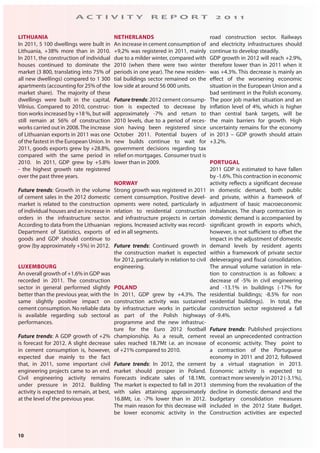
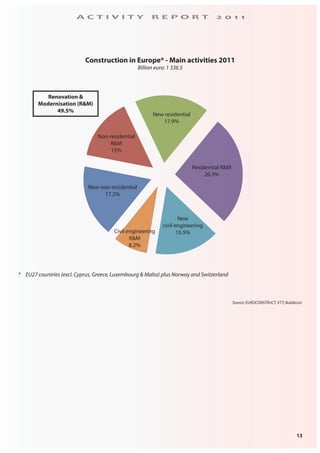
Construction in Europe* - Main activities 2011
Billion euro: 1 336.5
New residential
17.9%
Residential R&M
26.3%
New non-residential
17.2%
Non-residential
R&M
15%
Civil engineering
R&M
8.2%
New
civil engineering
15.5%
Renovation &
Modernisation (R&M)
49.5%
* EU27 countries (excl. Cyprus, Greece, Luxembourg & Malta) plus Norway and Switzerland
Source: EUROCONSTRUCT, VTT, Buildecon
14
A C T I V I T Y R E P O R T 2 0 1 1
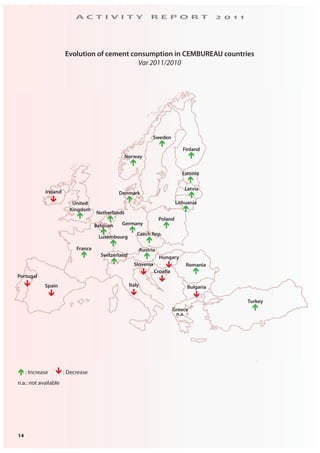
Evolution of cement consumption in CEMBUREAU countries
Var 2011/2010
Spain

Portugal

France

United
Kingdom

Ireland

Belgium

Luxembourg

Netherlands

Italy

Norway

Sweden

Finland

Germany

Switzerland

Estonia

Latvia

Lithuania

Poland

Czech Rep.

Austria

Slovenia
 Croatia

Hungary
 Romania

Bulgaria

Denmark

Greece
n.a.
Turkey

n.a.: not available
 : Increase : Decrease
15
A C T I V I T Y R E P O R T 2 0 1 1
EMISSIONS
REPORTING - GNR &
BEYOND
Releases from cement kilns originate
from the physical and chemical
reactions of the raw materials and
from the combustion of fuels. The
main constituents of the exhaust gases
of a cement kiln are nitrogen from the
combustion air, carbon dioxide (CO2)
from calcination and combustion,
water from the combustion process
and the raw material and excess
oxygen. The exhaust gases also
contain small quantities of dust,
sulphur dioxide (SO2) and nitrogen
oxides (NOX), among others.
In 2007, CEMBUREAU took part in
the WBCSD1
Cement Sustainability
Initiative’s “Getting the Numbers
Right” (GNR), aiming at monitoring
and addressing CO2 emissions trends
of the cement industry at global level.
CEMBUREAU has actively participated
in the GNR Management Committee
ever since.
GNR is a CO2 and energy performance
information system, based on emis-
sions data from individual cement
installations. The system gathers
information on each factor or lever
that impacts CO2 emissions and
energy efficiency, including: average
thermal efficiency per tonne of clinker,
substitution of conventional fuels by
alternative fossil fuels and biomass.
The information contained in the
system represents some 30% of world-
wide cement production (some 50%
without China). Separate reports for
the EU27 and CEMBUREAU regions are
available, including information from
327 installations and representing
some 98% of total EU cement
production.
As a result of the GNR, the European
cement industry has been able to
demonstrate a significant decoupling
of economic performance and
absolute CO2 emissions over time.
While cement production in the
EU27 region decreased by 16% from
1990 to 2010, the absolute net CO2
emissions decreased by 30%.
GNR reports are available online and
can be consulted from here:
http://www.wbcsdcement.org/index.
php?option=com_content&task=view&
id=57&Itemid=118
Since 2010, CEMBUREAU has extended
its statistical system, beyond GNR, to
other key pollutants emitted during
the clinker burning process, including
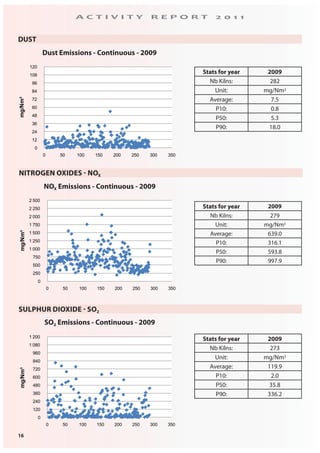
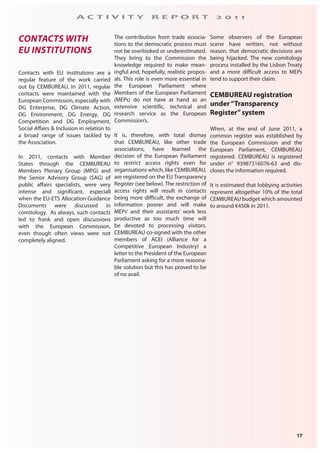
dust, NOX and SO2. It includes emission
values collected for 295 kilns from
CEMBUREAU member countries
for the years 2000, 2005, 2008
and 2009. The following concentra-
tion graphs, expressed in mg/Nm³,
provide up-to-date information on
dust, nitrogen oxides (NOX) and
sulphur dioxide (SO2) emissions of
cement kilns for the European
cement industry.
Note:
All measured values related to dry
gas under standard conditions:
Temperature 273° K, pressure
101.3 kPa and oxygen content
of 10%.
Measurements were provided as
annual arithmetic averages.
Measurements with values lower
than the detection limit were
reported as one half of the
detection limit.
1 World Business Council for Sustainable Development
16
A C T I V I T Y R E P O R T 2 0 1 1
Dust Emissions - Continuous - 2009
0
12
24
36
48
60
72
84
96
108
120
0 50 100 150 200 250 300 350
mg/Nm³
Stats for year 2009
Nb Kilns: 282
Unit: mg/Nm3
Average: 7.5
P10: 0.8
P50: 5.3
P90: 18.0
DUST
NITROGEN OXIDES - NOX
Stats for year 2009
Nb Kilns: 279
Unit: mg/Nm3
Average: 639.0
P10: 316.1
P50: 593.8
P90: 997.9
NOX Emissions - Continuous - 2009
0
250
500
750
1 000
1 250
1 500
1 750
2 000
2 250
2 500
0 50 100 150 200 250 300 350
mg/Nm³
SULPHUR DIOXIDE - SO2
SO2 Emissions - Continuous - 2009
Stats for year 2009
Nb Kilns: 273
Unit: mg/Nm3
Average: 119.9
P10: 2.0
P50: 35.8
P90: 336.2
0
120
240
360
480
600
720
840
960
1 080
1 200
0 50 100 150 200 250 300 350
mg/Nm³
17
A C T I V I T Y R E P O R T 2 0 1 1
CONTACTS WITH
EU INSTITUTIONS
Contacts with EU institutions are a
regular feature of the work carried
out by CEMBUREAU. In 2011, regular
contacts were maintained with the
European Commission, especially with
DG Enterprise, DG Climate Action,
DG Environment, DG Energy, DG
Competition and DG Employment,
Social Affairs & Inclusion in relation to
a broad range of issues tackled by
the Association.
In 2011, contacts with Member
States through the CEMBUREAU
Members Plenary Group (MPG) and
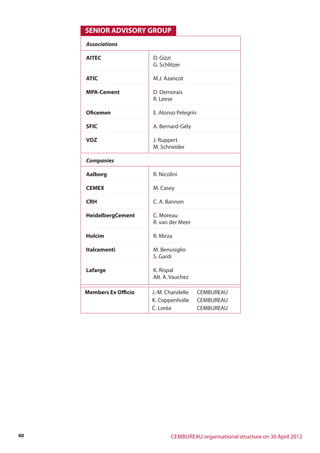
the Senior Advisory Group (SAG) of
public affairs specialists, were very
intense and significant, especiall
when the EU-ETS Allocation Guidance
Documents were discussed in
comitology. As always, such contacts
led to frank and open discussions
with the European Commission,
even though often views were not
completely aligned.
The contribution from trade associa-
tions to the democratic process must
not be overlooked or underestimated.
They bring to the Commission the
knowledge required to make mean-
ingful and, hopefully, realistic propos-
als. This role is even more essential in
the European Parliament where
Members of the European Parliament
(MEPs) do not have at hand as an
extensive scientific, technical and
research service as the European
Commission’s.
It is, therefore, with total dismay
that CEMBUREAU, like other trade
associations, have learned the
decision of the European Parliament
to restrict access rights even for
organisations which, like CEMBUREAU,
are registered on the EU Transparency
Register (see below). The restriction of
access rights will result in contacts
being more difficult, the exchange of
information poorer and will make
MEPs’ and their assistants’ work less
productive as too much time will
be devoted to processing visitors.
CEMBUREAU co-signed with the other
members of ACEI (Alliance for a
Competitive European Industry) a
letter to the President of the European
Parliament asking for a more reasona-
ble solution but this has proved to be
of no avail.
Some observers of the European
scene have written, not without
reason, that democratic decisions are
being hijacked. The new comitology
process installed by the Lisbon Treaty
and a more difficult access to MEPs
tend to support their claim.
CEMBUREAU registration
under“Transparency
Register”system
When, at the end of June 2011, a
common register was established by
the European Commission and the
European Parliament, CEMBUREAU
registered. CEMBUREAU is registered
under n° 93987316076-63 and dis-
closes the information required.
It is estimated that lobbying activities
represent altogether 10% of the total
CEMBUREAU budget which amounted
to around €450k in 2011.
18
A C T I V I T Y R E P O R T 2 0 1 1
WORKING WITH
ALLIANCES
CEMBUREAU is a key player in the
mostly Brussels based scene of
European Trade Associations.
CEMBUREAU interacts regularly with
a number of these associations, often
joining forces in order to achieve a
common goal.
The ECP (European Concrete Platform)
is a European association incorporated
as a non-profit association under
Belgian law. With its membership
comprising BIBM (European Fede-
ration for Precast Concrete),
CEMBUREAU, EFCA (European Fede-
ration of Concrete Admixtures
Associations), and ERMCO (European
Ready Mixed Concrete Organisation),
the ECP covers concrete related issues,
including the energy performance of
buildings, fire safety and Eurocodes.
In June 2011, Jean-Paul Méric, the
former President of CEMBUREAU, was
unanimously elected President of the
ECP for a two-year term.
The Common Language project con-
tinued to evolve in 2011. This joint
project between the ECP and the
Architects Council of Europe (ACE)
gathers together new concepts,
phrases, terms and expressions
currently being used within the field
of sustainable construction. In addi-
tion, cooperation on this project
was enhanced with the European
Economic and Social Committee
(EESC), who completed the translation
of the original glossary into all the
official languages of the European
Union in 2011. In April, the English,
French, German and Spanish versions
were published in an illustrated book
and launched during the EU’s
Sustainable Energy Week at an event
held on the EESC premises.
In September, the PDF versions of all
the other languages were made avail-
able for download from the websites
of ACE, CEMBUREAU, ECP and EESC. At
the end of the year, work began on the
creation of an interactive online data-
base containing the original glossary
and all other language versions. This
will be launched during 2012.
CEMBUREAU and its Members should
ensure that, in all their communica-
tions, the“common language”is used.
In October 2011, the ECP continued its
work on promoting the numerous
benefits of concrete via its participa-
tion in the 2011 World Sustainable
Building Conference held in Helsinki
(from 18 – 21 October 2011).
Participants attending this global
event were able to learn more about
the benefits of concrete structures, as
well as the role of the ECP, thanks to
the presence of the Association in the
exhibition area.
The ECP’s Fire SafetyTask Force contin-
ued to monitor fire issues in the main
standardisation bodies. The Platform
is represented in ISO/TC 92 (Fire Safety)
and Eurocodes (CEN/TC 250).
The ECP Health, Safety and the
Environment Task Force closely moni-
toredthedevelopmentoftheproposal
for a Council Directive, revising the EU
rules for the protection of workers and
the general public from ionising
radiations1
. The proposal was pre-
sented by the European Commission
on 29 September 2011. The ECP
then developed an interpretation
document for its members. The Task
Force also prepared the development
of the dossier of information justifying
the classification of concrete into
technical classes for the potential
release of regulated dangerous
substances without further-testing
(WFT) by the producer. Work on this
issue will commence in 2012. In
addition, the Task Force monitored
and discussed developments related
to drinking water and of End-of-Waste
criteria for aggregates.
Within the context of the
Environmental Product Declarations
(EPDs) for construction products,
CEMBUREAU chaired the Steering
Committee of the project carried out
by the University of Dundee on the
development of an indicator on the
sustainable use of natural resources.
EPDs will contain a number of indica-
tors, including one linked to resource
use. This indicator should be fair to all
materials and products, transparent
and understandable to users.
In addition, the ECP remained an
active member of the European
Construction Forum (ECF) and
decided to join CEPMC (Council of
European Producers of Materials for
Construction) as a full member.
BUSINESSEUROPE is the Confederation
of National Employers Federations
throughout Europe. CEMBUREAU
remained active in several of its
working groups throughout the year,
including its one on Climate Change
and the Environment, as well as
Sustainability and the Industrial
Emissions Directive (IED) Task Force.
With the entry into force of the
Industrial Emissions Directive2
, the IED
Task Force played a role in pulling
together industry views on the new
procedure for the exchange of
information. A letter from the IED
Task Force to the European
Commission stating its opposition to
deriving Best Available Technique
(BAT) Conclusions from the Cement
BAT Reference Document (BREF)
was of particular importance to
CEMBUREAU.
1 Proposal for a Council Directive laying down basic safety standards for protection against the dangers arising from exposure to ionising radiation, COM(2011)593
2 Directive 2010/75/EU of the European Parliament and of the Council of 24 November 2010 on industrial emissions (integrated pollution prevention and control), OJ EU
OJ L 334, 17.12.2010
19
A C T I V I T Y R E P O R T 2 0 1 1
CEMBUREAU, BUSINESSEUROPE and
some sectoral organisations form
part of the ACEI (Alliance for a
Competitive European Industry). ACEI
work concentrates on the Impact
Assessment of EU policies and regula-
tions and, more broadly, on better
regulation. In 2011, ACEI discussed
the Roadmap 20503
proposed by the
European Commission and comment-
ed in support of BUSINESSEUROPE’s
and the Alliance of Energy Intensive
Industries’ positions. ACEI also wrote
to the President of the European
Parliament to protest against the
unjustified restriction of access to
Parliament. More generally, competi-
tiveness of the European manufactur-
ing industry remained the main
priority.
The AEII (Alliance of Energy Intensive
Industries), representing alloys,
cement, ceramics, chlor-alkali, ex-
panded clay, glass, iron and steel, lime,
non-ferrous metals, and paper indus-
tries, remained very active in 2011,
focussing on the Roadmap to a
Competitive Low Carbon Economy by
20504
. In this respect, the AEII advo-
cated its position on issues including
the possible move beyond the 20%
greenhouse gas emission reduction
target, the manufacturing industries
Emissions Trading Scheme (ETS) cap
and the so-called “set aside” issue
(involving the setting aside of EU
emission allowances) in order to
maintain artificially high CO2 prices in
the EU-ETS. The Alliance also devel-
oped a common position on the
EU-ETS Allocation Rules for the third
trading period.
The IPPC Alliance (Integrated Pollution
Prevention and Control), representing
the same sectors as above, changed its
name to the Industrial Emissions
Alliance (IE Alliance) in order to update
it to the new Industrial Emissions
Directive (IED)5
as well as to expand its
action to other legislative processes
on industrial emissions. These include
the review of the Gothenburg Protocol
and of the National Emission Ceilings
Directive6
. In 2011, the IE Alliance was
fundamental for the exchange of
views and experiences on common
issues and challenges resulting from
the implementation of the IED on
what concerns the exchange of infor-
mation and on the design, review and
adoption of the Best Available
Techniques Reference Documents
(BREFs).
CEMBUREAU’s participation in the
NEEIP (Non-Energy Extractive Industry
Panel) was pursued in 2011. The main
issues discussed within the NEEIP in-
cluded resource efficiency, raw materi-
als and biodiversity. In this respect,
the NEEIP provided input to the EU’s
work on the Raw Materials Initiative7
,
the Resource Efficiency Roadmap8
as
well as the EU’s Business and
Biodiversity Platform. Other issues
including Classification, Labelling and
Packaging (CLP)9
and REACH10
, were
also discussed within this alliance,
with the Panel also contributing to the
European Minerals Foundation dinner
debate, held in April, and the Forum at
the end of November. As in previous
years, NEEIP papers have proved
authoritative.
2011 was named the “Year of
Resource Efficiency” by the European
Commission.With the importance that
the Resource Efficiency Roadmap
attained thanks to its interlinks with
other EU initiatives, the aligned actions
by the NEEIP were key to bringing the
extractive industries’ views and needs
to a fair level of recognition by the
European Commission in this field.
Special emphasis was placed on the
need to guarantee access to raw mate-
rials in the EU, as well as promoting
quarry rehabilitation practices.
EUCOPRO (the European Association
for Co-Processing) is another
CEMBUREAU partner on the European
scene. Cooperation has continued
more particularly, in 2011, on the
implementation of the Waste
Framework Directive11
, SEVESO III12
,
the development of End-of-Waste
criteria and the European Waste
3 Communication from the Commission to the European Parliament, the Council, the European Economic and Social Committee and the Committee of the Regions A
Roadmap for moving to a competitive low carbon economy in 2050, COM(2011)112
4 See reference 3
5 Directive 2010/75/EU of the European Parliament and of the Council of 24 November 2010 on industrial emissions (integrated pollution prevention and control), OJ EU
OJ L 334, 17.12.2010
6 Directive 2001/81/EC of the European Parliament and of the Council of 23 October 2001 on national emission ceilings for certain atmospheric pollutants, OJ EU L 309,
27.11.2001
7 Communication from the Commission to the European Parliament and the Council - The raw materials initiative : meeting our critical needs for growth and jobs in
Europe, COM(2008)699
8 Communication from the Commission to the European Parliament, the Council, the European Economic and Social Committee and the Committee of the Regions
Roadmap to a Resource Efficient Europe, COM(2011)571
9 Regulation (EC) No 1272/2008 of the European Parliament and of the Council of 16 December 2008 on classification, labelling and packaging of substances and mix-
tures, amending and repealing Directives 67/548/EEC and 1999/45/EC, and amending Regulation (EC) No 1907/2006, OJ EU L 353, 31.12.2008
10 Regulation (EC) No 1907/2006 of the European Parliament and of the Council of 18 December 2006 concerning the Registration, Evaluation, Authorisation and
Restriction of Chemicals (REACH), establishing a European Chemicals Agency, amending Directive 1999/45/EC and repealing Council Regulation (EEC) No 793/93 and
Commission Regulation (EC) No 1488/94 as well as Council Directive 76/769/EEC and Commission Directives 91/155/EEC, 93/67/EEC, 93/105/EC and 2000/21/EC, OJ EU
L 396, 30.12.2006
11 Directive 2008/98/EC of the European Parliament and of the Council of 19 November 2008 on waste and repealing certain Directives, OJ EU L 312, 22.11.2008
12 Proposal for a Directive of the European Parliament and of the Council on control of major-accident hazards involving dangerous substances, COM(2010)781
20
A C T I V I T Y R E P O R T 2 0 1 1
Catalogue review13
. EUCOPRO also
started to prepare for the revision
of the Best Available Techniques
Reference Document (BREF) for Waste
Treatment Industries. CEMBUREAU’s
Technical Director is an advisory
Member of the EUCOPRO Board.
The REACH Alliance, grouping togeth-
er several‘inorganic sectors’and which
was formed in 2005 to address the
formidable challenge of REACH14
,
continued to follow up on REACH
and CLP15
related issues.
CEMBUREAU is a Member of NEPSI, the
multi-sectoral negotiation platform on
silica (ESDA, European Network for
Crystalline Silica) which is monitoring
the application of the ESDA on
Crystalline Silica concluded in 200616
.
CEMBUREAU is represented on the
NEPSI Council where employers and
employees have equal representation.
Implementation in most sectors party
to the ESDA is proving successful.
However, claims were voiced, in 2011,
for the introduction of a European
wide exposure limit. Will this be
achieved through a new agreement of
regulatory measures? The future will
tell. In the cement industry, some
companies have started to apply the
ESDA best practices beyond the scope
of the agreement, a practice which
should become general.
In the construction industry,
CEMBUREAU remained a Member of
the ECF (European Construction
Forum), where all the industries oper-
ating in the field of construction and
the trade union representing workers
in the construction sector get togeth-
er. Energy efficiency in buildings,
particularly in the context of the
Energy Efficiency Directive (EED)17
proposed in 2012, remains an item of
priority for the ECF as well as coordina-
tion on construction within the
European Commission policies and
regulations. In this respect, a lot is at
stake, both positive and negative. The
European Construction Forum thus
highlighted that action to renovate
Europe’s building stock, to reduce
energy use in both new and existing
buildings and to improve the energy
efficiency of infrastructure was a
desirable goal. Buildings represent
40% of the total energy consumption
in Europe and energy efficiency in
buildings is the most effective way to
reach the EU’s objective of 20%
primary energy savings in 2020.
Therefore, whilst the ECF supported
the amendments which proposed the
strengthening of energy efficiency in
buildings on top of the Energy
Performance of Buildings Directive
(EPBD)18
requirements, it regretted
that they are confined to existing
buildings, highlighting that the
opportunity to tackle also new build-
ings should not be missed.
The ECF is a useful platform and
CEMBUREAU participation will be
maintained. However, in 2011, the
construction sector failed to address
adequately the challenges for the
construction sector as a whole raised
by the economic and financial crisis
and to seize the opportunities, and the
economic solutions that the EU could
present such as, interalia, Project
Bonds. There was no follow up to the
Manifesto published by the ECF in
2010 while the share of construction in
EU GDP fell to an all time low of 5.5% in
2010 in terms of gross value added. A
more efficient way to develop a joint
construction industry response has
yet to be found.
The close cooperation with CEPMC
(Council of European Producers of
Materials for Construction) was main-
tained, with participation in its
working groups and task forces on
Sustainable Construction, Sustainable
Consumption and Production/
Sustainable Industrial Policy, Fire,
Construction Products Directive/
Regulation and Sustainability. After
an active contribution of CEMBUREAU
to the ongoing discussions regarding
the restructuring of the association,
CEMBUREAU confirmed, at the end
of the year, its intention to become a
full member of CEPMC rather than
maintain its associate member status.
Members of the CEMBUREAU staff
directly engaged in advocacy with
the European Institutions remain
Members of SEAP (Society of European
Affairs Professionals) and are bound
by the SEAP Code of professional
ethics which had anticipated the
European Transparency Initiative (ETI)
Rules to which CEMBUREAU is also
subscribed. Cooperation with FAIB
(Federation of European and
International Associations, established
in Belgium), of which CEMBUREAU is
a Member, was also maintained.
13 Commission Decision of 3 May 2000 replacing Decision 94/3/EC establishing a list of wastes pursuant to Article 1(a) of Council Directive 75/442/EEC on waste and
Council Decision 94/904/EC establishing a list of hazardous waste pursuant to Article 1(4) of Council Directive 91/689/EEC on hazardous waste (notified under docu-
ment number C(2000) 1147), OJ EU L 226, 6.9.2000
14 Regulation (EC) No 1907/2006 of the European Parliament and of the Council of 18 December 2006 concerning the Registration, Evaluation, Authorisation and
Restriction of Chemicals (REACH), establishing a European Chemicals Agency, amending Directive 1999/45/EC and repealing Council Regulation (EEC) No 793/93 and
Commission Regulation (EC) No 1488/94 as well as Council Directive 76/769/EEC and Commission Directives 91/155/EEC, 93/67/EEC, 93/105/EC and 2000/21/EC, OJ EU
L 396, 30.12.2006
15 Regulation (EC) No 1272/2008 of the European Parliament and of the Council of 16 December 2008 on classification, labelling and packaging of substances and mix-
tures, amending and repealing Directives 67/548/EEC and 1999/45/EC, and amending Regulation (EC) No 1907/2006, OJ EU L 353, 31.12.2008
16 Agreement on Workers Health Protection through the Good Handling and Use of Crystalline Silica and Products containing it
17 Proposal for a Directive of the European Parliament and of the Council on energy efficiency and repealing Directives 2004/8/EC and 2006/32/EC, COM(2011)370
18 Directive 2002/91/EC of the European Parliament and of the Council of 16 December 2002 on the energy performance of building
21
A C T I V I T Y R E P O R T 2 0 1 1
CEMBUREAU
MAIN ISSUES
Climate Change
During the course of 2011,
CEMBUREAU was actively engaged in
contributing to the development of
the following Guidance Documents
which aim to support the Member
States in the implementation of the
new allocation methodology for
Phase III of the EU Emissions Trading
Scheme:
• Guidance Document n°1 on
General Guidance to the
allocation methodology
• Guidance Document n°2 on
Allocation methodologies
• Guidance Document n°3 on
Data collection guidance
• Guidance Document n°4 on
Verification of National
Implementation Measures (NIMs)
Baseline Data Reports and
Methodology Reports
• Guidance Document n°5 on
Carbon leakage
• Guidance Document n°6 on
Cross-Boundary Heat Flows
• Guidance Document n°7 on
Guidance on New Entrants and
Closures
• Guidance Document n°8 on
Waste gases and process
emissions sub-installation
• Guidance Document n°9 on
Sector-specific guidance
In spite of the rather technical and
complicated nature of these docu-
ments, the Association was able to
respond successfully within a relatively
short period of time.Those documents
are of importance to the sector for the
implementation of the benchmark
and although, on the whole, the
outcome is positive, capacity rationali-
sation (under Guidance Document n°7
(GD7) on New Entrants and Closures)
was regrettably not taken into consid-
eration. When capacity rationalisation
takes place, the transfer of allowances
between two installations reducing
total emissions, even within the
existing capacity of the rationalised
installation, clearly contributes to
achieving the CO2 reduction objective.
CEMBUREAU openly advocated this
point during the course of 2011,
stressing that industry should logically
be allowed to close operations which
are not the most CO2-efficient with
the possibility of transferring the
corresponding allowances, across
borders, to a more efficient plant,
particularly at a time when industry
needs to be restructured in Europe.
However, the final version of the
GD7 does not address this possibility.
Member States had to submit their
National Implementation Measures
(NIMs) for EU-ETS 3 by 30 September
2011. By the end of 2011, however,
only 7 Member States (Cyprus, Estonia,
Lithuania, Latvia, Malta, Poland and
Romania) had notified their respective
NIMs. It is quite significant that some
of the largest Member States, with
many installations subject to the
EU-ETS, were not likely to
notify their NIMs until the
New Year, most probably
at some point in time
during the 1st quarter
of 2012.
The delay was not
totally unexpected;
guidance (see GD4
above) was only
provided in bits
and pieces in April
and June 2011 and
completed only on
15 September 2011.
Even though most of
the content had been
known before, the task
was daunting. Calculating
the amount of allowances to
be allocated for free on the
basis of diverse benchmarks to
numerous installations in different
industries was, in itself, a time and
resource consuming task.The diversity
which characterises the political and
legal process to be followed in
Member States is another source of
difficulties.
Any delay increases the uncertainty as
to what volume of EU emission
allowances (EUAs) will be available for
free from 1 January 2013. Nor is it
possible to know whether a correction
factor will apply. Such information is,
however, essential to plan production
and to decide whether to invest in the
EU or elsewhere.
The Association also began to prepare
for the review of the list of sectors
vulnerable to carbon leakage, which
will be launched in 2014. In this
respect, a specific Task Force was
established.
22
A C T I V I T Y R E P O R T 2 0 1 1
1 Communication from the Commission to the European Parliament, the Council, the European Economic and Social Committee and the Committee of the Regions
A Roadmap for moving to a competitive low carbon economy in 2050, COM(2011)112
2 Proposal for a Directive of the European Parliament and of the Council on energy efficiency and repealing Directives 2004/8/EC and 2006/32/EC, COM(2011)370
During the year, CEMBUREAU also
advocated in favour of sectors at risk
of carbon leakage receiving full
compensation, via State aid optional
for Member States, for the indirect
effects through electricity prices of the
EU’s ETS post 2012. In December 2011,
the European Commission issued a
Consultation on this matter with the
aim of obtaining stakeholder views on
the State Aid Guidelines. Cement was
not listed under Annex II as a sector
deemed ex-ante to be exposed to a
significant risk of carbon leakage due
to indirect emission costs. Given the
potential trade distortion which could
arise between construction materials
whereby some products may be
afforded State aid, but cement, which
is used in concrete, is not, CEMBUREAU
began preparing its response to the
Consultation, which was submitted in
January 2012.
Following the Consultation from the
European Commission on a ‘Roadmap
for a low carbon economy by 2050’,
to which CEMBUREAU responded at
the end of 2010, the European
Commission published, in March 2011,
its Roadmap on this issue1
. This was
followed by discussions in the
European Parliament Committees on
the Environment, Public Health and
Food Safety (ENVI) and Industry,
Research and Energy (ITRE).
CEMBUREAU indicated that it would
support the development of EU
roadmaps to 2050, under certain
conditions, highlighting that the pro-
posed Roadmaps should be based on
sector by sector analysis of potential
reduction levels. The Association also
stressed that EU institutions should
refrain from undue intervention in the
market mechanisms, for example
through ‘setting aside’ allowances
(i.e. the removal of emission allowanc-
es from the ETS in order to lift the
carbon price) as proposed by the
“Low carbon roadmap 2050”. The
message applies, interalia, to attempts
to amend in this respect the Emissions
Trading Directive though the Energy
Efficiency Directive (EED)2
.
Setting aside was first mentioned in a
document from the Commission
leaked in early May 2011. The idea
wouldbetowithdrawacertainvolume
of EUAs from the auctioning (not the
free allowance) cap in order to increase
the price on the EUAs market.Whether
such allowances would be set aside
only for a time and then re-introduced
in the system or simply cancelled are
questions that remain unclear and still
the subject of much speculation.
In November 2011, the European
Commission submitted its proposal
for a Regulation on the Monitoring
and Reporting of Greenhouse Gas
Emissions under the EU Emissions
TradingSchemetotheClimateChange
Committee (CCC), which approved it
in December. In CEMBUREAU’s view,
this final draft was acceptable to
the cement industry, particularly
regarding the definitions related to
biomass, as well as the provisions on
dealing with biomass, as follows:
• ‘biomass’= the biodegradable
fraction of products, waste and
residues from biological origin
from agriculture (including
vegetal and animal substances),
forestry and related industries
including fisheries and aquacul-
ture, as well as the biodegradable
fraction of industrial and munici-
pal waste. It includes bioliquids
and biofuels;
• 'bioliquids' = liquid fuel for
energy purposes other than for
transport, including electricity
and heating and cooling,
produced from biomass;
• 'biofuels' = liquid or gaseous fuel
for transport produced from
biomass;
• ‘biomass fraction’= the ratio of
carbon stemming from biomass
to the total carbon content of a
fuel or material.
The Verification and Accreditation of
verifiers in the EU ETS regulation, also
approved by the CCC, was furthermore
acceptable to industry. These were
then sent to the European Parliament
and Council for approval under
Comitology.
In January 2011, the European
Commission was forced to stop
temporarily EU emission allowances
trading following the theft of EU
allowances in 2010. It is clear that
trading under the EU ETS must be
made more secure and thus, in 2011,
CEMBUREAU made recommendations
in that respect. The Association was
represented at a stakeholders meeting
held in March and raised several
recommendations.
23
A C T I V I T Y R E P O R T 2 0 1 1
Energy Efficiency Directive
In 2011, the European Commission
adopted the Energy Efficiency Action
Plan3
. The Action Plan is designed to
provide an enhanced framework for
national energy efficiency and savings
policies. It also reviews the previous
Energy Efficiency Action Plan4
. This
was followed by a proposal for an
Energy Efficiency Directive (EED)5
.
The proposal set out several energy
efficiency requirements for end-user
sectors, such as the cement industry.
A lot is at stake for the European
cement industry, both positive and
negative. In this respect, CEMBUREAU,
echoing the position of the European
Construction Forum in which it is
active, indicated that action to
renovate Europe’s building stock, to
reduce energy use in both new and
existing buildings and to improve the
energy efficiency of infrastructure was
a desirable goal. Buildings represent
40% of the total energy consumption
in Europe and energy efficiency in
buildings is the most effective way to
reach the EU’s objective of 20%
primary energy savings in 2020.
Therefore, whilst the Association
supported the amendments which
proposed the strengthening of energy
efficiency in buildings on top of the
Energy Performance of Buildings
Directive (EPBD)6
requirements, it
regretted that they are confined to
existing buildings, highlighting that
the opportunity to tackle also new
buildings should not be missed.
CEMBUREAU also stressed the need
to ensure that the EED does not
introduce distortion of competition
between construction materials, as
well as the fact that the whole life
cycle perspective should be taken
into account in the assessment of
the energy efficiency of buildings,
rather than assessment at product
level.
In addition, concerns were raised
regarding the proposal which deals
with energy efficiency in energy
intensive industries. Regarding the
mandatory energy audits proposed,
the Association advocated in favour of
allowing qualified in-house experts to
carry out such audits.
In relation to the obligation for new
and refurbished industrial installations
to capture all waste heat and export
such heat to district heating and
cooling networks, CEMBUREAU
stressed that, in some industries, like
the cement industry, solutions other
than connecting to district heating
and cooling networks would be more
efficient and economically viable.Thus
the Association indicated that the
proposal should allow for this.
The EED proposal also envisages to
allow the setting aside of allowances
under the EU-ETS as a means to
sustain the price of EUAs. Following
other energy intensive industries,
CEMBUREAU has agreed that the
introduction of such set-aside through
the EED would not lead to energy
efficiency and is, therefore, inappropri-
ate. The Association also stressed that
incentives for emission reductions
must, in principle, only spring from
transparent and explicit political
agreements on the overall cap on
emissions, and not from interference
with the carbon market (see also under
Climate Change).
CEMBUREAU was furthermore con-
cerned that the EED appeared to mix
energy efficiency and absolute energy
savings. In the proposal, the focus is
on energy savings, rather than real
efficiency. CEMBUREAU proposed to
streamline the proposal in the sense
that energy efficiency is supported,
and – where conflicting – absolute
energy savings are not set at any cost.
CEMBUREAU will continue to monitor
developments in this field in 2012.
Industrial Emissions
Directive (IED)
On 6 January 2011, the Industrial
Emissions Directive (IED)7
entered into
force. During the course of the year,
the IED Article 13 Forum was granted
the formal status of an expert group
for the exchange of information
pursuant to Article 13 of the IED.
To receive a permit, installations
covered by IPPC rules must apply
“best available techniques” (BATs) so
as to optimise their all-round
environmental performance. Emission
Limit Values (ELVs) must be set within
the scope of the ‘BAT conclusions’.
Regarding the cement industry, at
the very end of 2011, the serious
concern that the European
Commission intended to derive ELVs
and derogations as BAT conclusions
from the Cement BAT Reference
Document (BREF), which was revised
under the IPPC, was confirmed.
Efforts by the European Commission
to require and apply retrospectively
BAT conclusions to BREFs finalised, like
the Cement, Lime and Magnesium
Oxide (CLM) BREF, under the former
IPPC Directive would result in a real
conundrum. CEMBUREAU has strongly
opposed this idea and will continue to
liaise with the European Lime
Association (EuLA) and the European
Association of Mining Industries
(Euromines), which share the same
BREF, to try and ensure that our
message is heeded.
3 Communication from the Commission to the European Parliament, the Council, the European Economic and Social Committee and the Committee of the Regions
Energy Efficiency Plan 2011, COM(2011)109
4 Communication from the Commission - Action Plan for Energy Efficiency: Realising the Potential, COM(2006)545
5 Proposal for a Directive of the European Parliament and of the Council on energy efficiency and repealing Directives 2004/8/EC and 2006/32/EC, COM(2011)370
6 Directive 2002/91/EC of the European Parliament and of the Council of 16 December 2002 on the energy performance of building
7 2010/75/EU, recasting the former Industrial Pollution Prevention and Control [IPPC] Directive
24
A C T I V I T Y R E P O R T 2 0 1 1
Mercury
CEMBUREAU’s work on mercury
gathered momentum during the
course of 2011. CEMBUREAU, together
with the World Business Council for
Sustainable Development’s Cement
Sustainability Initiative (WBCSD-CSI),
played an active role within the
Cement Industry Partnership devoted
to mercury emissions in the cement
industry worldwide, under the United
Nations Environment Programme
(UNEP). This will be the key channel
to develop a global legally binding
instrument on mercury to be ready by
2013. The partnership is led by the
WBCSD-CSI and is open to participa-
tion of Member States and other
stakeholders under UNEP. The
Partnership Advisory Group officially
launched the Cement Partnership on
mercury on 6 November 2011.
Resource Efficiency
Resource Efficiency came high up on
the EU’s agenda in 2011, culminating
in the publication of the European
Commission’s Communication enti-
tled ‘Roadmap to a Resource Efficient
Europe’ 8
in September. As well as
containing a series medium- (2020)
and long-term (2050) resource
efficiency objectives, the Roadmap
indicates how to achieve these,
including targets by 2013 and
milestones for 2020.
Of particular importance to the
European cement industry were the
milestones set for 2020 in relation to
waste, soil and construction:
• Waste must be managed as a
resource with recycling and
re-use of waste becoming
economically attractive options.
• The Roadmap also stressed that
energy recovery should be
limited to non recyclable
materials.
• Ensuring that EU policies take
into account their direct and
indirect impacts on land use in
the EU.
• Ensuring that the construction
and renovation of buildings and
infrastructure attain a high level
of resource efficiency, that the
life cycle approach is widely
applied and that 70% of non
hazardous construction and
demolition waste is recycled.
One area of particular concern was the
invitation extended to governments
to shift taxation away from labour
towards pollution and resources, and
to provide fresh incentives to push
consumers towards resource-efficient
products. CEMBUREAU took the
opportunity of drawing the EU’s
attention to the fact that ‘tax
neutrality’, as referred to by the
European Commission, would not be
observed in industries which, like
the cement industry, make an
intensive use of mineral resources but
are characterised by a low labour
intensity. Given the total weight of
mineral, non-energy resources needed
to make cement, the sector would be
seriously penalised.
In July 2011, CEMBUREAU contributed
to an ECORYS Nederland BV study
commissioned by the European
Commission (DG Environment regard-
ing the number of jobs dependent
on the environment and resource
efficiency improvements. In its
response, CEMBUREAU provided the
latest economic data available for the
European cement industry. It also
reiterated the use of alternative fuels
and raw materials in the sector as a
resource efficient practice as it reduces
consumption of raw materials and
energy, replaces non renewable
resources by renewable ones as well as
reusing, recycling and recovering
waste as a substitute for natural raw
materials and energy. The Association
also highlighted the fact that resource
optimisation in the cement industry
represents reducing CO2 emissions,
supplying services to local communi-
ties in waste management and
creating green jobs. Nevertheless,
the Association indicated that it is
concerned about the lack of coordina-
tion,coherenceandcohesionbetween
the various Commission Directorate
Generals on the issue of Sustainable
Consumption and Production/
Sustainable Industrial Policy.
Raw Materials
Raw Materials remained high on the
EU agenda in 2011, with much of
the legislative work going through
European Parliament. In this respect,
CEMBUREAU welcomed the attention
given to the importance of domestic
raw material supplies, and the calls for
the competent public authorities
(national, regional and local) to apply
clear, efficient and coordinated
administrative procedures for the
granting of permits.
8 Communication from the Commission to the European Parliament, the Council, the European Economic and Social Committee and the Committee of the Regions
Roadmap to a Resource Efficient Europe, COM(2011)571
25
A C T I V I T Y R E P O R T 2 0 1 1
Biodiversity
In 2011, CEMBUREAU remained an
active stakeholder within the
European Commission’s Business and
Biodiversity Platform (B@B). The main
issue under discussion was the Non-
Energy Extractive Industry and
Biodiversity Conservation Bench-
marking Discussion Paper which was
formally published by the B@B in
September 2011. This document aims
to assist businesses in identifying
solutions to biodiversity challenges
related to their activities, whilst at the
same time ensuring a fair income and
green growth, and providing benefits
for biodiversity and ecosystems.
CEMBUREAU participated in the
second B@B workshop, during which
existing benchmarking instruments
were analysed in order to identify
whether they could be used to
assess the biodiversity performance
of companies in the sector, or
whether there may be a need and
possibility to develop such an
instrument. CEMBUREAU will continue
toliaisewiththeEuropeanCommission
on this issue.
Green infrastructure9
was also a key
topic discussed during the year.
CEMBUREAU was granted a seat on
the European Commission’s Green
Infrastructure Working Group which
produced a series of ‘Task’ documents
with the aim of increasing and
strengthening Europe’s green infra-
structure network.
Regarding the Natura 2000 network,
the Association continued to stress
the problems faced by the sector in
gaining access to land in Natura
2000 areas.
As highlighted by the “Non-energy
mineral extraction and Natura 2000”
guidance document, compatibility
between extraction activities and
biodiversity is achievable through
correct resource management during
the extraction phases in the cement
sector.
Working together with the European
Aggregates Association (UEPG),
CEMBUREAU also analysed the
potential consequences of financial
compensation for biodiversity loss
(offsets). In this respect, the
Association firmly believes that
rehabilitation is the most appropriate
form of compensation for the
European cement industry.
9 Green Infrastructure is defined as an interconnected network of natural areas and green man-made features
10 Directive 2008/98/EC of the European Parliament and of the Council of 19 November 2008 on waste and repealing certain Directives
Waste Framework Directive
TherevisedWasteFrameworkDirective
(WFD)10 has opened up the possibility
to lift, through comitology, the waste
status for certain waste streams. Thus,
duringthecourseof2011,CEMBUREAU
presented its views on when lifting the
waste status may be justified for a
limited selection of waste streams,
insisting that this should only occur
under strict conditions.
The Association stressed the impor-
tance of ensuring that the lifting of the
waste status should not become an
easy way to by-pass waste legislation
and should not lead to a leakage of
no-longer-waste materials, circulating
freely as products, inside and out of
the EU, nor should they be subject to
less demanding requirements.
26
A C T I V I T Y R E P O R T 2 0 1 1
Regarding the revision of Annex III of
the WFD, which contains the criteria
to classify waste as hazardous,
CEMBUREAU was concerned by the
proposals for methods to determine
whether waste is an irritant or not.
Applying one of the listed methods
based on the pH without the neces-
sary qualification and nuance, could
mean, as a consequence, that certain
types of waste concrete from construc-
tion and demolition waste could be
considered as hazardous instead of as
inert waste.
CEMBUREAU has expressed serious
concerns regarding lifting the waste
status for Solid Recovered Fuels (SRF)
as, for such a heterogeneous category,
the responsibility of the producer,
traceability and transparency are lost
once the waste status is lifted.
CEMBUREAU believes that lifting the
waste status of SRF, under the pressure
of market forces, may lead to unfairly
promoting waste-to-energy over
national recycling.
It is to be noted that SRF, once
no longer waste, will be subject to
registration under REACH11
.
REACH and CLP Regulation
In 2011 the EU cement industry agreed
on one, well-documented classifica-
tion for Portland cement clinker and
for common cements under the
Classification, Labelling and Packaging
Regulation12
and based on scientific
information.
A modification, in 2011, of the CLP
Regulation from 1 December 2012
allowed for the sensitiser category 1 to
be split into two categories: 1A (many
individuals sensitised) and 1B (few
individuals sensitised). CEMBUREAU
11 Regulation (EC) No 1907/2006 of the European Parliament and of the Council of 18 December 2006 concerning the Registration, Evaluation, Authorisation and
Restriction of Chemicals (REACH), establishing a European Chemicals Agency, amending Directive 1999/45/EC and repealing Council Regulation (EEC) No 793/93 and
Commission Regulation (EC) No 1488/94 as well as Council Directive 76/769/EEC and Commission Directives 91/155/EEC, 93/67/EEC, 93/105/EC and 2000/21/EC,
OJ EU L 396, 30.12.2006
12 Regulation (EC) No 1272/2008 of the European Parliament and of the Council of 16 December 2008 on classification, labelling and packaging of substances and
mixtures, amending and repealing Directives 67/548/EEC and 1999/45/EC, and amending Regulation (EC) No 1907/2006, OJ EU L 353, 31.12.2008
Hazard class Hazard category Classification procedure
Skin irritation 2 On the basis of test data
Serious eye damage/
eye irritation
1 On the basis of test data
Skin sensitisation 1 On the basis of literature survey
Specific target organ
toxicity single exposure
respiratory tract irritation
3 On the basis of literature survey
therefore decided, at the end of the
year, to have clinker/cement reclassi-
fied as sensitiser category 1B.
The notification of Classification and
Labelling (C&L) for Portland cement
clinker was carried out by CEMBUREAU
on behalf of EU cement manufactur-
ers/importers in December 2010.
Nevertheless, other, different classifi-
cations of Portland cement have been
notified to the European Chemicals
Agency (ECHA) inventory. ECHA
cannot intervene in the process of
agreeing on C&L between companies,
but agreed to make available tools/
platform which will facilitate exchange
of information by companies. The
C&L inventory was expected to be
made publically available in the
beginning of 2012, but it has not been
confirmed that it will contain informa-
tion on whether or not notification
was done by a group of manufactur-
ers/importers.
In March 2011, a new, updated Safety
Data Sheet (SDS) for Portland cement
clinker and common cements,
supported by the whole of the EU
cement industry, was produced and
adapted to the new structure of
SDS following adaptation of the EU
format to the United Nations Globally
Harmonized System of Classification
and Labelling of Chemicals (UN-GHS)
and following entry into force of CLP
Regulation. Translations of these SDS
and of the SDS for flue dust from the
production of cement clinker have
beensharedamongsttheCEMBUREAU
membership.
REACH (registration, evaluation,
restrictions and authorisation of
chemicals) remained a priority for
CEMBUREAU in 2011. In this respect,
the Association remained an active
stakeholder and continued to provide
input on issues of relevance to the
cement industry. During the summer
27
A C T I V I T Y R E P O R T 2 0 1 1
Revision of Seveso II
Seveso is a Directive from 1996 on the
Prevention and Control of Major
Accidents in industries considered at
risk13
. A new revision of this Directive
is currently in preparation.
CEMBUREAU is monitoring this issue
and has not identified any major
source of concern. A strange situation,
however, occurs as long as the new
Directive has not been approved.
Heavy fuel oil, which has been reclassi-
fied further to the REACH14
and CLP15
regulations, may lead to certain
cement plants falling temporarily
within the scope of the Seveso II
Directive. As a result of this reclassifi-
cation, the thresholds which trigger
of 2011, the European Chemicals
Agency (ECHA) issued a draft
recommendation for the inclusion of
potassium dichromate on the List of
Substances Subject to Authorisation
(Annex XIV of REACH). Potassium
dichromate is used in small quantities
as a laboratory chemical to test the
chromium (VI) content of cement.
Cement producers need to determine
this in order to comply with the
restriction on the content of Cr (VI) in
cement (2 ppm per dry weight) and
cement containing mixtures (REACH
Annex XVII point 47). It was originally
placed on the candidate list in 2010
because of its harmonised classifica-
tion as carcinogenic, mutagenic and
toxic for reproduction category 1B.
If it becomes subject to authorisation,
each manufacturer of potassium
dichromate would have to apply for
authorisation of all uses of the
substance (unless there are any uses
which are not subject to authorisa-
tion). In June, CEMBUREAU issued a
paper explaining how to use the
exemption from registration for
recovered substances under REACH.
The document covers which condi-
tions have to be fulfilled and which
information is necessary. It also
contains an annex with more detailed
information on substances which are
of importance to cement producers
and which could fall under this exemp-
tion, namely: gypsum, fly ash, blast
furnace slag, converter slag and iron
oxide.
13 Proposal for a Directive of the European Parliament and of the Council on control of major-accident hazards involving dangerous substances, COM(2010)781
14 Regulation (EC) No 1907/2006 of the European Parliament and of the Council of 18 December 2006 concerning the Registration, Evaluation, Authorisation and
Restriction of Chemicals (REACH), establishing a European Chemicals Agency, amending Directive 1999/45/EC and repealing Council Regulation (EEC) No 793/93 and
Commission Regulation (EC) No 1488/94 as well as Council Directive 76/769/EEC and Commission Directives 91/155/EEC, 93/67/EEC, 93/105/EC and 2000/21/EC,
OJ EU L 396, 30.12.2006
15 Regulation (EC) No 1272/2008 of the European Parliament and of the Council of 16 December 2008 on classification, labelling and packaging of substances and
mixtures, amending and repealing Directives 67/548/EEC and 1999/45/EC, and amending Regulation (EC) No 1907/2006, OJ EU L 353, 31.12.2008
Substance Classification /
named substance
Lower
tier (t)
Upper
tier (t)
Anhydrous ammonia Named substance 50 200
Ammonia solution ≥ 25% Ac aq tox cat 1 100 200
Ammonia solution < 25% C, N: not in scope
Urea Not in scope
Heavy fuel oil Named substance 2 500 25 000
Gasolines and naphthas Named substance 2 500 25 000
Gas oils including diesel Named substance 2 500 25 000
LPG or natural gas Named substance 50 200
Some grinding aids, lubricants Chron aq tox cat 2 200 500
Acetylene Named substance 5 50
Oxygen Named substance 200 2 000
Petcoke Not in scope
Hazardous waste To be determined by MS
the application of the Seveso Directive
are lowered to 100 and 200 tonnes per
year. This will be remedied under the
new Directive, but only in 2015 when
it comes into effect. Under the new
Directive the thresholds are adjusted
to 2 500 – 25 000 tonnes per year. This
is illustrated by the table below which
also shows how other hazardous
substances relevant to the activity of
cement companies are to be treated
under the revised Directive. Being
temporarily subjected to the Seveso
Directive would not trigger any
material change of substantial
concern, but it might raise concerns in
the neighbourhoods located close to
the plants as a result of the informa-
tion which needs to be provided by
Seveso installations.
28
A C T I V I T Y R E P O R T 2 0 1 1
Comprehensive Health Risk
Study
The Comprehensive Health Risk Study
was launched by CEMBUREAU in 2005
as a response to previous studies
among cement workers causing
concern about the health risks
surrounding the exposure to cement
containing dust. The study is
composed of several elements
including an updated survey of the
literature on the question, a toxico-
logical study carried out in two phases,
one involving in-vitro tests, the other
ex-vivo tests, a European Prospective
Lung Function Monitoring Study and
exposure measurements in the
construction industry. All elements,
with the exception of the prospective
monitoring study, have now
concluded. Work therefore began on
communicating the results of the
CHRS. In this respect, CEMBUREAU
commissioned GreenFacts to produce
an independent synthesis of the full
CHRS, including summaries designed
to be easily accessible to external
audiences. Work on the report began
at the end of 2011. The reports will be
finalised by Greenfacts and verified by
an independent Scientific Committee
in2012. Communicationtoallrelevant
stakeholders will then commence.
Sustainable Consumption &
Production
The European Commission’s Joint
Research Centre is developing
eco-label and green public procure-
ment criteria for office buildings.
CEMBUREAU, together with the other
members of the European Concrete
Platform (ECP) submitted comments
on the draft criteria and participated
in stakeholder meetings. The
Commission intends to launch the
eco-label scheme in 2013.
On Environmental Footprinting, in
November 2011 the European
Commission launched a public
consultation on its draft methodology
for the calculation of the environmen-
tal footprint of products and the
environmental footprint of compa-
nies. CEMBUREAU contributed to
the consultation, highlighting that
CEN/TC 350 standards already
provide accepted product cat-
egory rules for construction
products.
CEMBUREAU also fol-
lowed the various
developments
related to the
Ecodesign
Directive16
. Of
relevance were
a study by
the Centre for
Strategy and
Evaluation
Services (CSES)
on the feasibility
of extending the
scope, a study by
Van Holsteijn en
Kemma (VHK) on a
Working Plan for 2012-
2014, and a preparatory
study on ecodesign of
Industrial and Laboratory Furnaces
and Ovens, which includes cement
kilns.
Work continued on the proposed
revisions of the existing Directives on
public procurement over the course of
2011. Among the aims of the revision
is the use of public procurement in
achieving policy objectives, such as
environmental objectives.
CEMBUREAU responded to the
consultation on the Green Paper in
April and the proposed Directives
were announced on 20 December
2011.
16 Directive 2009/125/EC of the European Parliament and of the Council of 21 October 2009 establishing a framework for the setting of ecodesign requirements for
energy-related product
29
A C T I V I T Y R E P O R T 2 0 1 1
The“Main Issues”section covers just the key areas of CEMBUREAU’s work in 2011.
The Association continued to work on many other issues throughout the year.
It should also be noted that the Members and company representatives active with the CEMBUREAU Working
Groups play an invaluable role in ensuring the success of the Association and the best possible outcome,
and it is to them that we extend our thanks.
For more information on specific issues dealt with by CEMBUREAU,
please e-mail aj.johnson@cembureau.eu.
Product Standards
CEMBUREAU has a ‘liaison status’
within several of the European
Committee for Standardisation (CEN)
committees and participated actively
in several meetings during the course
of the year. In theTechnical Committee
(TC) 51 and TC 104 relevant commit-
tee, 2011 was marked by the adoption
of the EN 197-1 Revision, in September
which now integrates sulfate resisting
cements. Through the Council of
European Producers of Materials for
Construction (CEPMC), the Association
monitored the implementation of
the new Construction Products
Regulation.
In addition, CEMBUREAU followed up
the possible implications of the
proposal for a Directive laying down
basic safety standards (BSS) for
protection against the dangers arising
from exposure to ionising radiation17
.
The Euratom Directive (BSS) addresses
gamma radiation from building
materials and indoor exposure to
radon.
Furthermore, CEMBUREAU began
work looking into how new cements
and constituents could be incorporat-
ed into existing standards.
The Association also continued to
monitor developments relating to the
review of the European standardisa-
tion system.
CEN/TC 350“Sustainability
of Construction Works”
CEMBUREAU actively contributed to
the development of CEN/TC 350
standards during 2011, in particular
those related to the product level, the
social aspects of buildings and the
framework standards. The framework
and environmental standards are
almost complete but CEMBUREAU’s
contribution will continue in relation
to social aspects and in the new
working group on civil engineering
works.
Environmental Product
Declarations (EPDs)
With European standard EN 15804,
which defines product category rules
for the creation of Environmental
Product Declarations (EPDs) for
construction products, nearing
completion, 2011 discussions in
CEMBUREAU and elsewhere focused
on how and when EPDs should be
developed to be in line with this
standard. CEMBUREAU’s current EPD
for CEM I is valid until 31 July 2013.
Within the context of the EPDs for
construction products, CEMBUREAU
has chaired the Steering Committee
of the project carried out by the
University of Dundee on the develop-
mentofanindicatoronthesustainable
use of natural resources. EPDs will
contain a number of indicators,
including one linked to resource use.
This indicator should be fair to all
materials and products, transparent
and understandable to users.
17 Proposal for a Council Directive laying down basic safety standards for protection against the dangers arising from exposure to ionising radiation, COM(2011)593
30
A C T I V I T Y R E P O R T 2 0 1 1
CEM•PROSPECTS
The 2011 edition of the Energy Market
Prospects conference organised by
Cimeurope SARL (CEM•PROSPECTS) was
held in Budapest, Hungary on 26 & 27
September 2011. It was a success.
With 120 participants from 23
countries, the conference reviewed
the evolution of the world steam coal
& petcoke markets, as well as the
freight market over the coming years.
Information on alternative fuels was
also given during the conference.
THE ENERGY MARKET
The overall kiln combustible market
was characterised by very high volatil-
ity in 2011, the highest since 2008,
translating into difficult purchasing
conditions for the world cement
industry.
Following severe flooding in many
producing countries at the end of
2010, the steam coal market attained
peak prices of around US$130 FOB
South Africa in January 2011, and
similar FOB prices from Colombia and
Russia. Despite the fact that the coal
market thereafter entered a sideways
movement until the end of the third
quarter, before entering a bear market,
the high prices in H1 led to a sharp
firming of other kiln combustibles, in
particular petcoke.
FOB prices for petcoke from US Gulf
and Venezuela were very strong in H1
of 2011, with FOB prices for high
sulphur petcoke increasing from
US$80 (at the end of 2010) to peaks of
US$115-120 in June 2011. For 4%
sulphur petcoke, FOB prices peaked at
record prices of US$140-145 in May-
June 2011, about US$10-15 above the
highs recorded in 2008.
The reasons for the rally were higher
steam coal prices, rising demand for
petcoke from the cement and steel
industries in the Atlantic Basin partly
triggered by switching from coal to
petcoke and, trend wise, rising interest
from Asian consumers.
However,thepetcokemarketchanged
completely from June 2011 (on the
demand side) due to a combination of
falling consumption in several
European countries, in turn a conse-
quence of sharply lower construction
activity in Europe, the sovereign crisis,
negative impacts in North Africa, the
Arab Spring, and even lower than
predicted demand in Brazil. Petcoke
production was boosted by high
refinery and coker margins in the US,
and the pending start up of a number
of new cokers from the end of 2011
until the middle of 2013.
The overall shortage of heavy sour
crudes has also been amplified due to
the setting up of additional refineries
in Asia, China and India. Saudi Arabian
heavy crudes have thus been shipped
to these units instead of to the US Gulf.
In parallel, output of Mexican and
Venezuelan heavy crudes dwindled.
The equilibrium FOB prices
for high sulphur petcoke
was set to a level of
US$60 for Q4, but given
the downwards mo-
mentum, the market
was deemed to over-
shoot downwards
by 25% from the
US$60 level, to
attain a bottom at
around US$45.
The market saw a low of US$42-45
FOB US Gulf in December 2011, but
has since rallied under the support
of lower refinery and coker margins,
delays in the starting up of new cokers,
and very low inventories at the end
of 2011 both on the supply side and
with buyers, such as cement plants.
Many cement companies are also
switching to petcoke from steam coal
and gas, such as in South America,
adding to overall consumption,
despite the still falling construction
markets in Europe.
The crude oil markets were in an
uptrend for most of 2011 with, in
particular, Brent prices holding up,
supported by supply threats from
Libya, Nigeria and other countries.
High prices for crudes compared to
those of gasoline and heating oil, have
directly led to a deterioration of
refinery and coker margins, and may
thus result in lower petcoke output in
the US Gulf at the beginning of 2012.
31
A C T I V I T Y R E P O R T 2 0 1 1
0
5
10
15
20
25
30
35
40
45
50
55
60
65
70
75
80
85
90
95
100
105
110
115
120
125
130
135
140
145
150
155
160
165
170
175
180
185
190
195
200
205
210
215
220
225
230
FOB South Africa
6000 kcal/kg
C & F ARA
6000 kcal/kg
US$/t
0
5
10
15
20
25
30
35
40
45
50
55
60
65
70
75
80
85
90
95
100
105
110
115
120
125
130
135
140
145
150
155
160
165
170
175
C & F
W. Europe (ARA)
FOB US Gulf
Sulphur 4%-5%
US$/t
South African Steam Coal Price
January 2003 - Beginning December 2011
Petcoke Price
January 2003 - Beginning December 2011
© Cimeurope
© Cimeurope
32
A C T I V I T Y R E P O R T 2 0 1 1
EVENTS
During the course of 2011,
CEMBUREAU joined forces with a
range of European associations in the
organisation of a series of events
covering issues of relevance to the
European cement industry.
Under the auspices of the European
Concrete Platform (ECP), an event was
jointly organised with the Architects
Council of Europe (ACE) and the
European Economic and Social
Committee (EESC) in April 2011 to
launch the multilingual sustainable
construction common language
glossary. This event, which fell under
the umbrella of the EU’s Sustainable
Energy Week, was hosted by EESC
Transport and Energy (TEN) Section
President Stéphane Buffetaut. The
event provided an opportunity for
discussions involving contributions
from many experts in the field of
sustainable construction, including
non-governmental and national
representatives, supplemented by
senior officials from the European
Commission.The multilingual glossary
now in use across the construction
sector, is available from here:
http://www.europeanconcrete.eu/
issues/common-language
The European Minerals Day initiative
(EMD) took place, once more, in 2011.
CEMBUREAU once again joined forces
with the industrial minerals sector
(IMA-Europe), and the European
aggregates sector (UEPG), in the
organisation of two events designed
to raise awareness about the impor-
tance of minerals in our daily lives.
The first of these two successful
initiatives was the organisation in April
of a Parliamentary Première, held at
the European Parliament located in
Brussels. Attended by over 100
participants representing the
European institutions, Permanent
Representations and Embassies as
well as the minerals sector and
NGOs, the EMD partners took this
opportunity to highlight the European
minerals sector’s contribution to
Europe’s sustainable, smart and
inclusive growth.
This was followed by the official
open days which were held in quarries
across Europe during the weekend of
13 – 15 May 2011. Together with a
representative from the European
Commission, the EMD partners were
present at the Bulgarian central event
held in Vetovo.
In October 2011, CEMBUREAU once
again joined forces with the other
members of the European Concrete
Platform (ECP). On this occasion, the
aim was to promote both the activities
of the ECP as well as the benefits of
concrete in terms of sustainable
construction. The ECP was thus
present with a stand during the World
Sustainable Building Conference
which was held in Helsinki. The key
topics presented to visitors included
the benefits of thermal mass in
relation to reducing the energy
consumption of buildings, as well as
the fire safety properties of concrete.
33
A C T I V I T Y R E P O R T 2 0 1 1
CEMBUREAU IT
New CEMBUREAU
Document Management
System
With the aim of facilitating and
strengthening the work of the
CEMBUREAU secretariat, the
Association has invested in the
development of a dedicated
Document Management System
(DMS). In collaboration with the
CEMBUREAU staff, a consultant was
identified and a programme selected
and adapted to meet the Association’s
needs.
The programme, “Organon”, allows for
the management of, amongst others,
contacts, documents, working groups
and meetings. During the year, tests
were carried out on the system and
training provided to all members of
staff. CEMBUREAU would like to thank
the positive efforts of the whole team
in implementing this tool.
CORPORATE
CEMBUREAU Public Affairs
In terms of Public Affairs, CEMBUREAU
continued to work closely with both
the Members Plenary Group (MPG)
and the Senior Advisory Group (SAG),
in order to ensure a valuable contribu-
tion to CEMBUREAU’s advocacy.
In addition to regular contacts on
specific issues, the MPG met twice in
2011. The first meeting (MPG Working
Session) was held in Brussels in
springtime, and their Annual Meeting
was held in Bucharest (Romania)
in September. Once again, these
Meetings are of utmost importance for
co-ordinating and implementing the
actions of CEMBUREAU and its
Members.
The SAG also played an indispensable
role, with the majority of its work
being conducted via conference calls
and e-mails.
Contacts with other Cement
Associations
CEMBUREAU’s Chief Executive attend-
ed the General Assembly of FICEM
(the Federación Interamericana del
Cemento) held in Quito, Ecuador on
28 October 2011.
CEMBUREAU also maintained regular
contacts with the Australian Cement
Industry Federation (CIF), the Japan
Cement Association (JCA), and the
Portland Cement Association (PCA)
and the Sindicato National da Industria
do Cimento (SNIC – Brazil).
The Association was also involved
in the CSI’s (Cement Sustainability
Initiative) stakeholders’ forum held in
Bangkok, Thailand on 20 September
2011, the focus of which was sustaina-
ble development, particularly in Asia.
In September 2011, the Association
was also represented at a workshop
under the auspices of the Global
Superior Energy Performance
Partnership (GSEP). GSEP is an
initiative of the Clean Energy
Ministerial (CEM) and the International
Partnership for Energy Efficiency
Cooperation (IPEEC).
The aim of GSEP is to reduce global
energy use in industrial facilities and
commercial buildings in order to
improve energy security and to reduce
global greenhouse gas emissions.
Cement is one of the 6 GSEP working
groups and the aim of the workshop
was to discuss its future activities.
These include working further on an
Activity Statement of Common
Interests and Strategies to Implement
the Mission by the next meeting
which will be held in 2012.
CEMBUREAU is now liaising with the
European Commission to give a
European dimension to this public–
private partnership.
34
A C T I V I T Y R E P O R T 2 0 1 1
Technical
Director: Claude Loréa
Assistant: Marie-Hélène Troger
Health & Safety Issues Officer: Kamil Mroz (from 16 April 2012)
Issues Manager: Vagner Maringolo
Issues Officer: Karl Downey
Secretary: Cathy Roeland
Secretary: Inna Perova
Chief Executive
JEAN-MARIE CHANDELLE
KOEN COPPENHOLLE
(Chief Executive from 1 July 2012)
Assistant: Martine Paravy
Secretary: Stella Kirabo
Corporate & Human Resources
Manager: Nathalie Timmerman
Secretary: Sylvianne Liesen
Office & Property
Manager: Nour-eddine Chafki
Assistant: Latifa Ben Yamoun
Secretary: Sylvianne Liesen
Finance & IT
Manager: Eric Berger
IT assistant: Latifa Ben Yamoun
Secretary: Sylvianne Liesen
Communications
Head: Jessica Johnson
Graphic Designer & Corporate Identity: Patricia Moreaux
Secretary: Inna Perova
Intelligence Unit
Head: Jean-François Mottint
Information Analyst: Jean-Baptiste Gomes de Almeida Morais
Assistant: Nour-eddine Chafki
Statistics & Industrial Data
Economics & Statistics Officer: Alessandro Sciamarelli
(from 9 July 2012)
Secretary: Mireille Tonnet
Energy
Head: Sven Rydahl
Secretary: Mireille Tonnet
CEMBUREAU SECRETARIAT
35CEMBUREAU organisational structure on 30 April 2012
CEMBUREAU
ORGANISATIONAL
STRUCTURE
ON
30 APRIL 2012
CEMBUREAU organisational structure on 30 April 201236
CEMBUREAU ORGANISATIONAL STRUCTURE
Austria T. Spannagl
Belgium P. Dolberg A. Jacquemart
Bulgaria A. Chakmakov T. Kostov
Czech Republic J. Hrozek J. Chmela
Denmark R. Nicolini M.L. Braad
Estonia M. Einstein
Finland K. Matikainen
France J.Y. Le Dreff R. Benyakhlef
Germany G. Hirth Ch. Knell
Greece S. Baltzis P. Deleplanque
Hungary J. Szarkándi
Ireland H. Morris K. McKnight
Italy M. Buzzi F. Pedetta
Latvia E.A. Garcia Morelos Zaragoza R. Kuhn
Lithuania J.A. Mituzas A. Zaremba
Luxembourg J.-P. Proth W. Bauer
Netherlands D. Gauthier R. van der Meer
Norway G. Syvertsen P. Brevik
Poland T. Ehrhart K. Kocik
Portugal L.F. Sequeira Martins G. Salazar Leite
Romania M. Rohan D. Bach
Slovenia J. Funda
Spain J. Béjar V. Lefebvre
Sweden J. Gånge
Switzerland U. Sandmeier K. Wenger
Turkey M. Güçlü
United Kingdom J. Morrish J. Gonzalez
Permanent AlternatesFull Members
Members Ex Officio J.-M. Chandelle Chief Executive
K. Coppenholle Chief Executive (from 1 July 2012)
C. Loréa Technical Director
A.M. O'Loghlen President of Liaison Committee
BOARD
President I. Madridejos Fernandez
Vice President P. Hoddinott
37CEMBUREAU organisational structure on 30 April 2012
Austria T. Spannagl
Belgium P. Dolberg A. Jacquemart
Bulgaria A. Chakmakov T. Kostov
Czech Republic J. Hrozek J. Chmela
Denmark R. Nicolini M.L. Braad
Estonia M. Einstein
Finland K. Matikainen
France R. Benyakhlef J.Y. Le Dreff
Germany Ch. Knell G. Hirth
Greece S. Baltzis P. Deleplanque
Hungary J. Szarkándi
Ireland K. McKnight H. Morris
Italy P. Bianchi
Latvia E.A. Garcia Morelos Zaragoza R. Kuhn
Lithuania J.A. Mituzas A. Zaremba
Luxembourg J.-P. Proth W. Bauer
Netherlands D. Gauthier
Poland T. Ehrhart K. Kocik
Portugal G. Salazar Leite C.M.D. Oliveira
Romania M. Rohan D. Bach
Slovenia J. Funda
Spain V. Lefebvre J. Ruiz de Haro
Sweden J. Gånge
United Kingdom J. Morrish J. Gonzalez
President A.M. O’Loghlen
Vice President G. Hirth
Permanent AlternatesFull Members
Members Ex Officio J.-M. Chandelle Secretary General
K. Coppenholle Secretary General (from 1 July 2012)
C. Loréa Technical Director
LIAISON COMMITTEE OF THE CEMENT INDUSTRIES IN THE EU
CEMBUREAU organisational structure on 30 April 201238
Austria T. Spannagl
Belgium A. Jacquemart
Germany G. Hirth
Latvia I. Madridejos Fernandez (CEMBUREAU President)
Members Ex Officio J.-M. Chandelle CEMBUREAU
K. Coppenholle CEMBUREAU
E. Berger CEMBUREAU
RESOURCES COMMITTEE
Chairman: P. Hoddinott
Composition
STEERING COMMITTEE
Working Group Nominee(s) Country Position
Working Group 1
“Climate Change & CO2”
D. Gauthier Netherlands Sponsor
V. Mages Slovenia Co-Chairman
F.J. Merle Pons Spain Co-Chairman
Working Group 2
“Energy & Materials
Resources”
T.P. Ehrhart Poland Sponsor
R. van der Meer Sweden Co-Chairman
J-P. Grozellier Switzerland Co-Chairman
Working Group 3
“State of the Art in
Cement Manufacturing”
P. Bianchi Italy Sponsor
J. M. Bravo Ferreira Portugal Co-Chairman
G. Cinti Italy Co-Chairman
Working Group 4
“Health & Safety”
T. Spannagl Austria Sponsor
M.H. Silva Portugal Co-Chairman
M. Schneider Germany Co-Chairman
Working Group 5
“Markets & Products”
M. Güçlü Turkey Sponsor
P. Dolberg Belgium Sponsor
C. Bannon Ireland Co-Chairman
J. C. López Agüí Spain Co-Chairman
Members Ex Officio
R. Mirza CSI - Observer
I Madridejos Fernandez CEMBUREAU President
A.M. O'Loghlen Liaison Committee President
G. Hirth Liaison Committee Vice President
J.-M. Chandelle Chief Executive
K. Coppenholle Chief Executive (from 1 July 2012)
C. Loréa Technical Director
39CEMBUREAU organisational structure on 30 April 2012
MEMBERS PLENARY GROUP
Austria F. Friembichler
Belgium A. Jasienski
Bulgaria V.B. Stariradev
Croatia Z. Bartolovic
T. Renic
Czech Republic J. Gemrich
Denmark R. Nicolini
Estonia M. Einstein
Finland K. Matikainen
France A. Bernard-Gély
Germany M. Schneider
Greece N. Kotitsas
Hungary T. Pálvölgyi
Ireland K. McKnight
Italy G. Schlitzer
Latvia E.A. Garcia Morelos Zaragoza
Lithuania A. Zaremba
Alt. J.A. Mituzas
Luxembourg J.-P. Proth
Netherlands A. Burger
Norway G. Syvertsen
Poland J. Deja
Portugal M.J. Azancot
Romania M. Dracea
Slovenia J. Funda
Spain A. Zaragoza Ramírez
Sweden A. Lyberg
Switzerland G. Spicher
Turkey O. Tezmen
United Kingdom P. Chana
CEMBUREAU organisational structure on 30 April 201240
Associations
AITEC D. Gizzi
G. Schlitzer
ATIC M.J. Azancot
MPA-Cement D. Demorais
R. Leese
Oficemen E. Alonso Pelegrín
SFIC A. Bernard-Gély
VDZ J. Ruppert
M. Schneider
Companies
Aalborg R. Nicolini
CEMEX M. Casey
CRH C. A. Bannon
HeidelbergCement C. Moreau
R. van der Meer
Holcim R. Mirza
Italcementi M. Benusiglio
S. Gardi
Lafarge K. Rispal
Alt. A. Vauchez
Members Ex Officio J.-M. Chandelle CEMBUREAU
K. Coppenholle CEMBUREAU
C. Loréa CEMBUREAU
SENIOR ADVISORY GROUP
41CEMBUREAU organisational structure on 30 April 2012
WORKING GROUPS AND TASK FORCES
WORKING GROUP 1“Climate Change and CO2”
Co-Chairmen V. Mages - F. J. Merle Pons
Task Forces - Carbon Leakage
- CEN TC 264 WG33 Mirror Group
- 2050 Low Carbon Economy Roadmap
WORKING GROUP 2“Energy and Materials Resources”
Co-Chairmen J-P. Grozellier - R. van der Meer
Task Forces - Biodiversity
- Electricity
- Solid Fuels
- End of Waste
WORKING GROUP 3“State of the Art in Cement Manufacturing” - (including environmental performance)
Co-Chairmen J. M. Bravo Ferreira - G. Cinti
Task Force - Revision of the BREF
WORKING GROUP 4“Health and Safety”
Co-Chairmen M.H. Silva - M. Schneider
Task Forces - Comprehensive Health Risk Study
- Crystalline Silica
- REACH – SDS - C&L
WORKING GROUP 5“Markets and Products”
Co-Chairmen C.A. Bannon - J.C. López Agüí
Task Forces - Product Standards and Regulations
- Sustainable Construction
CEMBUREAU MANAGEMENT
Chief Executive J.-M. Chandelle
Chief Executive (from 1 July 2012) K. Coppenholle
Technical Director C. Loréa
CEMBUREAU organisational structure on 30 April 201242
43CEMBUREAU organisational structure on 30 April 2012
MEMBERS
&
ASSOCIATE
MEMBER
CEMBUREAU organisational structure on 30 April 201244
MEMBERS
AUSTRIA VÖZ – Vereinigung der Österreichischen Zementindustrie
Association of the Austrian Cement Industry
BELGIUM Febelcem – Fédération de l’Industrie Cimentière Belge a.s.b.l.
Association of the Belgian Cement Industry
CZECH REPUBLIC Svaz výrobců cementu ČR
Czech Cement Association
DENMARK Aalborg Portland A/S
FINLAND Finnsementti Oy
FRANCE SFIC – Syndicat Français de l’Industrie Cimentière
Association of the French Cement Industry
GERMANY VDZ – Verein Deutscher Zementwerke e.V.
German Cement Works Association
Tannenstrasse 2
DE - 40476 Düsseldorf
www.vdz-online.de
Tel.: +49 211 45 78 1
Fax: +49 211 45 78 296
info@vdz-online.de
ESTONIA KNC – As Kunda Nordic Tsement
Kunda Nordic Cement Corporation
Jaarma 2
EE - 44106 Kunda
www.knc.ee
Tel.: +372 32 29 900
Fax: +372 32 21 546
knc@knc.ee
BULGARIA BACI – Bulgarian Association of Cement Industry
73 Todor Alexandrov Blvd
BG - 1303 Sofia
www.bacibg.org
Tel.: +359 2 984 81 90
Fax: +359 2 981 22 96
baci.baci.bg@gmail.com
Reisnerstrasse 53
AT - 1030 Wien
www.zement.at
Tel.: +43 1 714 66 81 0
Fax: +43 1 714 66 81 66
office@voezfi.at
Boulevard du Souverain 68
BE - 1170 Bruxelles
www.febelcem.be
Tel.: +32 2 645 52 11
Fax: +32 2 640 06 70
info@febelcem.be
K. Cementárně 1261
CZ – 153 00 Praha 5 - Radotín
www.svcement.cz
Tel.: +420 2 57 811 797
Fax: +420 2 57 811 798
svcement@svcement.cz
Islands Brygge 43
DK - 2300 Kobenhavn S
www.aalborgportland.com
Tel.: +45 32 88 44 40
Fax: +45 32 88 44 10
cement@aalborg-portland.dk
Skräbbölentie 18
FI - 21600 Parainen
www.finnsementti.fi
Tel.: +358 201 206 200
Fax: +358 201 206 311
info@finnsementti.fi
7, place de la Défense, La Défense 4
FR - 92974 Paris-La-Défense Cedex
www.infociments.fr
Tel.: +33 1 55 23 01 23
Fax: +33 1 55 23 01 24
sfic@sfic.fr
45CEMBUREAU organisational structure on 30 April 2012
IRELAND Cement Manufacturers Ireland
ITALY Aitec – Associazione Italiana Tecnico Economica del Cemento
Italian Technical and Economic Association of Cement
LUXEMBOURG CIMALUX s.a.
NETHERLANDS ENCI BV - Eerste Nederlandse Cement Industry
NORWAY Norcem A.S.
POLAND PCA – Stowarzyszenie Producentów Cementu
The Polish Cement Association
HUNGARY MCSZ – Magyar Cementipari Szövetzég
Hungarian Cement Association
CEMEX LATVIALATVIA
GREECE HCIA – Hellenic Cement Industry Association
LITHUANIA Akmenes Cementas AB
1 Bakou G. Street
GR - 115 24 Athens
www.hcia.gr
Tel.: +30 210 691 18 86
Fax: +30 210 699 33 98
hcia@otenet.gr
Bécsi út 120.
HU - 1034 Budapest
www.mcsz.hu
Tel.: +36 1 250 1629
Fax: +36 1 368 7628
mcsz@mcsz.hu
Confederation House
84/86 Lower Baggot Street
IE - Dublin 2
Tel.: +353 1 605 16 21
Fax: +353 1 638 16 21
Piazza Guglielmo Marconi 25
IT - 00144 Roma
www.aitecweb.com
Tel.: +39 06 54210237
Fax: +39 06 5915408
info@aitecweb.com
Lielirbes liela 17a - 28
LV - 1046 Riga
www.cemex.lv
Tel.: +371 67033400
Fax: +371 67033414
informacija@cemex.com
J.Dalinkeviciaus g.2
LT - 85118 Naujoji Akmene
www.cementas.lt
Tel.: +370 425 58395
Fax: +370 425 56533
sekretoriatas@cementas.lt
50, rue Romain Fandel
LU - 4149 Esch-sur-Alzette
www.cimalux.lu
Tel.: +352 55 25 25 1
Fax: +352 55 70 61
info@cimalux.lu
Lilleakerveien 2 B
NO – 0283 Oslo
www.norcem.no
Tel.: +47 22 87 84 00
Fax: +47 22 87 84 01
firmapost@norcem.no
Gebouw Cementrum
St. Teunislaan 1
NL - 5231 BS ’s-Hertogenbosch
www.enci.nl
Tel.: +31 73 640 11 70
Fax: +31 73 640 12 99
betoninfo@enci.nl
ul. Lubelska 29
PL - 30 003 Kraków
www.polskicement.pl
Tel.: +48 12 423 33 55
Fax: +48 12 423 33 45
biuro@polskicement.pl
CEMBUREAU organisational structure on 30 April 201246
TURKEY TÇMB – Türkiye Çimento Müstahsilleri Birligi
TCMA – Turkish Cement Manufacturers’Association
UNITED KINGDOM MPA – Mineral Products Association – Cement
All country codes are written in accordance with ISO Standard 3166 - Part 1
SWITZERLAND cemsuisse
SPAIN Oficemen – Agrupación de Fabricantes de Cemento de España
Association of Spanish Cement Producers
SWEDEN Cementa AB
ROMANIA CIROM
SLOVENIA SLOCEM – Slovenian Cement Producers Association
PORTUGAL ATIC – Associação Técnica da Indústria de Cimento
Technical Association of the Cement Industry
Edifício Central Park
Rua Central Park, nº 6 - 1º C
PT-2795-242 Linda-a-Velha
www.atic.pt
Tel.: +351 21 351 08 30
Fax: +351 21 351 08 38
cimento.atic@atic.pt
1-3 Valter Maracineanu St,
3rd floor, Room 250-252, Sector 1
RO - 77562 Bucharest
www.cirom.ro
Tel.: +40 21 313 20 10
Fax: +40 21 313 20 10
office@cirom.ro
Dunajska 63
SI - 1000 Ljubljana
Tel.: +386 5 392 12 07
Fax: +386 5 305 10 27
slocem@slocem.si
José Abascal 53 - 1°
ES - 28003 Madrid
www.oficemen.com
Tel.: +34 91 441 16 88
Fax: +34 91 442 38 17
direccion@oficemen.com
PO Box 47210
SE - 100 74 Stockholm
www.cementa.se
Tel.: +46 8 625 68 00
Fax: +46 8 625 68 98
danderyd@cementa.se
Marktgasse 53
CH - 3011 Bern
www.cemsuisse.ch
Tel.: +41 31 327 97 97
Fax: +41 31 327 97 70
info@cemsuisse.ch
Tepe Prime, A Block Floor: 18-19
Eskişehir Devlet Yolu
(Dumlupinar Bulvari) 9.km
TR - No: 266 06800 Ankara
www.tcma.org.tr
Tel.: +90 312 444 50 57
Fax: +90 312 265 09 05
info@tcma.org.tr
Riverside House
4 Meadows Business Park
Station Approach,
Blackwater, Camberley
GB - Surrey, GU17 9AB
cement.mineralproducts.org
Tel.: +44 1276 608 700
Fax: +44 1276 608 701
mpacement@mineralproducts.org
47CEMBUREAU organisational structure on 30 April 2012
All country codes are written in accordance with ISO Standard 3166 - Part 1
Croatia Cement g.i.u.CROATIA
ASSOCIATE MEMBER
Prilaz Gjure Deželića 30
HR - 10000 Zagreb
www.croatiacement.hr
Tel.: +385 1 48 46 854
Fax: +385 1 48 46 139
cca@croatiacement.hr
48
A C T I V I T Y R E P O R T 2 0 1 1
ACE Architects Council of Europe
ACEI Alliance for a Competitive European
Industry
AEII Alliance of Energy Intensive Industries
BAT Best Available Techniques
BIBM European Federation for Precast Concrete
BREF Best Available Techniques Reference
Document
BSS Basic Safety Standards
BUSINESSEUROPE Confederation of National Employers
Federations
CCC Climate Change Committee
CEM Clean Energy Ministerial
CEPMC Council of European Producers of Materials
for Construction
CLM Cement, Lime and Magnesium Oxide
CLP Classification, Labelling & Packaging
CSES Centre for Strategy and Evaluation Services
CSI Cement Sustainability Initiative
ECB European Central Bank
ECF European Construction Forum
ECP European Concrete Platform
EED Energy Efficiency Directive
EESC European Economic and Social Committee
EFCA European Federation of Concrete
Admixtures Associations
ELVs Emission Limit Values
ENVI European Parliament Committee on the
Environment, Public Health and Food Safety
EPBD Energy Performance of Buildings Directive
EPDs Environmental Product Declarations
ERMCO European Ready Mixed Concrete
Organisation
ESDA European Social Dialogue Agreement
ETS Emissions Trading Scheme
EUCOPRO The European Association for
Co-processing
EuLA European Lime Association
Euromines European Association of Mining Industries
FAIB Federation of European and International
Associations
FOB Freight on Board
GNR Getting the Numbers Right
GSEP Global Superior Energy Performance
Partnership
IED Industrial Emissions Directive
IMA-Europe Industrial Minerals Sector
IMF International Monetary Fund
IPEEC International Partnership for Energy
Efficiency Cooperation
ITRE European Parliament Committee on
Industry, Research and Energy
MEPs Members of the European Parliament
MPG Members Plenary Group
NEPSI European Network for Crystalline Silica
NIMs National Implementation Measures
REACH Registration, Evaluation and Authorisation
of Chemicals
SAG Senior Advisory Group
SEAP Society of European Affairs Professionals
SFR Solid Recovered Fuels
UEPG European Aggregates Association
UNEP United Nations Environment Programme
WBCSD-CSI World Business Council for Sustainable
Development-Cement Sustainability
Initiative
WFD Waste Framework Directive
ABBREVIATIONS GLOSSARY
© Copyright: CEMBUREAU
N° Editeur: D/2012/5457/May
All rights reserved. No part of this report
may be reproduced, stored in a retrieval
system or transmitted in any form or by any
means, electronic, mechanical, photocopying,
recording or otherwise, without the prior written
permission of the publisher.
Published by CEMBUREAU
The European Cement Association
Rue d’Arlon 55 - BE-1040 Brussels
Tel.: + 32 2 234 10 11
Fax: + 32 2 230 47 20
secretariat@cembureau.eu
www.cembureau.eu
Layout & Printing by
CEMBUREAU
Photographs:
Thanks to:
Cover: "Turning Torso" - Malmö - Sweden - iStockphoto.com
p. 11-15-21 & 32: iStockphoto.com
p. 25: ©PhosfoR from iStockphoto.com
p. 28: ©neptuno from iStockphoto.com
p. 30: ©soultga from iStockphoto.com
p. 34: "Etrange Couple" - Courtesy of Jean-Marie Huberty
CEMBUREAU activity Report

CEMBUREAU activity Report

  • 1.
  • 2.
    CEMBUREAU - TheEuropean Cement Association based in Brussels is the representative organisation of the cement industry in Europe. Currently, its Full Members are the national cement industry associations and cement companies of the European Union (with the exception of Cyprus, Malta and Slovakia) plus Norway, Switzerland and Turkey. Croatia is an Associate Member of CEMBUREAU. The Association acts as spokesman for the cement industry before the European Union institutions and other public authorities, and communicates the industry’s views on all issues and policy developments with regard to technical, environmental, energy and promotional issues. Permanent dialogue is maintained with EU institutions, international authorities and other international associations. Serviced by a multi-national staff in Brussels and with the input from its Members via five Working Groups as well as a number of Task Forces set up on an ad hoc basis and directly reporting to the appropriate Working Group, CEMBUREAU takes action in relation to all developments at European level affecting the cement industry. CEMBUREAU plays a significant role in the world-wide promotion of cement and the ready-mix and precastconcreteindustriesinco-operationwithMemberAssociationsandotherrelevantorganisations. The Association regularly co-hosts conferences on specific issues aimed at improving the market perception of the concrete industry and promoting the use of generic cement and concrete products. In addition, the Association regularly commissions studies to evaluate specific issues of importance to the industry. Association Européenne du Ciment The European Cement Association Rue d’Arlon 55 – BE-1040 Bruxelles – Tel.: + 32 2 234 10 11 – Fax: + 32 2 230 47 20 secretariat@cembureau.eu – www.cembureau.eu
  • 3.
    1 A C TI V I T Y R E P O R T 2 0 1 1 TABLE OF CONTENTS MESSAGE FROM THE CHIEF EXECUTIVE 2 THE ECONOMY THE WORLD 4 EUROPE 6 EMISSIONS REPORTING - GNR & BEYOND 15 CONTACTS WITH EU INSTITUTIONS 17 WORKING WITH ALLIANCES 18 CEMBUREAU MAIN ISSUES 21 CEM • PROSPECTS 30 THE ENERGY MARKET 30 EVENTS 32 CEMBUREAU IT 33 CORPORATE 33 CEMBUREAU SECRETARIAT 34 CEMBUREAU ORGANISATIONAL STRUCTURE 36 MEMBERS & 44 ASSOCIATE MEMBER 47 ABBREVIATIONS GLOSSARY 48 This Activity Report is produced in-house to meet the requirements of Paragraph 6 of the CEMBUREAU Articles
  • 4.
    2 A C TI V I T Y R E P O R T 2 0 1 1 MESSAGE FROM THE CHIEF EXECUTIVE 2011 – CEMBUREAU prepares for the future in a gloomy EU context In 2011, the financial and economic crisis, in Europe, was aggravated by uncontrolled levels of public debt in certain Member States. The response from the EU, the IMF (International Monetary Fund) and the ECB (European Central Bank) was austerity measures which in turn contributed to worsening the economic situation, not to mention dire social consequences. The eurozone was seen in peril of imploding under the pressure of financial markets. Voices were heard in many corners, especially in the European Parliament, calling upon the Member States to take a bold step towards a more federal Europe which would provide the needed political and fiscal, as well as economic, governance required for the monetary Union to survive in times of crisis. No such vision material- ised, however, and the EU appeared like an economic giant staggering through history, hesitating between the Community method and intergov- ernmental cooperation, plugging holes rather than running the game. While rigour was undeniably needed, austerity is definitely not the path to growth and jobs.The lack of a common political approach made it hard to resort to truly European solutions, such as EU Bonds or Project Bonds... Austerity has taken its toll on European industry and, at various degrees in Member States, construction was badly hit. Such crises have, of course, a very detrimental effect, but they also present opportunities. Unfortunately, in 2011 a divided construction sector was not able to seize these. Construction, with a relatively high ratio of labour intensity per € of Fixed Capital Formation, represents a relatively rapid means for generating economic activity, creating jobs and growth while, in the longer term, providing the EU with a better infrastructure. With greater concerted action, the construction sector could have aimed for and secured greater support for such projects. Crisis funds were set up by the EU for construction projects but cash- strapped national governments could not find the matching funds needed to release EU aid. This, in addition to the lack of response from the con- struction industry, explains why this source of funding remained largely untapped. Only a fraction of the total funds available was actually allocated. On the issues front, Climate Change remained very high on the EU agenda in 2011 but some develop- ments took place which have raised questions about the wisdom of EU policy in this field. The European Commission has en- trenched itself in an arm wrestling contest with other nations such as Brazil, China, India, Russia, the USA, and many others, when it extended the EU-ETS to CO2 emissions from international flights. Rather than consult with key partners, the Commission has po- sitioned itself on a legal high horse and thereby lost all room for manoeuvre. In the EU-ETS itself, prices of CO2 allowances fell so low as to raise doubts about the viability of the EU-ETS. On the international scene, at the end of the year, Durban was claimed to be a victory for the EU Climate Change Policy. Let us hope it will not prove a pyrrhic victory. Meanwhile, the regulatory machine worked at full throttle. The Guidance Documents necessary to implement the decisions on allocation of ETS allowances taken in 2010 led to complex and often heated debates in comitology. Overall, the decision made by the European Commission and the Member States did not pose fundamental problems to the cement industry with one notable exception: “rationalisation”.
  • 5.
    3 A C TI V I T Y R E P O R T 2 0 1 1 CEMBUREAU argued that, logically, if an operator transfers production from one plant to a more efficient installation, emitting less CO2, the allowances should be re-allocated from the former to the latter in order to cover the increased production of the latter, even if the nominal capac- ity is not increased, provided always that the environmental benefit is dem- onstrated. Rather than address this logically, the European Commission has opposed the very idea of such rationalisation. Worse, the Guidance Documents provide an incentive to maintain production in existing instal- lations at at least 51% of their median historical production level, i.e. the median production in 2005 to 2008 or, where applicable, the median produc- tion in 2009 to 2010. This is bad news for Climate Change and for the future of industry. At a time when analysts stress the need for capacity rationali- sation in Europe, the European Commission is taking steps which clearly will not help Europe re-indus- trialise. Against such a gloomy background CEMBUREAU has continued to pave the way for the future. Many new issues were tackled, ranging from Biodiversity and related offsets, Resource Efficiency and Standardisa- tion. Sustainable Construction has growninimportanceonCEMBUREAU’s agenda and is a major point in the Energy Efficiency Directive proposed in 2011. The same year also saw the successful creation of a cement industry partnership under UNEP (United Nations Environment Programme) in order to cooperate with governments and other stake- holders on the development of a legally binding international instru- ment on mercury emissions which must be in place by 2013. CEMBUREAU has also to ensure that its structure is appropriate to meet future issues and challenges. Discussions were initiated in 2011 and will continue in 2012, looking at the role of the Steering Committee, the operation of the Working Groups and, under the Resources Committee, a critical examination of CEMBUREAU finance and funding. In 2012, these tasks and many others will rest upon the shoulders of the new Chief Executive who, no doubt, will steer CEMBUREAU through new waters as well as already opened channels. The search for a new Chief Executive was organised in 2011 and successfully completed at the end of the year. I have no doubt that Koen Coppenholle shall be successful and that, under his leadership and with an improved structure, CEMBUREAU has a very promising future.
  • 6.
    4 A C TI V I T Y R E P O R T 2 0 1 1 THE ECONOMY The World World Production and Trends In 2011, global economic growth was lowerthanpreviouslyexpected,driven mainly by uncertainty and vulnerabili- ty in the most mature economies. The financial turmoil in Europe partly spread to other high-income and some developing countries. This pushed up borrowing costs in many parts of the world, and put pressure on stock markets. The European Union lacked the fiscal or monetary resources to bail out the banking system or stimulate demand. At the same time, capital flows to developing countries weakened sharply as investors withdrew substantial sums from developing-country markets during the second half of the year. As a result, and despite a strengthening of activity in the United States and Japan, global growth and world trade slowed sharply. World output was estimated to have expanded by 2.7% in 2011, 6% in the developing countries and 1.6% in high-income economies1. World cement production for 2011 is estimated at 3.6Bt, an increase of 7.6% compared to 2010. China registered an additional increase of 9.6% to 2.1Bt, a lower growth rate when compared to 14.5% the previous year. China accounted for 57.3% of the world’s total cement production, translating into an additional percentage point compared to 56.2% in 2010. Apart from China, global cement production increased by 4.9%, a lower growth rate compared to 6.2% in 2010. Among the G20 countries, results showed a net increase in the volumes of emerging economies. In aggregated terms, these countries encountered 6.7% growth year-on-year. The highest increase was registered in Indonesia, the Russian Federation and Argentina, which grew by around 14.6%, 11.3% and 11.2%, respectively. Increases in cement production levels were also notable in Australia, India and South Africa. In contrast, the effects of the economic downturn were still visible among the majority of advanced economies where cement output recovered only partially. 2011 data for G7 countries showed some growth in the US (3.3%), whilst Japan and Canada remained slightly negative (-0.3% and -1%, respectively). Higher growth rates were registered in Germany, France and the UK, while Italy remained negative. Overall, G7 cement produc- tion rose by 6.2% in 2011. Cement production in South America, Africa and Asia rose by 5% or more. These regions were responsible for 3%, 5% and 78% of world cement production, respectively. CEMBUREAU countries accounted for about 7% of world production whilst the EU27 Member States, contributed some 6% to global production volumes. World cement production by region - Evolution 2001-2011 Index 2001 = 100 1 World Bank, Global Economic Prospects, January 2012 (Source for all charts: CEMBUREAU) 60 90 120 150 180 210 240 270 300 2001 2002 2003 2004 2005 2006 2007 2008 2009 2010 2011 Africa America Asia CIS CEMBUREAU EU 27 Oceania
  • 7.
    5 A C TI V I T Y R E P O R T 2 0 1 1 China 661.0 1 068.8 1 236.8 1 361.2 1 388.4 1 644.0 1 881.9 2 063.2 India 102.9 142.7 159.0 170.5 183.3 186.9 213.9 223.5 e European Union 225.9 248.0 264.8 271.0 251.8 201.0 190.9 195.3 USA 88.9 99.3 98.2 95.5 86.3 63.9 65.5 67.7 Brazil 39.4 38.7 41.4 45.9 51.6 51.7 59.1 63.9 Turkey 30.0 42.8 47.4 49.3 51.4 54.0 62.7 63.4 Russian Federation 28.7 48.7 54.7 59.9 53.5 44.3 50.4 56.1 Japan 75.9 68.7 69.9 67.8 63.0 54.9 51.7 51.5 Korea, Rep. of 52.0 47.2 49.2 52.2 51.7 50.1 47.4 48.3 Saudi Arabia 20.0 26.1 27.0 30.3 37.4 37.8 42.5 e 47.0 e Indonesia 31.1 33.9 33.0 35.0 38.5 36.9 39.5 45.2 Mexico 30.8 36.0 38.8 39.5 38.3 37.1 38.9 39.8 e Germany 32.1 31.0 33.6 33.4 33.6 30.4 29.9 33.5 Italy 39.8 46.4 47.8 47.4 43.0 36.4 34.4 33.1 France 19.1 20.9 22.0 22.1 21.2 18.1 18.0 19.4 Canada 12.1 13.5 14.3 15.1 13.7 11.0 12.4 12.3 e Argentina 5.5 7.6 8.9 9.6 9.7 9.4 10.4 11.6 South Africa * 8.4 12.1 13.1 13.7 13.4 11.8 10.9 11.2 Australia 6.8 9.1 9.2 9.5 9.7 8.7 9.1 9.6 e United Kingdom 11.9 11.6 12.1 12.6 10.5 7.8 7.9 8.3 Main world producers - The G-20 Group Cement production° (Million tonnes) Notes: ° Cement production including cement produced with imported clinker p: Preliminary – e: Estimation – *: Estimation including cementitious Country 2001 2005 2006 2007 2008 2009 2010 World cement production 2011, by region and main countries 3.6 billion tonnes * Including EU27 countries not members of CEMBUREAU 2011 p China 57.3% Japan 1.4% India 6.2% Asia (excl. China, India, Japan) 12.9% Africa 4.7% USA 1.9% America (excl. USA) 5.2% CIS 2.5% CEMBUREAU 7.3% Europe (excl. CEMBUREAU)* 0.3% Oceania 0.3%
  • 8.
    6 A C TI V I T Y R E P O R T 2 0 1 1 Europe Compared to 2010, 2011 cement production in the CEMBUREAU coun- tries showed a slight increase of 2% to 263 million tonnes. A general positive trend was registered in Central, Northern and Western European countries, while a majority of Southern European countries performed nega- tively. Nineteen out of twenty-eight CEMBUREAU member countries expe- rienced a positive trend, of which twelve showed double-digit growth in production volumes. In contrast, seven countries still registered a decline of more than -5%. If all EU27 countries are taken into consideration, produc- tion rose by 2.3%, to 195.3 million tonnes, thus showing the first signs of recovery since the impact of the global economic crisis in 2008. Total 2011 clinker and cement exports from the CEMBUREAU member countries fell by 11.6%, to about 45 million tonnes, whereas imports rose by 3.7%, to approximately 23 million tonnes. In 2011, clinker represented 19.6% of total export flows and 18.7% of total import flows. Signs of recovery were felt in the majority of national markets. National sales volumes increased by 3.8% and 1.9% in the CEMBUREAU and EU27 countries respectively. Domestic demand followed accord- ingly. Cement consumption grew compared to 2010 in the majority of the CEMBUREAU countries, nineteen of which experienced positive growth rates. However, the impact of the economic crisis was still felt in Eastern and Southern Europe, with nine countries registering a drop in cement consumption, including some of more than 10%.Taking into account all EU27 countries, consumption fell in eleven and grew in sixteen countries. 100 150 200 250 300 350 2001 2002 2003 2004 2005 2006 2007 2008 2009 2010 2011 Note: Cement production includes cement produced with imported clinker Cement production in CEMBUREAU and EU27 countries Million tonnes CEMBUREAU EU27 Var 2011/2010 +2.3% Var 2011/2010 +2%
  • 9.
    7 A C TI V I T Y R E P O R T 2 0 1 1 Country by country analysis - 2011 AUSTRIA After the recession years, the Austrian economy began to see the light at the end of the tunnel: GDP grew by +3.1% in 2011; investments picked up leading, to a minor improvement in the construction sector. Domestic cement deliveries, however, remained just below 2010 levels. In 2011, the overall Austrian construction output amounted to € 13.4 billion, an increase of 2.8% compared to 2010. Residential construction was up by +5%, non- residential by +13.5%. Renovation increased by +5.8% while industrial and civil engineering went up by +12.4%. Regarding infrastructure, water engineering went up by +10.2% but underground engineering and other civil engineering fell by -3.6% mostly due to a reduction of invest- ment in tunnels (-23.1%) and railways (-15.1%). Future trends: Further to the upturn of GDP in 2011, a number of private as well as public projects were resumed after having been stopped during the recession. Due to the emphasis on energy efficiency, renovation will remain a growing market. Further to the economic and financial difficulties in the Euro-zone, the Austrian national bank has revised its GDP forecast for 2012 down to +0.7%. A GDP growth of +1.9% is expected for 2013 which should lead to some growth in the construction sector. BELGIUM Despite the consequences of the international crisis, the Belgian construction industry developed positively in 2011. Construction sector output grew by +3.1%, compared to 2010 partly due to very favourable climatic conditions. Whilst activity in the non-residential sector increased only slightly (+1%), the residential sector experienced a decline of -2.8% in housing investment. Public works performed best, with a leap of +10.5% compared to 2010, most of which being new construction (+12%) as opposed to renovation (+4%). Cement consumption increased by +12.5%, a surprise given the limited growth of construction in general. Future trends: Forecasts are less favourable for 2012, as 20% fewer building permits were issued in 2011 compared to 2010. Compared with 2011, construction sector activity is likely to slow down. Indeed, the generalised economic crisis will probably urge companies and the private sector to invest cautiously, whilst austerity programmes (with- drawal of tax benefits for energy savings and the ongoing crisis in the banking sector) could force authorities to cut public spending on infrastruc- ture. BULGARIA In 2011, the cement market remained, to a high degree, at 2010 levels. High interest rates on loans from private banks resulted in low levels of private investment in the residential sector. Thus, the private construction sector did not regain any ground. Some posi- tive developments were registered in public infrastructure projects, mainly roads. However, the impact of these projects on cement consumption was low. Future trends: The market is expected to fall a further -4 to -5% in 2012. This will depend on the level of imports from neighbouring countries and the government’s efforts to speed up public infrastructure projects. CROATIA 2011 consumption continued to fall due to the country’s economic crisis and financial problems. The construc- tion sector was, as a result, heavily affected. Future trends:The number of building permits continued to drop. The first recovery signs are not expected before 2013. CZECH REPUBLIC In 2011, output from construction fell by -3.1%, year-on-year, and by -10.8% compared to 2008 (a year which regis- tered a construction boom). The plan- ning and building control authorities granted +1.4% more building permits, year-on-year, although the approxi- mate value of permitted constructions dropped by -14.8%, compared to the previous year. The total value of newly received construction orders in the Czech Republic decreased by -12.2%. In 2011, the number of started dwellings was -2.1% lower than in 2010 and the number of completed dwellings plummeted by -21.4%, year-on-year. Futuretrends: 2012 cement consump- tion is expected to either stagnate or increase slightly. DENMARK Construction and building activity improved in 2011 compared to the historically low level in 2010. This increase was positively affected, to a certain extent, by publicly funded growth initiatives, particularly in relation to infrastructure and social housing, and a milder winter com- pared to the previous year. Future trends: 2012 volumes are expected to increase marginally based on public-sector growth activities and other political initiatives aimed at kick-starting the sector. Although a decline in the residential building segment is expected in 2012 and 2013, the commercial building segment is forecast to remain at the historically low level of 2011.
  • 10.
    8 A C TI V I T Y R E P O R T 2 0 1 1 ESTONIA The building volumes of Estonian construction enterprises (both nation- ally and abroad) grew by +26% year- on-year during the 3rd quarter of 2011, according to the statistical office ‘Eesti Statistika’. Infrastructure construction volumes increased by +15% year-on-year, whilst that of buildings grew by +36%. Construction volumes have registered growth during the first half of 2011. At the same time, absolute volumes remain at low levels due to the low compari- son year of 2010. The share of new residential buildings has decreased. The growth is mostly due to the renovation sector. It is for this reason that 2011 sales of insulation materials, dry mortars etc. were better compared to other construction materials. The main contributors to cement, aggregate and ready-mix concrete sales were EU-backed infrastructure projects.The sale of concrete elements was also supported by exports to other EU countries. Future trends: Construction volumes, which have been declining since the beginning of 2008, returned to growth in Q1 2012. According to Eesti Statistika, whilst the share of new buildings has decreased in terms of total volumes, this growth is mostly due to renovation and refurbishing works. These are largely supported by energy efficiency schemes, such as programmes which are financed by the sale of unused CO2 allowances. FINLAND Overall, construction grew by +8% compared to 2010. Building construc- tion grew by some +11% and special- ised construction by +8%. Civil engi- neering continued its negative trend from 2010, falling by -2%. However, a positive trend was registered as of Q3-Q4/2011. Future trends: In 2012, economic uncertainty remains in all construction sectors. A moderate growth is expect- ed for residential construction. Civil engineering is due to remain stable and non-residential construction is expected to fall by a few percentage points. FRANCE French cement consumption regis- tered a return to growth in 2011, following a decline of -21% as a result of the economic crisis. French GDP growth was also positive in 2011: +1.7%, but still too weak to be consi- dered as a true return to economic growth. 2011 activity in the different sectors evolved as follows: residential construction increased by +5%, non- residential construction fell by -1%, renovation increased by +1%, and civil engineering by +5%. Future trends: So far, the evolution by sector for 2012 indicates a -2.2% fall in residential construction, -2.2% in non-residential construction, -1.7% in renovation, and -1% in civil engineer- ing. The outlook for cement consump- tion in France indicates a limited decline, while GDP is expected to grow by +0.2%. CEMBUREAU Trade 1977-2011 Million tonnes Note: Exports and imports including intra-trade flows between CEMBUREAU countries Exports (cement and clinker) Imports (cement and clinker) 0 10 20 30 40 50 60
  • 11.
    9 A C TI V I T Y R E P O R T 2 0 1 1 GERMANY Construction activity in Germany increased by +12.5% in 2011. All sectors were able to benefit from the recovery of the German economy. In addition, some special effects were noted due to exceptionally mild weather conditions during the first and fourth quarters. The residential sector increased by approximately +25% (order entries) in 2011, while the non-residential sector developed heterogeneously. Although demand for office buildings still remained at a very low level, orders from manufacturers and industry increased. The number of building permits in this sector increased by +18%. Activity in the civil engineering sector was stable. Future trends: In 2012, cement con- sumption is expected to remain at the level of the previous year. The residen- tial construction sector will still benefit from the low interest rates which are supporting investments in real estate. The non-residential sector is expected to profit from the ongoing growth of the German economy, even if the dynamics decelerate. Public invest- ments are expected to decrease. The civil engineering sector will be significantly below the level of the previous years with increasing risks for the future. GREECE Construction activity continued its steep decline in 2011. Provisional data from the Statistics Authority indicates a decrease of approximately -37% in volume and almost -41% in surface. Cement consumption fell accordingly. Total construction volumes were down by -37%. Private sector volumes fell by -36%. Future trends: An additional signifi- cant decrease is expected for 2012, linked to austerity measures. HUNGARY The decline in construction sector volumes, which started in 2006, con- tinued in 2011 with a -7.8% decrease in output, year-on-year. Performance fell in both the main construction groups. Building construction was -11.3% lower compared to the previ- ous year, as a result of a significant fall in home construction and the lack of large projects. Civil engineering works dropped by -3.8%. This was largely due to the extremely low base of the previous year, as well as construction activity in the road and railway sectors during the second half of the year. Future trends: The fall in construction output might come to an end in 2012 and there could be a return to growth in 2013 (at the earliest). In 2012, cement consumption is expected to remain at the same level as the previous year. IRELAND The change in volume of construction output in 2011 compared to 2010 was as follows: -17% in the building and construction sector as a whole, -11% in the building sector (excluding civil engineering), -21% in the residential building sector, -3% in non-residential building sector, and -27% in the civil engineering sector. Future trends: Construction output is forecast to continue to fall in 2012 but by less than in previous years. This will lead to a further decline in cement consumption. Government spending is severely curtailed by weak govern- ment finances. The level of private investment in construction seems to be stabilising somewhat, but at a low level. The private commercial and residential property markets may see a slight increase in activity in 2012. ITALY In 2011, Italian cement consumption registered a small slowdown com- pared to 2010, following a major decrease in 2010. The analysis by type of construction activity shows an overall decrease which has affected all sectors. In particular, residential construction activities decreased by -2.9%, whilst output in civil engineer- ing works decreased by -10.5% and non-residential construction by -6%. Future trends: Forecasts for 2012 Italian cement consumption point to a significant further decrease. LATVIA In 2011, economic growth was strong- er than expected, with GDP registering a growth of +6%, boosted by export- ing sectors and their investments, as well as by household consumption. The rapid increase in cement demand is mostly explained by higher exports of construction materials by manufac- turing companies. (Source: Swedbank Macro Outlook Jan'2012) Future trends: Demand for new housing remains weak with house- holds being cautious before undertak- ing long-term liabilities. The existing stock of already built, but still unsold, real estate will continue to undermine new residential construction. Much of the new investment activity in the residential sector is not expected to materialise, although there is potential for growth in the supply of premium- class dwellings. In turn, commercial real estate construction will mainly continue to be driven by exporting sectors, in areas such as industrial buildings, warehouses and by energy efficiency. Accordingly, 2012 growth in cement consumption is expected to stabilise at mild levels. (Source: Swedbank Macro Outlook Jan'2012)
  • 12.
    10 A C TI V I T Y R E P O R T 2 0 1 1 LITHUANIA In 2011, 5 100 dwellings were built in Lithuania, +38% more than in 2010. In 2011, the construction of individual houses continued to dominate the market (3 800, translating into 75% of all new dwellings) compared to 1 300 apartments (accounting for 25% of the market share). The majority of these dwellings were built in the capital, Vilnius. Compared to 2010, construc- tion works increased by +18 %, but will still remain at 56% of construction works carried out in 2008.The increase of Lithuanian exports in 2011 was one of the fastest in the European Union. In 2011, goods exports grew by +28.8%, compared with the same period in 2010. In 2011, GDP grew by +5.8% - the highest growth rate registered over the past three years. Future trends: Growth in the volume of cement sales in the 2012 domestic market is related to the construction of individual houses and an increase in orders in the infrastructure sector. According to data from the Lithuanian Department of Statistics, exports of goods and GDP should continue to grow (by approximately +5%) in 2012. LUXEMBOURG An overall growth of +1.6% in GDP was recorded in 2011. The construction sector in general performed slightly better than the previous year, with the same slightly positive impact on cement consumption. No reliable data is available regarding sub sectoral performances. Future trends: A GDP growth of +2% is forecast for 2012. A slight decrease in cement consumption is, however, expected due mainly to the fact that, in 2011, some important civil engineering projects came to an end. Civil engineering activity remains under pressure in 2012. Building activity is expected to remain, at best, at the level of the previous year. NETHERLANDS An increase in cement consumption of +9,2% was registered in 2011, mainly due to a milder winter, compared with 2010 (when there were two winter periods in one year). The new residen- tial buildings sector remained on the low side at around 56 000 units. Futuretrends: 2012 cement consump- tion is expected to decrease by approximately -7% and return to 2010 levels, due to a period of reces- sion having been registered since October 2011. Potential buyers of new builds continue to wait for government decisions regarding tax relief on mortgages. Consumer trust is lower than in 2009. NORWAY Strong growth was registered in 2011 cement consumption. Positive devel- opments were noted, particularly in relation to residential construction and infrastructure projects in certain regions. Increased activity was record- ed in all segments. Future trends: Continued growth in the construction market is expected for 2012, particularly in relation to civil engineering. POLAND In 2011, GDP grew by +4.3%. The construction activity was sustained by infrastructure works in particular as part of the Polish highways programme and the new infrastruc- ture for the Euro 2012 football championship. As a result, cement sales reached 18.7Mt i.e. an increase of +21% compared to 2010. Future trends: In 2012, the cement market should prosper in Poland. Forecasts indicate sales of 18.1Mt. The market is expected to fall in 2013 with sales attaining approximately 16.8Mt, i.e. -7% lower than in 2012. The main reason for this decrease will be lower economic activity in the road construction sector. Railways and electricity infrastructures should continue to develop steadily. GDP growth in 2012 will reach +2.9%, therefore lower than in 2011 when it was +4.3%. This decrease is mainly an effect of the worsening economic situation in the European Union and a bad sentiment in the Polish economy. The poor job market situation and an inflation level of 4%, which is higher than central bank targets, will be the main barriers for growth. High uncertainty remains for the economy in 2013 – GDP growth should attain +3.2%. PORTUGAL 2011 GDP is estimated to have fallen by -1.6%. This contraction in economic activity reflects a significant decrease in domestic demand, both public and private, within a framework of adjustment of basic macroeconomic imbalances. The sharp contraction in domestic demand is accompanied by significant growth in exports which, however, is not sufficient to offset the impact in the adjustment of domestic demand levels by resident agents within a framework of private sector deleveraging and fiscal consolidation. The annual volume variation in rela- tion to construction is as follows: a decrease of -5% in civil engineering and -13.1% in buildings (-17% for residential buildings; -8.5% for non residential buildings). In total, the construction sector registered a fall of -9.4%. Future trends: Published projections reveal an unprecedented contraction of economic activity. They point to a contraction of the Portuguese economy in 2011 and 2012, followed by a virtual stagnation in 2013. Economic activity is expected to contract more severely in 2012 (-3.1%), stemming from the revaluation of the decline in domestic demand and the budgetary consolidation measures included in the 2012 State Budget. Construction activities are expected
  • 13.
    11 A C TI V I T Y R E P O R T 2 0 1 1 to decrease by approximately -11.5% in 2012. Neither the civil engineering sector (-10%) nor the different building segments (-12.9%) have positive prospects. Both residential and non-residential buildings are expected to decrease by -17% and -8.6% in 2012, respectively. Cement consumption is expected to fall further, as a result of the consolidation measures to meet the demanding fiscal targets for the coming years and the tighter financing conditions. The Portuguese government’s request for financial assistance from the International Monetary Fund and the European Union led to an Economic and Financial Assistance Programme (EFAP), in which the Portuguese government pledged to adopt adjust- ment measures to address macroeco- nomic imbalances and structural reforms. ROMANIA 2011 is the first year since the crisis began that an increase both in cement production and cement consumption was recorded. In 2011, compared with 2010, the volume of construction works rose by +2.8%. New construc- tion works increased by +2.5%, and capital repair works by +10.3%. The maintenance and repair sector decreased by -0.7%. In relation to the type of construction, the volume of construction works increased in non-residential buildings by +6.3% and engineering works by +2.6%. The residential buildings sector decreased by -2.3%. Future trends: The crisis in the con- struction industry has not disappeared as yet.Therefore, the real estate market remains blocked and difficulties in gaining access to credit for potential newinvestmentslingeron. If,however, the government continues the infra- structural projects started in 2011, these will have an immediate impact, particularly upon the cement sector. Therefore, estimates indicate that, in 2012, the cement market will grow by +2 to +3% compared to 2011. SLOVENIA The construction industry has regis- tered a dramatic decrease over the past three years. Following a -21% fall in 2009 and -17% in 2010, 2011 activity fell by more than -25%. The largest drop was observed in the non-residential building sector which stood at almost -41% below the previous year. In residential construc- tion, the volume decreased by -35%. The fall in the engineering segment was only -15%. The biggest problems in construction continue to be the lack of public orders, problems with payments and the over-indebtedness of companies. Future trends: When taking into consideration forecasts and the number of building permits issued, it is expected that the crisis will continue in 2012 in the construction sector. Further declines in construction activity of around -5% are forecast. Consequently, a -4% decrease in cement consumption in comparison to 2011 is likely. SPAIN Cement consumption fell by -17% during 2011. However, this fall intensified throughout the year, reaching a level of -27% in the fourth quarter. The distribution of cement consumption by different construc- tion sectors was: -19% in residential, -17% in non-residential and -64% in civil engineering. Future trends: The current economic situation in Spain, with the govern- ment limitations on investments in public works, high levels of unemploy- ment and the current difficulties faced by the private sector in obtaining bank loans, will be reflected in a further decline in construction activity and cement consumption. The biggest decline in 2012 cement consumption is expected to be in civil engineering.
  • 14.
    12 A C TI V I T Y R E P O R T 2 0 1 1 SWEDEN Strong growth was registered in cement consumption in 2011. Positive developments were related, in particular, to residential construction and infrastructure projects. Increased activity was noted in all segments. Future trends: Cement consumption is expected to remain at the same high level as in 2011. Continued growth in the construction market is expected in 2012, in particular related to civil engineering and non-residential works. SWITZERLAND Cement consumption increased by some +2.3%. The main driver is the housing sector. Based on a provisional estimation from the Federal Office for Statistics, in total, the construction sector increased by roughly +5% in 2011. Private housing accounted for some +47%. Future trends: For 2012, however, cement consumption is likely to decrease by -3 to -5%. A further slight decrease is forecast for 2013. TURKEY In 2011, the Turkish economy grew by +8.5%. During this period, the construction sector also registered a growth of +11.2%. The cement indus- try holds a special position in the Turkish economy with a turnover of US$4 billion, US$900 million in exports and the fact that it provides direct and indirect employment for 15 000 people. The industry produced about 68Mt of cement in 2011, compared to 66.2Mt in 2010. Domestic sales grew by 11% in Turkey (9% in relation to TCMA members). At the end of 2011, 12Mt of cement and 2.4Mt of clinker were exported, a decrease of -23% and -11% respectively, compared to the previous year. Although this decline was mainly the result of the situation in foreign markets, an increase in Turkish consumption softened the negative effects of this decrease. The cement industry developed new export markets, given the narrowing European markets due to the global financial crisis. Western Africa is showing remarkable progress. With the installation of new capacity, at the end of 2011,Turkey had a clinker production capacity of 65.1Mt. Future trends: In Turkey, which has considerable infrastructure and housing gaps, the construction industry has a more promising future. Forecasts indicate that domestic cement demand will grow by around +4-5% in 2012. UNITED KINGDOM UK construction output recorded an overall growth of +1.8% in 2011 but the deterioration in UK industry conditions over the last months affected all sectors. A public sector fall of -2.2% was outweighed by a private sector growth of +4.2%. About two-thirds of construction output is private sector. Of this, private housing (including repair, maintenance and improvement - RM&I) output rose +3% and public housing fell -3%. Non-housing construction total new work, excluding RM&I, rose +0.8% whereby infrastructure rose by +9.7% but industrial fell by -8.1%. About half of the non-housing total new work is commercial and this remained flat for 2011. Future trends: A fall by around -5% in construction output is expected for 2012, largely attributable to the low level of housing starts and public sector construction work, which is set to fall by -18% between 2011 and 2014. On the positive side, private sector construction work is anticipated to rise by +14%, with additional very large increases anticipated for rail, where a new high-speed route has been announced, and energy, where it is required to meet anticipated demand.
  • 15.
    13 A C TI V I T Y R E P O R T 2 0 1 1 Construction in Europe* - Main activities 2011 Billion euro: 1 336.5 New residential 17.9% Residential R&M 26.3% New non-residential 17.2% Non-residential R&M 15% Civil engineering R&M 8.2% New civil engineering 15.5% Renovation & Modernisation (R&M) 49.5% * EU27 countries (excl. Cyprus, Greece, Luxembourg & Malta) plus Norway and Switzerland Source: EUROCONSTRUCT, VTT, Buildecon
  • 16.
    14 A C TI V I T Y R E P O R T 2 0 1 1 Evolution of cement consumption in CEMBUREAU countries Var 2011/2010 Spain  Portugal  France  United Kingdom  Ireland  Belgium  Luxembourg  Netherlands  Italy  Norway  Sweden  Finland  Germany  Switzerland  Estonia  Latvia  Lithuania  Poland  Czech Rep.  Austria  Slovenia  Croatia  Hungary  Romania  Bulgaria  Denmark  Greece n.a. Turkey  n.a.: not available  : Increase : Decrease
  • 17.
    15 A C TI V I T Y R E P O R T 2 0 1 1 EMISSIONS REPORTING - GNR & BEYOND Releases from cement kilns originate from the physical and chemical reactions of the raw materials and from the combustion of fuels. The main constituents of the exhaust gases of a cement kiln are nitrogen from the combustion air, carbon dioxide (CO2) from calcination and combustion, water from the combustion process and the raw material and excess oxygen. The exhaust gases also contain small quantities of dust, sulphur dioxide (SO2) and nitrogen oxides (NOX), among others. In 2007, CEMBUREAU took part in the WBCSD1 Cement Sustainability Initiative’s “Getting the Numbers Right” (GNR), aiming at monitoring and addressing CO2 emissions trends of the cement industry at global level. CEMBUREAU has actively participated in the GNR Management Committee ever since. GNR is a CO2 and energy performance information system, based on emis- sions data from individual cement installations. The system gathers information on each factor or lever that impacts CO2 emissions and energy efficiency, including: average thermal efficiency per tonne of clinker, substitution of conventional fuels by alternative fossil fuels and biomass. The information contained in the system represents some 30% of world- wide cement production (some 50% without China). Separate reports for the EU27 and CEMBUREAU regions are available, including information from 327 installations and representing some 98% of total EU cement production. As a result of the GNR, the European cement industry has been able to demonstrate a significant decoupling of economic performance and absolute CO2 emissions over time. While cement production in the EU27 region decreased by 16% from 1990 to 2010, the absolute net CO2 emissions decreased by 30%. GNR reports are available online and can be consulted from here: http://www.wbcsdcement.org/index. php?option=com_content&task=view& id=57&Itemid=118 Since 2010, CEMBUREAU has extended its statistical system, beyond GNR, to other key pollutants emitted during the clinker burning process, including dust, NOX and SO2. It includes emission values collected for 295 kilns from CEMBUREAU member countries for the years 2000, 2005, 2008 and 2009. The following concentra- tion graphs, expressed in mg/Nm³, provide up-to-date information on dust, nitrogen oxides (NOX) and sulphur dioxide (SO2) emissions of cement kilns for the European cement industry. Note: All measured values related to dry gas under standard conditions: Temperature 273° K, pressure 101.3 kPa and oxygen content of 10%. Measurements were provided as annual arithmetic averages. Measurements with values lower than the detection limit were reported as one half of the detection limit. 1 World Business Council for Sustainable Development
  • 18.
    16 A C TI V I T Y R E P O R T 2 0 1 1 Dust Emissions - Continuous - 2009 0 12 24 36 48 60 72 84 96 108 120 0 50 100 150 200 250 300 350 mg/Nm³ Stats for year 2009 Nb Kilns: 282 Unit: mg/Nm3 Average: 7.5 P10: 0.8 P50: 5.3 P90: 18.0 DUST NITROGEN OXIDES - NOX Stats for year 2009 Nb Kilns: 279 Unit: mg/Nm3 Average: 639.0 P10: 316.1 P50: 593.8 P90: 997.9 NOX Emissions - Continuous - 2009 0 250 500 750 1 000 1 250 1 500 1 750 2 000 2 250 2 500 0 50 100 150 200 250 300 350 mg/Nm³ SULPHUR DIOXIDE - SO2 SO2 Emissions - Continuous - 2009 Stats for year 2009 Nb Kilns: 273 Unit: mg/Nm3 Average: 119.9 P10: 2.0 P50: 35.8 P90: 336.2 0 120 240 360 480 600 720 840 960 1 080 1 200 0 50 100 150 200 250 300 350 mg/Nm³
  • 19.
    17 A C TI V I T Y R E P O R T 2 0 1 1 CONTACTS WITH EU INSTITUTIONS Contacts with EU institutions are a regular feature of the work carried out by CEMBUREAU. In 2011, regular contacts were maintained with the European Commission, especially with DG Enterprise, DG Climate Action, DG Environment, DG Energy, DG Competition and DG Employment, Social Affairs & Inclusion in relation to a broad range of issues tackled by the Association. In 2011, contacts with Member States through the CEMBUREAU Members Plenary Group (MPG) and the Senior Advisory Group (SAG) of public affairs specialists, were very intense and significant, especiall when the EU-ETS Allocation Guidance Documents were discussed in comitology. As always, such contacts led to frank and open discussions with the European Commission, even though often views were not completely aligned. The contribution from trade associa- tions to the democratic process must not be overlooked or underestimated. They bring to the Commission the knowledge required to make mean- ingful and, hopefully, realistic propos- als. This role is even more essential in the European Parliament where Members of the European Parliament (MEPs) do not have at hand as an extensive scientific, technical and research service as the European Commission’s. It is, therefore, with total dismay that CEMBUREAU, like other trade associations, have learned the decision of the European Parliament to restrict access rights even for organisations which, like CEMBUREAU, are registered on the EU Transparency Register (see below). The restriction of access rights will result in contacts being more difficult, the exchange of information poorer and will make MEPs’ and their assistants’ work less productive as too much time will be devoted to processing visitors. CEMBUREAU co-signed with the other members of ACEI (Alliance for a Competitive European Industry) a letter to the President of the European Parliament asking for a more reasona- ble solution but this has proved to be of no avail. Some observers of the European scene have written, not without reason, that democratic decisions are being hijacked. The new comitology process installed by the Lisbon Treaty and a more difficult access to MEPs tend to support their claim. CEMBUREAU registration under“Transparency Register”system When, at the end of June 2011, a common register was established by the European Commission and the European Parliament, CEMBUREAU registered. CEMBUREAU is registered under n° 93987316076-63 and dis- closes the information required. It is estimated that lobbying activities represent altogether 10% of the total CEMBUREAU budget which amounted to around €450k in 2011.
  • 20.
    18 A C TI V I T Y R E P O R T 2 0 1 1 WORKING WITH ALLIANCES CEMBUREAU is a key player in the mostly Brussels based scene of European Trade Associations. CEMBUREAU interacts regularly with a number of these associations, often joining forces in order to achieve a common goal. The ECP (European Concrete Platform) is a European association incorporated as a non-profit association under Belgian law. With its membership comprising BIBM (European Fede- ration for Precast Concrete), CEMBUREAU, EFCA (European Fede- ration of Concrete Admixtures Associations), and ERMCO (European Ready Mixed Concrete Organisation), the ECP covers concrete related issues, including the energy performance of buildings, fire safety and Eurocodes. In June 2011, Jean-Paul Méric, the former President of CEMBUREAU, was unanimously elected President of the ECP for a two-year term. The Common Language project con- tinued to evolve in 2011. This joint project between the ECP and the Architects Council of Europe (ACE) gathers together new concepts, phrases, terms and expressions currently being used within the field of sustainable construction. In addi- tion, cooperation on this project was enhanced with the European Economic and Social Committee (EESC), who completed the translation of the original glossary into all the official languages of the European Union in 2011. In April, the English, French, German and Spanish versions were published in an illustrated book and launched during the EU’s Sustainable Energy Week at an event held on the EESC premises. In September, the PDF versions of all the other languages were made avail- able for download from the websites of ACE, CEMBUREAU, ECP and EESC. At the end of the year, work began on the creation of an interactive online data- base containing the original glossary and all other language versions. This will be launched during 2012. CEMBUREAU and its Members should ensure that, in all their communica- tions, the“common language”is used. In October 2011, the ECP continued its work on promoting the numerous benefits of concrete via its participa- tion in the 2011 World Sustainable Building Conference held in Helsinki (from 18 – 21 October 2011). Participants attending this global event were able to learn more about the benefits of concrete structures, as well as the role of the ECP, thanks to the presence of the Association in the exhibition area. The ECP’s Fire SafetyTask Force contin- ued to monitor fire issues in the main standardisation bodies. The Platform is represented in ISO/TC 92 (Fire Safety) and Eurocodes (CEN/TC 250). The ECP Health, Safety and the Environment Task Force closely moni- toredthedevelopmentoftheproposal for a Council Directive, revising the EU rules for the protection of workers and the general public from ionising radiations1 . The proposal was pre- sented by the European Commission on 29 September 2011. The ECP then developed an interpretation document for its members. The Task Force also prepared the development of the dossier of information justifying the classification of concrete into technical classes for the potential release of regulated dangerous substances without further-testing (WFT) by the producer. Work on this issue will commence in 2012. In addition, the Task Force monitored and discussed developments related to drinking water and of End-of-Waste criteria for aggregates. Within the context of the Environmental Product Declarations (EPDs) for construction products, CEMBUREAU chaired the Steering Committee of the project carried out by the University of Dundee on the development of an indicator on the sustainable use of natural resources. EPDs will contain a number of indica- tors, including one linked to resource use. This indicator should be fair to all materials and products, transparent and understandable to users. In addition, the ECP remained an active member of the European Construction Forum (ECF) and decided to join CEPMC (Council of European Producers of Materials for Construction) as a full member. BUSINESSEUROPE is the Confederation of National Employers Federations throughout Europe. CEMBUREAU remained active in several of its working groups throughout the year, including its one on Climate Change and the Environment, as well as Sustainability and the Industrial Emissions Directive (IED) Task Force. With the entry into force of the Industrial Emissions Directive2 , the IED Task Force played a role in pulling together industry views on the new procedure for the exchange of information. A letter from the IED Task Force to the European Commission stating its opposition to deriving Best Available Technique (BAT) Conclusions from the Cement BAT Reference Document (BREF) was of particular importance to CEMBUREAU. 1 Proposal for a Council Directive laying down basic safety standards for protection against the dangers arising from exposure to ionising radiation, COM(2011)593 2 Directive 2010/75/EU of the European Parliament and of the Council of 24 November 2010 on industrial emissions (integrated pollution prevention and control), OJ EU OJ L 334, 17.12.2010
  • 21.
    19 A C TI V I T Y R E P O R T 2 0 1 1 CEMBUREAU, BUSINESSEUROPE and some sectoral organisations form part of the ACEI (Alliance for a Competitive European Industry). ACEI work concentrates on the Impact Assessment of EU policies and regula- tions and, more broadly, on better regulation. In 2011, ACEI discussed the Roadmap 20503 proposed by the European Commission and comment- ed in support of BUSINESSEUROPE’s and the Alliance of Energy Intensive Industries’ positions. ACEI also wrote to the President of the European Parliament to protest against the unjustified restriction of access to Parliament. More generally, competi- tiveness of the European manufactur- ing industry remained the main priority. The AEII (Alliance of Energy Intensive Industries), representing alloys, cement, ceramics, chlor-alkali, ex- panded clay, glass, iron and steel, lime, non-ferrous metals, and paper indus- tries, remained very active in 2011, focussing on the Roadmap to a Competitive Low Carbon Economy by 20504 . In this respect, the AEII advo- cated its position on issues including the possible move beyond the 20% greenhouse gas emission reduction target, the manufacturing industries Emissions Trading Scheme (ETS) cap and the so-called “set aside” issue (involving the setting aside of EU emission allowances) in order to maintain artificially high CO2 prices in the EU-ETS. The Alliance also devel- oped a common position on the EU-ETS Allocation Rules for the third trading period. The IPPC Alliance (Integrated Pollution Prevention and Control), representing the same sectors as above, changed its name to the Industrial Emissions Alliance (IE Alliance) in order to update it to the new Industrial Emissions Directive (IED)5 as well as to expand its action to other legislative processes on industrial emissions. These include the review of the Gothenburg Protocol and of the National Emission Ceilings Directive6 . In 2011, the IE Alliance was fundamental for the exchange of views and experiences on common issues and challenges resulting from the implementation of the IED on what concerns the exchange of infor- mation and on the design, review and adoption of the Best Available Techniques Reference Documents (BREFs). CEMBUREAU’s participation in the NEEIP (Non-Energy Extractive Industry Panel) was pursued in 2011. The main issues discussed within the NEEIP in- cluded resource efficiency, raw materi- als and biodiversity. In this respect, the NEEIP provided input to the EU’s work on the Raw Materials Initiative7 , the Resource Efficiency Roadmap8 as well as the EU’s Business and Biodiversity Platform. Other issues including Classification, Labelling and Packaging (CLP)9 and REACH10 , were also discussed within this alliance, with the Panel also contributing to the European Minerals Foundation dinner debate, held in April, and the Forum at the end of November. As in previous years, NEEIP papers have proved authoritative. 2011 was named the “Year of Resource Efficiency” by the European Commission.With the importance that the Resource Efficiency Roadmap attained thanks to its interlinks with other EU initiatives, the aligned actions by the NEEIP were key to bringing the extractive industries’ views and needs to a fair level of recognition by the European Commission in this field. Special emphasis was placed on the need to guarantee access to raw mate- rials in the EU, as well as promoting quarry rehabilitation practices. EUCOPRO (the European Association for Co-Processing) is another CEMBUREAU partner on the European scene. Cooperation has continued more particularly, in 2011, on the implementation of the Waste Framework Directive11 , SEVESO III12 , the development of End-of-Waste criteria and the European Waste 3 Communication from the Commission to the European Parliament, the Council, the European Economic and Social Committee and the Committee of the Regions A Roadmap for moving to a competitive low carbon economy in 2050, COM(2011)112 4 See reference 3 5 Directive 2010/75/EU of the European Parliament and of the Council of 24 November 2010 on industrial emissions (integrated pollution prevention and control), OJ EU OJ L 334, 17.12.2010 6 Directive 2001/81/EC of the European Parliament and of the Council of 23 October 2001 on national emission ceilings for certain atmospheric pollutants, OJ EU L 309, 27.11.2001 7 Communication from the Commission to the European Parliament and the Council - The raw materials initiative : meeting our critical needs for growth and jobs in Europe, COM(2008)699 8 Communication from the Commission to the European Parliament, the Council, the European Economic and Social Committee and the Committee of the Regions Roadmap to a Resource Efficient Europe, COM(2011)571 9 Regulation (EC) No 1272/2008 of the European Parliament and of the Council of 16 December 2008 on classification, labelling and packaging of substances and mix- tures, amending and repealing Directives 67/548/EEC and 1999/45/EC, and amending Regulation (EC) No 1907/2006, OJ EU L 353, 31.12.2008 10 Regulation (EC) No 1907/2006 of the European Parliament and of the Council of 18 December 2006 concerning the Registration, Evaluation, Authorisation and Restriction of Chemicals (REACH), establishing a European Chemicals Agency, amending Directive 1999/45/EC and repealing Council Regulation (EEC) No 793/93 and Commission Regulation (EC) No 1488/94 as well as Council Directive 76/769/EEC and Commission Directives 91/155/EEC, 93/67/EEC, 93/105/EC and 2000/21/EC, OJ EU L 396, 30.12.2006 11 Directive 2008/98/EC of the European Parliament and of the Council of 19 November 2008 on waste and repealing certain Directives, OJ EU L 312, 22.11.2008 12 Proposal for a Directive of the European Parliament and of the Council on control of major-accident hazards involving dangerous substances, COM(2010)781
  • 22.
    20 A C TI V I T Y R E P O R T 2 0 1 1 Catalogue review13 . EUCOPRO also started to prepare for the revision of the Best Available Techniques Reference Document (BREF) for Waste Treatment Industries. CEMBUREAU’s Technical Director is an advisory Member of the EUCOPRO Board. The REACH Alliance, grouping togeth- er several‘inorganic sectors’and which was formed in 2005 to address the formidable challenge of REACH14 , continued to follow up on REACH and CLP15 related issues. CEMBUREAU is a Member of NEPSI, the multi-sectoral negotiation platform on silica (ESDA, European Network for Crystalline Silica) which is monitoring the application of the ESDA on Crystalline Silica concluded in 200616 . CEMBUREAU is represented on the NEPSI Council where employers and employees have equal representation. Implementation in most sectors party to the ESDA is proving successful. However, claims were voiced, in 2011, for the introduction of a European wide exposure limit. Will this be achieved through a new agreement of regulatory measures? The future will tell. In the cement industry, some companies have started to apply the ESDA best practices beyond the scope of the agreement, a practice which should become general. In the construction industry, CEMBUREAU remained a Member of the ECF (European Construction Forum), where all the industries oper- ating in the field of construction and the trade union representing workers in the construction sector get togeth- er. Energy efficiency in buildings, particularly in the context of the Energy Efficiency Directive (EED)17 proposed in 2012, remains an item of priority for the ECF as well as coordina- tion on construction within the European Commission policies and regulations. In this respect, a lot is at stake, both positive and negative. The European Construction Forum thus highlighted that action to renovate Europe’s building stock, to reduce energy use in both new and existing buildings and to improve the energy efficiency of infrastructure was a desirable goal. Buildings represent 40% of the total energy consumption in Europe and energy efficiency in buildings is the most effective way to reach the EU’s objective of 20% primary energy savings in 2020. Therefore, whilst the ECF supported the amendments which proposed the strengthening of energy efficiency in buildings on top of the Energy Performance of Buildings Directive (EPBD)18 requirements, it regretted that they are confined to existing buildings, highlighting that the opportunity to tackle also new build- ings should not be missed. The ECF is a useful platform and CEMBUREAU participation will be maintained. However, in 2011, the construction sector failed to address adequately the challenges for the construction sector as a whole raised by the economic and financial crisis and to seize the opportunities, and the economic solutions that the EU could present such as, interalia, Project Bonds. There was no follow up to the Manifesto published by the ECF in 2010 while the share of construction in EU GDP fell to an all time low of 5.5% in 2010 in terms of gross value added. A more efficient way to develop a joint construction industry response has yet to be found. The close cooperation with CEPMC (Council of European Producers of Materials for Construction) was main- tained, with participation in its working groups and task forces on Sustainable Construction, Sustainable Consumption and Production/ Sustainable Industrial Policy, Fire, Construction Products Directive/ Regulation and Sustainability. After an active contribution of CEMBUREAU to the ongoing discussions regarding the restructuring of the association, CEMBUREAU confirmed, at the end of the year, its intention to become a full member of CEPMC rather than maintain its associate member status. Members of the CEMBUREAU staff directly engaged in advocacy with the European Institutions remain Members of SEAP (Society of European Affairs Professionals) and are bound by the SEAP Code of professional ethics which had anticipated the European Transparency Initiative (ETI) Rules to which CEMBUREAU is also subscribed. Cooperation with FAIB (Federation of European and International Associations, established in Belgium), of which CEMBUREAU is a Member, was also maintained. 13 Commission Decision of 3 May 2000 replacing Decision 94/3/EC establishing a list of wastes pursuant to Article 1(a) of Council Directive 75/442/EEC on waste and Council Decision 94/904/EC establishing a list of hazardous waste pursuant to Article 1(4) of Council Directive 91/689/EEC on hazardous waste (notified under docu- ment number C(2000) 1147), OJ EU L 226, 6.9.2000 14 Regulation (EC) No 1907/2006 of the European Parliament and of the Council of 18 December 2006 concerning the Registration, Evaluation, Authorisation and Restriction of Chemicals (REACH), establishing a European Chemicals Agency, amending Directive 1999/45/EC and repealing Council Regulation (EEC) No 793/93 and Commission Regulation (EC) No 1488/94 as well as Council Directive 76/769/EEC and Commission Directives 91/155/EEC, 93/67/EEC, 93/105/EC and 2000/21/EC, OJ EU L 396, 30.12.2006 15 Regulation (EC) No 1272/2008 of the European Parliament and of the Council of 16 December 2008 on classification, labelling and packaging of substances and mix- tures, amending and repealing Directives 67/548/EEC and 1999/45/EC, and amending Regulation (EC) No 1907/2006, OJ EU L 353, 31.12.2008 16 Agreement on Workers Health Protection through the Good Handling and Use of Crystalline Silica and Products containing it 17 Proposal for a Directive of the European Parliament and of the Council on energy efficiency and repealing Directives 2004/8/EC and 2006/32/EC, COM(2011)370 18 Directive 2002/91/EC of the European Parliament and of the Council of 16 December 2002 on the energy performance of building
  • 23.
    21 A C TI V I T Y R E P O R T 2 0 1 1 CEMBUREAU MAIN ISSUES Climate Change During the course of 2011, CEMBUREAU was actively engaged in contributing to the development of the following Guidance Documents which aim to support the Member States in the implementation of the new allocation methodology for Phase III of the EU Emissions Trading Scheme: • Guidance Document n°1 on General Guidance to the allocation methodology • Guidance Document n°2 on Allocation methodologies • Guidance Document n°3 on Data collection guidance • Guidance Document n°4 on Verification of National Implementation Measures (NIMs) Baseline Data Reports and Methodology Reports • Guidance Document n°5 on Carbon leakage • Guidance Document n°6 on Cross-Boundary Heat Flows • Guidance Document n°7 on Guidance on New Entrants and Closures • Guidance Document n°8 on Waste gases and process emissions sub-installation • Guidance Document n°9 on Sector-specific guidance In spite of the rather technical and complicated nature of these docu- ments, the Association was able to respond successfully within a relatively short period of time.Those documents are of importance to the sector for the implementation of the benchmark and although, on the whole, the outcome is positive, capacity rationali- sation (under Guidance Document n°7 (GD7) on New Entrants and Closures) was regrettably not taken into consid- eration. When capacity rationalisation takes place, the transfer of allowances between two installations reducing total emissions, even within the existing capacity of the rationalised installation, clearly contributes to achieving the CO2 reduction objective. CEMBUREAU openly advocated this point during the course of 2011, stressing that industry should logically be allowed to close operations which are not the most CO2-efficient with the possibility of transferring the corresponding allowances, across borders, to a more efficient plant, particularly at a time when industry needs to be restructured in Europe. However, the final version of the GD7 does not address this possibility. Member States had to submit their National Implementation Measures (NIMs) for EU-ETS 3 by 30 September 2011. By the end of 2011, however, only 7 Member States (Cyprus, Estonia, Lithuania, Latvia, Malta, Poland and Romania) had notified their respective NIMs. It is quite significant that some of the largest Member States, with many installations subject to the EU-ETS, were not likely to notify their NIMs until the New Year, most probably at some point in time during the 1st quarter of 2012. The delay was not totally unexpected; guidance (see GD4 above) was only provided in bits and pieces in April and June 2011 and completed only on 15 September 2011. Even though most of the content had been known before, the task was daunting. Calculating the amount of allowances to be allocated for free on the basis of diverse benchmarks to numerous installations in different industries was, in itself, a time and resource consuming task.The diversity which characterises the political and legal process to be followed in Member States is another source of difficulties. Any delay increases the uncertainty as to what volume of EU emission allowances (EUAs) will be available for free from 1 January 2013. Nor is it possible to know whether a correction factor will apply. Such information is, however, essential to plan production and to decide whether to invest in the EU or elsewhere. The Association also began to prepare for the review of the list of sectors vulnerable to carbon leakage, which will be launched in 2014. In this respect, a specific Task Force was established.
  • 24.
    22 A C TI V I T Y R E P O R T 2 0 1 1 1 Communication from the Commission to the European Parliament, the Council, the European Economic and Social Committee and the Committee of the Regions A Roadmap for moving to a competitive low carbon economy in 2050, COM(2011)112 2 Proposal for a Directive of the European Parliament and of the Council on energy efficiency and repealing Directives 2004/8/EC and 2006/32/EC, COM(2011)370 During the year, CEMBUREAU also advocated in favour of sectors at risk of carbon leakage receiving full compensation, via State aid optional for Member States, for the indirect effects through electricity prices of the EU’s ETS post 2012. In December 2011, the European Commission issued a Consultation on this matter with the aim of obtaining stakeholder views on the State Aid Guidelines. Cement was not listed under Annex II as a sector deemed ex-ante to be exposed to a significant risk of carbon leakage due to indirect emission costs. Given the potential trade distortion which could arise between construction materials whereby some products may be afforded State aid, but cement, which is used in concrete, is not, CEMBUREAU began preparing its response to the Consultation, which was submitted in January 2012. Following the Consultation from the European Commission on a ‘Roadmap for a low carbon economy by 2050’, to which CEMBUREAU responded at the end of 2010, the European Commission published, in March 2011, its Roadmap on this issue1 . This was followed by discussions in the European Parliament Committees on the Environment, Public Health and Food Safety (ENVI) and Industry, Research and Energy (ITRE). CEMBUREAU indicated that it would support the development of EU roadmaps to 2050, under certain conditions, highlighting that the pro- posed Roadmaps should be based on sector by sector analysis of potential reduction levels. The Association also stressed that EU institutions should refrain from undue intervention in the market mechanisms, for example through ‘setting aside’ allowances (i.e. the removal of emission allowanc- es from the ETS in order to lift the carbon price) as proposed by the “Low carbon roadmap 2050”. The message applies, interalia, to attempts to amend in this respect the Emissions Trading Directive though the Energy Efficiency Directive (EED)2 . Setting aside was first mentioned in a document from the Commission leaked in early May 2011. The idea wouldbetowithdrawacertainvolume of EUAs from the auctioning (not the free allowance) cap in order to increase the price on the EUAs market.Whether such allowances would be set aside only for a time and then re-introduced in the system or simply cancelled are questions that remain unclear and still the subject of much speculation. In November 2011, the European Commission submitted its proposal for a Regulation on the Monitoring and Reporting of Greenhouse Gas Emissions under the EU Emissions TradingSchemetotheClimateChange Committee (CCC), which approved it in December. In CEMBUREAU’s view, this final draft was acceptable to the cement industry, particularly regarding the definitions related to biomass, as well as the provisions on dealing with biomass, as follows: • ‘biomass’= the biodegradable fraction of products, waste and residues from biological origin from agriculture (including vegetal and animal substances), forestry and related industries including fisheries and aquacul- ture, as well as the biodegradable fraction of industrial and munici- pal waste. It includes bioliquids and biofuels; • 'bioliquids' = liquid fuel for energy purposes other than for transport, including electricity and heating and cooling, produced from biomass; • 'biofuels' = liquid or gaseous fuel for transport produced from biomass; • ‘biomass fraction’= the ratio of carbon stemming from biomass to the total carbon content of a fuel or material. The Verification and Accreditation of verifiers in the EU ETS regulation, also approved by the CCC, was furthermore acceptable to industry. These were then sent to the European Parliament and Council for approval under Comitology. In January 2011, the European Commission was forced to stop temporarily EU emission allowances trading following the theft of EU allowances in 2010. It is clear that trading under the EU ETS must be made more secure and thus, in 2011, CEMBUREAU made recommendations in that respect. The Association was represented at a stakeholders meeting held in March and raised several recommendations.
  • 25.
    23 A C TI V I T Y R E P O R T 2 0 1 1 Energy Efficiency Directive In 2011, the European Commission adopted the Energy Efficiency Action Plan3 . The Action Plan is designed to provide an enhanced framework for national energy efficiency and savings policies. It also reviews the previous Energy Efficiency Action Plan4 . This was followed by a proposal for an Energy Efficiency Directive (EED)5 . The proposal set out several energy efficiency requirements for end-user sectors, such as the cement industry. A lot is at stake for the European cement industry, both positive and negative. In this respect, CEMBUREAU, echoing the position of the European Construction Forum in which it is active, indicated that action to renovate Europe’s building stock, to reduce energy use in both new and existing buildings and to improve the energy efficiency of infrastructure was a desirable goal. Buildings represent 40% of the total energy consumption in Europe and energy efficiency in buildings is the most effective way to reach the EU’s objective of 20% primary energy savings in 2020. Therefore, whilst the Association supported the amendments which proposed the strengthening of energy efficiency in buildings on top of the Energy Performance of Buildings Directive (EPBD)6 requirements, it regretted that they are confined to existing buildings, highlighting that the opportunity to tackle also new buildings should not be missed. CEMBUREAU also stressed the need to ensure that the EED does not introduce distortion of competition between construction materials, as well as the fact that the whole life cycle perspective should be taken into account in the assessment of the energy efficiency of buildings, rather than assessment at product level. In addition, concerns were raised regarding the proposal which deals with energy efficiency in energy intensive industries. Regarding the mandatory energy audits proposed, the Association advocated in favour of allowing qualified in-house experts to carry out such audits. In relation to the obligation for new and refurbished industrial installations to capture all waste heat and export such heat to district heating and cooling networks, CEMBUREAU stressed that, in some industries, like the cement industry, solutions other than connecting to district heating and cooling networks would be more efficient and economically viable.Thus the Association indicated that the proposal should allow for this. The EED proposal also envisages to allow the setting aside of allowances under the EU-ETS as a means to sustain the price of EUAs. Following other energy intensive industries, CEMBUREAU has agreed that the introduction of such set-aside through the EED would not lead to energy efficiency and is, therefore, inappropri- ate. The Association also stressed that incentives for emission reductions must, in principle, only spring from transparent and explicit political agreements on the overall cap on emissions, and not from interference with the carbon market (see also under Climate Change). CEMBUREAU was furthermore con- cerned that the EED appeared to mix energy efficiency and absolute energy savings. In the proposal, the focus is on energy savings, rather than real efficiency. CEMBUREAU proposed to streamline the proposal in the sense that energy efficiency is supported, and – where conflicting – absolute energy savings are not set at any cost. CEMBUREAU will continue to monitor developments in this field in 2012. Industrial Emissions Directive (IED) On 6 January 2011, the Industrial Emissions Directive (IED)7 entered into force. During the course of the year, the IED Article 13 Forum was granted the formal status of an expert group for the exchange of information pursuant to Article 13 of the IED. To receive a permit, installations covered by IPPC rules must apply “best available techniques” (BATs) so as to optimise their all-round environmental performance. Emission Limit Values (ELVs) must be set within the scope of the ‘BAT conclusions’. Regarding the cement industry, at the very end of 2011, the serious concern that the European Commission intended to derive ELVs and derogations as BAT conclusions from the Cement BAT Reference Document (BREF), which was revised under the IPPC, was confirmed. Efforts by the European Commission to require and apply retrospectively BAT conclusions to BREFs finalised, like the Cement, Lime and Magnesium Oxide (CLM) BREF, under the former IPPC Directive would result in a real conundrum. CEMBUREAU has strongly opposed this idea and will continue to liaise with the European Lime Association (EuLA) and the European Association of Mining Industries (Euromines), which share the same BREF, to try and ensure that our message is heeded. 3 Communication from the Commission to the European Parliament, the Council, the European Economic and Social Committee and the Committee of the Regions Energy Efficiency Plan 2011, COM(2011)109 4 Communication from the Commission - Action Plan for Energy Efficiency: Realising the Potential, COM(2006)545 5 Proposal for a Directive of the European Parliament and of the Council on energy efficiency and repealing Directives 2004/8/EC and 2006/32/EC, COM(2011)370 6 Directive 2002/91/EC of the European Parliament and of the Council of 16 December 2002 on the energy performance of building 7 2010/75/EU, recasting the former Industrial Pollution Prevention and Control [IPPC] Directive
  • 26.
    24 A C TI V I T Y R E P O R T 2 0 1 1 Mercury CEMBUREAU’s work on mercury gathered momentum during the course of 2011. CEMBUREAU, together with the World Business Council for Sustainable Development’s Cement Sustainability Initiative (WBCSD-CSI), played an active role within the Cement Industry Partnership devoted to mercury emissions in the cement industry worldwide, under the United Nations Environment Programme (UNEP). This will be the key channel to develop a global legally binding instrument on mercury to be ready by 2013. The partnership is led by the WBCSD-CSI and is open to participa- tion of Member States and other stakeholders under UNEP. The Partnership Advisory Group officially launched the Cement Partnership on mercury on 6 November 2011. Resource Efficiency Resource Efficiency came high up on the EU’s agenda in 2011, culminating in the publication of the European Commission’s Communication enti- tled ‘Roadmap to a Resource Efficient Europe’ 8 in September. As well as containing a series medium- (2020) and long-term (2050) resource efficiency objectives, the Roadmap indicates how to achieve these, including targets by 2013 and milestones for 2020. Of particular importance to the European cement industry were the milestones set for 2020 in relation to waste, soil and construction: • Waste must be managed as a resource with recycling and re-use of waste becoming economically attractive options. • The Roadmap also stressed that energy recovery should be limited to non recyclable materials. • Ensuring that EU policies take into account their direct and indirect impacts on land use in the EU. • Ensuring that the construction and renovation of buildings and infrastructure attain a high level of resource efficiency, that the life cycle approach is widely applied and that 70% of non hazardous construction and demolition waste is recycled. One area of particular concern was the invitation extended to governments to shift taxation away from labour towards pollution and resources, and to provide fresh incentives to push consumers towards resource-efficient products. CEMBUREAU took the opportunity of drawing the EU’s attention to the fact that ‘tax neutrality’, as referred to by the European Commission, would not be observed in industries which, like the cement industry, make an intensive use of mineral resources but are characterised by a low labour intensity. Given the total weight of mineral, non-energy resources needed to make cement, the sector would be seriously penalised. In July 2011, CEMBUREAU contributed to an ECORYS Nederland BV study commissioned by the European Commission (DG Environment regard- ing the number of jobs dependent on the environment and resource efficiency improvements. In its response, CEMBUREAU provided the latest economic data available for the European cement industry. It also reiterated the use of alternative fuels and raw materials in the sector as a resource efficient practice as it reduces consumption of raw materials and energy, replaces non renewable resources by renewable ones as well as reusing, recycling and recovering waste as a substitute for natural raw materials and energy. The Association also highlighted the fact that resource optimisation in the cement industry represents reducing CO2 emissions, supplying services to local communi- ties in waste management and creating green jobs. Nevertheless, the Association indicated that it is concerned about the lack of coordina- tion,coherenceandcohesionbetween the various Commission Directorate Generals on the issue of Sustainable Consumption and Production/ Sustainable Industrial Policy. Raw Materials Raw Materials remained high on the EU agenda in 2011, with much of the legislative work going through European Parliament. In this respect, CEMBUREAU welcomed the attention given to the importance of domestic raw material supplies, and the calls for the competent public authorities (national, regional and local) to apply clear, efficient and coordinated administrative procedures for the granting of permits. 8 Communication from the Commission to the European Parliament, the Council, the European Economic and Social Committee and the Committee of the Regions Roadmap to a Resource Efficient Europe, COM(2011)571
  • 27.
    25 A C TI V I T Y R E P O R T 2 0 1 1 Biodiversity In 2011, CEMBUREAU remained an active stakeholder within the European Commission’s Business and Biodiversity Platform (B@B). The main issue under discussion was the Non- Energy Extractive Industry and Biodiversity Conservation Bench- marking Discussion Paper which was formally published by the B@B in September 2011. This document aims to assist businesses in identifying solutions to biodiversity challenges related to their activities, whilst at the same time ensuring a fair income and green growth, and providing benefits for biodiversity and ecosystems. CEMBUREAU participated in the second B@B workshop, during which existing benchmarking instruments were analysed in order to identify whether they could be used to assess the biodiversity performance of companies in the sector, or whether there may be a need and possibility to develop such an instrument. CEMBUREAU will continue toliaisewiththeEuropeanCommission on this issue. Green infrastructure9 was also a key topic discussed during the year. CEMBUREAU was granted a seat on the European Commission’s Green Infrastructure Working Group which produced a series of ‘Task’ documents with the aim of increasing and strengthening Europe’s green infra- structure network. Regarding the Natura 2000 network, the Association continued to stress the problems faced by the sector in gaining access to land in Natura 2000 areas. As highlighted by the “Non-energy mineral extraction and Natura 2000” guidance document, compatibility between extraction activities and biodiversity is achievable through correct resource management during the extraction phases in the cement sector. Working together with the European Aggregates Association (UEPG), CEMBUREAU also analysed the potential consequences of financial compensation for biodiversity loss (offsets). In this respect, the Association firmly believes that rehabilitation is the most appropriate form of compensation for the European cement industry. 9 Green Infrastructure is defined as an interconnected network of natural areas and green man-made features 10 Directive 2008/98/EC of the European Parliament and of the Council of 19 November 2008 on waste and repealing certain Directives Waste Framework Directive TherevisedWasteFrameworkDirective (WFD)10 has opened up the possibility to lift, through comitology, the waste status for certain waste streams. Thus, duringthecourseof2011,CEMBUREAU presented its views on when lifting the waste status may be justified for a limited selection of waste streams, insisting that this should only occur under strict conditions. The Association stressed the impor- tance of ensuring that the lifting of the waste status should not become an easy way to by-pass waste legislation and should not lead to a leakage of no-longer-waste materials, circulating freely as products, inside and out of the EU, nor should they be subject to less demanding requirements.
  • 28.
    26 A C TI V I T Y R E P O R T 2 0 1 1 Regarding the revision of Annex III of the WFD, which contains the criteria to classify waste as hazardous, CEMBUREAU was concerned by the proposals for methods to determine whether waste is an irritant or not. Applying one of the listed methods based on the pH without the neces- sary qualification and nuance, could mean, as a consequence, that certain types of waste concrete from construc- tion and demolition waste could be considered as hazardous instead of as inert waste. CEMBUREAU has expressed serious concerns regarding lifting the waste status for Solid Recovered Fuels (SRF) as, for such a heterogeneous category, the responsibility of the producer, traceability and transparency are lost once the waste status is lifted. CEMBUREAU believes that lifting the waste status of SRF, under the pressure of market forces, may lead to unfairly promoting waste-to-energy over national recycling. It is to be noted that SRF, once no longer waste, will be subject to registration under REACH11 . REACH and CLP Regulation In 2011 the EU cement industry agreed on one, well-documented classifica- tion for Portland cement clinker and for common cements under the Classification, Labelling and Packaging Regulation12 and based on scientific information. A modification, in 2011, of the CLP Regulation from 1 December 2012 allowed for the sensitiser category 1 to be split into two categories: 1A (many individuals sensitised) and 1B (few individuals sensitised). CEMBUREAU 11 Regulation (EC) No 1907/2006 of the European Parliament and of the Council of 18 December 2006 concerning the Registration, Evaluation, Authorisation and Restriction of Chemicals (REACH), establishing a European Chemicals Agency, amending Directive 1999/45/EC and repealing Council Regulation (EEC) No 793/93 and Commission Regulation (EC) No 1488/94 as well as Council Directive 76/769/EEC and Commission Directives 91/155/EEC, 93/67/EEC, 93/105/EC and 2000/21/EC, OJ EU L 396, 30.12.2006 12 Regulation (EC) No 1272/2008 of the European Parliament and of the Council of 16 December 2008 on classification, labelling and packaging of substances and mixtures, amending and repealing Directives 67/548/EEC and 1999/45/EC, and amending Regulation (EC) No 1907/2006, OJ EU L 353, 31.12.2008 Hazard class Hazard category Classification procedure Skin irritation 2 On the basis of test data Serious eye damage/ eye irritation 1 On the basis of test data Skin sensitisation 1 On the basis of literature survey Specific target organ toxicity single exposure respiratory tract irritation 3 On the basis of literature survey therefore decided, at the end of the year, to have clinker/cement reclassi- fied as sensitiser category 1B. The notification of Classification and Labelling (C&L) for Portland cement clinker was carried out by CEMBUREAU on behalf of EU cement manufactur- ers/importers in December 2010. Nevertheless, other, different classifi- cations of Portland cement have been notified to the European Chemicals Agency (ECHA) inventory. ECHA cannot intervene in the process of agreeing on C&L between companies, but agreed to make available tools/ platform which will facilitate exchange of information by companies. The C&L inventory was expected to be made publically available in the beginning of 2012, but it has not been confirmed that it will contain informa- tion on whether or not notification was done by a group of manufactur- ers/importers. In March 2011, a new, updated Safety Data Sheet (SDS) for Portland cement clinker and common cements, supported by the whole of the EU cement industry, was produced and adapted to the new structure of SDS following adaptation of the EU format to the United Nations Globally Harmonized System of Classification and Labelling of Chemicals (UN-GHS) and following entry into force of CLP Regulation. Translations of these SDS and of the SDS for flue dust from the production of cement clinker have beensharedamongsttheCEMBUREAU membership. REACH (registration, evaluation, restrictions and authorisation of chemicals) remained a priority for CEMBUREAU in 2011. In this respect, the Association remained an active stakeholder and continued to provide input on issues of relevance to the cement industry. During the summer
  • 29.
    27 A C TI V I T Y R E P O R T 2 0 1 1 Revision of Seveso II Seveso is a Directive from 1996 on the Prevention and Control of Major Accidents in industries considered at risk13 . A new revision of this Directive is currently in preparation. CEMBUREAU is monitoring this issue and has not identified any major source of concern. A strange situation, however, occurs as long as the new Directive has not been approved. Heavy fuel oil, which has been reclassi- fied further to the REACH14 and CLP15 regulations, may lead to certain cement plants falling temporarily within the scope of the Seveso II Directive. As a result of this reclassifi- cation, the thresholds which trigger of 2011, the European Chemicals Agency (ECHA) issued a draft recommendation for the inclusion of potassium dichromate on the List of Substances Subject to Authorisation (Annex XIV of REACH). Potassium dichromate is used in small quantities as a laboratory chemical to test the chromium (VI) content of cement. Cement producers need to determine this in order to comply with the restriction on the content of Cr (VI) in cement (2 ppm per dry weight) and cement containing mixtures (REACH Annex XVII point 47). It was originally placed on the candidate list in 2010 because of its harmonised classifica- tion as carcinogenic, mutagenic and toxic for reproduction category 1B. If it becomes subject to authorisation, each manufacturer of potassium dichromate would have to apply for authorisation of all uses of the substance (unless there are any uses which are not subject to authorisa- tion). In June, CEMBUREAU issued a paper explaining how to use the exemption from registration for recovered substances under REACH. The document covers which condi- tions have to be fulfilled and which information is necessary. It also contains an annex with more detailed information on substances which are of importance to cement producers and which could fall under this exemp- tion, namely: gypsum, fly ash, blast furnace slag, converter slag and iron oxide. 13 Proposal for a Directive of the European Parliament and of the Council on control of major-accident hazards involving dangerous substances, COM(2010)781 14 Regulation (EC) No 1907/2006 of the European Parliament and of the Council of 18 December 2006 concerning the Registration, Evaluation, Authorisation and Restriction of Chemicals (REACH), establishing a European Chemicals Agency, amending Directive 1999/45/EC and repealing Council Regulation (EEC) No 793/93 and Commission Regulation (EC) No 1488/94 as well as Council Directive 76/769/EEC and Commission Directives 91/155/EEC, 93/67/EEC, 93/105/EC and 2000/21/EC, OJ EU L 396, 30.12.2006 15 Regulation (EC) No 1272/2008 of the European Parliament and of the Council of 16 December 2008 on classification, labelling and packaging of substances and mixtures, amending and repealing Directives 67/548/EEC and 1999/45/EC, and amending Regulation (EC) No 1907/2006, OJ EU L 353, 31.12.2008 Substance Classification / named substance Lower tier (t) Upper tier (t) Anhydrous ammonia Named substance 50 200 Ammonia solution ≥ 25% Ac aq tox cat 1 100 200 Ammonia solution < 25% C, N: not in scope Urea Not in scope Heavy fuel oil Named substance 2 500 25 000 Gasolines and naphthas Named substance 2 500 25 000 Gas oils including diesel Named substance 2 500 25 000 LPG or natural gas Named substance 50 200 Some grinding aids, lubricants Chron aq tox cat 2 200 500 Acetylene Named substance 5 50 Oxygen Named substance 200 2 000 Petcoke Not in scope Hazardous waste To be determined by MS the application of the Seveso Directive are lowered to 100 and 200 tonnes per year. This will be remedied under the new Directive, but only in 2015 when it comes into effect. Under the new Directive the thresholds are adjusted to 2 500 – 25 000 tonnes per year. This is illustrated by the table below which also shows how other hazardous substances relevant to the activity of cement companies are to be treated under the revised Directive. Being temporarily subjected to the Seveso Directive would not trigger any material change of substantial concern, but it might raise concerns in the neighbourhoods located close to the plants as a result of the informa- tion which needs to be provided by Seveso installations.
  • 30.
    28 A C TI V I T Y R E P O R T 2 0 1 1 Comprehensive Health Risk Study The Comprehensive Health Risk Study was launched by CEMBUREAU in 2005 as a response to previous studies among cement workers causing concern about the health risks surrounding the exposure to cement containing dust. The study is composed of several elements including an updated survey of the literature on the question, a toxico- logical study carried out in two phases, one involving in-vitro tests, the other ex-vivo tests, a European Prospective Lung Function Monitoring Study and exposure measurements in the construction industry. All elements, with the exception of the prospective monitoring study, have now concluded. Work therefore began on communicating the results of the CHRS. In this respect, CEMBUREAU commissioned GreenFacts to produce an independent synthesis of the full CHRS, including summaries designed to be easily accessible to external audiences. Work on the report began at the end of 2011. The reports will be finalised by Greenfacts and verified by an independent Scientific Committee in2012. Communicationtoallrelevant stakeholders will then commence. Sustainable Consumption & Production The European Commission’s Joint Research Centre is developing eco-label and green public procure- ment criteria for office buildings. CEMBUREAU, together with the other members of the European Concrete Platform (ECP) submitted comments on the draft criteria and participated in stakeholder meetings. The Commission intends to launch the eco-label scheme in 2013. On Environmental Footprinting, in November 2011 the European Commission launched a public consultation on its draft methodology for the calculation of the environmen- tal footprint of products and the environmental footprint of compa- nies. CEMBUREAU contributed to the consultation, highlighting that CEN/TC 350 standards already provide accepted product cat- egory rules for construction products. CEMBUREAU also fol- lowed the various developments related to the Ecodesign Directive16 . Of relevance were a study by the Centre for Strategy and Evaluation Services (CSES) on the feasibility of extending the scope, a study by Van Holsteijn en Kemma (VHK) on a Working Plan for 2012- 2014, and a preparatory study on ecodesign of Industrial and Laboratory Furnaces and Ovens, which includes cement kilns. Work continued on the proposed revisions of the existing Directives on public procurement over the course of 2011. Among the aims of the revision is the use of public procurement in achieving policy objectives, such as environmental objectives. CEMBUREAU responded to the consultation on the Green Paper in April and the proposed Directives were announced on 20 December 2011. 16 Directive 2009/125/EC of the European Parliament and of the Council of 21 October 2009 establishing a framework for the setting of ecodesign requirements for energy-related product
  • 31.
    29 A C TI V I T Y R E P O R T 2 0 1 1 The“Main Issues”section covers just the key areas of CEMBUREAU’s work in 2011. The Association continued to work on many other issues throughout the year. It should also be noted that the Members and company representatives active with the CEMBUREAU Working Groups play an invaluable role in ensuring the success of the Association and the best possible outcome, and it is to them that we extend our thanks. For more information on specific issues dealt with by CEMBUREAU, please e-mail aj.johnson@cembureau.eu. Product Standards CEMBUREAU has a ‘liaison status’ within several of the European Committee for Standardisation (CEN) committees and participated actively in several meetings during the course of the year. In theTechnical Committee (TC) 51 and TC 104 relevant commit- tee, 2011 was marked by the adoption of the EN 197-1 Revision, in September which now integrates sulfate resisting cements. Through the Council of European Producers of Materials for Construction (CEPMC), the Association monitored the implementation of the new Construction Products Regulation. In addition, CEMBUREAU followed up the possible implications of the proposal for a Directive laying down basic safety standards (BSS) for protection against the dangers arising from exposure to ionising radiation17 . The Euratom Directive (BSS) addresses gamma radiation from building materials and indoor exposure to radon. Furthermore, CEMBUREAU began work looking into how new cements and constituents could be incorporat- ed into existing standards. The Association also continued to monitor developments relating to the review of the European standardisa- tion system. CEN/TC 350“Sustainability of Construction Works” CEMBUREAU actively contributed to the development of CEN/TC 350 standards during 2011, in particular those related to the product level, the social aspects of buildings and the framework standards. The framework and environmental standards are almost complete but CEMBUREAU’s contribution will continue in relation to social aspects and in the new working group on civil engineering works. Environmental Product Declarations (EPDs) With European standard EN 15804, which defines product category rules for the creation of Environmental Product Declarations (EPDs) for construction products, nearing completion, 2011 discussions in CEMBUREAU and elsewhere focused on how and when EPDs should be developed to be in line with this standard. CEMBUREAU’s current EPD for CEM I is valid until 31 July 2013. Within the context of the EPDs for construction products, CEMBUREAU has chaired the Steering Committee of the project carried out by the University of Dundee on the develop- mentofanindicatoronthesustainable use of natural resources. EPDs will contain a number of indicators, including one linked to resource use. This indicator should be fair to all materials and products, transparent and understandable to users. 17 Proposal for a Council Directive laying down basic safety standards for protection against the dangers arising from exposure to ionising radiation, COM(2011)593
  • 32.
    30 A C TI V I T Y R E P O R T 2 0 1 1 CEM•PROSPECTS The 2011 edition of the Energy Market Prospects conference organised by Cimeurope SARL (CEM•PROSPECTS) was held in Budapest, Hungary on 26 & 27 September 2011. It was a success. With 120 participants from 23 countries, the conference reviewed the evolution of the world steam coal & petcoke markets, as well as the freight market over the coming years. Information on alternative fuels was also given during the conference. THE ENERGY MARKET The overall kiln combustible market was characterised by very high volatil- ity in 2011, the highest since 2008, translating into difficult purchasing conditions for the world cement industry. Following severe flooding in many producing countries at the end of 2010, the steam coal market attained peak prices of around US$130 FOB South Africa in January 2011, and similar FOB prices from Colombia and Russia. Despite the fact that the coal market thereafter entered a sideways movement until the end of the third quarter, before entering a bear market, the high prices in H1 led to a sharp firming of other kiln combustibles, in particular petcoke. FOB prices for petcoke from US Gulf and Venezuela were very strong in H1 of 2011, with FOB prices for high sulphur petcoke increasing from US$80 (at the end of 2010) to peaks of US$115-120 in June 2011. For 4% sulphur petcoke, FOB prices peaked at record prices of US$140-145 in May- June 2011, about US$10-15 above the highs recorded in 2008. The reasons for the rally were higher steam coal prices, rising demand for petcoke from the cement and steel industries in the Atlantic Basin partly triggered by switching from coal to petcoke and, trend wise, rising interest from Asian consumers. However,thepetcokemarketchanged completely from June 2011 (on the demand side) due to a combination of falling consumption in several European countries, in turn a conse- quence of sharply lower construction activity in Europe, the sovereign crisis, negative impacts in North Africa, the Arab Spring, and even lower than predicted demand in Brazil. Petcoke production was boosted by high refinery and coker margins in the US, and the pending start up of a number of new cokers from the end of 2011 until the middle of 2013. The overall shortage of heavy sour crudes has also been amplified due to the setting up of additional refineries in Asia, China and India. Saudi Arabian heavy crudes have thus been shipped to these units instead of to the US Gulf. In parallel, output of Mexican and Venezuelan heavy crudes dwindled. The equilibrium FOB prices for high sulphur petcoke was set to a level of US$60 for Q4, but given the downwards mo- mentum, the market was deemed to over- shoot downwards by 25% from the US$60 level, to attain a bottom at around US$45. The market saw a low of US$42-45 FOB US Gulf in December 2011, but has since rallied under the support of lower refinery and coker margins, delays in the starting up of new cokers, and very low inventories at the end of 2011 both on the supply side and with buyers, such as cement plants. Many cement companies are also switching to petcoke from steam coal and gas, such as in South America, adding to overall consumption, despite the still falling construction markets in Europe. The crude oil markets were in an uptrend for most of 2011 with, in particular, Brent prices holding up, supported by supply threats from Libya, Nigeria and other countries. High prices for crudes compared to those of gasoline and heating oil, have directly led to a deterioration of refinery and coker margins, and may thus result in lower petcoke output in the US Gulf at the beginning of 2012.
  • 33.
    31 A C TI V I T Y R E P O R T 2 0 1 1 0 5 10 15 20 25 30 35 40 45 50 55 60 65 70 75 80 85 90 95 100 105 110 115 120 125 130 135 140 145 150 155 160 165 170 175 180 185 190 195 200 205 210 215 220 225 230 FOB South Africa 6000 kcal/kg C & F ARA 6000 kcal/kg US$/t 0 5 10 15 20 25 30 35 40 45 50 55 60 65 70 75 80 85 90 95 100 105 110 115 120 125 130 135 140 145 150 155 160 165 170 175 C & F W. Europe (ARA) FOB US Gulf Sulphur 4%-5% US$/t South African Steam Coal Price January 2003 - Beginning December 2011 Petcoke Price January 2003 - Beginning December 2011 © Cimeurope © Cimeurope
  • 34.
    32 A C TI V I T Y R E P O R T 2 0 1 1 EVENTS During the course of 2011, CEMBUREAU joined forces with a range of European associations in the organisation of a series of events covering issues of relevance to the European cement industry. Under the auspices of the European Concrete Platform (ECP), an event was jointly organised with the Architects Council of Europe (ACE) and the European Economic and Social Committee (EESC) in April 2011 to launch the multilingual sustainable construction common language glossary. This event, which fell under the umbrella of the EU’s Sustainable Energy Week, was hosted by EESC Transport and Energy (TEN) Section President Stéphane Buffetaut. The event provided an opportunity for discussions involving contributions from many experts in the field of sustainable construction, including non-governmental and national representatives, supplemented by senior officials from the European Commission.The multilingual glossary now in use across the construction sector, is available from here: http://www.europeanconcrete.eu/ issues/common-language The European Minerals Day initiative (EMD) took place, once more, in 2011. CEMBUREAU once again joined forces with the industrial minerals sector (IMA-Europe), and the European aggregates sector (UEPG), in the organisation of two events designed to raise awareness about the impor- tance of minerals in our daily lives. The first of these two successful initiatives was the organisation in April of a Parliamentary Première, held at the European Parliament located in Brussels. Attended by over 100 participants representing the European institutions, Permanent Representations and Embassies as well as the minerals sector and NGOs, the EMD partners took this opportunity to highlight the European minerals sector’s contribution to Europe’s sustainable, smart and inclusive growth. This was followed by the official open days which were held in quarries across Europe during the weekend of 13 – 15 May 2011. Together with a representative from the European Commission, the EMD partners were present at the Bulgarian central event held in Vetovo. In October 2011, CEMBUREAU once again joined forces with the other members of the European Concrete Platform (ECP). On this occasion, the aim was to promote both the activities of the ECP as well as the benefits of concrete in terms of sustainable construction. The ECP was thus present with a stand during the World Sustainable Building Conference which was held in Helsinki. The key topics presented to visitors included the benefits of thermal mass in relation to reducing the energy consumption of buildings, as well as the fire safety properties of concrete.
  • 35.
    33 A C TI V I T Y R E P O R T 2 0 1 1 CEMBUREAU IT New CEMBUREAU Document Management System With the aim of facilitating and strengthening the work of the CEMBUREAU secretariat, the Association has invested in the development of a dedicated Document Management System (DMS). In collaboration with the CEMBUREAU staff, a consultant was identified and a programme selected and adapted to meet the Association’s needs. The programme, “Organon”, allows for the management of, amongst others, contacts, documents, working groups and meetings. During the year, tests were carried out on the system and training provided to all members of staff. CEMBUREAU would like to thank the positive efforts of the whole team in implementing this tool. CORPORATE CEMBUREAU Public Affairs In terms of Public Affairs, CEMBUREAU continued to work closely with both the Members Plenary Group (MPG) and the Senior Advisory Group (SAG), in order to ensure a valuable contribu- tion to CEMBUREAU’s advocacy. In addition to regular contacts on specific issues, the MPG met twice in 2011. The first meeting (MPG Working Session) was held in Brussels in springtime, and their Annual Meeting was held in Bucharest (Romania) in September. Once again, these Meetings are of utmost importance for co-ordinating and implementing the actions of CEMBUREAU and its Members. The SAG also played an indispensable role, with the majority of its work being conducted via conference calls and e-mails. Contacts with other Cement Associations CEMBUREAU’s Chief Executive attend- ed the General Assembly of FICEM (the Federación Interamericana del Cemento) held in Quito, Ecuador on 28 October 2011. CEMBUREAU also maintained regular contacts with the Australian Cement Industry Federation (CIF), the Japan Cement Association (JCA), and the Portland Cement Association (PCA) and the Sindicato National da Industria do Cimento (SNIC – Brazil). The Association was also involved in the CSI’s (Cement Sustainability Initiative) stakeholders’ forum held in Bangkok, Thailand on 20 September 2011, the focus of which was sustaina- ble development, particularly in Asia. In September 2011, the Association was also represented at a workshop under the auspices of the Global Superior Energy Performance Partnership (GSEP). GSEP is an initiative of the Clean Energy Ministerial (CEM) and the International Partnership for Energy Efficiency Cooperation (IPEEC). The aim of GSEP is to reduce global energy use in industrial facilities and commercial buildings in order to improve energy security and to reduce global greenhouse gas emissions. Cement is one of the 6 GSEP working groups and the aim of the workshop was to discuss its future activities. These include working further on an Activity Statement of Common Interests and Strategies to Implement the Mission by the next meeting which will be held in 2012. CEMBUREAU is now liaising with the European Commission to give a European dimension to this public– private partnership.
  • 36.
    34 A C TI V I T Y R E P O R T 2 0 1 1 Technical Director: Claude Loréa Assistant: Marie-Hélène Troger Health & Safety Issues Officer: Kamil Mroz (from 16 April 2012) Issues Manager: Vagner Maringolo Issues Officer: Karl Downey Secretary: Cathy Roeland Secretary: Inna Perova Chief Executive JEAN-MARIE CHANDELLE KOEN COPPENHOLLE (Chief Executive from 1 July 2012) Assistant: Martine Paravy Secretary: Stella Kirabo Corporate & Human Resources Manager: Nathalie Timmerman Secretary: Sylvianne Liesen Office & Property Manager: Nour-eddine Chafki Assistant: Latifa Ben Yamoun Secretary: Sylvianne Liesen Finance & IT Manager: Eric Berger IT assistant: Latifa Ben Yamoun Secretary: Sylvianne Liesen Communications Head: Jessica Johnson Graphic Designer & Corporate Identity: Patricia Moreaux Secretary: Inna Perova Intelligence Unit Head: Jean-François Mottint Information Analyst: Jean-Baptiste Gomes de Almeida Morais Assistant: Nour-eddine Chafki Statistics & Industrial Data Economics & Statistics Officer: Alessandro Sciamarelli (from 9 July 2012) Secretary: Mireille Tonnet Energy Head: Sven Rydahl Secretary: Mireille Tonnet CEMBUREAU SECRETARIAT
  • 37.
    35CEMBUREAU organisational structureon 30 April 2012 CEMBUREAU ORGANISATIONAL STRUCTURE ON 30 APRIL 2012
  • 38.
    CEMBUREAU organisational structureon 30 April 201236 CEMBUREAU ORGANISATIONAL STRUCTURE Austria T. Spannagl Belgium P. Dolberg A. Jacquemart Bulgaria A. Chakmakov T. Kostov Czech Republic J. Hrozek J. Chmela Denmark R. Nicolini M.L. Braad Estonia M. Einstein Finland K. Matikainen France J.Y. Le Dreff R. Benyakhlef Germany G. Hirth Ch. Knell Greece S. Baltzis P. Deleplanque Hungary J. Szarkándi Ireland H. Morris K. McKnight Italy M. Buzzi F. Pedetta Latvia E.A. Garcia Morelos Zaragoza R. Kuhn Lithuania J.A. Mituzas A. Zaremba Luxembourg J.-P. Proth W. Bauer Netherlands D. Gauthier R. van der Meer Norway G. Syvertsen P. Brevik Poland T. Ehrhart K. Kocik Portugal L.F. Sequeira Martins G. Salazar Leite Romania M. Rohan D. Bach Slovenia J. Funda Spain J. Béjar V. Lefebvre Sweden J. Gånge Switzerland U. Sandmeier K. Wenger Turkey M. Güçlü United Kingdom J. Morrish J. Gonzalez Permanent AlternatesFull Members Members Ex Officio J.-M. Chandelle Chief Executive K. Coppenholle Chief Executive (from 1 July 2012) C. Loréa Technical Director A.M. O'Loghlen President of Liaison Committee BOARD President I. Madridejos Fernandez Vice President P. Hoddinott
  • 39.
    37CEMBUREAU organisational structureon 30 April 2012 Austria T. Spannagl Belgium P. Dolberg A. Jacquemart Bulgaria A. Chakmakov T. Kostov Czech Republic J. Hrozek J. Chmela Denmark R. Nicolini M.L. Braad Estonia M. Einstein Finland K. Matikainen France R. Benyakhlef J.Y. Le Dreff Germany Ch. Knell G. Hirth Greece S. Baltzis P. Deleplanque Hungary J. Szarkándi Ireland K. McKnight H. Morris Italy P. Bianchi Latvia E.A. Garcia Morelos Zaragoza R. Kuhn Lithuania J.A. Mituzas A. Zaremba Luxembourg J.-P. Proth W. Bauer Netherlands D. Gauthier Poland T. Ehrhart K. Kocik Portugal G. Salazar Leite C.M.D. Oliveira Romania M. Rohan D. Bach Slovenia J. Funda Spain V. Lefebvre J. Ruiz de Haro Sweden J. Gånge United Kingdom J. Morrish J. Gonzalez President A.M. O’Loghlen Vice President G. Hirth Permanent AlternatesFull Members Members Ex Officio J.-M. Chandelle Secretary General K. Coppenholle Secretary General (from 1 July 2012) C. Loréa Technical Director LIAISON COMMITTEE OF THE CEMENT INDUSTRIES IN THE EU
  • 40.
    CEMBUREAU organisational structureon 30 April 201238 Austria T. Spannagl Belgium A. Jacquemart Germany G. Hirth Latvia I. Madridejos Fernandez (CEMBUREAU President) Members Ex Officio J.-M. Chandelle CEMBUREAU K. Coppenholle CEMBUREAU E. Berger CEMBUREAU RESOURCES COMMITTEE Chairman: P. Hoddinott Composition STEERING COMMITTEE Working Group Nominee(s) Country Position Working Group 1 “Climate Change & CO2” D. Gauthier Netherlands Sponsor V. Mages Slovenia Co-Chairman F.J. Merle Pons Spain Co-Chairman Working Group 2 “Energy & Materials Resources” T.P. Ehrhart Poland Sponsor R. van der Meer Sweden Co-Chairman J-P. Grozellier Switzerland Co-Chairman Working Group 3 “State of the Art in Cement Manufacturing” P. Bianchi Italy Sponsor J. M. Bravo Ferreira Portugal Co-Chairman G. Cinti Italy Co-Chairman Working Group 4 “Health & Safety” T. Spannagl Austria Sponsor M.H. Silva Portugal Co-Chairman M. Schneider Germany Co-Chairman Working Group 5 “Markets & Products” M. Güçlü Turkey Sponsor P. Dolberg Belgium Sponsor C. Bannon Ireland Co-Chairman J. C. López Agüí Spain Co-Chairman Members Ex Officio R. Mirza CSI - Observer I Madridejos Fernandez CEMBUREAU President A.M. O'Loghlen Liaison Committee President G. Hirth Liaison Committee Vice President J.-M. Chandelle Chief Executive K. Coppenholle Chief Executive (from 1 July 2012) C. Loréa Technical Director
  • 41.
    39CEMBUREAU organisational structureon 30 April 2012 MEMBERS PLENARY GROUP Austria F. Friembichler Belgium A. Jasienski Bulgaria V.B. Stariradev Croatia Z. Bartolovic T. Renic Czech Republic J. Gemrich Denmark R. Nicolini Estonia M. Einstein Finland K. Matikainen France A. Bernard-Gély Germany M. Schneider Greece N. Kotitsas Hungary T. Pálvölgyi Ireland K. McKnight Italy G. Schlitzer Latvia E.A. Garcia Morelos Zaragoza Lithuania A. Zaremba Alt. J.A. Mituzas Luxembourg J.-P. Proth Netherlands A. Burger Norway G. Syvertsen Poland J. Deja Portugal M.J. Azancot Romania M. Dracea Slovenia J. Funda Spain A. Zaragoza Ramírez Sweden A. Lyberg Switzerland G. Spicher Turkey O. Tezmen United Kingdom P. Chana
  • 42.
    CEMBUREAU organisational structureon 30 April 201240 Associations AITEC D. Gizzi G. Schlitzer ATIC M.J. Azancot MPA-Cement D. Demorais R. Leese Oficemen E. Alonso Pelegrín SFIC A. Bernard-Gély VDZ J. Ruppert M. Schneider Companies Aalborg R. Nicolini CEMEX M. Casey CRH C. A. Bannon HeidelbergCement C. Moreau R. van der Meer Holcim R. Mirza Italcementi M. Benusiglio S. Gardi Lafarge K. Rispal Alt. A. Vauchez Members Ex Officio J.-M. Chandelle CEMBUREAU K. Coppenholle CEMBUREAU C. Loréa CEMBUREAU SENIOR ADVISORY GROUP
  • 43.
    41CEMBUREAU organisational structureon 30 April 2012 WORKING GROUPS AND TASK FORCES WORKING GROUP 1“Climate Change and CO2” Co-Chairmen V. Mages - F. J. Merle Pons Task Forces - Carbon Leakage - CEN TC 264 WG33 Mirror Group - 2050 Low Carbon Economy Roadmap WORKING GROUP 2“Energy and Materials Resources” Co-Chairmen J-P. Grozellier - R. van der Meer Task Forces - Biodiversity - Electricity - Solid Fuels - End of Waste WORKING GROUP 3“State of the Art in Cement Manufacturing” - (including environmental performance) Co-Chairmen J. M. Bravo Ferreira - G. Cinti Task Force - Revision of the BREF WORKING GROUP 4“Health and Safety” Co-Chairmen M.H. Silva - M. Schneider Task Forces - Comprehensive Health Risk Study - Crystalline Silica - REACH – SDS - C&L WORKING GROUP 5“Markets and Products” Co-Chairmen C.A. Bannon - J.C. López Agüí Task Forces - Product Standards and Regulations - Sustainable Construction CEMBUREAU MANAGEMENT Chief Executive J.-M. Chandelle Chief Executive (from 1 July 2012) K. Coppenholle Technical Director C. Loréa
  • 44.
  • 45.
    43CEMBUREAU organisational structureon 30 April 2012 MEMBERS & ASSOCIATE MEMBER
  • 46.
    CEMBUREAU organisational structureon 30 April 201244 MEMBERS AUSTRIA VÖZ – Vereinigung der Österreichischen Zementindustrie Association of the Austrian Cement Industry BELGIUM Febelcem – Fédération de l’Industrie Cimentière Belge a.s.b.l. Association of the Belgian Cement Industry CZECH REPUBLIC Svaz výrobců cementu ČR Czech Cement Association DENMARK Aalborg Portland A/S FINLAND Finnsementti Oy FRANCE SFIC – Syndicat Français de l’Industrie Cimentière Association of the French Cement Industry GERMANY VDZ – Verein Deutscher Zementwerke e.V. German Cement Works Association Tannenstrasse 2 DE - 40476 Düsseldorf www.vdz-online.de Tel.: +49 211 45 78 1 Fax: +49 211 45 78 296 info@vdz-online.de ESTONIA KNC – As Kunda Nordic Tsement Kunda Nordic Cement Corporation Jaarma 2 EE - 44106 Kunda www.knc.ee Tel.: +372 32 29 900 Fax: +372 32 21 546 knc@knc.ee BULGARIA BACI – Bulgarian Association of Cement Industry 73 Todor Alexandrov Blvd BG - 1303 Sofia www.bacibg.org Tel.: +359 2 984 81 90 Fax: +359 2 981 22 96 baci.baci.bg@gmail.com Reisnerstrasse 53 AT - 1030 Wien www.zement.at Tel.: +43 1 714 66 81 0 Fax: +43 1 714 66 81 66 office@voezfi.at Boulevard du Souverain 68 BE - 1170 Bruxelles www.febelcem.be Tel.: +32 2 645 52 11 Fax: +32 2 640 06 70 info@febelcem.be K. Cementárně 1261 CZ – 153 00 Praha 5 - Radotín www.svcement.cz Tel.: +420 2 57 811 797 Fax: +420 2 57 811 798 svcement@svcement.cz Islands Brygge 43 DK - 2300 Kobenhavn S www.aalborgportland.com Tel.: +45 32 88 44 40 Fax: +45 32 88 44 10 cement@aalborg-portland.dk Skräbbölentie 18 FI - 21600 Parainen www.finnsementti.fi Tel.: +358 201 206 200 Fax: +358 201 206 311 info@finnsementti.fi 7, place de la Défense, La Défense 4 FR - 92974 Paris-La-Défense Cedex www.infociments.fr Tel.: +33 1 55 23 01 23 Fax: +33 1 55 23 01 24 sfic@sfic.fr
  • 47.
    45CEMBUREAU organisational structureon 30 April 2012 IRELAND Cement Manufacturers Ireland ITALY Aitec – Associazione Italiana Tecnico Economica del Cemento Italian Technical and Economic Association of Cement LUXEMBOURG CIMALUX s.a. NETHERLANDS ENCI BV - Eerste Nederlandse Cement Industry NORWAY Norcem A.S. POLAND PCA – Stowarzyszenie Producentów Cementu The Polish Cement Association HUNGARY MCSZ – Magyar Cementipari Szövetzég Hungarian Cement Association CEMEX LATVIALATVIA GREECE HCIA – Hellenic Cement Industry Association LITHUANIA Akmenes Cementas AB 1 Bakou G. Street GR - 115 24 Athens www.hcia.gr Tel.: +30 210 691 18 86 Fax: +30 210 699 33 98 hcia@otenet.gr Bécsi út 120. HU - 1034 Budapest www.mcsz.hu Tel.: +36 1 250 1629 Fax: +36 1 368 7628 mcsz@mcsz.hu Confederation House 84/86 Lower Baggot Street IE - Dublin 2 Tel.: +353 1 605 16 21 Fax: +353 1 638 16 21 Piazza Guglielmo Marconi 25 IT - 00144 Roma www.aitecweb.com Tel.: +39 06 54210237 Fax: +39 06 5915408 info@aitecweb.com Lielirbes liela 17a - 28 LV - 1046 Riga www.cemex.lv Tel.: +371 67033400 Fax: +371 67033414 informacija@cemex.com J.Dalinkeviciaus g.2 LT - 85118 Naujoji Akmene www.cementas.lt Tel.: +370 425 58395 Fax: +370 425 56533 sekretoriatas@cementas.lt 50, rue Romain Fandel LU - 4149 Esch-sur-Alzette www.cimalux.lu Tel.: +352 55 25 25 1 Fax: +352 55 70 61 info@cimalux.lu Lilleakerveien 2 B NO – 0283 Oslo www.norcem.no Tel.: +47 22 87 84 00 Fax: +47 22 87 84 01 firmapost@norcem.no Gebouw Cementrum St. Teunislaan 1 NL - 5231 BS ’s-Hertogenbosch www.enci.nl Tel.: +31 73 640 11 70 Fax: +31 73 640 12 99 betoninfo@enci.nl ul. Lubelska 29 PL - 30 003 Kraków www.polskicement.pl Tel.: +48 12 423 33 55 Fax: +48 12 423 33 45 biuro@polskicement.pl
  • 48.
    CEMBUREAU organisational structureon 30 April 201246 TURKEY TÇMB – Türkiye Çimento Müstahsilleri Birligi TCMA – Turkish Cement Manufacturers’Association UNITED KINGDOM MPA – Mineral Products Association – Cement All country codes are written in accordance with ISO Standard 3166 - Part 1 SWITZERLAND cemsuisse SPAIN Oficemen – Agrupación de Fabricantes de Cemento de España Association of Spanish Cement Producers SWEDEN Cementa AB ROMANIA CIROM SLOVENIA SLOCEM – Slovenian Cement Producers Association PORTUGAL ATIC – Associação Técnica da Indústria de Cimento Technical Association of the Cement Industry Edifício Central Park Rua Central Park, nº 6 - 1º C PT-2795-242 Linda-a-Velha www.atic.pt Tel.: +351 21 351 08 30 Fax: +351 21 351 08 38 cimento.atic@atic.pt 1-3 Valter Maracineanu St, 3rd floor, Room 250-252, Sector 1 RO - 77562 Bucharest www.cirom.ro Tel.: +40 21 313 20 10 Fax: +40 21 313 20 10 office@cirom.ro Dunajska 63 SI - 1000 Ljubljana Tel.: +386 5 392 12 07 Fax: +386 5 305 10 27 slocem@slocem.si José Abascal 53 - 1° ES - 28003 Madrid www.oficemen.com Tel.: +34 91 441 16 88 Fax: +34 91 442 38 17 direccion@oficemen.com PO Box 47210 SE - 100 74 Stockholm www.cementa.se Tel.: +46 8 625 68 00 Fax: +46 8 625 68 98 danderyd@cementa.se Marktgasse 53 CH - 3011 Bern www.cemsuisse.ch Tel.: +41 31 327 97 97 Fax: +41 31 327 97 70 info@cemsuisse.ch Tepe Prime, A Block Floor: 18-19 Eskişehir Devlet Yolu (Dumlupinar Bulvari) 9.km TR - No: 266 06800 Ankara www.tcma.org.tr Tel.: +90 312 444 50 57 Fax: +90 312 265 09 05 info@tcma.org.tr Riverside House 4 Meadows Business Park Station Approach, Blackwater, Camberley GB - Surrey, GU17 9AB cement.mineralproducts.org Tel.: +44 1276 608 700 Fax: +44 1276 608 701 mpacement@mineralproducts.org
  • 49.
    47CEMBUREAU organisational structureon 30 April 2012 All country codes are written in accordance with ISO Standard 3166 - Part 1 Croatia Cement g.i.u.CROATIA ASSOCIATE MEMBER Prilaz Gjure Deželića 30 HR - 10000 Zagreb www.croatiacement.hr Tel.: +385 1 48 46 854 Fax: +385 1 48 46 139 cca@croatiacement.hr
  • 50.
    48 A C TI V I T Y R E P O R T 2 0 1 1 ACE Architects Council of Europe ACEI Alliance for a Competitive European Industry AEII Alliance of Energy Intensive Industries BAT Best Available Techniques BIBM European Federation for Precast Concrete BREF Best Available Techniques Reference Document BSS Basic Safety Standards BUSINESSEUROPE Confederation of National Employers Federations CCC Climate Change Committee CEM Clean Energy Ministerial CEPMC Council of European Producers of Materials for Construction CLM Cement, Lime and Magnesium Oxide CLP Classification, Labelling & Packaging CSES Centre for Strategy and Evaluation Services CSI Cement Sustainability Initiative ECB European Central Bank ECF European Construction Forum ECP European Concrete Platform EED Energy Efficiency Directive EESC European Economic and Social Committee EFCA European Federation of Concrete Admixtures Associations ELVs Emission Limit Values ENVI European Parliament Committee on the Environment, Public Health and Food Safety EPBD Energy Performance of Buildings Directive EPDs Environmental Product Declarations ERMCO European Ready Mixed Concrete Organisation ESDA European Social Dialogue Agreement ETS Emissions Trading Scheme EUCOPRO The European Association for Co-processing EuLA European Lime Association Euromines European Association of Mining Industries FAIB Federation of European and International Associations FOB Freight on Board GNR Getting the Numbers Right GSEP Global Superior Energy Performance Partnership IED Industrial Emissions Directive IMA-Europe Industrial Minerals Sector IMF International Monetary Fund IPEEC International Partnership for Energy Efficiency Cooperation ITRE European Parliament Committee on Industry, Research and Energy MEPs Members of the European Parliament MPG Members Plenary Group NEPSI European Network for Crystalline Silica NIMs National Implementation Measures REACH Registration, Evaluation and Authorisation of Chemicals SAG Senior Advisory Group SEAP Society of European Affairs Professionals SFR Solid Recovered Fuels UEPG European Aggregates Association UNEP United Nations Environment Programme WBCSD-CSI World Business Council for Sustainable Development-Cement Sustainability Initiative WFD Waste Framework Directive ABBREVIATIONS GLOSSARY
  • 51.
    © Copyright: CEMBUREAU N°Editeur: D/2012/5457/May All rights reserved. No part of this report may be reproduced, stored in a retrieval system or transmitted in any form or by any means, electronic, mechanical, photocopying, recording or otherwise, without the prior written permission of the publisher. Published by CEMBUREAU The European Cement Association Rue d’Arlon 55 - BE-1040 Brussels Tel.: + 32 2 234 10 11 Fax: + 32 2 230 47 20 secretariat@cembureau.eu www.cembureau.eu Layout & Printing by CEMBUREAU Photographs: Thanks to: Cover: "Turning Torso" - Malmö - Sweden - iStockphoto.com p. 11-15-21 & 32: iStockphoto.com p. 25: ©PhosfoR from iStockphoto.com p. 28: ©neptuno from iStockphoto.com p. 30: ©soultga from iStockphoto.com p. 34: "Etrange Couple" - Courtesy of Jean-Marie Huberty