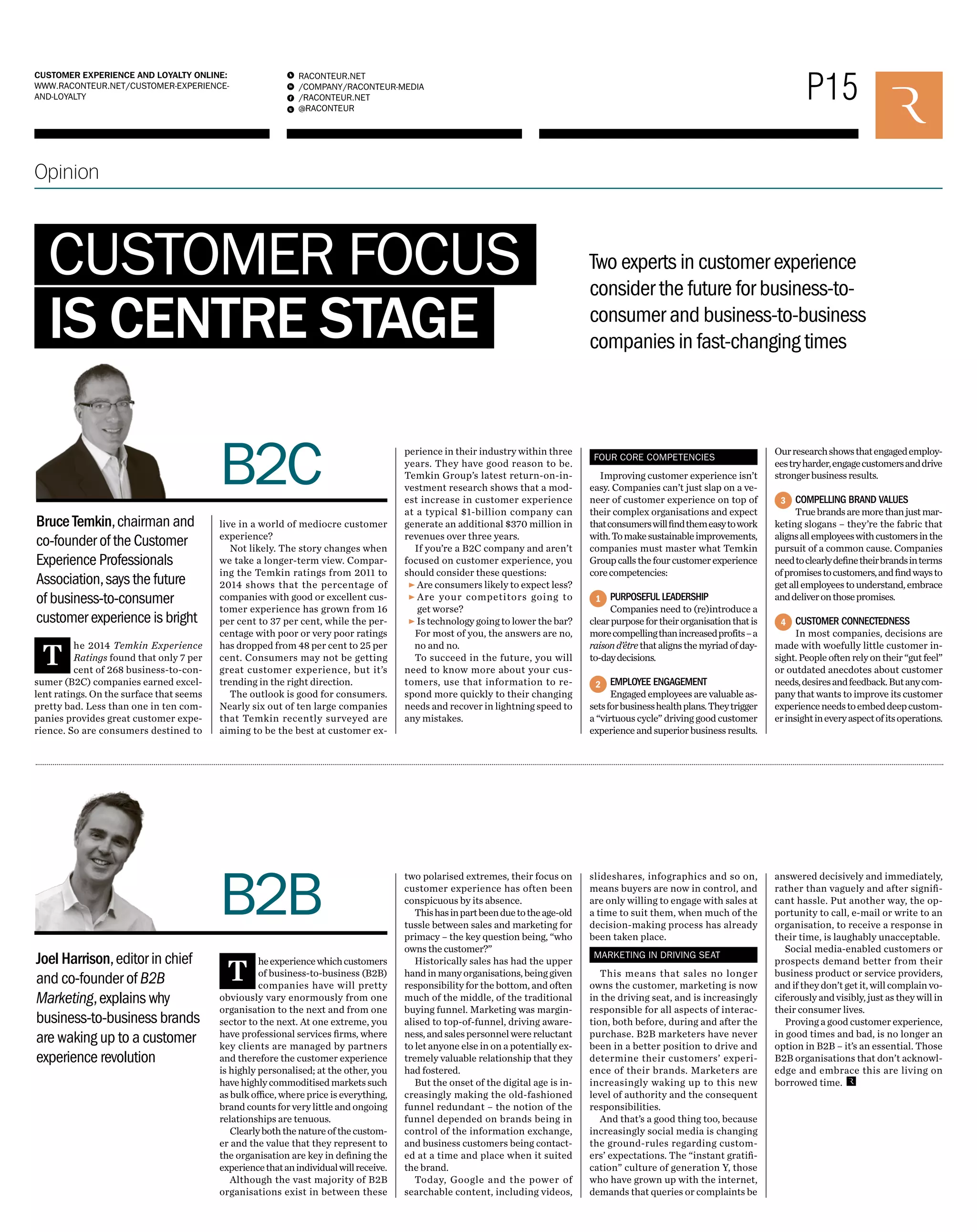
P03 Customers are setting 
P08 Getting personal with 
P10 
How to build a 
the business agenda 
offers you can’t refuse 
loyal fanbase 21/10/14 
#0284 
RACONTEUR.NET 
/COMPANY/RACONTEUR-MEDIA 
/RACONTEUR.NET 
@RACONTEUR 
1 
i 
f 
t 
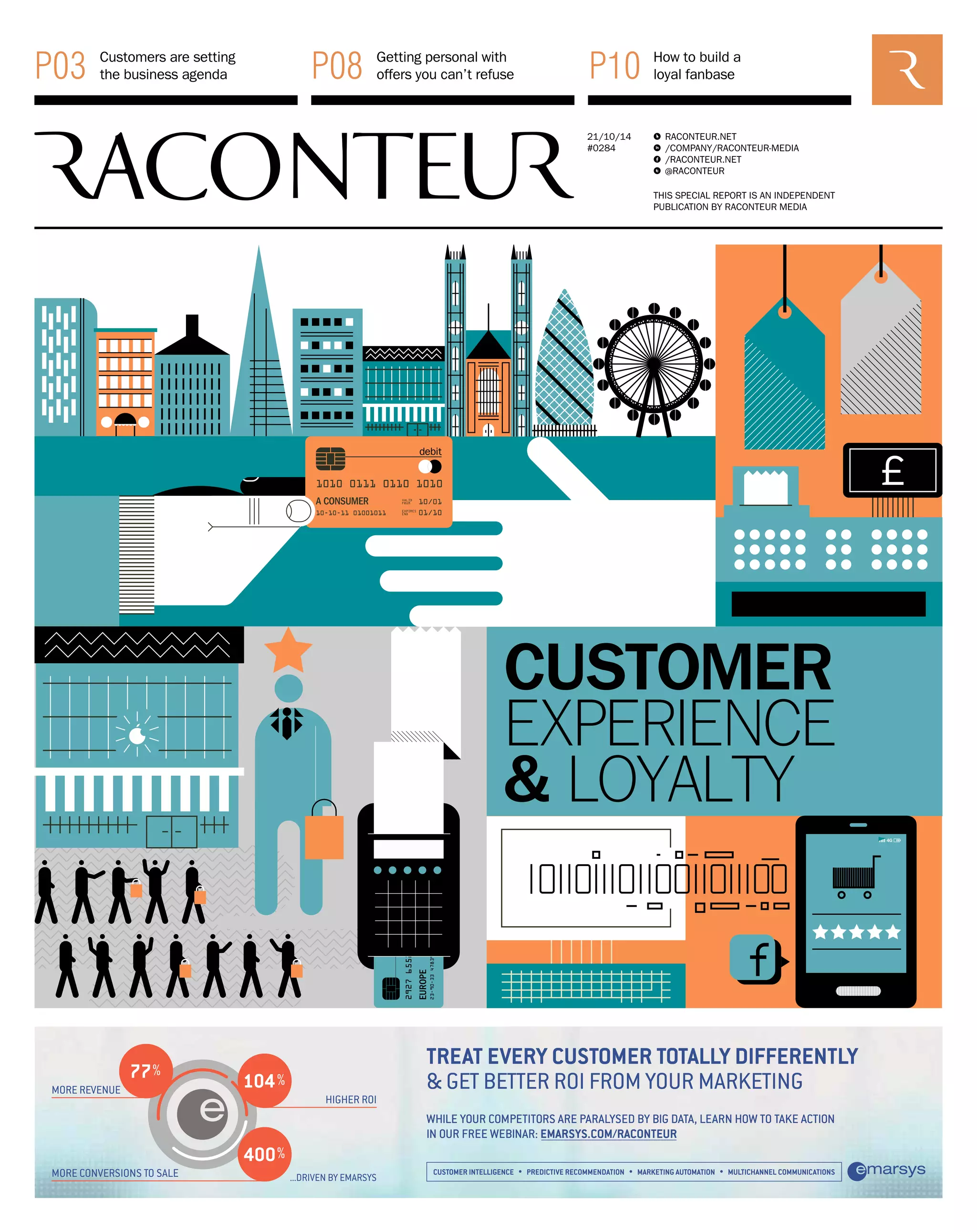
CUSTOMER 
EXPERIENCE 
& LOYALTY EUROPE 
one card 
2927 6552 1119 4030 
EXPIRES 
END 01/24 
23-90-33 47839022 
VALID 
FROM 08/14 
A CONSUMER 
debit 
1010 0111 0110 1010 
10-10-11 01001011 
VALID 
FROM 10/01 
EXPIRES 
END 01/10 
THIS SPECIAL REPORT IS AN INDEPENDENT 
PUBLICATION BY RACONTEUR MEDIA
RACONTEUR.NET 
/COMPANY/RACONTEUR-MEDIA 
/RACONTEUR.NET 
@RACONTEUR 
1 
i 
f 
t 
LOYALTY P03 
CUSTOMER EXPERIENCE AND LOYALTY ONLINE: 
WWW.RACONTEUR.NET/CUSTOMER-EXPERIENCE-AND- 
Overview 
Without doubt it is the age 
of the customer. They are 
louder than ever, have 
greater power and more ways of 
exerting it. Digital innovations 
have meant the consumer knows 
everything about a company, the 
product and its origins, as well as 
faster and more efficient ways of air-ing 
grievances and singing praises. 
While it might be terrifying 
to think your customers know 
everything about your processes, 
there’s an argument for embrac-ing 
the move towards customer 
empowerment. This is absolutely 
crucial to loyalty, says Alex Cheat-le, 
chief executive of lifestyle con-cierge 
and loyalty solutions provid-er 
Ten Group. 
“There is simply no such thing 
as a customer for life anymore; cus-tomer 
loyalty needs to be earned. 
Companies must show that they 
understand their customers and 
are responding to them as individ-uals,” 
he says. “A luxury clothing 
brand can’t just give away a pair of 
cufflinks with a shirt; they need to 
give the customer tickets to the op-era 
– because they know they like 
opera – in a city they visit regularly.” 
The customer isn’t just a buyer 
of a product, says Mr Cheatle, “Car 
manufacturers such as Maserati 
don’t just stick extras on their cars, 
they think around the issue and 
provide benefits that are perhaps 
unrelated to motoring, but are tai-lored 
to the person who is buying 
the car. Banks will no longer just 
offer travel insurance or Avios [re-ward 
currency] – customers have 
no patience with poring over small 
print or jumping through endless 
hoops for fulfillment. 
“Programmes such as Thank You 
from Coutts offer curated opportu-nities 
selected and tailored to their 
account holders. The customer 
needs to feel in charge of the ben-efits 
they receive and companies 
must use benefits to show how well 
they understand the individuals 
they are doing business with.” 
KEY TRENDS 
A report from Forrester, entitled 
Navigate the Future of Customer 
Service in 2014, outlines a num-ber 
of key trends. Customers now 
demand an omnichannel service. 
They want to start an interaction 
in one channel and complete it in 
another. The report says today’s 
customer is beginning to adopt a 
“mobile-first” mindset. Companies 
are starting to move away from 
duplicating their web presence 
for mobile and instead are look-ing 
at the right usage scenarios to 
add value to customers in a mobile 
environment. There is now a ten-dency 
towards a more focused user 
experience that allows tasks to be 
accomplished efficiently. 
Customers 2020, a report from US 
customer intelligence consulting 
firm Walker, looks at the customer 
experience industry of the future. 
The report claims customer service 
is the next brand differential, and by 
2020 will overtake price and product. 
The report says to be relevant 
in 2020, companies must focus on 
leveraging data to create a single 
source of truth and make custom-er 
intelligence accessible. It says: 
“Companies must consider ‘insight 
generation’ as a sales enablement 
function.” It also predicts the like-lihood 
of more companies having 
“chief customer champions”, serv-ing 
one purpose, “to create an un-relenting 
focus on the customer”. 
Data is being used to reach out pro-actively 
to customers in the form of 
invitations to chat and take part in 
tutorials. In addition it is being used 
innovatively to develop post-pur-chase 
engagement. 
Forrester’s The Business Impact 
of Customer Experience, 2014 report 
looks at the link between customer 
experience and consumers’ loyalty 
to a company. Unsurprisingly, the 
correlation is high. And the business 
case is strong. The research shows 
loyalty-based revenue benefit for 
a firm going from a below-average 
customer experience index score 
for its industry to above-average, 
ranged from $55 million for con-sumer 
internet service providers to 
$1.6 billion for wireless providers. 
And then there’s personalisation. 
There’s certainly a move towards 
the individualisation of the con-sumer 
process. Companies are in-creasingly 
using predictive analyt-ics 
to up and cross-sell to consumers 
based on their individual buying 
and browsing habits. It’s no longer 
just about knowing the customer’s 
name; it’s now about making sure 
offers are bespoke. 
NEW ADVISERS 
A 2013 IBM study, The Custom-er- 
Activated Enterprise, says that 
customers are the “new” business 
advisers, claiming that 90 per cent 
of senior leaders expected extensive 
collaboration with customers with-in 
the next five years. More than half 
(54 per cent) of chief executives said 
customers now have a considerable 
influence on their enterprises and, 
crucially, the outperformers are 24 
per cent more likely than underper-formers 
to have given the customer 
a prime seat at the boardroom table. 
The report highlights that in 
the first IBM study of this kind, 
released in 2004, chief executives 
ranked their own customers as 
sixth on the list of all market factors 
they believed would drive the most 
change in their organisations. What 
we see today is a very different sto-ry, 
where empowered customers 
now lead the agenda. 
The value of customer loyalty, based on a positive 
experience of service, is more important than ever, 
writes Hazel Davis 
Distributed in 
Publishing Manager 
Nathan Wilson 
Managing Editor 
Peter Archer 
Head of Production 
Natalia Rosek 
Commissioning Editor 
Hazel Davis 
Design, Infographics & Illustration 
The Design Surgery 
www.thedesignsurgery.co.uk 
Contributors 
Although this publication is funded through advertising and 
sponsorship, all editorial is without bias and sponsored features 
are clearly labelled. For an upcoming schedule, partnership 
inquiries or feedback, please call +44 (0)20 3428 5230 or 
e-mail info@raconteur.net 
Raconteur Media is a leading European publisher of special 
interest content and research. It covers a wide range of topics, 
including business, finance, sustainability, lifestyle and the arts. 
Its special reports are exclusively published within The Times, The 
Sunday Times and The Week. www.raconteur.net 
The information contained in this publication has been obtained 
from sources the Proprietors believe to be correct. However, 
no legal liability can be accepted for any errors. No part of this 
publication may be reproduced without the prior consent of the 
Publisher.© Raconteur Media 
Customer service is the next 
brand differential, and by 2020 
will overtake price and product 
HAZEL DAVIS 
Freelance writer, she contributes to The Times, Financial 
Times, The Daily Telegraph and The Guardian on a wide 
variety of subjects, but specialises in small businesses. 
MARCUS LEROUX 
Industrial correspondent of The Times, he was previously the 
newspaper’s retail correspondent. 
CHARLES ORTON-JONES 
Former Professional Publishers Association Business Journalist 
of the Year, he was editor-at-large of LondonlovesBusiness.com 
and editor of EuroBusiness magazine. 
IWONA TOKC-WILDE 
Freelance business journalist, she contributes regularly to 
various national media and trade press, covering economic 
trends, professional practices and other business issues. 
HUGH WILSON 
Former reporter and feature writer for Retail Week, he 
now writes as a freelance on a variety of topics including 
business, technology and innovation. 
CUSTOMERS ARE 
SETTING THE 
BUSINESS AGENDA 
Image: Getty
RACONTEUR.NET 
/COMPANY/RACONTEUR-MEDIA 
/RACONTEUR.NET 
@RACONTEUR 
1 
i 
f 
t 
CUSTOMER EXPERIENCE AND LOYALTY 
21/10/14 
EDITION #0284 
Leadership 
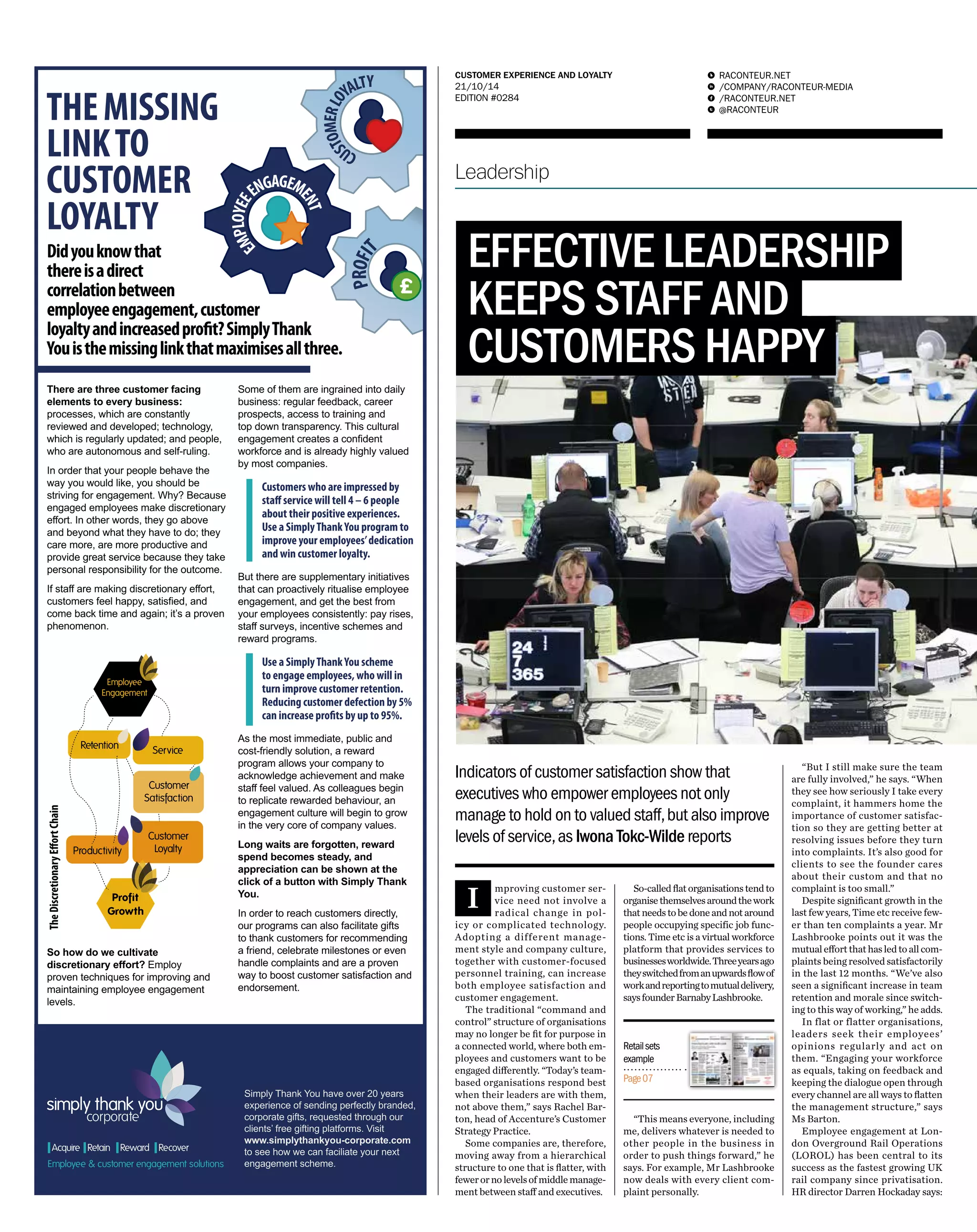
EFFECTIVE LEADERSHIP 
KEEPS STAFF AND 
CUSTOMERS HAPPY 
Indicators of customer satisfaction show that 
executives who empower employees not only 
manage to hold on to valued staff, but also improve 
levels of service, as Iwona Tokc-Wilde reports 
Improving customer ser-vice 
need not involve a 
radical change in pol-icy 
or complicated technology. 
Adopting a different manage-ment 
style and company culture, 
together with customer-focused 
personnel training, can increase 
both employee satisfaction and 
customer engagement. 
The traditional “command and 
control” structure of organisations 
may no longer be fit for purpose in 
a connected world, where both em-ployees 
and customers want to be 
engaged differently. “Today’s team-based 
organisations respond best 
when their leaders are with them, 
not above them,” says Rachel Bar-ton, 
head of Accenture’s Customer 
Strategy Practice. 
Some companies are, therefore, 
moving away from a hierarchical 
structure to one that is flatter, with 
fewer or no levels of middle manage-ment 
between staff and executives. 
So-called flat organisations tend to 
organise themselves around the work 
that needs to be done and not around 
people occupying specific job func-tions. 
Time etc is a virtual workforce 
platform that provides services to 
businesses worldwide. Three years ago 
they switched from an upwards flow of 
work and reporting to mutual delivery, 
says founder Barnaby Lashbrooke. 
“This means everyone, including 
me, delivers whatever is needed to 
other people in the business in 
order to push things forward,” he 
says. For example, Mr Lashbrooke 
now deals with every client com-plaint 
personally. 
“But I still make sure the team 
are fully involved,” he says. “When 
they see how seriously I take every 
complaint, it hammers home the 
importance of customer satisfac-tion 
so they are getting better at 
resolving issues before they turn 
into complaints. It’s also good for 
clients to see the founder cares 
about their custom and that no 
complaint is too small.” 
Despite significant growth in the 
last few years, Time etc receive few-er 
than ten complaints a year. Mr 
Lashbrooke points out it was the 
mutual effort that has led to all com-plaints 
being resolved satisfactorily 
in the last 12 months. “We’ve also 
seen a significant increase in team 
retention and morale since switch-ing 
to this way of working,” he adds. 
In flat or flatter organisations, 
leaders seek their employees’ 
opinions regularly and act on 
them. “Engaging your workforce 
as equals, taking on feedback and 
keeping the dialogue open through 
every channel are all ways to flatten 
the management structure,” says 
Ms Barton. 
Employee engagement at Lon-don 
Overground Rail Operations 
(LOROL) has been central to its 
success as the fastest growing UK 
rail company since privatisation. 
HR director Darren Hockaday says: 
Retail sets 
example 
Page 07
P05 RACONTEUR.NET 
/COMPANY/RACONTEUR-MEDIA 
/RACONTEUR.NET 
@RACONTEUR 
1 
i 
f 
t 
CUSTOMER EXPERIENCE AND LOYALTY ONLINE: 
WWW.RACONTEUR.NET/CUSTOMER-EXPERIENCE-AND- 
LOYALTY 
of operations. “Out of this has grown 
the company’s ethos of ‘training for 
all by all’ and in the last year more 
than a third of employees were in-volved 
in passing on their skills and 
experience to others.” 
The fact that all staff, regardless 
of position, can now deliver custom-er 
service training was “a conscious 
move from a culture which was 
highly compliant, dependent sole-ly 
on people following procedures, 
towards a culture focused on cus-tomer 
experience”, says Ms Plow-right. 
Since the move the company 
has won several national customer 
service training awards for its high 
standards of customer service. 
“Our net promoter score, an in-dicator 
of how likely our custom-ers 
are to recommend us, is indus-try- 
leading at +78 and customer 
retention rates are consistently over 
90 per cent too,” she says. 
Lawrence Jones, chief executive 
of internet hosting company UK-Fast, 
says their net promoter score 
has also improved, from +50 to +70, 
since he invested in an in-house 
training department last year. 
EMPLOYEE AUTONOMY 
In flatter organisations, front-line 
staff have a bigger say in how 
they deal with customers, which 
has direct impact on customer ex-perience. 
At John Lewis, staff work 
on the premise that the customer 
is right and they just need to solve 
Images: Getty 
Research has consistently 
proven a link between happy 
employees and happy customers 
any problems as quickly as possible. 
What they call “heroic recovery” 
contributes to John Lewis scoring 
the highest marks in various custom-er 
satisfaction surveys year on year. 
The world’s best hotels would not 
be the world’s best without their 
employees having almost complete 
autonomy, says Phil Anderson, client 
director at Ashridge Business School. 
“When I recently visited the Ritz 
Carlton in Singapore, staff were able 
to spend up to $2,000 replacing or re-pairing 
any item damaged by guests, 
without seeking approval,” he adds. 
GO THE EXTRA INCH 
De Vere Hotels and Village Ur-ban 
Resorts have a new customer 
service initiative called Going the 
Extra Inch, which empowers staff 
to take action to exceed their guests’ 
expectations. People development 
director Mike Williams gives an ex-ample 
of an employee who, working 
breakfast service, overheard a guest 
saying they preferred firmer pillows 
and went out at the end of her shift 
to buy them. 
“We’ve also created VIPs – Very 
Informed People – in each hotel, 
who look for ways to improve cus-tomer 
service, and who then present 
their ideas to their hotel manager 
and the company executive team,” 
says Mr Williams. 
Mr Anderson insists that in call 
centres and similar organisations, 
staff simply must have autonomy to 
be effective in dealing with custom-ers. 
“First Direct are an excellent 
example, they are truly a one-stop 
shop,” he says. 
At Wahanda, an online bookings 
platform connecting consumers 
and beauty businesses, the custom-er 
service staff are allowed to make 
judgment calls and issue credit 
notes without reverting to line man-agers 
first. “Our tech team aims to 
turn around any issues with the site 
within 24 hours, so our combined 
efforts have resulted in pushing 
up our net promoter score to over 
70,” says Wahanda’s chief executive 
Lopo Champalimaud. 
When employees have a bigger 
say in how and when they work, 
and get incentivised to deliver 
results, this too leads to better 
employee satisfaction and en-gagement, 
and to better customer 
service. At Wahanda, there are no 
limits on holiday allowances. “We 
simply trust people to do their job 
and they use their good judgment 
when it comes to taking time off,” 
says Mr Champalimaud. 
UKFast gives £1,000, £500 and 
£250 to the top three support en-gineers 
at the end of each quarter. 
“Earlier this year, high-performing 
engineers were also taken on an 
all-expenses-paid trip to Las Ve-gas,” 
says Mr Jones. De Vere Hotels 
and Village Urban Resorts celebrate 
their best employees at annual em-ployee 
awards. 
“Research has consistently proven 
a link between happy employees and 
happy customers,” says Ms Barton. 
De Vere Hotels and Village Urban 
Resorts have run their own com-parisons 
of their employee engage-ment 
scores for each hotel against 
their customer service measures, 
discovering a compelling correlation 
between the two. “Our three hotels 
with the highest customer satisfac-tion 
scores of over 80 per cent are 
also the top three when it comes to 
employee engagement, again over 80 
per cent,” says Mr Williams. 
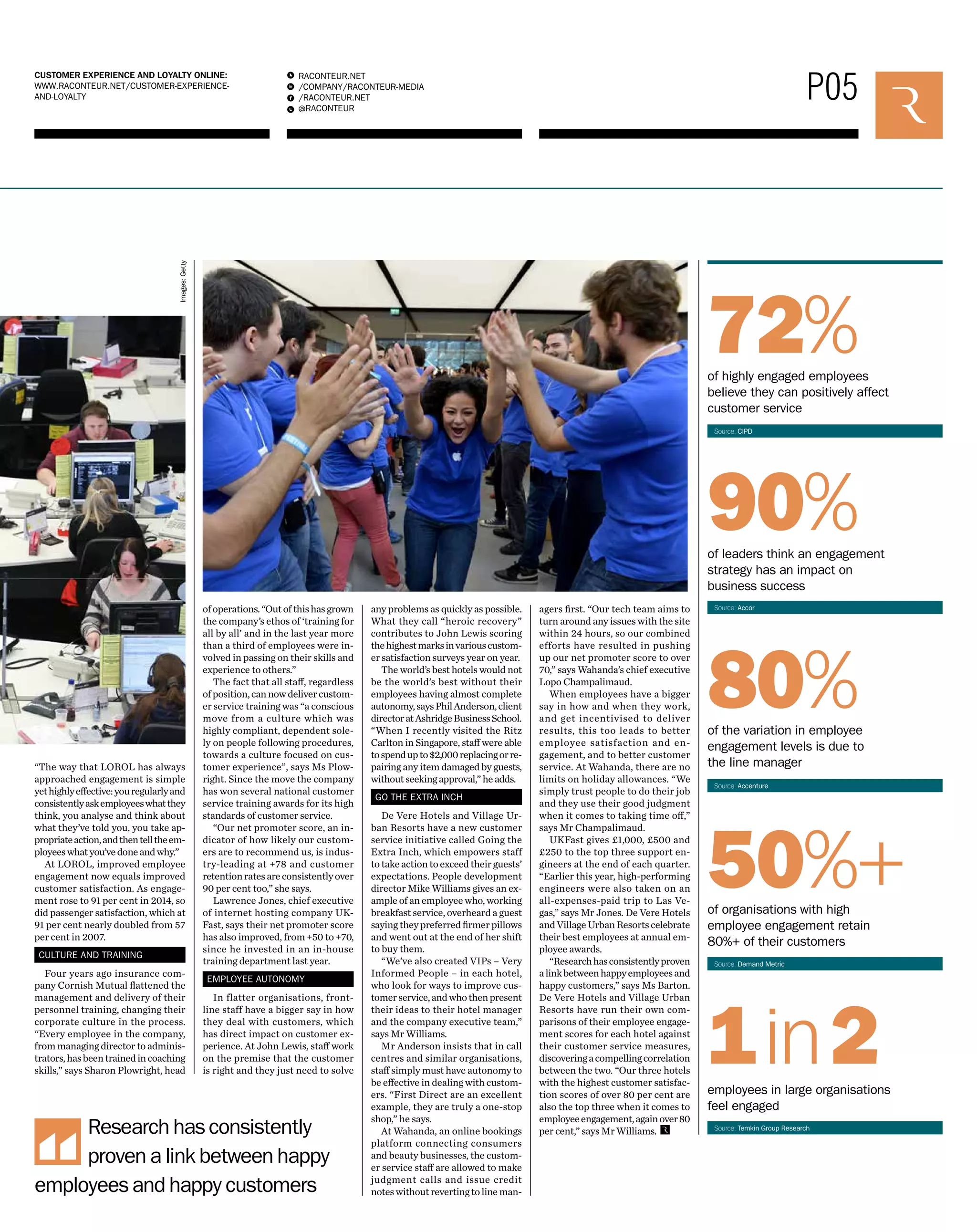
72% 
of highly engaged employees 
believe they can positively affect 
customer service 
Source: CIPD 
90% 
of leaders think an engagement 
strategy has an impact on 
business success 
Source: Accor 
80% 
of the variation in employee 
engagement levels is due to 
the line manager 
Source: Accenture 
50%+ 
of organisations with high 
employee engagement retain 
80%+ of their customers 
Source: Demand Metric 
1in2 
employees in large organisations 
feel engaged 
Source: Temkin Group Research 
“The way that LOROL has always 
approached engagement is simple 
yet highly effective: you regularly and 
consistently ask employees what they 
think, you analyse and think about 
what they’ve told you, you take ap-propriate 
action, and then tell the em-ployees 
what you’ve done and why.” 
At LOROL, improved employee 
engagement now equals improved 
customer satisfaction. As engage-ment 
rose to 91 per cent in 2014, so 
did passenger satisfaction, which at 
91 per cent nearly doubled from 57 
per cent in 2007. 
CULTURE AND TRAINING 
Four years ago insurance com-pany 
Cornish Mutual flattened the 
management and delivery of their 
personnel training, changing their 
corporate culture in the process. 
“Every employee in the company, 
from managing director to adminis-trators, 
has been trained in coaching 
skills,” says Sharon Plowright, head
P06 RACONTEUR.NET 
/COMPANY/RACONTEUR-MEDIA 
/RACONTEUR.NET 
@RACONTEUR 
1 
i 
f 
t 
CUSTOMER EXPERIENCE AND LOYALTY 
21/10/14 
EDITION #0283 
P00 ENGAGEMENT AND LOYALTY 
15/0000 
Commercial Feature 
Powering loyalty with credit cards 
With the UK economy showing clear signs of recovery and household 
spending on the up, brands are capitalising on a renewed opportunity to 
commercialise and collaborate on customer loyalty 
As consumers once again reach into 
their wallets, many will be pulling 
out their cards and demonstrating 
their commitment to a particular or-ganisation, 
whether that’s a football 
club, airline or charity. 
Affi nity card relationships can offer 
consumers loyal to brands a unique set 
of benefi ts as well as driving results for 
the brands themselves. 
“Credit-card affi nities can help brands 
grow their business on the back of real 
consumer advocacy,” says Michael Don-ald, 
commercial executive at MBNA, a UK 
leader in credit-card affi nity relationships. 
“Every time a customer takes a card 
product out of their wallet, it reminds 
them why they took it out and about the 
brand they have a particular affi nity with, 
whether retailer or airline. UK brands 
are able to make these connections 
even more powerful, while brands from 
• AMERICAN AIRLINES 
• EMIRATES 
• ETIHAD AIRWAYS 
“Our model is rooted in truly under-standing 
consumer loyalties, and con-necting 
and rewarding these. It’s a win 
for the consumer, but also a commercial 
win for the affi nity brands we’re proud to 
work with.” 
One example of this is the organisa-tion’s 
work with Manchester United, 
where MBNA was able to roll out a new 
“Champions” credit card to eligible fans 
in the UK within a week of the club win-ning 
the title for a record twentieth time, 
helping to strengthen its relationship 
with supporters and allowing them to 
share in the club’s achievement. 
emerging markets are also coming to 
the UK with their global brand, wanting 
to launch affi nities.” 
For brands, it can not only generate an 
additional source of revenue each time a 
transaction is made, but also help to re-inforce 
and reward a customer’s loyalty 
to their organisation, ensuring priority of 
the card and helping to keep customers 
loyal in the future. 
From a consumer’s perspective, af-fi 
nity credit cards allow individuals to 
benefi t from a wide range of rewards 
put forward by the brands they support, 
ranging from discounted fl ights to foot-ball 
shirts, tickets to events and charity 
donations, as well as helping to support 
that particular cause fi nancially. 
MBNA’s affinity-card experience 
means it can work with partners to iden-tify 
the business model that best suits 
them and their customer base. 
“We believe MBNA is unrivalled in the 
UK in terms of running co-branded cred-it- 
card programmes and the reason we’re 
so good at it is that we’re able to work with 
the partners to understand the needs of 
their customers,” says Mr Donald. 
Michael Donald 
Commercial executive at MBNA 
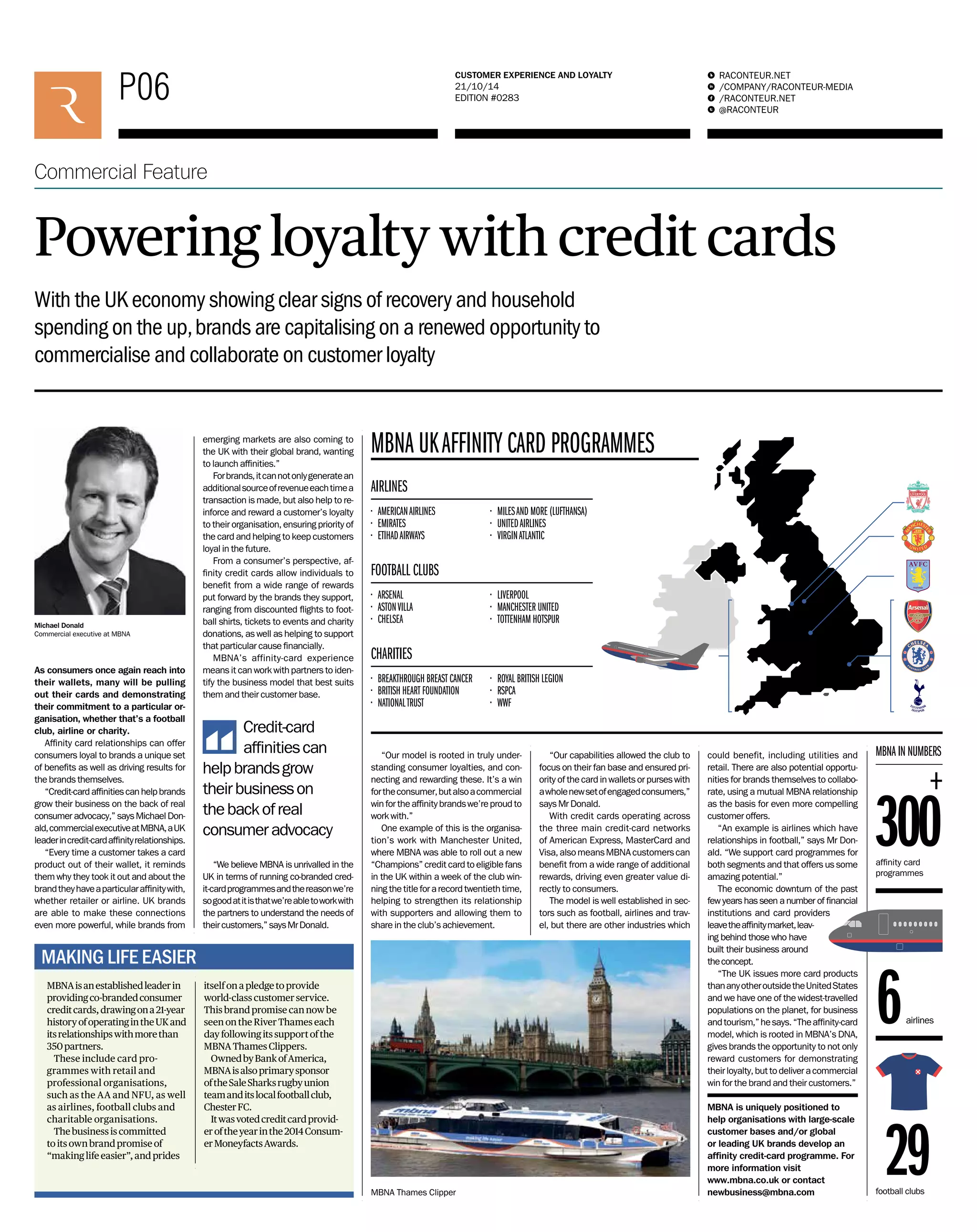
MBNA IN NUMBERS 
300 affi nity card 
programmes 
MBNA Thames Clipper 
airlines 6 
football clubs 29 
MBNA UK AFFINITY CARD PROGRAMMES 
• ARSENAL 
• ASTON VILLA 
• CHELSEA 
• LIVERPOOL 
• MANCHESTER UNITED 
• TOTTENHAM HOTSPUR 
FOOTBALL CLUBS 
• MILES AND MORE (LUFTHANSA) 
• UNITED AIRLINES 
• VIRGIN ATLANTIC 
AIRLINES 
Credit-card 
affi nities can 
help brands grow 
their business on 
the back of real 
consumer advocacy 
• BREAKTHROUGH BREAST CANCER 
• BRITISH HEART FOUNDATION 
• NATIONAL TRUST 
• ROYAL BRITISH LEGION 
• RSPCA 
• WWF 
CHARITIES 
“Our capabilities allowed the club to 
focus on their fan base and ensured pri-ority 
of the card in wallets or purses with 
a whole new set of engaged consumers,” 
says Mr Donald. 
With credit cards operating across 
the three main credit-card networks 
of American Express, MasterCard and 
Visa, also means MBNA customers can 
benefi t from a wide range of additional 
rewards, driving even greater value di-rectly 
to consumers. 
The model is well established in sec-tors 
such as football, airlines and trav-el, 
but there are other industries which 
MBNA is an established leader in 
providing co-branded consumer 
credit cards, drawing on a 21-year 
history of operating in the UK and 
its relationships with more than 
350 partners. 
These include card pro-grammes 
with retail and 
professional organisations, 
such as the AA and NFU, as well 
as airlines, football clubs and 
charitable organisations. 
The business is committed 
to its own brand promise of 
“making life easier”, and prides 
itself on a pledge to provide 
world-class customer service. 
This brand promise can now be 
seen on the River Thames each 
day following its support of the 
MBNA Thames Clippers. 
Owned by Bank of America, 
MBNA is also primary sponsor 
of the Sale Sharks rugby union 
team and its local football club, 
Chester FC. 
It was voted credit card provid-er 
of the year in the 2014 Consum-er 
Moneyfacts Awards. 
MAKING LIFE EASIER 
could benefit, including utilities and 
retail. There are also potential opportu-nities 
for brands themselves to collabo-rate, 
using a mutual MBNA relationship 
as the basis for even more compelling 
customer offers. 
“An example is airlines which have 
relationships in football,” says Mr Don-ald. 
“We support card programmes for 
both segments and that offers us some 
amazing potential.” 
The economic downturn of the past 
few years has seen a number of fi nancial 
institutions and card providers 
leave the affi nity market, leav-ing 
behind those who have 
built their business around 
the concept. 
“The UK issues more card products 
than any other outside the United States 
and we have one of the widest-travelled 
populations on the planet, for business 
and tourism,” he says. “The affi nity-card 
model, which is rooted in MBNA’s DNA, 
gives brands the opportunity to not only 
reward customers for demonstrating 
their loyalty, but to deliver a commercial 
win for the brand and their customers.” 
MBNA is uniquely positioned to 
help organisations with large-scale 
customer bases and/or global 
or leading UK brands develop an 
affi nity credit-card programme. For 
more information visit 
www.mbna.co.uk or contact 
newbusiness@mbna.com
P07 RACONTEUR.NET 
/COMPANY/RACONTEUR-MEDIA 
/RACONTEUR.NET 
@RACONTEUR 
1 
i 
f 
t 
CUSTOMER EXPERIENCE AND LOYALTY ONLINE: 
WWW.RACONTEUR.NET/CUSTOMER-EXPERIENCE-AND- 
LOYALTY 
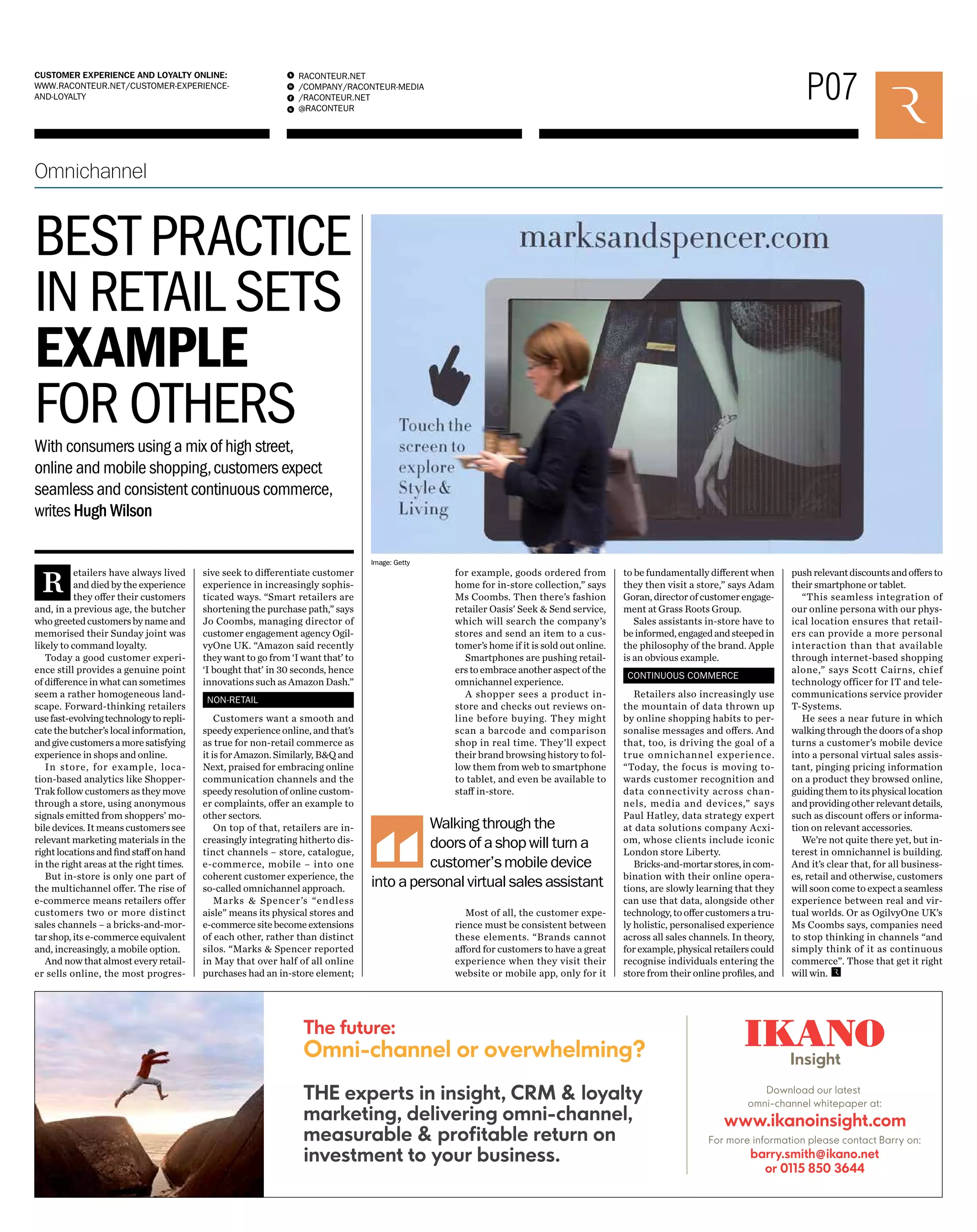
Walking through the 
doors of a shop will turn a 
customer’s mobile device 
into a personal virtual sales assistant 
Omnichannel 
BEST PRACTICE 
IN RETAIL SETS 
EXAMPLE 
FOR OTHERS 
Retailers have always lived 
and died by the experience 
they offer their customers 
and, in a previous age, the butcher 
who greeted customers by name and 
memorised their Sunday joint was 
likely to command loyalty. 
Today a good customer experi-ence 
still provides a genuine point 
of difference in what can sometimes 
seem a rather homogeneous land-scape. 
Forward-thinking retailers 
use fast-evolving technology to repli-cate 
the butcher’s local information, 
and give customers a more satisfying 
experience in shops and online. 
In store, for example, loca-tion- 
based analytics like Shopper- 
Trak follow customers as they move 
through a store, using anonymous 
signals emitted from shoppers’ mo-bile 
devices. It means customers see 
relevant marketing materials in the 
right locations and find staff on hand 
in the right areas at the right times. 
But in-store is only one part of 
the multichannel offer. The rise of 
e-commerce means retailers offer 
customers two or more distinct 
sales channels – a bricks-and-mor-tar 
shop, its e-commerce equivalent 
and, increasingly, a mobile option. 
And now that almost every retail-er 
sells online, the most progres-sive 
seek to differentiate customer 
experience in increasingly sophis-ticated 
ways. “Smart retailers are 
shortening the purchase path,” says 
Jo Coombs, managing director of 
customer engagement agency Ogil-vyOne 
UK. “Amazon said recently 
they want to go from ‘I want that’ to 
‘I bought that’ in 30 seconds, hence 
innovations such as Amazon Dash.” 
NON-RETAIL 
Customers want a smooth and 
speedy experience online, and that’s 
as true for non-retail commerce as 
it is for Amazon. Similarly, B&Q and 
Next, praised for embracing online 
communication channels and the 
speedy resolution of online custom-er 
complaints, offer an example to 
other sectors. 
On top of that, retailers are in-creasingly 
integrating hitherto dis-tinct 
channels – store, catalogue, 
e-commerce, mobile – into one 
coherent customer experience, the 
so-called omnichannel approach. 
Marks & Spencer’s “endless 
aisle” means its physical stores and 
e-commerce site become extensions 
of each other, rather than distinct 
silos. “Marks & Spencer reported 
in May that over half of all online 
purchases had an in-store element; 
for example, goods ordered from 
home for in-store collection,” says 
Ms Coombs. Then there’s fashion 
retailer Oasis’ Seek & Send service, 
which will search the company’s 
stores and send an item to a cus-tomer’s 
home if it is sold out online. 
Smartphones are pushing retail-ers 
to embrace another aspect of the 
omnichannel experience. 
A shopper sees a product in-store 
and checks out reviews on-line 
before buying. They might 
scan a barcode and comparison 
shop in real time. They’ll expect 
their brand browsing history to fol-low 
them from web to smartphone 
to tablet, and even be available to 
staff in-store. 
Most of all, the customer expe-rience 
must be consistent between 
these elements. “Brands cannot 
afford for customers to have a great 
experience when they visit their 
website or mobile app, only for it 
to be fundamentally different when 
they then visit a store,” says Adam 
Goran, director of customer engage-ment 
at Grass Roots Group. 
Sales assistants in-store have to 
be informed, engaged and steeped in 
the philosophy of the brand. Apple 
is an obvious example. 
CONTINUOUS COMMERCE 
Retailers also increasingly use 
the mountain of data thrown up 
by online shopping habits to per-sonalise 
messages and offers. And 
that, too, is driving the goal of a 
true omnichannel experience. 
“Today, the focus is moving to-wards 
customer recognition and 
data connectivity across chan-nels, 
media and devices,” says 
Paul Hatley, data strategy expert 
at data solutions company Acxi-om, 
whose clients include iconic 
London store Liberty. 
Bricks-and-mortar stores, in com-bination 
with their online opera-tions, 
are slowly learning that they 
can use that data, alongside other 
technology, to offer customers a tru-ly 
holistic, personalised experience 
across all sales channels. In theory, 
for example, physical retailers could 
recognise individuals entering the 
store from their online profiles, and 
push relevant discounts and offers to 
their smartphone or tablet. 
“This seamless integration of 
our online persona with our phys-ical 
location ensures that retail-ers 
can provide a more personal 
interaction than that available 
through internet-based shopping 
alone,” says Scott Cairns, chief 
technology officer for IT and tele-communications 
service provider 
T-Systems. 
He sees a near future in which 
walking through the doors of a shop 
turns a customer’s mobile device 
into a personal virtual sales assis-tant, 
pinging pricing information 
on a product they browsed online, 
guiding them to its physical location 
and providing other relevant details, 
such as discount offers or informa-tion 
on relevant accessories. 
We’re not quite there yet, but in-terest 
in omnichannel is building. 
And it’s clear that, for all business-es, 
retail and otherwise, customers 
will soon come to expect a seamless 
experience between real and vir-tual 
worlds. Or as OgilvyOne UK’s 
Ms Coombs says, companies need 
to stop thinking in channels “and 
simply think of it as continuous 
commerce”. Those that get it right 
will win. 
With consumers using a mix of high street, 
online and mobile shopping, customers expect 
seamless and consistent continuous commerce, 
writes Hugh Wilson 
Image: Getty
P08 RACONTEUR.NET 
/COMPANY/RACONTEUR-MEDIA 
/RACONTEUR.NET 
@RACONTEUR 
1 
i 
f 
t 
CUSTOMER EXPERIENCE AND LOYALTY 
21/10/14 
EDITION #0284 
Personalisation 
LET’S GET 
PERSONAL 
2 
3 
4 
5 
1 
Offering the same old 
customer experience is 
becoming obsolete. What 
consumers want is a 
personalised service, tailored 
to meet their individual 
desires, budget and mindset. 
As Charles Orton-Jones 
discovers, it is possible to 
offer a unique experience to 
each and every customer, no 
matter what sector a business 
operates in 
Google boss Eric Schmidt once 
defined his company’s mission 
as serving you just what you 
want online before you’ve 
even asked for it. The trend for 
personalised advertisements 
is making that aim feel spookily 
close. 
The most common way to per-sonalise 
adverts is to look at 
the users’ search history and 
tailor adverts to match their 
search criteria. For example, 
James Villa Holidays, which 
offers villa holidays across the 
Mediterranean and United 
States, uses search retarget-ing 
to follow potential holiday-makers 
across the web. 
The process starts when a 
user begins researching a 
holiday online. They’ll type 
in something like “Dalmatia 
holiday villa”. Then James 
Villa Holidays learns what it 
can about the user from their 
web history. It can then place 
precisely the right banner ads 
in front of the user by bidding, 
in microseconds, for web 
real estate. The firm uses an 
automated system supplied by 
search retargeting specialist 
Captify. The result? 
“Customers are incredibly 
receptive to our personalised 
digital ads,” says Sally Pemble 
of James Villa Holidays. 
“During a recent campaign we 
doubled the click-through rate 
compared with other digital 
campaigns we’ve run and 
increased the conversion rate 
by around 60 per cent.” 
Computer games tend to be 
standard experiences. If you 
play Angry Birds or Portal 2, it 
is the same no matter whether 
you are an 8 year old or a mid-dle- 
aged hardcore gamer. This 
is changing. The new generation 
of games adapt to each user to 
ensure everyone gets the game 
they want. 
One of the biggest person-alisation 
consultancies is 
Edinburgh-based deltaDNA. 
It collects user data to help 
designers tailor games to 
different demographics. For 
example, Heroes & Generals, 
by games house Reto-Moto, 
is an online Second World War 
shooter game with 3.2 million 
registered users. With multiple 
game modes accessible across 
multiple platforms, players can 
choose to play as either heroes 
fighting on the battlefields or 
as generals devising the grand 
strategy of a massive war 
with thousands of concurrent 
players. 
Using the deltaDNA platform, 
Reto-Moto is able to segment 
players based on their playing 
style and ability, ensuring the 
playing experience is shaped for 
different types of players. Nov-ice 
players can be nurtured; ex-pert 
players can be challenged, 
especially in the early stages of 
the game when churn is highest 
as being cannon fodder isn’t fun 
for anyone. The result is happy 
heroes and happy generals, no 
matter what level of compe-tence 
they play with. 
China is a huge market for 
Scotch whisky. And what the Chi-nese 
want more than anything 
is the absolute top end. How 
better to serve this niche than by 
creating tailor-made whiskies? 
Three years ago drinks giant 
Diageo opened The Johnnie 
Walker House in Shanghai. It 
is marketed as an “embassy 
for Scotch whisky culture”. The 
crowning glory is the opportuni-ty 
for members and guests to 
have the chance to blend their 
own bespoke whisky. The result-ing 
product, your very own John 
Walker & Sons Signature Blend, 
is produced under the guidance 
of Jim Beveridge, master blend-er 
for Johnnie Walker. 
The packaging – both bottle 
and special presentation case 
– is also designed to be tailored 
exclusively to a client’s prefer-ence, 
with both decanter and 
bottle options. London agency 
Sedley Place is responsible for 
this aspect of personalisation. 
Details on the bespoke 
packaging extend to a client 
monogram, personalisation of 
the bottle or decanter marked 
with the client’s signature, 
a specially designed neck 
charm and a certificate of 
authentication. 
The success of the Shanghai 
concept has led to Diageo 
opening new branches in Bei-jing 
and Seoul. Each Signature 
Blend starts from a price tag 
of £80,000, which gets you 20 
bottles. To date ten Signature 
Blends have been produced. 
Showing the same website to 
all visitors is a lost opportuni-ty. 
Ideally your website ought 
to optimise for every individual 
visitor, showing them precisely 
what they want to see. 
SkiWeekends.com is a ski 
holiday booking website cov-ering 
24 ski resorts, serviced 
by 17 UK airports. The travel 
agent behind it has 30 years’ 
experience and is at the 
cutting edge of personalising 
the online experience. 
The site uses a service called 
Sitecore Experience Platform, 
which gathers all available 
data to personalise what 
each visitor sees. It takes 
into account factors such as 
search terms and the visitor’s 
location, using their IP (inter-net 
protocol) address, to tailor 
site specifics such as desti-nations, 
transport options, 
promotions and incentives. 
Since the start of the 2013-14 
ski season, sales revenue 
at SkiWeekends.com has in-creased 
by 16 per cent year on 
year, thanks to a 55 per cent 
rise in conversion of site visits 
to its online booking pages. 
The site has attracted 15 
per cent more unique visits, 
increasing to almost 200,000 
in six months. But, more signif-icantly, 
the improved usability 
and personalisation means 
32 per cent more visitors are 
finding their ideal ski holiday – 
all done by a firm with just six 
full-time members of staff. 
Children playing football don’t 
need any encouragement 
to keep playing. They’ll stay 
outdoors kicking the ball until 
it’s too dark to see. But why 
don’t they behave the same 
way with maths homework? 
The goal of personalised 
learning is to bring the same 
thrills and emotions to learning 
that games offer. The latest 
iteration in personalised learn-ing, 
developed by the global 
IT trade body CompTIA, tracks 
emissions of the pleasure 
hormone dopamine to ensure 
learners are kept at the perfect 
mental state: excited, curious 
and happy. 
The Chicago-based Computer 
Systems Institute is trialling 
CompTIA’s new system, called 
CertMaster. Questions are 
presented at specially timed 
intervals to help each student 
remember, and each question 
must be answered accurately 
and confidently twice before 
the system shows they have 
mastered the topic. 
An algorithm looks at 
things which signify optimal 
dopamine levels, such as 
confidence level, based on 
what types of answers they 
choose and time they take to 
answer, the speed at which 
students master topics, and 
how well they memorise what 
they have learnt. 
This approach creates a dopa-mine 
effect and a self-perpet-uating 
positive feedback loop 
to keep learners’ attention 
and boost knowledge reten-tion. 
In early trials, CertMaster 
claims 80 per cent knowledge 
retention 
YOUR OWN PERFECT WHISKY 
LESSONS YOU WON’T WANT TO END 
SHOWING ADS YOU WANT TO SEE 
NO MORE CANNON FODDER 
PERSONALISED WEBSITES
P09 RACONTEUR.NET 
/COMPANY/RACONTEUR-MEDIA 
/RACONTEUR.NET 
@RACONTEUR 
1 
i 
f 
t 
CUSTOMER EXPERIENCE AND LOYALTY ONLINE: 
WWW.RACONTEUR.NET/CUSTOMER-EXPERIENCE-AND- 
LOYALTY 
80 
60 
40 
20 
0 
SALE SALE 
Source: Forrester, April 2014 Source: Forrester, April 2014 
80 
60 
40 
20 
0 
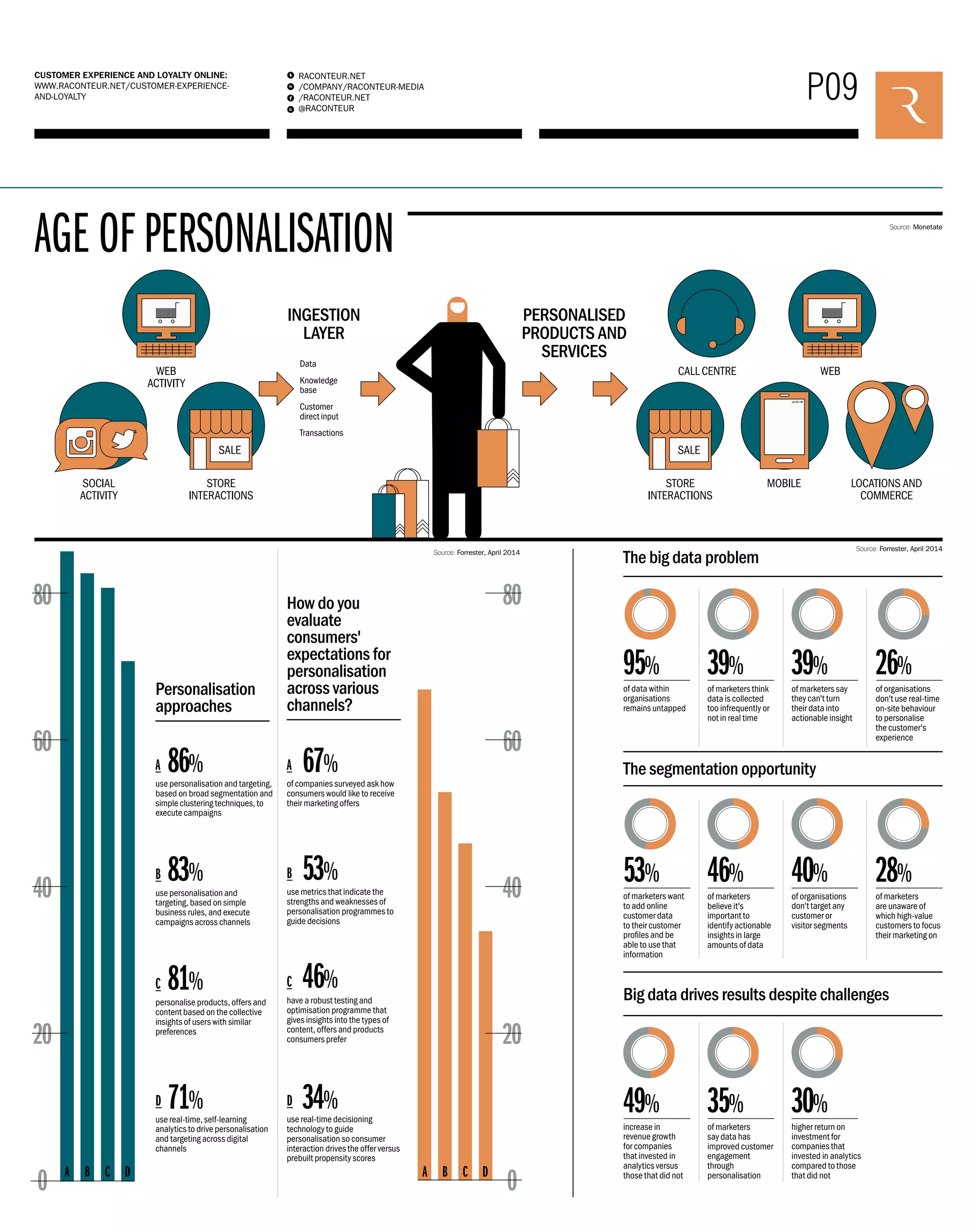
95% 
86% A 
67% 
B 
81% C 
46% 
71% D 
34% 
of data within 
organisations 
remains untapped 
53% 
of marketers want 
to add online 
customer data 
to their customer 
profiles and be 
able to use that 
information 
49% 
39% 
46% 
35% 
39% 
40% 
30% 
26% 
28% 
AGE OF PERSONALISATION 
The big data problem 
WEB 
ACTIVITY 
Personalisation 
approaches 
How do you 
evaluate 
consumers' 
expectations for 
personalisation 
across various 
channels? 
The segmentation opportunity 
Big data drives results despite challenges 
increase in 
revenue growth 
for companies 
that invested in 
analytics versus 
those that did not 
of marketers say 
they can't turn 
their data into 
actionable insight 
of organisations 
don't target any 
customer or 
visitor segments 
higher return on 
investment for 
companies that 
invested in analytics 
compared to those 
that did not 
of marketers think 
data is collected 
too infrequently or 
not in real time 
of marketers 
believe it's 
important to 
identify actionable 
insights in large 
amounts of data 
of marketers 
say data has 
improved customer 
engagement 
through 
personalisation 
of organisations 
don't use real-time 
on-site behaviour 
to personalise 
the customer's 
experience 
of marketers 
are unaware of 
which high-value 
customers to focus 
their marketing on 
A 
use personalisation and targeting, 
based on broad segmentation and 
simple clustering techniques, to 
execute campaigns 
CALL CENTRE WEB 
SOCIAL 
ACTIVITY 
STORE 
INTERACTIONS 
INGESTION 
LAYER 
PERSONALISED 
PRODUCTS AND 
SERVICES 
STORE 
INTERACTIONS 
MOBILE LOCATIONS AND 
COMMERCE 
of companies surveyed ask how 
consumers would like to receive 
their marketing offers 
83% 
B 
use personalisation and 
targeting, based on simple 
business rules, and execute 
campaigns across channels 
53% 
use metrics that indicate the 
strengths and weaknesses of 
personalisation programmes to 
guide decisions 
C 
personalise products, offers and 
content based on the collective 
insights of users with similar 
preferences 
have a robust testing and 
optimisation programme that 
gives insights into the types of 
content, offers and products 
consumers prefer 
D 
use real-time, self-learning 
analytics to drive personalisation 
and targeting across digital 
channels 
use real-time decisioning 
technology to guide 
personalisation so consumer 
interaction drives the offer versus 
prebuilt propensity scores 
A B A B 
C D C D 
Source: Monetate 
Data 
Knowledge 
base 
Customer 
direct input 
Transactions
P10 RACONTEUR.NET 
/COMPANY/RACONTEUR-MEDIA 
/RACONTEUR.NET 
@RACONTEUR 
1 
i 
f 
t 
CUSTOMER EXPERIENCE AND LOYALTY 
21/10/14 
EDITION #0284 
Customer Communities 
BUILDING 
A FANBASE 
Businesses launch customer 
communities for a variety 
of reasons – to help cus-tomers 
with products, to improve 
the effectiveness of marketing ef-forts, 
to create customer feedback 
loops, to use market data and to im-prove 
customer satisfaction. 
North of England-based open-ac-cess 
train operator Grand Central 
has developed an extraordinary rep-utation 
for great customer service, 
largely through word of mouth and 
the efforts of its very vocal fanbase, 
the customers. 
The company’s communica-tions 
and stakeholder manager 
Kate Thorpe says its success in this 
area has a lot to do with the need it 
serves. “As an open-access operator, 
Grand Central Rail exists because 
the local communities we serve did 
not already have a direct rail link to 
London,” she says. “Local support 
for our services in the early days 
gave communities a sense of owner-ship 
of Grand Central Rail services, 
and we work hard to maintain and 
develop close co-operative links.” 
Ms Thorpe says Grand Central 
seeks out opportunities to support, 
promote and develop local initia-tives 
which benefit the community, 
“from supporting Brass Factor – a 
brass band talent competition in 
West Yorkshire – to jobs fairs and 
other stakeholder activity”. 
The company runs a station am-bassador 
scheme manned by volun-teers. 
“As a small company which 
does not own or manage any sta-tions, 
we do not have the infrastruc-ture 
or resources to staff stations on 
Sundays, when smaller stations are 
traditionally unstaffed and the ma-jority 
of rail engineering work takes 
place, disrupting rail travel across 
the country,” she says. 
“The station ambassadors mod-el 
we adopted allows us to provide 
face-to-face customer advice on 
travel, tickets, rail replacement 
services, taxis and directions 
using fully trained, uniformed 
volunteers from local business 
communities, who donate their 
time in order to provide help and 
assistance. Their presence has had 
a positive effect on our passengers 
and staff, and contributes to devel-oping 
rail travel in the North East 
and Yorkshire.” 
It has paid off. Figures released 
by Passenger Focus earlier this year 
found that 95 per cent of Grand 
Central passengers were “satis-fied” 
or “very satisfied”, which is 
something you don’t often hear 
in the same breath as the words 
“train company”. Enterprise busi-ness 
technology provider Avanade 
uses social media as a core plat-form 
for its thought leadership as 
well as creating dialogue with its 
customers. Jessica Brookes, global 
director of media and analyst rela-tions, 
says: “Simply put, we listen 
to the market, making sure we are 
staying on top of developing indus-try 
trends, emerging technologies 
and enterprise pain points that 
are on the minds of our enterprise 
customers. The data we glean from 
this active listening helps inform 
our marketing campaign focus and 
content creation.” 
Avanade generated 3.5 million 
impressions on LinkedIn last year 
and has 25 different groups there, 
with 15,000 members combined. 
But using social media to mobi-lise 
customers isn’t about gather-ing 
followers indiscriminately. It’s 
about how well you use the follow-ers 
you have. Avanade uses social 
media channels to manage its 
brand presence online, identifying 
who its audience and influencers 
are, and measuring how effective it 
is at reaching them. “We tailor our 
content to be relevant and person-alized, 
and respond in real time to 
questions, comments and trends,” 
says Ms Brookes. 
“We do this at a corporate lev-el, 
regional level and with specific 
‘digital executives’ who share their 
unique point of view. We are aim-ing 
for two-way communication 
with social platforms such as our 
blog and Tumblr accounts.” 
TWEETCHATS 
Avanade hosts regular tweet-chats, 
and even uses Instagram 
and Pinterest. Though Instagram, 
which isn’t typically used by large 
companies, might seem like a 
time-consuming and non-cost-ef-fective 
use of labour, Avanade’s 
chief marketing officer Stella Gou-let 
says it’s a great way of human-ising 
the company and showing its 
personality, and this filters down 
to the bottom line. 
The company joined Instagram 
about 18 months ago and says Ms 
Goulet: “We leverage Instagram 
with teams and customers at vari-ous 
tradeshows, Formula 1 [motor 
racing] events, as part of its spon-sorship 
with Lotus F1 Team, and 
showcase fun things happening in 
our offices worldwide.” 
Social tools such as Instagram 
might not gather millions of follow-ers, 
she says, but they, “ increase em-ployee 
engagement and, hopefully, 
communicate to potential recruits 
that Avanade creates change”. 
Research into consumerisation of 
enterprise sales, published by Ava-nade 
at the end of 2013, showed that 
enterprise buyers are beginning to 
mimic consumer shopping behav-iours 
and the value of the customer 
experience is now more important 
than cost in the buying process. 
The research found that the value 
of the customer experience surpass-es 
cost as the top factor in a busi-ness- 
to-business (B2B) purchasing 
decision. Customers report they 
are willing to pay up to 30 per cent 
more for a superior experience. In 
fact, 56 per cent of those surveyed 
report paying more for a product 
in the last six months because the 
customer experience was better 
than other less expensive options. 
According to the research, 61 
per cent of B2B buyers report 
third-party sites and feedback 
from business partners, industry 
peers or social channels as more 
important than conversations 
with a company’s sales team when 
making a purchasing decision. 
They also talk about their busi-ness 
purchase decision publicly 
– 32 per cent posted a review on 
social media channels and 19 per 
cent posted comments about the 
company on Twitter. 
Most companies know how to use social media to promote their 
business, but some are building successful cohesive and supportive 
online and offline customer communities, who are working almost as 
hard to back the brand as the paid employees. Hazel Davis reports 
Communities thrive 
on shared interest, 
engaging dialogue, 
freely exchanged stories and 
mutual support 
Data 
is key 
Page 13 
Image: Getty
P11 RACONTEUR.NET 
/COMPANY/RACONTEUR-MEDIA 
/RACONTEUR.NET 
@RACONTEUR 
1 
i 
f 
t 
CUSTOMER EXPERIENCE AND LOYALTY ONLINE: 
WWW.RACONTEUR.NET/CUSTOMER-EXPERIENCE-AND- 
LOYALTY 
Case Study 
RESIST SELF-INTEREST 
Jim Prior, chief executive of 
brand consultancies The Partners 
and Lambie-Nairn, says: “Com-munities 
are built in the virtual 
world in the same ways as they are 
in the physical world. They thrive 
on shared interest, engaging di-alogue, 
freely exchanged stories 
and mutual support, and tend to 
resist more dictatorial or self-in-terested 
approaches. 
“For companies, successful 
community building requires a 
different approach to the one-way 
broadcast technique of traditional 
marketing. It needs companies to 
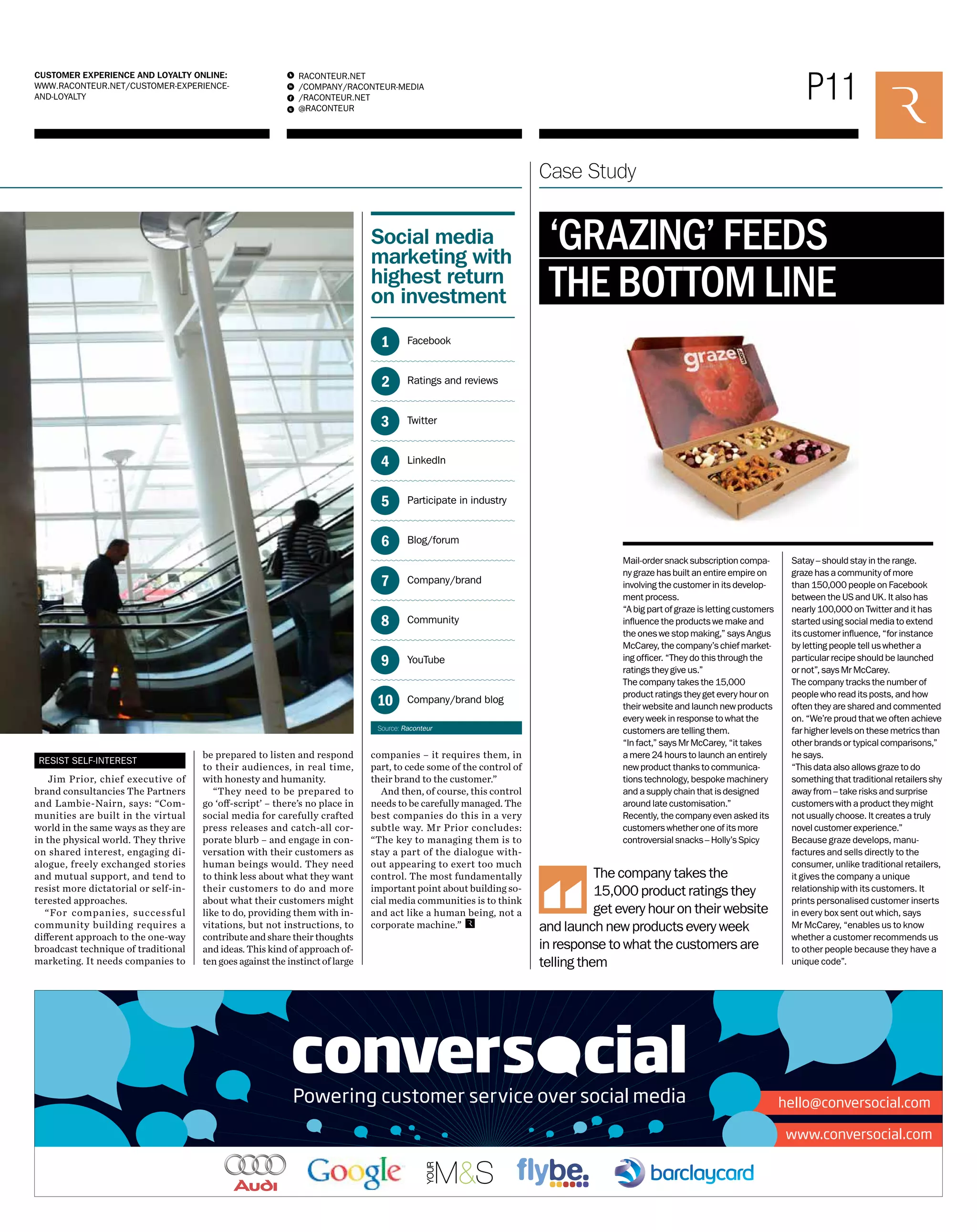
‘GRAZING’ FEEDS 
THE BOTTOM LINE 
Mail-order snack subscription compa-ny 
graze has built an entire empire on 
involving the customer in its develop-ment 
process. 
“A big part of graze is letting customers 
influence the products we make and 
the ones we stop making,” says Angus 
McCarey, the company’s chief market-ing 
officer. “They do this through the 
ratings they give us.” 
The company takes the 15,000 
product ratings they get every hour on 
their website and launch new products 
every week in response to what the 
customers are telling them. 
“In fact,” says Mr McCarey, “it takes 
a mere 24 hours to launch an entirely 
new product thanks to communica-tions 
technology, bespoke machinery 
and a supply chain that is designed 
around late customisation.” 
Recently, the company even asked its 
customers whether one of its more 
controversial snacks – Holly’s Spicy 
Satay – should stay in the range. 
graze has a community of more 
than 150,000 people on Facebook 
between the US and UK. It also has 
nearly 100,000 on Twitter and it has 
started using social media to extend 
its customer influence, “for instance 
by letting people tell us whether a 
particular recipe should be launched 
or not”, says Mr McCarey. 
The company tracks the number of 
people who read its posts, and how 
often they are shared and commented 
on. “We’re proud that we often achieve 
far higher levels on these metrics than 
other brands or typical comparisons,” 
he says. 
“This data also allows graze to do 
something that traditional retailers shy 
away from – take risks and surprise 
customers with a product they might 
not usually choose. It creates a truly 
novel customer experience.” 
Because graze develops, manu-factures 
and sells directly to the 
consumer, unlike traditional retailers, 
it gives the company a unique 
relationship with its customers. It 
prints personalised customer inserts 
in every box sent out which, says 
Mr McCarey, “enables us to know 
whether a customer recommends us 
to other people because they have a 
unique code”. 
The company takes the 
15,000 product ratings they 
get every hour on their website 
and launch new products every week 
in response to what the customers are 
telling them 
be prepared to listen and respond 
to their audiences, in real time, 
with honesty and humanity. 
“They need to be prepared to 
go ‘off-script’ – there’s no place in 
social media for carefully crafted 
press releases and catch-all cor-porate 
blurb – and engage in con-versation 
with their customers as 
human beings would. They need 
to think less about what they want 
their customers to do and more 
about what their customers might 
like to do, providing them with in-vitations, 
but not instructions, to 
contribute and share their thoughts 
and ideas. This kind of approach of-ten 
goes against the instinct of large 
Social media 
marketing with 
highest return 
on investment 
Facebook 
Ratings and reviews 
Twitter 
LinkedIn 
Participate in industry 
Blog/forum 
Company/brand 
Community 
YouTube 
Company/brand blog 
1 
2 
3 
4 
5 
6 
7 
8 
9 
10 
Source: Raconteur 
companies – it requires them, in 
part, to cede some of the control of 
their brand to the customer.” 
And then, of course, this control 
needs to be carefully managed. The 
best companies do this in a very 
subtle way. Mr Prior concludes: 
“The key to managing them is to 
stay a part of the dialogue with-out 
appearing to exert too much 
control. The most fundamentally 
important point about building so-cial 
media communities is to think 
and act like a human being, not a 
corporate machine.”
P12 RACONTEUR.NET 
P00 RACONTEUR.NET 
/COMPANY/RACONTEUR-MEDIA 
/RACONTEUR.NET 
@RACONTEUR 
1 
i 
f 
t 
CUSTOMER EXPERIENCE AND LOYALTY 
21/10/14 
EDITION #0284 
Commercial Feature 
/COMPANY/RACONTEUR-MEDIA 
/RACONTEUR.NET 
@RACONTEUR 
1 
i 
f 
t 
FUTURE OF WORK 
16/10/14 
EDITION #0000 
Commercial Feature 
Delivering optimum customer 
experience is must-do for business 
Brands must start looking at the customer experience 
from the point of view of the customer, not their own – a 
change that is easier to implement than many may think, 
says Tash Whitmey, group chief executive of Havas EHS 
We’ve all had the much-talked-about 
experience. You visit a website, type 
in your details, do a search and in-put 
your preferences. Then you ring 
the call centre… and go through the 
whole business all over again be-cause 
the person on the other end 
of the line has no access to what 
you’ve inputted. 
Or you have a lengthy conversation 
with the call centre representative, then 
fi nd yourself having to repeat it yet again 
when you visit the store. 
Ironically, we clearly know what a cus-tomer 
wants – because we are custom-ers. 
Yet we have organisations who defi ne 
themselves in silos, focusing on product 
or operational deliverables, and still many 
brands lag way behind their customers’ 
wants, while they struggle to put a cus-tomer- 
fi rst philosophy into practice. 
To put the customer experience fi rst 
is now essential. There is no captive au-dience. 
Customers are more demand-ing, 
more selective and more savvy. 
They want brands that are committed 
to them and take time to understand 
exactly what they want. If a brand fails 
to recognise customer priorities, then 
social media at every level provides a 
powerful platform for customers to be 
heard and deliver their choices. And in 
turn a new wave of startups, such as 
giffgaff or ASOS, fl eet of foot and with 
no legacy systems, challenge well-es-tablished 
brands to deliver a smoother, 
more integrated customer journey. 
CUSTOMER PERSPECTIVE 
We believe brands need to have the 
ability to look at the customer experi-ence 
through the lens of the customer 
themselves, while being clear about 
which parts of the organisation are con-tributing 
to it – a two-way mirror. 
But why do so many well-managed, 
sales-led, hitherto successful brands 
baulk at starting with the customer? In 
a way you can hardly blame them. They 
perceive the answer as being a potential 
re-engineering of whole sections of the 
organisation or replacement of entire IT 
systems. And if that were the case – yes, 
it would be pretty scary. 
“Do we really have to change 
everything?” clients often ask us. The 
good news is that the answer to this 
question is a resounding “No, you don’t.” 
Changing everything is like boiling the 
ocean when you really just want to make 
a cup of tea. 
The Havas EHS approach is we 
make the difference that will make a 
difference. We create a single way of 
connecting all the different views of the 
customer, from unknown to identifi able, 
and work out how to manage all the in-teractions 
in-between. Then we map a 
customers’ journey to deliver new and 
better experiences that, if tested and 
work, are scaled up. 
DATA IS GLUE 
Data is the glue which creates our 
insights and enables us to know where, 
when, why and how to focus on creating 
better customer experiences. 
There are so many moments that a 
customer “touches” a business, and 
we need to be able to defi ne which we 
should infl uence and where we can have 
the most impact; not just what happens 
“at the moment”, but what we do before 
and after each interaction. 
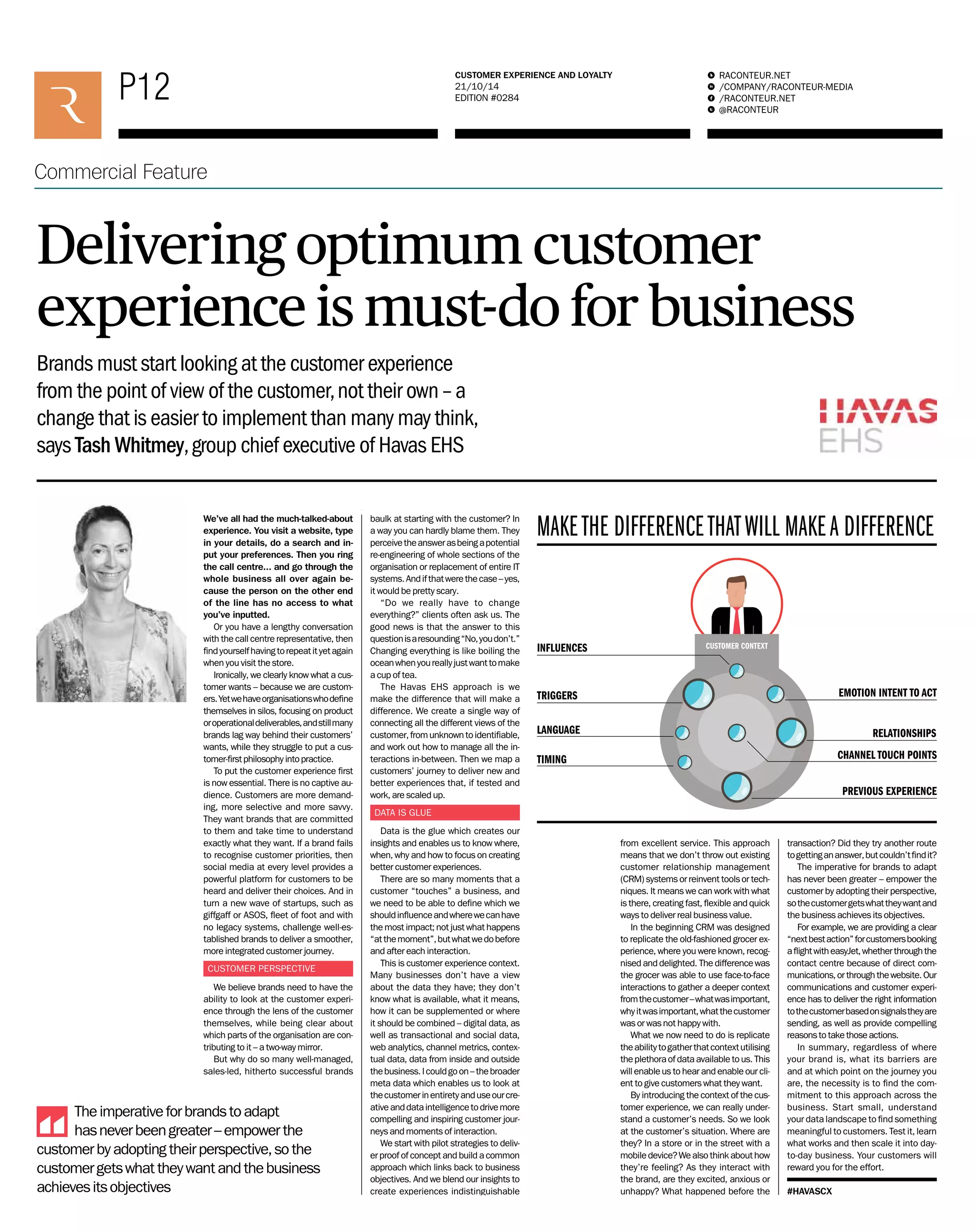
This is customer experience context. 
Many businesses don’t have a view 
about the data they have; they don’t 
know what is available, what it means, 
how it can be supplemented or where 
it should be combined – digital data, as 
well as transactional and social data, 
web analytics, channel metrics, contex-tual 
data, data from inside and outside 
the business. I could go on – the broader 
meta data which enables us to look at 
the customer in entirety and use our cre-ative 
and data intelligence to drive more 
compelling and inspiring customer jour-neys 
and moments of interaction. 
We start with pilot strategies to deliv-er 
proof of concept and build a common 
approach which links back to business 
objectives. And we blend our insights to 
create experiences indistinguishable 
MAKE THE DIFFERENCE THAT WILL MAKE A DIFFERENCE 
INFLUENCES 
TRIGGERS 
EMOTION INTENT TO ACT 
LANGUAGE RELATIONSHIPS 
TIMING CHANNEL TOUCH POINTS 
PREVIOUS EXPERIENCE 
from excellent service. This approach 
means that we don’t throw out existing 
customer relationship management 
(CRM) systems or reinvent tools or tech-niques. 
It means we can work with what 
is there, creating fast, fl exible and quick 
ways to deliver real business value. 
In the beginning CRM was designed 
to replicate the old-fashioned grocer ex-perience, 
where you were known, recog-nised 
and delighted. The difference was 
the grocer was able to use face-to-face 
interactions to gather a deeper context 
from the customer – what was important, 
why it was important, what the customer 
was or was not happy with. 
What we now need to do is replicate 
the ability to gather that context utilising 
the plethora of data available to us. This 
will enable us to hear and enable our cli-ent 
to give customers what they want. 
By introducing the context of the cus-tomer 
experience, we can really under-stand 
a customer’s needs. So we look 
at the customer’s situation. Where are 
they? In a store or in the street with a 
mobile device? We also think about how 
they’re feeling? As they interact with 
the brand, are they excited, anxious or 
unhappy? What happened before the 
transaction? Did they try another route 
to getting an answer, but couldn’t fi nd it? 
The imperative for brands to adapt 
has never been greater – empower the 
customer by adopting their perspective, 
so the customer gets what they want and 
the business achieves its objectives. 
For example, we are providing a clear 
“next best action” for customers booking 
a fl ight with easyJet, whether through the 
contact centre because of direct com-munications, 
or through the website. Our 
communications and customer experi-ence 
has to deliver the right information 
to the customer based on signals they are 
sending, as well as provide compelling 
reasons to take those actions. 
In summary, regardless of where 
your brand is, what its barriers are 
and at which point on the journey you 
are, the necessity is to fi nd the com-mitment 
to this approach across the 
business. Start small, understand 
your data landscape to fi nd something 
meaningful to customers. Test it, learn 
what works and then scale it into day-to- 
day business. Your customers will 
reward you for the effort. 
#HAVASCX 
CUSTOMER CONTEXT 
The imperative for brands to adapt 
has never been greater – empower the 
customer by adopting their perspective, so the 
customer gets what they want and the business 
achieves its objectives
P13 RACONTEUR.NET 
/COMPANY/RACONTEUR-MEDIA 
/RACONTEUR.NET 
@RACONTEUR 
1 
i 
f 
t 
CUSTOMER EXPERIENCE AND LOYALTY ONLINE: 
WWW.RACONTEUR.NET/CUSTOMER-EXPERIENCE-AND- 
LOYALTY 
Customer Data 
IN THE VANGUARD 
OF UNLOCKING DATA 
Businesses are deluged by data – a wave of 
information that has opened up new possibilities 
for a far-sighted few, writes Marcus Leroux 
The proliferation of con-nected 
devices, from tab-let 
computers to the inter-net 
of things, saturated broadband 
coverage and the rise of the mobile 
internet has all lead to reams of in-formation 
about customers. At the 
same time, improved software plat-forms 
and analytics better enable 
this information to be harnessed. 
A better use of the wealth of data 
lurking in the cloud, in customer 
relationship management systems 
and in sales figures can improve 
customer retention and satisfaction 
– and, ultimately, the bottom line. 
But there are inherent challeng-es 
and tensions in using data. First, 
customers can find it unnerving if 
a company knows too much about 
them. Second, the security of data is 
a major concern as high-profile data 
breaches appear all too common for 
the public. Most recently, J.P. Mor-gan 
Chase fell victim to a hack that 
compromised the accounts of 73 
million American households. 
Getting hold of the data can be is 
as big a problem as keeping it safe. 
Asda’s challenge has historically 
been that it lacks a loyalty card, 
unlike its two biggest rivals Tesco 
and J Sainsbury. If a company has 
no way of tying baskets of goods to 
particular individuals, then it must 
rely on batch-processed, top-level, 
aggregated data, an approach that 
many have already consigned to the 
20th century. 
SMARTPHONES 
Part of Asda’s attempted solu-tion 
has been to find ways to tempt 
consumers into making that link. 
Last year the supermarket group 
introduced a trial run of a tech-nology 
that allowed customers to 
scan products as they go around 
the aisles using their smartphones, 
making the check-out process re-dundant. 
According to Asda chief 
executive Andy Clarke, the need 
to gather data was a key part of the 
motivation.Chris Nott, IBM’s chief 
technology officer for big data an-alytics 
in the UK, says he has ob-served 
two new trends in recent 
months. “Firstly, organisations are 
taking a much more rounded view of 
customers, and trying to understand 
their current context so they can be 
much more personal and individu-al 
in their interactions. They want 
to be much more seamless across 
channels and they also want to be 
much more in-the-moment in terms 
of applying insights,” he says. 
“That’s driving demand for re-al- 
time capabilities. They want to 
use data while the customer is with 
you, rather than after they have left.” 
Social media represents the sec-ond 
new frontier, but is an awkward 
part of the jigsaw to integrate with 
other data sources. “There are some 
technology components which will 
help you to realise that single view 
of the customer,” says Mr Nott. 
“It’s also about having a coherent 
approach to technology across the 
organisation so that you can take on 
increasing numbers of data sources, 
such as website activity, mobile app 
usage or social media, which you 
need to be facilitated into the struc-ture 
if you want to build up that 
richer picture of how a customer 
interacts with you.” 
Consumers appear to be show-ing 
an increasing willingness to let 
companies share their information 
by signing in to services or online 
stores via their Facebook or Twit-ter 
accounts. 
Some 84 per cent of 18 to 34 year 
olds use social login when register-ing 
or signing in to websites, allow-ing 
brands access to some of their 
profile data, compared with 59 per 
cent for the population overall. 
Patrick Salyer, chief executive of 
social login and consumer manage-ment 
technology specialists Gigya, 
says that allowing sign-in through 
social media yields better data and a 
better relationship with customers. 
“Personalisation depends on access 
to high-quality and authentic data 
about customers. If you ask custom-ers 
for permission to use their data 
and explain what you are going to 
collect and why, you will learn more 
and establish a foundation of loyalty 
and trust,” he says. 
The advantage of superior data, 
pioneered through supermarket 
loyalty schemes such as Tesco’s 
Clubcard in the late-1990s, is the 
ability to target customers with of-fers 
tailored especially for them. 
SHOPPING JOURNEY 
The next phase of the develop-ment, 
for retailers such as Kroger 
in the United States and Metro of 
Germany, is targeted offers that ar-rive 
on a mobile device as a shopper 
strolls through the store. This capa-bility 
to offer a promotion to a con-sumer 
at precisely the right moment 
in the shopping journey is already 
standard among grocery websites, 
such as Ocado in the UK and Fresh 
Direct in the US. 
In the cut-throat world of mobile 
phone network operators, better 
targeting of offers and marketing 
can prevent customers defecting. 
Pakistan’s Ufone at one point had 
a churn rate of 3 per cent a month, 
which meant that it had to replace 
nearly one customer in every 30 
monthly just to stand still. It shifted 
away from conventional marketing 
campaigns – flyers, TV advertis-ing 
and so on – in favour of a more 
targeted and analytical approach. 
It found that customers who were 
under-using their pre-pay packages 
were more likely to leave, and so it 
developed offers targeted at particu-lar 
types of user, which increased 
customer satisfaction scores and 
reduced churn. 
In the insurance industry, Infinity 
in the US used analysis of fraud cas-es 
to reduce the workload of its loss 
adjusters by weeding out certain 
low-risk accidents, which cut costs 
radically and speeded up payments. 
The return on investment was more 
or less instant and customers were 
less agitated by delays in payments. 
Such virtuous circles – saving 
money by using data to give the 
customer what they want when they 
want it – will become increasingly 
common for businesses at the van-guard 
of unlocking data. But experts 
say that the key is in asking the right 
questions – data is a means, not an 
end in itself. 
Gigya’s Mr Salyer concludes: “Or-ganisations 
must reject the outdat-ed, 
and quite frankly careless, no-tion 
of asking as many questions and 
collecting as much data as possible, 
then sorting through it later.” 
The key is in asking 
the right questions – 
data is a means, not 
an end in itself 
011010100101011010 
11101010010101010 
1110101001010010 
11001011010 
1101011010 
10110010011 
101110110111010010
P14 RACONTEUR.NET 
/COMPANY/RACONTEUR-MEDIA 
/RACONTEUR.NET 
@RACONTEUR 
1 
i 
f 
t 
CUSTOMER EXPERIENCE AND LOYALTY 
21/10/14 
EDITION #0284 
P00 POWERING THE FUTURE 
15/0000 
Commercial Feature 
What customer experience 
really means for retailers 
The phrase customer experience is frequently used, but 
defining it is less easy. That’s why customer centricity 
consultancy 5one has developed five essential principles of 
customer experience, says chief strategy officer Trish Ferguson 
Every decade has its business 
buzzwords. Today it’s almost im-possible 
to talk about customer 
engagement and loyalty without 
hearing the phrase “the customer 
experience”. The words might be 
familiar, but what do they actual-ly 
mean? Ask ten marketers and 
you’ll probably get ten very differ-ent 
definitions. 
In parallel, the growth of big data of-fers 
huge potential for understanding 
customers and their experiences more 
precisely, and at a more granular level 
than ever before. However, it can raise 
more questions than it answers. 
At 5one we recognise that sifting 
through the vast and expanding ocean 
of facts, figures and other records that 
big data offers is overwhelming. We work 
with businesses to identify the informa-tion 
they can use to really understand 
customers, and help them focus on 
what is relevant to them and what they 
actually need. This is increasingly impor-tant 
as more data becomes available. 
Big data needs to be distilled into action-able 
information. 
FIVE PRINCIPLES OF 
CUSTOMER EXPERIENCE 
At 5one we don’t just manage data, we 
use it to help clients understand the full 
customer journey and so, we're increas-ingly 
finding ourselves helping a wide 
range of retailers and other businesses 
to analyse their customer experience, 
and to transform it into something they 
can action to leapfrog their competitors. 
At 5one we’ve developed what we call the 
five principles of customer experience. As 
a leading customer centricity consultan-cy, 
we find these simple rules help our 
clients as they seek to understand their 
customers better and develop more ef-fective 
engagement strategies. 
A customer’s value to a business 
is driven by their experiences. 
This means that each interaction, good 
or bad, a customer has with a brand has 
an impact on the way they view that 
brand. The experience is a cumulative 
impact of all their interactions and in 
turn determines their value. Historically 
there has been a focus on what consum-ers 
are buying as a way of understanding 
their behaviour at the point of purchase. 
However, we’re finding that in order to 
be able to deliver a personalised cus-tomer 
experience, businesses need to 
analyse more than just this one part of 
the journey. 
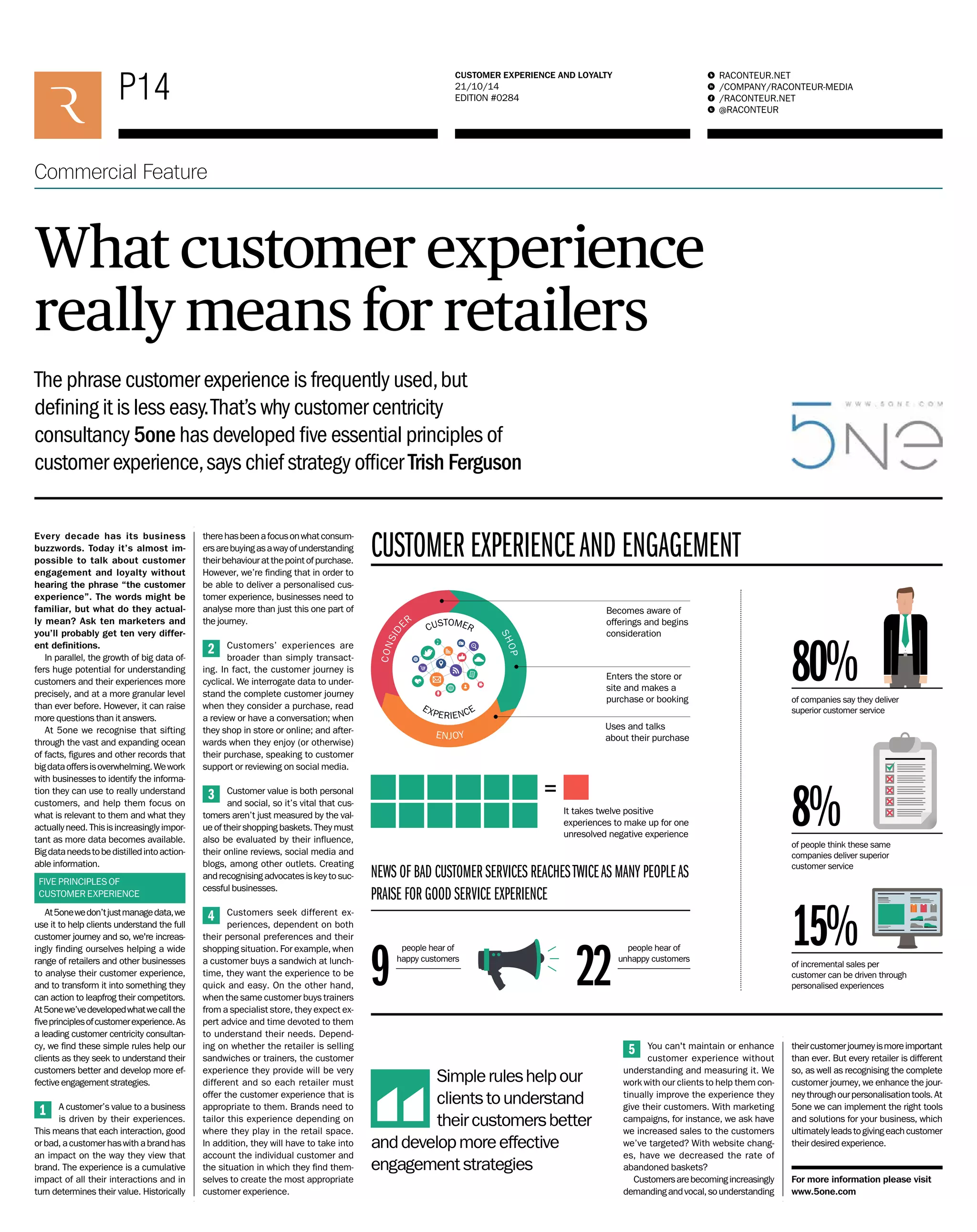
Customers’ experiences are 
broader than simply transact-ing. 
In fact, the customer journey is 
cyclical. We interrogate data to under-stand 
the complete customer journey 
when they consider a purchase, read 
a review or have a conversation; when 
they shop in store or online; and after-wards 
when they enjoy (or otherwise) 
their purchase, speaking to customer 
support or reviewing on social media. 
Customer value is both personal 
and social, so it’s vital that cus-tomers 
aren’t just measured by the val-ue 
of their shopping baskets. They must 
also be evaluated by their influence, 
their online reviews, social media and 
blogs, among other outlets. Creating 
and recognising advocates is key to suc-cessful 
businesses. 
Customers seek different ex-periences, 
dependent on both 
their personal preferences and their 
shopping situation. For example, when 
a customer buys a sandwich at lunch-time, 
they want the experience to be 
quick and easy. On the other hand, 
when the same customer buys trainers 
from a specialist store, they expect ex-pert 
advice and time devoted to them 
to understand their needs. Depend-ing 
on whether the retailer is selling 
sandwiches or trainers, the customer 
experience they provide will be very 
different and so each retailer must 
offer the customer experience that is 
appropriate to them. Brands need to 
tailor this experience depending on 
where they play in the retail space. 
In addition, they will have to take into 
account the individual customer and 
the situation in which they find them-selves 
to create the most appropriate 
customer experience. 
Simple rules help our 
clients to understand 
their customers better 
and develop more effective 
engagement strategies 
You can't maintain or enhance 
customer experience without 
understanding and measuring it. We 
work with our clients to help them con-tinually 
improve the experience they 
give their customers. With marketing 
campaigns, for instance, we ask have 
we increased sales to the customers 
we’ve targeted? With website chang-es, 
have we decreased the rate of 
abandoned baskets? 
Customers are becoming increasingly 
demanding and vocal, so understanding 
their customer journey is more important 
than ever. But every retailer is different 
so, as well as recognising the complete 
customer journey, we enhance the jour-ney 
through our personalisation tools. At 
5one we can implement the right tools 
and solutions for your business, which 
ultimately leads to giving each customer 
their desired experience. 
For more information please visit 
www.5one.com 
CUSTOMER EXPERIENCE AND ENGAGEMENT 
It takes twelve positive 
experiences to make up for one 
unresolved negative experience 
= 
NEWS OF BAD CUSTOMER SERVICES REACHES TWICE AS MANY PEOPLE AS 
PRAISE FOR GOOD SERVICE EXPERIENCE 
9 people hear of 
happy customers 22 people hear of 
unhappy customers 
80% 
of companies say they deliver 
superior customer service 
8% 
of people think these same 
companies deliver superior 
customer service 
15% 
of incremental sales per 
customer can be driven through 
personalised experiences 
CONSIDER 
ENJOY 
SHOP 
Becomes aware of 
offerings and begins 
consideration 
Enters the store or 
site and makes a 
purchase or booking 
Uses and talks 
about their purchase 
CUSTOMER 
EXPERIENCE
P15 RACONTEUR.NET 
/COMPANY/RACONTEUR-MEDIA 
/RACONTEUR.NET 
@RACONTEUR 
1 
i 
f 
t 
CUSTOMER EXPERIENCE AND LOYALTY ONLINE: 
WWW.RACONTEUR.NET/CUSTOMER-EXPERIENCE-AND- 
LOYALTY 
Opinion 
CUSTOMER FOCUS 
IS CENTRE STAGE 
Two experts in customer experience 
consider the future for business-to-consumer 
and business-to-business 
companies in fast-changing times 
The 2014 Temkin Experience 
Ratings found that only 7 per 
cent of 268 business-to-con-sumer 
(B2C) companies earned excel-lent 
ratings. On the surface that seems 
pretty bad. Less than one in ten com-panies 
provides great customer expe-rience. 
So are consumers destined to 
B2C 
live in a world of mediocre customer 
experience? 
Not likely. The story changes when 
we take a longer-term view. Compar-ing 
the Temkin ratings from 2011 to 
2014 shows that the percentage of 
companies with good or excellent cus-tomer 
experience has grown from 16 
per cent to 37 per cent, while the per-centage 
with poor or very poor ratings 
has dropped from 48 per cent to 25 per 
cent. Consumers may not be getting 
great customer experience, but it’s 
trending in the right direction. 
The outlook is good for consumers. 
Nearly six out of ten large companies 
that Temkin recently surveyed are 
aiming to be the best at customer ex- 
B2B 
The experience which customers 
of business-to-business (B2B) 
companies have will pretty 
obviously vary enormously from one 
organisation to the next and from one 
sector to the next. At one extreme, you 
have professional services firms, where 
key clients are managed by partners 
and therefore the customer experience 
is highly personalised; at the other, you 
have highly commoditised markets such 
as bulk office, where price is everything, 
brand counts for very little and ongoing 
relationships are tenuous. 
Clearly both the nature of the custom-er 
and the value that they represent to 
the organisation are key in defining the 
experience that an individual will receive. 
Although the vast majority of B2B 
organisations exist in between these 
Bruce Temkin, chairman and 
co-founder of the Customer 
Experience Professionals 
Association, says the future 
of business-to-consumer 
customer experience is bright 
Joel Harrison, editor in chief 
and co-founder of B2B 
Marketing, explains why 
business-to-business brands 
are waking up to a customer 
experience revolution 
1 
2 
3 
4 
perience in their industry within three 
years. They have good reason to be. 
Temkin Group’s latest return-on-in-vestment 
research shows that a mod-est 
increase in customer experience 
at a typical $1-billion company can 
generate an additional $370 million in 
revenues over three years. 
If you’re a B2C company and aren’t 
focused on customer experience, you 
should consider these questions: 
• Are consumers likely to expect less? 
• Are your competitors going to 
get worse? 
• Is technology going to lower the bar? 
For most of you, the answers are no, 
no and no. 
To succeed in the future, you will 
need to know more about your cus-tomers, 
use that information to re-spond 
more quickly to their changing 
needs and recover in lightning speed to 
any mistakes. 
FOUR CORE COMPETENCIES 
Improving customer experience isn’t 
easy. Companies can’t just slap on a ve-neer 
of customer experience on top of 
their complex organisations and expect 
that consumers will find them easy to work 
with. To make sustainable improvements, 
companies must master what Temkin 
Group calls the four customer experience 
core competencies: 
PURPOSEFUL LEADERSHIP 
Companies need to (re)introduce a 
clear purpose for their organisation that is 
more compelling than increased profits – a 
raison d’être that aligns the myriad of day-to- 
day decisions. 
EMPLOYEE ENGAGEMENT 
Engaged employees are valuable as-sets 
for business health plans. They trigger 
a “virtuous cycle” driving good customer 
experience and superior business results. 
Our research shows that engaged employ-ees 
try harder, engage customers and drive 
stronger business results. 
COMPELLING BRAND VALUES 
True brands are more than just mar-keting 
slogans – they’re the fabric that 
aligns all employees with customers in the 
pursuit of a common cause. Companies 
need to clearly define their brands in terms 
of promises to customers, and find ways to 
get all employees to understand, embrace 
and deliver on those promises. 
CUSTOMER CONNECTEDNESS 
In most companies, decisions are 
made with woefully little customer in-sight. 
People often rely on their “gut feel” 
or outdated anecdotes about customer 
needs, desires and feedback. But any com-pany 
that wants to improve its customer 
experience needs to embed deep custom-er 
insight in every aspect of its operations. 
two polarised extremes, their focus on 
customer experience has often been 
conspicuous by its absence. 
This has in part been due to the age-old 
tussle between sales and marketing for 
primacy – the key question being, “who 
owns the customer?” 
Historically sales has had the upper 
hand in many organisations, being given 
responsibility for the bottom, and often 
much of the middle, of the traditional 
buying funnel. Marketing was margin-alised 
to top-of-funnel, driving aware-ness, 
and sales personnel were reluctant 
to let anyone else in on a potentially ex-tremely 
valuable relationship that they 
had fostered. 
But the onset of the digital age is in-creasingly 
making the old-fashioned 
funnel redundant – the notion of the 
funnel depended on brands being in 
control of the information exchange, 
and business customers being contact-ed 
at a time and place when it suited 
the brand. 
Today, Google and the power of 
searchable content, including videos, 
slideshares, infographics and so on, 
means buyers are now in control, and 
are only willing to engage with sales at 
a time to suit them, when much of the 
decision-making process has already 
been taken place. 
MARKETING IN DRIVING SEAT 
This means that sales no longer 
owns the customer, marketing is now 
in the driving seat, and is increasingly 
responsible for all aspects of interac-tion, 
both before, during and after the 
purchase. B2B marketers have never 
been in a better position to drive and 
determine their customers’ experi-ence 
of their brands. Marketers are 
increasingly waking up to this new 
level of authority and the consequent 
responsibilities. 
And that’s a good thing too, because 
increasingly social media is changing 
the ground-rules regarding custom-ers’ 
expectations. The “instant gratifi-cation” 
culture of generation Y, those 
who have grown up with the internet, 
demands that queries or complaints be 
answered decisively and immediately, 
rather than vaguely and after signifi-cant 
hassle. Put another way, the op-portunity 
to call, e-mail or write to an 
organisation, to receive a response in 
their time, is laughably unacceptable. 
Social media-enabled customers or 
prospects demand better from their 
business product or service providers, 
and if they don’t get it, will complain vo-ciferously 
and visibly, just as they will in 
their consumer lives. 
Proving a good customer experience, 
in good times and bad, is no longer an 
option in B2B – it’s an essential. Those 
B2B organisations that don’t acknowl-edge 
and embrace this are living on 
borrowed time.
CE_L---singles

CE_L---singles

  • 1.
    P03 Customers aresetting P08 Getting personal with P10 How to build a the business agenda offers you can’t refuse loyal fanbase 21/10/14 #0284 RACONTEUR.NET /COMPANY/RACONTEUR-MEDIA /RACONTEUR.NET @RACONTEUR 1 i f t CUSTOMER EXPERIENCE & LOYALTY EUROPE one card 2927 6552 1119 4030 EXPIRES END 01/24 23-90-33 47839022 VALID FROM 08/14 A CONSUMER debit 1010 0111 0110 1010 10-10-11 01001011 VALID FROM 10/01 EXPIRES END 01/10 THIS SPECIAL REPORT IS AN INDEPENDENT PUBLICATION BY RACONTEUR MEDIA
  • 3.
    RACONTEUR.NET /COMPANY/RACONTEUR-MEDIA /RACONTEUR.NET @RACONTEUR 1 i f t LOYALTY P03 CUSTOMER EXPERIENCE AND LOYALTY ONLINE: WWW.RACONTEUR.NET/CUSTOMER-EXPERIENCE-AND- Overview Without doubt it is the age of the customer. They are louder than ever, have greater power and more ways of exerting it. Digital innovations have meant the consumer knows everything about a company, the product and its origins, as well as faster and more efficient ways of air-ing grievances and singing praises. While it might be terrifying to think your customers know everything about your processes, there’s an argument for embrac-ing the move towards customer empowerment. This is absolutely crucial to loyalty, says Alex Cheat-le, chief executive of lifestyle con-cierge and loyalty solutions provid-er Ten Group. “There is simply no such thing as a customer for life anymore; cus-tomer loyalty needs to be earned. Companies must show that they understand their customers and are responding to them as individ-uals,” he says. “A luxury clothing brand can’t just give away a pair of cufflinks with a shirt; they need to give the customer tickets to the op-era – because they know they like opera – in a city they visit regularly.” The customer isn’t just a buyer of a product, says Mr Cheatle, “Car manufacturers such as Maserati don’t just stick extras on their cars, they think around the issue and provide benefits that are perhaps unrelated to motoring, but are tai-lored to the person who is buying the car. Banks will no longer just offer travel insurance or Avios [re-ward currency] – customers have no patience with poring over small print or jumping through endless hoops for fulfillment. “Programmes such as Thank You from Coutts offer curated opportu-nities selected and tailored to their account holders. The customer needs to feel in charge of the ben-efits they receive and companies must use benefits to show how well they understand the individuals they are doing business with.” KEY TRENDS A report from Forrester, entitled Navigate the Future of Customer Service in 2014, outlines a num-ber of key trends. Customers now demand an omnichannel service. They want to start an interaction in one channel and complete it in another. The report says today’s customer is beginning to adopt a “mobile-first” mindset. Companies are starting to move away from duplicating their web presence for mobile and instead are look-ing at the right usage scenarios to add value to customers in a mobile environment. There is now a ten-dency towards a more focused user experience that allows tasks to be accomplished efficiently. Customers 2020, a report from US customer intelligence consulting firm Walker, looks at the customer experience industry of the future. The report claims customer service is the next brand differential, and by 2020 will overtake price and product. The report says to be relevant in 2020, companies must focus on leveraging data to create a single source of truth and make custom-er intelligence accessible. It says: “Companies must consider ‘insight generation’ as a sales enablement function.” It also predicts the like-lihood of more companies having “chief customer champions”, serv-ing one purpose, “to create an un-relenting focus on the customer”. Data is being used to reach out pro-actively to customers in the form of invitations to chat and take part in tutorials. In addition it is being used innovatively to develop post-pur-chase engagement. Forrester’s The Business Impact of Customer Experience, 2014 report looks at the link between customer experience and consumers’ loyalty to a company. Unsurprisingly, the correlation is high. And the business case is strong. The research shows loyalty-based revenue benefit for a firm going from a below-average customer experience index score for its industry to above-average, ranged from $55 million for con-sumer internet service providers to $1.6 billion for wireless providers. And then there’s personalisation. There’s certainly a move towards the individualisation of the con-sumer process. Companies are in-creasingly using predictive analyt-ics to up and cross-sell to consumers based on their individual buying and browsing habits. It’s no longer just about knowing the customer’s name; it’s now about making sure offers are bespoke. NEW ADVISERS A 2013 IBM study, The Custom-er- Activated Enterprise, says that customers are the “new” business advisers, claiming that 90 per cent of senior leaders expected extensive collaboration with customers with-in the next five years. More than half (54 per cent) of chief executives said customers now have a considerable influence on their enterprises and, crucially, the outperformers are 24 per cent more likely than underper-formers to have given the customer a prime seat at the boardroom table. The report highlights that in the first IBM study of this kind, released in 2004, chief executives ranked their own customers as sixth on the list of all market factors they believed would drive the most change in their organisations. What we see today is a very different sto-ry, where empowered customers now lead the agenda. The value of customer loyalty, based on a positive experience of service, is more important than ever, writes Hazel Davis Distributed in Publishing Manager Nathan Wilson Managing Editor Peter Archer Head of Production Natalia Rosek Commissioning Editor Hazel Davis Design, Infographics & Illustration The Design Surgery www.thedesignsurgery.co.uk Contributors Although this publication is funded through advertising and sponsorship, all editorial is without bias and sponsored features are clearly labelled. For an upcoming schedule, partnership inquiries or feedback, please call +44 (0)20 3428 5230 or e-mail info@raconteur.net Raconteur Media is a leading European publisher of special interest content and research. It covers a wide range of topics, including business, finance, sustainability, lifestyle and the arts. Its special reports are exclusively published within The Times, The Sunday Times and The Week. www.raconteur.net The information contained in this publication has been obtained from sources the Proprietors believe to be correct. However, no legal liability can be accepted for any errors. No part of this publication may be reproduced without the prior consent of the Publisher.© Raconteur Media Customer service is the next brand differential, and by 2020 will overtake price and product HAZEL DAVIS Freelance writer, she contributes to The Times, Financial Times, The Daily Telegraph and The Guardian on a wide variety of subjects, but specialises in small businesses. MARCUS LEROUX Industrial correspondent of The Times, he was previously the newspaper’s retail correspondent. CHARLES ORTON-JONES Former Professional Publishers Association Business Journalist of the Year, he was editor-at-large of LondonlovesBusiness.com and editor of EuroBusiness magazine. IWONA TOKC-WILDE Freelance business journalist, she contributes regularly to various national media and trade press, covering economic trends, professional practices and other business issues. HUGH WILSON Former reporter and feature writer for Retail Week, he now writes as a freelance on a variety of topics including business, technology and innovation. CUSTOMERS ARE SETTING THE BUSINESS AGENDA Image: Getty
  • 4.
    RACONTEUR.NET /COMPANY/RACONTEUR-MEDIA /RACONTEUR.NET @RACONTEUR 1 i f t CUSTOMER EXPERIENCE AND LOYALTY 21/10/14 EDITION #0284 Leadership EFFECTIVE LEADERSHIP KEEPS STAFF AND CUSTOMERS HAPPY Indicators of customer satisfaction show that executives who empower employees not only manage to hold on to valued staff, but also improve levels of service, as Iwona Tokc-Wilde reports Improving customer ser-vice need not involve a radical change in pol-icy or complicated technology. Adopting a different manage-ment style and company culture, together with customer-focused personnel training, can increase both employee satisfaction and customer engagement. The traditional “command and control” structure of organisations may no longer be fit for purpose in a connected world, where both em-ployees and customers want to be engaged differently. “Today’s team-based organisations respond best when their leaders are with them, not above them,” says Rachel Bar-ton, head of Accenture’s Customer Strategy Practice. Some companies are, therefore, moving away from a hierarchical structure to one that is flatter, with fewer or no levels of middle manage-ment between staff and executives. So-called flat organisations tend to organise themselves around the work that needs to be done and not around people occupying specific job func-tions. Time etc is a virtual workforce platform that provides services to businesses worldwide. Three years ago they switched from an upwards flow of work and reporting to mutual delivery, says founder Barnaby Lashbrooke. “This means everyone, including me, delivers whatever is needed to other people in the business in order to push things forward,” he says. For example, Mr Lashbrooke now deals with every client com-plaint personally. “But I still make sure the team are fully involved,” he says. “When they see how seriously I take every complaint, it hammers home the importance of customer satisfac-tion so they are getting better at resolving issues before they turn into complaints. It’s also good for clients to see the founder cares about their custom and that no complaint is too small.” Despite significant growth in the last few years, Time etc receive few-er than ten complaints a year. Mr Lashbrooke points out it was the mutual effort that has led to all com-plaints being resolved satisfactorily in the last 12 months. “We’ve also seen a significant increase in team retention and morale since switch-ing to this way of working,” he adds. In flat or flatter organisations, leaders seek their employees’ opinions regularly and act on them. “Engaging your workforce as equals, taking on feedback and keeping the dialogue open through every channel are all ways to flatten the management structure,” says Ms Barton. Employee engagement at Lon-don Overground Rail Operations (LOROL) has been central to its success as the fastest growing UK rail company since privatisation. HR director Darren Hockaday says: Retail sets example Page 07
  • 5.
    P05 RACONTEUR.NET /COMPANY/RACONTEUR-MEDIA /RACONTEUR.NET @RACONTEUR 1 i f t CUSTOMER EXPERIENCE AND LOYALTY ONLINE: WWW.RACONTEUR.NET/CUSTOMER-EXPERIENCE-AND- LOYALTY of operations. “Out of this has grown the company’s ethos of ‘training for all by all’ and in the last year more than a third of employees were in-volved in passing on their skills and experience to others.” The fact that all staff, regardless of position, can now deliver custom-er service training was “a conscious move from a culture which was highly compliant, dependent sole-ly on people following procedures, towards a culture focused on cus-tomer experience”, says Ms Plow-right. Since the move the company has won several national customer service training awards for its high standards of customer service. “Our net promoter score, an in-dicator of how likely our custom-ers are to recommend us, is indus-try- leading at +78 and customer retention rates are consistently over 90 per cent too,” she says. Lawrence Jones, chief executive of internet hosting company UK-Fast, says their net promoter score has also improved, from +50 to +70, since he invested in an in-house training department last year. EMPLOYEE AUTONOMY In flatter organisations, front-line staff have a bigger say in how they deal with customers, which has direct impact on customer ex-perience. At John Lewis, staff work on the premise that the customer is right and they just need to solve Images: Getty Research has consistently proven a link between happy employees and happy customers any problems as quickly as possible. What they call “heroic recovery” contributes to John Lewis scoring the highest marks in various custom-er satisfaction surveys year on year. The world’s best hotels would not be the world’s best without their employees having almost complete autonomy, says Phil Anderson, client director at Ashridge Business School. “When I recently visited the Ritz Carlton in Singapore, staff were able to spend up to $2,000 replacing or re-pairing any item damaged by guests, without seeking approval,” he adds. GO THE EXTRA INCH De Vere Hotels and Village Ur-ban Resorts have a new customer service initiative called Going the Extra Inch, which empowers staff to take action to exceed their guests’ expectations. People development director Mike Williams gives an ex-ample of an employee who, working breakfast service, overheard a guest saying they preferred firmer pillows and went out at the end of her shift to buy them. “We’ve also created VIPs – Very Informed People – in each hotel, who look for ways to improve cus-tomer service, and who then present their ideas to their hotel manager and the company executive team,” says Mr Williams. Mr Anderson insists that in call centres and similar organisations, staff simply must have autonomy to be effective in dealing with custom-ers. “First Direct are an excellent example, they are truly a one-stop shop,” he says. At Wahanda, an online bookings platform connecting consumers and beauty businesses, the custom-er service staff are allowed to make judgment calls and issue credit notes without reverting to line man-agers first. “Our tech team aims to turn around any issues with the site within 24 hours, so our combined efforts have resulted in pushing up our net promoter score to over 70,” says Wahanda’s chief executive Lopo Champalimaud. When employees have a bigger say in how and when they work, and get incentivised to deliver results, this too leads to better employee satisfaction and en-gagement, and to better customer service. At Wahanda, there are no limits on holiday allowances. “We simply trust people to do their job and they use their good judgment when it comes to taking time off,” says Mr Champalimaud. UKFast gives £1,000, £500 and £250 to the top three support en-gineers at the end of each quarter. “Earlier this year, high-performing engineers were also taken on an all-expenses-paid trip to Las Ve-gas,” says Mr Jones. De Vere Hotels and Village Urban Resorts celebrate their best employees at annual em-ployee awards. “Research has consistently proven a link between happy employees and happy customers,” says Ms Barton. De Vere Hotels and Village Urban Resorts have run their own com-parisons of their employee engage-ment scores for each hotel against their customer service measures, discovering a compelling correlation between the two. “Our three hotels with the highest customer satisfac-tion scores of over 80 per cent are also the top three when it comes to employee engagement, again over 80 per cent,” says Mr Williams. 72% of highly engaged employees believe they can positively affect customer service Source: CIPD 90% of leaders think an engagement strategy has an impact on business success Source: Accor 80% of the variation in employee engagement levels is due to the line manager Source: Accenture 50%+ of organisations with high employee engagement retain 80%+ of their customers Source: Demand Metric 1in2 employees in large organisations feel engaged Source: Temkin Group Research “The way that LOROL has always approached engagement is simple yet highly effective: you regularly and consistently ask employees what they think, you analyse and think about what they’ve told you, you take ap-propriate action, and then tell the em-ployees what you’ve done and why.” At LOROL, improved employee engagement now equals improved customer satisfaction. As engage-ment rose to 91 per cent in 2014, so did passenger satisfaction, which at 91 per cent nearly doubled from 57 per cent in 2007. CULTURE AND TRAINING Four years ago insurance com-pany Cornish Mutual flattened the management and delivery of their personnel training, changing their corporate culture in the process. “Every employee in the company, from managing director to adminis-trators, has been trained in coaching skills,” says Sharon Plowright, head
  • 6.
    P06 RACONTEUR.NET /COMPANY/RACONTEUR-MEDIA /RACONTEUR.NET @RACONTEUR 1 i f t CUSTOMER EXPERIENCE AND LOYALTY 21/10/14 EDITION #0283 P00 ENGAGEMENT AND LOYALTY 15/0000 Commercial Feature Powering loyalty with credit cards With the UK economy showing clear signs of recovery and household spending on the up, brands are capitalising on a renewed opportunity to commercialise and collaborate on customer loyalty As consumers once again reach into their wallets, many will be pulling out their cards and demonstrating their commitment to a particular or-ganisation, whether that’s a football club, airline or charity. Affi nity card relationships can offer consumers loyal to brands a unique set of benefi ts as well as driving results for the brands themselves. “Credit-card affi nities can help brands grow their business on the back of real consumer advocacy,” says Michael Don-ald, commercial executive at MBNA, a UK leader in credit-card affi nity relationships. “Every time a customer takes a card product out of their wallet, it reminds them why they took it out and about the brand they have a particular affi nity with, whether retailer or airline. UK brands are able to make these connections even more powerful, while brands from • AMERICAN AIRLINES • EMIRATES • ETIHAD AIRWAYS “Our model is rooted in truly under-standing consumer loyalties, and con-necting and rewarding these. It’s a win for the consumer, but also a commercial win for the affi nity brands we’re proud to work with.” One example of this is the organisa-tion’s work with Manchester United, where MBNA was able to roll out a new “Champions” credit card to eligible fans in the UK within a week of the club win-ning the title for a record twentieth time, helping to strengthen its relationship with supporters and allowing them to share in the club’s achievement. emerging markets are also coming to the UK with their global brand, wanting to launch affi nities.” For brands, it can not only generate an additional source of revenue each time a transaction is made, but also help to re-inforce and reward a customer’s loyalty to their organisation, ensuring priority of the card and helping to keep customers loyal in the future. From a consumer’s perspective, af-fi nity credit cards allow individuals to benefi t from a wide range of rewards put forward by the brands they support, ranging from discounted fl ights to foot-ball shirts, tickets to events and charity donations, as well as helping to support that particular cause fi nancially. MBNA’s affinity-card experience means it can work with partners to iden-tify the business model that best suits them and their customer base. “We believe MBNA is unrivalled in the UK in terms of running co-branded cred-it- card programmes and the reason we’re so good at it is that we’re able to work with the partners to understand the needs of their customers,” says Mr Donald. Michael Donald Commercial executive at MBNA MBNA IN NUMBERS 300 affi nity card programmes MBNA Thames Clipper airlines 6 football clubs 29 MBNA UK AFFINITY CARD PROGRAMMES • ARSENAL • ASTON VILLA • CHELSEA • LIVERPOOL • MANCHESTER UNITED • TOTTENHAM HOTSPUR FOOTBALL CLUBS • MILES AND MORE (LUFTHANSA) • UNITED AIRLINES • VIRGIN ATLANTIC AIRLINES Credit-card affi nities can help brands grow their business on the back of real consumer advocacy • BREAKTHROUGH BREAST CANCER • BRITISH HEART FOUNDATION • NATIONAL TRUST • ROYAL BRITISH LEGION • RSPCA • WWF CHARITIES “Our capabilities allowed the club to focus on their fan base and ensured pri-ority of the card in wallets or purses with a whole new set of engaged consumers,” says Mr Donald. With credit cards operating across the three main credit-card networks of American Express, MasterCard and Visa, also means MBNA customers can benefi t from a wide range of additional rewards, driving even greater value di-rectly to consumers. The model is well established in sec-tors such as football, airlines and trav-el, but there are other industries which MBNA is an established leader in providing co-branded consumer credit cards, drawing on a 21-year history of operating in the UK and its relationships with more than 350 partners. These include card pro-grammes with retail and professional organisations, such as the AA and NFU, as well as airlines, football clubs and charitable organisations. The business is committed to its own brand promise of “making life easier”, and prides itself on a pledge to provide world-class customer service. This brand promise can now be seen on the River Thames each day following its support of the MBNA Thames Clippers. Owned by Bank of America, MBNA is also primary sponsor of the Sale Sharks rugby union team and its local football club, Chester FC. It was voted credit card provid-er of the year in the 2014 Consum-er Moneyfacts Awards. MAKING LIFE EASIER could benefit, including utilities and retail. There are also potential opportu-nities for brands themselves to collabo-rate, using a mutual MBNA relationship as the basis for even more compelling customer offers. “An example is airlines which have relationships in football,” says Mr Don-ald. “We support card programmes for both segments and that offers us some amazing potential.” The economic downturn of the past few years has seen a number of fi nancial institutions and card providers leave the affi nity market, leav-ing behind those who have built their business around the concept. “The UK issues more card products than any other outside the United States and we have one of the widest-travelled populations on the planet, for business and tourism,” he says. “The affi nity-card model, which is rooted in MBNA’s DNA, gives brands the opportunity to not only reward customers for demonstrating their loyalty, but to deliver a commercial win for the brand and their customers.” MBNA is uniquely positioned to help organisations with large-scale customer bases and/or global or leading UK brands develop an affi nity credit-card programme. For more information visit www.mbna.co.uk or contact newbusiness@mbna.com
  • 7.
    P07 RACONTEUR.NET /COMPANY/RACONTEUR-MEDIA /RACONTEUR.NET @RACONTEUR 1 i f t CUSTOMER EXPERIENCE AND LOYALTY ONLINE: WWW.RACONTEUR.NET/CUSTOMER-EXPERIENCE-AND- LOYALTY Walking through the doors of a shop will turn a customer’s mobile device into a personal virtual sales assistant Omnichannel BEST PRACTICE IN RETAIL SETS EXAMPLE FOR OTHERS Retailers have always lived and died by the experience they offer their customers and, in a previous age, the butcher who greeted customers by name and memorised their Sunday joint was likely to command loyalty. Today a good customer experi-ence still provides a genuine point of difference in what can sometimes seem a rather homogeneous land-scape. Forward-thinking retailers use fast-evolving technology to repli-cate the butcher’s local information, and give customers a more satisfying experience in shops and online. In store, for example, loca-tion- based analytics like Shopper- Trak follow customers as they move through a store, using anonymous signals emitted from shoppers’ mo-bile devices. It means customers see relevant marketing materials in the right locations and find staff on hand in the right areas at the right times. But in-store is only one part of the multichannel offer. The rise of e-commerce means retailers offer customers two or more distinct sales channels – a bricks-and-mor-tar shop, its e-commerce equivalent and, increasingly, a mobile option. And now that almost every retail-er sells online, the most progres-sive seek to differentiate customer experience in increasingly sophis-ticated ways. “Smart retailers are shortening the purchase path,” says Jo Coombs, managing director of customer engagement agency Ogil-vyOne UK. “Amazon said recently they want to go from ‘I want that’ to ‘I bought that’ in 30 seconds, hence innovations such as Amazon Dash.” NON-RETAIL Customers want a smooth and speedy experience online, and that’s as true for non-retail commerce as it is for Amazon. Similarly, B&Q and Next, praised for embracing online communication channels and the speedy resolution of online custom-er complaints, offer an example to other sectors. On top of that, retailers are in-creasingly integrating hitherto dis-tinct channels – store, catalogue, e-commerce, mobile – into one coherent customer experience, the so-called omnichannel approach. Marks & Spencer’s “endless aisle” means its physical stores and e-commerce site become extensions of each other, rather than distinct silos. “Marks & Spencer reported in May that over half of all online purchases had an in-store element; for example, goods ordered from home for in-store collection,” says Ms Coombs. Then there’s fashion retailer Oasis’ Seek & Send service, which will search the company’s stores and send an item to a cus-tomer’s home if it is sold out online. Smartphones are pushing retail-ers to embrace another aspect of the omnichannel experience. A shopper sees a product in-store and checks out reviews on-line before buying. They might scan a barcode and comparison shop in real time. They’ll expect their brand browsing history to fol-low them from web to smartphone to tablet, and even be available to staff in-store. Most of all, the customer expe-rience must be consistent between these elements. “Brands cannot afford for customers to have a great experience when they visit their website or mobile app, only for it to be fundamentally different when they then visit a store,” says Adam Goran, director of customer engage-ment at Grass Roots Group. Sales assistants in-store have to be informed, engaged and steeped in the philosophy of the brand. Apple is an obvious example. CONTINUOUS COMMERCE Retailers also increasingly use the mountain of data thrown up by online shopping habits to per-sonalise messages and offers. And that, too, is driving the goal of a true omnichannel experience. “Today, the focus is moving to-wards customer recognition and data connectivity across chan-nels, media and devices,” says Paul Hatley, data strategy expert at data solutions company Acxi-om, whose clients include iconic London store Liberty. Bricks-and-mortar stores, in com-bination with their online opera-tions, are slowly learning that they can use that data, alongside other technology, to offer customers a tru-ly holistic, personalised experience across all sales channels. In theory, for example, physical retailers could recognise individuals entering the store from their online profiles, and push relevant discounts and offers to their smartphone or tablet. “This seamless integration of our online persona with our phys-ical location ensures that retail-ers can provide a more personal interaction than that available through internet-based shopping alone,” says Scott Cairns, chief technology officer for IT and tele-communications service provider T-Systems. He sees a near future in which walking through the doors of a shop turns a customer’s mobile device into a personal virtual sales assis-tant, pinging pricing information on a product they browsed online, guiding them to its physical location and providing other relevant details, such as discount offers or informa-tion on relevant accessories. We’re not quite there yet, but in-terest in omnichannel is building. And it’s clear that, for all business-es, retail and otherwise, customers will soon come to expect a seamless experience between real and vir-tual worlds. Or as OgilvyOne UK’s Ms Coombs says, companies need to stop thinking in channels “and simply think of it as continuous commerce”. Those that get it right will win. With consumers using a mix of high street, online and mobile shopping, customers expect seamless and consistent continuous commerce, writes Hugh Wilson Image: Getty
  • 8.
    P08 RACONTEUR.NET /COMPANY/RACONTEUR-MEDIA /RACONTEUR.NET @RACONTEUR 1 i f t CUSTOMER EXPERIENCE AND LOYALTY 21/10/14 EDITION #0284 Personalisation LET’S GET PERSONAL 2 3 4 5 1 Offering the same old customer experience is becoming obsolete. What consumers want is a personalised service, tailored to meet their individual desires, budget and mindset. As Charles Orton-Jones discovers, it is possible to offer a unique experience to each and every customer, no matter what sector a business operates in Google boss Eric Schmidt once defined his company’s mission as serving you just what you want online before you’ve even asked for it. The trend for personalised advertisements is making that aim feel spookily close. The most common way to per-sonalise adverts is to look at the users’ search history and tailor adverts to match their search criteria. For example, James Villa Holidays, which offers villa holidays across the Mediterranean and United States, uses search retarget-ing to follow potential holiday-makers across the web. The process starts when a user begins researching a holiday online. They’ll type in something like “Dalmatia holiday villa”. Then James Villa Holidays learns what it can about the user from their web history. It can then place precisely the right banner ads in front of the user by bidding, in microseconds, for web real estate. The firm uses an automated system supplied by search retargeting specialist Captify. The result? “Customers are incredibly receptive to our personalised digital ads,” says Sally Pemble of James Villa Holidays. “During a recent campaign we doubled the click-through rate compared with other digital campaigns we’ve run and increased the conversion rate by around 60 per cent.” Computer games tend to be standard experiences. If you play Angry Birds or Portal 2, it is the same no matter whether you are an 8 year old or a mid-dle- aged hardcore gamer. This is changing. The new generation of games adapt to each user to ensure everyone gets the game they want. One of the biggest person-alisation consultancies is Edinburgh-based deltaDNA. It collects user data to help designers tailor games to different demographics. For example, Heroes & Generals, by games house Reto-Moto, is an online Second World War shooter game with 3.2 million registered users. With multiple game modes accessible across multiple platforms, players can choose to play as either heroes fighting on the battlefields or as generals devising the grand strategy of a massive war with thousands of concurrent players. Using the deltaDNA platform, Reto-Moto is able to segment players based on their playing style and ability, ensuring the playing experience is shaped for different types of players. Nov-ice players can be nurtured; ex-pert players can be challenged, especially in the early stages of the game when churn is highest as being cannon fodder isn’t fun for anyone. The result is happy heroes and happy generals, no matter what level of compe-tence they play with. China is a huge market for Scotch whisky. And what the Chi-nese want more than anything is the absolute top end. How better to serve this niche than by creating tailor-made whiskies? Three years ago drinks giant Diageo opened The Johnnie Walker House in Shanghai. It is marketed as an “embassy for Scotch whisky culture”. The crowning glory is the opportuni-ty for members and guests to have the chance to blend their own bespoke whisky. The result-ing product, your very own John Walker & Sons Signature Blend, is produced under the guidance of Jim Beveridge, master blend-er for Johnnie Walker. The packaging – both bottle and special presentation case – is also designed to be tailored exclusively to a client’s prefer-ence, with both decanter and bottle options. London agency Sedley Place is responsible for this aspect of personalisation. Details on the bespoke packaging extend to a client monogram, personalisation of the bottle or decanter marked with the client’s signature, a specially designed neck charm and a certificate of authentication. The success of the Shanghai concept has led to Diageo opening new branches in Bei-jing and Seoul. Each Signature Blend starts from a price tag of £80,000, which gets you 20 bottles. To date ten Signature Blends have been produced. Showing the same website to all visitors is a lost opportuni-ty. Ideally your website ought to optimise for every individual visitor, showing them precisely what they want to see. SkiWeekends.com is a ski holiday booking website cov-ering 24 ski resorts, serviced by 17 UK airports. The travel agent behind it has 30 years’ experience and is at the cutting edge of personalising the online experience. The site uses a service called Sitecore Experience Platform, which gathers all available data to personalise what each visitor sees. It takes into account factors such as search terms and the visitor’s location, using their IP (inter-net protocol) address, to tailor site specifics such as desti-nations, transport options, promotions and incentives. Since the start of the 2013-14 ski season, sales revenue at SkiWeekends.com has in-creased by 16 per cent year on year, thanks to a 55 per cent rise in conversion of site visits to its online booking pages. The site has attracted 15 per cent more unique visits, increasing to almost 200,000 in six months. But, more signif-icantly, the improved usability and personalisation means 32 per cent more visitors are finding their ideal ski holiday – all done by a firm with just six full-time members of staff. Children playing football don’t need any encouragement to keep playing. They’ll stay outdoors kicking the ball until it’s too dark to see. But why don’t they behave the same way with maths homework? The goal of personalised learning is to bring the same thrills and emotions to learning that games offer. The latest iteration in personalised learn-ing, developed by the global IT trade body CompTIA, tracks emissions of the pleasure hormone dopamine to ensure learners are kept at the perfect mental state: excited, curious and happy. The Chicago-based Computer Systems Institute is trialling CompTIA’s new system, called CertMaster. Questions are presented at specially timed intervals to help each student remember, and each question must be answered accurately and confidently twice before the system shows they have mastered the topic. An algorithm looks at things which signify optimal dopamine levels, such as confidence level, based on what types of answers they choose and time they take to answer, the speed at which students master topics, and how well they memorise what they have learnt. This approach creates a dopa-mine effect and a self-perpet-uating positive feedback loop to keep learners’ attention and boost knowledge reten-tion. In early trials, CertMaster claims 80 per cent knowledge retention YOUR OWN PERFECT WHISKY LESSONS YOU WON’T WANT TO END SHOWING ADS YOU WANT TO SEE NO MORE CANNON FODDER PERSONALISED WEBSITES
  • 9.
    P09 RACONTEUR.NET /COMPANY/RACONTEUR-MEDIA /RACONTEUR.NET @RACONTEUR 1 i f t CUSTOMER EXPERIENCE AND LOYALTY ONLINE: WWW.RACONTEUR.NET/CUSTOMER-EXPERIENCE-AND- LOYALTY 80 60 40 20 0 SALE SALE Source: Forrester, April 2014 Source: Forrester, April 2014 80 60 40 20 0 95% 86% A 67% B 81% C 46% 71% D 34% of data within organisations remains untapped 53% of marketers want to add online customer data to their customer profiles and be able to use that information 49% 39% 46% 35% 39% 40% 30% 26% 28% AGE OF PERSONALISATION The big data problem WEB ACTIVITY Personalisation approaches How do you evaluate consumers' expectations for personalisation across various channels? The segmentation opportunity Big data drives results despite challenges increase in revenue growth for companies that invested in analytics versus those that did not of marketers say they can't turn their data into actionable insight of organisations don't target any customer or visitor segments higher return on investment for companies that invested in analytics compared to those that did not of marketers think data is collected too infrequently or not in real time of marketers believe it's important to identify actionable insights in large amounts of data of marketers say data has improved customer engagement through personalisation of organisations don't use real-time on-site behaviour to personalise the customer's experience of marketers are unaware of which high-value customers to focus their marketing on A use personalisation and targeting, based on broad segmentation and simple clustering techniques, to execute campaigns CALL CENTRE WEB SOCIAL ACTIVITY STORE INTERACTIONS INGESTION LAYER PERSONALISED PRODUCTS AND SERVICES STORE INTERACTIONS MOBILE LOCATIONS AND COMMERCE of companies surveyed ask how consumers would like to receive their marketing offers 83% B use personalisation and targeting, based on simple business rules, and execute campaigns across channels 53% use metrics that indicate the strengths and weaknesses of personalisation programmes to guide decisions C personalise products, offers and content based on the collective insights of users with similar preferences have a robust testing and optimisation programme that gives insights into the types of content, offers and products consumers prefer D use real-time, self-learning analytics to drive personalisation and targeting across digital channels use real-time decisioning technology to guide personalisation so consumer interaction drives the offer versus prebuilt propensity scores A B A B C D C D Source: Monetate Data Knowledge base Customer direct input Transactions
  • 10.
    P10 RACONTEUR.NET /COMPANY/RACONTEUR-MEDIA /RACONTEUR.NET @RACONTEUR 1 i f t CUSTOMER EXPERIENCE AND LOYALTY 21/10/14 EDITION #0284 Customer Communities BUILDING A FANBASE Businesses launch customer communities for a variety of reasons – to help cus-tomers with products, to improve the effectiveness of marketing ef-forts, to create customer feedback loops, to use market data and to im-prove customer satisfaction. North of England-based open-ac-cess train operator Grand Central has developed an extraordinary rep-utation for great customer service, largely through word of mouth and the efforts of its very vocal fanbase, the customers. The company’s communica-tions and stakeholder manager Kate Thorpe says its success in this area has a lot to do with the need it serves. “As an open-access operator, Grand Central Rail exists because the local communities we serve did not already have a direct rail link to London,” she says. “Local support for our services in the early days gave communities a sense of owner-ship of Grand Central Rail services, and we work hard to maintain and develop close co-operative links.” Ms Thorpe says Grand Central seeks out opportunities to support, promote and develop local initia-tives which benefit the community, “from supporting Brass Factor – a brass band talent competition in West Yorkshire – to jobs fairs and other stakeholder activity”. The company runs a station am-bassador scheme manned by volun-teers. “As a small company which does not own or manage any sta-tions, we do not have the infrastruc-ture or resources to staff stations on Sundays, when smaller stations are traditionally unstaffed and the ma-jority of rail engineering work takes place, disrupting rail travel across the country,” she says. “The station ambassadors mod-el we adopted allows us to provide face-to-face customer advice on travel, tickets, rail replacement services, taxis and directions using fully trained, uniformed volunteers from local business communities, who donate their time in order to provide help and assistance. Their presence has had a positive effect on our passengers and staff, and contributes to devel-oping rail travel in the North East and Yorkshire.” It has paid off. Figures released by Passenger Focus earlier this year found that 95 per cent of Grand Central passengers were “satis-fied” or “very satisfied”, which is something you don’t often hear in the same breath as the words “train company”. Enterprise busi-ness technology provider Avanade uses social media as a core plat-form for its thought leadership as well as creating dialogue with its customers. Jessica Brookes, global director of media and analyst rela-tions, says: “Simply put, we listen to the market, making sure we are staying on top of developing indus-try trends, emerging technologies and enterprise pain points that are on the minds of our enterprise customers. The data we glean from this active listening helps inform our marketing campaign focus and content creation.” Avanade generated 3.5 million impressions on LinkedIn last year and has 25 different groups there, with 15,000 members combined. But using social media to mobi-lise customers isn’t about gather-ing followers indiscriminately. It’s about how well you use the follow-ers you have. Avanade uses social media channels to manage its brand presence online, identifying who its audience and influencers are, and measuring how effective it is at reaching them. “We tailor our content to be relevant and person-alized, and respond in real time to questions, comments and trends,” says Ms Brookes. “We do this at a corporate lev-el, regional level and with specific ‘digital executives’ who share their unique point of view. We are aim-ing for two-way communication with social platforms such as our blog and Tumblr accounts.” TWEETCHATS Avanade hosts regular tweet-chats, and even uses Instagram and Pinterest. Though Instagram, which isn’t typically used by large companies, might seem like a time-consuming and non-cost-ef-fective use of labour, Avanade’s chief marketing officer Stella Gou-let says it’s a great way of human-ising the company and showing its personality, and this filters down to the bottom line. The company joined Instagram about 18 months ago and says Ms Goulet: “We leverage Instagram with teams and customers at vari-ous tradeshows, Formula 1 [motor racing] events, as part of its spon-sorship with Lotus F1 Team, and showcase fun things happening in our offices worldwide.” Social tools such as Instagram might not gather millions of follow-ers, she says, but they, “ increase em-ployee engagement and, hopefully, communicate to potential recruits that Avanade creates change”. Research into consumerisation of enterprise sales, published by Ava-nade at the end of 2013, showed that enterprise buyers are beginning to mimic consumer shopping behav-iours and the value of the customer experience is now more important than cost in the buying process. The research found that the value of the customer experience surpass-es cost as the top factor in a busi-ness- to-business (B2B) purchasing decision. Customers report they are willing to pay up to 30 per cent more for a superior experience. In fact, 56 per cent of those surveyed report paying more for a product in the last six months because the customer experience was better than other less expensive options. According to the research, 61 per cent of B2B buyers report third-party sites and feedback from business partners, industry peers or social channels as more important than conversations with a company’s sales team when making a purchasing decision. They also talk about their busi-ness purchase decision publicly – 32 per cent posted a review on social media channels and 19 per cent posted comments about the company on Twitter. Most companies know how to use social media to promote their business, but some are building successful cohesive and supportive online and offline customer communities, who are working almost as hard to back the brand as the paid employees. Hazel Davis reports Communities thrive on shared interest, engaging dialogue, freely exchanged stories and mutual support Data is key Page 13 Image: Getty
  • 11.
    P11 RACONTEUR.NET /COMPANY/RACONTEUR-MEDIA /RACONTEUR.NET @RACONTEUR 1 i f t CUSTOMER EXPERIENCE AND LOYALTY ONLINE: WWW.RACONTEUR.NET/CUSTOMER-EXPERIENCE-AND- LOYALTY Case Study RESIST SELF-INTEREST Jim Prior, chief executive of brand consultancies The Partners and Lambie-Nairn, says: “Com-munities are built in the virtual world in the same ways as they are in the physical world. They thrive on shared interest, engaging di-alogue, freely exchanged stories and mutual support, and tend to resist more dictatorial or self-in-terested approaches. “For companies, successful community building requires a different approach to the one-way broadcast technique of traditional marketing. It needs companies to ‘GRAZING’ FEEDS THE BOTTOM LINE Mail-order snack subscription compa-ny graze has built an entire empire on involving the customer in its develop-ment process. “A big part of graze is letting customers influence the products we make and the ones we stop making,” says Angus McCarey, the company’s chief market-ing officer. “They do this through the ratings they give us.” The company takes the 15,000 product ratings they get every hour on their website and launch new products every week in response to what the customers are telling them. “In fact,” says Mr McCarey, “it takes a mere 24 hours to launch an entirely new product thanks to communica-tions technology, bespoke machinery and a supply chain that is designed around late customisation.” Recently, the company even asked its customers whether one of its more controversial snacks – Holly’s Spicy Satay – should stay in the range. graze has a community of more than 150,000 people on Facebook between the US and UK. It also has nearly 100,000 on Twitter and it has started using social media to extend its customer influence, “for instance by letting people tell us whether a particular recipe should be launched or not”, says Mr McCarey. The company tracks the number of people who read its posts, and how often they are shared and commented on. “We’re proud that we often achieve far higher levels on these metrics than other brands or typical comparisons,” he says. “This data also allows graze to do something that traditional retailers shy away from – take risks and surprise customers with a product they might not usually choose. It creates a truly novel customer experience.” Because graze develops, manu-factures and sells directly to the consumer, unlike traditional retailers, it gives the company a unique relationship with its customers. It prints personalised customer inserts in every box sent out which, says Mr McCarey, “enables us to know whether a customer recommends us to other people because they have a unique code”. The company takes the 15,000 product ratings they get every hour on their website and launch new products every week in response to what the customers are telling them be prepared to listen and respond to their audiences, in real time, with honesty and humanity. “They need to be prepared to go ‘off-script’ – there’s no place in social media for carefully crafted press releases and catch-all cor-porate blurb – and engage in con-versation with their customers as human beings would. They need to think less about what they want their customers to do and more about what their customers might like to do, providing them with in-vitations, but not instructions, to contribute and share their thoughts and ideas. This kind of approach of-ten goes against the instinct of large Social media marketing with highest return on investment Facebook Ratings and reviews Twitter LinkedIn Participate in industry Blog/forum Company/brand Community YouTube Company/brand blog 1 2 3 4 5 6 7 8 9 10 Source: Raconteur companies – it requires them, in part, to cede some of the control of their brand to the customer.” And then, of course, this control needs to be carefully managed. The best companies do this in a very subtle way. Mr Prior concludes: “The key to managing them is to stay a part of the dialogue with-out appearing to exert too much control. The most fundamentally important point about building so-cial media communities is to think and act like a human being, not a corporate machine.”
  • 12.
    P12 RACONTEUR.NET P00RACONTEUR.NET /COMPANY/RACONTEUR-MEDIA /RACONTEUR.NET @RACONTEUR 1 i f t CUSTOMER EXPERIENCE AND LOYALTY 21/10/14 EDITION #0284 Commercial Feature /COMPANY/RACONTEUR-MEDIA /RACONTEUR.NET @RACONTEUR 1 i f t FUTURE OF WORK 16/10/14 EDITION #0000 Commercial Feature Delivering optimum customer experience is must-do for business Brands must start looking at the customer experience from the point of view of the customer, not their own – a change that is easier to implement than many may think, says Tash Whitmey, group chief executive of Havas EHS We’ve all had the much-talked-about experience. You visit a website, type in your details, do a search and in-put your preferences. Then you ring the call centre… and go through the whole business all over again be-cause the person on the other end of the line has no access to what you’ve inputted. Or you have a lengthy conversation with the call centre representative, then fi nd yourself having to repeat it yet again when you visit the store. Ironically, we clearly know what a cus-tomer wants – because we are custom-ers. Yet we have organisations who defi ne themselves in silos, focusing on product or operational deliverables, and still many brands lag way behind their customers’ wants, while they struggle to put a cus-tomer- fi rst philosophy into practice. To put the customer experience fi rst is now essential. There is no captive au-dience. Customers are more demand-ing, more selective and more savvy. They want brands that are committed to them and take time to understand exactly what they want. If a brand fails to recognise customer priorities, then social media at every level provides a powerful platform for customers to be heard and deliver their choices. And in turn a new wave of startups, such as giffgaff or ASOS, fl eet of foot and with no legacy systems, challenge well-es-tablished brands to deliver a smoother, more integrated customer journey. CUSTOMER PERSPECTIVE We believe brands need to have the ability to look at the customer experi-ence through the lens of the customer themselves, while being clear about which parts of the organisation are con-tributing to it – a two-way mirror. But why do so many well-managed, sales-led, hitherto successful brands baulk at starting with the customer? In a way you can hardly blame them. They perceive the answer as being a potential re-engineering of whole sections of the organisation or replacement of entire IT systems. And if that were the case – yes, it would be pretty scary. “Do we really have to change everything?” clients often ask us. The good news is that the answer to this question is a resounding “No, you don’t.” Changing everything is like boiling the ocean when you really just want to make a cup of tea. The Havas EHS approach is we make the difference that will make a difference. We create a single way of connecting all the different views of the customer, from unknown to identifi able, and work out how to manage all the in-teractions in-between. Then we map a customers’ journey to deliver new and better experiences that, if tested and work, are scaled up. DATA IS GLUE Data is the glue which creates our insights and enables us to know where, when, why and how to focus on creating better customer experiences. There are so many moments that a customer “touches” a business, and we need to be able to defi ne which we should infl uence and where we can have the most impact; not just what happens “at the moment”, but what we do before and after each interaction. This is customer experience context. Many businesses don’t have a view about the data they have; they don’t know what is available, what it means, how it can be supplemented or where it should be combined – digital data, as well as transactional and social data, web analytics, channel metrics, contex-tual data, data from inside and outside the business. I could go on – the broader meta data which enables us to look at the customer in entirety and use our cre-ative and data intelligence to drive more compelling and inspiring customer jour-neys and moments of interaction. We start with pilot strategies to deliv-er proof of concept and build a common approach which links back to business objectives. And we blend our insights to create experiences indistinguishable MAKE THE DIFFERENCE THAT WILL MAKE A DIFFERENCE INFLUENCES TRIGGERS EMOTION INTENT TO ACT LANGUAGE RELATIONSHIPS TIMING CHANNEL TOUCH POINTS PREVIOUS EXPERIENCE from excellent service. This approach means that we don’t throw out existing customer relationship management (CRM) systems or reinvent tools or tech-niques. It means we can work with what is there, creating fast, fl exible and quick ways to deliver real business value. In the beginning CRM was designed to replicate the old-fashioned grocer ex-perience, where you were known, recog-nised and delighted. The difference was the grocer was able to use face-to-face interactions to gather a deeper context from the customer – what was important, why it was important, what the customer was or was not happy with. What we now need to do is replicate the ability to gather that context utilising the plethora of data available to us. This will enable us to hear and enable our cli-ent to give customers what they want. By introducing the context of the cus-tomer experience, we can really under-stand a customer’s needs. So we look at the customer’s situation. Where are they? In a store or in the street with a mobile device? We also think about how they’re feeling? As they interact with the brand, are they excited, anxious or unhappy? What happened before the transaction? Did they try another route to getting an answer, but couldn’t fi nd it? The imperative for brands to adapt has never been greater – empower the customer by adopting their perspective, so the customer gets what they want and the business achieves its objectives. For example, we are providing a clear “next best action” for customers booking a fl ight with easyJet, whether through the contact centre because of direct com-munications, or through the website. Our communications and customer experi-ence has to deliver the right information to the customer based on signals they are sending, as well as provide compelling reasons to take those actions. In summary, regardless of where your brand is, what its barriers are and at which point on the journey you are, the necessity is to fi nd the com-mitment to this approach across the business. Start small, understand your data landscape to fi nd something meaningful to customers. Test it, learn what works and then scale it into day-to- day business. Your customers will reward you for the effort. #HAVASCX CUSTOMER CONTEXT The imperative for brands to adapt has never been greater – empower the customer by adopting their perspective, so the customer gets what they want and the business achieves its objectives
  • 13.
    P13 RACONTEUR.NET /COMPANY/RACONTEUR-MEDIA /RACONTEUR.NET @RACONTEUR 1 i f t CUSTOMER EXPERIENCE AND LOYALTY ONLINE: WWW.RACONTEUR.NET/CUSTOMER-EXPERIENCE-AND- LOYALTY Customer Data IN THE VANGUARD OF UNLOCKING DATA Businesses are deluged by data – a wave of information that has opened up new possibilities for a far-sighted few, writes Marcus Leroux The proliferation of con-nected devices, from tab-let computers to the inter-net of things, saturated broadband coverage and the rise of the mobile internet has all lead to reams of in-formation about customers. At the same time, improved software plat-forms and analytics better enable this information to be harnessed. A better use of the wealth of data lurking in the cloud, in customer relationship management systems and in sales figures can improve customer retention and satisfaction – and, ultimately, the bottom line. But there are inherent challeng-es and tensions in using data. First, customers can find it unnerving if a company knows too much about them. Second, the security of data is a major concern as high-profile data breaches appear all too common for the public. Most recently, J.P. Mor-gan Chase fell victim to a hack that compromised the accounts of 73 million American households. Getting hold of the data can be is as big a problem as keeping it safe. Asda’s challenge has historically been that it lacks a loyalty card, unlike its two biggest rivals Tesco and J Sainsbury. If a company has no way of tying baskets of goods to particular individuals, then it must rely on batch-processed, top-level, aggregated data, an approach that many have already consigned to the 20th century. SMARTPHONES Part of Asda’s attempted solu-tion has been to find ways to tempt consumers into making that link. Last year the supermarket group introduced a trial run of a tech-nology that allowed customers to scan products as they go around the aisles using their smartphones, making the check-out process re-dundant. According to Asda chief executive Andy Clarke, the need to gather data was a key part of the motivation.Chris Nott, IBM’s chief technology officer for big data an-alytics in the UK, says he has ob-served two new trends in recent months. “Firstly, organisations are taking a much more rounded view of customers, and trying to understand their current context so they can be much more personal and individu-al in their interactions. They want to be much more seamless across channels and they also want to be much more in-the-moment in terms of applying insights,” he says. “That’s driving demand for re-al- time capabilities. They want to use data while the customer is with you, rather than after they have left.” Social media represents the sec-ond new frontier, but is an awkward part of the jigsaw to integrate with other data sources. “There are some technology components which will help you to realise that single view of the customer,” says Mr Nott. “It’s also about having a coherent approach to technology across the organisation so that you can take on increasing numbers of data sources, such as website activity, mobile app usage or social media, which you need to be facilitated into the struc-ture if you want to build up that richer picture of how a customer interacts with you.” Consumers appear to be show-ing an increasing willingness to let companies share their information by signing in to services or online stores via their Facebook or Twit-ter accounts. Some 84 per cent of 18 to 34 year olds use social login when register-ing or signing in to websites, allow-ing brands access to some of their profile data, compared with 59 per cent for the population overall. Patrick Salyer, chief executive of social login and consumer manage-ment technology specialists Gigya, says that allowing sign-in through social media yields better data and a better relationship with customers. “Personalisation depends on access to high-quality and authentic data about customers. If you ask custom-ers for permission to use their data and explain what you are going to collect and why, you will learn more and establish a foundation of loyalty and trust,” he says. The advantage of superior data, pioneered through supermarket loyalty schemes such as Tesco’s Clubcard in the late-1990s, is the ability to target customers with of-fers tailored especially for them. SHOPPING JOURNEY The next phase of the develop-ment, for retailers such as Kroger in the United States and Metro of Germany, is targeted offers that ar-rive on a mobile device as a shopper strolls through the store. This capa-bility to offer a promotion to a con-sumer at precisely the right moment in the shopping journey is already standard among grocery websites, such as Ocado in the UK and Fresh Direct in the US. In the cut-throat world of mobile phone network operators, better targeting of offers and marketing can prevent customers defecting. Pakistan’s Ufone at one point had a churn rate of 3 per cent a month, which meant that it had to replace nearly one customer in every 30 monthly just to stand still. It shifted away from conventional marketing campaigns – flyers, TV advertis-ing and so on – in favour of a more targeted and analytical approach. It found that customers who were under-using their pre-pay packages were more likely to leave, and so it developed offers targeted at particu-lar types of user, which increased customer satisfaction scores and reduced churn. In the insurance industry, Infinity in the US used analysis of fraud cas-es to reduce the workload of its loss adjusters by weeding out certain low-risk accidents, which cut costs radically and speeded up payments. The return on investment was more or less instant and customers were less agitated by delays in payments. Such virtuous circles – saving money by using data to give the customer what they want when they want it – will become increasingly common for businesses at the van-guard of unlocking data. But experts say that the key is in asking the right questions – data is a means, not an end in itself. Gigya’s Mr Salyer concludes: “Or-ganisations must reject the outdat-ed, and quite frankly careless, no-tion of asking as many questions and collecting as much data as possible, then sorting through it later.” The key is in asking the right questions – data is a means, not an end in itself 011010100101011010 11101010010101010 1110101001010010 11001011010 1101011010 10110010011 101110110111010010
  • 14.
    P14 RACONTEUR.NET /COMPANY/RACONTEUR-MEDIA /RACONTEUR.NET @RACONTEUR 1 i f t CUSTOMER EXPERIENCE AND LOYALTY 21/10/14 EDITION #0284 P00 POWERING THE FUTURE 15/0000 Commercial Feature What customer experience really means for retailers The phrase customer experience is frequently used, but defining it is less easy. That’s why customer centricity consultancy 5one has developed five essential principles of customer experience, says chief strategy officer Trish Ferguson Every decade has its business buzzwords. Today it’s almost im-possible to talk about customer engagement and loyalty without hearing the phrase “the customer experience”. The words might be familiar, but what do they actual-ly mean? Ask ten marketers and you’ll probably get ten very differ-ent definitions. In parallel, the growth of big data of-fers huge potential for understanding customers and their experiences more precisely, and at a more granular level than ever before. However, it can raise more questions than it answers. At 5one we recognise that sifting through the vast and expanding ocean of facts, figures and other records that big data offers is overwhelming. We work with businesses to identify the informa-tion they can use to really understand customers, and help them focus on what is relevant to them and what they actually need. This is increasingly impor-tant as more data becomes available. Big data needs to be distilled into action-able information. FIVE PRINCIPLES OF CUSTOMER EXPERIENCE At 5one we don’t just manage data, we use it to help clients understand the full customer journey and so, we're increas-ingly finding ourselves helping a wide range of retailers and other businesses to analyse their customer experience, and to transform it into something they can action to leapfrog their competitors. At 5one we’ve developed what we call the five principles of customer experience. As a leading customer centricity consultan-cy, we find these simple rules help our clients as they seek to understand their customers better and develop more ef-fective engagement strategies. A customer’s value to a business is driven by their experiences. This means that each interaction, good or bad, a customer has with a brand has an impact on the way they view that brand. The experience is a cumulative impact of all their interactions and in turn determines their value. Historically there has been a focus on what consum-ers are buying as a way of understanding their behaviour at the point of purchase. However, we’re finding that in order to be able to deliver a personalised cus-tomer experience, businesses need to analyse more than just this one part of the journey. Customers’ experiences are broader than simply transact-ing. In fact, the customer journey is cyclical. We interrogate data to under-stand the complete customer journey when they consider a purchase, read a review or have a conversation; when they shop in store or online; and after-wards when they enjoy (or otherwise) their purchase, speaking to customer support or reviewing on social media. Customer value is both personal and social, so it’s vital that cus-tomers aren’t just measured by the val-ue of their shopping baskets. They must also be evaluated by their influence, their online reviews, social media and blogs, among other outlets. Creating and recognising advocates is key to suc-cessful businesses. Customers seek different ex-periences, dependent on both their personal preferences and their shopping situation. For example, when a customer buys a sandwich at lunch-time, they want the experience to be quick and easy. On the other hand, when the same customer buys trainers from a specialist store, they expect ex-pert advice and time devoted to them to understand their needs. Depend-ing on whether the retailer is selling sandwiches or trainers, the customer experience they provide will be very different and so each retailer must offer the customer experience that is appropriate to them. Brands need to tailor this experience depending on where they play in the retail space. In addition, they will have to take into account the individual customer and the situation in which they find them-selves to create the most appropriate customer experience. Simple rules help our clients to understand their customers better and develop more effective engagement strategies You can't maintain or enhance customer experience without understanding and measuring it. We work with our clients to help them con-tinually improve the experience they give their customers. With marketing campaigns, for instance, we ask have we increased sales to the customers we’ve targeted? With website chang-es, have we decreased the rate of abandoned baskets? Customers are becoming increasingly demanding and vocal, so understanding their customer journey is more important than ever. But every retailer is different so, as well as recognising the complete customer journey, we enhance the jour-ney through our personalisation tools. At 5one we can implement the right tools and solutions for your business, which ultimately leads to giving each customer their desired experience. For more information please visit www.5one.com CUSTOMER EXPERIENCE AND ENGAGEMENT It takes twelve positive experiences to make up for one unresolved negative experience = NEWS OF BAD CUSTOMER SERVICES REACHES TWICE AS MANY PEOPLE AS PRAISE FOR GOOD SERVICE EXPERIENCE 9 people hear of happy customers 22 people hear of unhappy customers 80% of companies say they deliver superior customer service 8% of people think these same companies deliver superior customer service 15% of incremental sales per customer can be driven through personalised experiences CONSIDER ENJOY SHOP Becomes aware of offerings and begins consideration Enters the store or site and makes a purchase or booking Uses and talks about their purchase CUSTOMER EXPERIENCE
  • 15.
    P15 RACONTEUR.NET /COMPANY/RACONTEUR-MEDIA /RACONTEUR.NET @RACONTEUR 1 i f t CUSTOMER EXPERIENCE AND LOYALTY ONLINE: WWW.RACONTEUR.NET/CUSTOMER-EXPERIENCE-AND- LOYALTY Opinion CUSTOMER FOCUS IS CENTRE STAGE Two experts in customer experience consider the future for business-to-consumer and business-to-business companies in fast-changing times The 2014 Temkin Experience Ratings found that only 7 per cent of 268 business-to-con-sumer (B2C) companies earned excel-lent ratings. On the surface that seems pretty bad. Less than one in ten com-panies provides great customer expe-rience. So are consumers destined to B2C live in a world of mediocre customer experience? Not likely. The story changes when we take a longer-term view. Compar-ing the Temkin ratings from 2011 to 2014 shows that the percentage of companies with good or excellent cus-tomer experience has grown from 16 per cent to 37 per cent, while the per-centage with poor or very poor ratings has dropped from 48 per cent to 25 per cent. Consumers may not be getting great customer experience, but it’s trending in the right direction. The outlook is good for consumers. Nearly six out of ten large companies that Temkin recently surveyed are aiming to be the best at customer ex- B2B The experience which customers of business-to-business (B2B) companies have will pretty obviously vary enormously from one organisation to the next and from one sector to the next. At one extreme, you have professional services firms, where key clients are managed by partners and therefore the customer experience is highly personalised; at the other, you have highly commoditised markets such as bulk office, where price is everything, brand counts for very little and ongoing relationships are tenuous. Clearly both the nature of the custom-er and the value that they represent to the organisation are key in defining the experience that an individual will receive. Although the vast majority of B2B organisations exist in between these Bruce Temkin, chairman and co-founder of the Customer Experience Professionals Association, says the future of business-to-consumer customer experience is bright Joel Harrison, editor in chief and co-founder of B2B Marketing, explains why business-to-business brands are waking up to a customer experience revolution 1 2 3 4 perience in their industry within three years. They have good reason to be. Temkin Group’s latest return-on-in-vestment research shows that a mod-est increase in customer experience at a typical $1-billion company can generate an additional $370 million in revenues over three years. If you’re a B2C company and aren’t focused on customer experience, you should consider these questions: • Are consumers likely to expect less? • Are your competitors going to get worse? • Is technology going to lower the bar? For most of you, the answers are no, no and no. To succeed in the future, you will need to know more about your cus-tomers, use that information to re-spond more quickly to their changing needs and recover in lightning speed to any mistakes. FOUR CORE COMPETENCIES Improving customer experience isn’t easy. Companies can’t just slap on a ve-neer of customer experience on top of their complex organisations and expect that consumers will find them easy to work with. To make sustainable improvements, companies must master what Temkin Group calls the four customer experience core competencies: PURPOSEFUL LEADERSHIP Companies need to (re)introduce a clear purpose for their organisation that is more compelling than increased profits – a raison d’être that aligns the myriad of day-to- day decisions. EMPLOYEE ENGAGEMENT Engaged employees are valuable as-sets for business health plans. They trigger a “virtuous cycle” driving good customer experience and superior business results. Our research shows that engaged employ-ees try harder, engage customers and drive stronger business results. COMPELLING BRAND VALUES True brands are more than just mar-keting slogans – they’re the fabric that aligns all employees with customers in the pursuit of a common cause. Companies need to clearly define their brands in terms of promises to customers, and find ways to get all employees to understand, embrace and deliver on those promises. CUSTOMER CONNECTEDNESS In most companies, decisions are made with woefully little customer in-sight. People often rely on their “gut feel” or outdated anecdotes about customer needs, desires and feedback. But any com-pany that wants to improve its customer experience needs to embed deep custom-er insight in every aspect of its operations. two polarised extremes, their focus on customer experience has often been conspicuous by its absence. This has in part been due to the age-old tussle between sales and marketing for primacy – the key question being, “who owns the customer?” Historically sales has had the upper hand in many organisations, being given responsibility for the bottom, and often much of the middle, of the traditional buying funnel. Marketing was margin-alised to top-of-funnel, driving aware-ness, and sales personnel were reluctant to let anyone else in on a potentially ex-tremely valuable relationship that they had fostered. But the onset of the digital age is in-creasingly making the old-fashioned funnel redundant – the notion of the funnel depended on brands being in control of the information exchange, and business customers being contact-ed at a time and place when it suited the brand. Today, Google and the power of searchable content, including videos, slideshares, infographics and so on, means buyers are now in control, and are only willing to engage with sales at a time to suit them, when much of the decision-making process has already been taken place. MARKETING IN DRIVING SEAT This means that sales no longer owns the customer, marketing is now in the driving seat, and is increasingly responsible for all aspects of interac-tion, both before, during and after the purchase. B2B marketers have never been in a better position to drive and determine their customers’ experi-ence of their brands. Marketers are increasingly waking up to this new level of authority and the consequent responsibilities. And that’s a good thing too, because increasingly social media is changing the ground-rules regarding custom-ers’ expectations. The “instant gratifi-cation” culture of generation Y, those who have grown up with the internet, demands that queries or complaints be answered decisively and immediately, rather than vaguely and after signifi-cant hassle. Put another way, the op-portunity to call, e-mail or write to an organisation, to receive a response in their time, is laughably unacceptable. Social media-enabled customers or prospects demand better from their business product or service providers, and if they don’t get it, will complain vo-ciferously and visibly, just as they will in their consumer lives. Proving a good customer experience, in good times and bad, is no longer an option in B2B – it’s an essential. Those B2B organisations that don’t acknowl-edge and embrace this are living on borrowed time.