CELL WALL:
STRUCTURE AND
DYNAMICS
SUBMITTED BY: SURBHI SHARMA
MSC. BIOTECHNOLOGY
171014002
INTRODUCTION
 Cell wall was first observed and named simply as
a “wall” by Robert Hooke in 1665.
 In 1804, Karl Rudolphi and J.H.F. Link proved
that cells have independent cell walls.
 A cell wall is a structural layer that surrounds
some types of cells, situated outside the cell
membrane.
 It can be tough, flexible and rigid which provides
cell with both structural support and protection.
INTRODUCTION
 On the basis of chemical composition of cell
wall there are three types of cell wall:
1) Bacterial Cell Wall : made up of Mucopeptide
and Muramic acid.
2) Cell wall of Fungi: made up of Chitin.
3) Plant Cell wall: made up of Cellulose.
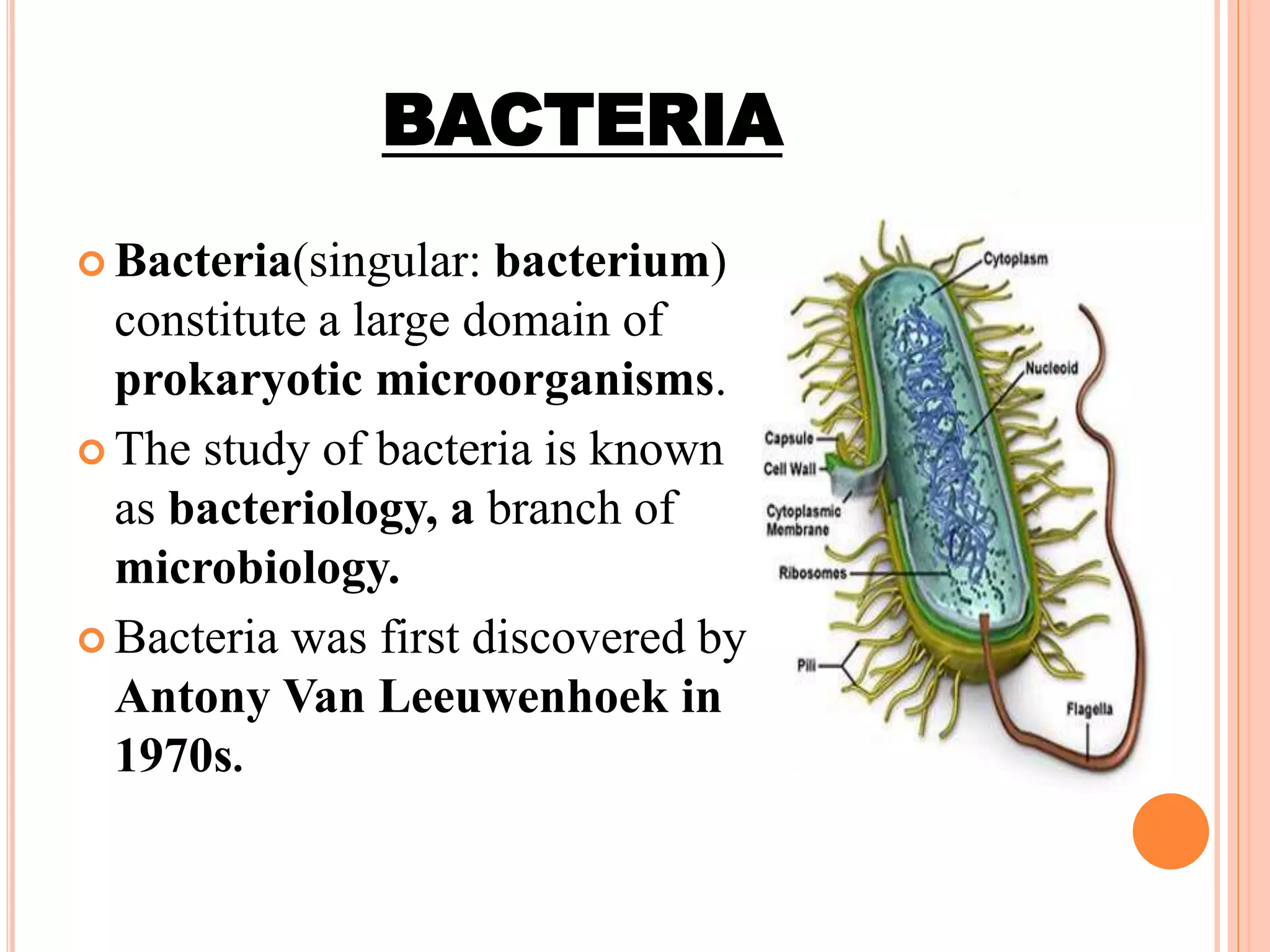
BACTERIA
 Bacteria(singular: bacterium)
constitute a large domain of
prokaryotic microorganisms.
 The study of bacteria is known
as bacteriology, a branch of
microbiology.
 Bacteria was first discovered by
Antony Van Leeuwenhoek in
1970s.
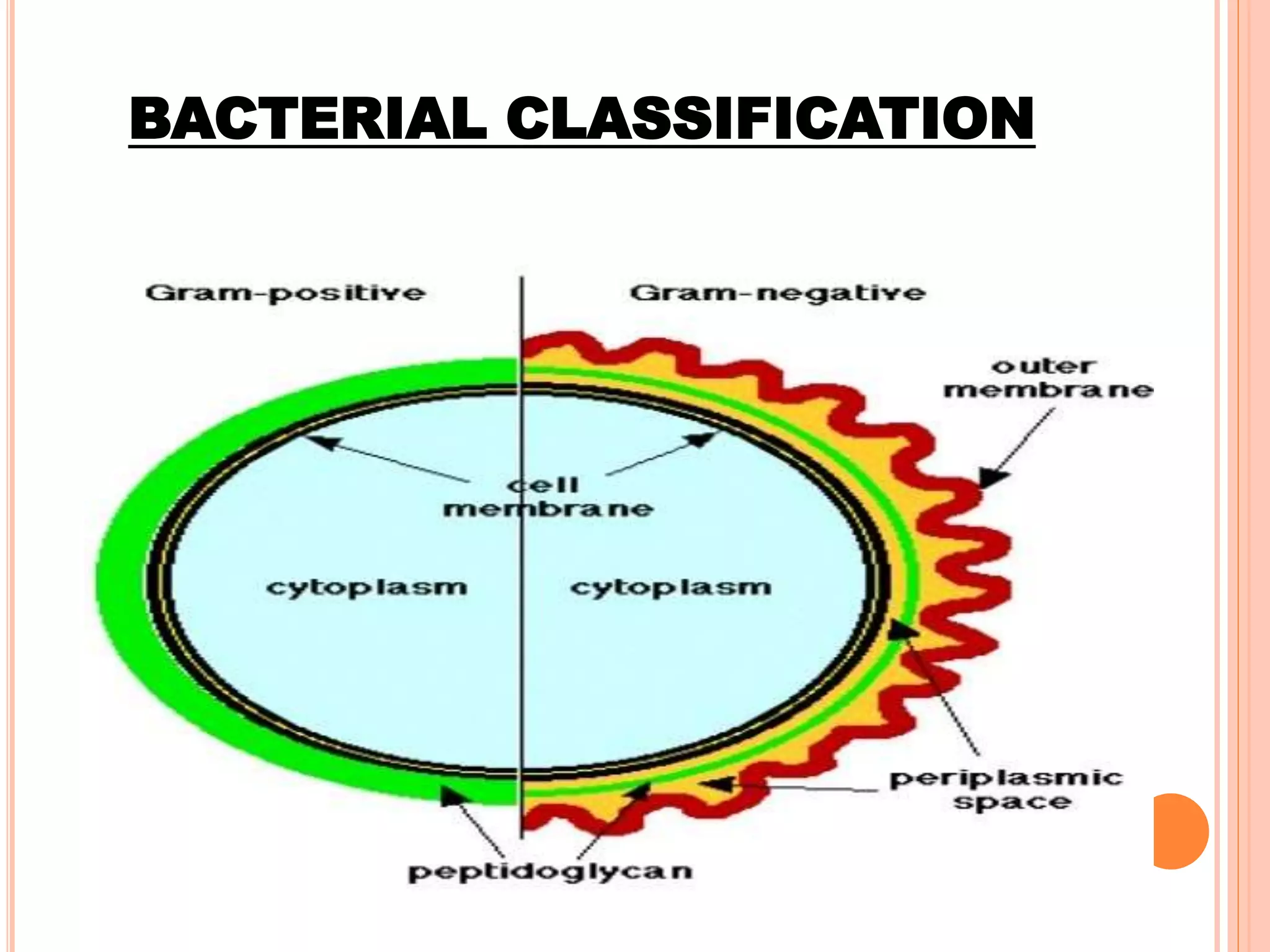
BACTERIAL CLASSIFICATION
PEPTIDOGLYCAN
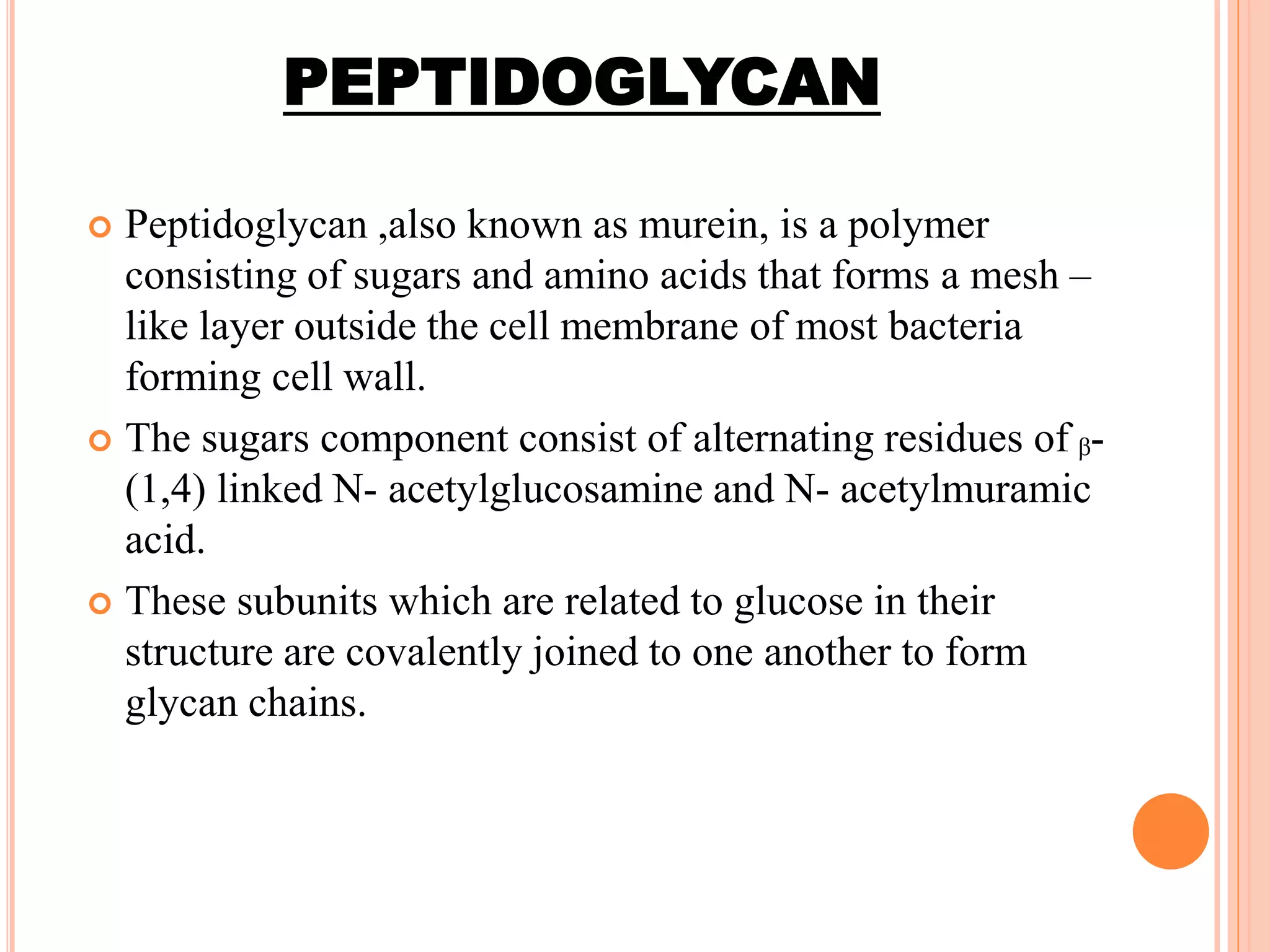
 Peptidoglycan ,also known as murein, is a polymer
consisting of sugars and amino acids that forms a mesh –
like layer outside the cell membrane of most bacteria
forming cell wall.
 The sugars component consist of alternating residues of ᵦ-
(1,4) linked N- acetylglucosamine and N- acetylmuramic
acid.
 These subunits which are related to glucose in their
structure are covalently joined to one another to form
glycan chains.
PEPTIDOGLYCAN
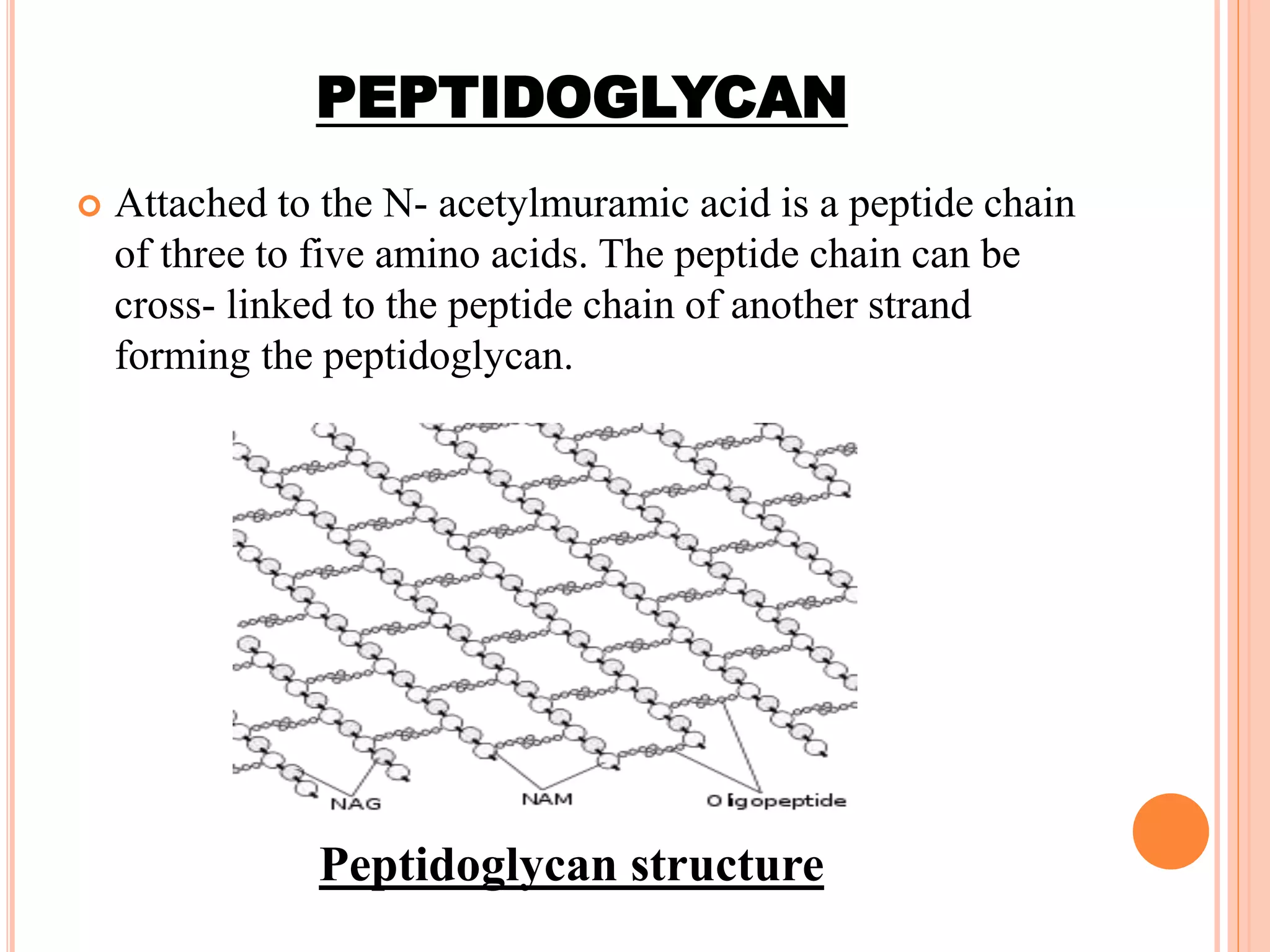
 Attached to the N- acetylmuramic acid is a peptide chain
of three to five amino acids. The peptide chain can be
cross- linked to the peptide chain of another strand
forming the peptidoglycan.
Peptidoglycan structure
TYPES OF BACTERIAL CELL
WALL
 On the based structure of the cell wall and to their
response to stain, bacteria have been classified into two
types:
- Gram Positive Bacteria
- Gram Negative Bacteria
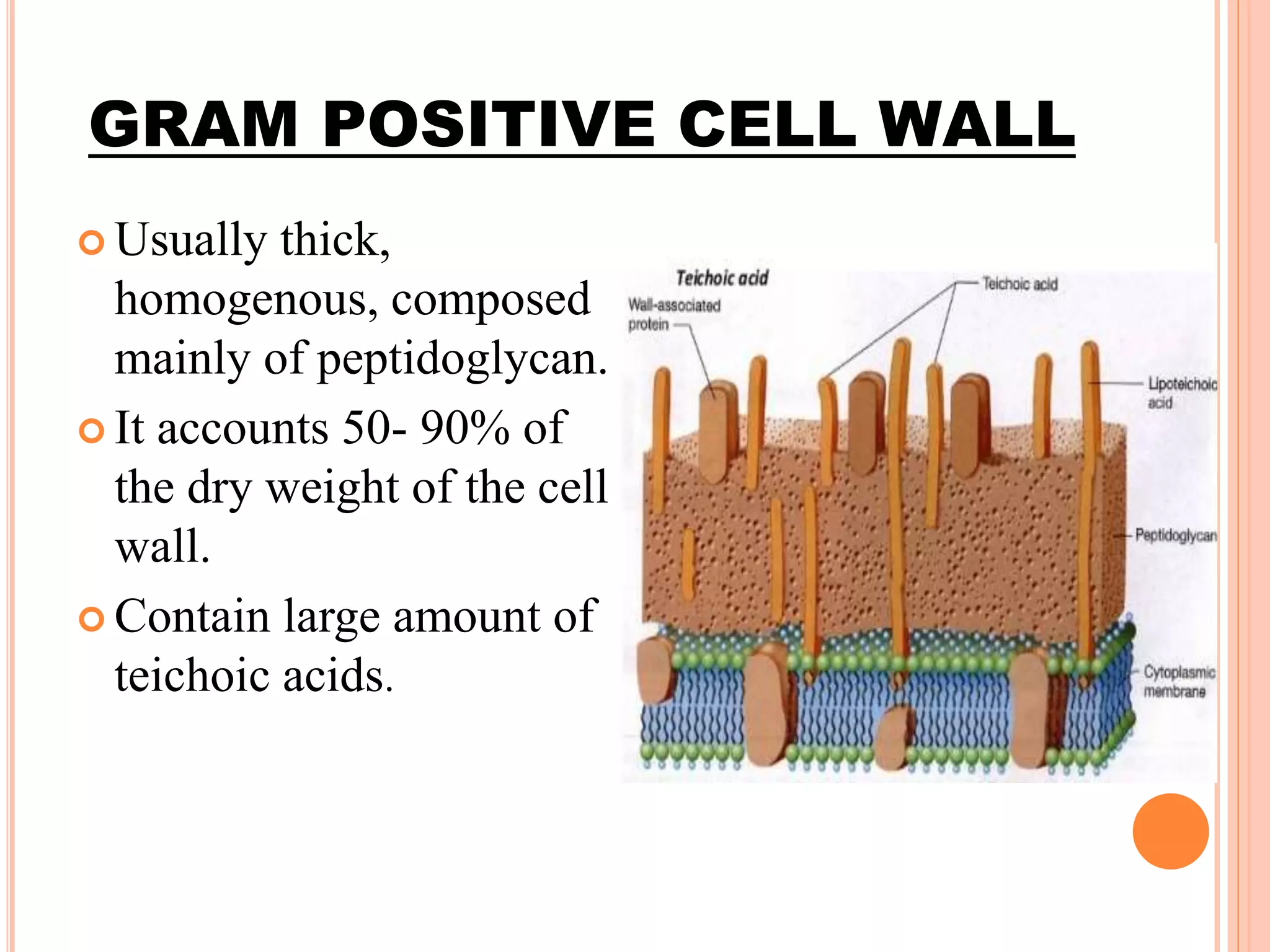
GRAM POSITIVE CELL WALL
 Usually thick,
homogenous, composed
mainly of peptidoglycan.
 It accounts 50- 90% of
the dry weight of the cell
wall.
 Contain large amount of
teichoic acids.
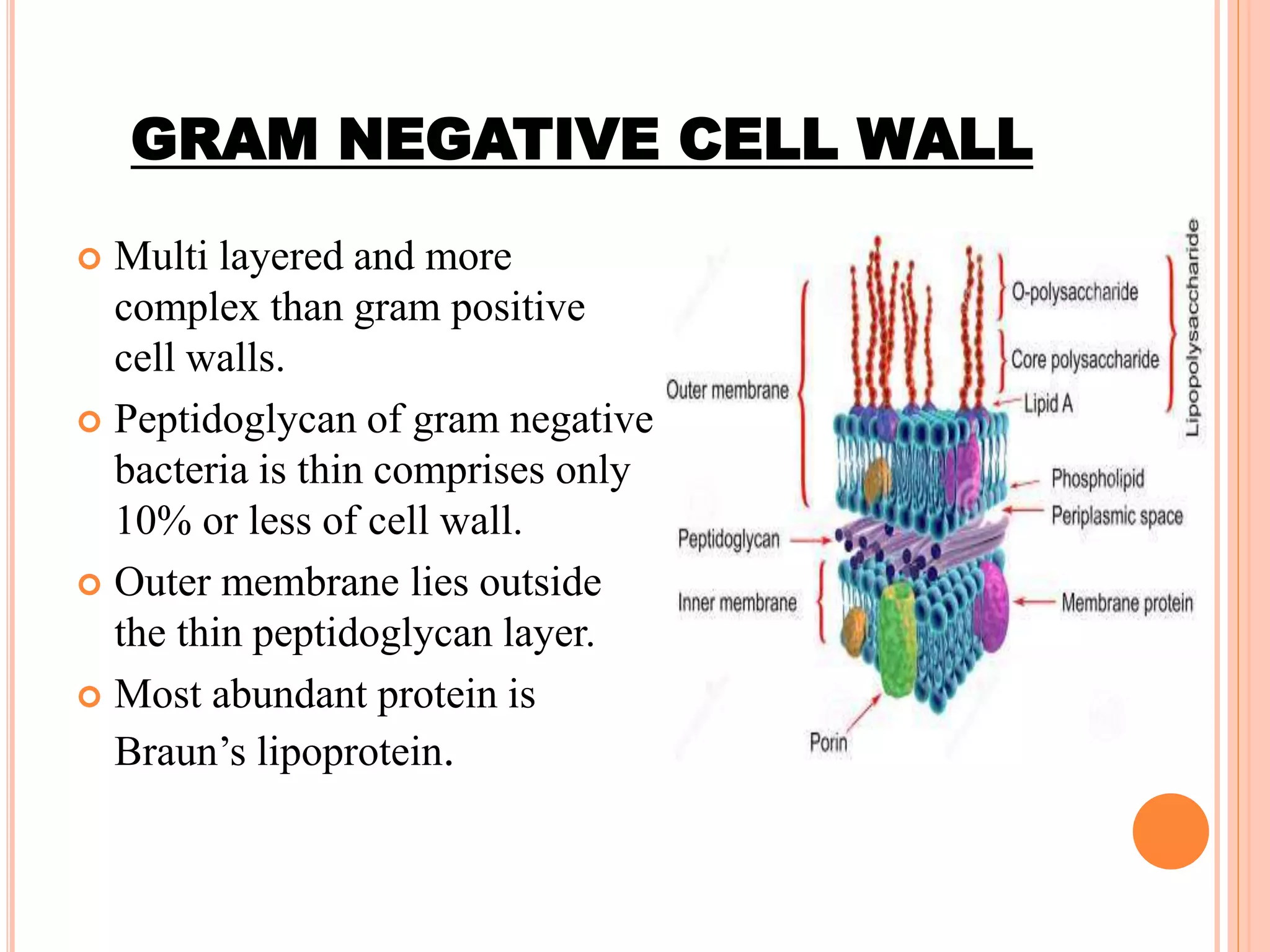
GRAM NEGATIVE CELL WALL
 Multi layered and more
complex than gram positive
cell walls.
 Peptidoglycan of gram negative
bacteria is thin comprises only
10% or less of cell wall.
 Outer membrane lies outside
the thin peptidoglycan layer.
 Most abundant protein is
Braun’s lipoprotein.
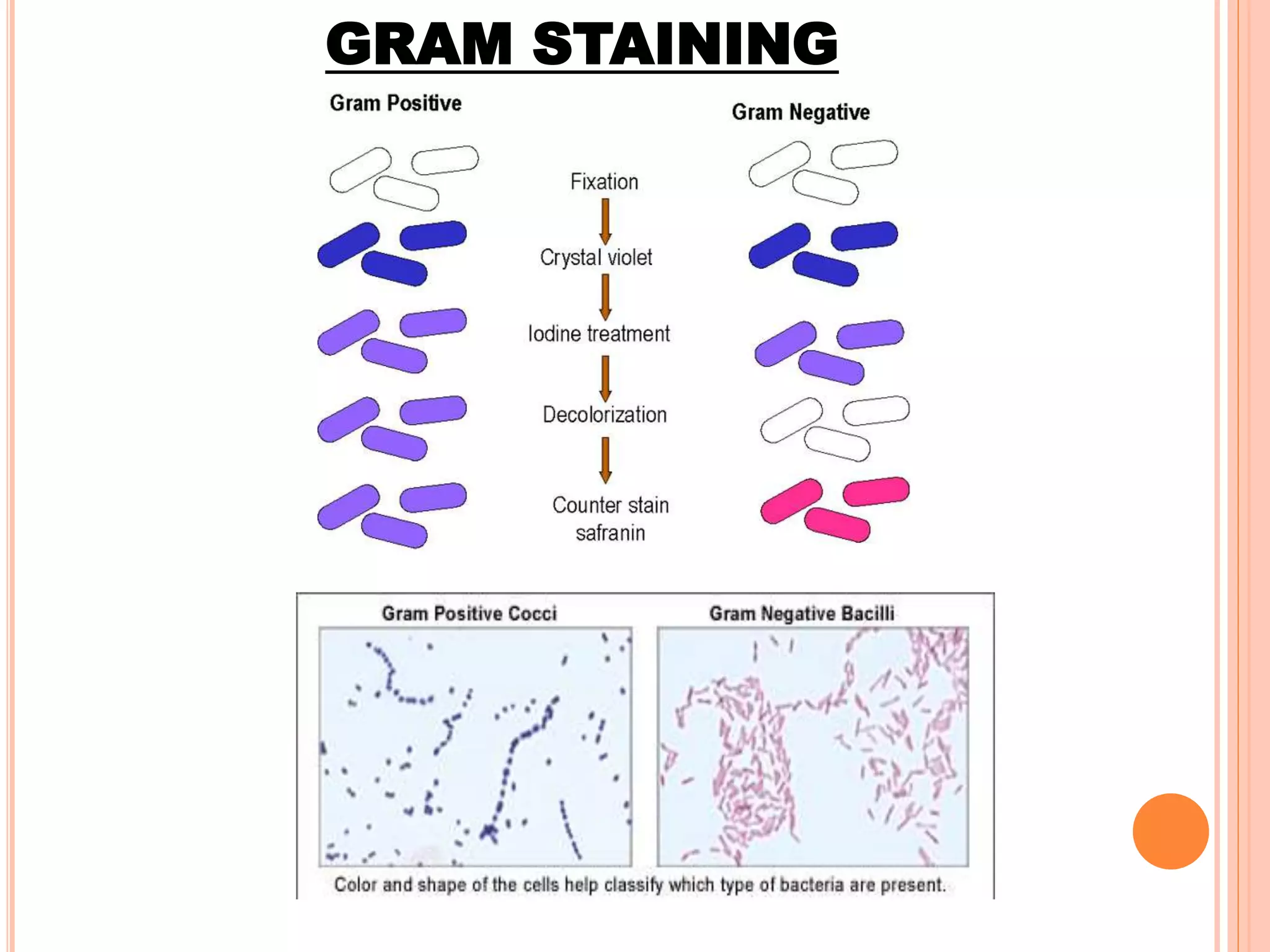
GRAM STAINING
FUNCTIONS OF BACTERIAL CELL
WALL
 Protect cells against osmotic shock and physical damage.
 Regulation of substance transport into and out of cells.
 Contain supplemental genetic information such as resistance
to antibiotics, production of toxins and tolerance to toxic
environment.
 Take part in protein synthesis.
 Movement of cells.
 Mineral storage of cells.
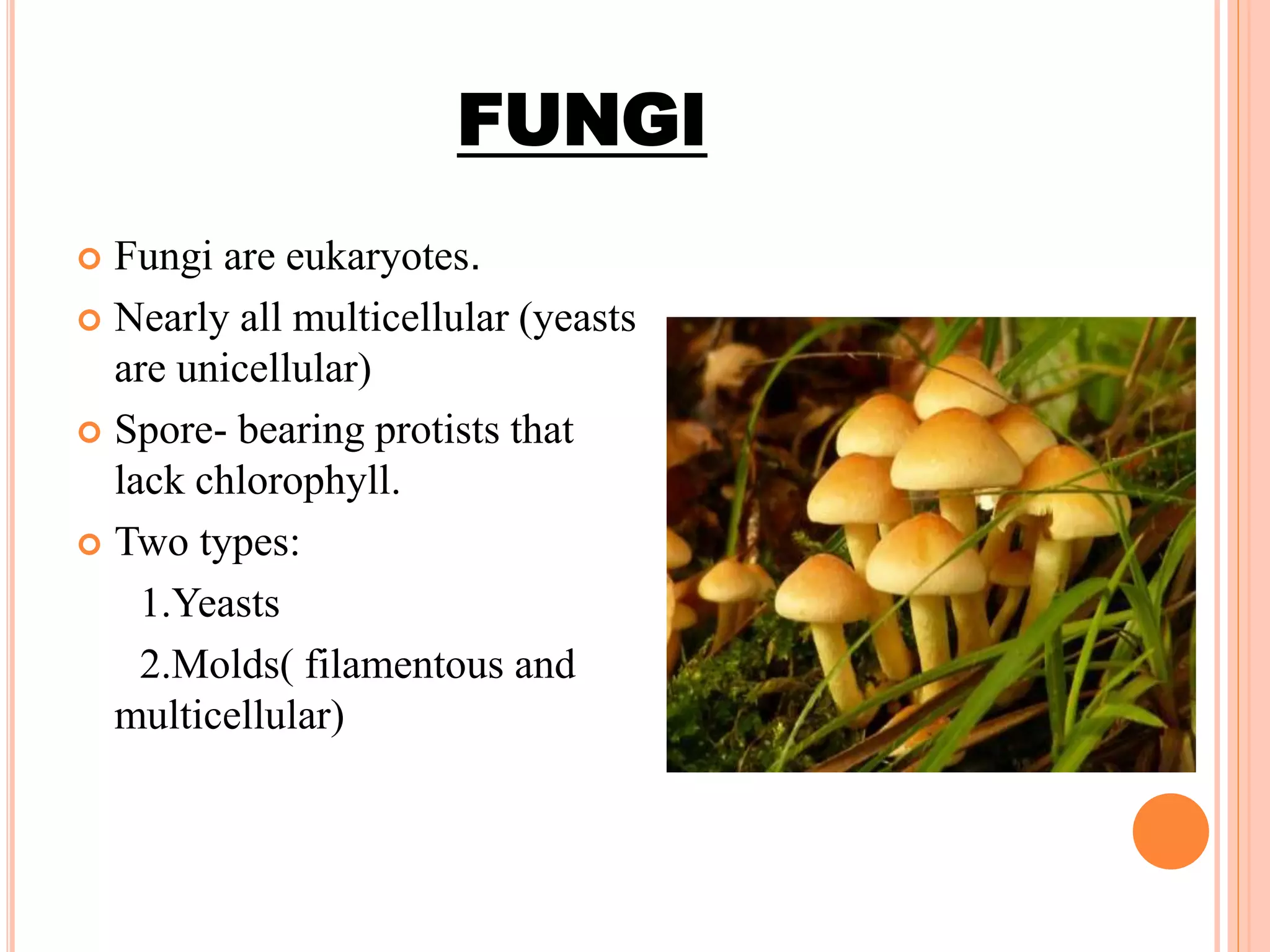
FUNGI
 Fungi are eukaryotes.
 Nearly all multicellular (yeasts
are unicellular)
 Spore- bearing protists that
lack chlorophyll.
 Two types:
1.Yeasts
2.Molds( filamentous and
multicellular)
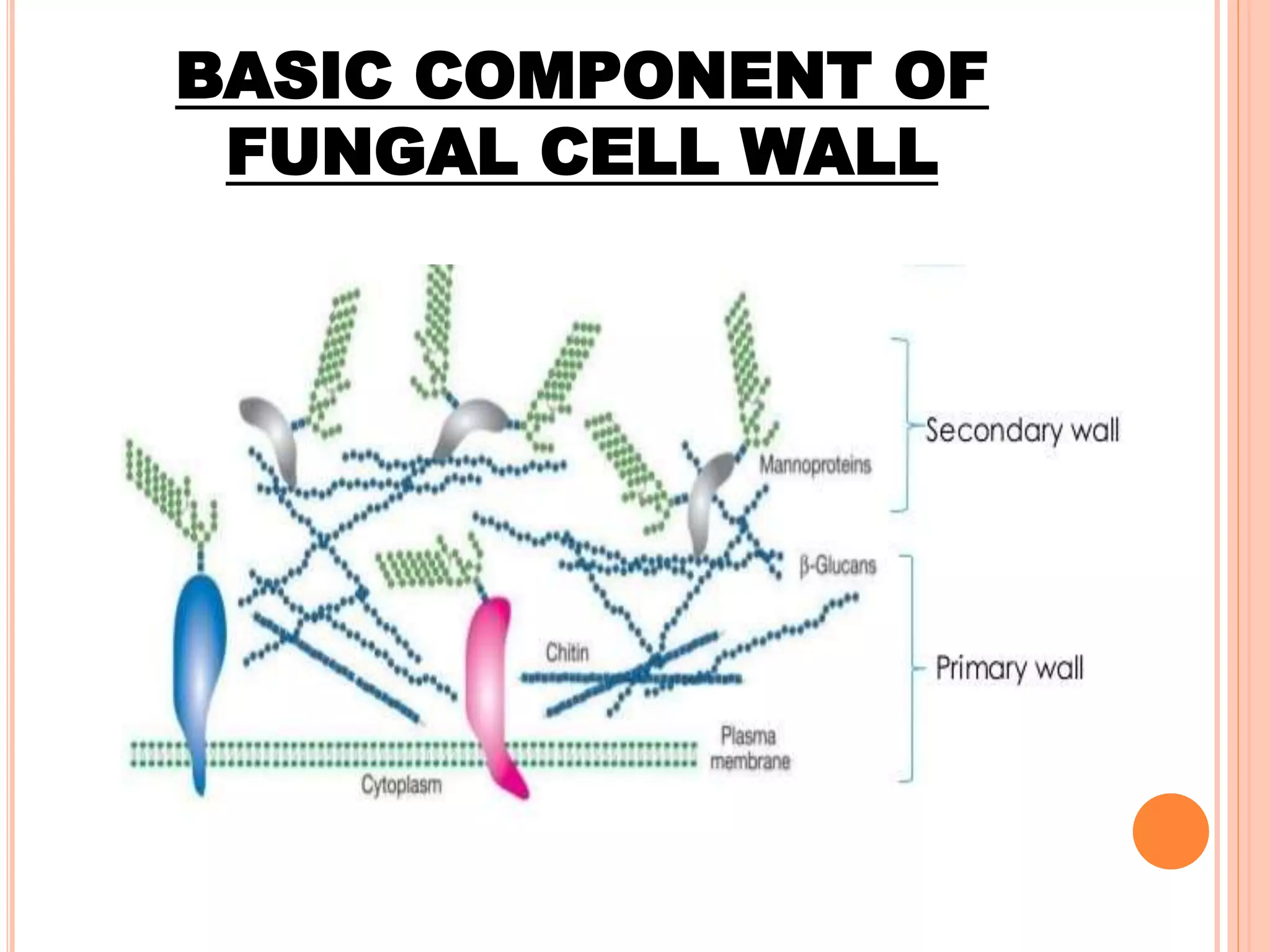
FUNGAL CELL WALL
 The cell wall is made up of :
1.Chitin (polymers of acetylated amino sugar N-acetyl-
glucosamine)
2.Glucans
3.Proteins
 Glucan and Chitin are components of the primary wall.
 Proteins are components of the secondary wall.
 Other components include chitosan, melanins and lipids.
BASIC COMPONENT OF
FUNGAL CELL WALL
FUNCTION OF FUNGAL
CELL WALL
 Protects against osmotic lysis.
 Acts as a molecular sieve.
 Contains pigments for protection.
 Binding sites for enzymes.
 The outermost surface of the cell wall
1) provides a medium between the cell and the environment.
2) a site where antigen and agglutinin gets attached to the
substrate, host and other cells.
PLANT CELL WALL
 The plant cell wall is a remarkable structure. It
provides the most significant difference between
plant cells and other eukaryotic cells.
 The wall is rigid(up to many micrometers in
thickness) and gives plant cells a very defined
shape.
 While most cells have a outer membrane , none
is comparable in strength to the plant cell wall.
The cell wall is the reason for the difference
between plant and animal cell functions. Because
the plant has evolved this rigid structure.
COMPONENTS OF PLANT
CELL WALL
The plant cell wall composed of :
1. The Middle Lamella
2. The Primary Cell Wall
3.The Secondary Cell Wall
4. The Tertiary Cell Wall
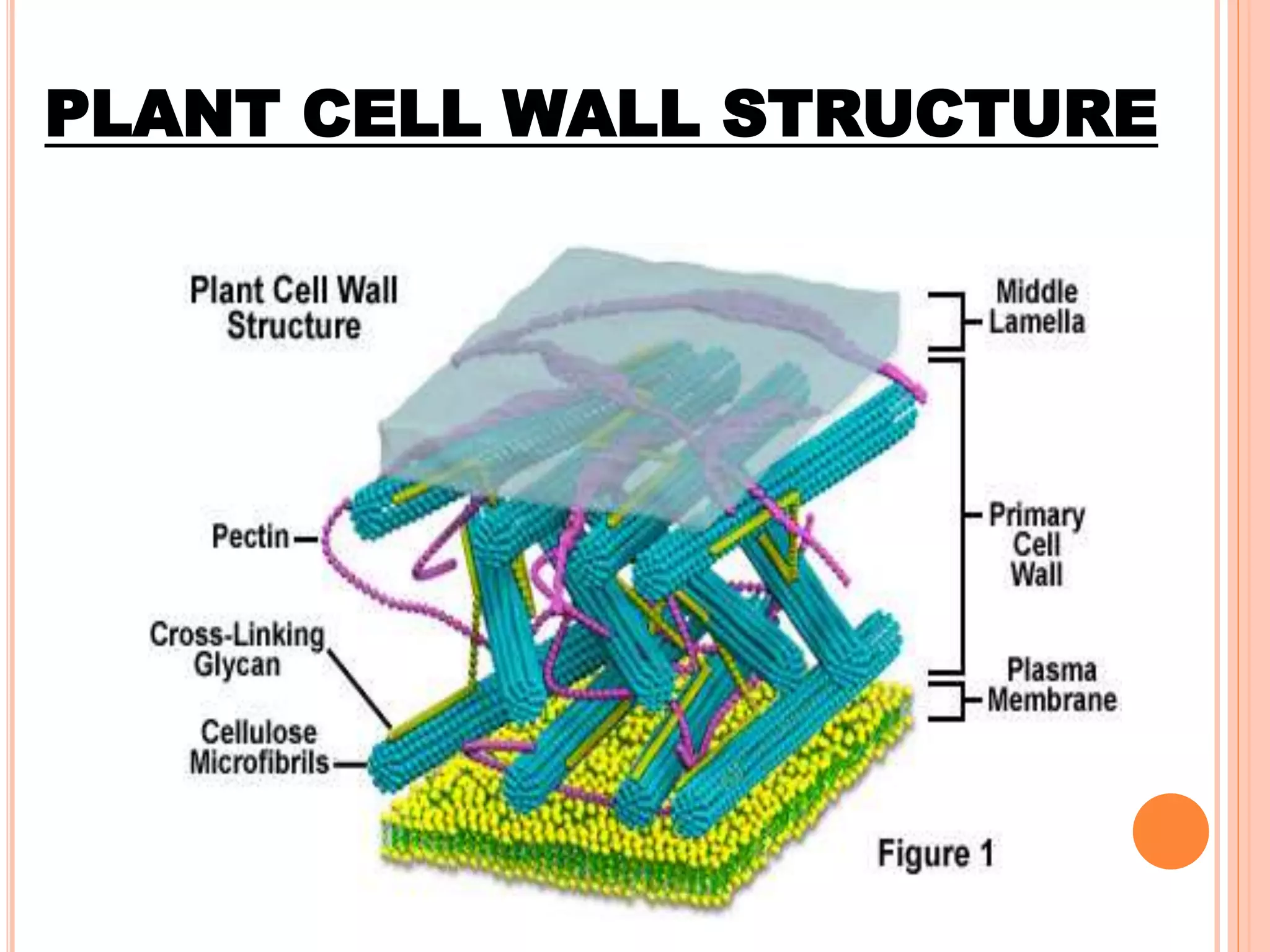
PLANT CELL WALL STRUCTURE
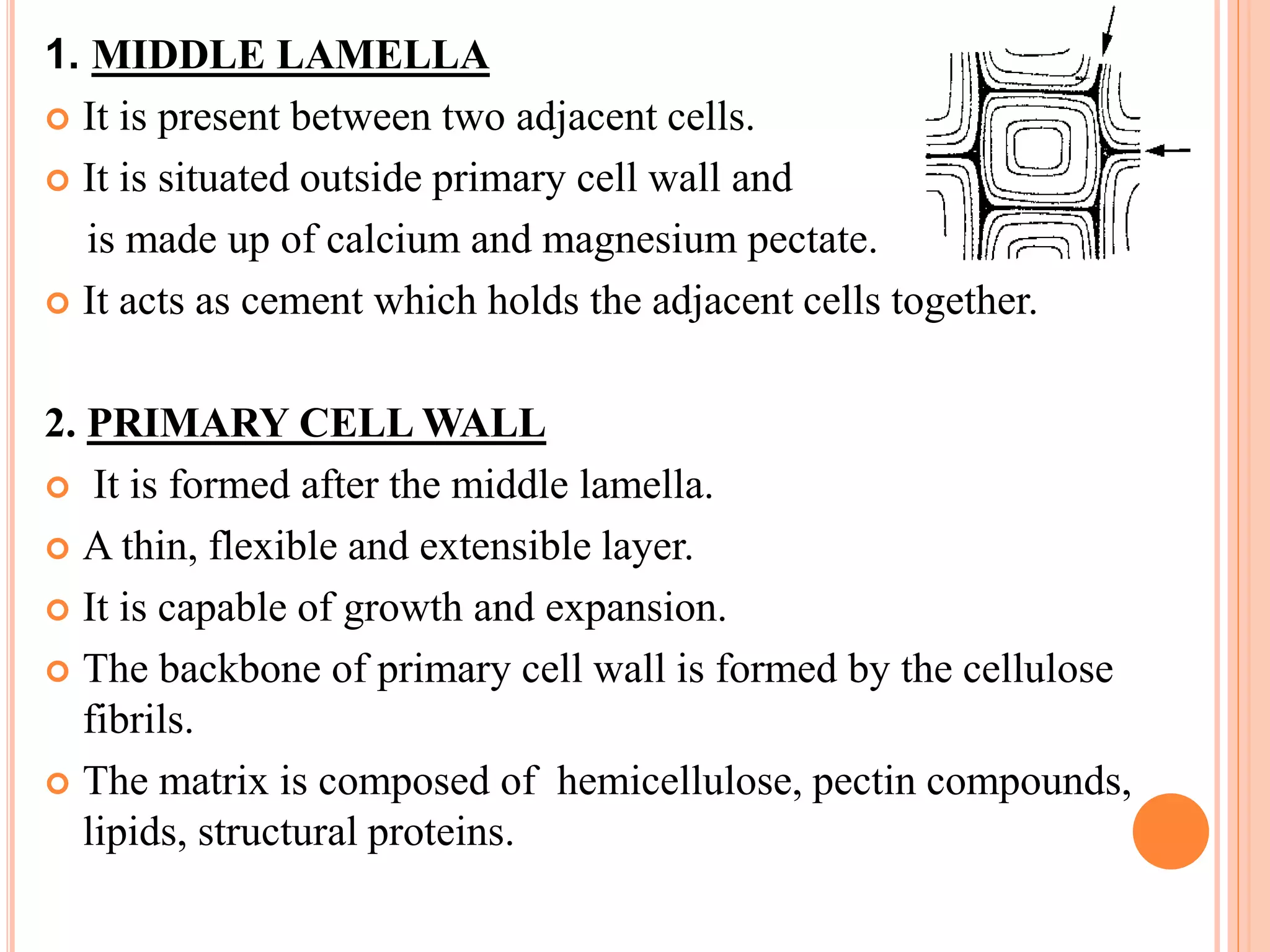
1. MIDDLE LAMELLA
 It is present between two adjacent cells.
 It is situated outside primary cell wall and
is made up of calcium and magnesium pectate.
 It acts as cement which holds the adjacent cells together.
2. PRIMARY CELL WALL
 It is formed after the middle lamella.
 A thin, flexible and extensible layer.
 It is capable of growth and expansion.
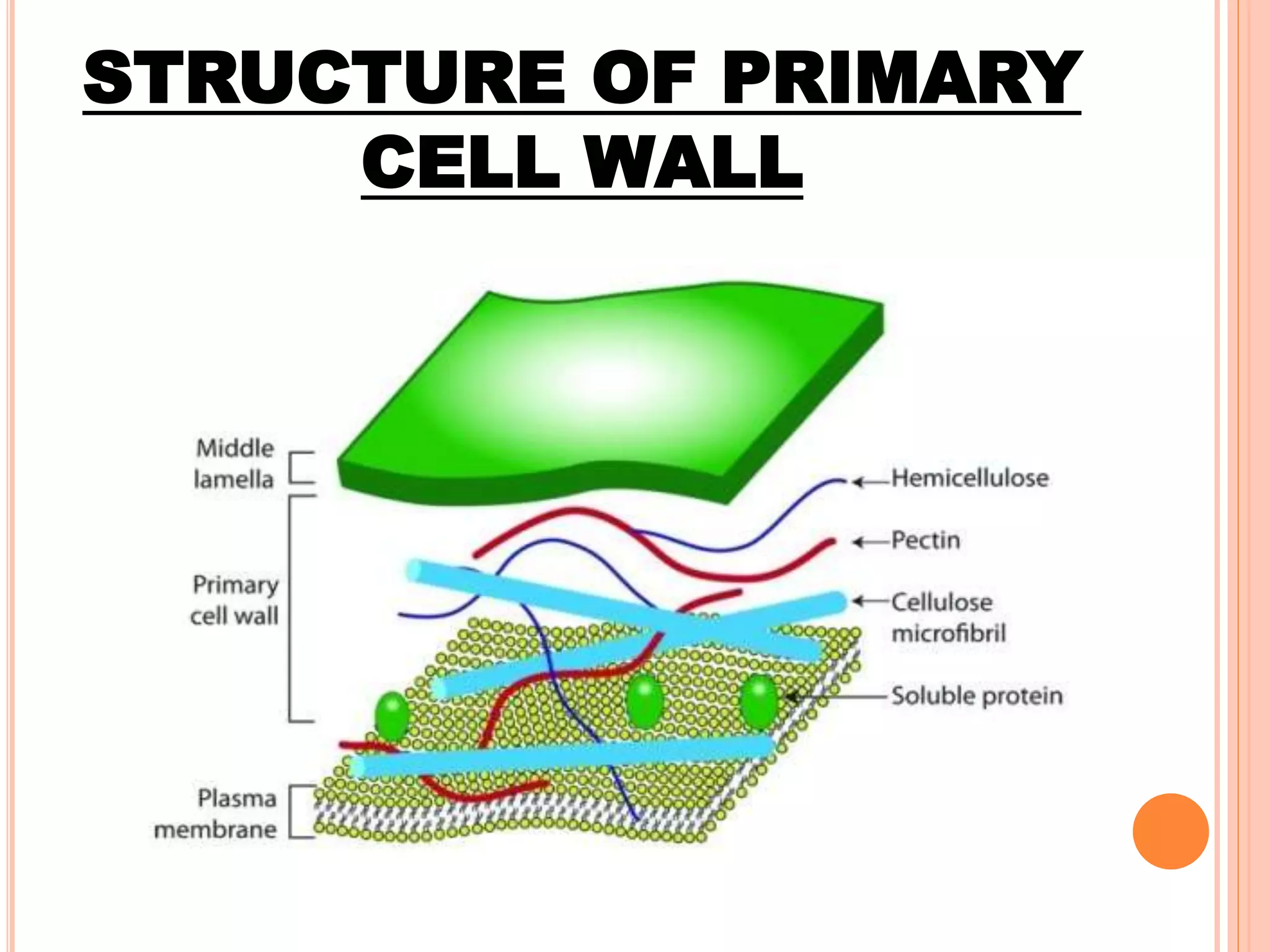
 The backbone of primary cell wall is formed by the cellulose
fibrils.
 The matrix is composed of hemicellulose, pectin compounds,
lipids, structural proteins.
STRUCTURE OF PRIMARY
CELL WALL
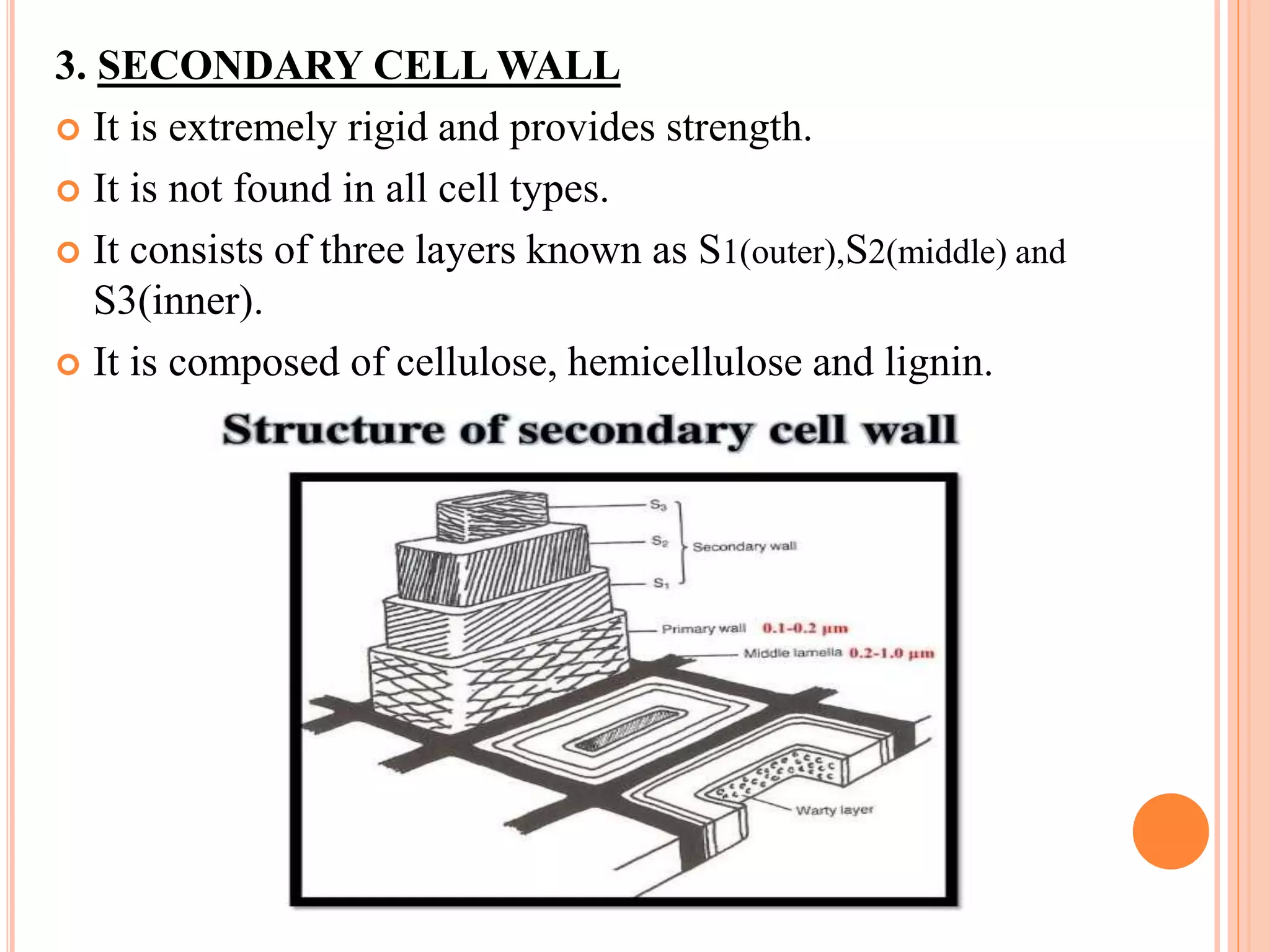
3. SECONDARY CELL WALL
 It is extremely rigid and provides strength.
 It is not found in all cell types.
 It consists of three layers known as S1(outer),S2(middle) and
S3(inner).
 It is composed of cellulose, hemicellulose and lignin.
4.TERTIARY CELL WALL
 Tertiary cell wall is deposited in few cells.
 It is considered to be dry residue of protoplast .
 Besides cellulose and hemi-cellulose, xylan is also present.
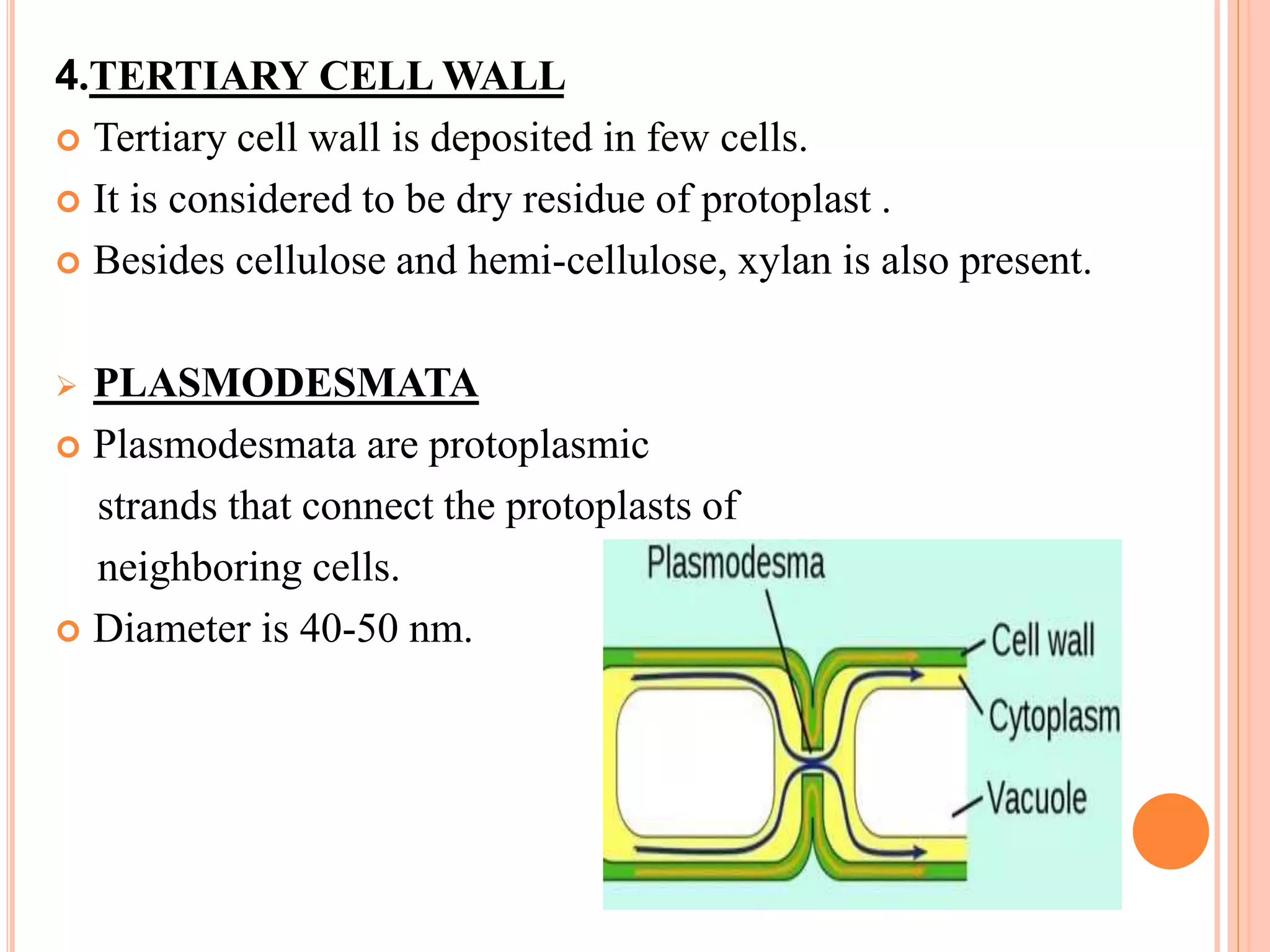
 PLASMODESMATA
 Plasmodesmata are protoplasmic
strands that connect the protoplasts of
neighboring cells.
 Diameter is 40-50 nm.
COMPOSITION OF CELL
WALL
 The cell wall is mainly composed of carbohydrate materials.
The major components of cell wall are cellulose,pectins,
hemicelluloses, proteins and phenolics.
1.Cellulose: It provides shape and strength to the cell wall. It
composes 20-30 % of the dry weight of primary wall and
accounts 40-90% of the dry weight of secondary wall.
2.Pectins: They are group of polysaccharides, which are rich in
galacturonic acid, rhamnose,arabinose and galactose .Pectins
are present in high concentration in the middle lamella where
they presumably serve the function of cementing adjacent
cells together.
3.Hemicelluloses: These are matrix polysaccharides built up of a variety of
different sugars. They differ in different species and in different cell
types.
o Xylan: It typically makes up roughly 5% of primary cell wall and 20%
of secondary cell wall in dicots.This hemi cellulosic polysaccharide is
linked with xylose and arabinose.
4. Proteins: Different varieties of protein are present in the cell wall, most
of which are linked with carbohydrate forming glycoprotein. The cell
wall glycoprotein extensin contains an unusual amino acid
hydroxyproline (about 40%), which is generally absent from the
protoplast. Extensins are present in the primary cell walls of dicots
making up one to ten percent of the wall.
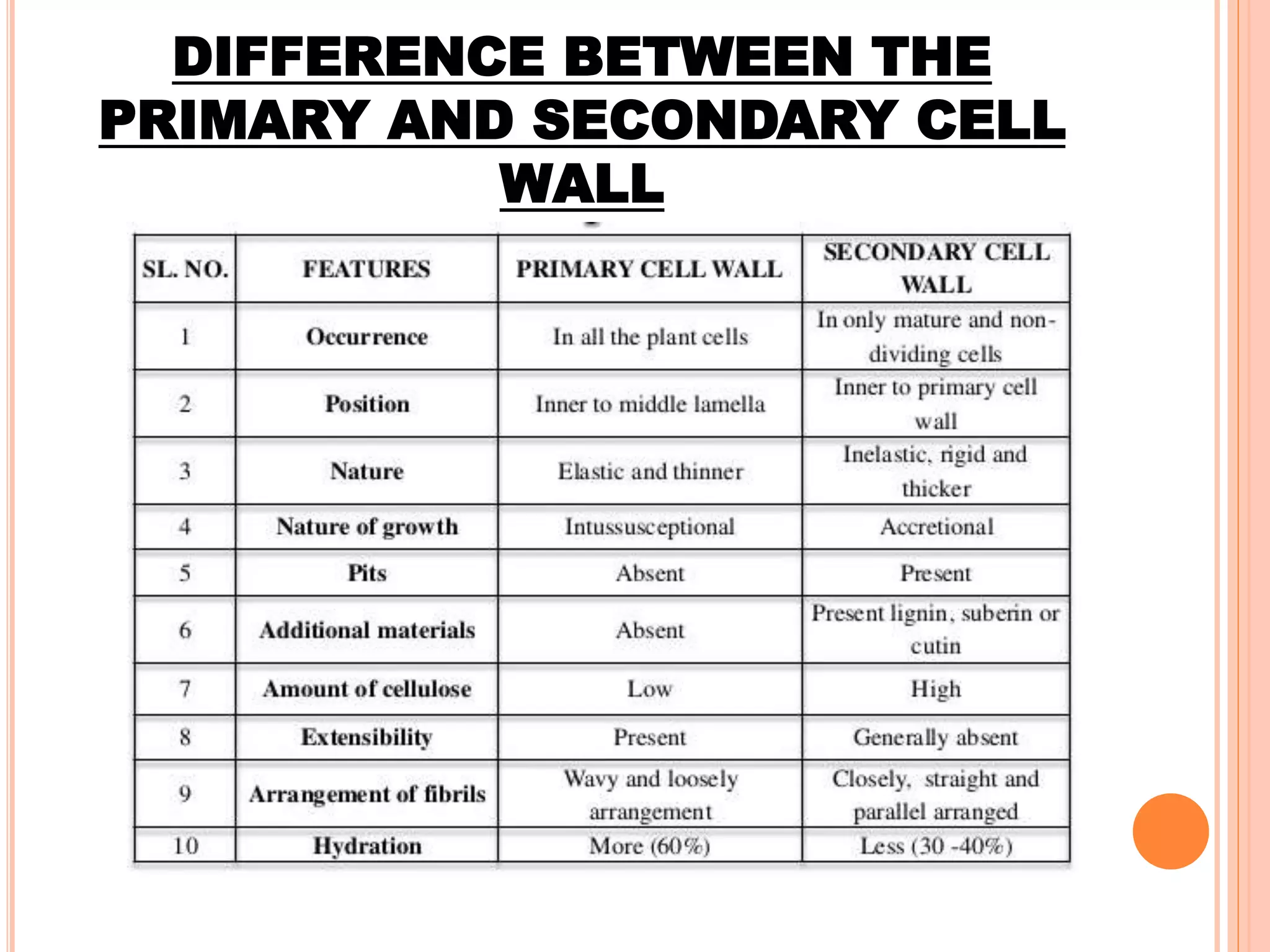
DIFFERENCE BETWEEN THE
PRIMARY AND SECONDARY CELL
WALL
FUNCTIONS OF CELL
WALL
 They determine the morphology, growth and development
of plant cells.
 They protect the protoplasm from invasion by viral,
bacterial and fungal pathogens.
 They are rigid structures and thus help the plant in
withstanding the gravitational forces.
 They are involved in the transport of materials and
metabolites into and out of cell.
 They withstand the turgor pressure which develops within
the cells due to high osmotic pressure.
Cell wall structure and function

Cell wall structure and function

  • 1.
    CELL WALL: STRUCTURE AND DYNAMICS SUBMITTEDBY: SURBHI SHARMA MSC. BIOTECHNOLOGY 171014002
  • 2.
    INTRODUCTION  Cell wallwas first observed and named simply as a “wall” by Robert Hooke in 1665.  In 1804, Karl Rudolphi and J.H.F. Link proved that cells have independent cell walls.  A cell wall is a structural layer that surrounds some types of cells, situated outside the cell membrane.  It can be tough, flexible and rigid which provides cell with both structural support and protection.
  • 3.
    INTRODUCTION  On thebasis of chemical composition of cell wall there are three types of cell wall: 1) Bacterial Cell Wall : made up of Mucopeptide and Muramic acid. 2) Cell wall of Fungi: made up of Chitin. 3) Plant Cell wall: made up of Cellulose.
  • 4.
    BACTERIA  Bacteria(singular: bacterium) constitutea large domain of prokaryotic microorganisms.  The study of bacteria is known as bacteriology, a branch of microbiology.  Bacteria was first discovered by Antony Van Leeuwenhoek in 1970s.
  • 5.
  • 6.
    PEPTIDOGLYCAN  Peptidoglycan ,alsoknown as murein, is a polymer consisting of sugars and amino acids that forms a mesh – like layer outside the cell membrane of most bacteria forming cell wall.  The sugars component consist of alternating residues of ᵦ- (1,4) linked N- acetylglucosamine and N- acetylmuramic acid.  These subunits which are related to glucose in their structure are covalently joined to one another to form glycan chains.
  • 7.
    PEPTIDOGLYCAN  Attached tothe N- acetylmuramic acid is a peptide chain of three to five amino acids. The peptide chain can be cross- linked to the peptide chain of another strand forming the peptidoglycan. Peptidoglycan structure
  • 8.
    TYPES OF BACTERIALCELL WALL  On the based structure of the cell wall and to their response to stain, bacteria have been classified into two types: - Gram Positive Bacteria - Gram Negative Bacteria
  • 9.
    GRAM POSITIVE CELLWALL  Usually thick, homogenous, composed mainly of peptidoglycan.  It accounts 50- 90% of the dry weight of the cell wall.  Contain large amount of teichoic acids.
  • 10.
    GRAM NEGATIVE CELLWALL  Multi layered and more complex than gram positive cell walls.  Peptidoglycan of gram negative bacteria is thin comprises only 10% or less of cell wall.  Outer membrane lies outside the thin peptidoglycan layer.  Most abundant protein is Braun’s lipoprotein.
  • 11.
  • 12.
    FUNCTIONS OF BACTERIALCELL WALL  Protect cells against osmotic shock and physical damage.  Regulation of substance transport into and out of cells.  Contain supplemental genetic information such as resistance to antibiotics, production of toxins and tolerance to toxic environment.  Take part in protein synthesis.  Movement of cells.  Mineral storage of cells.
  • 13.
    FUNGI  Fungi areeukaryotes.  Nearly all multicellular (yeasts are unicellular)  Spore- bearing protists that lack chlorophyll.  Two types: 1.Yeasts 2.Molds( filamentous and multicellular)
  • 14.
    FUNGAL CELL WALL The cell wall is made up of : 1.Chitin (polymers of acetylated amino sugar N-acetyl- glucosamine) 2.Glucans 3.Proteins  Glucan and Chitin are components of the primary wall.  Proteins are components of the secondary wall.  Other components include chitosan, melanins and lipids.
  • 15.
  • 16.
    FUNCTION OF FUNGAL CELLWALL  Protects against osmotic lysis.  Acts as a molecular sieve.  Contains pigments for protection.  Binding sites for enzymes.  The outermost surface of the cell wall 1) provides a medium between the cell and the environment. 2) a site where antigen and agglutinin gets attached to the substrate, host and other cells.
  • 17.
    PLANT CELL WALL The plant cell wall is a remarkable structure. It provides the most significant difference between plant cells and other eukaryotic cells.  The wall is rigid(up to many micrometers in thickness) and gives plant cells a very defined shape.  While most cells have a outer membrane , none is comparable in strength to the plant cell wall. The cell wall is the reason for the difference between plant and animal cell functions. Because the plant has evolved this rigid structure.
  • 18.
    COMPONENTS OF PLANT CELLWALL The plant cell wall composed of : 1. The Middle Lamella 2. The Primary Cell Wall 3.The Secondary Cell Wall 4. The Tertiary Cell Wall
  • 19.
    PLANT CELL WALLSTRUCTURE
  • 20.
    1. MIDDLE LAMELLA It is present between two adjacent cells.  It is situated outside primary cell wall and is made up of calcium and magnesium pectate.  It acts as cement which holds the adjacent cells together. 2. PRIMARY CELL WALL  It is formed after the middle lamella.  A thin, flexible and extensible layer.  It is capable of growth and expansion.  The backbone of primary cell wall is formed by the cellulose fibrils.  The matrix is composed of hemicellulose, pectin compounds, lipids, structural proteins.
  • 21.
  • 22.
    3. SECONDARY CELLWALL  It is extremely rigid and provides strength.  It is not found in all cell types.  It consists of three layers known as S1(outer),S2(middle) and S3(inner).  It is composed of cellulose, hemicellulose and lignin.
  • 23.
    4.TERTIARY CELL WALL Tertiary cell wall is deposited in few cells.  It is considered to be dry residue of protoplast .  Besides cellulose and hemi-cellulose, xylan is also present.  PLASMODESMATA  Plasmodesmata are protoplasmic strands that connect the protoplasts of neighboring cells.  Diameter is 40-50 nm.
  • 24.
    COMPOSITION OF CELL WALL The cell wall is mainly composed of carbohydrate materials. The major components of cell wall are cellulose,pectins, hemicelluloses, proteins and phenolics. 1.Cellulose: It provides shape and strength to the cell wall. It composes 20-30 % of the dry weight of primary wall and accounts 40-90% of the dry weight of secondary wall. 2.Pectins: They are group of polysaccharides, which are rich in galacturonic acid, rhamnose,arabinose and galactose .Pectins are present in high concentration in the middle lamella where they presumably serve the function of cementing adjacent cells together.
  • 25.
    3.Hemicelluloses: These arematrix polysaccharides built up of a variety of different sugars. They differ in different species and in different cell types. o Xylan: It typically makes up roughly 5% of primary cell wall and 20% of secondary cell wall in dicots.This hemi cellulosic polysaccharide is linked with xylose and arabinose. 4. Proteins: Different varieties of protein are present in the cell wall, most of which are linked with carbohydrate forming glycoprotein. The cell wall glycoprotein extensin contains an unusual amino acid hydroxyproline (about 40%), which is generally absent from the protoplast. Extensins are present in the primary cell walls of dicots making up one to ten percent of the wall.
  • 26.
    DIFFERENCE BETWEEN THE PRIMARYAND SECONDARY CELL WALL
  • 27.
    FUNCTIONS OF CELL WALL They determine the morphology, growth and development of plant cells.  They protect the protoplasm from invasion by viral, bacterial and fungal pathogens.  They are rigid structures and thus help the plant in withstanding the gravitational forces.  They are involved in the transport of materials and metabolites into and out of cell.  They withstand the turgor pressure which develops within the cells due to high osmotic pressure.