CCTV CAMERAS DEALERS
(BHADRAVATI)
Brickwood Security & Safety Systems
www.brickwood.co
info@brickwood.co
+91-7829422434
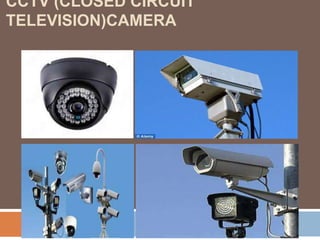
CCTV (CLOSED CIRCUIT
TELEVISION)CAMERA
CCTV CAMERA
Closed Circuit Television (CCTV) is the use of video
cameras to transmit a signal to a specific place on a
limited set of monitors.
It differs from broadcast television in that the signal is
not openly transmitted though it may employ point to
point , point to multipoint or mesh wireless links.
CCTV camera can be
categorized on the basis of -
 Types of images.
 Frames per second .
 Pan Tilt zoom camera.
 Cameras with special accessories .
CCTV camera can be
categorized(Continued…)
 Types of Images:
CCTV cameras generally take both black and white or
color video images. In addition, many CCTV cameras
even have night vision capabilities that allow a CCTV
camera to view and record low light images using special
technology.
 Frames per Second:
Frames per second is the amount of full frames that a
video camera captures and sends to a recording device
or monitor per second. While most CCTV camera
systems easily capture 30 or more frames per second
(30 fps is considered real time), the amount of video tape
or digital storage would be enormous to record every
moment of everyday. For most stores, speeds of 1 to 6
frames per second are more than enough to catch and
record a perpetrator committing a crime.
CCTV camera can be
categorized(Continued…)
 Pan Tilt Zoom (PTZ) Cameras:
These types of CCTV cameras allow a person controlling
the surveillance of an area to move the camera remotely,
usually with an RF or wired controller. Most movable
cameras allow the person monitoring it to move the
camera from right to left (pan), up and down (tilt), and
from a tight angle to a wide angle (close up zoom).
 Cameras with Special Accessories:
Certain CCTV cameras have special functions that are
made for specialty uses. For instance, there are
extremely small surveillance cameras that are used for
spying (Nanny Cams), night viewing, are vandal resistant,
and that are specifically made for indoor or outdoor uses.
Types of CCTV camera
 Indoor camera
 Outdoor camera
 IR day/night camera
 Dome camera
 Bullet camera
 Hidden camera
 Zoom camera
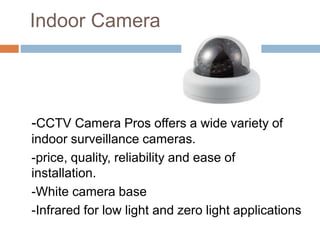
Indoor Camera
-CCTV Camera Pros offers a wide variety of
indoor surveillance cameras.
-price, quality, reliability and ease of
installation.
-White camera base
-Infrared for low light and zero light applications
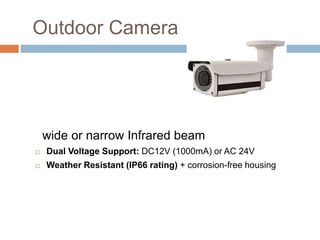
Outdoor Camera
wide or narrow Infrared beam
 Dual Voltage Support: DC12V (1000mA) or AC 24V
 Weather Resistant (IP66 rating) + corrosion-free housing
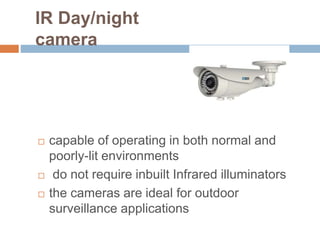
IR Day/night
camera
 capable of operating in both normal and
poorly-lit environments
 do not require inbuilt Infrared illuminators
 the cameras are ideal for outdoor
surveillance applications
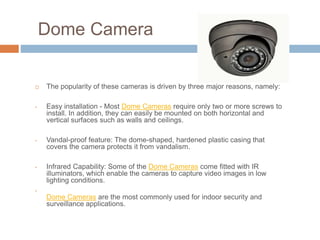
Dome Camera
 The popularity of these cameras is driven by three major reasons, namely:
• Easy installation - Most Dome Cameras require only two or more screws to
install. In addition, they can easily be mounted on both horizontal and
vertical surfaces such as walls and ceilings.
• Vandal-proof feature: The dome-shaped, hardened plastic casing that
covers the camera protects it from vandalism.
• Infrared Capability: Some of the Dome Cameras come fitted with IR
illuminators, which enable the cameras to capture video images in low
lighting conditions.
•
Dome Cameras are the most commonly used for indoor security and
surveillance applications.
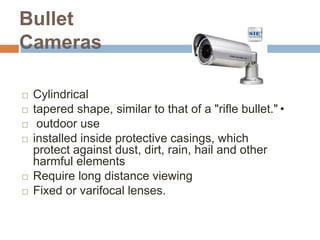
Bullet
Cameras
 Cylindrical
 tapered shape, similar to that of a "rifle bullet."•
 outdoor use
 installed inside protective casings, which
protect against dust, dirt, rain, hail and other
harmful elements
 Require long distance viewing
 Fixed or varifocal lenses.
Applications of CCTV
camera
 Retail
 Schools
 Shops
 Football and cricket
stadiums
 Staff theft and fraud
 Swimming pools
 Vandalism and theft
 Vending machines
 Warehouse CCTV
 Other uses
 Bars
 Cash rooms
 Car park
 Gaming machines
 Historic sites
 Holiday Sites
 Hospitals
 Number plate recording
 Public Spaces and other
Large Areas
 Reception areas
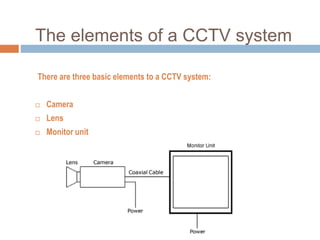
The elements of a CCTV system
There are three basic elements to a CCTV system:
 Camera
 Lens
 Monitor unit
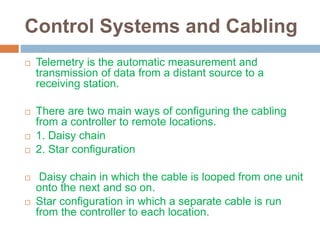
Control Systems and Cabling
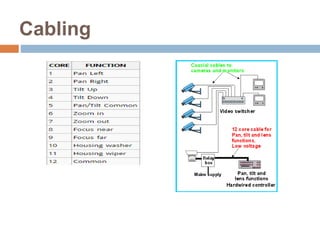
 Telemetry is the automatic measurement and
transmission of data from a distant source to a
receiving station.
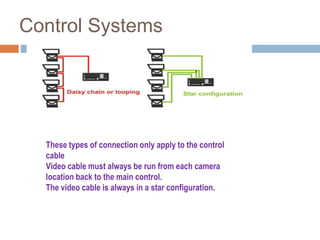
 There are two main ways of configuring the cabling
from a controller to remote locations.
 1. Daisy chain
 2. Star configuration
 Daisy chain in which the cable is looped from one unit
onto the next and so on.
 Star configuration in which a separate cable is run
from the controller to each location.
Control Systems
These types of connection only apply to the control
cable
Video cable must always be run from each camera
location back to the main control.
The video cable is always in a star configuration.
Cabling
Data Storing into CCTV
camera
 The required amount of storage is dependent on
camera’s image resolution, frame rate, compression
ratio and days of retention.
 Setting up camera to use motion detection can
significantly reduce storage usage.
 Hard Disc is required for storing data.
CCTV camera Brands
Hikvision
CP Plus
Dahua
Panasonic
Samsung
LG
Tyco
Honeywell
Sony
Zicom
Vintron
Alba
Pelco
AV Tech
Bosch
Advantages
 Provide more security
 Easy to configure & easy to maintain
 Assist the police in crime
 Increase the security level in the financial area
where the upper level people live.
Disadvantages
There is no any disadvantage as such of fixing CCTV
Cameras & Security Systems , then also we have pointed
out a few -
Privacy Is an Issue
It Can be a Costly Affair to maintain them .
They Can be Vulnerable to damages by burglars and
thieves .
Contact Us
Brickwood Security
Systems
Kanaka Nagar, Bhadravathi, Karnataka
577301
www.brickwood.co
info@brickwood.co
+91-7829422434
You can find us in Bangalore and Delhi.
Please go to the hyperlink of the below

CCTV CAMERA DEALERS IN BHADRAVATI

  • 1.
    CCTV CAMERAS DEALERS (BHADRAVATI) BrickwoodSecurity & Safety Systems www.brickwood.co info@brickwood.co +91-7829422434
  • 2.
  • 3.
    CCTV CAMERA Closed CircuitTelevision (CCTV) is the use of video cameras to transmit a signal to a specific place on a limited set of monitors. It differs from broadcast television in that the signal is not openly transmitted though it may employ point to point , point to multipoint or mesh wireless links.
  • 4.
    CCTV camera canbe categorized on the basis of -  Types of images.  Frames per second .  Pan Tilt zoom camera.  Cameras with special accessories .
  • 5.
    CCTV camera canbe categorized(Continued…)  Types of Images: CCTV cameras generally take both black and white or color video images. In addition, many CCTV cameras even have night vision capabilities that allow a CCTV camera to view and record low light images using special technology.  Frames per Second: Frames per second is the amount of full frames that a video camera captures and sends to a recording device or monitor per second. While most CCTV camera systems easily capture 30 or more frames per second (30 fps is considered real time), the amount of video tape or digital storage would be enormous to record every moment of everyday. For most stores, speeds of 1 to 6 frames per second are more than enough to catch and record a perpetrator committing a crime.
  • 6.
    CCTV camera canbe categorized(Continued…)  Pan Tilt Zoom (PTZ) Cameras: These types of CCTV cameras allow a person controlling the surveillance of an area to move the camera remotely, usually with an RF or wired controller. Most movable cameras allow the person monitoring it to move the camera from right to left (pan), up and down (tilt), and from a tight angle to a wide angle (close up zoom).  Cameras with Special Accessories: Certain CCTV cameras have special functions that are made for specialty uses. For instance, there are extremely small surveillance cameras that are used for spying (Nanny Cams), night viewing, are vandal resistant, and that are specifically made for indoor or outdoor uses.
  • 7.
    Types of CCTVcamera  Indoor camera  Outdoor camera  IR day/night camera  Dome camera  Bullet camera  Hidden camera  Zoom camera
  • 8.
    Indoor Camera -CCTV CameraPros offers a wide variety of indoor surveillance cameras. -price, quality, reliability and ease of installation. -White camera base -Infrared for low light and zero light applications
  • 9.
    Outdoor Camera wide ornarrow Infrared beam  Dual Voltage Support: DC12V (1000mA) or AC 24V  Weather Resistant (IP66 rating) + corrosion-free housing
  • 10.
    IR Day/night camera  capableof operating in both normal and poorly-lit environments  do not require inbuilt Infrared illuminators  the cameras are ideal for outdoor surveillance applications
  • 11.
    Dome Camera  Thepopularity of these cameras is driven by three major reasons, namely: • Easy installation - Most Dome Cameras require only two or more screws to install. In addition, they can easily be mounted on both horizontal and vertical surfaces such as walls and ceilings. • Vandal-proof feature: The dome-shaped, hardened plastic casing that covers the camera protects it from vandalism. • Infrared Capability: Some of the Dome Cameras come fitted with IR illuminators, which enable the cameras to capture video images in low lighting conditions. • Dome Cameras are the most commonly used for indoor security and surveillance applications.
  • 12.
    Bullet Cameras  Cylindrical  taperedshape, similar to that of a "rifle bullet."•  outdoor use  installed inside protective casings, which protect against dust, dirt, rain, hail and other harmful elements  Require long distance viewing  Fixed or varifocal lenses.
  • 13.
    Applications of CCTV camera Retail  Schools  Shops  Football and cricket stadiums  Staff theft and fraud  Swimming pools  Vandalism and theft  Vending machines  Warehouse CCTV  Other uses  Bars  Cash rooms  Car park  Gaming machines  Historic sites  Holiday Sites  Hospitals  Number plate recording  Public Spaces and other Large Areas  Reception areas
  • 14.
    The elements ofa CCTV system There are three basic elements to a CCTV system:  Camera  Lens  Monitor unit
  • 15.
    Control Systems andCabling  Telemetry is the automatic measurement and transmission of data from a distant source to a receiving station.  There are two main ways of configuring the cabling from a controller to remote locations.  1. Daisy chain  2. Star configuration  Daisy chain in which the cable is looped from one unit onto the next and so on.  Star configuration in which a separate cable is run from the controller to each location.
  • 16.
    Control Systems These typesof connection only apply to the control cable Video cable must always be run from each camera location back to the main control. The video cable is always in a star configuration.
  • 17.
  • 18.
    Data Storing intoCCTV camera  The required amount of storage is dependent on camera’s image resolution, frame rate, compression ratio and days of retention.  Setting up camera to use motion detection can significantly reduce storage usage.  Hard Disc is required for storing data.
  • 19.
    CCTV camera Brands Hikvision CPPlus Dahua Panasonic Samsung LG Tyco Honeywell Sony Zicom Vintron Alba Pelco AV Tech Bosch
  • 20.
    Advantages  Provide moresecurity  Easy to configure & easy to maintain  Assist the police in crime  Increase the security level in the financial area where the upper level people live.
  • 21.
    Disadvantages There is noany disadvantage as such of fixing CCTV Cameras & Security Systems , then also we have pointed out a few - Privacy Is an Issue It Can be a Costly Affair to maintain them . They Can be Vulnerable to damages by burglars and thieves .
  • 22.
    Contact Us Brickwood Security Systems KanakaNagar, Bhadravathi, Karnataka 577301 www.brickwood.co info@brickwood.co +91-7829422434 You can find us in Bangalore and Delhi. Please go to the hyperlink of the below