German Expressionism
What is German Expressionism
• German Expressionist Films were a set of special
cinematic art that was one of the greatest
achievements in early cinema history.
• Nearing the end of World War I, the German
government and military set up the UFA
(Universumfilm Aktiengesellschaft) to support the local
film industry and propaganda creation. Since the
borders were closed for importing, therefore all
entertainment had to be produced from inside the
borders.
• With so little resources from the inside and no help
from the outside, the films made were unique in their
own way. Portraying and translating emotions of the
locals into a moving art, so much that they can relate
the films to their post world war lives.
History and Influence
• The extreme non-realism did not last long, it faded away after a few
years, but the themes were mixed into the later film of the 1920’s
and 1930’s. From that, it created more control over the artistic
environment to enhance the mood of the film.
• Many German filmmakers travelled to Hollywood, due to the Nazi’s
rising in power. The filmmakers found that American studios
willingly accepted their ideas. Many German directors and
cameraman prospered and made a huge impact by producing a
range of films.
• Horror film and film noir (stylish Hollywood drama) was heavily
influenced by German Expressionism. Karl Freund help set the style
and mood of the universal monster movies with the dark and
designed sets, which because the model structure of horror films in
the later generations.
• Fritz Lang, Billy Wilder, Otto Preminger, Alfred Hitchcock, and
Michael Curtiz are directors that introduced the Expressionist style
to crime dramas of the 1940s which expanded the influence on
modern film making.
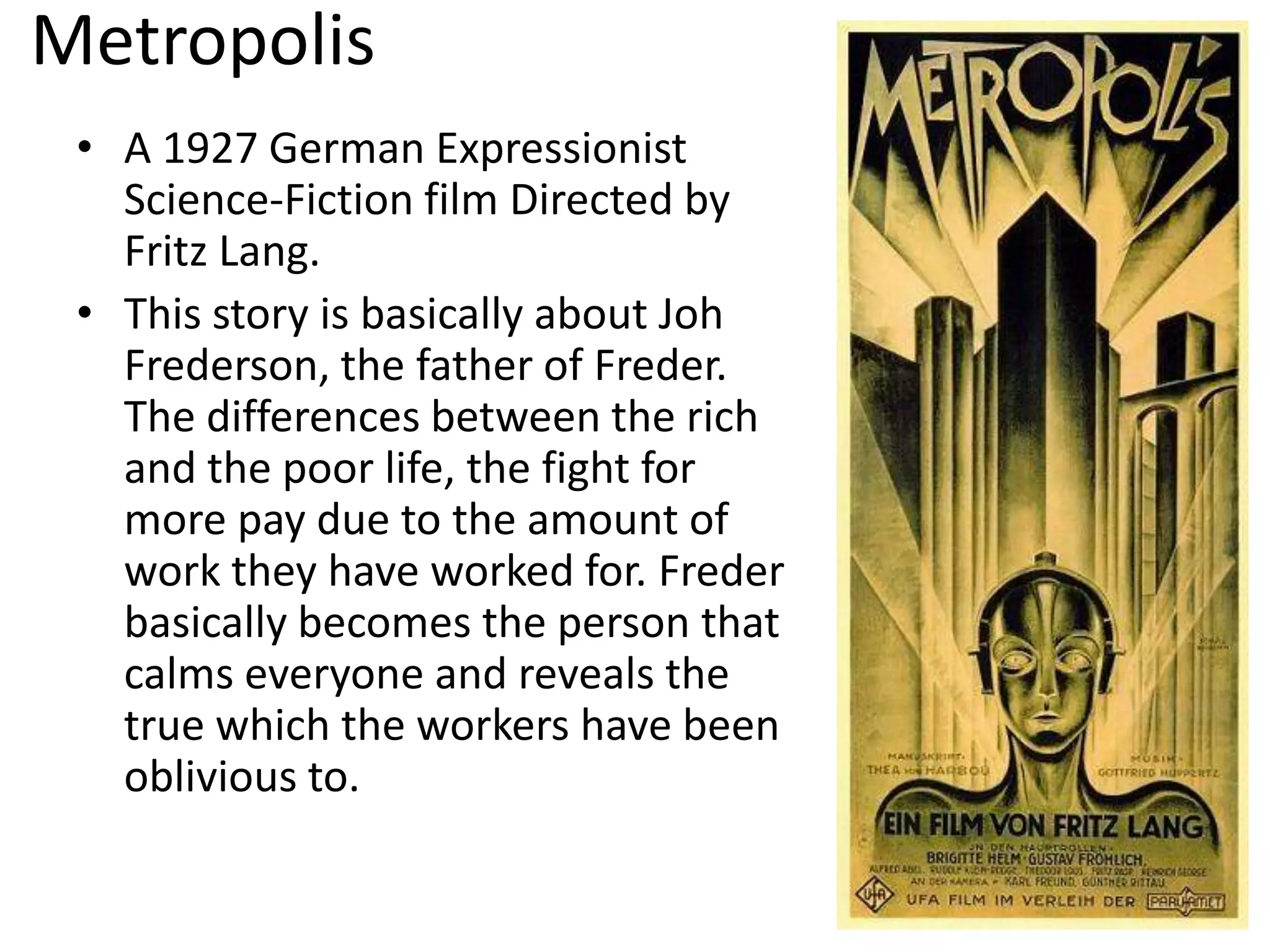
Metropolis
• A 1927 German Expressionist
Science-Fiction film Directed by
Fritz Lang.
• This story is basically about Joh
Frederson, the father of Freder.
The differences between the rich
and the poor life, the fight for
more pay due to the amount of
work they have worked for. Freder
basically becomes the person that
calms everyone and reveals the
true which the workers have been
oblivious to.
Nosferatu
• Translation: A Symphony of
Horror
• It is a 1922 German Expressionist
Horror film. Directed by
(Friedrich Wilhelm) F.W. Murnau.
• The whole story is about Thomas
Hutter meeting a new client
Count Orlok, which is a
Nosferatu, aka Vampire. Count
Orlok ships himself in a coffin to
Wisborg, where he seeks Ellen,
who is Hutter’s wife. Orlak
forgets about the sunrise whilst
he drinks her blood, and
vanished into smoke. Thus, the
end of the Count Orlak.
Did German Expressionism die out?
• It is said that German Expressionism was most
intense between the 1920 and 1924, and
during the final time where two films were
released. Both made by Ufa: Murnau’s Faust
and Lang’s Metropolis. The last releases in
January 1927 marked the end of the German
Expressionism.
• The two factors that caused the decline were
the high budgeting of the films and the
departure of expressionist filmmakers that
went to Hollywood.
So has it really died out?
• I don’t believe it has died out, it seems more that
it has integrated into the Hollywood filmmaking.
• Especially Horror films that are made, they follow
up with the dark mood and scenery that the
German Expressionists has came up with.
• There are many people that were influenced by
the German Expressionist film.
– Alfred Hitchcock, who filmed The Blackguard.
– Norman Bates, filmed Psycho
– Tim Burton, A Nightmare Before Christmas
References
• Bordwell, David; Thompson, Kristin. Film Art:
An Introduction (5th Edition), McGraw-Hill,
1997

Ccs presentation ~

  • 1.
  • 2.
    What is GermanExpressionism • German Expressionist Films were a set of special cinematic art that was one of the greatest achievements in early cinema history. • Nearing the end of World War I, the German government and military set up the UFA (Universumfilm Aktiengesellschaft) to support the local film industry and propaganda creation. Since the borders were closed for importing, therefore all entertainment had to be produced from inside the borders. • With so little resources from the inside and no help from the outside, the films made were unique in their own way. Portraying and translating emotions of the locals into a moving art, so much that they can relate the films to their post world war lives.
  • 3.
    History and Influence •The extreme non-realism did not last long, it faded away after a few years, but the themes were mixed into the later film of the 1920’s and 1930’s. From that, it created more control over the artistic environment to enhance the mood of the film. • Many German filmmakers travelled to Hollywood, due to the Nazi’s rising in power. The filmmakers found that American studios willingly accepted their ideas. Many German directors and cameraman prospered and made a huge impact by producing a range of films. • Horror film and film noir (stylish Hollywood drama) was heavily influenced by German Expressionism. Karl Freund help set the style and mood of the universal monster movies with the dark and designed sets, which because the model structure of horror films in the later generations. • Fritz Lang, Billy Wilder, Otto Preminger, Alfred Hitchcock, and Michael Curtiz are directors that introduced the Expressionist style to crime dramas of the 1940s which expanded the influence on modern film making.
  • 4.
    Metropolis • A 1927German Expressionist Science-Fiction film Directed by Fritz Lang. • This story is basically about Joh Frederson, the father of Freder. The differences between the rich and the poor life, the fight for more pay due to the amount of work they have worked for. Freder basically becomes the person that calms everyone and reveals the true which the workers have been oblivious to.
  • 5.
    Nosferatu • Translation: ASymphony of Horror • It is a 1922 German Expressionist Horror film. Directed by (Friedrich Wilhelm) F.W. Murnau. • The whole story is about Thomas Hutter meeting a new client Count Orlok, which is a Nosferatu, aka Vampire. Count Orlok ships himself in a coffin to Wisborg, where he seeks Ellen, who is Hutter’s wife. Orlak forgets about the sunrise whilst he drinks her blood, and vanished into smoke. Thus, the end of the Count Orlak.
  • 6.
    Did German Expressionismdie out? • It is said that German Expressionism was most intense between the 1920 and 1924, and during the final time where two films were released. Both made by Ufa: Murnau’s Faust and Lang’s Metropolis. The last releases in January 1927 marked the end of the German Expressionism. • The two factors that caused the decline were the high budgeting of the films and the departure of expressionist filmmakers that went to Hollywood.
  • 7.
    So has itreally died out? • I don’t believe it has died out, it seems more that it has integrated into the Hollywood filmmaking. • Especially Horror films that are made, they follow up with the dark mood and scenery that the German Expressionists has came up with. • There are many people that were influenced by the German Expressionist film. – Alfred Hitchcock, who filmed The Blackguard. – Norman Bates, filmed Psycho – Tim Burton, A Nightmare Before Christmas
  • 8.
    References • Bordwell, David;Thompson, Kristin. Film Art: An Introduction (5th Edition), McGraw-Hill, 1997