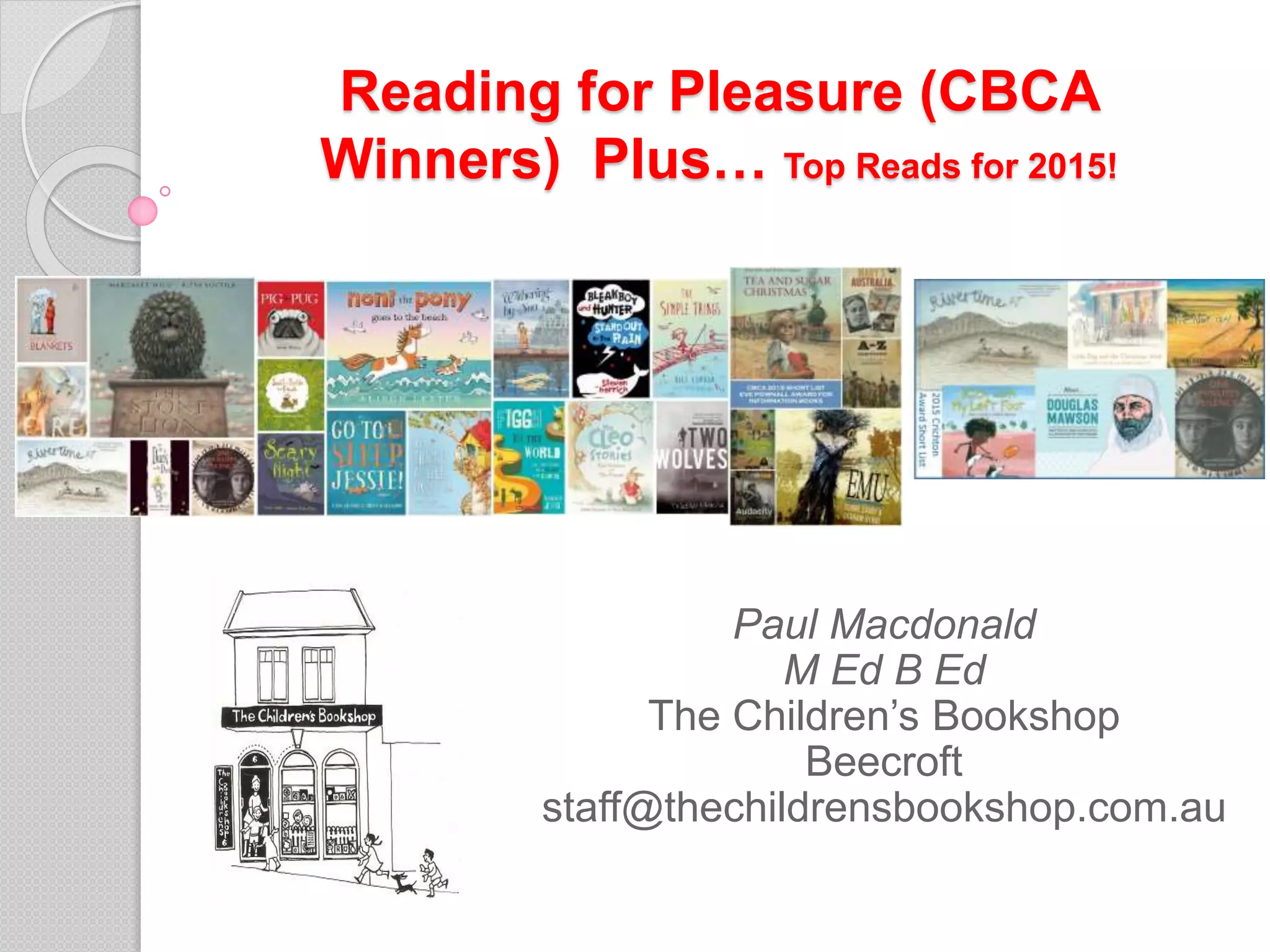
Reading for Pleasure (CBCA
Winners) Plus… Top Reads for 2015!
Paul Macdonald
M Ed B Ed
The Children’s Bookshop
Beecroft
staff@thechildrensbookshop.com.au
2
“Reading for pleasure is the most
important way to advance literacy
attainment in children.”
National Literacy Trust UK 2006
In a Nutshell…
 36 Books on the List… 26 Females
represented… 72% Female
contributions.
 Teachers’ Notes for All
 Diversity
 Video Links e.g.
https://www.youtube.com/watch?v=YVOZXaTgBic
Teaching Ideas
Display/Activity
Using the light bulb template found
here print off and make available for
students to write brief comments about
a book which has 'lit up their world'.
Take some time beforehand to
brainstorm what this means. Each
student who recommends a book can
have their photo taken to accompany
their 'light bulb'. Display on a wall in the
library and students can speak about
each to the class.
----------------------------------------------------
Activity with School Staff
Different students can interview staff to
find out a book title from their childhood
which 'lit up their world'. Students can
create an ebook using power point
slides and movie
maker/smore brochure/flipsnack or a
filmed interview which can then be
shared.
Need for Diversity…
“A US-led campaign to address the
lack of diversity in children’ literature
has sparked over-overdue
conversations in Australia” Books and Publishing,
2015
 Gender Representation
 Cultural Representation
 People with Disabilities
 Representation of cultural, ethnic and religious
minorities
 Representation of family units.
BOOK WEEK 2015
Books light up our world
Older Readers
Interesting Category
 2 Debuts- Nona and Me, The Minnow
 Deceased (parents)/ grieving
dominate
 Outsiders prevalent
 Page-turners rule this year.
 Romance is the leading genre mixed
with social realism.
With Are You Seeing Me? having just hit the shelves in Australia, I’d
like to share with you some insight into what inspired me to write the
novel.
Anyone who’s spent any time with me knows I am Dad to a set of
twins: one girl, one boy. My daughter is ‘neurotypical’, which is how
people in the Autism Spectrum Disorder (ASD) community sometimes
refer to regular, everyday kids who do not have autism. She is
amazing. She plays trumpet, creates short animated films and adores
The Hunger Games. My son, who is three minutes younger than my
daughter, is diagnosed with autism. He is amazing, too. He is awesome
at Minecraft, swims like a champ and enjoys Pixar films. They will
officially be teenagers in 2014.
Are You Seeing Me? is a gift to my daughter. She was due a book – my
previous novel, Kindling, was a gift to my son. (By the way, all of my
books are gifts for my beautiful
wife). When I first started considering what to write, I kept coming back
to a message I held dear for my daughter: ‘You should never feel like
you must be your brother’s keeper. Love him, as he loves you, but live
your own life to the full.’
Descriptive Writing- Are You Seeing Me?
A king tide of blood pummels my eardrums. The
onlookers are panes of glass….For a fleeting moment, there
is only stillness; the wait to discover if the tall ship of
clarity has dropped anchor in the swirling eddies of
sensory distress. (p. 7)
https://www.youtube.com/watch?v=9rCQdNAg
XF4&feature=youtu.be
“The Incredible Adventures of Cinnamon Girl has cemented Melissa
Keil onto my favourite author list….the characters are wonderful and I
wish I lived in Eden Valley so I could know them, spend time with
them, be friends with them.” – Lily Reads Books
Picturebooks
Teaching Notes
for All!
‘One day I found a scrap of wonderfulness.
Her wings were wounded but in her heart
there was hope.’
Hills bleached gold, a baked blue sky,
Leaves lay limp in air sucked dry.
I want to thank the river, too. It’s like it’s taught
me that I’m really part of everything; how to
slow right down, to really look, to listen, and to
just breathe.
Oscar Wilde wrote some stories that
were similar to Margaret Wild’s The
Stone Lion. The best-known of these are
The Happy Prince, The Selfish Giant
and The Nightingale. Chose one of
these stories and consider the ways in
which it is similar to The Stone Lion.
Early Childhood- Teachers’ Notes for all
Go To Sleep, Jessie!
Teacher Notes
Written by Libby Gleeson
Illustrated by Freya Blackwood
Published by Litte Hare, November 2014
WRITING STYLE
Libby Gleeson uses her trademark pared-back minimalist style with a focus on dialogue and action.
The story is told in the first person, so that the reader sees everything through the narrator’s eyes, but
the
simple impartial voice allows space for the readers to engage individually with the story and develop
their own conclusions. Libby avoids telling the reader too much, at the same time as providing enough
information to develop a vivid and insightful narrative. For example, she avoids telling us the narrator is
angry or frustrated or empathetic, but we are able to understand the anger, frustration or empathy
through her dialogue and actions. The vocabulary repeats certain pairs of contrasts—screaming/quiet,
upstairs/ downstairs—to suggest the dissonance, disconnection and exasperation that the narrator
experiences.
ILLUSTRATION STYLE
The contrasts expressed in the text are amplified in the illustrations. Freya has chosen a palette based
on orange and blue, which fall opposite each other on the colour wheel. The orange represents warmth
and light and is used to illustrate the downstairs scenes, and the deep blue is the colour of the dark
room upstairs where the children are trying to sleep. Further plays of visual contrasts are found in the
depiction of light versus dark, tidy versus messy. Freya uses a combination of full-bleed pictures and
multiple picture-boxes to show how a sequence of events can happen in one part of the house while a
single event occurs in another. Multiple levels in the pictures, repeated diagonals, and strong
horizontals and verticals that divide the page help contribute to a range of responses in the reader.
Most importantly, Freya’s illustrations show Jessie’s side of the story ... the frustration of a tiny child
unable to express that all she wants is a cuddle! The illustrations also add humour to the story.
Younger
Readers
Mapping Withering-by-Sea
Activity: Create a map of the
town Withering-by- Sea using
accurate information from the
novel. The map should be
created on A3 paper.
Consider using mapping
symbols and grid referencing
to identify key landmarks from
the novel. The novel contains
some clues to help you:
https://www.youtube.com/watch?v=LXgZSQBtgMs
Two Wolves also employs powerful metaphors and
similes, again to convey the greatest meaning and
emotion with the fewest possible words. Here are a
few examples:
• ‘Ben took a bite from a microwaved jam doughnut.
The jam was lava on his tongue’ (p. 2)
• ‘Ben watched, eyes alert, pupils black and big as
marbles’ (p. 103)
• ‘It shook low and heavy through his bones like a
train through a mountain tunnel.’ (p. 210)
Eve Pownall
http://www.abc.net.
au/news/2014-09-
26/history-of-
convicts-in-van-
diemens-
land/5771658
Crichton
What’s Hot? A quick review….
Focus Areas- National
Curriculum
 Expanded View of Literacy
 Multi-Modal Texts
 National Identity
 Indigenous Focus
 Focus on Asia
 Sustainability
 Greater Focus on Language
Sustainability
Random House….
 Sustainability and the Environment
Environmental education for sustainability
is such an important topic for all years of
schooling. So we thought we'd pull
together some of the best fiction books
with environmental themes. These titles
are set to empower and inspire your
students to think about and take action
toward a sustainable future.
Asian Focus- Picturebooks
https://www.youtube.com/watch?v=OoaX_W9Vemg
Picture Books
51
Easy Reads Abound
Impact of Diary of a Wimpy Kid
54
David Walliams… The New
Roald Dahl!
Junior Fiction
Transition Reads
http://www.bloomsbury.com/au/apple-and-rain-9781408853061/
https://www.youtube.com/watch?v=LCaPviOc1d0
Cool Non-Fiction
“Children who know adults who read for
pleasure take it for granted that
reading is a valuable and worthwhile
activity”
(Csikszentmihalyi, 1991)
59
60
Adult Reads
Book of the Year?
64
Paul Macdonald
M Ed B Ed
The Children’s Bookshop
Beecroft
staff@thechildrensbookshop.com.au
CBCA 2015
CBCA 2015

CBCA 2015

  • 1.
    Reading for Pleasure(CBCA Winners) Plus… Top Reads for 2015! Paul Macdonald M Ed B Ed The Children’s Bookshop Beecroft staff@thechildrensbookshop.com.au
  • 2.
    2 “Reading for pleasureis the most important way to advance literacy attainment in children.” National Literacy Trust UK 2006
  • 3.
    In a Nutshell… 36 Books on the List… 26 Females represented… 72% Female contributions.  Teachers’ Notes for All  Diversity  Video Links e.g. https://www.youtube.com/watch?v=YVOZXaTgBic
  • 4.
    Teaching Ideas Display/Activity Using thelight bulb template found here print off and make available for students to write brief comments about a book which has 'lit up their world'. Take some time beforehand to brainstorm what this means. Each student who recommends a book can have their photo taken to accompany their 'light bulb'. Display on a wall in the library and students can speak about each to the class. ---------------------------------------------------- Activity with School Staff Different students can interview staff to find out a book title from their childhood which 'lit up their world'. Students can create an ebook using power point slides and movie maker/smore brochure/flipsnack or a filmed interview which can then be shared.
  • 5.
    Need for Diversity… “AUS-led campaign to address the lack of diversity in children’ literature has sparked over-overdue conversations in Australia” Books and Publishing, 2015  Gender Representation  Cultural Representation  People with Disabilities  Representation of cultural, ethnic and religious minorities  Representation of family units.
  • 6.
    BOOK WEEK 2015 Bookslight up our world
  • 7.
  • 8.
    Interesting Category  2Debuts- Nona and Me, The Minnow  Deceased (parents)/ grieving dominate  Outsiders prevalent  Page-turners rule this year.  Romance is the leading genre mixed with social realism.
  • 9.
    With Are YouSeeing Me? having just hit the shelves in Australia, I’d like to share with you some insight into what inspired me to write the novel. Anyone who’s spent any time with me knows I am Dad to a set of twins: one girl, one boy. My daughter is ‘neurotypical’, which is how people in the Autism Spectrum Disorder (ASD) community sometimes refer to regular, everyday kids who do not have autism. She is amazing. She plays trumpet, creates short animated films and adores The Hunger Games. My son, who is three minutes younger than my daughter, is diagnosed with autism. He is amazing, too. He is awesome at Minecraft, swims like a champ and enjoys Pixar films. They will officially be teenagers in 2014. Are You Seeing Me? is a gift to my daughter. She was due a book – my previous novel, Kindling, was a gift to my son. (By the way, all of my books are gifts for my beautiful wife). When I first started considering what to write, I kept coming back to a message I held dear for my daughter: ‘You should never feel like you must be your brother’s keeper. Love him, as he loves you, but live your own life to the full.’
  • 10.
    Descriptive Writing- AreYou Seeing Me? A king tide of blood pummels my eardrums. The onlookers are panes of glass….For a fleeting moment, there is only stillness; the wait to discover if the tall ship of clarity has dropped anchor in the swirling eddies of sensory distress. (p. 7)
  • 11.
  • 12.
    “The Incredible Adventuresof Cinnamon Girl has cemented Melissa Keil onto my favourite author list….the characters are wonderful and I wish I lived in Eden Valley so I could know them, spend time with them, be friends with them.” – Lily Reads Books
  • 13.
  • 20.
    ‘One day Ifound a scrap of wonderfulness. Her wings were wounded but in her heart there was hope.’ Hills bleached gold, a baked blue sky, Leaves lay limp in air sucked dry. I want to thank the river, too. It’s like it’s taught me that I’m really part of everything; how to slow right down, to really look, to listen, and to just breathe.
  • 21.
    Oscar Wilde wrotesome stories that were similar to Margaret Wild’s The Stone Lion. The best-known of these are The Happy Prince, The Selfish Giant and The Nightingale. Chose one of these stories and consider the ways in which it is similar to The Stone Lion.
  • 23.
  • 27.
    Go To Sleep,Jessie! Teacher Notes Written by Libby Gleeson Illustrated by Freya Blackwood Published by Litte Hare, November 2014 WRITING STYLE Libby Gleeson uses her trademark pared-back minimalist style with a focus on dialogue and action. The story is told in the first person, so that the reader sees everything through the narrator’s eyes, but the simple impartial voice allows space for the readers to engage individually with the story and develop their own conclusions. Libby avoids telling the reader too much, at the same time as providing enough information to develop a vivid and insightful narrative. For example, she avoids telling us the narrator is angry or frustrated or empathetic, but we are able to understand the anger, frustration or empathy through her dialogue and actions. The vocabulary repeats certain pairs of contrasts—screaming/quiet, upstairs/ downstairs—to suggest the dissonance, disconnection and exasperation that the narrator experiences. ILLUSTRATION STYLE The contrasts expressed in the text are amplified in the illustrations. Freya has chosen a palette based on orange and blue, which fall opposite each other on the colour wheel. The orange represents warmth and light and is used to illustrate the downstairs scenes, and the deep blue is the colour of the dark room upstairs where the children are trying to sleep. Further plays of visual contrasts are found in the depiction of light versus dark, tidy versus messy. Freya uses a combination of full-bleed pictures and multiple picture-boxes to show how a sequence of events can happen in one part of the house while a single event occurs in another. Multiple levels in the pictures, repeated diagonals, and strong horizontals and verticals that divide the page help contribute to a range of responses in the reader. Most importantly, Freya’s illustrations show Jessie’s side of the story ... the frustration of a tiny child unable to express that all she wants is a cuddle! The illustrations also add humour to the story.
  • 29.
  • 30.
    Mapping Withering-by-Sea Activity: Createa map of the town Withering-by- Sea using accurate information from the novel. The map should be created on A3 paper. Consider using mapping symbols and grid referencing to identify key landmarks from the novel. The novel contains some clues to help you:
  • 31.
  • 32.
    Two Wolves alsoemploys powerful metaphors and similes, again to convey the greatest meaning and emotion with the fewest possible words. Here are a few examples: • ‘Ben took a bite from a microwaved jam doughnut. The jam was lava on his tongue’ (p. 2) • ‘Ben watched, eyes alert, pupils black and big as marbles’ (p. 103) • ‘It shook low and heavy through his bones like a train through a mountain tunnel.’ (p. 210)
  • 36.
  • 41.
  • 45.
  • 46.
    What’s Hot? Aquick review….
  • 47.
    Focus Areas- National Curriculum Expanded View of Literacy  Multi-Modal Texts  National Identity  Indigenous Focus  Focus on Asia  Sustainability  Greater Focus on Language
  • 48.
    Sustainability Random House….  Sustainabilityand the Environment Environmental education for sustainability is such an important topic for all years of schooling. So we thought we'd pull together some of the best fiction books with environmental themes. These titles are set to empower and inspire your students to think about and take action toward a sustainable future.
  • 49.
  • 50.
  • 51.
  • 53.
  • 54.
    Impact of Diaryof a Wimpy Kid 54
  • 55.
    David Walliams… TheNew Roald Dahl!
  • 56.
  • 57.
  • 58.
  • 59.
    “Children who knowadults who read for pleasure take it for granted that reading is a valuable and worthwhile activity” (Csikszentmihalyi, 1991) 59
  • 60.
  • 61.
  • 64.
    64 Paul Macdonald M EdB Ed The Children’s Bookshop Beecroft staff@thechildrensbookshop.com.au