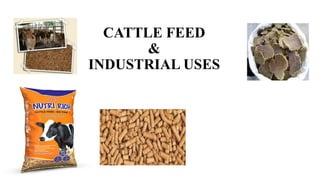
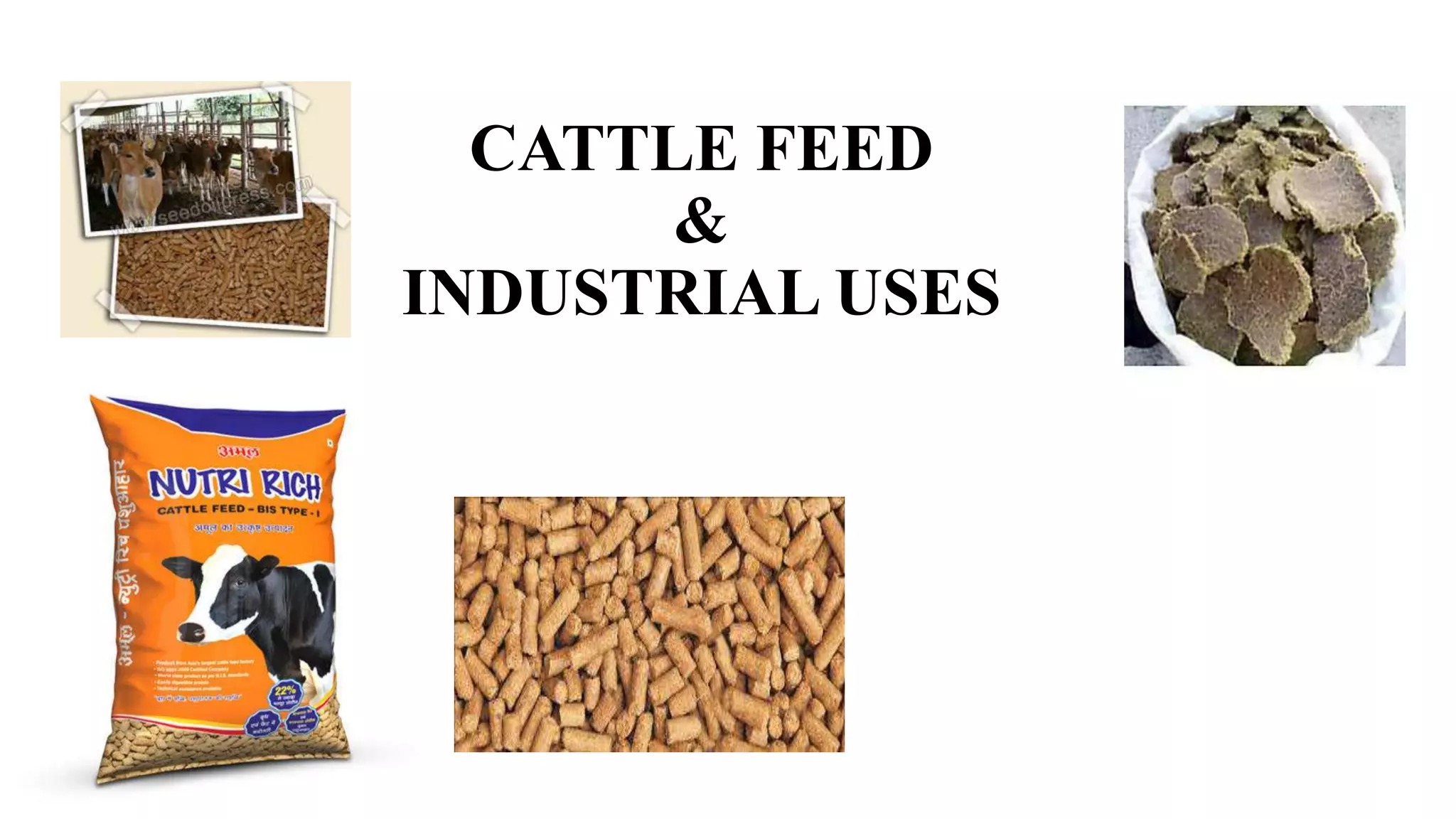
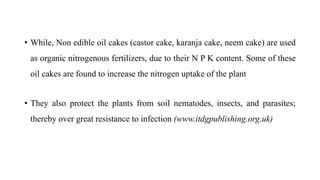
CATTLE FEED
&
INDUSTRIAL USES
INTRODUCTION
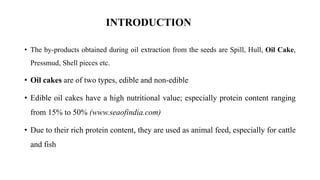
• The by-products obtained during oil extraction from the seeds are Spill, Hull, Oil Cake,
Pressmud, Shell pieces etc.
• Oil cakes are of two types, edible and non-edible
• Edible oil cakes have a high nutritional value; especially protein content ranging
from 15% to 50% (www.seaofindia.com)
• Due to their rich protein content, they are used as animal feed, especially for cattle
and fish
• While, Non edible oil cakes (castor cake, karanja cake, neem cake) are used
as organic nitrogenous fertilizers, due to their N P K content. Some of these
oil cakes are found to increase the nitrogen uptake of the plant
• They also protect the plants from soil nematodes, insects, and parasites;
thereby over great resistance to infection (www.itdgpublishing.org.uk)
Classification of Feeds
1) Roughages/ Forages:
• Pasture, stockpiled forage, hay, silage, crop residues, and straws
• Pastures and stockpiled forage can often meet or exceed the protein and energy needs of most
cows, even lactating cows. Cool season grasses like fescue and orchard grass are very nutritious in
the leafy stages, but their nutritional value decreases rapidly as these grasses bloom
• Hays are usually adequate to marginal in energy and protein. Legume hays are high in protein
• Silage from corn or sorghums are moderate to high in energy and low in protein
• Straw and some crop residues may provide limited amounts of energy, but are very deficient in
protein
2) Concentrates- Energy feeds
• Grains are high in energy and low to moderate in protein content. Corn is the standard
energy feed and is the most widely fed grain
• Molasses has 80% of the energy of corn and contains 14% more moisture. It is primarily
a palatability enhancer or a carrier for minerals
• Fats and oils contain 2-2.25 times the amount of energy per pound as corn, but they
should be used sparingly in cattle diets. Diets containing more than 5% fat can impair
rumen function
• High energy by-products include soybean hulls, hominy, distiller’s grains, brewer’s
grains, corn gluten feed and wheat middlings (mids)
3) Concentrates- Protein feeds
• Soybean meal is the principal supplementary protein source in many livestock diets. It is a well
balanced natural protein with some by-pass properties. Whole soybeans, roasted or raw, can also be
fed to cattle, but they have a high fat content. Raw soybeans contain a protein digestion inhibitor so
they should be used sparingly. Whole soybeans contain about 15% less protein than soybean meal
• Cottonseed meal is slightly lower in protein content than soybean meal. Whole cottonseed is also
high in energy and fiber. Whole cottonseeds may also be fed to cattle, but it contains only half the
protein of cottonseed meal and are high in fat
• Poultry litter contains moderate levels of protein and marginal to adequate levels of energy. As long
as it is properly deep-stacked before feeding, it contains no harmful bacteria or other pathogens
• Urea is the most common non-protein nitrogen (NPN) fed. NPN must be fed with an energy source
that is readily available to the rumen. It should not make up more than 1% of the total diet or 3% of
the concentrate mix. Urea is often used in liquid protein supplements to increase the crude protein
(CP) value of the product or added to corn silage to boost the CP level
4) Feed Supplements
• Feed supplements are the compounds used to improve the nutritional value of the basal
feeds so as to take care of any deficiency
• Commonly used feed supplements are
 Vitamin supplements e.g. Rovimix, Vitablend, Arovit etc.
 Mineral supplements e.g. Minimix, Milk min, Nutrimilk, Aromin etc.
5) Feed Additives
• Feed additives are the non-nutritive substances usually added to basal feed in small
quantity for the fortification in order to improve feed efficiency and productive
performance of the animals
• Some commonly used feed additives are
Antibiotics e.g. Terramycin, Zinc bacitracin, Flavomycin etc.
Enzymes e.g. Amylase, lipase, protease, pepsin etc.
Hormones eg. Estrogen, progesterone, hexosterol etc.
Probiotics e.g. Microbial species. Lactobacillus
Biostimulators e.g. Extracts of living organs like spleen, liver, ovary, chick embryo etc.
Antioxidants e.g. Vitamin E (Tocopherols), BHT ( Butylated hydroxy toluene)
Mold inhibitors e.g. Propionic acid, acetic acid
Pellet binders e.g Gur, meal, molasses, sodium bentonite
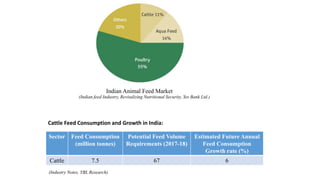
Indian Animal Feed Market
Cattle Feed Consumption and Growth in India:
Sector Feed Consumption
(million tonnes)
Potential Feed Volume
Requirements (2017-18)
Estimated Future Annual
Feed Consumption
Growth rate (%)
Cattle 7.5 67 6
(Indian feed Industry, Revitalizing Nutritional Security, Yes Bank Ltd.)
(Industry Notes, YBL Research)
Cattle Feed Ingredients
• Grains: Maize, sorghum, rice, oats, wheat, barley, ragi, millets etc.
• Brans: De-oiled rice bran, rice polish, wheat bran, maize bran etc.
• Protein cakes: Rapeseed cake, soybean cake, cottonseed cake, groundnut cake, coconut
cake, palm kernel cake, sesame cake, linseed cake, maize germ oil cake, maize gluten
cake, sunflower cake etc.
• Chunnies: Guar, tur, urd, moong, gram & chunnies of other locally available pulses
• Agro-industrial by-products: Molasses, babul chunni, tamarind seed powder, mango
kernel extraction, tapioca waste etc.
• Minerals & vitamins: Mineral mixture, calcite powder, common salt, di-calcium
phosphate, vitamin A & E.
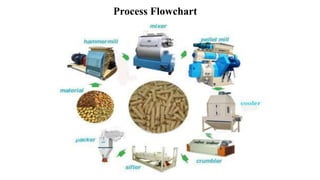
Process Flowchart
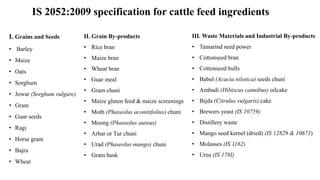
IS 2052:2009 specification for cattle feed ingredients
I. Grains and Seeds
• Barley
• Maize
• Oats
• Sorghum
• Jowar (Sorghum vulgare)
• Gram
• Guar seeds
• Ragi
• Horse gram
• Bajra
• Wheat
II. Grain By-products
• Rice bran
• Maize bran
• Wheat bran
• Guar meal
• Gram chuni
• Maize gluten feed & maize screenings
• Moth (Phaseolus aconitifolius) chuni
• Moong (Phaseolus aureus)
• Arhar or Tur chuni
• Urad (Phaseolus mungo) chuni
• Gram husk
III. Waste Materials and Industrial By-products
• Tamarind seed power
• Cottonseed bran
• Cottonseed hulls
• Babul (Acacia nilotica) seeds chuni
• Ambadi (Hibiscus cannibus) oilcake
• Bijda (Citrulus vulgaris) cake
• Brewers yeast (IS 10759)
• Distillery waste
• Mango seed kernel (dried) (IS 12829 & 10671)
• Molasses (IS 1162)
• Urea (IS 178I)
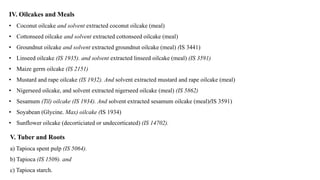
IV. Oilcakes and Meals
• Coconut oilcake and solvent extracted coconut oilcake (meal)
• Cottonseed oilcake and solvent extracted cottonseed oilcake (meal)
• Groundnut oilcake and solvent extracted groundnut oilcake (meal) (IS 3441)
• Linseed oilcake (IS 1935). and solvent extracted linseed oilcake (meal) (IS 3591)
• Maize germ oilcake (IS 2151)
• Mustard and rape oilcake (IS 1932). And solvent extracted mustard and rape oilcake (meal)
• Nigerseed oilcake, and solvent extracted nigerseed oilcake (meal) (IS 5862)
• Sesamum (Til) oilcake (IS 1934). And solvent extracted sesamum oilcake (meal)(IS 3591)
• Soyabean (Glycine. Max) oilcake (IS 1934)
• Sunflower oilcake (decorticiated or undecorticated) (IS 14702).
V. Tuber and Roots
a) Tapioca spent pulp (IS 5064).
b) Tapioca (IS 1509). and
c) Tapioca starch.
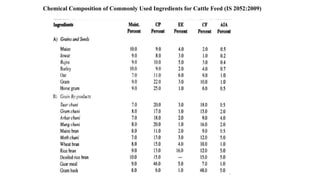
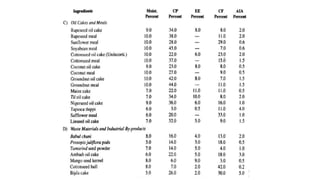
Chemical Composition of Commonly Used Ingredients for Cattle Feed (IS 2052:2009)
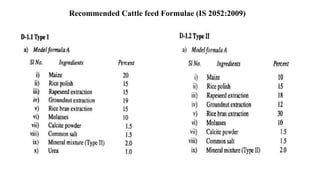
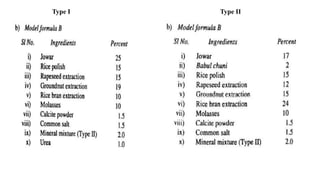
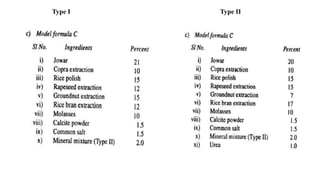
Recommended Cattle feed Formulae (IS 2052:2009)
Type I Type II
Type I Type II
Compound Cattle Feed
• The balanced mixture of concentrated ingredients, which varies in composition in
accordance with the animal type, season, region etc is called as compound cattle feed.
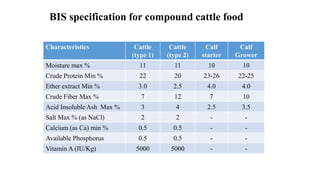
BIS specification for compound cattle food
Characteristics Cattle
(type 1)
Cattle
(type 2)
Calf
starter
Calf
Grower
Moisture max % 11 11 10 10
Crude Protein Min % 22 20 23-26 22-25
Ether extract Min % 3.0 2.5 4.0 4.0
Crude Fiber Max % 7 12 7 10
Acid Insoluble Ash Max % 3 4 2.5 3.5
Salt Max % (as NaCl) 2 2 - -
Calcium (as Ca) min % 0.5 0.5 - -
Available Phosphorus 0.5 0.5 - -
Vitamin A (IU/Kg) 5000 5000 - -
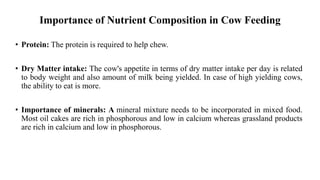
Importance of Nutrient Composition in Cow Feeding
• Protein: The protein is required to help chew.
• Dry Matter intake: The cow's appetite in terms of dry matter intake per day is related
to body weight and also amount of milk being yielded. In case of high yielding cows,
the ability to eat is more.
• Importance of minerals: A mineral mixture needs to be incorporated in mixed food.
Most oil cakes are rich in phosphorous and low in calcium whereas grassland products
are rich in calcium and low in phosphorous.
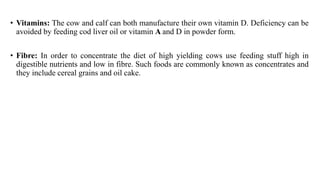
• Vitamins: The cow and calf can both manufacture their own vitamin D. Deficiency can be
avoided by feeding cod liver oil or vitamin A and D in powder form.
• Fibre: In order to concentrate the diet of high yielding cows use feeding stuff high in
digestible nutrients and low in fibre. Such foods are commonly known as concentrates and
they include cereal grains and oil cake.
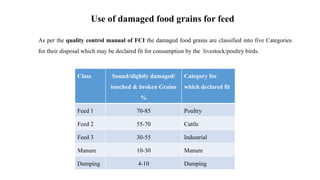
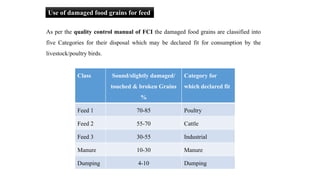
As per the quality control manual of FCI the damaged food grains are classified into five Categories
for their disposal which may be declared fit for consumption by the livestock/poultry birds.
Class Sound/slightly damaged/
touched & broken Grains
%
Category for
which declared fit
Feed 1 70-85 Poultry
Feed 2 55-70 Cattle
Feed 3 30-55 Industrial
Manure 10-30 Manure
Dumping 4-10 Dumping
Use of damaged food grains for feed
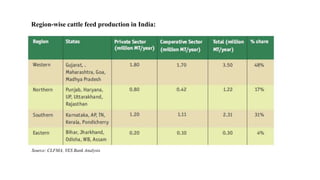
Region-wise cattle feed production in India:
Source: CLFMA, YES Bank Analysis
Major Companies in the cattle feed are as below
• Kapila Feeds
• Godrej Agrovet
• Suguna Cattle Feed
• Amrit Feeds
• KSE Ltd.
• Anmol Group
Conclusions
• With the growing opportunities in the cattle feed sector, the concept of feed is
converting to animal nutrition.
• The feed manufacturers are realizing the importance of serving animals with
essential nutrients as it strengthens the immune system of animals, improves their
health.
• This increases the productivity of the animals, which eventually increases revenue
in the acids & nutrients in animal nutrition market.
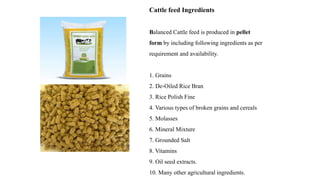
Cattle feed Ingredients
Balanced Cattle feed is produced in pellet
form by including following ingredients as per
requirement and availability.
1. Grains
2. De-Oiled Rice Bran
3. Rice Polish Fine
4. Various types of broken grains and cereals
5. Molasses
6. Mineral Mixture
7. Grounded Salt
8. Vitamins
9. Oil seed extracts.
10. Many other agricultural ingredients.
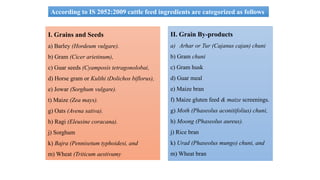
I. Grains and Seeds
a) Barley (Hordeum vulgare).
b) Gram (Cicer arietinum),
c) Guar seeds (Cyamposis tetragonolobai,
d) Horse gram or Kulthi tDolichos biflorus),
e) Jowar (Sorghum vulgare).
t) Maize (Zea mays).
g) Oats (Avena sativa).
h) Ragi (Eleusine coracana).
j) Sorghum
k) Bajra (Pennisetum typhoidesi, and
m) Wheat (Triticum aestivumy
According to IS 2052:2009 cattle feed ingredients are categorized as follows
II. Grain By-products
a) Arhar or Tur (Cajanus cajan) chuni
b) Gram chuni
c) Gram husk
d) Guar meal
e) Maize bran
f) Maize gluten feed & maize screenings.
g) Moth (Phaseolus aconitifolius) chuni,
h) Moong (Phaseolus aureus).
j) Rice bran
k) Urad (Phaseolus mungo) chuni, and
m) Wheat bran
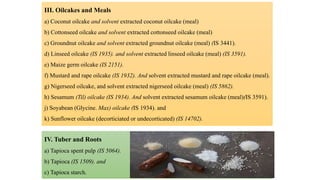
III. Oilcakes and Meals
a) Coconut oilcake and solvent extracted coconut oilcake (meal)
b) Cottonseed oilcake and solvent extracted cottonseed oilcake (meal)
c) Groundnut oilcake and solvent extracted groundnut oilcake (meal) (IS 3441).
d) Linseed oilcake (IS 1935). and solvent extracted linseed oilcake (meal) (IS 3591).
e) Maize germ oilcake (IS 2151).
f) Mustard and rape oilcake (IS 1932). And solvent extracted mustard and rape oilcake (meal).
g) Nigerseed oilcake, and solvent extracted nigerseed oilcake (meal) (IS 5862).
h) Sesamum (Til) oilcake (IS 1934). And solvent extracted sesamum oilcake (meal)(IS 3591).
j) Soyabean (Glycine. Max) oilcake (IS 1934). and
k) Sunflower oilcake (decorticiated or undecorticated) (IS 14702).
IV. Tuber and Roots
a) Tapioca spent pulp (IS 5064).
b) Tapioca (IS 1509). and
c) Tapioca starch.
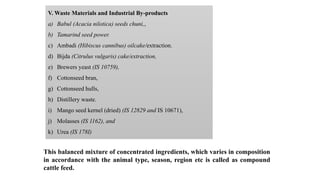
V. Waste Materials and Industrial By-products
a) Babul (Acacia nilotica) seeds chuni,,
b) Tamarind seed power.
c) Ambadi (Hibiscus cannibus) oilcake/extraction.
d) Bijda (Citrulus vulgaris) cake/extraction,
e) Brewers yeast (IS 10759),
f) Cottonseed bran,
g) Cottonseed hulls,
h) Distillery waste.
i) Mango seed kernel (dried) (IS 12829 and IS 10671),
j) Molasses (IS 1162), and
k) Urea (IS 178I)
This balanced mixture of concentrated ingredients, which varies in composition
in accordance with the animal type, season, region etc is called as compound
cattle feed.
Use of damaged food grains for feed
As per the quality control manual of FCI the damaged food grains are classified into
five Categories for their disposal which may be declared fit for consumption by the
livestock/poultry birds.
Class Sound/slightly damaged/
touched & broken Grains
%
Category for
which declared fit
Feed 1 70-85 Poultry
Feed 2 55-70 Cattle
Feed 3 30-55 Industrial
Manure 10-30 Manure
Dumping 4-10 Dumping
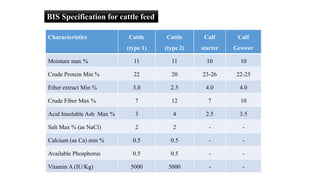
BIS Specification for cattle feed
Characteristics Cattle
(type 1)
Cattle
(type 2)
Calf
starter
Calf
Grower
Moisture max % 11 11 10 10
Crude Protein Min % 22 20 23-26 22-25
Ether extract Min % 3.0 2.5 4.0 4.0
Crude Fiber Max % 7 12 7 10
Acid Insoluble Ash Max % 3 4 2.5 3.5
Salt Max % (as NaCl) 2 2 - -
Calcium (as Ca) min % 0.5 0.5 - -
Available Phosphorus 0.5 0.5 - -
Vitamin A (IU/Kg) 5000 5000 - -
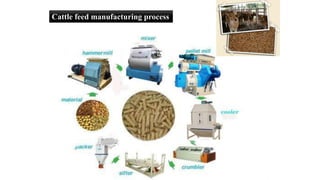
Cattle feed manufacturing process
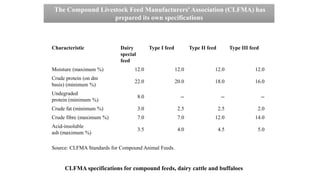
The Compound Livestock Feed Manufacturers' Association (CLFMA) has
prepared its own specifications
Characteristic Dairy
special
feed
Type I feed Type II feed Type III feed
Moisture (maximum %) 12.0 12.0 12.0 12.0
Crude protein (on dm
basis) (minimum %)
22.0 20.0 18.0 16.0
Undegraded
protein (minimum %)
8.0 -- -- --
Crude fat (minimum %) 3.0 2.5 2.5 2.0
Crude fibre (maximum %) 7.0 7.0 12.0 14.0
Acid-insoluble
ash (maximum %)
3.5 4.0 4.5 5.0
Source: CLFMA Standards for Compound Animal Feeds.
CLFMA specifications for compound feeds, dairy cattle and buffaloes
Characteristic Chick
feed
Grower
feed
Layer
feed, I
Layer
feed II
Broiler
starter
feed
Broiler
finisher
feed
Breede
r chick
feed
Breeder
grower
feed
Broiler
breeder
feed
Layer
breeder
feed
Broiler
male
breeder
feed
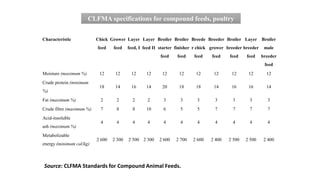
Moisture (maximum %) 12 12 12 12 12 12 12 12 12 12 12
Crude protein (minimum
%)
18 14 16 14 20 18 18 14 16 16 14
Fat (maximum %) 2 2 2 2 3 3 3 3 3 3 3
Crude fibre (maximum %) 7 8 8 10 6 5 5 7 7 7 7
Acid-insoluble
ash (maximum %)
4 4 4 4 4 4 4 4 4 4 4
Metabolizable
energy (minimum cal/kg)
2 600 2 300 2 500 2 300 2 600 2 700 2 600 2 400 2 500 2 500 2 400
Source: CLFMA Standards for Compound Animal Feeds.
CLFMA specifications for compound feeds, poultry
References
• CLFMA – Livestock Industry Survey Report 2014.
• Hall, J. B., Seay, W. W., & Baker, S. M. (2005). Nutrition and feeding of the cow-calf
herd: essential nutrients, feed classification and nutrient content of feeds.
• Source: Industry Notes, YBL Research.
• Indian feed Industry, Revitalizing Nutritional Security, Yes Bank Ltd.
• IS 2052 : 2009, Compounded feeds for cattle – Specification.
• http://oer.nios.ac.in/wiki/index.php/Classification_of_Feeds_and_Fodders
Thanks..

CATTLE FEED ppt.pptx

  • 1.
  • 2.
    INTRODUCTION • The by-productsobtained during oil extraction from the seeds are Spill, Hull, Oil Cake, Pressmud, Shell pieces etc. • Oil cakes are of two types, edible and non-edible • Edible oil cakes have a high nutritional value; especially protein content ranging from 15% to 50% (www.seaofindia.com) • Due to their rich protein content, they are used as animal feed, especially for cattle and fish
  • 3.
    • While, Nonedible oil cakes (castor cake, karanja cake, neem cake) are used as organic nitrogenous fertilizers, due to their N P K content. Some of these oil cakes are found to increase the nitrogen uptake of the plant • They also protect the plants from soil nematodes, insects, and parasites; thereby over great resistance to infection (www.itdgpublishing.org.uk)
  • 4.
    Classification of Feeds 1)Roughages/ Forages: • Pasture, stockpiled forage, hay, silage, crop residues, and straws • Pastures and stockpiled forage can often meet or exceed the protein and energy needs of most cows, even lactating cows. Cool season grasses like fescue and orchard grass are very nutritious in the leafy stages, but their nutritional value decreases rapidly as these grasses bloom • Hays are usually adequate to marginal in energy and protein. Legume hays are high in protein • Silage from corn or sorghums are moderate to high in energy and low in protein • Straw and some crop residues may provide limited amounts of energy, but are very deficient in protein
  • 5.
    2) Concentrates- Energyfeeds • Grains are high in energy and low to moderate in protein content. Corn is the standard energy feed and is the most widely fed grain • Molasses has 80% of the energy of corn and contains 14% more moisture. It is primarily a palatability enhancer or a carrier for minerals • Fats and oils contain 2-2.25 times the amount of energy per pound as corn, but they should be used sparingly in cattle diets. Diets containing more than 5% fat can impair rumen function • High energy by-products include soybean hulls, hominy, distiller’s grains, brewer’s grains, corn gluten feed and wheat middlings (mids)
  • 6.
    3) Concentrates- Proteinfeeds • Soybean meal is the principal supplementary protein source in many livestock diets. It is a well balanced natural protein with some by-pass properties. Whole soybeans, roasted or raw, can also be fed to cattle, but they have a high fat content. Raw soybeans contain a protein digestion inhibitor so they should be used sparingly. Whole soybeans contain about 15% less protein than soybean meal • Cottonseed meal is slightly lower in protein content than soybean meal. Whole cottonseed is also high in energy and fiber. Whole cottonseeds may also be fed to cattle, but it contains only half the protein of cottonseed meal and are high in fat • Poultry litter contains moderate levels of protein and marginal to adequate levels of energy. As long as it is properly deep-stacked before feeding, it contains no harmful bacteria or other pathogens • Urea is the most common non-protein nitrogen (NPN) fed. NPN must be fed with an energy source that is readily available to the rumen. It should not make up more than 1% of the total diet or 3% of the concentrate mix. Urea is often used in liquid protein supplements to increase the crude protein (CP) value of the product or added to corn silage to boost the CP level
  • 7.
    4) Feed Supplements •Feed supplements are the compounds used to improve the nutritional value of the basal feeds so as to take care of any deficiency • Commonly used feed supplements are  Vitamin supplements e.g. Rovimix, Vitablend, Arovit etc.  Mineral supplements e.g. Minimix, Milk min, Nutrimilk, Aromin etc. 5) Feed Additives • Feed additives are the non-nutritive substances usually added to basal feed in small quantity for the fortification in order to improve feed efficiency and productive performance of the animals
  • 8.
    • Some commonlyused feed additives are Antibiotics e.g. Terramycin, Zinc bacitracin, Flavomycin etc. Enzymes e.g. Amylase, lipase, protease, pepsin etc. Hormones eg. Estrogen, progesterone, hexosterol etc. Probiotics e.g. Microbial species. Lactobacillus Biostimulators e.g. Extracts of living organs like spleen, liver, ovary, chick embryo etc. Antioxidants e.g. Vitamin E (Tocopherols), BHT ( Butylated hydroxy toluene) Mold inhibitors e.g. Propionic acid, acetic acid Pellet binders e.g Gur, meal, molasses, sodium bentonite
  • 9.
    Indian Animal FeedMarket Cattle Feed Consumption and Growth in India: Sector Feed Consumption (million tonnes) Potential Feed Volume Requirements (2017-18) Estimated Future Annual Feed Consumption Growth rate (%) Cattle 7.5 67 6 (Indian feed Industry, Revitalizing Nutritional Security, Yes Bank Ltd.) (Industry Notes, YBL Research)
  • 10.
    Cattle Feed Ingredients •Grains: Maize, sorghum, rice, oats, wheat, barley, ragi, millets etc. • Brans: De-oiled rice bran, rice polish, wheat bran, maize bran etc. • Protein cakes: Rapeseed cake, soybean cake, cottonseed cake, groundnut cake, coconut cake, palm kernel cake, sesame cake, linseed cake, maize germ oil cake, maize gluten cake, sunflower cake etc. • Chunnies: Guar, tur, urd, moong, gram & chunnies of other locally available pulses • Agro-industrial by-products: Molasses, babul chunni, tamarind seed powder, mango kernel extraction, tapioca waste etc. • Minerals & vitamins: Mineral mixture, calcite powder, common salt, di-calcium phosphate, vitamin A & E.
  • 11.
  • 12.
    IS 2052:2009 specificationfor cattle feed ingredients I. Grains and Seeds • Barley • Maize • Oats • Sorghum • Jowar (Sorghum vulgare) • Gram • Guar seeds • Ragi • Horse gram • Bajra • Wheat II. Grain By-products • Rice bran • Maize bran • Wheat bran • Guar meal • Gram chuni • Maize gluten feed & maize screenings • Moth (Phaseolus aconitifolius) chuni • Moong (Phaseolus aureus) • Arhar or Tur chuni • Urad (Phaseolus mungo) chuni • Gram husk III. Waste Materials and Industrial By-products • Tamarind seed power • Cottonseed bran • Cottonseed hulls • Babul (Acacia nilotica) seeds chuni • Ambadi (Hibiscus cannibus) oilcake • Bijda (Citrulus vulgaris) cake • Brewers yeast (IS 10759) • Distillery waste • Mango seed kernel (dried) (IS 12829 & 10671) • Molasses (IS 1162) • Urea (IS 178I)
  • 13.
    IV. Oilcakes andMeals • Coconut oilcake and solvent extracted coconut oilcake (meal) • Cottonseed oilcake and solvent extracted cottonseed oilcake (meal) • Groundnut oilcake and solvent extracted groundnut oilcake (meal) (IS 3441) • Linseed oilcake (IS 1935). and solvent extracted linseed oilcake (meal) (IS 3591) • Maize germ oilcake (IS 2151) • Mustard and rape oilcake (IS 1932). And solvent extracted mustard and rape oilcake (meal) • Nigerseed oilcake, and solvent extracted nigerseed oilcake (meal) (IS 5862) • Sesamum (Til) oilcake (IS 1934). And solvent extracted sesamum oilcake (meal)(IS 3591) • Soyabean (Glycine. Max) oilcake (IS 1934) • Sunflower oilcake (decorticiated or undecorticated) (IS 14702). V. Tuber and Roots a) Tapioca spent pulp (IS 5064). b) Tapioca (IS 1509). and c) Tapioca starch.
  • 14.
    Chemical Composition ofCommonly Used Ingredients for Cattle Feed (IS 2052:2009)
  • 16.
    Recommended Cattle feedFormulae (IS 2052:2009)
  • 17.
  • 18.
  • 19.
    Compound Cattle Feed •The balanced mixture of concentrated ingredients, which varies in composition in accordance with the animal type, season, region etc is called as compound cattle feed.
  • 20.
    BIS specification forcompound cattle food Characteristics Cattle (type 1) Cattle (type 2) Calf starter Calf Grower Moisture max % 11 11 10 10 Crude Protein Min % 22 20 23-26 22-25 Ether extract Min % 3.0 2.5 4.0 4.0 Crude Fiber Max % 7 12 7 10 Acid Insoluble Ash Max % 3 4 2.5 3.5 Salt Max % (as NaCl) 2 2 - - Calcium (as Ca) min % 0.5 0.5 - - Available Phosphorus 0.5 0.5 - - Vitamin A (IU/Kg) 5000 5000 - -
  • 21.
    Importance of NutrientComposition in Cow Feeding • Protein: The protein is required to help chew. • Dry Matter intake: The cow's appetite in terms of dry matter intake per day is related to body weight and also amount of milk being yielded. In case of high yielding cows, the ability to eat is more. • Importance of minerals: A mineral mixture needs to be incorporated in mixed food. Most oil cakes are rich in phosphorous and low in calcium whereas grassland products are rich in calcium and low in phosphorous.
  • 22.
    • Vitamins: Thecow and calf can both manufacture their own vitamin D. Deficiency can be avoided by feeding cod liver oil or vitamin A and D in powder form. • Fibre: In order to concentrate the diet of high yielding cows use feeding stuff high in digestible nutrients and low in fibre. Such foods are commonly known as concentrates and they include cereal grains and oil cake.
  • 23.
    As per thequality control manual of FCI the damaged food grains are classified into five Categories for their disposal which may be declared fit for consumption by the livestock/poultry birds. Class Sound/slightly damaged/ touched & broken Grains % Category for which declared fit Feed 1 70-85 Poultry Feed 2 55-70 Cattle Feed 3 30-55 Industrial Manure 10-30 Manure Dumping 4-10 Dumping Use of damaged food grains for feed
  • 24.
    Region-wise cattle feedproduction in India: Source: CLFMA, YES Bank Analysis
  • 25.
    Major Companies inthe cattle feed are as below • Kapila Feeds • Godrej Agrovet • Suguna Cattle Feed • Amrit Feeds • KSE Ltd. • Anmol Group
  • 26.
    Conclusions • With thegrowing opportunities in the cattle feed sector, the concept of feed is converting to animal nutrition. • The feed manufacturers are realizing the importance of serving animals with essential nutrients as it strengthens the immune system of animals, improves their health. • This increases the productivity of the animals, which eventually increases revenue in the acids & nutrients in animal nutrition market.
  • 28.
    Cattle feed Ingredients BalancedCattle feed is produced in pellet form by including following ingredients as per requirement and availability. 1. Grains 2. De-Oiled Rice Bran 3. Rice Polish Fine 4. Various types of broken grains and cereals 5. Molasses 6. Mineral Mixture 7. Grounded Salt 8. Vitamins 9. Oil seed extracts. 10. Many other agricultural ingredients.
  • 30.
    I. Grains andSeeds a) Barley (Hordeum vulgare). b) Gram (Cicer arietinum), c) Guar seeds (Cyamposis tetragonolobai, d) Horse gram or Kulthi tDolichos biflorus), e) Jowar (Sorghum vulgare). t) Maize (Zea mays). g) Oats (Avena sativa). h) Ragi (Eleusine coracana). j) Sorghum k) Bajra (Pennisetum typhoidesi, and m) Wheat (Triticum aestivumy According to IS 2052:2009 cattle feed ingredients are categorized as follows II. Grain By-products a) Arhar or Tur (Cajanus cajan) chuni b) Gram chuni c) Gram husk d) Guar meal e) Maize bran f) Maize gluten feed & maize screenings. g) Moth (Phaseolus aconitifolius) chuni, h) Moong (Phaseolus aureus). j) Rice bran k) Urad (Phaseolus mungo) chuni, and m) Wheat bran
  • 31.
    III. Oilcakes andMeals a) Coconut oilcake and solvent extracted coconut oilcake (meal) b) Cottonseed oilcake and solvent extracted cottonseed oilcake (meal) c) Groundnut oilcake and solvent extracted groundnut oilcake (meal) (IS 3441). d) Linseed oilcake (IS 1935). and solvent extracted linseed oilcake (meal) (IS 3591). e) Maize germ oilcake (IS 2151). f) Mustard and rape oilcake (IS 1932). And solvent extracted mustard and rape oilcake (meal). g) Nigerseed oilcake, and solvent extracted nigerseed oilcake (meal) (IS 5862). h) Sesamum (Til) oilcake (IS 1934). And solvent extracted sesamum oilcake (meal)(IS 3591). j) Soyabean (Glycine. Max) oilcake (IS 1934). and k) Sunflower oilcake (decorticiated or undecorticated) (IS 14702). IV. Tuber and Roots a) Tapioca spent pulp (IS 5064). b) Tapioca (IS 1509). and c) Tapioca starch.
  • 32.
    V. Waste Materialsand Industrial By-products a) Babul (Acacia nilotica) seeds chuni,, b) Tamarind seed power. c) Ambadi (Hibiscus cannibus) oilcake/extraction. d) Bijda (Citrulus vulgaris) cake/extraction, e) Brewers yeast (IS 10759), f) Cottonseed bran, g) Cottonseed hulls, h) Distillery waste. i) Mango seed kernel (dried) (IS 12829 and IS 10671), j) Molasses (IS 1162), and k) Urea (IS 178I) This balanced mixture of concentrated ingredients, which varies in composition in accordance with the animal type, season, region etc is called as compound cattle feed.
  • 33.
    Use of damagedfood grains for feed As per the quality control manual of FCI the damaged food grains are classified into five Categories for their disposal which may be declared fit for consumption by the livestock/poultry birds. Class Sound/slightly damaged/ touched & broken Grains % Category for which declared fit Feed 1 70-85 Poultry Feed 2 55-70 Cattle Feed 3 30-55 Industrial Manure 10-30 Manure Dumping 4-10 Dumping
  • 34.
    BIS Specification forcattle feed Characteristics Cattle (type 1) Cattle (type 2) Calf starter Calf Grower Moisture max % 11 11 10 10 Crude Protein Min % 22 20 23-26 22-25 Ether extract Min % 3.0 2.5 4.0 4.0 Crude Fiber Max % 7 12 7 10 Acid Insoluble Ash Max % 3 4 2.5 3.5 Salt Max % (as NaCl) 2 2 - - Calcium (as Ca) min % 0.5 0.5 - - Available Phosphorus 0.5 0.5 - - Vitamin A (IU/Kg) 5000 5000 - -
  • 35.
  • 36.
    The Compound LivestockFeed Manufacturers' Association (CLFMA) has prepared its own specifications Characteristic Dairy special feed Type I feed Type II feed Type III feed Moisture (maximum %) 12.0 12.0 12.0 12.0 Crude protein (on dm basis) (minimum %) 22.0 20.0 18.0 16.0 Undegraded protein (minimum %) 8.0 -- -- -- Crude fat (minimum %) 3.0 2.5 2.5 2.0 Crude fibre (maximum %) 7.0 7.0 12.0 14.0 Acid-insoluble ash (maximum %) 3.5 4.0 4.5 5.0 Source: CLFMA Standards for Compound Animal Feeds. CLFMA specifications for compound feeds, dairy cattle and buffaloes
  • 37.
    Characteristic Chick feed Grower feed Layer feed, I Layer feedII Broiler starter feed Broiler finisher feed Breede r chick feed Breeder grower feed Broiler breeder feed Layer breeder feed Broiler male breeder feed Moisture (maximum %) 12 12 12 12 12 12 12 12 12 12 12 Crude protein (minimum %) 18 14 16 14 20 18 18 14 16 16 14 Fat (maximum %) 2 2 2 2 3 3 3 3 3 3 3 Crude fibre (maximum %) 7 8 8 10 6 5 5 7 7 7 7 Acid-insoluble ash (maximum %) 4 4 4 4 4 4 4 4 4 4 4 Metabolizable energy (minimum cal/kg) 2 600 2 300 2 500 2 300 2 600 2 700 2 600 2 400 2 500 2 500 2 400 Source: CLFMA Standards for Compound Animal Feeds. CLFMA specifications for compound feeds, poultry
  • 38.
    References • CLFMA –Livestock Industry Survey Report 2014. • Hall, J. B., Seay, W. W., & Baker, S. M. (2005). Nutrition and feeding of the cow-calf herd: essential nutrients, feed classification and nutrient content of feeds. • Source: Industry Notes, YBL Research. • Indian feed Industry, Revitalizing Nutritional Security, Yes Bank Ltd. • IS 2052 : 2009, Compounded feeds for cattle – Specification. • http://oer.nios.ac.in/wiki/index.php/Classification_of_Feeds_and_Fodders
  • 39.