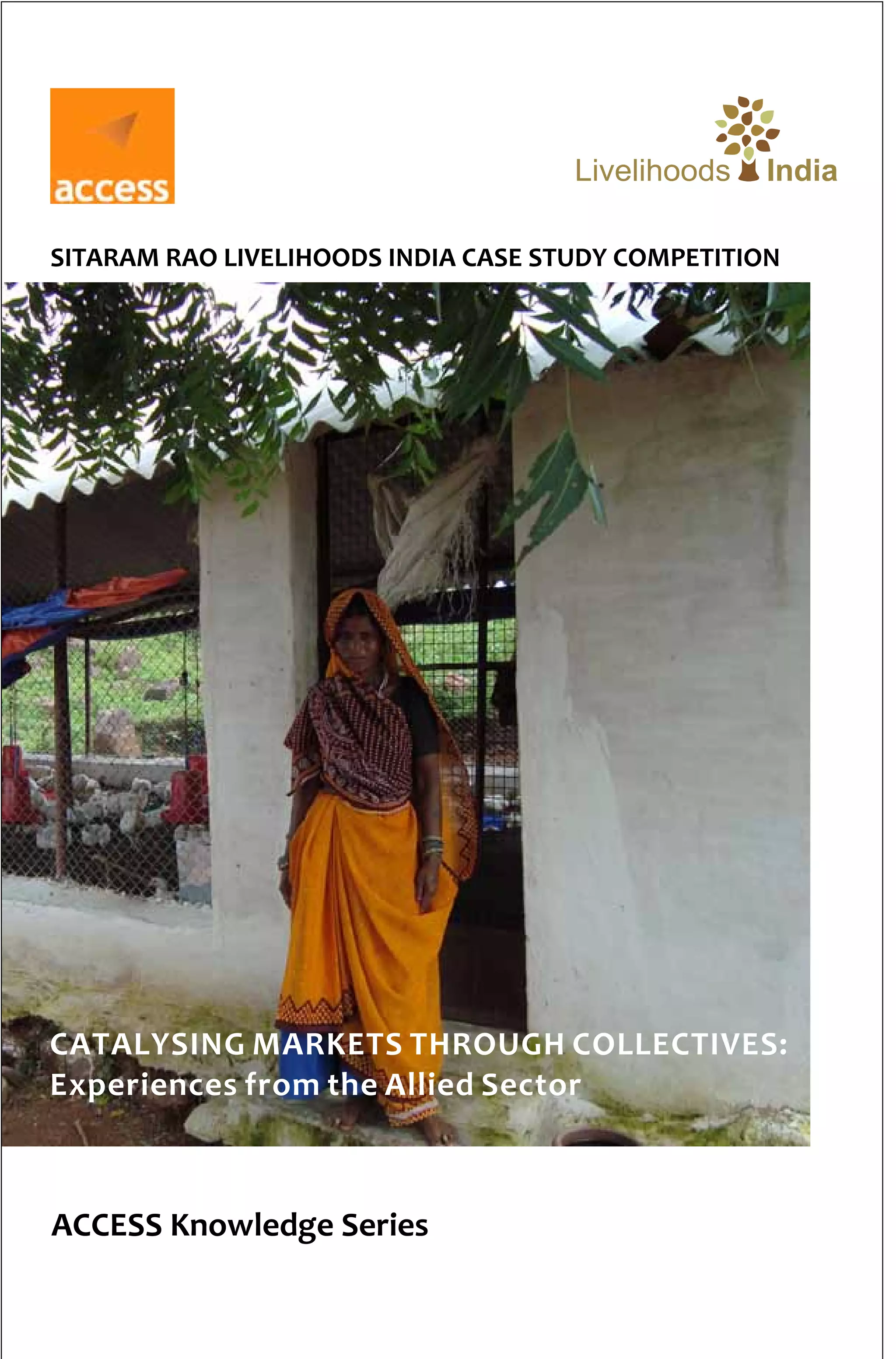
CATALYSING MARKETS THROUGH COLLECTIVES:
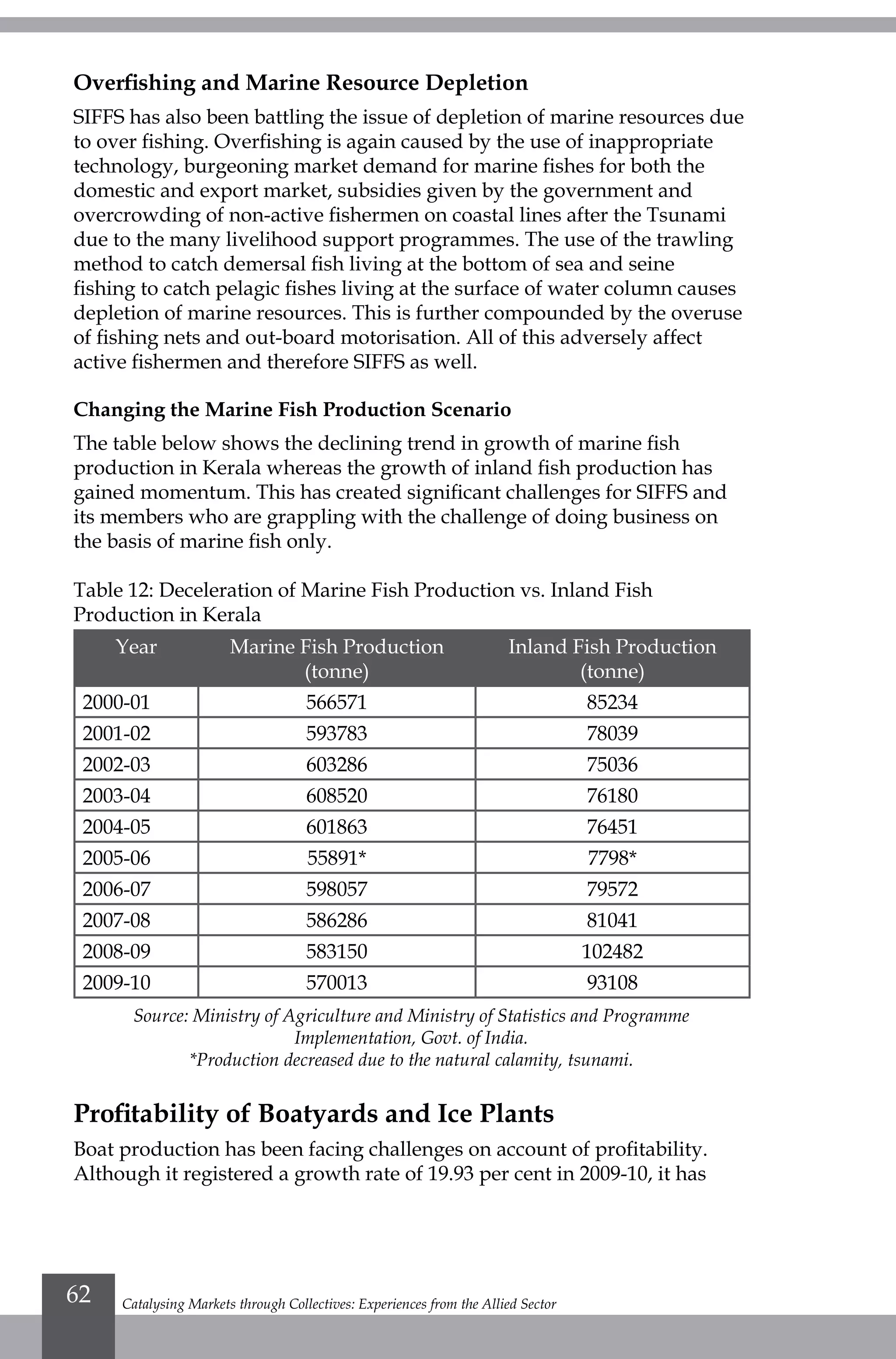
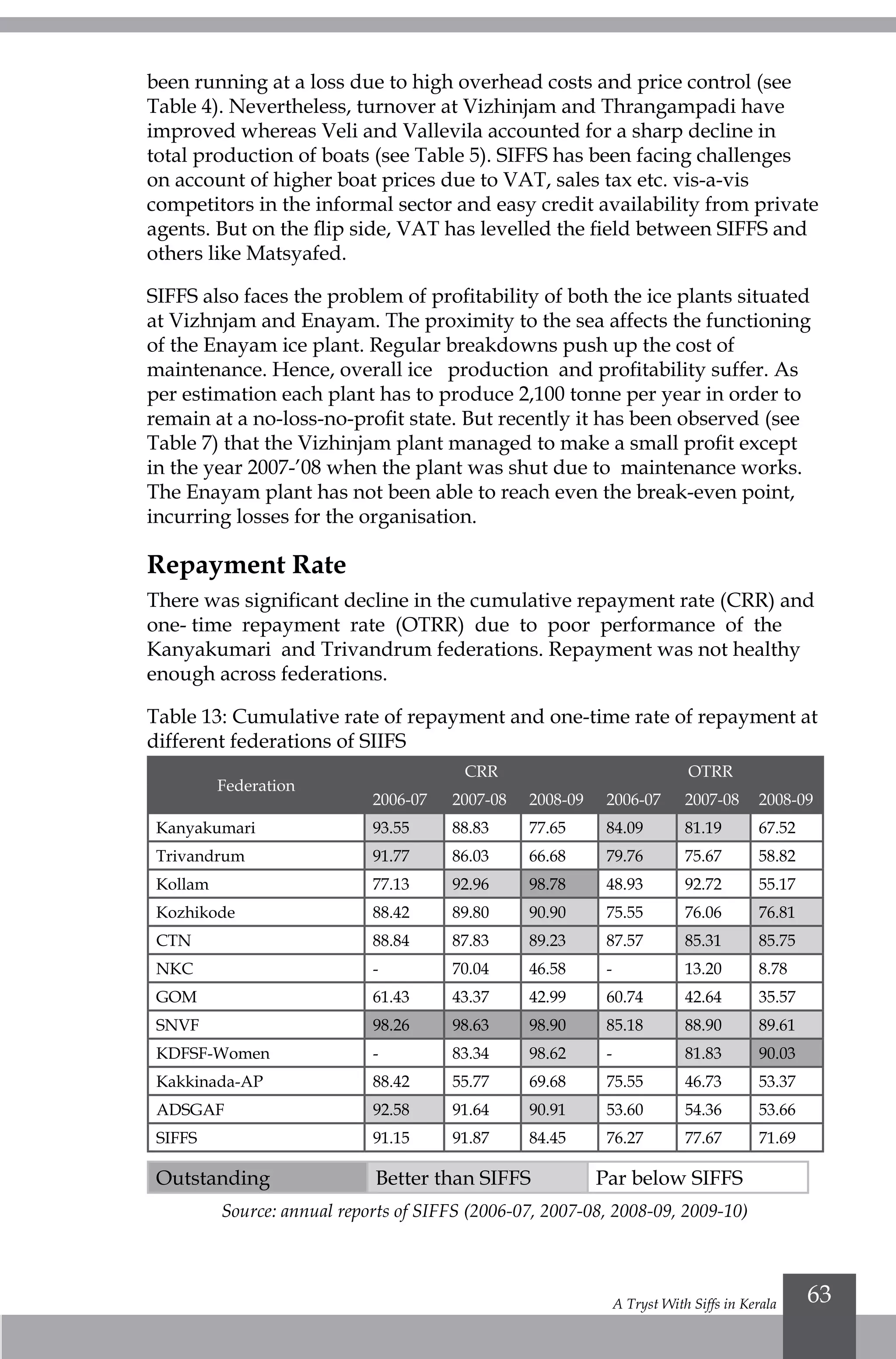
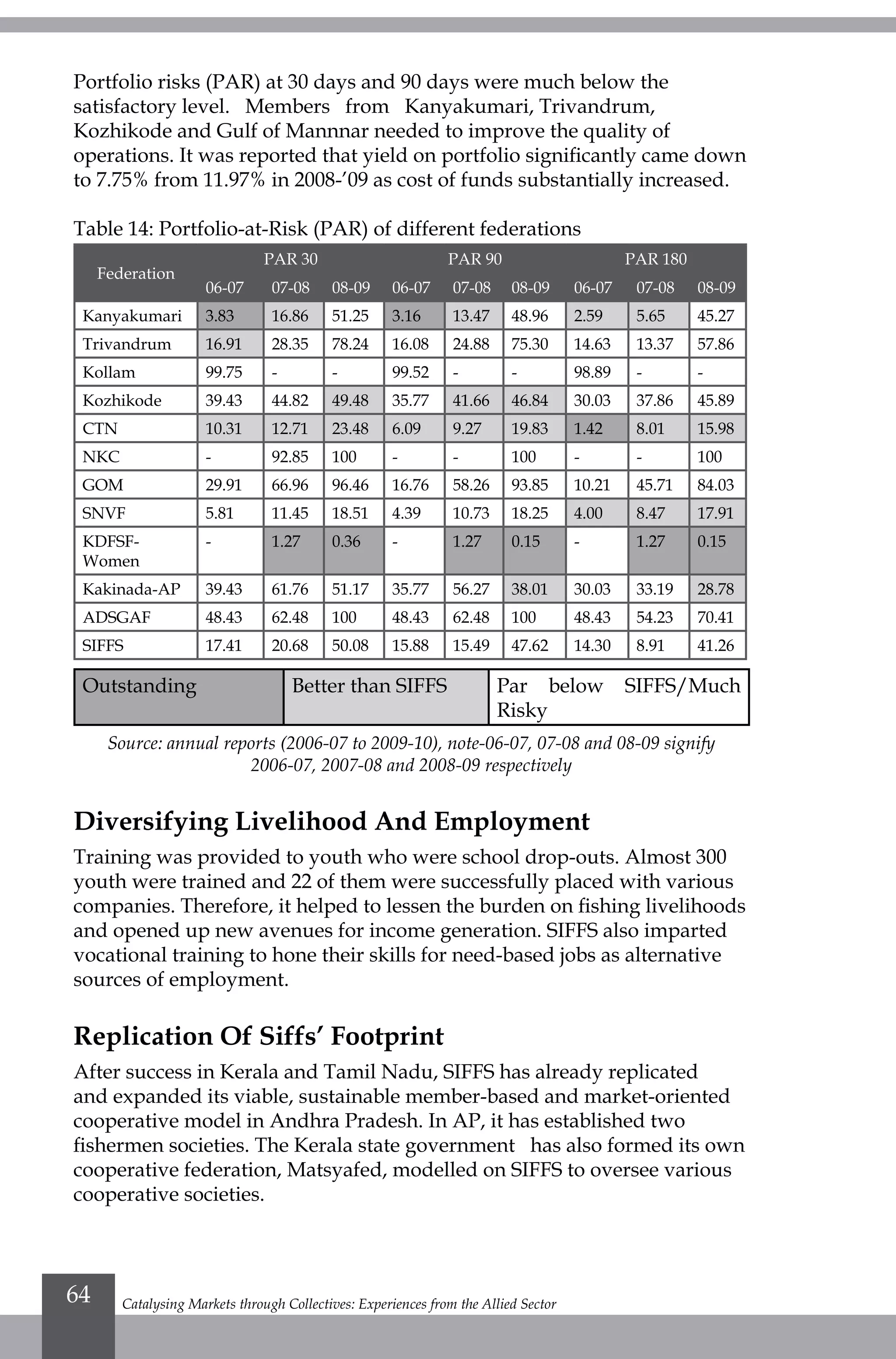
Experiences from the Allied Sector
SITARAM RAO LIVELIHOODS INDIA CASE STUDY COMPETITION
ACCESS Knowledge Series
IndiaLivelihoods
ACCESS Development Services is a national level livelihoods promotion
organization with focus on incubating innovations and sustainable models
for livelihoods promotion of the poor. Set up with in March 2006, ACCESS is
structured uniquely to work at all levels of the value chain – implementing
programmes on the ground, working with Civil Society organizations,
Government Departments, Corporate sector, and Multilateral / Bilateral agencies
as also undertaking a few national initiatives to influence and support policy
initiatives and strengthening the enabling environment. To optimize its resources
and maximize the results of its interventions, ACCESS believes in partnering with
key stakeholders in the sector in order to develop mutually reinforcing strategies,
bring convergence of competencies and build consensus on key issues.
Rabobank Group is an international financial services provider operating on the
basis of cooperative principles. It offers banking, asset management, leasing,
insurance and real estate services. Focus is on broad financial services provision
in the Netherlands and primarily on the food and agribusiness internationally.
Rabobank Group is comprised of independent local Rabobanks plus Rabobank
Nederland, their umbrella organisation, and a number of specialist subsidiaries. In
terms of Tier I capital, Rabobank Group is among the world’s 30 largest financial
institutions. Rabobank is consistently awarded a high rating by all rating agencies.
Rabobank Foundation
The Rabobank Foundation was established in 1973 as an independent foundation.
The organisation is funded by local member Rabobanks and Rabobank Nederland,
which donate a small percentage of their profits to the Rabobank Foundation. The
Rabobank Foundation helps underprivileged and disadvantaged people to become
economically active and independent. The support provided by the Rabobank
Foundation reflects Rabobank’s unique history and roots and is consequently
focussed first and foremost on enabling the development of small co-operatives
located in rural regions. This support is provided through donations, loans, trade
financing and technical assistance. In line with Rabobank’s own co-operative
background, the Rabobank Foundation especially focuses on establishing and
promoting co-operative savings and loan systems.
Catalysing Markets through collecives:
Experiences from the Allied Sector
Disclaimer: These case studies represent the personal views of the individual authors. They
do not necessarily represent the views of ACCESS Development Services.
Published by
ACCESS Development Services
28, Hauz Khas Village,
New Delhi - 110016
Catalysing Markets through Collectives:
Experiences from the Allied Sector
Copyright ©: ACCESS Development Services, 2011
All rights reserved. This book, or parts thereof, may not be reproduced in any form
or by any means, electronic or mechanical, including photocopying, recording or any
information storage and retrieval system now known or to be invented, without
permission by the Publisher.
Cover Photograph:
Dr. H.K. Deka
Printed by
Edge Communications
New Delhi.
Foreword	i
	 Editorial	 ix		
1	 Flying in a Flock	 1
2	 Jharkhand Women’s Self Supporting Poultry Federation: 	 17
	 A Perfect State of Cooperation	
3	 Tribals Develop Fisheries in Dimbhe Dam	 29
4	 A Tryst With Siffs in Kerala	 45
5	 Energising Rural India through Contract Farming Integration 	 67
	 Model in the Poultry Sector: The Case of Suguna Poultry Farms	
6	 Women’s Collective Venture towards Revival of 	 83
	 Animal Husbandary for Livelihood Security -
	 A Case Study from a Village of Kutch District	
7	 Netting Profits in Still Waters	 95
8	 Incentivising Traditional Livelihoods: The Case of Women	 113
	 SHG Managed Uppada Dry Fish Unit	
Contents
Catalysing Markets through Collectives: Experiences from the Allied Sectorvi
FOREWORD
The allied sector provides the much needed stability to
household earnings of the rural communities sometimes
as a mainstay livelihoods option and more often as a subsidiary
subsistence occupation. Scaling up these subsistence
level ventures requires capital and awareness to enhance
production as well as increased linkages with markets. And
often, given the low level of production and productivity,
the need for aggregation and pooling is becoming critical to
overcome these adverse factors and to better access markets.
Organising primary producers and aggregating their produce
has been a tried strategy.
ACCESS Development Services, instituted and mandated to
serve the poor and help them overcome poverty and live with
dignity, has been making significant efforts at all levels of the
sectoral value chain to impact and improve the livelihoods of he
poor, especially small and marginal farmers and small
producers. As a part of its programme strategy, ACCESS
also realizes the critical significance of needing to assimilate
learning and experience of different stakeholders as well as to
disseminate these for the benefit of the entire sector. Through
the initiatives like the Livelihoods India Conference, the
State of the Sector Report-Microfinance, the State of India’s
Livelihoods Report and various policy retreats and visioning
exercises, ACCESS has been attempting to contribute towards
dissemination and sharing of best practices for the benefit of
the sector, and has started to increasingly play the role of a
knowledge repository.
It is with this perspective that ACCESS initiated the Sitaram
Rao Livelihoods India Case Study Competition in the memory
of its late Board of Director and a sector leader. The theme
for this year is “Catalysing Markets through Collectives:
Experiences from the Allied Sector”. It was indeed a hard task
for the Jury comprising of sector experts such as Prof. Sunil
Ray, Institute of Development Studies, Jaipur; Prof. Mukul
Kumar, IRMA; Ms. Raji Gain, OSD and GM, Natural Resource
Management Centre, NABARD; Mr. Ajit Kanitkar, Program
Officer/Financial Assets, Ford Foundation; and Prof. Sukhpal
Singh, Institute of Economic Growth, University of Delhi to
shortlist the winning Case Studies.
The gamut of received cases covers wide ranging experience
from Madhya Pradesh Women Poultry Producer Company
Private Limited (MPWPCL), success story of a collective, which
vii
represents the bargaining power of the small producers at the
state level to Jharkhand Women self-supporting Poultry
Cooperative Federation Ltd., where PRADAN studied the
situation and came up with an effective livelihood model which
has stood the test of time. Also, another off the beaten track
example is from Dimbhe Dam where tribals have developed
community-run and scientific fishing mechanisms.
Other cases include experiences from Sairi Jo Sangathan in
Kutchh District where the rural women have taken up the
challenge to maintain their livestock and earn livelihood from
it through collective effort; Uppada Block in the Vishakapatnam
district of Andhra Pradesh where traditional fishing has been
revived as a lucrative livelihood option for the local community
by exploring the potential of combining scientific knowledge
and market incentives in the area of dry fish processing;
Bhusura Traditional Fisherwoman Co-operative (BTFC), a live
narrative of exploring resources available locally to provide
a source of sustainable livelihood; South Indian Federation of
Fishermen Societies (SIFFS), a NGO hich has promoted
fishermen’s livelihoods in the coastal alluvial soil of Kerala
during the eighties; and the successful case of contract farming
integration model practiced by Suguna Poultry Farms.
These different case studies enrich the knowledge bank of the
entire sector and we hope this compendium serves as a quality
reference for practitioners to innovate livelihoods solutions.
On behalf of ACCESS, I take this opportunity to thank the
Rabobank Foundation for supporting this important initiative.
Particularly, I would like to thank Pierre Hedel, Managing
Director and Arindom Datta at Rabobank Foundation for
supporting the Case Study Competition for the second
consecutive year. Arindoms’s deep engagement with the process
and his enthusiasm at each stage of the process characterizes
Rabobank Foundations’s manner of partnering with the investee
organizations. I also thank our Technical Partners for the Case
Study Competition, Institute of Rural Management, IRMA;
particularly Prof. Debiprasad Mishra, Prof. Girish Agarwal,
Prof. Vanita Yadav, and Prof. Shiladitya Roy for anchoring this
process at IRMA and bringing in much technical rigour to it. I
would also thank all those who have shown interest in the case
study competition and submitted their cases, several of them of
high quality. Though only eight could be finally shortlisted, the
rich content of all the cases is beyond any doubt. Special thanks
and appreciation is due to the time and effort put in by the Jury
members, albeit their very busy schedules, to critically examine
Catalysing Markets through Collectives: Experiences from the Allied Sectorviii
the cases and help us with the final list. Special thanks are also
due to Pritha Sen for editing the case studies on a very short
notice. I finally would like to thank my own Livelihoods India
team led by Puja, and ably supported by Paankhuri for running
an effective process for this round of Case Study Competition
to coordinate with IRMA, with the Jury, with the case study
authors and undertaking the initial screening; all of within
a tight timeline required rigour and focus. The small team
performed and delivered the outcomes with high professional
aplomb.
I am glad that ACCESS has been able to complete three years of
the case study competition and has been able to make a small
contribution to sectoral learning. We are very enthused by the
overall support received from several stakeholders in being able
to accomplish this task. I hope this endeavour of ACCESS is
found valuable by the sector.
Vipin Sharma
CEO,
ACCESS Development Services
ix
EDITORIAL
‘Occupy Wall Street’ gatherers in Liberty Plaza Park, also
known as Zuccotti Park in lower Manhattan, New York are a
community which conducts its affairs in ways that appear so
familiar of some public movements elsewhere like non-hierar-
chical decision making, open and transparent General Assem-
bly meetings, preparing meals communally, and there’s even a
public library.
We open up with reference to what is happening in Zuccotty
Park may look distantly similar to cooperative movements else-
where and in other circumstances and wonder, do cooperative
movements develop only when people are distressed and/ or
marginalized? More to the point, does cooperation offer people
more hope, more franchise, more control over their lives, more
participative decision making than other governance alterna-
tives tried in 20th century and the current one?
Nevertheless, in settings where people have a lot less food than
even the minimum necessary for subsistence and virtually no
control over accessible resources and where outreach of the
Government falls far short of touching their lives, some form of
cooperation does take shape under very hostile socio-economic
and authoritarian structures. While trying to understand such
phenomena, we may probably take recourse to the indomitable
human spirit to survive against all odds, we suspect, as this
compendium demonstrates that there are other factors at play
less well understood.
Present compendium was compiled out of Sitaram Rao Liveli-
hood Case Competition for year 2011 event finalists and re-
counts 8 such live narratives from various parts of India. These
stories bring to fore many other dimensions such as environ-
mental, social, and contextual and not the least, Governance
conditions. The 2011 theme of the competition was centred on
“Collectives in the Agri-allied Sector”. Specifically, the agri-
allied sector included dairy, poultry, goatary, sheep rearing,
piggery, fisheries, sericulture and bee keeping etc. It is hoped
that the compendium goes some way in playing a useful role in
framing of policy which is based on evidence based discourse
on relevant livelihood initiatives.
IRMA Team
(Debiprasad Mishra, Girish K. Agrawal, Shiladitya Roy, Vanita
Yadav)
Flying in a Flock 1
Flying in a Flock
Sunil Garg and Nishant Kumar
The Madhya Pradesh Women’s Poultry Producer Company Limited, a tribal
women’s collective, is today among the largest suppliers
of broiler chickens in the state.
In small hamlet of Chokipura, there is nothing which is distinguishable from
other villages of the Kesla block except that the village is abuzz with the cackling
sound of poultry birds. Each of the houses situated on both sides of a concrete
road have a poultry shed standing in the backyard. Their day starts early to take
care of the poultry farms the tribalfolk have built with so much resilience. This
small innovation of poultry breeding by the community has helped them overcome
constraints and realise a better living standard for themselves and their families.
Till the 1990s, a general air of wellbeing had permeated through the settlement.
Hoshangabad and, especially Kesla, had good forest area cover; however gradual
deforestation depleted this natural resource and the forest-based livelihood of the
people was taken from them. They had to face the trauma of displacement due
to construction of several projects such as the Tawa dam, the Ordnance factory
and the Bori sanctuary. Owing to the fact that the tribal community here had
depended on the forest for generations, depletion of forest resources due to these
constructions left them vulnerable and pushed them to the brink of poverty. Their
only source of living was now the wage labour in neighboring areas where the
agricultural intensity was high and on sale of minor forest produce like Tendu
leaves. Migration coupled with loss of jobs in the vicinity led to women being the
worst affected. They were either left in the villages to manage the children and the
livestock or forced to migrate seasonally to support their family. People became
vulnerable in the hands of local traders who would exploit them by lending at
high interest rates. Consumption of liquor was also on the rise which led to other
social and economic hardships for the villagers.
Livelihood interventions like sale of tendu leaves and bamboo baskets were
not economically sustainable. The rate of return in individual enterprises was
minimal and did not successfully intervene to uplift their conditions. They
required local solutions to overcome their hardships. Focused community
intervention seemed the only way to engage them productively. A basic
contention was the specific activity that could involve community members.
Among the tribal households, poultry is the most common livestock species and
every household keeps at least some birds in their backyard for local consumption
and to earn some income. Poultry rearing in small numbers is a part of the
integrated farming system and is followed traditionally by the community. The
village members are knowledgeable and skilled in rearing these indigenous birds.
1
CASESTUDY
Catalysing Markets through Collectives: Experiences from the Allied Sector2
But at the time of intervention they did not have the capacity to engage in large-
scale production.
PRADAN, which was working with the Madhya Pradesh District Initiative
Project (MPDPIP), approached women of the village to discuss the formation
of the community poultry centre in the village. Women were also informed of
the government schemes to assist them in this initiative. The organisation then
started working with working with the Gond and Korku tribes to build their
capacity in backyard poultry farming by involving better breed and rearing
practices coupled with better marketing mechanisms. Today, the Madhya Pradesh
Women’s Poultry Producer Company Limited, formed by the coming together of
six poultry cooperatives, is one of the biggest suppliers of broiler chickens in the
state of Madhya Pradesh.
How it All Began
PRADAN’s decade long association with community engagement in
poultry farming has provided it with valuable insights in the functioning
of the sector and the market. But most importantly PRADAN realised the
importance of economies of scale for forward and backward integration
to make this venture successful. PRADAN approached the villagers to
set up a poultry rearing enterprise for which most of the women showed
interest. It started working in the area by forming small interest groups.
They were also provided training in poultry rearing, poultry management
practices including construction of sheds. Once the training was over, each
woman was provided with Rs 30,000 for the construction of sheds. The
amount was part grant and part loan. The loan part was later settled by
deducting it from their share of the profits once they started operations.
When the number of women entrepreneurs reached around 300-400, they
were federated to form a cooperative. After the cooperative was formed,
they started operations with 300-400 chicks in their sheds. There are now
altogether six cooperatives working for the welfare of the community.
The managers of the cooperatives were also concerned with how to
increase the income of the poultry producers and ways to shield them
from the day to day volatility of input prices and final product prices.
The very basic purpose of securing livelihoods and to enhance it by this
supplementary activity was diluted for the producers were not shielded
from the risk of market fluctuations.
At this juncture the idea to form a producer company which would
combine all the cooperatives under a single umbrella for the purpose
of business but would still give them internal autonomy to function
was born. In the interest of the community finally the Madhya Pradesh
Women’s Poultry Producer Company Limited (MPWPCL) was formed,
which commenced operations in 2006.
Flying in a Flock 3
What Prompted the Formation of MPWPCL
•	 The scale of production was small. An individual cooperative’s scale
of production was no match for that by competitive commercial
farms.
•	 At the cooperative level integration was not possible.
•	 Cost of inputs as well as output was very volatile and hence
cooperatives were at the mercy of market forces they could not
influence.
•	 The size of production did not give the producers the bargaining
power to maintain their profit margins.
•	 As most inputs had to be sourced from outside, the profit margins
were eroded.
How MPWPCL Addressed these Problems
MPWPCL now is one of the biggest producers of broiler chicken in the
state. This was achieved by first establishing four feed processing units
which supplied feed to the cooperatives and then taking on the contract
for manufacturing medicines. Marketing activity under the brand name
‘Sukhtawa Chicken’ was started and a parent farm and hatchery was
commissioned in October 2011. Now as most of the inputs are produced
in-house or are getting contract manufactured by MPWPCL, market
volatility has a lot less influence on operations. The end-to-end integration
and scale of operations under the umbrella company MPWPCL has
given the producers much needed bargaining power to influence market
decisions and further shield themselves from market volatility and
depleting profit margins. Each step of integration has added to margins by
2-3 per cent.
2006
Formation of MPWPCL
2005
First Feed Process
Unit at Kesla
2003
Brand “Sukhtawa
Chicken” launched
1994
Poultry Activity
started in Kesla block
1994
2001
First co-operative
at Kesla
2004
Second co-operative
at Churahat 2006
5th co-operative
at Jatara
2007
2nd Feed Processing
Unit at Churahat
2011
Hatchery and Parent
Farm at Itarasi
2012
2009
Manufacturing of
medicine
by contract
2006
4th co-operative
at Orcha
2006
3rd co-operative
established at RajNagar
Figure 1: Time line in the history of MPWPCL
Catalysing Markets through Collectives: Experiences from the Allied Sector4
Benefits of the Cooperative
Each cooperative is designed in such a way as to allow producers to
compete with large commercial poultry producers. The cooperative
institution helps to accumulate capital over the years allowing members to
expand their production facilities. It provides the following services to the
farmers:
a.	 access to high quality inputs and market
b.	 on-farm production support
c.	 working capital assistance
d.	 risk mitigation from input and output price movements
These cooperatives have promoted the state-level secondary organisation,
namely MPWPCL. The aggregation at federation passes on the benefits
of vertical integration, professional and technical support, economies of
scale in procurement of inputs, increased bargaining power with external
suppliers and regulators, while providing a platform for knowledge and
process-sharing between its member cooperatives. It helps the member
cooperatives in reducing input cost for feed (about 60% of total expenses),
and ensure steady and consistent supply through collective purchase or
creation of in-house production facilities.
MPWPCL today has a producer base of over 3,000 scheduled caste (SC)
and scheduled tribe (ST) women and covers 108 villages in five districts of
MP -- Hoshangabad, Sidhi, Chattarpur, Dindori and Tikargarh
The Operating Model
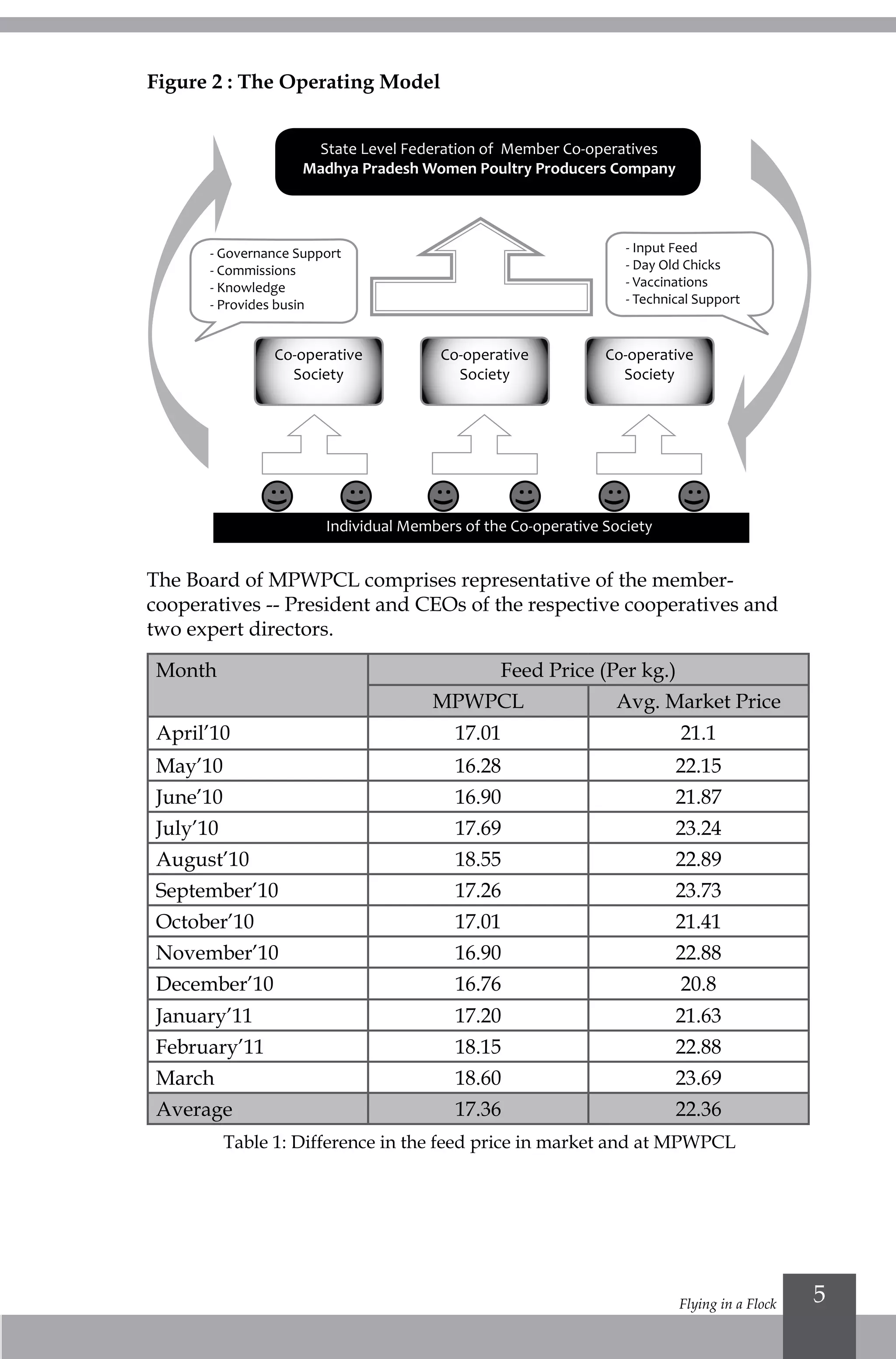
The Cooperative-Federation model leverages the strengths of both
centralised and decentralised structures; while the production and
marketing systems are decentralised, the procurement of inputs are
aggregated at the federation level. Decentralised production and
marketing systems help member cooperatives provide localised and
need-based support to their members by dedicating much wider
attention to them, members also have space to take decisions suitable
to their local context. Decentralised marketing by the cooperatives in
local markets also helps the cooperatives save costs and time involved
in logistics. The structure of the federation helps member cooperatives
achieve competitiveness and sustainability through economies of scale
while providing them a monitoring mechanism, which helps to minimise
internal conflicts between member cooperatives.
This unit is managed by an experienced and trained CEO along with a
professional team. Among other things as discussed earlier, it ensures
coordination among primary cooperatives, support in induction of new
members in the existing cooperatives and promoting new cooperatives in
its operational area. Further, it helps prepare organisational development
plans for member-cooperatives, organises the capacity building
programmes and ensures compliance with the statutory authorities.
Flying in a Flock 5
State Level Federation of Member Co-operatives
Madhya Pradesh Women Poultry Producers Company
Individual Members of the Co-operative Society
Co-operative
Society
Co-operative
Society
Co-operative
Society
- Governance Support
- Commissions
- Knowledge
- Provides busin
- Input Feed
- Day Old Chicks
- Vaccinations
- Technical Support
The Board of MPWPCL comprises representative of the member-
cooperatives -- President and CEOs of the respective cooperatives and
two expert directors.
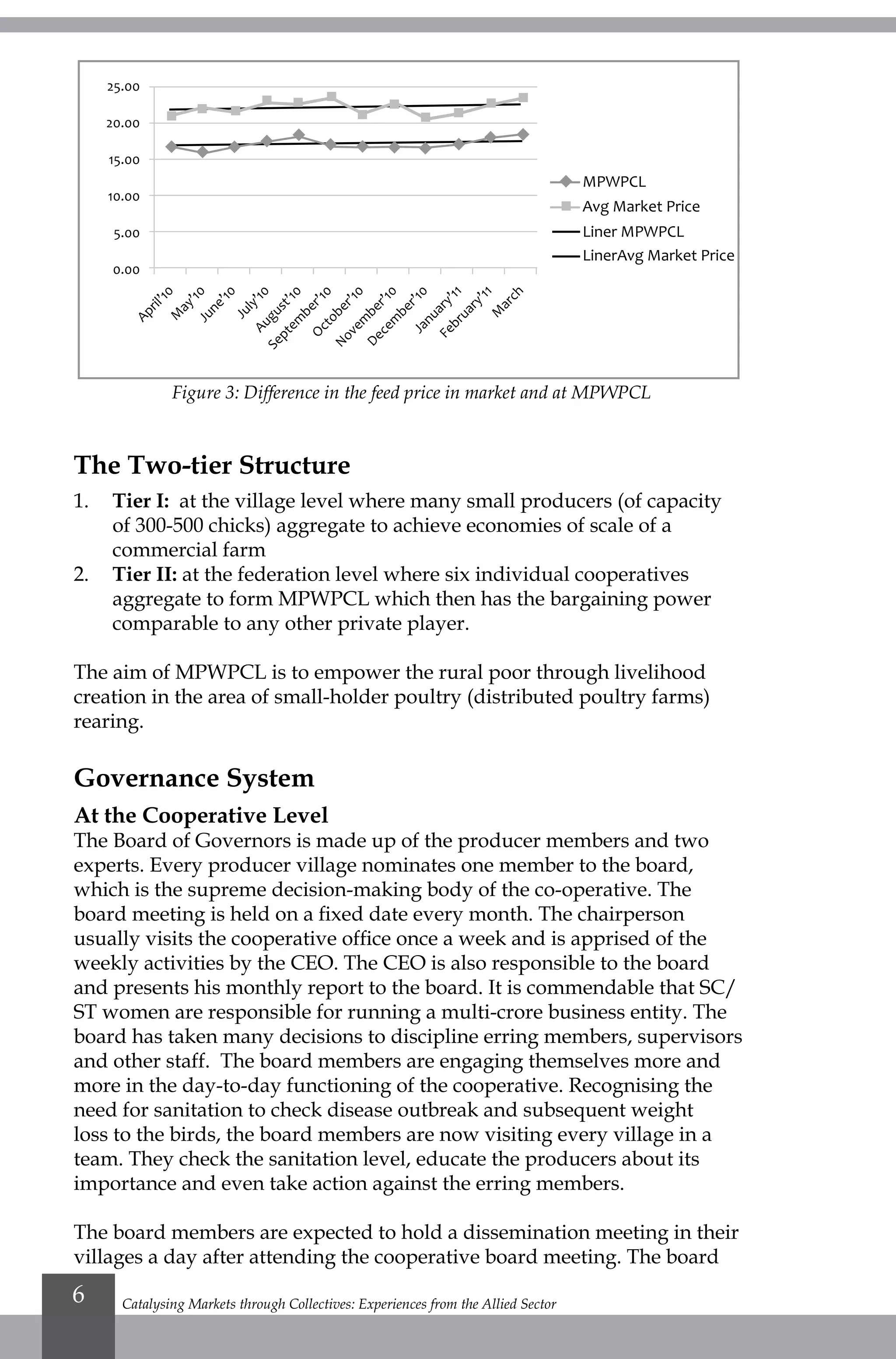
Month Feed Price (Per kg.)
MPWPCL Avg. Market Price
April’10 17.01 21.1
May’10 16.28 22.15
June’10 16.90 21.87
July’10 17.69 23.24
August’10 18.55 22.89
September’10 17.26 23.73
October’10 17.01 21.41
November’10 16.90 22.88
December’10 16.76 20.8
January’11 17.20 21.63
February’11 18.15 22.88
March 18.60 23.69
Average 17.36 22.36
Table 1: Difference in the feed price in market and at MPWPCL
Figure 2 : The Operating Model
Catalysing Markets through Collectives: Experiences from the Allied Sector6
Figure 3: Difference in the feed price in market and at MPWPCL
The Two-tier Structure
1.	 Tier I: at the village level where many small producers (of capacity
of 300-500 chicks) aggregate to achieve economies of scale of a
commercial farm
2.	 Tier II: at the federation level where six individual cooperatives
aggregate to form MPWPCL which then has the bargaining power
comparable to any other private player.
The aim of MPWPCL is to empower the rural poor through livelihood
creation in the area of small-holder poultry (distributed poultry farms)
rearing.
Governance System
At the Cooperative Level
The Board of Governors is made up of the producer members and two
experts. Every producer village nominates one member to the board,
which is the supreme decision-making body of the co-operative. The
board meeting is held on a fixed date every month. The chairperson
usually visits the cooperative office once a week and is apprised of the
weekly activities by the CEO. The CEO is also responsible to the board
and presents his monthly report to the board. It is commendable that SC/
ST women are responsible for running a multi-crore business entity. The
board has taken many decisions to discipline erring members, supervisors
and other staff. The board members are engaging themselves more and
more in the day-to-day functioning of the cooperative. Recognising the
need for sanitation to check disease outbreak and subsequent weight
loss to the birds, the board members are now visiting every village in a
team. They check the sanitation level, educate the producers about its
importance and even take action against the erring members.
The board members are expected to hold a dissemination meeting in their
villages a day after attending the cooperative board meeting. The board
25.00
20.00
MPWPCL
Avg Market Price
LinerAvg Market Price
Liner MPWPCL
15.00
10.00
5.00
0.00
April’10
M
ay’10June’10
July’10August’10
Septem
ber’10
October’10
Novem
ber’10
Decem
ber’10January’11
February’11
M
arch
Flying in a Flock 7
is in the process of deciding whether to devolve part of its role to the
village-level bodies and engage members by a gradual empowerment of
these institutions.
Every quarter a meeting is also held to review the progress and discuss
pressing issues. Regular training by external experts is also conducted
for the production managers as well as field supervisors.
Figure 5: Governance System from the village to the Co-operative level
At the Producer Company Level
A similar system as that of the cooperative is followed at the apex level.
All the CEOs are board members and they have an appointed president.
One of the board members has been appointed as the procurement
manager, who takes care of all the inputs supply along with a strong
support staff team which includes accountants. Eforts are on for taking
up full fledged marketing activities. An external expert on the board
functions in an advisory role.
Human Resources
Trained and committed personnel are necessary for institutional stability
and sustainability. The cooperative thus has created a cadre of village-
based supervisors. In addition, all the support staff is locally recruited.
At present, the staff is paid incentives on production efficiency achieved
by members. The CEO is a professional veterinary doctor, who is the
only non-permanent resident of the area. The CEO is now delegating
many of his responsibilities and empowering his subordinates and now
even in his prolonged absence, the business of the cooperative runs as
usual.
Marketing System
The selling price for chicken is decided on a daily basis. The prices
in Madhya Pradesh are influenced by prevailing prices in nearby
Co-operative level
• Co-operative level
• Village level
• Village levelIndividual Producers
SHG
CEO
BoardMembers
Catalysing Markets through Collectives: Experiences from the Allied Sector8
markets of Chhattisgarh and Maharashtra, most notably of Malegaon.
In general, Indore poultry prices are lesser than Bhopal poultry prices.
Typically poultry prices are benchmarked against market prices in few
major markets (for instance Malegaon, Jabalpur etc) that most impact the
prices in the local markets. The cooperative has subscribed to a market
information service which updates it on the daily prices in different parts
of the country. The cooperative generally fixes its sales price as a function
of prices prevailing in Indore and the Jabalpur market. The CEO also uses
his contacts in different markets to keep a tab on the price movements.
There are many other suppliers who purchase from the cooperative as
per their needs, apart from dedicated customers who purchase in bulk
from the cooperatives. All the sales are on a cash basis while the dedicated
customers get three days of credit. However, the dedicated suppliers also
have to settle their accounts at the end of the financial year. The boom
in the poultry demand in the rural areas has served the cooperative
well. Most of the produce is supplied to the nearby rural markets for it
is believed that the rural market has huge potential and even at the time
of avian flu outbreaks in the different parts of the country, the local rural
market is only marginally affected. The marketing is currently done at the
individual cooperative level.
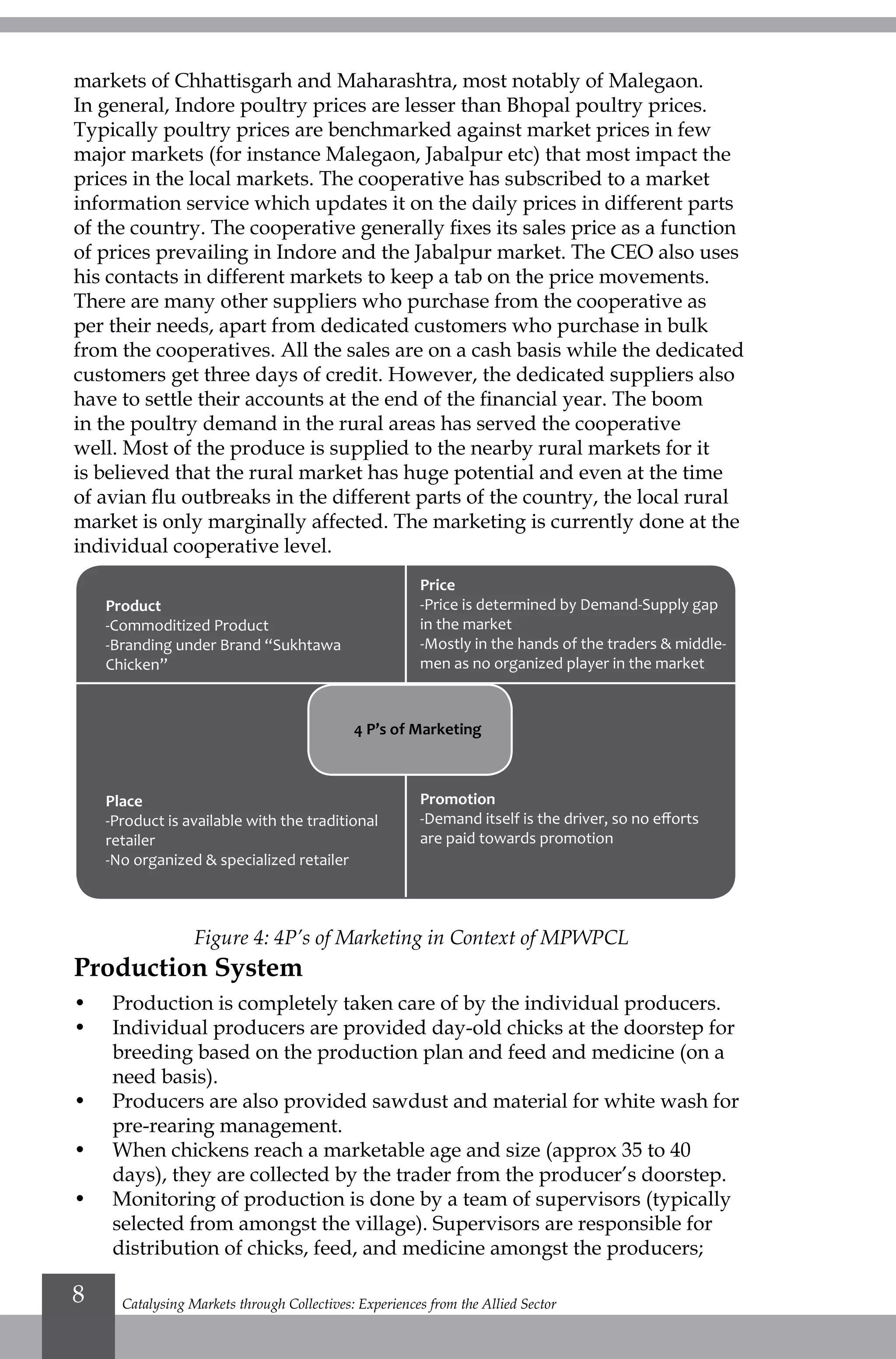
Figure 4: 4P’s of Marketing in Context of MPWPCL
Production System
•	 Production is completely taken care of by the individual producers.
•	 Individual producers are provided day-old chicks at the doorstep for
breeding based on the production plan and feed and medicine (on a
need basis).
•	 Producers are also provided sawdust and material for white wash for
pre-rearing management.
•	 When chickens reach a marketable age and size (approx 35 to 40
days), they are collected by the trader from the producer’s doorstep.
•	 Monitoring of production is done by a team of supervisors (typically
selected from amongst the village). Supervisors are responsible for
distribution of chicks, feed, and medicine amongst the producers;
Product
-Commoditized Product
-Branding under Brand “Sukhtawa
Chicken”
Place
-Product is available with the traditional
retailer
-No organized & specialized retailer
Price
-Price is determined by Demand-Supply gap
in the market
-Mostly in the hands of the traders & middle-
men as no organized player in the market
Promotion
-Demand itself is the driver, so no efforts
are paid towards promotion
4 P’s of Marketing
Flying in a Flock 9
production monitoring; weighing at the time of sales to the trader and
advising producers on upkeep of chickens, disease control, and post
mortems of dead chickens. Each supervisor is assigned to a village or
a cluster of villages.
•	 The cooperative has a CEO who is the most important functionary
and acts as a lynchpin for the various activities of the cooperative. He
is assisted by a central supervisor who monitors the work of other
supervisors.
•	 Each producer’s performance is measured on an efficiency index. The
efficiency index is a function of mortality, feed consumed and weigh
gain of the chick. The supervisor’s payment is directly linked to the
efficiency of his assigned producers, which, on an average, is around
Rs. 0.5 per live bird sold. The incentive of the supervisor is also
variable and there is a sharp decline in the incentive if the producer
fails to achieve a satisfactory score on the efficiency index.
•	 The cooperative endeavors to protect the farmer from any external
business shock. As a result the producer is reposed solely with
production responsibility and is assured a fixed minimum return
per kg of broiler (plus additional payment linked to production
efficiency).The collectivisation of the production helps in even
distribution of risk and even if profitability in some production cycles
are affected, it is compensated by gains in the rest of the production
cycles through the year.
•	 The cooperative usually pays surplus accumulated with it at the end
of financial year as deferred wage payment. This amount is generally
referred to as bonus by the producer members. In this study also
wherever the word bonus is mentioned, it refers to the deferred wage
payment to the producer at the end of the year.
Operations Management
The cooperative has an elaborate management information system
(MIS) that helps it keep track of all transactions and ensure accuracy and
transparency in all dealings. All transactions with members are recorded
in the system, and an elaborate system of challans and counter foils is used
to ensure transparency between the members and the cooperatives with
regards to the transactions.
The MIS software, ‘Udyogmunshi’, is custom-designed to suit the
accounting and stock taking requirements of the cooperative. The
cooperative also has accounts with the local banks in the area whose
representatives make regular visits.
Innovation
Summer is the most difficult season among all. Temperatures rise to 47-
48oC combined with harsh sunlight and dry winds. To steer through this
season, they have adopted an innovative technique, where on a platform
Catalysing Markets through Collectives: Experiences from the Allied Sector10
raised (on bamboo, which is available in plenty) on both sides of the farm,
leaves of either mango tree or jambul are placed and water is sprinkled
two to three times a day. Similarly, the roof of the poultry shed is also
covered by wheat straw, to insulate it from the heat of the sun.
Salient Features of the Model
1.	 Bulk Sourcing: Medicines are being contract manufactured by a third
party to give consistency of quality and control over price. Feed is
being manufactured at the producers’ own plants.
2.	 Decentralised Production: Small scale production (300-500 birds/
shed) over a larger area (in a village of 1 sq km.) and then commercial
farms (5,000-10,000 birds over an area of a single farm i.e. 5,500-11,000
sq ft).
3.	 Risk Mitigation: Due to decentralised production there is lot less
chance of a disease outbreak wiping out the whole flock.
4.	 Community Involvement: For the same number of birds reared
compared to private commercial farming, this model allots work to
more people and that too women.
5.	 Environment Conservation: As the production is decentralised there is
very little pathogenic load on the environment and less odour.
6.	 Local Employment: Local youth are employed as supervisors (at the
village level), accountant and other official posts (at the cooperative
level)
7.	 Centralised Database: Information pertaining to stock and
consumption is available centrally thus enabling the tracking of any
inefficiency in the system.
8.	 Better Quality Output: Small-scale production considerably brings
down the pathogenic load in the final product.
9.	 Clean Meat Production over Cleaned Meat Production: The stress is
on hygienic meat production vis-à-vis producing meat unhygienically
and getting it disinfected using chemicals.
10.	 Lesser Use of Chemicals: As stated above, lesser pathogenic load
demands lesser treatment and hence minimal use of chemicals.
11.	 Cost Leadership: Poultry provides the household opportunity
to employ its slack labor in a gainful economic activity. Hence,
cooperative members will always have a cost leadership over a large
farmer who has to employ labour from the market. Small farmers are
also efficient producers, with their food conversion ratio matching
the best in industry. The efficiency of the producer and utilisation of
slack resources makes the cooperative competitive in relation to large
farmers. Also the utility of a very strong support mechanism on both
backward and forward linkages cannot be underrated.
Major Hurdles Faced
The poultry industry is highly organised, complex, competitive and
intensively market-oriented. The poor with their socio-economic
Flying in a Flock 11
disadvantages and low skill base cannot enter the sector without external
support or intervention. The growing role of integrators and resultant
benefits of scale to these big business houses are a major handicap for the
poor participating in this growing market in many parts of the country.
The production efficiencies reached by the integrators has pushed a large
number of small farmers out of the production process in many parts
of India. At present, lack of retail control is the only visible impediment
for the integrators in monopolising the value chain in many parts of the
country.
The large farmers can produce livestock at a lower unit cost by reaping the
benefit of scale than the small ones. Their cost leadership overtimes pushes
small farmers out of the production cycle. The small farmer can only
survive if he produces for a few higher priced niche markets or subsidises
his labour and cuts costs to become competitive to a large farmer who
pays to hired labour. The poor can also survive if they provide place
utility for this perishable product in a predominantly wet market in India.
However, even then the odds are heavily against them.
The major impediments were
1.	High Entry Barriers: The commercial poultry production involves a
huge initial capital investment. For a unit of 400 birds this cost comes
to Rs 40,000 i.e., Rs 100 per bird. This cost varies as the raw material
cost keeps fluctuating. This is a huge cost and without incurring this,
the producer’s cannot kick-start the activity.
2.	Training: The members were not trained to handle commercial
poultry. Though they had experience with the indigenous breed,
this is a high potential bird with fast growth and demands that
kind of care. Any deviation could result in destroying the whole
stock. Besides, standardisation was also a hurdle as the production
techniques had to be adapted to local needs.
3.	 Irregular cash flow: The realisation of income at the end of each batch
was subject to final sale price volatility. As the final price is a function
of supply-demand there is little control over it. So, sometimes the
producer reaps very good benefits (when markets are at its peak)
while sometimes they suffer losses (when markets are at the bottom).
How these hurdles were crossed
1.	 For capital investment, where linkages were sought, a soft loan at very
low interest rates was financed by some foundations. Government
schemes were also tapped to subsidise the capital cost
2.	 For training, different modules in Hindi and other local languages
were created. Also, persons from within the organisation, who were
readily available at any time, were engaged to drive down the cost.
3.	 Delinking of market prices and payments made to the producers.
This was done through introduction of EI (Efficiency Index). Here
Catalysing Markets through Collectives: Experiences from the Allied Sector12
producers receive the compensation at the end of every batch
depending on three parameters, which objectively assesses how
efficiently the producers have raised the birds. At the end of the year
the profit was shared with all the cooperative members as dividend.
Difference Between the Models Followed by MPWPCL
& Private Firms
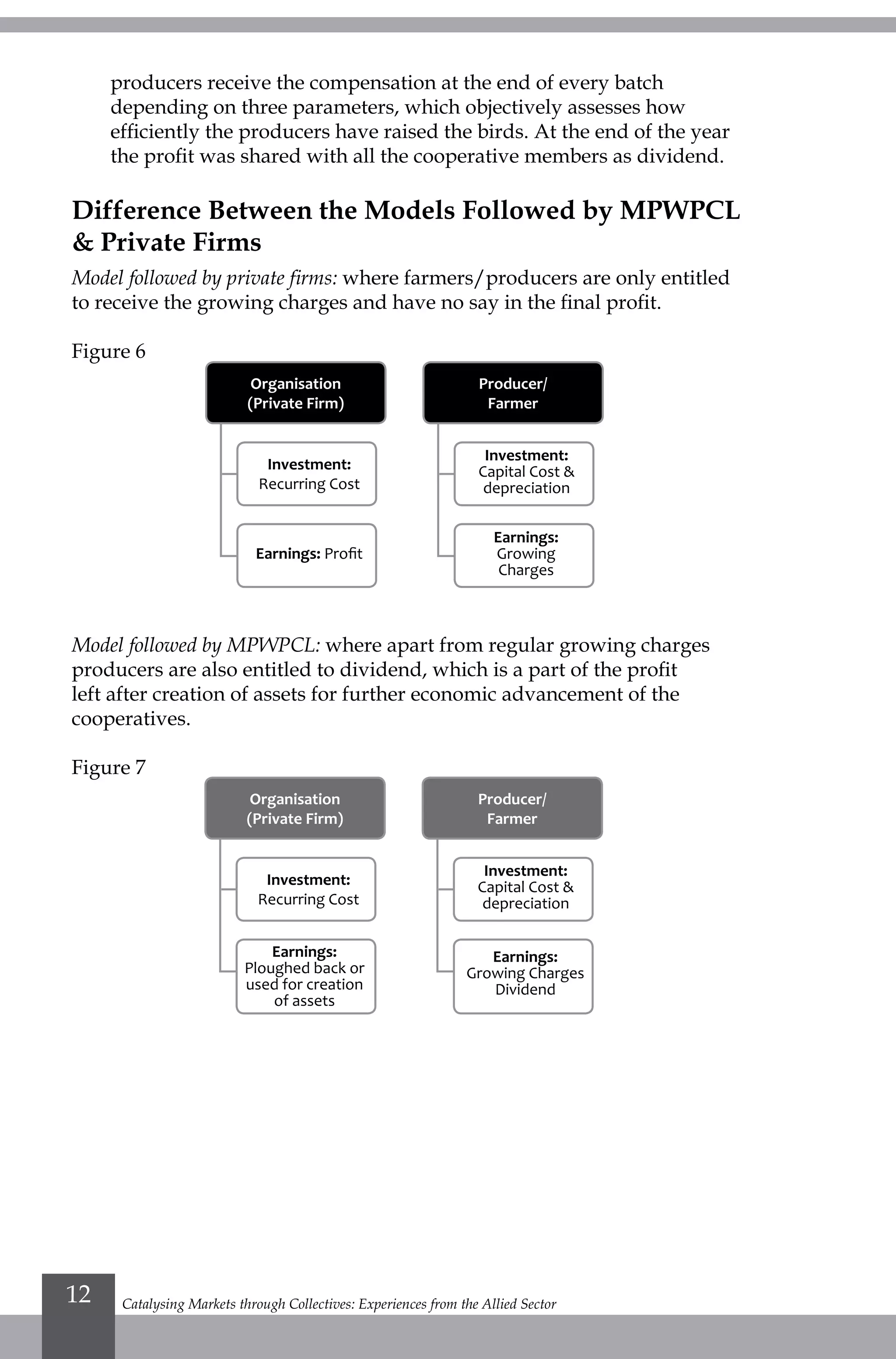
Model followed by private firms: where farmers/producers are only entitled
to receive the growing charges and have no say in the final profit.
Figure 6
Model followed by MPWPCL: where apart from regular growing charges
producers are also entitled to dividend, which is a part of the profit
left after creation of assets for further economic advancement of the
cooperatives.
Figure 7
Organisation
(Private Firm)
Producer/
Farmer
Investment:
Recurring Cost
Investment:
Capital Cost &
depreciation
Earnings:
Growing
Charges
Earnings: Profit
Organisation
(Private Firm)
Producer/
Farmer
Investment:
Recurring Cost
Investment:
Capital Cost &
depreciation
Earnings:
Growing Charges
Dividend
Earnings:
Ploughed back or
used for creation
of assets
Flying in a Flock 13
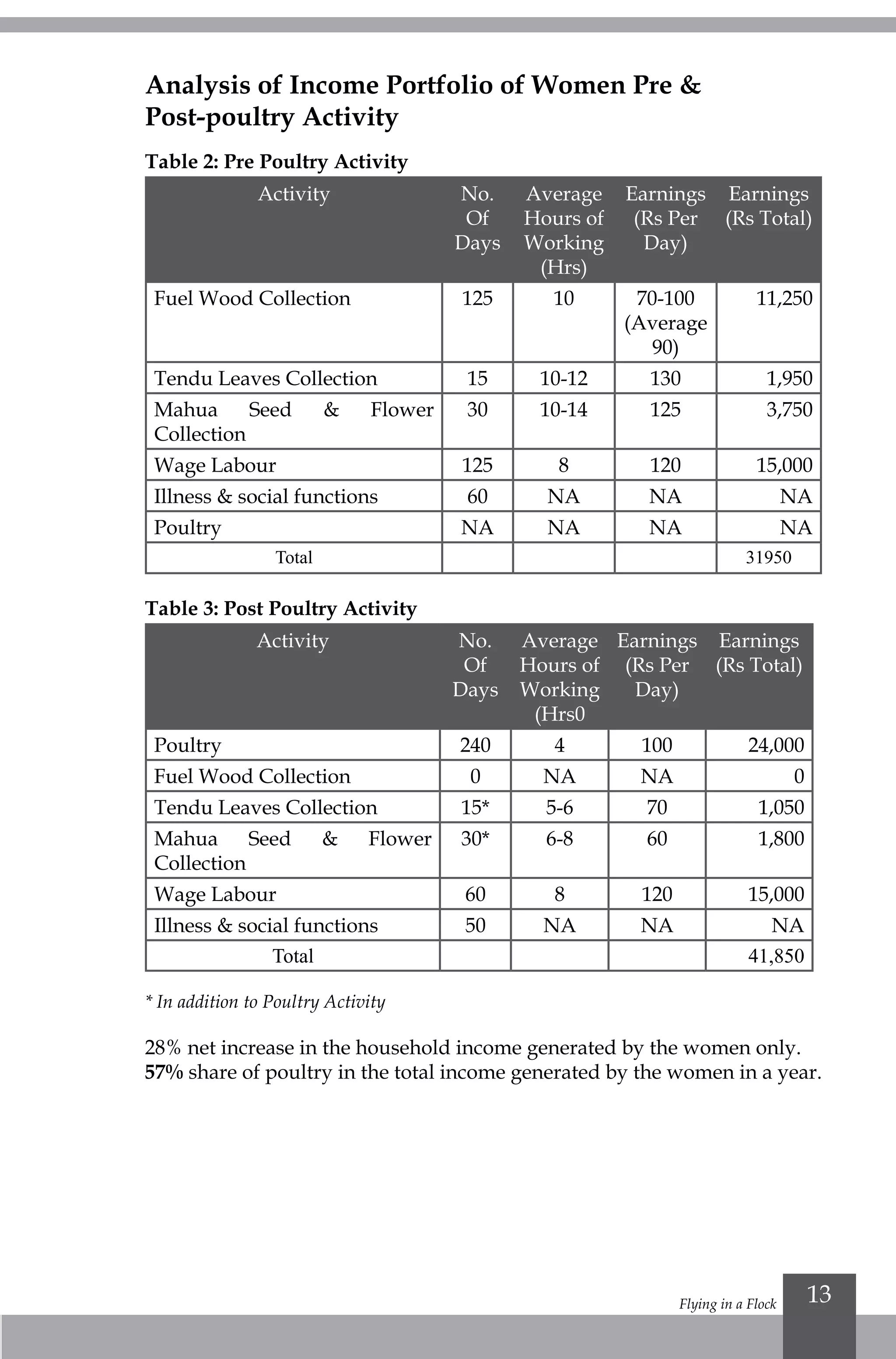
Analysis of Income Portfolio of Women Pre &
Post-poultry Activity
Table 2: Pre Poultry Activity
Activity No.
Of
Days
Average
Hours of
Working
(Hrs)
Earnings
(Rs Per
Day)
Earnings
(Rs Total)
Fuel Wood Collection 125 10 70-100
(Average
90)
11,250
Tendu Leaves Collection 15 10-12 130 1,950
Mahua Seed & Flower
Collection
30 10-14 125 3,750
Wage Labour 125 8 120 15,000
Illness & social functions 60 NA NA NA
Poultry NA NA NA NA
Total 31950
Table 3: Post Poultry Activity
Activity No.
Of
Days
Average
Hours of
Working
(Hrs0
Earnings
(Rs Per
Day)
Earnings
(Rs Total)
Poultry 240 4 100 24,000
Fuel Wood Collection 0 NA NA 0
Tendu Leaves Collection 15* 5-6 70 1,050
Mahua Seed & Flower
Collection
30* 6-8 60 1,800
Wage Labour 60 8 120 15,000
Illness & social functions 50 NA NA NA
Total 41,850
* In addition to Poultry Activity
28% net increase in the household income generated by the women only.
57% share of poultry in the total income generated by the women in a year.
Catalysing Markets through Collectives: Experiences from the Allied Sector14
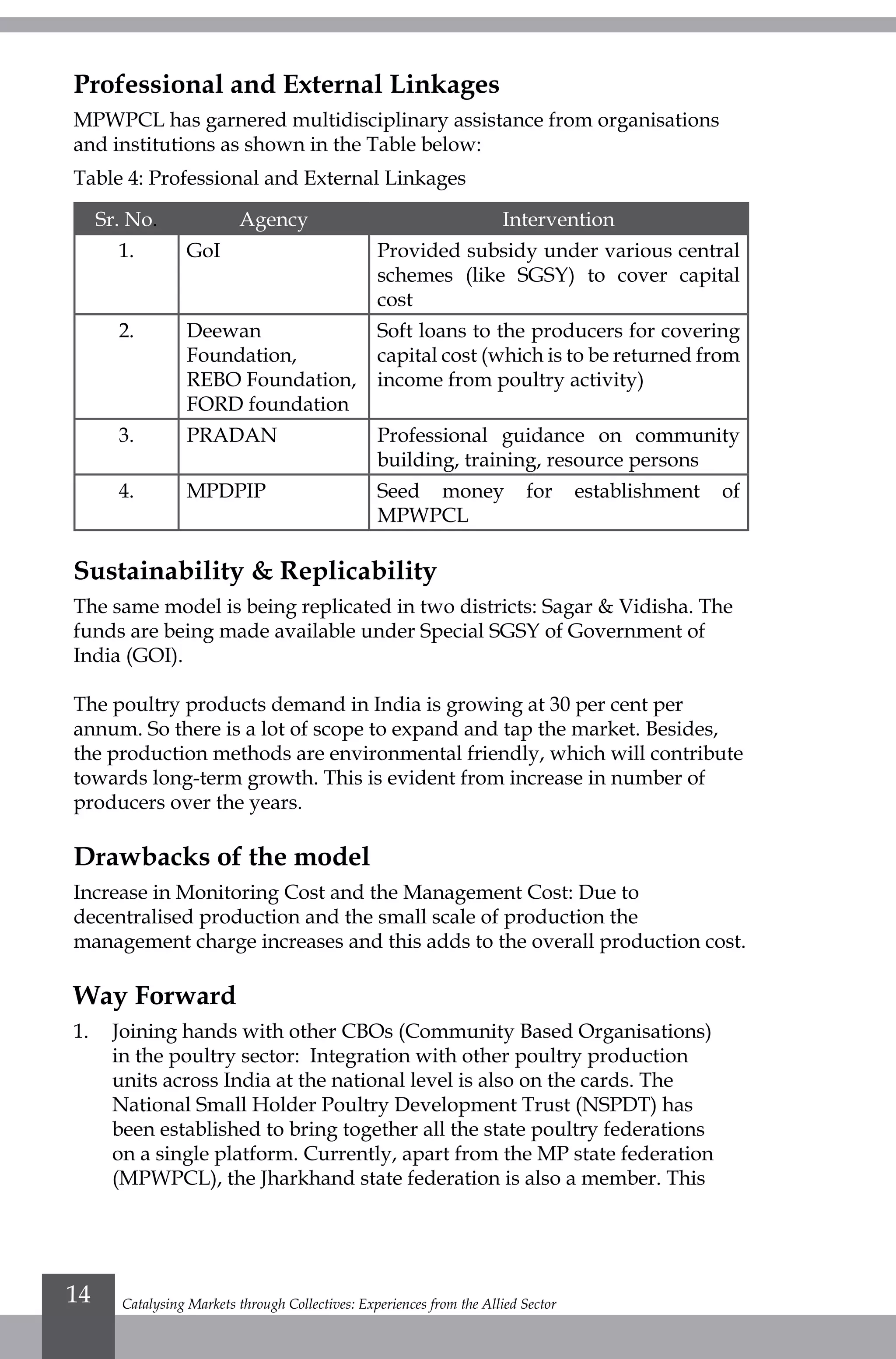
Professional and External Linkages
MPWPCL has garnered multidisciplinary assistance from organisations
and institutions as shown in the Table below:
Table 4: Professional and External Linkages
Sr. No. Agency Intervention
1. GoI Provided subsidy under various central
schemes (like SGSY) to cover capital
cost
2. Deewan
Foundation,
REBO Foundation,
FORD foundation
Soft loans to the producers for covering
capital cost (which is to be returned from
income from poultry activity)
3. PRADAN Professional guidance on community
building, training, resource persons
4. MPDPIP Seed money for establishment of
MPWPCL
Sustainability & Replicability
The same model is being replicated in two districts: Sagar & Vidisha. The
funds are being made available under Special SGSY of Government of
India (GOI).
The poultry products demand in India is growing at 30 per cent per
annum. So there is a lot of scope to expand and tap the market. Besides,
the production methods are environmental friendly, which will contribute
towards long-term growth. This is evident from increase in number of
producers over the years.
Drawbacks of the model
Increase in Monitoring Cost and the Management Cost: Due to
decentralised production and the small scale of production the
management charge increases and this adds to the overall production cost.
Way Forward
1.	 Joining hands with other CBOs (Community Based Organisations)
in the poultry sector: Integration with other poultry production
units across India at the national level is also on the cards. The
National Small Holder Poultry Development Trust (NSPDT) has
been established to bring together all the state poultry federations
on a single platform. Currently, apart from the MP state federation
(MPWPCL), the Jharkhand state federation is also a member. This
Flying in a Flock 15
trust can play a major role in promoting a major income augmenting
activity in the rural scenario.
2.	 Vertical Integration: The Indian poultry sector promises a growth
rate of 30 per cent per annum and is attracting big ticket foreign
investment. As the MNCs step into this network they will bring end-
to-end vertical integration. Organised players in India are also trying
to integrate their operations vertically, end-to-end. This calls for end-
to-end integration in MPWPCL too. Though MPWPCL is completely
backward integrated it should work towards full-fledged forward
integration.
Conclusion
MPWPCL has come way forward in addressing the problem of the Co-
operative& hence farmers & the job done are commendable. MPWPCL
should endevour its best to create more value to the associated producers.
The women community has got empowered by sustained efforts of the
organization. MPWPCL should try & built strong associations with
knowledge centers, Forward & backward linking agencies.
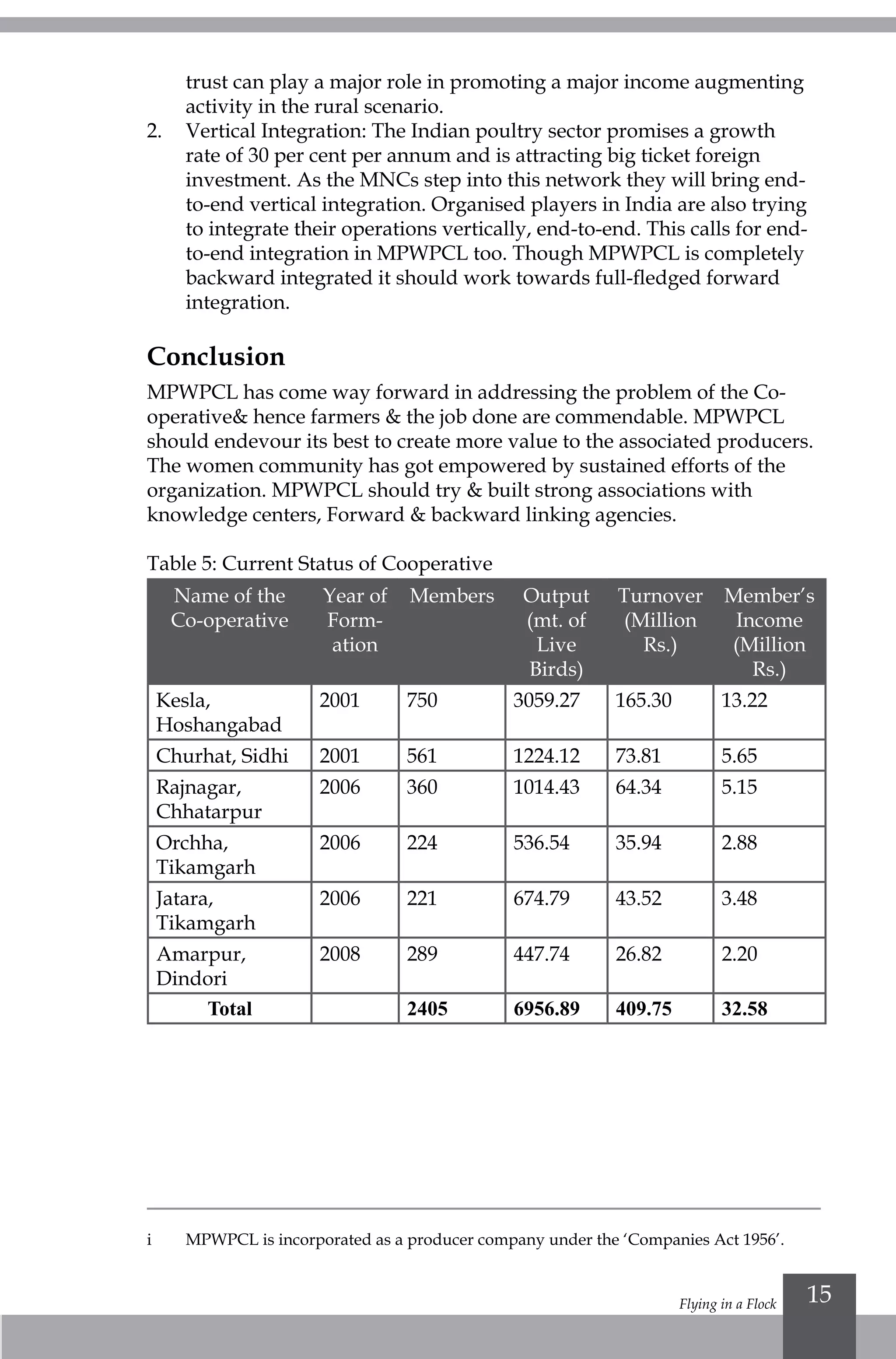
Table 5: Current Status of Cooperative
Name of the
Co-operative
Year of
Form-
ation
Members Output
(mt. of
Live
Birds)
Turnover
(Million
Rs.)
Member’s
Income
(Million
Rs.)
Kesla,
Hoshangabad
2001 750 3059.27 165.30 13.22
Churhat, Sidhi 2001 561 1224.12 73.81 5.65
Rajnagar,
Chhatarpur
2006 360 1014.43 64.34 5.15
Orchha,
Tikamgarh
2006 224 536.54 35.94 2.88
Jatara,
Tikamgarh
2006 221 674.79 43.52 3.48
Amarpur,
Dindori
2008 289 447.74 26.82 2.20
Total 2405 6956.89 409.75 32.58
i	
MPWPCL is incorporated as a producer company under the ‘Companies Act 1956’.
Catalysing Markets through Collectives: Experiences from the Allied Sector16
Jharkhand Women’s Self Supporting Poultry Federation: A Perfect State of Cooperation 17
Jharkhand Women’s Self Supporting Poultry
Federation: A Perfect State of Cooperation
M.V. Ashok and Pawan Ojha
The Jharkhand Womens’ Poultry Cooperative is growing into a statewide
movement through the successful implementation of the Small Holder
Broiler Farming Model.
A detailed market study commissioned by PRADAN in collaboration with the
poultry industry in 2002 showed that the whole of Jharkhand is a huge deficit
market for broiler birds. The daily sales of live bird was estimated to be around
80 metric ton (mt) with major consumption centers located in big and smaller
towns in the industrial and mining areas. As against the demand, the average
daily production in Jharkhand did not exceed more than 12 mt. The huge gap
between the demand and supply was met through supply from nearby states like
West Bengal, Orissa and Chhattisgarh and also from far off Madhya Pradesh. The
annual growth of the poultry market in Jharkhand was estimated to be around 20
per cent in real terms.
Seeing this immense potential, the members of self-help groups (SHGs) of Kuru
block of Lohardaga with support from PRADAN (Professional Assistance for
Development Action, a voluntary organization involved in the promotion of
livelihoods for poor rural families), decided to take up poultry activity as a
livelihood opportunity. With women belonging to resource poor families with
low risk-taking ability, PRADAN thought it prudent to try out the idea of
small-scale poultry units with each producer rearing not more than 300 poultry
birds per cycle. Efforts made towards collectivizing small poultry growers in a
cluster yielded very positive results in terms of helping the producers in reaching
economies of scale and to gain bargaining power to negotiate with the market on
fairer terms. This mechanism was institutionalized through establishment of the
Poultry Producers’ Cooperative involving all the producer women.
The first cooperative was registered in November 2002 in Lohardaga.
Subsequently, in a short span of time, four more cooperatives were established in
the districts of Gumla, Lohardaga, East Singbhum and Ranchi (presently Khunti).
Such an endeavour initially received favor from the Department of Cooperation,
Government. of Jharkhand that offered financial support to 400 poultry producers
through their cooperatives.
This initiative has further expanded in recent years to cover 3,969 poor rural
women, who find year-round income opportunities in broiler poultry farming.
The aggregated production of all the members in the last financial year amounted
to 6933.62 metric tonne of live birds (or an average of 20 mt per day) to gain
nearly 20 per cent share of the overall Jharkhand market. Most remarkably, all the
cooperatives demonstrated their resilience to withstand the shock of the bird flu
scare and could retain all the producers in the business. The net profit received by
the producers in the last year itself amounted to Rs. 309.05 lakh.
2
CASESTUDY
Catalysing Markets through Collectives: Experiences from the Allied Sector18
The major success of the initiative lies in the standardization of the Small Holder
model of poultry units that offers enormous scope for further expansion of the
activity to benefit larger numbers of poor rural women in Jharkhand.
The Rationale for the Initiative
Rain-fed agriculture has traditionally been at the core of livelihoods for
poor families in rural Jharkhand, supplemented in varying degrees by
small livestock rearing, handicrafts, wages and hunting and gathering.
Improving agricultural productivity and more generally the productivity
of primary rural resources is, therefore, essential to enhance rural
livelihoods. Agriculture, however, has inherent limits as a livelihood for
landless people and marginal farmers; it offers only fragile livelihoods
to farmers in agro-ecologically marginal or vulnerable regions; further
declining farm sizes due to population growth further limits the livelihood
potential of agriculture. Thus, beyond increasing agriculture productivity,
the challenge therefore is to develop livelihood opportunities based on
rural enterprises that do not depend on land, supplement agricultural
income, offset its uncertainty and exploit the growing demand for new
products, especially in urban centers.
Poultry: The Big Opportunity
By the year 2020, it is estimated that poultry would account for the largest
portion of the livestock output, which would be more than 50 per cent
of the total global agricultural output in financial terms. In India also
livestock accounted for about 32 per cent of the total value of agricultural
output with poultry contributing a major share. While the production of
agricultural crops has been rising at a rate of 1.5-2 per cent per annum,
that of eggs and broilers has been rising at a rate of 8-10 per cent per
annum. The increasing demand for livestock (protein) products is driven
by sustained economic growth and rising incomes. In addition, the
income elasticity of demand for meat products is high. Meat consumption
has increased by over 80 per cent between 1983 and 2000. The greatest
increases (in percentage terms) have occurred in poultry. In 1981, the
production of poultry meat was 0.12 million ton which, at present, is 2.2
million ton. The per capita consumption of poultry meat in 1970 was 146
gm and at present it is 1.6 kilogram.
The Innovative/Best Practice
The best practice in the poultry industry is large-scale poultry farming,
supported by backward and forward linkages which include the necessary
vertical integration such as parent farm, hatchery etc.. It reduces the cost of
production and production on a large scale helps to establish monopoly in
the market for better price realization.
Jharkhand Women’s Self Supporting Poultry Federation: A Perfect State of Cooperation 19
The Process Adopted -- The Small Holder Poultry
Prototype
The prototype attempts to adapt the complex production technology in a
small farmer’s context at the same time achieve economies of scale through
collective procurement of inputs and marketing of produce. The essential
elements of the small-holder poultry prototype are:
•	 Decentralized production infrastructure of 400-500 birds in the
backyard of the family thereby fitting it into their daily life.
•	 Ensuring production efficiency with rigorous training of producers,
intensive production support and quality on-call referral veterinary
services.
•	 Cost effectiveness with collective procurement of inputs and sale
of birds to achieve economies of scale and backward and forward
integration.
•	 Creation of a system to address the volatile nature of market by
delinking production efficiency from enterprise efficiency and
collectivization of operations involving market interface.
•	 Customized financial and MIS software for decentralized operations.
•	 Growing charges fashioned to create incentive for efficiency and para-
vet charges linked to production parameters.
•	 Capacity building to facilitate transition from wage earner to
entrepreneur.
•	 Participatory assessment of business performance and internalization
of best practices at the individual producer level.
Box:1 : A Broiler Farm - The Family Context
A typical broiler farmer of the collective is a rural woman from
disadvantaged communities, hitherto, dependent for their
sustenance on rain-fed agriculture and wage earning. Today
through systematic intervention at all the enterprise stages
she has gathered skills, infrastructure, inputs and marketing
arrangements for a successful home-based broiler poultry unit.
The minimum she requires is one cent of land (500 sq ft), either
owned by her or taken on lease. She earns between Rs 15,000-
20,000 a year which works out to Rs 75-100 a day for her 200
days of engagement. This income, available to her in a regular
stream of cash flows on a continuous basis, helps her to meet
the need of cash expenses and also of capital formation in the
family. This income strengthens the woman to negotiate a better
deal for herself within her family and the larger society. Income
from the activity equivalent to 200 wage days reduces migration
and helps the family invest on existing resources, most notably
the arable land – homestead or otherwise -- thereby further
augmenting the sufficiency in the hitherto deficit household.
Catalysing Markets through Collectives: Experiences from the Allied Sector20
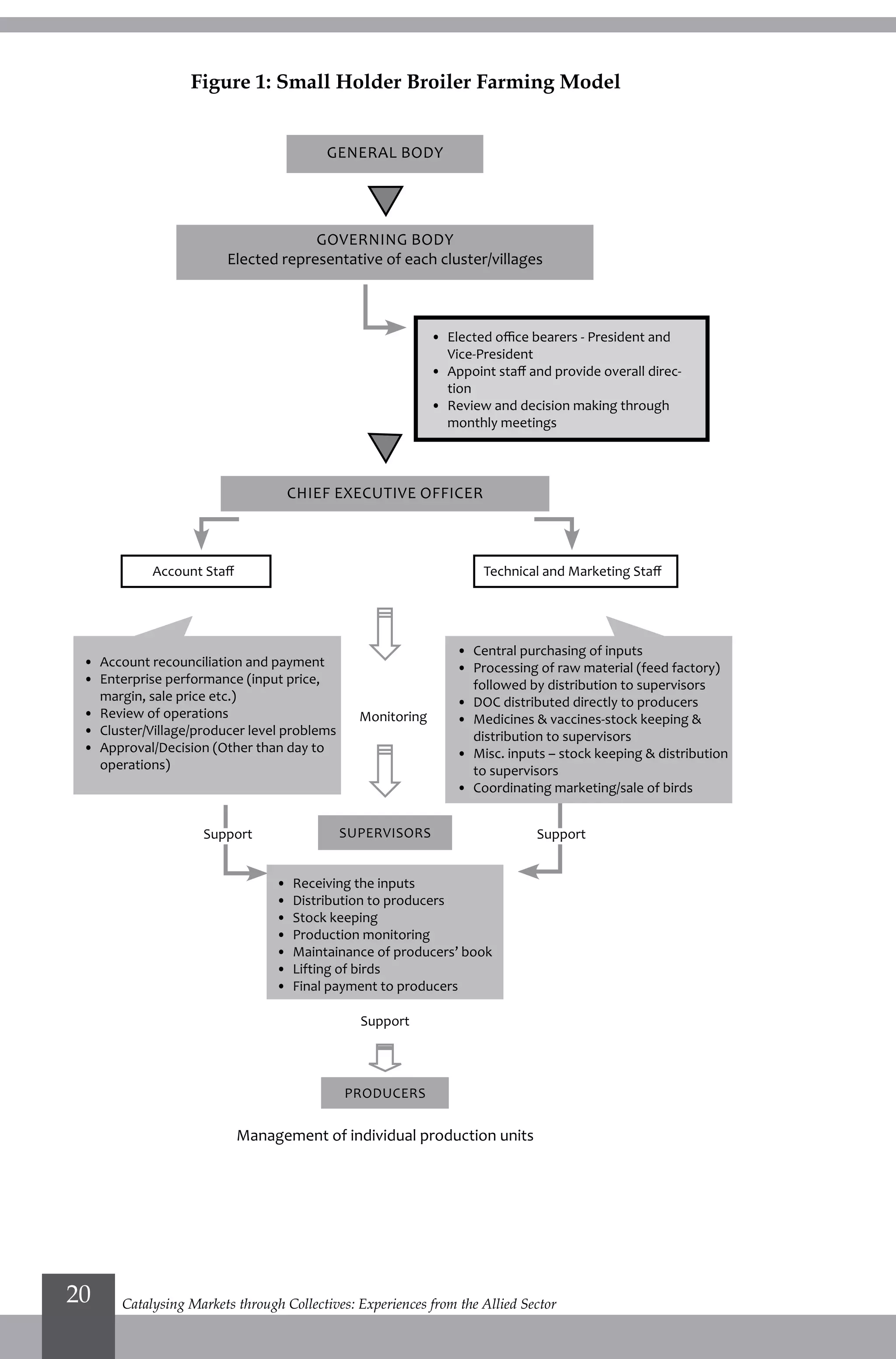
Figure 1: Small Holder Broiler Farming Model
General Body
Governing Body
Elected representative of each cluster/villages
Chief Executive Officer
• 	Elected office bearers - President and
Vice-President
•	 Appoint staff and provide overall direc-
tion
•	 Review and decision making through
monthly meetings
Account Staff
Monitoring
Support
SupportSupport
Management of individual production units
Supervisors
Producers
Technical and Marketing Staff
•	 Account recounciliation and payment
•	 Enterprise performance (input price,
margin, sale price etc.)
•	 Review of operations
•	 Cluster/Village/producer level problems
•	 Approval/Decision (Other than day to
operations)
•	 Receiving the inputs
•	 Distribution to producers
•	 Stock keeping
•	 Production monitoring
•	 Maintainance of producers’ book
•	 Lifting of birds
•	 Final payment to producers
•	 Central purchasing of inputs
•	 Processing of raw material (feed factory)
followed by distribution to supervisors
•	 DOC distributed directly to producers
•	 Medicines & vaccines-stock keeping &
distribution to supervisors
• 	Misc. inputs – stock keeping & distribution
to supervisors
•	 Coordinating marketing/sale of birds
Jharkhand Women’s Self Supporting Poultry Federation: A Perfect State of Cooperation 21
Institutions involved
Jharkhand Womens’ Poultry Self-Supporting Cooperative Federation
Ltd (JWPSSCF) was registered on March 31, 2005. The Department of
Cooperation, Govt of Jharkhand supported the federation with a grant of
Rs. 15 lakh to meet its administrative overheads and infrastructure costs
for two years. Presently, the federation has 11 member cooperatives with
operations spread over Lohardaga, Senha, Gumla, Khunti, E.Singbhum,
Patamda, Bokaro, Koderma, Godda, Hazaribagh and Dumka. All the
chairpersons of the primary cooperative societies are the governing board
members of the federation. The current scale of chick placement in all the
cooperatives is to the tune of 10 lakh DOCs (Day old chicks) per month. At
this scale, the federation sustains the largest organised poultry operations
in eastern India with 3,969 producer members.
The main functions of the federation are
•	 Procuring material inputs, especially the kind that are to be procured
from outside the state and supply of the same to all the member
cooperatives.
•	 Supporting member cooperatives in collective marketing of poultry
birds.
•	 Coordination among member cooperatives for ensuring strategy
coherence and for setting higher efficiency standards.
•	 System setting for production management and accounting and
periodic review of operations of all the members.
Technical feasibility
a)	 Suitability of climate and potentiality of the area:
	 Jharkhand is considered to be one of the best states as far as climate is
concerned and availablity of plenty of upland makes it highly suitable.
The market for broiler chicken is growing fast and unavailablity of
big farmers or integrators have made it highly conducive for the small
farmers to grow. The average daily requirement of the state is 140 mt.
Eighty per cent of which is being supplied from neighbouring states.
b)	Technical norms:
	 The smallholders have been organised into producers cooperatives for
the benefit of collectivisation. The details have been provided above.
c) 	 Facilities and infrastructure available for supply of inputs,
veterinary aid, marketing, training/experience of the beneficiaries:
	 All the producers have to be members of the concerned cooperative
societies. The co-operative societies with support from the state
federation procure the inputs in bulk and supply to its members. The
cooperatives with the help from the federation have been able to have
hatchery and feed mills which supply chicks and feed to the members.
The medicines and vaccines are supplied in bulk from the federation.
The supply chain of the inputs is in place.
Catalysing Markets through Collectives: Experiences from the Allied Sector22
All the cooperative societies have well trained veterinary graduates
who work as production managers. They are supported by village
level paravets. They have also been trained to support the members in
managing the birds.
Since the state is a huge deficit market of broiler birds, the marketing of
the produce has not been a problem so far and being done on a single
window basis. The cooperative societies purchase the birds and sell in the
market on a cash-and-carry basis from the farms directly. The members
have no problem and in fact the co-perative societies protect the members
from the highly fluctuating broiler market.
Each member gets seven days of on-the- job training. They are taken to the
farms of the existing producers and allowed to rear the birds for a week
under the supervision of an expert veterinarian. The training consists of
classroom as well as on-farm practical trainings.
Problems Faced
The key challenges with the activity and the attempt to minimize them are
as follows:
a) Low unit size of individual farms: The activity targets people
belonging to below poverty line (BPL) categories or just above that.
The capacity to invest is limited and hence the unit size of individual
members has been fixed to 400 and 500 birds. Individually, the members
will not withstand the competition from big farmers as far as the scale
is concerned, in respect to input procurement and selling of birds. This
has been addressed by collectivizing them into cooperative societies
and dealing in the market as a single unit. Going ahead, a complete
institutional arrangement has been made to become even bigger. At the
state level, the federation of cooperatives functions and at the national
level, the National Poultry Development Trust supports the cooperatives
and federations b) Quality input c) Skill level of the producers and
d) Price fluctuations
This model has addressed these by ensuring good quality inputs by
moving towards backward integration, like all the cooperatives have now
feed supply sources either own or from the federation. Two hatcheries
with six lakh chicks capacity are operational. The federation has planned
to have its own parent unit within a year, training and capacity building
of the producers along with services at the doorsteps of the farmers and
delinking production from enterprise.
The other risk is from larger players coming into the market. The
cost structure, and efficient deployment of capital along with simple
aggregation at very minimum professional cost makes the small-holder
model competitive with integrators. Further, as expansion is happening to
reach economies of scale, such risks from industrial players get mitigated.
Jharkhand Women’s Self Supporting Poultry Federation: A Perfect State of Cooperation 23
The only potential threat at present is the recurrence of bird flu, which
affects the market for a couple of weeks. The focus is to generate enough
surplus in good seasons which can be banked with the collectives and
can help tide over any such exigencies if the need arises. Moreover, after
repeated bouts of bird flu in backyard poultry across the country, the focus
shall go towards promoting commercial poultry by all stakeholders of the
industry including government agencies.
Risk Mitigation
Apart from the above mentioned risks, there are some more viral and
bacterial diseases which considerably affect the farmers. The most
common viral diseases which account for sometimes 100 per cent
mortality are Newcastle disease, commonly known as Ranikhet disease
and IBD (Infectious Bursal Disease) commonly known as Gombora as it
was first reported in Gomboro in 1962.
The chances of disease are high in the highly concentrated poultry pockets
and big farms. Vaccines have been developed and all the members of the
cooperative societies are trained. The schedules for the vaccines, which
are administered thrice in three weeks, are meticulously followed by all
the members in all the batches. All the societies have deep freezers with
proper power back-ups to maintain the cold chain. A person is deputed to
maintain and dispatch the vaccines. Every year more than 13,000 batches
are taken and outbreak of such diseases has been found in three to five
batches which may happen even after taking all the necessary precautions.
The members are protected and get Rs 300 even if she loses all the birds.
The other bacterial diseases are not as destructive as far as mortality is
concerned but the economic loss is very high as the mortality is low but
the feed conversion and growth is poor. Therefore, proper management
and following medication schedule is very much required. These things
are ensured by
•	 proper training to members and village-level supervisors
•	 daily farm visits by concerned supervisors and recording the status
•	 regular farm visits by veterinarians
•	 weekly supervisor meetings with proper analysis of data and
designing course of action
Insurance
The banks provide only 10 per cent as backup insurance on mortality. The
chances of disease are high in the highly concentrated poultry pockets and
big farms. None of the banks however have provided for insurance against
the Newcastle and IBD diseases. The members however are protected
and get Rs 300 even if she loses all the birds. In this way, the members are
protected against such shocks. This disease has not been reported lately.
Catalysing Markets through Collectives: Experiences from the Allied Sector24
Developmental Impact
The most important developmental impact is strengthening of livelihood
activities of 5,000 poor women SHG families directly, with an expected
incremental cash income of at least Rs 15,000 per annum for the members.
Further, this would create opportunities of growth in the small scale
poultry sector in the state. Further this would be a boost to the local
economy apart from the confidence-building effect wherein or village
women from far off villages come up with replicable models for the whole
of state or may be for the country as a whole.
Impact on the Environment
Poultry farming is a sustainable means of livelihood, not only in terms of
the cash income it provides to the members, but also environmentally. It
does no harm to the environment. It only requires a cent of land which is
easily available in the village, hence there is no need to cut trees. The litter
from the poultry farm works as an organic manure for the agricultural
land and increases its productivity. The cash income from the poultry
farming reduces migration. The members take care of agriculture and also
of the forests in the village.
Status of all Cooperatives in Jharkhand (FY 2009-10)
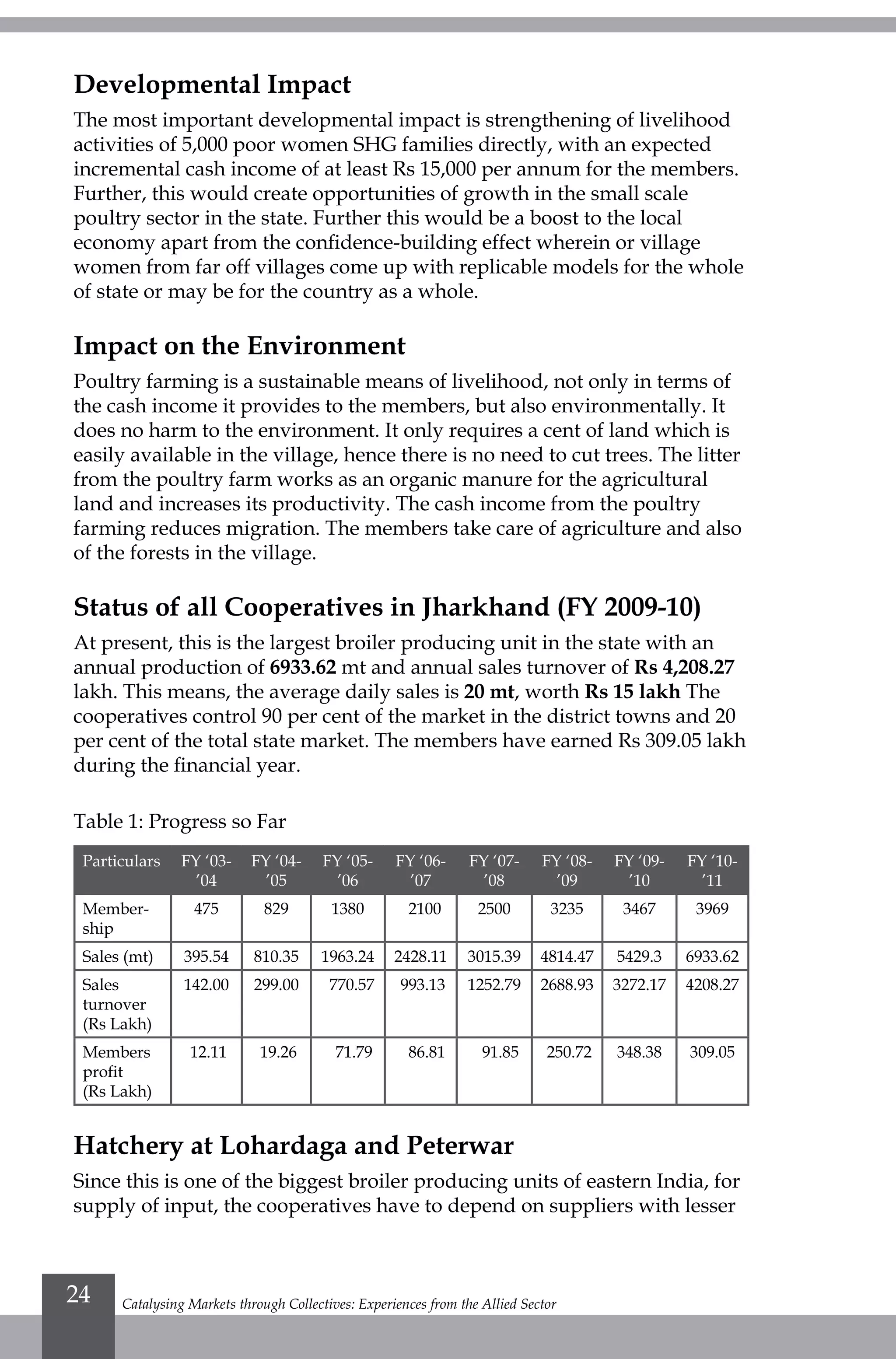
At present, this is the largest broiler producing unit in the state with an
annual production of 6933.62 mt and annual sales turnover of Rs 4,208.27
lakh. This means, the average daily sales is 20 mt, worth Rs 15 lakh The
cooperatives control 90 per cent of the market in the district towns and 20
per cent of the total state market. The members have earned Rs 309.05 lakh
during the financial year.
Table 1: Progress so Far
Particulars FY ‘03-
’04
FY ‘04-
’05
FY ‘05-
’06
FY ‘06-
’07
FY ‘07-
’08
FY ‘08-
’09
FY ‘09-
’10
FY ‘10-
’11
Member-
ship
475 829 1380 2100 2500 3235 3467 3969
Sales (mt) 395.54 810.35 1963.24 2428.11 3015.39 4814.47 5429.3 6933.62
Sales
turnover
(Rs Lakh)
142.00 299.00 770.57 993.13 1252.79 2688.93 3272.17 4208.27
Members
profit
(Rs Lakh)
12.11 19.26 71.79 86.81 91.85 250.72 348.38 309.05
Hatchery at Lohardaga and Peterwar
Since this is one of the biggest broiler producing units of eastern India, for
supply of input, the cooperatives have to depend on suppliers with lesser
Jharkhand Women’s Self Supporting Poultry Federation: A Perfect State of Cooperation 25
turnover. It has been found that the members of the cooperative societies
have to compromise on quality and quantity many a times. After feed,
chick is the most important factor. Seeing this, the cooperative society
of Lohardaga district has established the state’s biggest hatchery which
has the capacity to produce three lakh chicks per month. Each member
saves at least Rs 2 per chick.The eggs are being purchased from Jabalpur,
Hyderabad, Jalandhar and Bangalore. One more hatchery of this capacity
has been completed and is operational since May 2011 at Peterwar in
Bokaro district, funded by the National Cooperative Development
Corporation. The total monthly production of the chicks will be six lakh
per month. The hatching eggs are not available in the eastern region and
have to be purchased from the southern or northern states of the country.
A parent unit for the production of hatching eggs will a boon for the
enterprise on which the livelihood of 5,000 women depend. It is required
that the hatchery be backed by a parent farm.
Feed Mill
Almost all the cooperative societies have a feed mixing plant. They
procure maize and soyabean de-oiled cakes from the market and 15 per
cent concentrate from the federation and prepare the complete feed. The
federation is managing a feed mill at Barhi in Hazaribagh district where
15 per cent concentrate (mineral mixure) is prepared and supplied to the
cooperative societies. The average daily requirement of the feed to all the
cooperatives is more than 50 mt. Another feed mill is under construction at
Peterwar for uninterrupted supply of feed to the cooperatives.
The medicines and equipment are purchased collectively, which gives a
high bargaining power to the cooperatives. The medicines are purchased
from BGM Biologicals, an independent unit managed by the National Small
Holder Poultry Development Trust (NSPDT), a national collective of which the
federation is a part.
The major consumptions of the products is in the local markets. The
federation is planning on retail marketing of the products under their own
brand. Retail marketing will begin very soon which will give way to the
value chain development and further means of livelihoo d to the women.
How to Replicate
Marginalised disadvantaged women who wish to adopt the enterprise
take membership of the cooperative societies. The cooperative societies
then arrange for loans from the bank or subsidies and grant from
government agencies for infrastructure and working capital. The
association with the cooperative societies helps in easy access to finance. It
also helps to adopt the entire setting cost effectively, which a small farmer
finds difficult if done alone.
Catalysing Markets through Collectives: Experiences from the Allied Sector26
Poultry Value Chain: The Integration of Operations
The poultry market is influenced by large wholesellers and traders, who
own the vertical integration. They have large farms supported by a parent
unit, hatchery, feed units and other necessary input units. This heavily
decreases the cost of production for the large traders with small farmers
standing no chance for competition. The complex nature of these vertical
integrations has kept the small farmers away from it.
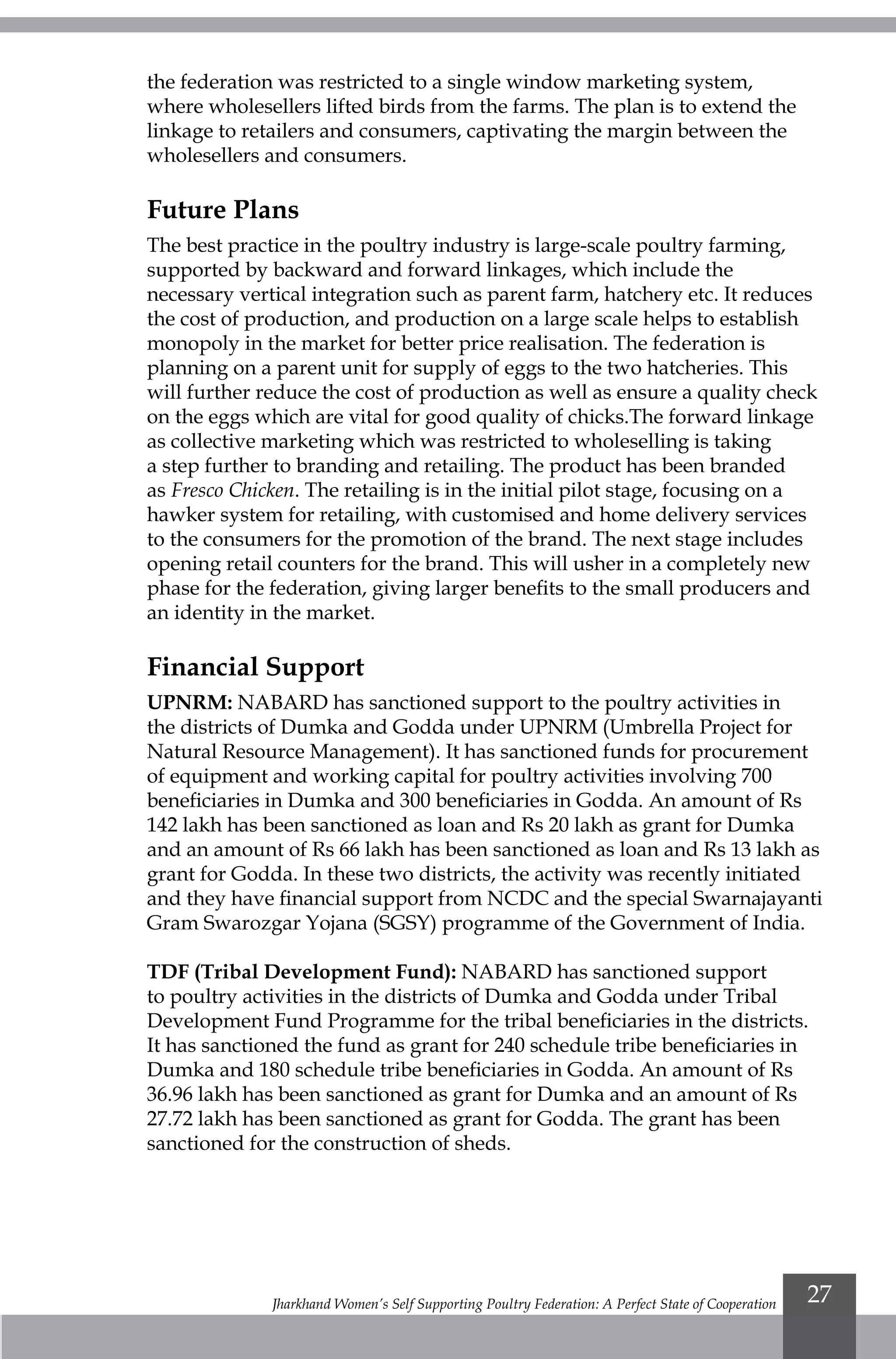
Figure 2: Poultry Value Chain
JWSPFL, with growing number of members is not far behind in vertical
integration. It already has two hatcheries functional at Lohardaga and
Peterwar with a capacity of six lakh chicks per month. It also has one
central feed unit at Barhi, Hazaribagh which supplies feed concentrates
to all the cooperatives. The feed concentrates are then utilized by the
cooperatives to prepare ready feed in feed-mixing plants operating in
every cooperative. The availability of feed and chicks, two most important
inputs within the federation, has helped in bringing down the cost of
production. Another central feed concentrate processing unit is under
construction at Peterwar, which will further help availability of feed
concentrates.
JWSPFL plans to notch up the vertical integration to the parent unit, for
supply of quality eggs to the hatcheries. In terms of forward linkage,
Poultry value chain
pure line
great grand parents
grand parents
consumers
parent unit
feed from feed mill
lifting of birds of wholesellers central market-
ing
by co-operative
rearing of birds brooding of
chicks
hatching
chicks
incubator at
hatchery
retailors
vaccination of
chicks in hatchery
Jharkhand Women’s Self Supporting Poultry Federation: A Perfect State of Cooperation 27
the federation was restricted to a single window marketing system,
where wholesellers lifted birds from the farms. The plan is to extend the
linkage to retailers and consumers, captivating the margin between the
wholesellers and consumers.
Future Plans
The best practice in the poultry industry is large-scale poultry farming,
supported by backward and forward linkages, which include the
necessary vertical integration such as parent farm, hatchery etc. It reduces
the cost of production, and production on a large scale helps to establish
monopoly in the market for better price realisation. The federation is
planning on a parent unit for supply of eggs to the two hatcheries. This
will further reduce the cost of production as well as ensure a quality check
on the eggs which are vital for good quality of chicks.The forward linkage
as collective marketing which was restricted to wholeselling is taking
a step further to branding and retailing. The product has been branded
as Fresco Chicken. The retailing is in the initial pilot stage, focusing on a
hawker system for retailing, with customised and home delivery services
to the consumers for the promotion of the brand. The next stage includes
opening retail counters for the brand. This will usher in a completely new
phase for the federation, giving larger benefits to the small producers and
an identity in the market.
Financial Support
UPNRM: NABARD has sanctioned support to the poultry activities in
the districts of Dumka and Godda under UPNRM (Umbrella Project for
Natural Resource Management). It has sanctioned funds for procurement
of equipment and working capital for poultry activities involving 700
beneficiaries in Dumka and 300 beneficiaries in Godda. An amount of Rs
142 lakh has been sanctioned as loan and Rs 20 lakh as grant for Dumka
and an amount of Rs 66 lakh has been sanctioned as loan and Rs 13 lakh as
grant for Godda. In these two districts, the activity was recently initiated
and they have financial support from NCDC and the special Swarnajayanti
Gram Swarozgar Yojana (SGSY) programme of the Government of India.
TDF (Tribal Development Fund): NABARD has sanctioned support
to poultry activities in the districts of Dumka and Godda under Tribal
Development Fund Programme for the tribal beneficiaries in the districts.
It has sanctioned the fund as grant for 240 schedule tribe beneficiaries in
Dumka and 180 schedule tribe beneficiaries in Godda. An amount of Rs
36.96 lakh has been sanctioned as grant for Dumka and an amount of Rs
27.72 lakh has been sanctioned as grant for Godda. The grant has been
sanctioned for the construction of sheds.
Catalysing Markets through Collectives: Experiences from the Allied Sector28
Table 2: Status of the poultry co-operative societies (Ist April 2010 to 31st March 2011)
Sl. No Name of the co-
operative society
District No. of
members
Qty of
broiler sold
(in metric
ton)
Sales
(Rs
lakh)
Members
Profit (Rs
lakh)
1 Lohardaga Grameen
Poultry Cooperative
Society Ltd
Lohardaga 569 908.34 534.49 28.33
2 Senha Grameen
Poultry Cooperative
Society Ltd
Lohardaga 285 164.34 100.20 5.73
3 Gumla Grameen
Poultry Cooperative
Society Ltd
Gumla 701 1710.14 1067.78 80.92
4 Potka Grameen
Poultry Cooperative
Society Ltd
East
Singhbhum
317 1065.29 680.61 33.32
5 Torpa Grameen
Poultry Cooperative
Society Ltd
Khunti 386 529.45 331.20 20.07
6 Petarwar Grameen
Poultry Cooperative
Society Ltd
Bokaro 648 1570.83 908.85 72.32
7 Chandwara
Grameen Poultry
Cooperative Society
Ltd
Koderma 128 14.47 9.97 0.37
8 Ekta Mahila Kukut
Palak Swalambhi
Sahkari Samiti Ltd.
Dumka 420 187.43 110.80 4.23
9 Godda Grameen
Poultry Cooperative
Society Ltd
Godda 105 38.47 26.87 0.81
10 Hazaribagh Mahila
Poultry Producer’s
Company
Hazaribagh 310 744.84 437.69 62.94
11 Patamda Grameen
Poultry Cooperative
Society Ltd
Patamda 100
12 Jharkhand Women’s
S. Poultry Fed. Ltd
Ranchi 666.11
Total 3969 6933.60 4874.57 309.05
Tribals Develop Fisheries in Dimbhe Dam 29
Tribals Develop Fisheries in Dimbhe Dam
Anand Kapoor & Budhaji Damse
In the year 2000, the Dimbhe dam inundated 2202 hectare (ha) of tribal land in the Ambe-
gaon block of Pune district. The once-green paddy terraces and small, peaceful hamlets with
quaint, red-tiled roofs and the bustling market town of Ambegaon went below water, and
the gentle, soft-spoken tribal people of this area were transported to faraway resettlement
colonies with their few belongings and cattle, displaced from their lands and houses, which
had been submerged. In all, 1253 families had to shift out, 11 villages were submerged fully
and another 13 villages were partially affected. Today 19 villages stand on the fringes of
the Dimbhe reservoir, which provides irrigation to about 14,000 ha of land. The face of the
command area has changed completely due to irrigation. The fields are lush green round the
year and farmers grow all sorts of vegetables, fruit and flowers.
Yet development had dealt the displaced and affected families a huge blow. They lost all
their best lands near the river and been forced to shift to the hill slopes above the water
level, to somehow eke out a living on stony land. But was water as a supportive natural re-
source for livelihoods only to be used for agriculture? The need for an alternative livelihood
for the displaced tribals was therefore the beginning of an exciting eight-year journey in
setting up fisheries which have enabled 214 families to harvest up to 27 tonne of fish annu-
ally, with the initiative poised to break even within the next three-four years. The producers
have successfully used state-of-the-art techniques in rearing fish in floating cages and pens
for the past five years. Tribal women are rearing goldfish in cages as well. The tribal
fishermen would like to have their own hatchery, about a third of them still do not have
boats, the fish have grown too big and their nets are small. However, the endeavour contin-
ues and hope burns bright.
3
How it All Began
In the year 2003, Budhaji Damse of Shashwat Trust, a Pune, Maharash-
tra-based voluntary organisation, observed that 25-40 members of the
tribal community displaced by the Dimbhe dam were venturing into the
Dimbhe reservoir regularly on truck rubber tubes with a total of about 50
kg of gill nets. However, their meagre catch was not even enough for their
own consumption. While the tribals had struck upon an alternate route
to a new livelihood, they were unable to build on it. So the Trust started
organising the tribals, holding meetings and discussions in all the 19 vil-
lages around the reservoir. Friends and fishermen from the Bargi Dam
Displaced and Affected People’s Association, Jabalpur, provided a guiding
hand. The villagers then decided to come together and formed an associa-
tion with a token membership fee. Shashwat introduced the first three
boats of the Madhya Pradesh type, made of galvanized iron sheets fixed
over a wooden frame, which were easy to operate and the people chipped
in with labour. The tribal women then came together to form 32 self-help
groups (SHGs).
CASESTUDY
Today the 214 members of the Dimbhe Jalashay Shramik Adivasi Mach-
himar Sahakari Society (DJSAMSS) Maryadit, Digad own around 147
such boats, have over 2,000 kg of nets and have harvested up to 27 tonne
of fish annually, amounting to a gross sales of Rs 7.03 lakh.
The Dimbhe Reservoir Area Poverty Alleviation
Programme
While working in this remote, hilly, steeply sloping, high rainfall, heav-
ily forested area since 1981, Shashwat Trust had been trying to formulate
a holistic area development plan based on the sustainable development
of natural resources and the skills and traditional knowledge of the local
tribal people. It basically envisaged a catchment development programme
for the Dimbhe dam and the main activities included sloping land de-
velopment for erosion control – paddy field terracing, drawdown land
cultivation, fishery, horticulture and forestry. The then divisional commis-
sioner, Pune Division, Pune, P. D. Karandikar, after his visit to the area in
February 2004, put most of the suggested activities together, envisaged
them into a proper framework for government intervention and then initi-
ated a poverty alleviation programme in 38 tribal villages situated in the
catchment area. Fisheries, cultivation of drawdown land, that is, land that
becomes available at the edges of the reservoir when the dam water levels
go down, and the making of new paddy fields with stone bunds on steeply
sloping lands owned by the tribal farmers, were the three main activities
taken up as a first step.
On the invitation of the divisional commissioner, Karandikar, the Central
Institute of Fisheries Education (CIFE), Mumbai made its first visit to the
reservoir area in June 2006. A series of review meetings with the villagers
and the departments of Revenue, Cooperatives, Fisheries, Irrigation and
Tribal Development led to the convergence of schemes and the enthusi-
astic participation of the tribals has resulted in the work continuing in the
face of many obstacles.
Gaining Fishing Rights
The dam was emptied twice by the irrigation department for operational
reasons between 2000 and 2002 and all the fish died. Then the dam
was with a private fish contractor from 2003 onwards, who did not do
enough stocking. Also, just when the local tribals had started to organise
themselves to participate in the fishing activity, the fishery contractor
brought in fishermen from outside the state. On both these counts the
local fisher-people’s organisation opposed the fish contractor through
Satyagraha and their objections were upheld by the fisheries department.
Kusum Karnik, the founder of Shashwat, helped the community to get the
fishing lease in the name of their newly registered fish cooperative society
and DJSAMSS was registered on May 29, 2006. At the time of registration,
their membership status was as given in the table below:
Catalysing Markets through Collectives: Experiences from the Allied Sector30
Tribals Develop Fisheries in Dimbhe Dam 31
Table 1: Membership Details
Sr. no. Particulars Caste/ Tribe No. of Members
1 Katkari Primitive Tribe 68
2 Thakar Sch. Tribe 11
3 KoliMahadev Sch. Tribe 76
4 Nav-Bauddha Sch. Caste 01
5 Muslim OBC 01
6 TOTAL 157
Initially there was a total of 15 women among the members. Fisherwomen
here go out to lay the nets – alone or with their menfolk -- bring the catch
in and also participate in selling the catch. Hence the Dimbhe tribal fish
cooperative showed gender sensitivity by appointing five women to their
first Board of Directors which consisted of 11 members. Recently they have
offered membership of the cooperative society to all women fishers of the
present member families on a membership fee of just Rs 101 as against Rs
3,500 for others and the number of women members is steadily increasing.
Presently the total number of members is 214.
On June 22, 2006, a fishing contract was offered by the district fisheries
development officer to the cooperative against a deposit of Rs 1,21,000
towards the contract amount and Rs 36,360 as security deposit, totalling Rs
1,57,360. The Society members had collected Rs. 201 as entrance fees and
Rs 800 towards extra shares. Members of the Katkari tribe also somehow
deposited the money with great difficulty; some could not but were
accepted as members. The money collected was still short, so Shashwat
arranged for a loan without interest of Rs 50,000 and for the first time the
reservoir came under the control of the local tribals.
Stocking
As per the fisheries department, fish seed totalling 9,09,000 fingerlings, at
a cost of Rs 3.80 lakh was to be released in the reservoir in the first year,
i.e. 2006. On the request of DJSAMSS, Shashwat submitted a proposal to
the tribal development department for grant of Rs 5,37,360 towards the
contract amount, security deposit and fish seed cost. The department
sanctioned Rs 3,79,900 towards fish seed cost; Shashwat arranged for a
further Rs 41,003 towards beneficiary contribution from SWISSAID. The
tribal department sent the amount to the fisheries department and the
first fish seed was put in. However, it took three years for the fisheries
department to supply all the fish seed.
Harvesting the Fish
In the first year (2006-’07), the catch totalled 20,530 kg -- 3,670 kg of catla
and 16,860 kg of chela in 72 fishing days. The size of the catla in 2006 was
about 700 gm. In 2010, the total catch was 24,000 kg, including 4,381 kg
of chela and 10,340 kg of Indian major carps (IMCs), in 147 fishing days.
The above is the result of aggressive stocking of IMCs (catla, rohu and
mrigala) as advised by CIFE. The catch composition is changing. Shashwat
has provided a motorboat for transport of the catch from the interior parts
of the reservoir. Now the wholesale buyer comes to the dam site to buy
the catch. The fish cooperative keeps up to 25 per cent of the catch for
sale to the smaller local vendors, as part of its responsibility towards the
nutrition of the local poor people. Payments to the fishermen are made
every Sunday. Fisher-folk from different villages share the responsibility
of checking accounts and being present while making the financial
transactions every day of the week. Net size regulation and no-fishing in
the closed season are maintained by the community, sometimes even by
confiscating the nets and penalising those who break rules. Back in 2003,
at a meeting in Digad, the fishermen had resolved that they would not
use poison or explosives for fishing, and discipline themselves to net size
regulation, and they continue to observe it.
Advanced Fish Culture Techniques -- Cage Culture
In 2007, CIFE introduced the first four floating cages. In 2010, the
fishermen of Dimbhe successfully reared 3,90,500 advanced fingerlings
in cages and pens and released them in the reservoir. The 1,278 ha of
fishing area in the Dimbhe reservoir needs to be stocked with nine lakh
fish seed of fingerling size (25-35 mm) every year, as per the contract
conditions. However, the survival rates for such small size fish seed in
such a large reservoir are barely 10-15 per cent due to high waves and
other reasons. If the stocking could be done with fish seed of advanced
fingerling size – 100-150 mm -- the survival rates would increase up to
85-90 per cent. Nylon nets
of mesh size 4mm to 6
mm, in the shapes of cages
three metre long, three
metre wide and three
metre deep are tied onto
floating platforms in deep
waters and stocked with
about 2,500 fish seed of
catla, rohu and mrigala,
30-40 mm in size in each
cage. They are fed twice
a day with rice bran and
groundnut oil cake in
proportion to their body
weight.
Catalysing Markets through Collectives: Experiences from the Allied Sector32
Tribals Develop Fisheries in Dimbhe Dam 33
Every week the cage nets must be cleaned with long-handled brushes to
ensure good exchange of water inside and outside the cage. In about three
months the fish seed grows up to 100-150 mm. They are then carefully
taken out of the cages, counted and gently released in the reservoir. It is
quite a job to care for the small delicate fish fingerlings in cages floating
in deep water. In the rainy season there is so much floating debris that
the nets have to be cleaned almost every other day. If for some reason
three-four fish seed die, they must be removed immediately or else the
others start dying. Floatation is provided by sealed 200 litre PVC barrels.
Sometimes the barrels leak or they develop cracks and the waves go over
the cage tops. If a small gap develops in the joint of the top and side nets
due to carelessness, the inside fish seed floats out and away.
In 2007, CIFE had given the cooperative one broken cage structure and the
floats and nets for four cages. Shashwat and the tribal fisherfolk put in a
lot of effort to take two crops of advanced fingerlings in the first year itself.
Seeing the zeal of the tribal people, CIFE provided another 16 new cages
for them. The enthusiasm and keenness of the tribals in working on these
cages in 2009 and 2010 were heart-warming.
Ornamental Fish
In 2010, the tribal women put in goldfish in two cages on the suggestion
of the CIFE scientists. The goldfish turn a gorgeous shiny red-gold
colour after about two months in the Dimbhe waters. By 2011, 37 tribal
women had participated in eight trainings at different places in rearing
ornamental fish. They have successfully reared goldfish up to 75-100 mm
size and provided the same as brooders to CIFE thrice. Ornamental fish
are even more delicate creatures, but among them goldfish and angel-fish
are somewhat sturdy.
It was in 2009 that Mrs Bababai Wagh, a member of the primitive Katkari
tribe and vice chairperson of the fish cooperative, spoke boldly to the
director of CIFE. She said: “We have 23 women’s SHGs, please give us
some work for our hands”. It was from this that the idea of ornamental
fish rearing by tribal women came. About 50-70 women attended the first
training and introduction sessions regarding ornamental fish. The hands
of the tribal women are by nature able to handle these delicate ornamental
fish very gently. Eight to 10 tribal women at a time started to come and
take care of their goldfish in cages. Once a crack developed in the net of
one of the cages and many of the goldfish floated away, but the women
did not lose heart. Slowly they began getting proficient in cleaning the
cage nets, feeding the fish at proper times, taking measurements of length
and weight of sample fish periodically. It is a delight to see the shiny
red-gold creatures gently moving against the backdrop of the green-blue
waters of the dam lake.
The National Fisheries Development Board (NFDB) has recently
sanctioned 16 cages for a two-year project through CIFE to give hands-on
training to tribal women on rearing ornamental fish, as also another 32
cages to provide an opportunity to the tribal fisher-folk to familiarise them
with rearing advanced fingerlings. The first crop of goldfish and angel
fish is now to emerge from these cages. A new dawn is breaking over the
Dimbhe waters.
Towards More Cost-effective Techniques
Pen Culture was first tried by the fisherfolk in 2009 at Bendharwadi. They
tied a long four-metre high nylon net across a depression between four-
five fields near the edge of the reservoir using a framework of bamboo
and wooden poles. When the water level rose, the water came towards
that side of the pen enclosed by the net. Thirty-three thousand fish seed
were released into the pen and given the same feed. But in 2009 the dam
did not fill to capacity and the water entered the pen only to a height of
two to three feet. Soon the waters of the dam were released for irrigation
through the canals and the reservoir water started receding. The fishermen
were left with barely 21 days for the fish seed to grow. Still the fish seed
increased in size from 25-35 mm up to 70-75 mm. The net was then lifted at
a few places and the large-sized fish seed went into the reservoir by itself.
In 2010, the cooperative set up four pens in the villages of Bendharwadi,
Digad and Savarli. Again this year the dam filled up late, but due to heavy
rains, the water overtopped the net in one pen, hence stocking of this pen
got delayed. The tribals run a net across the pen a few times to promote
growth. Every three-four weeks samples of fish seed are taken out and
their length and weights recorded, but this task is more difficult to carry
out in the pens. Pens are less costly than cages but there is an element of
uncertainty about when the water will flow into the pens erected and to
what level it would stay for how many days in dam reservoirs.
Reservoir Fisheries Contract
We would like to share here the details of a three-year long effort for
rationalisation of the reservoir lease amount in Maharashtra.
Table 2: Value of Fisheries contract for Dimbhe Reservoir since 2005
Sr. No. Year Amount of
Reservoir Fisheries
Contract
1 2005-’06 Rs 54,000/-
2 2006-’07 Rs 1,21,000/-
Catalysing Markets through Collectives: Experiences from the Allied Sector34
Tribals Develop Fisheries in Dimbhe Dam 35
The GR of the fisheries department dated May 31, 2006 stated that the
contract amount may be the offset price or the amount of the last contract
paid by the contractor, whichever is higher.
During 2002-’07, the fishing contract vested in a private contractor of
Pune. He violated several contract conditions. Hence the regional deputy
director, fisheries department, Pune, cancelled his contract on June 21,
2006 and the contract was then offered to DJSAMSS on June 22, 2006. The
cooperative had to deposit Rs 1,21,000 towards the contract amount and
Rs 36,360 as security deposit totalling Rs 1, 57, 360.
Review of amount of fisheries contract for Dimbhe
reservoir
Offset Price
In Maharashtra, the offset price for fishing lease of a reservoir is calculated
on the basis of:
1) Estimated annual fish production,
2) Market rate of fish, ( Rs 25 per kg as per GR ref. (iii) ) and
3) Percentage of total value of fish production (1% as per GR ref. iii).
Estimated Annual Fish Production
Since 2001, the fisheries department has been calculating the estimated
annual fish production as per the formula mentioned in ref (iv). As per
this formula, the estimated annual fish production for Dimbhe and some
selected reservoirs should be as follows:
Table 3: The estimated annual fish production for Dimbhe resevoir
Sr.
No.
Reservoir Average
Area in
Hectares
Expected
Fish
Production
(kg)
Expected
Fish
Production
Kg/ hectare
Actual
Fish
Production
1 Dimbhe
(dist.
Pune,
Mah.)

1,280 126000+
(1280-300)x150
=2,73,000 kg
______________
1,27,000 kg*
213.28
___________
99.37*	
11.54 kg
(2009-10)
26.6 kg max
(2008-09)
2 Aliyar
(TN)
650 126000+
(650-300)x50
= 1,78,500 kg
274.62
194 kg
3 Tawa
(MP)
12,145 646000+
(12145-5000)x50
=10,03,250 kg
82.30
32.37 kg
max
(1998-99)
4 Bargi
(MP)
16,030 646000+
(16030-5000)x50
=11,97,500 kg
74.70
33.00 kg
max.
(1998-99)
5 Gandhi
Sagar
(MP)
40,200 646000+
(40200-5000)x50
=24,06,000 kg
59.85
16.41 kg
(2001-02)
82.87 kg
max.
(1994-95)
Note: * The estimated annual fish production for Dimbhe reservoir is 1,27,000 kg, as per
letter no. ji ma pu/ ta./ dimbhe/ 668/ 05 dated 21/5/05 of the Dist. Fisheries Dev. Officer,
Pune, addressed to the Dy. Commissioner (Dev.) Pune.
Table 4: Period required for Fish production: As per the GR dated June 29,
1995.
Reservoir area Improved procedure of awarding fish contract
For reservoirs of
area 201 ha and
above
Reservoirs falling in this range are large and the
expenditure required for their development is
also high. It takes three years to get the expected
fish production. Hence fishing contracts for such
reservoirs should be given for five years at a time,
for stocking large numbers of fingerlings, making
rearing ponds etc.
	
The cooperative therefore requested that:
•	 The amount of fishing contract for Dimbhe should be the offset price
as per the GR dated 4th Jan. 2002. For Dimbhe this amount was Rs
54,000 per annum.
Catalysing Markets through Collectives: Experiences from the Allied Sector36
Tribals Develop Fisheries in Dimbhe Dam 37
•	 A review of the formula for calculating the offset price may be
considered, as per mentioned earlier.
It was also suggested that the expected annual fish production for Dimbhe
may be based on the actual fish production of reservoirs of similar average
area in the nearby areas. Some of these are as follows:	
Table 5: Average area of reservoir
Sr. No. District Name of Reservoir Average area (hectare)
1 Pune Dimbhe 1280
2 Pune Khadakwasla	 1255
3 Pune Varasgaon 1178
4 Pune Yedgaon 1498
5 Solapur Javalgaon 1250
6 Nagpur Nand 1340
The cooperative’s submission was supported twice by the Divisional
Commissioner, Pune Division and the Regional Dy. Commissioner
Fisheries, Pune, but the government expressed its inability to agree.
Shashwat persisted in its support of the cooperative’s efforts through
media, memorandums and meetings at the secretary level in the
government. Shashwat was given to understand that few other
representations were also being made by others. Senior government
officials however told Shashwat that theirs was the only representation
on technical grounds. Finally, in 2009, the government rescinded its order
of May 31, 2006 for new reservoir lease contracts to be awarded, thus
reverting to the old reservoir lease amounts. Fisher-folk in the whole state
benefited from this effort. However, it took another two years before the
tribal fishermen of Dimbhe could benefit from this reduction in the lease
amount. The new fishing lease for Dimbhe, for the period 2011-16, was
offered to the Dimbhe Tribal Fish Cooperative Society in June 2011 at the
reduced rates of Rs 54,000 annually and has been signed by the society.
Fish Cooperative Society Gets New Board of Directors
The five-year term of the first Board of Directors of the Dimbhe Tribal
Fish Cooperative Society ended in June 2011. Elections for the next
Board of Directors were announced by the Asst Registrar (ADF) Pune.
The cooperative department on its own decided to appoint Mr. Budhaji
Damse, Project Coordinator of Shashwat, as Election Officer and the fish
society members recently elected their new directors entirely unopposed.
While the cooperative department can appoint non-officials as election
officers to conduct and oversee the elections, it is a rare occurrence. This
also helped the tribal community to save almost Rs 50-60,000 towards
election expenses.
Net Aquatic Productivity
Scientists from the Central Institute of Fisheries Education, Mumbai,
visited the Dimbhe reservoir on June 8-9, 2006 for a preliminary survey of
the reservoir. They were of the view that the aquatic productivity of this
reservoir was about half the good productivity levels. Some extracts from
their study report of June 2006 are as follows:
Table 6: Comparison between existing and ideal productivity levels
Sr.
No.
Parameters Existing Range Ideal range
1 Net Primary
Productivity
230-260 mg c/M3 /
day
500 mg c/M3 /
day
2 Alkalinity 27-30 mg/l 50 mg/l
3 Total hardness 35-38 mg/l 50 mg/l
		
Plankton: The population of zooplankton was scanty. Among the
phytoplankton, mainly chlorophyceae members were present but almost
in negligible quantity. Therefore it appears to be very low productive
water. 1
Experimentation for Increasing Aquatic Productivity
The net aquatic productivity of the Dimbhe waters being much less
than required, the people and Shashwat decided, after consultations
with the director CIFE, to plant fields which are submerged every year
under the dam waters with the green manure crop, Taag / Dhencha. The
seeds were planted just after the first rains in 2007 and the crop grew up
to knee and waist height at five different locations across the reservoir,
before getting submerged under the rising waters of the dam. Soon the
fishermen found that large-mouthed fish – catla – were coming to eat the
leaves of these plants. When the waters went down due to canal releases,
these lands emerged out of the water and the farmers who farmed these
draw-down lands sowed wheat, which is the normal practice here. The
yield was significantly higher. Dhanaji Bharmal of Fulawade harvested
500 kg from his field planted with dhencha as compared to the previous
year’s harvest of 350 kg. Soil analysis of dhencha-planted fields by CIFE
scientists, together with neighbouring fields without dhencha as control,
has revealed the following picture:
(Ref: Preliminary Survey Report on fisheries and socio-economic condition of Dimbhe
Reservoir, Dist. Pune, Maharashtra, June 8-9, 2006),by CIFE, Versova, Mumbai).
Catalysing Markets through Collectives: Experiences from the Allied Sector38
Tribals Develop Fisheries in Dimbhe Dam 39
Table 7: Changes in soil properties after planting of Dhencha/ Taag
S.
No.
Particulars Field
with
Dhencha
Field
without
Dhencha
Field
with
Dhencha
Field
without
Dhencha
Year of sampling:
2007
Year of sampling:
2010
1 Colour of soil Dark
brown
Light
brown
Blackish
Brown
Blackish
Brown
2 Soil pH 7.5 7. 4 7.0 6.8
3 Water retention
capacity (%)
54.0 44.0 42 40
4 Organic Carbon
(%)
1.54 0.14 1.52 1.05
5 Organic Matter
Content (%)
2.58 0.24 2.62 1.81
6 Total Nitrogen
(mg/100 mg)
1.50 0.14 152 105
7 Total
Phosphorous
(mg/100 mg)
6.5 2.0 6.25 5.96
Note: Extract from report of soil samples taken in 2007 and soil samples taken in 2010.
The experiment proved quite popular and in 2009-10 the fish cooperative
paid for half of the 20 quintals of dhencha seed planted by the farmers
who cultivate such drawdown lands on the edge of the Dimbhe reservoir.
Extensive plantation of dhencha/taag has been carried out here in 2010
under the CIFE-led, on-going NFDB-funded action research project.
Roadblocks
There have been many heart-breaks, and difficulties galore have hounded
the efforts of the tribal fishermen. In 2008 a pest attack on teak trees
around the reservoir resulted in their green leaves dropping into the water
and forming a sticky mass; the resultant effect was that the nets put in the
water by the fishers would get stuck together like ropes and no fish would
get caught. It would take the people a couple of hours of daily scrubbing
and washing with detergent powder before the nets were loose enough
to be laid in the water again. The problem reduced after the water level
fell considerably due to canal releases. Perhaps due to environmental
considerations, the catch reduced substantially in 2010, when even 40 kg
of nets laid out would not get even four kg of fish catch. In 2009 and 2010
the dam did not fill to capacity, reducing the water volume available for
growth of fish.
Very recently on August 28, 2011, all five gates of the Dimbhe dam were
opened for about one-and-a-half days due to heavy precipitation and this
has led to a loss of about three tonne of fish, with the fishermen incurring
a revenue loss of about Rs 2.5 lakh. The morning after the gates were
opened, people were lined up all along the river almost up to Gangapur,
about five-six km downstream of the dam and were collecting fish which
had come down with the water. The fish died due to the impact after
falling down the 72 metre high spillway. People holding three to five
fish each weighing four to six kg were a common sight that day. Budhaji
Damse (co-author of this paper) saw one person with a silver carp so large
that it was difficult to carry. It must have been 12-15 kg, and several others
were carrying fish in sacks on their backs. It was a big loss for the people.
Unprecedented rains across western Maharashtra in 2007 led to severe loss
as the fishermen’s nets were washed away in heavy floods. It was at this
time that floods inundated a large number of villages and towns of Sangli
and Kolhapur districts. On the request of the divisional commissioner,
Pune Division, a group of 12 fishermen from the Dimbhe dam area went
with 10 boats to the flooded areas; they were among the first to reach,
transport having been provided by the revenue department. They saved
over 700 people from the flood waters in the most remote villages in the
first two days before the speed of the flood waters became too much for
the flat bottomed manual boats.
Conclusion
It has been an exciting time, the coming together of tribal fisherfolk
-- women and men -- a voluntary organisation, various government
departments and scientists of a national level research institute. Together,
they seem to have made a difference to the situation.
The fish of Dimbhe reservoir is completely free of pollution, as the
upstream areas are all well forested and practically no chemical fertilisers
or pesticides are used. So this fish catch should really fetch higher
prices. Sixteen to 17 local fish species existed in the area before the dam
construction, but are slowly getting extinct or have lost their taste. Further
there are no takers in the market for special local species like Kolas and Loli
as they have many bones, and local species like Humbli are popular only
among the poorest slum dwellers because they are cheap.
There is a still long way to go. With fish catch increasing, the fishermen of
Dimbhe are now thinking of their own small hatchery, how to get funds
for a small cold storage of their own, another motor boat to transport the
fish catch in time, among other things. About 50 of the poorest primitive
tribal fishermen still do not own boats, all of them also need large size nets
– they are now getting fish weighting around seven kg and their nets have
remained small. Infrastructure support for stocking for the next three-four
Catalysing Markets through Collectives: Experiences from the Allied Sector40
Tribals Develop Fisheries in Dimbhe Dam 41
years seems to be very necessary, as also space and working capital for
the ornamental fish business of the tribal women. While the Dimbhe fish
cooperative society seems now well set on the road to self- sufficiency, it
shall still be another three-four years before they are able to meet all their
costs and carry out fish seed stocking in the reservoir. Shashwat would
like to expand operations and hopes to be able to help the fisherfolk
of the six medium dams within a 30-40 km range to increase their fish
production and also to better their lives.
Inland fish production in India today has a share of 55 to 59% of the total
annual fish production of 76.2 lakh metric tonne. Maharashtra has a total
fish production of 5.96 lakh tonne, of which fresh water fish accounts for
barely 1.32 lakh tonne (2007). There is a huge scope for improvement.
Large inland reservoirs today have an average production of 10-16 kg
per ha per year and this could be increased up to 200 kg per ha average
fisheries area per year with aggressive stocking of good quality fish seed
of advanced fingerling size at the proper times. Training of personnel at
the field level is an absolute necessity. It needs the will of the government,
the determination and full involvement of the local fishermen and
continued support by voluntary organisations together with resourcing
organisations. Shashwat feels that the expansion of such a livelihood
initiative could make a difference by providing a good protein diet for
the poor in the country at affordable prices and put smiles on the faces of
women and children.
Fisherwoman in Dimbhe
May 2011
2003, Boats in Dimbhe
Annexure1:FinancialPerformanceofDimbheFishCooperativeSociety
DimbheJalashayaShramikAdivasiMacchimarSahakariSansthaMaryadit,Digad,Tal.
Ambegaon,Dist.PuneComparativeDraftFinancialPerformance
YearTotal
Fish
Catch
(Tons)
Chela
(Tons)
Catla
(Tons)
No.of
fishing
days
Wage
ratefor
Chela
Rs.perkg
Wage
ratefor
Catla
Rs.perkg
Gross
SalesRs.
lakh
Wages
Paidto
fisherfolk
Rs.lakh
Business
ProfitRs.
Rs.lakh
Net
Profit
Rs.lakh
Net
Loss
Rs.
lakh
2006-0720.5316.863.67728155.191.961.871.94
2007-0834.0223.7810.241398157.693.611.600.43
2008-0927.8316.2611.571758157.032.993.011.84
2009-1014.754.3410.414510185.482.282.030.32
Catalysing Markets through Collectives: Experiences from the Allied Sector42
Tribals Develop Fisheries in Dimbhe Dam 43
Reference
i)	 GR no. matsyavi 1206/ pra. kra.105/ paduma-13, dated May 31, 2006
ii)	 GR No. matsyavi 1206/ pra. kra.105/ paduma-13, dated April 24, 2006
iii)	 GR No. matsyavi 1201/ pra. kra.224/ paduma-13, dated January 4,
2002
iv) 	 GR No. matsyavi 1199/20/ pra. kra.8/ paduma-13, dated October 15,
2001
v)	 GR No. matsyavi 1261/CR135/ paduma-13, dated June 29, 1995 of the
Department of Agriculture, Animal Husbandry, Dairy Development
& Fisheries, Mantralaya Vistar, Mumbai.
Catalysing Markets through Collectives: Experiences from the Allied Sector44
A Tryst With Siffs in Kerala 45
A Tryst With Siffs in Kerala
Debashish Maitra and Kushankur Dey
This umbrella organisation of fishermen’s societies has demonstrated how
a marketing-based platform, if well managed, can reap rich dividends for
traditional, small-scale artisinal livelihoods.
The origin of the South Indian Federation of Fishermen Societies (SIFFS)
network, that works in the Marine Fisheries sector, dates back to the Seventies.
A diocesan rehabilitation project resettled fish workers from various localities in
an uninhabited stretch of coast, later christened Marianad, about 20 km north
of Trivandrum, the capital of the state of Kerala. One of the major problems
that the fish workers faced in the new settlement was that of marketing their fish
catch. The marketing system of the region at that time involved beach auctions.
Controlled by merchants and middlemen, the system was inherently exploitative.
Confronted with this, the fish workers with the assistance of a team of social
workers decided to set up their own marketing system and appointed their own
auctioneer. Faced with a determined set of fish workers, the merchants, who till
then controlled the business, eventually had to yield. The fishing community then
took over a dormant cooperative society that had been registered in the village
earlier and started operations formally. This was the first fish marketing society
called Marianad Matsya Utpadaka Cooperative Society (MUCS). The society was
member-based and marketing-oriented, with membership open only to active fish
workers who managed the society themselves. The three core activities of MUCS
were marketing of fish caught by members, providing credit for renewal of fishing
equipment and promoting savings. This model was gradually spread across to a
few adjoining districts of Quilon and Kanyakumari and SIFFS was born with the
coming together of all the cooperatives in Trivandrum.
Today SIFFS is the apex body of a three-tier cooperative structure of small-scale
artisinal fishermen. Registered in 1980 under the Travancore Literary, Scientific
and Charitable Societies Act of 1955. It has adopted a four-pronged approach
involving livelihood protection and enhancement using appropriate technology;
policy research and advocacy to support the interests of artisanal fishermen;
resource management to ensure sustainable livelihoods in fishing; and alternative
employment and strengthening of women’s livelihoods to diversify the economic
base of the community and ensure its all-round development.
With close to 10,000 member fishermen, organised through 156 primary
societies at the village level, SIFFS over the last two decades has kept its focus on
strengthening the artisanal fisheries. Established essentially as a fish-marketing
organisation, SIFFS now provides a range of services to member and non-
member fish workers. Today, over 17,987 fish workers including non-members
are availing these services. After the success of SIFFS in Kerala and Tamil Nadu,
4
CASESTUDY
the viable, sustainable member-based and market-oriented cooperative model has
been replicated in Andhra Pradesh. The Kerala state government has also formed
its own cooperative federation -- Matsyafed -- modelled on SIFFS to oversee
various cooperative societies.1
Fishing As A Mainstay In Coastlines
The Fishery sector was one of the main sources of livelihood for those
who lived in the coastal areas of Kerala. It employed a majority of the
coastal community in primary, secondary and tertiary sectors associated
with fishing. The distribution of 590 km coastline in Kerala is mentioned
in Table 1.
Table 1: District wise distribution of coastline of Kerala
Serial No District
Length of Coast Line
Length (in Km) Percentage of Total
1. Trivandrum 78 13.20
2. Kollam 37 6.30
3. Alappuzha 82 13.90
4. Ernakulam 46 7.80
5. Thrissur 54 9.20
6. Malappuram 70 11.80
7. Kozhikode 71 12.00
8. Kannur 82 14.00
9. Kasargode 70 11.80
Total 590 100.00
Source: Department of Fisheries, Government of Kerala.
The growth of active fishermen in coastal fishing villages has increased
over a period of time. The growth of fisherfolk and the employment
pattern in the marine sector as well as coastal fishing villages are
presented in Table 2 below.
1
http://www.siffs.org/index.html
Catalysing Markets through Collectives: Experiences from the Allied Sector46
A Tryst With Siffs in Kerala 47
Table 2: Growth of fishermen in coastal fishing villages and employment
pattern in Kerala
Indicator 1961-
62
1973-
77
1980 2005 Compound
Annual
Growth Rate
of Active
Fishers (%)
Employment Pattern
(2005)
(A) Number
of Fishermen
74241
(22)
80898
(21)
131101
(20)
140222
(23)
1.46 Primary Secondary
(B) Marine
Fish Sector
- - - - - 194816 233774
(C) Coastlines
Fishing
Villages
- - - - - 140222 71074
Percentage
(C to B) - - - - - 72 30
Source: Sathidhas and Prathap (2009), “Employment Scenario and Labour Migration in
MarineFisheries”, Central Marine Fisheries Research Institute (CMFRI), Kerala.
The share of active fishermen to overall population was 23 per cent in
2005. It is evident that out of the total marine sector, inhabitants of coastal
fishing villages occupied 72 per cent, which indicates the importance of
fishing in these areas.
The Factors Leading To The Formation Of The
Cooperative
Lack of Bargaining Power
Fishermen generally sold their catch to the wholesalers at beach markets.
They were not able to quote their own prices. Wholesalers and other
agents garnered the maximum benefits. Even fishermen were not paid
on time. So, this necessitated the formation of an organisation where
fishermen could pool their catches and sell them at better market prices
through open and public auction. This enabled them to access the market
directly, bypassing the middlemen.
Lack of Credit
Fishermen felt the need of credit for different purposes like purchasing
and renewal of fishing equipment, repair and maintenance, post-
harvest activities, consumption needs etc. The lack of institutional
channels to provide credit to serve their purposes affected the fishing
activity. This coupled with inequitable distribution of earnings	 further
compounded the plight of the fisherfolk, leading to indebtedness and
marginalisation.
Lack of Technology
The fishermen grappled with their age-old indigenous equipment which
were gradually becoming obsolete and hence unproductive. Generally, the
large softwood used to build traditional canoes became scarce gradually.
Modernisation was need of the hour to introduce new fishing crafts,
single gear, and methods to suit temperate waters for more fishing. The
new boats were manufactured by the private players who priced them
high. Being unable to purchase, the small fishermen started becoming
marginalised as only the large merchants and fishermen could afford to
buy them. Their exploitation by greedy middlemen and unscrupulous
merchants along with many other socio-economic problems led small
fishermen to start thinking of organising themselves into a cooperative.
Genesis Of Fishermen’s Cooperative
The initial developmental efforts in the fishermen community was
flagged off by the Bishop of erstwhile Trivandrum, who stepped down
from the traditional charity-based approach to adopt the then popular
development philosophy of community development. Way back in 1961,
the Bishop initiated a community development programme at Marianad,
a fishing village 20 km away from Trivandrum. The Marianad Matsya
Utpadaka Cooperative Society, the first such intervention of the society
was an offspring of these efforts. To even out the malpractices in fish
marketing, the society appointed an auctioneer, which auctioned the
day’s catch to the village merchants. This process, in turn, offered some
benefits as compared to the earlier system where the middlemen directly
sold the catch to the merchants at profitable prices and offered part or zero
payment to the fishermen, who were usually debt-ridden.
Though the new intervention faced resistance from the local business
community, the model proved successful and gradually spread to the
neighbouring Kanyakumari district. The following figures illustrate
the existence of SIFFS as an alternative marketing channel to promote
direct marketing to export companies, to even out malpractices in selling
practices through auctioning, and to augment market linkages with local
agents.
Catalysing Markets through Collectives: Experiences from the Allied Sector48
A Tryst With Siffs in Kerala 49
Figure 1: Marketing channel of SIIFFS
FIG 2: Existing Channel at Market
Source: authors after compilation of notes from various sources; unpublished OTS reports
of IRMA (2004, 2006), annual reports of SIFFS (2006-07, 2007-08, 2008-09, 2009-10)
Transforming the Sector
In the late Seventies, Kerala witnessed organised agitation by small-
scale artisanal fishermen against the indiscriminate fishing techniques
of trawling used by the mechanised sector which was destroying the
ecosystem leading to the gradual reduction in the variety of fish species.
It was obvious that the organised artisanal fish workers could not defy
and fight against the dominant coalition of the mechanised lobby. So
the artisinal communities organised themselves both politically and
commercially. On the political front, the trade unions formed fought for
and defended their rights while the cooperatives were formed to ensure a
fair price for the fish and a regular supply of inputs.
District
Federations
Bill
Members Society
Input Supply
Encashment of
Bills Special Export
Quality Fish
Auctioning Bidder/
Wholesaler/
Retailer
Local Agents
Procuring
Export
Company
Direct Marketing
Seasonal Fishes
Retailer ConsumerCommission
Agent
Foreign
Consumer
Exporting
Agency
WholesalerFishermen
After having entered the marketing scene, the society then identified credit
and savings as its next area of intervention. Fishermen were traditionally
considered non-bankable and they found it difficult to access credit from
formal financial institutions. Therefore, credit and savings assumed
importance. The society convinced the local bank to lend working
capital to the fishermen through the societies. In order to ensure regular
repayment streams, it was decided that a fixed percentage would be
deducted at source. The problem of variability in earnings was mitigated
by keeping aside a fixed amount from the daily sales into the member
savings account. This came as a boon to fishermen who earlier, during the
lean seasons, had to rely on exploitative sources of credit.
As for the other features of the Marianadu cooperative model,
information gleaned from the 2005-’06 archival database of the Institute of
Rural Management, Anand (IRMA) reveals that from the member earnings
3 per cent was deducted towards the expenses of the cooperative, 2 per
cent as compulsory savings, and 10 per cent towards loan repayment. The
members were paid the remaining earnings on the same day or a day later.
The system not only ensured uninterrupted payment schedule but also
helped them save for future contingencies and other needs. This model
was gradually spread across to a few adjoining districts of Quilon and
Kanyakumari. It is worth noting that Trivandrum district had 15
such cooperative societies until 2004-’05.
As mentioned earlier, the Trivandrum cooperatives came together to form
SIFFS as the apex body, which was registered in 1980, overseeing a three-
tier structure -- primary co-operative societies, district level federations.
Apart from enhancing the marketing of marine fishes, livelihood
protection, and access to technology, SIFFS also undertook advocacy to
support the interests of the artisanal fishermen and all round development
through alternative employment and women empowerment in
Trivandrum, Quilon and Malabar districts of Kerala and Kanyakumari
district in Tamil Nadu. In addition to this, SIFFS involved itself in the
following other activities:
•	 promotion of development of fishermen societies and their federations
including both membership and cooperative services
•	 research and development of sustainable fishing technology through
supply of inputs for fishing
•	 processing and marketing of fish catch by setting up cold storage
plants and other processing equipment
•	 information services to enhance digital literacy among fishermen
•	 financial services through microcredit and other contribution to the
fisheries sector, especially fisheries management
Catalysing Markets through Collectives: Experiences from the Allied Sector50
A Tryst With Siffs in Kerala 51
History And Growth
Though the federation was conceived mainly to help the fishermen with
better fish marketing, that logic did not seem to be feasible or adequate
when the federation started its actual work. The logic of a marketing
federation seemed feasible and necessary because there was a lack of
well-established markets and market linkages. Over the next decade, by
the time SIFFS started functioning, the markets were well developed,
characterised by low supply and soaring demand, high turnover and
low margins already described above. On the actual resource line,
there was the problem of marine source depletion, which resulted in
decline of fish catches for the small fishermen, who mainly depended
on the traditional fishing craft, the catamaran. Technology related to
small-scale artisanal fishermen was then recognised as the area of
intervention for SIFFS. This intervention was more of an accident than of
an orchestrated design.
The genesis of this intervention traced back to the work of a Belgium
priest, who came to work in the Indo-Belgian project that began in
Muttom in Kanyakumari district in 1968. In the ‘70s, realising that
the large commercial trawlers were against the interests of the small
fishermen, Fr Gillet, with his expertise in boat-building and fibre glass,
started working on an alternative for the traditional catamarans. This
was necessitated by the short supply of Albizzia, the timber for these boats
and its rising prices. As a result of various experiments and the support
extended by the Intermediate Technology Group, U.K., a new boat made
of marine plywood was introduced. The boat was an immediate success as
fishermen saw it as the ideal vehicle for motorised fishing as compared to
catamarans with motors.
In 1982, Fr Gillet, who had already worked closely with primary
cooperatives and SIFFS, persuaded SIFFS to set up a boatyard for
manufacturing the new boats. The technology intervention of SIFFS
came at a time when as an organisation, it was struggling to even
out its marketing activities. The boatyard intervention was looked at as
a business opportunity and as development work for promoting new
technology. The first boatyard was started in 1983 at Anjengo, a village
in north Trivandrum. To cater to the demand of these fishermen, Fr
Gillet developed the Plyvallom and the boatyard at Anjengo became the
specialised manufacturer of plywood vallom.
Gradually in 1984, in order to pay due attention to the increasing problems
with the imported motors used by the fishermen who lacked adequate
knowledge and skills to operate them, SIFFS started a motor workshop.
Subsequently, outboard motor (OBM) servicing and training was also put
in place.
The federation’s activities were steadily increasing and its services were
being sought by fishermen from the neighbouring districts of Quilon
and Kanyakumari. Out of a felt need to integrate these fishermen
from different regions, the present three-tier structure of SIFFS with
primary autonomous village level societies, independent district level
federations and SIFFS as the apex body was formed (refer to fig 3 & 4).
With SIFFS being formed as the apex body, division of activities were
carried out between the district federations and the apex body. The
federation was given the responsibility of society supervision,
credit, fish marketing for the members, handling of assets and the apex
body retained only the technology-related work, boat building and OBM
services. The apex body was also to undertake activities that were beyond
the scope of district federations such as export and import of fish and
finding new markets. Further, it had the mandate to set up and hand-hold
new societies in new districts.
	 Figure 2: Core of SIFFS as an identity
Though technology intervention such as boat building could not
bring in immediate profits, it was needed for long-term benefits not
only to the member fishermen but also to others. With this vision, the
new SIFFS started off in 1986. With its initial intervention into fish
marketing, the expansion of activities of the federation was need-based,
responding to the specific needs of the community at various junctures
Activities
Commercial Developmental
R&D
Society Expansion
Alternate Employment
Training
HRD
Information Service
Advocacy
Boat Yard
OBM
Ice Plant
Marketing
Microfinance
Catalysing Markets through Collectives: Experiences from the Allied Sector52
A Tryst With Siffs in Kerala 53
over the past decade. Thus input supply activities started in the mid-
Eighties; microcredit and society expansion in the mid-Nineties,
and advocacy and strengthening in late Nineties, and later on the
federation focused on alternative employment generation programmes.
This is evident from the following depiction (refer to Fig 5).
Figure 3: A cursory view of three-tier structure of SIFFS
Source: SIFFS’s annual reports (2008-09, 2009-10)
SIFFS
Full
Member
Associate
Member
KDFSF
Kanyakumari
55
Fishermen
Societies
94
Women
Societies
ADSGAF
Thuthur
346
Deep Sea
Going
Fishers
34
Fishermen
Societies
4
Women
Societies
2
Fishermen
Societies
Central
Tamilnadu
AP Muttom
Boat
Building
Centre
16
Fishermen
Societies
8
Fishermen
Societies
15
Fishermen
Societies
16
Fishermen
Societies
TDFF
Trivandrum
FWS
Kollam
NKDC
Nellai
MFFS
Malabar
1980-1990
Technology Intervention
with Marine Plywood and
Out Board Motors, Market
Linkage
•	SIFFS invented
marine plywood
board. Earlier
K u t t u m a r a n
fishingcrafts was
used but due to
shortage of supply
they were replaced
with marine
plywood.
•	To promote
livelihood of small
fishermen, SIFFS
introduced out
board motor (OBM)
to help them go into
deep sea.
•	Market linkages
for better price
realisation
•	Set up Village
Information Center
for providing
computertrainingto
students,awareness
p r o g r a m m e
and facilitating
between local
community and the
government
2000 and Onwards
Old Age Security
Scheme, F-MIS
•	 Introduced pension
scheme for member
above 60 years of
age based on the
deposit of Rs 50
per month until the
retirement age (60)
	or
•	 actual whichever
is less. Innovation
with IT to venture
into Fish-market
intelligence system
(F- MIS) to capture
real time data
of fish prices at
different locations
to disseminate to
the catchers
Source: compiled by authors from various presentations and annual reports of SIFFS
The year 2007 marked a further change in the activities of SIFFS.
Following its work in post-tsunami rehabilititation, they successfully
handed over 451 houses to fishermen in Nagapattinam district.
Figure 4: Growth trajectory in different time period
1990-2000
Microcredit Programme
and Ice Plant
•	 Started microfinance
activity to provide
credit to members
who were left out
of credit hitherto
at reasonable rate
Integrated women’s
organisations into
the microcredit
programme.
•	 Alternative employ-
ment pro-grammes
like carpentry
capacity training
programme and
OBM maintenance
training programme.
Establishment of ice
plants as post harvest
utilities.
Catalysing Markets through Collectives: Experiences from the Allied Sector54
A Tryst With Siffs in Kerala 55
Gradually this rehabilitation work notched up phenomenal growth with
a construction of 1,686 houses in total in Nagapattinam and Kanyakumari
districts in March 2010. On the other hand, SIFFS witnessed a new
beginning as the then chief executive (CEO) Shri V Vivekanandan,
whose contributions over 25 years had been instrumental in the growth of
the organisation.
Figure 5: Organisation structure of SIFFS
Source: annual report of SIFFS (2009-10)
Board
CEO
Dy. CEO
Boatyard
Fisheries
Resource
Management
Admin Finance Project
Monitoring &
Reporting
Sr. Executive
Membership
Services
MFI
Alternative
Employment
R&D OBM HRD Information
Services
Post
Harvest
Impact and Outreach of SIFFS
SIFFS has increased its outreach to 156 societies with more than 9,200
active sea-going small- scale fishermen. The fish sales have already crossed
Rs 101 crore. SIFFS has also included 7,600 women in more than 180
groups and also 2,800 fishing families of crews engaged with members in
different activities.
Figure 6: Trend of membership and sales
Source: annual reports of SIFFS (2006-07, 2007-08, 2008-09, 2009-10), SIFFS website
Recently SIFFS has started one more initiative to support district
federations directly engage with fish exporters, which, in turn, earned
revenues for federations. This diversification strategy enhanced SIFFS
product portfolios.
Table 3: Direct fish marketing by federation to fish export agencies (in
tonne & Rs in lakh)
Item 2008-09 2009-10
Shrimp 36.84 69.65
Cuttle Fish 587.83 214.33
Squid 272.66 172.97
Needle 19.04 59.50
All Species (in tonne) 916.37 516.45
Total (Rs in lakh) 973.11 621.63
Source: SIFFS’s annual reports (2008-09, 2009-10)
Membership(innumber)
(Sales(Rs.incrore)
Membership and Sales Pattern
10000
9000
8000
7000
6000
5000
4000
3000
2000
1000
0
120
100
80
60
40
20
0
2001-02
Year
Sales
Membership
2001-03
2003-04
2004-05
2005-06
2006-07
2007-08
2008-09
2009-10
27.84
4782
4538
3556 3900
4755
7050
8885 9104 9264
32.48 36.6 32.9
44.08
73.32
82.93
86.09
101.42
Catalysing Markets through Collectives: Experiences from the Allied Sector56
A Tryst With Siffs in Kerala 57
Boat Yard And Outboard Motor Division
Table 4, 5, 6 reports the performance, turnover of the boatyard and
performance of the OBM division respectively. Boat production and OBM
had registered a relatively high growth rate of 19.93 per cent and 34.89
per cent in 2009-10 respectively with respect to the previous year. OBM
paid off well for SIFFS and its members. SIFFS continued with its efforts
to support the supply of Suzuki OBM and tried to keep the price under
control. The major challenge that SIFFS faced was the increasing currency
value of the yen against the rupee, which eventually reduced profitability
in late 2010.
Table 4: Performance of boat building activity
Indicator 2005-06 2006-07 2007-08 2008-09 2009-10
No. of boats produced 773 193 198 144 208
No. of boats repaired 468 604 954 974 709
Sales (Rs. in lakh) 635.03 173.31 169.98 225.09 285.88
Repair (Rs. in lakh) 21.65 33.29 37.95 39.72 32.72
Total turnover (Rs. in lakh) 656.68 406.6 207.93 264.81 317.60
Growth (%) -38.08 -49.21 27.36 19.93
Profit/Loss (Rs. in lakh) 55.99 -14.48 -12.28 -5.66
Source: SIFFS3s annual reports (2008-09, 2009-10)
Table 5: Turnover of boat production yard wise	 [Rs. in lakh]
Place 2005-06 2006-07 2007-08 2008-09 2009-10
Veli 58.42 (59) 61.97 (49) 68.12 (12) 63.02 (32) 57.82 (28)
Vizhinjam 19.99 (2) 23.41 (19) 13.76 (15) 24.27 (13) 65.77 (27)
Needakara 10.67 (10) 6.92 (5) 16.37 (10) 19.31 (9) 19.03 (7)
Thalessary 8.12 (7) 18.98 (39) 12.37 (20) 15.77 (18) 24.50 (48)
Vallevila 101.61 (97) 40.26 (25) 41.44 (22) 74.38 (31) 53.88 (19)
Manakudy - - - - 6.35 (7)
Tharangampadi 418.95 (556) 14.27 (45) 11.47 (44) 24.35 (27) 51.24 (49)
Ranganathapuram - - 4 (4) 0.75 (1) 1.49 (2)
Karaikal - - 0.18 (2) 0.42 (4) -
Kakkinada 1.62 (9) 0.94 (6) 2.26 (19) 2.84 (9) 5.81 (21)
Managalore 15.65 (15) 6.56 (5) - - -
Total 635.03 (773) 173.31 (193) 169.98 (144) 225.09 (198) 285.88 (208)
Source: annual reports of SIFFS (2006-07, 2007-08, 2008-09, 2009-10), note- number of
units is given in parenthesis of each cell.
Table 6: Performance of OBM division
Indicator 2006-07 2007-08 2008-09 2009-10
Number sold 1006 832 583 849
Number repaired 9888 9946 8047 7459
Sales (Rs. in lakh) 542.01 511.74 376.15 627.05
Turnover on repair (Rs. in
lakh)
87.95 120.72 168.09 107.08
Total Turnover (Rs. in lakh) 629.96 632.46 544.24 734.13
Growth - 0.39 -13.95 34.89
Profit/Loss 35.22 50.66 9.97 -
Source: annual reports of SIFFS (2006-07 to 2009-10)
Ice Plants
SIFFS has extended its post harvest management activity by constructing
three ice plants at three major locations, one at Vizhinjam in Trivandrum
followed by another at Enyam in Kanyakumari and the last one at
Karaikkal Medu in Nagapattinam district. Each plant has a capacity of 20
tonne per day. If a plant sells seven tonne of fish per day for 300 days a
year, then it breaks even. The establishment of ice plants helped SIFFS in
preserving fish when there was a glut of fish landings and selling them
to different merchants at reasonable prices as well as becoming a major
player in the fish business. The performances of different ice plants are
given below.
Table 7: Performance indicators of ice plants
Indicator Vizhinjam Enayam Karaikkal
Medu
05-06 06-07 07-08 08-09 05-06 06-07 07-08 08-09 08-09
Price/block
(Rs.)
24 24 22-24 22-37 37 32-37 32-37 32-37 1/kg
Ice
produced
(blocks)
50729 58292 21550 43031 16600 23410 26825 6898 195600
Ice
produced
(tonne)
2536 2915 1077 2151 830 1171 1343 345 195.6
Total Sales
(Rs. in lakh)
12.17 13.80 4.93* 11.61 6.14 8.51 9.05 2.41 1.96
Source: compiled by authors from annual reports of SIFFS (2006-07, 2007-08,
2008-09, 2009-10)
*total sales of Vizhijam plant went down in 2007-08 due to dismantle of operation of the
plants for maintenance works during Jun to Sep of the respective year.
Catalysing Markets through Collectives: Experiences from the Allied Sector58
A Tryst With Siffs in Kerala 59
Microfinance Programmes
The microcredit programme was initiated by SIFFS as an additional
channel to bridge the gap of credit requirement and credit
delivered by different institutions. It was felt critical to the growth
and stability of the membership. SIFFS reported Rs 9.21 crore of total
outstanding portfolios in 2009-10.
Figure 7: Growth of Micro-credit Activity
Source: annual reports (2008-09, 2009-10)
All the members of the SIFFS network are covered under the Janashree
Bima Yojona (JBY) Life Insurance Scheme. An initiative was also
undertaken during 2009-10 for launching a micropension programme
in partnership with Invest India Micro Pension Services (IIMPS).
SIFFS’ outlook towards microfinance activity assumed importance to
protect fishermen and associated members from earlier interlocking
arrangement of money lenders to a great extent.
Insurance And Risk Mitigation
Old Age Security Scheme (OASS)
In order to provide a pension scheme, SIFFS came up with an old age
security scheme where a member is expected to deposit Rs 50 per month
until 60 years of age. This scheme was put in place to provide financial
security to the fishermen who could not fish anymore due to old age.
Table 8: Growth of OASS
Indicator
Year
2007-08 2008-09 2009-10
Member 4799 5054 5165
Savings (Rs. in crore) 0.71 1.13 1.31
Source: annual reports of SIFFS (2008-09, 2009-10)
Micro-credit Activity
No. of Loans
Disbursed
No. of Loans
Outstanding
Amt. of Loan
Outstanding
Amt. of Loan
Disbursed
Amountofloan(Rs.inCrore)
NumberofLoans
6000
5000
4000
3000
2000
1000
0
25
20
15
10
5
0
2005-06 2006-07 2007-08 2008-09 2009-10
4.35
6.72
3.85
10.95
10.44
7.03
4.34 3.63
9.35
9.21
Insurance Schemes
SIFFS’ mandate is to cover all its members under the JBY Life Insurance
Scheme to reduce the risk of sudden death or any other accident. It has
also started with another insurance coverage scheme under the National
Insurance Company (NIC) Crew Insurance Policy. The coverage and
impact of insurance schemes are given in Table 9 and 10 below.
Table 9: NIC crew insurance coverage
Indicator
Year
2006-’07 2007-’08 2008-’09 2009-10
No. of Crew Units covered 3317 2584 3305 2593
Crew members covered 16585 14710 16525 -
No. of claims forwarded 6 8 8 5
No. of claims settled 5 5 5 2
Amount Received (Rs in
lakh)
2.50 2.50 2.50 1.00
Source: annual reports of SIFFS (2006-07, 2007-08, 2008-09, 2009-10)
Table 10: JBY LIC coverage
Indicator
Year
2006-’07 2007-’08 2008-’09 2009-10
No. of members covered 7049 8737 8838 9200
No. of claims forwarded 15 24 20 19
No. of claims settled 15 19 17 14
Amount Received (Rs in
lakh)
5.25 6.15 5.55 -
Source: annual reports (2008-09, 2009-10)
Fish Market Intelligence System (F-Mis)
SIFFS set up a Fish-Market Intelligence System (F-MIS) in 2008 to keep
records of fish prices at nine select markets namely, Bangalore in
Karnataka, Calicut, Pangode, Parripally, Ettamanoor and Tellicherry in
Kerala, and Kaliakavilai, Madurai and Chindariput in Tamil Nadu
and 11 fishing harbours in Karnataka, Kerala and Tamil Nadu. Fish prices
of 30 species which contributed 75 per cent of the total volume of catches
were coded and recorded. This has enabled SIFFS to remain “as close to
real time as possible” and be aware of price information for taking timely
marketing decisions with immediacy. They also provide price information
to a large number of fishermen through digital technology like SMS to
keep them abreast of the latest prices.
Catalysing Markets through Collectives: Experiences from the Allied Sector60
A Tryst With Siffs in Kerala 61
Post-Tsunami Reconstruction
So far, SIFFS has reconstructed 1,686 houses which were washed away by
the devastating tsunami. The reconstruction work was mainly conducted
at Tharagambadi, Chinnakudu, Karanstreet, and Puthupalayam villages
of Nagapattinam district and Muttom, Pooothurai, Vallavilai and
Marthandamthurai villages of Kanyakumari district. The houses built
under this scheme are given in Table 11 below.
Table 11: Distribution of houses built under post-tsunami reconstruction
programme (March, 2010)
Village No. of Houses District
Tharangambadi 1091
Nagapattinam
Chinnakudi 213
Karanstreet 22
Puthupalayam 45
Muttom 57
Kanyakumari
Poothurai 82
Vallavilai 124
Marthandanthurai 52
Total 1686
Source: annual reports of SIFFS (2008-09, 2009-10)
Advocacy
SIFFS has been continuing its support to Alliance for Release
of Innocent Fishermen (ARIF) associations, trade unions and NGOs
interested in the Indo-Sri Lanka trans-border fishing issues. The aim is
to get all fishermen who were arrested for crossing international marine
borders released. SIFFS has already succeeded in securing the release of
a number of fishermen after holding successive talks with the Sri Lankan
Deputy High Commissioner in Chennai.
Challenges And Sustainabilty
Competition
It has not been easygoing for SIFFS since Matsyafed has started viewing
SIFFS as a competitor. Matsyafed, being a government initiative, enjoys
some privileges over SIFFS. New government policies and subsidies
go to Matsyafed members, which eventually discourage new members
from joining SIFFS. It is evident that small-scale fishermen perceive
a one-time subsidy more beneficial than SIFFS’ long-term support of
various resources. Matsyafed provides 50 per cent subsidy or Rs 20,000
(whichever is less) on outboard motor below 10 HP and Rs 6, 000 per craft
for gear. Matsyafed also promises to provide 25 per cent of the cost of new
generation of fishing craft as subsidy.
Overfishing and Marine Resource Depletion
SIFFS has also been battling the issue of depletion of marine resources due
to over fishing. Overfishing is again caused by the use of inappropriate
technology, burgeoning market demand for marine fishes for both the
domestic and export market, subsidies given by the government and
overcrowding of non-active fishermen on coastal lines after the Tsunami
due to the many livelihood support programmes. The use of the trawling
method to catch demersal fish living at the bottom of sea and seine
fishing to catch pelagic fishes living at the surface of water column causes
depletion of marine resources. This is further compounded by the overuse
of fishing nets and out-board motorisation. All of this adversely affect
active fishermen and therefore SIFFS as well.
Changing the Marine Fish Production Scenario
The table below shows the declining trend in growth of marine fish
production in Kerala whereas the growth of inland fish production has
gained momentum. This has created significant challenges for SIFFS and
its members who are grappling with the challenge of doing business on
the basis of marine fish only.
Table 12: Deceleration of Marine Fish Production vs. Inland Fish
Production in Kerala
Year Marine Fish Production
(tonne)
Inland Fish Production
(tonne)
2000-01 566571 85234
2001-02 593783 78039
2002-03 603286 75036
2003-04 608520 76180
2004-05 601863 76451
2005-06 55891* 7798*
2006-07 598057 79572
2007-08 586286 81041
2008-09 583150 102482
2009-10 570013 93108
Source: Ministry of Agriculture and Ministry of Statistics and Programme
Implementation, Govt. of India.
*Production decreased due to the natural calamity, tsunami.
Profitability of Boatyards and Ice Plants
Boat production has been facing challenges on account of profitability.
Although it registered a growth rate of 19.93 per cent in 2009-10, it has
Catalysing Markets through Collectives: Experiences from the Allied Sector62
A Tryst With Siffs in Kerala 63
been running at a loss due to high overhead costs and price control (see
Table 4). Nevertheless, turnover at Vizhinjam and Thrangampadi have
improved whereas Veli and Vallevila accounted for a sharp decline in
total production of boats (see Table 5). SIFFS has been facing challenges
on account of higher boat prices due to VAT, sales tax etc. vis-a-vis
competitors in the informal sector and easy credit availability from private
agents. But on the flip side, VAT has levelled the field between SIFFS and
others like Matsyafed.
SIFFS also faces the problem of profitability of both the ice plants situated
at Vizhnjam and Enayam. The proximity to the sea affects the functioning
of the Enayam ice plant. Regular breakdowns push up the cost of
maintenance. Hence, overall ice production and profitability suffer. As
per estimation each plant has to produce 2,100 tonne per year in order to
remain at a no-loss-no-profit state. But recently it has been observed (see
Table 7) that the Vizhinjam plant managed to make a small profit except
in the year 2007-’08 when the plant was shut due to maintenance works.
The Enayam plant has not been able to reach even the break-even point,
incurring losses for the organisation.
Repayment Rate
There was significant decline in the cumulative repayment rate (CRR) and
one- time repayment rate (OTRR) due to poor performance of the
Kanyakumari and Trivandrum federations. Repayment was not healthy
enough across federations.
Table 13: Cumulative rate of repayment and one-time rate of repayment at
different federations of SIIFS
Federation
CRR OTRR
2006-07 2007-08 2008-09 2006-07 2007-08 2008-09
Kanyakumari 93.55 88.83 77.65 84.09 81.19 67.52
Trivandrum 91.77 86.03 66.68 79.76 75.67 58.82
Kollam 77.13 92.96 98.78 48.93 92.72 55.17
Kozhikode 88.42 89.80 90.90 75.55 76.06 76.81
CTN 88.84 87.83 89.23 87.57 85.31 85.75
NKC - 70.04 46.58 - 13.20 8.78
GOM 61.43 43.37 42.99 60.74 42.64 35.57
SNVF 98.26 98.63 98.90 85.18 88.90 89.61
KDFSF-Women - 83.34 98.62 - 81.83 90.03
Kakkinada-AP 88.42 55.77 69.68 75.55 46.73 53.37
ADSGAF 92.58 91.64 90.91 53.60 54.36 53.66
SIFFS 91.15 91.87 84.45 76.27 77.67 71.69
Outstanding Better than SIFFS Par below SIFFS
Source: annual reports of SIFFS (2006-07, 2007-08, 2008-09, 2009-10)
Portfolio risks (PAR) at 30 days and 90 days were much below the
satisfactory level. Members from Kanyakumari, Trivandrum,
Kozhikode and Gulf of Mannnar needed to improve the quality of
operations. It was reported that yield on portfolio significantly came down
to 7.75% from 11.97% in 2008-’09 as cost of funds substantially increased.
Table 14: Portfolio-at-Risk (PAR) of different federations
Federation
PAR 30 PAR 90 PAR 180
06-07 07-08 08-09 06-07 07-08 08-09 06-07 07-08 08-09
Kanyakumari 3.83 16.86 51.25 3.16 13.47 48.96 2.59 5.65 45.27
Trivandrum 16.91 28.35 78.24 16.08 24.88 75.30 14.63 13.37 57.86
Kollam 99.75 - - 99.52 - - 98.89 - -
Kozhikode 39.43 44.82 49.48 35.77 41.66 46.84 30.03 37.86 45.89
CTN 10.31 12.71 23.48 6.09 9.27 19.83 1.42 8.01 15.98
NKC - 92.85 100 - - 100 - - 100
GOM 29.91 66.96 96.46 16.76 58.26 93.85 10.21 45.71 84.03
SNVF 5.81 11.45 18.51 4.39 10.73 18.25 4.00 8.47 17.91
KDFSF-
Women
- 1.27 0.36 - 1.27 0.15 - 1.27 0.15
Kakinada-AP 39.43 61.76 51.17 35.77 56.27 38.01 30.03 33.19 28.78
ADSGAF 48.43 62.48 100 48.43 62.48 100 48.43 54.23 70.41
SIFFS 17.41 20.68 50.08 15.88 15.49 47.62 14.30 8.91 41.26
Outstanding Better than SIFFS Par below SIFFS/Much
Risky
Source: annual reports (2006-07 to 2009-10), note-06-07, 07-08 and 08-09 signify
2006-07, 2007-08 and 2008-09 respectively
Diversifying Livelihood And Employment
Training was provided to youth who were school drop-outs. Almost 300
youth were trained and 22 of them were successfully placed with various
companies. Therefore, it helped to lessen the burden on fishing livelihoods
and opened up new avenues for income generation. SIFFS also imparted
vocational training to hone their skills for need-based jobs as alternative
sources of employment.
Replication Of Siffs’ Footprint
After success in Kerala and Tamil Nadu, SIFFS has already replicated
and expanded its viable, sustainable member-based and market-oriented
cooperative model in Andhra Pradesh. In AP, it has established two
fishermen societies. The Kerala state government has also formed its own
cooperative federation, Matsyafed, modelled on SIFFS to oversee various
cooperative societies.
Catalysing Markets through Collectives: Experiences from the Allied Sector64
A Tryst With Siffs in Kerala 65
Road Ahead
The challenges and sustainability issues described above had been
anticipated by SIFFS former CEO Vivekanandan. He had clearly identified
the woes of artisanal fishermen and anticipated dramatic changes in the
domestic and international fish market with respect to eco-labelling,
quality standards, and other non-tariff barriers. He had also emphasised
the need for resource conservation (the possibility of co-management) and
management as a recourse not only to make the business sustainable but
also to uplift the socio-economic status of small fishermen.
Key Insights
SIFFS being one of the prominent NGOs tended to play an active
role in providing livelihoods for fishermen communities; it marked a
dominant position in the realm of the state economy by augmenting
infrastructural facilities and exports of special quality fishes.
Insight 1: Collective Action is Essential for Development of Small Pro-
ducers
Through the successful management of primary societies for more than
two decades and extension of such societies in other states, SIFFS
has demonstrated that marketing cooperative societies in the coastal
villages are viable and sustainable. Moreover, it tightened the knot on
existing primary societies, wherever possible, under a common banner
by providing an associate membership to them. This, in turn, enabled the
societies to channel their resources, approaches and efforts in an organised
and efficient manner.
Insight 2: Collectives need to establish controls over different types of
markets, produce, credit, input, and technology and they need to look
into the future, predict changes and work on responses.
SIFFS had succeeded in designing and developing varieties of boats,
which served as an alternative to mechanised boats and competed
successfully with them. This had essentially improved the economic
wellbeing of fisherfolk and thereby contributed in an indirect way towards
the alleviation of poverty among the fishermen communities. At the same
time, it had also led to new concerns. The unabated growth of plywood
boats with outboard motors and their over presence and over fishing
also contributed towards rapid depletion of marine resources. So, in
response to externalities, SIFFS had dedicated efforts towards research and
development of marine resources. Eventually the R & D team attempted
and succeeded in creating new crafts for better fishing. Finally, the
cooperatives extended their help in curbing the influence of middlemen in
fish selling and marketing by addressing the needs of the members.
Insight 3: Autonomy of Producers and Self-reliance are Determinants of
Success
SIFFS has facilitated the collective decision-making process among
communities of small fishermen at the village level. Consequently, the
communities are not only conscious of socio-economic and political
developments, but have also responded to such developments
intelligently.
Insight 4: Networking is One of the Important Rules of the Game
SIFFS encouraged the emergence of other organisations in the fisheries
sector and built useful networks with these organisations. It sought the
assistance of and lent assistance to these organisations in their day-
to-day functioning. Therefore, it enhanced social relations among the
organisations and eventually strengthened social capital.
References
1.	 Annual Report (2006-07), South Indian Federation of Fishermen 		
	 Societies (SIFFS); (2007-08), South Indian Federation of Fishermen 	
	 Societies (SIFFS); (2008-09), South Indian Federation of Fishermen 	
	 Societies (SIFFS); (2009-010), South Indian Federation of Fishermen 	
	 Societies (SIFFS).
2.	 Abraham, J. and R. Rajesh (2004), “Fish Market System Study”, 		
	 unpublished OTS report, IRMA.
3.	 Aneesh, A. and P. Pillai (2006), “Organizational Understanding 		
	 of South Indian
4.	 Federation of Fishermen Societies”, unpublished OTS report, 		
	IRMA.
5.	 Department of Fisheries, Government of Kerala (www.fisheries.		
	kerala.gov.in
6.	 Matsyafed (http://www.matsyafed.org)
7.	 Ministry of Agriculture, Government of India (http://www. 		
	agricoop.nic.in)
8.	 Ministry of Statistics and Programme Implementation, 			
	 Government of	 India (http://www. mospi.nic.in)
9.	 Sathidhas, R and S. K. Prathap (2009), “Employment 		
	 Scenario and Labour Migration in Marine Fisheries”, 		
	 Central Marine Fisheries Research Institute (CMFRI), Kerala, 	
	 Asian Fisheries Science, 22: 713-727
Catalysing Markets through Collectives: Experiences from the Allied Sector66
A Tryst With Siffs in Kerala 67
10.	 Vivekanandan, V. (2009), A workshop on “Building Capacity 		
	 for Sustainable Governance in South Asian Fisheries: 			
	 Poverty, Wellbeing and Deliberative Policy Network”, 			
	Chennai, India (http://www.wellcoast.org/				
	 wp- content/uploads/docs/Workshop%203%20report%20BSG.		
	pdf)
Catalysing Markets through Collectives: Experiences from the Allied Sector68
Energising Rural India through Contract Farming Integration Model in the Poultry Sector:
The Case of Suguna Poultry Farms
69
The Indian poultry industry is believed to be around 5,000 years old. Over
the years, the sector has emerged as one of the fastest growing segments of the
agricultural sector in India compared to any other agro-allied sectors contributing
approximately 4 per cent to the country’s Gross Domestic Product (GDP) and
27 per cent to the agricultural GDP (Annexure I).1
Poultry development has
not only grown in size but also in productivity. The production of the poultry
business grows at annual varying rates of 8-15 per cent compared to agricultural
crop production which grows at a rate of 1.5- 2 per cent per annum. Presently
the industry is growing at the phenomenal rate of 12 to 15 per cent every year
and the international credit agency, ICRA, has assessed that the growth rate of
domestic broiler meat would rise at around 15-18 per cent, while that of eggs is
tipped to rise at 5-7 per cent in the coming years.2
With rising incomes, growing
urbanisation, and population growth in India, it is estimated that the demand for
livestock products will double by 2020.3
It is also projected that the Indian poultry
industry will emerge as the world’s second-largest market.
The industry has undergone a paradigm shift in its structure and operations.
Till the 1960s, poultry keeping in India was largely a backyard venture4
facing
many challenges such as rigid entry barriers, competition, lack of extension, poor
marketing network and lack of appropriate technology which discouraged the
small-holder poultry farmers to participate in the growth of the sector. Nearly 80
per cent of the farmer population in India consists of small and marginal farmers
who faced the above mentioned problems in the poultry rearing business.
Recognising the potential of the poultry rearing business that would significantly
contribute to the generation of new employment opportunities and to people’s
nutritious status and thereby improve the livelihoods of rural India, the
Government of India took countless measures such as encouraging commercial
broiler production, credit support by commercial, cooperative banks and
financial institutions coupled with numerous proposals to implement centrally
sponsored schemes to revive the industry with minimal government intervention.
1 	
“Explore India at IAI (International Animal Industry) Expo 2011”, http://en.engormix.com/MA-dairy-cattle/news/explore-india-
iai-international-t17004/p0.htm, 29th June 2011.
2	
“Indian poultry industry needs to ramp up growth: ICRA”, http://www.moneycontrol.com/news/business/indian-poultry-indus-
try-needs-to-rampgrowth-icra_567153.html, Jul 20th 2011
3 	
http://sapplpp.org/aboutus/aboutsapplpp
4 	
‘Backyard’ or ‘small- holder’ or ‘family poultry’ as they are often described is basically keeping poultry in small units of 5 to 15
birds or so.
Energising Rural India through Contract Farming
Integration Model in the Poultry Sector:
The case of Suguna Poultry Farms
Ananthi Rajayya
“The innovations in contract farming demonstrated by Suguna is a win-win model
for the farmer, the company and the country,” says Soundararajan, MD,
Suguna Poultry
5
CASESTUDY
Consequently, poultry farming witnessed an astonishing augmentation in market
size and evolved from being a homestead activity into a commercial industry in
just four decades (Annexure II). As of 2011, the domestic poultry market size of
India was estimated at more than INR 47,000 crore.5
One of the significant aspects behind this phenomenal growth was the vertical
integration of broiler farms with rural poultry farmers through contract
farming arrangements. Of the broiler farms, one of the noteworthy integrators
is Coimbatore-based Suguna Poultry Farm which promoted the innovative
method of contract farming and vertical integration across India. “Contract
poultry farming was taken up for the first time in India at Udumalpet,” said B.
Soundararajan, Managing Director, Suguna Poultry Farm Limited.6
Western
India has followed the southern footsteps.
Pioneered by Suguna way back in 1984, the concept of vertical integration with
the small poultry farmers through contract farming was billed to be a veritable
instrument in addressing the livelihood issues of thousands of small rural
farmers who were really suffering from insufficient investments, lack of access to
working capital, technical know-how and poor marketing network, particularly
in the rural areas of southern and western India. It is estimated that 90 per cent
of the poultry in the southern region, 80 per cent in the western region, 70 per
cent in the eastern region and 10 per cent in the northern region are under a
vertically integrated system. Eighty per cent of the broiler industry is now under
this system in India. Tamil Nadu, Andhra Pradesh, West Bengal, Maharastra,
Karnataka and Punjab are the major broiler producing states in India.
In Tamil Nadu, over 90 per cent of the birds reared today are on contract farms.
Hardly 10 per cent of the farmers are involved in poultry rearing independently.
Backed by the complete support of farmers, the poultry integrators have been
expanding most rapidly in southern India, particularly in the Coimbatore district
of Tamil Nadu, which reportedly has a large integration, which accounts for about
75 per cent of poultry production and consumption. The Coimbatore region of
Tamil Nadu is thus considered the vanguard of broiler production in the country.
It is understood that, through poultry integration, Suguna has contributed
significantly to transform the poultry business from backyard activity into a
major industry and has helped thousands of small farmers to turn into budding
entrepreneurs to grow along with the company. This case study examines how the
poultry integration model, introduced and pioneered by Suguna, has energised the
livelihoods of rural poultry farmers in the Coimbatore region of Tamil Nadu.
5
“Indian poultry industry needs to ramp up growth: ICRA”,
http://www.moneycontrol.com/news/business/indian-poultry-industry-needs-to-rampgrowth
icra_567153.html, Jul 20th 2011
6
T.S. SUBRAMANIAN, “An economic resurgence”,
http://www.hindu.com/fline/fl2305/stories/20060324001808300.htm
Catalysing Markets through Collectives: Experiences from the Allied Sector70
Energising Rural India through Contract Farming Integration Model in the Poultry Sector:
The Case of Suguna Poultry Farms
71
The Contract Farming Integration Model
Started in 1984 with 200 layer birds at Udumalpet, a small town near
Coimbatore, Tamil Nadu, Suguna is today one of the largest organised
players in India and is believed to rank among the top ten poultry
companies worldwide with a steadily increasing global presence. Suguna
was initially set up as a poultry farm by two brothers -- B. Soundararajan
(Managing Director) and G.B. Soundararajan (Joint Managing Director).
They started their career as traders for egg and poultry feed with an
initial investment of Rs 5,000 borrowed from their parents. In spite
of having no formal education, the brothers have grown Suguna into
the largest player in the market. It is presently the fourth largest in the
world. From 200 birds and a few hatcheries in the 1980s, Suguna now
has 15,000 farmers under its contract farming model across 11 states in
the country. Over the period of 27 years, Suguna has gone from strength
to strength and has turned into a Rs 3,720 crore company as of 20117
.
The exceptional growth of Suguna Poultry lies in its strategic move
of contract farming across India, the genesis of which can be traced
way back to the 1990s. During 1989-90, when poultry prices collapsed
due to an oversupply of birds in the local market, the brothers saw an
opportunity for business growth by helping the poultry farmers who
had bought feed and medicines on credit and could not clear their dues.
With a view to helping the indebted farmers in recovering their money,
Suguna began to provide feed and health support to them in return for
the end product i.e eggs/broilers. “Suddenly, we thought why not invest
working capital and manage these farms? Farmers also wanted stability.
We supplied the inputs and they (farmers) became converters.”8
This led
to the inception of the concept of contract farming. Today the company
has expanded exponentially with a network of 15,000 rural farmers as
its contract growers. “It was initially tough for us, but we put our faith
in the farmers and nurtured them and there was no looking back,” said
Soundararajan.
Unique aspects of the working model of Suguna
•	 It’s a win-win situation for both the farmers and the
company.
•	 Assured minimum growing charges and incentives for
better practices.
•	 Provides best quality chicks, feed and professional
medical care.
7
http://www.sugunapoultry.com/institutional_sales/institutional_sales.asp
8
“He Counts His Eggs Before They Hatch”, http://chennaistartup.wordpress.com/, July 26th 2008
•	 Provides market linkage for the poultry produced.
•	 Technical training to the farmers in scientific poultry
management practices
•	 Intensive monitoring of poor performers and on-farm
counselling for further improvement
•	 Provides direct and indirect employment opportunities
through its business processes.
•	 No risk for the farmer like market volatility, raw
material fluctuations etc.
•	 Investment in highly sophisticated technology and
infrastructure
•	 Project guidance and assistance with getting finance
Suguna’s business model (Exhibit I) is known as contract broiler farming.
Under this model, farmers who own land and have access to resources
such as water, electricity and labour can become contract growers
for Suguna. Farmers are provided with day-old chicks (DOCs), feed
and health support. Apart from providing all technical services, the
performance is monitored on a daily basis with Suguna field staff visiting
the farms to check on the health of the birds, feed intake, growth and
mortality levels. In addition, the integrator brings Good Manufacturing
Practice (GMP), and technical know-how which leads to higher
productivity. At the end of six weeks time (42 days), the birds are weighed
and are ready to be sold by Suguna. Farmers are paid a handsome
growing charge for the birds at the end of this period in the range of Rs
3.10 – 4.50 per kg, depending on their efficiency in lowering the Feed
Conversion Ratio (FCR)9
.
The broiler farm believes in stiff quality standards. For ensuring the
quality, the process of growing the chicks has been standardised and the
contract growers must conform to stipulated norms laid down by Suguna.
Quality control checks are carried out by company staff to ensure the
norms are being met. It is estimated that, on an average, a typical farmer
franchisee with a minimum flock size of 5,000 birds can earn around INR
15,000 monthly for breeding broiler chickens on their farm. The poultry
integration model intends to provide a win-win situation to both the
farmers and the integrator.
The company has faced many challenges over the years. During the 1990s,
the company passed through a critical situation with an irregular supply
of day-old-chicks (DOCs) for its parent farm. “It was a major problem
for us. Without chicks, our growth would end. So, we decided to set up a
hatchery to supply DOCs to our network of contract farmers. This taught
9
FCR a measure of an animal’s efficiency in converting feed mass into increased body mass. Animals that have a low FCR are
considered efficient users of feed.
Catalysing Markets through Collectives: Experiences from the Allied Sector72
Energising Rural India through Contract Farming Integration Model in the Poultry Sector:
The Case of Suguna Poultry Farms
73
us an important lesson -- we had to integrate backward if we had to grow
and make it big in the business, say the Soundararajan brothers.” In order
to strengthen its backward integration system, Suguna established a
grandparent farm in the year 2000 and tied up with Ross Breeders of UK.
The farm has 132 grandparent and parent farms. It operates 35 hatcheries
with an aggregate capacity of 350 million eggs per annum. Suguna opened
its first state-of-the-art hatchery in Sadayapalayam, Tamil Nadu and has
expanded hatchery operations across the country.
Since poultry feed is the major input in poultry production and accounts
for 70 - 80 per cent of the total production cost, Suguna has invested
heavily in setting up feed mills. It currently operates 38 feed mills across
the country. Another four additional mills, two in Andhra Pradesh and
one each in Karnataka and Maharashtra are in the pipeline. The feed
mill in Bangalore will be Asia’s largest feed mill with a capacity of 80-
tonne-per-hour at an investment of Rs 5,500 lakh. This modern feed mill
is expected to benefit about 2,000 farmers in Karnataka while providing
direct employment to over 800 people and indirect employment to another
2,000. The company has also entered the global poultry market through a
partnership with Supreme Foods Co. Ltd in the Middle East and forayed
into the Japanese market as well. The company is already a supplier of
poultry to brands like McDonald’s and KFC.
It was a tough task for Suguna to get financial assistance from banks
during its initial period. However, over the years, given the company’s
Figure 1: Suguna’s Working Model
Maize and Soya
Procurement Net-
work for feed
Suguna Poultry Seguna Fresh Retail
Backward
Integration
Extension
services
6 weeks
Grandpar-
ent birds
Day-old
chicks
Distributed to
contract farms
Field staff makes daily
visits to each farm to
check the health of
the birds, their feed
intake, growth and
mortality levels
About Suguna Poultry
• INR 2 billion turnover
• 11 states with 4,800 employees
• 15,000 + farmers
• 25,000 channel partners
• 395 million chickens produced
per annum
• 36 hatcheries and 50 feed mills
• 1.56 million tons feed production
per annum
Hatchery
Parent
birds
Hatching
Eggs
Retailers
Exports
Forward
Integration
Source: Company website
track record, many banks started coming forward to support Suguna’s
expansion plans. More than 10 banks are already connected with the farm.
Besides, Suguna is the first Indian agri business funded by International
Finance Corporation (IFC), the private sector arm of the World Bank.10
An
investment of Rs 110 crore has been made by IFC towards the expansion
and development plans of Suguna. The integrator has invested in the
latest technology to improve its efficiency. It has signed a deal with IBM to
incorporate the Oracle E-Business Suite in its business operations with an
investment of Rs 8 crore.11
The company also plans to sell its ready-to-cook
and ready-to-eat products and branded eggs through other retail chains as
well.
Suguna’s backward integration has not stopped only with broiler
production. It has set up a network to directly procure maize and soya,
key poultry feeds, from farmers through the contract farming model
which is expected to keep the feed costs low. A constant and relentless
drive for growth and expansion now engages over 15,000 farmers from
8,000 villages in 11 Indian states, 4,800 employees, 25,000 channel partners
with around 500,000 people benefiting from indirect employment.
Through its wide network, it has created opportunities for small traders
and low-skilled employees to take part in the growth momentum of
Suguna.
Relevance of Contract farming in Tamil Nadu
The broiler industry is well represented in the southern states with nearly
45 per cent of total domestic poultry output led by states such as Andhra
Pradesh and Tamil Nadu, followed by other southern states.12
The layer
industry is more represented in these states especially Andhra Pradesh,
Tamil Nadu and Maharastra as 70 per cent of egg production is from these
states.13
The Namakkal region of Tamil Nadu is known as the country’s
egg hub, while the Coimbatore region leads in processed chicken meat.
Nearly 95 per cent of the chicken meat exports from the country is from
this region. The Tamil Nadu poultry industry contributes 16.5 per cent of
country’s total poultry export. The state contributes 15.83 per cent of total
egg production and stands second in egg production in the country.
Agriculture is the most predominant sector of the economy in Tamil
Nadu. Seventy per cent of the state’s population is engaged in agriculture
and allied activities for their livelihood. Besides agriculture, poultry
farming plays a predominant role in the rural development of the
10
“Suguna readying to tap retail revolution”, http://www.financialexpress.com/news/Suguna-readying-to-tap-retail-
revolution/197396/2, April 23rd 2007
11
“Suguna Poultry Chooses IBM to implement Oracle Applications”, http://www.oracle.com/global/in/pressroom/051114_India_Su-
guna_IBM_Oracle%20announcement_pre-final.html
12
“Indian po ultry industry needs to ramp up growth: ICRA”, http://www.moneycontrol.com/news/business/indian-poultry-industry-
needs-to-rampgrowth-icra_567153.html, Jul 20th 2011
13
“Indian poultry industry needs to ramp up growth: ICRA”, http://www.moneycontrol.com/news/business/indian-poultry-industry-
needs-to-rampgrowth-icra_567153.html, Jul 20th 2011
Catalysing Markets through Collectives: Experiences from the Allied Sector74
Energising Rural India through Contract Farming Integration Model in the Poultry Sector:
The Case of Suguna Poultry Farms
75
state as it helps the rural population earn a regular income. Due to the
uncertainties in the sources of agricultural income caused by insufficient
and untimely rainfalls, frequent monsoon failures and continual floods
during the monsoon in the delta districts of Tamil Nadu, the poultry
rearing business is regarded as a good source of supplementary revenue
by many of the rural farmers. With easy availability of inputs required for
poultry farming, simple equipments for feeding, watering and sheltering
for small units, less land requirement, poultry farming was considered as
a viable business for small holders till 1990s. However during 1989-90, the
poultry prices crashed due to the over-supply of birds in the local market.
Many of the rural farmers engaged in poultry rearing suffered huge losses
during the crisis and faced a severe working capital crisis, ultimately
quitting poultry operations. The poultry industry in the state was moving
towards a state of depression.
In this crisis situation, the contract farming arrangements by the poultry
integrators were regarded as a significant source of livelihood for
thousands of small rural farmers in Tamil Nadu. Through this contractual
relationship, the farmers were provided with quality inputs such as day-
old chicks, required feed, health and veterinary services along with the
technical guidance, management skills, credit facilities and marketing
facilities for disposal of live broilers in the market. In turn, the farmers
were remunerated a handsome growing charge for the birds at the end
of this period. The vertical integration led the farmers to be absolutely
free from the market volatility and raw material fluctuations etc. Contract
farming was also considered as a stimulating way of empowering the rural
small farmers, transferring corporate management skills to the agro-allied
sectors, providing assured markets for the poultry produce, reducing the
operating and transaction costs involved in the value chains of the poultry
production. Poultry rearing, which had been a cottage industry all along,
has now become a big industry by itself in many places in the districts of
Namakkal, Salem, Erode and Coimbatore.
Impact Analysis
With a view to evaluate the livelihood impact of the Contract Farming
Integration Model pioneered by Suguna Poultry Farm at the village
level, a study was conducted in the Coimbatore region of Tamil Nadu. In
Tamil Nadu, around 2,000 rural farmers are under vertical integration by
Suguna. In the Coimbatore region alone, 250 farmers are under contract
with Suguna. For the purpose of the study, 25 farmers under vertical
integration by Suguna were selected randomly (Exhibit II). Twelve of these
farmers had an average farm size of 3,500-5,000 birds and the remaining
was with the average flock size of 5,000-10,000 and above. The primary
data was collected from the farmers using a semi-structured questionnaire
and focus group discussions. Besides, secondary data was collected from
the company websites and other research reports available on the Internet.
Table 1: Total Sample Size
Total farms
under
contract
farming by
Suguna in
Coimbatore
Region,
Tamilnadu
Average
Farm Size
(No. of
birds/cycle)
Sample
farms
selected for
study
Small Farms
with an
average size
of 3,500-
5,000 birds
Medium
and large-
scale farms
with an
average size
of 5,000-
10,000 and
above
250 7,500 25 12 13
Reaching a Large Number of Small Farmers
In earlier days, poultry keeping in India was largely a backyard venture
where households kept an average flock size of eight to 10 birds. Though
there existed a certain degree of success in reaching out to poor and
impoverished communities through the backyard poultry model14
, the
scavenging-based desi birds, mainly for household consumption, made
a minor contribution to rural livelihoods as the net income per bird per
month was very meagre, ranging from Rs 4 to Rs 13 per bird per month.
Another bigger hurdle often confronted the backyard model -- a very high
chick mortality rate due to inadequate medical care. However, with the
introduction of contract farming in Tamil Nadu, broiler farms with a flock
size of less than a 1,000 birds became a rare sight. Broiler farms with an
average of 3,500-5,000 birds are categorised as small broiler farms as they
achieve economies of scale, thereby generating adequate income to sustain
a family.
Lack of technical skills, adequate working capital, and the inability to bear
the risks associated with perishable commodities like poultry, greater
price fluctuations, lack of access to market information compelled the
small farmers to opt for contract farming. With lower opportunity cost of
labour and lower investment, small farmers see the contract growing as
a lucrative offer. Since the entire family is involved in the activity, small
farmers are highly motivated and require less supervision with better
husbandry management practices whereas the hired labour require more
supervision and wage rate is also higher comparatively (Rs 120-150 is paid
per day per hired labour in the region). Small farms are able to grow a mix
of crops and livestock, thereby increase their income. In a comparative
study on Institutional Innovations and Models for Agribusiness and Agro-
Industry in India, it was observed that Suguna had been ranked strong
in reaching large number of small farmers with adoption of the latest
technology and scientific management practices (Annexure III).
	
14
‘Backyard’ or ‘small- holder’ or ‘family poultry’ as they are often described is basically keeping poultry in small units of 5 to 15
birds or so.
Catalysing Markets through Collectives: Experiences from the Allied Sector76
Energising Rural India through Contract Farming Integration Model in the Poultry Sector:
The Case of Suguna Poultry Farms
77
From Independent Farming to Contract Farming
Most of the contract growers of Suguna were engaged in the poultry
business independently before the joining the integrator. The major causes
for the entry of independent farmers into contract farming in the region
are lack of working capital, risk reduction, additional income, and lack of
marketing and technical knowledge. “There is no risk for us as we do not
own the chicks. We also don’t have to worry about the prices of feed stock,
the logistics of arranging for veterinary guidance and the selling price of
chicken. Suguna takes care of all that. We just need to ensure that the birds
are well looked after as they grow,”15
says one of the contract farmers
engaged by Suguna since 1994.
Lack of capital was the most frequently cited reason for entering the
contract system. Farmers require initial capital to establish a poultry farm
and they also need cash to meet day-to-day expenses. Feed constitutes
almost 70 per cent of the total input cost of the poultry rearing. By acting
as a resource providing agency, the major component of the working
capital is borne by the integrator. In contract farming, the contractor
provides feed, DOCs, veterinary care and technical and marketing
assistance which represents over 90 per cent of the total cost of production.
Farmers have to incur only 10 per cent of the costs in farming poultry.
Through contract farming, the farmers are able to get financial assistance
without paying interest to run the business smoothly.
Repeatedly stung by a volatile market, independent farmers sometimes
have to sell even below the production costs. However with the assurance
of guaranteed returns, supply of required inputs and regular market
linkages for the poultry produced, the farmers see contract farming as a
good security cover for their poultry produced. Undisclosed quality of
inputs, penalty for the discrepancies in poultry output, etc. are perceived
as a lacunae in contract poultry farming. But still the poultry farmers are
much more interested in contract farming, primarily because of numerous
advantages they enjoy by integrating with the broiler farmers through the
contract farming model.
Supplementary Income for the Agri-farmers
Engaging in contract farming for poultry rearing provides a
supplementary income for the farmers who are already involved in
agriculture. In Tamil Nadu, most of the agricultural farmers are engaged
in coconut growing. However, with uncertainties in the sources of
agricultural income and diminishing returns from crop-based agriculture
caused by the insufficient and untimely rainfalls, frequent monsoon
failures and continual floods during monsoon in delta districts of Tamil
Nadu, many of the rural farmers prefer to engage in the poultry rearing
business besides agriculture. With easy availability of inputs required for
15
Madhavan N. , “Radically different”, http://businesstoday.intoday.in/story/radically-different/1/2513.html,
poultry farming, simple equipment for feeding, watering and sheltering
for small units and less land requirement, poultry farming is considered a
viable business for small holders.
Housing an average flock size of 3,500 - 5,000 birds is estimated to fetch
around Rs 15,000- 25,000 per cycle of 42 days which would generate an
annual income of Rs 80,000-1,50,000 with an investment of Rs 2,00,000-
3,00,000 for shed construction and other expenses. Hence, poultry farming
plays a predominant role in the rural development of the state as it helps
the rural population earn an income regularly like a salaried person.
Employment Opportunities for Unemployed Youth and
Household Women
In most of the cases, unemployed educated youth and women from the
rural areas of the region welcomed contract farming primarily because of
the assured returns, which could not be expected in conventional poultry
rearing. Subramani (25), a graduate who has been in poultry rearing for
the past seven years said: “Contract farming has helped me to generate
adequate income for my family livelihood. It also helped me to settle my
loan amount of Rs 5,00,000 taken from the cooperative society for the
shed construction”. He is earning around Rs 20,000–25,000 per cycle with
a flock size of 5,000 birds at a growing charge of Rs 3.10 per kg. Initially,
he had been with a local poultry integrator who had taken much time (40
days) to replace the chicks each time. Dissatisfied with the time taken for
replacement, he shifted to Suguna where the integrator works on a time
cycle of only 15-20 days for the chick placement. He is also happy with the
assured and guaranteed minimum returns received from the integrator.
Suguna makes the payment to the farmers at the end of 10 days of each
cycle period.
Ananthi (38), a housewife, has been assisting her husband in the contract
poultry rearing business for the past four years. From the beginning
they have been under contract with Suguna. With a flock size of 5,600
birds, they earn around Rs 25,000–30,000 per cycle at a growing charge
in the range of Rs 3.10–4.50 per kg. She said that, with the handsome
growing charge got from the integrator, she had settled three-fourth of
the loan amount of Rs 5,00,000 taken from the State Bank of India, besides
providing a livelihood to her family of four.
Free from Market Risks
Lack of proper marketing facilities is another reason for entering the
contract system. Under the contractual agreement, the farmer is assured
of input supplies and platform for disposal of the produce, hence they are
absolutely free from market volatility, raw material fluctuations etc.
Catalysing Markets through Collectives: Experiences from the Allied Sector78
Energising Rural India through Contract Farming Integration Model in the Poultry Sector:
The Case of Suguna Poultry Farms
79
Scientific Poultry Management Practices
For ensuring the quality, the process of growing the chicks has been
standardised and must conform to exacting standards laid down by
Suguna. Quality control checks are carried out by company staff to ensure
the norms are being met.
Efficient Supply Chain Management and Reduced Price
Suguna has successfully reduced middlemen in the poultry chain from 14
to 4. Farmers deal only with the company, and get assured returns. “Until
then the middlemen took away around 10 per cent as commission. As a
result, costs increased by 25 per cent,” said Soundararajan. With reduced
number of middle men and streamlined marketing channels, Suguna is
able to maximise efficiency, lower the production and transaction costs.
Regardless of the market price, the farmers still get the assured growing
charge/ cost, and incentives mainly because of its streamlined market
channels. The resultant fall in real prices of the poultry meat made it
affordable across different consumer segments.
Project Guidance and Assistance in Getting Finance
Besides, the poultry farm has signed a MoU with many leading banks
such as SBI etc, and recommends its contract farmers to avail hassle-free
financial assistance from these banks. In some areas, farmers approach
Suguna with only land and the integrator helps them to put up a poultry
farm, and then places chicks and trains the farmers to manage the birds.
Seeing the impact of Suguna’s initiatives in rural development, the chief
ministers of other states such as Andhra Pradesh, West Bengal, Punjab
and Jharkand have approached and invited Suguna to set up operations in
their states. The model has also attracted visitors from across borders that
are keen to learn from Suguna’s initiatives and success and to adopt the
same in their countries.
The Road Ahead
Although the contract farming system has significantly contributed to the
income generation of rural small farmers, some of the contractual terms
practiced under the model are limiting the participation of poor farmers.
According to the 2006 National Sample Survey (NSS) report on Livestock
Ownership, the majority portion of the total poultry birds grown in
India was by the landless, marginal and small farmers who accounted
for about 90 per cent of the 107-million agricultural households in India
(Exhibit III). Around 70 per cent of poultry population was “native bird”
and accounted for 70 per cent of egg production. Today, over 80 per cent
of poultry production is an “intensive managed production system”
managed mostly by large-sized farms with flock sizes of 10,000 birds and
above.
Figure 2: Distribution of Poultry Birds among Indian Households 2003
Source: U. Pica-Ciamarra and J. Otte , “Poultry, Food Security and Poverty in India:
Looking Beyond the Farm-Gate”, http://www.fao.org/ag/againfo/programmes/en/pplpi/
docarc/rep-0902_indiapoultry.pdf
With the introduction of the commercial broiler, this proportion has
changed and it is becoming apparant that the landless labourers and poor
farmers are not significantly benefited in the contract farming model as
land ownership is a prerequisite to enter into the contract. Moreover,
poultry development is chiefly confined in the cities. Tribal areas and low
poultry developed areas are difficult for the modern poultry system to
reach out to.
There are no significant collective initiatives in the poultry segment
like the PRADAN Model where poultry cooperatives are run by poor
sections of the society. They primarily use the backyard venture for their
commercial poultry production. In the absence of significant collective
initiatives in the poultry segment, the self-sustainable development of the
poor is questionable in southern India. However the system can be fine-
tuned and there are ways to integrate these resource poor segments with
the larger market. Some of the recommendations are:
•	 Broiler farms like Suguna which have demonstrated a tremendous
success in energising rural India through contract farming can
encourage the smaller size farms with a flock size of 400-700 birds as
these small farms can easily be managed by rural households with
lower fixed cost. These small units would generate income in the
Million
Landless Marginal Small Semi-medium Medium
Large
<0.002 ha 0.002-1 ha 1.01-2.0 ha 2.01-4.0 ha 4.01-10 ha >10 ha
Source: Gol (2006a)
90
75
60
45
30
15
0
Number of HH Number of birds
Catalysing Markets through Collectives: Experiences from the Allied Sector80
Energising Rural India through Contract Farming Integration Model in the Poultry Sector:
The Case of Suguna Poultry Farms
81
range of Rs 15,000–20,000 for 200 days of work annually. It could be a
viable business for the self-help group (SHG) women through group
rearing activities in rural areas.
•	 The Indian commercial poultry system can be modified to make it
more pro-poor by implementing the lessons learnt from the backyard
poultry initiatives that are common in rural communities. The broiler
farms can broaden their horizons by engaging in Emu16
farming also
through the contract farming model.
-	 It would be a win-win situation for both the farmers and the
company.
-	 It is estimated that there would be a huge demand for emu meat,
oil, skin, feathers, nails and egg shells in India and abroad as its
usage is high in industries such as pharmaceutical, fashion and
food.
-	 Emu farming is in the nascent stage in southern India. A large
number of small farms like Susi, Queen etc are involved in emu
farming.
-	 In the present emu farming system practiced by new farms, the
integrator receives a refundable deposit of Rs 1,50,000 to 2,00,000
for 10 emu chicks and sets up a mesh-wire fencing and a small
shed (300 sq ft is required for 10 chicks). The integrator also
provides feed, medicines and insurance coverage at no cost to the
farmer. Rs 6,000-8,000 per month is paid as a growing charge for
the two-year period. At the end of the period, the grown emus
are taken back by the farm and the deposit amount is refunded.
It is estimated that around Rs 72,000 - 1,00,000 can be earned by a
farmer as an annual income.
-	 The major impediment of the present emu farming system in
integrating the poor sections is the huge deposit amount to be
made by the grower initially. However, this system can be fine-
tuned to include the poor by reducing the deposit amount and
lowering the growing charges. With the minimal land requirement
and better experiences in backyard poultry management practices,
emu farming would be a great source of livelihood for the rural
poor farmers.
-	 With an established operations and marketing network, and
farmer base, considerable market share in the international
market with greater experience in vertical integration and contract
farming, emu farming would be a profitable business for Suguna
while addressing the pro-poor issues on the other hand.
16
Emu is an Australian bird, living on grains, cereals, pulses and grass, its immune system is so strong that it hardly suffers from
any disease. It survives in any type of climate.
Annexure I
Comparison with other Livestock Sector
Parameters Dairy Fisheries	 Poultry
1 Dominant Production System
Historical Small-
medium
Marginal-
small
marginal
Presen Small-
medium
Marginal-
small
large
2 Empoyment high high medium
3 Growth Opportunity 4% 5-6% 10%
4 Commercial Requirement for
Basic Seed Stock
25-30%
Private
40-50%
Private
95% Private
5 Extension Support Very good Moderate Very low
6 Public Investments high High Very low
7 Focus of Public Extension Breed
Improvement
Existing
Breeds
Existing Breeds
8 Farmer Social Profile Occupational Strong
occupational
Undifferentiated
Source: Kumar Anish, “ 2-Indian Poultry Sector - Integrating Poor & Small-holders :
Opportunities & Challenges “, http://sapplpp.org/informationhub/files/presentations/rural-
backyard-poultry-development,
Annexure II
Current Scenario (2010) Extrapolated
from FAOSTAT/GoI
Future Outlook : much stronger
Egg
production
59. million eggs •	 Commercial poultry sector’s
growth at 18.6% per year is
expected to continue (USDA)
Poultry Meat
Production
2.3 million tonnes •	 OECD-FAO Agriculture Outlook
2008-2017 demand and supply to
grow at 4.8% and 5.2% per year
over the next decade
Per Capital Consumption Driven by both demand & supply
•	 Strong per capita income
rises-6% p.a., increase household
purchasing power
•	 Rural-Urban Migration
•	 Iow priced products
•	 High income elasticity of demand
Eggs 55 eggs per annum
Meat 1.8 kg per annum
Contribution
to GDP
1.2% at Rs.350 billion,
10% of live-stock
sector
Employment Over 3 million
people (CARI Vision
2025-5m)
Source: Kumar Anish, “ 2-Indian Poultry Sector - Integrating Poor & Small-holders :
Opportunities & Challenges “, http://sapplpp.org/informationhub/files/presentations/rural-
backyard-poultry-development,
Catalysing Markets through Collectives: Experiences from the Allied Sector82
Energising Rural India through Contract Farming Integration Model in the Poultry Sector:
The Case of Suguna Poultry Farms
83
Broad comparison of different models on institutional performance parameters
Agro
Industry
Model
Reaching
lage
numbers
of small
farmers
Ensuring
adoption
of right
technology
and
practices
byfarmers
Use of
modern
processing
technology
and
meeting
the capital
costs
Delivering
strong
marketing
efforts
and per-
formance
Effective
management
and control
to meet
needs of all
stakeholders
Amul Strong Limited Strong Strong Strong
Nandini Good Limited Limited Reasonable Reasonable
Nestle Limited Strong Strong Strong Limited
Heritage Good Limited Good Good Limited
Mother
Dairy
Limited Limited Good Good Reasonable
Suguna Strong Strong Strong Strong Strong
Safal
Market
Limited Limited Good Limited Limited
HPMC Limited Limited Good Poor Poor
Pepsi Limited Strong Strong Strong Limited
ITC e-
Choupal
Strong Limited Strong Strong Limited
McCain Limited Strong Strong Strong Limited
Desai
Cold
Storage
Reasonable Good Good Strong Reasonable
Vasant P. Gandhi , “Institutional Innovations and Models for Agribusiness and Agro-
Industry in India”, http://www.gujagro.org/images/prof-vasant-gandhi-iim.pdf
Annexure III
Catalysing Markets through Collectives: Experiences from the Allied Sector84
Women’s Collective Venture towards Revival of Animal Husbandary for Livelihood Security -
A Case Study from a Village of Kutch District
85
Traditionally, livestock rearing or animal husbandry is considered one of the
major sources of livelihood for the rural poor, especially in the semi-arid regions
of the country. It contributes towards household income significantly and also
supports food security, improved nutrition, and insurance at the household level.
However, sustaining animal husbandry has become challenging for communities
in arid and semi-arid zones due to a precarious water situation, inaccessibility of
fodder, inadequate health facilities, lack of market and appropriate technology. A
combination of all these factors often force poor households to look for alternative
livelihood options such as migration, local wage labour etc, leaving behind their
traditional occupations. Moreover, in such situations, women are the worst
affected, posing a greater challenge.
This case study gives a picture of a women’s collective, Sairi Jo Sangathan, in the
Nakhatrana taluka of the Kutch district of Gujarat, and highlights the efforts made
for the revival of the traditional occupation of animal husbandry and the changes
it has brought about in the community. In analysing the case, an effort has been
made to bring forth the initiatives taken by the women for forming a community-
level institution and the arrangements that have been made surrounding the
resource use. In conclusion, this collective venture by women has not only revived
traditional livelihood options of the village but has also intensified the practice of
animal husbandry towards securing the livelihood of the community.
Context of the Women’s Collective Venture
This section illustrates the socio-economic, institutional, and natural
context in which the women’s collective initiative evolved in the village of
Dador.
Social Context
The village is inhabited by 118 households with a total population of 578
(298 males and 280 females). The residents belong to six communities and
include both Hindus and Muslims. The number of households belonging
to different religions and communities represented in Dador village is
detailed in Table 1 below1
Women’s Collective Venture towards Revival of
Animal Husbandary for Livelihood Security -
A Case Study from a Village of Kutch District
Meghadeepa Chakraborty
How a women’s collective in drought-stricken Dador scripted a new phase in liveli-
hood security through a judicious mix of watershed development, fodder banks and
cow-milk production.
6
CASESTUDY
1
Source: Primary Data from the field.
Table 1: Household composition in Dador
Community Religion No. of Households
Ahir Hindu 35
Darbar Hindu 1
Theba Muslim 40
Verar Muslim 34
Sameja Muslim 5
Sayed Muslim 3
The Ahir and Darbar are mainly agriculturists and own the maximum
assets whereas other communities are traditional pastoralists. The
households in the community have undergone occupational changes
over a period of time. The traditional pastoralists have no more confined
themselves to animal husbandry; rather they have begun to learn to do
agriculture on their own or in others land. This change is also seen among
the Ahirs who were traditionally agriculturists but in the recent past
have taken up animal husbandry as well. This change in the village has
brought the Hindu and Muslim communities closer in terms of sharing
occupational knowledge, skills and information with each other. Every
household of the village is part of a vibrant social network that serves as a
strong support system during any crisis and day-to-day requirements in
terms of exchange of goods, getting credit, identifying work opportunities
etc. The underlying fact behind the development of a strong social
network was not always economic. Rather, these communities have a
history of participation in each other’s ceremonies and festivals.
Prior to the intervention by the Kutch Mahila Vikash Sangathan (KMVS),
the situation was different. The Muslim community, who are traditional
pastoralists, were very poor and dependent on the Ahir community for
economic support and work on their lands. Similarly, the Ahir community
was dependent upon the Muslim community for human resources/
(agricultural labour) for their agricultural activities; supply of physical
resources such bullock, camel etc. Behind all these factors, the hardships of
the people during situations like drought and earthquake played the role
of a catalyst in binding people together and accepting each other’s support
as the only way out for them to solve their problems in the absence of
any kind of village level institution. Now the village has formed its own
community-level institution, the details of which are mentioned in Table 2
below2
.
2
Source : Moving towards reviving traditional occupations and bringing livelihood security – Annual Report for the year 2009-
2010
Catalysing Markets through Collectives: Experiences from the Allied Sector86
Women’s Collective Venture towards Revival of Animal Husbandary for Livelihood Security -
A Case Study from a Village of Kutch District
87
Table 2: Institutions
Institution Numbers Members
Milk Producer Group 2 83
Farmer Mandal
Member
1 34
Saving and Credit
Group
4 95
Economic Context
Rain-fed agriculture, animal husbandry and casual labour form the
primary occupations in the village with subsidiary occupations being
handicrafts and services. Table -33
represents different livelihood sources
of the villagers
Table 3: Livelihood sources
Total
work
force
Agri-
culture
Animal
Hus-
bandry
Agriculture+
Animal
Husbandry
Casual
Labour
Service Handi-
craft
118 74 47 121 86 15 35
Small and marginal farmers of the village do not have irrigation facilities.
Even though the village had a pipeline laid in 1986 for supply of drinking
water, the water was available for only three days a week. For the
remaining days, they relied heavily on irregular tankers or the women
had to fetch water from the nearby village of Vang at a distance of 3
km4
, losing the earning opportunity for the day. The small, marginal
and landless farmers engaged in agricultural and non-agricultural wage
labour within the village and in the nearby villages or migrate to the city.
The employment opportunity of the village was not the same prior to the
initiative by the community and KMVS. The village, due to its geological
location, faced acute water scarcity along with a high level of salinity
in water, affecting both farming and animal husbandry as well as the
availability of potable water. Poor harvest and unavailability of fodder for
livestock forced the farmers and livestock owners to depend on the market
to buy the required inputs. The livestock owner had to pay Rs 80 to 120
per maund in the open market for fodder. Therefore only the rich farmer
could actually afford to access the market. The remaining households had
to sell off their livestock or the male members had to migrate to distant
places with their livestock in search of water and fodder and wage labour,
leaving women alone back home.
3
Source: Detailed Project Report by PIA & District Watershed Development Unit , Bhuj-Kutch- 2009-2010
http://www.ruraldev.gujarat.gov.in/pdfs/Kut_IWMP_12.pdf
4
Cited from - Lamba. H., Kapoor.D., (2005-2006); Sahjeevan’s Renewable Energy Programmes- A learning Document.
http://www.sahjeevan.org/publications/thematic_areas/renewal_energy/Sahjeevan_Renewable.Energy.Programmes.pdf
on 29th August’2011.
Not surprisingly, migration has often been considered one of the
livelihood strategies at the household level but this strategy itself became
stressful for the family members especially for women of Dador who
were left behind at home to take care of the family in the village. She
carried not only the burden of shouldering all responsibilities of the family
alone but was often hindered by restrictive social norms, diverse work
responsibilities, less access or rights to financial and productive resources,
information and services. Migration increased the distress of women as
multiple other problems cropped up such as sexually transmitted health
problems among women whose men went out, nutrition deficiency due
to overwork and less intake of proper food, curtailment in the number
of meals, increased debt with high rate of interest from the money
lender, selling of jewellery, mortgaging of assets etc. During such times,
the village of Vang played an important role in the economy of Dador,
drawing all its work from the village. External actors like moneylenders,
local shopkeepers and relatives provided emergency livelihood support.
However, while the local shopkeepers extended credit and goods without
cash transactions, when credit reached limits of Rs 50,000 to a lakh, poor
households in Dador were plunged into an extremely vulnerable state.
The continuous struggle of the pastoral community coupled with the
loss of earnings from traditional occupations led to general apathy
towards traditional livelihoods in animal husbandry. Moreover, decline
in livestock, inadequate milk production, absence of a milk market, lack
of treatment facilities further discouraged people from continuing this
activity.
Natural Context
The Kutch region lies in Gujarat, bounded by the Arabian Sea to the West,
the Gulf of Kutch to the South and the Great and Small Ranns of Kutch
to the North and North-east. It occupies an area of 45,652sq km of the
total area of Gujarat that makes it the largest district in India. According
to the 2011 census, Kutch has a population of 20,90,3135
and its own very
unique and fragile ecosystem. The major portion of the land consists of a
desert and that brings Kutch under the semi-arid zone. The scanty rainfall,
with only 13 average rainy days, results in frequent drought every two to
three years. This erratic and variable rainfall results in scanty and thorny
vegetation, leading to severe soil erosion in the streams, rivulets and the
area around the Raan of Kutch.
Dador, which is located in the Nakhatrana taluka of the Kutch district, also
experiences frequent drought. The village falls under the desert prone and
uneven terrain. It is 60 km north-west of Bhuj. The village witnesses an
average rainfall of 225 mm, which is less than the district average rainfall
of 326 mm.
5
Cited from Census of India 2011, cited http://www.census2011.co.in/facts/largedistricts.html on 1/8/2011
Catalysing Markets through Collectives: Experiences from the Allied Sector88
Women’s Collective Venture towards Revival of Animal Husbandary for Livelihood Security -
A Case Study from a Village of Kutch District
89
Table: 4- The geographical area of the village is as follows6
:
Land Area
Total area of the village 2745.70 ha
Forest area 1808.90 ha
Land under agriculture 757 ha
Rainfed area 757 ha
Wasteland cultivable 176 ha
Non cultivable 3.80 ha
It is possible to use only a small proportion of the land for the purpose
of agriculture. The texture of the soil is sandy loam and saline with
brown to very dark greyish brown in surface colour. The continuous
drought furthermore degrades the ecological condition of the village and
contributes to the plight of the people.
The major portion of the village comes under forest cover. Before the
intervention by KMVS, a large portion of the village land was encroached
upon by powerful villagers from the nearby villages who forbade the local
people to take their livestock for grazing on these lands or utilise them for
the purpose of fodder.
Physical Resources
The village of Dador is situated at a distance of about 20 km from
Nakhatrana, the taluka headquarters and at the time of intevention by
KMVS, not too well connected with the nearest city. The houses were all
kutcha with no electricity or sanitation facilities. But in the present context,
because of government and non-government rehabilitation programmes
after the earthquake, all have pucca houses and few houses also have
sanitation. During day time the village is connected with a bus service,
but at night there is no public transport available on that route. Children
go to the primary school in the village. The primary health service centre
(PHC) is in Nerona, which is 18 km away. The village does not have
any grocery, wheat grinding or vegetable shop within its premises. The
villagers have to go to the nearby village of Vang or Nakhatrana to get
their household goods or any other necessities.
Financial Resources
The village’s greatest strength can perhaps said to be its social capital.
Persistent financial crises is often handled with the support of friends,
relatives etc. Other than that, they have access to financial institutions like
a bank and a credit cooperative society. Support from patrons also help
6
Source : Source: Detailed Project Report by PIA & District Watershed Development Unit , Bhuj-Kutch- 2009-2010 http://www.
ruraldev.gujarat.gov.in/pdfs/Kut_IWMP_12.pdf
some of these households during times of need. There are a few cases of
households/persons taking loans from the patrons to purchase a truck
or tractor. The poor villagers often go to their neighbours or a known
shopkeeper from whom they get goods without cash transaction and pay
back the amount once they get cash in hand. This was however, not the
case earlier. Before the phase of development initiatives in the village
or before the earthquake, the system to help each other with monetary
support was limited as the people did not have the ability to help other;
villagers reported that they did not even have an excess of five rupees
that they could lend at a time of crisis. People were totally unaware
about the concept of having their own saving groups or credit society.
The only source to get financial support was the moneylender who used
to give loans with high interest rates. They did not also have access to
bank loans as the bank was never sure about their repayment ability. In
extreme cases, households used to resort to selling or mortgaging their
assets like jewellery, land, livestock etc. Earlier the purpose of loan was for
consumption but now villagers take productive loans for investment in
agriculture, for buying livestock or sometimes weddings in the family. The
village where households were almost on the verge of withdrawal from
the traditional occupation of animal husbandry have now taken loans to
purchase livestock after the revival of the occupation. The formation of
the women’s credit group generated a support system for the household.
They no longer had to depend upon the moneylender and pay high rates
of interest. Rather, they try to fulfil their requirements from their own
savings. The bank also provides financial support to the group now.
The Women’s Collective Venture
The journey of the collective venture can be described in the following
stages
Entry point of the External Agency
In 1986-’87 and ‘88, there was a severe drought that reduced the livestock
population in Kutch. Many animals died or migrated. Farmers dependent
upon rain-fed farming became wage labourers. The major impact was on
women, as water was not available in the village and they had to walk
3 km to fetch water. Entire families migrated with their animals and the
movement disrupted the social equilibrium of the community.
During that period, the Kutch Mahila Vikash Sangathan (KMVS) began
to work on a small scale in different locations in Kutch. A team of three
initiated the interaction with women in different places to understand
their situation. During that time the team visited Dador and witnessed
the plight of the village, especially women, very closely. There was a
realisation that it could prove beneficial to revive those occupations on
which the women of the region were dependent. KMVS began to address
Catalysing Markets through Collectives: Experiences from the Allied Sector90
Women’s Collective Venture towards Revival of Animal Husbandary for Livelihood Security -
A Case Study from a Village of Kutch District
91
those issues first in alignment with their goal to empower women socially,
economically and politically and develop their confidence in decision-
making and gaining access and control over resources. The organisation
initiated working with women with the understanding that they were
not merely beneficiaries of their intervention, rather stakeholders by way
of programme planning, designing and implementation7
of livelihoods
projects undertaken in the area. In the initial days the team experienced
resistance from the villagers, as outsiders were always looked at with
scepticism. However, with regular visits and meetings, the KMVS team
developed a rapport and gained the trust of the villagers.
Targeting the core problem
For the first time women were asked to identify and discuss their
major issues and concerns when KMVS came to the village and tried
to understand the situation of these rural women. This was the genesis
of collective action. In the initial stages KMVS addressed two-three
issues with women by forming groups. One was on health, adolescent
girl child education and embroidery. Frequent dialogue with women
repeatedly indicated to KMVS the fact of continuous resource depletion
and degradation of the environment due to water scarcity, leading to
a breakdown of the traditional occupations of agriculture and animal
husbandry. KMVS realised that in order to bring about changes in the lives
of rural women, their primary occupations needed to be strengthened.
Water therefore was the first issue to be addressed. Continuous discussion
with villagers and a survey revealed that earlier, the people had their own
drought mitigation and management system. But with the passing of time
the system had faded away. Moreover, women realised that government
drought relief activities were not sustainable and understood the fact that
until and unless there is work for sustainability there will be no solution.
Identifying unavailability of water as a root cause of the vulnerability
of the women, KMVS along with the women themselves, took up the
initiative to work towards ecological regeneration by reviving the
traditional sources of local water and learning new skills of natural
resource conservation and management. Soon the need for a technical
support team was felt. The Jan Vikas Ecological Cell (presently known
as Sahejeevan), joined hands with KMVS to provide eco-technological
support for the regeneration of natural resources through decentralised
and self-managed village institutions8
. Women were given training
and their capacities on natural resource conservation and management
enhanced in order to equip them with skills in designing and managing
environment-related projects. The illiterate women of Dador village
took up the challenge to solve the drinking water problem by ensuring
7
Cited from Ramachandran. V., Saihjee.A. (2003); Flying with the Crane- Recapturing ten year’s journey of KMVS
8
Cited from Ramachandran. V., Saihjee.A. (2003); Flying with the Crane- Recapturing ten year’s journey of KMVS
community ownership and management built upon the foundations of
indigenous knowledge and developed norms for its maintenance and
operation.
The work began with a geological survey in which few patches were
identified where there was sandstone due to which there was a possibility
to get water recharged. For the first two-three years, there was not
much increase in water. After that three water harvesting structures
were constructed - the Prabasar talab, Debrai and then the Dakhai dam.
With these structures, the storage area for water increased. Ultimately
in 2003-’04, the community, under the supervision and management of
the women’s collective with support from KMVS and Jan Vikas, made
a tube-well and well for drinking water. At last, the village got its own
water. Not only that, the recharged water tank also increased the water
table of the farm land, which in turn gave farmers the hope for an increase
in agricultural production. The entire watershed programme was
implemented by the women of Dador village. However the problem of
taking the water to the village and developing a sustainable distribution
system remained to be addressed. Mechanical pumping was not the
solution. That was when the women realised the need to form rules and
regulations for management. They formed their own water committee
for the management of the water and tax collection from the community.
With this collective effort, women managed to plan, guide and supervise
the entire activity with the support of the external agencies and it
enhanced the confidence and status of women in the family and society.
For the first time the community came up with the concept of a group well
that provided irrigation facilities to poor farmers and their households.
The formation of this village level institution by women brought tangible
changes in the community in terms of developing interest and hope
towards traditional occupations, generating self-sufficient water sources
within the village and increased the confidence and decision making
abilities of women.
After the earthquake of 2001, it became clear that the women of
Nakhatrana block could work independently and they registered a
community-based organisation in the name of Sairi Jo Sangathan (SJS)
under the bigger umbrella of KMVS. Many women leaders came up from
Dador village.
Systematic Planned Development
The success of the watershed programme motivated the women to take
the next step towards the revival of the traditional occupation of animal
husbandry and give it a business model which would enhances the
economy of the village and bring livelihood security. The collective began
by addressing the problems associated with the rearing of livestock such
as fodder crisis, shrinking grazing land due to encroachment, proper
Catalysing Markets through Collectives: Experiences from the Allied Sector92
Women’s Collective Venture towards Revival of Animal Husbandary for Livelihood Security -
A Case Study from a Village of Kutch District
93
health facilities, infrastructure for drinking water, high-cost cattle feed,
non-availability of credit for the purchase of livestock etc. Through
regular group meetings, dialogue with external agencies, bargaining and
negotiating with the authorities at different levels, SJS began to tackle
these issues one by one. The first initiative taken in this regard was the
generation of a fodder bank. The idea was to develop a model for a
fodder bank that could support animal husbandry during drought and
they realised that a solution lay in reclaiming the community land that
had been encroached on by influential people from adjoining villages.
The women came forward and resolved the problem with the help of the
Panchayat along with community participation. A systematic model was
designed with the support of the external agency. A village Samiti was
formed with five women, three community leaders and one Panchayat
member for the process of adopting and setting up a Joint Forest
Management System9
(JFMS) in the village for fodder plantation where
grass seeding on forest land in groups and promotion of green fodder
cultivation on private land was done. The external agency provided seed
and paid all the expenditure for crop formation for the initial year. When
the grass was produced, the Samiti looked after the fodder distribution
system within the community and used the revolving fund every year for
further investment.
Women into Dairy Business
The next interesting initiative that was taken up in Dador was dairying.
Most households in Dador keep cows, buffaloes, goat and sheep.
However, what was missing was a market for milk. In the beginning they
used to make mawa (cream) and sell it. During the peak season (June
– July) for marriages they used to get a decent price for the cream. But
during winter and the rainy season the rate would dip and the market
would become irregular. Ten years back when the dairy system collapsed
in Kutch no one had thought that it could be revived. Dairy revival
happened in Powerpatty first and women from Dador took the lead role.
The village of Powerpatty took the initiative to work towards the revival
of dairying and Sahejeevan tied up with NDDB with an understanding
that the collaboration of both the organisations would revive the animal
husbandry sector in the area. NDDB set up its bulk milk cooler or dairy
with assurance from the producer that they would supply milk to NDDB
in summer and in drought. The entry of NDDB made the milk market
vibrant in that belt because of the increased price rate and assured market.
However, various problems cropped up with the NDDB association such
as less space in decision-making, lack of ownership, lack of faith in the
central level fat measurement system in which there were variations etc10
9
Cited from Moving Towards Reviving Traditional Occupations and Bringing Livelihood Security – Annual Report for the year 2009-
2010
10
Source : Moving towards reviving traditional occupations and bringing livelihood security – Annual Report for the year 2009-2010
for which the producers felt the need to run the dairy themselves. The
women took up the challenge to get into the milk business themselves
and formed a women’s dairy, where women engaged in milk collection
and selling. The milk was collected in the village and sold in the nearby
villages. Finding direct milk selling less profitable, the women decided
to sell its by-products such as butter milk and ghee. The women’s milk
producer group got into the venture of ghee-making from cow milk
and set up a ghee-making unit in the village with proper infrastructure.
Presently, 34 women are associated with the ghee-making unit in Dador.11
The revival of the dairy sector reshaped the practice of animal husbandry
and the rearing of cows and buffaloes in the village. The women also
set up a cattle-feed centre which they maintain and manage, providing
villagers with cattle feed at subsidised rates. As production intensified in
the village, concern over animal welfare also took centre stage. An animal
health service centre has been set up by the women of SJS and Sahejeevan
in response to the poor quality of health services for the livestock.
Outcomes of the Collective Venture
The livelihood security achieved by the systematic collective action of
the women led to an increase in agricultural production, local institution
development, and establishment of inter-linkages with external agencies,
development of women’s capacity and decision-making powers, reduction
in migration, access to resources etc. as stated by the villagers. The
successful management of different initiatives not only brought livelihood
security among the poor households in Dador but also strengthened
women’s empowerment. The pastoral community who had once lost all
hope in livestock rearing for a livelihood, returned to their traditional
occupation with new aspirations and motivation rather than considering
livestock a burden, especially during drought. In the present scenario
it is observed in the village of Dador that animal rearing has become a
gender neutral practice where both male and female members, even the
young boys and girls, share the workload, show interest and take care
of the animals. Enhanced individual and collective capacities of women
acted as an effective safety net for the community in the revival of animal
husbandry. The experience of women revealed that the process of revival
required them to be in continuous dialogue with different agencies,
pooling resources, designing on-time services etc which is not possible
without capacitating and preparing themselves and their group to meet
the demands of the task.
The back-up system developed by SJS resulted in the purchase of more
livestock and intensified the livestock rearing practices. As reported by
the SJS coordinator, there is increase in the number of loans taken for the
purchase of livestock as people see profit in animal husbandry. Sixty-per
11
Source : Moving towards reviving traditional occupations and bringing livelihood security – Annual Report for the year 2009-2010
Catalysing Markets through Collectives: Experiences from the Allied Sector94
Women’s Collective Venture towards Revival of Animal Husbandary for Livelihood Security -
A Case Study from a Village of Kutch District
95
cent of the loan goes for animal husbandry and 40 per cent for agricultural
purposes. The development of effective back-up plans enabled the milk
business to become a viable source of income for the poor households. A
total of 85 households are associated with milk selling and approximately
500 litre of buffalo milk and 140 litre of cow milk is collected from the
village in a day. The per-day earnings of the household have increased by
Rs 50 because of dairying after all expenses have been met. Furthermore,
the collective action helped the small producers of the village to access
the large and competitive market. Most households owning livestock
reported that the animals provided food security, income and status
in the community. Training in animal health and management, and
access to veterinary care have controlled animal diseases and increased
productivity.
The revival of animal husbandry would not have been possible if the
core problem of water scarcity had not been solved. Water conservation
work carried out in the village improved the agricultural output. Earlier
there was no skilled person in the village. With the task of infrastructure
development such as check dam, talab etc., people developed skills in
masonry and many have taken it up as an occupation. Earlier the income
of a mason was about Rs 60-70 a day. Now, with increased skills they can
earn about Rs 200-250 per day. Intensification of agriculture and extension
activities have increased opportunities for employment and better wages
for those who were dependent on wage labour. Earlier, the landless and
wage labour were assured of only four months work in the village. For the
rest of the time they were dependent on government hand-outs or other
labour work outside the village. Now, only 30 per cent of the population
migrate for work.
To ensure the sustainability of the intervention, institutional development
at the local level played a vital role. Different groups were formed by way
of four savings-and-credit groups, two milk producer groups, one farmer
mandal, one water committee, which ensures proper management by the
locals themselves and proper utilisation of resources. The inter-linkages
with the external agencies over a period of time for technical inputs and
services has strengthened the institutions and developed the confidence
of the illiterate women to take decisions and improved their ability to
have dialogue, design and implement the programmes on their own, do
business, bargain and negotiate with the market and demand their rights
with the government and Panchayat.
The most innovative aspect of the whole intervention was the initiative
to conserve cow milk along with ghee in a market that is dominated
by buffalo milk and its by-products. The second interesting aspect was
the women-led watershed programme. Generally, women are always
sidelined in such projects but in Dador the entire intervention was made
by women with the support of external agencies. The challenge however
lies in sustaining the institution for which expansion and large-scale
production is required. Thus the women need support in developing
better marketing skills, processing technology and skill, heavy investment
and brand building. The other challenge is to keep a check on over
exploitation of water resources.
Catalysing Markets through Collectives: Experiences from the Allied Sector96
Netting Profits in Still Waters. 97
Bhusura Traditional Fisherwomen Cooperative (BTFC) is a successful example
of livelihood interventions by a non-governmental organisation (NGO) named
ADITHI, wherein the intervention was carried out making use of people’s
traditional knowledge and locally available natural resources. This cooperative is
unique in the sense that it has been registered in the name of fisherwomen, run
and managed by them as well.
BTFC was formed in the year 1984 in a small village in the Muzaffarpur district
of Bihar and fishing operations were started from the beginning of 1986. ADITHI,
an organisation that works towards the empowerment of women in rural Bihar,
provided support in terms of getting the cooperative registered, land leased in the
name of the fisherwomen, assisting fisherwomen to get loans from banks and other
capacity building measures and brought about a positive impact on the lives of
these fisherfolk in terms of economic and social development. BTFC has a unique
conflict resolution and profit-sharing mechanism. ADITHI helped formalise all the
operating procedures and related issues of BTFC.
The Background
Bhusura is a village located in the Gaighat block of Muzaffarpur district
in Bihar. This village is surrounded by two rivers, Bagmati and Gandak
and is inhabited largely by a fishing community called Mallah or Nishad
belonging to a backward class. The village has a population of about 3,000.
This community has traditional fishing skills and their livelihood depends
on it. Alongside, they have very small land holdings.
An ox-bow lake over an area of 325 acre is located in the village which
receives water from the Bagmati and Gandak rivers flowing through the
region. The two ends of this U-shaped lake are open. It receives maximum
water during the rainy season due to the flood in these rivers. The very
shape of the lake helps it remain water logged throughout the year.
Historical Perspective
The Mallah, an indigenous group of people belonging to the Backward
Classes of the state of Bihar, have a moral and social right over the locally
available fishing resources. It was they who fished in the lake for centuries,
and since they were so few in number earlier, there was enough fish for
all the families, without anyone being deprived of the haul. Moreover,
Netting Profits in Still Waters
Shashibala Rai
An ox-bow lake becomes the architect of a unique example in collective action
for a sustainable livelihood in the Muzaffarpur district of Bihar.
7
CASESTUDY
there was collective ownership of the resources (fish in the lake) with no
significant improvement in the character of productive forces.
Even today, no sophisticated gadgets (like motor boats or motorised
fishing gear) are used, just those that are typical of traditional small
scale fishing. The reasons, attributed by the fishermen for not using
sophisticated gadgets, are:
• 	 The water level in the lake is not deep enough to require motor boats.
• 	 The nets used by the fisherfolk of the lake do not sink very deep.
Hence they risk damage to the nets if other than catamarans are used.
• 	 The fisherfolk are of the opinion that if they use motor boats, they may
pollute the lake and oil leakage from motor boats could damage the
aquatic species of the lake.
The Need for Collective Action
BTFC is outcome of the Mahila Krishi Vigyan Kendra (MKVK) programme
run by ADITHI. In 1984, when ADITHI started its operations in this
village, it found that there existed multiple factors for poor economic
development among the village dwellers. The very small land holdings
forced the menfolk of the village to migrate to other states like Punjab
and Gujarat. ADITHI began working then with the women who had
been left behind to look after their families through an income-generation
programme. ADITHI recognised the traditional skills of women in fishing
related activities. But there were no resources to utilise these skills in
the vicinity of village. The two rivers Bagmati and Gandak flow at some
distance from the village. It was difficult for the fisherwomen to leave their
homes and go to the rivers to catch fish.
During that time, the Bhusura Lake was choked with weeds and filth was
not suitable for fishing. ADITHI realised that if this lake, which is situated
in the heart of village, was made available to these fisherwomen, they
would get a livelihood opportunity right at their doorstep. Keeping this
point in focus, ADITHI organised group meetings with the fisherwomen
and discussed the idea of fish rearing and fish catching in the Bhusura
Lake.
ADITHI as an Implementing Agency
ADITHI is a non-profit rural women’s organisation based in Patna with
project areas in different rural and urban areas of Bihar, Jharkhand and
Tamil Nadu. ADITHI was registered on May 11th, 1988 to enable the
empowerment through economic and social development of women living
below the poverty line in India. The name ADITHI was coined to capture
the essence of the various activities carried out by it. ADITHI stands for
A 	 - Agriculture,
D 	 - Dairying
I 	 - Industry(small)
Catalysing Markets through Collectives: Experiences from the Allied Sector98
Netting Profits in Still Waters. 99
T 	 - Tree plantation and Tasar silk
H 	 - Handicrafts, handlooms, horticulture
I 	 - Integration of women in all these sectors
ADITHI’s advocacy efforts have resulted in the fisherwomen of the
Bhusura village getting the oxbow lake leased in the name of their
cooperative BTFC from the state government. It further assisted the
fisherwomen in de-weeding the lake, filling it with spawn and also
helping them to get credit for building and maintaining fishing gear.
Bhusura traditional fisherwomen have repaid Rs 8,93,000 out of a bank
loan of Rs. 10,00,000 for the development of their oxbow lake; this has been
the highest repayment in Bihar (especially by fisherwomen) so far.
Formation and Management of BTFC
BTFC was formed in the year 1984 and it is registered as a cooperative
with 100 fisherwomen as its members. This lake has been leased for a 10-
year period from the state government, renewable every 10 years. In the
year 1984, this lake was not conducive for fishing due to heavy growth
of weeds. It took one year to de-weed this lake and make it suitable for
fishing. ADITHI helped the cooperative to get a loan from the bank to
carry out its activities. There was no return in the initial two years as
the most of the investment was carried out in making the lake suitable
for fishing. The cooperative started full-fledged fishing in the lake and
realised profits from the first year of operations.
BTFC has a three-tier management structure. These are: a) managing
committee of BTFC; b) society staff; and c) general fisherfolk members
(which include both men and women). There exists a reciprocal
relationship (See Figure 3) between the three-tier system and the fish-
catching members. The 100 fisherwomen members are divided into 11
groups. Each group has its group leaders. The chairman of the cooperative
is selected from these group leaders. Since the inception of the cooperative,
Mrs Pano Devi has been serving as the chairperson of BTFC. The
cooperative has a unique conflict resolution mechanism. The chairperson
is informed about the conflict. A meeting of all the group leaders are held
at the village chaupal near the lake. Other villagers too join the meeting
procedures. The issue is sorted out through discussion and negotiation.
The decision of the chairman, in consultation with other group leaders, is
final in all aspects and is accepted by all the parties concerned.
The staff members comprise one munshi (accountant) to manage the daily
accounts of the cooperative. The munshi is paid a fixed monthly salary of
Rs 2,500. His role consists of maintaining daily as well as monthly sales
record of fish and other financial transactions of the cooperative.
Figure 1: Reciprocal relationship between various units of BTFC.
Source: Discussion with the BTFC members
Fish Catching & Operational Procedure
(a) Fishing Season - The lake is filled with water throughout the year.
The harvesting season is from November to June. During the months of
July to October, no fishing activities are carried out in the lake. During
this time the fish seed enter the lake due to the rains and flood waters. If
fishing activity is carried out during this time, it will affect the growth of
the fish seeds. In the past, the fisherfolk had tried to develop the fish seeds
in the lake. Their attempt was futile due to the concurrent flood in the
Bagmati and Gandak rivers. All the fish seeds were washed away as the
lake is not bound from all sides. The flood water brings fish seeds with it
and therefore the lake is left undisturbed during the monsoon season. This
helps in development and growth of fish seeds.
(b) Fishing Equipment - The cooperative has 65 wooden boats for fishing
during the season. There are three nets with the capacity of netting 20
tonne of fish.
(c) Method of Work Distribution - Few fisherwomen venture out into the
lake to catch fish. Fishing is carried out by the menfolk from the families
of members of BTFC. Those who are engaged in fishing are called Jalua.
The schedule for fishing is decided at the beginning of each month and is
Chairman: 1 Person
(Selected from SHG
Group Leaders)
Fish- Catchers ( Men
and Women from
the 100 fisherwoman
members of the
BTFC)
Munshi
(Accountant):
1 person
Managing Committee
Members: 10
( SHG Group Leaders)
Catalysing Markets through Collectives: Experiences from the Allied Sector100
Netting Profits in Still Waters. 101
displayed on the notice board of Machhli Ghat (fish collection and selling
centre). The fishermen follow this schedule for catching fish.
(d) Profit Sharing Mechanism - A fish collection centre called Machhli Ghat
has been built near the lake bank. The group leaders of the 11 self-help
groups (SHGs) are assigned fixed places at the Ghat. The fishermen and
fisherwomen bring their catch to the Machhli Ghat. The fish/produce is
weighed there. The munshi maintains a record of this in the Khata Bahi (log
book). The catch is sold at the Machhli Ghat. The local traders come to the
Ghat and take away all the produce. The price of the catch is fixed in the
morning through a telephonic discussion.
These fishermen are paid daily wages. They get 33 per cent share of the
catch of the day. The rest 67 per cent of the catch is sold. The return from
this sale is distributed equally among the 100 members of BTFC.
Table 1: Sales revenue from the sale of fish on 10/7/2010.
Name of
the Jalua
Total Fish Catch (Kg) Rate (Rs./Kg) Total
sales
(Rs)Rohu1
Khauda2
Khudi3
Rohu Khauda Khudi
Bishnath
Laltoo
2.1 3 1 137 84 84 624
Anil
Laltoo
1.1 2 3.75 146 95 91 692
Bholanath
Laltoo
3 2.5 4 140 88 85 980
Bhola
Laltoo
2.4 3 4.5 145 95 92 1,047
Eknath
Laltoo
3 4 2.5 147 89 86 1,012
Shambhu
Laltoo
3.75 2.80 4.65 150 93 90 1,241
Total Sales
for the Day
(Rs.)
5,596
Source: Munshi Record Book.
(e) Market Linkages - There is huge demand for fish from this lake.
There is a common belief among the people that the fish from this lake
are sweet in taste because they grow naturally. Due to the huge demand,
traders from the nearby blocks and Muzaffarpur district come to Machhli
1
Rohu – Labeo Rohita, is a fish of the carp family Cyprinidae.
2
Khauda- is the given to the offspring of Rohu.
3
Khudi- A variety of fish available locally.
Ghat. BTFC, thus, does not have to worry about the market linkage for its
produce. Every day, the traders give a final call to the munshi at around
1.00 PM in the afternoon and enquire about the availability of fish and
confirm the order. They then come and collect their order. Payment for the
bulk orders (more than 30 kg and above) are made on the same day. For
smaller orders, traders are given a credit period of five days.
BTFC and Sustainable Livelihoods
The most quoted definition of livelihoods is provided by Chambers and
Conway (1992:7) wherein a livelihood ‘comprises the capabilities, assets
(stores, resources, claims and access) and activities required for a means
of living’. Although there is very little consensus among the academicians,
researchers and practitioner on livelihood as a concept, this definition with
minor modification has been adopted by several researchers employing
a rural livelihoods approach (Carswell, 1997; Hussein and Nelson, 1998;
Scoones, 1998).
Successful livelihoods projects must capture the link between assets and
options people possess in practice to pursue alternative activities that can
generate the income level required for survival. BTFC is one such example
of a successful livelihood project. The fisherfolk have the traditional
skills of fish catching and the resource (lake) was available in the village.
ADITHI recognised the assets and skills people have and initiated the
project for achieving sustainable livelihoods.
In order to understand the complex social phenomena such as providing
sustainable livelihood to the poor, ADITHI employed the Livelihoods
Framework developed by IFAD (Fig 4). The reference frame captures
livelihoods through six key assets ranging from human and financial
capital, through physical and natural capital to social and personal capital.
Interaction among these elements defines an ‘envelope of opportunity’ for
the poor. It then draws a distinction between a vulnerability context with
its potential shocks, trends and seasonality on one side, and the enabling
agencies and service providers of the wider context with their influences
on the six dimensions of livelihood assets on the other. There is a constant
conflict between the vulnerability threat and facilitating conditions as tried
by the enabling agencies and service providers. This tension is reflected
by the arrows in either direction in the figure. Where the relationships
between enabling agencies, service delivery agencies and the poor do
not function well and fail to support them, their capacity to deal with
vulnerability factors will be reduced, the ‘envelope of opportunity’
more limited (the inner circle contracted), and both the aspirations and
opportunities of the poor would be correspondingly constrained.
The IFAD framework also highlights the importance of markets – most
service providers are usually private sector agencies. It is important
Catalysing Markets through Collectives: Experiences from the Allied Sector102
Netting Profits in Still Waters. 103
to appreciate the private sector by analysing the rules that govern it,
understand who sets these rules and how are they enforced. Market forces
also exert a major influence on livelihoods through changes in the relative
prices and terms of trade. Government liberalisation polices may interact
with market forces by removing market imperfections and barriers.
The framework also specifically recognises ‘politics’ – representation,
power relations, rights, and political processes that influence strongly the
relations between enabling agencies, service providers and rural citizens.
Culture is also liable to play a critical role in defining the ‘rules of the
game’ – attitudes to legal process, money, property, the distribution of
power, the roles of gender/age/class/ethnic group/ability in attracting
people’s access to services and to the policy process and the social ‘norms
‘or customs that are common throughout society or for particular groups
within society.
Figure 2: IFAD Livelihood Framework (Source: IFAD)
ADITHI also employed the Nine-Square Mandala approach to understand
the impact of BTFC on the lives of people. The key insight in the
application of the nine square Mandala is that BTFC has not only been able
to impact the lives of people in the region deeply, it has also inculcated a
sense of pride among the people regarding pursuing their traditional skills
to achieve earn a livelihood in more dignified way. Before the formation
of BTFC, there was distress migration among the male population in
the village. BTFC has helped to check migration and there is reverse
migration. Earlier people used to live in thatched houses. Now 90 per cent
of the people live in pucca houses and rest of the 10 per cent have laid
foundations for the same.	
Enabling
agencies
Service
providers
Human
Physical
Personal
Social
Financial
Natural
The
Poor
Markets
Culture
Politics
Rights
Gen
der Age C
lass
Ethnic Ability
ASPIRATIONS OPPORTUNITIES
Vulnerability - Shocks Seasonality Trends - VULNER
ABILIt
Table 2: Nine Square Mandala.
9.	Individual
Orientation
Visions, Hopes,
Aspirations, Fears,
Self-Image
“Guru” models
8.	Family
Ancestors, Caste,
Social Status,
Aspirations to Education,
Leadership, jobs,
Aspirations to power,
wealth and social
mobility
7.	Collective
Orientation
Subsistence
Agriculture, Food
Security, Religion,
Tradition, Values,
State Laws, Common
Property Resources
World Views,
Ideologies
6.	 Inner Human
Space
Integrity, identity,
Awareness,
Selfishness,
Compassion
People orientation
Curiosity, Courage
5.	 Family Space
Gender relations
Nutrition distribution
Health, Family planning
Work distribution
Solidarity
4.	Socio-economic
Space
Production relations
Patterns of
cooperation
Community
organisations
Factors and goods
markets
Intermediation
processes
3.	 Emotional Base
Memories
Attachments
Feelings, Anxieties
Boredom, Idealism
2. Knowledge Activity
Base
Technical skills,
Experience
Agriculture patterns
Traditional knowledge
Labour, Crafts, Services
Modern professions
1.	 Physical Base
Natural habitat
Natural resource base
Animals-
populations-trees
Distribution of wealth
Accumulation of
wealth
Traditional Bound	 				 Outer Reality
Expansion Opportunities for BTFC (Alternatives for
BTFC)
BTFC is considering the options of a) converting this lake into a tourist
spot during the non-harvesting season; b) increasing the productivity;
and 3) scientific culture based fisheries and aquaculture. All of above
alternatives seems to be feasible. The chairperson is worried about the
financial assistance for the same. Plan two and three require phase-wise
investment. Whereas option one can be pursued with focus on existing
infrastructure and careful planning of communication and promotion
strategy.
The Directorate of Fisheries, Bihar government has launched a scheme
Catalysing Markets through Collectives: Experiences from the Allied Sector104
Netting Profits in Still Waters. 105
for the development of fisheries in ox-bow lakes and they have planned
financial outlays for the same. Exhibit 2 provides details on this issue. As
it can be seen from Exhibit 3, Bihar falls under the aquaculture zone. There
are various schemes under the National Fisheries Development Board for
intensive aquaculture in ponds and lakes. The lists of various schemes
are listed in Exhibit 4. The chairperson can avail financial assistance from
these schemes.
Directorate of Fisheries, Bihar Government Scheme for the
Development of Fisheries in Ox-Bow Lakes
An estimated 9,000 ha of water body area varying in size from four to 400
ha in the form of ox-bow lakes or mauns offers immense scope for scientific
culture based fisheries development supporting a sizeable number of
fishers and small and marginal farming households. These lakes are the
discarded loops of meandering rivers, mainly in the Gandak basin, which
get disconnected and connected with the main rivers during floods or the
rainy season, thereby drawing water. At present, mainly capture fisheries
is practiced, and only about 2,700 ha area i.e. less than one-third of
available area has been brought under culture with average productivity
of 300-400 kg/ha/yr. The lakes have been subjected to a number of stress
factors like heavy infestation of aquatic weeds, siltation, encroachment,
habitat degradation, etc., leading to considerable decline in its physical
expanse and aquatic biodiversity.
The policy seeks to bring almost every ox-bow lake into culture based
fisheries by the year 2020 and produce nearly 9,000 tonne of fish every
year. The policy encourages community participated management of the
ox-bow lakes by active involvement of local fishing/farming communities.
The leasing policy shall ensure long-term leasing of water bodies to
facilitate investment, inculcate a sense of ownership and sustainable
production approach. The leasing priority, lease rent, terms and conditions
are to be streamlined and subjected to periodic review. A cluster
development approach is to be adopted to ensure easy and round-the-year
availability of adequate and quality fish seed. Comprehensive mapping
and survey for proper planning, renovation and restoration of oxbow
lakes to make them suitable for fish culture, regular training and technical
support are some of the essential parts of the management strategy so
as to help the local communities sustainably manage these ecologically
significant resources.
BTFC has both opportunities in terms of expansion and resources to meet
them. The problem faced by it is the lack of awareness about various
schemes under the state government’s fishery department. Previously,
ADITHI was supporting it in most of the issues. Slowly ADITHI withdrew
its support in order to make this cooperative self-reliant. Now the
chairperson feels handicapped without the support of ADITHI. Mrs Pano
Devi should take the help of the educated people in the village to gather
information about the various government schemes. BTFC will easily get
the financial support from the state government on the basis of its unique
characteristics. It is just required to reach out to the people concerned and
make presentations before them for fund allocation.
Factors accounting for the Success of BTFC
The design principle of Elinor Ostrom (1990) has been analysed separately
here in order to highlight the factors that contributed to the success of this
collective.
Design Principle 1: Clearly defined boundaries
Ostrom (1990) states that the boundaries of both the service area and the
individual households with the user right to the CPR should be clearly
defined. It is crucial to determine what is being managed and by whom.
BTFC has very clear boundaries regarding the service area and the 100
participatory households. They have fishing rights over the Bhusura Lake
spread over 325 acre. This lake is open on two sides and boundaries on
the other two. Non members from the village are not given access to this
fishing resource.
Design Principle 2: Proportional Equivalence between Benefits
and Costs
It is crucial that well-tailored appropriation and provision rules are
crafted concerning the system itself. Rules regarding all aspects of the
management must be in place, with regard to input and output. However,
it is crucial that local conditions are considered.
The member users have very clear and structured management rules
regarding BTFC. The chairperson is the highest authority in all matters
related to cooperative. They have official rules regarding the fish netting
schedules. The schedule is prepared in advance for the month. Each
member follows the schedule. There is penalty for violating this schedule.
Design Principle 3: Collective Choice Arrangement
This principle states that in long enduring self-governing systems, the
individuals affected by the operational rules must be included in the
decision unit one can modify over time. The users must take on the
enforcement role.
Every member of BTFC is included in the decision-making process. As
mentioned earlier, there are 11 groups with one group leader. Each group
is responsible for the implementation of crafted rules. Every member has
right to call for a meeting regarding any issues on the management of the
cooperative, implementation of rules or sanctioning punishment to the
defaulter.
Catalysing Markets through Collectives: Experiences from the Allied Sector106
Netting Profits in Still Waters. 107
Design Principle 4: Monitoring
This design principle clearly states rules might not always be followed;
therefore it is crucial to have monitors for the system. These monitors can
be the users themselves or external authorities. However, a long enduring
system indicates that the users themselves should undertake monitoring,
and that the monitors must be accountable to the users.
In BTFC, the members of the cooperative as well as their family members
have the official role to monitor the users to ensure no violation of the
operational rules. However, all members know each other well, and the
members conduct day-to-day monitoring of fish catch, cleaning of the
collection centre, daily sales record and keeping watch on the lake. There
is mutual understanding among the members that the fishermen families
residing near the lake keep watch on the lake so that there is no event of
poisoning of fish seeds, cattle bath in the ponds or using of pond water for
washing clothes etc.
Design Principle 5: Graduated Sanctions
It states that users who violate the operational rules are likely to receive
graduated sanctions depending on the seriousness and the context of the
offence. Users themselves and/or officials accountable to the users can
implement the sanctions.
In case of BTFC, if the members do not turn up for fishing on the
scheduled day, s/he is not entitled to get wages for that day. Apart from
that they have devised mechanisms to impose penalties, depending
upon the severity of the offence. For example, if the member reaches the
collection centre for cleaning it, he is liable to a punishment of a 100 sit-
ups. Economic sanctions are imposed on those who miss their schedules
for fishing. Those who turn up late for the monthly meetings are told to
hold his/her ear in front of all the members present there.
Design Principle 6: Conflict Resolution Mechanism
This principle states that the users and their officials need rapid access to
low-cost local arenas in order to resolve conflict between users, or between
users and officials. Furthermore, it is crucial that the selection of equal
representation is clearly structured and the conflict resolution mechanism
has an informal character.
BTFC has provision for a conflict resolution mechanism. The chairperson
of the cooperative is the highest authority for conflict resolution. Members
first try to resolve the conflict at their own level. If it is not resolved, a
meeting of all the members is called for the same. Till now, there has not
been any major conflict among the members of BTFC.
Design Principle 7: Minimal Recognition of Rights to Organise
This principle states that the rights of the users to devise their own
institution should not be challenged by external governmental authorities.
Lacking formal recognition might hinder opening bank accounts,
representations before administrative or judicial bodies. A system might
crumble if the rules are challenged by formal government.
BTFC has formal recognition. The state government has leased the lake in
the name of the cooperative for the fisherwomen. This has helped them
to get a loan from the bank for the development of the lake. Since there is
provision that this pond can only be leased to the local fisherwomen, no
other external agency can try and control this lake. Local NGO ADITHI
has helped these fisherwomen in skill development and capacity building.
Design Principle 8: Nested Enterprises
It states that the long enduring CPR systems are organised into multiple
layers of nested enterprises. Several different scales (small and large)
within the organisation generate sustainable systems, relying on internal
resources and if the seventh design principle holds, all enterprises should
be externally organised political jurisdictions.
There is no evidence of nested enterprise in the case of BTFC. They
have planned for producing value-added products such as fish pickles,
developing this site as a tourist place. But as of now, these have not been
brought into existence.
Intersection of Gender and Collective Action in success
of BTFC
Apart from these design principles, the role of gender has added another
dimension to the factors responsible for the success of this cooperative.
Collective action plays a vital role in many aspects of human interaction,
including income generation, risk reduction, and public service provision.
Experience has shown that institutions of collective action play an
important role in how people use natural resources, which in turn shapes
the outcomes of production systems. Collective action refers both to the
process by which voluntary institutions are created and maintained and
to the groups that decide to act together. It can assume various forms
ranging from voluntary SHGs to formal organisations that aim to manage
a community’s natural resources or to advocate for political change at the
national level.
Integrating a gender perspective into successful collective action is
imperative because institutions themselves are gendered and can
either challenge or reinforce existing social roles. Gender also serves
Catalysing Markets through Collectives: Experiences from the Allied Sector108
Netting Profits in Still Waters. 109
as an organising principle for community action and thus may have
implications for the efficiency and effectiveness of collective action.
Gender refers to the “socially determined ideas and practices of what
it is to be female or male” (Reeves and Baden, 2000). Gender is both an
organising principle and a source of power dynamics and yet gender is
largely absent from the literature on collective action for public goods
provision, particularly in the context of agriculture and natural resource
management. Also, as noted above, many women’s programmes are
premised on collective action yet lack a clear understanding of the
mechanics of effective collective action.
BTFC is a unique example of intersection of gender and collective action.
It presents three entry points for analysis of gender in collective actions:
motivations for engaging in collective action, effectiveness of collective
action (as defined by the group’s objective), and impact of collective action
on gender equity.
In terms of motivations, BTFC is being used as a vehicle for reaching
development and poverty-reduction goals; hence a better understanding
of women’s and men’s motivations for joining such groups.
In terms of effectiveness, certain socio-economic characteristics, such
as class and ethnicity, have been studied in an effort to understand the
group dynamics and the power relations which foster effective collective
action, but much less attention has been paid to how gender influences
group dynamics and patterns of interaction within collective action. This
is somewhat surprising given that a wide range of group strategies exist
(from women-only groups on one end of the spectrum, to gender blind
male groups on the other, and mixed sex groups in between), thus raising
the question of whether certain strategies may be more effective than
others. BTFC becomes a unique case in terms of ethnicity and gender.
There exists homogeneity in terms of ethnicity and all its members are
women.
In terms of impact, collective action programmes that fail to address
gender risks further disempower women, while gender-related
programmes premised on collective action can provide real opportunities
to foster women’s empowerment. BTFC presents a different scenario in
terms of impact. It has elevated the status of women within her family.
During discussion with the villagers on the same issue, most of the men
in the village echoed that “yeh co-operative chal raha hai kyunki mahilaye isko
sambhal rahi hai” (This cooperative is thriving because it is managed by
women).
Catalysing Markets through Collectives: Experiences from the Allied Sector110
Conclusion
BTFC wishes to expand its activities in order to generate revenue
throughout the year. The three best possible solutions have been
provided to collective. The strategies for implementing these strategies
are discussed in detail thereupon. This case study provides empirical
evidence in support of the effectiveness of collective actions in sustainable
livelihood. The community included in the study have mutual agreement
regarding the design of management mechanisms. There is no problem
of enforcement because every member of the community is his brother’s
keeper. Those who violate rules are easily detected and social pressures
are brought to bear upon them. Evidently, the mechanisms adopted are
effective in engendering sustainable development of the fisheries. The
traditional belief system, cohesiveness of the social system, homogeneity
of the fisherfolk and their commitment to the socio-cultural values
of the communities are the main determinants of the effectiveness of
management mechanisms.
Netting Profits in Still Waters. 111
Annexure 1: Fisheries Proposed Eleventh Plan Outlays
Code Major Head/ Minxor Head of
Development
Tenth
Plan 2002-
07
Eleventh
Plan 2007-
12
01 Agriculture and Allied Activities
2405 Fisheries 011 Direction and
administration
1. Strengthening of fisheries
organisation 40.26 50
101 Inland Fisheries
1. Production and supply of quality
fish seed 400 600
2. Development of reservoir fisheries 40 40
3. Fish farmers development agency 655 350
4. Supply of fisheries requisities
including subsidy - -
5. Maun development scheme 200 430
105 Processing / Preservation / Marketing
1. Fisheries Marketing scheme 25 35
109 Extension & Training
1. Fisheries extension schem 15 150
2. Training and extension scheme
(CSS) 60 60
120 Fisheries Cooperratives
Group Accident Insurance Scheme 20 25
190 Assistance to PSUs
Fisheries Development Corporation - -
191 Fisheries Cooperatives
Fishermen Housing under National
Welfare Scheme (CSS) 370 450
800 Other Expenditures
1. Fisheries Research Scheme 25 40
2. Assistance to fisherfolk under BCP/
WCS/SCP 50
Total 1,895.26 2,280.00
Source: Department of Animal Husbandry and Fisheries, Governement of Bihar)
Annexure 2: Aquaculture Zones in India
Source: www.nfdb.org.in
Potentials of
Aquaculture
In India
Coldwater
Aquaculture
Freshwater
Aquaculture
Mariculture
Coastal
Aquaculture
Catalysing Markets through Collectives: Experiences from the Allied Sector112
Netting Profits in Still Waters. 113
Annexure 3: Schemes under National Fisheries Development Board
Sl
No.
Activity Eligibility
Criteria
Eligible
Financial
Assistance
Documents
required
1 Reclamation/
renovation
of existing
ponds &
tanks
•	State
departments of
fisheries
•	Farmers who
desire to
construct new
ponds and
sponsored by
the fisheries
departments
•	Farmers who
have fish
ponds and
tanks and
sponsored
by the state
department of
fisheries
20%
subsidy
on the unit
cost Rs.
60000
•	Duly filled in
application
(Form-IA-I),
routing through
the DoF
concerned
•	Land
ownership title
deed; If lessee,
lease hold
agreement for
not less than 5
yrs
•	Bank consent to
provide loan
2 Construction
of new ponds
and tanks
As above 20% subsidy
on the unit
cost of Rs.
2.00 lakhs.
For SC/SC
& NE States
25% subsidy
As Above
3 First year
inputs for
new ponds
and claimed/
renovated
ponds and
tanks
As above •	20 %
subsidy
on the
unit cost
of Rs. 0.30
lakhs.
•	For SC/
ST & NE
States
25%
subsidy
•	Duly filled in
application
(Form-IA-I /II)
•	Land
ownership title
deed; If lessee,
lease hold
agreement for
not less than 5
yrs
•	Bank consent to
provide loan
Source: www.nfdb.org.in
References
1.	 Acharya, K. P & P. Gentle (2005). “Improving the effectiveness of
collective action: Sharing experiences from community forestry
in Nepal. Paper presented at the CAPRI International Research
Workshop on Gender and Collective Action, Chiang Mai, Thailand,
October, 2005.
2.	 Agarwal Bina (2000). “Conceptualising environmental collective
action: Why gender matters.” Cambridge Journal of Economics. 24:280-
310.
3.	 Hardin, G. (I968). “The Tragedy of the Commons.” Science 162:1243-
48.
4.	 Jain, Pankaj S. (1989), “Gambhira Co-operative Farming Society:
A successful experiment in collective efforts.” Indian Journal of
Agricultural Economics. 45(3).
5.	 Ostrom, Elinor (1990), “Governing the Commons- The evolution of
institutions for collective actions.” Cambridge University Press.
6.	www.bihar.nic.in
7.	www.nfdb.org.in
8.	 www.mapsofindia.com
Catalysing Markets through Collectives: Experiences from the Allied Sector114
Incentivising Traditional Livelihoods: The Case of Women SHG Managed Uppada Dry Fish Unit 115
Uppada Fish Delights (A Fish drying and packing unit)
Chapaluppada Village, Visakhapatnam District, Andhra Pradesh
FXB India Suraksha is a non- governmental organization working for the rights of
children affected by poverty and disease. Responding to the poor social, economic
and education conditions in Chapaluppada village in southern India, FXB India
has been implementing the Integrated Village Development Project here since
January, 2010. Located along the eastern coast, 25 km north of Visakhapatnam, on
the Bhimili beach road, Chapaluppada village panchayat comprises seven hamlets
namely, the villages of Pedauppada, Chinauppada, Chapala Debbadapalem,
Kotturu, Paturu, Pukkallapalem and Chukkavanipalem, covering 260 acre
with a population of above 4000 (2001 census). All these villages are mainly
occupied by the poor traditional fishermen community. The adult literacy rate
in Chapaluppada village is as low as 13 per cent and has direct effect on their
children, resulting in poor attendance in schools, a high drop-out rate and poor
academic competencies among the children. Fishing as an occupation is also on
the decline as it is no more considered lucrative due to its unpredictable nature,
the lack of gainful activity leading to high alcoholism among the menfolk. The
Incentivising Traditional Livelihoods:
The Case of Women SHG Managed
Uppada Dry Fish Unit
Mamta Borgoyary and G. Kiran Kumai
Poor fisherwomen of a nondescript village in Andhra Pradesh have transformed a
low-profile, declining dry-fish sale activity into a high-value profitable business,
attracting high-end customers in metro supermarkets.
8
CASESTUDY
women then bear the burden of fending for the family, many of them resorting to
daily wage labour. One of the supplementary activities some of these women take
on to augment family income is processing and selling dry fish. Building on this
fish-related activity, FXB has brought the women of the village together to work
on dry fish processing and packaging. In July, 2011, this women’s group launched
a branded packed dry fish product in the market -- Uppada Fish Delights. Initially
this product was placed in the Spencer’s hyper mall in Visakhapatnam and later
distributed to other super markets in Visakhapatnam as well as in the three other
districts of Prakasam, Warangal and Hyderabad.
The Background
Fishing – a declining occupation: Originally the people of this village
were fishermen, but only 44 per cent of the population today is solely
dependent on fish related economic activity such as the men fishing and
women selling wet or dry fish. (FXB Baseline Survey, March 2010). It was
also found that in the recent past there has been a rapid transformation of
occupations in the village. Interactions with the community have revealed
interesting facts about the change of occupational choices. In the past there
were about 40 boat owners in the village who were employing more than
600 people as fishing labour. But presently the number of boat owners
has come down to 19, indicating a decline in the population directly
dependent on fishing as an economic activity. There are three reasons
attributed to this situation:
•	 Gradual depletion of quantity of fish for traditional boats with
increased fishing by mechanized boats and heavy vessels along the
coast.
•	 Erratic income from fishing has discouraged fishermen from
continuing with this activity.
•	 Increased availability of other livelihood options like construction
labour where the incomes are higher.
The effect of these changes on women
Among the fishering community in Chapalupadda village, women are
forced to take on the responsibility of supporting the family as the men
are out at sea for most of the time. However, the income from traditional
fishing is inconsistent and unpredictable in nature. In addition, most
men spend a major portion of their incomes on alcohol consumption and
neglect the family. Due to these pressures, women are forced to take up
some economic activity, mostly fish related, in order to sustain the family
and children.
Women selling dry fish: Women borrow capital from the local money
lenders at high interest rates and buy fish from the harbor. They dry the
procured fish in the village and take the loads to sell in the surrounding
Catalysing Markets through Collectives: Experiences from the Allied Sector116
Incentivising Traditional Livelihoods: The Case of Women SHG Managed Uppada Dry Fish Unit 117
villages and village markets. They travel long distances, up to 150 km
and stay away from home for a week to ten days in order to sell the fish.
During their trips, they keep the stock at one house in the village and
sustain themselves on meager amounts of food offered by the owner of
the house in return for fish free of cost. They sleep in the corridors of
unknown people’s homes and spend insecure days to make meager profits
of Rs 1,000 to 1,500 per trip. They go on such trips twice or thrice a month
in order to provide for the family.
The Consequences
•	 Women neglect their diet and health when away from home.
•	 Children are completely neglected as the caregivers stay away from
home. School attendance is irregular leading to large numbers of
drop-outs. The girl child takes on the role of the caregiver in the
mother’s absence, cooking and feeding younger siblings.
•	 The women are exploited by the money lenders.
•	 They get a poor price for their product as they follow very unhygienic
drying processes and suffer losses due to wastage.
•	 During their trips they live in hazardous conditions and are exposed
to risks.
In view of the risks involved, older women consider this job unsafe for
the younger generation and mostly keep them away from this economic
activity. Now, the majority of the younger women in the village, stay at
home without any source of income, in spite of extremely poor economic
conditions. Some women however take on daily wage labour to sustain
their families. The government fisheries department officials have
expressed concern over these women withdrawing from traditional fish-
related activity and being plunged into further poverty. What is needed
therefore is a holistic solution that
a.	 provides enough income to run the family;
b.	 allows the women to stay at home and care for the family;
c.	 rejuvenates the declining fish-related economy;
d.	 improves their overall quality of life.
The FXB India Suraksha Intervention
As part of the comprehensive development project, FXB is implementing
various programmes related to water and sanitation, health, education
and livelihood promotion at Chapaluppada village. During the start-up
interactions with the villagers to initiate income-generation activities,
the FXB staff took all the information shared above into consideration.
Understanding the diverse nature of the issues and dynamics involved in
the fish-related economic activity, the FXB team has carefully developed
an initiative that addresses the concerns regarding the livelihood of the
women.
Uppada Fish Delights (Fish Drying and Packing Unit)
Dry fish is considered poor man’s food as it is generally prepared from
left over or spoiled wet fish and available for half the price. Whereas, in
actuality, dry fish prepared from good quality wet fish should cost three to
five times that of fresh fish because three to five kg of wet fish is required
to process a kilogram of dry fish. FXB surveyed the market demand for the
quality dry fish and found that there was good demand for good quality
dry fish in big super markets from high-end customers but there was no
supply.
In February 2010, FXB organized training programmes with the help of
the Central Institute of Fisheries Technology (CIFT) for 20 fisherwomen in
hygienic fish drying methods. After completing the training, a group of 10
to 12 women came forward to start a unit
to produce high quality dry fish products.
Meanwhile women went around the
village to hire a building for a dry fish unit,
but failed to get space since house owners
feared the fish processing odour. Finally,
in April 2011, the women collectively
made a representation to the village
president to provide them with space for
a processing shelter and built a shed with
the support of FXB.
FXB helped the women with the
equipment and running capital to start up
the processing unit. Meanwhile, FXB has
conducted various training programmes
for the women in unit management,
quality control systems, book-keeping and
marketing skills for effective functioning
of the unit. In July 2011, this women’s group launched a high quality
packaged dry fish product in the market with the brand name Uppada
Fish Delights. Initially this product was placed in the Spencer’s hypermall
in Visakhapatnam and later on distributed to other super markets in
Visakhapatnam and in the three other districts of Prakasam, Warangal and
Hyderabad.
Adoption of Technology to Add Value to the Product
The adoption of CIFT-suggested technical inputs and hygienic processing
methods by the women has improved the quality of the dry fish product
and elicited a very good response from the market.
Catalysing Markets through Collectives: Experiences from the Allied Sector118
Incentivising Traditional Livelihoods: The Case of Women SHG Managed Uppada Dry Fish Unit 119
Traditional drying	Vs. Hygienic drying	
Fish used for drying is already 	 Good quality fresh fish used
spoiled and not possible for wet
consumption
No precautions in handling		 Hygienic methods like cleaning 		
the wet fish		 containers with chlorine water,
		 washing the fish, usage of ice
No dressing is done		 Viscera is removed and scaling is 		
		done
Soaked in poor quality salt		 Quality salt applied proportionately
Dried in the sand or road side		 Dried on elevated racks
Flies and other insects carrying 	 Lemon spray is used to control 		
infection		infections	
Stored in gunny bags outside 		 Stored in clean crates in a dry,
the house		 elevated place
Final product, unpacked, smelly, 	 Added harmless preservatives, and
mixed with sand 		 packed, no outside smell,
other foreign particles, spoils fast,	 neat and clean, can
Lot of wastage at time of cooking	 be placed with other products,
		 simple and ready to cook		
Poor sale price and sold in village	 Good sale price and sold in super
markets 		 markets		
The quality of the dry fish produced with the technical procedure
suggested by CIFT was far better than the traditional dried fish. When
packed, the fish looked very neat and clean and attracted higher price for
the value added.
For example, traditionally dried fish
‘anchovy’ is sold at Rs 100 per kg, whereas
Uppada Fish Delights is sold for Rs 400 per
kg in the super markets.
The fish processed and packaged by the
Uppada group can be preserved for a long
time i.e. for six months due to the hygienic
handling, sufficient drying, and proportionate
application of salt and harmless preservatives.
This reduces the wastage of production due to
fast spoiling and insufficient drying.
Figure 1: Quality Drying Activity – Value Stream Map
The Uppada Fish Delights Products
To increase the productivity of the Uppada Fish Delights unit when
dry fish processing is halted due to poor supply and higher demand for
raw fish, the women have started making other value-added products
which are now available in the market. They have been trained in making
products like fish/prawn pickles, powders, fish wafers and fast foods.
Impact
•	 Poor fisherwomen are making a profit of Rs 15,000-20,000 per month
staying in the village and taking care of their children and the family.
•	 Women have reported that their status in the family has been
enhanced with more respect being accorder to them by their husbands
and other family members due to their involvement in the collective
business activity
•	 The younger generation, who were avoiding the fish-related activity,
is now increasingly getting involved as the market grows.
•	 More than 60 traditional fisherwomen have been trained in hygienic
drying of fish and there is visible change in the traditional methods.
Towards a More Sustainable Approach -- FSEMAC
Society
In addition to the fish drying and packing unit, FXB India Suraksha is
promoting various other livelihood projects for poor fisherwomen in
15 min
300 kg
Supervisors
1 hr 1 hr 84 hrs 1 hr 1 hr45 min 2 hrs 15 min 30 min 30 min
15 min 15 min 15 min
Cycle Time=120 hours (5
days)
15 min 15 min 15 min 15 min 15 min
78 kg
(26% outpur)
Twice a month, 50 to 100 kg
Once or twice per week, up to 300 kg
Twice a month, 100 kg
Customer
Supermarket
Supplier
Harbor Fish Market
Local
28 km
OUTSTATION
Produ ctioin
Control
1 supervisor per 4
employees
Cleaning
Remove
guts and
impurities
Curing
Disinfect with
water and
bleach solution
Dressing
Cut out spine
and non-
consumable
parts
Draining
Drain
excess
liquid
Salting
250g salt
per 2 kg
fish
Stacking
in tubes
Let sit
overnight
Rinsing
Rinse excess
salt with
clean water
Drying
Lay out on
bamboo
racks
Applying Pre-
servative
Cover dry fish
with preserva-
tive
Packaging
150g per
package 52
packages
Catalysing Markets through Collectives: Experiences from the Allied Sector120
Incentivising Traditional Livelihoods: The Case of Women SHG Managed Uppada Dry Fish Unit 121
Chapaluppada village like production of recycled hand-made paper and
paper products, making of low-cost sanitary napkins, placement-linked
computer training for the rural youth, kitchen gardens and milk collection
centers. FXB has registered a community organization under the Andhra
Pradesh Mutually Aided Cooperative Societies Act, 1995 -- the FXB
Suraksha Entrepreneurs Mutually Aided Cooperative Society Limited
(FSEMAC Society) -- with the following objectives:
•	 Provide corporate status to the women SHG entrepreneurs for
entering contracts/partnerships, entitlement for concessions,
exemptions, permissions and other benefits from government and
associated agencies. Provide eligibility to the enterprise to apply for
licensee and taxation as well.
•	 The cooperative is legally empowered to avail loans so that it can
provide financial services to livelihood projects as and when required
for expansion.
•	 The Board of Directors who has been undergoing various training
programmes will be able to manage the cooperative society and
respective enterprises effectively in future, making the initiatives
sustainable for the benefit of the community.
	 Two leaders from each individual enterprise have been elected as
directors. FXB India Suraksha is conducting training programmes
for the directors and staff in enterprise development in partnership
with ALEAP and the District Industrial Centre (DIC). These directors
and the cooperative staff will then be able to manage the society
independently in six months time.
Challenges Faced
•	 Initially, women did face resistance from the community by way of
denial for a space to start the activity. Finally they could help from the
panchayat and could erect a structure to run their business.
•	 The supply of raw materials was erratic and unpredictable combined
with price fluctuations.
•	 Initially the group incurred losses due to continuous rains and
unfavorable climatic conditions.
•	 The government subsidy for storing facilities took long in coming and
affected their business.
•	 Initially, imbalance between availability of stock and market demand
caused loss when fish was stored for a longer time.
References
1.	 Uppada Fish Delights SHG women interaction with Dr. Ayyappan
DG, Indian Counsel of Agricultural Research and Dr. B.Meenakumari
DDG (Fy) appeared in the ICAR website
2.	 Post graduate business students of University of WISCONSIN,
WHITE WATERS, United States has conducted a study on
“Sustainability Challenge of Uppada Fish Delights and Solutions for
Developing Countries” and provided a decision supporting system
template to enable sound decision-making.
3.	 French TV, a European TV channel has produced a 20-min
documentary on the success story of Uppada Fish Delights’ women
SHG entrepreneur model.
4.	 Telugu popular TV news channel ETV 2 has telecast a 15-min
documentary programme highlighting the success of the women SHG
entrepreneurs called VICTORY OF POOR FISHERWOMEN.
5.	 Popular Telugu Eenadu has published a full page article on Uppada
Fish Delights elaborating on the success of the poor fisherwomen SHG
initiative.
Catalysing Markets through Collectives: Experiences from the Allied Sector122
Catalysing Markets through Collectives:
Experiences from the Allied Sector
Knowledge Partner Technical Partner
This book is a compendium of the eight best entries
to the Sitaram Rao Livelihoods India Case Study
Compendium 2011. The Competition strives to bring
together the collective intellect in the sector and
assimilate innovative solutions, breakthroughs, good
experiences and best practices that can help change
the poverty status in India.
The 2011 theme for the Competition was ‘Catalysing
Markets through Collectives
. After a rigorous evaluation process by
an esteemed Jury, eight best cases were selected,
which are published in this Compendium. The
authors of these published cases are a diverse set of
people, ranging from students to organisation heads
to practitioners. The compendium gives an insight
into some innovative practices across the country,
which aim to provide sustainable livelihood solutions
to the poor through collective action in agri-allied
sector.
: Experiences from the
Allied Sector’
ACCESS Development Services
28, Hauz Khas Village, New Delhi 110016
Tel: 011 26510915 Telefax: 011 26050821
www.accessdev.org
www.livelihoods-india.org

Case Study Compendium_2011

  • 1.
    CATALYSING MARKETS THROUGHCOLLECTIVES: Experiences from the Allied Sector SITARAM RAO LIVELIHOODS INDIA CASE STUDY COMPETITION ACCESS Knowledge Series IndiaLivelihoods
  • 2.
    ACCESS Development Servicesis a national level livelihoods promotion organization with focus on incubating innovations and sustainable models for livelihoods promotion of the poor. Set up with in March 2006, ACCESS is structured uniquely to work at all levels of the value chain – implementing programmes on the ground, working with Civil Society organizations, Government Departments, Corporate sector, and Multilateral / Bilateral agencies as also undertaking a few national initiatives to influence and support policy initiatives and strengthening the enabling environment. To optimize its resources and maximize the results of its interventions, ACCESS believes in partnering with key stakeholders in the sector in order to develop mutually reinforcing strategies, bring convergence of competencies and build consensus on key issues. Rabobank Group is an international financial services provider operating on the basis of cooperative principles. It offers banking, asset management, leasing, insurance and real estate services. Focus is on broad financial services provision in the Netherlands and primarily on the food and agribusiness internationally. Rabobank Group is comprised of independent local Rabobanks plus Rabobank Nederland, their umbrella organisation, and a number of specialist subsidiaries. In terms of Tier I capital, Rabobank Group is among the world’s 30 largest financial institutions. Rabobank is consistently awarded a high rating by all rating agencies. Rabobank Foundation The Rabobank Foundation was established in 1973 as an independent foundation. The organisation is funded by local member Rabobanks and Rabobank Nederland, which donate a small percentage of their profits to the Rabobank Foundation. The Rabobank Foundation helps underprivileged and disadvantaged people to become economically active and independent. The support provided by the Rabobank Foundation reflects Rabobank’s unique history and roots and is consequently focussed first and foremost on enabling the development of small co-operatives located in rural regions. This support is provided through donations, loans, trade financing and technical assistance. In line with Rabobank’s own co-operative background, the Rabobank Foundation especially focuses on establishing and promoting co-operative savings and loan systems.
  • 3.
    Catalysing Markets throughcollecives: Experiences from the Allied Sector Disclaimer: These case studies represent the personal views of the individual authors. They do not necessarily represent the views of ACCESS Development Services.
  • 4.
    Published by ACCESS DevelopmentServices 28, Hauz Khas Village, New Delhi - 110016 Catalysing Markets through Collectives: Experiences from the Allied Sector Copyright ©: ACCESS Development Services, 2011 All rights reserved. This book, or parts thereof, may not be reproduced in any form or by any means, electronic or mechanical, including photocopying, recording or any information storage and retrieval system now known or to be invented, without permission by the Publisher. Cover Photograph: Dr. H.K. Deka Printed by Edge Communications New Delhi.
  • 5.
    Foreword i Editorial ix 1 Flying in a Flock 1 2 Jharkhand Women’s Self Supporting Poultry Federation: 17 A Perfect State of Cooperation 3 Tribals Develop Fisheries in Dimbhe Dam 29 4 A Tryst With Siffs in Kerala 45 5 Energising Rural India through Contract Farming Integration 67 Model in the Poultry Sector: The Case of Suguna Poultry Farms 6 Women’s Collective Venture towards Revival of 83 Animal Husbandary for Livelihood Security - A Case Study from a Village of Kutch District 7 Netting Profits in Still Waters 95 8 Incentivising Traditional Livelihoods: The Case of Women 113 SHG Managed Uppada Dry Fish Unit Contents
  • 6.
    Catalysing Markets throughCollectives: Experiences from the Allied Sectorvi FOREWORD The allied sector provides the much needed stability to household earnings of the rural communities sometimes as a mainstay livelihoods option and more often as a subsidiary subsistence occupation. Scaling up these subsistence level ventures requires capital and awareness to enhance production as well as increased linkages with markets. And often, given the low level of production and productivity, the need for aggregation and pooling is becoming critical to overcome these adverse factors and to better access markets. Organising primary producers and aggregating their produce has been a tried strategy. ACCESS Development Services, instituted and mandated to serve the poor and help them overcome poverty and live with dignity, has been making significant efforts at all levels of the sectoral value chain to impact and improve the livelihoods of he poor, especially small and marginal farmers and small producers. As a part of its programme strategy, ACCESS also realizes the critical significance of needing to assimilate learning and experience of different stakeholders as well as to disseminate these for the benefit of the entire sector. Through the initiatives like the Livelihoods India Conference, the State of the Sector Report-Microfinance, the State of India’s Livelihoods Report and various policy retreats and visioning exercises, ACCESS has been attempting to contribute towards dissemination and sharing of best practices for the benefit of the sector, and has started to increasingly play the role of a knowledge repository. It is with this perspective that ACCESS initiated the Sitaram Rao Livelihoods India Case Study Competition in the memory of its late Board of Director and a sector leader. The theme for this year is “Catalysing Markets through Collectives: Experiences from the Allied Sector”. It was indeed a hard task for the Jury comprising of sector experts such as Prof. Sunil Ray, Institute of Development Studies, Jaipur; Prof. Mukul Kumar, IRMA; Ms. Raji Gain, OSD and GM, Natural Resource Management Centre, NABARD; Mr. Ajit Kanitkar, Program Officer/Financial Assets, Ford Foundation; and Prof. Sukhpal Singh, Institute of Economic Growth, University of Delhi to shortlist the winning Case Studies. The gamut of received cases covers wide ranging experience from Madhya Pradesh Women Poultry Producer Company Private Limited (MPWPCL), success story of a collective, which
  • 7.
    vii represents the bargainingpower of the small producers at the state level to Jharkhand Women self-supporting Poultry Cooperative Federation Ltd., where PRADAN studied the situation and came up with an effective livelihood model which has stood the test of time. Also, another off the beaten track example is from Dimbhe Dam where tribals have developed community-run and scientific fishing mechanisms. Other cases include experiences from Sairi Jo Sangathan in Kutchh District where the rural women have taken up the challenge to maintain their livestock and earn livelihood from it through collective effort; Uppada Block in the Vishakapatnam district of Andhra Pradesh where traditional fishing has been revived as a lucrative livelihood option for the local community by exploring the potential of combining scientific knowledge and market incentives in the area of dry fish processing; Bhusura Traditional Fisherwoman Co-operative (BTFC), a live narrative of exploring resources available locally to provide a source of sustainable livelihood; South Indian Federation of Fishermen Societies (SIFFS), a NGO hich has promoted fishermen’s livelihoods in the coastal alluvial soil of Kerala during the eighties; and the successful case of contract farming integration model practiced by Suguna Poultry Farms. These different case studies enrich the knowledge bank of the entire sector and we hope this compendium serves as a quality reference for practitioners to innovate livelihoods solutions. On behalf of ACCESS, I take this opportunity to thank the Rabobank Foundation for supporting this important initiative. Particularly, I would like to thank Pierre Hedel, Managing Director and Arindom Datta at Rabobank Foundation for supporting the Case Study Competition for the second consecutive year. Arindoms’s deep engagement with the process and his enthusiasm at each stage of the process characterizes Rabobank Foundations’s manner of partnering with the investee organizations. I also thank our Technical Partners for the Case Study Competition, Institute of Rural Management, IRMA; particularly Prof. Debiprasad Mishra, Prof. Girish Agarwal, Prof. Vanita Yadav, and Prof. Shiladitya Roy for anchoring this process at IRMA and bringing in much technical rigour to it. I would also thank all those who have shown interest in the case study competition and submitted their cases, several of them of high quality. Though only eight could be finally shortlisted, the rich content of all the cases is beyond any doubt. Special thanks and appreciation is due to the time and effort put in by the Jury members, albeit their very busy schedules, to critically examine
  • 8.
    Catalysing Markets throughCollectives: Experiences from the Allied Sectorviii the cases and help us with the final list. Special thanks are also due to Pritha Sen for editing the case studies on a very short notice. I finally would like to thank my own Livelihoods India team led by Puja, and ably supported by Paankhuri for running an effective process for this round of Case Study Competition to coordinate with IRMA, with the Jury, with the case study authors and undertaking the initial screening; all of within a tight timeline required rigour and focus. The small team performed and delivered the outcomes with high professional aplomb. I am glad that ACCESS has been able to complete three years of the case study competition and has been able to make a small contribution to sectoral learning. We are very enthused by the overall support received from several stakeholders in being able to accomplish this task. I hope this endeavour of ACCESS is found valuable by the sector. Vipin Sharma CEO, ACCESS Development Services
  • 9.
    ix EDITORIAL ‘Occupy Wall Street’gatherers in Liberty Plaza Park, also known as Zuccotti Park in lower Manhattan, New York are a community which conducts its affairs in ways that appear so familiar of some public movements elsewhere like non-hierar- chical decision making, open and transparent General Assem- bly meetings, preparing meals communally, and there’s even a public library. We open up with reference to what is happening in Zuccotty Park may look distantly similar to cooperative movements else- where and in other circumstances and wonder, do cooperative movements develop only when people are distressed and/ or marginalized? More to the point, does cooperation offer people more hope, more franchise, more control over their lives, more participative decision making than other governance alterna- tives tried in 20th century and the current one? Nevertheless, in settings where people have a lot less food than even the minimum necessary for subsistence and virtually no control over accessible resources and where outreach of the Government falls far short of touching their lives, some form of cooperation does take shape under very hostile socio-economic and authoritarian structures. While trying to understand such phenomena, we may probably take recourse to the indomitable human spirit to survive against all odds, we suspect, as this compendium demonstrates that there are other factors at play less well understood. Present compendium was compiled out of Sitaram Rao Liveli- hood Case Competition for year 2011 event finalists and re- counts 8 such live narratives from various parts of India. These stories bring to fore many other dimensions such as environ- mental, social, and contextual and not the least, Governance conditions. The 2011 theme of the competition was centred on “Collectives in the Agri-allied Sector”. Specifically, the agri- allied sector included dairy, poultry, goatary, sheep rearing, piggery, fisheries, sericulture and bee keeping etc. It is hoped that the compendium goes some way in playing a useful role in framing of policy which is based on evidence based discourse on relevant livelihood initiatives. IRMA Team (Debiprasad Mishra, Girish K. Agrawal, Shiladitya Roy, Vanita Yadav)
  • 11.
    Flying in aFlock 1 Flying in a Flock Sunil Garg and Nishant Kumar The Madhya Pradesh Women’s Poultry Producer Company Limited, a tribal women’s collective, is today among the largest suppliers of broiler chickens in the state. In small hamlet of Chokipura, there is nothing which is distinguishable from other villages of the Kesla block except that the village is abuzz with the cackling sound of poultry birds. Each of the houses situated on both sides of a concrete road have a poultry shed standing in the backyard. Their day starts early to take care of the poultry farms the tribalfolk have built with so much resilience. This small innovation of poultry breeding by the community has helped them overcome constraints and realise a better living standard for themselves and their families. Till the 1990s, a general air of wellbeing had permeated through the settlement. Hoshangabad and, especially Kesla, had good forest area cover; however gradual deforestation depleted this natural resource and the forest-based livelihood of the people was taken from them. They had to face the trauma of displacement due to construction of several projects such as the Tawa dam, the Ordnance factory and the Bori sanctuary. Owing to the fact that the tribal community here had depended on the forest for generations, depletion of forest resources due to these constructions left them vulnerable and pushed them to the brink of poverty. Their only source of living was now the wage labour in neighboring areas where the agricultural intensity was high and on sale of minor forest produce like Tendu leaves. Migration coupled with loss of jobs in the vicinity led to women being the worst affected. They were either left in the villages to manage the children and the livestock or forced to migrate seasonally to support their family. People became vulnerable in the hands of local traders who would exploit them by lending at high interest rates. Consumption of liquor was also on the rise which led to other social and economic hardships for the villagers. Livelihood interventions like sale of tendu leaves and bamboo baskets were not economically sustainable. The rate of return in individual enterprises was minimal and did not successfully intervene to uplift their conditions. They required local solutions to overcome their hardships. Focused community intervention seemed the only way to engage them productively. A basic contention was the specific activity that could involve community members. Among the tribal households, poultry is the most common livestock species and every household keeps at least some birds in their backyard for local consumption and to earn some income. Poultry rearing in small numbers is a part of the integrated farming system and is followed traditionally by the community. The village members are knowledgeable and skilled in rearing these indigenous birds. 1 CASESTUDY
  • 12.
    Catalysing Markets throughCollectives: Experiences from the Allied Sector2 But at the time of intervention they did not have the capacity to engage in large- scale production. PRADAN, which was working with the Madhya Pradesh District Initiative Project (MPDPIP), approached women of the village to discuss the formation of the community poultry centre in the village. Women were also informed of the government schemes to assist them in this initiative. The organisation then started working with working with the Gond and Korku tribes to build their capacity in backyard poultry farming by involving better breed and rearing practices coupled with better marketing mechanisms. Today, the Madhya Pradesh Women’s Poultry Producer Company Limited, formed by the coming together of six poultry cooperatives, is one of the biggest suppliers of broiler chickens in the state of Madhya Pradesh. How it All Began PRADAN’s decade long association with community engagement in poultry farming has provided it with valuable insights in the functioning of the sector and the market. But most importantly PRADAN realised the importance of economies of scale for forward and backward integration to make this venture successful. PRADAN approached the villagers to set up a poultry rearing enterprise for which most of the women showed interest. It started working in the area by forming small interest groups. They were also provided training in poultry rearing, poultry management practices including construction of sheds. Once the training was over, each woman was provided with Rs 30,000 for the construction of sheds. The amount was part grant and part loan. The loan part was later settled by deducting it from their share of the profits once they started operations. When the number of women entrepreneurs reached around 300-400, they were federated to form a cooperative. After the cooperative was formed, they started operations with 300-400 chicks in their sheds. There are now altogether six cooperatives working for the welfare of the community. The managers of the cooperatives were also concerned with how to increase the income of the poultry producers and ways to shield them from the day to day volatility of input prices and final product prices. The very basic purpose of securing livelihoods and to enhance it by this supplementary activity was diluted for the producers were not shielded from the risk of market fluctuations. At this juncture the idea to form a producer company which would combine all the cooperatives under a single umbrella for the purpose of business but would still give them internal autonomy to function was born. In the interest of the community finally the Madhya Pradesh Women’s Poultry Producer Company Limited (MPWPCL) was formed, which commenced operations in 2006.
  • 13.
    Flying in aFlock 3 What Prompted the Formation of MPWPCL • The scale of production was small. An individual cooperative’s scale of production was no match for that by competitive commercial farms. • At the cooperative level integration was not possible. • Cost of inputs as well as output was very volatile and hence cooperatives were at the mercy of market forces they could not influence. • The size of production did not give the producers the bargaining power to maintain their profit margins. • As most inputs had to be sourced from outside, the profit margins were eroded. How MPWPCL Addressed these Problems MPWPCL now is one of the biggest producers of broiler chicken in the state. This was achieved by first establishing four feed processing units which supplied feed to the cooperatives and then taking on the contract for manufacturing medicines. Marketing activity under the brand name ‘Sukhtawa Chicken’ was started and a parent farm and hatchery was commissioned in October 2011. Now as most of the inputs are produced in-house or are getting contract manufactured by MPWPCL, market volatility has a lot less influence on operations. The end-to-end integration and scale of operations under the umbrella company MPWPCL has given the producers much needed bargaining power to influence market decisions and further shield themselves from market volatility and depleting profit margins. Each step of integration has added to margins by 2-3 per cent. 2006 Formation of MPWPCL 2005 First Feed Process Unit at Kesla 2003 Brand “Sukhtawa Chicken” launched 1994 Poultry Activity started in Kesla block 1994 2001 First co-operative at Kesla 2004 Second co-operative at Churahat 2006 5th co-operative at Jatara 2007 2nd Feed Processing Unit at Churahat 2011 Hatchery and Parent Farm at Itarasi 2012 2009 Manufacturing of medicine by contract 2006 4th co-operative at Orcha 2006 3rd co-operative established at RajNagar Figure 1: Time line in the history of MPWPCL
  • 14.
    Catalysing Markets throughCollectives: Experiences from the Allied Sector4 Benefits of the Cooperative Each cooperative is designed in such a way as to allow producers to compete with large commercial poultry producers. The cooperative institution helps to accumulate capital over the years allowing members to expand their production facilities. It provides the following services to the farmers: a. access to high quality inputs and market b. on-farm production support c. working capital assistance d. risk mitigation from input and output price movements These cooperatives have promoted the state-level secondary organisation, namely MPWPCL. The aggregation at federation passes on the benefits of vertical integration, professional and technical support, economies of scale in procurement of inputs, increased bargaining power with external suppliers and regulators, while providing a platform for knowledge and process-sharing between its member cooperatives. It helps the member cooperatives in reducing input cost for feed (about 60% of total expenses), and ensure steady and consistent supply through collective purchase or creation of in-house production facilities. MPWPCL today has a producer base of over 3,000 scheduled caste (SC) and scheduled tribe (ST) women and covers 108 villages in five districts of MP -- Hoshangabad, Sidhi, Chattarpur, Dindori and Tikargarh The Operating Model The Cooperative-Federation model leverages the strengths of both centralised and decentralised structures; while the production and marketing systems are decentralised, the procurement of inputs are aggregated at the federation level. Decentralised production and marketing systems help member cooperatives provide localised and need-based support to their members by dedicating much wider attention to them, members also have space to take decisions suitable to their local context. Decentralised marketing by the cooperatives in local markets also helps the cooperatives save costs and time involved in logistics. The structure of the federation helps member cooperatives achieve competitiveness and sustainability through economies of scale while providing them a monitoring mechanism, which helps to minimise internal conflicts between member cooperatives. This unit is managed by an experienced and trained CEO along with a professional team. Among other things as discussed earlier, it ensures coordination among primary cooperatives, support in induction of new members in the existing cooperatives and promoting new cooperatives in its operational area. Further, it helps prepare organisational development plans for member-cooperatives, organises the capacity building programmes and ensures compliance with the statutory authorities.
  • 15.
    Flying in aFlock 5 State Level Federation of Member Co-operatives Madhya Pradesh Women Poultry Producers Company Individual Members of the Co-operative Society Co-operative Society Co-operative Society Co-operative Society - Governance Support - Commissions - Knowledge - Provides busin - Input Feed - Day Old Chicks - Vaccinations - Technical Support The Board of MPWPCL comprises representative of the member- cooperatives -- President and CEOs of the respective cooperatives and two expert directors. Month Feed Price (Per kg.) MPWPCL Avg. Market Price April’10 17.01 21.1 May’10 16.28 22.15 June’10 16.90 21.87 July’10 17.69 23.24 August’10 18.55 22.89 September’10 17.26 23.73 October’10 17.01 21.41 November’10 16.90 22.88 December’10 16.76 20.8 January’11 17.20 21.63 February’11 18.15 22.88 March 18.60 23.69 Average 17.36 22.36 Table 1: Difference in the feed price in market and at MPWPCL Figure 2 : The Operating Model
  • 16.
    Catalysing Markets throughCollectives: Experiences from the Allied Sector6 Figure 3: Difference in the feed price in market and at MPWPCL The Two-tier Structure 1. Tier I: at the village level where many small producers (of capacity of 300-500 chicks) aggregate to achieve economies of scale of a commercial farm 2. Tier II: at the federation level where six individual cooperatives aggregate to form MPWPCL which then has the bargaining power comparable to any other private player. The aim of MPWPCL is to empower the rural poor through livelihood creation in the area of small-holder poultry (distributed poultry farms) rearing. Governance System At the Cooperative Level The Board of Governors is made up of the producer members and two experts. Every producer village nominates one member to the board, which is the supreme decision-making body of the co-operative. The board meeting is held on a fixed date every month. The chairperson usually visits the cooperative office once a week and is apprised of the weekly activities by the CEO. The CEO is also responsible to the board and presents his monthly report to the board. It is commendable that SC/ ST women are responsible for running a multi-crore business entity. The board has taken many decisions to discipline erring members, supervisors and other staff. The board members are engaging themselves more and more in the day-to-day functioning of the cooperative. Recognising the need for sanitation to check disease outbreak and subsequent weight loss to the birds, the board members are now visiting every village in a team. They check the sanitation level, educate the producers about its importance and even take action against the erring members. The board members are expected to hold a dissemination meeting in their villages a day after attending the cooperative board meeting. The board 25.00 20.00 MPWPCL Avg Market Price LinerAvg Market Price Liner MPWPCL 15.00 10.00 5.00 0.00 April’10 M ay’10June’10 July’10August’10 Septem ber’10 October’10 Novem ber’10 Decem ber’10January’11 February’11 M arch
  • 17.
    Flying in aFlock 7 is in the process of deciding whether to devolve part of its role to the village-level bodies and engage members by a gradual empowerment of these institutions. Every quarter a meeting is also held to review the progress and discuss pressing issues. Regular training by external experts is also conducted for the production managers as well as field supervisors. Figure 5: Governance System from the village to the Co-operative level At the Producer Company Level A similar system as that of the cooperative is followed at the apex level. All the CEOs are board members and they have an appointed president. One of the board members has been appointed as the procurement manager, who takes care of all the inputs supply along with a strong support staff team which includes accountants. Eforts are on for taking up full fledged marketing activities. An external expert on the board functions in an advisory role. Human Resources Trained and committed personnel are necessary for institutional stability and sustainability. The cooperative thus has created a cadre of village- based supervisors. In addition, all the support staff is locally recruited. At present, the staff is paid incentives on production efficiency achieved by members. The CEO is a professional veterinary doctor, who is the only non-permanent resident of the area. The CEO is now delegating many of his responsibilities and empowering his subordinates and now even in his prolonged absence, the business of the cooperative runs as usual. Marketing System The selling price for chicken is decided on a daily basis. The prices in Madhya Pradesh are influenced by prevailing prices in nearby Co-operative level • Co-operative level • Village level • Village levelIndividual Producers SHG CEO BoardMembers
  • 18.
    Catalysing Markets throughCollectives: Experiences from the Allied Sector8 markets of Chhattisgarh and Maharashtra, most notably of Malegaon. In general, Indore poultry prices are lesser than Bhopal poultry prices. Typically poultry prices are benchmarked against market prices in few major markets (for instance Malegaon, Jabalpur etc) that most impact the prices in the local markets. The cooperative has subscribed to a market information service which updates it on the daily prices in different parts of the country. The cooperative generally fixes its sales price as a function of prices prevailing in Indore and the Jabalpur market. The CEO also uses his contacts in different markets to keep a tab on the price movements. There are many other suppliers who purchase from the cooperative as per their needs, apart from dedicated customers who purchase in bulk from the cooperatives. All the sales are on a cash basis while the dedicated customers get three days of credit. However, the dedicated suppliers also have to settle their accounts at the end of the financial year. The boom in the poultry demand in the rural areas has served the cooperative well. Most of the produce is supplied to the nearby rural markets for it is believed that the rural market has huge potential and even at the time of avian flu outbreaks in the different parts of the country, the local rural market is only marginally affected. The marketing is currently done at the individual cooperative level. Figure 4: 4P’s of Marketing in Context of MPWPCL Production System • Production is completely taken care of by the individual producers. • Individual producers are provided day-old chicks at the doorstep for breeding based on the production plan and feed and medicine (on a need basis). • Producers are also provided sawdust and material for white wash for pre-rearing management. • When chickens reach a marketable age and size (approx 35 to 40 days), they are collected by the trader from the producer’s doorstep. • Monitoring of production is done by a team of supervisors (typically selected from amongst the village). Supervisors are responsible for distribution of chicks, feed, and medicine amongst the producers; Product -Commoditized Product -Branding under Brand “Sukhtawa Chicken” Place -Product is available with the traditional retailer -No organized & specialized retailer Price -Price is determined by Demand-Supply gap in the market -Mostly in the hands of the traders & middle- men as no organized player in the market Promotion -Demand itself is the driver, so no efforts are paid towards promotion 4 P’s of Marketing
  • 19.
    Flying in aFlock 9 production monitoring; weighing at the time of sales to the trader and advising producers on upkeep of chickens, disease control, and post mortems of dead chickens. Each supervisor is assigned to a village or a cluster of villages. • The cooperative has a CEO who is the most important functionary and acts as a lynchpin for the various activities of the cooperative. He is assisted by a central supervisor who monitors the work of other supervisors. • Each producer’s performance is measured on an efficiency index. The efficiency index is a function of mortality, feed consumed and weigh gain of the chick. The supervisor’s payment is directly linked to the efficiency of his assigned producers, which, on an average, is around Rs. 0.5 per live bird sold. The incentive of the supervisor is also variable and there is a sharp decline in the incentive if the producer fails to achieve a satisfactory score on the efficiency index. • The cooperative endeavors to protect the farmer from any external business shock. As a result the producer is reposed solely with production responsibility and is assured a fixed minimum return per kg of broiler (plus additional payment linked to production efficiency).The collectivisation of the production helps in even distribution of risk and even if profitability in some production cycles are affected, it is compensated by gains in the rest of the production cycles through the year. • The cooperative usually pays surplus accumulated with it at the end of financial year as deferred wage payment. This amount is generally referred to as bonus by the producer members. In this study also wherever the word bonus is mentioned, it refers to the deferred wage payment to the producer at the end of the year. Operations Management The cooperative has an elaborate management information system (MIS) that helps it keep track of all transactions and ensure accuracy and transparency in all dealings. All transactions with members are recorded in the system, and an elaborate system of challans and counter foils is used to ensure transparency between the members and the cooperatives with regards to the transactions. The MIS software, ‘Udyogmunshi’, is custom-designed to suit the accounting and stock taking requirements of the cooperative. The cooperative also has accounts with the local banks in the area whose representatives make regular visits. Innovation Summer is the most difficult season among all. Temperatures rise to 47- 48oC combined with harsh sunlight and dry winds. To steer through this season, they have adopted an innovative technique, where on a platform
  • 20.
    Catalysing Markets throughCollectives: Experiences from the Allied Sector10 raised (on bamboo, which is available in plenty) on both sides of the farm, leaves of either mango tree or jambul are placed and water is sprinkled two to three times a day. Similarly, the roof of the poultry shed is also covered by wheat straw, to insulate it from the heat of the sun. Salient Features of the Model 1. Bulk Sourcing: Medicines are being contract manufactured by a third party to give consistency of quality and control over price. Feed is being manufactured at the producers’ own plants. 2. Decentralised Production: Small scale production (300-500 birds/ shed) over a larger area (in a village of 1 sq km.) and then commercial farms (5,000-10,000 birds over an area of a single farm i.e. 5,500-11,000 sq ft). 3. Risk Mitigation: Due to decentralised production there is lot less chance of a disease outbreak wiping out the whole flock. 4. Community Involvement: For the same number of birds reared compared to private commercial farming, this model allots work to more people and that too women. 5. Environment Conservation: As the production is decentralised there is very little pathogenic load on the environment and less odour. 6. Local Employment: Local youth are employed as supervisors (at the village level), accountant and other official posts (at the cooperative level) 7. Centralised Database: Information pertaining to stock and consumption is available centrally thus enabling the tracking of any inefficiency in the system. 8. Better Quality Output: Small-scale production considerably brings down the pathogenic load in the final product. 9. Clean Meat Production over Cleaned Meat Production: The stress is on hygienic meat production vis-à-vis producing meat unhygienically and getting it disinfected using chemicals. 10. Lesser Use of Chemicals: As stated above, lesser pathogenic load demands lesser treatment and hence minimal use of chemicals. 11. Cost Leadership: Poultry provides the household opportunity to employ its slack labor in a gainful economic activity. Hence, cooperative members will always have a cost leadership over a large farmer who has to employ labour from the market. Small farmers are also efficient producers, with their food conversion ratio matching the best in industry. The efficiency of the producer and utilisation of slack resources makes the cooperative competitive in relation to large farmers. Also the utility of a very strong support mechanism on both backward and forward linkages cannot be underrated. Major Hurdles Faced The poultry industry is highly organised, complex, competitive and intensively market-oriented. The poor with their socio-economic
  • 21.
    Flying in aFlock 11 disadvantages and low skill base cannot enter the sector without external support or intervention. The growing role of integrators and resultant benefits of scale to these big business houses are a major handicap for the poor participating in this growing market in many parts of the country. The production efficiencies reached by the integrators has pushed a large number of small farmers out of the production process in many parts of India. At present, lack of retail control is the only visible impediment for the integrators in monopolising the value chain in many parts of the country. The large farmers can produce livestock at a lower unit cost by reaping the benefit of scale than the small ones. Their cost leadership overtimes pushes small farmers out of the production cycle. The small farmer can only survive if he produces for a few higher priced niche markets or subsidises his labour and cuts costs to become competitive to a large farmer who pays to hired labour. The poor can also survive if they provide place utility for this perishable product in a predominantly wet market in India. However, even then the odds are heavily against them. The major impediments were 1. High Entry Barriers: The commercial poultry production involves a huge initial capital investment. For a unit of 400 birds this cost comes to Rs 40,000 i.e., Rs 100 per bird. This cost varies as the raw material cost keeps fluctuating. This is a huge cost and without incurring this, the producer’s cannot kick-start the activity. 2. Training: The members were not trained to handle commercial poultry. Though they had experience with the indigenous breed, this is a high potential bird with fast growth and demands that kind of care. Any deviation could result in destroying the whole stock. Besides, standardisation was also a hurdle as the production techniques had to be adapted to local needs. 3. Irregular cash flow: The realisation of income at the end of each batch was subject to final sale price volatility. As the final price is a function of supply-demand there is little control over it. So, sometimes the producer reaps very good benefits (when markets are at its peak) while sometimes they suffer losses (when markets are at the bottom). How these hurdles were crossed 1. For capital investment, where linkages were sought, a soft loan at very low interest rates was financed by some foundations. Government schemes were also tapped to subsidise the capital cost 2. For training, different modules in Hindi and other local languages were created. Also, persons from within the organisation, who were readily available at any time, were engaged to drive down the cost. 3. Delinking of market prices and payments made to the producers. This was done through introduction of EI (Efficiency Index). Here
  • 22.
    Catalysing Markets throughCollectives: Experiences from the Allied Sector12 producers receive the compensation at the end of every batch depending on three parameters, which objectively assesses how efficiently the producers have raised the birds. At the end of the year the profit was shared with all the cooperative members as dividend. Difference Between the Models Followed by MPWPCL & Private Firms Model followed by private firms: where farmers/producers are only entitled to receive the growing charges and have no say in the final profit. Figure 6 Model followed by MPWPCL: where apart from regular growing charges producers are also entitled to dividend, which is a part of the profit left after creation of assets for further economic advancement of the cooperatives. Figure 7 Organisation (Private Firm) Producer/ Farmer Investment: Recurring Cost Investment: Capital Cost & depreciation Earnings: Growing Charges Earnings: Profit Organisation (Private Firm) Producer/ Farmer Investment: Recurring Cost Investment: Capital Cost & depreciation Earnings: Growing Charges Dividend Earnings: Ploughed back or used for creation of assets
  • 23.
    Flying in aFlock 13 Analysis of Income Portfolio of Women Pre & Post-poultry Activity Table 2: Pre Poultry Activity Activity No. Of Days Average Hours of Working (Hrs) Earnings (Rs Per Day) Earnings (Rs Total) Fuel Wood Collection 125 10 70-100 (Average 90) 11,250 Tendu Leaves Collection 15 10-12 130 1,950 Mahua Seed & Flower Collection 30 10-14 125 3,750 Wage Labour 125 8 120 15,000 Illness & social functions 60 NA NA NA Poultry NA NA NA NA Total 31950 Table 3: Post Poultry Activity Activity No. Of Days Average Hours of Working (Hrs0 Earnings (Rs Per Day) Earnings (Rs Total) Poultry 240 4 100 24,000 Fuel Wood Collection 0 NA NA 0 Tendu Leaves Collection 15* 5-6 70 1,050 Mahua Seed & Flower Collection 30* 6-8 60 1,800 Wage Labour 60 8 120 15,000 Illness & social functions 50 NA NA NA Total 41,850 * In addition to Poultry Activity 28% net increase in the household income generated by the women only. 57% share of poultry in the total income generated by the women in a year.
  • 24.
    Catalysing Markets throughCollectives: Experiences from the Allied Sector14 Professional and External Linkages MPWPCL has garnered multidisciplinary assistance from organisations and institutions as shown in the Table below: Table 4: Professional and External Linkages Sr. No. Agency Intervention 1. GoI Provided subsidy under various central schemes (like SGSY) to cover capital cost 2. Deewan Foundation, REBO Foundation, FORD foundation Soft loans to the producers for covering capital cost (which is to be returned from income from poultry activity) 3. PRADAN Professional guidance on community building, training, resource persons 4. MPDPIP Seed money for establishment of MPWPCL Sustainability & Replicability The same model is being replicated in two districts: Sagar & Vidisha. The funds are being made available under Special SGSY of Government of India (GOI). The poultry products demand in India is growing at 30 per cent per annum. So there is a lot of scope to expand and tap the market. Besides, the production methods are environmental friendly, which will contribute towards long-term growth. This is evident from increase in number of producers over the years. Drawbacks of the model Increase in Monitoring Cost and the Management Cost: Due to decentralised production and the small scale of production the management charge increases and this adds to the overall production cost. Way Forward 1. Joining hands with other CBOs (Community Based Organisations) in the poultry sector: Integration with other poultry production units across India at the national level is also on the cards. The National Small Holder Poultry Development Trust (NSPDT) has been established to bring together all the state poultry federations on a single platform. Currently, apart from the MP state federation (MPWPCL), the Jharkhand state federation is also a member. This
  • 25.
    Flying in aFlock 15 trust can play a major role in promoting a major income augmenting activity in the rural scenario. 2. Vertical Integration: The Indian poultry sector promises a growth rate of 30 per cent per annum and is attracting big ticket foreign investment. As the MNCs step into this network they will bring end- to-end vertical integration. Organised players in India are also trying to integrate their operations vertically, end-to-end. This calls for end- to-end integration in MPWPCL too. Though MPWPCL is completely backward integrated it should work towards full-fledged forward integration. Conclusion MPWPCL has come way forward in addressing the problem of the Co- operative& hence farmers & the job done are commendable. MPWPCL should endevour its best to create more value to the associated producers. The women community has got empowered by sustained efforts of the organization. MPWPCL should try & built strong associations with knowledge centers, Forward & backward linking agencies. Table 5: Current Status of Cooperative Name of the Co-operative Year of Form- ation Members Output (mt. of Live Birds) Turnover (Million Rs.) Member’s Income (Million Rs.) Kesla, Hoshangabad 2001 750 3059.27 165.30 13.22 Churhat, Sidhi 2001 561 1224.12 73.81 5.65 Rajnagar, Chhatarpur 2006 360 1014.43 64.34 5.15 Orchha, Tikamgarh 2006 224 536.54 35.94 2.88 Jatara, Tikamgarh 2006 221 674.79 43.52 3.48 Amarpur, Dindori 2008 289 447.74 26.82 2.20 Total 2405 6956.89 409.75 32.58 i MPWPCL is incorporated as a producer company under the ‘Companies Act 1956’.
  • 26.
    Catalysing Markets throughCollectives: Experiences from the Allied Sector16
  • 27.
    Jharkhand Women’s SelfSupporting Poultry Federation: A Perfect State of Cooperation 17 Jharkhand Women’s Self Supporting Poultry Federation: A Perfect State of Cooperation M.V. Ashok and Pawan Ojha The Jharkhand Womens’ Poultry Cooperative is growing into a statewide movement through the successful implementation of the Small Holder Broiler Farming Model. A detailed market study commissioned by PRADAN in collaboration with the poultry industry in 2002 showed that the whole of Jharkhand is a huge deficit market for broiler birds. The daily sales of live bird was estimated to be around 80 metric ton (mt) with major consumption centers located in big and smaller towns in the industrial and mining areas. As against the demand, the average daily production in Jharkhand did not exceed more than 12 mt. The huge gap between the demand and supply was met through supply from nearby states like West Bengal, Orissa and Chhattisgarh and also from far off Madhya Pradesh. The annual growth of the poultry market in Jharkhand was estimated to be around 20 per cent in real terms. Seeing this immense potential, the members of self-help groups (SHGs) of Kuru block of Lohardaga with support from PRADAN (Professional Assistance for Development Action, a voluntary organization involved in the promotion of livelihoods for poor rural families), decided to take up poultry activity as a livelihood opportunity. With women belonging to resource poor families with low risk-taking ability, PRADAN thought it prudent to try out the idea of small-scale poultry units with each producer rearing not more than 300 poultry birds per cycle. Efforts made towards collectivizing small poultry growers in a cluster yielded very positive results in terms of helping the producers in reaching economies of scale and to gain bargaining power to negotiate with the market on fairer terms. This mechanism was institutionalized through establishment of the Poultry Producers’ Cooperative involving all the producer women. The first cooperative was registered in November 2002 in Lohardaga. Subsequently, in a short span of time, four more cooperatives were established in the districts of Gumla, Lohardaga, East Singbhum and Ranchi (presently Khunti). Such an endeavour initially received favor from the Department of Cooperation, Government. of Jharkhand that offered financial support to 400 poultry producers through their cooperatives. This initiative has further expanded in recent years to cover 3,969 poor rural women, who find year-round income opportunities in broiler poultry farming. The aggregated production of all the members in the last financial year amounted to 6933.62 metric tonne of live birds (or an average of 20 mt per day) to gain nearly 20 per cent share of the overall Jharkhand market. Most remarkably, all the cooperatives demonstrated their resilience to withstand the shock of the bird flu scare and could retain all the producers in the business. The net profit received by the producers in the last year itself amounted to Rs. 309.05 lakh. 2 CASESTUDY
  • 28.
    Catalysing Markets throughCollectives: Experiences from the Allied Sector18 The major success of the initiative lies in the standardization of the Small Holder model of poultry units that offers enormous scope for further expansion of the activity to benefit larger numbers of poor rural women in Jharkhand. The Rationale for the Initiative Rain-fed agriculture has traditionally been at the core of livelihoods for poor families in rural Jharkhand, supplemented in varying degrees by small livestock rearing, handicrafts, wages and hunting and gathering. Improving agricultural productivity and more generally the productivity of primary rural resources is, therefore, essential to enhance rural livelihoods. Agriculture, however, has inherent limits as a livelihood for landless people and marginal farmers; it offers only fragile livelihoods to farmers in agro-ecologically marginal or vulnerable regions; further declining farm sizes due to population growth further limits the livelihood potential of agriculture. Thus, beyond increasing agriculture productivity, the challenge therefore is to develop livelihood opportunities based on rural enterprises that do not depend on land, supplement agricultural income, offset its uncertainty and exploit the growing demand for new products, especially in urban centers. Poultry: The Big Opportunity By the year 2020, it is estimated that poultry would account for the largest portion of the livestock output, which would be more than 50 per cent of the total global agricultural output in financial terms. In India also livestock accounted for about 32 per cent of the total value of agricultural output with poultry contributing a major share. While the production of agricultural crops has been rising at a rate of 1.5-2 per cent per annum, that of eggs and broilers has been rising at a rate of 8-10 per cent per annum. The increasing demand for livestock (protein) products is driven by sustained economic growth and rising incomes. In addition, the income elasticity of demand for meat products is high. Meat consumption has increased by over 80 per cent between 1983 and 2000. The greatest increases (in percentage terms) have occurred in poultry. In 1981, the production of poultry meat was 0.12 million ton which, at present, is 2.2 million ton. The per capita consumption of poultry meat in 1970 was 146 gm and at present it is 1.6 kilogram. The Innovative/Best Practice The best practice in the poultry industry is large-scale poultry farming, supported by backward and forward linkages which include the necessary vertical integration such as parent farm, hatchery etc.. It reduces the cost of production and production on a large scale helps to establish monopoly in the market for better price realization.
  • 29.
    Jharkhand Women’s SelfSupporting Poultry Federation: A Perfect State of Cooperation 19 The Process Adopted -- The Small Holder Poultry Prototype The prototype attempts to adapt the complex production technology in a small farmer’s context at the same time achieve economies of scale through collective procurement of inputs and marketing of produce. The essential elements of the small-holder poultry prototype are: • Decentralized production infrastructure of 400-500 birds in the backyard of the family thereby fitting it into their daily life. • Ensuring production efficiency with rigorous training of producers, intensive production support and quality on-call referral veterinary services. • Cost effectiveness with collective procurement of inputs and sale of birds to achieve economies of scale and backward and forward integration. • Creation of a system to address the volatile nature of market by delinking production efficiency from enterprise efficiency and collectivization of operations involving market interface. • Customized financial and MIS software for decentralized operations. • Growing charges fashioned to create incentive for efficiency and para- vet charges linked to production parameters. • Capacity building to facilitate transition from wage earner to entrepreneur. • Participatory assessment of business performance and internalization of best practices at the individual producer level. Box:1 : A Broiler Farm - The Family Context A typical broiler farmer of the collective is a rural woman from disadvantaged communities, hitherto, dependent for their sustenance on rain-fed agriculture and wage earning. Today through systematic intervention at all the enterprise stages she has gathered skills, infrastructure, inputs and marketing arrangements for a successful home-based broiler poultry unit. The minimum she requires is one cent of land (500 sq ft), either owned by her or taken on lease. She earns between Rs 15,000- 20,000 a year which works out to Rs 75-100 a day for her 200 days of engagement. This income, available to her in a regular stream of cash flows on a continuous basis, helps her to meet the need of cash expenses and also of capital formation in the family. This income strengthens the woman to negotiate a better deal for herself within her family and the larger society. Income from the activity equivalent to 200 wage days reduces migration and helps the family invest on existing resources, most notably the arable land – homestead or otherwise -- thereby further augmenting the sufficiency in the hitherto deficit household.
  • 30.
    Catalysing Markets throughCollectives: Experiences from the Allied Sector20 Figure 1: Small Holder Broiler Farming Model General Body Governing Body Elected representative of each cluster/villages Chief Executive Officer • Elected office bearers - President and Vice-President • Appoint staff and provide overall direc- tion • Review and decision making through monthly meetings Account Staff Monitoring Support SupportSupport Management of individual production units Supervisors Producers Technical and Marketing Staff • Account recounciliation and payment • Enterprise performance (input price, margin, sale price etc.) • Review of operations • Cluster/Village/producer level problems • Approval/Decision (Other than day to operations) • Receiving the inputs • Distribution to producers • Stock keeping • Production monitoring • Maintainance of producers’ book • Lifting of birds • Final payment to producers • Central purchasing of inputs • Processing of raw material (feed factory) followed by distribution to supervisors • DOC distributed directly to producers • Medicines & vaccines-stock keeping & distribution to supervisors • Misc. inputs – stock keeping & distribution to supervisors • Coordinating marketing/sale of birds
  • 31.
    Jharkhand Women’s SelfSupporting Poultry Federation: A Perfect State of Cooperation 21 Institutions involved Jharkhand Womens’ Poultry Self-Supporting Cooperative Federation Ltd (JWPSSCF) was registered on March 31, 2005. The Department of Cooperation, Govt of Jharkhand supported the federation with a grant of Rs. 15 lakh to meet its administrative overheads and infrastructure costs for two years. Presently, the federation has 11 member cooperatives with operations spread over Lohardaga, Senha, Gumla, Khunti, E.Singbhum, Patamda, Bokaro, Koderma, Godda, Hazaribagh and Dumka. All the chairpersons of the primary cooperative societies are the governing board members of the federation. The current scale of chick placement in all the cooperatives is to the tune of 10 lakh DOCs (Day old chicks) per month. At this scale, the federation sustains the largest organised poultry operations in eastern India with 3,969 producer members. The main functions of the federation are • Procuring material inputs, especially the kind that are to be procured from outside the state and supply of the same to all the member cooperatives. • Supporting member cooperatives in collective marketing of poultry birds. • Coordination among member cooperatives for ensuring strategy coherence and for setting higher efficiency standards. • System setting for production management and accounting and periodic review of operations of all the members. Technical feasibility a) Suitability of climate and potentiality of the area: Jharkhand is considered to be one of the best states as far as climate is concerned and availablity of plenty of upland makes it highly suitable. The market for broiler chicken is growing fast and unavailablity of big farmers or integrators have made it highly conducive for the small farmers to grow. The average daily requirement of the state is 140 mt. Eighty per cent of which is being supplied from neighbouring states. b) Technical norms: The smallholders have been organised into producers cooperatives for the benefit of collectivisation. The details have been provided above. c) Facilities and infrastructure available for supply of inputs, veterinary aid, marketing, training/experience of the beneficiaries: All the producers have to be members of the concerned cooperative societies. The co-operative societies with support from the state federation procure the inputs in bulk and supply to its members. The cooperatives with the help from the federation have been able to have hatchery and feed mills which supply chicks and feed to the members. The medicines and vaccines are supplied in bulk from the federation. The supply chain of the inputs is in place.
  • 32.
    Catalysing Markets throughCollectives: Experiences from the Allied Sector22 All the cooperative societies have well trained veterinary graduates who work as production managers. They are supported by village level paravets. They have also been trained to support the members in managing the birds. Since the state is a huge deficit market of broiler birds, the marketing of the produce has not been a problem so far and being done on a single window basis. The cooperative societies purchase the birds and sell in the market on a cash-and-carry basis from the farms directly. The members have no problem and in fact the co-perative societies protect the members from the highly fluctuating broiler market. Each member gets seven days of on-the- job training. They are taken to the farms of the existing producers and allowed to rear the birds for a week under the supervision of an expert veterinarian. The training consists of classroom as well as on-farm practical trainings. Problems Faced The key challenges with the activity and the attempt to minimize them are as follows: a) Low unit size of individual farms: The activity targets people belonging to below poverty line (BPL) categories or just above that. The capacity to invest is limited and hence the unit size of individual members has been fixed to 400 and 500 birds. Individually, the members will not withstand the competition from big farmers as far as the scale is concerned, in respect to input procurement and selling of birds. This has been addressed by collectivizing them into cooperative societies and dealing in the market as a single unit. Going ahead, a complete institutional arrangement has been made to become even bigger. At the state level, the federation of cooperatives functions and at the national level, the National Poultry Development Trust supports the cooperatives and federations b) Quality input c) Skill level of the producers and d) Price fluctuations This model has addressed these by ensuring good quality inputs by moving towards backward integration, like all the cooperatives have now feed supply sources either own or from the federation. Two hatcheries with six lakh chicks capacity are operational. The federation has planned to have its own parent unit within a year, training and capacity building of the producers along with services at the doorsteps of the farmers and delinking production from enterprise. The other risk is from larger players coming into the market. The cost structure, and efficient deployment of capital along with simple aggregation at very minimum professional cost makes the small-holder model competitive with integrators. Further, as expansion is happening to reach economies of scale, such risks from industrial players get mitigated.
  • 33.
    Jharkhand Women’s SelfSupporting Poultry Federation: A Perfect State of Cooperation 23 The only potential threat at present is the recurrence of bird flu, which affects the market for a couple of weeks. The focus is to generate enough surplus in good seasons which can be banked with the collectives and can help tide over any such exigencies if the need arises. Moreover, after repeated bouts of bird flu in backyard poultry across the country, the focus shall go towards promoting commercial poultry by all stakeholders of the industry including government agencies. Risk Mitigation Apart from the above mentioned risks, there are some more viral and bacterial diseases which considerably affect the farmers. The most common viral diseases which account for sometimes 100 per cent mortality are Newcastle disease, commonly known as Ranikhet disease and IBD (Infectious Bursal Disease) commonly known as Gombora as it was first reported in Gomboro in 1962. The chances of disease are high in the highly concentrated poultry pockets and big farms. Vaccines have been developed and all the members of the cooperative societies are trained. The schedules for the vaccines, which are administered thrice in three weeks, are meticulously followed by all the members in all the batches. All the societies have deep freezers with proper power back-ups to maintain the cold chain. A person is deputed to maintain and dispatch the vaccines. Every year more than 13,000 batches are taken and outbreak of such diseases has been found in three to five batches which may happen even after taking all the necessary precautions. The members are protected and get Rs 300 even if she loses all the birds. The other bacterial diseases are not as destructive as far as mortality is concerned but the economic loss is very high as the mortality is low but the feed conversion and growth is poor. Therefore, proper management and following medication schedule is very much required. These things are ensured by • proper training to members and village-level supervisors • daily farm visits by concerned supervisors and recording the status • regular farm visits by veterinarians • weekly supervisor meetings with proper analysis of data and designing course of action Insurance The banks provide only 10 per cent as backup insurance on mortality. The chances of disease are high in the highly concentrated poultry pockets and big farms. None of the banks however have provided for insurance against the Newcastle and IBD diseases. The members however are protected and get Rs 300 even if she loses all the birds. In this way, the members are protected against such shocks. This disease has not been reported lately.
  • 34.
    Catalysing Markets throughCollectives: Experiences from the Allied Sector24 Developmental Impact The most important developmental impact is strengthening of livelihood activities of 5,000 poor women SHG families directly, with an expected incremental cash income of at least Rs 15,000 per annum for the members. Further, this would create opportunities of growth in the small scale poultry sector in the state. Further this would be a boost to the local economy apart from the confidence-building effect wherein or village women from far off villages come up with replicable models for the whole of state or may be for the country as a whole. Impact on the Environment Poultry farming is a sustainable means of livelihood, not only in terms of the cash income it provides to the members, but also environmentally. It does no harm to the environment. It only requires a cent of land which is easily available in the village, hence there is no need to cut trees. The litter from the poultry farm works as an organic manure for the agricultural land and increases its productivity. The cash income from the poultry farming reduces migration. The members take care of agriculture and also of the forests in the village. Status of all Cooperatives in Jharkhand (FY 2009-10) At present, this is the largest broiler producing unit in the state with an annual production of 6933.62 mt and annual sales turnover of Rs 4,208.27 lakh. This means, the average daily sales is 20 mt, worth Rs 15 lakh The cooperatives control 90 per cent of the market in the district towns and 20 per cent of the total state market. The members have earned Rs 309.05 lakh during the financial year. Table 1: Progress so Far Particulars FY ‘03- ’04 FY ‘04- ’05 FY ‘05- ’06 FY ‘06- ’07 FY ‘07- ’08 FY ‘08- ’09 FY ‘09- ’10 FY ‘10- ’11 Member- ship 475 829 1380 2100 2500 3235 3467 3969 Sales (mt) 395.54 810.35 1963.24 2428.11 3015.39 4814.47 5429.3 6933.62 Sales turnover (Rs Lakh) 142.00 299.00 770.57 993.13 1252.79 2688.93 3272.17 4208.27 Members profit (Rs Lakh) 12.11 19.26 71.79 86.81 91.85 250.72 348.38 309.05 Hatchery at Lohardaga and Peterwar Since this is one of the biggest broiler producing units of eastern India, for supply of input, the cooperatives have to depend on suppliers with lesser
  • 35.
    Jharkhand Women’s SelfSupporting Poultry Federation: A Perfect State of Cooperation 25 turnover. It has been found that the members of the cooperative societies have to compromise on quality and quantity many a times. After feed, chick is the most important factor. Seeing this, the cooperative society of Lohardaga district has established the state’s biggest hatchery which has the capacity to produce three lakh chicks per month. Each member saves at least Rs 2 per chick.The eggs are being purchased from Jabalpur, Hyderabad, Jalandhar and Bangalore. One more hatchery of this capacity has been completed and is operational since May 2011 at Peterwar in Bokaro district, funded by the National Cooperative Development Corporation. The total monthly production of the chicks will be six lakh per month. The hatching eggs are not available in the eastern region and have to be purchased from the southern or northern states of the country. A parent unit for the production of hatching eggs will a boon for the enterprise on which the livelihood of 5,000 women depend. It is required that the hatchery be backed by a parent farm. Feed Mill Almost all the cooperative societies have a feed mixing plant. They procure maize and soyabean de-oiled cakes from the market and 15 per cent concentrate from the federation and prepare the complete feed. The federation is managing a feed mill at Barhi in Hazaribagh district where 15 per cent concentrate (mineral mixure) is prepared and supplied to the cooperative societies. The average daily requirement of the feed to all the cooperatives is more than 50 mt. Another feed mill is under construction at Peterwar for uninterrupted supply of feed to the cooperatives. The medicines and equipment are purchased collectively, which gives a high bargaining power to the cooperatives. The medicines are purchased from BGM Biologicals, an independent unit managed by the National Small Holder Poultry Development Trust (NSPDT), a national collective of which the federation is a part. The major consumptions of the products is in the local markets. The federation is planning on retail marketing of the products under their own brand. Retail marketing will begin very soon which will give way to the value chain development and further means of livelihoo d to the women. How to Replicate Marginalised disadvantaged women who wish to adopt the enterprise take membership of the cooperative societies. The cooperative societies then arrange for loans from the bank or subsidies and grant from government agencies for infrastructure and working capital. The association with the cooperative societies helps in easy access to finance. It also helps to adopt the entire setting cost effectively, which a small farmer finds difficult if done alone.
  • 36.
    Catalysing Markets throughCollectives: Experiences from the Allied Sector26 Poultry Value Chain: The Integration of Operations The poultry market is influenced by large wholesellers and traders, who own the vertical integration. They have large farms supported by a parent unit, hatchery, feed units and other necessary input units. This heavily decreases the cost of production for the large traders with small farmers standing no chance for competition. The complex nature of these vertical integrations has kept the small farmers away from it. Figure 2: Poultry Value Chain JWSPFL, with growing number of members is not far behind in vertical integration. It already has two hatcheries functional at Lohardaga and Peterwar with a capacity of six lakh chicks per month. It also has one central feed unit at Barhi, Hazaribagh which supplies feed concentrates to all the cooperatives. The feed concentrates are then utilized by the cooperatives to prepare ready feed in feed-mixing plants operating in every cooperative. The availability of feed and chicks, two most important inputs within the federation, has helped in bringing down the cost of production. Another central feed concentrate processing unit is under construction at Peterwar, which will further help availability of feed concentrates. JWSPFL plans to notch up the vertical integration to the parent unit, for supply of quality eggs to the hatcheries. In terms of forward linkage, Poultry value chain pure line great grand parents grand parents consumers parent unit feed from feed mill lifting of birds of wholesellers central market- ing by co-operative rearing of birds brooding of chicks hatching chicks incubator at hatchery retailors vaccination of chicks in hatchery
  • 37.
    Jharkhand Women’s SelfSupporting Poultry Federation: A Perfect State of Cooperation 27 the federation was restricted to a single window marketing system, where wholesellers lifted birds from the farms. The plan is to extend the linkage to retailers and consumers, captivating the margin between the wholesellers and consumers. Future Plans The best practice in the poultry industry is large-scale poultry farming, supported by backward and forward linkages, which include the necessary vertical integration such as parent farm, hatchery etc. It reduces the cost of production, and production on a large scale helps to establish monopoly in the market for better price realisation. The federation is planning on a parent unit for supply of eggs to the two hatcheries. This will further reduce the cost of production as well as ensure a quality check on the eggs which are vital for good quality of chicks.The forward linkage as collective marketing which was restricted to wholeselling is taking a step further to branding and retailing. The product has been branded as Fresco Chicken. The retailing is in the initial pilot stage, focusing on a hawker system for retailing, with customised and home delivery services to the consumers for the promotion of the brand. The next stage includes opening retail counters for the brand. This will usher in a completely new phase for the federation, giving larger benefits to the small producers and an identity in the market. Financial Support UPNRM: NABARD has sanctioned support to the poultry activities in the districts of Dumka and Godda under UPNRM (Umbrella Project for Natural Resource Management). It has sanctioned funds for procurement of equipment and working capital for poultry activities involving 700 beneficiaries in Dumka and 300 beneficiaries in Godda. An amount of Rs 142 lakh has been sanctioned as loan and Rs 20 lakh as grant for Dumka and an amount of Rs 66 lakh has been sanctioned as loan and Rs 13 lakh as grant for Godda. In these two districts, the activity was recently initiated and they have financial support from NCDC and the special Swarnajayanti Gram Swarozgar Yojana (SGSY) programme of the Government of India. TDF (Tribal Development Fund): NABARD has sanctioned support to poultry activities in the districts of Dumka and Godda under Tribal Development Fund Programme for the tribal beneficiaries in the districts. It has sanctioned the fund as grant for 240 schedule tribe beneficiaries in Dumka and 180 schedule tribe beneficiaries in Godda. An amount of Rs 36.96 lakh has been sanctioned as grant for Dumka and an amount of Rs 27.72 lakh has been sanctioned as grant for Godda. The grant has been sanctioned for the construction of sheds.
  • 38.
    Catalysing Markets throughCollectives: Experiences from the Allied Sector28 Table 2: Status of the poultry co-operative societies (Ist April 2010 to 31st March 2011) Sl. No Name of the co- operative society District No. of members Qty of broiler sold (in metric ton) Sales (Rs lakh) Members Profit (Rs lakh) 1 Lohardaga Grameen Poultry Cooperative Society Ltd Lohardaga 569 908.34 534.49 28.33 2 Senha Grameen Poultry Cooperative Society Ltd Lohardaga 285 164.34 100.20 5.73 3 Gumla Grameen Poultry Cooperative Society Ltd Gumla 701 1710.14 1067.78 80.92 4 Potka Grameen Poultry Cooperative Society Ltd East Singhbhum 317 1065.29 680.61 33.32 5 Torpa Grameen Poultry Cooperative Society Ltd Khunti 386 529.45 331.20 20.07 6 Petarwar Grameen Poultry Cooperative Society Ltd Bokaro 648 1570.83 908.85 72.32 7 Chandwara Grameen Poultry Cooperative Society Ltd Koderma 128 14.47 9.97 0.37 8 Ekta Mahila Kukut Palak Swalambhi Sahkari Samiti Ltd. Dumka 420 187.43 110.80 4.23 9 Godda Grameen Poultry Cooperative Society Ltd Godda 105 38.47 26.87 0.81 10 Hazaribagh Mahila Poultry Producer’s Company Hazaribagh 310 744.84 437.69 62.94 11 Patamda Grameen Poultry Cooperative Society Ltd Patamda 100 12 Jharkhand Women’s S. Poultry Fed. Ltd Ranchi 666.11 Total 3969 6933.60 4874.57 309.05
  • 39.
    Tribals Develop Fisheriesin Dimbhe Dam 29 Tribals Develop Fisheries in Dimbhe Dam Anand Kapoor & Budhaji Damse In the year 2000, the Dimbhe dam inundated 2202 hectare (ha) of tribal land in the Ambe- gaon block of Pune district. The once-green paddy terraces and small, peaceful hamlets with quaint, red-tiled roofs and the bustling market town of Ambegaon went below water, and the gentle, soft-spoken tribal people of this area were transported to faraway resettlement colonies with their few belongings and cattle, displaced from their lands and houses, which had been submerged. In all, 1253 families had to shift out, 11 villages were submerged fully and another 13 villages were partially affected. Today 19 villages stand on the fringes of the Dimbhe reservoir, which provides irrigation to about 14,000 ha of land. The face of the command area has changed completely due to irrigation. The fields are lush green round the year and farmers grow all sorts of vegetables, fruit and flowers. Yet development had dealt the displaced and affected families a huge blow. They lost all their best lands near the river and been forced to shift to the hill slopes above the water level, to somehow eke out a living on stony land. But was water as a supportive natural re- source for livelihoods only to be used for agriculture? The need for an alternative livelihood for the displaced tribals was therefore the beginning of an exciting eight-year journey in setting up fisheries which have enabled 214 families to harvest up to 27 tonne of fish annu- ally, with the initiative poised to break even within the next three-four years. The producers have successfully used state-of-the-art techniques in rearing fish in floating cages and pens for the past five years. Tribal women are rearing goldfish in cages as well. The tribal fishermen would like to have their own hatchery, about a third of them still do not have boats, the fish have grown too big and their nets are small. However, the endeavour contin- ues and hope burns bright. 3 How it All Began In the year 2003, Budhaji Damse of Shashwat Trust, a Pune, Maharash- tra-based voluntary organisation, observed that 25-40 members of the tribal community displaced by the Dimbhe dam were venturing into the Dimbhe reservoir regularly on truck rubber tubes with a total of about 50 kg of gill nets. However, their meagre catch was not even enough for their own consumption. While the tribals had struck upon an alternate route to a new livelihood, they were unable to build on it. So the Trust started organising the tribals, holding meetings and discussions in all the 19 vil- lages around the reservoir. Friends and fishermen from the Bargi Dam Displaced and Affected People’s Association, Jabalpur, provided a guiding hand. The villagers then decided to come together and formed an associa- tion with a token membership fee. Shashwat introduced the first three boats of the Madhya Pradesh type, made of galvanized iron sheets fixed over a wooden frame, which were easy to operate and the people chipped in with labour. The tribal women then came together to form 32 self-help groups (SHGs). CASESTUDY
  • 40.
    Today the 214members of the Dimbhe Jalashay Shramik Adivasi Mach- himar Sahakari Society (DJSAMSS) Maryadit, Digad own around 147 such boats, have over 2,000 kg of nets and have harvested up to 27 tonne of fish annually, amounting to a gross sales of Rs 7.03 lakh. The Dimbhe Reservoir Area Poverty Alleviation Programme While working in this remote, hilly, steeply sloping, high rainfall, heav- ily forested area since 1981, Shashwat Trust had been trying to formulate a holistic area development plan based on the sustainable development of natural resources and the skills and traditional knowledge of the local tribal people. It basically envisaged a catchment development programme for the Dimbhe dam and the main activities included sloping land de- velopment for erosion control – paddy field terracing, drawdown land cultivation, fishery, horticulture and forestry. The then divisional commis- sioner, Pune Division, Pune, P. D. Karandikar, after his visit to the area in February 2004, put most of the suggested activities together, envisaged them into a proper framework for government intervention and then initi- ated a poverty alleviation programme in 38 tribal villages situated in the catchment area. Fisheries, cultivation of drawdown land, that is, land that becomes available at the edges of the reservoir when the dam water levels go down, and the making of new paddy fields with stone bunds on steeply sloping lands owned by the tribal farmers, were the three main activities taken up as a first step. On the invitation of the divisional commissioner, Karandikar, the Central Institute of Fisheries Education (CIFE), Mumbai made its first visit to the reservoir area in June 2006. A series of review meetings with the villagers and the departments of Revenue, Cooperatives, Fisheries, Irrigation and Tribal Development led to the convergence of schemes and the enthusi- astic participation of the tribals has resulted in the work continuing in the face of many obstacles. Gaining Fishing Rights The dam was emptied twice by the irrigation department for operational reasons between 2000 and 2002 and all the fish died. Then the dam was with a private fish contractor from 2003 onwards, who did not do enough stocking. Also, just when the local tribals had started to organise themselves to participate in the fishing activity, the fishery contractor brought in fishermen from outside the state. On both these counts the local fisher-people’s organisation opposed the fish contractor through Satyagraha and their objections were upheld by the fisheries department. Kusum Karnik, the founder of Shashwat, helped the community to get the fishing lease in the name of their newly registered fish cooperative society and DJSAMSS was registered on May 29, 2006. At the time of registration, their membership status was as given in the table below: Catalysing Markets through Collectives: Experiences from the Allied Sector30
  • 41.
    Tribals Develop Fisheriesin Dimbhe Dam 31 Table 1: Membership Details Sr. no. Particulars Caste/ Tribe No. of Members 1 Katkari Primitive Tribe 68 2 Thakar Sch. Tribe 11 3 KoliMahadev Sch. Tribe 76 4 Nav-Bauddha Sch. Caste 01 5 Muslim OBC 01 6 TOTAL 157 Initially there was a total of 15 women among the members. Fisherwomen here go out to lay the nets – alone or with their menfolk -- bring the catch in and also participate in selling the catch. Hence the Dimbhe tribal fish cooperative showed gender sensitivity by appointing five women to their first Board of Directors which consisted of 11 members. Recently they have offered membership of the cooperative society to all women fishers of the present member families on a membership fee of just Rs 101 as against Rs 3,500 for others and the number of women members is steadily increasing. Presently the total number of members is 214. On June 22, 2006, a fishing contract was offered by the district fisheries development officer to the cooperative against a deposit of Rs 1,21,000 towards the contract amount and Rs 36,360 as security deposit, totalling Rs 1,57,360. The Society members had collected Rs. 201 as entrance fees and Rs 800 towards extra shares. Members of the Katkari tribe also somehow deposited the money with great difficulty; some could not but were accepted as members. The money collected was still short, so Shashwat arranged for a loan without interest of Rs 50,000 and for the first time the reservoir came under the control of the local tribals. Stocking As per the fisheries department, fish seed totalling 9,09,000 fingerlings, at a cost of Rs 3.80 lakh was to be released in the reservoir in the first year, i.e. 2006. On the request of DJSAMSS, Shashwat submitted a proposal to the tribal development department for grant of Rs 5,37,360 towards the contract amount, security deposit and fish seed cost. The department sanctioned Rs 3,79,900 towards fish seed cost; Shashwat arranged for a further Rs 41,003 towards beneficiary contribution from SWISSAID. The tribal department sent the amount to the fisheries department and the first fish seed was put in. However, it took three years for the fisheries department to supply all the fish seed.
  • 42.
    Harvesting the Fish Inthe first year (2006-’07), the catch totalled 20,530 kg -- 3,670 kg of catla and 16,860 kg of chela in 72 fishing days. The size of the catla in 2006 was about 700 gm. In 2010, the total catch was 24,000 kg, including 4,381 kg of chela and 10,340 kg of Indian major carps (IMCs), in 147 fishing days. The above is the result of aggressive stocking of IMCs (catla, rohu and mrigala) as advised by CIFE. The catch composition is changing. Shashwat has provided a motorboat for transport of the catch from the interior parts of the reservoir. Now the wholesale buyer comes to the dam site to buy the catch. The fish cooperative keeps up to 25 per cent of the catch for sale to the smaller local vendors, as part of its responsibility towards the nutrition of the local poor people. Payments to the fishermen are made every Sunday. Fisher-folk from different villages share the responsibility of checking accounts and being present while making the financial transactions every day of the week. Net size regulation and no-fishing in the closed season are maintained by the community, sometimes even by confiscating the nets and penalising those who break rules. Back in 2003, at a meeting in Digad, the fishermen had resolved that they would not use poison or explosives for fishing, and discipline themselves to net size regulation, and they continue to observe it. Advanced Fish Culture Techniques -- Cage Culture In 2007, CIFE introduced the first four floating cages. In 2010, the fishermen of Dimbhe successfully reared 3,90,500 advanced fingerlings in cages and pens and released them in the reservoir. The 1,278 ha of fishing area in the Dimbhe reservoir needs to be stocked with nine lakh fish seed of fingerling size (25-35 mm) every year, as per the contract conditions. However, the survival rates for such small size fish seed in such a large reservoir are barely 10-15 per cent due to high waves and other reasons. If the stocking could be done with fish seed of advanced fingerling size – 100-150 mm -- the survival rates would increase up to 85-90 per cent. Nylon nets of mesh size 4mm to 6 mm, in the shapes of cages three metre long, three metre wide and three metre deep are tied onto floating platforms in deep waters and stocked with about 2,500 fish seed of catla, rohu and mrigala, 30-40 mm in size in each cage. They are fed twice a day with rice bran and groundnut oil cake in proportion to their body weight. Catalysing Markets through Collectives: Experiences from the Allied Sector32
  • 43.
    Tribals Develop Fisheriesin Dimbhe Dam 33 Every week the cage nets must be cleaned with long-handled brushes to ensure good exchange of water inside and outside the cage. In about three months the fish seed grows up to 100-150 mm. They are then carefully taken out of the cages, counted and gently released in the reservoir. It is quite a job to care for the small delicate fish fingerlings in cages floating in deep water. In the rainy season there is so much floating debris that the nets have to be cleaned almost every other day. If for some reason three-four fish seed die, they must be removed immediately or else the others start dying. Floatation is provided by sealed 200 litre PVC barrels. Sometimes the barrels leak or they develop cracks and the waves go over the cage tops. If a small gap develops in the joint of the top and side nets due to carelessness, the inside fish seed floats out and away. In 2007, CIFE had given the cooperative one broken cage structure and the floats and nets for four cages. Shashwat and the tribal fisherfolk put in a lot of effort to take two crops of advanced fingerlings in the first year itself. Seeing the zeal of the tribal people, CIFE provided another 16 new cages for them. The enthusiasm and keenness of the tribals in working on these cages in 2009 and 2010 were heart-warming. Ornamental Fish In 2010, the tribal women put in goldfish in two cages on the suggestion of the CIFE scientists. The goldfish turn a gorgeous shiny red-gold colour after about two months in the Dimbhe waters. By 2011, 37 tribal women had participated in eight trainings at different places in rearing ornamental fish. They have successfully reared goldfish up to 75-100 mm size and provided the same as brooders to CIFE thrice. Ornamental fish are even more delicate creatures, but among them goldfish and angel-fish are somewhat sturdy. It was in 2009 that Mrs Bababai Wagh, a member of the primitive Katkari tribe and vice chairperson of the fish cooperative, spoke boldly to the director of CIFE. She said: “We have 23 women’s SHGs, please give us some work for our hands”. It was from this that the idea of ornamental fish rearing by tribal women came. About 50-70 women attended the first training and introduction sessions regarding ornamental fish. The hands of the tribal women are by nature able to handle these delicate ornamental fish very gently. Eight to 10 tribal women at a time started to come and take care of their goldfish in cages. Once a crack developed in the net of one of the cages and many of the goldfish floated away, but the women did not lose heart. Slowly they began getting proficient in cleaning the cage nets, feeding the fish at proper times, taking measurements of length and weight of sample fish periodically. It is a delight to see the shiny red-gold creatures gently moving against the backdrop of the green-blue waters of the dam lake.
  • 44.
    The National FisheriesDevelopment Board (NFDB) has recently sanctioned 16 cages for a two-year project through CIFE to give hands-on training to tribal women on rearing ornamental fish, as also another 32 cages to provide an opportunity to the tribal fisher-folk to familiarise them with rearing advanced fingerlings. The first crop of goldfish and angel fish is now to emerge from these cages. A new dawn is breaking over the Dimbhe waters. Towards More Cost-effective Techniques Pen Culture was first tried by the fisherfolk in 2009 at Bendharwadi. They tied a long four-metre high nylon net across a depression between four- five fields near the edge of the reservoir using a framework of bamboo and wooden poles. When the water level rose, the water came towards that side of the pen enclosed by the net. Thirty-three thousand fish seed were released into the pen and given the same feed. But in 2009 the dam did not fill to capacity and the water entered the pen only to a height of two to three feet. Soon the waters of the dam were released for irrigation through the canals and the reservoir water started receding. The fishermen were left with barely 21 days for the fish seed to grow. Still the fish seed increased in size from 25-35 mm up to 70-75 mm. The net was then lifted at a few places and the large-sized fish seed went into the reservoir by itself. In 2010, the cooperative set up four pens in the villages of Bendharwadi, Digad and Savarli. Again this year the dam filled up late, but due to heavy rains, the water overtopped the net in one pen, hence stocking of this pen got delayed. The tribals run a net across the pen a few times to promote growth. Every three-four weeks samples of fish seed are taken out and their length and weights recorded, but this task is more difficult to carry out in the pens. Pens are less costly than cages but there is an element of uncertainty about when the water will flow into the pens erected and to what level it would stay for how many days in dam reservoirs. Reservoir Fisheries Contract We would like to share here the details of a three-year long effort for rationalisation of the reservoir lease amount in Maharashtra. Table 2: Value of Fisheries contract for Dimbhe Reservoir since 2005 Sr. No. Year Amount of Reservoir Fisheries Contract 1 2005-’06 Rs 54,000/- 2 2006-’07 Rs 1,21,000/- Catalysing Markets through Collectives: Experiences from the Allied Sector34
  • 45.
    Tribals Develop Fisheriesin Dimbhe Dam 35 The GR of the fisheries department dated May 31, 2006 stated that the contract amount may be the offset price or the amount of the last contract paid by the contractor, whichever is higher. During 2002-’07, the fishing contract vested in a private contractor of Pune. He violated several contract conditions. Hence the regional deputy director, fisheries department, Pune, cancelled his contract on June 21, 2006 and the contract was then offered to DJSAMSS on June 22, 2006. The cooperative had to deposit Rs 1,21,000 towards the contract amount and Rs 36,360 as security deposit totalling Rs 1, 57, 360. Review of amount of fisheries contract for Dimbhe reservoir Offset Price In Maharashtra, the offset price for fishing lease of a reservoir is calculated on the basis of: 1) Estimated annual fish production, 2) Market rate of fish, ( Rs 25 per kg as per GR ref. (iii) ) and 3) Percentage of total value of fish production (1% as per GR ref. iii). Estimated Annual Fish Production Since 2001, the fisheries department has been calculating the estimated annual fish production as per the formula mentioned in ref (iv). As per this formula, the estimated annual fish production for Dimbhe and some selected reservoirs should be as follows:
  • 46.
    Table 3: Theestimated annual fish production for Dimbhe resevoir Sr. No. Reservoir Average Area in Hectares Expected Fish Production (kg) Expected Fish Production Kg/ hectare Actual Fish Production 1 Dimbhe (dist. Pune, Mah.) 1,280 126000+ (1280-300)x150 =2,73,000 kg ______________ 1,27,000 kg* 213.28 ___________ 99.37* 11.54 kg (2009-10) 26.6 kg max (2008-09) 2 Aliyar (TN) 650 126000+ (650-300)x50 = 1,78,500 kg 274.62 194 kg 3 Tawa (MP) 12,145 646000+ (12145-5000)x50 =10,03,250 kg 82.30 32.37 kg max (1998-99) 4 Bargi (MP) 16,030 646000+ (16030-5000)x50 =11,97,500 kg 74.70 33.00 kg max. (1998-99) 5 Gandhi Sagar (MP) 40,200 646000+ (40200-5000)x50 =24,06,000 kg 59.85 16.41 kg (2001-02) 82.87 kg max. (1994-95) Note: * The estimated annual fish production for Dimbhe reservoir is 1,27,000 kg, as per letter no. ji ma pu/ ta./ dimbhe/ 668/ 05 dated 21/5/05 of the Dist. Fisheries Dev. Officer, Pune, addressed to the Dy. Commissioner (Dev.) Pune. Table 4: Period required for Fish production: As per the GR dated June 29, 1995. Reservoir area Improved procedure of awarding fish contract For reservoirs of area 201 ha and above Reservoirs falling in this range are large and the expenditure required for their development is also high. It takes three years to get the expected fish production. Hence fishing contracts for such reservoirs should be given for five years at a time, for stocking large numbers of fingerlings, making rearing ponds etc. The cooperative therefore requested that: • The amount of fishing contract for Dimbhe should be the offset price as per the GR dated 4th Jan. 2002. For Dimbhe this amount was Rs 54,000 per annum. Catalysing Markets through Collectives: Experiences from the Allied Sector36
  • 47.
    Tribals Develop Fisheriesin Dimbhe Dam 37 • A review of the formula for calculating the offset price may be considered, as per mentioned earlier. It was also suggested that the expected annual fish production for Dimbhe may be based on the actual fish production of reservoirs of similar average area in the nearby areas. Some of these are as follows: Table 5: Average area of reservoir Sr. No. District Name of Reservoir Average area (hectare) 1 Pune Dimbhe 1280 2 Pune Khadakwasla 1255 3 Pune Varasgaon 1178 4 Pune Yedgaon 1498 5 Solapur Javalgaon 1250 6 Nagpur Nand 1340 The cooperative’s submission was supported twice by the Divisional Commissioner, Pune Division and the Regional Dy. Commissioner Fisheries, Pune, but the government expressed its inability to agree. Shashwat persisted in its support of the cooperative’s efforts through media, memorandums and meetings at the secretary level in the government. Shashwat was given to understand that few other representations were also being made by others. Senior government officials however told Shashwat that theirs was the only representation on technical grounds. Finally, in 2009, the government rescinded its order of May 31, 2006 for new reservoir lease contracts to be awarded, thus reverting to the old reservoir lease amounts. Fisher-folk in the whole state benefited from this effort. However, it took another two years before the tribal fishermen of Dimbhe could benefit from this reduction in the lease amount. The new fishing lease for Dimbhe, for the period 2011-16, was offered to the Dimbhe Tribal Fish Cooperative Society in June 2011 at the reduced rates of Rs 54,000 annually and has been signed by the society. Fish Cooperative Society Gets New Board of Directors The five-year term of the first Board of Directors of the Dimbhe Tribal Fish Cooperative Society ended in June 2011. Elections for the next Board of Directors were announced by the Asst Registrar (ADF) Pune. The cooperative department on its own decided to appoint Mr. Budhaji Damse, Project Coordinator of Shashwat, as Election Officer and the fish society members recently elected their new directors entirely unopposed. While the cooperative department can appoint non-officials as election officers to conduct and oversee the elections, it is a rare occurrence. This also helped the tribal community to save almost Rs 50-60,000 towards election expenses.
  • 48.
    Net Aquatic Productivity Scientistsfrom the Central Institute of Fisheries Education, Mumbai, visited the Dimbhe reservoir on June 8-9, 2006 for a preliminary survey of the reservoir. They were of the view that the aquatic productivity of this reservoir was about half the good productivity levels. Some extracts from their study report of June 2006 are as follows: Table 6: Comparison between existing and ideal productivity levels Sr. No. Parameters Existing Range Ideal range 1 Net Primary Productivity 230-260 mg c/M3 / day 500 mg c/M3 / day 2 Alkalinity 27-30 mg/l 50 mg/l 3 Total hardness 35-38 mg/l 50 mg/l Plankton: The population of zooplankton was scanty. Among the phytoplankton, mainly chlorophyceae members were present but almost in negligible quantity. Therefore it appears to be very low productive water. 1 Experimentation for Increasing Aquatic Productivity The net aquatic productivity of the Dimbhe waters being much less than required, the people and Shashwat decided, after consultations with the director CIFE, to plant fields which are submerged every year under the dam waters with the green manure crop, Taag / Dhencha. The seeds were planted just after the first rains in 2007 and the crop grew up to knee and waist height at five different locations across the reservoir, before getting submerged under the rising waters of the dam. Soon the fishermen found that large-mouthed fish – catla – were coming to eat the leaves of these plants. When the waters went down due to canal releases, these lands emerged out of the water and the farmers who farmed these draw-down lands sowed wheat, which is the normal practice here. The yield was significantly higher. Dhanaji Bharmal of Fulawade harvested 500 kg from his field planted with dhencha as compared to the previous year’s harvest of 350 kg. Soil analysis of dhencha-planted fields by CIFE scientists, together with neighbouring fields without dhencha as control, has revealed the following picture: (Ref: Preliminary Survey Report on fisheries and socio-economic condition of Dimbhe Reservoir, Dist. Pune, Maharashtra, June 8-9, 2006),by CIFE, Versova, Mumbai). Catalysing Markets through Collectives: Experiences from the Allied Sector38
  • 49.
    Tribals Develop Fisheriesin Dimbhe Dam 39 Table 7: Changes in soil properties after planting of Dhencha/ Taag S. No. Particulars Field with Dhencha Field without Dhencha Field with Dhencha Field without Dhencha Year of sampling: 2007 Year of sampling: 2010 1 Colour of soil Dark brown Light brown Blackish Brown Blackish Brown 2 Soil pH 7.5 7. 4 7.0 6.8 3 Water retention capacity (%) 54.0 44.0 42 40 4 Organic Carbon (%) 1.54 0.14 1.52 1.05 5 Organic Matter Content (%) 2.58 0.24 2.62 1.81 6 Total Nitrogen (mg/100 mg) 1.50 0.14 152 105 7 Total Phosphorous (mg/100 mg) 6.5 2.0 6.25 5.96 Note: Extract from report of soil samples taken in 2007 and soil samples taken in 2010. The experiment proved quite popular and in 2009-10 the fish cooperative paid for half of the 20 quintals of dhencha seed planted by the farmers who cultivate such drawdown lands on the edge of the Dimbhe reservoir. Extensive plantation of dhencha/taag has been carried out here in 2010 under the CIFE-led, on-going NFDB-funded action research project. Roadblocks There have been many heart-breaks, and difficulties galore have hounded the efforts of the tribal fishermen. In 2008 a pest attack on teak trees around the reservoir resulted in their green leaves dropping into the water and forming a sticky mass; the resultant effect was that the nets put in the water by the fishers would get stuck together like ropes and no fish would get caught. It would take the people a couple of hours of daily scrubbing and washing with detergent powder before the nets were loose enough to be laid in the water again. The problem reduced after the water level fell considerably due to canal releases. Perhaps due to environmental considerations, the catch reduced substantially in 2010, when even 40 kg of nets laid out would not get even four kg of fish catch. In 2009 and 2010 the dam did not fill to capacity, reducing the water volume available for growth of fish.
  • 50.
    Very recently onAugust 28, 2011, all five gates of the Dimbhe dam were opened for about one-and-a-half days due to heavy precipitation and this has led to a loss of about three tonne of fish, with the fishermen incurring a revenue loss of about Rs 2.5 lakh. The morning after the gates were opened, people were lined up all along the river almost up to Gangapur, about five-six km downstream of the dam and were collecting fish which had come down with the water. The fish died due to the impact after falling down the 72 metre high spillway. People holding three to five fish each weighing four to six kg were a common sight that day. Budhaji Damse (co-author of this paper) saw one person with a silver carp so large that it was difficult to carry. It must have been 12-15 kg, and several others were carrying fish in sacks on their backs. It was a big loss for the people. Unprecedented rains across western Maharashtra in 2007 led to severe loss as the fishermen’s nets were washed away in heavy floods. It was at this time that floods inundated a large number of villages and towns of Sangli and Kolhapur districts. On the request of the divisional commissioner, Pune Division, a group of 12 fishermen from the Dimbhe dam area went with 10 boats to the flooded areas; they were among the first to reach, transport having been provided by the revenue department. They saved over 700 people from the flood waters in the most remote villages in the first two days before the speed of the flood waters became too much for the flat bottomed manual boats. Conclusion It has been an exciting time, the coming together of tribal fisherfolk -- women and men -- a voluntary organisation, various government departments and scientists of a national level research institute. Together, they seem to have made a difference to the situation. The fish of Dimbhe reservoir is completely free of pollution, as the upstream areas are all well forested and practically no chemical fertilisers or pesticides are used. So this fish catch should really fetch higher prices. Sixteen to 17 local fish species existed in the area before the dam construction, but are slowly getting extinct or have lost their taste. Further there are no takers in the market for special local species like Kolas and Loli as they have many bones, and local species like Humbli are popular only among the poorest slum dwellers because they are cheap. There is a still long way to go. With fish catch increasing, the fishermen of Dimbhe are now thinking of their own small hatchery, how to get funds for a small cold storage of their own, another motor boat to transport the fish catch in time, among other things. About 50 of the poorest primitive tribal fishermen still do not own boats, all of them also need large size nets – they are now getting fish weighting around seven kg and their nets have remained small. Infrastructure support for stocking for the next three-four Catalysing Markets through Collectives: Experiences from the Allied Sector40
  • 51.
    Tribals Develop Fisheriesin Dimbhe Dam 41 years seems to be very necessary, as also space and working capital for the ornamental fish business of the tribal women. While the Dimbhe fish cooperative society seems now well set on the road to self- sufficiency, it shall still be another three-four years before they are able to meet all their costs and carry out fish seed stocking in the reservoir. Shashwat would like to expand operations and hopes to be able to help the fisherfolk of the six medium dams within a 30-40 km range to increase their fish production and also to better their lives. Inland fish production in India today has a share of 55 to 59% of the total annual fish production of 76.2 lakh metric tonne. Maharashtra has a total fish production of 5.96 lakh tonne, of which fresh water fish accounts for barely 1.32 lakh tonne (2007). There is a huge scope for improvement. Large inland reservoirs today have an average production of 10-16 kg per ha per year and this could be increased up to 200 kg per ha average fisheries area per year with aggressive stocking of good quality fish seed of advanced fingerling size at the proper times. Training of personnel at the field level is an absolute necessity. It needs the will of the government, the determination and full involvement of the local fishermen and continued support by voluntary organisations together with resourcing organisations. Shashwat feels that the expansion of such a livelihood initiative could make a difference by providing a good protein diet for the poor in the country at affordable prices and put smiles on the faces of women and children. Fisherwoman in Dimbhe May 2011 2003, Boats in Dimbhe
  • 52.
  • 53.
    Tribals Develop Fisheriesin Dimbhe Dam 43 Reference i) GR no. matsyavi 1206/ pra. kra.105/ paduma-13, dated May 31, 2006 ii) GR No. matsyavi 1206/ pra. kra.105/ paduma-13, dated April 24, 2006 iii) GR No. matsyavi 1201/ pra. kra.224/ paduma-13, dated January 4, 2002 iv) GR No. matsyavi 1199/20/ pra. kra.8/ paduma-13, dated October 15, 2001 v) GR No. matsyavi 1261/CR135/ paduma-13, dated June 29, 1995 of the Department of Agriculture, Animal Husbandry, Dairy Development & Fisheries, Mantralaya Vistar, Mumbai.
  • 54.
    Catalysing Markets throughCollectives: Experiences from the Allied Sector44
  • 55.
    A Tryst WithSiffs in Kerala 45 A Tryst With Siffs in Kerala Debashish Maitra and Kushankur Dey This umbrella organisation of fishermen’s societies has demonstrated how a marketing-based platform, if well managed, can reap rich dividends for traditional, small-scale artisinal livelihoods. The origin of the South Indian Federation of Fishermen Societies (SIFFS) network, that works in the Marine Fisheries sector, dates back to the Seventies. A diocesan rehabilitation project resettled fish workers from various localities in an uninhabited stretch of coast, later christened Marianad, about 20 km north of Trivandrum, the capital of the state of Kerala. One of the major problems that the fish workers faced in the new settlement was that of marketing their fish catch. The marketing system of the region at that time involved beach auctions. Controlled by merchants and middlemen, the system was inherently exploitative. Confronted with this, the fish workers with the assistance of a team of social workers decided to set up their own marketing system and appointed their own auctioneer. Faced with a determined set of fish workers, the merchants, who till then controlled the business, eventually had to yield. The fishing community then took over a dormant cooperative society that had been registered in the village earlier and started operations formally. This was the first fish marketing society called Marianad Matsya Utpadaka Cooperative Society (MUCS). The society was member-based and marketing-oriented, with membership open only to active fish workers who managed the society themselves. The three core activities of MUCS were marketing of fish caught by members, providing credit for renewal of fishing equipment and promoting savings. This model was gradually spread across to a few adjoining districts of Quilon and Kanyakumari and SIFFS was born with the coming together of all the cooperatives in Trivandrum. Today SIFFS is the apex body of a three-tier cooperative structure of small-scale artisinal fishermen. Registered in 1980 under the Travancore Literary, Scientific and Charitable Societies Act of 1955. It has adopted a four-pronged approach involving livelihood protection and enhancement using appropriate technology; policy research and advocacy to support the interests of artisanal fishermen; resource management to ensure sustainable livelihoods in fishing; and alternative employment and strengthening of women’s livelihoods to diversify the economic base of the community and ensure its all-round development. With close to 10,000 member fishermen, organised through 156 primary societies at the village level, SIFFS over the last two decades has kept its focus on strengthening the artisanal fisheries. Established essentially as a fish-marketing organisation, SIFFS now provides a range of services to member and non- member fish workers. Today, over 17,987 fish workers including non-members are availing these services. After the success of SIFFS in Kerala and Tamil Nadu, 4 CASESTUDY
  • 56.
    the viable, sustainablemember-based and market-oriented cooperative model has been replicated in Andhra Pradesh. The Kerala state government has also formed its own cooperative federation -- Matsyafed -- modelled on SIFFS to oversee various cooperative societies.1 Fishing As A Mainstay In Coastlines The Fishery sector was one of the main sources of livelihood for those who lived in the coastal areas of Kerala. It employed a majority of the coastal community in primary, secondary and tertiary sectors associated with fishing. The distribution of 590 km coastline in Kerala is mentioned in Table 1. Table 1: District wise distribution of coastline of Kerala Serial No District Length of Coast Line Length (in Km) Percentage of Total 1. Trivandrum 78 13.20 2. Kollam 37 6.30 3. Alappuzha 82 13.90 4. Ernakulam 46 7.80 5. Thrissur 54 9.20 6. Malappuram 70 11.80 7. Kozhikode 71 12.00 8. Kannur 82 14.00 9. Kasargode 70 11.80 Total 590 100.00 Source: Department of Fisheries, Government of Kerala. The growth of active fishermen in coastal fishing villages has increased over a period of time. The growth of fisherfolk and the employment pattern in the marine sector as well as coastal fishing villages are presented in Table 2 below. 1 http://www.siffs.org/index.html Catalysing Markets through Collectives: Experiences from the Allied Sector46
  • 57.
    A Tryst WithSiffs in Kerala 47 Table 2: Growth of fishermen in coastal fishing villages and employment pattern in Kerala Indicator 1961- 62 1973- 77 1980 2005 Compound Annual Growth Rate of Active Fishers (%) Employment Pattern (2005) (A) Number of Fishermen 74241 (22) 80898 (21) 131101 (20) 140222 (23) 1.46 Primary Secondary (B) Marine Fish Sector - - - - - 194816 233774 (C) Coastlines Fishing Villages - - - - - 140222 71074 Percentage (C to B) - - - - - 72 30 Source: Sathidhas and Prathap (2009), “Employment Scenario and Labour Migration in MarineFisheries”, Central Marine Fisheries Research Institute (CMFRI), Kerala. The share of active fishermen to overall population was 23 per cent in 2005. It is evident that out of the total marine sector, inhabitants of coastal fishing villages occupied 72 per cent, which indicates the importance of fishing in these areas. The Factors Leading To The Formation Of The Cooperative Lack of Bargaining Power Fishermen generally sold their catch to the wholesalers at beach markets. They were not able to quote their own prices. Wholesalers and other agents garnered the maximum benefits. Even fishermen were not paid on time. So, this necessitated the formation of an organisation where fishermen could pool their catches and sell them at better market prices through open and public auction. This enabled them to access the market directly, bypassing the middlemen. Lack of Credit Fishermen felt the need of credit for different purposes like purchasing and renewal of fishing equipment, repair and maintenance, post- harvest activities, consumption needs etc. The lack of institutional channels to provide credit to serve their purposes affected the fishing activity. This coupled with inequitable distribution of earnings further compounded the plight of the fisherfolk, leading to indebtedness and marginalisation.
  • 58.
    Lack of Technology Thefishermen grappled with their age-old indigenous equipment which were gradually becoming obsolete and hence unproductive. Generally, the large softwood used to build traditional canoes became scarce gradually. Modernisation was need of the hour to introduce new fishing crafts, single gear, and methods to suit temperate waters for more fishing. The new boats were manufactured by the private players who priced them high. Being unable to purchase, the small fishermen started becoming marginalised as only the large merchants and fishermen could afford to buy them. Their exploitation by greedy middlemen and unscrupulous merchants along with many other socio-economic problems led small fishermen to start thinking of organising themselves into a cooperative. Genesis Of Fishermen’s Cooperative The initial developmental efforts in the fishermen community was flagged off by the Bishop of erstwhile Trivandrum, who stepped down from the traditional charity-based approach to adopt the then popular development philosophy of community development. Way back in 1961, the Bishop initiated a community development programme at Marianad, a fishing village 20 km away from Trivandrum. The Marianad Matsya Utpadaka Cooperative Society, the first such intervention of the society was an offspring of these efforts. To even out the malpractices in fish marketing, the society appointed an auctioneer, which auctioned the day’s catch to the village merchants. This process, in turn, offered some benefits as compared to the earlier system where the middlemen directly sold the catch to the merchants at profitable prices and offered part or zero payment to the fishermen, who were usually debt-ridden. Though the new intervention faced resistance from the local business community, the model proved successful and gradually spread to the neighbouring Kanyakumari district. The following figures illustrate the existence of SIFFS as an alternative marketing channel to promote direct marketing to export companies, to even out malpractices in selling practices through auctioning, and to augment market linkages with local agents. Catalysing Markets through Collectives: Experiences from the Allied Sector48
  • 59.
    A Tryst WithSiffs in Kerala 49 Figure 1: Marketing channel of SIIFFS FIG 2: Existing Channel at Market Source: authors after compilation of notes from various sources; unpublished OTS reports of IRMA (2004, 2006), annual reports of SIFFS (2006-07, 2007-08, 2008-09, 2009-10) Transforming the Sector In the late Seventies, Kerala witnessed organised agitation by small- scale artisanal fishermen against the indiscriminate fishing techniques of trawling used by the mechanised sector which was destroying the ecosystem leading to the gradual reduction in the variety of fish species. It was obvious that the organised artisanal fish workers could not defy and fight against the dominant coalition of the mechanised lobby. So the artisinal communities organised themselves both politically and commercially. On the political front, the trade unions formed fought for and defended their rights while the cooperatives were formed to ensure a fair price for the fish and a regular supply of inputs. District Federations Bill Members Society Input Supply Encashment of Bills Special Export Quality Fish Auctioning Bidder/ Wholesaler/ Retailer Local Agents Procuring Export Company Direct Marketing Seasonal Fishes Retailer ConsumerCommission Agent Foreign Consumer Exporting Agency WholesalerFishermen
  • 60.
    After having enteredthe marketing scene, the society then identified credit and savings as its next area of intervention. Fishermen were traditionally considered non-bankable and they found it difficult to access credit from formal financial institutions. Therefore, credit and savings assumed importance. The society convinced the local bank to lend working capital to the fishermen through the societies. In order to ensure regular repayment streams, it was decided that a fixed percentage would be deducted at source. The problem of variability in earnings was mitigated by keeping aside a fixed amount from the daily sales into the member savings account. This came as a boon to fishermen who earlier, during the lean seasons, had to rely on exploitative sources of credit. As for the other features of the Marianadu cooperative model, information gleaned from the 2005-’06 archival database of the Institute of Rural Management, Anand (IRMA) reveals that from the member earnings 3 per cent was deducted towards the expenses of the cooperative, 2 per cent as compulsory savings, and 10 per cent towards loan repayment. The members were paid the remaining earnings on the same day or a day later. The system not only ensured uninterrupted payment schedule but also helped them save for future contingencies and other needs. This model was gradually spread across to a few adjoining districts of Quilon and Kanyakumari. It is worth noting that Trivandrum district had 15 such cooperative societies until 2004-’05. As mentioned earlier, the Trivandrum cooperatives came together to form SIFFS as the apex body, which was registered in 1980, overseeing a three- tier structure -- primary co-operative societies, district level federations. Apart from enhancing the marketing of marine fishes, livelihood protection, and access to technology, SIFFS also undertook advocacy to support the interests of the artisanal fishermen and all round development through alternative employment and women empowerment in Trivandrum, Quilon and Malabar districts of Kerala and Kanyakumari district in Tamil Nadu. In addition to this, SIFFS involved itself in the following other activities: • promotion of development of fishermen societies and their federations including both membership and cooperative services • research and development of sustainable fishing technology through supply of inputs for fishing • processing and marketing of fish catch by setting up cold storage plants and other processing equipment • information services to enhance digital literacy among fishermen • financial services through microcredit and other contribution to the fisheries sector, especially fisheries management Catalysing Markets through Collectives: Experiences from the Allied Sector50
  • 61.
    A Tryst WithSiffs in Kerala 51 History And Growth Though the federation was conceived mainly to help the fishermen with better fish marketing, that logic did not seem to be feasible or adequate when the federation started its actual work. The logic of a marketing federation seemed feasible and necessary because there was a lack of well-established markets and market linkages. Over the next decade, by the time SIFFS started functioning, the markets were well developed, characterised by low supply and soaring demand, high turnover and low margins already described above. On the actual resource line, there was the problem of marine source depletion, which resulted in decline of fish catches for the small fishermen, who mainly depended on the traditional fishing craft, the catamaran. Technology related to small-scale artisanal fishermen was then recognised as the area of intervention for SIFFS. This intervention was more of an accident than of an orchestrated design. The genesis of this intervention traced back to the work of a Belgium priest, who came to work in the Indo-Belgian project that began in Muttom in Kanyakumari district in 1968. In the ‘70s, realising that the large commercial trawlers were against the interests of the small fishermen, Fr Gillet, with his expertise in boat-building and fibre glass, started working on an alternative for the traditional catamarans. This was necessitated by the short supply of Albizzia, the timber for these boats and its rising prices. As a result of various experiments and the support extended by the Intermediate Technology Group, U.K., a new boat made of marine plywood was introduced. The boat was an immediate success as fishermen saw it as the ideal vehicle for motorised fishing as compared to catamarans with motors. In 1982, Fr Gillet, who had already worked closely with primary cooperatives and SIFFS, persuaded SIFFS to set up a boatyard for manufacturing the new boats. The technology intervention of SIFFS came at a time when as an organisation, it was struggling to even out its marketing activities. The boatyard intervention was looked at as a business opportunity and as development work for promoting new technology. The first boatyard was started in 1983 at Anjengo, a village in north Trivandrum. To cater to the demand of these fishermen, Fr Gillet developed the Plyvallom and the boatyard at Anjengo became the specialised manufacturer of plywood vallom. Gradually in 1984, in order to pay due attention to the increasing problems with the imported motors used by the fishermen who lacked adequate knowledge and skills to operate them, SIFFS started a motor workshop. Subsequently, outboard motor (OBM) servicing and training was also put in place.
  • 62.
    The federation’s activitieswere steadily increasing and its services were being sought by fishermen from the neighbouring districts of Quilon and Kanyakumari. Out of a felt need to integrate these fishermen from different regions, the present three-tier structure of SIFFS with primary autonomous village level societies, independent district level federations and SIFFS as the apex body was formed (refer to fig 3 & 4). With SIFFS being formed as the apex body, division of activities were carried out between the district federations and the apex body. The federation was given the responsibility of society supervision, credit, fish marketing for the members, handling of assets and the apex body retained only the technology-related work, boat building and OBM services. The apex body was also to undertake activities that were beyond the scope of district federations such as export and import of fish and finding new markets. Further, it had the mandate to set up and hand-hold new societies in new districts. Figure 2: Core of SIFFS as an identity Though technology intervention such as boat building could not bring in immediate profits, it was needed for long-term benefits not only to the member fishermen but also to others. With this vision, the new SIFFS started off in 1986. With its initial intervention into fish marketing, the expansion of activities of the federation was need-based, responding to the specific needs of the community at various junctures Activities Commercial Developmental R&D Society Expansion Alternate Employment Training HRD Information Service Advocacy Boat Yard OBM Ice Plant Marketing Microfinance Catalysing Markets through Collectives: Experiences from the Allied Sector52
  • 63.
    A Tryst WithSiffs in Kerala 53 over the past decade. Thus input supply activities started in the mid- Eighties; microcredit and society expansion in the mid-Nineties, and advocacy and strengthening in late Nineties, and later on the federation focused on alternative employment generation programmes. This is evident from the following depiction (refer to Fig 5). Figure 3: A cursory view of three-tier structure of SIFFS Source: SIFFS’s annual reports (2008-09, 2009-10) SIFFS Full Member Associate Member KDFSF Kanyakumari 55 Fishermen Societies 94 Women Societies ADSGAF Thuthur 346 Deep Sea Going Fishers 34 Fishermen Societies 4 Women Societies 2 Fishermen Societies Central Tamilnadu AP Muttom Boat Building Centre 16 Fishermen Societies 8 Fishermen Societies 15 Fishermen Societies 16 Fishermen Societies TDFF Trivandrum FWS Kollam NKDC Nellai MFFS Malabar
  • 64.
    1980-1990 Technology Intervention with MarinePlywood and Out Board Motors, Market Linkage • SIFFS invented marine plywood board. Earlier K u t t u m a r a n fishingcrafts was used but due to shortage of supply they were replaced with marine plywood. • To promote livelihood of small fishermen, SIFFS introduced out board motor (OBM) to help them go into deep sea. • Market linkages for better price realisation • Set up Village Information Center for providing computertrainingto students,awareness p r o g r a m m e and facilitating between local community and the government 2000 and Onwards Old Age Security Scheme, F-MIS • Introduced pension scheme for member above 60 years of age based on the deposit of Rs 50 per month until the retirement age (60) or • actual whichever is less. Innovation with IT to venture into Fish-market intelligence system (F- MIS) to capture real time data of fish prices at different locations to disseminate to the catchers Source: compiled by authors from various presentations and annual reports of SIFFS The year 2007 marked a further change in the activities of SIFFS. Following its work in post-tsunami rehabilititation, they successfully handed over 451 houses to fishermen in Nagapattinam district. Figure 4: Growth trajectory in different time period 1990-2000 Microcredit Programme and Ice Plant • Started microfinance activity to provide credit to members who were left out of credit hitherto at reasonable rate Integrated women’s organisations into the microcredit programme. • Alternative employ- ment pro-grammes like carpentry capacity training programme and OBM maintenance training programme. Establishment of ice plants as post harvest utilities. Catalysing Markets through Collectives: Experiences from the Allied Sector54
  • 65.
    A Tryst WithSiffs in Kerala 55 Gradually this rehabilitation work notched up phenomenal growth with a construction of 1,686 houses in total in Nagapattinam and Kanyakumari districts in March 2010. On the other hand, SIFFS witnessed a new beginning as the then chief executive (CEO) Shri V Vivekanandan, whose contributions over 25 years had been instrumental in the growth of the organisation. Figure 5: Organisation structure of SIFFS Source: annual report of SIFFS (2009-10) Board CEO Dy. CEO Boatyard Fisheries Resource Management Admin Finance Project Monitoring & Reporting Sr. Executive Membership Services MFI Alternative Employment R&D OBM HRD Information Services Post Harvest
  • 66.
    Impact and Outreachof SIFFS SIFFS has increased its outreach to 156 societies with more than 9,200 active sea-going small- scale fishermen. The fish sales have already crossed Rs 101 crore. SIFFS has also included 7,600 women in more than 180 groups and also 2,800 fishing families of crews engaged with members in different activities. Figure 6: Trend of membership and sales Source: annual reports of SIFFS (2006-07, 2007-08, 2008-09, 2009-10), SIFFS website Recently SIFFS has started one more initiative to support district federations directly engage with fish exporters, which, in turn, earned revenues for federations. This diversification strategy enhanced SIFFS product portfolios. Table 3: Direct fish marketing by federation to fish export agencies (in tonne & Rs in lakh) Item 2008-09 2009-10 Shrimp 36.84 69.65 Cuttle Fish 587.83 214.33 Squid 272.66 172.97 Needle 19.04 59.50 All Species (in tonne) 916.37 516.45 Total (Rs in lakh) 973.11 621.63 Source: SIFFS’s annual reports (2008-09, 2009-10) Membership(innumber) (Sales(Rs.incrore) Membership and Sales Pattern 10000 9000 8000 7000 6000 5000 4000 3000 2000 1000 0 120 100 80 60 40 20 0 2001-02 Year Sales Membership 2001-03 2003-04 2004-05 2005-06 2006-07 2007-08 2008-09 2009-10 27.84 4782 4538 3556 3900 4755 7050 8885 9104 9264 32.48 36.6 32.9 44.08 73.32 82.93 86.09 101.42 Catalysing Markets through Collectives: Experiences from the Allied Sector56
  • 67.
    A Tryst WithSiffs in Kerala 57 Boat Yard And Outboard Motor Division Table 4, 5, 6 reports the performance, turnover of the boatyard and performance of the OBM division respectively. Boat production and OBM had registered a relatively high growth rate of 19.93 per cent and 34.89 per cent in 2009-10 respectively with respect to the previous year. OBM paid off well for SIFFS and its members. SIFFS continued with its efforts to support the supply of Suzuki OBM and tried to keep the price under control. The major challenge that SIFFS faced was the increasing currency value of the yen against the rupee, which eventually reduced profitability in late 2010. Table 4: Performance of boat building activity Indicator 2005-06 2006-07 2007-08 2008-09 2009-10 No. of boats produced 773 193 198 144 208 No. of boats repaired 468 604 954 974 709 Sales (Rs. in lakh) 635.03 173.31 169.98 225.09 285.88 Repair (Rs. in lakh) 21.65 33.29 37.95 39.72 32.72 Total turnover (Rs. in lakh) 656.68 406.6 207.93 264.81 317.60 Growth (%) -38.08 -49.21 27.36 19.93 Profit/Loss (Rs. in lakh) 55.99 -14.48 -12.28 -5.66 Source: SIFFS3s annual reports (2008-09, 2009-10) Table 5: Turnover of boat production yard wise [Rs. in lakh] Place 2005-06 2006-07 2007-08 2008-09 2009-10 Veli 58.42 (59) 61.97 (49) 68.12 (12) 63.02 (32) 57.82 (28) Vizhinjam 19.99 (2) 23.41 (19) 13.76 (15) 24.27 (13) 65.77 (27) Needakara 10.67 (10) 6.92 (5) 16.37 (10) 19.31 (9) 19.03 (7) Thalessary 8.12 (7) 18.98 (39) 12.37 (20) 15.77 (18) 24.50 (48) Vallevila 101.61 (97) 40.26 (25) 41.44 (22) 74.38 (31) 53.88 (19) Manakudy - - - - 6.35 (7) Tharangampadi 418.95 (556) 14.27 (45) 11.47 (44) 24.35 (27) 51.24 (49) Ranganathapuram - - 4 (4) 0.75 (1) 1.49 (2) Karaikal - - 0.18 (2) 0.42 (4) - Kakkinada 1.62 (9) 0.94 (6) 2.26 (19) 2.84 (9) 5.81 (21) Managalore 15.65 (15) 6.56 (5) - - - Total 635.03 (773) 173.31 (193) 169.98 (144) 225.09 (198) 285.88 (208) Source: annual reports of SIFFS (2006-07, 2007-08, 2008-09, 2009-10), note- number of units is given in parenthesis of each cell.
  • 68.
    Table 6: Performanceof OBM division Indicator 2006-07 2007-08 2008-09 2009-10 Number sold 1006 832 583 849 Number repaired 9888 9946 8047 7459 Sales (Rs. in lakh) 542.01 511.74 376.15 627.05 Turnover on repair (Rs. in lakh) 87.95 120.72 168.09 107.08 Total Turnover (Rs. in lakh) 629.96 632.46 544.24 734.13 Growth - 0.39 -13.95 34.89 Profit/Loss 35.22 50.66 9.97 - Source: annual reports of SIFFS (2006-07 to 2009-10) Ice Plants SIFFS has extended its post harvest management activity by constructing three ice plants at three major locations, one at Vizhinjam in Trivandrum followed by another at Enyam in Kanyakumari and the last one at Karaikkal Medu in Nagapattinam district. Each plant has a capacity of 20 tonne per day. If a plant sells seven tonne of fish per day for 300 days a year, then it breaks even. The establishment of ice plants helped SIFFS in preserving fish when there was a glut of fish landings and selling them to different merchants at reasonable prices as well as becoming a major player in the fish business. The performances of different ice plants are given below. Table 7: Performance indicators of ice plants Indicator Vizhinjam Enayam Karaikkal Medu 05-06 06-07 07-08 08-09 05-06 06-07 07-08 08-09 08-09 Price/block (Rs.) 24 24 22-24 22-37 37 32-37 32-37 32-37 1/kg Ice produced (blocks) 50729 58292 21550 43031 16600 23410 26825 6898 195600 Ice produced (tonne) 2536 2915 1077 2151 830 1171 1343 345 195.6 Total Sales (Rs. in lakh) 12.17 13.80 4.93* 11.61 6.14 8.51 9.05 2.41 1.96 Source: compiled by authors from annual reports of SIFFS (2006-07, 2007-08, 2008-09, 2009-10) *total sales of Vizhijam plant went down in 2007-08 due to dismantle of operation of the plants for maintenance works during Jun to Sep of the respective year. Catalysing Markets through Collectives: Experiences from the Allied Sector58
  • 69.
    A Tryst WithSiffs in Kerala 59 Microfinance Programmes The microcredit programme was initiated by SIFFS as an additional channel to bridge the gap of credit requirement and credit delivered by different institutions. It was felt critical to the growth and stability of the membership. SIFFS reported Rs 9.21 crore of total outstanding portfolios in 2009-10. Figure 7: Growth of Micro-credit Activity Source: annual reports (2008-09, 2009-10) All the members of the SIFFS network are covered under the Janashree Bima Yojona (JBY) Life Insurance Scheme. An initiative was also undertaken during 2009-10 for launching a micropension programme in partnership with Invest India Micro Pension Services (IIMPS). SIFFS’ outlook towards microfinance activity assumed importance to protect fishermen and associated members from earlier interlocking arrangement of money lenders to a great extent. Insurance And Risk Mitigation Old Age Security Scheme (OASS) In order to provide a pension scheme, SIFFS came up with an old age security scheme where a member is expected to deposit Rs 50 per month until 60 years of age. This scheme was put in place to provide financial security to the fishermen who could not fish anymore due to old age. Table 8: Growth of OASS Indicator Year 2007-08 2008-09 2009-10 Member 4799 5054 5165 Savings (Rs. in crore) 0.71 1.13 1.31 Source: annual reports of SIFFS (2008-09, 2009-10) Micro-credit Activity No. of Loans Disbursed No. of Loans Outstanding Amt. of Loan Outstanding Amt. of Loan Disbursed Amountofloan(Rs.inCrore) NumberofLoans 6000 5000 4000 3000 2000 1000 0 25 20 15 10 5 0 2005-06 2006-07 2007-08 2008-09 2009-10 4.35 6.72 3.85 10.95 10.44 7.03 4.34 3.63 9.35 9.21
  • 70.
    Insurance Schemes SIFFS’ mandateis to cover all its members under the JBY Life Insurance Scheme to reduce the risk of sudden death or any other accident. It has also started with another insurance coverage scheme under the National Insurance Company (NIC) Crew Insurance Policy. The coverage and impact of insurance schemes are given in Table 9 and 10 below. Table 9: NIC crew insurance coverage Indicator Year 2006-’07 2007-’08 2008-’09 2009-10 No. of Crew Units covered 3317 2584 3305 2593 Crew members covered 16585 14710 16525 - No. of claims forwarded 6 8 8 5 No. of claims settled 5 5 5 2 Amount Received (Rs in lakh) 2.50 2.50 2.50 1.00 Source: annual reports of SIFFS (2006-07, 2007-08, 2008-09, 2009-10) Table 10: JBY LIC coverage Indicator Year 2006-’07 2007-’08 2008-’09 2009-10 No. of members covered 7049 8737 8838 9200 No. of claims forwarded 15 24 20 19 No. of claims settled 15 19 17 14 Amount Received (Rs in lakh) 5.25 6.15 5.55 - Source: annual reports (2008-09, 2009-10) Fish Market Intelligence System (F-Mis) SIFFS set up a Fish-Market Intelligence System (F-MIS) in 2008 to keep records of fish prices at nine select markets namely, Bangalore in Karnataka, Calicut, Pangode, Parripally, Ettamanoor and Tellicherry in Kerala, and Kaliakavilai, Madurai and Chindariput in Tamil Nadu and 11 fishing harbours in Karnataka, Kerala and Tamil Nadu. Fish prices of 30 species which contributed 75 per cent of the total volume of catches were coded and recorded. This has enabled SIFFS to remain “as close to real time as possible” and be aware of price information for taking timely marketing decisions with immediacy. They also provide price information to a large number of fishermen through digital technology like SMS to keep them abreast of the latest prices. Catalysing Markets through Collectives: Experiences from the Allied Sector60
  • 71.
    A Tryst WithSiffs in Kerala 61 Post-Tsunami Reconstruction So far, SIFFS has reconstructed 1,686 houses which were washed away by the devastating tsunami. The reconstruction work was mainly conducted at Tharagambadi, Chinnakudu, Karanstreet, and Puthupalayam villages of Nagapattinam district and Muttom, Pooothurai, Vallavilai and Marthandamthurai villages of Kanyakumari district. The houses built under this scheme are given in Table 11 below. Table 11: Distribution of houses built under post-tsunami reconstruction programme (March, 2010) Village No. of Houses District Tharangambadi 1091 Nagapattinam Chinnakudi 213 Karanstreet 22 Puthupalayam 45 Muttom 57 Kanyakumari Poothurai 82 Vallavilai 124 Marthandanthurai 52 Total 1686 Source: annual reports of SIFFS (2008-09, 2009-10) Advocacy SIFFS has been continuing its support to Alliance for Release of Innocent Fishermen (ARIF) associations, trade unions and NGOs interested in the Indo-Sri Lanka trans-border fishing issues. The aim is to get all fishermen who were arrested for crossing international marine borders released. SIFFS has already succeeded in securing the release of a number of fishermen after holding successive talks with the Sri Lankan Deputy High Commissioner in Chennai. Challenges And Sustainabilty Competition It has not been easygoing for SIFFS since Matsyafed has started viewing SIFFS as a competitor. Matsyafed, being a government initiative, enjoys some privileges over SIFFS. New government policies and subsidies go to Matsyafed members, which eventually discourage new members from joining SIFFS. It is evident that small-scale fishermen perceive a one-time subsidy more beneficial than SIFFS’ long-term support of various resources. Matsyafed provides 50 per cent subsidy or Rs 20,000 (whichever is less) on outboard motor below 10 HP and Rs 6, 000 per craft for gear. Matsyafed also promises to provide 25 per cent of the cost of new generation of fishing craft as subsidy.
  • 72.
    Overfishing and MarineResource Depletion SIFFS has also been battling the issue of depletion of marine resources due to over fishing. Overfishing is again caused by the use of inappropriate technology, burgeoning market demand for marine fishes for both the domestic and export market, subsidies given by the government and overcrowding of non-active fishermen on coastal lines after the Tsunami due to the many livelihood support programmes. The use of the trawling method to catch demersal fish living at the bottom of sea and seine fishing to catch pelagic fishes living at the surface of water column causes depletion of marine resources. This is further compounded by the overuse of fishing nets and out-board motorisation. All of this adversely affect active fishermen and therefore SIFFS as well. Changing the Marine Fish Production Scenario The table below shows the declining trend in growth of marine fish production in Kerala whereas the growth of inland fish production has gained momentum. This has created significant challenges for SIFFS and its members who are grappling with the challenge of doing business on the basis of marine fish only. Table 12: Deceleration of Marine Fish Production vs. Inland Fish Production in Kerala Year Marine Fish Production (tonne) Inland Fish Production (tonne) 2000-01 566571 85234 2001-02 593783 78039 2002-03 603286 75036 2003-04 608520 76180 2004-05 601863 76451 2005-06 55891* 7798* 2006-07 598057 79572 2007-08 586286 81041 2008-09 583150 102482 2009-10 570013 93108 Source: Ministry of Agriculture and Ministry of Statistics and Programme Implementation, Govt. of India. *Production decreased due to the natural calamity, tsunami. Profitability of Boatyards and Ice Plants Boat production has been facing challenges on account of profitability. Although it registered a growth rate of 19.93 per cent in 2009-10, it has Catalysing Markets through Collectives: Experiences from the Allied Sector62
  • 73.
    A Tryst WithSiffs in Kerala 63 been running at a loss due to high overhead costs and price control (see Table 4). Nevertheless, turnover at Vizhinjam and Thrangampadi have improved whereas Veli and Vallevila accounted for a sharp decline in total production of boats (see Table 5). SIFFS has been facing challenges on account of higher boat prices due to VAT, sales tax etc. vis-a-vis competitors in the informal sector and easy credit availability from private agents. But on the flip side, VAT has levelled the field between SIFFS and others like Matsyafed. SIFFS also faces the problem of profitability of both the ice plants situated at Vizhnjam and Enayam. The proximity to the sea affects the functioning of the Enayam ice plant. Regular breakdowns push up the cost of maintenance. Hence, overall ice production and profitability suffer. As per estimation each plant has to produce 2,100 tonne per year in order to remain at a no-loss-no-profit state. But recently it has been observed (see Table 7) that the Vizhinjam plant managed to make a small profit except in the year 2007-’08 when the plant was shut due to maintenance works. The Enayam plant has not been able to reach even the break-even point, incurring losses for the organisation. Repayment Rate There was significant decline in the cumulative repayment rate (CRR) and one- time repayment rate (OTRR) due to poor performance of the Kanyakumari and Trivandrum federations. Repayment was not healthy enough across federations. Table 13: Cumulative rate of repayment and one-time rate of repayment at different federations of SIIFS Federation CRR OTRR 2006-07 2007-08 2008-09 2006-07 2007-08 2008-09 Kanyakumari 93.55 88.83 77.65 84.09 81.19 67.52 Trivandrum 91.77 86.03 66.68 79.76 75.67 58.82 Kollam 77.13 92.96 98.78 48.93 92.72 55.17 Kozhikode 88.42 89.80 90.90 75.55 76.06 76.81 CTN 88.84 87.83 89.23 87.57 85.31 85.75 NKC - 70.04 46.58 - 13.20 8.78 GOM 61.43 43.37 42.99 60.74 42.64 35.57 SNVF 98.26 98.63 98.90 85.18 88.90 89.61 KDFSF-Women - 83.34 98.62 - 81.83 90.03 Kakkinada-AP 88.42 55.77 69.68 75.55 46.73 53.37 ADSGAF 92.58 91.64 90.91 53.60 54.36 53.66 SIFFS 91.15 91.87 84.45 76.27 77.67 71.69 Outstanding Better than SIFFS Par below SIFFS Source: annual reports of SIFFS (2006-07, 2007-08, 2008-09, 2009-10)
  • 74.
    Portfolio risks (PAR)at 30 days and 90 days were much below the satisfactory level. Members from Kanyakumari, Trivandrum, Kozhikode and Gulf of Mannnar needed to improve the quality of operations. It was reported that yield on portfolio significantly came down to 7.75% from 11.97% in 2008-’09 as cost of funds substantially increased. Table 14: Portfolio-at-Risk (PAR) of different federations Federation PAR 30 PAR 90 PAR 180 06-07 07-08 08-09 06-07 07-08 08-09 06-07 07-08 08-09 Kanyakumari 3.83 16.86 51.25 3.16 13.47 48.96 2.59 5.65 45.27 Trivandrum 16.91 28.35 78.24 16.08 24.88 75.30 14.63 13.37 57.86 Kollam 99.75 - - 99.52 - - 98.89 - - Kozhikode 39.43 44.82 49.48 35.77 41.66 46.84 30.03 37.86 45.89 CTN 10.31 12.71 23.48 6.09 9.27 19.83 1.42 8.01 15.98 NKC - 92.85 100 - - 100 - - 100 GOM 29.91 66.96 96.46 16.76 58.26 93.85 10.21 45.71 84.03 SNVF 5.81 11.45 18.51 4.39 10.73 18.25 4.00 8.47 17.91 KDFSF- Women - 1.27 0.36 - 1.27 0.15 - 1.27 0.15 Kakinada-AP 39.43 61.76 51.17 35.77 56.27 38.01 30.03 33.19 28.78 ADSGAF 48.43 62.48 100 48.43 62.48 100 48.43 54.23 70.41 SIFFS 17.41 20.68 50.08 15.88 15.49 47.62 14.30 8.91 41.26 Outstanding Better than SIFFS Par below SIFFS/Much Risky Source: annual reports (2006-07 to 2009-10), note-06-07, 07-08 and 08-09 signify 2006-07, 2007-08 and 2008-09 respectively Diversifying Livelihood And Employment Training was provided to youth who were school drop-outs. Almost 300 youth were trained and 22 of them were successfully placed with various companies. Therefore, it helped to lessen the burden on fishing livelihoods and opened up new avenues for income generation. SIFFS also imparted vocational training to hone their skills for need-based jobs as alternative sources of employment. Replication Of Siffs’ Footprint After success in Kerala and Tamil Nadu, SIFFS has already replicated and expanded its viable, sustainable member-based and market-oriented cooperative model in Andhra Pradesh. In AP, it has established two fishermen societies. The Kerala state government has also formed its own cooperative federation, Matsyafed, modelled on SIFFS to oversee various cooperative societies. Catalysing Markets through Collectives: Experiences from the Allied Sector64
  • 75.
    A Tryst WithSiffs in Kerala 65 Road Ahead The challenges and sustainability issues described above had been anticipated by SIFFS former CEO Vivekanandan. He had clearly identified the woes of artisanal fishermen and anticipated dramatic changes in the domestic and international fish market with respect to eco-labelling, quality standards, and other non-tariff barriers. He had also emphasised the need for resource conservation (the possibility of co-management) and management as a recourse not only to make the business sustainable but also to uplift the socio-economic status of small fishermen. Key Insights SIFFS being one of the prominent NGOs tended to play an active role in providing livelihoods for fishermen communities; it marked a dominant position in the realm of the state economy by augmenting infrastructural facilities and exports of special quality fishes. Insight 1: Collective Action is Essential for Development of Small Pro- ducers Through the successful management of primary societies for more than two decades and extension of such societies in other states, SIFFS has demonstrated that marketing cooperative societies in the coastal villages are viable and sustainable. Moreover, it tightened the knot on existing primary societies, wherever possible, under a common banner by providing an associate membership to them. This, in turn, enabled the societies to channel their resources, approaches and efforts in an organised and efficient manner. Insight 2: Collectives need to establish controls over different types of markets, produce, credit, input, and technology and they need to look into the future, predict changes and work on responses. SIFFS had succeeded in designing and developing varieties of boats, which served as an alternative to mechanised boats and competed successfully with them. This had essentially improved the economic wellbeing of fisherfolk and thereby contributed in an indirect way towards the alleviation of poverty among the fishermen communities. At the same time, it had also led to new concerns. The unabated growth of plywood boats with outboard motors and their over presence and over fishing also contributed towards rapid depletion of marine resources. So, in response to externalities, SIFFS had dedicated efforts towards research and development of marine resources. Eventually the R & D team attempted and succeeded in creating new crafts for better fishing. Finally, the cooperatives extended their help in curbing the influence of middlemen in fish selling and marketing by addressing the needs of the members.
  • 76.
    Insight 3: Autonomyof Producers and Self-reliance are Determinants of Success SIFFS has facilitated the collective decision-making process among communities of small fishermen at the village level. Consequently, the communities are not only conscious of socio-economic and political developments, but have also responded to such developments intelligently. Insight 4: Networking is One of the Important Rules of the Game SIFFS encouraged the emergence of other organisations in the fisheries sector and built useful networks with these organisations. It sought the assistance of and lent assistance to these organisations in their day- to-day functioning. Therefore, it enhanced social relations among the organisations and eventually strengthened social capital. References 1. Annual Report (2006-07), South Indian Federation of Fishermen Societies (SIFFS); (2007-08), South Indian Federation of Fishermen Societies (SIFFS); (2008-09), South Indian Federation of Fishermen Societies (SIFFS); (2009-010), South Indian Federation of Fishermen Societies (SIFFS). 2. Abraham, J. and R. Rajesh (2004), “Fish Market System Study”, unpublished OTS report, IRMA. 3. Aneesh, A. and P. Pillai (2006), “Organizational Understanding of South Indian 4. Federation of Fishermen Societies”, unpublished OTS report, IRMA. 5. Department of Fisheries, Government of Kerala (www.fisheries. kerala.gov.in 6. Matsyafed (http://www.matsyafed.org) 7. Ministry of Agriculture, Government of India (http://www. agricoop.nic.in) 8. Ministry of Statistics and Programme Implementation, Government of India (http://www. mospi.nic.in) 9. Sathidhas, R and S. K. Prathap (2009), “Employment Scenario and Labour Migration in Marine Fisheries”, Central Marine Fisheries Research Institute (CMFRI), Kerala, Asian Fisheries Science, 22: 713-727 Catalysing Markets through Collectives: Experiences from the Allied Sector66
  • 77.
    A Tryst WithSiffs in Kerala 67 10. Vivekanandan, V. (2009), A workshop on “Building Capacity for Sustainable Governance in South Asian Fisheries: Poverty, Wellbeing and Deliberative Policy Network”, Chennai, India (http://www.wellcoast.org/ wp- content/uploads/docs/Workshop%203%20report%20BSG. pdf)
  • 78.
    Catalysing Markets throughCollectives: Experiences from the Allied Sector68
  • 79.
    Energising Rural Indiathrough Contract Farming Integration Model in the Poultry Sector: The Case of Suguna Poultry Farms 69 The Indian poultry industry is believed to be around 5,000 years old. Over the years, the sector has emerged as one of the fastest growing segments of the agricultural sector in India compared to any other agro-allied sectors contributing approximately 4 per cent to the country’s Gross Domestic Product (GDP) and 27 per cent to the agricultural GDP (Annexure I).1 Poultry development has not only grown in size but also in productivity. The production of the poultry business grows at annual varying rates of 8-15 per cent compared to agricultural crop production which grows at a rate of 1.5- 2 per cent per annum. Presently the industry is growing at the phenomenal rate of 12 to 15 per cent every year and the international credit agency, ICRA, has assessed that the growth rate of domestic broiler meat would rise at around 15-18 per cent, while that of eggs is tipped to rise at 5-7 per cent in the coming years.2 With rising incomes, growing urbanisation, and population growth in India, it is estimated that the demand for livestock products will double by 2020.3 It is also projected that the Indian poultry industry will emerge as the world’s second-largest market. The industry has undergone a paradigm shift in its structure and operations. Till the 1960s, poultry keeping in India was largely a backyard venture4 facing many challenges such as rigid entry barriers, competition, lack of extension, poor marketing network and lack of appropriate technology which discouraged the small-holder poultry farmers to participate in the growth of the sector. Nearly 80 per cent of the farmer population in India consists of small and marginal farmers who faced the above mentioned problems in the poultry rearing business. Recognising the potential of the poultry rearing business that would significantly contribute to the generation of new employment opportunities and to people’s nutritious status and thereby improve the livelihoods of rural India, the Government of India took countless measures such as encouraging commercial broiler production, credit support by commercial, cooperative banks and financial institutions coupled with numerous proposals to implement centrally sponsored schemes to revive the industry with minimal government intervention. 1 “Explore India at IAI (International Animal Industry) Expo 2011”, http://en.engormix.com/MA-dairy-cattle/news/explore-india- iai-international-t17004/p0.htm, 29th June 2011. 2 “Indian poultry industry needs to ramp up growth: ICRA”, http://www.moneycontrol.com/news/business/indian-poultry-indus- try-needs-to-rampgrowth-icra_567153.html, Jul 20th 2011 3 http://sapplpp.org/aboutus/aboutsapplpp 4 ‘Backyard’ or ‘small- holder’ or ‘family poultry’ as they are often described is basically keeping poultry in small units of 5 to 15 birds or so. Energising Rural India through Contract Farming Integration Model in the Poultry Sector: The case of Suguna Poultry Farms Ananthi Rajayya “The innovations in contract farming demonstrated by Suguna is a win-win model for the farmer, the company and the country,” says Soundararajan, MD, Suguna Poultry 5 CASESTUDY
  • 80.
    Consequently, poultry farmingwitnessed an astonishing augmentation in market size and evolved from being a homestead activity into a commercial industry in just four decades (Annexure II). As of 2011, the domestic poultry market size of India was estimated at more than INR 47,000 crore.5 One of the significant aspects behind this phenomenal growth was the vertical integration of broiler farms with rural poultry farmers through contract farming arrangements. Of the broiler farms, one of the noteworthy integrators is Coimbatore-based Suguna Poultry Farm which promoted the innovative method of contract farming and vertical integration across India. “Contract poultry farming was taken up for the first time in India at Udumalpet,” said B. Soundararajan, Managing Director, Suguna Poultry Farm Limited.6 Western India has followed the southern footsteps. Pioneered by Suguna way back in 1984, the concept of vertical integration with the small poultry farmers through contract farming was billed to be a veritable instrument in addressing the livelihood issues of thousands of small rural farmers who were really suffering from insufficient investments, lack of access to working capital, technical know-how and poor marketing network, particularly in the rural areas of southern and western India. It is estimated that 90 per cent of the poultry in the southern region, 80 per cent in the western region, 70 per cent in the eastern region and 10 per cent in the northern region are under a vertically integrated system. Eighty per cent of the broiler industry is now under this system in India. Tamil Nadu, Andhra Pradesh, West Bengal, Maharastra, Karnataka and Punjab are the major broiler producing states in India. In Tamil Nadu, over 90 per cent of the birds reared today are on contract farms. Hardly 10 per cent of the farmers are involved in poultry rearing independently. Backed by the complete support of farmers, the poultry integrators have been expanding most rapidly in southern India, particularly in the Coimbatore district of Tamil Nadu, which reportedly has a large integration, which accounts for about 75 per cent of poultry production and consumption. The Coimbatore region of Tamil Nadu is thus considered the vanguard of broiler production in the country. It is understood that, through poultry integration, Suguna has contributed significantly to transform the poultry business from backyard activity into a major industry and has helped thousands of small farmers to turn into budding entrepreneurs to grow along with the company. This case study examines how the poultry integration model, introduced and pioneered by Suguna, has energised the livelihoods of rural poultry farmers in the Coimbatore region of Tamil Nadu. 5 “Indian poultry industry needs to ramp up growth: ICRA”, http://www.moneycontrol.com/news/business/indian-poultry-industry-needs-to-rampgrowth icra_567153.html, Jul 20th 2011 6 T.S. SUBRAMANIAN, “An economic resurgence”, http://www.hindu.com/fline/fl2305/stories/20060324001808300.htm Catalysing Markets through Collectives: Experiences from the Allied Sector70
  • 81.
    Energising Rural Indiathrough Contract Farming Integration Model in the Poultry Sector: The Case of Suguna Poultry Farms 71 The Contract Farming Integration Model Started in 1984 with 200 layer birds at Udumalpet, a small town near Coimbatore, Tamil Nadu, Suguna is today one of the largest organised players in India and is believed to rank among the top ten poultry companies worldwide with a steadily increasing global presence. Suguna was initially set up as a poultry farm by two brothers -- B. Soundararajan (Managing Director) and G.B. Soundararajan (Joint Managing Director). They started their career as traders for egg and poultry feed with an initial investment of Rs 5,000 borrowed from their parents. In spite of having no formal education, the brothers have grown Suguna into the largest player in the market. It is presently the fourth largest in the world. From 200 birds and a few hatcheries in the 1980s, Suguna now has 15,000 farmers under its contract farming model across 11 states in the country. Over the period of 27 years, Suguna has gone from strength to strength and has turned into a Rs 3,720 crore company as of 20117 . The exceptional growth of Suguna Poultry lies in its strategic move of contract farming across India, the genesis of which can be traced way back to the 1990s. During 1989-90, when poultry prices collapsed due to an oversupply of birds in the local market, the brothers saw an opportunity for business growth by helping the poultry farmers who had bought feed and medicines on credit and could not clear their dues. With a view to helping the indebted farmers in recovering their money, Suguna began to provide feed and health support to them in return for the end product i.e eggs/broilers. “Suddenly, we thought why not invest working capital and manage these farms? Farmers also wanted stability. We supplied the inputs and they (farmers) became converters.”8 This led to the inception of the concept of contract farming. Today the company has expanded exponentially with a network of 15,000 rural farmers as its contract growers. “It was initially tough for us, but we put our faith in the farmers and nurtured them and there was no looking back,” said Soundararajan. Unique aspects of the working model of Suguna • It’s a win-win situation for both the farmers and the company. • Assured minimum growing charges and incentives for better practices. • Provides best quality chicks, feed and professional medical care. 7 http://www.sugunapoultry.com/institutional_sales/institutional_sales.asp 8 “He Counts His Eggs Before They Hatch”, http://chennaistartup.wordpress.com/, July 26th 2008
  • 82.
    • Provides marketlinkage for the poultry produced. • Technical training to the farmers in scientific poultry management practices • Intensive monitoring of poor performers and on-farm counselling for further improvement • Provides direct and indirect employment opportunities through its business processes. • No risk for the farmer like market volatility, raw material fluctuations etc. • Investment in highly sophisticated technology and infrastructure • Project guidance and assistance with getting finance Suguna’s business model (Exhibit I) is known as contract broiler farming. Under this model, farmers who own land and have access to resources such as water, electricity and labour can become contract growers for Suguna. Farmers are provided with day-old chicks (DOCs), feed and health support. Apart from providing all technical services, the performance is monitored on a daily basis with Suguna field staff visiting the farms to check on the health of the birds, feed intake, growth and mortality levels. In addition, the integrator brings Good Manufacturing Practice (GMP), and technical know-how which leads to higher productivity. At the end of six weeks time (42 days), the birds are weighed and are ready to be sold by Suguna. Farmers are paid a handsome growing charge for the birds at the end of this period in the range of Rs 3.10 – 4.50 per kg, depending on their efficiency in lowering the Feed Conversion Ratio (FCR)9 . The broiler farm believes in stiff quality standards. For ensuring the quality, the process of growing the chicks has been standardised and the contract growers must conform to stipulated norms laid down by Suguna. Quality control checks are carried out by company staff to ensure the norms are being met. It is estimated that, on an average, a typical farmer franchisee with a minimum flock size of 5,000 birds can earn around INR 15,000 monthly for breeding broiler chickens on their farm. The poultry integration model intends to provide a win-win situation to both the farmers and the integrator. The company has faced many challenges over the years. During the 1990s, the company passed through a critical situation with an irregular supply of day-old-chicks (DOCs) for its parent farm. “It was a major problem for us. Without chicks, our growth would end. So, we decided to set up a hatchery to supply DOCs to our network of contract farmers. This taught 9 FCR a measure of an animal’s efficiency in converting feed mass into increased body mass. Animals that have a low FCR are considered efficient users of feed. Catalysing Markets through Collectives: Experiences from the Allied Sector72
  • 83.
    Energising Rural Indiathrough Contract Farming Integration Model in the Poultry Sector: The Case of Suguna Poultry Farms 73 us an important lesson -- we had to integrate backward if we had to grow and make it big in the business, say the Soundararajan brothers.” In order to strengthen its backward integration system, Suguna established a grandparent farm in the year 2000 and tied up with Ross Breeders of UK. The farm has 132 grandparent and parent farms. It operates 35 hatcheries with an aggregate capacity of 350 million eggs per annum. Suguna opened its first state-of-the-art hatchery in Sadayapalayam, Tamil Nadu and has expanded hatchery operations across the country. Since poultry feed is the major input in poultry production and accounts for 70 - 80 per cent of the total production cost, Suguna has invested heavily in setting up feed mills. It currently operates 38 feed mills across the country. Another four additional mills, two in Andhra Pradesh and one each in Karnataka and Maharashtra are in the pipeline. The feed mill in Bangalore will be Asia’s largest feed mill with a capacity of 80- tonne-per-hour at an investment of Rs 5,500 lakh. This modern feed mill is expected to benefit about 2,000 farmers in Karnataka while providing direct employment to over 800 people and indirect employment to another 2,000. The company has also entered the global poultry market through a partnership with Supreme Foods Co. Ltd in the Middle East and forayed into the Japanese market as well. The company is already a supplier of poultry to brands like McDonald’s and KFC. It was a tough task for Suguna to get financial assistance from banks during its initial period. However, over the years, given the company’s Figure 1: Suguna’s Working Model Maize and Soya Procurement Net- work for feed Suguna Poultry Seguna Fresh Retail Backward Integration Extension services 6 weeks Grandpar- ent birds Day-old chicks Distributed to contract farms Field staff makes daily visits to each farm to check the health of the birds, their feed intake, growth and mortality levels About Suguna Poultry • INR 2 billion turnover • 11 states with 4,800 employees • 15,000 + farmers • 25,000 channel partners • 395 million chickens produced per annum • 36 hatcheries and 50 feed mills • 1.56 million tons feed production per annum Hatchery Parent birds Hatching Eggs Retailers Exports Forward Integration Source: Company website
  • 84.
    track record, manybanks started coming forward to support Suguna’s expansion plans. More than 10 banks are already connected with the farm. Besides, Suguna is the first Indian agri business funded by International Finance Corporation (IFC), the private sector arm of the World Bank.10 An investment of Rs 110 crore has been made by IFC towards the expansion and development plans of Suguna. The integrator has invested in the latest technology to improve its efficiency. It has signed a deal with IBM to incorporate the Oracle E-Business Suite in its business operations with an investment of Rs 8 crore.11 The company also plans to sell its ready-to-cook and ready-to-eat products and branded eggs through other retail chains as well. Suguna’s backward integration has not stopped only with broiler production. It has set up a network to directly procure maize and soya, key poultry feeds, from farmers through the contract farming model which is expected to keep the feed costs low. A constant and relentless drive for growth and expansion now engages over 15,000 farmers from 8,000 villages in 11 Indian states, 4,800 employees, 25,000 channel partners with around 500,000 people benefiting from indirect employment. Through its wide network, it has created opportunities for small traders and low-skilled employees to take part in the growth momentum of Suguna. Relevance of Contract farming in Tamil Nadu The broiler industry is well represented in the southern states with nearly 45 per cent of total domestic poultry output led by states such as Andhra Pradesh and Tamil Nadu, followed by other southern states.12 The layer industry is more represented in these states especially Andhra Pradesh, Tamil Nadu and Maharastra as 70 per cent of egg production is from these states.13 The Namakkal region of Tamil Nadu is known as the country’s egg hub, while the Coimbatore region leads in processed chicken meat. Nearly 95 per cent of the chicken meat exports from the country is from this region. The Tamil Nadu poultry industry contributes 16.5 per cent of country’s total poultry export. The state contributes 15.83 per cent of total egg production and stands second in egg production in the country. Agriculture is the most predominant sector of the economy in Tamil Nadu. Seventy per cent of the state’s population is engaged in agriculture and allied activities for their livelihood. Besides agriculture, poultry farming plays a predominant role in the rural development of the 10 “Suguna readying to tap retail revolution”, http://www.financialexpress.com/news/Suguna-readying-to-tap-retail- revolution/197396/2, April 23rd 2007 11 “Suguna Poultry Chooses IBM to implement Oracle Applications”, http://www.oracle.com/global/in/pressroom/051114_India_Su- guna_IBM_Oracle%20announcement_pre-final.html 12 “Indian po ultry industry needs to ramp up growth: ICRA”, http://www.moneycontrol.com/news/business/indian-poultry-industry- needs-to-rampgrowth-icra_567153.html, Jul 20th 2011 13 “Indian poultry industry needs to ramp up growth: ICRA”, http://www.moneycontrol.com/news/business/indian-poultry-industry- needs-to-rampgrowth-icra_567153.html, Jul 20th 2011 Catalysing Markets through Collectives: Experiences from the Allied Sector74
  • 85.
    Energising Rural Indiathrough Contract Farming Integration Model in the Poultry Sector: The Case of Suguna Poultry Farms 75 state as it helps the rural population earn a regular income. Due to the uncertainties in the sources of agricultural income caused by insufficient and untimely rainfalls, frequent monsoon failures and continual floods during the monsoon in the delta districts of Tamil Nadu, the poultry rearing business is regarded as a good source of supplementary revenue by many of the rural farmers. With easy availability of inputs required for poultry farming, simple equipments for feeding, watering and sheltering for small units, less land requirement, poultry farming was considered as a viable business for small holders till 1990s. However during 1989-90, the poultry prices crashed due to the over-supply of birds in the local market. Many of the rural farmers engaged in poultry rearing suffered huge losses during the crisis and faced a severe working capital crisis, ultimately quitting poultry operations. The poultry industry in the state was moving towards a state of depression. In this crisis situation, the contract farming arrangements by the poultry integrators were regarded as a significant source of livelihood for thousands of small rural farmers in Tamil Nadu. Through this contractual relationship, the farmers were provided with quality inputs such as day- old chicks, required feed, health and veterinary services along with the technical guidance, management skills, credit facilities and marketing facilities for disposal of live broilers in the market. In turn, the farmers were remunerated a handsome growing charge for the birds at the end of this period. The vertical integration led the farmers to be absolutely free from the market volatility and raw material fluctuations etc. Contract farming was also considered as a stimulating way of empowering the rural small farmers, transferring corporate management skills to the agro-allied sectors, providing assured markets for the poultry produce, reducing the operating and transaction costs involved in the value chains of the poultry production. Poultry rearing, which had been a cottage industry all along, has now become a big industry by itself in many places in the districts of Namakkal, Salem, Erode and Coimbatore. Impact Analysis With a view to evaluate the livelihood impact of the Contract Farming Integration Model pioneered by Suguna Poultry Farm at the village level, a study was conducted in the Coimbatore region of Tamil Nadu. In Tamil Nadu, around 2,000 rural farmers are under vertical integration by Suguna. In the Coimbatore region alone, 250 farmers are under contract with Suguna. For the purpose of the study, 25 farmers under vertical integration by Suguna were selected randomly (Exhibit II). Twelve of these farmers had an average farm size of 3,500-5,000 birds and the remaining was with the average flock size of 5,000-10,000 and above. The primary data was collected from the farmers using a semi-structured questionnaire and focus group discussions. Besides, secondary data was collected from the company websites and other research reports available on the Internet.
  • 86.
    Table 1: TotalSample Size Total farms under contract farming by Suguna in Coimbatore Region, Tamilnadu Average Farm Size (No. of birds/cycle) Sample farms selected for study Small Farms with an average size of 3,500- 5,000 birds Medium and large- scale farms with an average size of 5,000- 10,000 and above 250 7,500 25 12 13 Reaching a Large Number of Small Farmers In earlier days, poultry keeping in India was largely a backyard venture where households kept an average flock size of eight to 10 birds. Though there existed a certain degree of success in reaching out to poor and impoverished communities through the backyard poultry model14 , the scavenging-based desi birds, mainly for household consumption, made a minor contribution to rural livelihoods as the net income per bird per month was very meagre, ranging from Rs 4 to Rs 13 per bird per month. Another bigger hurdle often confronted the backyard model -- a very high chick mortality rate due to inadequate medical care. However, with the introduction of contract farming in Tamil Nadu, broiler farms with a flock size of less than a 1,000 birds became a rare sight. Broiler farms with an average of 3,500-5,000 birds are categorised as small broiler farms as they achieve economies of scale, thereby generating adequate income to sustain a family. Lack of technical skills, adequate working capital, and the inability to bear the risks associated with perishable commodities like poultry, greater price fluctuations, lack of access to market information compelled the small farmers to opt for contract farming. With lower opportunity cost of labour and lower investment, small farmers see the contract growing as a lucrative offer. Since the entire family is involved in the activity, small farmers are highly motivated and require less supervision with better husbandry management practices whereas the hired labour require more supervision and wage rate is also higher comparatively (Rs 120-150 is paid per day per hired labour in the region). Small farms are able to grow a mix of crops and livestock, thereby increase their income. In a comparative study on Institutional Innovations and Models for Agribusiness and Agro- Industry in India, it was observed that Suguna had been ranked strong in reaching large number of small farmers with adoption of the latest technology and scientific management practices (Annexure III). 14 ‘Backyard’ or ‘small- holder’ or ‘family poultry’ as they are often described is basically keeping poultry in small units of 5 to 15 birds or so. Catalysing Markets through Collectives: Experiences from the Allied Sector76
  • 87.
    Energising Rural Indiathrough Contract Farming Integration Model in the Poultry Sector: The Case of Suguna Poultry Farms 77 From Independent Farming to Contract Farming Most of the contract growers of Suguna were engaged in the poultry business independently before the joining the integrator. The major causes for the entry of independent farmers into contract farming in the region are lack of working capital, risk reduction, additional income, and lack of marketing and technical knowledge. “There is no risk for us as we do not own the chicks. We also don’t have to worry about the prices of feed stock, the logistics of arranging for veterinary guidance and the selling price of chicken. Suguna takes care of all that. We just need to ensure that the birds are well looked after as they grow,”15 says one of the contract farmers engaged by Suguna since 1994. Lack of capital was the most frequently cited reason for entering the contract system. Farmers require initial capital to establish a poultry farm and they also need cash to meet day-to-day expenses. Feed constitutes almost 70 per cent of the total input cost of the poultry rearing. By acting as a resource providing agency, the major component of the working capital is borne by the integrator. In contract farming, the contractor provides feed, DOCs, veterinary care and technical and marketing assistance which represents over 90 per cent of the total cost of production. Farmers have to incur only 10 per cent of the costs in farming poultry. Through contract farming, the farmers are able to get financial assistance without paying interest to run the business smoothly. Repeatedly stung by a volatile market, independent farmers sometimes have to sell even below the production costs. However with the assurance of guaranteed returns, supply of required inputs and regular market linkages for the poultry produced, the farmers see contract farming as a good security cover for their poultry produced. Undisclosed quality of inputs, penalty for the discrepancies in poultry output, etc. are perceived as a lacunae in contract poultry farming. But still the poultry farmers are much more interested in contract farming, primarily because of numerous advantages they enjoy by integrating with the broiler farmers through the contract farming model. Supplementary Income for the Agri-farmers Engaging in contract farming for poultry rearing provides a supplementary income for the farmers who are already involved in agriculture. In Tamil Nadu, most of the agricultural farmers are engaged in coconut growing. However, with uncertainties in the sources of agricultural income and diminishing returns from crop-based agriculture caused by the insufficient and untimely rainfalls, frequent monsoon failures and continual floods during monsoon in delta districts of Tamil Nadu, many of the rural farmers prefer to engage in the poultry rearing business besides agriculture. With easy availability of inputs required for 15 Madhavan N. , “Radically different”, http://businesstoday.intoday.in/story/radically-different/1/2513.html,
  • 88.
    poultry farming, simpleequipment for feeding, watering and sheltering for small units and less land requirement, poultry farming is considered a viable business for small holders. Housing an average flock size of 3,500 - 5,000 birds is estimated to fetch around Rs 15,000- 25,000 per cycle of 42 days which would generate an annual income of Rs 80,000-1,50,000 with an investment of Rs 2,00,000- 3,00,000 for shed construction and other expenses. Hence, poultry farming plays a predominant role in the rural development of the state as it helps the rural population earn an income regularly like a salaried person. Employment Opportunities for Unemployed Youth and Household Women In most of the cases, unemployed educated youth and women from the rural areas of the region welcomed contract farming primarily because of the assured returns, which could not be expected in conventional poultry rearing. Subramani (25), a graduate who has been in poultry rearing for the past seven years said: “Contract farming has helped me to generate adequate income for my family livelihood. It also helped me to settle my loan amount of Rs 5,00,000 taken from the cooperative society for the shed construction”. He is earning around Rs 20,000–25,000 per cycle with a flock size of 5,000 birds at a growing charge of Rs 3.10 per kg. Initially, he had been with a local poultry integrator who had taken much time (40 days) to replace the chicks each time. Dissatisfied with the time taken for replacement, he shifted to Suguna where the integrator works on a time cycle of only 15-20 days for the chick placement. He is also happy with the assured and guaranteed minimum returns received from the integrator. Suguna makes the payment to the farmers at the end of 10 days of each cycle period. Ananthi (38), a housewife, has been assisting her husband in the contract poultry rearing business for the past four years. From the beginning they have been under contract with Suguna. With a flock size of 5,600 birds, they earn around Rs 25,000–30,000 per cycle at a growing charge in the range of Rs 3.10–4.50 per kg. She said that, with the handsome growing charge got from the integrator, she had settled three-fourth of the loan amount of Rs 5,00,000 taken from the State Bank of India, besides providing a livelihood to her family of four. Free from Market Risks Lack of proper marketing facilities is another reason for entering the contract system. Under the contractual agreement, the farmer is assured of input supplies and platform for disposal of the produce, hence they are absolutely free from market volatility, raw material fluctuations etc. Catalysing Markets through Collectives: Experiences from the Allied Sector78
  • 89.
    Energising Rural Indiathrough Contract Farming Integration Model in the Poultry Sector: The Case of Suguna Poultry Farms 79 Scientific Poultry Management Practices For ensuring the quality, the process of growing the chicks has been standardised and must conform to exacting standards laid down by Suguna. Quality control checks are carried out by company staff to ensure the norms are being met. Efficient Supply Chain Management and Reduced Price Suguna has successfully reduced middlemen in the poultry chain from 14 to 4. Farmers deal only with the company, and get assured returns. “Until then the middlemen took away around 10 per cent as commission. As a result, costs increased by 25 per cent,” said Soundararajan. With reduced number of middle men and streamlined marketing channels, Suguna is able to maximise efficiency, lower the production and transaction costs. Regardless of the market price, the farmers still get the assured growing charge/ cost, and incentives mainly because of its streamlined market channels. The resultant fall in real prices of the poultry meat made it affordable across different consumer segments. Project Guidance and Assistance in Getting Finance Besides, the poultry farm has signed a MoU with many leading banks such as SBI etc, and recommends its contract farmers to avail hassle-free financial assistance from these banks. In some areas, farmers approach Suguna with only land and the integrator helps them to put up a poultry farm, and then places chicks and trains the farmers to manage the birds. Seeing the impact of Suguna’s initiatives in rural development, the chief ministers of other states such as Andhra Pradesh, West Bengal, Punjab and Jharkand have approached and invited Suguna to set up operations in their states. The model has also attracted visitors from across borders that are keen to learn from Suguna’s initiatives and success and to adopt the same in their countries. The Road Ahead Although the contract farming system has significantly contributed to the income generation of rural small farmers, some of the contractual terms practiced under the model are limiting the participation of poor farmers. According to the 2006 National Sample Survey (NSS) report on Livestock Ownership, the majority portion of the total poultry birds grown in India was by the landless, marginal and small farmers who accounted for about 90 per cent of the 107-million agricultural households in India (Exhibit III). Around 70 per cent of poultry population was “native bird” and accounted for 70 per cent of egg production. Today, over 80 per cent of poultry production is an “intensive managed production system” managed mostly by large-sized farms with flock sizes of 10,000 birds and above.
  • 90.
    Figure 2: Distributionof Poultry Birds among Indian Households 2003 Source: U. Pica-Ciamarra and J. Otte , “Poultry, Food Security and Poverty in India: Looking Beyond the Farm-Gate”, http://www.fao.org/ag/againfo/programmes/en/pplpi/ docarc/rep-0902_indiapoultry.pdf With the introduction of the commercial broiler, this proportion has changed and it is becoming apparant that the landless labourers and poor farmers are not significantly benefited in the contract farming model as land ownership is a prerequisite to enter into the contract. Moreover, poultry development is chiefly confined in the cities. Tribal areas and low poultry developed areas are difficult for the modern poultry system to reach out to. There are no significant collective initiatives in the poultry segment like the PRADAN Model where poultry cooperatives are run by poor sections of the society. They primarily use the backyard venture for their commercial poultry production. In the absence of significant collective initiatives in the poultry segment, the self-sustainable development of the poor is questionable in southern India. However the system can be fine- tuned and there are ways to integrate these resource poor segments with the larger market. Some of the recommendations are: • Broiler farms like Suguna which have demonstrated a tremendous success in energising rural India through contract farming can encourage the smaller size farms with a flock size of 400-700 birds as these small farms can easily be managed by rural households with lower fixed cost. These small units would generate income in the Million Landless Marginal Small Semi-medium Medium Large <0.002 ha 0.002-1 ha 1.01-2.0 ha 2.01-4.0 ha 4.01-10 ha >10 ha Source: Gol (2006a) 90 75 60 45 30 15 0 Number of HH Number of birds Catalysing Markets through Collectives: Experiences from the Allied Sector80
  • 91.
    Energising Rural Indiathrough Contract Farming Integration Model in the Poultry Sector: The Case of Suguna Poultry Farms 81 range of Rs 15,000–20,000 for 200 days of work annually. It could be a viable business for the self-help group (SHG) women through group rearing activities in rural areas. • The Indian commercial poultry system can be modified to make it more pro-poor by implementing the lessons learnt from the backyard poultry initiatives that are common in rural communities. The broiler farms can broaden their horizons by engaging in Emu16 farming also through the contract farming model. - It would be a win-win situation for both the farmers and the company. - It is estimated that there would be a huge demand for emu meat, oil, skin, feathers, nails and egg shells in India and abroad as its usage is high in industries such as pharmaceutical, fashion and food. - Emu farming is in the nascent stage in southern India. A large number of small farms like Susi, Queen etc are involved in emu farming. - In the present emu farming system practiced by new farms, the integrator receives a refundable deposit of Rs 1,50,000 to 2,00,000 for 10 emu chicks and sets up a mesh-wire fencing and a small shed (300 sq ft is required for 10 chicks). The integrator also provides feed, medicines and insurance coverage at no cost to the farmer. Rs 6,000-8,000 per month is paid as a growing charge for the two-year period. At the end of the period, the grown emus are taken back by the farm and the deposit amount is refunded. It is estimated that around Rs 72,000 - 1,00,000 can be earned by a farmer as an annual income. - The major impediment of the present emu farming system in integrating the poor sections is the huge deposit amount to be made by the grower initially. However, this system can be fine- tuned to include the poor by reducing the deposit amount and lowering the growing charges. With the minimal land requirement and better experiences in backyard poultry management practices, emu farming would be a great source of livelihood for the rural poor farmers. - With an established operations and marketing network, and farmer base, considerable market share in the international market with greater experience in vertical integration and contract farming, emu farming would be a profitable business for Suguna while addressing the pro-poor issues on the other hand. 16 Emu is an Australian bird, living on grains, cereals, pulses and grass, its immune system is so strong that it hardly suffers from any disease. It survives in any type of climate.
  • 92.
    Annexure I Comparison withother Livestock Sector Parameters Dairy Fisheries Poultry 1 Dominant Production System Historical Small- medium Marginal- small marginal Presen Small- medium Marginal- small large 2 Empoyment high high medium 3 Growth Opportunity 4% 5-6% 10% 4 Commercial Requirement for Basic Seed Stock 25-30% Private 40-50% Private 95% Private 5 Extension Support Very good Moderate Very low 6 Public Investments high High Very low 7 Focus of Public Extension Breed Improvement Existing Breeds Existing Breeds 8 Farmer Social Profile Occupational Strong occupational Undifferentiated Source: Kumar Anish, “ 2-Indian Poultry Sector - Integrating Poor & Small-holders : Opportunities & Challenges “, http://sapplpp.org/informationhub/files/presentations/rural- backyard-poultry-development, Annexure II Current Scenario (2010) Extrapolated from FAOSTAT/GoI Future Outlook : much stronger Egg production 59. million eggs • Commercial poultry sector’s growth at 18.6% per year is expected to continue (USDA) Poultry Meat Production 2.3 million tonnes • OECD-FAO Agriculture Outlook 2008-2017 demand and supply to grow at 4.8% and 5.2% per year over the next decade Per Capital Consumption Driven by both demand & supply • Strong per capita income rises-6% p.a., increase household purchasing power • Rural-Urban Migration • Iow priced products • High income elasticity of demand Eggs 55 eggs per annum Meat 1.8 kg per annum Contribution to GDP 1.2% at Rs.350 billion, 10% of live-stock sector Employment Over 3 million people (CARI Vision 2025-5m) Source: Kumar Anish, “ 2-Indian Poultry Sector - Integrating Poor & Small-holders : Opportunities & Challenges “, http://sapplpp.org/informationhub/files/presentations/rural- backyard-poultry-development, Catalysing Markets through Collectives: Experiences from the Allied Sector82
  • 93.
    Energising Rural Indiathrough Contract Farming Integration Model in the Poultry Sector: The Case of Suguna Poultry Farms 83 Broad comparison of different models on institutional performance parameters Agro Industry Model Reaching lage numbers of small farmers Ensuring adoption of right technology and practices byfarmers Use of modern processing technology and meeting the capital costs Delivering strong marketing efforts and per- formance Effective management and control to meet needs of all stakeholders Amul Strong Limited Strong Strong Strong Nandini Good Limited Limited Reasonable Reasonable Nestle Limited Strong Strong Strong Limited Heritage Good Limited Good Good Limited Mother Dairy Limited Limited Good Good Reasonable Suguna Strong Strong Strong Strong Strong Safal Market Limited Limited Good Limited Limited HPMC Limited Limited Good Poor Poor Pepsi Limited Strong Strong Strong Limited ITC e- Choupal Strong Limited Strong Strong Limited McCain Limited Strong Strong Strong Limited Desai Cold Storage Reasonable Good Good Strong Reasonable Vasant P. Gandhi , “Institutional Innovations and Models for Agribusiness and Agro- Industry in India”, http://www.gujagro.org/images/prof-vasant-gandhi-iim.pdf Annexure III
  • 94.
    Catalysing Markets throughCollectives: Experiences from the Allied Sector84
  • 95.
    Women’s Collective Venturetowards Revival of Animal Husbandary for Livelihood Security - A Case Study from a Village of Kutch District 85 Traditionally, livestock rearing or animal husbandry is considered one of the major sources of livelihood for the rural poor, especially in the semi-arid regions of the country. It contributes towards household income significantly and also supports food security, improved nutrition, and insurance at the household level. However, sustaining animal husbandry has become challenging for communities in arid and semi-arid zones due to a precarious water situation, inaccessibility of fodder, inadequate health facilities, lack of market and appropriate technology. A combination of all these factors often force poor households to look for alternative livelihood options such as migration, local wage labour etc, leaving behind their traditional occupations. Moreover, in such situations, women are the worst affected, posing a greater challenge. This case study gives a picture of a women’s collective, Sairi Jo Sangathan, in the Nakhatrana taluka of the Kutch district of Gujarat, and highlights the efforts made for the revival of the traditional occupation of animal husbandry and the changes it has brought about in the community. In analysing the case, an effort has been made to bring forth the initiatives taken by the women for forming a community- level institution and the arrangements that have been made surrounding the resource use. In conclusion, this collective venture by women has not only revived traditional livelihood options of the village but has also intensified the practice of animal husbandry towards securing the livelihood of the community. Context of the Women’s Collective Venture This section illustrates the socio-economic, institutional, and natural context in which the women’s collective initiative evolved in the village of Dador. Social Context The village is inhabited by 118 households with a total population of 578 (298 males and 280 females). The residents belong to six communities and include both Hindus and Muslims. The number of households belonging to different religions and communities represented in Dador village is detailed in Table 1 below1 Women’s Collective Venture towards Revival of Animal Husbandary for Livelihood Security - A Case Study from a Village of Kutch District Meghadeepa Chakraborty How a women’s collective in drought-stricken Dador scripted a new phase in liveli- hood security through a judicious mix of watershed development, fodder banks and cow-milk production. 6 CASESTUDY 1 Source: Primary Data from the field.
  • 96.
    Table 1: Householdcomposition in Dador Community Religion No. of Households Ahir Hindu 35 Darbar Hindu 1 Theba Muslim 40 Verar Muslim 34 Sameja Muslim 5 Sayed Muslim 3 The Ahir and Darbar are mainly agriculturists and own the maximum assets whereas other communities are traditional pastoralists. The households in the community have undergone occupational changes over a period of time. The traditional pastoralists have no more confined themselves to animal husbandry; rather they have begun to learn to do agriculture on their own or in others land. This change is also seen among the Ahirs who were traditionally agriculturists but in the recent past have taken up animal husbandry as well. This change in the village has brought the Hindu and Muslim communities closer in terms of sharing occupational knowledge, skills and information with each other. Every household of the village is part of a vibrant social network that serves as a strong support system during any crisis and day-to-day requirements in terms of exchange of goods, getting credit, identifying work opportunities etc. The underlying fact behind the development of a strong social network was not always economic. Rather, these communities have a history of participation in each other’s ceremonies and festivals. Prior to the intervention by the Kutch Mahila Vikash Sangathan (KMVS), the situation was different. The Muslim community, who are traditional pastoralists, were very poor and dependent on the Ahir community for economic support and work on their lands. Similarly, the Ahir community was dependent upon the Muslim community for human resources/ (agricultural labour) for their agricultural activities; supply of physical resources such bullock, camel etc. Behind all these factors, the hardships of the people during situations like drought and earthquake played the role of a catalyst in binding people together and accepting each other’s support as the only way out for them to solve their problems in the absence of any kind of village level institution. Now the village has formed its own community-level institution, the details of which are mentioned in Table 2 below2 . 2 Source : Moving towards reviving traditional occupations and bringing livelihood security – Annual Report for the year 2009- 2010 Catalysing Markets through Collectives: Experiences from the Allied Sector86
  • 97.
    Women’s Collective Venturetowards Revival of Animal Husbandary for Livelihood Security - A Case Study from a Village of Kutch District 87 Table 2: Institutions Institution Numbers Members Milk Producer Group 2 83 Farmer Mandal Member 1 34 Saving and Credit Group 4 95 Economic Context Rain-fed agriculture, animal husbandry and casual labour form the primary occupations in the village with subsidiary occupations being handicrafts and services. Table -33 represents different livelihood sources of the villagers Table 3: Livelihood sources Total work force Agri- culture Animal Hus- bandry Agriculture+ Animal Husbandry Casual Labour Service Handi- craft 118 74 47 121 86 15 35 Small and marginal farmers of the village do not have irrigation facilities. Even though the village had a pipeline laid in 1986 for supply of drinking water, the water was available for only three days a week. For the remaining days, they relied heavily on irregular tankers or the women had to fetch water from the nearby village of Vang at a distance of 3 km4 , losing the earning opportunity for the day. The small, marginal and landless farmers engaged in agricultural and non-agricultural wage labour within the village and in the nearby villages or migrate to the city. The employment opportunity of the village was not the same prior to the initiative by the community and KMVS. The village, due to its geological location, faced acute water scarcity along with a high level of salinity in water, affecting both farming and animal husbandry as well as the availability of potable water. Poor harvest and unavailability of fodder for livestock forced the farmers and livestock owners to depend on the market to buy the required inputs. The livestock owner had to pay Rs 80 to 120 per maund in the open market for fodder. Therefore only the rich farmer could actually afford to access the market. The remaining households had to sell off their livestock or the male members had to migrate to distant places with their livestock in search of water and fodder and wage labour, leaving women alone back home. 3 Source: Detailed Project Report by PIA & District Watershed Development Unit , Bhuj-Kutch- 2009-2010 http://www.ruraldev.gujarat.gov.in/pdfs/Kut_IWMP_12.pdf 4 Cited from - Lamba. H., Kapoor.D., (2005-2006); Sahjeevan’s Renewable Energy Programmes- A learning Document. http://www.sahjeevan.org/publications/thematic_areas/renewal_energy/Sahjeevan_Renewable.Energy.Programmes.pdf on 29th August’2011.
  • 98.
    Not surprisingly, migrationhas often been considered one of the livelihood strategies at the household level but this strategy itself became stressful for the family members especially for women of Dador who were left behind at home to take care of the family in the village. She carried not only the burden of shouldering all responsibilities of the family alone but was often hindered by restrictive social norms, diverse work responsibilities, less access or rights to financial and productive resources, information and services. Migration increased the distress of women as multiple other problems cropped up such as sexually transmitted health problems among women whose men went out, nutrition deficiency due to overwork and less intake of proper food, curtailment in the number of meals, increased debt with high rate of interest from the money lender, selling of jewellery, mortgaging of assets etc. During such times, the village of Vang played an important role in the economy of Dador, drawing all its work from the village. External actors like moneylenders, local shopkeepers and relatives provided emergency livelihood support. However, while the local shopkeepers extended credit and goods without cash transactions, when credit reached limits of Rs 50,000 to a lakh, poor households in Dador were plunged into an extremely vulnerable state. The continuous struggle of the pastoral community coupled with the loss of earnings from traditional occupations led to general apathy towards traditional livelihoods in animal husbandry. Moreover, decline in livestock, inadequate milk production, absence of a milk market, lack of treatment facilities further discouraged people from continuing this activity. Natural Context The Kutch region lies in Gujarat, bounded by the Arabian Sea to the West, the Gulf of Kutch to the South and the Great and Small Ranns of Kutch to the North and North-east. It occupies an area of 45,652sq km of the total area of Gujarat that makes it the largest district in India. According to the 2011 census, Kutch has a population of 20,90,3135 and its own very unique and fragile ecosystem. The major portion of the land consists of a desert and that brings Kutch under the semi-arid zone. The scanty rainfall, with only 13 average rainy days, results in frequent drought every two to three years. This erratic and variable rainfall results in scanty and thorny vegetation, leading to severe soil erosion in the streams, rivulets and the area around the Raan of Kutch. Dador, which is located in the Nakhatrana taluka of the Kutch district, also experiences frequent drought. The village falls under the desert prone and uneven terrain. It is 60 km north-west of Bhuj. The village witnesses an average rainfall of 225 mm, which is less than the district average rainfall of 326 mm. 5 Cited from Census of India 2011, cited http://www.census2011.co.in/facts/largedistricts.html on 1/8/2011 Catalysing Markets through Collectives: Experiences from the Allied Sector88
  • 99.
    Women’s Collective Venturetowards Revival of Animal Husbandary for Livelihood Security - A Case Study from a Village of Kutch District 89 Table: 4- The geographical area of the village is as follows6 : Land Area Total area of the village 2745.70 ha Forest area 1808.90 ha Land under agriculture 757 ha Rainfed area 757 ha Wasteland cultivable 176 ha Non cultivable 3.80 ha It is possible to use only a small proportion of the land for the purpose of agriculture. The texture of the soil is sandy loam and saline with brown to very dark greyish brown in surface colour. The continuous drought furthermore degrades the ecological condition of the village and contributes to the plight of the people. The major portion of the village comes under forest cover. Before the intervention by KMVS, a large portion of the village land was encroached upon by powerful villagers from the nearby villages who forbade the local people to take their livestock for grazing on these lands or utilise them for the purpose of fodder. Physical Resources The village of Dador is situated at a distance of about 20 km from Nakhatrana, the taluka headquarters and at the time of intevention by KMVS, not too well connected with the nearest city. The houses were all kutcha with no electricity or sanitation facilities. But in the present context, because of government and non-government rehabilitation programmes after the earthquake, all have pucca houses and few houses also have sanitation. During day time the village is connected with a bus service, but at night there is no public transport available on that route. Children go to the primary school in the village. The primary health service centre (PHC) is in Nerona, which is 18 km away. The village does not have any grocery, wheat grinding or vegetable shop within its premises. The villagers have to go to the nearby village of Vang or Nakhatrana to get their household goods or any other necessities. Financial Resources The village’s greatest strength can perhaps said to be its social capital. Persistent financial crises is often handled with the support of friends, relatives etc. Other than that, they have access to financial institutions like a bank and a credit cooperative society. Support from patrons also help 6 Source : Source: Detailed Project Report by PIA & District Watershed Development Unit , Bhuj-Kutch- 2009-2010 http://www. ruraldev.gujarat.gov.in/pdfs/Kut_IWMP_12.pdf
  • 100.
    some of thesehouseholds during times of need. There are a few cases of households/persons taking loans from the patrons to purchase a truck or tractor. The poor villagers often go to their neighbours or a known shopkeeper from whom they get goods without cash transaction and pay back the amount once they get cash in hand. This was however, not the case earlier. Before the phase of development initiatives in the village or before the earthquake, the system to help each other with monetary support was limited as the people did not have the ability to help other; villagers reported that they did not even have an excess of five rupees that they could lend at a time of crisis. People were totally unaware about the concept of having their own saving groups or credit society. The only source to get financial support was the moneylender who used to give loans with high interest rates. They did not also have access to bank loans as the bank was never sure about their repayment ability. In extreme cases, households used to resort to selling or mortgaging their assets like jewellery, land, livestock etc. Earlier the purpose of loan was for consumption but now villagers take productive loans for investment in agriculture, for buying livestock or sometimes weddings in the family. The village where households were almost on the verge of withdrawal from the traditional occupation of animal husbandry have now taken loans to purchase livestock after the revival of the occupation. The formation of the women’s credit group generated a support system for the household. They no longer had to depend upon the moneylender and pay high rates of interest. Rather, they try to fulfil their requirements from their own savings. The bank also provides financial support to the group now. The Women’s Collective Venture The journey of the collective venture can be described in the following stages Entry point of the External Agency In 1986-’87 and ‘88, there was a severe drought that reduced the livestock population in Kutch. Many animals died or migrated. Farmers dependent upon rain-fed farming became wage labourers. The major impact was on women, as water was not available in the village and they had to walk 3 km to fetch water. Entire families migrated with their animals and the movement disrupted the social equilibrium of the community. During that period, the Kutch Mahila Vikash Sangathan (KMVS) began to work on a small scale in different locations in Kutch. A team of three initiated the interaction with women in different places to understand their situation. During that time the team visited Dador and witnessed the plight of the village, especially women, very closely. There was a realisation that it could prove beneficial to revive those occupations on which the women of the region were dependent. KMVS began to address Catalysing Markets through Collectives: Experiences from the Allied Sector90
  • 101.
    Women’s Collective Venturetowards Revival of Animal Husbandary for Livelihood Security - A Case Study from a Village of Kutch District 91 those issues first in alignment with their goal to empower women socially, economically and politically and develop their confidence in decision- making and gaining access and control over resources. The organisation initiated working with women with the understanding that they were not merely beneficiaries of their intervention, rather stakeholders by way of programme planning, designing and implementation7 of livelihoods projects undertaken in the area. In the initial days the team experienced resistance from the villagers, as outsiders were always looked at with scepticism. However, with regular visits and meetings, the KMVS team developed a rapport and gained the trust of the villagers. Targeting the core problem For the first time women were asked to identify and discuss their major issues and concerns when KMVS came to the village and tried to understand the situation of these rural women. This was the genesis of collective action. In the initial stages KMVS addressed two-three issues with women by forming groups. One was on health, adolescent girl child education and embroidery. Frequent dialogue with women repeatedly indicated to KMVS the fact of continuous resource depletion and degradation of the environment due to water scarcity, leading to a breakdown of the traditional occupations of agriculture and animal husbandry. KMVS realised that in order to bring about changes in the lives of rural women, their primary occupations needed to be strengthened. Water therefore was the first issue to be addressed. Continuous discussion with villagers and a survey revealed that earlier, the people had their own drought mitigation and management system. But with the passing of time the system had faded away. Moreover, women realised that government drought relief activities were not sustainable and understood the fact that until and unless there is work for sustainability there will be no solution. Identifying unavailability of water as a root cause of the vulnerability of the women, KMVS along with the women themselves, took up the initiative to work towards ecological regeneration by reviving the traditional sources of local water and learning new skills of natural resource conservation and management. Soon the need for a technical support team was felt. The Jan Vikas Ecological Cell (presently known as Sahejeevan), joined hands with KMVS to provide eco-technological support for the regeneration of natural resources through decentralised and self-managed village institutions8 . Women were given training and their capacities on natural resource conservation and management enhanced in order to equip them with skills in designing and managing environment-related projects. The illiterate women of Dador village took up the challenge to solve the drinking water problem by ensuring 7 Cited from Ramachandran. V., Saihjee.A. (2003); Flying with the Crane- Recapturing ten year’s journey of KMVS 8 Cited from Ramachandran. V., Saihjee.A. (2003); Flying with the Crane- Recapturing ten year’s journey of KMVS
  • 102.
    community ownership andmanagement built upon the foundations of indigenous knowledge and developed norms for its maintenance and operation. The work began with a geological survey in which few patches were identified where there was sandstone due to which there was a possibility to get water recharged. For the first two-three years, there was not much increase in water. After that three water harvesting structures were constructed - the Prabasar talab, Debrai and then the Dakhai dam. With these structures, the storage area for water increased. Ultimately in 2003-’04, the community, under the supervision and management of the women’s collective with support from KMVS and Jan Vikas, made a tube-well and well for drinking water. At last, the village got its own water. Not only that, the recharged water tank also increased the water table of the farm land, which in turn gave farmers the hope for an increase in agricultural production. The entire watershed programme was implemented by the women of Dador village. However the problem of taking the water to the village and developing a sustainable distribution system remained to be addressed. Mechanical pumping was not the solution. That was when the women realised the need to form rules and regulations for management. They formed their own water committee for the management of the water and tax collection from the community. With this collective effort, women managed to plan, guide and supervise the entire activity with the support of the external agencies and it enhanced the confidence and status of women in the family and society. For the first time the community came up with the concept of a group well that provided irrigation facilities to poor farmers and their households. The formation of this village level institution by women brought tangible changes in the community in terms of developing interest and hope towards traditional occupations, generating self-sufficient water sources within the village and increased the confidence and decision making abilities of women. After the earthquake of 2001, it became clear that the women of Nakhatrana block could work independently and they registered a community-based organisation in the name of Sairi Jo Sangathan (SJS) under the bigger umbrella of KMVS. Many women leaders came up from Dador village. Systematic Planned Development The success of the watershed programme motivated the women to take the next step towards the revival of the traditional occupation of animal husbandry and give it a business model which would enhances the economy of the village and bring livelihood security. The collective began by addressing the problems associated with the rearing of livestock such as fodder crisis, shrinking grazing land due to encroachment, proper Catalysing Markets through Collectives: Experiences from the Allied Sector92
  • 103.
    Women’s Collective Venturetowards Revival of Animal Husbandary for Livelihood Security - A Case Study from a Village of Kutch District 93 health facilities, infrastructure for drinking water, high-cost cattle feed, non-availability of credit for the purchase of livestock etc. Through regular group meetings, dialogue with external agencies, bargaining and negotiating with the authorities at different levels, SJS began to tackle these issues one by one. The first initiative taken in this regard was the generation of a fodder bank. The idea was to develop a model for a fodder bank that could support animal husbandry during drought and they realised that a solution lay in reclaiming the community land that had been encroached on by influential people from adjoining villages. The women came forward and resolved the problem with the help of the Panchayat along with community participation. A systematic model was designed with the support of the external agency. A village Samiti was formed with five women, three community leaders and one Panchayat member for the process of adopting and setting up a Joint Forest Management System9 (JFMS) in the village for fodder plantation where grass seeding on forest land in groups and promotion of green fodder cultivation on private land was done. The external agency provided seed and paid all the expenditure for crop formation for the initial year. When the grass was produced, the Samiti looked after the fodder distribution system within the community and used the revolving fund every year for further investment. Women into Dairy Business The next interesting initiative that was taken up in Dador was dairying. Most households in Dador keep cows, buffaloes, goat and sheep. However, what was missing was a market for milk. In the beginning they used to make mawa (cream) and sell it. During the peak season (June – July) for marriages they used to get a decent price for the cream. But during winter and the rainy season the rate would dip and the market would become irregular. Ten years back when the dairy system collapsed in Kutch no one had thought that it could be revived. Dairy revival happened in Powerpatty first and women from Dador took the lead role. The village of Powerpatty took the initiative to work towards the revival of dairying and Sahejeevan tied up with NDDB with an understanding that the collaboration of both the organisations would revive the animal husbandry sector in the area. NDDB set up its bulk milk cooler or dairy with assurance from the producer that they would supply milk to NDDB in summer and in drought. The entry of NDDB made the milk market vibrant in that belt because of the increased price rate and assured market. However, various problems cropped up with the NDDB association such as less space in decision-making, lack of ownership, lack of faith in the central level fat measurement system in which there were variations etc10 9 Cited from Moving Towards Reviving Traditional Occupations and Bringing Livelihood Security – Annual Report for the year 2009- 2010 10 Source : Moving towards reviving traditional occupations and bringing livelihood security – Annual Report for the year 2009-2010
  • 104.
    for which theproducers felt the need to run the dairy themselves. The women took up the challenge to get into the milk business themselves and formed a women’s dairy, where women engaged in milk collection and selling. The milk was collected in the village and sold in the nearby villages. Finding direct milk selling less profitable, the women decided to sell its by-products such as butter milk and ghee. The women’s milk producer group got into the venture of ghee-making from cow milk and set up a ghee-making unit in the village with proper infrastructure. Presently, 34 women are associated with the ghee-making unit in Dador.11 The revival of the dairy sector reshaped the practice of animal husbandry and the rearing of cows and buffaloes in the village. The women also set up a cattle-feed centre which they maintain and manage, providing villagers with cattle feed at subsidised rates. As production intensified in the village, concern over animal welfare also took centre stage. An animal health service centre has been set up by the women of SJS and Sahejeevan in response to the poor quality of health services for the livestock. Outcomes of the Collective Venture The livelihood security achieved by the systematic collective action of the women led to an increase in agricultural production, local institution development, and establishment of inter-linkages with external agencies, development of women’s capacity and decision-making powers, reduction in migration, access to resources etc. as stated by the villagers. The successful management of different initiatives not only brought livelihood security among the poor households in Dador but also strengthened women’s empowerment. The pastoral community who had once lost all hope in livestock rearing for a livelihood, returned to their traditional occupation with new aspirations and motivation rather than considering livestock a burden, especially during drought. In the present scenario it is observed in the village of Dador that animal rearing has become a gender neutral practice where both male and female members, even the young boys and girls, share the workload, show interest and take care of the animals. Enhanced individual and collective capacities of women acted as an effective safety net for the community in the revival of animal husbandry. The experience of women revealed that the process of revival required them to be in continuous dialogue with different agencies, pooling resources, designing on-time services etc which is not possible without capacitating and preparing themselves and their group to meet the demands of the task. The back-up system developed by SJS resulted in the purchase of more livestock and intensified the livestock rearing practices. As reported by the SJS coordinator, there is increase in the number of loans taken for the purchase of livestock as people see profit in animal husbandry. Sixty-per 11 Source : Moving towards reviving traditional occupations and bringing livelihood security – Annual Report for the year 2009-2010 Catalysing Markets through Collectives: Experiences from the Allied Sector94
  • 105.
    Women’s Collective Venturetowards Revival of Animal Husbandary for Livelihood Security - A Case Study from a Village of Kutch District 95 cent of the loan goes for animal husbandry and 40 per cent for agricultural purposes. The development of effective back-up plans enabled the milk business to become a viable source of income for the poor households. A total of 85 households are associated with milk selling and approximately 500 litre of buffalo milk and 140 litre of cow milk is collected from the village in a day. The per-day earnings of the household have increased by Rs 50 because of dairying after all expenses have been met. Furthermore, the collective action helped the small producers of the village to access the large and competitive market. Most households owning livestock reported that the animals provided food security, income and status in the community. Training in animal health and management, and access to veterinary care have controlled animal diseases and increased productivity. The revival of animal husbandry would not have been possible if the core problem of water scarcity had not been solved. Water conservation work carried out in the village improved the agricultural output. Earlier there was no skilled person in the village. With the task of infrastructure development such as check dam, talab etc., people developed skills in masonry and many have taken it up as an occupation. Earlier the income of a mason was about Rs 60-70 a day. Now, with increased skills they can earn about Rs 200-250 per day. Intensification of agriculture and extension activities have increased opportunities for employment and better wages for those who were dependent on wage labour. Earlier, the landless and wage labour were assured of only four months work in the village. For the rest of the time they were dependent on government hand-outs or other labour work outside the village. Now, only 30 per cent of the population migrate for work. To ensure the sustainability of the intervention, institutional development at the local level played a vital role. Different groups were formed by way of four savings-and-credit groups, two milk producer groups, one farmer mandal, one water committee, which ensures proper management by the locals themselves and proper utilisation of resources. The inter-linkages with the external agencies over a period of time for technical inputs and services has strengthened the institutions and developed the confidence of the illiterate women to take decisions and improved their ability to have dialogue, design and implement the programmes on their own, do business, bargain and negotiate with the market and demand their rights with the government and Panchayat. The most innovative aspect of the whole intervention was the initiative to conserve cow milk along with ghee in a market that is dominated by buffalo milk and its by-products. The second interesting aspect was the women-led watershed programme. Generally, women are always sidelined in such projects but in Dador the entire intervention was made
  • 106.
    by women withthe support of external agencies. The challenge however lies in sustaining the institution for which expansion and large-scale production is required. Thus the women need support in developing better marketing skills, processing technology and skill, heavy investment and brand building. The other challenge is to keep a check on over exploitation of water resources. Catalysing Markets through Collectives: Experiences from the Allied Sector96
  • 107.
    Netting Profits inStill Waters. 97 Bhusura Traditional Fisherwomen Cooperative (BTFC) is a successful example of livelihood interventions by a non-governmental organisation (NGO) named ADITHI, wherein the intervention was carried out making use of people’s traditional knowledge and locally available natural resources. This cooperative is unique in the sense that it has been registered in the name of fisherwomen, run and managed by them as well. BTFC was formed in the year 1984 in a small village in the Muzaffarpur district of Bihar and fishing operations were started from the beginning of 1986. ADITHI, an organisation that works towards the empowerment of women in rural Bihar, provided support in terms of getting the cooperative registered, land leased in the name of the fisherwomen, assisting fisherwomen to get loans from banks and other capacity building measures and brought about a positive impact on the lives of these fisherfolk in terms of economic and social development. BTFC has a unique conflict resolution and profit-sharing mechanism. ADITHI helped formalise all the operating procedures and related issues of BTFC. The Background Bhusura is a village located in the Gaighat block of Muzaffarpur district in Bihar. This village is surrounded by two rivers, Bagmati and Gandak and is inhabited largely by a fishing community called Mallah or Nishad belonging to a backward class. The village has a population of about 3,000. This community has traditional fishing skills and their livelihood depends on it. Alongside, they have very small land holdings. An ox-bow lake over an area of 325 acre is located in the village which receives water from the Bagmati and Gandak rivers flowing through the region. The two ends of this U-shaped lake are open. It receives maximum water during the rainy season due to the flood in these rivers. The very shape of the lake helps it remain water logged throughout the year. Historical Perspective The Mallah, an indigenous group of people belonging to the Backward Classes of the state of Bihar, have a moral and social right over the locally available fishing resources. It was they who fished in the lake for centuries, and since they were so few in number earlier, there was enough fish for all the families, without anyone being deprived of the haul. Moreover, Netting Profits in Still Waters Shashibala Rai An ox-bow lake becomes the architect of a unique example in collective action for a sustainable livelihood in the Muzaffarpur district of Bihar. 7 CASESTUDY
  • 108.
    there was collectiveownership of the resources (fish in the lake) with no significant improvement in the character of productive forces. Even today, no sophisticated gadgets (like motor boats or motorised fishing gear) are used, just those that are typical of traditional small scale fishing. The reasons, attributed by the fishermen for not using sophisticated gadgets, are: • The water level in the lake is not deep enough to require motor boats. • The nets used by the fisherfolk of the lake do not sink very deep. Hence they risk damage to the nets if other than catamarans are used. • The fisherfolk are of the opinion that if they use motor boats, they may pollute the lake and oil leakage from motor boats could damage the aquatic species of the lake. The Need for Collective Action BTFC is outcome of the Mahila Krishi Vigyan Kendra (MKVK) programme run by ADITHI. In 1984, when ADITHI started its operations in this village, it found that there existed multiple factors for poor economic development among the village dwellers. The very small land holdings forced the menfolk of the village to migrate to other states like Punjab and Gujarat. ADITHI began working then with the women who had been left behind to look after their families through an income-generation programme. ADITHI recognised the traditional skills of women in fishing related activities. But there were no resources to utilise these skills in the vicinity of village. The two rivers Bagmati and Gandak flow at some distance from the village. It was difficult for the fisherwomen to leave their homes and go to the rivers to catch fish. During that time, the Bhusura Lake was choked with weeds and filth was not suitable for fishing. ADITHI realised that if this lake, which is situated in the heart of village, was made available to these fisherwomen, they would get a livelihood opportunity right at their doorstep. Keeping this point in focus, ADITHI organised group meetings with the fisherwomen and discussed the idea of fish rearing and fish catching in the Bhusura Lake. ADITHI as an Implementing Agency ADITHI is a non-profit rural women’s organisation based in Patna with project areas in different rural and urban areas of Bihar, Jharkhand and Tamil Nadu. ADITHI was registered on May 11th, 1988 to enable the empowerment through economic and social development of women living below the poverty line in India. The name ADITHI was coined to capture the essence of the various activities carried out by it. ADITHI stands for A - Agriculture, D - Dairying I - Industry(small) Catalysing Markets through Collectives: Experiences from the Allied Sector98
  • 109.
    Netting Profits inStill Waters. 99 T - Tree plantation and Tasar silk H - Handicrafts, handlooms, horticulture I - Integration of women in all these sectors ADITHI’s advocacy efforts have resulted in the fisherwomen of the Bhusura village getting the oxbow lake leased in the name of their cooperative BTFC from the state government. It further assisted the fisherwomen in de-weeding the lake, filling it with spawn and also helping them to get credit for building and maintaining fishing gear. Bhusura traditional fisherwomen have repaid Rs 8,93,000 out of a bank loan of Rs. 10,00,000 for the development of their oxbow lake; this has been the highest repayment in Bihar (especially by fisherwomen) so far. Formation and Management of BTFC BTFC was formed in the year 1984 and it is registered as a cooperative with 100 fisherwomen as its members. This lake has been leased for a 10- year period from the state government, renewable every 10 years. In the year 1984, this lake was not conducive for fishing due to heavy growth of weeds. It took one year to de-weed this lake and make it suitable for fishing. ADITHI helped the cooperative to get a loan from the bank to carry out its activities. There was no return in the initial two years as the most of the investment was carried out in making the lake suitable for fishing. The cooperative started full-fledged fishing in the lake and realised profits from the first year of operations. BTFC has a three-tier management structure. These are: a) managing committee of BTFC; b) society staff; and c) general fisherfolk members (which include both men and women). There exists a reciprocal relationship (See Figure 3) between the three-tier system and the fish- catching members. The 100 fisherwomen members are divided into 11 groups. Each group has its group leaders. The chairman of the cooperative is selected from these group leaders. Since the inception of the cooperative, Mrs Pano Devi has been serving as the chairperson of BTFC. The cooperative has a unique conflict resolution mechanism. The chairperson is informed about the conflict. A meeting of all the group leaders are held at the village chaupal near the lake. Other villagers too join the meeting procedures. The issue is sorted out through discussion and negotiation. The decision of the chairman, in consultation with other group leaders, is final in all aspects and is accepted by all the parties concerned. The staff members comprise one munshi (accountant) to manage the daily accounts of the cooperative. The munshi is paid a fixed monthly salary of Rs 2,500. His role consists of maintaining daily as well as monthly sales record of fish and other financial transactions of the cooperative.
  • 110.
    Figure 1: Reciprocalrelationship between various units of BTFC. Source: Discussion with the BTFC members Fish Catching & Operational Procedure (a) Fishing Season - The lake is filled with water throughout the year. The harvesting season is from November to June. During the months of July to October, no fishing activities are carried out in the lake. During this time the fish seed enter the lake due to the rains and flood waters. If fishing activity is carried out during this time, it will affect the growth of the fish seeds. In the past, the fisherfolk had tried to develop the fish seeds in the lake. Their attempt was futile due to the concurrent flood in the Bagmati and Gandak rivers. All the fish seeds were washed away as the lake is not bound from all sides. The flood water brings fish seeds with it and therefore the lake is left undisturbed during the monsoon season. This helps in development and growth of fish seeds. (b) Fishing Equipment - The cooperative has 65 wooden boats for fishing during the season. There are three nets with the capacity of netting 20 tonne of fish. (c) Method of Work Distribution - Few fisherwomen venture out into the lake to catch fish. Fishing is carried out by the menfolk from the families of members of BTFC. Those who are engaged in fishing are called Jalua. The schedule for fishing is decided at the beginning of each month and is Chairman: 1 Person (Selected from SHG Group Leaders) Fish- Catchers ( Men and Women from the 100 fisherwoman members of the BTFC) Munshi (Accountant): 1 person Managing Committee Members: 10 ( SHG Group Leaders) Catalysing Markets through Collectives: Experiences from the Allied Sector100
  • 111.
    Netting Profits inStill Waters. 101 displayed on the notice board of Machhli Ghat (fish collection and selling centre). The fishermen follow this schedule for catching fish. (d) Profit Sharing Mechanism - A fish collection centre called Machhli Ghat has been built near the lake bank. The group leaders of the 11 self-help groups (SHGs) are assigned fixed places at the Ghat. The fishermen and fisherwomen bring their catch to the Machhli Ghat. The fish/produce is weighed there. The munshi maintains a record of this in the Khata Bahi (log book). The catch is sold at the Machhli Ghat. The local traders come to the Ghat and take away all the produce. The price of the catch is fixed in the morning through a telephonic discussion. These fishermen are paid daily wages. They get 33 per cent share of the catch of the day. The rest 67 per cent of the catch is sold. The return from this sale is distributed equally among the 100 members of BTFC. Table 1: Sales revenue from the sale of fish on 10/7/2010. Name of the Jalua Total Fish Catch (Kg) Rate (Rs./Kg) Total sales (Rs)Rohu1 Khauda2 Khudi3 Rohu Khauda Khudi Bishnath Laltoo 2.1 3 1 137 84 84 624 Anil Laltoo 1.1 2 3.75 146 95 91 692 Bholanath Laltoo 3 2.5 4 140 88 85 980 Bhola Laltoo 2.4 3 4.5 145 95 92 1,047 Eknath Laltoo 3 4 2.5 147 89 86 1,012 Shambhu Laltoo 3.75 2.80 4.65 150 93 90 1,241 Total Sales for the Day (Rs.) 5,596 Source: Munshi Record Book. (e) Market Linkages - There is huge demand for fish from this lake. There is a common belief among the people that the fish from this lake are sweet in taste because they grow naturally. Due to the huge demand, traders from the nearby blocks and Muzaffarpur district come to Machhli 1 Rohu – Labeo Rohita, is a fish of the carp family Cyprinidae. 2 Khauda- is the given to the offspring of Rohu. 3 Khudi- A variety of fish available locally.
  • 112.
    Ghat. BTFC, thus,does not have to worry about the market linkage for its produce. Every day, the traders give a final call to the munshi at around 1.00 PM in the afternoon and enquire about the availability of fish and confirm the order. They then come and collect their order. Payment for the bulk orders (more than 30 kg and above) are made on the same day. For smaller orders, traders are given a credit period of five days. BTFC and Sustainable Livelihoods The most quoted definition of livelihoods is provided by Chambers and Conway (1992:7) wherein a livelihood ‘comprises the capabilities, assets (stores, resources, claims and access) and activities required for a means of living’. Although there is very little consensus among the academicians, researchers and practitioner on livelihood as a concept, this definition with minor modification has been adopted by several researchers employing a rural livelihoods approach (Carswell, 1997; Hussein and Nelson, 1998; Scoones, 1998). Successful livelihoods projects must capture the link between assets and options people possess in practice to pursue alternative activities that can generate the income level required for survival. BTFC is one such example of a successful livelihood project. The fisherfolk have the traditional skills of fish catching and the resource (lake) was available in the village. ADITHI recognised the assets and skills people have and initiated the project for achieving sustainable livelihoods. In order to understand the complex social phenomena such as providing sustainable livelihood to the poor, ADITHI employed the Livelihoods Framework developed by IFAD (Fig 4). The reference frame captures livelihoods through six key assets ranging from human and financial capital, through physical and natural capital to social and personal capital. Interaction among these elements defines an ‘envelope of opportunity’ for the poor. It then draws a distinction between a vulnerability context with its potential shocks, trends and seasonality on one side, and the enabling agencies and service providers of the wider context with their influences on the six dimensions of livelihood assets on the other. There is a constant conflict between the vulnerability threat and facilitating conditions as tried by the enabling agencies and service providers. This tension is reflected by the arrows in either direction in the figure. Where the relationships between enabling agencies, service delivery agencies and the poor do not function well and fail to support them, their capacity to deal with vulnerability factors will be reduced, the ‘envelope of opportunity’ more limited (the inner circle contracted), and both the aspirations and opportunities of the poor would be correspondingly constrained. The IFAD framework also highlights the importance of markets – most service providers are usually private sector agencies. It is important Catalysing Markets through Collectives: Experiences from the Allied Sector102
  • 113.
    Netting Profits inStill Waters. 103 to appreciate the private sector by analysing the rules that govern it, understand who sets these rules and how are they enforced. Market forces also exert a major influence on livelihoods through changes in the relative prices and terms of trade. Government liberalisation polices may interact with market forces by removing market imperfections and barriers. The framework also specifically recognises ‘politics’ – representation, power relations, rights, and political processes that influence strongly the relations between enabling agencies, service providers and rural citizens. Culture is also liable to play a critical role in defining the ‘rules of the game’ – attitudes to legal process, money, property, the distribution of power, the roles of gender/age/class/ethnic group/ability in attracting people’s access to services and to the policy process and the social ‘norms ‘or customs that are common throughout society or for particular groups within society. Figure 2: IFAD Livelihood Framework (Source: IFAD) ADITHI also employed the Nine-Square Mandala approach to understand the impact of BTFC on the lives of people. The key insight in the application of the nine square Mandala is that BTFC has not only been able to impact the lives of people in the region deeply, it has also inculcated a sense of pride among the people regarding pursuing their traditional skills to achieve earn a livelihood in more dignified way. Before the formation of BTFC, there was distress migration among the male population in the village. BTFC has helped to check migration and there is reverse migration. Earlier people used to live in thatched houses. Now 90 per cent of the people live in pucca houses and rest of the 10 per cent have laid foundations for the same. Enabling agencies Service providers Human Physical Personal Social Financial Natural The Poor Markets Culture Politics Rights Gen der Age C lass Ethnic Ability ASPIRATIONS OPPORTUNITIES Vulnerability - Shocks Seasonality Trends - VULNER ABILIt
  • 114.
    Table 2: NineSquare Mandala. 9. Individual Orientation Visions, Hopes, Aspirations, Fears, Self-Image “Guru” models 8. Family Ancestors, Caste, Social Status, Aspirations to Education, Leadership, jobs, Aspirations to power, wealth and social mobility 7. Collective Orientation Subsistence Agriculture, Food Security, Religion, Tradition, Values, State Laws, Common Property Resources World Views, Ideologies 6. Inner Human Space Integrity, identity, Awareness, Selfishness, Compassion People orientation Curiosity, Courage 5. Family Space Gender relations Nutrition distribution Health, Family planning Work distribution Solidarity 4. Socio-economic Space Production relations Patterns of cooperation Community organisations Factors and goods markets Intermediation processes 3. Emotional Base Memories Attachments Feelings, Anxieties Boredom, Idealism 2. Knowledge Activity Base Technical skills, Experience Agriculture patterns Traditional knowledge Labour, Crafts, Services Modern professions 1. Physical Base Natural habitat Natural resource base Animals- populations-trees Distribution of wealth Accumulation of wealth Traditional Bound Outer Reality Expansion Opportunities for BTFC (Alternatives for BTFC) BTFC is considering the options of a) converting this lake into a tourist spot during the non-harvesting season; b) increasing the productivity; and 3) scientific culture based fisheries and aquaculture. All of above alternatives seems to be feasible. The chairperson is worried about the financial assistance for the same. Plan two and three require phase-wise investment. Whereas option one can be pursued with focus on existing infrastructure and careful planning of communication and promotion strategy. The Directorate of Fisheries, Bihar government has launched a scheme Catalysing Markets through Collectives: Experiences from the Allied Sector104
  • 115.
    Netting Profits inStill Waters. 105 for the development of fisheries in ox-bow lakes and they have planned financial outlays for the same. Exhibit 2 provides details on this issue. As it can be seen from Exhibit 3, Bihar falls under the aquaculture zone. There are various schemes under the National Fisheries Development Board for intensive aquaculture in ponds and lakes. The lists of various schemes are listed in Exhibit 4. The chairperson can avail financial assistance from these schemes. Directorate of Fisheries, Bihar Government Scheme for the Development of Fisheries in Ox-Bow Lakes An estimated 9,000 ha of water body area varying in size from four to 400 ha in the form of ox-bow lakes or mauns offers immense scope for scientific culture based fisheries development supporting a sizeable number of fishers and small and marginal farming households. These lakes are the discarded loops of meandering rivers, mainly in the Gandak basin, which get disconnected and connected with the main rivers during floods or the rainy season, thereby drawing water. At present, mainly capture fisheries is practiced, and only about 2,700 ha area i.e. less than one-third of available area has been brought under culture with average productivity of 300-400 kg/ha/yr. The lakes have been subjected to a number of stress factors like heavy infestation of aquatic weeds, siltation, encroachment, habitat degradation, etc., leading to considerable decline in its physical expanse and aquatic biodiversity. The policy seeks to bring almost every ox-bow lake into culture based fisheries by the year 2020 and produce nearly 9,000 tonne of fish every year. The policy encourages community participated management of the ox-bow lakes by active involvement of local fishing/farming communities. The leasing policy shall ensure long-term leasing of water bodies to facilitate investment, inculcate a sense of ownership and sustainable production approach. The leasing priority, lease rent, terms and conditions are to be streamlined and subjected to periodic review. A cluster development approach is to be adopted to ensure easy and round-the-year availability of adequate and quality fish seed. Comprehensive mapping and survey for proper planning, renovation and restoration of oxbow lakes to make them suitable for fish culture, regular training and technical support are some of the essential parts of the management strategy so as to help the local communities sustainably manage these ecologically significant resources. BTFC has both opportunities in terms of expansion and resources to meet them. The problem faced by it is the lack of awareness about various schemes under the state government’s fishery department. Previously, ADITHI was supporting it in most of the issues. Slowly ADITHI withdrew its support in order to make this cooperative self-reliant. Now the chairperson feels handicapped without the support of ADITHI. Mrs Pano Devi should take the help of the educated people in the village to gather
  • 116.
    information about thevarious government schemes. BTFC will easily get the financial support from the state government on the basis of its unique characteristics. It is just required to reach out to the people concerned and make presentations before them for fund allocation. Factors accounting for the Success of BTFC The design principle of Elinor Ostrom (1990) has been analysed separately here in order to highlight the factors that contributed to the success of this collective. Design Principle 1: Clearly defined boundaries Ostrom (1990) states that the boundaries of both the service area and the individual households with the user right to the CPR should be clearly defined. It is crucial to determine what is being managed and by whom. BTFC has very clear boundaries regarding the service area and the 100 participatory households. They have fishing rights over the Bhusura Lake spread over 325 acre. This lake is open on two sides and boundaries on the other two. Non members from the village are not given access to this fishing resource. Design Principle 2: Proportional Equivalence between Benefits and Costs It is crucial that well-tailored appropriation and provision rules are crafted concerning the system itself. Rules regarding all aspects of the management must be in place, with regard to input and output. However, it is crucial that local conditions are considered. The member users have very clear and structured management rules regarding BTFC. The chairperson is the highest authority in all matters related to cooperative. They have official rules regarding the fish netting schedules. The schedule is prepared in advance for the month. Each member follows the schedule. There is penalty for violating this schedule. Design Principle 3: Collective Choice Arrangement This principle states that in long enduring self-governing systems, the individuals affected by the operational rules must be included in the decision unit one can modify over time. The users must take on the enforcement role. Every member of BTFC is included in the decision-making process. As mentioned earlier, there are 11 groups with one group leader. Each group is responsible for the implementation of crafted rules. Every member has right to call for a meeting regarding any issues on the management of the cooperative, implementation of rules or sanctioning punishment to the defaulter. Catalysing Markets through Collectives: Experiences from the Allied Sector106
  • 117.
    Netting Profits inStill Waters. 107 Design Principle 4: Monitoring This design principle clearly states rules might not always be followed; therefore it is crucial to have monitors for the system. These monitors can be the users themselves or external authorities. However, a long enduring system indicates that the users themselves should undertake monitoring, and that the monitors must be accountable to the users. In BTFC, the members of the cooperative as well as their family members have the official role to monitor the users to ensure no violation of the operational rules. However, all members know each other well, and the members conduct day-to-day monitoring of fish catch, cleaning of the collection centre, daily sales record and keeping watch on the lake. There is mutual understanding among the members that the fishermen families residing near the lake keep watch on the lake so that there is no event of poisoning of fish seeds, cattle bath in the ponds or using of pond water for washing clothes etc. Design Principle 5: Graduated Sanctions It states that users who violate the operational rules are likely to receive graduated sanctions depending on the seriousness and the context of the offence. Users themselves and/or officials accountable to the users can implement the sanctions. In case of BTFC, if the members do not turn up for fishing on the scheduled day, s/he is not entitled to get wages for that day. Apart from that they have devised mechanisms to impose penalties, depending upon the severity of the offence. For example, if the member reaches the collection centre for cleaning it, he is liable to a punishment of a 100 sit- ups. Economic sanctions are imposed on those who miss their schedules for fishing. Those who turn up late for the monthly meetings are told to hold his/her ear in front of all the members present there. Design Principle 6: Conflict Resolution Mechanism This principle states that the users and their officials need rapid access to low-cost local arenas in order to resolve conflict between users, or between users and officials. Furthermore, it is crucial that the selection of equal representation is clearly structured and the conflict resolution mechanism has an informal character. BTFC has provision for a conflict resolution mechanism. The chairperson of the cooperative is the highest authority for conflict resolution. Members first try to resolve the conflict at their own level. If it is not resolved, a meeting of all the members is called for the same. Till now, there has not been any major conflict among the members of BTFC.
  • 118.
    Design Principle 7:Minimal Recognition of Rights to Organise This principle states that the rights of the users to devise their own institution should not be challenged by external governmental authorities. Lacking formal recognition might hinder opening bank accounts, representations before administrative or judicial bodies. A system might crumble if the rules are challenged by formal government. BTFC has formal recognition. The state government has leased the lake in the name of the cooperative for the fisherwomen. This has helped them to get a loan from the bank for the development of the lake. Since there is provision that this pond can only be leased to the local fisherwomen, no other external agency can try and control this lake. Local NGO ADITHI has helped these fisherwomen in skill development and capacity building. Design Principle 8: Nested Enterprises It states that the long enduring CPR systems are organised into multiple layers of nested enterprises. Several different scales (small and large) within the organisation generate sustainable systems, relying on internal resources and if the seventh design principle holds, all enterprises should be externally organised political jurisdictions. There is no evidence of nested enterprise in the case of BTFC. They have planned for producing value-added products such as fish pickles, developing this site as a tourist place. But as of now, these have not been brought into existence. Intersection of Gender and Collective Action in success of BTFC Apart from these design principles, the role of gender has added another dimension to the factors responsible for the success of this cooperative. Collective action plays a vital role in many aspects of human interaction, including income generation, risk reduction, and public service provision. Experience has shown that institutions of collective action play an important role in how people use natural resources, which in turn shapes the outcomes of production systems. Collective action refers both to the process by which voluntary institutions are created and maintained and to the groups that decide to act together. It can assume various forms ranging from voluntary SHGs to formal organisations that aim to manage a community’s natural resources or to advocate for political change at the national level. Integrating a gender perspective into successful collective action is imperative because institutions themselves are gendered and can either challenge or reinforce existing social roles. Gender also serves Catalysing Markets through Collectives: Experiences from the Allied Sector108
  • 119.
    Netting Profits inStill Waters. 109 as an organising principle for community action and thus may have implications for the efficiency and effectiveness of collective action. Gender refers to the “socially determined ideas and practices of what it is to be female or male” (Reeves and Baden, 2000). Gender is both an organising principle and a source of power dynamics and yet gender is largely absent from the literature on collective action for public goods provision, particularly in the context of agriculture and natural resource management. Also, as noted above, many women’s programmes are premised on collective action yet lack a clear understanding of the mechanics of effective collective action. BTFC is a unique example of intersection of gender and collective action. It presents three entry points for analysis of gender in collective actions: motivations for engaging in collective action, effectiveness of collective action (as defined by the group’s objective), and impact of collective action on gender equity. In terms of motivations, BTFC is being used as a vehicle for reaching development and poverty-reduction goals; hence a better understanding of women’s and men’s motivations for joining such groups. In terms of effectiveness, certain socio-economic characteristics, such as class and ethnicity, have been studied in an effort to understand the group dynamics and the power relations which foster effective collective action, but much less attention has been paid to how gender influences group dynamics and patterns of interaction within collective action. This is somewhat surprising given that a wide range of group strategies exist (from women-only groups on one end of the spectrum, to gender blind male groups on the other, and mixed sex groups in between), thus raising the question of whether certain strategies may be more effective than others. BTFC becomes a unique case in terms of ethnicity and gender. There exists homogeneity in terms of ethnicity and all its members are women. In terms of impact, collective action programmes that fail to address gender risks further disempower women, while gender-related programmes premised on collective action can provide real opportunities to foster women’s empowerment. BTFC presents a different scenario in terms of impact. It has elevated the status of women within her family. During discussion with the villagers on the same issue, most of the men in the village echoed that “yeh co-operative chal raha hai kyunki mahilaye isko sambhal rahi hai” (This cooperative is thriving because it is managed by women).
  • 120.
    Catalysing Markets throughCollectives: Experiences from the Allied Sector110 Conclusion BTFC wishes to expand its activities in order to generate revenue throughout the year. The three best possible solutions have been provided to collective. The strategies for implementing these strategies are discussed in detail thereupon. This case study provides empirical evidence in support of the effectiveness of collective actions in sustainable livelihood. The community included in the study have mutual agreement regarding the design of management mechanisms. There is no problem of enforcement because every member of the community is his brother’s keeper. Those who violate rules are easily detected and social pressures are brought to bear upon them. Evidently, the mechanisms adopted are effective in engendering sustainable development of the fisheries. The traditional belief system, cohesiveness of the social system, homogeneity of the fisherfolk and their commitment to the socio-cultural values of the communities are the main determinants of the effectiveness of management mechanisms.
  • 121.
    Netting Profits inStill Waters. 111 Annexure 1: Fisheries Proposed Eleventh Plan Outlays Code Major Head/ Minxor Head of Development Tenth Plan 2002- 07 Eleventh Plan 2007- 12 01 Agriculture and Allied Activities 2405 Fisheries 011 Direction and administration 1. Strengthening of fisheries organisation 40.26 50 101 Inland Fisheries 1. Production and supply of quality fish seed 400 600 2. Development of reservoir fisheries 40 40 3. Fish farmers development agency 655 350 4. Supply of fisheries requisities including subsidy - - 5. Maun development scheme 200 430 105 Processing / Preservation / Marketing 1. Fisheries Marketing scheme 25 35 109 Extension & Training 1. Fisheries extension schem 15 150 2. Training and extension scheme (CSS) 60 60 120 Fisheries Cooperratives Group Accident Insurance Scheme 20 25 190 Assistance to PSUs Fisheries Development Corporation - - 191 Fisheries Cooperatives Fishermen Housing under National Welfare Scheme (CSS) 370 450 800 Other Expenditures 1. Fisheries Research Scheme 25 40 2. Assistance to fisherfolk under BCP/ WCS/SCP 50 Total 1,895.26 2,280.00 Source: Department of Animal Husbandry and Fisheries, Governement of Bihar)
  • 122.
    Annexure 2: AquacultureZones in India Source: www.nfdb.org.in Potentials of Aquaculture In India Coldwater Aquaculture Freshwater Aquaculture Mariculture Coastal Aquaculture Catalysing Markets through Collectives: Experiences from the Allied Sector112
  • 123.
    Netting Profits inStill Waters. 113 Annexure 3: Schemes under National Fisheries Development Board Sl No. Activity Eligibility Criteria Eligible Financial Assistance Documents required 1 Reclamation/ renovation of existing ponds & tanks • State departments of fisheries • Farmers who desire to construct new ponds and sponsored by the fisheries departments • Farmers who have fish ponds and tanks and sponsored by the state department of fisheries 20% subsidy on the unit cost Rs. 60000 • Duly filled in application (Form-IA-I), routing through the DoF concerned • Land ownership title deed; If lessee, lease hold agreement for not less than 5 yrs • Bank consent to provide loan 2 Construction of new ponds and tanks As above 20% subsidy on the unit cost of Rs. 2.00 lakhs. For SC/SC & NE States 25% subsidy As Above 3 First year inputs for new ponds and claimed/ renovated ponds and tanks As above • 20 % subsidy on the unit cost of Rs. 0.30 lakhs. • For SC/ ST & NE States 25% subsidy • Duly filled in application (Form-IA-I /II) • Land ownership title deed; If lessee, lease hold agreement for not less than 5 yrs • Bank consent to provide loan Source: www.nfdb.org.in
  • 124.
    References 1. Acharya, K.P & P. Gentle (2005). “Improving the effectiveness of collective action: Sharing experiences from community forestry in Nepal. Paper presented at the CAPRI International Research Workshop on Gender and Collective Action, Chiang Mai, Thailand, October, 2005. 2. Agarwal Bina (2000). “Conceptualising environmental collective action: Why gender matters.” Cambridge Journal of Economics. 24:280- 310. 3. Hardin, G. (I968). “The Tragedy of the Commons.” Science 162:1243- 48. 4. Jain, Pankaj S. (1989), “Gambhira Co-operative Farming Society: A successful experiment in collective efforts.” Indian Journal of Agricultural Economics. 45(3). 5. Ostrom, Elinor (1990), “Governing the Commons- The evolution of institutions for collective actions.” Cambridge University Press. 6. www.bihar.nic.in 7. www.nfdb.org.in 8. www.mapsofindia.com Catalysing Markets through Collectives: Experiences from the Allied Sector114
  • 125.
    Incentivising Traditional Livelihoods:The Case of Women SHG Managed Uppada Dry Fish Unit 115 Uppada Fish Delights (A Fish drying and packing unit) Chapaluppada Village, Visakhapatnam District, Andhra Pradesh FXB India Suraksha is a non- governmental organization working for the rights of children affected by poverty and disease. Responding to the poor social, economic and education conditions in Chapaluppada village in southern India, FXB India has been implementing the Integrated Village Development Project here since January, 2010. Located along the eastern coast, 25 km north of Visakhapatnam, on the Bhimili beach road, Chapaluppada village panchayat comprises seven hamlets namely, the villages of Pedauppada, Chinauppada, Chapala Debbadapalem, Kotturu, Paturu, Pukkallapalem and Chukkavanipalem, covering 260 acre with a population of above 4000 (2001 census). All these villages are mainly occupied by the poor traditional fishermen community. The adult literacy rate in Chapaluppada village is as low as 13 per cent and has direct effect on their children, resulting in poor attendance in schools, a high drop-out rate and poor academic competencies among the children. Fishing as an occupation is also on the decline as it is no more considered lucrative due to its unpredictable nature, the lack of gainful activity leading to high alcoholism among the menfolk. The Incentivising Traditional Livelihoods: The Case of Women SHG Managed Uppada Dry Fish Unit Mamta Borgoyary and G. Kiran Kumai Poor fisherwomen of a nondescript village in Andhra Pradesh have transformed a low-profile, declining dry-fish sale activity into a high-value profitable business, attracting high-end customers in metro supermarkets. 8 CASESTUDY
  • 126.
    women then bearthe burden of fending for the family, many of them resorting to daily wage labour. One of the supplementary activities some of these women take on to augment family income is processing and selling dry fish. Building on this fish-related activity, FXB has brought the women of the village together to work on dry fish processing and packaging. In July, 2011, this women’s group launched a branded packed dry fish product in the market -- Uppada Fish Delights. Initially this product was placed in the Spencer’s hyper mall in Visakhapatnam and later distributed to other super markets in Visakhapatnam as well as in the three other districts of Prakasam, Warangal and Hyderabad. The Background Fishing – a declining occupation: Originally the people of this village were fishermen, but only 44 per cent of the population today is solely dependent on fish related economic activity such as the men fishing and women selling wet or dry fish. (FXB Baseline Survey, March 2010). It was also found that in the recent past there has been a rapid transformation of occupations in the village. Interactions with the community have revealed interesting facts about the change of occupational choices. In the past there were about 40 boat owners in the village who were employing more than 600 people as fishing labour. But presently the number of boat owners has come down to 19, indicating a decline in the population directly dependent on fishing as an economic activity. There are three reasons attributed to this situation: • Gradual depletion of quantity of fish for traditional boats with increased fishing by mechanized boats and heavy vessels along the coast. • Erratic income from fishing has discouraged fishermen from continuing with this activity. • Increased availability of other livelihood options like construction labour where the incomes are higher. The effect of these changes on women Among the fishering community in Chapalupadda village, women are forced to take on the responsibility of supporting the family as the men are out at sea for most of the time. However, the income from traditional fishing is inconsistent and unpredictable in nature. In addition, most men spend a major portion of their incomes on alcohol consumption and neglect the family. Due to these pressures, women are forced to take up some economic activity, mostly fish related, in order to sustain the family and children. Women selling dry fish: Women borrow capital from the local money lenders at high interest rates and buy fish from the harbor. They dry the procured fish in the village and take the loads to sell in the surrounding Catalysing Markets through Collectives: Experiences from the Allied Sector116
  • 127.
    Incentivising Traditional Livelihoods:The Case of Women SHG Managed Uppada Dry Fish Unit 117 villages and village markets. They travel long distances, up to 150 km and stay away from home for a week to ten days in order to sell the fish. During their trips, they keep the stock at one house in the village and sustain themselves on meager amounts of food offered by the owner of the house in return for fish free of cost. They sleep in the corridors of unknown people’s homes and spend insecure days to make meager profits of Rs 1,000 to 1,500 per trip. They go on such trips twice or thrice a month in order to provide for the family. The Consequences • Women neglect their diet and health when away from home. • Children are completely neglected as the caregivers stay away from home. School attendance is irregular leading to large numbers of drop-outs. The girl child takes on the role of the caregiver in the mother’s absence, cooking and feeding younger siblings. • The women are exploited by the money lenders. • They get a poor price for their product as they follow very unhygienic drying processes and suffer losses due to wastage. • During their trips they live in hazardous conditions and are exposed to risks. In view of the risks involved, older women consider this job unsafe for the younger generation and mostly keep them away from this economic activity. Now, the majority of the younger women in the village, stay at home without any source of income, in spite of extremely poor economic conditions. Some women however take on daily wage labour to sustain their families. The government fisheries department officials have expressed concern over these women withdrawing from traditional fish- related activity and being plunged into further poverty. What is needed therefore is a holistic solution that a. provides enough income to run the family; b. allows the women to stay at home and care for the family; c. rejuvenates the declining fish-related economy; d. improves their overall quality of life. The FXB India Suraksha Intervention As part of the comprehensive development project, FXB is implementing various programmes related to water and sanitation, health, education and livelihood promotion at Chapaluppada village. During the start-up interactions with the villagers to initiate income-generation activities, the FXB staff took all the information shared above into consideration. Understanding the diverse nature of the issues and dynamics involved in the fish-related economic activity, the FXB team has carefully developed an initiative that addresses the concerns regarding the livelihood of the women.
  • 128.
    Uppada Fish Delights(Fish Drying and Packing Unit) Dry fish is considered poor man’s food as it is generally prepared from left over or spoiled wet fish and available for half the price. Whereas, in actuality, dry fish prepared from good quality wet fish should cost three to five times that of fresh fish because three to five kg of wet fish is required to process a kilogram of dry fish. FXB surveyed the market demand for the quality dry fish and found that there was good demand for good quality dry fish in big super markets from high-end customers but there was no supply. In February 2010, FXB organized training programmes with the help of the Central Institute of Fisheries Technology (CIFT) for 20 fisherwomen in hygienic fish drying methods. After completing the training, a group of 10 to 12 women came forward to start a unit to produce high quality dry fish products. Meanwhile women went around the village to hire a building for a dry fish unit, but failed to get space since house owners feared the fish processing odour. Finally, in April 2011, the women collectively made a representation to the village president to provide them with space for a processing shelter and built a shed with the support of FXB. FXB helped the women with the equipment and running capital to start up the processing unit. Meanwhile, FXB has conducted various training programmes for the women in unit management, quality control systems, book-keeping and marketing skills for effective functioning of the unit. In July 2011, this women’s group launched a high quality packaged dry fish product in the market with the brand name Uppada Fish Delights. Initially this product was placed in the Spencer’s hypermall in Visakhapatnam and later on distributed to other super markets in Visakhapatnam and in the three other districts of Prakasam, Warangal and Hyderabad. Adoption of Technology to Add Value to the Product The adoption of CIFT-suggested technical inputs and hygienic processing methods by the women has improved the quality of the dry fish product and elicited a very good response from the market. Catalysing Markets through Collectives: Experiences from the Allied Sector118
  • 129.
    Incentivising Traditional Livelihoods:The Case of Women SHG Managed Uppada Dry Fish Unit 119 Traditional drying Vs. Hygienic drying Fish used for drying is already Good quality fresh fish used spoiled and not possible for wet consumption No precautions in handling Hygienic methods like cleaning the wet fish containers with chlorine water, washing the fish, usage of ice No dressing is done Viscera is removed and scaling is done Soaked in poor quality salt Quality salt applied proportionately Dried in the sand or road side Dried on elevated racks Flies and other insects carrying Lemon spray is used to control infection infections Stored in gunny bags outside Stored in clean crates in a dry, the house elevated place Final product, unpacked, smelly, Added harmless preservatives, and mixed with sand packed, no outside smell, other foreign particles, spoils fast, neat and clean, can Lot of wastage at time of cooking be placed with other products, simple and ready to cook Poor sale price and sold in village Good sale price and sold in super markets markets The quality of the dry fish produced with the technical procedure suggested by CIFT was far better than the traditional dried fish. When packed, the fish looked very neat and clean and attracted higher price for the value added. For example, traditionally dried fish ‘anchovy’ is sold at Rs 100 per kg, whereas Uppada Fish Delights is sold for Rs 400 per kg in the super markets. The fish processed and packaged by the Uppada group can be preserved for a long time i.e. for six months due to the hygienic handling, sufficient drying, and proportionate application of salt and harmless preservatives. This reduces the wastage of production due to fast spoiling and insufficient drying.
  • 130.
    Figure 1: QualityDrying Activity – Value Stream Map The Uppada Fish Delights Products To increase the productivity of the Uppada Fish Delights unit when dry fish processing is halted due to poor supply and higher demand for raw fish, the women have started making other value-added products which are now available in the market. They have been trained in making products like fish/prawn pickles, powders, fish wafers and fast foods. Impact • Poor fisherwomen are making a profit of Rs 15,000-20,000 per month staying in the village and taking care of their children and the family. • Women have reported that their status in the family has been enhanced with more respect being accorder to them by their husbands and other family members due to their involvement in the collective business activity • The younger generation, who were avoiding the fish-related activity, is now increasingly getting involved as the market grows. • More than 60 traditional fisherwomen have been trained in hygienic drying of fish and there is visible change in the traditional methods. Towards a More Sustainable Approach -- FSEMAC Society In addition to the fish drying and packing unit, FXB India Suraksha is promoting various other livelihood projects for poor fisherwomen in 15 min 300 kg Supervisors 1 hr 1 hr 84 hrs 1 hr 1 hr45 min 2 hrs 15 min 30 min 30 min 15 min 15 min 15 min Cycle Time=120 hours (5 days) 15 min 15 min 15 min 15 min 15 min 78 kg (26% outpur) Twice a month, 50 to 100 kg Once or twice per week, up to 300 kg Twice a month, 100 kg Customer Supermarket Supplier Harbor Fish Market Local 28 km OUTSTATION Produ ctioin Control 1 supervisor per 4 employees Cleaning Remove guts and impurities Curing Disinfect with water and bleach solution Dressing Cut out spine and non- consumable parts Draining Drain excess liquid Salting 250g salt per 2 kg fish Stacking in tubes Let sit overnight Rinsing Rinse excess salt with clean water Drying Lay out on bamboo racks Applying Pre- servative Cover dry fish with preserva- tive Packaging 150g per package 52 packages Catalysing Markets through Collectives: Experiences from the Allied Sector120
  • 131.
    Incentivising Traditional Livelihoods:The Case of Women SHG Managed Uppada Dry Fish Unit 121 Chapaluppada village like production of recycled hand-made paper and paper products, making of low-cost sanitary napkins, placement-linked computer training for the rural youth, kitchen gardens and milk collection centers. FXB has registered a community organization under the Andhra Pradesh Mutually Aided Cooperative Societies Act, 1995 -- the FXB Suraksha Entrepreneurs Mutually Aided Cooperative Society Limited (FSEMAC Society) -- with the following objectives: • Provide corporate status to the women SHG entrepreneurs for entering contracts/partnerships, entitlement for concessions, exemptions, permissions and other benefits from government and associated agencies. Provide eligibility to the enterprise to apply for licensee and taxation as well. • The cooperative is legally empowered to avail loans so that it can provide financial services to livelihood projects as and when required for expansion. • The Board of Directors who has been undergoing various training programmes will be able to manage the cooperative society and respective enterprises effectively in future, making the initiatives sustainable for the benefit of the community. Two leaders from each individual enterprise have been elected as directors. FXB India Suraksha is conducting training programmes for the directors and staff in enterprise development in partnership with ALEAP and the District Industrial Centre (DIC). These directors and the cooperative staff will then be able to manage the society independently in six months time. Challenges Faced • Initially, women did face resistance from the community by way of denial for a space to start the activity. Finally they could help from the panchayat and could erect a structure to run their business. • The supply of raw materials was erratic and unpredictable combined with price fluctuations. • Initially the group incurred losses due to continuous rains and unfavorable climatic conditions. • The government subsidy for storing facilities took long in coming and affected their business. • Initially, imbalance between availability of stock and market demand caused loss when fish was stored for a longer time.
  • 132.
    References 1. Uppada FishDelights SHG women interaction with Dr. Ayyappan DG, Indian Counsel of Agricultural Research and Dr. B.Meenakumari DDG (Fy) appeared in the ICAR website 2. Post graduate business students of University of WISCONSIN, WHITE WATERS, United States has conducted a study on “Sustainability Challenge of Uppada Fish Delights and Solutions for Developing Countries” and provided a decision supporting system template to enable sound decision-making. 3. French TV, a European TV channel has produced a 20-min documentary on the success story of Uppada Fish Delights’ women SHG entrepreneur model. 4. Telugu popular TV news channel ETV 2 has telecast a 15-min documentary programme highlighting the success of the women SHG entrepreneurs called VICTORY OF POOR FISHERWOMEN. 5. Popular Telugu Eenadu has published a full page article on Uppada Fish Delights elaborating on the success of the poor fisherwomen SHG initiative. Catalysing Markets through Collectives: Experiences from the Allied Sector122
  • 134.
    Catalysing Markets throughCollectives: Experiences from the Allied Sector Knowledge Partner Technical Partner This book is a compendium of the eight best entries to the Sitaram Rao Livelihoods India Case Study Compendium 2011. The Competition strives to bring together the collective intellect in the sector and assimilate innovative solutions, breakthroughs, good experiences and best practices that can help change the poverty status in India. The 2011 theme for the Competition was ‘Catalysing Markets through Collectives . After a rigorous evaluation process by an esteemed Jury, eight best cases were selected, which are published in this Compendium. The authors of these published cases are a diverse set of people, ranging from students to organisation heads to practitioners. The compendium gives an insight into some innovative practices across the country, which aim to provide sustainable livelihood solutions to the poor through collective action in agri-allied sector. : Experiences from the Allied Sector’ ACCESS Development Services 28, Hauz Khas Village, New Delhi 110016 Tel: 011 26510915 Telefax: 011 26050821 www.accessdev.org www.livelihoods-india.org