Peptic Ulcer Disease Andrea M. Wilkins-Daly BSc.,PharmD  October 2009
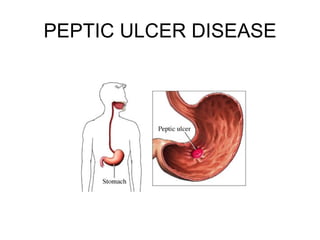
Peptic Ulcer Disease Peptic Ulcer  - an imbalance between aggressive factors (gastric acid and pepsin)  + protective factors (gastric mucus, bicarbonate, prostaglandins). Peptic ulcers are chronic most often solitary, lesions that occur in any portion of gastrointestinal tract exposed to the aggressive action of acid-peptic juices.
Pathophysiology Duodenal Ulcer –  H.pyloric  (95%) - NSAIDS Gastric Ulcer – NSAIDS H.pyloric
ROLE OF  H. Pylori  INFECTION H. pylori  infection is present in almost all patients with duodenal ulcers and 70% cases with gastric ulcers. Duodenal ulcers - Usually associated with gastritis confined to the antrum. Gastric ulcers - Usually associated with pangastritis (inflammation of the entire stomach) .
Other factors causing PUD - high gastrin level and excess acid   production . Gastrinoma may cause multiple peptic ulceration as  in Zollinger Ellison syndrome. There is increased parietal cell mass. impaired mucosal  defense  . The  gastric acid and pepsin levels are normal  and  no H.pylori  are present. Chronic use of NSAIDs (aspirin) causes suppression of mucosal prostaglandin and direct irritative topical effect. Repeated use of corticosteroid  and Chemotherapy in high dose.  Cigarette smoking impair healing and favour recurrences. Alcoholic cirrhosis. Psychological stress, ischemia.
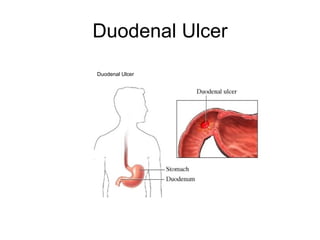
Sites of Peptic Ulcer Duodenum: First portion ( few cms from the pyloric ring).  Anterior wall is more often affected. Stomach: Usually antrum.  Lesser curvature (common) . Anterior and posterior wall and greater curvature  (less common).  In the margins of a gastroenterostomy (stomal ulcer) In the duodenum, stomach or jejunum of patients with Zollinger-Ellison syndrome.
Mechanism of  H pyloric M echanism – H pylori secretes urease (generates ammonia), protease (breaks down glycoprotein in the gastric mucus) - breakdown of mucosal defense ****Show H plyoric Slide**treatment options H
Mechanism  Of H pyloric Damage of the protective mucosal layer. The epithelial cells are exposed to the damaging effect of acid-peptic digestion. Inflammation of the gastric mucosa. Chronically inflamed mucosa more susceptible to acid- peptic injury and prone to peptic ulceration. Ulcers occur at sites of chronic inflammation  Eg  -  Antrum
PEPTIC ULCER DISEASE
Duodenal Ulcer Duodenal Ulcer
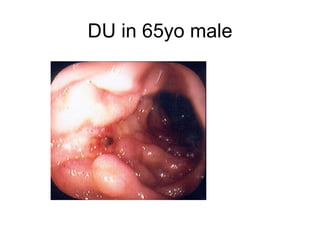
DU in 65yo male
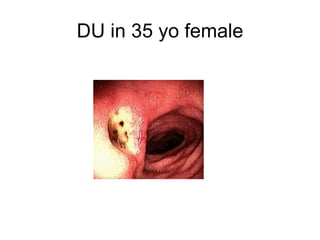
DU in 35 yo female
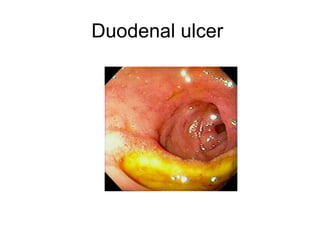
Duodenal ulcer
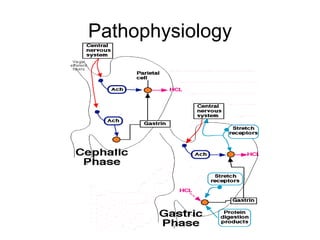
Pathophysiology
Case Presentation Mr. Sloley is a 45 year old male who  presents to your clinic with epigastric  abdominal pain x 2 weeks.  What is your initial differential diagnosis at this point given the limited information?
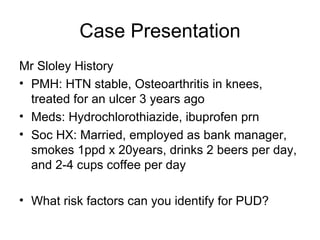
Case Presentation Mr Sloley History  PMH: HTN stable, Osteoarthritis in knees, treated for an ulcer 3 years ago  Meds: Hydrochlorothiazide, ibuprofen prn  Soc HX: Married, employed as bank manager, smokes 1ppd x 20years, drinks 2 beers per day, and 2-4 cups coffee per day  What risk factors can you identify for PUD?
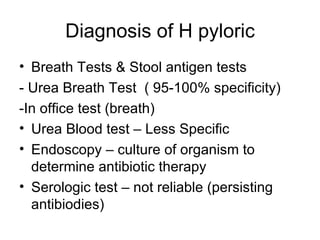
Diagnosis of H pyloric Breath Tests & Stool antigen tests - Urea Breath Test  ( 95-100% specificity) -In office test (breath) Urea Blood test – Less Specific Endoscopy – culture of organism to determine antibiotic therapy Serologic test – not reliable (persisting antibiodies)
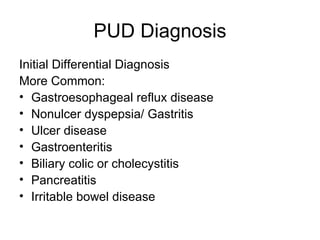
PUD Diagnosis Initial Differential Diagnosis  More Common:  Gastroesophageal reflux disease  Nonulcer dyspepsia/ Gastritis  Ulcer disease  Gastroenteritis  Biliary colic or cholecystitis  Pancreatitis  Irritable bowel disease
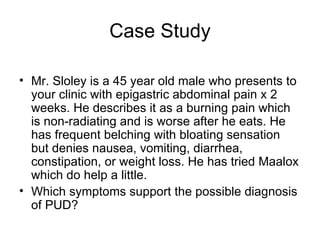
Case Study Mr. Sloley is a 45 year old male who presents to your clinic with epigastric abdominal pain x 2 weeks. He describes it as a burning pain which is non-radiating and is worse after he eats. He has frequent belching with bloating sensation but denies nausea, vomiting, diarrhea, constipation, or weight loss. He has tried Maalox which do help a little.  Which symptoms support the possible diagnosis of PUD?
Case Presentation Signs and Symptoms of PUD  Epigastric pain is most common symptom  Pain described as gnawing, burning or annoying May radiate to the back (consider penetration)  Pain occurs when stomach is empty Relieved by food, antacids (duodenal), Dyspepsia including belching/ bloating  Hematemesis or melena with GI bleeding
Gastric Ulcers Pts with Gastric or Duodenal ulcers have similar symptoms Lacks pattern Pain occurs at anytime of day: frequently immediately or within 1-3 hrs after a meal Mortality rate is higher in these patients 10% of pts with PUD present with complications and have no prior Hx of pain
Treatment Goals Relieve symptoms Healing of ulcer Eliminating cause of ulcer
Treatment No single medication works to get rid of  H pylori  infection.  2 combinations are available Triple or Dual Therapy Ideal treatment regimen for H pyloric has not been identified
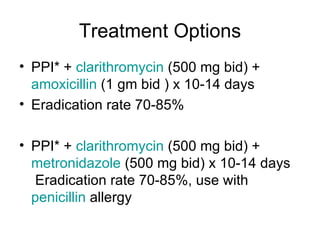
Treatment Options PPI* +  clarithromycin  (500 mg bid) +  amoxicillin  (1 gm bid ) x 10-14 days  Eradication rate 70-85% PPI* +  clarithromycin  (500 mg bid) +  metronidazole  (500 mg bid) x 10-14 days  Eradication rate 70-85%, use with  penicillin  allergy
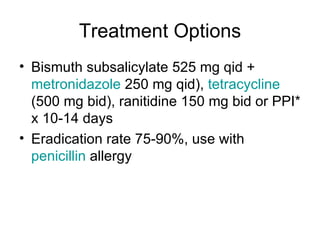
Treatment Options Bismuth subsalicylate 525 mg qid +  metronidazole  250 mg qid),  tetracycline  (500 mg bid), ranitidine 150 mg bid or PPI* x 10-14 days  Eradication rate 75-90%, use with  penicillin  allergy
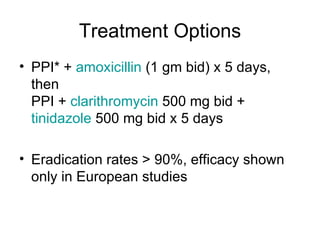
Treatment Options PPI* +  amoxicillin  (1 gm bid) x 5 days, then  PPI +  clarithromycin  500 mg bid +  tinidazole  500 mg bid x 5 days  Eradication rates > 90%, efficacy shown only in European studies
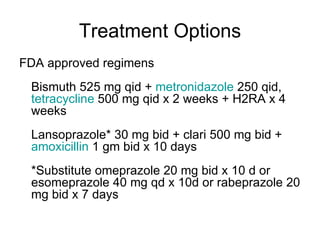
Treatment Options FDA approved regimens  Bismuth 525 mg qid +  metronidazole  250 qid,  tetracycline  500 mg qid x 2 weeks + H2RA x 4 weeks  Lansoprazole* 30 mg bid + clari 500 mg bid +  amoxicillin  1 gm bid x 10 days  *Substitute omeprazole 20 mg bid x 10 d or esomeprazole 40 mg qd x 10d or rabeprazole 20 mg bid x 7 days
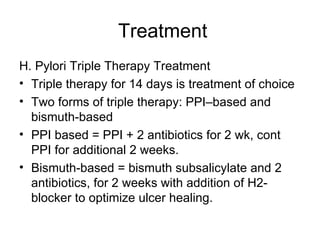
Treatment H. Pylori Triple Therapy Treatment  Triple therapy for 14 days is treatment of choice  Two forms of triple therapy: PPI–based and bismuth-based  PPI based = PPI + 2 antibiotics for 2 wk, cont PPI for additional 2 weeks.  Bismuth-based = bismuth subsalicylate and 2 antibiotics, for 2 weeks with addition of H2- blocker to optimize ulcer healing.
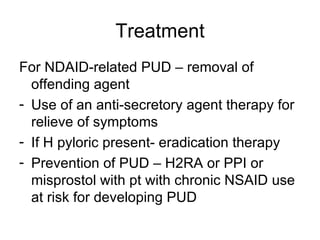
Treatment For NDAID-related PUD – removal of offending agent Use of an anti-secretory agent therapy for relieve of symptoms If H pyloric present- eradication therapy Prevention of PUD – H2RA or PPI or misprostol with pt with chronic NSAID use at risk for developing PUD
Treatment Patient Counseling – adherence to therapy, proper dosing, side-effects Surgery –reserved pts with refractory ulcers or hemorrhage
NEW DEVOLPMENTS Supplementation with vitamin C enhances the success of Helicobacter pylori eradication efforts, researchers from Iran report.  **PLEASE REMEMBER TO READ CPT MANUAL ON DRUGS AND S/E

Case presentation pud

  • 1.
    Peptic Ulcer DiseaseAndrea M. Wilkins-Daly BSc.,PharmD October 2009
  • 2.
    Peptic Ulcer DiseasePeptic Ulcer - an imbalance between aggressive factors (gastric acid and pepsin) + protective factors (gastric mucus, bicarbonate, prostaglandins). Peptic ulcers are chronic most often solitary, lesions that occur in any portion of gastrointestinal tract exposed to the aggressive action of acid-peptic juices.
  • 3.
    Pathophysiology Duodenal Ulcer– H.pyloric (95%) - NSAIDS Gastric Ulcer – NSAIDS H.pyloric
  • 4.
    ROLE OF H. Pylori INFECTION H. pylori infection is present in almost all patients with duodenal ulcers and 70% cases with gastric ulcers. Duodenal ulcers - Usually associated with gastritis confined to the antrum. Gastric ulcers - Usually associated with pangastritis (inflammation of the entire stomach) .
  • 5.
    Other factors causingPUD - high gastrin level and excess acid production . Gastrinoma may cause multiple peptic ulceration as in Zollinger Ellison syndrome. There is increased parietal cell mass. impaired mucosal defense . The gastric acid and pepsin levels are normal and no H.pylori are present. Chronic use of NSAIDs (aspirin) causes suppression of mucosal prostaglandin and direct irritative topical effect. Repeated use of corticosteroid and Chemotherapy in high dose. Cigarette smoking impair healing and favour recurrences. Alcoholic cirrhosis. Psychological stress, ischemia.
  • 6.
    Sites of PepticUlcer Duodenum: First portion ( few cms from the pyloric ring). Anterior wall is more often affected. Stomach: Usually antrum. Lesser curvature (common) . Anterior and posterior wall and greater curvature (less common). In the margins of a gastroenterostomy (stomal ulcer) In the duodenum, stomach or jejunum of patients with Zollinger-Ellison syndrome.
  • 7.
    Mechanism of H pyloric M echanism – H pylori secretes urease (generates ammonia), protease (breaks down glycoprotein in the gastric mucus) - breakdown of mucosal defense ****Show H plyoric Slide**treatment options H
  • 8.
    Mechanism OfH pyloric Damage of the protective mucosal layer. The epithelial cells are exposed to the damaging effect of acid-peptic digestion. Inflammation of the gastric mucosa. Chronically inflamed mucosa more susceptible to acid- peptic injury and prone to peptic ulceration. Ulcers occur at sites of chronic inflammation Eg - Antrum
  • 9.
  • 10.
  • 11.
  • 12.
    DU in 35yo female
  • 13.
  • 14.
  • 15.
    Case Presentation Mr.Sloley is a 45 year old male who presents to your clinic with epigastric abdominal pain x 2 weeks. What is your initial differential diagnosis at this point given the limited information?
  • 16.
    Case Presentation MrSloley History PMH: HTN stable, Osteoarthritis in knees, treated for an ulcer 3 years ago Meds: Hydrochlorothiazide, ibuprofen prn Soc HX: Married, employed as bank manager, smokes 1ppd x 20years, drinks 2 beers per day, and 2-4 cups coffee per day What risk factors can you identify for PUD?
  • 17.
    Diagnosis of Hpyloric Breath Tests & Stool antigen tests - Urea Breath Test ( 95-100% specificity) -In office test (breath) Urea Blood test – Less Specific Endoscopy – culture of organism to determine antibiotic therapy Serologic test – not reliable (persisting antibiodies)
  • 18.
    PUD Diagnosis InitialDifferential Diagnosis More Common: Gastroesophageal reflux disease Nonulcer dyspepsia/ Gastritis Ulcer disease Gastroenteritis Biliary colic or cholecystitis Pancreatitis Irritable bowel disease
  • 19.
    Case Study Mr.Sloley is a 45 year old male who presents to your clinic with epigastric abdominal pain x 2 weeks. He describes it as a burning pain which is non-radiating and is worse after he eats. He has frequent belching with bloating sensation but denies nausea, vomiting, diarrhea, constipation, or weight loss. He has tried Maalox which do help a little. Which symptoms support the possible diagnosis of PUD?
  • 20.
    Case Presentation Signsand Symptoms of PUD Epigastric pain is most common symptom Pain described as gnawing, burning or annoying May radiate to the back (consider penetration) Pain occurs when stomach is empty Relieved by food, antacids (duodenal), Dyspepsia including belching/ bloating Hematemesis or melena with GI bleeding
  • 21.
    Gastric Ulcers Ptswith Gastric or Duodenal ulcers have similar symptoms Lacks pattern Pain occurs at anytime of day: frequently immediately or within 1-3 hrs after a meal Mortality rate is higher in these patients 10% of pts with PUD present with complications and have no prior Hx of pain
  • 22.
    Treatment Goals Relievesymptoms Healing of ulcer Eliminating cause of ulcer
  • 23.
    Treatment No singlemedication works to get rid of H pylori infection. 2 combinations are available Triple or Dual Therapy Ideal treatment regimen for H pyloric has not been identified
  • 24.
    Treatment Options PPI*+ clarithromycin (500 mg bid) + amoxicillin (1 gm bid ) x 10-14 days Eradication rate 70-85% PPI* + clarithromycin (500 mg bid) + metronidazole (500 mg bid) x 10-14 days Eradication rate 70-85%, use with penicillin  allergy
  • 25.
    Treatment Options Bismuthsubsalicylate 525 mg qid + metronidazole 250 mg qid), tetracycline (500 mg bid), ranitidine 150 mg bid or PPI* x 10-14 days Eradication rate 75-90%, use with penicillin  allergy
  • 26.
    Treatment Options PPI*+ amoxicillin (1 gm bid) x 5 days, then PPI + clarithromycin 500 mg bid + tinidazole  500 mg bid x 5 days Eradication rates > 90%, efficacy shown only in European studies
  • 27.
    Treatment Options FDAapproved regimens Bismuth 525 mg qid + metronidazole 250 qid, tetracycline 500 mg qid x 2 weeks + H2RA x 4 weeks Lansoprazole* 30 mg bid + clari 500 mg bid + amoxicillin 1 gm bid x 10 days *Substitute omeprazole 20 mg bid x 10 d or esomeprazole 40 mg qd x 10d or rabeprazole 20 mg bid x 7 days
  • 28.
    Treatment H. PyloriTriple Therapy Treatment Triple therapy for 14 days is treatment of choice Two forms of triple therapy: PPI–based and bismuth-based PPI based = PPI + 2 antibiotics for 2 wk, cont PPI for additional 2 weeks. Bismuth-based = bismuth subsalicylate and 2 antibiotics, for 2 weeks with addition of H2- blocker to optimize ulcer healing.
  • 29.
    Treatment For NDAID-relatedPUD – removal of offending agent Use of an anti-secretory agent therapy for relieve of symptoms If H pyloric present- eradication therapy Prevention of PUD – H2RA or PPI or misprostol with pt with chronic NSAID use at risk for developing PUD
  • 30.
    Treatment Patient Counseling– adherence to therapy, proper dosing, side-effects Surgery –reserved pts with refractory ulcers or hemorrhage
  • 31.
    NEW DEVOLPMENTS Supplementationwith vitamin C enhances the success of Helicobacter pylori eradication efforts, researchers from Iran report. **PLEASE REMEMBER TO READ CPT MANUAL ON DRUGS AND S/E