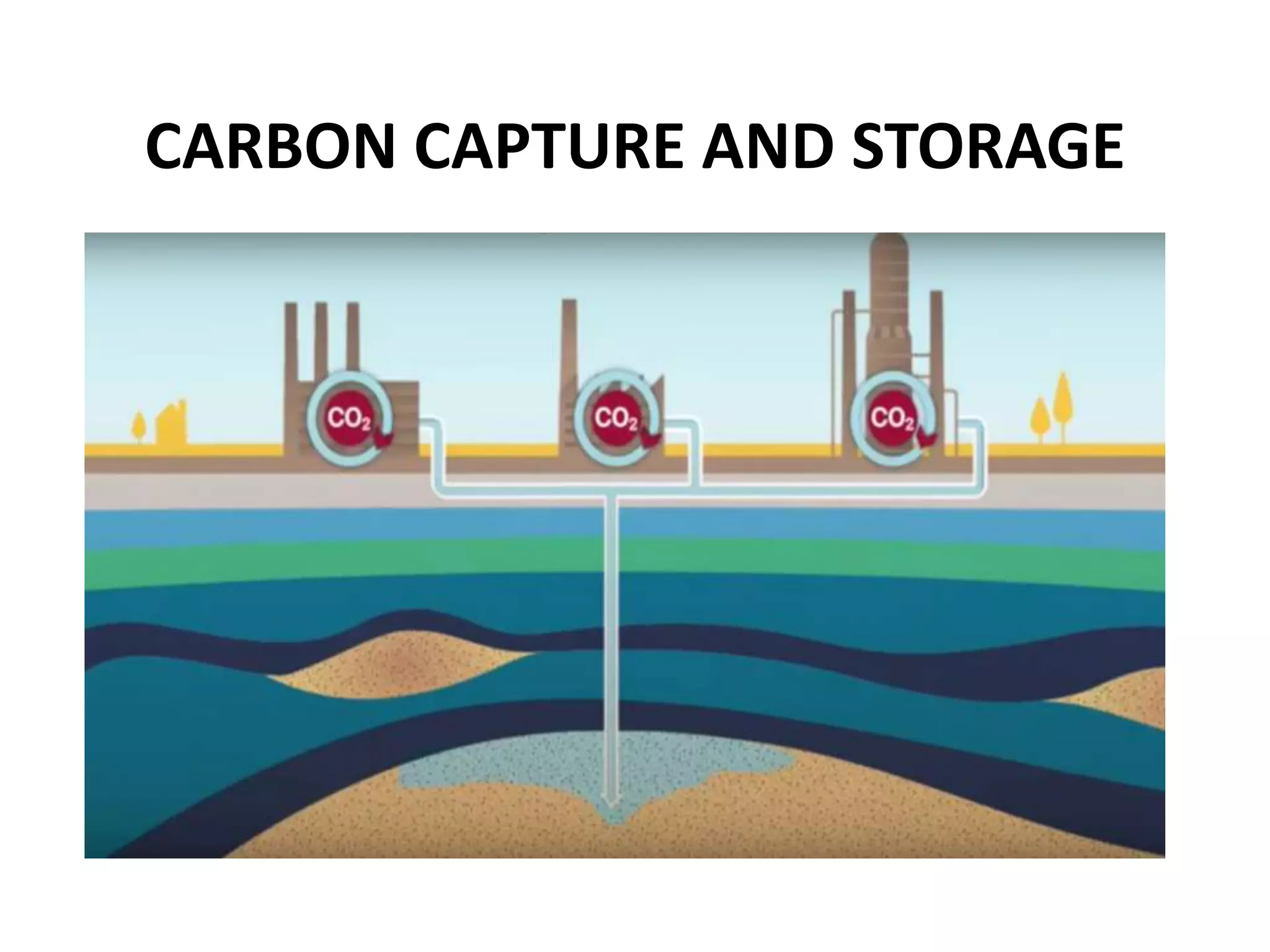
CARBON CAPTURE AND STORAGE
What is Carbon capture and storage?
•Carbon Capture and Storage (CCS) is a technology that
can capture up to 90% of the carbon dioxide emissions
produced from the use of fossil fuels in electricity
generation and industrial processes, preventing the
carbon dioxide from entering the atmosphere.
•It is often regarded as a means of mitigating the
contribution of fossil fuel emissions to global warming.
How is this possible?
The CCS consists of Three parts
1. Capturing the Carbon Dioxide
2. Transporting the carbon dioxide and
3. Storing the Carbon dioxide emissions
Capturing Carbon
The first stage in the CCS process is the capture of
CO2 released during the burning of fossil fuels, or as a
result of industrial processes such as making cement,
steel or in the chemical industry.
This can be done in three different ways:
• Pre-combustion capture
• Post-combustion capture
• Oxy-fuel combustion
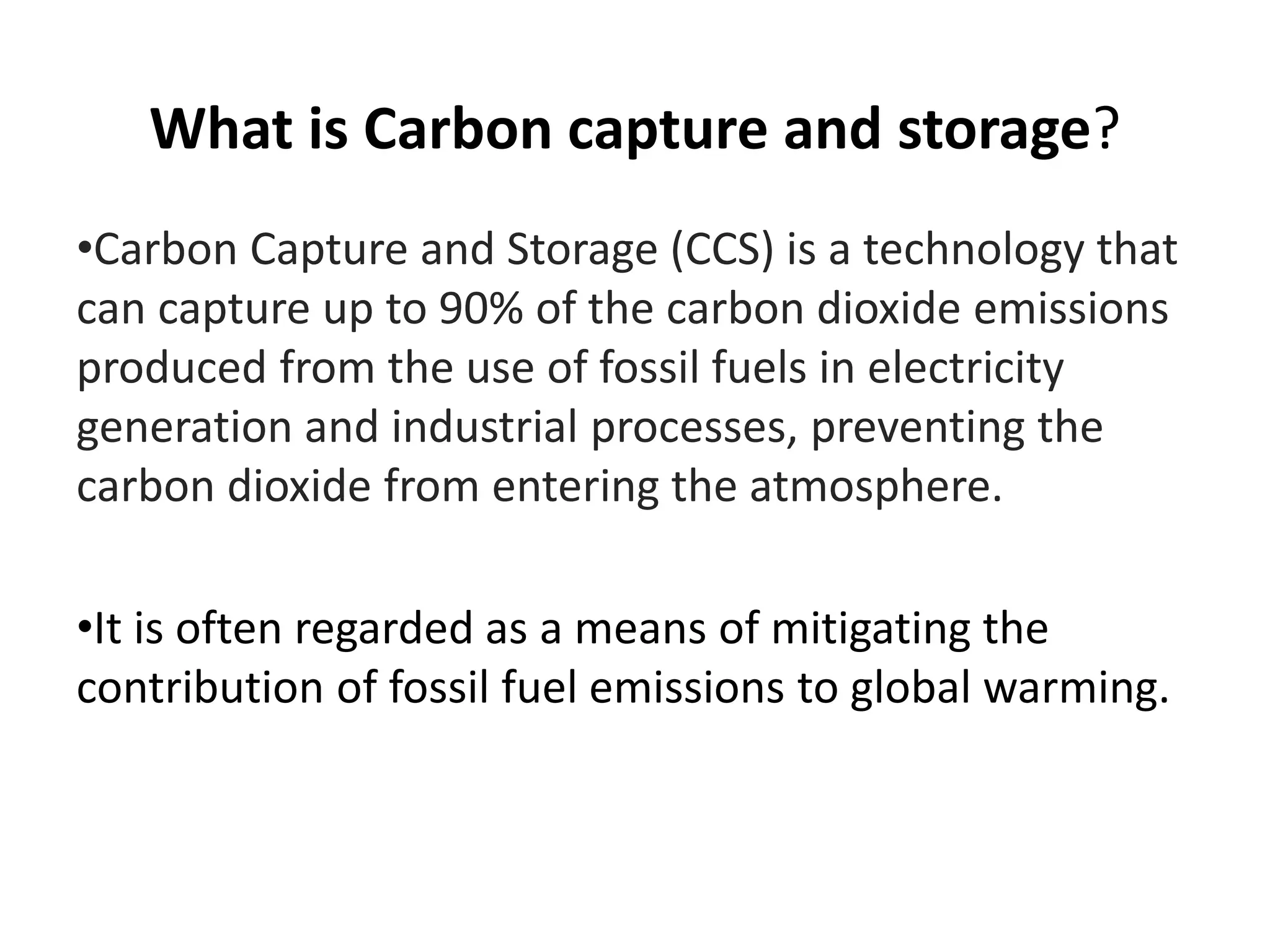
Pre-combustion capture
A pre-combustion system involves first converting solid, liquid
or gaseous fuel into a mixture of hydrogen and carbon dioxide
using one of a number of processes such as ‘gasification’ or
‘reforming’.
Post-combustion capture
•It is used to capture CO2 from the Flue gases that
escape after combustion.
•The scrubbing is done by passing the gases through
ammonia, which is then blasted clean with steam,
releasing the CO2 for storage.
•The absorbed carbon dioxide is removed from the
solvent and then compressed for transport and safe
underground storage.
Oxy-Fuel combustion
•In the process of oxy-fuel combustion the oxygen
required is separated from air prior to combustion and
the fuel is combusted in oxygen diluted with recycled
flue-gas rather than by air.
•This oxygen-rich, nitrogen-free atmosphere results in
final flue-gases consisting mainly of CO2 and H2O
(water), so producing a more concentrated CO2 stream
for easier purification.
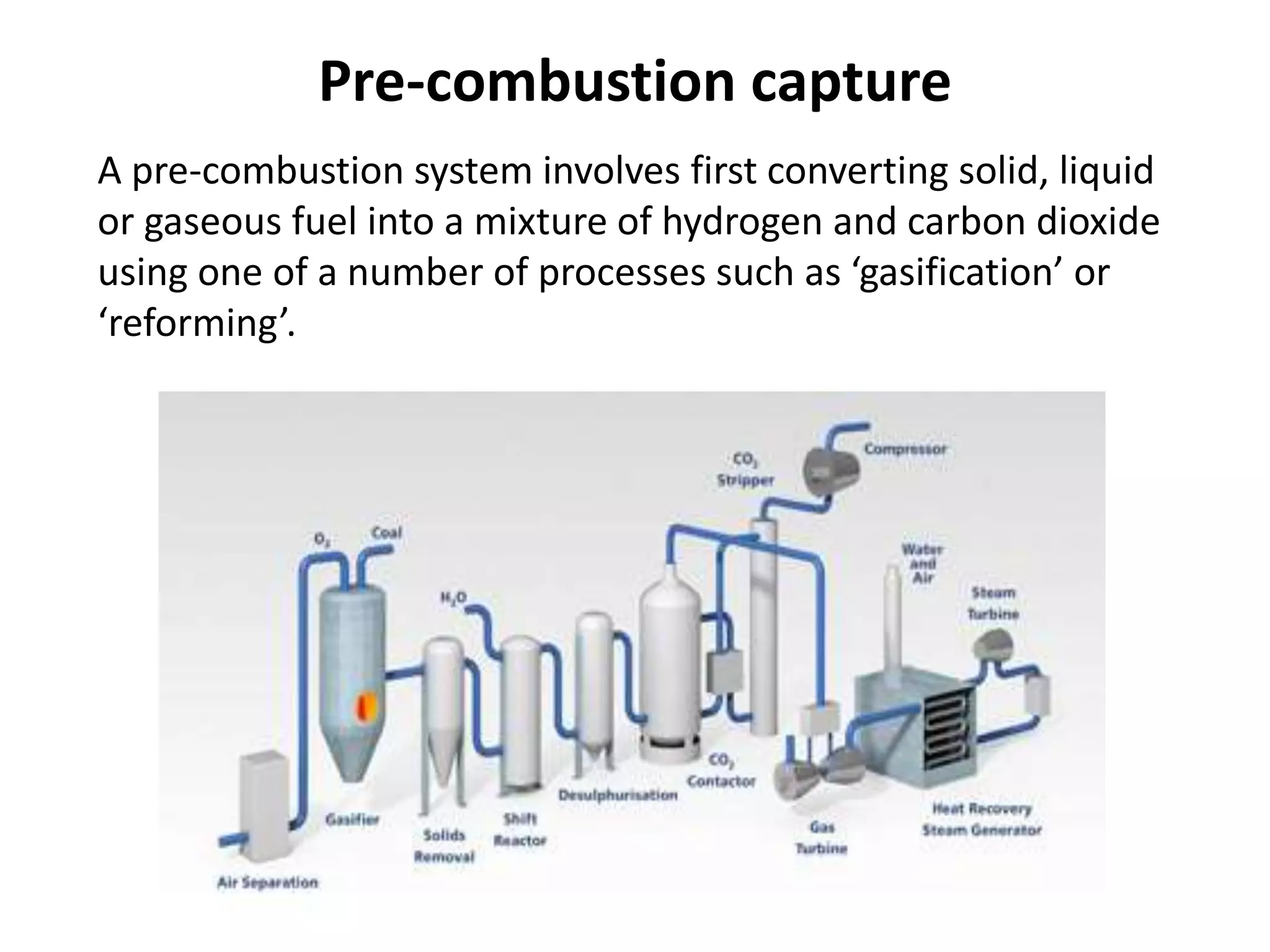
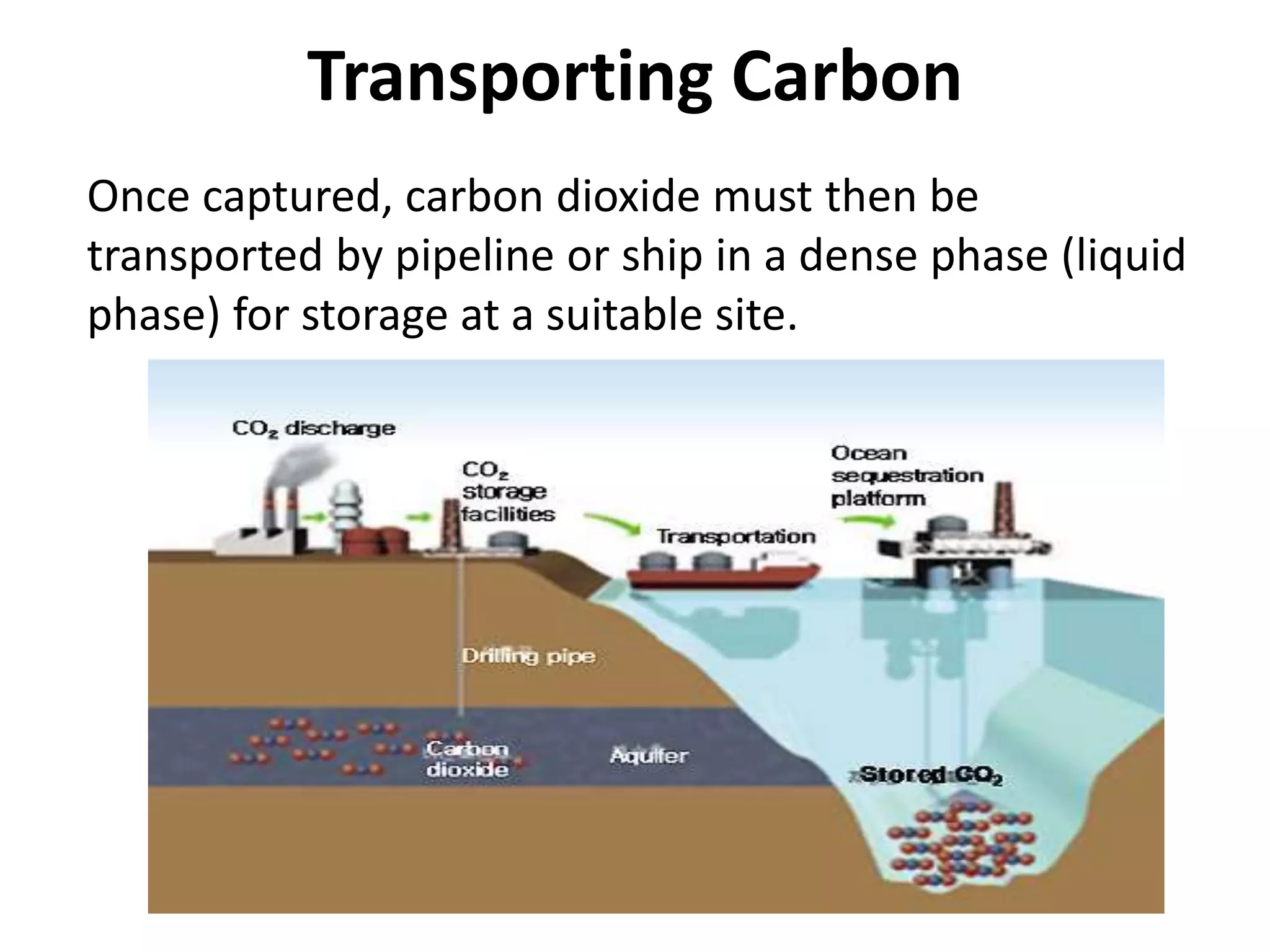
Transporting Carbon
Once captured, carbon dioxide must then be
transported by pipeline or ship in a dense phase (liquid
phase) for storage at a suitable site.
Storage
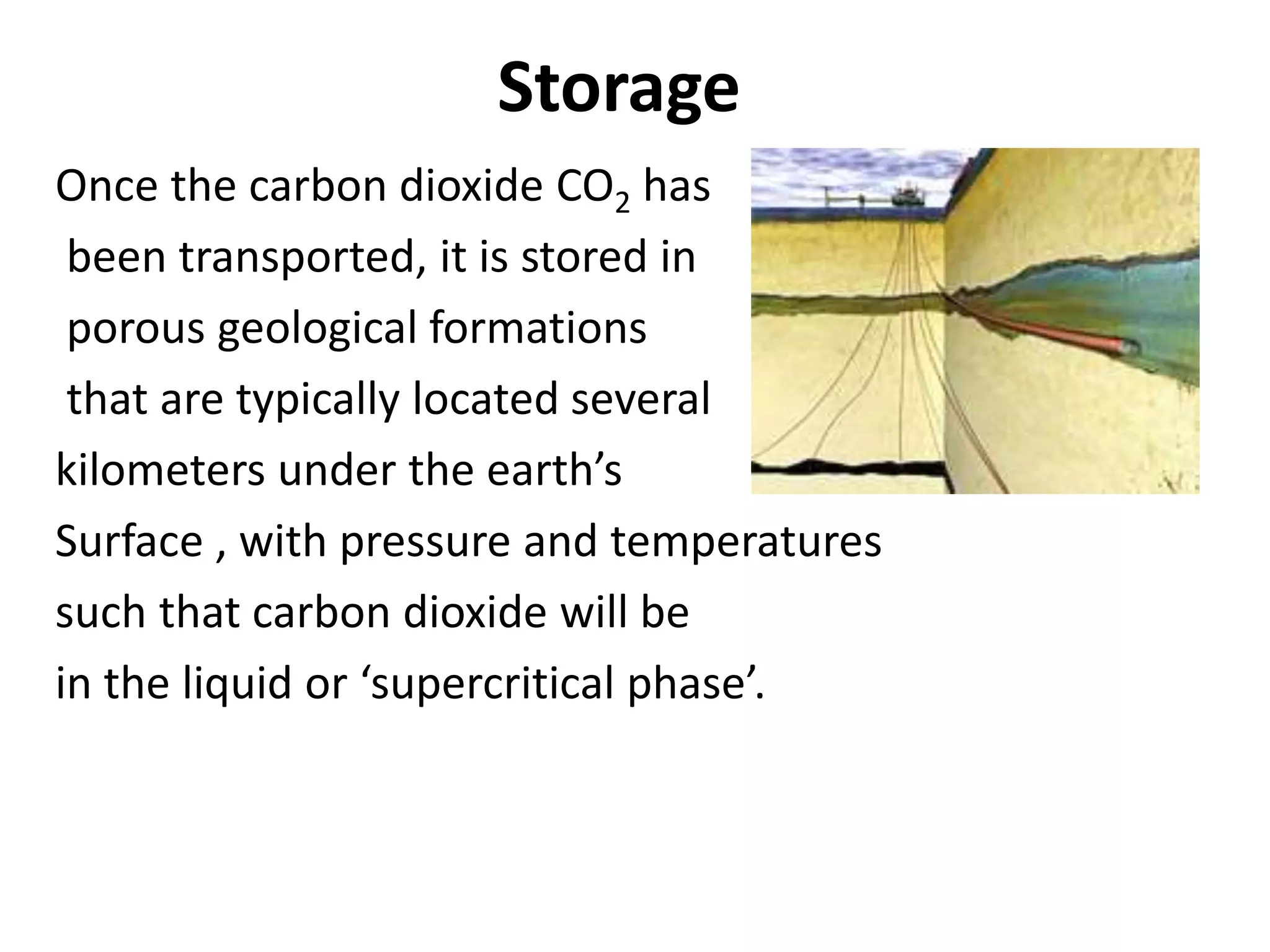
Once the carbon dioxide CO2 has
been transported, it is stored in
porous geological formations
that are typically located several
kilometers under the earth’s
Surface , with pressure and temperatures
such that carbon dioxide will be
in the liquid or ‘supercritical phase’.
Advantages
•CCS applied to a modern conventional power plant
could reduce CO2 emissions to the atmosphere by 80-
90 % compared to a plant without CCS.
•The solvents used to capture CO2 from the flue gases
will remove some nitrogen oxides and sulphur oxides.
Economical Drawbacks
•Capturing and compressing C02 requires much energy and
would increase the fuel needs of a coal-fired plant with CCS
by 25-40%.
•These and other system costs are estimated to increase
the cost of energy from a new power plant with CCS by 21-
90 %.
•Water consumption, however, may be an issue for carbon
capture systems which rely on solvents to remove CO2 from
flue gases.
Environmental Impacts
•In ocean storage carbon dioxide reacts with water to
form acid, so the oceans could become significantly
more acidic .
•Another difficulty is that the CO2 would also
eventually return to the atmosphere, leakages pose
local risks to health and ecosystems.
•For storage sites under water, there are concerns
about chronic exposure of marine ecosystems to
raised CO2 levels, such as might occur near injection
sites.
CCS Operations
CCS plants are operational today. There are currently 4
operational commercial-scale CCS plants globally:
•Sleipner is in the North Sea operational since 1996 and
injecting over 1 million tonnes of carbon dioxide annually.
•Weyburn is in southeastern Saskatchewan, Canada:
operational since 2005 and injecting 26 million tonnes over
the lifetime of the project
• In Salah is in central Algeria: operational since 2004 and
injecting over 1 millions tonnes of carbon dioxide annually
•The Snovit plant in northern Norway: operational since
2008 and, at full production, the plant has a capture and
storage capacity of 700,000 tonnes of carbon dioxide per
year.
References
•http://www.ccsassociation.org/faqs/ccs-and-fossil-fuels/
•https://en.wikipedia.org/wiki/Carbon_capture_and_stor
age
•http://www.sciencedirect.com/science/article/pii/S0306
261913009616
•http://www.ipcc.ch/pdf/special-
reports/srccs/srccs_summaryforpolicymakers.pdf
The End

CARBON CAPTURE AND STORAGE

  • 1.
  • 2.
    What is Carboncapture and storage? •Carbon Capture and Storage (CCS) is a technology that can capture up to 90% of the carbon dioxide emissions produced from the use of fossil fuels in electricity generation and industrial processes, preventing the carbon dioxide from entering the atmosphere. •It is often regarded as a means of mitigating the contribution of fossil fuel emissions to global warming.
  • 3.
    How is thispossible? The CCS consists of Three parts 1. Capturing the Carbon Dioxide 2. Transporting the carbon dioxide and 3. Storing the Carbon dioxide emissions
  • 4.
    Capturing Carbon The firststage in the CCS process is the capture of CO2 released during the burning of fossil fuels, or as a result of industrial processes such as making cement, steel or in the chemical industry. This can be done in three different ways: • Pre-combustion capture • Post-combustion capture • Oxy-fuel combustion
  • 5.
    Pre-combustion capture A pre-combustionsystem involves first converting solid, liquid or gaseous fuel into a mixture of hydrogen and carbon dioxide using one of a number of processes such as ‘gasification’ or ‘reforming’.
  • 6.
    Post-combustion capture •It isused to capture CO2 from the Flue gases that escape after combustion. •The scrubbing is done by passing the gases through ammonia, which is then blasted clean with steam, releasing the CO2 for storage. •The absorbed carbon dioxide is removed from the solvent and then compressed for transport and safe underground storage.
  • 8.
    Oxy-Fuel combustion •In theprocess of oxy-fuel combustion the oxygen required is separated from air prior to combustion and the fuel is combusted in oxygen diluted with recycled flue-gas rather than by air. •This oxygen-rich, nitrogen-free atmosphere results in final flue-gases consisting mainly of CO2 and H2O (water), so producing a more concentrated CO2 stream for easier purification.
  • 10.
    Transporting Carbon Once captured,carbon dioxide must then be transported by pipeline or ship in a dense phase (liquid phase) for storage at a suitable site.
  • 11.
    Storage Once the carbondioxide CO2 has been transported, it is stored in porous geological formations that are typically located several kilometers under the earth’s Surface , with pressure and temperatures such that carbon dioxide will be in the liquid or ‘supercritical phase’.
  • 12.
    Advantages •CCS applied toa modern conventional power plant could reduce CO2 emissions to the atmosphere by 80- 90 % compared to a plant without CCS. •The solvents used to capture CO2 from the flue gases will remove some nitrogen oxides and sulphur oxides.
  • 13.
    Economical Drawbacks •Capturing andcompressing C02 requires much energy and would increase the fuel needs of a coal-fired plant with CCS by 25-40%. •These and other system costs are estimated to increase the cost of energy from a new power plant with CCS by 21- 90 %. •Water consumption, however, may be an issue for carbon capture systems which rely on solvents to remove CO2 from flue gases.
  • 14.
    Environmental Impacts •In oceanstorage carbon dioxide reacts with water to form acid, so the oceans could become significantly more acidic . •Another difficulty is that the CO2 would also eventually return to the atmosphere, leakages pose local risks to health and ecosystems. •For storage sites under water, there are concerns about chronic exposure of marine ecosystems to raised CO2 levels, such as might occur near injection sites.
  • 15.
    CCS Operations CCS plantsare operational today. There are currently 4 operational commercial-scale CCS plants globally: •Sleipner is in the North Sea operational since 1996 and injecting over 1 million tonnes of carbon dioxide annually. •Weyburn is in southeastern Saskatchewan, Canada: operational since 2005 and injecting 26 million tonnes over the lifetime of the project • In Salah is in central Algeria: operational since 2004 and injecting over 1 millions tonnes of carbon dioxide annually •The Snovit plant in northern Norway: operational since 2008 and, at full production, the plant has a capture and storage capacity of 700,000 tonnes of carbon dioxide per year.
  • 16.
  • 17.