PENSION PLAN
GOVERNANCE GUIDELINES
and
SELF-ASSESSMENT
QUESTIONNAIRE
JULY 2003
Association of
CAPSA
Canadian
Pension
Supervisory
Authorities
TABLE OF CONTENTS
Context for the Guidelines...........................................................................1
CAPSA Pension Plan Governance Principles...........................................3
CAPSA Pension Plan Governance Guidelines .........................................4
Principle 1: Fiduciary responsibility.....................................................4
Principle 2: Governance objectives ......................................................5
Principle 3: Roles and responsibilities..................................................5
Principle 4: Performance measures ......................................................6
Principle 5: Knowledge and skills ........................................................7
Principle 6: Access to information........................................................7
Principle 7: Risk management ..............................................................7
Principle 8: Oversight and compliance.................................................8
Principle 9: Transparency and accountability......................................8
Principle 10: Code of conduct and conflict of interest........................9
Principle 11: Governance review........................................................10
Glossary of Terms .......................................................................................11
Appendix A: CAPSA Pension Plan Governance Self-Assessment
Questionnaire...............................................................................................13
CONTEXT
JULY 2003 1
CONTEXT FOR THE GUIDELINES
Pension governance * is about delivering on the pension promise consistent
with the pension plan documents and pension legislation. Pension plan
administrators have pension governance responsibilities. CAPSA, the
association of pension regulators across Canada, has designed these
guidelines to help plan administrators meet their governance responsibilities.
Pension plan governance refers to the structure and processes for overseeing,
managing and administering a pension plan to ensure the fiduciary and other
obligations of the plan are met. CAPSA believes that good pension plan
governance is essential if plan members are to both receive the benefits and
values they are entitled to, and to understand their rights and responsibilities
under the pension plan.
Pension legislation specifies who may be a plan administrator and identifies
the plan administrator’s responsibilities. The plan administrator may be any
of the following:
§ the employer who established the plan,
§ a pension committee,
§ a board of trustees,
§ an insurance company,
§ a bargaining agent, or
§ another body established by law.
While the plan administrator may use delegates to help carry out governance
responsibilities, pension legislation defines the administrator as the governing
body ultimately responsible for overseeing the plan.
An effective pension governance system:
§ establishes a framework for dividing the responsibility and
accountability among all participants in the governance process,
§ covers all facets of pension plan management, including
communication, funding, investments and benefit administration, and
§ provides careful oversight while enhancing protection for plan
members and beneficiaries.
* Please note that defined terms are italicized when first used. Definitions
are in the Glossary of Terms, page 11.
CONTEXT
JULY 2003 2
Good pension plan governance:
§ is essential for meeting fiduciary and other obligations,
§ minimizes risks and maximizes efficiency,
§ promotes the accurate, fast, and cost-effective delivery of pension
benefits,
§ promotes consistent administration of the plan in the best interests of
plan members and beneficiaries,
§ requires control mechanisms that encourage good decision-making,
proper and efficient practices, clear accountability, and regular review
and evaluation, and
§ contributes to positive pension plan performance and demonstrates
due diligence on the part of the plan administrator.
The CAPSA Pension Plan Governance Guidelines provide a broad, flexible
outline of key pension plan governance principles. Different types and sizes
of plans, however, may require different governance practices. Although
pension plan administrators need to adapt their governance practices to
specific circumstances and resources, we strongly recommend that all plan
administrators adopt a governance structure and processes consistent with
the principles that follow.
The Guidelines recommend principles for effective pension plan governance.
They discuss the appropriate roles and responsibilities of the plan sponsor
only when the plan sponsor is acting as plan administrator. They do not
discuss the roles and responsibilities of the plan sponsor under general
corporate governance principles. Many individuals who have pension plan
governance responsibilities also have responsibilities to the plan sponsor.
Consequently, they must clearly understand the different roles and
responsibilities for each. Further, when taking actions that affect the pension
plan, they must carefully document the actions for both sets of
responsibilities.
The Guidelines build on important work by labour organizations, industry
associations such as the Pension Investment Association of Canada (PIAC),
the Association of Canadian Pension Management (ACPM) and pension
regulators such as the Office of the Superintendent of Financial Institutions
(OSFI).
CAPSA encourages all pension plan administrators in Canada to assess
whether their current pension plan governance structures are effective and to
strive for the best practices set out in the Guidelines. Note, however, that the
Guidelines are not intended to create additional rights and obligations for any
party to a pension plan. Though voluntary, they are meant to help plan
administrators achieve and maintain good pension plan governance.
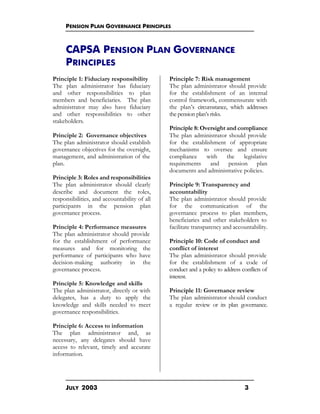
PENSION PLAN GOVERNANCE PRINCIPLES
JULY 2003 3
CAPSA PENSION PLAN GOVERNANCE
PRINCIPLES
Principle 1: Fiduciary responsibility
The plan administrator has fiduciary
and other responsibilities to plan
members and beneficiaries. The plan
administrator may also have fiduciary
and other responsibilities to other
stakeholders.
Principle 2: Governance objectives
The plan administrator should establish
governance objectives for the oversight,
management, and administration of the
plan.
Principle 3: Roles and responsibilities
The plan administrator should clearly
describe and document the roles,
responsibilities, and accountability of all
participants in the pension plan
governance process.
Principle 4: Performance measures
The plan administrator should provide
for the establishment of performance
measures and for monitoring the
performance of participants who have
decision-making authority in the
governance process.
Principle 5: Knowledge and skills
The plan administrator, directly or with
delegates, has a duty to apply the
knowledge and skills needed to meet
governance responsibilities.
Principle 6: Access to information
The plan administrator and, as
necessary, any delegates should have
access to relevant, timely and accurate
information.
Principle 7: Risk management
The plan administrator should provide
for the establishment of an internal
control framework, commensurate with
the plan’s circumstance, which addresses
the pension plan’s risks.
Principle 8: Oversight and compliance
The plan administrator should provide
for the establishment of appropriate
mechanisms to oversee and ensure
compliance with the legislative
requirements and pension plan
documents and administrative policies.
Principle 9: Transparency and
accountability
The plan administrator should provide
for the communication of the
governance process to plan members,
beneficiaries and other stakeholders to
facilitate transparency and accountability.
Principle 10: Code of conduct and
conflict of interest
The plan administrator should provide
for the establishment of a code of
conduct and a policy to address conflicts of
interest.
Principle 11: Governance review
The plan administrator should conduct
a regular review or its plan governance.
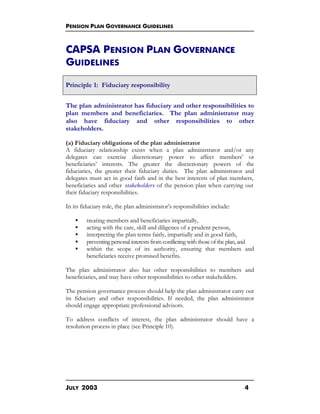
PENSION PLAN GOVERNANCE GUIDELINES
JULY 2003 4
CAPSA PENSION PLAN GOVERNANCE
GUIDELINES
Principle 1: Fiduciary responsibility
The plan administrator has fiduciary and other responsibilities to
plan members and beneficiaries. The plan administrator may
also have fiduciary and other responsibilities to other
stakeholders.
(a) Fiduciary obligations of the plan administrator
A fiduciary relationship exists when a plan administrator and/or any
delegates can exercise discretionary power to affect members’ or
beneficiaries’ interests. The greater the discretionary powers of the
fiduciaries, the greater their fiduciary duties. The plan administrator and
delegates must act in good faith and in the best interests of plan members,
beneficiaries and other stakeholders of the pension plan when carrying out
their fiduciary responsibilities.
In its fiduciary role, the plan administrator’s responsibilities include:
§ treating members and beneficiaries impartially,
§ acting with the care, skill and diligence of a prudent person,
§ interpreting the plan terms fairly, impartially and in good faith,
§ preventing personal interests from conflicting with those of the plan, and
§ within the scope of its authority, ensuring that members and
beneficiaries receive promised benefits.
The plan administrator also has other responsibilities to members and
beneficiaries, and may have other responsibilities to other stakeholders.
The pension governance process should help the plan administrator carry out
its fiduciary and other responsibilities. If needed, the plan administrator
should engage appropriate professional advisors.
To address conflicts of interest, the plan administrator should have a
resolution process in place (see Principle 10).
PENSION PLAN GOVERNANCE GUIDELINES
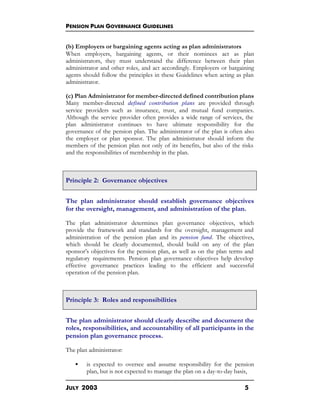
JULY 2003 5
(b) Employers or bargaining agents acting as plan administrators
When employers, bargaining agents, or their nominees act as plan
administrators, they must understand the difference between their plan
administrator and other roles, and act accordingly. Employers or bargaining
agents should follow the principles in these Guidelines when acting as plan
administrator.
(c) Plan Administrator for member-directed defined contribution plans
Many member-directed defined contribution plans are provided through
service providers such as insurance, trust, and mutual fund companies.
Although the service provider often provides a wide range of services, the
plan administrator continues to have ultimate responsibility for the
governance of the pension plan. The administrator of the plan is often also
the employer or plan sponsor. The plan administrator should inform the
members of the pension plan not only of its benefits, but also of the risks
and the responsibilities of membership in the plan.
Principle 2: Governance objectives
The plan administrator should establish governance objectives
for the oversight, management, and administration of the plan.
The plan administrator determines plan governance objectives, which
provide the framework and standards for the oversight, management and
administration of the pension plan and its pension fund. The objectives,
which should be clearly documented, should build on any of the plan
sponsor’s objectives for the pension plan, as well as on the plan terms and
regulatory requirements. Pension plan governance objectives help develop
effective governance practices leading to the efficient and successful
operation of the pension plan.
Principle 3: Roles and responsibilities
The plan administrator should clearly describe and document the
roles, responsibilities, and accountability of all participants in the
pension plan governance process.
The plan administrator:
§ is expected to oversee and assume responsibility for the pension
plan, but is not expected to manage the plan on a day-to-day basis,
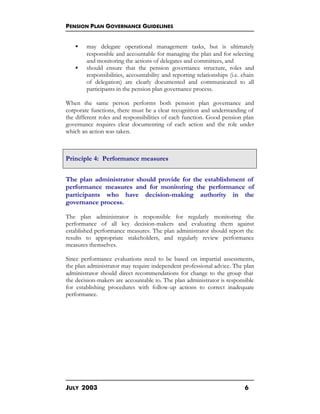
PENSION PLAN GOVERNANCE GUIDELINES
JULY 2003 6
§ may delegate operational management tasks, but is ultimately
responsible and accountable for managing the plan and for selecting
and monitoring the actions of delegates and committees, and
§ should ensure that the pension governance structure, roles and
responsibilities, accountability and reporting relationships (i.e. chain
of delegation) are clearly documented and communicated to all
participants in the pension plan governance process.
When the same person performs both pension plan governance and
corporate functions, there must be a clear recognition and understanding of
the different roles and responsibilities of each function. Good pension plan
governance requires clear documenting of each action and the role under
which an action was taken.
Principle 4: Performance measures
The plan administrator should provide for the establishment of
performance measures and for monitoring the performance of
participants who have decision-making authority in the
governance process.
The plan administrator is responsible for regularly monitoring the
performance of all key decision-makers and evaluating them against
established performance measures. The plan administrator should report the
results to appropriate stakeholders, and regularly review performance
measures themselves.
Since performance evaluations need to be based on impartial assessments,
the plan administrator may require independent professional advice. The plan
administrator should direct recommendations for change to the group that
the decision-makers are accountable to. The plan administrator is responsible
for establishing procedures with follow-up actions to correct inadequate
performance.
PENSION PLAN GOVERNANCE GUIDELINES
JULY 2003 7
Principle 5: Knowledge and skills
The plan administrator, directly or with delegates, has a duty to
apply the knowledge and skills needed to meet governance
responsibilities.
The plan administrator is ultimately responsible for the governance of the
pension plan. The plan administrator may get help from others to meet the
obligations of this role. The administrator, delegates and committees in the
governance structure should together possess and apply the knowledge and
skills to fulfill governance responsibilities. The plan administrator should be
provided with appropriate training and ongoing education, as required.
Principle 6: Access to information
The plan administrator and, as necessary, any delegates should
have access to relevant, timely and accurate information.
Processes should exist so that the plan administrator and any delegates, as
required, receive appropriate, current, accurate, and complete information to
enable them to perform their responsibilities effectively.
Principle 7: Risk management
The plan administrator should provide for the establishment of
an internal control framework, commensurate with the plan’s
circumstances, that addresses the pension plan’s risks.
(a) Internal control framework
The internal control framework should ensure that risks are addressed and
appropriate controls are in place. The plan administrator should understand
and approve the framework and the written internal control policies. While
the framework may vary depending on the plan type, it should include
policies on documentation, record keeping, costing, funding, fund
investment, expense control, benefits administration, outsourcing,
compliance, and communication.
PENSION PLAN GOVERNANCE GUIDELINES
JULY 2003 8
(b) Fees
The plan administrator should monitor and assess the reasonableness and
competitiveness of any fees charged to the plan or paid by members.
(c) Delinquency control
The plan administrator should establish a delinquency control program with
procedures for collecting unpaid contributions and data, and solutions for
non-compliance.
Principle 8: Oversight and compliance
The plan administrator should provide for the establishment of
appropriate mechanisms to oversee and ensure compliance with
the legislative requirements and pension plan documents and
administrative policies.
Every pension plan needs documented processes and standards to enable
compliance with legislative requirements. This also ensures all administrative
functions, including calculating, paying and receiving contributions and
pension benefits or values, fall within the plan terms, plan administrative
policies, and legislative requirements.
Principle 9: Transparency and accountability
The plan administrator should provide for the communication of
the governance process to plan members, beneficiaries and other
stakeholders to facilitate transparency and accountability.
(a) Communication policy: plan members and beneficiaries
A governance-focussed communication policy should be established for the
pension plan. The policy should provide for the disclosure of governance-
related information to members and beneficiaries. At a minimum, this should
include the information required by statute. Communication should be
appropriate, timely, accurate, complete, consistent, cost-effective, and
accessible to promote members’ and beneficiaries’ confidence in the
governance process.
The plan administrator should consider both fiduciary and other
responsibilities when deciding what to disclose, the manner and form of
disclosure, and whom to disclose the information. In this context, the plan
administrator needs to consider appropriate information disclosure to
PENSION PLAN GOVERNANCE GUIDELINES
JULY 2003 9
members about the benefits, risks, and responsibilities of membership in the
plan.
The plan administrator should give sufficient information to members for
them to make informed decisions about their pension plan options.
(b) Plan member and beneficiary concerns
Pension plan members and beneficiaries have a right to voice their concerns
and have them addressed quickly.
The administrator should arrange for capable parties to address member
inquiries and complaints, and create effective conflict resolution procedures
to handle disagreements. The names and responsibilities of key contacts
should be given to plan members and beneficiaries.
Principle 10: Code of conduct and conflict of interest
The plan administrator should provide for the establishment of a
code of conduct and a policy to address conflicts of interest.
The plan administrator should establish a code of conduct for both the plan
administrator and its delegates. The code of conduct should set out required
behaviour, establish a control procedure for conflicts of interest and provide
for due process and a dispute resolution mechanism.
The plan administrator should always behave in a manner that reflects its
fiduciary and other obligations. To ensure the code of conduct is effective,
and that it also applies to delegates, the plan administrator should set up a
review process.
The conflict of interest policy should set out an appropriate procedure to
disclose and address conflicts of interest. The policy should address both
actual conflicts and the appearance of conflicts.
PENSION PLAN GOVERNANCE GUIDELINES
JULY 2003 10
Principle 11: Governance review
The plan administrator should conduct a regular review of its
plan governance.
The plan administrator should periodically review governance procedures
and practices to assess their effectiveness compared to the pension plan’s
stated governance objectives. The administrator may wish to report the
results of the self-assessment exercise, including any resulting changes in
policies, procedures and practices to pension plan members, beneficiaries,
delegates and other stakeholders.
Every pension plan should have a method of regularly assessing the plan
administrator’s performance and the governance structure of the pension
plan. Ongoing review of the governance procedures themselves will show the
effectiveness of a pension plan’s governance structure and operations. It will
also demonstrate whether the plan administrator is meeting the governance
objectives and fulfilling the required fiduciary and other responsibilities.
After each review, the plan administrator should modify the governance
structure and the policies and practices, as required, to enhance effectiveness.
Plan administrators may wish to seek independent professional advice to
ensure impartiality for their self-assessment. Self-assessment should be
tailored to the circumstances of the pension plan.
GLOSSARY OF TERMS
JULY 2003 11
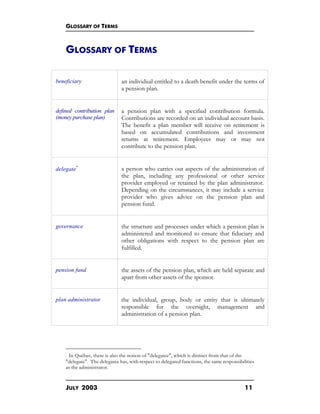
GLOSSARY OF TERMS
beneficiary an individual entitled to a death benefit under the terms of
a pension plan.
defined contribution plan
(money purchase plan)
a pension plan with a specified contribution formula.
Contributions are recorded on an individual account basis.
The benefit a plan member will receive on retirement is
based on accumulated contributions and investment
returns at retirement. Employees may or may not
contribute to the pension plan.
delegate∗
a person who carries out aspects of the administration of
the plan, including any professional or other service
provider employed or retained by the plan administrator.
Depending on the circumstances, it may include a service
provider who gives advice on the pension plan and
pension fund.
governance the structure and processes under which a pension plan is
administered and monitored to ensure that fiduciary and
other obligations with respect to the pension plan are
fulfilled.
pension fund the assets of the pension plan, which are held separate and
apart from other assets of the sponsor.
plan administrator the individual, group, body or entity that is ultimately
responsible for the oversight, management and
administration of a pension plan.
∗
In Québec, there is also the notion of "delegatee", which is distinct from that of the
"delegate". The delegatee has, with respect to delegated functions, the same responsibilities
as the administrator.
GLOSSARY OF TERMS
JULY 2003 12
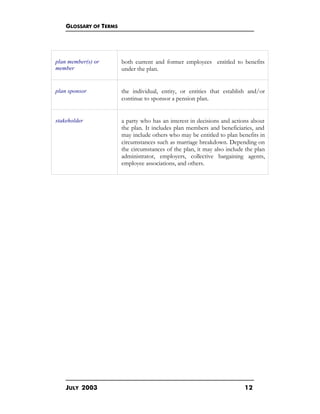
plan member(s) or
member
both current and former employees entitled to benefits
under the plan.
plan sponsor the individual, entity, or entities that establish and/or
continue to sponsor a pension plan.
stakeholder a party who has an interest in decisions and actions about
the plan. It includes plan members and beneficiaries, and
may include others who may be entitled to plan benefits in
circumstances such as marriage breakdown. Depending on
the circumstances of the plan, it may also include the plan
administrator, employers, collective bargaining agents,
employee associations, and others.
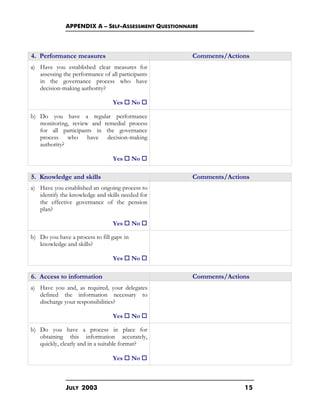
APPENDIX A – SELF-ASSESSMENT QUESTIONNAIRE
JULY 2003 13
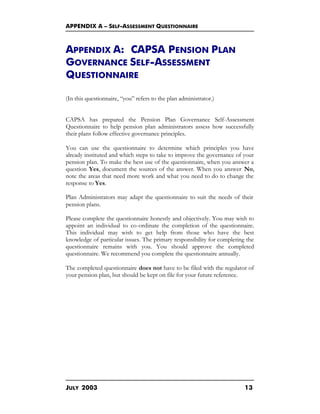
APPENDIX A: CAPSA PENSION PLAN
GOVERNANCE SELF-ASSESSMENT
QUESTIONNAIRE
(In this questionnaire, “you” refers to the plan administrator.)
CAPSA has prepared the Pension Plan Governance Self-Assessment
Questionnaire to help pension plan administrators assess how successfully
their plans follow effective governance principles.
You can use the questionnaire to determine which principles you have
already instituted and which steps to take to improve the governance of your
pension plan. To make the best use of the questionnaire, when you answer a
question Yes, document the sources of the answer. When you answer No,
note the areas that need more work and what you need to do to change the
response to Yes.
Plan Administrators may adapt the questionnaire to suit the needs of their
pension plans.
Please complete the questionnaire honestly and objectively. You may wish to
appoint an individual to co-ordinate the completion of the questionnaire.
This individual may wish to get help from those who have the best
knowledge of particular issues. The primary responsibility for completing the
questionnaire remains with you. You should approve the completed
questionnaire. We recommend you complete the questionnaire annually.
The completed questionnaire does not have to be filed with the regulator of
your pension plan, but should be kept on file for your future reference.
APPENDIX A – SELF-ASSESSMENT QUESTIONNAIRE
JULY 2003 14
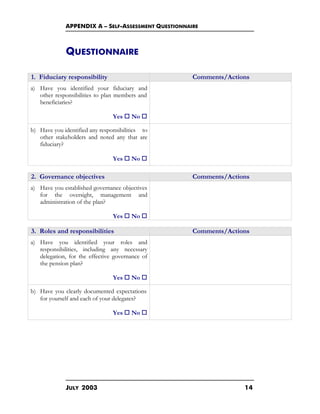
QUESTIONNAIRE
1. Fiduciary responsibility Comments/Actions
a) Have you identified your fiduciary and
other responsibilities to plan members and
beneficiaries?
Yes o No o
b) Have you identified any responsibilities to
other stakeholders and noted any that are
fiduciary?
Yes o No o
2. Governance objectives Comments/Actions
a) Have you established governance objectives
for the oversight, management and
administration of the plan?
Yes o No o
3. Roles and responsibilities Comments/Actions
a) Have you identified your roles and
responsibilities, including any necessary
delegation, for the effective governance of
the pension plan?
Yes o No o
b) Have you clearly documented expectations
for yourself and each of your delegates?
Yes o No o
APPENDIX A – SELF-ASSESSMENT QUESTIONNAIRE
JULY 2003 15
4. Performance measures Comments/Actions
a) Have you established clear measures for
assessing the performance of all participants
in the governance process who have
decision-making authority?
Yes o No o
b) Do you have a regular performance
monitoring, review and remedial process
for all participants in the governance
process who have decision-making
authority?
Yes o No o
5. Knowledge and skills Comments/Actions
a) Have you established an ongoing process to
identify the knowledge and skills needed for
the effective governance of the pension
plan?
Yes o No o
b) Do you have a process to fill gaps in
knowledge and skills?
Yes o No o
6. Access to information Comments/Actions
a) Have you and, as required, your delegates
defined the information necessary to
discharge your responsibilities?
Yes o No o
b) Do you have a process in place for
obtaining this information accurately,
quickly, clearly and in a suitable format?
Yes o No o
APPENDIX A – SELF-ASSESSMENT QUESTIONNAIRE
JULY 2003 16
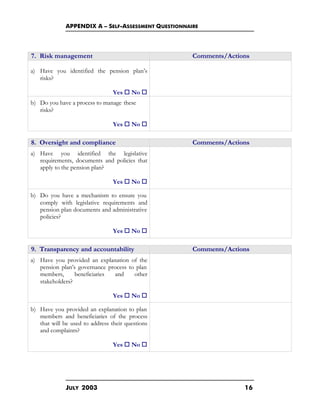
7. Risk management Comments/Actions
a) Have you identified the pension plan’s
risks?
Yes o No o
b) Do you have a process to manage these
risks?
Yes o No o
8. Oversight and compliance Comments/Actions
a) Have you identified the legislative
requirements, documents and policies that
apply to the pension plan?
Yes o No o
b) Do you have a mechanism to ensure you
comply with legislative requirements and
pension plan documents and administrative
policies?
Yes o No o
9. Transparency and accountability Comments/Actions
a) Have you provided an explanation of the
pension plan’s governance process to plan
members, beneficiaries and other
stakeholders?
Yes o No o
b) Have you provided an explanation to plan
members and beneficiaries of the process
that will be used to address their questions
and complaints?
Yes o No o
APPENDIX A – SELF-ASSESSMENT QUESTIONNAIRE
JULY 2003 17
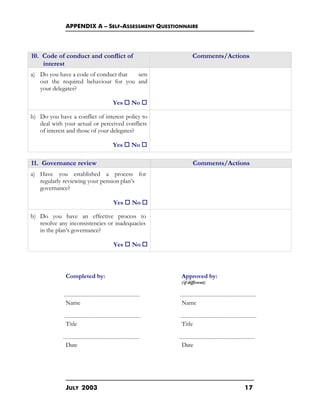
10. Code of conduct and conflict of
interest
Comments/Actions
a) Do you have a code of conduct that sets
out the required behaviour for you and
your delegates?
Yes o No o
b) Do you have a conflict of interest policy to
deal with your actual or perceived conflicts
of interest and those of your delegates?
Yes o No o
11. Governance review Comments/Actions
a) Have you established a process for
regularly reviewing your pension plan’s
governance?
Yes o No o
b) Do you have an effective process to
resolve any inconsistencies or inadequacies
in the plan’s governance?
Yes o No o
Completed by: Approved by:
(if different)
Name Name
Title Title
Date Date

CAPSA Governance Guidelines&Questionnaire

  • 1.
    PENSION PLAN GOVERNANCE GUIDELINES and SELF-ASSESSMENT QUESTIONNAIRE JULY2003 Association of CAPSA Canadian Pension Supervisory Authorities
  • 2.
    TABLE OF CONTENTS Contextfor the Guidelines...........................................................................1 CAPSA Pension Plan Governance Principles...........................................3 CAPSA Pension Plan Governance Guidelines .........................................4 Principle 1: Fiduciary responsibility.....................................................4 Principle 2: Governance objectives ......................................................5 Principle 3: Roles and responsibilities..................................................5 Principle 4: Performance measures ......................................................6 Principle 5: Knowledge and skills ........................................................7 Principle 6: Access to information........................................................7 Principle 7: Risk management ..............................................................7 Principle 8: Oversight and compliance.................................................8 Principle 9: Transparency and accountability......................................8 Principle 10: Code of conduct and conflict of interest........................9 Principle 11: Governance review........................................................10 Glossary of Terms .......................................................................................11 Appendix A: CAPSA Pension Plan Governance Self-Assessment Questionnaire...............................................................................................13
  • 3.
    CONTEXT JULY 2003 1 CONTEXTFOR THE GUIDELINES Pension governance * is about delivering on the pension promise consistent with the pension plan documents and pension legislation. Pension plan administrators have pension governance responsibilities. CAPSA, the association of pension regulators across Canada, has designed these guidelines to help plan administrators meet their governance responsibilities. Pension plan governance refers to the structure and processes for overseeing, managing and administering a pension plan to ensure the fiduciary and other obligations of the plan are met. CAPSA believes that good pension plan governance is essential if plan members are to both receive the benefits and values they are entitled to, and to understand their rights and responsibilities under the pension plan. Pension legislation specifies who may be a plan administrator and identifies the plan administrator’s responsibilities. The plan administrator may be any of the following: § the employer who established the plan, § a pension committee, § a board of trustees, § an insurance company, § a bargaining agent, or § another body established by law. While the plan administrator may use delegates to help carry out governance responsibilities, pension legislation defines the administrator as the governing body ultimately responsible for overseeing the plan. An effective pension governance system: § establishes a framework for dividing the responsibility and accountability among all participants in the governance process, § covers all facets of pension plan management, including communication, funding, investments and benefit administration, and § provides careful oversight while enhancing protection for plan members and beneficiaries. * Please note that defined terms are italicized when first used. Definitions are in the Glossary of Terms, page 11.
  • 4.
    CONTEXT JULY 2003 2 Goodpension plan governance: § is essential for meeting fiduciary and other obligations, § minimizes risks and maximizes efficiency, § promotes the accurate, fast, and cost-effective delivery of pension benefits, § promotes consistent administration of the plan in the best interests of plan members and beneficiaries, § requires control mechanisms that encourage good decision-making, proper and efficient practices, clear accountability, and regular review and evaluation, and § contributes to positive pension plan performance and demonstrates due diligence on the part of the plan administrator. The CAPSA Pension Plan Governance Guidelines provide a broad, flexible outline of key pension plan governance principles. Different types and sizes of plans, however, may require different governance practices. Although pension plan administrators need to adapt their governance practices to specific circumstances and resources, we strongly recommend that all plan administrators adopt a governance structure and processes consistent with the principles that follow. The Guidelines recommend principles for effective pension plan governance. They discuss the appropriate roles and responsibilities of the plan sponsor only when the plan sponsor is acting as plan administrator. They do not discuss the roles and responsibilities of the plan sponsor under general corporate governance principles. Many individuals who have pension plan governance responsibilities also have responsibilities to the plan sponsor. Consequently, they must clearly understand the different roles and responsibilities for each. Further, when taking actions that affect the pension plan, they must carefully document the actions for both sets of responsibilities. The Guidelines build on important work by labour organizations, industry associations such as the Pension Investment Association of Canada (PIAC), the Association of Canadian Pension Management (ACPM) and pension regulators such as the Office of the Superintendent of Financial Institutions (OSFI). CAPSA encourages all pension plan administrators in Canada to assess whether their current pension plan governance structures are effective and to strive for the best practices set out in the Guidelines. Note, however, that the Guidelines are not intended to create additional rights and obligations for any party to a pension plan. Though voluntary, they are meant to help plan administrators achieve and maintain good pension plan governance.
  • 5.
    PENSION PLAN GOVERNANCEPRINCIPLES JULY 2003 3 CAPSA PENSION PLAN GOVERNANCE PRINCIPLES Principle 1: Fiduciary responsibility The plan administrator has fiduciary and other responsibilities to plan members and beneficiaries. The plan administrator may also have fiduciary and other responsibilities to other stakeholders. Principle 2: Governance objectives The plan administrator should establish governance objectives for the oversight, management, and administration of the plan. Principle 3: Roles and responsibilities The plan administrator should clearly describe and document the roles, responsibilities, and accountability of all participants in the pension plan governance process. Principle 4: Performance measures The plan administrator should provide for the establishment of performance measures and for monitoring the performance of participants who have decision-making authority in the governance process. Principle 5: Knowledge and skills The plan administrator, directly or with delegates, has a duty to apply the knowledge and skills needed to meet governance responsibilities. Principle 6: Access to information The plan administrator and, as necessary, any delegates should have access to relevant, timely and accurate information. Principle 7: Risk management The plan administrator should provide for the establishment of an internal control framework, commensurate with the plan’s circumstance, which addresses the pension plan’s risks. Principle 8: Oversight and compliance The plan administrator should provide for the establishment of appropriate mechanisms to oversee and ensure compliance with the legislative requirements and pension plan documents and administrative policies. Principle 9: Transparency and accountability The plan administrator should provide for the communication of the governance process to plan members, beneficiaries and other stakeholders to facilitate transparency and accountability. Principle 10: Code of conduct and conflict of interest The plan administrator should provide for the establishment of a code of conduct and a policy to address conflicts of interest. Principle 11: Governance review The plan administrator should conduct a regular review or its plan governance.
  • 6.
    PENSION PLAN GOVERNANCEGUIDELINES JULY 2003 4 CAPSA PENSION PLAN GOVERNANCE GUIDELINES Principle 1: Fiduciary responsibility The plan administrator has fiduciary and other responsibilities to plan members and beneficiaries. The plan administrator may also have fiduciary and other responsibilities to other stakeholders. (a) Fiduciary obligations of the plan administrator A fiduciary relationship exists when a plan administrator and/or any delegates can exercise discretionary power to affect members’ or beneficiaries’ interests. The greater the discretionary powers of the fiduciaries, the greater their fiduciary duties. The plan administrator and delegates must act in good faith and in the best interests of plan members, beneficiaries and other stakeholders of the pension plan when carrying out their fiduciary responsibilities. In its fiduciary role, the plan administrator’s responsibilities include: § treating members and beneficiaries impartially, § acting with the care, skill and diligence of a prudent person, § interpreting the plan terms fairly, impartially and in good faith, § preventing personal interests from conflicting with those of the plan, and § within the scope of its authority, ensuring that members and beneficiaries receive promised benefits. The plan administrator also has other responsibilities to members and beneficiaries, and may have other responsibilities to other stakeholders. The pension governance process should help the plan administrator carry out its fiduciary and other responsibilities. If needed, the plan administrator should engage appropriate professional advisors. To address conflicts of interest, the plan administrator should have a resolution process in place (see Principle 10).
  • 7.
    PENSION PLAN GOVERNANCEGUIDELINES JULY 2003 5 (b) Employers or bargaining agents acting as plan administrators When employers, bargaining agents, or their nominees act as plan administrators, they must understand the difference between their plan administrator and other roles, and act accordingly. Employers or bargaining agents should follow the principles in these Guidelines when acting as plan administrator. (c) Plan Administrator for member-directed defined contribution plans Many member-directed defined contribution plans are provided through service providers such as insurance, trust, and mutual fund companies. Although the service provider often provides a wide range of services, the plan administrator continues to have ultimate responsibility for the governance of the pension plan. The administrator of the plan is often also the employer or plan sponsor. The plan administrator should inform the members of the pension plan not only of its benefits, but also of the risks and the responsibilities of membership in the plan. Principle 2: Governance objectives The plan administrator should establish governance objectives for the oversight, management, and administration of the plan. The plan administrator determines plan governance objectives, which provide the framework and standards for the oversight, management and administration of the pension plan and its pension fund. The objectives, which should be clearly documented, should build on any of the plan sponsor’s objectives for the pension plan, as well as on the plan terms and regulatory requirements. Pension plan governance objectives help develop effective governance practices leading to the efficient and successful operation of the pension plan. Principle 3: Roles and responsibilities The plan administrator should clearly describe and document the roles, responsibilities, and accountability of all participants in the pension plan governance process. The plan administrator: § is expected to oversee and assume responsibility for the pension plan, but is not expected to manage the plan on a day-to-day basis,
  • 8.
    PENSION PLAN GOVERNANCEGUIDELINES JULY 2003 6 § may delegate operational management tasks, but is ultimately responsible and accountable for managing the plan and for selecting and monitoring the actions of delegates and committees, and § should ensure that the pension governance structure, roles and responsibilities, accountability and reporting relationships (i.e. chain of delegation) are clearly documented and communicated to all participants in the pension plan governance process. When the same person performs both pension plan governance and corporate functions, there must be a clear recognition and understanding of the different roles and responsibilities of each function. Good pension plan governance requires clear documenting of each action and the role under which an action was taken. Principle 4: Performance measures The plan administrator should provide for the establishment of performance measures and for monitoring the performance of participants who have decision-making authority in the governance process. The plan administrator is responsible for regularly monitoring the performance of all key decision-makers and evaluating them against established performance measures. The plan administrator should report the results to appropriate stakeholders, and regularly review performance measures themselves. Since performance evaluations need to be based on impartial assessments, the plan administrator may require independent professional advice. The plan administrator should direct recommendations for change to the group that the decision-makers are accountable to. The plan administrator is responsible for establishing procedures with follow-up actions to correct inadequate performance.
  • 9.
    PENSION PLAN GOVERNANCEGUIDELINES JULY 2003 7 Principle 5: Knowledge and skills The plan administrator, directly or with delegates, has a duty to apply the knowledge and skills needed to meet governance responsibilities. The plan administrator is ultimately responsible for the governance of the pension plan. The plan administrator may get help from others to meet the obligations of this role. The administrator, delegates and committees in the governance structure should together possess and apply the knowledge and skills to fulfill governance responsibilities. The plan administrator should be provided with appropriate training and ongoing education, as required. Principle 6: Access to information The plan administrator and, as necessary, any delegates should have access to relevant, timely and accurate information. Processes should exist so that the plan administrator and any delegates, as required, receive appropriate, current, accurate, and complete information to enable them to perform their responsibilities effectively. Principle 7: Risk management The plan administrator should provide for the establishment of an internal control framework, commensurate with the plan’s circumstances, that addresses the pension plan’s risks. (a) Internal control framework The internal control framework should ensure that risks are addressed and appropriate controls are in place. The plan administrator should understand and approve the framework and the written internal control policies. While the framework may vary depending on the plan type, it should include policies on documentation, record keeping, costing, funding, fund investment, expense control, benefits administration, outsourcing, compliance, and communication.
  • 10.
    PENSION PLAN GOVERNANCEGUIDELINES JULY 2003 8 (b) Fees The plan administrator should monitor and assess the reasonableness and competitiveness of any fees charged to the plan or paid by members. (c) Delinquency control The plan administrator should establish a delinquency control program with procedures for collecting unpaid contributions and data, and solutions for non-compliance. Principle 8: Oversight and compliance The plan administrator should provide for the establishment of appropriate mechanisms to oversee and ensure compliance with the legislative requirements and pension plan documents and administrative policies. Every pension plan needs documented processes and standards to enable compliance with legislative requirements. This also ensures all administrative functions, including calculating, paying and receiving contributions and pension benefits or values, fall within the plan terms, plan administrative policies, and legislative requirements. Principle 9: Transparency and accountability The plan administrator should provide for the communication of the governance process to plan members, beneficiaries and other stakeholders to facilitate transparency and accountability. (a) Communication policy: plan members and beneficiaries A governance-focussed communication policy should be established for the pension plan. The policy should provide for the disclosure of governance- related information to members and beneficiaries. At a minimum, this should include the information required by statute. Communication should be appropriate, timely, accurate, complete, consistent, cost-effective, and accessible to promote members’ and beneficiaries’ confidence in the governance process. The plan administrator should consider both fiduciary and other responsibilities when deciding what to disclose, the manner and form of disclosure, and whom to disclose the information. In this context, the plan administrator needs to consider appropriate information disclosure to
  • 11.
    PENSION PLAN GOVERNANCEGUIDELINES JULY 2003 9 members about the benefits, risks, and responsibilities of membership in the plan. The plan administrator should give sufficient information to members for them to make informed decisions about their pension plan options. (b) Plan member and beneficiary concerns Pension plan members and beneficiaries have a right to voice their concerns and have them addressed quickly. The administrator should arrange for capable parties to address member inquiries and complaints, and create effective conflict resolution procedures to handle disagreements. The names and responsibilities of key contacts should be given to plan members and beneficiaries. Principle 10: Code of conduct and conflict of interest The plan administrator should provide for the establishment of a code of conduct and a policy to address conflicts of interest. The plan administrator should establish a code of conduct for both the plan administrator and its delegates. The code of conduct should set out required behaviour, establish a control procedure for conflicts of interest and provide for due process and a dispute resolution mechanism. The plan administrator should always behave in a manner that reflects its fiduciary and other obligations. To ensure the code of conduct is effective, and that it also applies to delegates, the plan administrator should set up a review process. The conflict of interest policy should set out an appropriate procedure to disclose and address conflicts of interest. The policy should address both actual conflicts and the appearance of conflicts.
  • 12.
    PENSION PLAN GOVERNANCEGUIDELINES JULY 2003 10 Principle 11: Governance review The plan administrator should conduct a regular review of its plan governance. The plan administrator should periodically review governance procedures and practices to assess their effectiveness compared to the pension plan’s stated governance objectives. The administrator may wish to report the results of the self-assessment exercise, including any resulting changes in policies, procedures and practices to pension plan members, beneficiaries, delegates and other stakeholders. Every pension plan should have a method of regularly assessing the plan administrator’s performance and the governance structure of the pension plan. Ongoing review of the governance procedures themselves will show the effectiveness of a pension plan’s governance structure and operations. It will also demonstrate whether the plan administrator is meeting the governance objectives and fulfilling the required fiduciary and other responsibilities. After each review, the plan administrator should modify the governance structure and the policies and practices, as required, to enhance effectiveness. Plan administrators may wish to seek independent professional advice to ensure impartiality for their self-assessment. Self-assessment should be tailored to the circumstances of the pension plan.
  • 13.
    GLOSSARY OF TERMS JULY2003 11 GLOSSARY OF TERMS beneficiary an individual entitled to a death benefit under the terms of a pension plan. defined contribution plan (money purchase plan) a pension plan with a specified contribution formula. Contributions are recorded on an individual account basis. The benefit a plan member will receive on retirement is based on accumulated contributions and investment returns at retirement. Employees may or may not contribute to the pension plan. delegate∗ a person who carries out aspects of the administration of the plan, including any professional or other service provider employed or retained by the plan administrator. Depending on the circumstances, it may include a service provider who gives advice on the pension plan and pension fund. governance the structure and processes under which a pension plan is administered and monitored to ensure that fiduciary and other obligations with respect to the pension plan are fulfilled. pension fund the assets of the pension plan, which are held separate and apart from other assets of the sponsor. plan administrator the individual, group, body or entity that is ultimately responsible for the oversight, management and administration of a pension plan. ∗ In Québec, there is also the notion of "delegatee", which is distinct from that of the "delegate". The delegatee has, with respect to delegated functions, the same responsibilities as the administrator.
  • 14.
    GLOSSARY OF TERMS JULY2003 12 plan member(s) or member both current and former employees entitled to benefits under the plan. plan sponsor the individual, entity, or entities that establish and/or continue to sponsor a pension plan. stakeholder a party who has an interest in decisions and actions about the plan. It includes plan members and beneficiaries, and may include others who may be entitled to plan benefits in circumstances such as marriage breakdown. Depending on the circumstances of the plan, it may also include the plan administrator, employers, collective bargaining agents, employee associations, and others.
  • 15.
    APPENDIX A –SELF-ASSESSMENT QUESTIONNAIRE JULY 2003 13 APPENDIX A: CAPSA PENSION PLAN GOVERNANCE SELF-ASSESSMENT QUESTIONNAIRE (In this questionnaire, “you” refers to the plan administrator.) CAPSA has prepared the Pension Plan Governance Self-Assessment Questionnaire to help pension plan administrators assess how successfully their plans follow effective governance principles. You can use the questionnaire to determine which principles you have already instituted and which steps to take to improve the governance of your pension plan. To make the best use of the questionnaire, when you answer a question Yes, document the sources of the answer. When you answer No, note the areas that need more work and what you need to do to change the response to Yes. Plan Administrators may adapt the questionnaire to suit the needs of their pension plans. Please complete the questionnaire honestly and objectively. You may wish to appoint an individual to co-ordinate the completion of the questionnaire. This individual may wish to get help from those who have the best knowledge of particular issues. The primary responsibility for completing the questionnaire remains with you. You should approve the completed questionnaire. We recommend you complete the questionnaire annually. The completed questionnaire does not have to be filed with the regulator of your pension plan, but should be kept on file for your future reference.
  • 16.
    APPENDIX A –SELF-ASSESSMENT QUESTIONNAIRE JULY 2003 14 QUESTIONNAIRE 1. Fiduciary responsibility Comments/Actions a) Have you identified your fiduciary and other responsibilities to plan members and beneficiaries? Yes o No o b) Have you identified any responsibilities to other stakeholders and noted any that are fiduciary? Yes o No o 2. Governance objectives Comments/Actions a) Have you established governance objectives for the oversight, management and administration of the plan? Yes o No o 3. Roles and responsibilities Comments/Actions a) Have you identified your roles and responsibilities, including any necessary delegation, for the effective governance of the pension plan? Yes o No o b) Have you clearly documented expectations for yourself and each of your delegates? Yes o No o
  • 17.
    APPENDIX A –SELF-ASSESSMENT QUESTIONNAIRE JULY 2003 15 4. Performance measures Comments/Actions a) Have you established clear measures for assessing the performance of all participants in the governance process who have decision-making authority? Yes o No o b) Do you have a regular performance monitoring, review and remedial process for all participants in the governance process who have decision-making authority? Yes o No o 5. Knowledge and skills Comments/Actions a) Have you established an ongoing process to identify the knowledge and skills needed for the effective governance of the pension plan? Yes o No o b) Do you have a process to fill gaps in knowledge and skills? Yes o No o 6. Access to information Comments/Actions a) Have you and, as required, your delegates defined the information necessary to discharge your responsibilities? Yes o No o b) Do you have a process in place for obtaining this information accurately, quickly, clearly and in a suitable format? Yes o No o
  • 18.
    APPENDIX A –SELF-ASSESSMENT QUESTIONNAIRE JULY 2003 16 7. Risk management Comments/Actions a) Have you identified the pension plan’s risks? Yes o No o b) Do you have a process to manage these risks? Yes o No o 8. Oversight and compliance Comments/Actions a) Have you identified the legislative requirements, documents and policies that apply to the pension plan? Yes o No o b) Do you have a mechanism to ensure you comply with legislative requirements and pension plan documents and administrative policies? Yes o No o 9. Transparency and accountability Comments/Actions a) Have you provided an explanation of the pension plan’s governance process to plan members, beneficiaries and other stakeholders? Yes o No o b) Have you provided an explanation to plan members and beneficiaries of the process that will be used to address their questions and complaints? Yes o No o
  • 19.
    APPENDIX A –SELF-ASSESSMENT QUESTIONNAIRE JULY 2003 17 10. Code of conduct and conflict of interest Comments/Actions a) Do you have a code of conduct that sets out the required behaviour for you and your delegates? Yes o No o b) Do you have a conflict of interest policy to deal with your actual or perceived conflicts of interest and those of your delegates? Yes o No o 11. Governance review Comments/Actions a) Have you established a process for regularly reviewing your pension plan’s governance? Yes o No o b) Do you have an effective process to resolve any inconsistencies or inadequacies in the plan’s governance? Yes o No o Completed by: Approved by: (if different) Name Name Title Title Date Date