

“Capability Maturity Model”
(CMM) of MIS
Ahadali Bangliwala 1
Irfan 2
Naved Ansari 3
Saud Ansari 4
Faizan Anware 5
Usama Anware 6
Zaib Shaikh 61
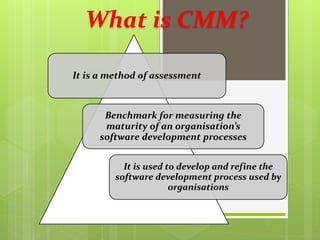
What is CMM?
It is a method of assessment
Benchmark for measuring the
maturity of an organisation’s
software development processes
It is used to develop and refine the
software development process used by
organisations
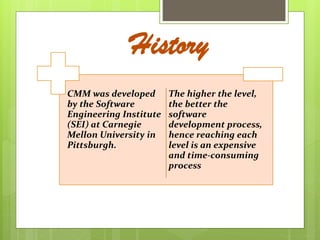
CMM was developed
by the Software
Engineering Institute
(SEI) at Carnegie
Mellon University in
Pittsburgh.
The higher the level,
the better the
software
development process,
hence reaching each
level is an expensive
and time-consuming
process
History
Initially funded by
military research.
U.S. Air force
funded a study at
a software
institute to create
a model (an
abstract) for the
military to use as
an objective
evaluation of
software
subcontractors.
The result was the
Capability Model,
published as
Managing the
Software Process
in 1989. Maturity
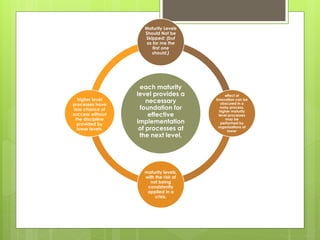
each maturity
level provides a
necessary
foundation for
effective
implementation
of processes at
the next level,
Maturity Levels
Should Not be
Skipped: (but
as for me the
first one
should.)
effect of
innovation can be
obscured in a
noisy process,
higher maturity
level processes
may be
performed by
organizations at
lower
maturity levels,
with the risk of
not being
consistently
applied in a
crisis.
higher level
processes have
less chance of
success without
the discipline
provided by
lower levels,
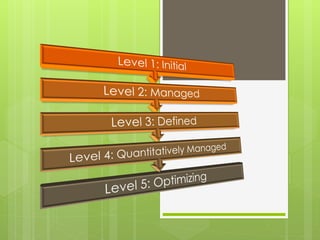
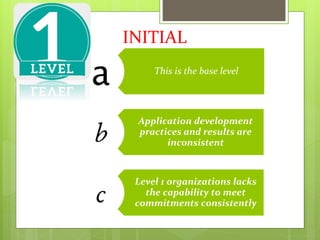
This is the base level
Application development
practices and results are
inconsistent
Level 1 organizations lacks
the capability to meet
commitments consistently
INITIAL
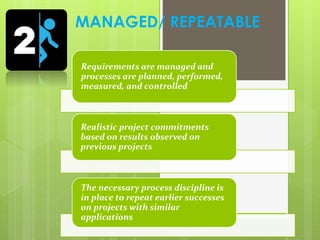
Requirements are managed and
processes are planned, performed,
measured, and controlled
Realistic project commitments
based on results observed on
previous projects
The necessary process discipline is
in place to repeat earlier successes
on projects with similar
applications
MANAGED/ REPEATABLE
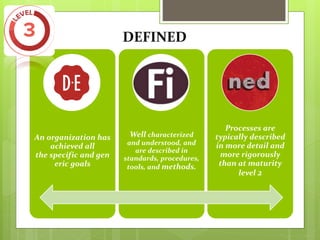
An organization has
achieved all
the specific and gen
eric goals
Well characterized
and understood, and
are described in
standards, procedures,
tools, and methods.
Processes are
typically described
in more detail and
more rigorously
than at maturity
level 2
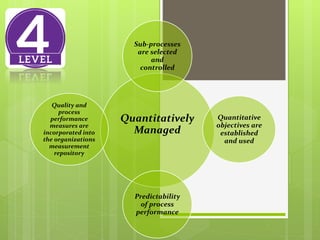
Quantitatively
Managed
Sub-processes
are selected
and
controlled
Quantitative
objectives are
established
and used
Predictability
of process
performance
Quality and
process
performance
measures are
incorporated into
the organizations
measurement
repository
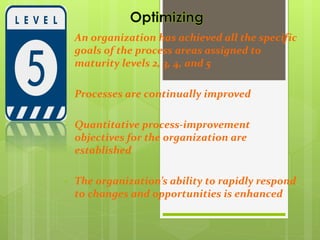
• An organization has achieved all the specific
goals of the process areas assigned to
maturity levels 2, 3, 4, and 5
• Processes are continually improved
• Quantitative process-improvement
objectives for the organization are
established
• The organization’s ability to rapidly respond
to changes and opportunities is enhanced
APPRAISAL
An organization cannot be certified in CMM; instead, an
organization is appraised.
• Depending on the type of appraisal, the organization can be
awarded a maturity level rating (1‐5) or a capability level
achievement profile.
• Many organizations find value in measuring their progress by
conducting an appraisal. Appraisals are typically conducted for
one or more of the following reasons:
– 1. To determine how well the organization’s
processes compare to CMMI best practices, and to identify areas where
improvement can be made.
– 2. To inform external customers and suppliers of how well the
organization’s processes compare to CMMI best practices
– 3. To meet the contractual requirements of one or more
Customers.
Lack of Integration
Limitations of KPA
Activity‐based Approach:
Paperwork
1 – Consistency
2 – Cost saving
3 – Self improvement
4 – Market demand
5 – Performance demand
6 – Process improvement
Case study
OC-ALC
(OKLAHOMA CITY-AIR LOGISTICS
CENTRE)
INTRODUCTION
 OC-ALC is located at Tinker Air Force Base, OklaThere are over
400 personnel in seven branches of The Software Division. The
responsibility of The Software Division (LAS) is to develop and
maintain many different Air Force software items.
 At that time LAS was rated at CMM level 1, LAS was chosen by
the SEI to be an alpha site for the updated software process
improvement methodology. As a result, LAS was one of the first to
get CMM level 2 certified in March 1993.
 LAS was working on getting certified at CMM level 3 with the
next assessment scheduled for 1996.
 LAS had to achieve Key Process Areas (KPAs) and goals of the
CMM level 3, which were much more than KPAs of the level 2.
Process
 LAS began its relationship with the SEI in 1989. “To facilitate process
improvement, LAS has developed and implemented a process
improvement infrastructure, the purpose of which is to guide and
monitor the organization’s process improvement efforts.”
 The process improvement infrastructure includes the Management
Steering Team (MST), composed of the senior organizational
management along with the Software Engineering Process Group
(SEPG), composed of technical personnel.
 LAS felt that they have had success in their process improvement
efforts because they have seen a return on their process improvement
investment.
 Another key to success is the funding that the Air Force Material
Command provides for process improvement. Funding is the key
allowing the improvement efforts to be worked at the same
management level.
Lessons from the CS
 LAS invested 15 million over an 8-year period. It saves cost of
$11.3 million.
 LAS has reduced the cost of a TPS maintenance correction by 26
percent. Productivity of the project had also increased.
 We learned from the case study that the important factors of
improving process are the leadership and support of the senior
management.
 The process improvement efforts were having a positive impact
on the organization.
 CMM is very useful for the organizations willing to improve
their software process by giving key process areas at each level.
Organization could achieve the KPAs and goals at each level to
get certified to the higher level.
Capability maturity model

Capability maturity model

  • 1.
    “Capability Maturity Model” (CMM)of MIS Ahadali Bangliwala 1 Irfan 2 Naved Ansari 3 Saud Ansari 4 Faizan Anware 5 Usama Anware 6 Zaib Shaikh 61
  • 2.
    What is CMM? Itis a method of assessment Benchmark for measuring the maturity of an organisation’s software development processes It is used to develop and refine the software development process used by organisations
  • 3.
    CMM was developed bythe Software Engineering Institute (SEI) at Carnegie Mellon University in Pittsburgh. The higher the level, the better the software development process, hence reaching each level is an expensive and time-consuming process History
  • 5.
    Initially funded by militaryresearch. U.S. Air force funded a study at a software institute to create a model (an abstract) for the military to use as an objective evaluation of software subcontractors. The result was the Capability Model, published as Managing the Software Process in 1989. Maturity
  • 6.
    each maturity level providesa necessary foundation for effective implementation of processes at the next level, Maturity Levels Should Not be Skipped: (but as for me the first one should.) effect of innovation can be obscured in a noisy process, higher maturity level processes may be performed by organizations at lower maturity levels, with the risk of not being consistently applied in a crisis. higher level processes have less chance of success without the discipline provided by lower levels,
  • 8.
    This is thebase level Application development practices and results are inconsistent Level 1 organizations lacks the capability to meet commitments consistently INITIAL
  • 9.
    Requirements are managedand processes are planned, performed, measured, and controlled Realistic project commitments based on results observed on previous projects The necessary process discipline is in place to repeat earlier successes on projects with similar applications MANAGED/ REPEATABLE
  • 10.
    An organization has achievedall the specific and gen eric goals Well characterized and understood, and are described in standards, procedures, tools, and methods. Processes are typically described in more detail and more rigorously than at maturity level 2
  • 11.
    Quantitatively Managed Sub-processes are selected and controlled Quantitative objectives are established andused Predictability of process performance Quality and process performance measures are incorporated into the organizations measurement repository
  • 12.
    • An organizationhas achieved all the specific goals of the process areas assigned to maturity levels 2, 3, 4, and 5 • Processes are continually improved • Quantitative process-improvement objectives for the organization are established • The organization’s ability to rapidly respond to changes and opportunities is enhanced
  • 13.
    APPRAISAL An organization cannotbe certified in CMM; instead, an organization is appraised. • Depending on the type of appraisal, the organization can be awarded a maturity level rating (1‐5) or a capability level achievement profile. • Many organizations find value in measuring their progress by conducting an appraisal. Appraisals are typically conducted for one or more of the following reasons: – 1. To determine how well the organization’s processes compare to CMMI best practices, and to identify areas where improvement can be made. – 2. To inform external customers and suppliers of how well the organization’s processes compare to CMMI best practices – 3. To meet the contractual requirements of one or more Customers.
  • 14.
    Lack of Integration Limitationsof KPA Activity‐based Approach: Paperwork
  • 15.
    1 – Consistency 2– Cost saving 3 – Self improvement 4 – Market demand 5 – Performance demand 6 – Process improvement
  • 16.
  • 17.
    INTRODUCTION  OC-ALC islocated at Tinker Air Force Base, OklaThere are over 400 personnel in seven branches of The Software Division. The responsibility of The Software Division (LAS) is to develop and maintain many different Air Force software items.  At that time LAS was rated at CMM level 1, LAS was chosen by the SEI to be an alpha site for the updated software process improvement methodology. As a result, LAS was one of the first to get CMM level 2 certified in March 1993.  LAS was working on getting certified at CMM level 3 with the next assessment scheduled for 1996.  LAS had to achieve Key Process Areas (KPAs) and goals of the CMM level 3, which were much more than KPAs of the level 2.
  • 18.
    Process  LAS beganits relationship with the SEI in 1989. “To facilitate process improvement, LAS has developed and implemented a process improvement infrastructure, the purpose of which is to guide and monitor the organization’s process improvement efforts.”  The process improvement infrastructure includes the Management Steering Team (MST), composed of the senior organizational management along with the Software Engineering Process Group (SEPG), composed of technical personnel.  LAS felt that they have had success in their process improvement efforts because they have seen a return on their process improvement investment.  Another key to success is the funding that the Air Force Material Command provides for process improvement. Funding is the key allowing the improvement efforts to be worked at the same management level.
  • 19.
    Lessons from theCS  LAS invested 15 million over an 8-year period. It saves cost of $11.3 million.  LAS has reduced the cost of a TPS maintenance correction by 26 percent. Productivity of the project had also increased.  We learned from the case study that the important factors of improving process are the leadership and support of the senior management.  The process improvement efforts were having a positive impact on the organization.  CMM is very useful for the organizations willing to improve their software process by giving key process areas at each level. Organization could achieve the KPAs and goals at each level to get certified to the higher level.