CAP Theorem
Vikash Kodati
10/19/2016
CAP Theorem (also Brewer's theorem)
4/6/2016 T-MobileConfidential2
It is impossible for a distributed system to simultaneously provide all three of the
following guarantees: (Pick any two)
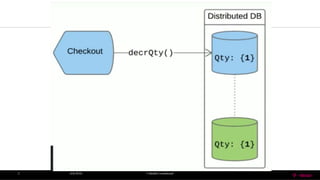
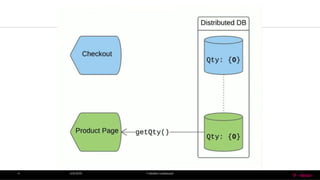
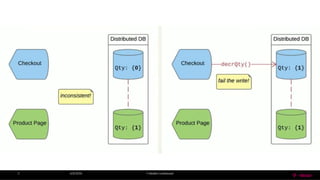
1. Consistency: All nodes should see the same data at the same time or reads
return latest written value by any client
2. Availability: Every request receives a response. The system allows operations all
the time and operations return quickly
3. Partition – Tolerance: the system continues to operate despite arbitrary
partitioning due to network failures
4/6/2016 T-MobileConfidential3
4/6/2016 T-MobileConfidential4
4/6/2016 T-MobileConfidential5
Why is Availability Important?
4/6/2016 T-MobileConfidential6
Availability = Reads / writes complete reliably and quickly.
• Data shows that a 500 ms increase in latency for operations at Amazon.com or at
Google.com can cause a 20% drop in revenue
• At Amazon , each added millisecond of latency implies a $6M yearly loss
• SLAs written by providers predominantly deal with latencies faced by clients
Why is Consistency Important?
4/6/2016 T-MobileConfidential7
Consistency = all nodes see same data at time, or reads return latest written value by
any client.
• When you access your bank or investment account via multiple clients, you want the
updates done from one client to be visible to other clients.
• When thousands of customers are looking to book a flight, all updates from any client
should be accessible by other clients.
Why is Partition - Tolerance Important?
4/6/2016 T-MobileConfidential8
Partitions can happen across datacenter when the network gets disconnected
• Internet router outages
• Under-sea cables cut
• DNS not working
• Partitions can also occur within a datacenter, e.g., a rack switch outage.
• Still we desire a system to continue functioning normally
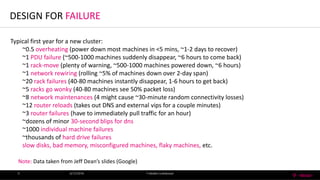
DESIGN FOR FAILURE
6/13/2016 T-MobileConfidential9
Typical first year for a new cluster:
~0.5 overheating (power down most machines in <5 mins, ~1-2 days to recover)
~1 PDU failure (~500-1000 machines suddenly disappear, ~6 hours to come back)
~1 rack-move (plenty of warning, ~500-1000 machines powered down, ~6 hours)
~1 network rewiring (rolling ~5% of machines down over 2-day span)
~20 rack failures (40-80 machines instantly disappear, 1-6 hours to get back)
~5 racks go wonky (40-80 machines see 50% packet loss)
~8 network maintenances (4 might cause ~30-minute random connectivity losses)
~12 router reloads (takes out DNS and external vips for a couple minutes)
~3 router failures (have to immediately pull traffic for an hour)
~dozens of minor 30-second blips for dns
~1000 individual machine failures
~thousands of hard drive failures
slow disks, bad memory, misconfigured machines, flaky machines, etc.
Note: Data taken from Jeff Dean’s slides (Google)
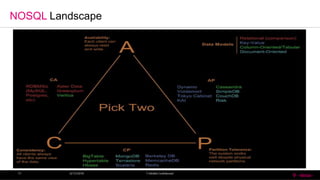
CAP Theorem Fallout
4/6/2016 T-MobileConfidential10
• Since partition-tolerance is essential / inevitable in today’s cloud computing systems,
CAP theorem implies that a system has to choose between consistency and
availability.
• Cassandra (AP System, Sacrifice Consistency)
• Eventual (Weak) consistency , Availability and Partition –Tolerance.
• Traditional RDBMSs (CA System, Partitions can’t happen [single node])
• Strong consistency over availability under a partition.
NOSQL Landscape
6/13/2016 T-MobileConfidential11
Eventual Consistency
4/6/2016 T-MobileConfidential12
• If all writes stop (to a key), then all its values (replicas) will coverage eventually.
• If writes continues , then system always tries to keep converging.
• Moving “wave” of updated values lagging behind the latest values sent by
clients , but always trying to catch up.
• But works well when there a few periods of low writes – system converges quickly.
RDBMS vs. Key value stores
4/6/2016 T-MobileConfidential13
• While RDBMS provide ACID.
• Atomicity
• Consistency
• Isolation
• Durability
• Key – value stores like Cassandra provide BASE
• Basically Available Soft-state Eventual Consistency
• Prefers Availability over Consistency
CONCLUSION
4/6/2016 T-MobileConfidential14
• Business vs Engineering decisions
• Would you rather be down or show wrong prices/inventory
• Would you rather be slow or show wrong prices/inventory
• New Paradigm
• Industries trying trying to run on availability
• Model systems to mimic laws of Physics
• Once done, cant revert. Why: because we cannot go back in time
• Once done, we can correct (if needed). This is eventual consistency
• Telecommunication Industry Example
• Commissions team: Pay advances but chargeback later
THANK YOU & QA
6/13/2016 T-MobileConfidential15
Vikash Kodati
• Email: Vikash.Kodati@t-mobile.com
• Yammer: https://www.yammer.com/t-mobile.com/users/vikashkodati
• Github: https://github.com/vikashkodati
• LinkedIn: /in/vikashkodati
• Twitter: @vikashkodati
• Blog: https://tmobileusa.sharepoint.com/portals/hub/personal/vikashkodati
REFERENCES
6/13/2016 T-MobileConfidential16
http://mwhittaker.github.io/2014/08/16/illustrated-proof-cap-theorem/
https://pinboard.in/u:sids/t:fifthel2015
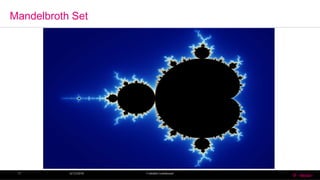
Mandelbroth Set
6/13/2016 T-MobileConfidential17
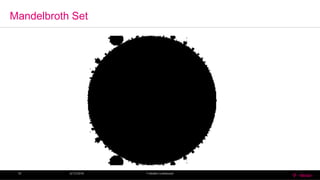
Mandelbroth Set
6/13/2016 T-MobileConfidential18

CAP Theorem

  • 1.
  • 2.
    CAP Theorem (alsoBrewer's theorem) 4/6/2016 T-MobileConfidential2 It is impossible for a distributed system to simultaneously provide all three of the following guarantees: (Pick any two) 1. Consistency: All nodes should see the same data at the same time or reads return latest written value by any client 2. Availability: Every request receives a response. The system allows operations all the time and operations return quickly 3. Partition – Tolerance: the system continues to operate despite arbitrary partitioning due to network failures
  • 3.
  • 4.
  • 5.
  • 6.
    Why is AvailabilityImportant? 4/6/2016 T-MobileConfidential6 Availability = Reads / writes complete reliably and quickly. • Data shows that a 500 ms increase in latency for operations at Amazon.com or at Google.com can cause a 20% drop in revenue • At Amazon , each added millisecond of latency implies a $6M yearly loss • SLAs written by providers predominantly deal with latencies faced by clients
  • 7.
    Why is ConsistencyImportant? 4/6/2016 T-MobileConfidential7 Consistency = all nodes see same data at time, or reads return latest written value by any client. • When you access your bank or investment account via multiple clients, you want the updates done from one client to be visible to other clients. • When thousands of customers are looking to book a flight, all updates from any client should be accessible by other clients.
  • 8.
    Why is Partition- Tolerance Important? 4/6/2016 T-MobileConfidential8 Partitions can happen across datacenter when the network gets disconnected • Internet router outages • Under-sea cables cut • DNS not working • Partitions can also occur within a datacenter, e.g., a rack switch outage. • Still we desire a system to continue functioning normally
  • 9.
    DESIGN FOR FAILURE 6/13/2016T-MobileConfidential9 Typical first year for a new cluster: ~0.5 overheating (power down most machines in <5 mins, ~1-2 days to recover) ~1 PDU failure (~500-1000 machines suddenly disappear, ~6 hours to come back) ~1 rack-move (plenty of warning, ~500-1000 machines powered down, ~6 hours) ~1 network rewiring (rolling ~5% of machines down over 2-day span) ~20 rack failures (40-80 machines instantly disappear, 1-6 hours to get back) ~5 racks go wonky (40-80 machines see 50% packet loss) ~8 network maintenances (4 might cause ~30-minute random connectivity losses) ~12 router reloads (takes out DNS and external vips for a couple minutes) ~3 router failures (have to immediately pull traffic for an hour) ~dozens of minor 30-second blips for dns ~1000 individual machine failures ~thousands of hard drive failures slow disks, bad memory, misconfigured machines, flaky machines, etc. Note: Data taken from Jeff Dean’s slides (Google)
  • 10.
    CAP Theorem Fallout 4/6/2016T-MobileConfidential10 • Since partition-tolerance is essential / inevitable in today’s cloud computing systems, CAP theorem implies that a system has to choose between consistency and availability. • Cassandra (AP System, Sacrifice Consistency) • Eventual (Weak) consistency , Availability and Partition –Tolerance. • Traditional RDBMSs (CA System, Partitions can’t happen [single node]) • Strong consistency over availability under a partition.
  • 11.
  • 12.
    Eventual Consistency 4/6/2016 T-MobileConfidential12 •If all writes stop (to a key), then all its values (replicas) will coverage eventually. • If writes continues , then system always tries to keep converging. • Moving “wave” of updated values lagging behind the latest values sent by clients , but always trying to catch up. • But works well when there a few periods of low writes – system converges quickly.
  • 13.
    RDBMS vs. Keyvalue stores 4/6/2016 T-MobileConfidential13 • While RDBMS provide ACID. • Atomicity • Consistency • Isolation • Durability • Key – value stores like Cassandra provide BASE • Basically Available Soft-state Eventual Consistency • Prefers Availability over Consistency
  • 14.
    CONCLUSION 4/6/2016 T-MobileConfidential14 • Businessvs Engineering decisions • Would you rather be down or show wrong prices/inventory • Would you rather be slow or show wrong prices/inventory • New Paradigm • Industries trying trying to run on availability • Model systems to mimic laws of Physics • Once done, cant revert. Why: because we cannot go back in time • Once done, we can correct (if needed). This is eventual consistency • Telecommunication Industry Example • Commissions team: Pay advances but chargeback later
  • 15.
    THANK YOU &QA 6/13/2016 T-MobileConfidential15 Vikash Kodati • Email: Vikash.Kodati@t-mobile.com • Yammer: https://www.yammer.com/t-mobile.com/users/vikashkodati • Github: https://github.com/vikashkodati • LinkedIn: /in/vikashkodati • Twitter: @vikashkodati • Blog: https://tmobileusa.sharepoint.com/portals/hub/personal/vikashkodati
  • 16.
  • 17.
  • 18.

Editor's Notes

  • #2 Encourage interactive session Informal discussion Eat lunch My Goal is to keep us all on the same page at a conceptual level. Please stop me and ask questions
  • #3 Again a set of statements.
  • #10 Netflix randomly brings down nodes and simulate failure to check resiliency (Chaos Monkey)
  • #11 Again a set of statements.
  • #12 Talk about eventual consistency This concept is also known as BASE (as opposed to ACID) – Basically Available, Soft State, Eventually Consistent ACID (Atomicity, Consistency, Isolation, Durability)
  • #13 Again a set of statements.
  • #14 Again a set of statements.
  • #18 Z_(n+1) = (Z_n)^2 + C Beautiful fractal, In complex plane Recursive quadratic equation (self referential) Analogy for zoom in zoom out (various levels of abstraction) How there exists a universe at every abstraction level and the same thing repeats over and over ad infinitum. Characteristic: It is bounded. [-2, 2]
  • #19 There exists a universe at every abstraction level and the same thing repeats over and over ad infinitum. Characteristic: It is bounded. [-2, 2]