WHAT IS CALORIFIC VALUE….?
hmm…..
CALORIFIC
VALUE..???
Uhh…
 The calorific value of a substance is the amount
of energy that is released when burning a given
amount of the substance.
 This energy is released in the form of heat, when
the substance is burned in standard conditions.
 Calorific value is also known as ..
HEAT OF COMBUSTION or ENERGY VALUE.
NOW..
It should be expressed too ……
Expressed Joules/kilogram.
Why…..
Joules and Kilogram only..??
 It is expressed so because the energy of the material
to be measured is a solid.
How…...
to measure the value ?
a. Practically
b. Theortically
c. Both
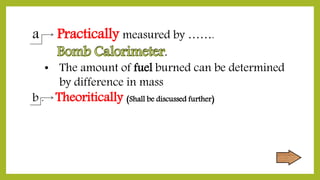
a Practically measured by …….
.
• The amount of fuel burned can be determined
by difference in mass
b . Theoritically (Shall be discussed further)
A is a type of constant-
volume calorimeter used in measuring the heat
of combustion of a particular reaction.
Every thing has types
And so shall this be.
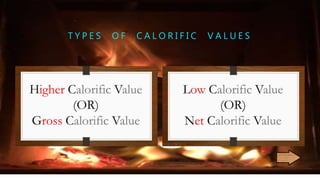
T Y P E S O F C A L O R I F I C V A L U E S
Higher calorific value
Higher calorific value means the total quantity of
heat liberated from combustion of unit mass or
unit volume of given fuel when by products/side
products are allowed to cool at room
temperature.
Low calorific value
Lower calorific value means the total
quantity of heat liberated from
combustion of unit mass or unit volume
of given fuel when side products are
allowed to escape.
Difference
Main difference is in higher calorific
value heat losses to cool down but in
lower calorific value there is no heat
because side products (ash,volatile
matter etc) escapes.
Now…
Measurement is also a factor Is’nt
it?
There is a specific formula for everything .
For calculating the calorific value of a fuel , a special formula has
been introduced…
Called DULONG’S FORMULA
Now calculation of HCV and
LCV by Dulong’s
formula
H.C.V.= (33800 C +144000 (H2 - O2/8) + 9270 S) KJ/Kg.
LCV=[HCV-(0.09H)587]Kcal/Kg {for Solid & liquid fuels}
{for gaseous fuels }
LCV=[HCV-(m x 587)]Kcal/m3 {for gaseous fuels }
v
Enough for now ..
Thank you for listening.
BYE

Calorific Values

  • 2.
    WHAT IS CALORIFICVALUE….? hmm….. CALORIFIC VALUE..???
  • 3.
    Uhh…  The calorificvalue of a substance is the amount of energy that is released when burning a given amount of the substance.  This energy is released in the form of heat, when the substance is burned in standard conditions.  Calorific value is also known as .. HEAT OF COMBUSTION or ENERGY VALUE.
  • 4.
    NOW.. It should beexpressed too …… Expressed Joules/kilogram.
  • 5.
    Why….. Joules and Kilogramonly..??  It is expressed so because the energy of the material to be measured is a solid. How…... to measure the value ? a. Practically b. Theortically c. Both
  • 6.
    a Practically measuredby ……. . • The amount of fuel burned can be determined by difference in mass b . Theoritically (Shall be discussed further)
  • 7.
    A is atype of constant- volume calorimeter used in measuring the heat of combustion of a particular reaction.
  • 8.
    Every thing hastypes And so shall this be.
  • 9.
    T Y PE S O F C A L O R I F I C V A L U E S
  • 11.
    Higher calorific value Highercalorific value means the total quantity of heat liberated from combustion of unit mass or unit volume of given fuel when by products/side products are allowed to cool at room temperature.
  • 13.
    Low calorific value Lowercalorific value means the total quantity of heat liberated from combustion of unit mass or unit volume of given fuel when side products are allowed to escape.
  • 14.
    Difference Main difference isin higher calorific value heat losses to cool down but in lower calorific value there is no heat because side products (ash,volatile matter etc) escapes.
  • 15.
    Now… Measurement is alsoa factor Is’nt it?
  • 16.
    There is aspecific formula for everything . For calculating the calorific value of a fuel , a special formula has been introduced… Called DULONG’S FORMULA
  • 17.
    Now calculation ofHCV and LCV by Dulong’s formula
  • 18.
    H.C.V.= (33800 C+144000 (H2 - O2/8) + 9270 S) KJ/Kg. LCV=[HCV-(0.09H)587]Kcal/Kg {for Solid & liquid fuels} {for gaseous fuels } LCV=[HCV-(m x 587)]Kcal/m3 {for gaseous fuels } v
  • 19.
    Enough for now.. Thank you for listening. BYE