MORPHOLOGY:
By
May Sari Yanti S6C
201212500054
MORPHOLOGY
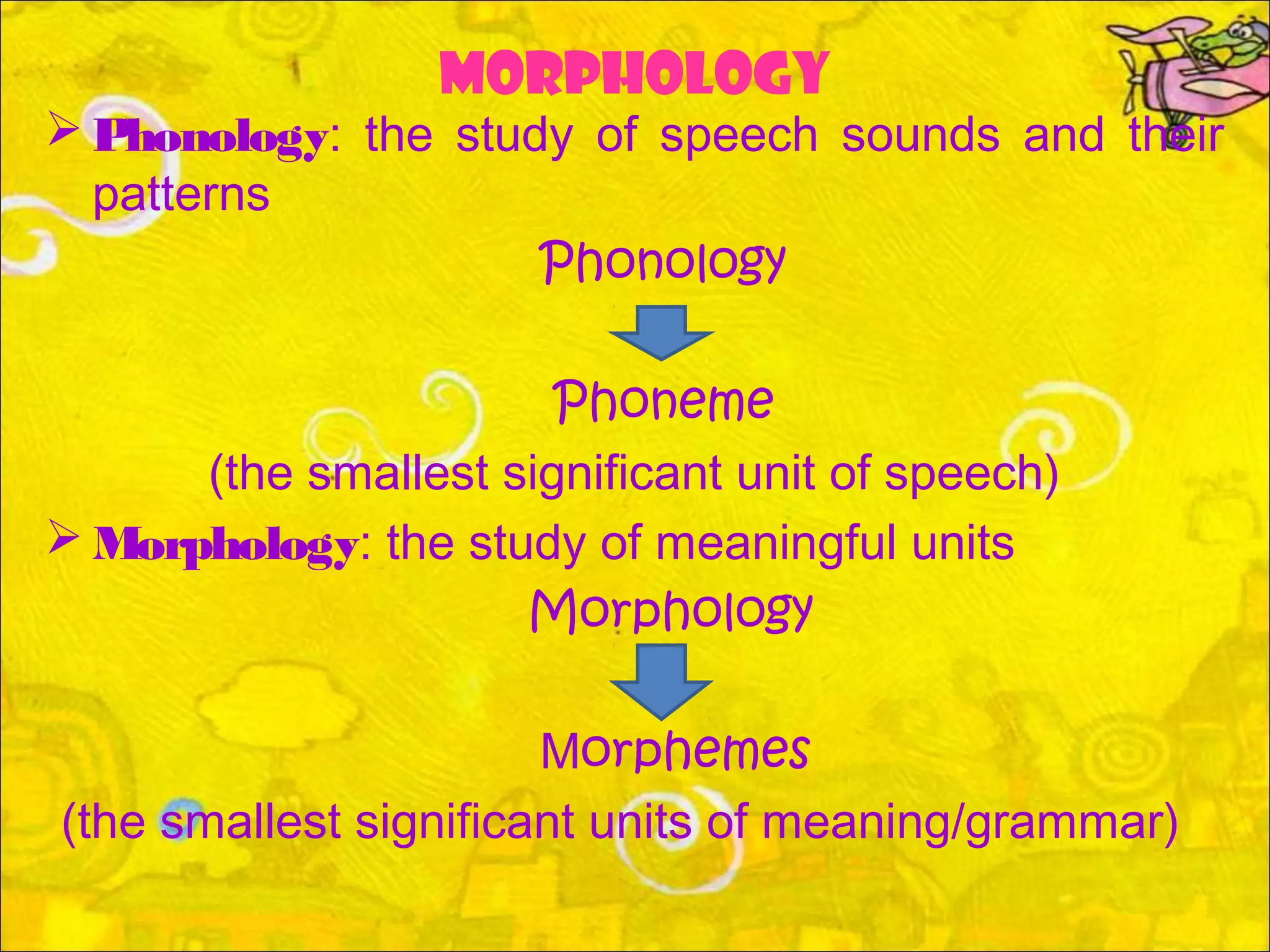
 Phonology: the study of speech sounds and their
patterns
Phonology
Phoneme
(the smallest significant unit of speech)
 Morphology: the study of meaningful units
Morphology
Morphemes
(the smallest significant units of meaning/grammar)
MORPHemes
CASE:
a) cat /kæt/ : consists of three (3) combination of
phonemes  /k/, /æ/, & /t/. That is, /k/ is meaningless
and /æt/ is meaningless but /kæt/ is meaningful.
b) Singular Plural
cat /kæt/ cats  cat+s /kæts/
The combination of phonemes /kæt/ carry the meaning
of the word “cat”and the adding /s/ carries the meaning
of“plural”.The word cat contains one (1) morpheme; but
cats contains two (2) morphemes, that is, the
morpheme“cat” and the morpheme “s” which marks the
difference between singular and plural.
c ) Present Past
cook cooked  cook+ed
look looked  look+ed
book booked  book+ed
Each of the examples contains two (2) morphemes, that is,
the morpheme “cook, look, book”and the morpheme “ed”
which indicates the past tense for many English verbs.
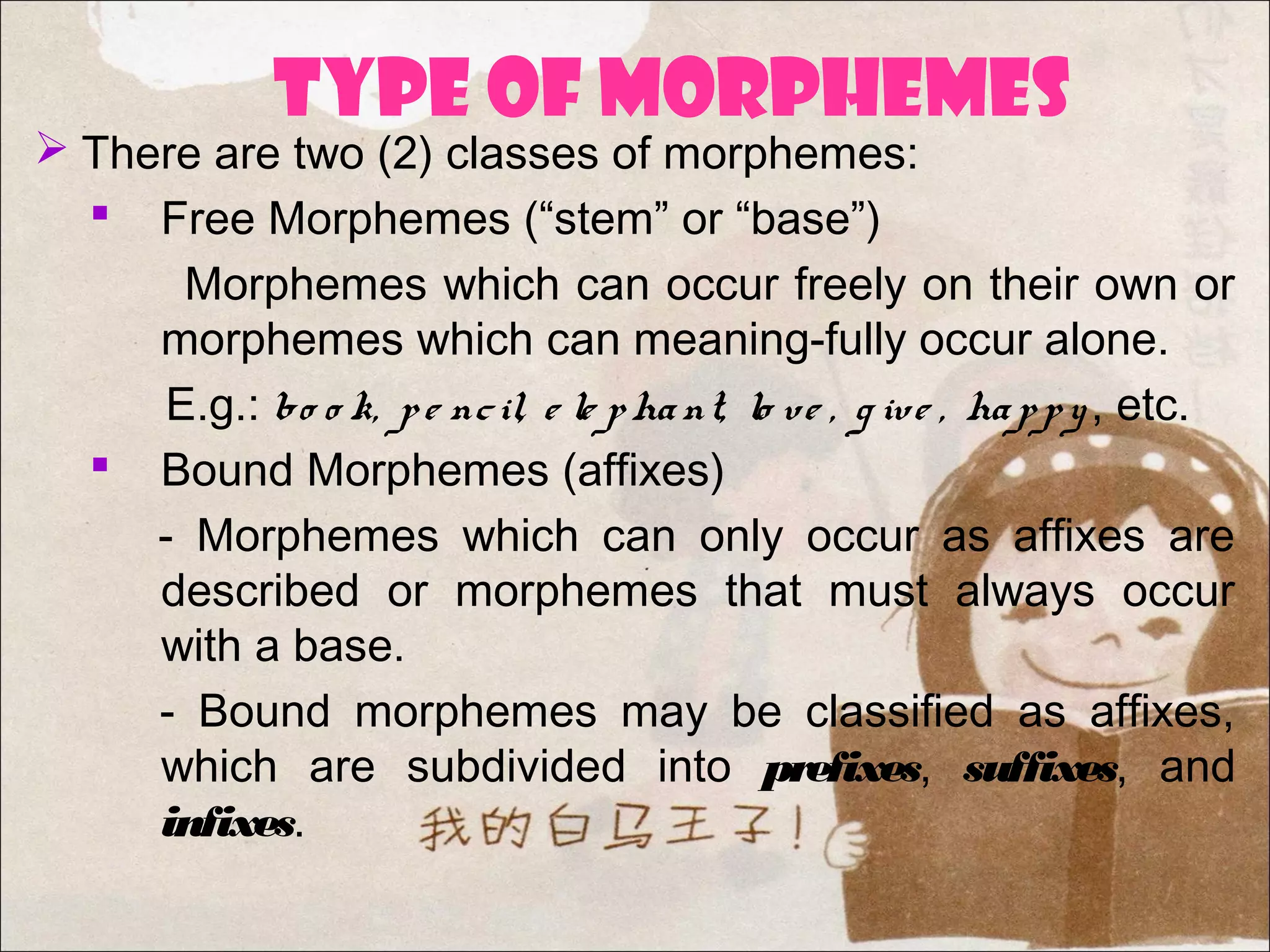
TYPE OF MORPHEMEs
 There are two (2) classes of morphemes:
 Free Morphemes (“stem” or “base”)
Morphemes which can occur freely on their own or
morphemes which can meaning-fully occur alone.
E.g.: bo o k, pe ncil, e le phant, lo ve , g ive , happy, etc.
 Bound Morphemes (affixes)
- Morphemes which can only occur as affixes are
described or morphemes that must always occur
with a base.
- Bound morphemes may be classified as affixes,
which are subdivided into prefixes, suffixes, and
infixes.
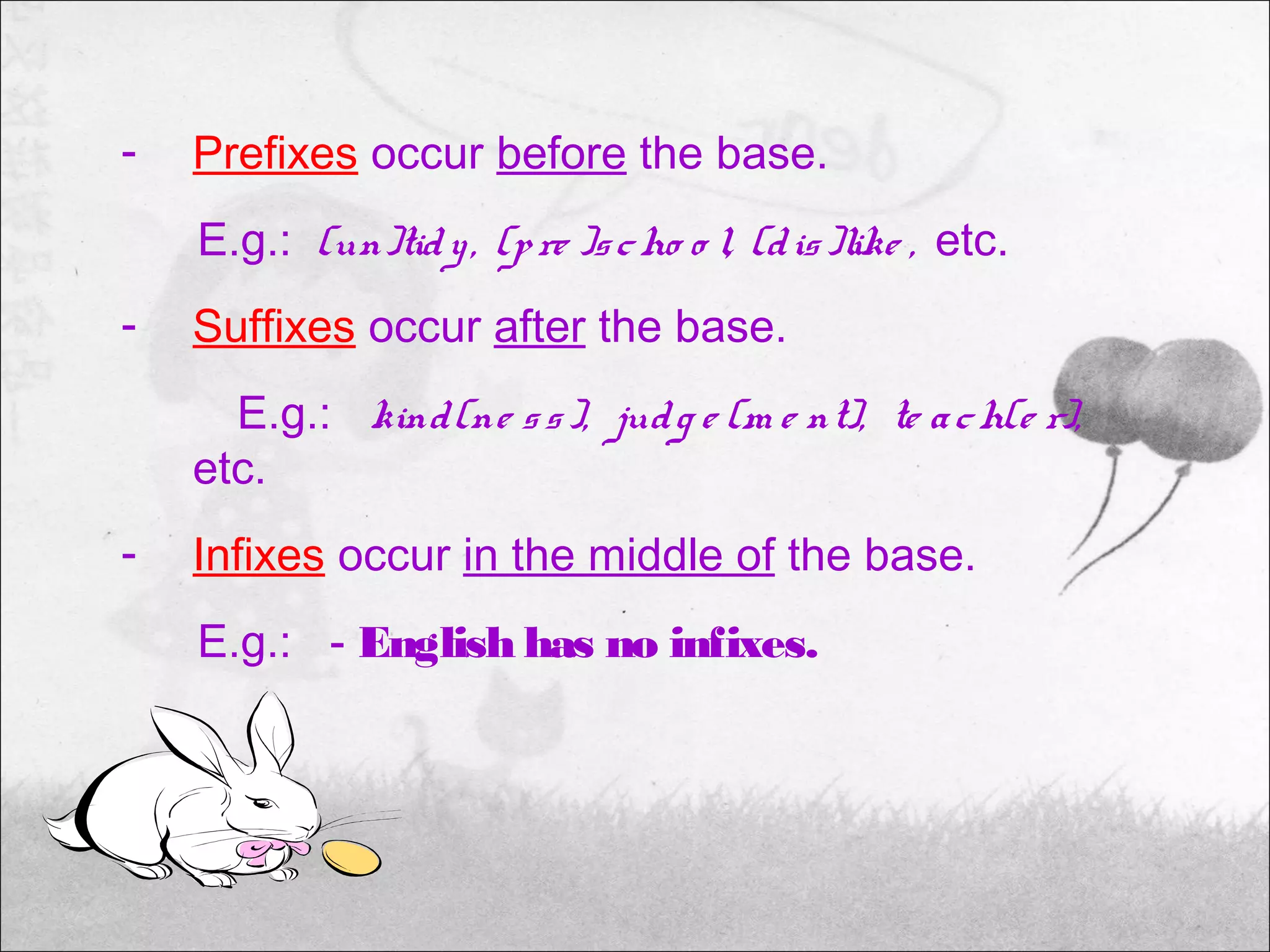
- Prefixes occur before the base.
E.g.: (un)tidy, (pre )scho o l, (dis)like , etc.
- Suffixes occur after the base.
E.g.: kind(ne ss), judg e (m e nt), te ach(e r),
etc.
- Infixes occur in the middle of the base.
E.g.: - English has no infixes.
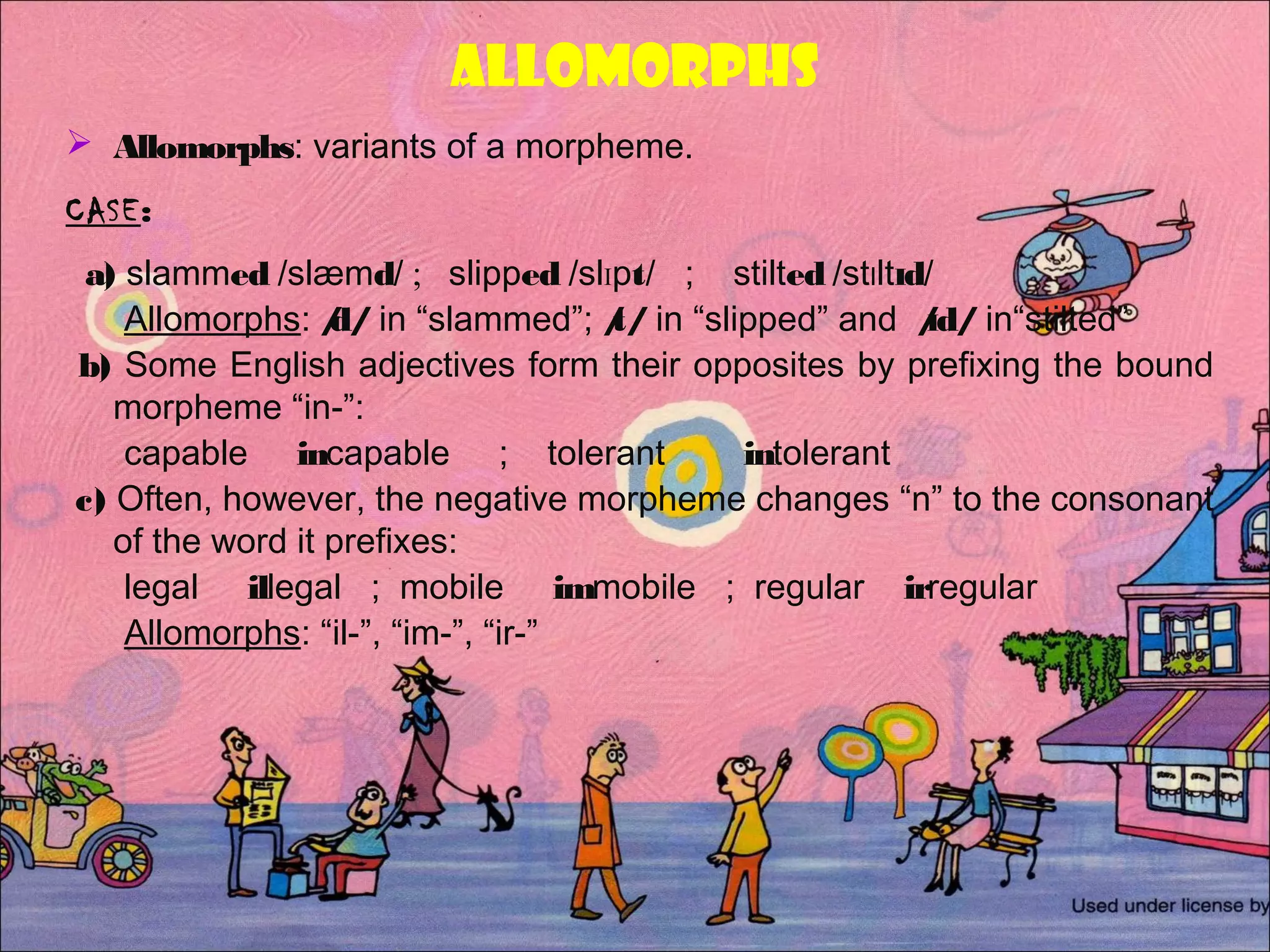
ALLOMORPHs
 Allomorphs: variants of a morpheme.
CASE:
a) slammed /slæmd/ ; slipped /slIpt/ ; stilted /stIltId/
Allomorphs: /d/ in “slammed”; /t/ in “slipped” and /Id/ in“stilted”
b) Some English adjectives form their opposites by prefixing the bound
morpheme “in-”:
capable incapable ; tolerant intolerant
c) Often, however, the negative morpheme changes “n” to the consonant
of the word it prefixes:
legal illegal ; mobile immobile ; regular irregular
Allomorphs: “il-”, “im-”, “ir-”
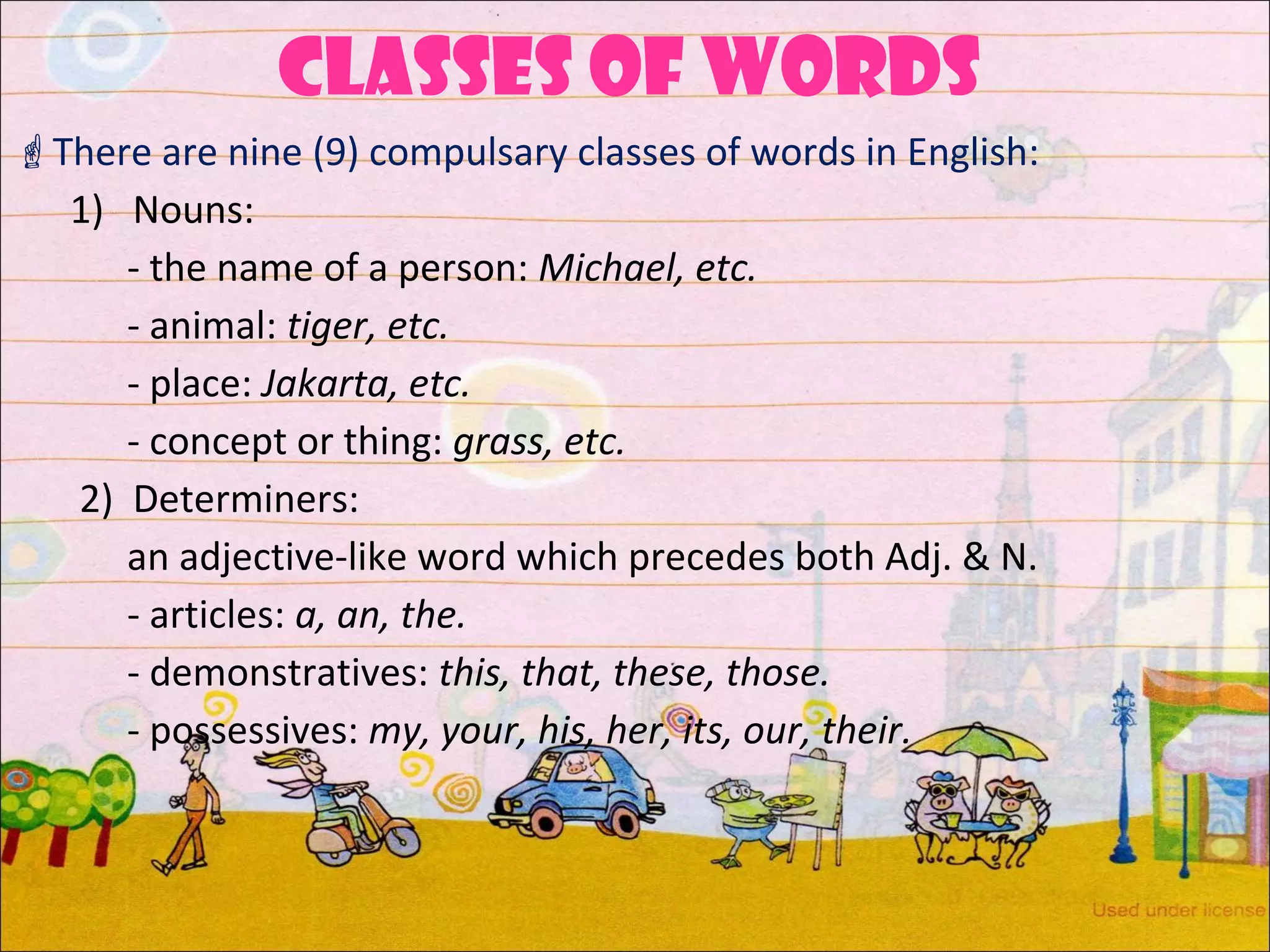
CLASSES of words
There are nine (9) compulsary classes of words in English:
1) Nouns:
- the name of a person: Michael, etc.
- animal: tiger, etc.
- place: Jakarta, etc.
- concept or thing: grass, etc.
2) Determiners:
an adjective-like word which precedes both Adj. & N.
- articles: a, an, the.
- demonstratives: this, that, these, those.
- possessives: my, your, his, her, its, our, their.
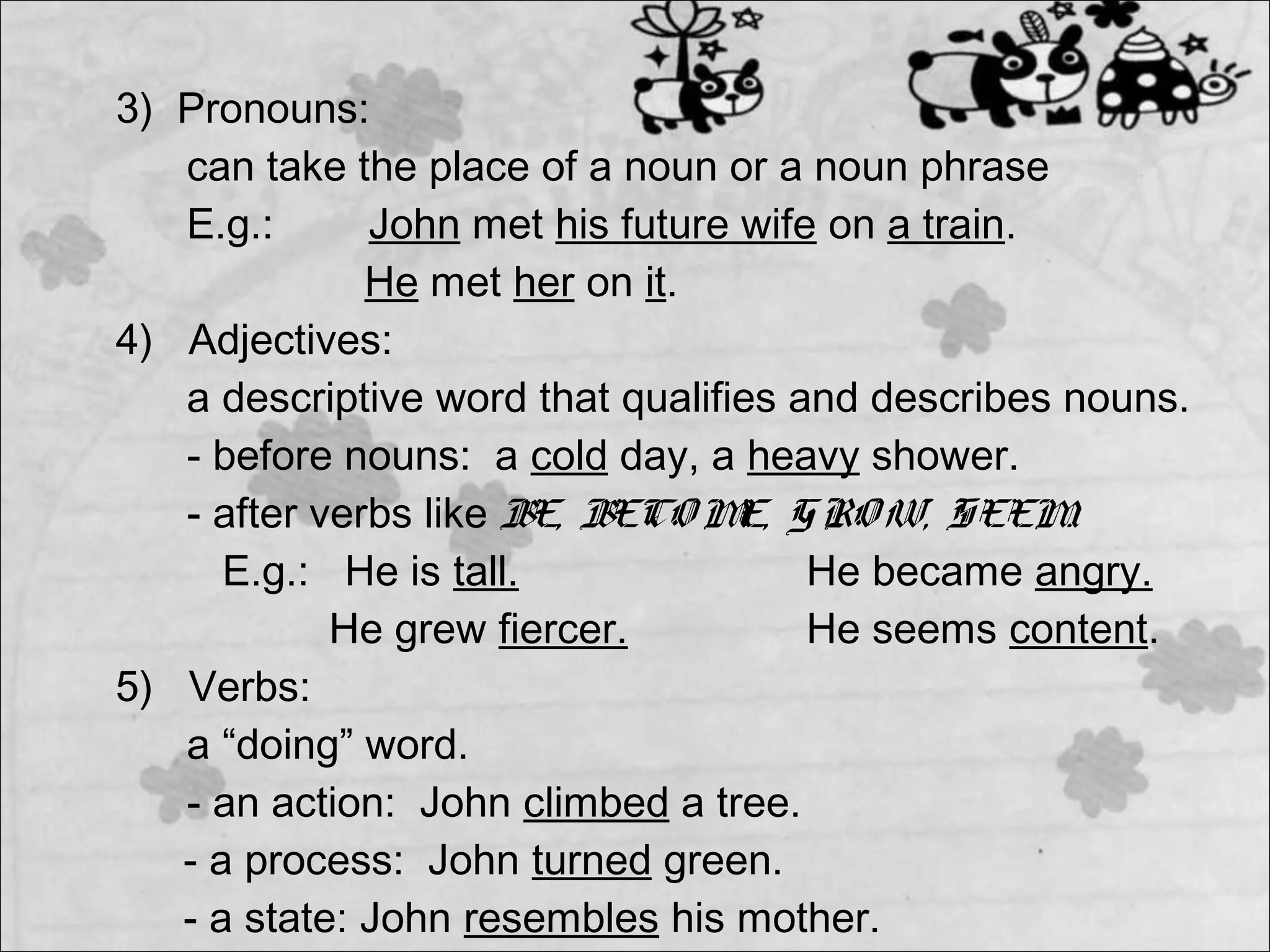
3) Pronouns:
can take the place of a noun or a noun phrase
E.g.: John met his future wife on a train.
He met her on it.
4) Adjectives:
a descriptive word that qualifies and describes nouns.
- before nouns: a cold day, a heavy shower.
- after verbs like BE, BECO ME, GRO W, SEEM.
E.g.: He is tall. He became angry.
He grew fiercer. He seems content.
5) Verbs:
a “doing” word.
- an action: John climbed a tree.
- a process: John turned green.
- a state: John resembles his mother.
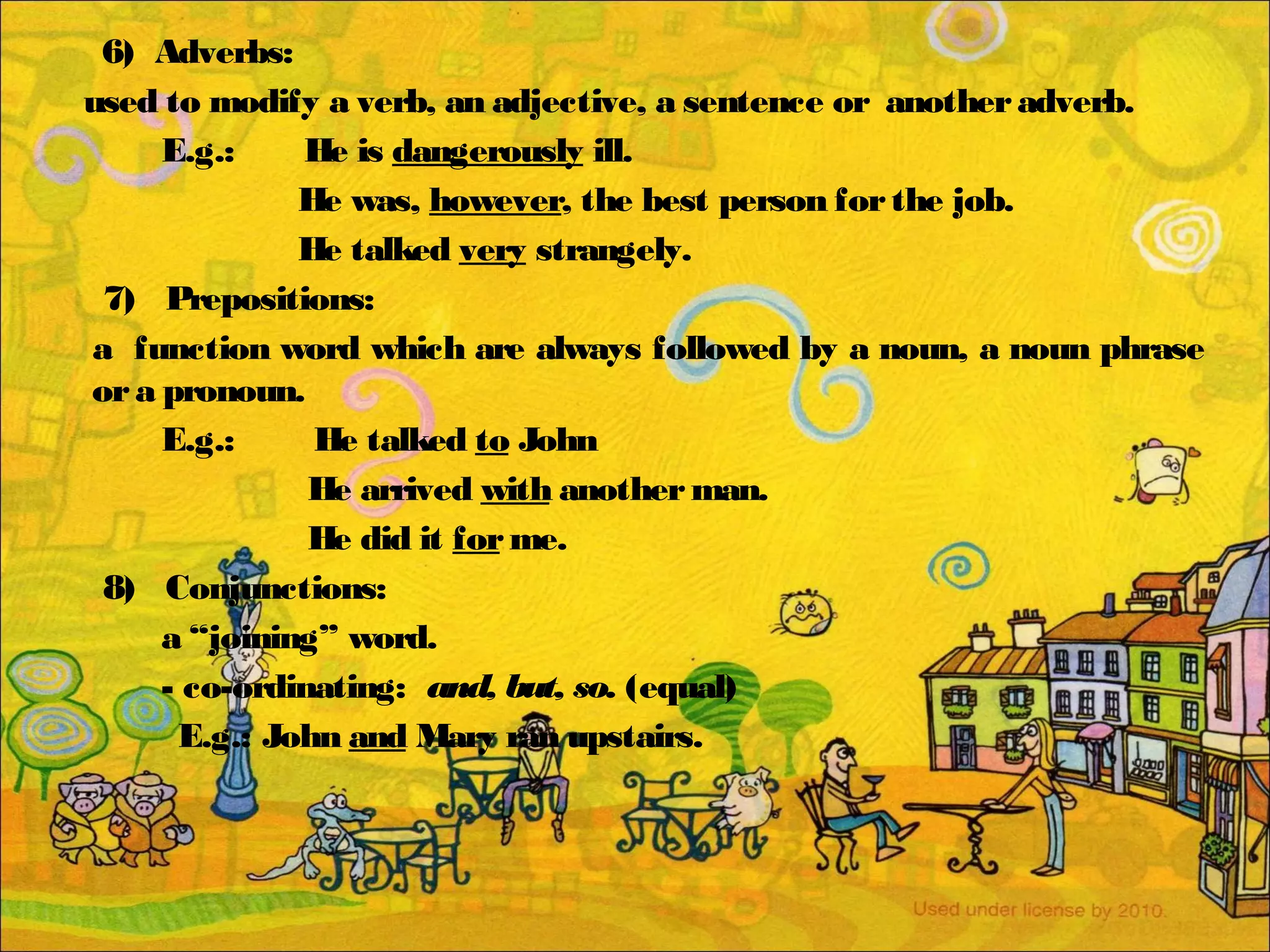
6) Adverbs:
used to modify a verb, an adjective, a sentence or anotheradverb.
E.g.: He is dangerously ill.
He was, however, the best person forthe job.
He talked very strangely.
7) Prepositions:
a function word which are always followed by a noun, a noun phrase
ora pronoun.
E.g.: He talked to John
He arrived with anotherman.
He did it forme.
8) Conjunctions:
a “joining” word.
- co-ordinating: and, but, so. (equal)
E.g.: John and Mary ran upstairs.
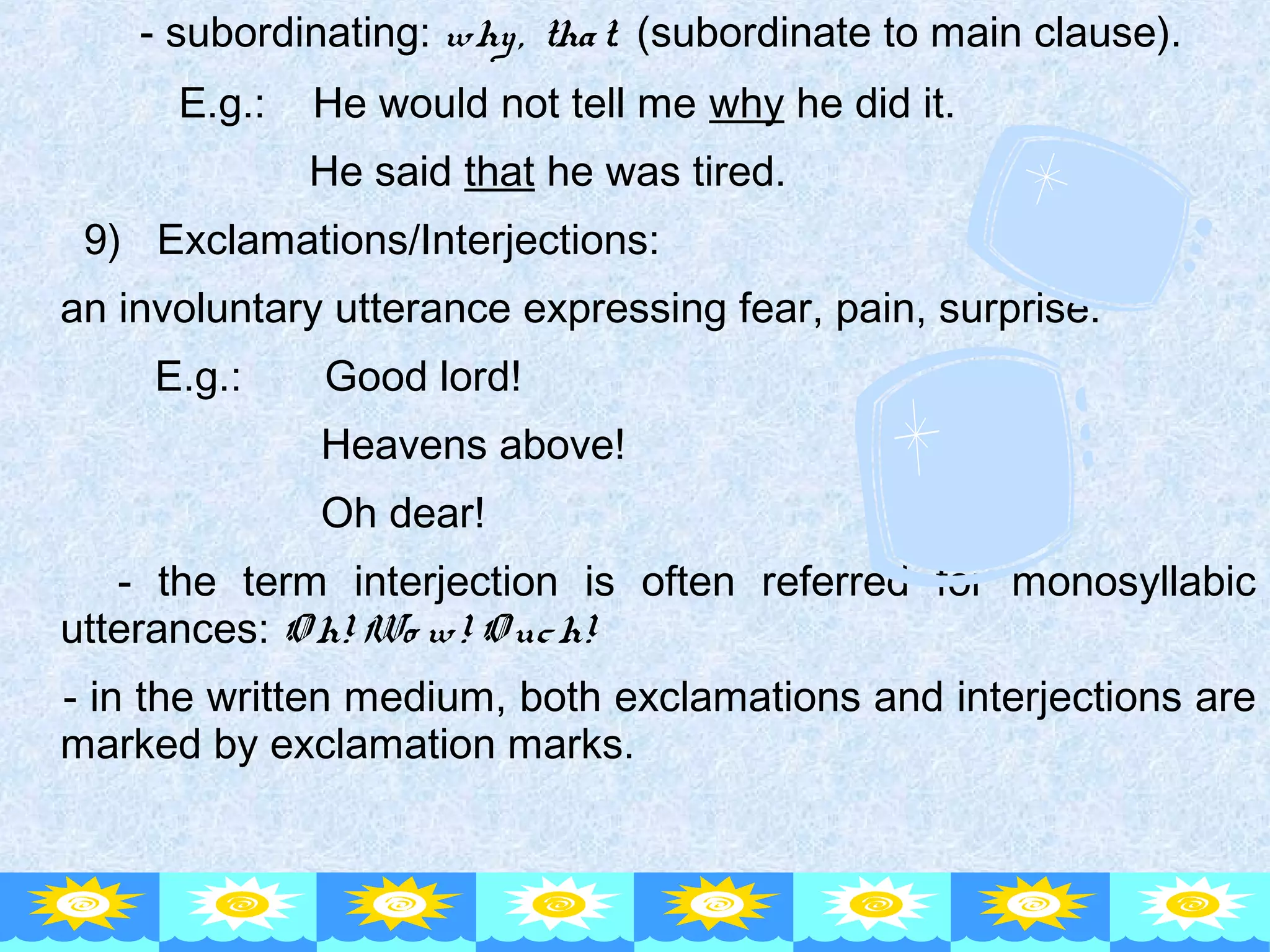
- subordinating: why, that. (subordinate to main clause).
E.g.: He would not tell me why he did it.
He said that he was tired.
9) Exclamations/Interjections:
an involuntary utterance expressing fear, pain, surprise.
E.g.: Good lord!
Heavens above!
Oh dear!
- the term interjection is often referred for monosyllabic
utterances: O h! Wo w! O uch!
- in the written medium, both exclamations and interjections are
marked by exclamation marks.
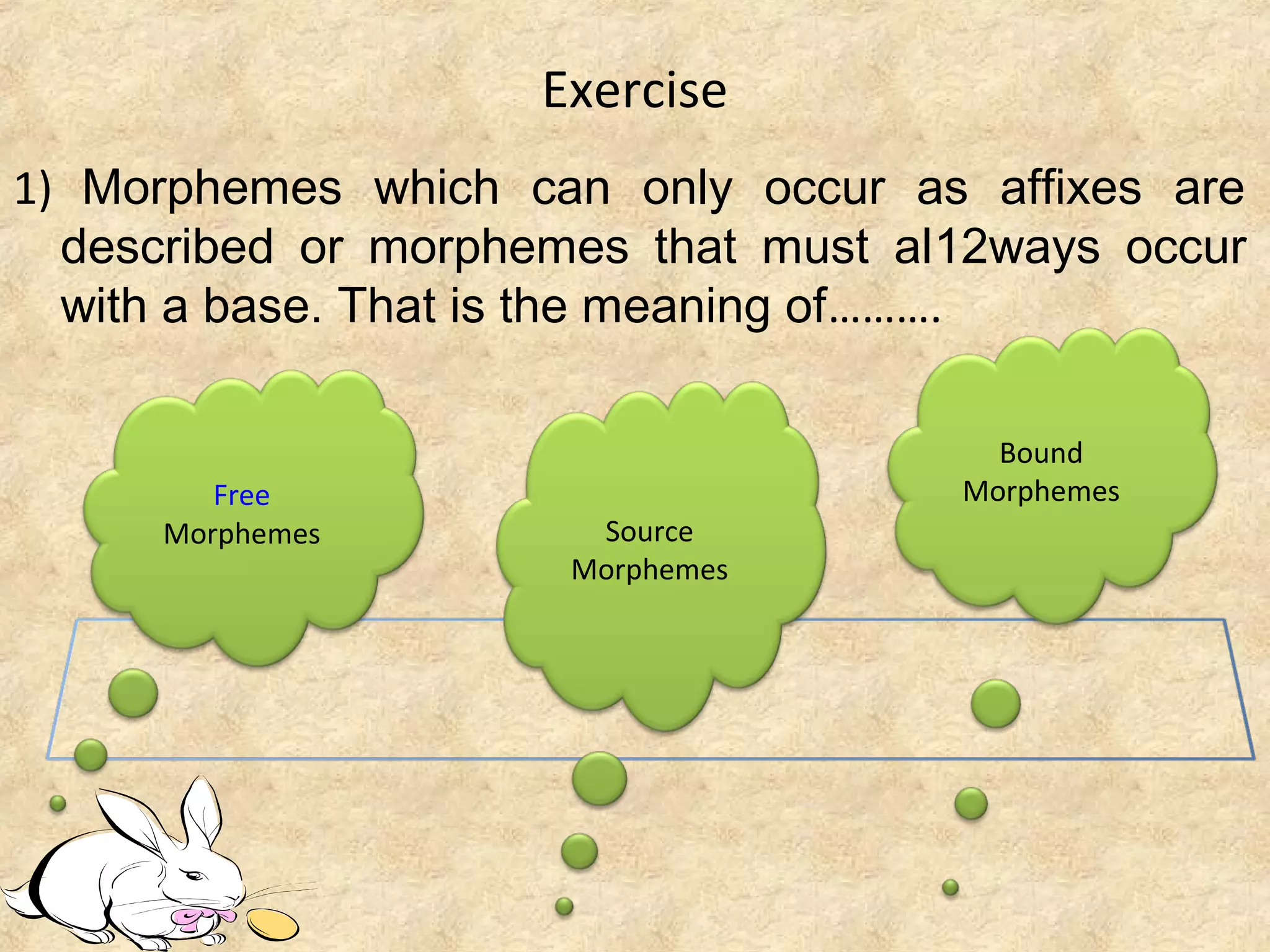
Exercise
1) Morphemes which can only occur as affixes are
described or morphemes that must al12ways occur
with a base. That is the meaning of……….
Free
Morphemes Source
Morphemes
Bound
Morphemes
Yes
Correct
Yes
Correct
Yes
Correct
Incorrect
Incorrec
t
Incorrec
t
Incorrec
t
THANK YOUTHANK YOU
Sources :Sources :
• An Introduction to Linguistics (Loreto Todd)An Introduction to Linguistics (Loreto Todd)
•Google.comGoogle.com

MORPHOLOPGY-Call

  • 1.
  • 2.
    MORPHOLOGY  Phonology: thestudy of speech sounds and their patterns Phonology Phoneme (the smallest significant unit of speech)  Morphology: the study of meaningful units Morphology Morphemes (the smallest significant units of meaning/grammar)
  • 3.
    MORPHemes CASE: a) cat /kæt/: consists of three (3) combination of phonemes  /k/, /æ/, & /t/. That is, /k/ is meaningless and /æt/ is meaningless but /kæt/ is meaningful. b) Singular Plural cat /kæt/ cats  cat+s /kæts/ The combination of phonemes /kæt/ carry the meaning of the word “cat”and the adding /s/ carries the meaning of“plural”.The word cat contains one (1) morpheme; but cats contains two (2) morphemes, that is, the morpheme“cat” and the morpheme “s” which marks the difference between singular and plural.
  • 4.
    c ) PresentPast cook cooked  cook+ed look looked  look+ed book booked  book+ed Each of the examples contains two (2) morphemes, that is, the morpheme “cook, look, book”and the morpheme “ed” which indicates the past tense for many English verbs.
  • 5.
    TYPE OF MORPHEMEs There are two (2) classes of morphemes:  Free Morphemes (“stem” or “base”) Morphemes which can occur freely on their own or morphemes which can meaning-fully occur alone. E.g.: bo o k, pe ncil, e le phant, lo ve , g ive , happy, etc.  Bound Morphemes (affixes) - Morphemes which can only occur as affixes are described or morphemes that must always occur with a base. - Bound morphemes may be classified as affixes, which are subdivided into prefixes, suffixes, and infixes.
  • 6.
    - Prefixes occurbefore the base. E.g.: (un)tidy, (pre )scho o l, (dis)like , etc. - Suffixes occur after the base. E.g.: kind(ne ss), judg e (m e nt), te ach(e r), etc. - Infixes occur in the middle of the base. E.g.: - English has no infixes.
  • 7.
    ALLOMORPHs  Allomorphs: variantsof a morpheme. CASE: a) slammed /slæmd/ ; slipped /slIpt/ ; stilted /stIltId/ Allomorphs: /d/ in “slammed”; /t/ in “slipped” and /Id/ in“stilted” b) Some English adjectives form their opposites by prefixing the bound morpheme “in-”: capable incapable ; tolerant intolerant c) Often, however, the negative morpheme changes “n” to the consonant of the word it prefixes: legal illegal ; mobile immobile ; regular irregular Allomorphs: “il-”, “im-”, “ir-”
  • 8.
    CLASSES of words Thereare nine (9) compulsary classes of words in English: 1) Nouns: - the name of a person: Michael, etc. - animal: tiger, etc. - place: Jakarta, etc. - concept or thing: grass, etc. 2) Determiners: an adjective-like word which precedes both Adj. & N. - articles: a, an, the. - demonstratives: this, that, these, those. - possessives: my, your, his, her, its, our, their.
  • 9.
    3) Pronouns: can takethe place of a noun or a noun phrase E.g.: John met his future wife on a train. He met her on it. 4) Adjectives: a descriptive word that qualifies and describes nouns. - before nouns: a cold day, a heavy shower. - after verbs like BE, BECO ME, GRO W, SEEM. E.g.: He is tall. He became angry. He grew fiercer. He seems content. 5) Verbs: a “doing” word. - an action: John climbed a tree. - a process: John turned green. - a state: John resembles his mother.
  • 10.
    6) Adverbs: used tomodify a verb, an adjective, a sentence or anotheradverb. E.g.: He is dangerously ill. He was, however, the best person forthe job. He talked very strangely. 7) Prepositions: a function word which are always followed by a noun, a noun phrase ora pronoun. E.g.: He talked to John He arrived with anotherman. He did it forme. 8) Conjunctions: a “joining” word. - co-ordinating: and, but, so. (equal) E.g.: John and Mary ran upstairs.
  • 11.
    - subordinating: why,that. (subordinate to main clause). E.g.: He would not tell me why he did it. He said that he was tired. 9) Exclamations/Interjections: an involuntary utterance expressing fear, pain, surprise. E.g.: Good lord! Heavens above! Oh dear! - the term interjection is often referred for monosyllabic utterances: O h! Wo w! O uch! - in the written medium, both exclamations and interjections are marked by exclamation marks.
  • 12.
    Exercise 1) Morphemes whichcan only occur as affixes are described or morphemes that must al12ways occur with a base. That is the meaning of………. Free Morphemes Source Morphemes Bound Morphemes
  • 13.
  • 14.
  • 15.
    THANK YOUTHANK YOU Sources:Sources : • An Introduction to Linguistics (Loreto Todd)An Introduction to Linguistics (Loreto Todd) •Google.comGoogle.com