1
CMSC 671
Fall 2010
Class #23 — Monday, November 22
2
Today’s class
• Machine learning
– What is ML?
– Inductive learning
• Supervised
• Unsupervised
– Decision trees
• Later we’ll also cover:
– Other classification methods (k-nearest neighbor, naïve Bayes, BN
learning, support vector machines, neural nets)
– Clustering
3
Machine Learning
Chapter 18.1-18.4
Some material adopted from notes
by Chuck Dyer
4
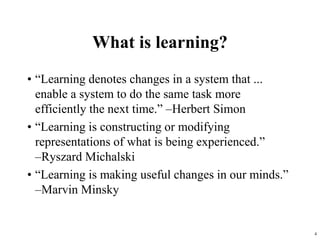
What is learning?
• “Learning denotes changes in a system that ...
enable a system to do the same task more
efficiently the next time.” –Herbert Simon
• “Learning is constructing or modifying
representations of what is being experienced.”
–Ryszard Michalski
• “Learning is making useful changes in our minds.”
–Marvin Minsky
5
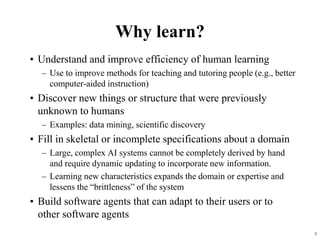
Why learn?
• Understand and improve efficiency of human learning
– Use to improve methods for teaching and tutoring people (e.g., better
computer-aided instruction)
• Discover new things or structure that were previously
unknown to humans
– Examples: data mining, scientific discovery
• Fill in skeletal or incomplete specifications about a domain
– Large, complex AI systems cannot be completely derived by hand
and require dynamic updating to incorporate new information.
– Learning new characteristics expands the domain or expertise and
lessens the “brittleness” of the system
• Build software agents that can adapt to their users or to
other software agents
6
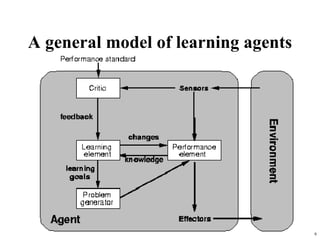
A general model of learning agents
7
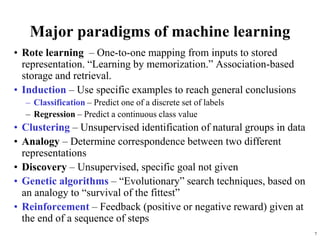
Major paradigms of machine learning
• Rote learning – One-to-one mapping from inputs to stored
representation. “Learning by memorization.” Association-based
storage and retrieval.
• Induction – Use specific examples to reach general conclusions
– Classification – Predict one of a discrete set of labels
– Regression – Predict a continuous class value
• Clustering – Unsupervised identification of natural groups in data
• Analogy – Determine correspondence between two different
representations
• Discovery – Unsupervised, specific goal not given
• Genetic algorithms – “Evolutionary” search techniques, based on
an analogy to “survival of the fittest”
• Reinforcement – Feedback (positive or negative reward) given at
the end of a sequence of steps
8
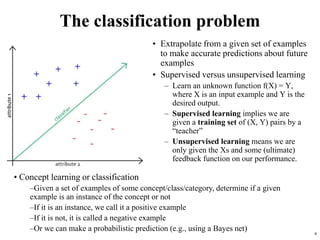
The classification problem
• Extrapolate from a given set of examples
to make accurate predictions about future
examples
• Supervised versus unsupervised learning
– Learn an unknown function f(X) = Y,
where X is an input example and Y is the
desired output.
– Supervised learning implies we are
given a training set of (X, Y) pairs by a
“teacher”
– Unsupervised learning means we are
only given the Xs and some (ultimate)
feedback function on our performance.
• Concept learning or classification
–Given a set of examples of some concept/class/category, determine if a given
example is an instance of the concept or not
–If it is an instance, we call it a positive example
–If it is not, it is called a negative example
–Or we can make a probabilistic prediction (e.g., using a Bayes net)
9
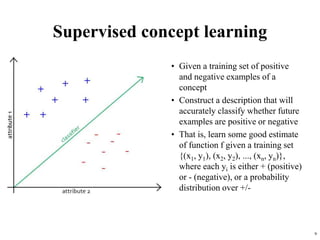
Supervised concept learning
• Given a training set of positive
and negative examples of a
concept
• Construct a description that will
accurately classify whether future
examples are positive or negative
• That is, learn some good estimate
of function f given a training set
{(x1, y1), (x2, y2), ..., (xn, yn)},
where each yi is either + (positive)
or - (negative), or a probability
distribution over +/-
10
Inductive learning framework
• Raw input data from sensors are typically
preprocessed to obtain a feature vector, X,
that adequately describes all of the relevant
features for classifying examples
• Each x is a list of (attribute, value) pairs. For
example,
X = [Person:Sue, EyeColor:Brown, Age:Young,
Sex:Female]
• The number of attributes (a.k.a. features) is
fixed (positive, finite)
• Each attribute has a fixed, finite number of
possible values (or could be continuous)
• Each example can be interpreted as a point in an
n-dimensional feature space, where n is the number of attributes
11
Inductive learning as search
• Instance space I defines the language for the training and
test instances
– Typically, but not always, each instance i  I is a feature vector
– Features are also sometimes called attributes or variables
– I: V1 x V2 x … x Vk, i = (v1, v2, …, vk)
• Class variable C gives an instance’s class (to be predicted)
• Model space M defines the possible classifiers
– M: I → C, M = {m1, … mn} (possibly infinite)
– Model space is sometimes, but not always, defined in terms of the
same features as the instance space
• Training data can be used to direct the search for a good
(consistent, complete, simple) hypothesis in the model
space
12
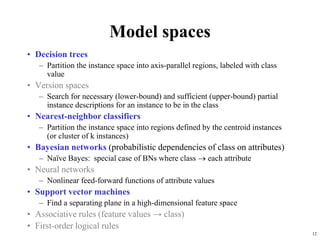
Model spaces
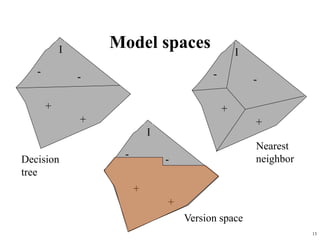
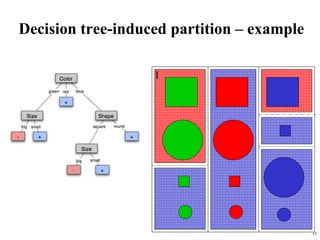
• Decision trees
– Partition the instance space into axis-parallel regions, labeled with class
value
• Version spaces
– Search for necessary (lower-bound) and sufficient (upper-bound) partial
instance descriptions for an instance to be in the class
• Nearest-neighbor classifiers
– Partition the instance space into regions defined by the centroid instances
(or cluster of k instances)
• Bayesian networks (probabilistic dependencies of class on attributes)
– Naïve Bayes: special case of BNs where class  each attribute
• Neural networks
– Nonlinear feed-forward functions of attribute values
• Support vector machines
– Find a separating plane in a high-dimensional feature space
• Associative rules (feature values → class)
• First-order logical rules
13
Model spaces I
+
+
-
-
I
+
+
-
-
I
+
+
-
-
Nearest
neighbor
Version space
Decision
tree
14
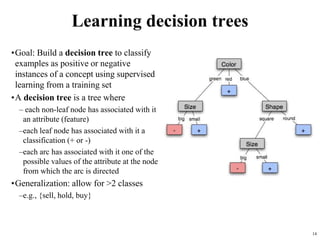
Learning decision trees
•Goal: Build a decision tree to classify
examples as positive or negative
instances of a concept using supervised
learning from a training set
•A decision tree is a tree where
– each non-leaf node has associated with it
an attribute (feature)
–each leaf node has associated with it a
classification (+ or -)
–each arc has associated with it one of the
possible values of the attribute at the node
from which the arc is directed
•Generalization: allow for >2 classes
–e.g., {sell, hold, buy}
15
Decision tree-induced partition – example
I
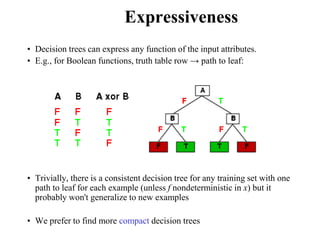
Expressiveness
• Decision trees can express any function of the input attributes.
• E.g., for Boolean functions, truth table row → path to leaf:
• Trivially, there is a consistent decision tree for any training set with one
path to leaf for each example (unless f nondeterministic in x) but it
probably won't generalize to new examples
• We prefer to find more compact decision trees
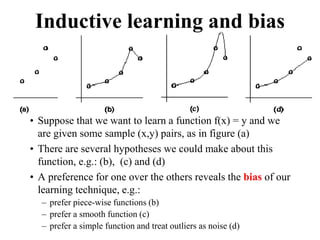
Inductive learning and bias
• Suppose that we want to learn a function f(x) = y and we
are given some sample (x,y) pairs, as in figure (a)
• There are several hypotheses we could make about this
function, e.g.: (b), (c) and (d)
• A preference for one over the others reveals the bias of our
learning technique, e.g.:
– prefer piece-wise functions (b)
– prefer a smooth function (c)
– prefer a simple function and treat outliers as noise (d)
18
Preference bias: Ockham’s Razor
• A.k.a. Occam’s Razor, Law of Economy, or Law of
Parsimony
• Principle stated by William of Ockham (1285-1347/49), a
scholastic, that
– “non sunt multiplicanda entia praeter necessitatem”
– or, “entities are not to be multiplied beyond necessity”
• The simplest consistent explanation is the best
• Therefore, the smallest decision tree that correctly classifies
all of the training examples is best.
• Finding the provably smallest decision tree is NP-hard, so
instead of constructing the absolute smallest tree consistent
with the training examples, construct one that is pretty small
19
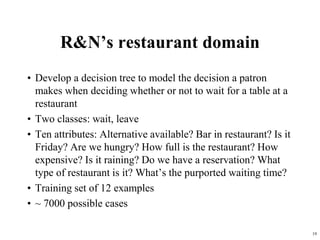
R&N’s restaurant domain
• Develop a decision tree to model the decision a patron
makes when deciding whether or not to wait for a table at a
restaurant
• Two classes: wait, leave
• Ten attributes: Alternative available? Bar in restaurant? Is it
Friday? Are we hungry? How full is the restaurant? How
expensive? Is it raining? Do we have a reservation? What
type of restaurant is it? What’s the purported waiting time?
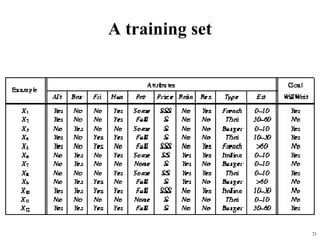
• Training set of 12 examples
• ~ 7000 possible cases
20
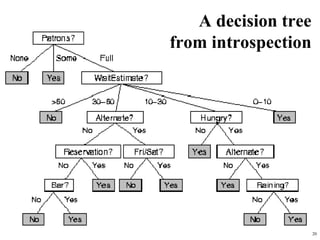
A decision tree
from introspection
21
A training set
22
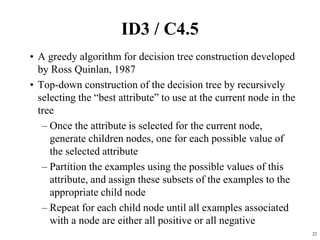
ID3 / C4.5
• A greedy algorithm for decision tree construction developed
by Ross Quinlan, 1987
• Top-down construction of the decision tree by recursively
selecting the “best attribute” to use at the current node in the
tree
– Once the attribute is selected for the current node,
generate children nodes, one for each possible value of
the selected attribute
– Partition the examples using the possible values of this
attribute, and assign these subsets of the examples to the
appropriate child node
– Repeat for each child node until all examples associated
with a node are either all positive or all negative
23
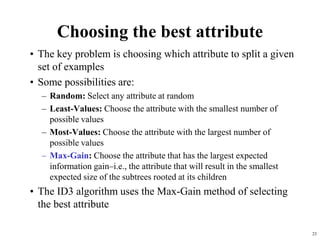
Choosing the best attribute
• The key problem is choosing which attribute to split a given
set of examples
• Some possibilities are:
– Random: Select any attribute at random
– Least-Values: Choose the attribute with the smallest number of
possible values
– Most-Values: Choose the attribute with the largest number of
possible values
– Max-Gain: Choose the attribute that has the largest expected
information gain–i.e., the attribute that will result in the smallest
expected size of the subtrees rooted at its children
• The ID3 algorithm uses the Max-Gain method of selecting
the best attribute
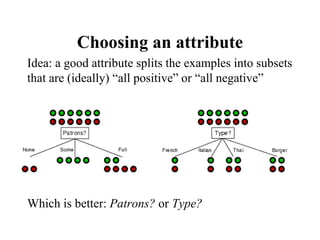
Choosing an attribute
Idea: a good attribute splits the examples into subsets
that are (ideally) “all positive” or “all negative”
Which is better: Patrons? or Type?
25
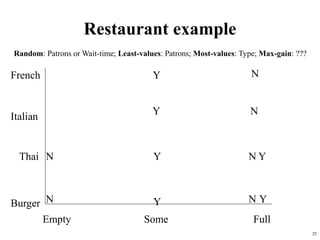
Restaurant example
French
Italian
Thai
Burger
Empty Some Full
Y
Y
Y
Y
Y
Y
N
N
N
N
N
N
Random: Patrons or Wait-time; Least-values: Patrons; Most-values: Type; Max-gain: ???
26
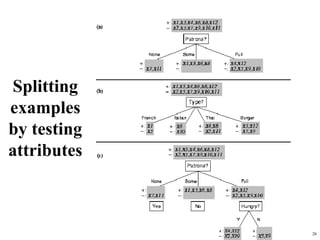
Splitting
examples
by testing
attributes
27
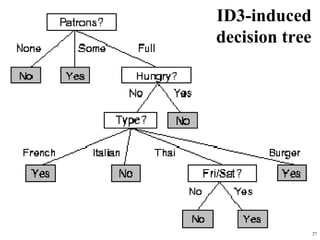
ID3-induced
decision tree
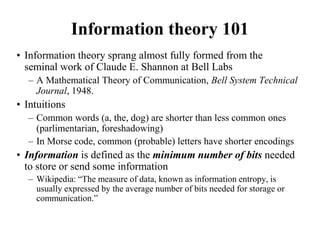
Information theory 101
• Information theory sprang almost fully formed from the
seminal work of Claude E. Shannon at Bell Labs
– A Mathematical Theory of Communication, Bell System Technical
Journal, 1948.
• Intuitions
– Common words (a, the, dog) are shorter than less common ones
(parlimentarian, foreshadowing)
– In Morse code, common (probable) letters have shorter encodings
• Information is defined as the minimum number of bits needed
to store or send some information
– Wikipedia: “The measure of data, known as information entropy, is
usually expressed by the average number of bits needed for storage or
communication.”
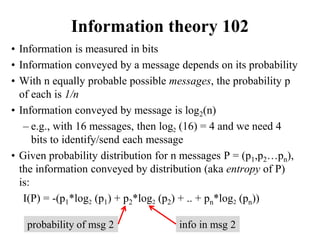
Information theory 102
• Information is measured in bits
• Information conveyed by a message depends on its probability
• With n equally probable possible messages, the probability p
of each is 1/n
• Information conveyed by message is log2(n)
– e.g., with 16 messages, then log2 (16) = 4 and we need 4
bits to identify/send each message
• Given probability distribution for n messages P = (p1,p2…pn),
the information conveyed by distribution (aka entropy of P)
is:
I(P) = -(p1*log2 (p1) + p2*log2 (p2) + .. + pn*log2 (pn))
info in msg 2
probability of msg 2
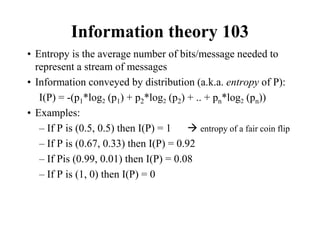
Information theory 103
• Entropy is the average number of bits/message needed to
represent a stream of messages
• Information conveyed by distribution (a.k.a. entropy of P):
I(P) = -(p1*log2 (p1) + p2*log2 (p2) + .. + pn*log2 (pn))
• Examples:
– If P is (0.5, 0.5) then I(P) = 1  entropy of a fair coin flip
– If P is (0.67, 0.33) then I(P) = 0.92
– If Pis (0.99, 0.01) then I(P) = 0.08
– If P is (1, 0) then I(P) = 0
Entropy as measure of homogeneity of
examples
• Entropy used to characterize the (im)purity of an arbitrary
collection of examples.
• Given a collection S (e.g. the table with 12 examples for the
restaurant domain), containing positive and negative
examples of some target concept, the entropy of S relative
to its boolean classification is:
I(S) = -(p+*log2 (p+) + p-*log2 (p-))
Entropy([6+, 6-]) = 1  entropy of the restaurant dataset
Entropy([9+, 5-]) = 0.940
34
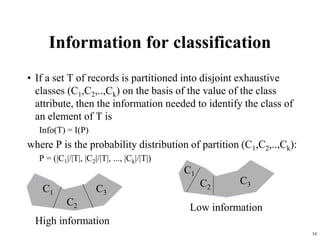
Information for classification
• If a set T of records is partitioned into disjoint exhaustive
classes (C1,C2,..,Ck) on the basis of the value of the class
attribute, then the information needed to identify the class of
an element of T is
Info(T) = I(P)
where P is the probability distribution of partition (C1,C2,..,Ck):
P = (|C1|/|T|, |C2|/|T|, ..., |Ck|/|T|)
C1
C2
C3
C1
C2
C3
High information
Low information
35
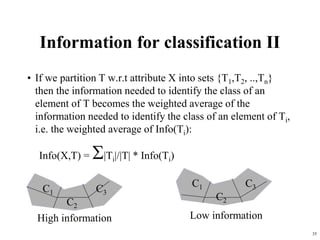
Information for classification II
• If we partition T w.r.t attribute X into sets {T1,T2, ..,Tn}
then the information needed to identify the class of an
element of T becomes the weighted average of the
information needed to identify the class of an element of Ti,
i.e. the weighted average of Info(Ti):
Info(X,T) = S|Ti|/|T| * Info(Ti)
C1
C2
C3
C1
C2
C3
High information Low information
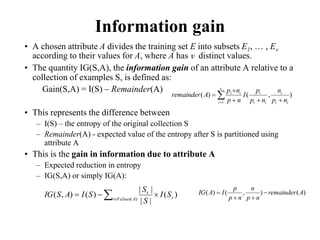
Information gain
• A chosen attribute A divides the training set E into subsets E1, … , Ev
according to their values for A, where A has v distinct values.
• The quantity IG(S,A), the information gain of an attribute A relative to a
collection of examples S, is defined as:
Gain(S,A) = I(S) – Remainder(A)
• This represents the difference between
– I(S) – the entropy of the original collection S
– Remainder(A) - expected value of the entropy after S is partitioned using
attribute A
• This is the gain in information due to attribute A
– Expected reduction in entropy
– IG(S,A) or simply IG(A):

 




v
i i
i
i
i
i
i
i
i
n
p
n
n
p
p
I
n
p
n
p
A
remainder
1
)
,
(
)
(
)
(
|
|
|
|
)
(
)
,
( )
( v
A
Values
v
v
S
I
S
S
S
I
A
S
IG 

 
)
(
)
,
(
)
( A
remainder
n
p
n
n
p
p
I
A
IG 



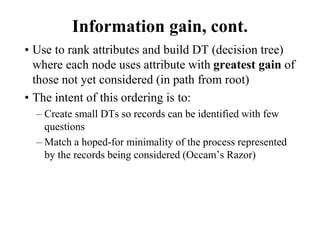
Information gain, cont.
• Use to rank attributes and build DT (decision tree)
where each node uses attribute with greatest gain of
those not yet considered (in path from root)
• The intent of this ordering is to:
– Create small DTs so records can be identified with few
questions
– Match a hoped-for minimality of the process represented
by the records being considered (Occam’s Razor)
Information gain, cont.
For the training set, S:
p = n = 6,
I(6/12, 6/12) = 1 bit
Consider the attributes Patrons and Type (and others too):
Patrons has the highest IG of all attributes and so is chosen by the DTL algorithm
as the root
bits
0
)]
4
2
,
4
2
(
12
4
)
4
2
,
4
2
(
12
4
)
2
1
,
2
1
(
12
2
)
2
1
,
2
1
(
12
2
[
1
)
(
bits
0541
.
)]
6
4
,
6
2
(
12
6
)
0
,
1
(
12
4
)
1
,
0
(
12
2
[
1
)
(











I
I
I
I
Type
IG
I
I
I
Patrons
IG
39
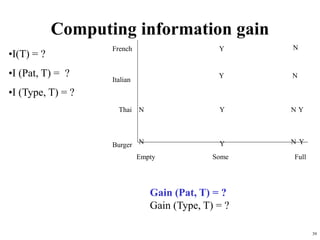
Computing information gain
French
Italian
Thai
Burger
Empty Some Full
Y
Y
Y
Y
Y
Y
N
N
N
N
N
N
•I(T) = ?
•I (Pat, T) = ?
•I (Type, T) = ?
Gain (Pat, T) = ?
Gain (Type, T) = ?
40
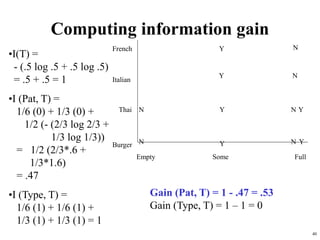
Computing information gain
French
Italian
Thai
Burger
Empty Some Full
Y
Y
Y
Y
Y
Y
N
N
N
N
N
N
•I(T) =
- (.5 log .5 + .5 log .5)
= .5 + .5 = 1
•I (Pat, T) =
1/6 (0) + 1/3 (0) +
1/2 (- (2/3 log 2/3 +
1/3 log 1/3))
= 1/2 (2/3*.6 +
1/3*1.6)
= .47
•I (Type, T) =
1/6 (1) + 1/6 (1) +
1/3 (1) + 1/3 (1) = 1
Gain (Pat, T) = 1 - .47 = .53
Gain (Type, T) = 1 – 1 = 0
41
The ID3 algorithm is used to build a decision tree, given a set of non-categorical attributes
C1, C2, .., Cn, the class attribute C, and a training set T of records.
function ID3 (R: a set of input attributes,
C: the class attribute,
S: a training set) returns a decision tree;
begin
If S is empty, return a single node with value Failure;
If every example in S has the same value for C, return
single node with that value;
If R is empty, then return a single node with most
frequent of the values of C found in examples S;
[note: there will be errors, i.e., improperly classified
records];
Let D be attribute with largest Gain(D,S) among attributes in R;
Let {dj| j=1,2, .., m} be the values of attribute D;
Let {Sj| j=1,2, .., m} be the subsets of S consisting
respectively of records with value dj for attribute D;
Return a tree with root labeled D and arcs labeled
d1, d2, .., dm going respectively to the trees
ID3(R-{D},C,S1), ID3(R-{D},C,S2) ,.., ID3(R-{D},C,Sm);
end ID3;
42
How well does it work?
Many case studies have shown that decision trees are at least
as accurate as human experts.
– A study for diagnosing breast cancer had humans correctly
classifying the examples 65% of the time; the decision tree
classified 72% correct
– British Petroleum designed a decision tree for gas-oil
separation for offshore oil platforms that replaced an
earlier rule-based expert system
– Cessna designed an airplane flight controller using 90,000
examples and 20 attributes per example
– SKICAT (Sky Image Cataloging and Analysis Tool) used
a decision tree to classify sky objects that were an order of
magnitude fainter than was previously possible, with an
accuracy of over 90%.
43
Extensions of ID3
• Using gain ratios
• Real-valued data
• Noisy data and overfitting – pruning, early stopping,
windowing
• Generation of rules
• Setting parameters
• Cross-validation for experimental validation of performance
• C4.5 is an extension of ID3 that accounts for unavailable
values, continuous attribute value ranges, pruning of
decision trees, rule derivation, and so on
44
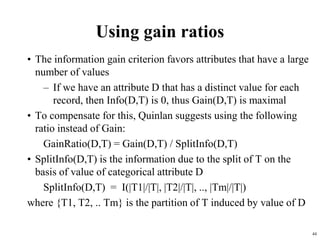
Using gain ratios
• The information gain criterion favors attributes that have a large
number of values
– If we have an attribute D that has a distinct value for each
record, then Info(D,T) is 0, thus Gain(D,T) is maximal
• To compensate for this, Quinlan suggests using the following
ratio instead of Gain:
GainRatio(D,T) = Gain(D,T) / SplitInfo(D,T)
• SplitInfo(D,T) is the information due to the split of T on the
basis of value of categorical attribute D
SplitInfo(D,T) = I(|T1|/|T|, |T2|/|T|, .., |Tm|/|T|)
where {T1, T2, .. Tm} is the partition of T induced by value of D
45
Computing gain ratio
French
Italian
Thai
Burger
Empty Some Full
Y
Y
Y
Y
Y
Y
N
N
N
N
N
N
•I(T) = 1
•I (Pat, T) = .47
•I (Type, T) = 1
Gain (Pat, T) =.53
Gain (Type, T) = 0
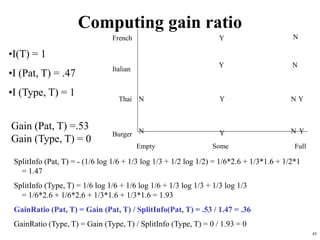
SplitInfo (Pat, T) = - (1/6 log 1/6 + 1/3 log 1/3 + 1/2 log 1/2) = 1/6*2.6 + 1/3*1.6 + 1/2*1
= 1.47
SplitInfo (Type, T) = 1/6 log 1/6 + 1/6 log 1/6 + 1/3 log 1/3 + 1/3 log 1/3
= 1/6*2.6 + 1/6*2.6 + 1/3*1.6 + 1/3*1.6 = 1.93
GainRatio (Pat, T) = Gain (Pat, T) / SplitInfo(Pat, T) = .53 / 1.47 = .36
GainRatio (Type, T) = Gain (Type, T) / SplitInfo (Type, T) = 0 / 1.93 = 0
46
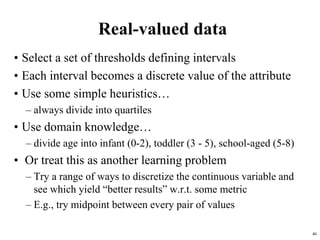
Real-valued data
• Select a set of thresholds defining intervals
• Each interval becomes a discrete value of the attribute
• Use some simple heuristics…
– always divide into quartiles
• Use domain knowledge…
– divide age into infant (0-2), toddler (3 - 5), school-aged (5-8)
• Or treat this as another learning problem
– Try a range of ways to discretize the continuous variable and
see which yield “better results” w.r.t. some metric
– E.g., try midpoint between every pair of values
48
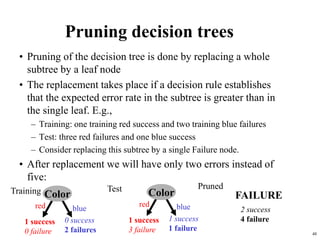
Pruning decision trees
• Pruning of the decision tree is done by replacing a whole
subtree by a leaf node
• The replacement takes place if a decision rule establishes
that the expected error rate in the subtree is greater than in
the single leaf. E.g.,
– Training: one training red success and two training blue failures
– Test: three red failures and one blue success
– Consider replacing this subtree by a single Failure node.
• After replacement we will have only two errors instead of
five:
Color
1 success
0 failure
0 success
2 failures
red blue
Color
1 success
3 failure
1 success
1 failure
red blue 2 success
4 failure
FAILURE
Training Test Pruned
49
Converting decision trees to rules
• It is easy to derive a rule set from a decision tree: write a rule
for each path in the decision tree from the root to a leaf
• In that rule the left-hand side is easily built from the label of
the nodes and the labels of the arcs
• The resulting rules set can be simplified:
– Let LHS be the left hand side of a rule
– Let LHS' be obtained from LHS by eliminating some conditions
– We can certainly replace LHS by LHS' in this rule if the subsets of the
training set that satisfy respectively LHS and LHS' are equal
– A rule may be eliminated by using metaconditions such as “if no other
rule applies”
50
Summary: Decision tree learning
• Inducing decision trees is one of the most widely used
learning methods in practice
• Can out-perform human experts in many problems
• Strengths include
– Fast
– Simple to implement
– Can convert result to a set of easily interpretable rules
– Empirically valid in many commercial products
– Handles noisy data
• Weaknesses include:
– Univariate splits/partitioning using only one attribute at a time so limits
types of possible trees
– Large decision trees may be hard to understand
– Requires fixed-length feature vectors
– Non-incremental (i.e., batch method)
51
Evaluation methodology
• Standard methodology:
1. Collect a large set of examples (all with correct classifications)
2. Randomly divide collection into two disjoint sets: training and test
3. Apply learning algorithm to training set giving hypothesis H
4. Measure performance of H w.r.t. test set
• Important: keep the training and test sets disjoint!
• To study the efficiency and robustness of an algorithm, repeat
steps 2-4 for different training sets and sizes of training sets
• If you improve your algorithm, start again with step 1 to avoid
evolving the algorithm to work well on just this collection
Measuring model quality
• How good is a model?
– Predictive accuracy
– False positives / false negatives for a given cutoff threshold
• Loss function (accounts for cost of different types of errors)
– Area under the (ROC) curve
– Minimizing loss can lead to problems with overfitting
• Training error
– Train on all data; measure error on all data
– Subject to overfitting (of course we’ll make good predictions on the
data on which we trained!)
• Regularization
– Attempt to avoid overfitting
– Explicitly minimize the complexity of the function while minimizing
loss. Trade off is modeled with a regularization parameter
52
Cross-validation
• Holdout cross-validation:
– Divide data into training set and test set
– Train on training set; measure error on test set
– Better than training error, since we are measuring generalization to
new data
– To get a good estimate, we need a reasonably large test set
– But this gives less data to train on, reducing our model quality!
53
Cross-validation, cont.
• k-fold cross-validation:
– Divide data into k folds
– Train on k-1 folds, use the kth fold to measure error
– Repeat k times; use average error to measure generalization accuracy
– Statistically valid and gives good accuracy estimates
• Leave-one-out cross-validation (LOOCV)
– k-fold cross validation where k=N (test data = 1 instance!)
– Quite accurate, but also quite expensive, since it requires building N
models
54

c23_ml1.ppt

  • 1.
    1 CMSC 671 Fall 2010 Class#23 — Monday, November 22
  • 2.
    2 Today’s class • Machinelearning – What is ML? – Inductive learning • Supervised • Unsupervised – Decision trees • Later we’ll also cover: – Other classification methods (k-nearest neighbor, naïve Bayes, BN learning, support vector machines, neural nets) – Clustering
  • 3.
    3 Machine Learning Chapter 18.1-18.4 Somematerial adopted from notes by Chuck Dyer
  • 4.
    4 What is learning? •“Learning denotes changes in a system that ... enable a system to do the same task more efficiently the next time.” –Herbert Simon • “Learning is constructing or modifying representations of what is being experienced.” –Ryszard Michalski • “Learning is making useful changes in our minds.” –Marvin Minsky
  • 5.
    5 Why learn? • Understandand improve efficiency of human learning – Use to improve methods for teaching and tutoring people (e.g., better computer-aided instruction) • Discover new things or structure that were previously unknown to humans – Examples: data mining, scientific discovery • Fill in skeletal or incomplete specifications about a domain – Large, complex AI systems cannot be completely derived by hand and require dynamic updating to incorporate new information. – Learning new characteristics expands the domain or expertise and lessens the “brittleness” of the system • Build software agents that can adapt to their users or to other software agents
  • 6.
    6 A general modelof learning agents
  • 7.
    7 Major paradigms ofmachine learning • Rote learning – One-to-one mapping from inputs to stored representation. “Learning by memorization.” Association-based storage and retrieval. • Induction – Use specific examples to reach general conclusions – Classification – Predict one of a discrete set of labels – Regression – Predict a continuous class value • Clustering – Unsupervised identification of natural groups in data • Analogy – Determine correspondence between two different representations • Discovery – Unsupervised, specific goal not given • Genetic algorithms – “Evolutionary” search techniques, based on an analogy to “survival of the fittest” • Reinforcement – Feedback (positive or negative reward) given at the end of a sequence of steps
  • 8.
    8 The classification problem •Extrapolate from a given set of examples to make accurate predictions about future examples • Supervised versus unsupervised learning – Learn an unknown function f(X) = Y, where X is an input example and Y is the desired output. – Supervised learning implies we are given a training set of (X, Y) pairs by a “teacher” – Unsupervised learning means we are only given the Xs and some (ultimate) feedback function on our performance. • Concept learning or classification –Given a set of examples of some concept/class/category, determine if a given example is an instance of the concept or not –If it is an instance, we call it a positive example –If it is not, it is called a negative example –Or we can make a probabilistic prediction (e.g., using a Bayes net)
  • 9.
    9 Supervised concept learning •Given a training set of positive and negative examples of a concept • Construct a description that will accurately classify whether future examples are positive or negative • That is, learn some good estimate of function f given a training set {(x1, y1), (x2, y2), ..., (xn, yn)}, where each yi is either + (positive) or - (negative), or a probability distribution over +/-
  • 10.
    10 Inductive learning framework •Raw input data from sensors are typically preprocessed to obtain a feature vector, X, that adequately describes all of the relevant features for classifying examples • Each x is a list of (attribute, value) pairs. For example, X = [Person:Sue, EyeColor:Brown, Age:Young, Sex:Female] • The number of attributes (a.k.a. features) is fixed (positive, finite) • Each attribute has a fixed, finite number of possible values (or could be continuous) • Each example can be interpreted as a point in an n-dimensional feature space, where n is the number of attributes
  • 11.
    11 Inductive learning assearch • Instance space I defines the language for the training and test instances – Typically, but not always, each instance i  I is a feature vector – Features are also sometimes called attributes or variables – I: V1 x V2 x … x Vk, i = (v1, v2, …, vk) • Class variable C gives an instance’s class (to be predicted) • Model space M defines the possible classifiers – M: I → C, M = {m1, … mn} (possibly infinite) – Model space is sometimes, but not always, defined in terms of the same features as the instance space • Training data can be used to direct the search for a good (consistent, complete, simple) hypothesis in the model space
  • 12.
    12 Model spaces • Decisiontrees – Partition the instance space into axis-parallel regions, labeled with class value • Version spaces – Search for necessary (lower-bound) and sufficient (upper-bound) partial instance descriptions for an instance to be in the class • Nearest-neighbor classifiers – Partition the instance space into regions defined by the centroid instances (or cluster of k instances) • Bayesian networks (probabilistic dependencies of class on attributes) – Naïve Bayes: special case of BNs where class  each attribute • Neural networks – Nonlinear feed-forward functions of attribute values • Support vector machines – Find a separating plane in a high-dimensional feature space • Associative rules (feature values → class) • First-order logical rules
  • 13.
  • 14.
    14 Learning decision trees •Goal:Build a decision tree to classify examples as positive or negative instances of a concept using supervised learning from a training set •A decision tree is a tree where – each non-leaf node has associated with it an attribute (feature) –each leaf node has associated with it a classification (+ or -) –each arc has associated with it one of the possible values of the attribute at the node from which the arc is directed •Generalization: allow for >2 classes –e.g., {sell, hold, buy}
  • 15.
  • 16.
    Expressiveness • Decision treescan express any function of the input attributes. • E.g., for Boolean functions, truth table row → path to leaf: • Trivially, there is a consistent decision tree for any training set with one path to leaf for each example (unless f nondeterministic in x) but it probably won't generalize to new examples • We prefer to find more compact decision trees
  • 17.
    Inductive learning andbias • Suppose that we want to learn a function f(x) = y and we are given some sample (x,y) pairs, as in figure (a) • There are several hypotheses we could make about this function, e.g.: (b), (c) and (d) • A preference for one over the others reveals the bias of our learning technique, e.g.: – prefer piece-wise functions (b) – prefer a smooth function (c) – prefer a simple function and treat outliers as noise (d)
  • 18.
    18 Preference bias: Ockham’sRazor • A.k.a. Occam’s Razor, Law of Economy, or Law of Parsimony • Principle stated by William of Ockham (1285-1347/49), a scholastic, that – “non sunt multiplicanda entia praeter necessitatem” – or, “entities are not to be multiplied beyond necessity” • The simplest consistent explanation is the best • Therefore, the smallest decision tree that correctly classifies all of the training examples is best. • Finding the provably smallest decision tree is NP-hard, so instead of constructing the absolute smallest tree consistent with the training examples, construct one that is pretty small
  • 19.
    19 R&N’s restaurant domain •Develop a decision tree to model the decision a patron makes when deciding whether or not to wait for a table at a restaurant • Two classes: wait, leave • Ten attributes: Alternative available? Bar in restaurant? Is it Friday? Are we hungry? How full is the restaurant? How expensive? Is it raining? Do we have a reservation? What type of restaurant is it? What’s the purported waiting time? • Training set of 12 examples • ~ 7000 possible cases
  • 20.
  • 21.
  • 22.
    22 ID3 / C4.5 •A greedy algorithm for decision tree construction developed by Ross Quinlan, 1987 • Top-down construction of the decision tree by recursively selecting the “best attribute” to use at the current node in the tree – Once the attribute is selected for the current node, generate children nodes, one for each possible value of the selected attribute – Partition the examples using the possible values of this attribute, and assign these subsets of the examples to the appropriate child node – Repeat for each child node until all examples associated with a node are either all positive or all negative
  • 23.
    23 Choosing the bestattribute • The key problem is choosing which attribute to split a given set of examples • Some possibilities are: – Random: Select any attribute at random – Least-Values: Choose the attribute with the smallest number of possible values – Most-Values: Choose the attribute with the largest number of possible values – Max-Gain: Choose the attribute that has the largest expected information gain–i.e., the attribute that will result in the smallest expected size of the subtrees rooted at its children • The ID3 algorithm uses the Max-Gain method of selecting the best attribute
  • 24.
    Choosing an attribute Idea:a good attribute splits the examples into subsets that are (ideally) “all positive” or “all negative” Which is better: Patrons? or Type?
  • 25.
    25 Restaurant example French Italian Thai Burger Empty SomeFull Y Y Y Y Y Y N N N N N N Random: Patrons or Wait-time; Least-values: Patrons; Most-values: Type; Max-gain: ???
  • 26.
  • 27.
  • 28.
    Information theory 101 •Information theory sprang almost fully formed from the seminal work of Claude E. Shannon at Bell Labs – A Mathematical Theory of Communication, Bell System Technical Journal, 1948. • Intuitions – Common words (a, the, dog) are shorter than less common ones (parlimentarian, foreshadowing) – In Morse code, common (probable) letters have shorter encodings • Information is defined as the minimum number of bits needed to store or send some information – Wikipedia: “The measure of data, known as information entropy, is usually expressed by the average number of bits needed for storage or communication.”
  • 29.
    Information theory 102 •Information is measured in bits • Information conveyed by a message depends on its probability • With n equally probable possible messages, the probability p of each is 1/n • Information conveyed by message is log2(n) – e.g., with 16 messages, then log2 (16) = 4 and we need 4 bits to identify/send each message • Given probability distribution for n messages P = (p1,p2…pn), the information conveyed by distribution (aka entropy of P) is: I(P) = -(p1*log2 (p1) + p2*log2 (p2) + .. + pn*log2 (pn)) info in msg 2 probability of msg 2
  • 30.
    Information theory 103 •Entropy is the average number of bits/message needed to represent a stream of messages • Information conveyed by distribution (a.k.a. entropy of P): I(P) = -(p1*log2 (p1) + p2*log2 (p2) + .. + pn*log2 (pn)) • Examples: – If P is (0.5, 0.5) then I(P) = 1  entropy of a fair coin flip – If P is (0.67, 0.33) then I(P) = 0.92 – If Pis (0.99, 0.01) then I(P) = 0.08 – If P is (1, 0) then I(P) = 0
  • 31.
    Entropy as measureof homogeneity of examples • Entropy used to characterize the (im)purity of an arbitrary collection of examples. • Given a collection S (e.g. the table with 12 examples for the restaurant domain), containing positive and negative examples of some target concept, the entropy of S relative to its boolean classification is: I(S) = -(p+*log2 (p+) + p-*log2 (p-)) Entropy([6+, 6-]) = 1  entropy of the restaurant dataset Entropy([9+, 5-]) = 0.940
  • 32.
    34 Information for classification •If a set T of records is partitioned into disjoint exhaustive classes (C1,C2,..,Ck) on the basis of the value of the class attribute, then the information needed to identify the class of an element of T is Info(T) = I(P) where P is the probability distribution of partition (C1,C2,..,Ck): P = (|C1|/|T|, |C2|/|T|, ..., |Ck|/|T|) C1 C2 C3 C1 C2 C3 High information Low information
  • 33.
    35 Information for classificationII • If we partition T w.r.t attribute X into sets {T1,T2, ..,Tn} then the information needed to identify the class of an element of T becomes the weighted average of the information needed to identify the class of an element of Ti, i.e. the weighted average of Info(Ti): Info(X,T) = S|Ti|/|T| * Info(Ti) C1 C2 C3 C1 C2 C3 High information Low information
  • 34.
    Information gain • Achosen attribute A divides the training set E into subsets E1, … , Ev according to their values for A, where A has v distinct values. • The quantity IG(S,A), the information gain of an attribute A relative to a collection of examples S, is defined as: Gain(S,A) = I(S) – Remainder(A) • This represents the difference between – I(S) – the entropy of the original collection S – Remainder(A) - expected value of the entropy after S is partitioned using attribute A • This is the gain in information due to attribute A – Expected reduction in entropy – IG(S,A) or simply IG(A):        v i i i i i i i i i n p n n p p I n p n p A remainder 1 ) , ( ) ( ) ( | | | | ) ( ) , ( ) ( v A Values v v S I S S S I A S IG     ) ( ) , ( ) ( A remainder n p n n p p I A IG    
  • 35.
    Information gain, cont. •Use to rank attributes and build DT (decision tree) where each node uses attribute with greatest gain of those not yet considered (in path from root) • The intent of this ordering is to: – Create small DTs so records can be identified with few questions – Match a hoped-for minimality of the process represented by the records being considered (Occam’s Razor)
  • 36.
    Information gain, cont. Forthe training set, S: p = n = 6, I(6/12, 6/12) = 1 bit Consider the attributes Patrons and Type (and others too): Patrons has the highest IG of all attributes and so is chosen by the DTL algorithm as the root bits 0 )] 4 2 , 4 2 ( 12 4 ) 4 2 , 4 2 ( 12 4 ) 2 1 , 2 1 ( 12 2 ) 2 1 , 2 1 ( 12 2 [ 1 ) ( bits 0541 . )] 6 4 , 6 2 ( 12 6 ) 0 , 1 ( 12 4 ) 1 , 0 ( 12 2 [ 1 ) (            I I I I Type IG I I I Patrons IG
  • 37.
    39 Computing information gain French Italian Thai Burger EmptySome Full Y Y Y Y Y Y N N N N N N •I(T) = ? •I (Pat, T) = ? •I (Type, T) = ? Gain (Pat, T) = ? Gain (Type, T) = ?
  • 38.
    40 Computing information gain French Italian Thai Burger EmptySome Full Y Y Y Y Y Y N N N N N N •I(T) = - (.5 log .5 + .5 log .5) = .5 + .5 = 1 •I (Pat, T) = 1/6 (0) + 1/3 (0) + 1/2 (- (2/3 log 2/3 + 1/3 log 1/3)) = 1/2 (2/3*.6 + 1/3*1.6) = .47 •I (Type, T) = 1/6 (1) + 1/6 (1) + 1/3 (1) + 1/3 (1) = 1 Gain (Pat, T) = 1 - .47 = .53 Gain (Type, T) = 1 – 1 = 0
  • 39.
    41 The ID3 algorithmis used to build a decision tree, given a set of non-categorical attributes C1, C2, .., Cn, the class attribute C, and a training set T of records. function ID3 (R: a set of input attributes, C: the class attribute, S: a training set) returns a decision tree; begin If S is empty, return a single node with value Failure; If every example in S has the same value for C, return single node with that value; If R is empty, then return a single node with most frequent of the values of C found in examples S; [note: there will be errors, i.e., improperly classified records]; Let D be attribute with largest Gain(D,S) among attributes in R; Let {dj| j=1,2, .., m} be the values of attribute D; Let {Sj| j=1,2, .., m} be the subsets of S consisting respectively of records with value dj for attribute D; Return a tree with root labeled D and arcs labeled d1, d2, .., dm going respectively to the trees ID3(R-{D},C,S1), ID3(R-{D},C,S2) ,.., ID3(R-{D},C,Sm); end ID3;
  • 40.
    42 How well doesit work? Many case studies have shown that decision trees are at least as accurate as human experts. – A study for diagnosing breast cancer had humans correctly classifying the examples 65% of the time; the decision tree classified 72% correct – British Petroleum designed a decision tree for gas-oil separation for offshore oil platforms that replaced an earlier rule-based expert system – Cessna designed an airplane flight controller using 90,000 examples and 20 attributes per example – SKICAT (Sky Image Cataloging and Analysis Tool) used a decision tree to classify sky objects that were an order of magnitude fainter than was previously possible, with an accuracy of over 90%.
  • 41.
    43 Extensions of ID3 •Using gain ratios • Real-valued data • Noisy data and overfitting – pruning, early stopping, windowing • Generation of rules • Setting parameters • Cross-validation for experimental validation of performance • C4.5 is an extension of ID3 that accounts for unavailable values, continuous attribute value ranges, pruning of decision trees, rule derivation, and so on
  • 42.
    44 Using gain ratios •The information gain criterion favors attributes that have a large number of values – If we have an attribute D that has a distinct value for each record, then Info(D,T) is 0, thus Gain(D,T) is maximal • To compensate for this, Quinlan suggests using the following ratio instead of Gain: GainRatio(D,T) = Gain(D,T) / SplitInfo(D,T) • SplitInfo(D,T) is the information due to the split of T on the basis of value of categorical attribute D SplitInfo(D,T) = I(|T1|/|T|, |T2|/|T|, .., |Tm|/|T|) where {T1, T2, .. Tm} is the partition of T induced by value of D
  • 43.
    45 Computing gain ratio French Italian Thai Burger EmptySome Full Y Y Y Y Y Y N N N N N N •I(T) = 1 •I (Pat, T) = .47 •I (Type, T) = 1 Gain (Pat, T) =.53 Gain (Type, T) = 0 SplitInfo (Pat, T) = - (1/6 log 1/6 + 1/3 log 1/3 + 1/2 log 1/2) = 1/6*2.6 + 1/3*1.6 + 1/2*1 = 1.47 SplitInfo (Type, T) = 1/6 log 1/6 + 1/6 log 1/6 + 1/3 log 1/3 + 1/3 log 1/3 = 1/6*2.6 + 1/6*2.6 + 1/3*1.6 + 1/3*1.6 = 1.93 GainRatio (Pat, T) = Gain (Pat, T) / SplitInfo(Pat, T) = .53 / 1.47 = .36 GainRatio (Type, T) = Gain (Type, T) / SplitInfo (Type, T) = 0 / 1.93 = 0
  • 44.
    46 Real-valued data • Selecta set of thresholds defining intervals • Each interval becomes a discrete value of the attribute • Use some simple heuristics… – always divide into quartiles • Use domain knowledge… – divide age into infant (0-2), toddler (3 - 5), school-aged (5-8) • Or treat this as another learning problem – Try a range of ways to discretize the continuous variable and see which yield “better results” w.r.t. some metric – E.g., try midpoint between every pair of values
  • 45.
    48 Pruning decision trees •Pruning of the decision tree is done by replacing a whole subtree by a leaf node • The replacement takes place if a decision rule establishes that the expected error rate in the subtree is greater than in the single leaf. E.g., – Training: one training red success and two training blue failures – Test: three red failures and one blue success – Consider replacing this subtree by a single Failure node. • After replacement we will have only two errors instead of five: Color 1 success 0 failure 0 success 2 failures red blue Color 1 success 3 failure 1 success 1 failure red blue 2 success 4 failure FAILURE Training Test Pruned
  • 46.
    49 Converting decision treesto rules • It is easy to derive a rule set from a decision tree: write a rule for each path in the decision tree from the root to a leaf • In that rule the left-hand side is easily built from the label of the nodes and the labels of the arcs • The resulting rules set can be simplified: – Let LHS be the left hand side of a rule – Let LHS' be obtained from LHS by eliminating some conditions – We can certainly replace LHS by LHS' in this rule if the subsets of the training set that satisfy respectively LHS and LHS' are equal – A rule may be eliminated by using metaconditions such as “if no other rule applies”
  • 47.
    50 Summary: Decision treelearning • Inducing decision trees is one of the most widely used learning methods in practice • Can out-perform human experts in many problems • Strengths include – Fast – Simple to implement – Can convert result to a set of easily interpretable rules – Empirically valid in many commercial products – Handles noisy data • Weaknesses include: – Univariate splits/partitioning using only one attribute at a time so limits types of possible trees – Large decision trees may be hard to understand – Requires fixed-length feature vectors – Non-incremental (i.e., batch method)
  • 48.
    51 Evaluation methodology • Standardmethodology: 1. Collect a large set of examples (all with correct classifications) 2. Randomly divide collection into two disjoint sets: training and test 3. Apply learning algorithm to training set giving hypothesis H 4. Measure performance of H w.r.t. test set • Important: keep the training and test sets disjoint! • To study the efficiency and robustness of an algorithm, repeat steps 2-4 for different training sets and sizes of training sets • If you improve your algorithm, start again with step 1 to avoid evolving the algorithm to work well on just this collection
  • 49.
    Measuring model quality •How good is a model? – Predictive accuracy – False positives / false negatives for a given cutoff threshold • Loss function (accounts for cost of different types of errors) – Area under the (ROC) curve – Minimizing loss can lead to problems with overfitting • Training error – Train on all data; measure error on all data – Subject to overfitting (of course we’ll make good predictions on the data on which we trained!) • Regularization – Attempt to avoid overfitting – Explicitly minimize the complexity of the function while minimizing loss. Trade off is modeled with a regularization parameter 52
  • 50.
    Cross-validation • Holdout cross-validation: –Divide data into training set and test set – Train on training set; measure error on test set – Better than training error, since we are measuring generalization to new data – To get a good estimate, we need a reasonably large test set – But this gives less data to train on, reducing our model quality! 53
  • 51.
    Cross-validation, cont. • k-foldcross-validation: – Divide data into k folds – Train on k-1 folds, use the kth fold to measure error – Repeat k times; use average error to measure generalization accuracy – Statistically valid and gives good accuracy estimates • Leave-one-out cross-validation (LOOCV) – k-fold cross validation where k=N (test data = 1 instance!) – Quite accurate, but also quite expensive, since it requires building N models 54